SOME FACTS AND FIGURES
Reading edition
As a multitude of friends and other correspondents have asked me to give full particulars concerning the time and cost of this journey, I will add a few lines to answer these natural inquiries.
I was told by the most sanguine, before starting, that the journey from Vladivostock to Moscow could be made in twenty-two days. I do not think that it ever was, or can be, made in that length of time, until the Trans-Baikal Railway is greatly improved, and the Amour and Shilka have a channel dredged through their shallows; and that will be many a long day yet.
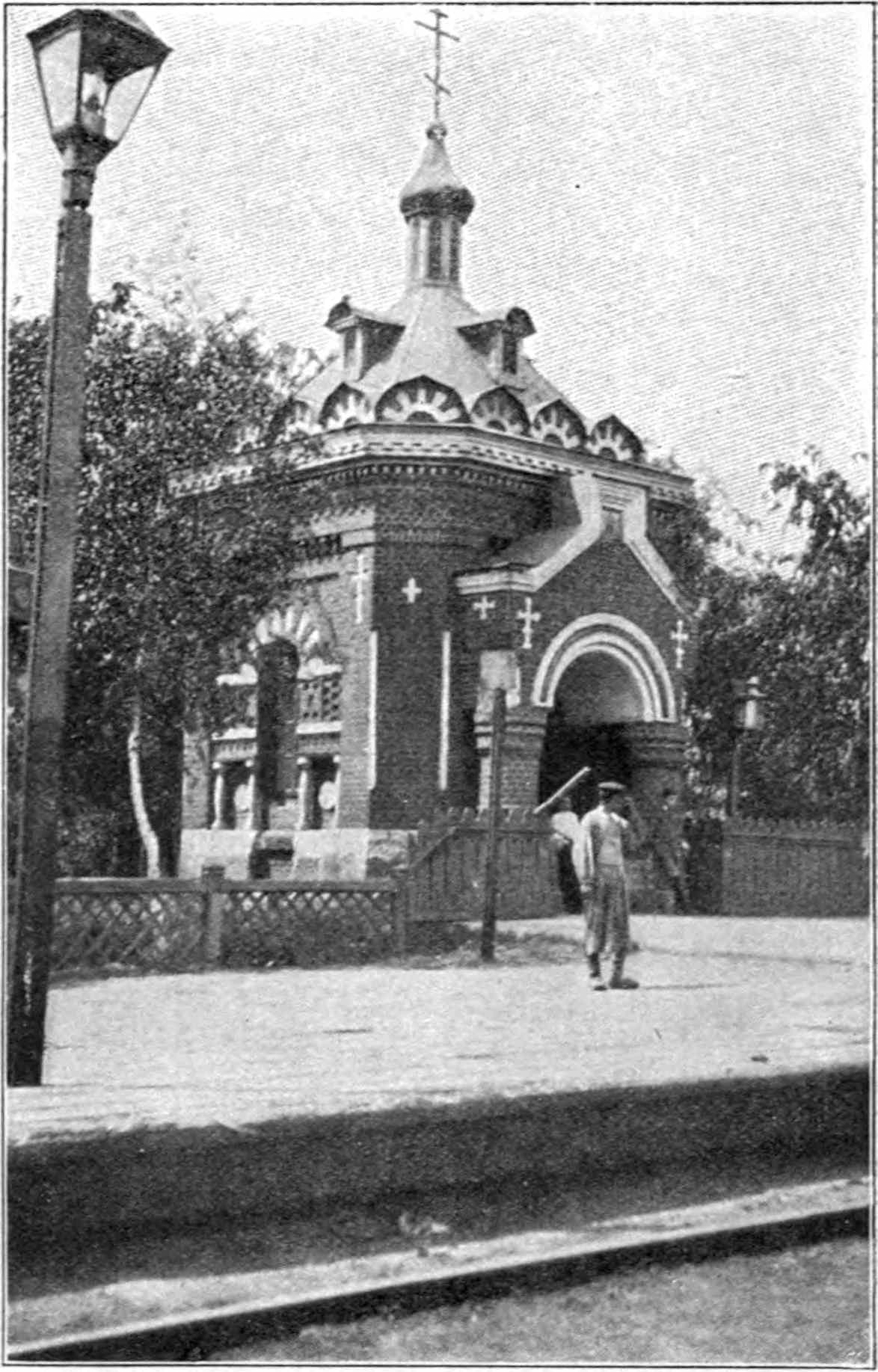
A SHRINE AT A RAILWAY STATION
As a matter of fact, the journey took us thirty-eight days, and, allowing for probable detentions by rail and river, it cannot often be made in less time. If it had not been for the kind personal interest of the governor of Vladivostock, we should have been much longer on the way than we were. I can well imagine that the trip might take three or four months instead of as many weeks. The exact time of the different divisions of our journey was as follows:
Days
Vladivostock to Khabaroffsk (rail) 1¼
Khabaroffsk to Blagavestchensk (boat) 5½
Waited for steamer at Blagavestchensk 2
Blagavestchensk to Stretinsk (boat) 12½
Waited for train at Stretinsk 1½
Stretinsk to Irkutsk (rail) 6
Waited for train at Irkutsk 1
Irkutsk to Moscow (rail) 8½
Total 38¼
If we had found high water in the Amour, we might have saved three days on the river journey, and if the bridge on the Trans-Baikal road had not burned down so inopportunely, we might have saved two days more, but it is difficult to see how more than five or six days could have been saved by the most favoring combination of circumstances.
I also heard many absurd rumors of the cheapness of the journey across Siberia. One Russian official of note told me that the whole cost from Vladivostock to Moscow, first-class, meals included, would be one hundred and twenty roubles. I will give the fares as they actually were paid, leaving out the odd kopeks:
Roubles
Vladivostock to Khabaroffsk 17
Khabaroffsk to Blagavestchensk 23
Blagavestchensk to Stretinsk 29
Stretinsk to Irkutsk 18
Irkutsk to Moscow 98
Total for fares (first-class) 183
To this must be added at least three roubles a day for living expenses along the road, even by those economically inclined who drink no strong liquors, which will add to the expense of a thirty-eight days’ journey one hundred and fourteen roubles, making the journey cost two hundred and ninety-six roubles, or, in round numbers, about one hundred and fifty dollars in gold—not expensive, to be sure, for a six-thousand-mile trip, but not so cheap as is usually thought.
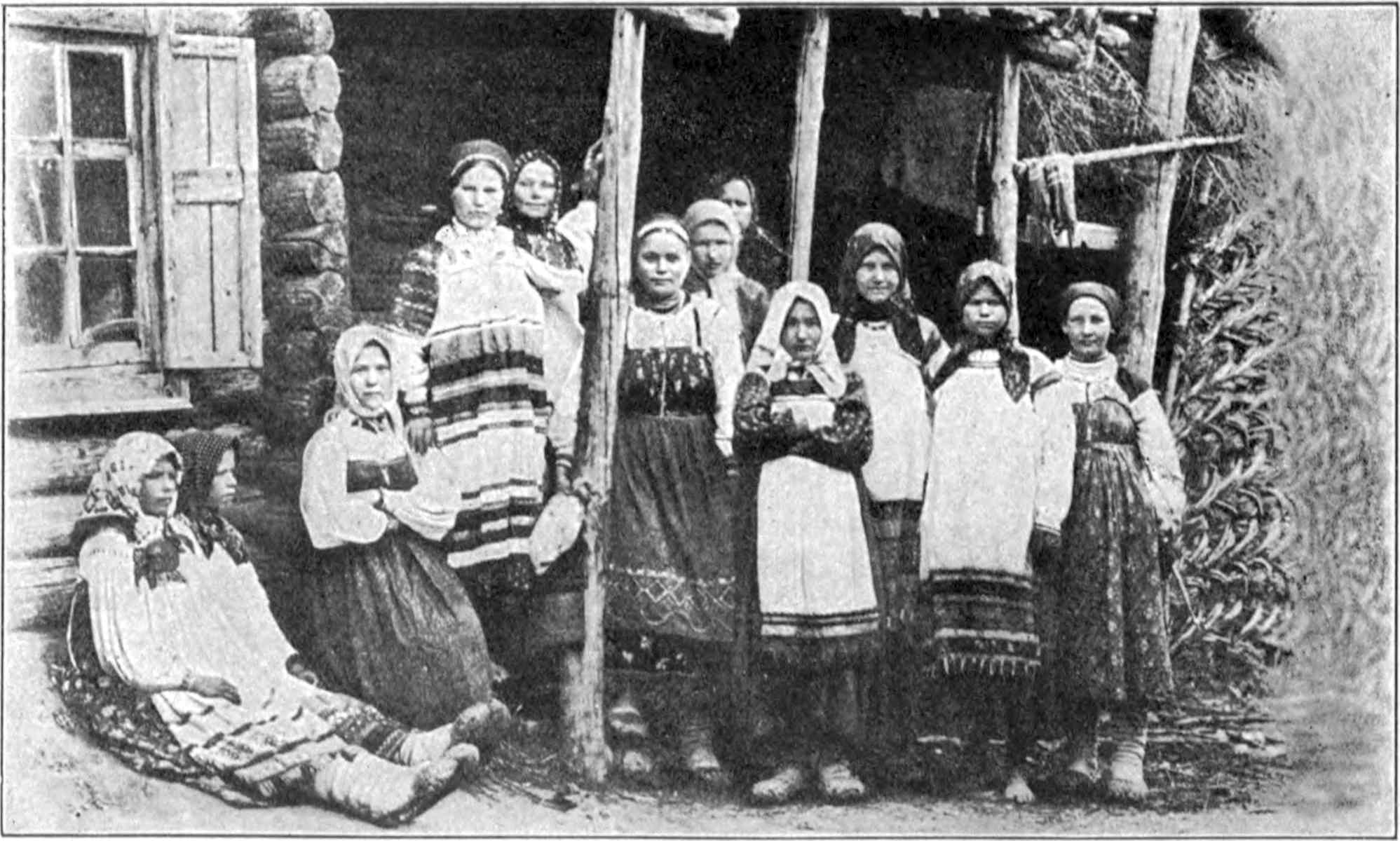
RUSSIAN TYPES
Those who are willing to travel in second-class cars and steamer accommodations can save nearly one hundred roubles, or about fifty dollars, on the whole journey. The second-class cars are entirely comfortable, and very little poorer than the first-class, but the second cabin on the steamers is not to be recommended.
I have very often been asked whether I would advise others to take the journey. That all depends upon their circumstances and travel proclivities.
For good sailors who do not mind a long ocean voyage, the trip through the Suez Canal is certainly easier and more restful. For bad sailors and those who fear the sea for any reason—and their name is legion—the Trans-Siberian route offers many compensations. Moreover, if one can command his own time, and is in no great haste to reach his journey’s end at a fixed date, the Siberian journey will prove far more attractive than to those who are pressed with engagements and must make schedule time, for it is impossible to calculate exactly, or even within a fortnight, the time that may be taken. A pressing engagement in London, which I almost missed owing to the unexpected delays, detracted not a little from the comfort of the journey so far as I was concerned.
Nevertheless, in spite of the discomforts and delays, I am exceedingly glad to have taken the journey. It was an experience never to be forgotten, and furnished memory-pictures that will never fade. I should advise any one with plenty of time on his hands, who enjoys rail and river travel, and who is not afraid of the inevitable hardships of a new frontier country, to go and do likewise.
The journey I have described was made at a most fortunate time, immediately before the Chinese outbreak, which may change the face of the world, especially of the far Siberian world. A week later, or a fortnight later at the most, the journey would have been impossible for many months. But doubtless before my readers wish to take this new way round the old world the “Yellow Peril” will be overpassed, and the Trans-Siberian route will be once more open to the travelling public.
In these annals I have purposely omitted any extended reference to the commercial and political importance of the Trans-Siberian Railway, for the reading public has been flooded with speculations and facts, more or less accurate, on this subject. There seems, then, to be little need for their further exploitation. Moreover, history, during the next decade, will determine these matters much more accurately than the wisest prophet can forecast them to-day.
When the Eastern Chinese Railway, connecting with the Trans-Siberian road, is opened—if the Mongolians, who are showing such unexpected ferocity, ever allow it to be opened—it will be possible, perhaps, to go from Paris to Peking in two weeks, or, in time, even in eleven days, as Mr. A. R. Colquhoun, in his excellent book, Overland to China, points out.
Even then, there will be many who will desire to take the journey I have described through the lordly domain of Siberia, by rail and river from the Pacific to the Atlantic, which for vastness of extent along the same east and west parallels, for variety of primeval scenery, and for wideness of view over “this goodly frame, the earth,” will never be surpassed.
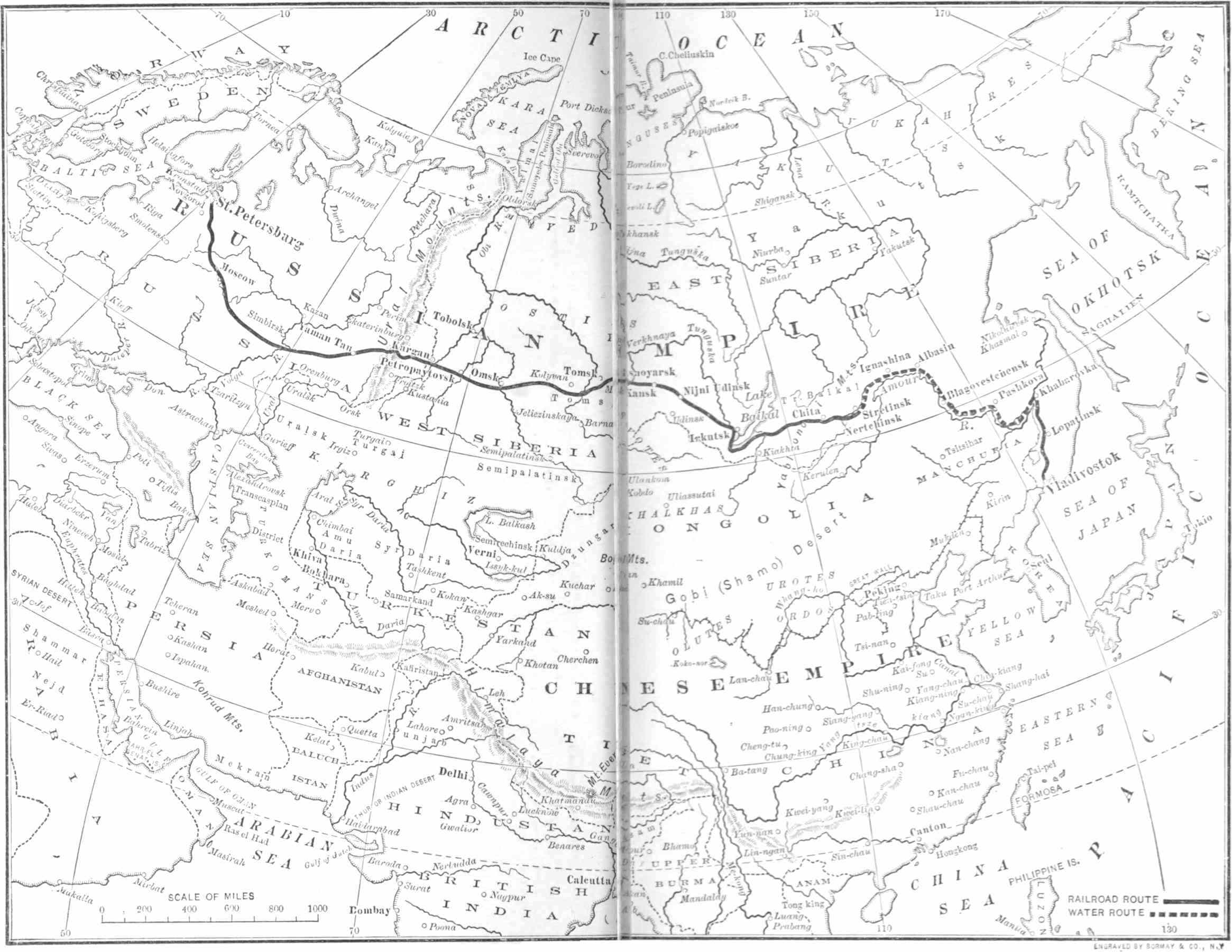
MAP SHOWING THE AUTHOR’S ROUTE FROM VLADIOSTOCK ACROSS SIBERIA TO ST. PETERSBURG