XIV A SIBERIAN TRAIN DE LUXE
Reading edition
The Paris Exposition has made famous the Siberian train de luxe, with its moving panorama, its terminal stations at St. Petersburg and Peking, and its dinners at seven francs per head. The newspaper correspondent, too, who has seen it only in his mind’s eye, as he sat at his own cosey fireside rehashing second-hand descriptions of its magnificence, has done his share to advertise it, until the wondering world has an idea that it is a veritable Waldorf-Astoria on wheels, before which all Empire State expresses on the American continent must hide their diminished heads. We read of library-cars and bath-cars, gymnasium-cars where one can make a century run on a stationary bicycle, elegant dinners, barber-shops where passengers receive a free shave every morning, pianos, and other luxuries too numerous to mention.
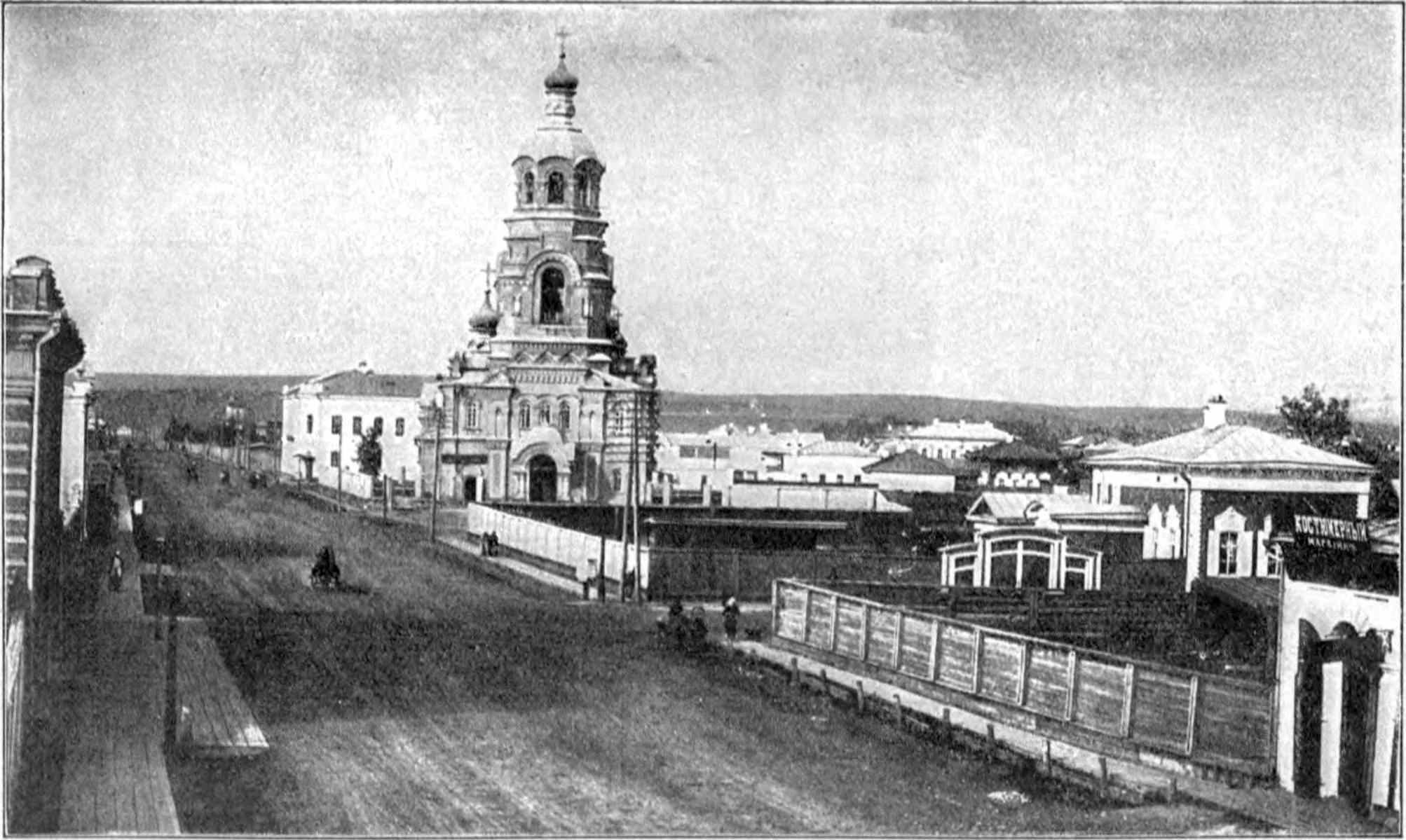
ONE OF THE BEAUTIFUL CHURCHES OF IRKUTSK
As a matter of fact, the Siberian train de luxe, at least as it started from Irkutsk on the 29th day of June, in the year of our Lord 1900, was a rather shabby vestibuled train of three sleepers, a diner, and a baggage-car. It was luxurious, indeed, compared with the fourth-class emigrant train on which we had been journeying, but it is still many degrees behind the best American trains. It should be remarked, however, that the best cars had been sent to Paris for the Exposition, and it is doubtless true that the train we took is somewhat below the average of the Siberian trains de luxe. It is well worth describing, however, as an important link in the great chain that connects the Atlantic and the Pacific in this new way around the world.
First, and very naturally, comes the engine of Russian make, with a great flaring smoke-stack for burning wood. Next to it is the baggage-car with one end fitted with a bath-tub, where dusty travellers can enjoy a refreshing bath on payment of a rouble and a half (seventy-five cents), a very high price to be sure compared with the rate charged for transportation; but then the scarcest and dearest thing throughout Siberia we found to be cold water, either for drinking or bathing purposes.
Following the baggage-car was the dining-car, which was also divided into two sections, half being occupied with small tables that seat two and four each, and the other half fitted with easy-chairs for the smokers and provided with ample windows for observation. In the smoking-room was a small library of, perhaps, fifty books in the Russian, French, and German languages, but nothing in English, except two or three discarded fifth-rate novels in paper covers, evidently contributed by previous travellers.
In the dining-car, two table d’hôte meals were provided: a lunch of two courses at one o’clock, which cost one rouble, and a dinner at six of four courses, for a rouble and a quarter. At other times of day passengers could order what they pleased à la carte from a limited bill of fare.
Behind the dining-car came a second-class sleeping-car, then a first-class sleeper, and, last of all, another second-class sleeper.
These cars are all divided into compartments, or little staterooms, holding two or four people each, with a window, a table, and a wide and very comfortable berth for each person. The cars are all handsomely carpeted and upholstered in blue plush, covered, for the sake of protection, with red-striped denim. In each stateroom were convenient racks and hooks for the disposal of clothes and baggage, and in every way one could make himself as comfortable and have almost as much room as in an ocean steamer’s cabin.
For two friends travelling together, or for a small family of three, as in my own case, this arrangement is far superior to America’s more promiscuous and public Pullman sleeping-car. For individuals travelling alone, the Pullman plan has some decided advantages, if one does not care to be cooped up in narrow quarters for eight or nine days with any chance stranger who may be assigned to the same stateroom. The Pullman cars, too, economize space, for while from forty to forty-eight people can sleep in a Pullman car when crowded, only eighteen can find “lying-down room,” in a Siberian sleeper.
One curiosity of this particular train de luxe was that the first and second class cars were precisely alike in every particular. In amount of room, fittings, upholstery, and comforts of every description, there was not the slightest difference between the three sleeping-cars that composed our train, while the difference of price was nearly forty roubles in favor of the second-class. One would think that, these being the facts, the second-class cars would be overcrowded and the first-class would be empty. Such was not the case on this train at least, for I found every cabin in the first-class taken, and was able to get a large four-berth stateroom in one of the second-class cars for little more than I would pay for two berths in the first-class car.
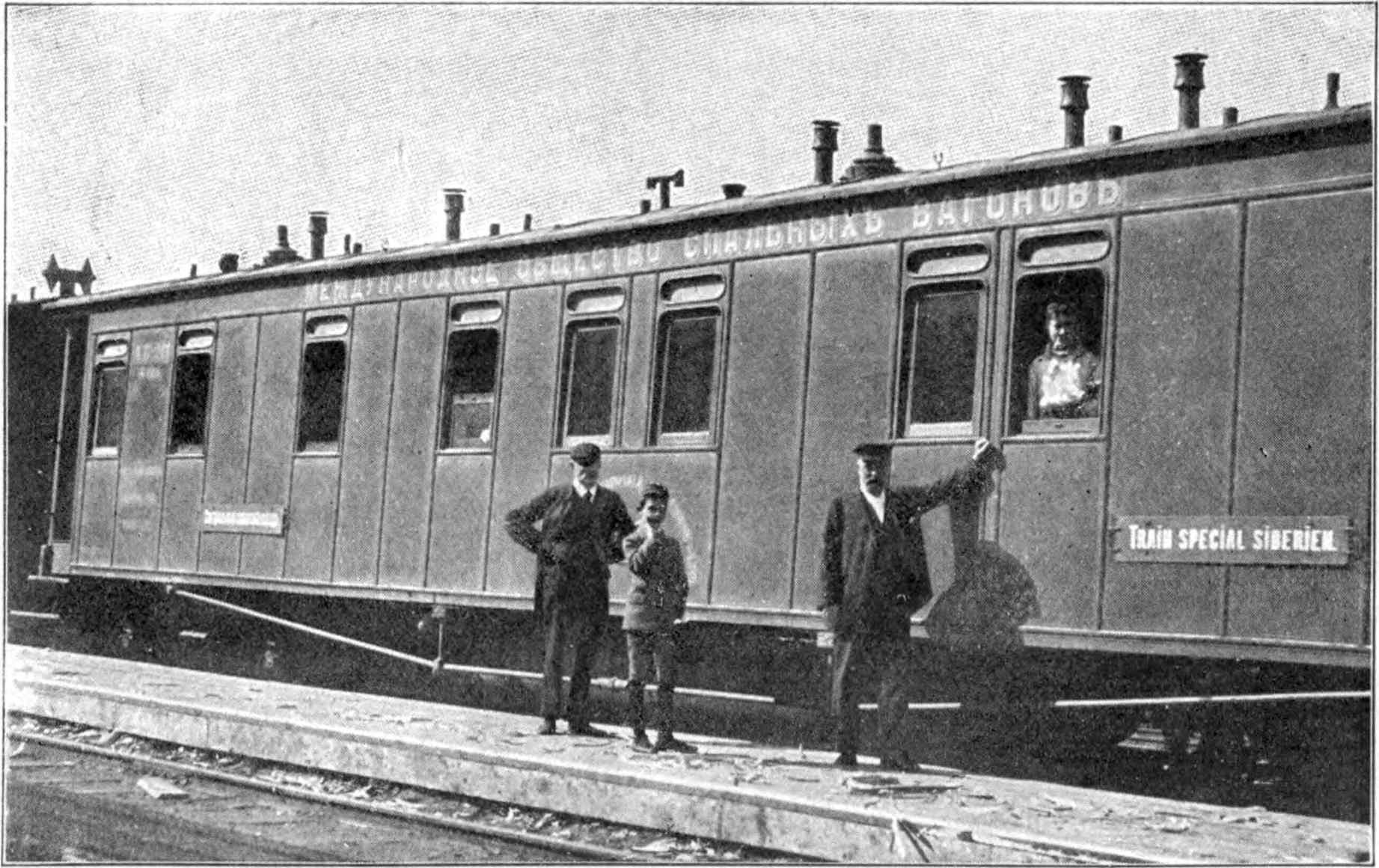
A PART OF OUR
TRAIN DE LUXE
At the most, the fares in Siberia are remarkably cheap. For the whole stateroom I paid less than one hundred and twenty dollars from Irkutsk to Moscow, a distance of three thousand three hundred and fifty miles; this included four fares and the supplementary price of the train de luxe. For the same accommodations in a Pullman car across the American continent (a shorter distance) I should have paid at least five hundred dollars. The full first-class fare in the train de luxe is about fifty dollars, while the second-class fares are less than thirty dollars. By the ordinary trains a considerable saving is effected over these very cheap rates.
Each car has its porter, who can usually speak German or French in addition to Russian, but the specimens that we saw were very lazy and inefficient fellows compared with the deft and obliging “George” who attends to one’s wants in a Pullman car. Our porters on the train de luxe never thought of sweeping or dusting the staterooms, and seemed to think it an imposition to be asked to thoroughly make up the berths for day travel, preferring to leave the beds made up by day that they might have less trouble at night. All day long the lazy porters would loll about on their seats in the middle of the car, doing as little as possible, and apparently begrudging that little. Twice a week the bed linen is changed. Ample washrooms, with a single roller towel, for all guests who do not furnish their own, complete the equipment of the Siberian sleeper.
My excuse for this somewhat minute description of these accommodations is that it will be welcomed by future travellers who have to spend at least eight and one-half days in their little room on wheels.
It must not be thought that for all its name and fame the “Siberian Special” is a lightning express. In speed it would be outstripped, during all the early part of the journey, by any “huckleberry train” in America. Fourteen miles an hour, including stops, was all it pretended to make during the first five days from Irkutsk. The road-bed is new, the rails are light, and as a consequence the train plods along at a pace which an able-bodied cowboy on his bronco would outstrip. In fact I saw, one evening, a race between our famous train and a Siberian “cow-puncher,” in which, for two miles or more, the horseman more than held his own. Then he pulled up with a careless wave of his hat, as though he did not consider it worth while to race any longer with so slow a rival.
The stops at the stations, too, seem most unnecessarily protracted for such a train, which might be supposed to have the right of way. Never less than ten minutes, and more often fifteen or twenty, our patient locomotive would stand panting at every little platform in the wilds before the station-master would ring his welcome bell, to tell it that it might shriek its farewell and proceed on its way.
For a number of miles after leaving Irkutsk, the railway follows the windings of the swift-flowing Angara, and then, leaving the river, strikes off across the interminable wooded prairies that line so much of the track to Moscow. The weather was exceedingly hot during the first four or five days of the journey, the thermometers in the cars frequently registering over ninety degrees Fahrenheit. If one takes the Siberian route to avoid the heat of the Red Sea in summer, he will not gain much, though, to be sure, the cool nights make the Siberian journey more tolerable. Moreover, the heat, much of the time, was of the damp, “muggy” variety so trying to bear.
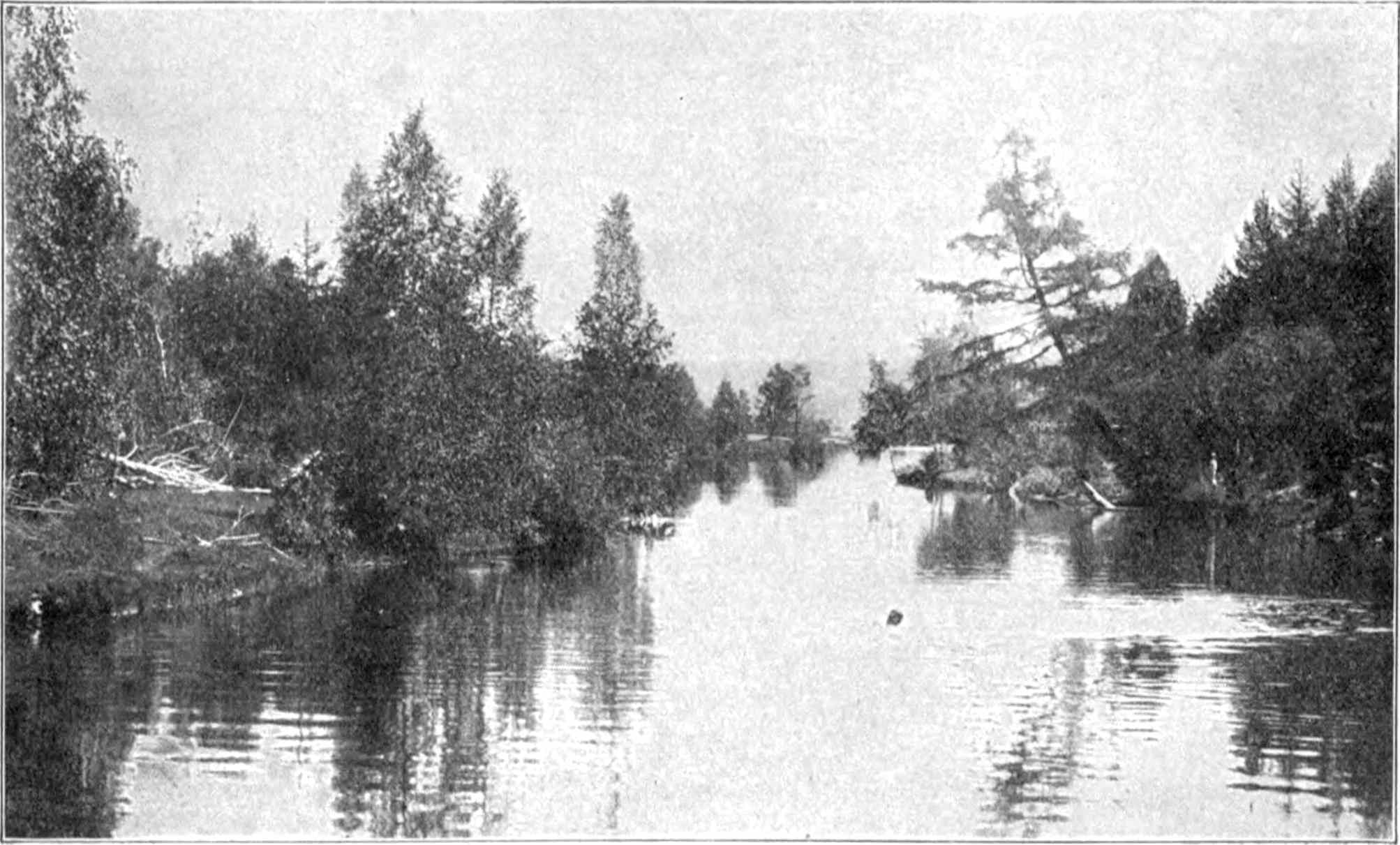
A VIEW ON THE ANGARA, NEAR IRKUTSK
A plague of flies, which would have made even Pharaoh quail, added much to the minor discomforts of the trip, though they did not afflict the passengers within the cars as sorely as when they ventured out upon the platform. Here they were, indeed, intolerable, and set every pair of hands revolving about a tormented head like a windmill in a gale. The most obnoxious insect was a little black gnat, much like the midge of the Adirondacks, which in clouds filled the air, and filled as well eyes, and nose, and ears of any venturesome traveller that left the comparative refuge of his car. The natives have learned to protect themselves against these pests by wearing veils of black mosquito netting day and night. For fully fifteen hundred miles almost every man, woman, and child we met was thus protected, and it gave a peculiarly solemn and lugubrious aspect to the little villages and stations to see every one peering at you through a mask of black netting. In this funereal attire every Siberian looked as though he had lost every friend in the world, or was about to attend his own obsequies. Trainmen working on the track, flagmen signalling the engineer, women with bottles of milk and loaves of bread, station-masters in bright official uniforms, little tow-headed children with bare feet, all had gone into mourning because of the midges.
At every station were country hucksters at a little stand, ready to sell the few products of the farms to the hungry travellers. They did not do much business, naturally, with the passengers of the train de luxe, who had their own dining-car, but with the regular trains or the frequent special emigrant or military trains they had a rushing trade. As we approached the European frontier, prices of these country comestibles fell, and boiled eggs were to be bought for half a cent each, and a very considerable loaf of bread for two cents and a half, while milk, fried fish, chunks of roast meat, and kvass, or Russian pop-beer, were proportionately cheap.
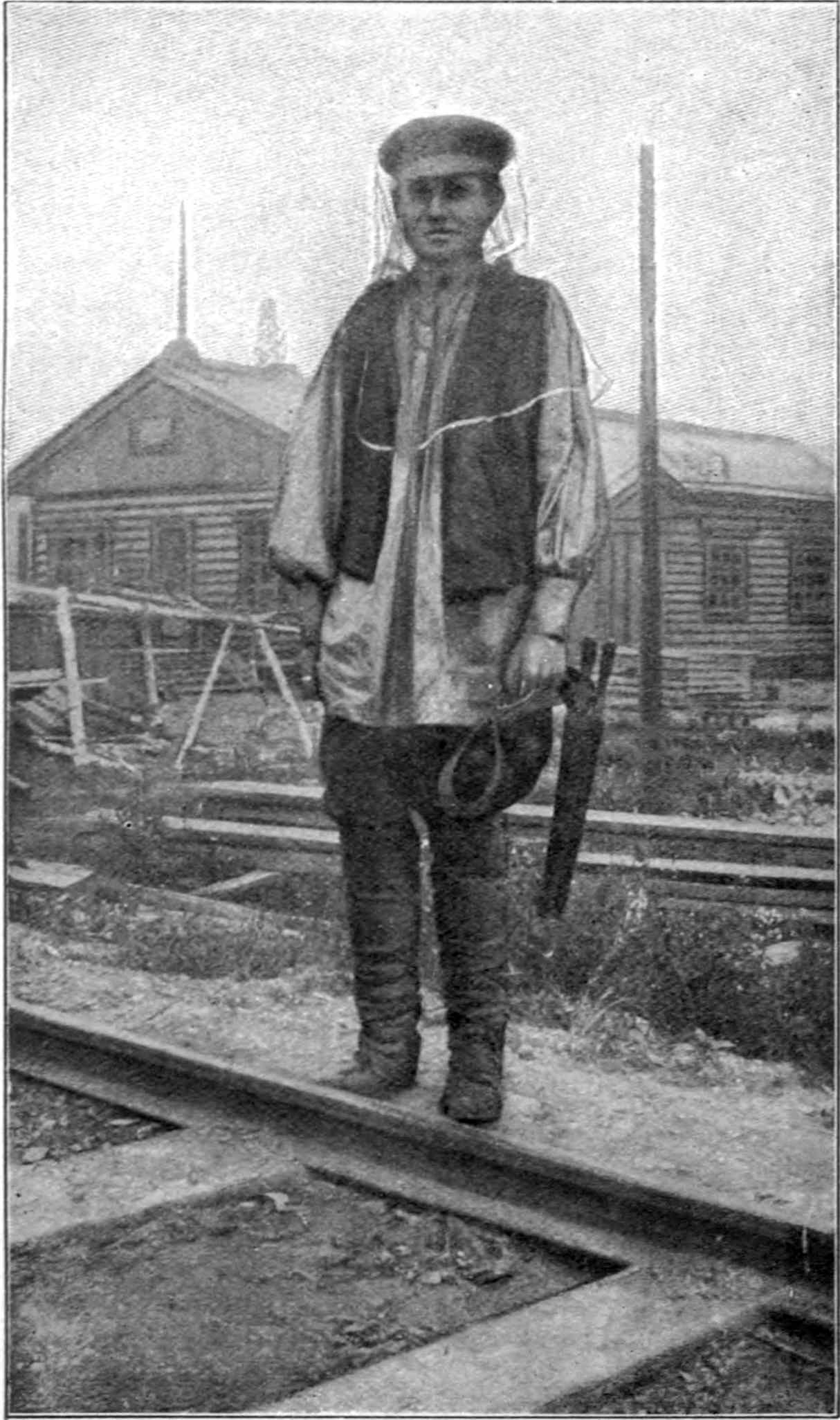
A TRAINMAN WHO HAS TAKEN THE VEIL
At almost every siding we passed a long train laden with emigrants or soldiers on their way to China, for the Siberian reserves had been called out. The latter were stalwart, rough, honest-looking fellows, who evidently had left their little farms at a moment’s notice to serve their country. They seemed to possess no uniforms or equipments, though, to be sure, these may have been stored in the close box-cars that accompanied each train. They wore their peasants’ red blouses and loose breeches. Many of them were barefooted, and some of them were hatless and ragged, but, before they meet the Chinese, these raw recruits will doubtless be licked into shape by the drill-masters, uniformed and armed, and made into very presentable soldiers. They certainly have the requisite brawn, if not the brain. I was surprised to see that there seemed to be few young men among them, scarcely any under thirty, while most looked to be over forty.
The emigrants were weighted with more impedimenta than the soldiers, but even their household belongings were pitifully scant. Every day we passed half a dozen long trainloads of men, women, and children on their way to the new Eldorado on the banks of the Amour. Most of them were too poor to afford even the hard comfort of a third or fourth class car, and they were pigged in together in ordinary box freight-cars, which were marked on the outside to carry “twelve horses or twenty-four men.” Still they did not seem discontented, much less hopeless, but at every little station jumped from their stifling boxes and raced for the hot-water tank, which a paternal government always kept steaming, free of charge. Here they filled their tin pails and made their inevitable “chi” (tea), on which, supplemented by liberal portions of black bread, they chiefly subsist.
Sometimes we indulged in the luxury of giving the little emigrating urchins, bound for a far-off land, a few kopeks, when the gratitude of the parents was touching to see. Rushing from the car, they would sometimes seize our hands and kiss them in the courtly old Russian style, as though we had bestowed a king’s ransom on their offspring, and then as the trains parted, going east and west, would tumble back into their fifth-class boxes, while we would return to our compartments feeling as we reached them that he would be a thankless man indeed who, with such contrasts in view, should ever grumble again at the minor discomforts of a train de luxe.
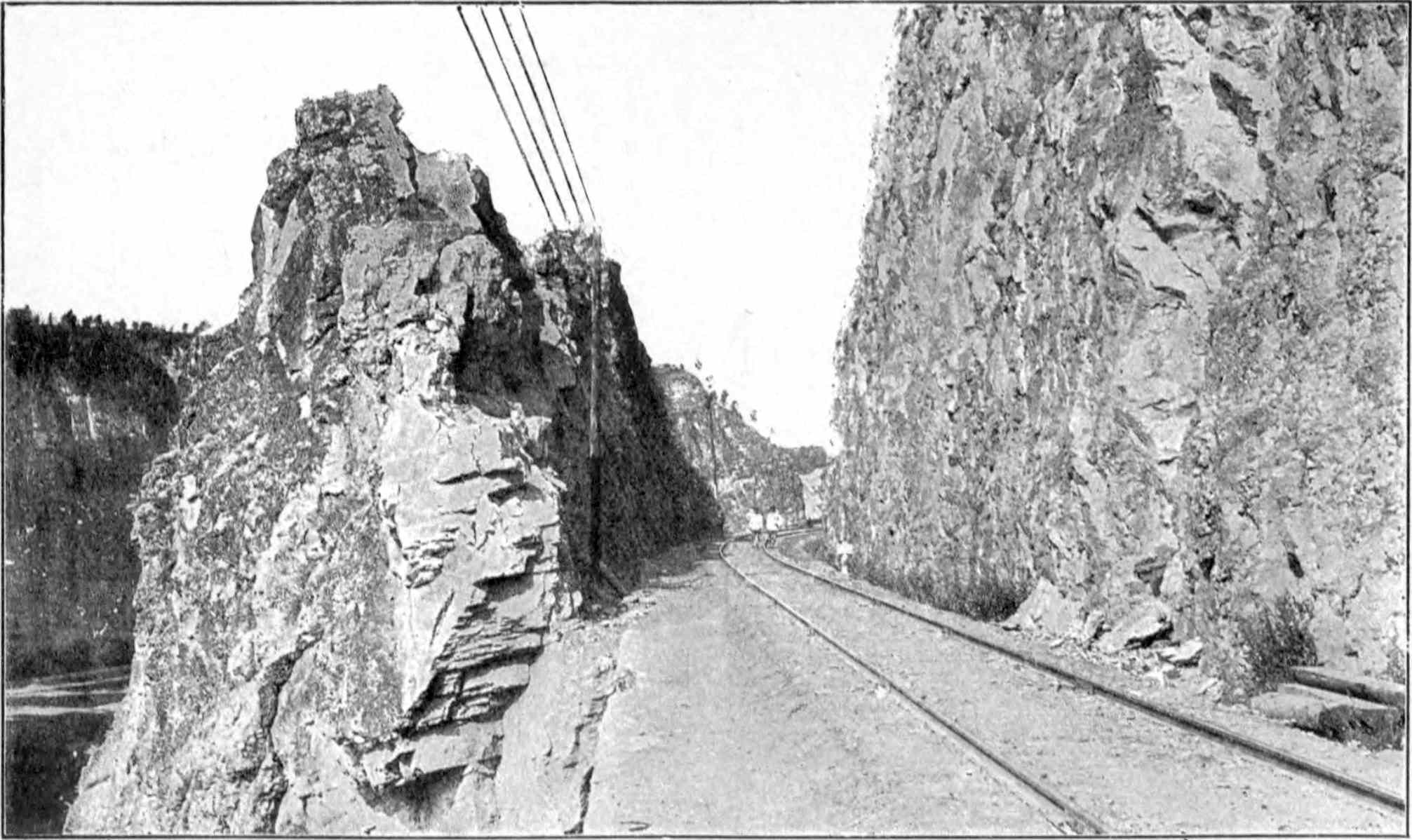
SIBERIAN RAILWAY NEAR THE ASIATIC BORDER