IX AGROUND IN THE AMOUR
Reading edition
Two Mississippi River captains were once conversing as to the merits of their respective steamers as light-draught boats. One claimed that his steamer could run in a good heavy dew. The other, not to be outdone, claimed that that was nothing, for his boat could run on the sweat of an ice-pitcher. It is this latter kind of boat that is needed on the upper reaches of the Amour River, as we began to think before we were many miles from Blagavestchensk. We had scarcely gone five miles before we heard that peculiar crunching, scraping, gritty sound which we came to know so well. The paddle-wheels revolved fruitlessly for a few minutes, but it was no use, and we knew that we were hard and fast aground in less than three feet of water. For hours the boatmen worked with might and main, and at last we could feel that there was water under our keel and that we were making slow progress against the current once more. But we had scarcely been moving another hour when c-r-u-n-c-h, s-c-r-a-p-e, s-t-o-p, and there we were stuck on another sand-bank. The captain seemed to tear his hair in despair, and well he might, for Stretinsk was 1187 versts away, and we had scarcely come ten versts in ten hours from Blagavestchensk. If it requires ten hours to do ten versts, how long will it take to reach Stretinsk, was an appalling problem in mental arithmetic.
However, we made somewhat better progress after getting off the second time, and the hope that springs eternal in the human breast kept us from despair of reaching in time the important engagement at our journey’s end.
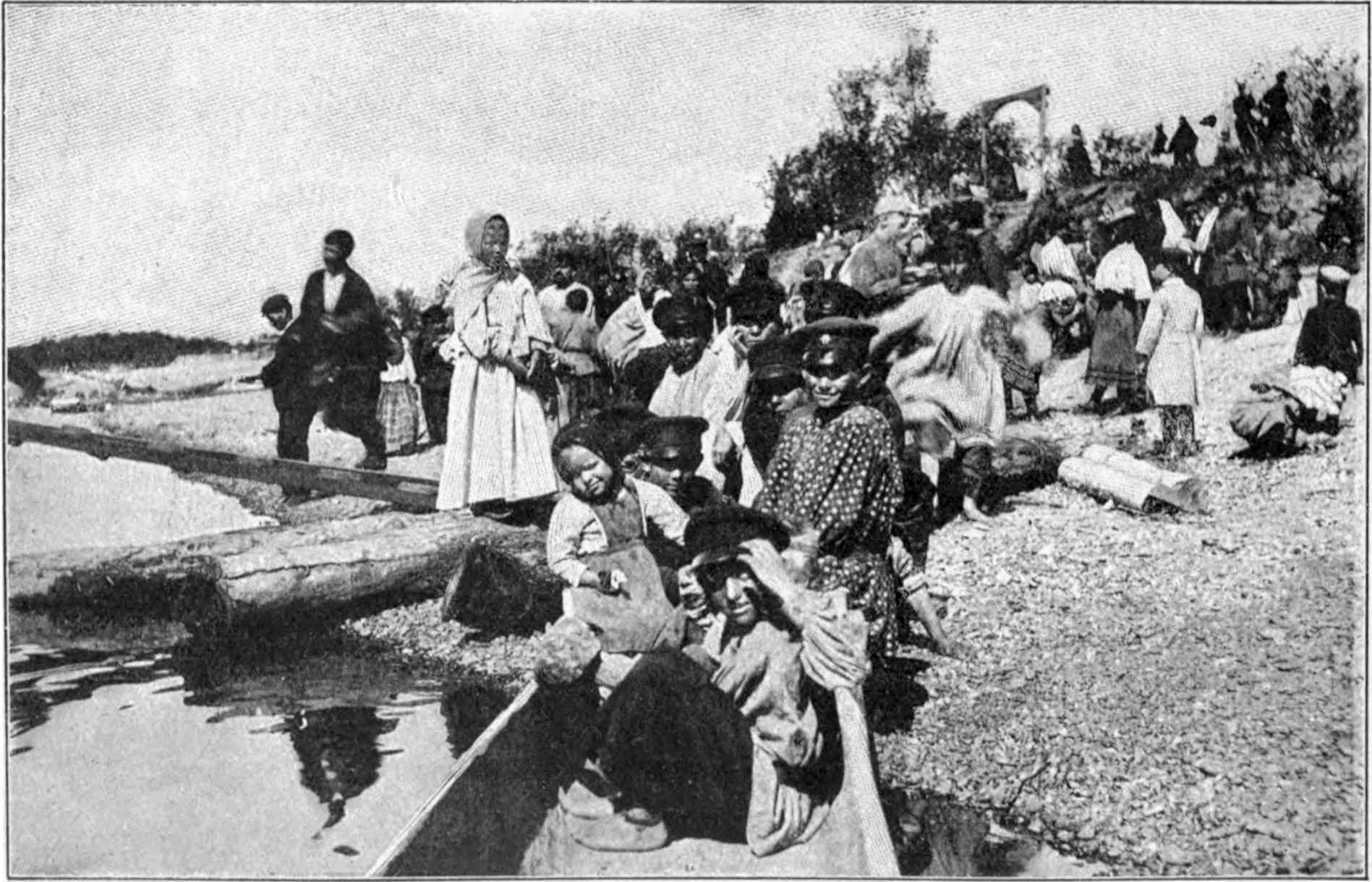
TUMBLING ASHORE FROM THE
ADMIRAL CHICACHOFF
The Ivan Vishnegradskie was a much smaller steamer than the Baron Korff, and consequently much more crowded. Especially were the third-class passengers much in evidence, for there were no steerage accommodations, and they were obliged to lie about anywhere as best they could, in the passages, on the companion-way, huddled on the boiler deck, lying out on the wood-pile or anchor chains; every available foot of deck room had its two human feet to occupy it.
It is said that the birth-rate of Siberia is higher than any other country in the world, amounting to fifty-six in the thousand. I could well believe it as I saw the uncounted, tow-headed babies tucked into every nook and cranny of the Ivan Vishnegradskie. Head to heel and heel to head, they lay, with their fathers and mothers and older brothers and sisters lying about them four square, building, as it were, a sort of living rampart around the family compound. It was pathetic to see a mother lay her three little children out in a row, with the croupy baby in the middle, while she herself sat in the draughty doorway all night long to shield them from the wind.
“She bared her bosom to the storm, And smiled to think her babe was warm.”
For two days we sailed on this crowded little craft. The river turns almost due north after leaving Blagavestchensk. A very tortuous stream is the Amour from here on, turning and twisting and doubling on itself like a huge serpent writhing in agony. Following its twistings we made very little progress, even when we could steam all day long, which the treacherous shoals did not often allow us to do. The shores on either side were often picturesque and beautiful, and sometimes grand and striking, with bare cliffs of rock rising sheer from the water’s edge to a height of four or five hundred feet.
The park-like effect of the clean, open woods continued, and made it difficult to believe that the country had not been thickly inhabited for a thousand years, except that the utter absence of habitations dispelled the illusion.
On the second day out from Blagavestchensk we were obliged to change steamers and take up our abode in the Admiral Chicachoff, the regular steamer of this line, which had not been able to get so far down the river as the above-named city. The Admiral was a somewhat larger boat than the Ivan, and had much better accommodations for the steerage passengers, who no longer had to sleep in doorways and draughty passages, but had the after upper deck roofed over for their accommodation. The steamers of the line on which we were embarked carried the government mail, and were supposed to be more sure of reaching their destination than the other river-steamers, of which there are many lines on the Amour.
Frequently we passed other steamers going down with the current at a famous rate of speed compared with our slow and toilsome ascent of the river. More often we passed great rafts of timber, with little bark huts built upon them, in which families lived and moved and had their being for weeks and perhaps months at a time, as they let the force of the current carry them down the stream, and tied up to the bank at night to avoid the passing steamers. Sometimes the rafts would be loaded with horses that seemed to enjoy their floating quarters, and who lived off the country, for it was only necessary to tie the raft to the shore and drive its living freight into the rich pasturage, which in many places could be obtained free, gratis, for nothing.
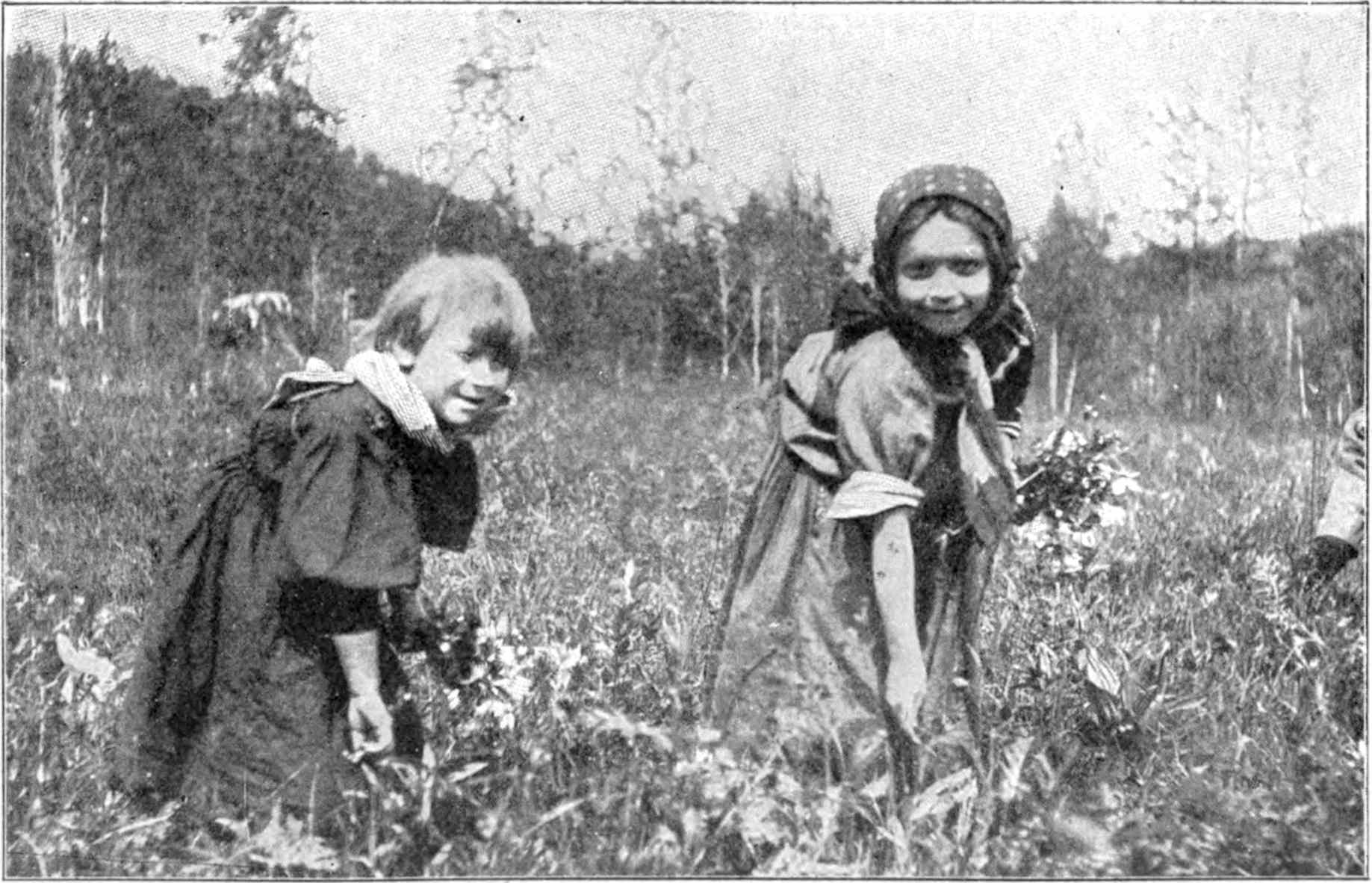
CHILDREN OF EMIGRANTS PICKING WILD FLOWERS ON THE BANKS OF THE AMOUR
The monotony of the voyage was varied by a stop once or twice every twenty-four hours to take on wood, or at some little log village on the river’s margin. On the occasion of these stops the passengers would tumble ashore almost before the gangplank made connections, and would spend the time as the fancy seized them, in the woods or on the pebbly margin of the river. The youngsters would scale the bluffs, which usually abounded near the wood-piles, or would come back from the meadows laden with great armfuls of beautiful wild flowers. Lilies of the valley seemed to abound everywhere, violets, blue and white forget-me-nots, lady slippers, and another beautiful orchid somewhat similar, which I have never seen elsewhere. In other places, blue honeysuckles were found, and yellow lilies, and Solomon’s seal, and the yellowest of buttercups. Indeed, the flora of the country seemed to be exceedingly extensive, embracing most of the spring flowers with which I am familiar in New England, except the arbutus, and many flowers that I had never seen before. The trees were mostly white and yellow birch, poplar, white oak, soft maple, larch, and pine. The wood-piles, cut for the use of the river steamers, were interminable, and consisted of beautiful, straight, knotless sticks of birch and pine that it seemed a pity to sacrifice in the rapacious maw of our never-satisfied boilers, to go up in smoke and sparks.
While the smaller fry were racing on the shore or gathering wild flowers, their more sedate elders among the steerage passengers would kindle a little fire of driftwood on the shore and cook a savory pot of stew to vary the crude monotony of their daily fare. Or the forethoughtful mothers would improve the opportunity to scrub their offspring or wash their clothes, pounding the latter upon the stones. Sometimes we would get a delicious bath in the clear, cold water which, less than a month ago, was bound with icy fetters, for the weather, much of the time, was extremely warm. The summers of Siberia are short and fiercely hot. Vegetation has to be forced to maturity by Dame Nature in six weeks, instead of taking six months, as she would do in more leisurely climes.
Many patches of snow and ice still lingered upon the banks, and it could have been comparatively but few days since all the country was snow-bound. Yet every tree seemed to be in full leaf, and ferns and grasses in many places were knee-high and were growing with the lustiness and vigor of a tropical summer.
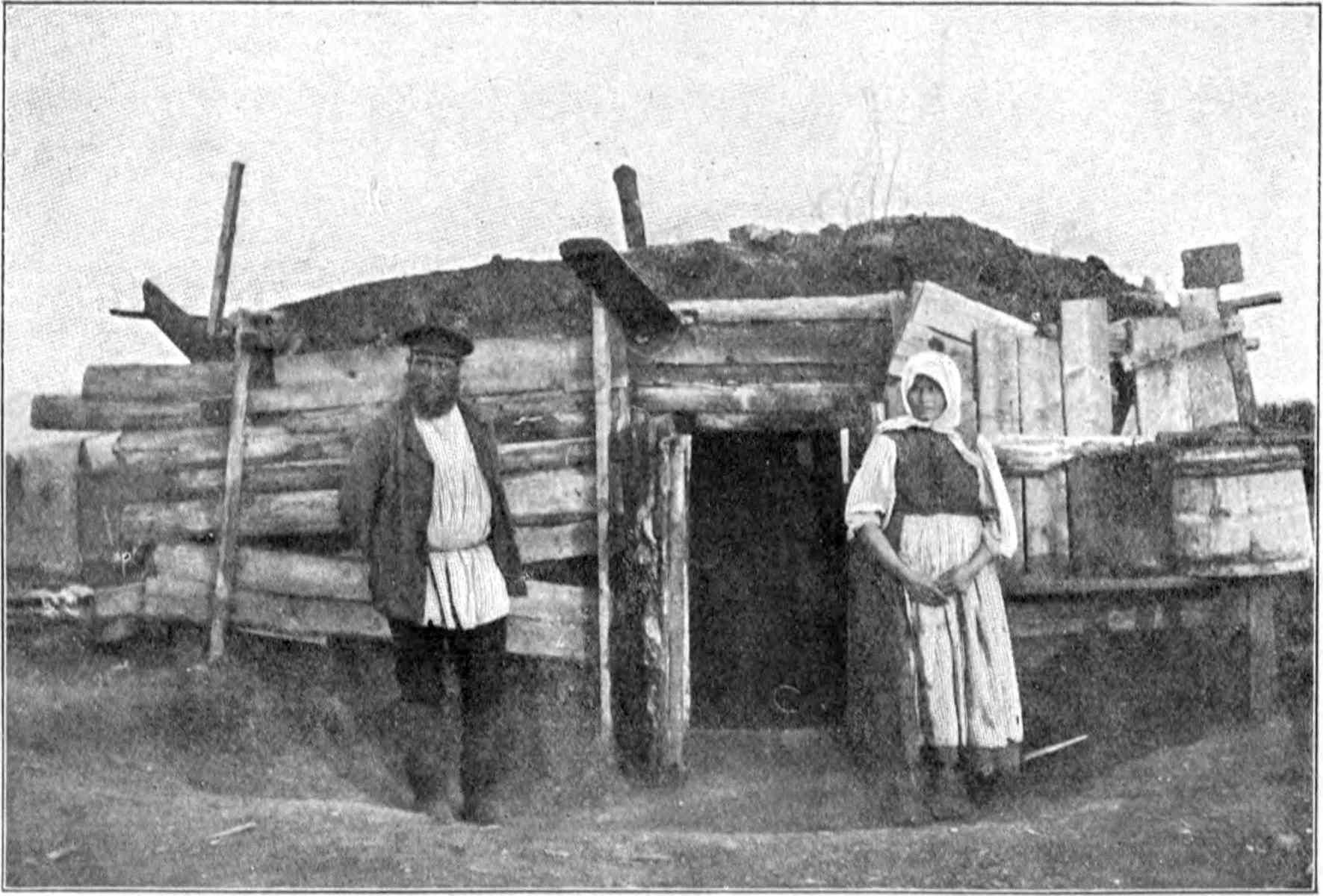
AN EMIGRANT HOUSE ON THE UPPER AMOUR
Our new steamer was no more exempt from the prosaic perils of the sand-bar than the one we had just left, for, before we had finished the first day we had run hard aground in a place where the current was very swift, and where it was very difficult to get off. For seventeen hours our officers and crew worked with a will, but to no effect. First huge poles, like iron-shod battering-rams, as big as telegraph poles, which could barely be lifted by six men, were hitched to the windlass by a wire rope, and, with this, every effort was made to pry us off. But all utterly failed. Then two telegraph poles were rigged, and finally three, but all in vain. In the useless effort, three or four of these huge pries were broken off short, and yet the little steamer did not budge. Then, to lighten ship, the convict barge, which all these days had been following in our wake, was towed alongside, and all the passengers were requested to go on board of her.
This gave us an opportunity to visit our fellow-passengers behind the bars, if I may so call those who were propelled by the same steam and were hitched to us by a single cable. It must be confessed that they were not bad-looking fellows as men average, and the impartial visitor, had he been asked to pick out the convicts by their looks, would, very likely, have chosen the hardened criminals from among the free men on top of the barge, instead of from among those whom the law had put into the cage below. Possibly even some of the first-class passengers who had paid thirty roubles for their voyage would have been chosen, instead of those who had fare and board paid by the government. My idea of the severity with which Russia treats her Siberian exiles was also modified when I saw the clean and comparatively comfortable quarters of the prisoners, which compared most favorably with the steerage accommodations on our own steamer. There were not many prisoners in the cage, and they were going from the crowded prisons of Vladivostock or Khabaroffsk to other prisons in the interior. One poor fellow was landed at a little river town, and in his heavy felt boots and overcoat, though it was a broiling day, was marched between two soldiers to a new prison, or, perhaps, handed over to some man who had bought his labor for a time.
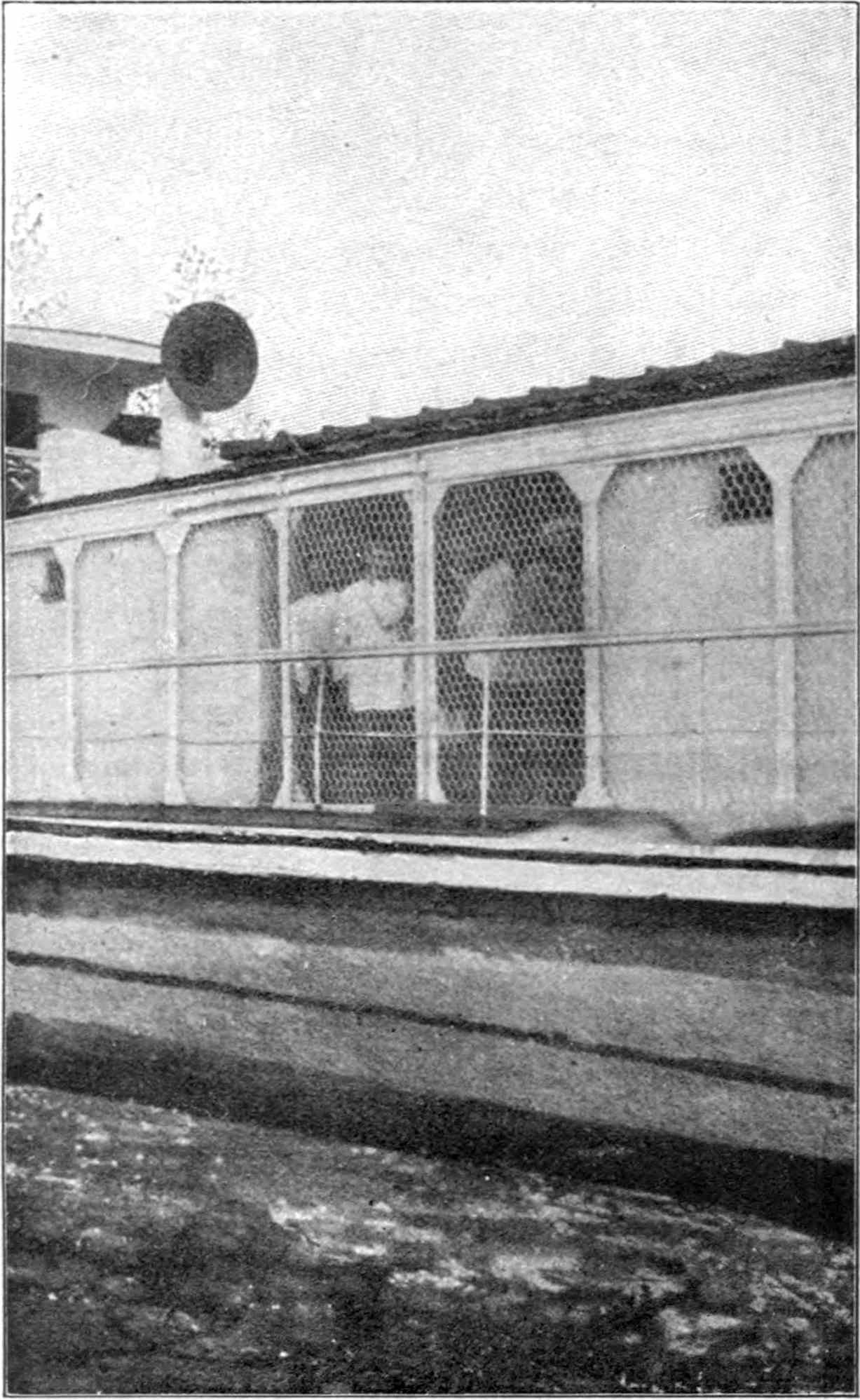
THE MEN BEHIND THE BARS ON THE PRISON BARGE
But we had gone aboard the convict barge to lighten our ship, and not to inspect the prisoners. It was all of no avail, however, and some new method must be tried. So an anchor was carried out into mid-stream, two hundred yards away, perhaps; the steam windlass was again brought into play and, little by little, inch by inch, we were coaxed off the sand-bar, the flat bottom creaking and groaning as the steamer scraped along, as though unwilling to leave her comfortable bed. Seventeen hours had been wasted, and not a third of our voyage had been accomplished.
After this experience our captain was very cautious, and when he came to shallow places would anchor, and often spent several hours in a small boat in ascertaining the channel and marking it with sticks driven into the sand. Then the Admiral would start up slowly and warily. Two men, one on either side of the bow, with sounding-poles, would constantly take the water and report to the first officer of the deck above, who shouted it back to the man at the wheel. “Vosem” (eight), “sem” (seven), “shest” (six), he would call, and no one would feel anxious, for the Admiral only draws two feet and a half; but when it came to “pyat polovina” (five and one-half), to “pyat” (five), or to “chiteery” (four), we began to be interested.
When, in stentorian tones, the leadsman would call “trees polovina” (three and one-half), and his mate on the other side would call “trees,” and the first officer would shout to the wheel, “trees,” we would positively hold our breath, and sit more lightly in our chairs to ease the ship, until again the leadsman would reassuringly cry “chiteery,” “pyat,” “shest,” “sem,” and we would feel that we were safely over one more bar.