XI THE TRANS-BAIKAL
Reading edition
We had supposed, as has already been remarked, that if we had tears to shed, we should need to indulge them on the last part of our river journey. But we soon found that we should have saved them all for the journey on the Trans-Baikal Railway between Stretinsk and Irkutsk, as the sequel will show.
Stretinsk is a raw, shabby, straggling frontier town, whose only excuse for being so uninteresting is that it is very new and never thought of being a place of any importance until it suddenly found itself, on the 28th of December, 1899, the terminus of the Trans-Baikal Railway, and an important forwarding point for freight and passengers between the Atlantic and Pacific. The large railway shops and engine-houses are situated across the river from the town, which is connected with them by a ferry, ingeniously worked by the swift current of the Shilka, like the picturesque ferry at Bonn, on the Rhine. The hotels of Stretinsk are wretched inns, and there are absolutely no attractions within the town to persuade the traveller to remain. But, in justice even to the squalid raggedness of Stretinsk, it must be admitted that fine hills encircle it and a noble river washes its feet, for the Shilka, in spite of shoals and shallows, is still a mighty stream, and runs even here with a large, impetuous flow.
We were glad enough to find that we must remain in Stretinsk only thirty-six hours, and that the train which was to carry us to Lake Baikal was to start the following night. We were still more rejoiced to find that the good governor of Vladivostock, General Tchitchagoff, had not forgotten us, but had wired for a special car for our use. The car was very small, and held but five people, and, as can be imagined, it was not built on the latest Pullman plan, but, as compared with the cars assigned to our three hundred fellow-passengers, it was a car de luxe, indeed.
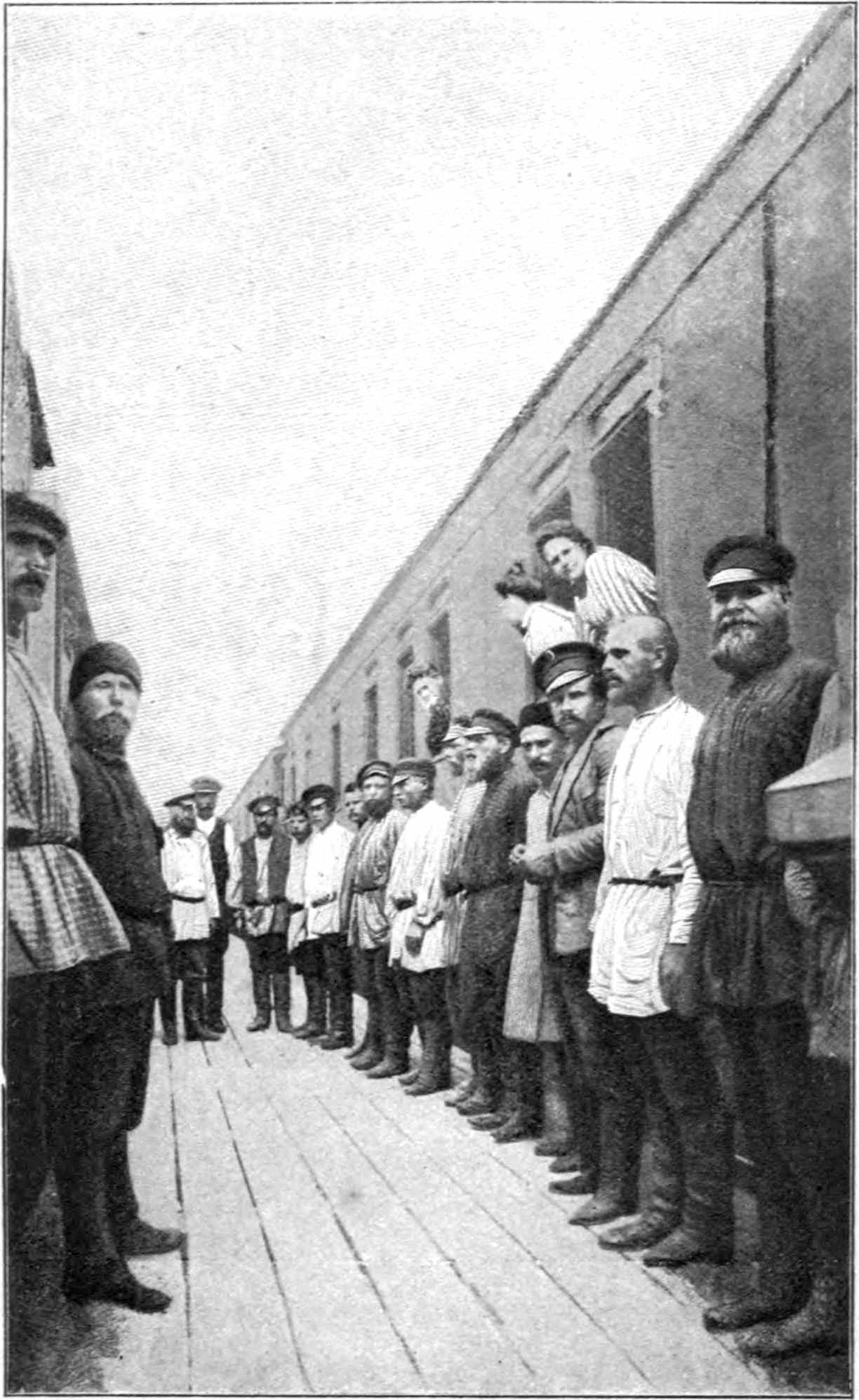
SIBERIAN RECRUITS BOUND FOR CHINA
This road is not yet officially opened for traffic, and we were taken on sufferance, as it were. At least, most of those who take it have to suffer severely. Nor can they complain overmuch, for the government does not invite them to go or advertise any attractions. The best cars that are yet run, with the exception of the little car de luxe, of which I have just spoken, are marked “fourth class,” and are no better than they pretend to be. They have wooden seats of the hardest possible variety, and three wooden shelves, one above another, afford cramped opportunity for a man not more than five feet long to stretch himself out. Each of these cars, with three tiers of shelves, is supposed to afford accommodations for forty-three people. But these are the best, as I have said. Others, which might be termed fifth class, if the nomenclature of railway trains descended so far, are simply box-cars, with no seats, and marked on the outside, “to carry twelve horses or forty-three men.” Into these cars there crowded, helter-skelter, pell-mell, higgledy-piggledy, Russians and Siberians, Moujiks and Chinamen, Tartars, Buriats and Englishmen, Frenchmen, Germans, and Americans.
If there were fifth-class cars, there were plenty of sixth and seventh class people—some in rags, and many in tags, but few in velvet gowns. Old Moujiks, with half a dozen half-naked children, filthy with a grime that has accumulated since their birth, and alive with unmentionable parasites, crowded every car, or, rather, human pigpen, as each car soon becomes. Odors indescribably offensive made the air thick and almost murky. The stench, the dirt, the vermin grew worse the longer the car was inhabited, and one simply resigned himself to the inevitable and lived through each wearisome hour as best he could.
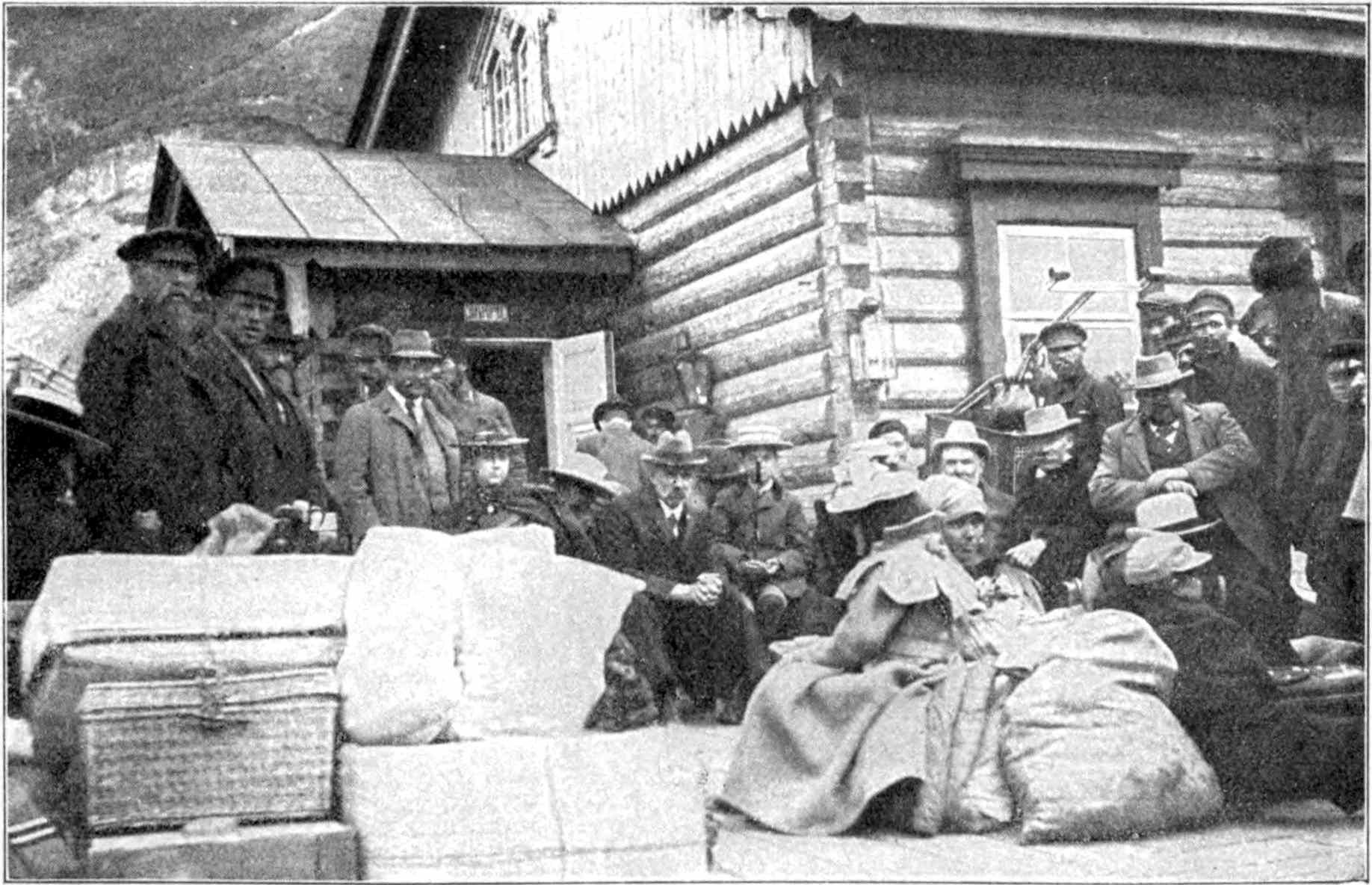
FOR THIRTY-SIX MORTAL HOURS WE WAITED
Our non-Russian fellow-passengers, when they found the true state of affairs, made a desperate resistance to their fate, and after repeated remonstrances, objurgations, and even threats, which nearly came to blows, induced the station-master to put on another little car, which they could have for themselves.
We fondly hoped that the governor’s kindness had spared us the heaviest affliction of the journey; but alas! even the best-hearted governor cannot insure all the bridges on the line, and we had not been travelling a half-dozen hours when we learned that a bridge had burned down twenty miles ahead, owing to the carelessness of a fireman who drew the fire on the wooden sleepers, and there we were stranded as fast as though on a sand-bar on the Shilka.
For thirty-six mortal hours we waited at that wretched railway town, which consisted principally of a round-house and a water-tower, then were pulled to the burned bridge, twenty miles away, and, with much difficulty and long delay, were transferred to the train on the other side. Here our good fortune deserted us. Our comparatively fine car could not, of course, cross the bridge, the governor could do nothing more for us, and in the general scramble we found ourselves in one of those dreadful fourth-class cars I have already described, with the Moujiks, the filth, and the vermin destined to be our companions for four weary days and nights.
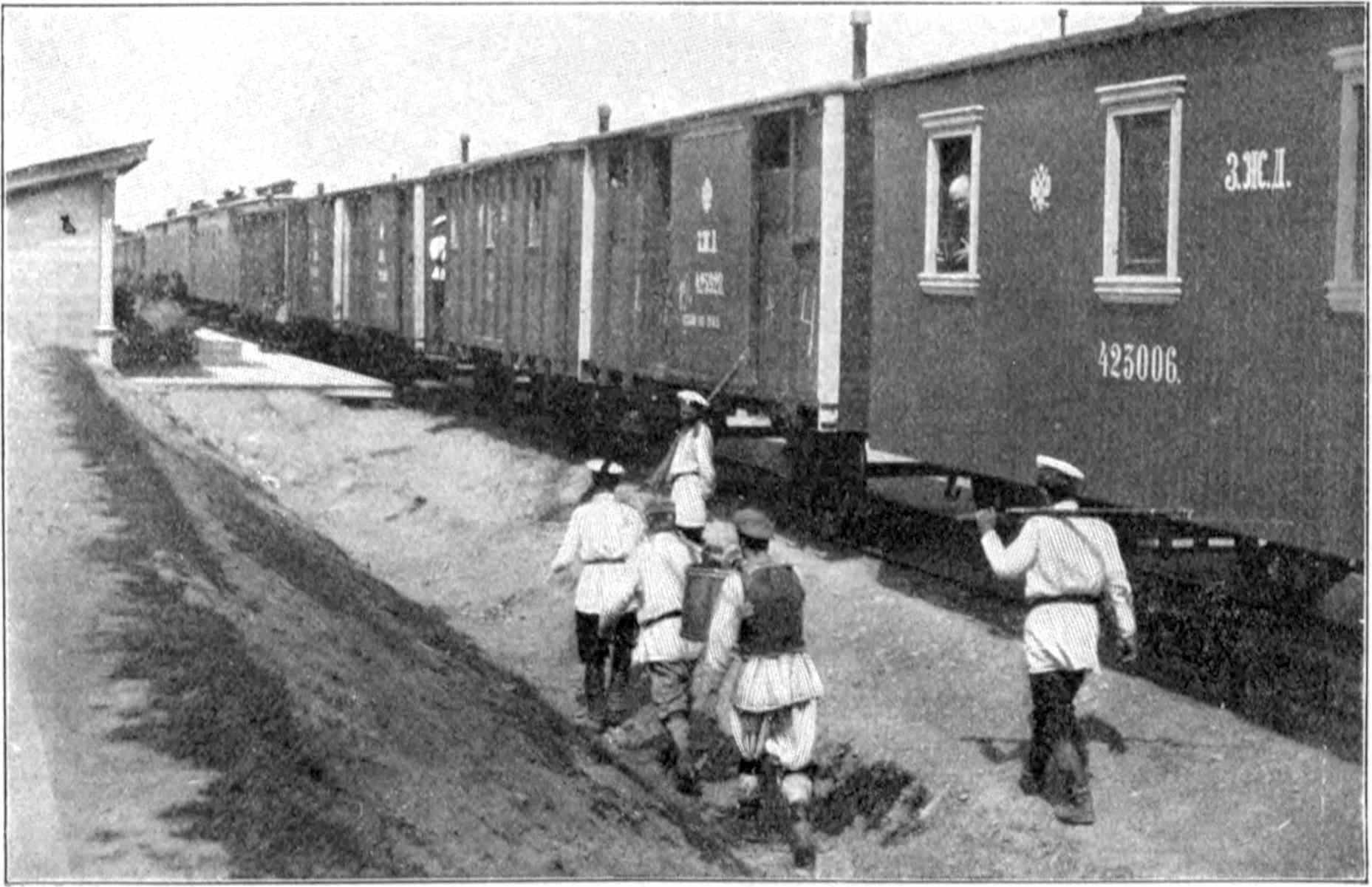
A TRANS-BAIKAL TRAIN. PRISONERS CARRYING WATER
After passing the burned bridge our train met with no serious delay, though our rate of progress was exceedingly moderate. The whole distance to Irkutsk is about seven hundred miles, and we managed to consume three days and a half of actual travel in covering it. It would seem impossible to the uninitiated in Siberian travel that a railway train that could go at all could go so slowly. Two hundred miles a day, or about eight miles an hour, is scarcely more than post-horses would make. This is accounted for by reason of the interminable, unreasonable length of the stops at the stations. Our train would draw up at a wood-pile and a log-house. The peasants would scramble out of the train, build their fires, cook their soup, boil their tea, and still the train would wait. There was usually no baggage to be taken on or put off, no passengers to join us, no passing train to wait for. Water would soon be taken, and still we would wait, a half-hour, three-quarters, a full hour. At last, for no particular reason, apparently, the station-master would ring a big dinner-bell. Five minutes later he would ring another. Then, soon after, the guard would blow his whistle, the engineer would respond with the engine whistle, the guard would blow again, the engineer would answer him once more, and, after this exchange of compliments, the train would move leisurely along, only to repeat the process two hours later at the next station.
The stops ranged from half an hour to two hours in length, and the speed attained about fifteen miles an hour while running. Fortunately the stations are few and far between, averaging nearly thirty miles apart.
The only towns of any importance on this line are Chita and Verkneydinsk, the former about two hundred and the latter about five hundred and fifty miles from Stretinsk. Verkneydinsk is a centre of the old caravan tea trade, and retains its life in spite of the new railway.
The Trans-Baikal province, which this railway traverses from end to end, is the smallest of the six provinces into which Siberia is divided, and has about six hundred thousand inhabitants, of whom two hundred thousand belong to the aboriginal tribes. Much of it seems exceedingly fertile, and vast savannas, stretching away from the railway track as far as the eye can reach on either side, are frequently seen during the early part of the journey. Thousands of cattle and horses roam on these great flat prairies, which, often, are as level as a house floor for miles. In other parts of this journey the scenery is beautiful and picturesque, but never grand, the mountain range which is crossed being not a lofty one. For many miles the railway follows the winding of the Shilka River, usually high above its banks. Then it crosses the plains, and afterwards, some four hundred miles from the starting point, plunges among the pine-clad hills which hem it in on both sides with their resinous heights.
In other parts of the hill beautiful birches stand like white sentries in a green livery. The flowers that carpet the fields everywhere are lovely; marigolds and marguerites, roses and blue honeysuckles, buttercups galore, bold tiger-lilies, modest lilies of the valley, and white and yellow poppies make the trackside gay.
After traversing about half the distance, the streams, which had been flowing east into the Pacific, give way to others that flow west to Lake Baikal. The roof of the world, or, at least, of this part of the world, has been reached, and now we will follow the raindrops towards the distant Atlantic.
The Selenga, which we reach on the last day of this journey, is a great and strong flowing river, as large as the St. Lawrence above the Ottawa. It is crossed by a splendid iron bridge, resting on magnificent piers of cut stone, a bridge which would be an honor to any railway in the world.
It is the custom of the few travellers who have crossed this line, or any part of it, to poke fun at the Trans-Baikal Railway. And, indeed, it is not hard to do so. With its crawling trains, its inordinately long stops, its primitive rolling-stock, it does not inspire much respect. It reminds one of the railway in the United States called a “tri-weekly road,” which was explained by its president to mean that a train went up one week, and tried to come down the next.
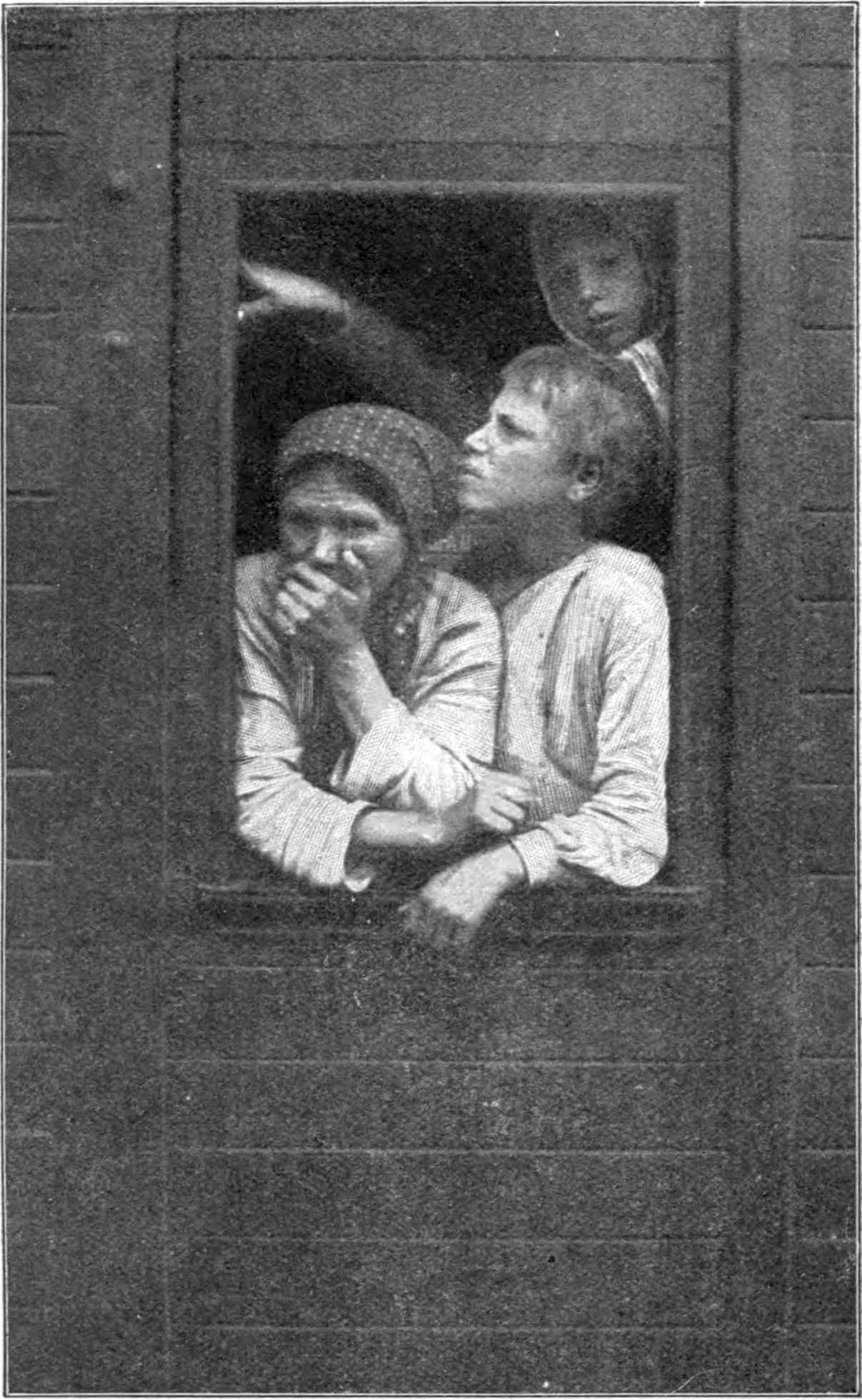
BOUND FOR FAR SIBERIA
A passing glimpse of an emigrant train
All the ancient and hoary railway jokes, like the one about the boy who started on a half-fare ticket and was so old before he reached the end of his journey that he had to pay full fare for the last part, are cracked and appreciated by the passengers on this line. Yet it must be remembered that the last spike in this road was driven less than six months before I passed over it; that it was not even then accepted by the government, or formally open for traffic; that it is largely built for military exigencies, and that no one is asked to travel over it, but rather discouraged by Russian officials; then the jokes lose their best points.
Still it must be confessed that the road seems to tithe the mint, anise, and cumin, and omit the weightier matters of railway construction. For instance, the water-towers are beautiful, stately structures, and the stations are very creditable even for an old railway, but the rails are light and constantly breaking and giving way and delaying traffic for days at a time. “Two streaks of rust across Siberia,” is the exaggeration of a friend, which has an element of truth in it.
Many parts of the embankment have been carefully sodded, the sods being pegged down with great care, but the road is very imperfectly ballasted, and is rough almost beyond belief. The culverts and small bridges are buttressed with cut stone, carefully dressed; the cars, as I have said, are exceedingly poor and filthy.
Still the road is evidently built for the future, and all these defects will, in time, be remedied, and the Trans-Baikal section will take its place as an important link in the greatest railway of the world.
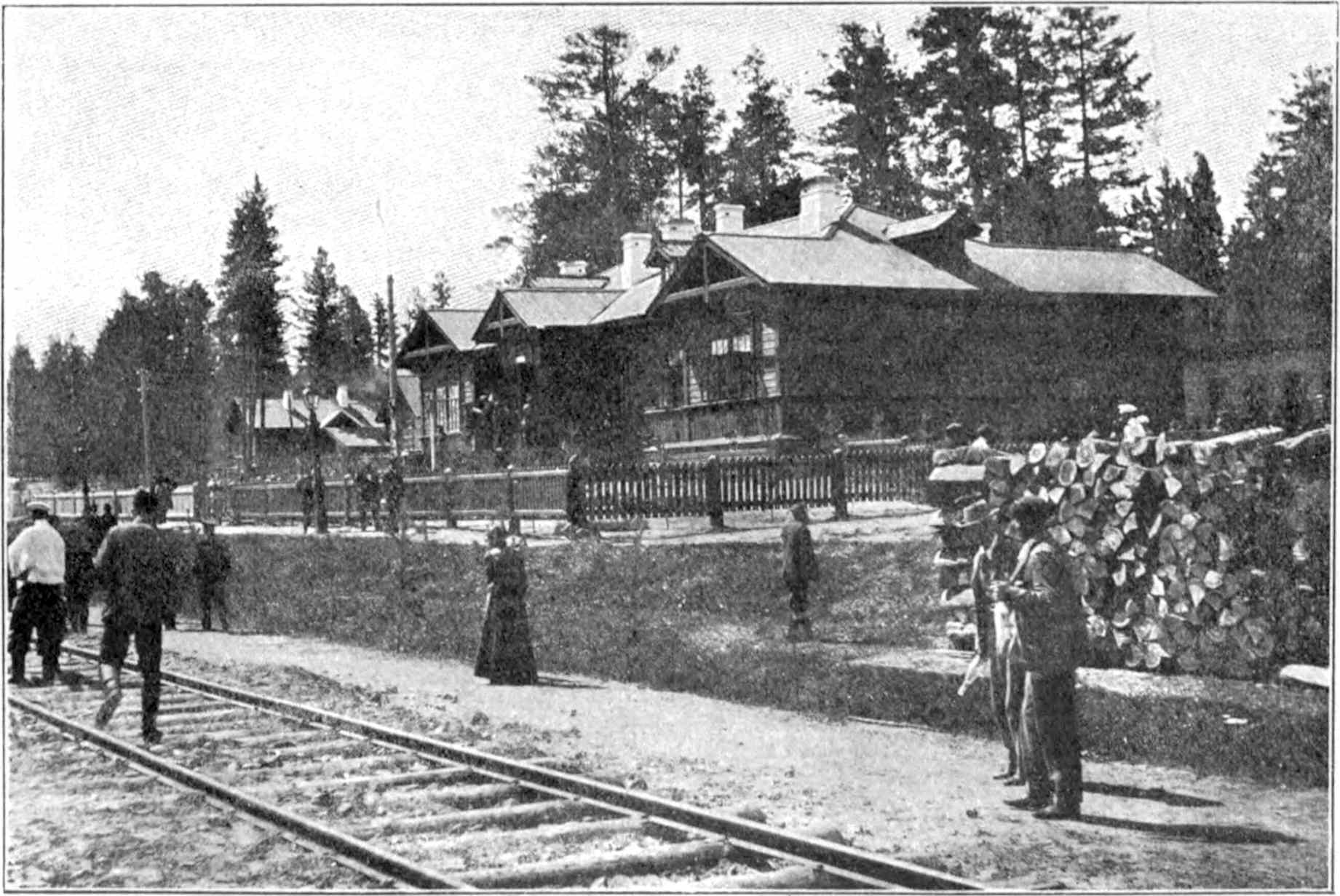
FIFTEEN MINUTES AT EVERY STATION
During these long and weary days we were obliged to get what diversion we could from our fellow-passengers. We watched the mother who combed her offspring’s head with a carving-knife, with which she made vigorous onslaught on the numerous inhabitants that had taken shelter there, while we shuddered as we thought of the coming night in close proximity. We were interested in the other mother who did her daily washing in a pint cup and hung it out to dry on the upper bunk. We were fascinated by the soldiers who performed their morning ablutions by taking a large mouthful of water from a teapot, then, squirting it on their hands, vigorously washed their faces.
We never get away from the prisoners in Siberia, and two cars, immediately in front of ours, were filled with these poor wretches. Before these cars, at every station, marched four soldiers with set bayonets. The heads of the prisoners, shaved on one side only, would have betrayed them even had they escaped for a little.
At the stations women and girls with milk and eggs were eagerly patronized by us all, for we were desperately thirsty, and water that we dared to drink was scarce. At some stations we saw the aborigines of the country, the Buriats, of whom two hundred thousand remain in the province. They are a Mongol race, and their black hair and slant eyes contrast with the blue eyes and tow heads of the Siberians, bleached as they were still further by the sun.
Some of the Buriats are won to Christianity, but most of them are rank heathen still. They are a nomadic race, and do not take kindly even to the limited civilization of Siberia.
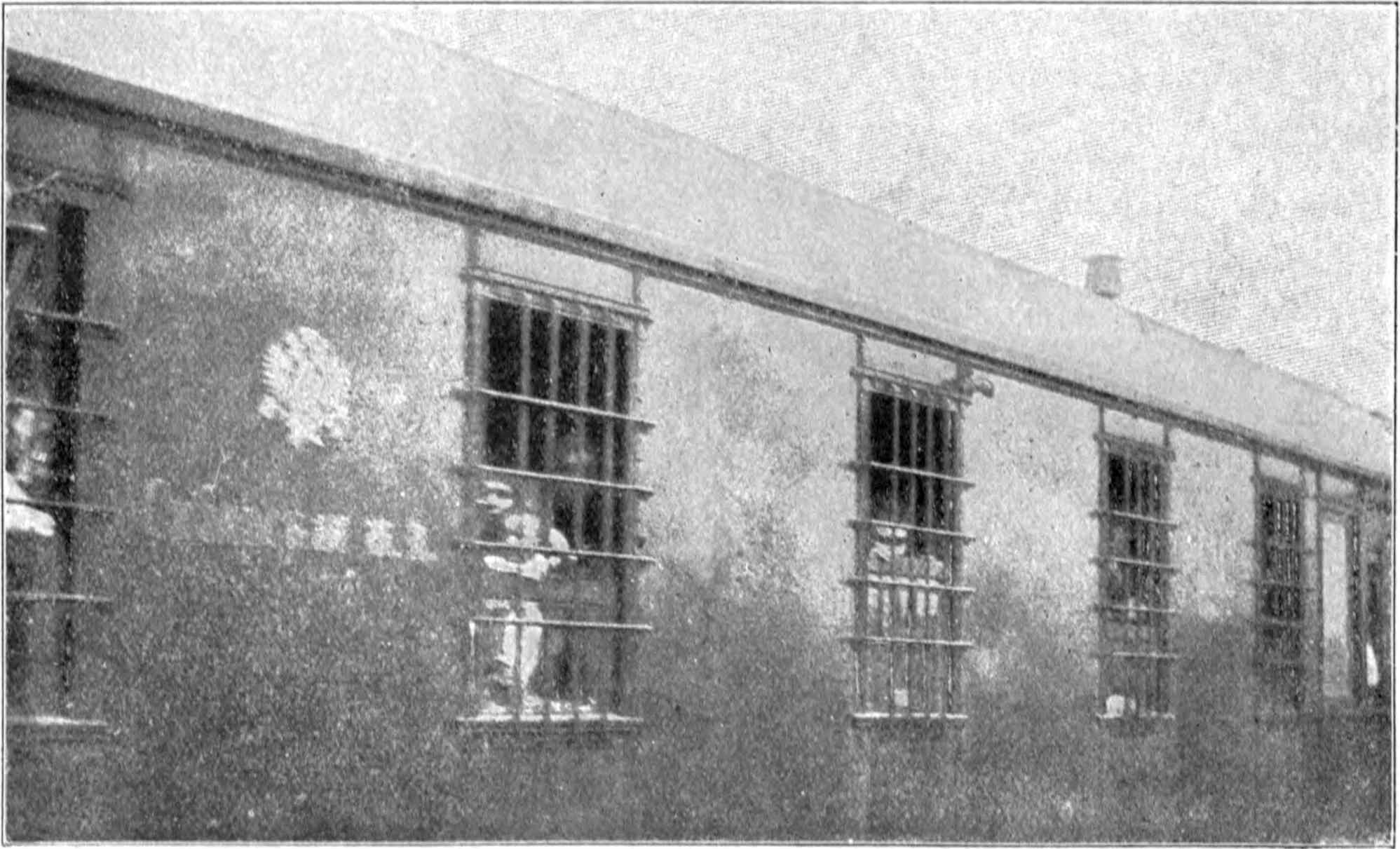
PRISON CAR IN SIBERIA. FAMILIES OF PRISONERS AT THE WINDOWS
I must record that, in the midst of the filth and discomfort and unutterable odors of this hard journey, we met with many courtesies and kindnesses from the most unpromising of our fellow-travellers. Some of the peasants were ladies and gentlemen at heart, who would incommode themselves to promote our comfort, and were never too preoccupied to lend a helping hand, or to supplement our exceedingly limited Russian. We discovered a “fourth-class guardian angel,” who took us under his special protection, and was never weary of offering little kindnesses. He even wished to share with us his black bread and some curds, which we found it difficult to refuse without hurting his feelings.
None of the occupants of our car were intemperate or noisy, and, in genuine politeness of heart, these Russian serfs of a few years back could have given many points to the two selfish, unmannerly, foul-mouthed Frenchmen of the party, who represent the nation erroneously supposed to have a superfluous supply of politeness and good manners.