Front matter (continued 6)
Reading edition
May 4th.—Everything appeared to combine against us: weather, snow ice, and sickness! In spite of these evils our tents were struck and a start made; but after advancing for half a mile, which took us exactly three and a half hours to accomplish, we arrived at such a confused heap of hummocks that, with the dense fog prevailing and the falling snow, it was impossible to make any headway. To persevere would have been imprudent. The tents were accordingly pitched, and we consoled ourselves by saying that the rest would be productive of much good to our sick companions, for even those that had to be carried on the sledges could get no rest whilst being dragged and jolted and sometimes capsized over the roughest road imaginable. After lunch, the weather clearing a little, we employed ourselves in cutting a road through an amorphous conglomeration of ice for quite three-quarters of a mile. The pack over which we were travelling appeared to consist of numerous small floes, the largest being barely one hundred yards across at its widest diameter, but the majority much smaller, and each of these floes was surrounded by a mass of hummocks piled up and lying one on top of the other to the height of twenty and thirty feet: the belts of hummocks being from thirty to forty yards in breadth.
Observing one large hummock to be very much discoloured, we found, on approach, that this discolouration was caused by the adhesion of mud or clay, a line of which extended for some distance along the edge of the floe, and gave one the idea that it had rubbed against, or in some manner had come into contact with, the shore. Mud it undoubtedly was, and we bottled a quantity of it for the purpose of subjecting it to microscopic investigation when we should return on board. This was conclusive evidence that a periodical, if not an annual, disruption of the pack occurs, and that these floes, although now at such a distance from the land, had at some time or another been in very close proximity. Moreover, this must have occurred at a recent date, otherwise the summer thaws and the autumn snow would have obliterated all such traces as those we had discovered.
May 5th.—The weather was still as thick as pea-soup! However, we were able to avail ourselves of the road that we had constructed yesterday, and moved our camp so far. To do this, although the road was fairly good and the distance only three-quarters of a mile, the time occupied was four and a half hours! The scene that surrounded our encampment was a dreary one indeed—a desolate, cold, and inhospitable scene: everything of the same uniform colour; no object to relieve the eye; no signs of life; nothing to break the stillness and solitude of this waste of snow and ice. Surely Shelley must have contemplated such a scene when he wrote the following lines:
“Those wastes of frozen billows that were hurled By everlasting snow-storms round the Poles, Where matters dared not vegetate nor live, But ceaseless frost round the vast solitude Bound the broad zone of stillness.”
It was a relief, indeed, to turn from such a scene, and rest the eye upon our little encampment, while listening to the cheerful voices of our men, as, oblivious to hardship and suffering, they sat “yarning,” in their tents, and relating to each other their adventures in other parts of the globe. To our great satisfaction and comfort the temperature was at, or about, zero all day, and for the first time, since leaving the ship, we were able to eat our bacon without in the first place thawing it in our tea!
May 6th.—A fine, bright day; but the rest of yesterday had produced no beneficial results. Our invalids were gradually getting worse; even those who were apparently in good health complained of aching limbs, and exhibited some of the first symptoms of those who were already ailing. Four of the men had also been suffering for the last few days from snow blindness, though not in a severe form. A suger of lead lotion afforded them great relief, and acted as a cure. We had been so far extremely fortunate in our comparative exemption from this painful and irritating affliction. We must attribute our immunity from it to the constant use of our snow-goggles, which were never taken off until the time of “bagging!”
In getting under weigh in the morning, and also when we are encamping, the sick men cause us no little delay; for they are perfectly helpless, and require assistance in every little detail connected with their dressing and undressing, being totally incapacitated from doing anything themselves.
The travelling was very heavy. We appeared to have arrived at a perfect barrier of hummocks, with portions of large floes intermixed, all broken and squeezed up together and covered with deep snow. As far as reaching a high latitude was concerned, we might as well have turned back at once, for our advance must needs be slow; but it was not impossible that this sea of hummocks, with which we were contending, might be the limit of our rough road, and that if we could succeed in struggling through them for a few miles, we might emerge upon large and level floes on which we should be able to travel with greater ease and celerity. Possibly the rugged nature of the ice might be due to the junction of two tides, which, from the commotion produced, would create the obstacles that were impeding our progress. After halting for the night, a party of men were employed road-making whilst the tents were being pitched and supper preparing. All were very glad to get into their bags and rest after the fatigues of the day. A slight air from the S.E. sent the temperature down rapidly to 11° below zero. The minus quantities still prevailed.
May 7th.—We started this morning carrying three of our invalids; but before we had gone many yards it became painfully evident that the two others were quite unable to walk, although the gallant fellows struggled along manfully.
Our only resource was to advance the sledges and then return with them empty to bring on the other disabled sufferers. We had now a third of our little band hors de combat, our strength was diminishing daily, and our weights on the sledges in consequence were increasing. The travelling appeared to be getting, if possible, worse; the hummocks were higher and the snow-drifts deeper. One of the former, on being measured by means of a lead line, was found to be, from the top of the floe to its summit, forty-three feet three inches.
We halted earlier than usual, and, having constructed a pedestal for the magnetic instrument out of solid snow, obtained a series of observations for the inclination of the needle and for the total magnetic force.
May 8th.—We at length forced ourselves to believe that the disease from which our men were suffering was really scurvy. We issued to those who were afflicted daily allowances of lime-juice from the small stock that we brought away with us.
But it was with the utmost difficulty that a small allowance for each could be thawed. The lime-juice was in two bottles. On putting one near the cooking apparatus to thaw, the bottle cracked and fell to pieces. At last I adopted the plan of placing the other bottle between my legs when in the sleeping-bag, and, after a long time, I succeeded in thawing a small quantity. But it is now known that this was of no use; for the state of the lime-juice used by Dr. Coppinger at Polaris Bay showed that the whole volume must be thawed and remixed before it can be used with any advantage. This can only be done in the warmer weather of June or July.
The loss of appetite, depression of spirits, with other symptoms were, we thought, decidedly scorbutic, and we feared, without fresh meat and vegetables, that there was little chance of seeing the sick men on the drag-ropes again during the journey. Being a fine, bright day, the invalids were made to come out and bask in the sun, whilst the rest of the party, with pickaxes and shovels, were engaged in cutting a road through the hummocks. A double series of magnetic observations were obtained, together with sights for latitude, longitude, and variation of the compass. The hummocks amongst which our tents were pitched were of various heights and bulk, from small fragments of ice to huge piles over forty feet high. Some of them consisted of a number of small hummocks squeezed up into one large mass, whilst others were apparently the regular floe-bergs, and, although perhaps of greater bulk, were not quite so high.
Between these hummocks, and consequently along the only road where we could drag our sledges, the snow had accumulated in drifts to a great depth, and this, formed into ridges by the wind, rendered the travelling all the more difficult. Occasionally the tops of these ridges were frozen hard, and it was of no uncommon occurrence to step from deep snow, through which we were floundering up to our waists, on to a hard, frozen piece, or vice versâ.
Sometimes these ridges were only partially frozen, or covered with a slight crust, just hard enough not to bear our weights, and this made it exceedingly disagreeable and laborious to travel over.
May 9th.—Another beautifully warm day, with the temperature only a degree or two below zero! It was impossible to remain idle on such a day, so we resolved to push on.
Lightening two of the sledges of about half their loads, two of the sick men were placed on them, and these were dragged to the limit of the road made yesterday. Here the tent was pitched, the two invalids placed inside, the sledge unpacked and dragged back. In this manner we succeeded in advancing during the day a distance of about three-quarters of a mile; but so tortuous was our road, and so often had it to be traversed, that to accomplish this short distance we had to walk about seven miles, and this through very deep snow. Rawlings, Simpson, and Ferbrache were complaining of aching limbs, and their legs exhibited slight discolouration.
May 10th.—We advanced the sledges in the same manner as yesterday, accomplishing about the same distance; but so distressing was it to see the exertions of the men in their endeavours to perform a good day’s work, and so painful was it to witness the sufferings of the sick, that I very reluctantly came to the conclusion that our camp this evening must be our most northern one. With five of my little force disabled, and as many more showing decided scorbutic symptoms, it would have been imprudent to persevere farther, however much inclination might prompt such a proceeding. Besides, our provisions must be taken into consideration, and we had only thirty days left to take us back a distance that occupied us forty days to advance, so that our turning back became an imperative necessity. We might, I think, console ourselves with the knowledge that the motto engraved on my flagstaff, and which had been presented to me by my friend and former Captain, now Commodore A. H. Hoskins, had been fully carried out. It was happily chosen, and although the lines are expressed in the first personal pronoun they had reference to the whole party:
“I dare do all that may become a man: Who dares do more is none.”
We felt that the absence of any greater success could not be attributed either to a lack of energy or of perseverence. It was, however, a bitter ending to all our aspirations, for which even the knowledge of being homeward bound failed to compensate. In justice to my brave companions I must say that no men could have done more under the same circumstances.
May 11th.—Having arrived at the determination of dragging the sledges no farther in a northerly direction, I deemed it desirable to try what good two days’ perfect rest would do for our invalids; and, as there were many useful observations to be taken in this high latitude, I determined to devote the two following days to obtaining them. As soon as breakfast was discussed, a snow pedestal was erected for the instrument for determining the magnetic force and inclination of the needle, a double series of observations being obtained. Sights were taken in order to fix our position both by latitude and longitude, and also for the variation of the compass.1
Some of the men were employed in cutting a hole through young ice that existed between the hummocks in order that we might obtain deep sea temperatures with a Casella’s thermometer, which we had brought with us for the purpose.
In three hours this work was accomplished, the ice being only sixty-four inches in thickness. On attempting to get soundings, to our great surprise we succeeded in finding bottom in seventy-one fathoms (four hundred and twenty-six feet).
At this depth we managed to obtain, by various contrivances that were lowered down, a specimen of the bottom, which was carefully bottled, in order to be carried to the ship, there to undergo microscopic examination.
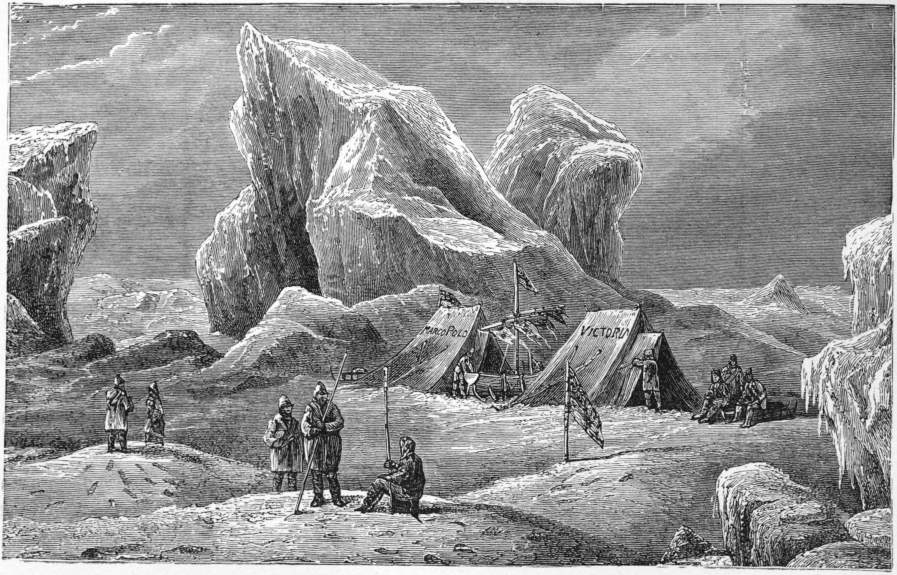
HIGHEST NORTHERN CAMP.
Wishing to possess any specimens of animal life that might exist in this high latitude, a bread bag, filled with the scrapings of our pannikins and a little pemmican, was lowered to the bottom, and, having been kept there some hours, was hauled up, and to our great joy found to be almost alive with numerous small crustaceans2 and foraminifera; specimens of which were, of course, collected and preserved, being the most northern animal life yet discovered. With our thermometer a series of temperatures was taken at every ten fathoms, whilst the specific gravity of the surface water was also obtained.
Tidal action was apparent; but, with the means at our disposal, we were unable to observe the rise and fall of the tide, or to make any accurate measurement regarding it. Altogether the day was not unprofitably spent.
May 12th.—This 12th of May must always be regarded as an eventful day in the lives of our little party, for it was that on which we had the honour, and no small gratification, of planting the Union Jack on the most northern limit of the globe ever attained by civilized man, or, in fact, so far as our knowledge goes, by mortal man! In order to insure being within four hundred miles of the North Pole, we started immediately after breakfast to the northward, carrying with us the sextant, artificial horizon, and all our colours and banners. We were a party of ten,3 two men being left behind to attend to the wants of the five who were sick, and who were left comfortably settled inside the tents.
The walking was undoubtedly severe, at one moment struggling through deep snow-drifts, in which we floundered up to our waists, and at another tumbling about amongst the hummocks.
Some idea may be formed of the difficulties of the road, when, after more than two hours’ hard walking, with little or nothing to carry, we had barely accomplished one mile!
Shortly before noon a halt was called, the artificial horizon set up, and the flags and sledge standards displayed. Fortunately the sun was favourable to us, and we were able to obtain a good altitude as it passed the meridian, although almost immediately afterwards dark clouds rolled up, snow began to fall, and the sun was lost in obscurity.
We found the latitude to be 83° 20′ 26″ N., or three hundred and ninety-nine miles and a half from the North Pole. The announcement of our position was received with three cheers, with one more for Captain Nares; then all sang the “Union Jack of Old England,” our “Grand Palæocrystic Sledging Chorus,” winding up, like loyal subjects, with “God save the Queen.”
No words of mine could describe the scene that surrounded us better than those of Coleridge in his “Ancient Mariner”:
“The ice was here, the ice was there, The ice was all around.”
For nought else but snow and ice could be seen in any direction.
In spite, however, of these dreary surroundings, suggesting everything that was desolate and miserable, mirth, happiness, and joy seemed to reign paramount amongst our little party. Perhaps there was something in the idea of having been farther north than any other man had hitherto penetrated, that promoted such feelings! Whatever produced them, they were shared in by all. Even the sick, on our return to camp, prostrate and suffering as they were, participated in the general hilarity and rejoicing. They knew their toilsome journey had terminated, and that each day would bring them nearer to their ship and to those supplies that were necessary to save their lives.
On returning to the tents, a magnum of whiskey, kindly sent by the “Dean of Dundee,” for the express purpose of being drunk at our highest northern position, was broached, and for supper we had divided amongst the two sledge crews a hare that had been shot by Dr. Moss on the third day after leaving the ship. Could men in our position want more? Never were the bones of a hare picked so clean! No dog would have benefited much from the scraps remaining from our repast!
Absent friends were duly toasted, and the evening was brought to a close with songs, in which even the invalids joined. All appeared happy, cheerful, and contented.
1 The original from which the annexed illustration is a copy, was painted by Admiral R. B. Beechey, and exhibited in the Royal Academy in 1877. It is now in the possession of Mr. Clements Markham.
2 Anonyx nugax, a fine adult male example, and several smaller ones. The length of the largest specimen is 1½ inch. This species is one of the commonest and most abundantly distributed of the northern Amphipoda. It was discovered by Captain Phipps in 1773, and is found along the shores of Arctic America, in the White Sea, on the coasts of Greenland, Iceland, Spitzbergen, Norway, and in the Sea of Okhotsk.
3 The names of these men are—Commander A. H. Markham, Lieutenant A. A. C. Parr, Thos. Rawlings, Ed. Lawrence, John Radmore, Thos. Jolliffe, Daniel Harley, Wm. Ferbrache, Wm. Maskell, and John Pearson.

CHAPTER XXIV.
RETURN OF THE NORTHERN DIVISION.
“Is not short payne well borne, that brings long ease, And layes the soule to sleepe in quiet grace? Sleepe after toyle, port after stormie seas, Ease after warre, death after life, does greatly please.” Faërie Queene.
At three o’clock on the afternoon of the 13th of May the homeward march was commenced, our main object, of course, being to get back to the ship as speedily as possible.
Before starting, a couple of records, inclosed in two tin cases, were deposited on the floe. One was placed as near the centre of the floe as possible, the other was secured on the top of a hummock.
On the records was stated the latitude and longitude of the position, together with a few words regarding the condition of the party. If these are ever picked up it will be very interesting and important, as throwing light on the drift or tide in these high latitudes.
It is unnecessary to describe the incidents that occurred on each successive day during the return journey. Day by day did our strength diminish. Gradually, but surely, the men, one after the other, began to feel the cruel grasp of the disease, as they struggled manfully on, dragging their poor, helpless companions, in spite of racking pains and aching limbs. Although themselves attacked by the dreadful malady, the men who were still able to work suppressed their own sufferings in their endeavours to ameliorate those of their more helpless and ailing comrades. Unmindful of their own miserable plight, they devoted themselves to the tender and soothing functions of nurses with a thoughtful and careful tenderness that would have done credit even to those of the weaker sex.
Often had the same road to be traversed, as the sledges were advanced one at a time, and most fortunate was it that we were able to adhere to the road constructed during our outward journey. To do so, however, during the thick weather which constantly prevailed, was a task of great difficulty and very trying to the eyes; but we knew that if by ill-luck we should wander away and lose it, our chances of ever seeing the ship again would be poor indeed! The hours selected for travelling were between 6 P.M. and 6 A.M. By choosing this part of the day, or rather night, for working, we kept the sun as much as possible at our backs, and slept during the warmth of the day. Towards the end of May, although the temperature of the outside air was below the freezing point, the sun was so powerful that it would raise the temperature inside our tent, whilst we were sleeping, to as much as 70° or 80°, which would be quite unbearable! Frost-bites had become a thing of the past, and were no longer dreaded. The temperature did not rise above the freezing point until the month of June.
Snow fell heavily during the greater part of the return journey, and fogs were very prevalent. Gales of wind had to be endured, for to halt was out of the question—rest there was none—onward was the order of the day.
As the disease gradually assumed the mastery over the party, so did the appetites decrease, and in a very alarming manner, until it was with the greatest difficulty that anybody could be induced to eat at all. Instead of each man disposing of one pound of pemmican a day, the same quantity sufficed for the entire party in one tent; and even this, occasionally, was not consumed. Nor was the subject of eating and drinking so often discussed. During the outward journey, beefsteaks and onions, mutton chops and new potatoes, and Bass’s beer formed the chief topics of conversation. On the return journey they were scarcely alluded to. Hunger was never felt; but we were all assailed by an intolerable thirst, which could only be appeased at meal times, or after the temperature was sufficiently high to admit of quenching our thirst by putting icicles into our mouths.
Aching bones and sleepless nights were the chief causes of our sufferings.
With all these hardships it was a great comfort to be able to put on dry foot gear. If it was fine when we encamped, our blanket wrappers and hose were spread out on the tent in the sun, so that when we got up they were not only dry, but not frozen, and were, therefore, limp and supple!
On the 17th of May we again, strange to say, crossed the track of a hare, being at the time about twenty-five miles from the nearest land. Like the track before seen, the footsteps were close together, indicating that the poor little creature was in a very exhausted state. Although the traces were very indistinct, they appeared to be going in a northerly direction.
Though our travelling was slow, we could see a perceptible decrease in the distance between ourselves and the land, whenever the weather was fine enough for us to observe it. “Old Joe,” as the men irreverently termed Cape Joseph Henry, loomed nearer and darker, and we all regarded it with anxious, longing eyes.
On the 18th of May the first icicles were observed hanging from the edges of a few hummocks—a sure sign of the returning power of the sun.
Ominous symptoms of a disruption of the pack were seen on the same day, and again on the following one. A crack in some ice had opened considerably since we last passed over it, whilst small hummocks had been formed by the pressure of two floes, one against the other. These little indications made matters assume a still more serious aspect. They may have been due to tidal action, but they were undoubtedly warnings to get off the pack as speedily as possible.
On the 20th the snow crystals that fell actually melted on coming into contact with our clothes or any dark substance. These crystals were all of a beautiful stellar shape. A hummock passed, although composed, apparently, of one piece of ice, was of two different colours, a deep blue and a pale yellow. Portions of each were broken off for the purpose of testing their respective specific gravities, and also to carry back to the ship for analysis. In all probability the discolouration was caused by the presence of diatomaceæ. The hummocks, at about this date, began to assume a different appearance, the mild weather depriving them of their snowy covering, and causing them to lose much of their former resemblance to gigantic wedding cakes!
The men began to have an inkling of the nature of the disease from which they were suffering, although we studiously avoided all mention of it. It went with them by the name of the “Joseph Henry mange!” Their spirits were wonderful, and they joked each other as they hobbled along. Their lameness they called the “Marco Polo limp,” and declared on their return to England they would introduce it as the fashionable gait!
Nothing appeared to subdue their courage or their zeal. Orders were always executed with the utmost willingness and good humour, and with as much alacrity as they were capable of evincing.
The men having heard that tea-leaves had been recommended as a good vegetable, the contents of the tea-kettle, after lunch and supper, were carefully collected, and devoured with avidity; but there is little faith, I fear, to be placed in their efficacy for warding off or subduing our terrible complaint.
Instead of our sledge loads appearing to diminish in weight as the provisions were consumed, they seemed to drag heavier, and we were at a loss whether to attribute this to the depth and softness of the snow over which we travelled, or to the increasing weakness of our party! It was hard work, and as much as we could do to make any progress at all. The men experienced great difficulty in moving their legs, the slightest exertion caused intense pain, and it was a piteous sight to witness them struggling bravely on, without uttering a murmur or complaint. They all knew that their only hope of safety was to get back to the ship as speedily as possible.
The 24th of May being the Queen’s birthday, all the flags and banners were displayed during the short time we halted for lunch, and her Majesty’s health was drunk by her most northern and not least loyal subjects. On that day, amongst the entire party, we could only muster four and a half good and sound pairs of legs! Still even those with “game legs” stuck to the drag-ropes nobly, and if they were unable to render much assistance, still the drag-ropes acted as a support, and therefore enabled them to keep up.
On the 25th the eighty-third parallel of latitude was recrossed.
The comparatively high temperature caused the snow over which we journeyed to assume a “sludgy” consistency, which clung tenaciously to our legs and to the sledge runners, rendering the work of dragging and walking all the more laborious.
On the 27th the condition of the party was so critical that it became only too painfully evident that, to insure their reaching the land alive, the sledges must be considerably lightened in order to admit of a more rapid advance. The state of the party was on that day as follows: five men were in a very precarious condition, utterly unable to move, and consequently had to be carried on the sledges; five others nearly as bad, but who nobly persisted in hobbling after the sledges, which they could just manage to accomplish, for, as the sledges had to be advanced one by one, it gave them plenty of time to perform the distance; whilst three others exhibited all the premonitory scorbutic symptoms. Thus only the two officers and two men1 could be considered as effective! This was, it must be acknowledged, a very deplorable state of affairs.
I therefore decided to abandon the remaining boat, which would materially lessen the load to be dragged. This decision was only arrived at after long and anxious consideration. I had to decide which was the lesser of two evils.
For I well knew that should a disruption of the pack occur, and we had already observed ominous signs of such an event, without a boat the party would indeed be placed in a hopeless position; but again I knew that in retaining the boat, the weights to be dragged by our weakened crew would be so excessive as to preclude the possibility of reaching the shore before all the provisions would be expended, and starvation would be the result. Again it was of the utmost importance that haste should be made in order to reach the ship, and place the sick under proper medical treatment. The disease was extending so rapidly as to produce a marked change for the worse every day. The boat, therefore, and all superfluous weights were abandoned, and the march was again wearily resumed.
Many a silent prayer was offered up to God to protect and watch over us, for we felt, indeed, that we were in dire distress, and that without His aid and assistance we must perish; and we prayed for strength to enable us to drag our poor helpless and suffering companions to a place of safety. A record was left in the deserted boat, containing a brief account of our state and condition, with the latitude and longitude where it was abandoned.
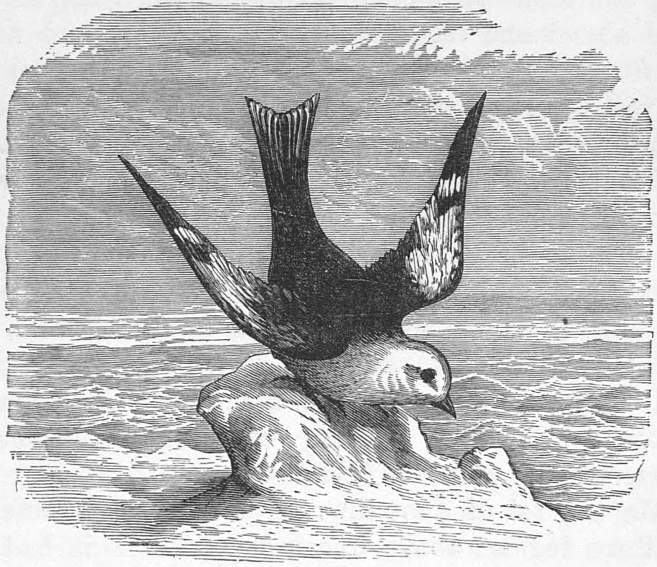
SNOW BUNTING
On the following day great excitement was caused by the appearance of a snow bunting, which was seen fluttering about amongst the hummocks, uttering its sweet and pleasant chirp, which to us was the most pleasing music we had heard for many a long day. No wonder the sudden appearance amongst us of this little warbler was so interesting, for it was the first bird we had seen for nine long months. Even the invalids, as they lay on the sledges, requested that they might have their faces uncovered, so as both to see and hear the little friend that had flown off to us, as if it were a messenger to welcome our party back to life and friends. Long and anxiously was it watched as it winged its course towards the land, whither we also were slowly wending our way.
On the 29th the colours were again displayed at lunch time, in commemoration of the first anniversary of our sailing from England, and allusions were made to that ever-memorable day, comparisons being drawn between our condition then and now! On that evening our tents were pitched close to the boat that we had abandoned on our outward journey, and which we found exactly in the same state as when we left it, with its mast stepped and yard hoisted, standing out like a grim sentinel guarding those icy wastes.
On the 31st, whilst crossing some young ice between two heavy floes, one of the sledges broke through, and we had no little trouble in saving it from complete immersion, and the invalid who was on it from being drowned! These warnings were unmistakeable, and pointed to the necessity of reaching the land as quickly as possible. The falling snow and drift thawed upon our clothes, making us wet and extremely wretched and uncomfortable.
On the 1st of June the temperature was some two or three degrees above freezing point. This had the effect of thawing the surface snow and converting it into a thick sludge. Our foot gear in consequence was in a soaking wet state. Our working force on this day was reduced to six, and all suffering more or less.
On the 2nd the thick weather, which had so persistently clung to us, proved triumphant and robbed us of our road. Up to this date we had been able to avail ourselves of the road constructed with so much trouble and labour on our outward journey. On this day we wandered off it, and in spite of our efforts were unable to pick up the trail again. The severe and monotonous labour of road-making had again to be resorted to. On the 5th, to our very great joy, we succeeded once more in pitching our camp on terra firma, after an absence from it of two months. On first landing our hopes were excited on observing the recent traces of a sledge and human footprints, and we congratulated ourselves upon soon obtaining that relief we all so much required; but we were doomed to disappointment, for on reaching the depôt of provisions established near Cape Joseph Henry for our use, and which was found intact, we learnt that a sledge party with Captain Nares had left for the ship only two days previously! This was a bitter blow, for we knew that something more than provisions was needed for the safety of the party.
We learnt also that scurvy had made its appearance on board the “Alert,” and that poor Petersen died from the effects of his last sledge journey, on the 14th of May.
Three hares had been kindly and thoughtfully left for us in a crevice amongst the hummocks by Captain Nares, and this furnished us with meals for a couple of days; it is needless to add, they were done ample justice to, not only for the sake of their goodness and the change they afforded, but also because we thought the fresh meat would act as a specific against the scurvy.
The tracks of a wolf were observed near the depôt, and the animal was frequently heard howling in a mournful manner, but we never saw it.
Obtaining a few supplies from the depôt, our march was again resumed; but so rapid had been the encroachments of the disease, that it was only too palpable that immediate succour was absolutely necessary for our salvation. At the rate of progress we were making, it would take us fully three weeks to reach the ship, although only forty miles distant; and who would there be left in three weeks’ time? The few who were still strong enough to drag the sledges would barely last as many days! Assistance had, therefore, to be obtained. To procure it, one amongst us was ready and willing to set out on this lonely and solitary mission, with the firm reliance of being able to accomplish what he had undertaken, and with the knowledge that he possessed the full confidence of those for whose relief he was about to start on a long and hazardous walk. On the 7th of June Lieut. Parr started on his arduous march to the ship. Deep and heartfelt were the God-speeds uttered as he took his departure, and anxiously was his retreating form watched until it was gradually lost to sight amidst the interminable hummocks.
“All waste! no sign of life But the track of the wolf and the bear! No sound but the wild, wild wind, And the snow crunching under his feet.”
Although the loss of one strong man, like Parr, from the party was seriously felt, still the knowledge that active steps had been taken to procure aid was sufficient to compensate for this reduction in our strength, and the men gallantly persevered at the drag-ropes, buoyed up by renewed hopes.
On the day previous to that on which Parr left, an Eskimo dog, to our great surprise, was seen threading its way to us through the hummocks. It was soon recognized to be one of our dogs, named Flo; but she was so timid that at first nothing would induce her to approach. After a little time, however, we coaxed her to us, and on having some pemmican thrown to her she ate it ravenously. Poor thing! she was wretchedly thin and emaciated; she, we concluded, had been cast adrift, or made her escape from the last dog-sledge that visited this neighbourhood. She joined our tail of cripples, hobbling, like them, after us and carefully walking in the track of our sledges.
On the 8th of June sadness and despondency prevailed amongst our little band. One of our number had received that summons to which all must at some time attend, and had been called to his long account.
“His soul to Him who gave it rose. God led it to its long repose— Its glorious rest.”
This was a terrible and unexpected blow to many who regarded themselves as being in a still more critical and precarious condition than was poor Porter. His end was calm and peaceful, and he retained his senses to within five minutes of the time of dissolution.
Sad and mournful, indeed, was the small procession that wended its way slowly to the new-made grave, dug out of a frozen soil, carrying the lifeless remains of their comrade, covered with the Union Jack, on the same sledge on which he had been dragged, whilst alive, for many weeks; and there, with the tears trickling down their weather-beaten and smoke-begrimed faces, with their hearts so full as to choke all utterance, they laid their late fellow-sufferer in his last resting-place.
A rude cross, improvised out of the rough materials that our own equipment supplied, with a brief inscription, marks the lone and dreary spot in that far-off icy desert where rests our comrade in his long sleep that knows no waking, and where probably human foot will never again tread.
“O World! so few the years we live, Would that the life that thou dost give Were life indeed! Alas! thy sorrows fall so fast, Our happiest hour is when at last The soul is freed.”
Gladly, after the ceremony was concluded, was the order to renew the march received, every one being desirous of quitting a place so fraught with sad and melancholy associations; the day, as if in unison with the state of our own thoughts and feelings, was dull and gloomy.
The late mournful event produced a despondency in our little band to which we had hitherto been strangers.
One and all felt and knew that assistance, to be of any avail, must arrive speedily, and many a wistful glance was directed towards the south, in the faint hope of seeing that succour without which they would surely perish. They felt more their own weakness and helplessness, and dreaded a recurrence of what had recently taken place. The journey was silently and wearily resumed.
As many of the men were unable to eat their pemmican, on account of the soreness of their gums, and from a certain dislike that they had lately taken to it, a new “dish” was tried, consisting of preserved potatoes mixed with bacon fat, and although in flavour, if any was perceptible, it rather resembled what starch might be like, it was decidedly acceptable as a change, and each person consumed about two-thirds of a pannikin.
On the morning of the 9th a rainbow was seen, which, being an unusual sight, afforded much interest. On the same day, shortly after the march had been commenced, a moving object was suddenly seen amidst the hummocks to the southward. At first it was regarded as an optical illusion, for we could scarcely realize the fact that it could be anybody from the “Alert!” With what intense anxiety this object was regarded is beyond description.
Gradually emerging from the hummocks, a hearty cheer put an end to the suspense that was almost agonizing, as a dog-sledge with three men was seen to be approaching. A cheer in return was attempted, but so full were our hearts that it resembled more a wail than a cheer.
It is impossible to describe our feelings as May and Moss came up, and we received from them a warm and hearty welcome. We felt that we were saved, and a feeling of thankfulness and gratitude was uppermost in our minds, as we shook the hands of those who had hurried out to our relief the moment that Parr had conveyed to them intelligence of our distress. Those who a few short moments before were in the lowest depths of despondency, appeared now in the most exuberant spirits. Pain was disregarded and hardships were forgotten as numerous and varied questions were asked and answered.
We heard with delight that they were only the vanguard of a larger party, headed by Captain Nares himself, that was coming out to our relief, and which we should probably meet on the following day. A halt was immediately ordered, cooking utensils lighted up, ice made into water, and we were soon all enjoying a good pannikin full of lime-juice, with the prospect of mutton for supper!
After halting for the night Moss made a thorough medical inspection of the whole party. His report was by no means cheering: all were more or less affected, and some were in a very precarious condition. The presence, however, of a medical officer amongst us restored confidence, and acted as a powerful antiscorbutic!
On the following day we met the larger party coming out to our assistance, and with their help arrived alongside the “Alert” on the 14th of June, seventy-two days after our departure from the ship.
What a contrast did that departure afford to our return!
Then, on that bright but cold April morning, all were in the highest spirits, cheerful and enthusiastic, looking forward with confidence to a comparatively successful issue to their undertaking—a fine, strong, and resolute band.
Alas! how different was the return! Out of that party of fifteen men, one had gone to his long home, eleven others were carried alongside the ship on sledges dragged by a party despatched to their relief, and only the remaining three were capable of walking.2 Even they were scarcely able to move one leg before the other, and were, on their return, placed with the others under the doctor’s hands. It was, indeed, a sad and terrible calamity with which we had been afflicted, totally unexpected and unparalleled in the annals of Arctic sledging experiences. On our arrival alongside the ship, we were, of course, most warmly welcomed by every soul on board; before entering Captain Nares called for three cheers for our party, and then offered up thanks to Almighty God for having preserved us through many dangers and privations, and for guiding us back to our ship without further loss of life.
1 John Radmore, chief carpenter’s mate, and William Maskell, able seaman.
2 Radmore, Jolliffe, and Maskell.
CHAPTER XXV.
RETURN OF ALL THE SLEDGE TRAVELLERS.
“Now that the winter’s gone, the earth hath lost Her snow-white robes, and now no more the frost Candies the grass, or calls an icy cream Upon the silver lake or crystal stream, But the warm sun thaws the benumbed earth.” Carew.
The hearty welcome we received from one and all on board the “Alert,” together with the indescribable pleasure of a warm bath, followed by a champagne supper for those whom the doctor reported well enough to indulge in such a luxury, made us all supremely happy; the feeling being increased by the knowledge that our suffering companions were under the tender care of kind and skilful hands, and that all responsibility connected with their treatment had, so far as we were concerned, ceased. Our late hardships and the anxiety we had felt regarding the safe return of the party were almost forgotten, and were it not for the number of cots hanging up outside the ward-room, and the row of beds along the lower deck, each occupied by a sick man, we should almost have felt inclined to regard our late sledging expedition as a dream from which we had suddenly been awakened.
A more thorough break-up of a healthy and strong body of men it would be difficult to conceive. Not only had the men engaged in the extended party under my command been attacked with scurvy, but also those who had been absent from the ship only for short periods, and some, who may be said never to have left the ship at all, or if they did, only for two or three days! The disease then could not be attributed to any special circumstance connected with sledge travelling.
The seeds must have been sown during the time, nearly five months, that the sun was absent, and we were in darkness. Fresh animal and vegetable food is undoubtedly necessary for the preservation of health, and its absence is the originating cause of scurvy. To this originating cause all Arctic Expeditions have been equally exposed. The predisposing causes of scurvy, which actually lead to an outbreak when the originating cause exists, are the long absence of the sun, entailing darkness, damp, intense cold, and bad ventilation. To these predisposing causes our expedition was exposed for a very much longer period than any other which sent out extended travelling parties. For this reason other expeditions were exempt from scurvy while we were attacked. In short, the different result was caused by the difference in latitude. As our winter arrangements, and our scale of diet, both on board and while travelling, were identical with those of former expeditions, the cause of the outbreak could not have had anything to do either with diet or winter routine. Lime-juice, though most useful in warding off for a time and delaying an attack of scurvy, and as a cure, will not, with other circumstances unfavourable, prevent an outbreak. This is the opinion of all the best medical authorities; and our experience proved it to be an undoubted fact. Some of our men had scurvy who never left the ship and never ceased to take their daily rations of lime-juice, and others were attacked who went away travelling at a time when daily rations of lime-juice formed a part of the sledge dietary.1
In future, when an expedition winters in so high a latitude as 82° N., the prevention of an outbreak of scurvy must be secured by improved measures for mitigating the predisposing causes.
Owing to the condition of the crew of the “Alert,” Captain Nares publicly announced, on the 16th of June, that on the return of the sledge parties, he would endeavour to rejoin the “Discovery,” and would then send that vessel to England with all the invalids, and those unfit to remain out a second winter. The “Alert” would pass her second winter at Port Foulke, whence, in the ensuing spring, parties would be despatched for the purpose of exploring Hayes Sound, and the adjacent land. This work completed, that vessel also would return to England. The reason that Port Foulke was selected as our future winter quarters was the amount of animal life, principally reindeer, reported to abound in that neighbourhood, and we also anticipated little or no difficulty in breaking out in the following summer.
This resolution was undoubtedly a wise one, for it was certain that in the then state of the ship’s company of the “Alert,” many lives would be sacrificed if all the men were required to spend another winter in the Arctic Regions. The idea of soon reaching England acted as a cure upon those who were in the worst stage of scurvy, and conduced more to their recovery than all the medicines and careful nursing that they received from our painstaking and attentive doctor.
In the mean time great anxiety began to be felt regarding the safety of the western sledge party under Aldrich. From the wholesale manner in which the northern division had been afflicted, it was feared that they also would not pass scathless.
Still we hoped they would not suffer to the same extent. Their route was along the coast line, and it was expected that they would have been able to supply themselves occasionally with fresh provisions, such as hares, geese, and perhaps musk-oxen.
On the 18th of June, four days after the return of my party, May, with three men and the dog-sledge, dragged by our remaining six dogs, left the ship in order to obtain intelligence of Aldrich’s party, and if necessary to take him relief and assistance. The succeeding days were anxious ones to all on board, and many were the trips taken to the summit of Look-out-hill, in the hope of seeing the returning sledgers. We could not disguise from ourselves the fact that unless they returned quickly they would be placed in a very critical position. In a few days they must be without provisions. This we knew. The temperature, too, had reached freezing point, and frequently stood two or three degrees above it, causing the surface snow to thaw, and therefore making the task of dragging a sledge one of severe and unpleasant toil.
On the 21st the sun reached its highest northern declination, and every day would bring us nearer to another winter; therefore we knew that to effect our deliverance from the ice this year, it was necessary to get our sledging parties on board as soon as possible, in order to prepare the ship for sea, and to commence the operations requisite for cutting her out of winter quarters.
The snow on the hills to the northward of us was rapidly disappearing; but this might only be due to their southern aspect, for in our immediate vicinity the snow appeared as deep as ever. Towards the latter end of May the hills around the ship were perfectly bare; but the heavy fall of snow, experienced by us during our return journey, had again covered them as they were during the winter.
Water began to form in little pools on the floes near the ship, and every sign betokened the approaching disruption of the pack. On the 23rd, a few king ducks, some Arctic terns, and skuas were seen hovering about the land, and one or two specimens of the latter were shot—their skins swelling our natural history collection, their bodies being reserved for the sick.
On Sunday, June 25th, immediately after Divine Service, on ascending Look-out-hill, to our very great delight we observed the wanderers struggling through the hummocks some six or seven miles off. Hurrying down to communicate the good news, a relief party was speedily formed, and by midnight we had the very great satisfaction of receiving them all on board. It was the old story repeated. All were suffering from scurvy, and only Aldrich and two men were able to walk alongside the ship, one of the latter being so bad that he was under medical treatment for many weeks after his return on board.
Their absence from the ship extended over a period of eighty-four days, during which they did very good service, having explored no less than two hundred and twenty miles of new coast line. May found them near Cape Joseph Henry, not far from the spot where he had before brought succour to my party. They were then struggling bravely on, but were in a very crippled condition. It is most fortunate he succeeded in reaching them when he did. His cheery spirit and strong help did much to assist them, and enabled Aldrich to bring his little party alongside their Arctic home in undiminished numbers. It was a great relief to all on board to know that every one had returned, that no stragglers were absent. So great was the anxiety felt until all the sledging parties had arrived, that the lot of those on board was hardly more enviable than that of the travellers!
Our good ship was now converted into a regular hospital, and might almost be said to be in charge of the medical officers; for those who were not actually under treatment had to be placed at the disposal of the doctor, so as to act as nurses, cooks, or attendants of some kind. Perfect rest and careful nursing were the most essential requisites for a complete restoration to health. Spenser must have had the recovery of similar wayworn and stricken travellers in his mind when he wrote—
“Now when their wearie limbes with kindly reste And bodies were refresht with dew repast.”
The medical staff were unremitting in their ceaseless attention to their patients, and it was to their untiring watchfulness that we owed the complete recovery of our sick.
Much had to be done to get the ship ready for sea; but, for some time, only a few officers and three men could be employed in any work connected with these preparations, the remainder being engaged entirely with their duties to the sick. The principal work that had to be done, before the ice broke up round the ship, was to get on board and stow away all our powder, besides the provisions and stores that had been landed before the winter. The housing had long been taken down, and the upper deck had been partially cleared of snow, so that daylight was once more admitted through the skylights and illuminators. It is a curious fact connected with those who were for a long period absent from their ship, that the hair on their faces became perfectly bleached, until in fact it was nearly white. The loss of colour was gradual, and, although noticed, was never alluded to, each one imagining that his companion’s hair was turning grey from the effects of hardship and anxiety! It was only after our return to the ship that those possessing beards and moustaches discovered the change that had occurred. The colour returned in the same gradual manner that it had disappeared. We all suffered a loss of hair from the head; but this may easily be attributed to our sealskin caps, and other head-dresses, which were constantly worn.
After the long use of moccasins, it took us some time to get accustomed to leather boots, which we were obliged to wear on account of the sludgy state of the surface of the floes and the land. With a temperature some degrees below freezing point, nothing is more comfortable or better suited for travelling over the pack than a good pair of moccasins.
The return of the sledge travellers was celebrated, on the 29th of June, by the best dinner we could afford to put on the table. As our printing-press had long been dismantled, a written menu was given to myself and Aldrich as the leaders of the two extended sledge parties. A beautiful sketch of the highest position reached was drawn by Moss, the following being as near as possible a fac-simile:—
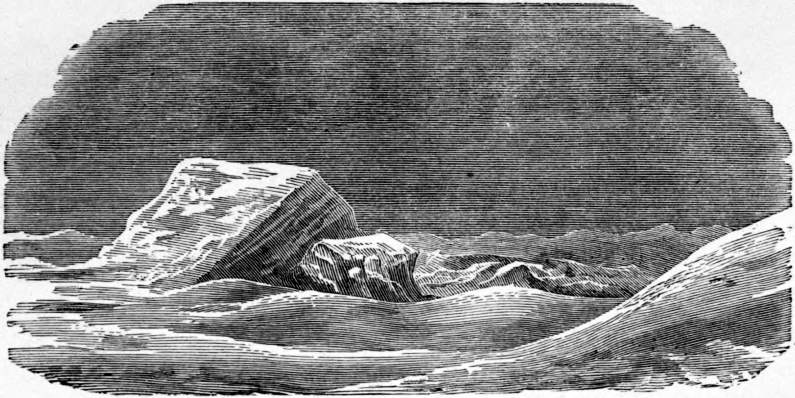
“Marco Polo.” Lat. 83° 20′ 26″ N.
MENU.
Potage olla Podrida.
Petits Pâtes d’Homards. Fricassée de Pégouse et Sardines.
Rognons aux Champignons saucés dans Attrapez-en-haut.
Rissoles à la Tomato.
Mâchoire de Bœuf. Jambon au Champagne.
Petits Pois. Carottes. Ognons. Pommes de Terre.
Tourte de Pêches.
Compote de Blancmange et Rhubarbe Fou. Pouding en Marmelade.
Pains rôtis aux Anchois.
Fromage. Liqueurs. Dessert.
Café noir.
H.M.S. “Alert.” 29th June, 1876.
On the reverse side of the bill of fare were the following verses composed by Pullen for the occasion. It is needless to add that they were not only appreciated, but that they found a response in every breast:—
Welcome home to the wished-for rest, Travellers to north and travellers to west! Welcome back from bristling floe, Frowning cliff and quaking snow! Nobly, bravely the work was done; Inch by inch was the hard fight won. Now the toilsome march is o’er, Welcome home to our tranquil shore. Rough and rude is the feast we bring; Rougher and ruder the verse we sing. Not rough, not rude are the thoughts that rise To choke our voices and dim our eyes, As we call to mind that joyous sight On an April morning cold and bright, When a chosen band stepped boldly forth To the unknown west and the unknown north; And we from our haven could only pray— “God send them strength for each weary day!” He heard our prayer; He made them strong; He bore their stalwart limbs along; Planted their sturdy footsteps sure; Gave them courage to endure. Taught them, too, for His dear sake, Many a sacrifice to make: By many a tender woman’s deed To aid a brother in his need. And safe for ever shall He keep In His gentle hand the two who sleep. His love shall quench the tears that flow For the buried dear ones under the snow. And we who live and are strong to do, His love shall keep us safely too: Shall tend our sick, and soothe their pain, And bring them back to health again. And the breath of His wind shall set us free, Through the opening ice to the soft green sea.
Captain Nares had hinted that, in the present condition of the men, and supposing also that those of the “Discovery” were in the same state, he would not be justified in allowing even one ship to remain another year exposed to the rigours of an Arctic winter and to the same causes that had led to the recent outbreak of scurvy. We were prepared for this announcement; for we well knew that to remain out a second winter, although there were many of us ready and eager to do so, would simply be to sacrifice many valuable lives for no object; for we could not possibly expect to reach a higher northern latitude, or even to extend our explorations much farther to the westward, although the whole force of the expedition should be confined to the one direction. In deciding to return to England, Captain Nares showed great moral courage, and exercised a sound and wise judgment, in the opinion of all his officers.
On the Sunday following the return of Aldrich’s party, a special thanksgiving was offered up to Almighty God for our safe return, and prayers were also said for the speedy recovery of our sick comrades.
On the 1st of July, on the usual monthly medical examination being held, only ten men out of our fine ship’s company were reported in a fit state for work, and some of these were convalescents! The invalids, however, thanks to the doctor’s assiduous care, were improving slowly but surely.
The thaw had by this time commenced. The snow was soft and wet in the valleys, small rivulets were already meandering through the ravines and gorges, whilst the summits of the mountains were covered with brown patches that the wind and thaw combined had left bare. Little tufts of the beautiful purple saxifrage dotted the sides of the hills over which we walked, bringing forcibly to our minds the wild flowers of our own dear country, and creating a longing desire to behold them once more. Footprints of animals, notably musk-oxen, were occasionally observed; but although these traces appeared fresh, they were evidently those of the preceding autumn, which, having been covered with snow and frozen hard during the winter, had thus been perfectly preserved.
On the 5th of July, however, we were so fortunate as to shoot three musk-oxen within three or four miles of the ship, and on the following morning another fell a victim to the prowess of our sportsmen. This was indeed a God-send, for without fresh meat the recovery of our sick would be long and tedious. The actual amount of food obtained from these animals was at the average rate of 120 lbs. from each. The dexterity with which the beasts were operated upon after death would have done credit to the most accomplished butchers. Our first dish of liver and bacon at breakfast was, it is needless to say, done full justice to—the only fault being an insufficiency in amount.
Fresh provisions were indispensable for the restoration of the invalids to health. Shooting parties were, therefore, organized amongst the officers, and the whole country for a radius of many miles was well scoured in search of game. These shooting parties were very enjoyable, especially to those who, like myself, had been engaged on one of the prolonged sledging expeditions—the contrast being very great. No anxiety, little or no responsibility, careless of time, and oblivious of everything save our own pleasure and convenience. Sleeping when we felt tired, and having our meals when we felt hungry, the night the same as the day, the sun at midnight being as bright as at noon, free from all cares, intent only on sport, the time passed in a serene and delightful manner, and we were truly sorry when the time came to relinquish our gipsying life for a more civilized one on board.
On one of these shooting tours I was away from the ship, accompanied by a few choice spirits, for fourteen days. During that time we succeeded in obtaining a couple of musk-oxen, and several brent geese, which were a welcome addition to the fresh meat already obtained for the sick on board the ship. What delightful little meals we used to cook for ourselves, each one taking his turn, and vying with the others in his endeavours to make his dishes excel those of his predecessor!
On one occasion we had for breakfast the livers and gizzards of thirteen geese served up with a little bacon, these being the perquisites of the sportsmen. In the enjoyment of such luxuries it is not surprising that a return to the ship, and our everlasting Australian and New Zealand beef and mutton, was not hailed with delight.
All this time the thaw had been rapidly progressing, the tops of the hills were bare, and the ravines were rendered almost impassable from the mountain torrents that dashed down towards the sea, gaining strength and volume as they neared their outlets. These had to be crossed by the shooting parties, the water reaching up to our waists, and flowing with such force as nearly to carry us off our legs. As for change of clothing, we had none; but on reaching our tents we would get into our sleeping-bags and leave our wet clothes outside to dry; the temperature at this time being about 40°. A warm supper, with a pannikin of hot tea, followed by a glass of grog, soon made us forget the discomforts of the past in the enjoyment of the present.
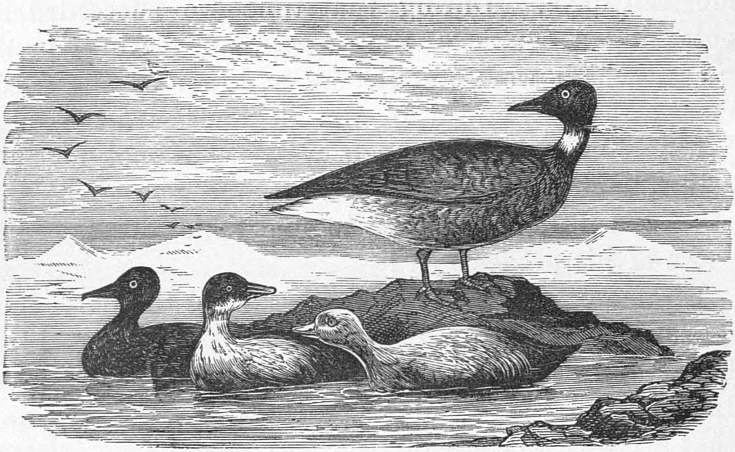
BRENT GOOSE AND EIDER DUCKS.
Some of the scenery, about five or ten miles in the interior, was extremely picturesque. The spot that we selected for our camp was on the borders of a lake that formed one of a chain extending to the south westward. Some of the hills surrounding these lakes were beautifully carpeted with the pretty little purple saxifrage, a draba, a potentilla, and other wild flowers, while the valleys were covered with patches of luxuriant vegetation, consisting of grasses and delightfully soft moss. Altogether the aspect of the surrounding country afforded a striking contrast to what it was but a few short weeks back, when still wrapped in its wintry garb.
On our return to the ship on the 24th of July, we were glad to hear that our invalids were progressing favourably, and the convalescents regaining strength. It was also a source of great gratification to us to find a broad stream of water forming outside our protecting floe-bergs, and extending from Point Sheridan to as far south as we could see. This was a very agreeable and unexpected surprise. Active preparations were at once made to release the ship from her icy prison. All stores and provisions were re-embarked, instruments were brought on board and carefully packed up and put away, boats were hoisted up, the screw lowered, and the engines reported in good working order. Strict orders were issued that no one was to be absent from the ship, on any pretence, for a longer period than four hours without express permission. Any day might see our release! Anxious eyes were constantly directed towards the pack, which was now acted upon both by wind and tide, drifting north and south as it felt their influences.
A large cairn, fully ten feet high, was erected on the summit of “Cairn Hill,” in which was deposited a record stating briefly what had been accomplished by the expedition, and giving a list of the officers and men of both ships. To this document each of the former attached his signature. Will this ever be disturbed by our fellow-men?
Strenuous exertions were made by means of powder to blow up the ice between the ship and the channel of water that almost tantalized us by its existence, and so clear a passage by which we could effect our escape. Countless torpedoes, containing from 1 to 50 lbs. of powder, were used to accomplish this object, and many hours of hard labour were expended in the same endeavour. At length, on the morning of the 31st of July, our exertions were crowned with success, and great was the excitement on board when hurried orders were issued to raise steam with all despatch and to prepare for sea! A fresh south-westerly wind had blown the pack off the shore, leaving a clear channel of water extending as far as could be seen to the southward.
By 7 A.M. the ship was free and afloat, and at eight o’clock the colours were hoisted, and we succeeded, without much difficulty, in steaming clear of the prison that had for eleven long months so securely held us in its icy fetters.
Who can describe the feelings experienced by all on board the “Alert” on again hearing the long-silent throbbing of the engines, and knowing that the ship was once more in motion?
Yet a slight pang of regret was felt at leaving the barren, sterile coast, off which we had passed so many happy days, and we could not but feel grateful to the kind floe-bergs which had, during that time, protected us so well from “ye merciless yce.”
1 As soon as it was possible to use the lime-juice in the form in which it was supplied to the expedition (that is, in jars or bottles) all sledge parties were invariably supplied with it as a daily ration.
CHAPTER XXVI.
THE RETURN VOYAGE IN THE ICE.
“Let our trusty band Haste to Fatherland, Let our vessel brave Plough the angry wave.” Thorhall’s Saga.
Cape Joseph Henry was lost to sight as the “Alert” rounded Cape Rawson; but very heavy ice off Cape Union for a time completely obstructed our progress.
Excessive caution was necessary in handling the ship amongst these ponderous floes. Patience combined with perseverance are essential virtues inseparable to successful ice navigation, and they were constantly called into requisition in order to ensure a safe deliverance from the dangers which surrounded us.
A vigilant look-out had to be kept on the pack, and the ship was moved from time to time in order to avoid a “nip.” Frequently we would observe a heavy floe coming into contact with the large grounded masses of ice that lined the coast, forcing them over, or crumbling them into shapeless fragments, thus clearly illustrating our own fate should we be so unfortunate as to be caught between the two.
The orders “up” and “down screw and rudder” were given and executed several times during each day. As on our outward journey, preparations were now made for abandoning the ship at a moment’s notice. Tents, clothing, cooking utensils, and all necessaries for a life on shore were spread out on the upper deck in readiness to be thrown on the ice in the event of such a catastrophe.
The cool way in which we all spoke of the probable loss of our home, and the prospect of being cast adrift at a moment’s notice, was very remarkable. Perhaps the knowledge that our consort, the “Discovery,” was within some forty miles of us, and therefore within easy travelling distance, might account for the light manner in which such a calamity was regarded; but it was impossible to disguise the fact that the loss of our good ship would be a very serious, not to say uncomfortable, event.
Steam had to be kept ready at a few minutes’ notice, so as to take advantage of every little opening that might occur in the ice, even though we should only succeed in advancing a few hundred yards. On one occasion the ship was purposely forced into the pack, with which it drifted to the southward; but on the turn of the tide, when the ice began to drift in the opposite direction, it was no easy matter to free ourselves from the bondage to which we had voluntarily subjected ourselves. If it can be avoided, it is best not to allow a ship to get beset, even when the drift of the pack is favourable.
As we proceeded south, although our progress was slow, the change in the appearance and massiveness of the ice was very palpable. Occasionally we would meet small specimens of our palæocrystic friends, over which we had travelled during the preceding spring, but, as a rule, the ice was of a much lighter description. Still the floes were far heavier than those met with in Baffin Bay, and by no means to be despised.
During the time the ship was detained, waiting for the ice to open to allow her to proceed, our sportsmen were not idle, landing at all hours of the day and night in order to procure fresh food for the sick. So successful were they in their forays that the sick were supplied with a fresh meat meal daily,—geese, ducks, and hares forming the principal part of their “bags.” The slaughter amongst the former was tremendous—entire flocks numbering from fifty to seventy birds falling victims to the prowess of not more than two guns, and within the short space perhaps of half an hour! The unfortunate birds being in the act of moulting were, of course, unable to escape the unerring aim of our marksmen.
In addition to crops of mustard and cress that we succeeded in raising on board, we were able to obtain small quantities of sorrel, which the convalescents were sent on shore to gather from the valleys and sides of the hills, often returning with sufficient to enable a limited allowance to be served out periodically. Sometimes the sick men were sent on shore themselves to browse on this excellent antiscorbutic.
On the morning of the 5th of August, being within twenty miles of the “Discovery,” Egerton, accompanied by one of the men, was sent to give them information of our position. Our own ship was then, and had been for the past forty-eight hours, effectually jammed by the ice and unable to move. In the mean time we on board the “Alert” were endeavouring to get our vessel clean, and into something like order and ship-shape. On the following morning we sustained a slight “nip,” caused by the ice setting rapidly in towards us. Our rudder head was badly wrenched before the rudder could be unshipped, and the iron tiller was bent and crippled. We only succeeded in easing the pressure by exploding some charges under the ice. In the forenoon Rawson, with two of the men belonging to the “Discovery,” walked on board. We were, of course, delighted to see them and to hear news of our consort.
From them we learnt that poor Egerton had lost his way, and did not arrive on board their ship until after he had been wandering about for eighteen hours! The news from the “Discovery” was what we feared. Notwithstanding the large amount of musk-ox flesh procured by them during the autumn and following summer, scurvy had attacked her crew in almost the same virulent manner as it had ours. The return journeys of some of their sledge parties were simply a repetition of our own. Beaumont’s division—the one exploring the north-western coast of Greenland—had suffered very severely, and we heard with extreme regret that two of his small party had succumbed to this terrible disease.
The rest of his men, with himself and Dr. Coppinger, had not yet returned to the “Discovery,” having remained in Polaris Bay to recruit their healths. This was, indeed, a bitter ending to our spring campaign, on which we had all set out so full of enthusiasm and hope. It had the effect, however, of confirming Captain Nares in his resolution to proceed to England. With such broken-down crews it would have been folly indeed to have risked the rigours of a second Arctic winter; and there was really nothing left for us to do, Beaumont having done his work so well that it would have been impossible for us to have extended any exploration in that quarter. The “Discovery” had been afloat for some time, and was in perfect readiness to proceed to sea on the arrival of Beaumont and his party. Their absence caused us great anxiety, as the pack, being in motion between ourselves and Polaris Bay, and consequently where they would have to cross, made us fully alive to the risks and dangers they would encounter whilst crossing it. Still we hoped to hear of their safe arrival as soon as we should drop anchor alongside our consort in Discovery Bay.
The most important news was that a large seam of lignite of the Miocene period had been discovered within about three miles of their winter quarters. They had not been able to utilize this coal, but several large specimens had been carried to the ship—the result of experiments made being that it was reported, for steaming purposes, equal to the best Welsh coal.
Whilst imprisoned by the ice and waiting to escape, our naturalist made an interesting discovery within two hundred yards of the ship. On the beach, about twenty feet above high-water mark, he observed some wood which, on examination, proved to be portions of sledge runners and cross-pieces; also a snow scraper, made from the tusk of a narwhal or walrus, and a large lamp, apparently a piece of schistose rock hollowed out.1 These relics are the most northern traces of Eskimos yet found. Their position would lead one to suppose that the wanderers had arrived so far north along the shores on the western side of the channel, and from thence crossed over to the opposite Greenland coast; the cliffs to the northward being very steep, and although not actually impassable, great difficulty would be experienced in travelling along their base. This, and the absence of animal life, would readily account for their desire to leave such an inhospitable and sterile land.
On the 7th and 8th of August the ship was subjected to some very severe squeezes. On the latter day a large floe-berg pressed violently against the vessel and forced her on shore, lifting the stern bodily out of the water to a height of about five feet. The noise of the cracking of the beams and the groaning of the timbers was a sound that once heard will never be forgotten. To those below, the crumbling of the pitch in the deck seams sounded like a shower of hail on the upper deck. Fortunately for us the floe-berg was heavy and of deep flotation, and therefore grounded before it had time to cause the destruction of the ship. It was a grand sight to witness some of the neighbouring floe-bergs—great masses of ice from sixty to seventy feet in thickness—turned completely over and swept away by the pack in its irresistible career.
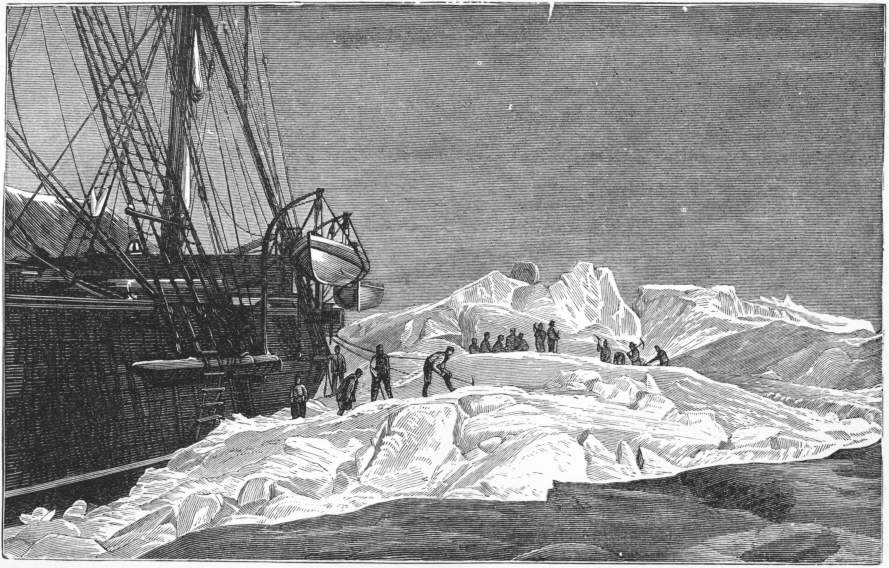
REDUCING A FLOE-BERG.
We had no time, however, to indulge ourselves in watching spectacles of such magnificence. Our position was by no means pleasant: any pressure upon the ship, caused by spring tides or otherwise, must inevitably crush her; and the prospect of another winter in the ice began to dawn upon us. There was apparently no escape, as, from our experience of the preceding year, we had cause to believe that, when once the floe-bergs grounded along the coast, they remained immoveable during the whole winter, and here were we forced on shore by a floe-berg which had grounded immediately outside us. Our only chance was to reduce the huge mass of ice by which we were imprisoned, so as to lighten it sufficiently to float and drift away at high water. It was a bold idea; but it was no sooner resolved on than every available working man in the ship, irrespective of rank or station, was busily employed with axe, pick, or chisel in demolishing the obstruction. On the third day, so energetically was the work carried out, that the judicious explosion of a heavy charge of powder immediately under the berg had the effect of floating it away at high water, and the ship was released.
The pack being loose, we succeeded in making good progress, and on the following evening had the very great satisfaction of anchoring alongside the “Discovery,” after having been separated from her for nearly twelve months. An interchange of visitors immediately took place. Local news, for want of more important intelligence, was fully and freely discussed, and the routine of the winter and the doings of the sledge parties formed topics of interesting conversation. The prolonged absence of Beaumont and his party acted as a damper upon our spirits, for we could not hide from ourselves the fact that their journey across the strait must be a hazardous one. So uneasy did Captain Nares feel regarding their safety that he determined upon going in search of them, even over to Polaris Bay. Accordingly, on Sunday morning, the 13th of August, having transferred all our sick and helpless hands to the “Discovery,” and having our own ship’s company supplemented by six men from our consort, we again made a start, but were stopped by heavy ice at the entrance of the harbour, through which it was quite impossible to penetrate. On the following day, to our great delight, we observed a tent pitched on the ice about three miles to the southward of the ship. A relief party was quickly formed, and in a few hours we had the extreme pleasure and satisfaction of welcoming Beaumont and his party on board, none the worse for what they had recently gone through, and almost indignant at all offers of assistance that were made to them. On account of the drifting of the pack over which they had been travelling, their work, during the last three or four days, had been excessively severe. On occasions they were compelled to continue the march for thirty-two and twenty-two consecutive hours without resting.
As the ice still remained packed and impenetrable, we were unable to advance, although more than one unsuccessful attempt was made to push on. On several occasions the dredge was hauled and with good and interesting results. The coal seam was also visited by different parties of officers. It exists in a visible seam on the northern side of a ravine, and is about three hundred yards long and twenty-five high. We were unable to ascertain its depth below the surface of the ground, or its thickness.
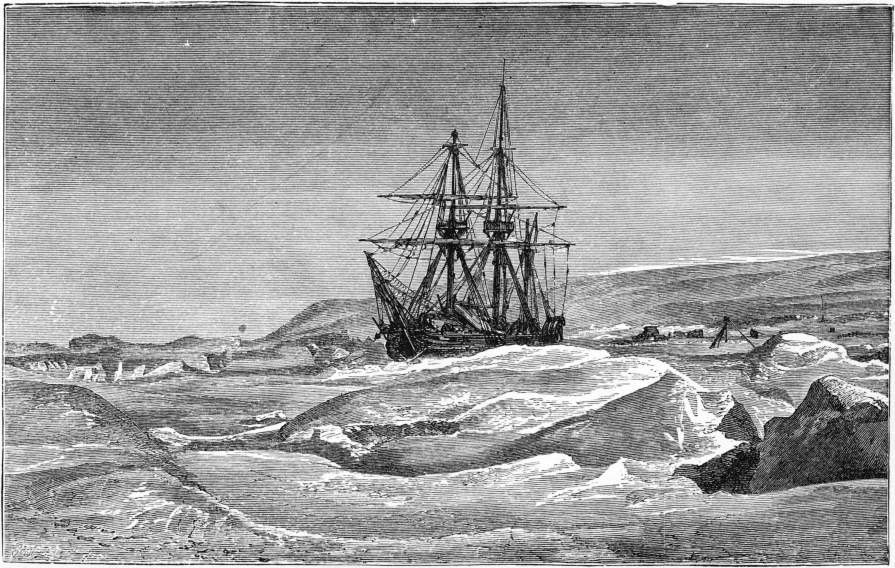
H.M.S. “ALERT” FORCED ON SHORE.
We were also very fortunate in finding a large number of vegetable fossils in the surrounding limestone, some of the leaf impressions being very clear and perfect. At the head of the ravine is a magnificent cave, formed by the two sides of the gorge and covered with a roof of frozen snow. This roof is apparently permanent, as when we visited the cave it was precisely in the same condition as when it was first discovered twelve months before! The cave is very large, capable of accommodating easily sixty or seventy men.
During these excursions several butterflies were caught and brought on board as specimens, as also some flies, gnats, and other diptera. Many hares were also shot, to the great delight of our doctor, who had been working like a horse in order to bring his patients round.
The scenery in the channel between Bellot Island and the mainland, through which we passed in one of our vain attempts to get south, was very striking: bold cliffs, and hills rising to a height of two thousand feet on either side, intersected by deep ravines and gorges having almost precipitous sides and terminating in bays and little harbours.
On Sunday the 20th, by dint of boring and charging, at the expense, however, of our rudder head, we succeeded in forcing a passage through the ice in Lady Franklin Bay, and into a broad stream of water extending along the coast to the southward, which we fondly hoped would eventually lead us into open water.2 But navigation in ice-bound seas is indeed uncertain. For on the following day we were compelled to seek refuge inside a land-locked and apparently well-protected and secure harbour. How deceitful was its appearance! Hardly an hour had elapsed after entering this sheltered retreat, before the “Alert” was severely nipped by a heavy floe and forced on shore.
For many hours the ship remained in a very critical position, as the tide receding left her completely high and dry, and listed over at an angle of 25°.
So steep was the bank on which we had been forced, that at low water we were able to walk, “dry shod,” from the stem to the main chains, whilst aft the water was over our mizzen chains, and within a short distance of the taff-rail. A good sensational photograph and some sketches were made of the ship in this unpleasant position. Strenuous efforts were, of course, at once made to lighten and float the vessel. The fore part was entirely cleared, and the chain cables brought aft. A bower anchor was laid out astern in order to haul the ship off to.
The manner in which this latter work was performed was both novel and ingenious. A small but heavy piece of ice was secured and brought alongside the ship. On this was placed the anchor, as on a raft. It was then towed by boats to the position decided upon, when the raft was destroyed by exploding a charge of gunpowder immediately underneath it, the anchor, of course, sinking to the bottom.
With such good will did all work, that we had the joy and satisfaction of seeing our good ship afloat, and ready to proceed, in about fifteen hours from the time of the accident taking place. The bay, which was the scene of our mishap, was called Rawlings Bay, after one of our men, who was my sledge captain in all my expeditions. A musk-ox skull and the horn of a reindeer were picked up by Feilden close to where the ship was aground, proving that the neighbourhood is occasionally visited by these animals.
From this time, until the 9th of September, we were engaged in a never-ceasing struggle with the ice, frequently detained for many hours, and rarely advancing more than a few hundred yards during the day. The fast-forming ice reminded us unpleasantly of the near approach of winter, whilst the land had again assumed its wintry covering of snow. On the 22nd of August candles had to be used below at midnight for reading or writing. The young ice was found very tenacious, glueing and cementing the broken fragments of floes together. This caused such an impediment to our advance, although the pack was what is termed loose, that we were on several occasions compelled to relinquish all attempts at penetrating farther, and to secure the ships until a more favourable opportunity should occur. Our stock of coal, too, was getting alarmingly small, and had to be very carefully economized. Without the means of steaming, our chance of escape would, indeed, have been small.
On the 24th we rounded Cape Fraser;3 on the 27th,4 so slow was our progress, that we only just succeeded in getting into Dobbin Bay, where we were detained until the 3rd of September. The temperature had fallen to 19°. Last year we were frozen up on the 3rd of September, and here were we on the same date with as low a temperature and many miles to accomplish before we could actually be clear of the ice!
Snow also began to fall heavily, and everything appeared gloomy and inhospitable. As there was now a prospect of our being forcibly detained for another winter in the ice, and as some of our provisions were getting low, on passing the large depôt established in Dobbin Bay on our way up the previous year, we landed and brought off all the tea, sugar, and chocolate, and such other articles as we were likely to require.
Whilst this work was in progress, a large ground seal (Phoca barbata) was shot by Hans, of the “Discovery,” on which was found a partially healed wound; on further examination, an iron-pointed harpoon with an ivory socket, evidently of Eskimo construction, was discovered imbedded in its blubber. It would have been very interesting if we could have traced, by the manufacture of the instrument, the tribe to which it had belonged and the locality where the wound was inflicted.
One morning, when some little distance from the land, a small fox, of a mottled colour, wandered off to the ship, being attracted towards us either by hunger or curiosity. The officer of the watch, always on the alert, soon spied the little animal cruising about amongst the hummocks and shot it. The skin was preserved with the collection of natural history specimens, whilst the body was eaten by us at dinner and found to be delicious. Passing Cape Hawks, and Allman Bay, an inlet which was named after the distinguished President of the Linnæan Society, we continued to push the ships in the direction of open water to the south, which we at length reached.
It was with no small amount of thankfulness that on the 9th of September we emerged from the cold, grim clutches that seemed only too ready to detain us for another winter in the realms of the Ice King, and that we felt our ship rise and fall once more on the bosom of an undoubted ocean swell. It was, indeed, a joyous sensation to look around and see nothing but blue water, and, with the exception of a few straggling bergs, not a single speck of ice in sight. This broad sheet of water had for some time been known to us, having been observed from the summits of various hills that we had ascended, and all our energies of late had been concentrated into reaching it. We had a hard fight, but perseverance and patience ultimately proved triumphant.
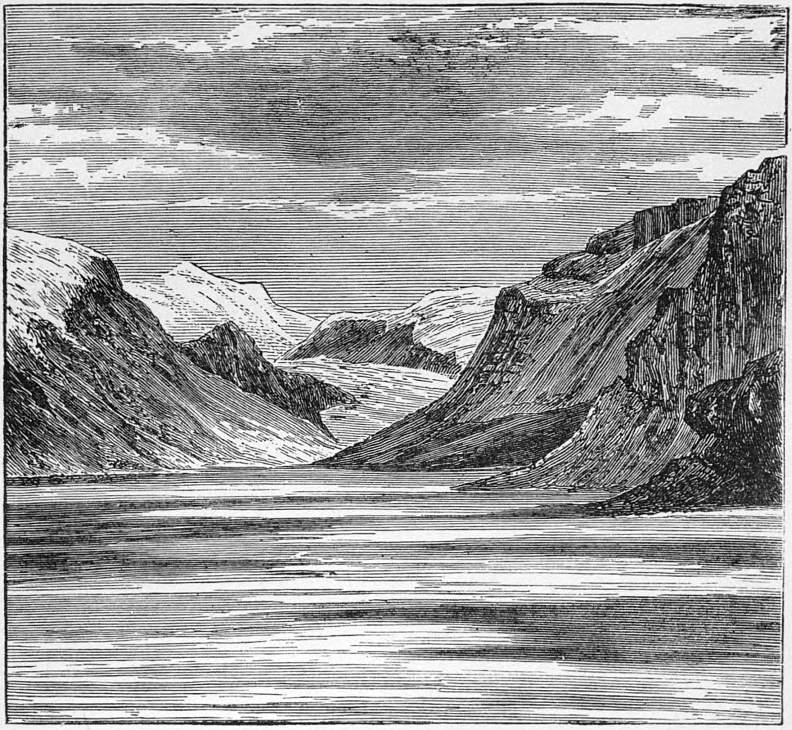
ALLMAN BAY.
On first reaching it, we found it to be coated with a thin layer of young ice, which offered a great deal of hindrance, although it had not the effect of checking us altogether. Our course through this young ice could be distinctly traced for a long distance astern, by a broad lane of water resembling the Suez Canal. At 6 P.M. we passed Cape Sabine, and distinguished our cairn on the top of Brevoort Island apparently untouched. Ahead was Cape Isabella, towards which we steered.
1 I have already referred to this discovery in my remarks on the migrations of the Eskimos, at p. 69.
2 At this time the “Pandora” was cruising in the entrance of Smith Sound, with an impenetrable barrier of ice blocking her way to the northward.
3 On this day the “Pandora” succeeded in landing a party on Cape Isabella for the second time, searching for a record.
4 On the 27th the “Pandora” was driven out of Smith Sound by a gale.
CHAPTER XXVII.
HOMEWARD BOUND.
“Still in the yawning trough the vessel reels, Ingulfed beneath two fluctuating hills; On either side they rise, tremendous scene, A long dark melancholy vale between. The balanced ship, now forward, now behind, Still felt the impression of the waves and wind, And to the right and left by turns inclined.” Falconer.
“Montano.—What from the cape can you discern at sea? 1st Gent.—Nothing at all: it is a high-wrought flood; I cannot, ’twixt the heaven and the main, Descry a sail. Montano.—Let’s to the seaside, ho! 3rd Gent.—Come, let’s do so; For every moment is expectancy Of more arrivance. (Within.) A sail! A sail! 4th Gent.—The town is empty; on the brow of the sea Stand ranks of people, and they cry—a sail!” Othello.
Shortly before midnight, on the 9th of September, Cape Isabella was reached and the ships were clear of Smith Sound. As, on our outward journey, to me had been allotted the duty of erecting a cairn on that prominent headland, and establishing a post office, so, on our return journey, was I assigned the duty of visiting the place in order to ascertain if letters had been deposited there during the period of our absence by any enterprising friend. On reaching the lower cairn, to my great surprise—for we hardly expected that any one would have visited the place since our departure the previous year—I found an additional cask had been placed alongside the one that I had established there. This was quickly opened, and found to contain a small mail for each ship.
Hurriedly leaving a record notifying our visit, we eagerly seized our treasures and made the best of our way to the boat. Great was the excitement when the news spread that a mail from England was actually on board, and we were soon deep in the enjoyment of perusing late letters from home, a pleasure to which we had so long been strangers.
Many were the heartfelt expressions of gratitude that rose to the lips of those lucky recipients of home news towards that gallant officer and friend who had so perseveringly and so generously, in spite of many dangers and difficulties, succeeded in depositing their letters so far north. The bulk of our mail we imagined had been left either at Disco or Upernivik. Had we examined the cairn on the summit of Cape Isabella, we should there have learnt that the same kind and disinterested friend had taken them to Littleton Island, and there safely deposited them. Being ignorant of this fact, and the weather being against our proceeding thither, a course was shaped to the southward; those who were under the impression that our English letters were really on that island being consoled by the fact that we were steering homewards, and that in a short time letters would be no longer necessary or of any value.
Wars, and rumours of wars, were prevalent, for our latest news came from England at the time when all Europe was disturbed and unsettled by the complexion of affairs in the East.
This made us all the more anxious to get home quickly; but alas! everything was against us. Tempestuous weather, with the wind always contrary, was our introduction to our own element, and, as our coal was running very short, we were obliged to put the ships under canvas and thrash them at it. Icebergs were innumerable, and, as the nights were increasing in length and the darkness in density, they were anything but pleasant neighbours.
On the 12th of September it was blowing so hard and the weather was so thick, that it was determined to seek an anchorage under the lee of the land in Whale Sound, and there wait until the weather moderated. With this object the ships were worked up under fore and aft sails and steam, eventually anchoring in a small bay (Bardin Bay) in close proximity to the Tyndall Glacier. As we came in we observed an Eskimo settlement on the eastern side of the bay, and several natives were seen running along the land towards us; but as the glacier intervened they were unable to communicate, and the weather was too bad to allow us to send a boat to them. This was much to be deplored, as, irrespective of the fact that these people were the first human beings that we had seen for many a long month, it was desirable that we should propitiate them in favour of white men, and for this purpose we had many little articles of infinite value to them, such as knives, needles, thread, scissors, etc., besides provisions, ready for their acceptance.
These natives were of the same tribe as those who were so kind to Kane and Hayes, and also to the “Polaris,” so it would have been a good action, independently of all other reasons, could we have befriended them.
We had not been at anchor, however, more than five hours before a change of wind, accompanied by heavy squalls which came over the hills fast and furious, obliged us to get under weigh, and again put to sea, although the weather was as thick and the wind as strong as ever—added to which hail and snow showers were frequent: altogether a very unpleasant and miserable night was spent, for it was nearly midnight when we were forced to fly from our harbour.
On the 16th we were beating about off the entrance to Lancaster Sound, near Cape Byam Martin. This was all familiar ground to me, and brought back to my recollection scenes on board the old whaler, “Arctic,” that had occurred in the same locality three years before. We made many tacks in our endeavours to weather Cape Walter Bathurst, but, for a long time, without success, for the wind invariably headed us on each tack.
On the 20th several eider-ducks, some turnstones, rotges, and snow-buntings were seen, but all going in a southerly direction, apparently anxious to seek warmer climes before the winter should have claimed both the sea and land. How we envied these birds their means of locomotion! for foul and strong winds causing slow progress, were beginning to be very irksome. Our old friends the “mollies” (fulmar petrels), that we had not seen for so long, again joined us, and might be seen continually darting down and picking up in their voracious maws all scraps that had been thrown overboard.
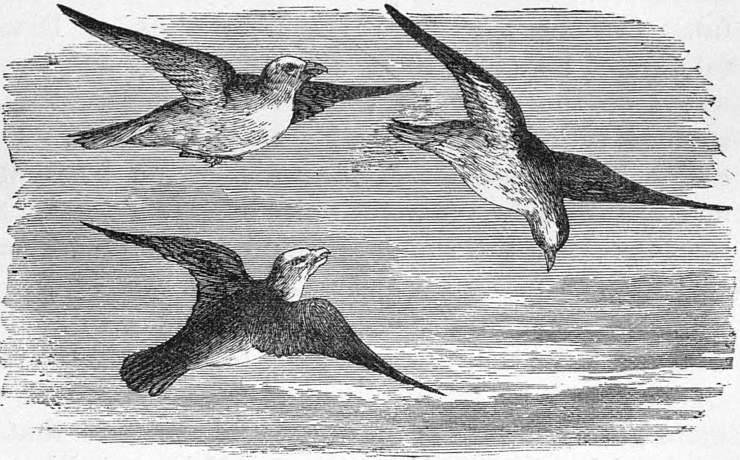
FULMAR PETRELS (“MOLLIES”).
The persistent manner in which the bad weather clung to us was quite marvellous. Hardly a fine day had been enjoyed since we emerged from the ice. The words of Falconer would have been applicable to us, and might have been repeated with truth every morning:
“A lowering squall obscures the southern sky, Before whose sweeping breath the waters fly. * * * * * It comes resistless! and with foaming sweep, Upturns the whitening surface of the deep.”
At length, after being buffeted about for many days, the high land of Disco was sighted on the 25th of September; and on the same day we came to an anchor in the little harbour of Godhavn, and congratulated ourselves once more upon our return to civilization.
The day, as if to make up for our previous bad weather, was a bright sunny one, and perfectly still and calm. This was all the more appreciated after the turbulent seas which had lately almost driven us distracted. The scenery coming in was very beautiful. On one side were the high cliffs of Disco, intersected here and there with deep fiords and bays, whilst on the other lay the perfectly quiescent sea, studded with icebergs of all shapes and sizes. Occasionally the surface of the water would be ruffled and disturbed by the appearance of a seal’s head, as the inquisitive little animal would pop it up to gaze curiously at us as we steamed slowly by; or else a whale, as he swam lazily along, would give a flick with his huge tail, or spout a jet of water in the air, which might be taken either as a welcome back to more genial climes, or an angry remonstrance that a monster larger than himself should dare to live in his own particular domain. Birds flew around and alighted near us. One, a ger-falcon, was so bold as to venture to perch upon our fore-royal truck; but, I am ashamed to relate, was fired at for its misplaced confidence. It escaped, however, unhurt. Everything was bright and joyous, and all were happy and elated. Our joy was slightly marred on arrival to find that our mails had really been taken on and left at Littleton Island; but a mail, with letters of a later date than those brought out by the “Pandora,” which had been got together and made up for us at Copenhagen by my cousin, had just arrived in the Danish brig “Tjalfe.”