Front matter (continued 5)
Reading edition
Such were the details of the general equipment of the sledging parties that were despatched from the “Alert” in the spring of 1876. Officers and men shared alike in everything; they had the same provisions, their costume was identical, they shared the same couch and tent, and each showed the same zealous desire to perform his duty, and the same eager anxiety to bring to a successful issue the service on which they were employed.
Although the whole of the available force on board the “Alert” was engaged in the sledging operations of the spring, we were only able to despatch two extended parties.4 The rest of the men and sledges were required to act as auxiliaries to the advanced parties, and were continually employed during the summer until the return of all the travellers brought our sledging operations to a conclusion.
The programme to be carried out, and which was determined upon after very mature and careful deliberation, was for one party, the command of which was given to Aldrich the first lieutenant, to continue the discoveries of the autumn by exploring the coast line to the westward; whilst a larger party, which was entrusted to my conduct, was to push across the rugged polar pack, and endeavour to reach as high a northern latitude as possible. The exploration of the north side of Greenland, to the eastward, and the examination of the fiords in Robeson Channel, were left to the sledge parties from the “Discovery.”
The difficulties to be encountered and the serious obstacles to be overcome in the journey due north over the frozen sea were well understood. We had made ourselves acquainted with the nature of the travelling to be anticipated by various short excursions on the ice in the vicinity of the ship, and were, therefore, fully aware of the serious character of the work that was before us. None were so rash as to indulge in any extravagant ideas of successfully reaching a very high position. The parallel of 84°, or perhaps 85° by the more sanguine, was regarded as the highest that could possibly be attained.
It was a well-known fact, before the ship went into winter quarters, that the polar pack, composed of extraordinarily heavy ice, was in motion at that season. This motion, or perhaps a general disruption, would occur, it was calculated, in about July or August, possibly in June. It was, therefore, not only a measure of prudence, but one of absolute necessity, that the party destined to travel over this frozen ocean should be provided with the means of safety to themselves, if a disruption should take place at an earlier period than was anticipated. It was therefore decided that two boats,5 capable of conveying the whole party from one floe to another, should form part of the equipment of the northern division. This additional weight, of course, seriously augmented the labour of the men.
The only previous attempt to advance over a frozen sea, away from the land, was made by Sir Edward Parry, in his memorable journey towards the North Pole in 1827.6
For reasons already stated, the northern party was unable to lay out depôts on the ice, nor could our sledges be met by supporting sledges until after their return to the land. It therefore became necessary that they should carry with them sufficient provisions to last for the whole time of anticipated absence. This, with the boats, obliged the two sledge crews composing the division to take with them a third sledge, so that under the most favourable conditions of travelling, they would be compelled, after advancing two sledges, to return over the same road and drag on the third. This we fondly hoped on starting we should be able to accomplish; little did we think that the fearfully rugged nature of the road would necessitate the same distance being traversed five or even seven times.
For the same reason that the men were ordered to emblazon arms and crests on the backs of their clothes, we had the boats which were to accompany the sledges painted with gay and brilliant devices. The rose, shamrock, and thistle were painted on the hulls, and the royal arms decorated their sterns. Moss, on this as on other occasions, was the artist; his great difficulty in accomplishing the work being that in spite of the quantity of turpentine with which the paint was mixed, it persisted in freezing in the brush, rendering that article more like a stick than an artist’s pencil.
The sledges were, of course, all named by their commanders.
1 The eight-men sledge has six uprights eighteen inches apart. It is eleven feet long, three feet two inches wide, eleven inches high, and weighs 130 lbs. complete. In former expeditions sails were frequently used on the sledges to great advantage, when travelling over smooth ice. But we were seldom so fortunate as to meet with ice which was suitable for sailing, in any of our sledge journeys. May and Egerton got their sledges under sail on an extensive floe in Robeson Channel, when they crossed over to the Greenland side; but as a rule the ice we met with was far too rough to make the use of sails practicable. In rigging a sail on the sledge two tent poles are lashed together as a yard, with a spare pole as a foot yard. The other two tent poles are used as shears, and at their ends a mast-head iron, or shear head, is fitted, consisting of two rings united by a piece of iron about three inches long, from the centre of which there is a hook on each side for the steadying guys, and a small block for the halyards is seized on to the iron between the rings. A spare cross-bar is placed on the top of the lading, over the midship uprights, and lashed down to the bearer. It is fitted with a span seized along its top-side, and the bights, with a thimble in each, project just beyond the cross-bar. The ends of the shears are then stepped into the thimbles attached to this cross-bar, and the sail hoisted. On smooth ice, with the wind aft or on the quarter, a sledge will travel under sail at a good pace. But smooth ice was almost unknown in the region explored by our expedition.
2 The tents were of light, close, unbleached duck. The eight-men tents were nine feet four inches long at the bottom, and eight feet at the top, seven feet wide and high, and weighed 44 lbs. The tent ropes are six fathoms long of one and a quarter inch, and the tent poles eight feet six inches long.
3 The medical stores for each sledge were:—2 phials of sal volatile and aromatic spirits of ammonia; 2 phials of laudanum; 2 phials of wine of opium; a small tin of Gregory’s powders; 12 papers (10 grains each) of Dover’s powders; 32 papers (15 grains each) of chalk powders; 30 papers (4 grains each) of sugar of lead; a bottle of turpentine liniment; a phial of carbolic acid; glycerine ointment; white ointment; carbolic plaster; 4 dozen purgative pills; oil silk. Sponge, pins, expanding splints, and carbolized tow, cotton wool, a catheter, a tourniquet, a truss with pad, a lancet, twill, Persian gauze, 2 eye shades, small splint, scissors, flannel ice goggles, tape, mustard, 3 calico bandages, 2 flannel bandages, and lint. These stores were in a wooden case, and a medicine tin for bottles, together weighing 4 lbs.; while their contents weighed 7 lbs. 11 ozs., together, 12 lbs.
4 Our available force was much smaller than that of the expeditions under Sir Horatio Austin (1850-51), and Sir Henry Kellet (1852-54). They enjoyed the great advantage of having a third larger force—ninety instead of sixty men.
5 The sledges for carrying boats have the two end cross-bars fitted with two cleats, one on each side of the boat’s keel. These cleats are seven inches long, and are securely lashed to the cross-bars. Two battens of American elm, each two inches wide and half an inch thick, are lashed in a fore and aft direction to the top of the cross-bars three and a half inches apart, that is to say one and three-quarters inch on each side of the central bearer. They are sufficiently long to allow of being secured to all the cross-bars. When the boat is placed on the sledge the keel rests on the cross-bars between the cleats, and is held in an upright position by one long cushion of stout canvas, stuffed with cork cuttings, on each side, and these are kept in their places by lashings.
6 As Sir Edward Parry’s attempt to reach the Pole was the only extended journey that was ever undertaken due north across the Polar Sea, until the second attempt was made by the northern division of sledges under my command, it will be well to give, in this place, the details of Parry’s equipment and the result of his expedition.
A Sir Edward Parry sailed from England in the “Hecla,” on April 3rd, 1827; when placing her in a safe harbour on the north coast of Spitzbergen, he commenced his memorable attempt to reach the Pole on June 21st. He had two boats, the “Enterprise” and the “Endeavour.” Parry himself, with Mr. Beverley, was in the former, James Ross and Edward Bird in the latter. Ten seamen and two marines formed the crew of each boat. The boats were flat-bottomed, with the extreme breadth of seven feet, carried well forward and aft, and twenty feet long, the timbers of tough ash and hickory. On the outside frame a system of planking was adopted with a view to securing elasticity in the frequent concussions with the ice. This consisted of a covering of waterproof canvas coated with tar, then a thin fir plank, then a sheet of felt, and, lastly, a thin oak plank, all secured to the timbers by iron screws. On each side of the keel there was a strong runner shod with metal, like that of a sledge, on which the boats entirely rested when on the ice. A hide span across the fore-part of the runners had two horse-hair drag ropes attached to it. The boats had two thwarts, a locker at each end, a light framework along the sides for containing provisions and spare clothes, a bamboo mast, and tanned duck sail, fourteen paddles, and a steer oar. They started with seventy-one days’ provisions. The weight of each boat was 1,539 lbs., and the total weight, with provisions, 3,753 lbs., or 268 lbs. per man; besides four light taboggan sledges weighing 26 lbs. each. The daily allowance for each man was 10 ozs. of biscuit, 9 ozs. of pemmican, 1 oz. of cocoa, and 1 gill of rum. Parry took no lime-juice. They slept in the boat with sails as awnings, and travelled during the night.
They sailed in the boats until June 23rd, when it became necessary to haul them on the ice in 81° 12′ 51″ N. The actual travelling then began over floes of small extent, intersected by hummocks. After a journey of thirty days, Parry reached his most northern point on July 23rd, in latitude, by dead reckoning, 82° 45′ N. No actual observation for latitude was obtained at their extreme northern point. They had travelled ninety-two miles over the ice, and two hundred in the boats before they hauled them on to the floe, but were only one hundred and seventy-two miles from the “Hecla.” Such had been the drift of the floes to the southward. The boats returned to the “Hecla” on August 21st, and Parry arrived in England again on October 6th.
This journey was made in the middle of summer after the disruption of the ice. The daily allowance of food for the men was insufficient, and the weight of 26 lbs. for each man was too great. But these were points which could only be learnt by experience, and Sir Edward Parry was the pioneer of Arctic sledge travelling. He attained the highest northern latitude ever before reached by man, and it was forty-eight years and two months before any explorer succeeded in going beyond the parallel which Parry reached in 1827.

CHAPTER XX.
THE JOURNEY OF EGERTON AND RAWSON.
“You were used to say, Extremity was the trier of spirits, That common chances common men could bear, That when the sea was calm, all boats alike Showed mastership in floating.” Shakespeare.
It was a part of Captain Nares’s scheme for the spring campaign that, before the departure of the extended parties, a dog sledge should be despatched to communicate with our consort wintering some fifty miles to the southward of us.
The officers and men of the “Discovery” were, of course, in total ignorance of our position and even of our safety, for no communication had taken place between the two ships since the day of our departure from Discovery Harbour, seven months before. As soon as there was sufficient light to admit of travelling, the important and necessary duty had to be undertaken of conveying information to her respecting our position, so that the anxiety of her people concerning our safety might be relieved, and also that the Captain of the “Discovery” might be made acquainted with our intentions regarding the routes of exploration allotted to our sledge travellers. The parties from the “Discovery” would then adopt other routes, and thus the area of unknown country to he explored would be extended to the utmost limit possible. The work of the expedition, consisting of the journeys of the different parties from the two ships, taking different routes, would thus embrace all that human effort could achieve with the means provided.
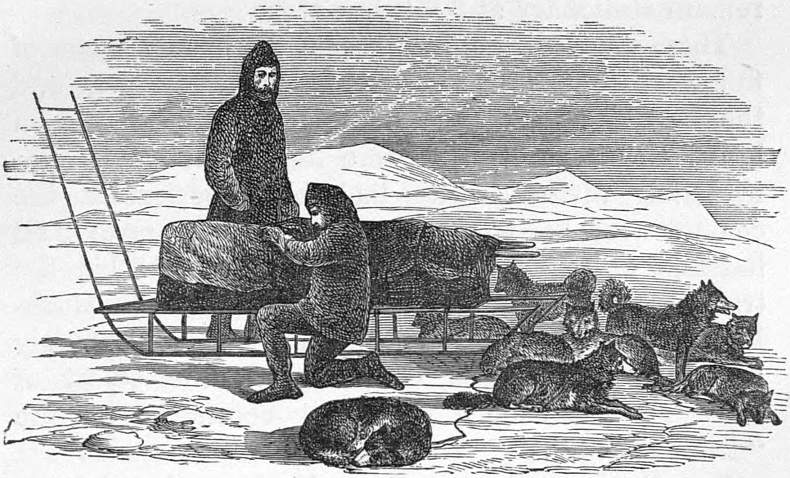
DOGS AND SLEDGE.
The duty of communicating with the “Discovery” was entrusted to Egerton; and Rawson, who was naturally desirous of re-visiting his ship, was allowed to accompany him. Their sledge was dragged by a team of nine dogs, and the party was provisioned and equipped for an absence of ten days. If they failed in accomplishing their object in that time, and their supplies became exhausted, they could replenish their stock from the large depôt that had been established during the previous autumn at a point about midway between the two ships, in Lincoln Bay. Petersen, the Danish interpreter, accompanied the two officers in the capacity of dog driver.
In consequence of the very low temperature experienced during the first week in March, their time of departure had to be deferred. Sunday, the 12th of March, was the day eventually selected for the start of this the first sledging expedition of the season.
The temperature on that morning was low, but rose gradually towards noon, until it seemed inclined to remain stationary at 30° below zero.
There were further indications of a continuance of fine weather, from the day being bright and clear and the barometer steady. Letters to our friends on board the “Discovery” were hastily finished. Immediately divine service had been performed the colours were hoisted, and amidst the cheers of “all hands,” who had assembled on the floe to bid the travellers God speed, H.M. sledge “Clements Markham,” with its bright standard fluttering out bravely before a light breeze, started with the object of renewing intercourse with our comrades in the “Discovery.”
For the next two or three days our thoughts on board were constantly with the absent ones, especially as the temperature, shortly after their departure, had again fallen very low. This, however, caused us little uneasiness, for we knew that everything that lay in our power had been done to protect them from any sudden and extreme cold, and we all had the greatest confidence in the skill, discretion, and sound judgment of our two messmates. Many a silent prayer was offered up in their behalf, that they might accomplish their mission in safety, and return speedily with good news of those who, like ourselves, were wintering in the ice.
On the third day they returned unexpectedly with a sad tale of woe and suffering, and with the poor Dane utterly prostrate and helpless on the sledge. I cannot do better than relate the sad story in Lieutenant Egerton’s own words.
We read in his official report, that not five hours after they had left the ship “frost-bites became so numerous, that I thought it advisable to encamp.”
This was only the beginning of the story, for they appear to have passed a comparatively comfortable night.
At any rate they were up early the next morning and again under weigh; at about one o’clock, when they halted for lunch, Petersen complained of cramp in his stomach and was given some hot tea. He had no appetite, which perhaps was as well, for we read of the bacon, which is always used for lunch, “We were unable to eat it, being frozen so hard that we could not get our teeth through the lean.” They still continued their journey, encountering some very rough travelling, which necessitated severe physical labour on the part of the two officers. “The dogs were of little or no use in getting across these slopes, as it was impossible to get them to go up the cliff, and Petersen being unable to work, Lieutenant Rawson and I had to get the sledge along as best we could.” Towards the end of the day we read: “Petersen began to get rather worse, and was shivering all over, his nose being constantly frost-bitten, and at times taking five or ten minutes before the circulation could be thoroughly restored. Lieutenant Rawson had several small frost-bites, and I escaped with only one.”
On halting for the night, directly the tent was pitched they sent Petersen inside with strict injunctions to shift his foot gear and get into his sleeping-bag, whilst they busied themselves in preparing supper and attending to the dogs; but when they entered the tent, they found “that he had turned in without shifting his foot gear, was groaning a good deal, and complaining of cramp in the stomach and legs.”
Having made him change, they gave him some tea, and then administered a few drops of sal volatile, which appeared to give the poor fellow a little ease.
The next morning the wind was so high and their patient in such a weak state that they did not think it prudent to attempt a start. He had passed a very restless night, and still complained very much of cramp.
Later in the day he appeared to get worse, “shaking and shivering all over and breathing in short gasps. His face, hands, and feet were all frost-bitten, the latter severely, and he had pains in his side as well.” After restoring the circulation they rubbed him with warm flannels and placed one of their comforters round his stomach.
In such a wretched state was the poor fellow that they agreed it would endanger his life if they proceeded on their journey; and that when the weather moderated the only course they could pursue was to return with all haste to their ship.
As it was impossible to keep their patient warm in the tent, these two young officers burrowed a hole in a snow-drift, and into this cavity they transported the sick man, themselves, and all their tent robes, closing the aperture by placing over it the tent and sledge. They deprived themselves of their own clothing for the benefit of the invalid, whose frozen feet they actually placed inside their clothes in direct contact with their bodies, until their own heat was extracted and they were themselves severely frost-bitten in various parts. The poor fellow was now in a very low state; he could retain neither food nor liquid. “About 6 P.M. he was very bad; this time worse than before. There appeared to be no heat in him of any kind whatever, and he had acute pains in the stomach and back. We chafed him on the stomach, hands, face, and feet, and when he got better wrapped him up in everything warm we could lay our hands upon,” namely, their own clothing, which they could ill afford to lose; but they entirely forgot their own condition in their endeavours to ameliorate that of their comrade. Lighting their spirit lamp and carefully closing every crevice by which the cold air could enter, they succeeded in raising the temperature of the interior to 7°; but “the atmosphere in the hut became somewhat thick!” This was, however, preferable to the intense cold. Let us follow the story out, and learn how nobly these two officers tended their sick and suffering companion. “We were constantly asking if he was warm in his feet and hands, to which he replied in the affirmative; but before making him comfortable” (fancy being comfortable under such circumstances!) “for the night, we examined his feet, and found them both perfectly gelid and hard from the toes to the ankle, his hands nearly as bad. So each taking a foot we set to work to warm them with our hands and flannels, as each hand and flannel got cold warming them about our persons, and also lit up the spirit lamp. In about two hours we got his feet to, and put them in warm foot gear, cut his bag down to allow him more room to move in, and then wrapped him up in the spare coverlet. His hands we also brought round and bound them up in flannel wrappers, with mitts over all. Gave him some warm tea and a little rum and water, which he threw up. Shortly after I found him eating snow, which we had strictly forbidden once or twice before. In endeavouring to do this again during the night, he dragged his feet out of the covering; but only a few minutes could have elapsed before this was detected by Lieutenant Rawson, who, upon examining his feet, found them in much the same state as before. We rubbed and chafed them again for over an hour, and when circulation was restored wrapped him up again, and so passed the third night.”
The patience and endurance of the two officers are beyond all praise. It is difficult to realize the misery of that night. Wearied with the severe physical exertions of the two previous days, having their own meals to prepare and the dogs to look after, they had to pass a sleepless and anxious night in their endeavours to keep life in the body of their half-frozen comrade.
On the following morning Petersen appeared to be slightly better, so thinking it was preferable to run the risk of taking him back as he was, than to pass such another night as the last, they put him on the sledge, and, having hurriedly eaten their breakfast, they started for the ship with all despatch. They had a rough journey before them of eighteen miles; but they knew it was a case of life and death, and they encouraged the dogs to their utmost speed. The dogs, being homeward bound, were willing enough and needed little persuasion, so that, for a time, they rattled along at a good pace. But actual progress could not have been very rapid, for we read in Egerton’s report that the patient’s “circulation was so feeble that his face and hands were constantly frost-bitten, entailing frequent stoppages whilst we endeavoured to restore the affected parts.” The difficulties of the homeward journey may be gathered from the following extracts: “On arriving at the Black Cape we had to take the patient off the sledge, and while one assisted him round, the other kept the dogs back, for by this time they knew they were homeward bound, and required no small amount of trouble to hold in. After getting the sledge round and restoring Petersen’s hands and nose (which were almost as bad again a few minutes after), and securing him on the sledge, we again set off. At the next cape the same difficulties were experienced, in fact rather more, for the sledge took charge down a ‘ditch,’1 about twenty-five feet deep, turning right over three times in its descent, and out of which we had to drag it, and while clearing harness (which employed us both, one to stand in front of the dogs with the whip, while the other cleared the lines), the dogs made a sudden bolt past Lieutenant Rawson, who was in front with the whip, and dragged me more than a hundred yards before we could stop them. At length, after the usual process with Petersen (that of thawing his hands and nose, which we did every time we cleared harness, or it was actually necessary to stop), we got away, thankful that our troubles were over. The dogs got their harness into a dreadful entanglement in their excitement to get home; but we were afraid to clear them lest they should break away from us, or cause us any delay, as we were both naturally anxious to return with the utmost speed to the ship, and so relieve ourselves of the serious responsibility occasioned by the very precarious state in which our patient was lying. Upon arriving alongside at 6.30 P.M., we were very thankful that Petersen was able to answer us when we informed him he was at home.”
Poor fellow! it was the last home he ever reached alive, for in two short months his remains were carried from the ship and laid in their last resting-place in this world, on the summit of a low hill overlooking the scene of his last sledge journey! In conclusion, Egerton says, “I regret exceedingly that I have been compelled to return to the ship without having accomplished my journey to H.M.S. ‘Discovery;’ but I trust that what I have done will meet with your approval, and that the course I adopted may be the means of having lessened the very serious and distressing condition of Petersen.” Gallant fellow! of course his doings meet not only with the approval but the admiration of all Englishmen who take pride in the noble and heroic deeds of their countrymen. The work of these two brave young officers on this occasion stands out conspicuously amongst the many deeds of daring and devotion with which the annals of Arctic adventure abound.
It must be remembered that during the time they were away the sun had only just made its reappearance, and was therefore at a very low altitude, so that little benefit could be derived from its rays; and it only afforded sufficient light to enable the travellers to keep on the march for about eight or nine hours a day.2 On the 20th of March, five days after the return from their calamitous journey, the same two officers made another and a more successful start. On this occasion they were accompanied by a couple of sailors, and their sledge was dragged by a team of seven dogs. In five days, after a severe and toilsome journey, rendered doubly so by the extreme cold and the heavy nature of the road over which they had to travel, they reached the “Discovery,” conveying to her officers and crew the pleasing intelligence of our safety, and receiving in return an account of the happy winter passed by them.
Poor Petersen never recovered from the effects of this journey. He rallied a little after he arrived on board, and was placed under the tender and skilful treatment of Dr. Colan, who for some time held out slight hopes of his recovery; but the injuries he had received were of too serious a nature to admit of much hope, and he gradually sank until he expired peacefully on the 14th of May. Perhaps it was better that it should be so, for the poor fellow would not only have been disfigured by losing portions of his nose and ears, but he would also have been a cripple, for the doctor had been compelled to amputate both his feet in order to stop the mortification from extending. These frost-bites are indeed very dreadful, and must always be quickly taken in hand so as to avoid any serious result.
So cold were the frozen limbs of poor Petersen, that his companions said it was like touching cold steel, and produced frost-bite almost as rapidly as if they were really touching a piece of metal!
Although this chapter is rather a mournful one, and has a very melancholy termination, I make no apology for having devoted it entirely to our first sledging expedition of the season, believing that my readers will feel both pride and pleasure in hearing of the noble conduct of my two messmates.
1 By a “ditch” is meant a hollow formed between a high snow-drift and a hummock or any projection. Some of these ditches were very steep and precipitous.
2 In previous expeditions parties have left their ships in March; but the March of 75° N. is very different from the March of 82° N. In the former position the sun has been many days longer above the horizon than in 82° N.
CHAPTER XXI.
THE ROUTINE OF SLEDGE TRAVELLING.
“We are well persuaded We carry not a heart with us from hence That grows not in a fair consent with ours; Nor leave not one behind, that doth not wish Success and conquest to attend on us.” Henry V.
On the morning of Monday, the 3rd of April, an unwonted bustle and excitement on board and around the “Alert” betokened that something unusual was taking place. Men in their travelling costumes might have been observed busily engaged in adding the last finishing touches to the already well-packed sledges. Officers, also in travelling attire, were carefully conveying delicate instruments from the ship to the row of sledges drawn up in “line of battle” on the floe, whilst the white ensign flying from the peak bore witness of some important event.
The day was indeed one of memorable import, for it was the one that we had all, during the long dark winter, looked forward to as that on which our real work was to commence. It was the day on which we were to start forth with the object of achieving all that was possible with the means at our disposal, in the great and glorious work of increasing the stock of geographical knowledge respecting the Polar regions. No wonder, then, that the scene of our winter quarters presented an animated and unwonted appearance on that bright but intensely cold morning.
The sledges, seven in number, on two of which were placed the boats to accompany the northern division, were drawn up in single line, one before the other, according to the seniority of their respective leaders. They were all fully equipped and provisioned, and were “manned” by a force of fifty-three officers and men; a chosen band, eager to emulate the deeds of their predecessors, and willing to risk their lives in bringing to a successful issue the task they had resolved to accomplish.
A strict medical examination had been held a day or two previously, and the rather unnecessary question, “Do you feel yourself fit and able in every way to go sledging?” was put to all. It is needless to record the answer!
On the previous day, being Sunday, Pullen preached a capital sermon, drawing comparisons between the undertaking in which we were about to engage, and the march of the Israelites to the Promised Land. The hymn “for those at sea” was sung and the Holy Communion celebrated, at which latter service there was an exceptionally good attendance, the number of communicants amongst the men having largely increased.
From each sledge flew the bright colours of its commander’s standard: a swallow-tailed flag bearing the armorial colours, and emblazoned with the crest of its owner, each charged with the red cross of St. George. In addition, the two boats displayed from their mast-heads Captain Nares’s Union Jack and a white ensign. Worked by the fair hands of some loved and cherished one at home, these standards, as they fluttered out bravely before a gentle breeze, kindled our enthusiasm, whilst they materially added to the spirit and gaiety of the scene.
The sledges were arranged in the following order:—“Marco Polo” (with a boat), “Challenger,” “Victoria” (with a boat), “Poppie,” “Bulldog,” “Alexandra,” and “Bloodhound;” the latter was only a small sledge party ordered to accompany us for three or four days, then supply us with three days’ provisions, and return to the ship to report our progress.
At eleven o’clock, everything being in readiness for a start, all hands assembled on the floe, and prayers were read by Pullen. The hymn, “God, from whom all blessings flow,” was then sung, after which the order was given to “fall in,” and, amidst the hearty cheers of those few who were left behind, the sledging parties moved off. The captain and officers accompanied us for a short distance, when, wishing us Godspeed, they turned to go back. This was a signal for three cheers from the travellers, after which they settled down to their work, and the march was steadily commenced.
The first day’s march was necessarily a short one. It was to many their introduction to the “drag-ropes,” and symptoms of fatigue were soon detected, caused by the energetic exertions of the inexperienced, who, unlike the veterans of the previous autumn, overtaxed their strength in their ardour to perform a good day’s work.
The temperature at starting was 33° below zero, and at this it remained steady the whole day, rendering the task of writing up our journals when we halted extremely unpleasant and painful.
The scene of our first encampment was an animated and picturesque one. We had marched about six miles from the ship, and the site selected was at the base of a low brow, forming a connection or isthmus between a long projecting tongue and the mainland. Here we pitched our seven tents, from each of which the smoke from the cooking utensils issued, ascending in spiral columns until lost amidst the clouds. In our rear were the snow-clad hills, whilst in front was the illimitable frozen sea. Men hurried about in the execution of various duties incidental to “pitching for the night,” such as the issuing of provisions by the several sledge-captains, the banking up with snow of the exterior of the tents, the re-packing of the sledges, or the careful covering up of the lading so as to ensure its protection from snow-drift; all of which duties must be sedulously carried out before rest and repose can be sought in the sleeping-bags. A pleasing aroma of cooking tea was mixed with the fragrance of stewed pemmican, and made us smack our lips in anticipation of the meal that was preparing.
Not the least hard part of a day’s work is that of camping after a toilsome and weary journey, especially when the temperature is low and a cold sleepless night anticipated; but when the weather is warm enough to obtain a good night’s rest, the order to halt is always received with very great satisfaction, more especially when a good day’s work has been accomplished, with the prospect of fair travelling on the morrow.
As soon as the tents are ready for the reception of the men, they enter one by one, take off their “overalls” for which their duffel coats are substituted, change their foot gear and get into their sleeping-bags. This change of foot gear in the morning and evening is the whole extent of the toilet performed by the sledgers until their return to the ship!
The following morning we were under weigh pretty early, having spent a cold wretched night, only too glad to be up and doing something, the temperature inside our tent, with all the men in their bags, being as low as 15° below zero. The experience gained during the autumn had a very salutary effect on the travellers, the apprehension even of frost-bite being in itself sufficient to banish all idea of sleep.
The operation of dressing and undressing, although it is entirely limited to the clothing of the feet, is without doubt one of the most disagreeable duties connected with sledge travelling. Our hose and blanket-wrappers, although they were invariably kept inside our sleeping-bags during the night, were frozen so hard in the morning that they were with the greatest difficulty folded over our feet. Sometimes the wrappers were tied round the knees at night-time to protect them from the cold, for that part of our body seemed more sensitive to the temperature than any other.
Not the least trying part of our toilet was lacing and tying the stiffly frozen strings of our equally hard moccasins with fingers either aching from cold or devoid of all sensation. Not only was this a very painful operation, but it was one that sorely taxed and ruffled the equanimity of our tempers.
The snow over which we travelled was very soft and, unfortunately for us, was also very deep, making the dragging with our heavily laden sledges most laborious, in fact so much so that we were frequently compelled to resort to “double banking;” that is to say, the two crews would be employed in first dragging on one sledge and then return to advance the other. This, of course, made our progress very slow. After the long confinement of the men during the darkness of the winter, they were, in spite of the careful attention that had been paid to daily exercise, hardly in what might be called first-rate condition, so that fatigue for the first few days was felt by the majority, and not wishing to impose too much on their zealous desire to push on, short journeys were in consequence performed.
On the second day out, the temperature fell to 45° below zero, or 77° below freezing point. The cold then was so intense as to deprive us of sleep, the temperature inside the tent being as low as -25°, the whole period of rest being occupied in attempting to keep the blood in circulation. Several frost-bites were sustained, but they were all attended to in time, and resulted in nothing worse than severe and very uncomfortable blisters.
So hard were our tent robes and sleeping-bags frozen that they resembled sheet-iron, and care had to be taken to prevent them from coming into contact with the face, for an abrasion of the skin would undoubtedly follow!
Our curry paste, a small quantity of which we used to mix with our pemmican to make it more palateable, looked, as the cook of the day observed, exactly like a piece of brass, and was equally hard. Cramp in the legs was complained of by many during the first few nights, but gradually wore off, having in all probability been induced by the severe and unaccustomed exercise. Thirst was also a subject of complaint, and this, except at meal times, it was impossible to alleviate; for although each man was supplied with a tin water-bottle covered with duffel, the water could not be prevented from freezing, in spite of the bottles being kept inside the waistbands of the men’s trousers. The practice of quenching thirst by putting snow or ice into the mouth is a very dangerous one and was never permitted.
On the fourth day out we parted with our little sledge, the “Bloodhound,” which, having fulfilled its mission, returned to the ship, taking back one of our party, who appeared unable to stand the fatigues of sledging, and leaving one of their crew to fill his vacancy. We were thus able to send back intelligence of our progress so far, and to report the health of the men to be satisfactory, and that all were in capital spirits. On the 10th of April the six sledges in company arrived at the depôt of provisions established near Cape Joseph Henry during the autumn, and found it undisturbed. The remainder of that day was employed in bringing the provisions off to the sledges, which were left on the ice, and in distributing them. The next morning was thick and foggy, the atmosphere being rendered doubly obscure by a heavy fall of snow.
“The cold, uncomfortable daylight dawned, And the white tents, topping a low ground fog, Show’d like a fleet becalmed.”
On this day the supporting sledges “Bulldog” and “Alexandra,” having performed the duties allotted to them, bade farewell to their companions and returned to their ship. The two extended parties advanced on their solitary missions; the northern division leaving the land and pushing straight out on the rugged polar pack, whilst the western party continued the exploration of the coast to the westward.
It was a strange farewell that was taken on that cold dull day on the inhospitable ice-floe, amidst bristling hummocks and heaped up snow-drifts, as the several parties pursued their different courses, one returning to their Arctic home, the others to unknown difficulties, but to hoped-for discoveries.
Brief was the parting, but sincere were the wishes for each other’s success. Hearty British cheers resounded in that icy wilderness, hitherto undisturbed by the presence of mortal man, as we bade adieu to our fellow-travellers, the echoes from which had scarce died away before their forms vanished from our view in the thick driving snow that shrouded in obscurity the surrounding objects.
It was, however, no time for reflection; for now all our energies, both mental and physical, had to be devoted to the furtherance of the great work with which we were entrusted. The men resolutely seized their drag-ropes, and with light and willing hearts commenced their toilsome advance.
In order to enable my readers to follow us during the time we were engaged in the sledging operations, I will endeavour to explain, as briefly as possible, the ordinary daily routine invariably carried out by those so employed belonging to the “Alert.”
The cook for the day is an important personage, and his duties, as I have before related, are of a very onerous and trying description. Each individual composing the sledge crew has to perform this office in turn during twenty-four hours, and it is one that sorely taxes his patience and powers of endurance, especially in very cold weather. He gladly transfers his functions as cook to his successor, happy in the assurance that his “turn” will not come round for another week, unless sickness or any other unforeseen event should prostrate any of his comrades.
The cook’s work commences at an early hour, when, after having lighted his lamp and converted sufficient ice or snow into water for the morning meal, he reenters the tent, and walking unconcernedly on the sleeping forms of his companions, proceeds deliberately to brush from the top and sides of the tent the condensed moisture that has been accumulating during the night, and which falls in minute frozen particles on the coverlet. This operation being concluded, to the no small relief of those over whom he has been walking, the coverlet is removed, well brushed, shaken, folded up, and placed on the sledge. He then busies himself with the important preparations for breakfast. In about two hours from the time that the cook is called, the cocoa is reported ready, when the rest of the party are awakened.
If the weather is very cold, breakfast is discussed in our bags, in which we all sit up; a comical-looking lot in our grey skull-caps and duffel coats! The biscuit bag is then laid in the centre of the tent, spoons are produced, and the pannikins, each containing one pint of warm cocoa, are handed in. The only articles that were not considered as common property amongst us were our spoons. These were slightly larger than an ordinary table-spoon, were made of horn, and supplied to each sledger by a beneficent Government. We generally carried them slung round our necks by laniards, or in our pockets.
The pannikins being emptied they are returned to the cook, who has in the mean time been preparing the pemmican. So hard is this article frozen that the portions for use have to be chipped off with a chopper before they can be put into the stew-pan.
While the cook’s anxiety is momentarily increased by the fear that his fuel will be consumed before the repast is prepared, and his fingers are alternately burnt and frost-bitten in his endeavours to trim and adjust the lamp, prayers are read to those inside, the foot gear is changed and the sleeping-bags rolled up. By the time this has been done, the pemmican is ready, passed in, and eaten. Orders are then given to strike tent, pack sledge, and prepare to march.
The great secret in packing a sledge properly is to have the weights as nearly as possible in the centre—as far from the extremes as it is possible to get them, so that the sledge may rise easily over obstacles. When all is ready, the drag-ropes are manned, and with a “one, two, three, haul,” and a good pull altogether, the sledge is started and the march commenced.
Care should be taken to scrape the pannikins out with a knife, before the refuse inside has time to freeze, otherwise it will be difficult to remove. Water for washing purposes, of any description, whilst sledging is quite out of the question. After marching for about five or six hours, a halt is called for lunch. This meal consists of four ounces of bacon, a little biscuit, and a warm pannikin of tea to each man.
Although the most refreshing and enjoyable of all our meals, luncheon was, when there was much wind, or the weather intensely cold, a very trying one. The halt is of necessity long. Frequently an hour or an hour and a half elapses before the tea is reported ready, during which time the men are compelled to keep constantly on the move to avoid frost-bites. When there is much wind the tent is pitched; but this adds little to our comfort, for it is too cold to remain inside for any length of time. If we were not all suffering from the same cause, we should be disposed to laugh at the strange antics of our companions in their efforts to keep their feet from getting frost-bitten. One man is “marking time” at the double; another jumping up and down in a frantic manner; another is sitting down cross-legged like a Turk, or a tailor, and is occupied in belabouring his feet with his mittened hands, in his energetic endeavours to restore circulation; whilst another, unable any longer to endure the cold, commences furiously to kick the sledge, or a hummock, with both feet like one bereft of his senses. Although halted, little rest is enjoyed; anxiously is the kettle watched, and many are the tender inquiries concerning the state of the water inside. “Does it boil?” is a question frequently asked, and unless the cook is blessed with an amiable disposition, the perversity of the kettle is sufficient, at times, to drive him almost distracted. The old saw, “A watched pot never boils,” is fully exemplified. At length, to the relief and delight of all, the announcement is made that the tea is ready, when all troubles are forgotten in the pleasure and enjoyment of a warm pannikin of tea. Sometimes little difficulties would arise in consequence of the haste with which it was necessary to prepare and discuss this meal. These, although serious at the time, served afterwards to amuse, and were soon forgotten. On one occasion, the water having been boiled, and the cook having, as he thought, carefully added the tea and sugar, which were as carefully stirred up, the allowance of tea was served out and eagerly drunk by the wearied sledgers, who were only too glad and thankful to receive anything warm. It was not until some time after the allowance had been consumed that the cook discovered he had omitted to put in the tea, and had served out simply a decoction of warm water and brown sugar! Sometimes the tea was made from salt-water ice, the cook having inadvertently mixed it before tasting the water! In such a case we had either to drink it, or get none at all!
Our bacon was, as a rule, frozen so hard as to be like a piece of granite, and it was only by thawing it in our warm tea that it became eatable. This had the effect of converting our tea into a sort of soup!
The time of halting for the night varied considerably; but it was generally after ten, eleven, and sometimes twelve hours’ steady marching. The first thing to be done is to select a suitable site as level as possible and where the snow is not too deep, for pitching the tent, which should be carefully banked up outside with snow to the height of two or three feet. Every one assists in this work except the cook, who is busily engaged in the necessary preparations for the evening meal. As soon as the tent is ready, the men enter, change their foot gear, and struggle into their half-frozen bags, their toes and feet having previously been examined by the officer for the detection of frost-bites. If a frost-bite is discovered, circulation is immediately restored, and the injured part dressed by the application of a little glycerine ointment and some lint.
As a rule the moccasins, hose, and blanket wrappers are so firmly frozen together that they are with difficulty separated, and are taken off the feet as one article of clothing. It is amusing to witness the frantic exertions made by some of the men in their efforts to struggle into their duffel coats. They are frozen so stiff and hard that this operation is always an intensely aggravating one, and even when it is accomplished, the men are utterly helpless until the warmth from their bodies has partially thawed the coats and rendered them supple. They were, with a very great deal of truth, likened to “strait-jackets.”
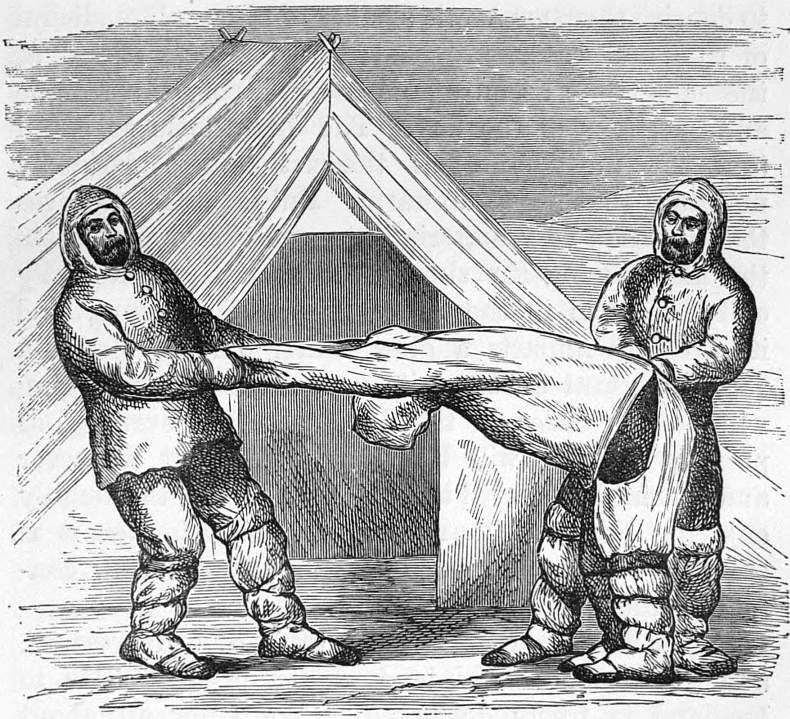
GETTING READY TO “BAG.”
By the time that the whole party are comfortably settled in their bags, supper, consisting of tea and pemmican, is ready and served; after which pipes are lighted, conversation ensues, and the allowance of grog is served out. This is undoubtedly the most delightful and happiest part of the day’s proceedings, and I should deprecate very strongly any attempts to deprive the poor Arctic sledger of his small modicum of rum and water, provided it was always issued at the same time as ours, and never during the fatigue and exertions of the day. The quantity is so small that the most fanatical theorist cannot seriously maintain that it can do harm. But experience proves that it tends very materially to cheer and invigorate the men during the short time that they can really call their own in the whole twenty-four hours, and it certainly imparts a glow which induces sleep—a very important effect of its use. Sometimes singing will be the order of the day, or rather evening, or perhaps a book will be read aloud; but whatever amusement is resorted to for the purpose of thoroughly enjoying the half-hour after supper, whether it is singing, reading, or yarning, all are cheerful, contented, and happy.
Home is, of course, a great topic of conversation, and what each man intends doing on his return to England is freely discussed. We know all about each other, and frequently detect ourselves confiding secrets that we should under ordinary circumstances divulge only to our bosom friends. Sometimes a hot argument is maintained between two men belonging to different counties on the relative merits of the pigs of their own counties and their manner of feeding; or perhaps they will get into a discussion on the liberality of large landed proprietors near whom they may be living. For instance, one man who lived in Devonshire was extolling Lord Mount Edgcumbe. “Ah! he was a noble lord! he opened his grounds once a week for the admission of the public.” But another man, hailing from Lancashire, answered by saying, “He didn’t see that he was any better than any other lord; for,” he said, “Lord Derby admitted the public into his park every day, and if it was raining he would send his carriage for you!” This argument, although I fear not strictly correct, was unanswerable, and the west countryman had to give in to the more liberal experiences of his friend.
Before composing ourselves to sleep, the cook, having made the necessary preparations for the morning’s meal, passes in our coverlet. This is always the last thing done before closing the door of the tent for the night.
How is it possible to describe what this coverlet is like when handed in? Those who have never been initiated into the mysteries of Arctic sledge life would be unable to realize what it resembles when unpacked from the sledge. It is more like a piece of wood or sheet-iron than an article of woollen material. With the utmost difficulty it is unfolded; but as for spreading, that is quite out of the question: it stands up in the centre like a second tent, and refuses to lie flat, in spite of the beating with which it is assailed. It is only after it has been some time in this position that it gradually thaws, when it becomes a “wet blanket” indeed!
The contents of this chapter may give some idea of the ordinary routine of a sledge traveller’s life. The details were invariably carried out by the different sledge parties despatched from the “Alert.” In the succeeding chapter we will follow the fortunes of the northern division, and I shall endeavour to depict briefly the difficulties it had to contend with, and the manner in which they were surmounted.
CHAPTER XXII.
THE NORTHERN DIVISION—TRAVELLING IN APRIL.
“These high wild hills, and rough uneven ways, Draw out our miles and make them wearisome; And yet your fair discourse hath been as sugar, Making the hard way sweet and delectable.... But I bethink me, what a weary way!” Richard II.
The different sledge parties having branched off, as related in the preceding chapter, I must request my readers to follow the fortunes of the northern division, which was under my command.
The serious obstacles that so persistently impeded our progress were immediately encountered. The retreating forms of our comrades, who had assisted us thus far, were scarcely out of sight before we were busily engaged in constructing a road along which to drag our sledges. These roads were rendered necessary in consequence of the rugged nature of the ice over which we had to travel, the floes being of the smallest dimensions as regarded superficial area, and surrounded by broad fringes of squeezed-up hummocks. The hummocks proved most formidable impediments to our advance. No sooner had we congratulated ourselves upon successfully accomplishing a passage through one line of these obstacles, than another, and perhaps a more ragged and apparently impassable hedge, appeared in front of us. It seemed as if a terrible conflict had been fought between these ponderous masses of ice, which had so shattered and split them up as to suggest to us the idea that they resembled a tempestuous broken sea suddenly frozen.
To make any advance at all, pickaxes and shovels were in constant requisition, and with these implements we succeeded in hewing and cutting a road for our sledges, by which we were able to make a snail-like progress. The roughness of the road was not our only difficulty. Around and about the hummocks the snow had drifted to such a depth that the men were frequently floundering in it up to their waists, and passages through this had to be cleared with shovels before the sledges could be dragged on. Occasionally the sledges would have to be unpacked and lightened considerably before they could be dragged through this deep soft snow.
We, at first, attempted to console ourselves with the idea that this irregular and broken sea of ice was only caused by our proximity to the land; and that we should, as we advanced in a northerly direction, meet with smooth level floes, on which we should be able to travel along merrily, and so make up for the time expended in struggling through the hummocks.
How delusive proved our hopes and anticipations the sequel will show! The belts of hummocks that separated the floes varied from twenty yards to half a mile in breadth, and were from fifteen to fifty feet in height.
Road-making, as we called it, was a work of daily, I may say of constant, occurrence. We regarded our pickaxes with great affection, and they were consequently treated with the utmost tenderness and care. Any mishap to them would have been indeed a serious misfortune, as we should have nothing to supply their place, and would therefore have been in a predicament in which we could neither advance nor return. The anxiety with which they were watched may therefore be imagined.
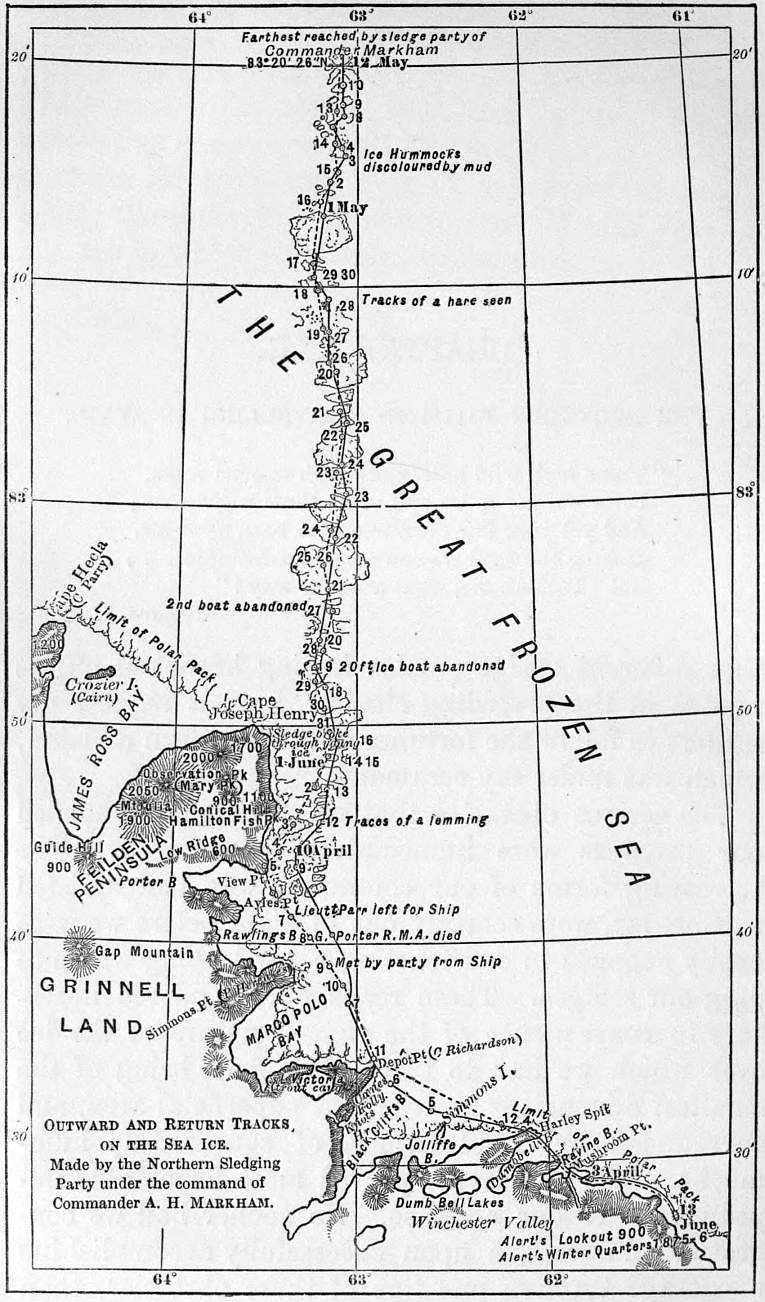
Instead of giving simply a brief résumé of our sledging life, it will, I think, be more interesting to follow the sledge parties day by day in their arduous march to the northward, and their still more irksome and wearisome return journey. To do this, it will be as well to extract portions from my daily journal, avoiding repetition as much as possible, and commencing on the day after that on which we were left by our supporting sledges to prosecute our undertaking.
April 12th.—A most gratifying and unexpected change of weather enabled us to pass a comparatively comfortable night, the temperature inside our tent being as high as +16°. Hitherto it has stood at, and generally far below, zero. With the thermometer in the air registering a few degrees below zero, it is just possible to keep ourselves warm enough inside our tents to sleep; but with a temperature ranging from -35° downwards sleep is almost out of the question.
In order to keep the sun as much as possible at our backs during the time we were on the march, we adopted the system of travelling, whilst on our outward journey, between noon and midnight. The cooks were, as a rule, called at about half-past nine in the forenoon, and the sledges were generally on the move about half-past eleven. This time of travelling was selected more with a view to the prevention of snow blindness than anything else.
After breakfast the road-makers, six in number, were advanced for the purpose of constructing a road through an ugly fringe of hummocks on the southern side of which our camp had been pitched; the rest of the party being employed in striking the tents, packing and bringing on the sledges, one by one, as far as the road was practicable. Being a bright sunny day the tent robes and other gear were triced up to the boats’ masts and yards to dry. The sun was powerful enough to extract the moisture from the woollen substance, which would freeze, forming a sort of hoar-frost that could with ease be brushed or shaken off.
On these bright clear days, the snow on the surface of the floes over which we were journeying was so highly crystallized that it sparkled and glittered with the most brilliant iridescent colours. The ground upon which we trod appeared to be strewn with bright and lustrous gems, of which the most prominent were diamonds, rubies, emeralds, and sapphires. It was indeed a fairy-like scene; but our duties were too matter of fact to admit of our indulging for any time in romance or sentiment.
A glance at our comrades would quickly recall us to the reality of our situation. Their dirty and rough-clad forms were strangely at variance with the scene of enchantment that might be conjured up. With faces scarified by the combined action of sun and frost, and black with smoke, with the tips of their fingers senseless from repeated frost-bites, with sore shoulders and aching limbs, the wearied sledgers pursued their way, not altogether indifferent to the beauties that surrounded them, but careless of the difficulties and discomforts they encountered.
During the afternoon, being about three miles from the nearest land, we observed, to our surprise, the fresh traces on the snow of a little lemming! It is hard to tell what inducement this little animal could have had for straying so far away from the land, and consequently from its means of obtaining the wherewithal to support life!
We passed through a dense mass of hummocks, emerging, eventually, on a heavy floe of “ancient lineage,” whose surface was undulating, and adorned with veritable “ice-mountains” some twenty feet in height. These were generally of a rounded form and of a smooth surface, and appeared to be the result of long and continuous snow-drift. We camped on the northern edge of the floe, the men being employed in cutting a road through the hummocks whilst supper was preparing, in readiness for our start on the morrow.
A journey through, and over, hummocks is the most unsatisfactory kind of travelling that can possibly be imagined. “Standing pulls” must be the order of the day, and the incessant “one, two, three, haul” is constantly heard. The trudging backwards and forwards to drag the different sledges to the front along the same road is decidedly monotonous; but this had no effect on the cheerfulness and general good spirits of the men, who were all actuated by the same zealous desire to do their best. The temperature all day had been delightful, ranging from 8° to 20° below zero.
April 13th.—A dull, cloudy day, with the sun shining at intervals, and the temperature as low at one time as -33°. We cut a road and dragged the sledges through a fringe of hummocks about two hundred yards in breadth, then crossed a fine large floe that afforded us capital travelling for nearly a mile in a northerly direction, then through another long fringe of large and troublesome hummocks, until we were completely brought to a standstill by a mass of enormous fragments of ice, piled up in an irregular form to the height of from twenty to thirty feet. Through this obstacle we resolved to cut a road: in fact, no other alternative offered. It was a long and tedious job; but with such a hearty good will did the men work that we had the satisfaction of dragging our sledges over a very rough road and encamping for the night with the difficulties in our rear. Parr with pickaxe and shovel was a first-rate “navvy,” and worked like a horse.
Our routine was for one or other of us to select the best route through the hummocks. This being done, one, with a gang of road-makers, proceeded to construct the road, whilst the other, with the remainder of the party, dragged the sledges on one by one. Great care had to be taken that our boats, on the exceedingly rough road over which they were dragged, did not sustain any injury. Sometimes it was a very delicate matter, and one that required skilful handling, after the sledges had been hauled up to the top of the hummocks, to lower them down in safety on the opposite side. The ease and facility with which the ice yielded to the dexterous blows of the pickaxes, wielded by strong and determined men, was almost incredible. Apparently impenetrable masses of ice vanished before their efforts, and left a fairly good road by which we advanced.
April 14th.—Last night our sleeping-bags were frozen so hard that it was with great difficulty we succeeded in getting into them. Even when this was accomplished, the warmth we derived from them was inappreciable, and we felt more as if we were confined in a wooden box or coffin than in a woollen bag! My blanket wrappers, although I laid on them all night, were so stiff this morning that I had the utmost difficulty in bending them over my feet! Being Good Friday, our prayers in the morning were of longer duration than usual.
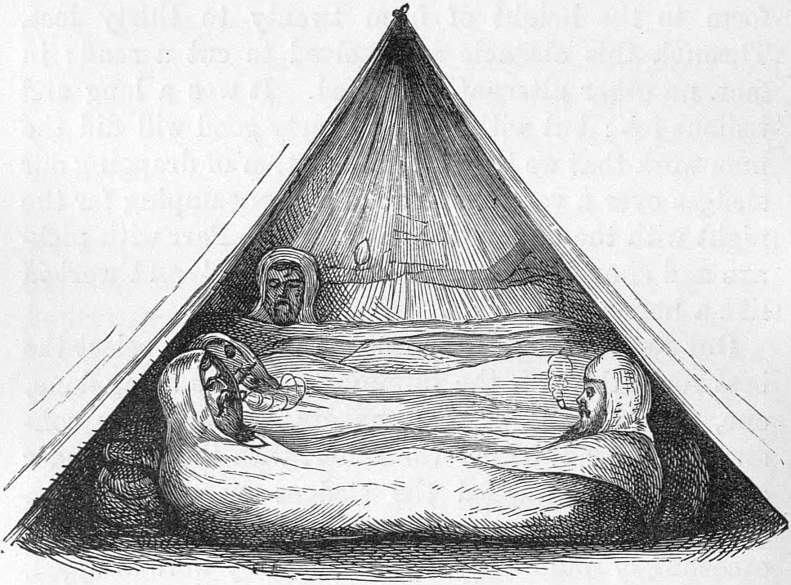
INTERIOR OF TENT.
Crossed an old floe having a hard incrustation on its surface—not sufficiently strong, however, to bear the weight either of the men or the sledges; consequently at every step we broke through, and would then sink deeply into soft snow. This was not only very laborious but very aggravating work.
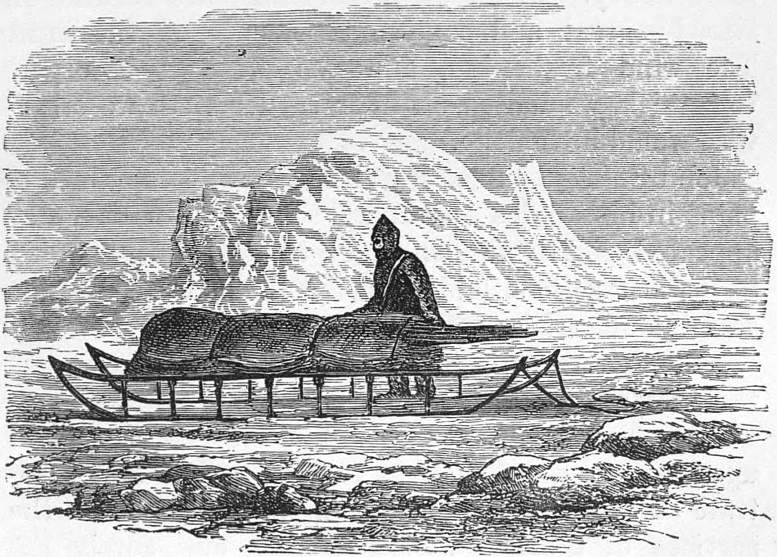
A PACKED SLEDGE.
On portions of the road, where these patches of level soft snow occurred, the flat-bottomed taboggans, used in the Hudson Bay Company’s territory, would be suitable. But the greater part of the road was over heavy broken-up hummocks and hard fragments of ice, lying at all kinds of angles; on the whole we found the eight-men high-runner sledge which we used, and which was originally designed by Sir Leopold McClintock, infinitely preferable. Long experience has conclusively proved its excellence. It was the kind of sledge with which the North West Passage was discovered and the Parry Islands explored, and with us it once more did most admirable service in many directions, and over the roughest ground imaginable.
The temperature was too low to allow us to stop for the purpose of obtaining a meridian altitude, which we invariably get at noon. There was an unpleasant nipping breeze from the northward; our faces, more especially our noses, being “touched up” constantly by Jack Frost.
The floes off Cape Joseph Henry, although actually smaller than most of those we have crossed, were far more heavy. In all probability they are reduced in size by great and continual pressure off the cape. The wind freshening, and the weather becoming very thick, we halted an hour earlier than we otherwise would have done.
John Shirley, one of my sledge crew, complained of pains in his ankles and knees. On examination they appeared slightly swollen, and I treated him according to the instructions laid down for the guidance of the sledging officers by our doctor.
Although at the time ignorant of the fact, this was the first appearance of that dreadful disease, scurvy, which shortly afterwards laid its destroying hand upon us, and reduced us to such a helpless and prostrate state. From this day we were deprived of the services of Shirley, who gradually but surely got worse, and was never again able to render the slightest assistance even in the most minute details of our routine.
April 15th.—A N.W. gale, with an exceedingly low temperature, and an impervious snow-drift, rendered travelling quite out of the question.
Extreme wretchedness, I might almost say abject misery, was our lot to-day.
We appeared to receive little benefit, in the way of warmth, from our tent robes, and the temperature inside our tent, with our whole party huddled close together, was 22° below zero! Gladly would we have pushed on had it been possible. A hard day’s work, even amongst the most impenetrable hummocks, would have been infinitely preferable to our present forced detention and inactivity. Unable to stir outside the tent, on account of the blinding snow-drift that was whirling around, too cold to read or even to sit up in one’s bag for the sake of conversation, tent robes and bags frozen hard—a combination of these evils renders the position of those who suffer from them an unenviable one indeed. It is a remarkable fact that we this day experienced a lower temperature during a gale of wind than we did during the whole winter at the “Alert’s” winter quarters. This appears to point conclusively to the fact that there can be no large body of water either to the northward or westward of us.
The thermometer invariably rose during the southerly gales experienced in the winter, and this was very naturally attributed to the wind blowing across a large expanse of open water.
April 16th.—Easter Sunday.
The gale, although it had moderated, was still blowing too fiercely to allow us to proceed. We were therefore compelled, sorely against our inclination, to remain encamped. We unanimously came to the conclusion that this was by far the most wretched and miserable Easter Sunday that we had ever spent. Forty-eight hours in a gale of wind, tied up in a bag off the most northern known land, with a temperature 67° below freezing point, is certainly not the most pleasant manner that any one would select for passing an Easter Sunday!
For forty hours I did not have the slightest feeling in my feet, and could not really declare that I was in possession of those useful members—as for sleep, under the circumstances, that was quite out of the question. In spite of the cold and dismal surroundings, we did not neglect last evening the usual Saturday night’s toast, on receipt of our small allowance of grog. It most decidedly had the effect of cheering us up considerably, and for the time assisted in making us forget the discomfort of our position. At half-past four in the afternoon, the wind having subsided, it was determined to make a move. We felt that anything was preferable to the tedium and dreariness of our compulsory detention. The tents were accordingly struck, sledges packed, and the march renewed. Shirley, being unable to walk, was placed in his sleeping-bag, rolled up in the tent robes, and tied securely on one of the sledges. This seriously added to the weight to be dragged, whilst it also reduced our motive power; however, we hoped that by thus giving him complete rest, he would the more rapidly recover and resume his place on the drag-ropes.
Alas! how little did we think that the fearful and wasting disease, the premonitory symptoms of which were now exhibited, would insidiously steal its way amongst us, and assailing the party one by one reduce us so disastrously as to bring us to the verge of destruction!
We cut our way through a hedge of hummocks about one-third of a mile in breadth, and then on to a floe apparently of great thickness; but, unfortunately for us, not more than three hundred yards across. Between these stupendous floes we would occasionally meet with some young ice amongst the hummocks which, when it trended in the right direction, would afford us easy travelling; but these leads were never of any extent.
The gale had accumulated the snow in deep drifts, which rendered the task of dragging the sledges harder than ever. Our progress was necessarily slow. We halted and encamped at half-past ten. The men appeared to be more easily fatigued after lying so long idle in their bags than if they had performed a hard day’s work. Our camp this evening was pitched almost abreast of Cape Joseph Henry, though some miles off it.
When viewed from seaward, or more correctly speaking, “iceward,” this headland presents a bold and rugged appearance, rising nearly perpendicular from base to summit, to a height of about eight hundred feet, whence the land recedes, gradually ascending until it culminates in a peak about three or four hundred feet higher. It appears to be of limestone formation, with regular stratifications dipping to the southward at an angle of 6° to 10° from the horizontal. The Cape itself terminates in a knife-like edge from summit to base, in shape very much resembling the ram-bow of an ironclad. Conical Hill, situated immediately to the southward of Cape Joseph Henry, when observed on the same bearing, presents more the form of a hog’s back than a cone, but possesses the same bold, rugged aspect. It is about the same height as the peak surmounting Cape Joseph Henry, and is of the same formation; but, unlike its neighbour, the strata dip to the southward at an angle of about 6° or 10° from the vertical, giving it altogether a rather distorted appearance. There is a great deal of similarity in the surrounding hills, all being more or less coniform, and of an altitude of from one to two thousand feet.
April 17th.—Shirley no better this morning, and to add to our troubles, George Porter, one of Parr’s sledge crew, was also suffering in the same manner from swollen and puffy knee joints.
Two men hors de combat out of our little force diminishes our strength very materially, and as they have both to be carried on the sledges it adds seriously to the weights to be dragged. The morning was bright and sunny, with a temperature as high as 24° below zero, so we congratulated ourselves that it was now really on the turn, and that we should no longer encounter any more extreme cold. The men take kindly to their snow-goggles, and never attempt to take them off whilst on the march—perhaps my expatiating largely on the excruciating agony and acute pain inseparable from snow blindness, is in some way connected with their submissiveness in this respect! Alfred Pearce was, yesterday, rather severely frost-bitten on one of his fingers; but circulation was rapidly restored, and to-day, with the exception of a little soreness, he suffers no ill effects from it. The travelling to-day was nearly a repetition of what we had hitherto been encountering: large masses of ice thickly compacted together, squeezed up into every conceivable, but indescribable, shape and form to a height of about twenty-five feet; but these had to succumb to the strenuous exertions of Parr and his indefatigable road-makers.
Energy and perseverance performed wonders. The men worked uncommonly well—my only fear was that they would overtax their strength. Poor fellows! they get little rest during the day, for even when we halt for lunch, they are compelled to be continually on the move to keep their blood in circulation. To sit or lie down for any length of time would be fatal. No wonder, then, they are fatigued at the end of the day’s work.
Some of the floes over which we travelled to-day were of greater thickness than others, and it was no unfrequent occurrence for us to drop a height of six or seven feet from the top of one floe to the surface of another; or, vice versâ, to have to haul the sledges up the same height. This was no easy work with our heavily laden sledges and boats. Snow commenced falling at 3 P.M., and continued all night.
April 18th.—The old story last night with our sleeping-bags! So hard were they frozen that it occupied us a considerable time before we could struggle into them. The night, however, was not so cold, and we succeeded in sleeping pretty comfortably. Before starting this morning we lightened our heavy sledge by making a redistribution of the weights on all three sledges. By these means we hoped to be able to get on a little better.
We found the helmet worsted caps that were so kindly given to us by the Empress very warm and comfortable for sleeping in. They are much appreciated by the men, who call them “Eugenies,” and they constantly refer with gratitude to her Majesty’s kind and thoughtful present.
The travelling to-day was excessively heavy, in consequence of the unevenness of the floes and the deep soft snow with which they were covered. After lunch we arrived at and crossed some “veritable palæocrystic floes”—apparently of gigantic thickness, and studded with numerous rounded snow hillocks; the height of some of the latter being as much as thirty feet above the surface of the floe. In crossing one of these, the “Victoria” sledge capsized, but was soon righted without damaging either the sledge or the boat, or injuring the invalid who was lashed on top, and who received only a slight shaking. As we proceeded northwards we opened out the land to the westward, and a large bay which has since been called Clements Markham Inlet. A S.E. breeze sprang up in the evening shortly before we halted, which, strange to say, sent the temperature down rapidly to -33°, and we had, in consequence, to be cautious about frost-bites.
April 19th.—A fine clear day. Our bags last night were rendered a little more habitable by having been exposed during the day to the heat of the sun, which was sufficiently powerful to extract the greater part of the moisture which had been absorbed by them. Our plan is on fine days to suspend as much as we possibly can from the masts and yards of the boats, and to spread the gear out over the sledges, so that it may dry as we travel along. This answers admirably and enables us to pass more comfortable nights.
After toiling hard for three and a half hours, during which time we had advanced the sledges barely a quarter of a mile, I came to the determination to abandon our largest boat. It was heart-breaking to witness the men slaving in their endeavours to drag on the heavy sledge and boat—to see the continual standing pulls, the incessant “one, two, three, haul,” and no result.
I did not arrive at this decision until after very mature deliberation. My conviction was that amongst such ice as that over which we were travelling, should a disruption occur, our boats would be of little service to us, except as a means of ferrying from one floe to another. For this purpose I retain the smaller boat.
Leaving the boat in as conspicuous a position as possible, with her mast stepped and yard triced up, and having obtained a round of angles in order to fix her position, so as to facilitate our finding her on the return journey, the march was resumed, every one well pleased at being rid of the incubus, as the large boat was always regarded. We travelled over deep and uneven snow ridges, and experienced great difficulty in getting from one floe to another, on account of the perpendicular drop. Before halting we got on to some young ice amongst the hummocks, along which we rattled gaily, actually performing a distance of about half a mile in something like two hours! This is good work for us. It must be remembered that we have to advance three sledges, and to do this we have to walk over the same road five times!
If our invalids would only show some symptoms of improvement we should have more hope of reaching a higher latitude; but at present they compensate in weight and loss of power for the abandonment of the boat. I regard each man carried as about 200 lbs. extra weight, and the loss of their services on the drag-ropes is about equal to another 200 lbs. weight to be added—therefore the two invalids reckon as much as 800 lbs., exactly equivalent to the weight of the deserted boat! So long as they remain ill, we gain nothing upon the actual weights dragged before their sickness commenced. Instead of their getting better, we have the prospect of an increased sick list, for this evening Alfred Pearce was compelled to fall out from the drag-ropes, suffering from a badly swollen ankle, and exhibiting in fact the same symptoms as the other men.
April 20th.—This morning we were unable to make a start in consequence of the thickness of the weather. Snow was falling slightly, but the fog was so dense that it was impossible to see the length of the sledge ahead. As I had brought with me one of Dickens’s works, “The Old Curiosity Shop,” I read aloud to the men, who were much interested in the story.
By 2 P.M., the weather having cleared slightly, we determined to push on and find our way through the fog and hummocks as best we could. The snow was very deep and the hummocks appeared to be interminable. The task of selecting a road was by no means easy—nothing to be seen but hummocks in every direction. At eight o’clock, the fog lifting a little, we succeeded in extricating ourselves from our difficulties, and crossing a large heavy floe got on to a lead of young ice which gave us good travelling. Although this young ice enabled us to travel quicker, and rendered the work of dragging easier, still I was sorry to see it, as I was rather apprehensive that the pack might break up earlier than we anticipated, and so place us in an exceedingly awkward predicament. We halted and camped at half-past ten, having (considering the lateness of our start) performed a fair day’s work.
April 21st.—A keen piercing wind from the northward. Travelling much the same. Although the temperature was only 17° below zero, the cold was more intense than we had yet felt it since leaving the ship. The wind seemed to cut us in two, and was the cause of numerous superficial frost-bites. One man, Thomas Simpson, was rather severely frost-bitten in the big toe, which was, however, quickly attended to and brought round.
Our greatest enemies, whilst crossing a floe of any extent, were the numberless cracks and fissures in the ice, radiating in all directions and treacherously concealed by a covering of snow. Into these we frequently fell, and as some of them were of great depth it seemed almost miraculous that we escaped without a fractured limb! These cracks must be produced either by enormous pressure or intense cold.
April 22nd.—The wind blew in heavy squalls last night, and continued fresh this morning; but as we all dreaded a longer detention in our tent we resolved to push on at all hazards.
It was painful to witness the efforts of the poor fellows in their endeavours to protect their faces from the cold cutting wind as they plodded along, dragging the heavily laden sledges; but they seemed cheerful enough, and treated the numerous frost-bites that appeared on their cheeks as rather a good joke than anything else. The sun peeped out for a few moments during the afternoon; but a heavy mist hung over the land, entirely obscuring it from our view. The floes over which we travelled to-day were more level than any we had yet crossed, and infinitely larger; but as a set-off against this, we found the snow very deep, which rendered the dragging excessively laborious. Few hummocks adorned the edges of these floes. They appeared to have come into contact with each other in a most amicable manner, and then immediately united before any pressure could be exerted, so as to form the immense hedges of heaped-up masses of ice that have hitherto been our great bugbear. One floe crossed to-day was estimated at about a mile and three-quarters in length, and about six miles in circumference.
April 23rd.—Progressing but slowly. The travelling was very heavy, through deep soft snow, and we were delayed considerably by being obliged to make roads over broad belts of heavy hummocks.
We camped for the night on the verge of a floe, with enormous hummocks squeezed up together immediately in front. The prospect of advancing was not cheering! A S.E. breeze, springing up in the afternoon, sent the temperature down suddenly to -24°. Our invalids did not appear to be improving, and we were rather puzzled at some of their symptoms.
April 24th.—The greater part of the day was employed in cutting a road through a perfect sea of hummocks. They appeared to be interminable. From the highest we could see nothing like a floe, nothing but an uneven range of massive and shapeless blocks of ice. The road-making was very hard and very cold work, and the men had to be relieved pretty often with the tools.
Skill is of more avail at this sort of work than brute force. A skilled workman will soon demolish a large hummock, on which a strong but inexperienced man is wasting all his energy and strength in fruitless blows.
We had the satisfaction to-day of crossing the eighty-third parallel of latitude,1 and of knowing that we were the first party of men that had ever reached such a high position. The wind to-day, although decidedly unpleasant, was of some service, for being from the southward we were able to make sail on our sledges and thus utilize the otherwise unwelcome breeze.
April 25th.—A beautiful day, but with a low temperature. A slight breeze from the eastward reminded us that we possessed noses. These latter appendages have been voted decided nuisances, and could easily be dispensed with whilst sledging! The travelling to-day was a slight improvement on our preceding day’s work. Indeed at one time we were able to advance our two light sledges “single banked,” that is with their own individual crews, instead of employing both crews to drag on one sledge at a time; but this was only for a very short distance. The snow was very deep and of a tenacious consistency, clinging to the sledge runners and thereby seriously impeding our progress. So powerful were the rays of the sun this afternoon that my thermometer, when exposed to them, rose rapidly from -17° to -3°. At 6 P.M. I observed faint parhelia showing prismatic colours. We were delayed towards the end of the day by a broad belt of hummocks, through which a road had to be cut. The large hummocks passed to-day, although smooth and rounded on the top and on one side, were precipitous on the other and were fully thirty feet high. Some of them appeared like isolated fragments in the centre of a floe, and resembled the large grounded floe-bergs in the vicinity of the “Alert’s” winter quarters. They were undoubtedly portions of the floe which had been broken off and squeezed up under irresistible pressure.
April 26th.—Temperature to-day as high as -2°. For the first time, since we have been away, were we able thoroughly to enjoy our lunch. On account of the increased warmth, our bacon was more palateable, and we could throw our wearied forms on the soft snow and discuss our pint of tea without running the risk of having our toes frost-bitten. The sensation of possessing feet was a novel and delightful one. Several of the men have of late been attacked by violent bleedings of the nose; but this, in all probability, is due to the rise of temperature. No improvement in our travelling—still the same old story—hummocks and snow-drifts, snow-drifts and hummocks. So dense were the latter that, when we halted for the night, it really seemed as if we had arrived at “the end of all things;” for in front of us was an apparently impassable sea of hummocks extending north, east, and west as far as the range of vision. A dismal prospect, indeed! But we did not despair, and still hoped we might cut our way through these obstacles, and emerge upon floes along which we should have little difficulty in advancing.
April 27th.—A hard day’s work! Road-makers incessantly employed, and the sledges “double banked” the whole day, progress being necessarily slow. Our invalids showed no signs of amendment, indeed two others exhibited symptoms of the same disease; for such it appears to be.
Another great misfortune that happened was that both our shovels came to grief—the handles breaking off at the junction between the wood and iron. We, however, succeeded in “fishing” and thus rendering them serviceable. We should be in a sorry plight if any accident happened to our pickaxes as well as to our shovels. As an instance of the amount of walking we had to perform, I may mention that to-day I had, of necessity, to cross the same floe, on which the snow was knee-deep, no less than thirteen times, “and didn’t I hate that blackguard floe!”
April 28th.—The temperature actually rose as high as +2°! This is the first day that we have registered the thermometer above zero! It is a decided improvement.
Last night, inside my tent, the temperature was as high as 33°, and, in spite of a hard day’s work, we were all busily employed, after supper was over, in some way or another. A couple were splicing lanyards in their drag-belts; one was tailoring; another repairing his moccasins; one was darning his mitts, and another patching up his stockings with an old blanket wrapper; whilst I was both reading aloud and dressing and bandaging my patients’ legs. All were smoking except myself. The effect in a small confined tent may be imagined!
Two of the men, who are not tobacco smokers, smoked what they called “herb” tobacco, which diffused a rather pleasing aroma, and served to deaden the unpleasantness of the tobacco smoke. It is composed of various dried aromatic herbs, and is, I believe, recommended by the faculty for many disorders.
The travelling was as bad as ever—through heavy hummocks and deep snow-drifts. We had the misfortune to capsize the sledge, on which was one of the invalids; but a slight delay was the only inconvenience caused. The weather in the afternoon became very thick, making it extremely difficult to select a route. Everything was of one uniform colour: above, below, behind, and before; all was alike, and it was quite impossible to tell whether we were going up or down hill until a fall would inform us of the fact. To our great surprise, this evening, we came across the traces of a hare in the soft snow. They were apparently recent, and travelling in a southerly direction. The little creature was evidently very tired, as the footsteps appeared to be close together. Poor Pussy! it must have wandered out on the floe and lost itself, for we were quite seventeen miles from the nearest land. I have no doubt, if we had followed up the track, that we should have found the poor little animal lying dead or exhausted under some hummock, famished for want of food.
April 29th.—Small floes surrounded with high hummocks and covered with deep snow, were still encountered, with occasionally a short lead on some young ice that we sometimes met twining round the larger floes. It was difficult to account for the presence of so much young ice, and I can only suggest that, after the disruption in the summer, the pack remained some length of time in a quiescent state, and so allowed the young ice to form between the floes; for if once in motion, no ice of a single season’s formation could withstand the tremendous pressure that would be exerted by these stupendous floes, but must inevitably be pulverized and broken up into small fragments. Our wretched cook last night made our tea and cooked our pemmican with the water obtained from salt-water ice. We all in consequence suffered from intense thirst, without being able to obtain anything to alleviate it.
April 30th.—After halting last night the wind freshened into a gale, the clouds thickened, and snow began to fall heavily, and this continued all day without intermission, so much so that we were unable to make a start. It was impossible to see the length of the sledge ahead, and, surrounded as we were by hummocks, it would have been folly to have attempted a move. We consoled ourselves by saying that the rest would do us good, and that the invalids more especially would benefit by it.
1 By the Act of Parliament (58 Geo. III. cap. xx.) passed in 1818, a reward of £1000 was assigned to any one who should cross the latitude of 83° N. But in 1828 this Act for the encouragement of Polar discovery was repealed by 9 Geo. IV. cap. lxvi.
CHAPTER XXIII.
THE MOST NORTHERN POINT EVER REACHED BY MAN.
“And here on snows, where never human foot Of common mortal trod, we nightly tread And leave no traces, o’er the savage sea, The glassy ocean of the mountain ice; We skim its rugged breakers, which put on The aspect of a tumbling tempest’s foam Frozen in a moment.” Byron.
May 1st.—A fine sunny morning ushered in the month of May, all the more appreciated in consequence of the enforced idleness of the preceding day. The bright sun had a wonderful effect upon us all. It seemed to cheer and invigorate our spirits, whilst it stimulated us to renewed exertions in our endeavours to reach as high a northern latitude as possible. Our invalids, however, were very faint and weak. They exhibited no favourable symptoms of improvement, and were a great clog and drawback to our progress. With our diminished crews we found it hard work to drag the sledges over the rough hummocky road, and through the deep soft snow-drifts that were constantly met. Road-making became a necessary part of the daily routine. Floes of any extent were rarely seen, and we had to thread our way through a perfect labyrinth of piled-up masses of ice, with little or no prospect of its improving. It was a dreary and wild-looking scene: no living thing in sight but our own little party, no colour or object to relieve the eye; nothing but a chaotic and illimitable sea of ice. Sometimes a fog was observed gradually rolling itself towards us, like a large mantle, until we were completely enveloped in its dense folds; when, continuing its onward course, it would roll as rapidly away, leaving a bright luminous band stretching across the horizon in the direction whence it had come.
May 2nd.—Although we had been told that there was not the slightest chance of our being attacked with scurvy, still, from the utter prostration of our invalids, combined with other symptoms, we were almost inclined to believe that we were really afflicted with this dire and wasting disease. It was a terrible idea that forced itself upon us, and one that we were loath to indulge in; but we feared that the symptoms pointed unmistakeably to the fact that this fearful disease, so dreaded by the mariners of old, was gradually but surely laying its hand upon us, completely prostrating those it attacked and rendering them helpless from pain and exhaustion. Parr and myself spoke of it only when we were by ourselves, as we considered it of the utmost importance that the men should remain in ignorance as long as possible, and not even suspect the nature of the disease which had crippled so many of their number. Swollen joints and discolouration of the skin, attended with faintness and great weakness, were the principal symptoms. Great as were the natural difficulties which surrounded us, still, should our surmise be correct, we could not but regard this as the most formidable of all obstacles to our advance that could possibly be imagined. Our only hope was that the five men now afflicted might, through their habits or disposition, have been more prone to the attacks of this insidious disease, than the remainder of our party, who, we hoped, might escape scathless. We camped this evening amidst a pile of hummocks, after one of the hardest day’s work we have yet performed. So rough was the road and so deep was the snow that the sledges could only be advanced by “standing pulls.” This was disheartening, for we had all been cherishing the hope that as we advanced northwards we should find larger and more level floes and less snow; the reverse, however, was the case. Several times did one or other of us disappear through deep rents in the floe, but we always succeeded in scrambling up again unhurt.
May 3rd.—A dull, dark, foggy day rendered it extremely difficult to select our road, and we were occasionally compelled to unload the sledges before they could be dragged through the deep soft snow-drifts which were continually met across our route, making the work all the more hard and distressing. The fog persistently hung over us all day; but was not sufficiently dense to retard our progress altogether, though it materially increased our labours and augmented our difficulties.