Front matter (continued 3)
Reading edition
The bay in which we had taken refuge was, in consequence of the work there performed, named “Shift-Rudder Bay.”
Sunday, August 29th.—At noon we were again under weigh, Captain Nares having ascended a high hill during the forenoon, from which he had observed an opening in the pack by which we might proceed. Cape Beechey was easily rounded; but, in consequence of the floes closing into the land, we had a very narrow escape of being caught whilst going round Cape Frederick VII., and it was only by pressing the ship at her utmost speed that we succeeded in rounding it in safety. Two minutes after we were round, the floe came into contact with the high steep side of the cape, crumbling against it and piling up hummock on hummock from the irresistible force of the outside pressure. What would have been the fate of our poor little frail ship had she been caught between these two stupendous works of nature?
The ice had now assumed a totally different character from any that we had hitherto seen, being infinitely more massive and heavy. The thickness was estimated at from eighty to one hundred feet, whilst the hummocks formed along the shore and round the edges of the floes were fully twenty-five and thirty feet in height.
These large hummocks received from us the name of “floe-bergs,” the term being intended to convey the idea of masses of ice more bulky than ordinary hummocks, and formed in a different way. Some of these huge fragments that fringed the coast line were fully sixty feet in height, yet they were aground in some ten and twelve fathoms of water! This will give some idea of the massive nature of the ice with which we were contending. The region of icebergs, the creation of land glaciers, had been passed, and in their place were substituted these floe-bergs, the production of a floating glacier.
To contend with this massive ice required the greatest care and judgment, for little respect is shown to the unfortunate vessel that is exposed to the fatal embrace of what has been aptly termed by our old Arctic navigators “ye unmercifull yce.” Before midnight the ship was secured to a large floe in Lincoln Bay, the pack having again closed in to the land, thereby obstructing our advance.
The positions of the different bays and headlands on the western side of Robeson Channel we found strangely at variance with the positions assigned to them on the latest American chart; indeed, the shore, as delineated, was quite unrecognizable. The land on the opposite side of the channel seemed, on the contrary, to be very accurately laid down.
With the exception of a little lemming (Myodes torquatus), captured by Captain Nares when he landed in the morning, a solitary dovekie (Uria grylle), fluttering about in the ice-encumbered waters, was the only living thing seen during the day. The first-named little animal was the first of its species caught alive, and excited considerable interest, every one being desirous of obtaining a peep at the diminutive little quadruped. One man, more fortunate than his messmates, was literally besieged, by those less lucky than himself in seeing the animal, with numerous questions regarding its appearance. When asked its colour the man hesitated, finding it difficult to describe; but suddenly brightening up he said, “Why, lemon colour, of course!” an answer that appeared quite satisfactory, agreeing, as it did, so well with its name!
These little mouse-like creatures are the smallest, yet the most numerous and common, of all quadrupeds in the Arctic regions. They are extremely pugnacious and fearless, and often attract attention, when they would otherwise be unobserved, by their shrill cries of rage at an approaching step. They hibernate in burrows under the snow, and live during the summer on the scant vegetation of these regions. When roasted and served up on toast, like sparrows, they were found to be excellent eating, although provokingly small.
On the same hill where the capture of this little animal was effected, our naturalist picked up a marine shell (Astarte borealis), about a mile from the beach, and at least a hundred and fifty feet above the level of the sea. This shell was in excellent preservation, the epidermis still adhering, and in a perfect state.
The apparent freshness of this specimen gave rise to many conjectures regarding the theory of the upheaval of the land, the evidence pointing conclusively to its being both recent and rapid. These regions offer a wide field for the geologist and student of natural history.
Monday, August 30th.—During the forenoon, there being no prospect of pushing forward, a large depôt of provisions, consisting of one thousand rations, was landed. This depôt was established for the use of travelling parties from the “Discovery,” or from our own ship should it be determined to despatch any to the southward. It was not without some difficulty that the heavy casks were transported from the boats to a suitable position sufficiently removed from the encroachments of the pack. Their transit was only effected by a nautical process known as “parbuckling,” by which casks and barrels are either hauled up or lowered down steep inclines.
On the brow of the hill immediately above the depôt a large cairn was erected, in which the usual records were deposited; the provisions themselves being so placed as to form a very conspicuous landmark to any ship passing to the northward, or to any sledge party travelling along the coast line. Whilst engaged in these operations, the pack was observed to slacken considerably, several leads of water opening to the northward, which we fondly hoped would afford us an easy passage towards the attainment of that object which was ever uppermost in our thoughts, and for which we were ready and willing to make any sacrifice—the object of exploring the unknown region, and of reaching a high northern latitude.
Steam was accordingly quickly raised, and another attempt made to proceed; but alas! having incautiously been tempted by promising lanes of water to stray farther from the land than had hitherto been our custom, we were soon hopelessly beset by very heavy ice, of at least eighty or one hundred feet in thickness, and fully ten feet above the surface of the water. So high was it that our boats, suspended at the davits, were seriously endangered, and had in consequence to be “turned in” to avoid being crushed altogether. We were, fortunately, surrounded by loose pieces of broken-off ice, which acting as cushions between the ship and the more massive floes, thereby saved the “Alert” from an unpleasant nip. As there was no saying when we might be deprived of the friendly aid of these “buffers,” by any sudden movement of the pack, steam was kept ready in both boilers in order that we might take immediate advantage of any such motion for the purpose of extricating our vessel from her very unpleasant and perilous position.
An anxious night was spent by all on board, and many ineffectual attempts were made to push our way through cracks in the pack that appeared to be inclined to open. Sleep was out of the question—indeed, was hardly thought of—every one being prepared, with his little bag of necessaries, to abandon the ship when such an order, which seemed inevitable, should be given.
On the following day, by dint of much labour, a space was cleared round the stern of the vessel, which enabled us to ship our rudder, and, the ice having slackened a little, by constantly steaming ahead and astern we succeeded in clearing a larger space in which the ship could be worked, when, boldly attacking the pack, we forced our way through, and with relieved minds and thankful hearts extricated ourselves from our dangerous position, and once more secured the ship in Lincoln Bay. The time occupied in steaming through the pack, a distance of about a mile, was exactly five hours!
The ice was observed to be still tightly packed against Cape Union, and consequently hindered us from pushing on.
We had much reason to be grateful for our safe deliverance from the pack, for, shortly after our extrication, a heavy gale sprang up from the S.W., the effect of which on the ship, beset in such ponderous ice, must have been disastrous in the extreme, and would in all probability have been fatal. Ice navigators, however, are not, as a rule, prone to indulge in ideas as to “what might have occurred had this or that happened:” their thoughts and minds must be directed entirely to the present and the future, only too happy and thankful, as the days go by, to find they still have their own good vessel to sustain them, and carry them through another day. To our engines we owed a deep debt of gratitude, for without the powerful aid of steam we should have been unable, before the gale burst upon us, to have effected our deliverance.
Towards midnight the gale freshened considerably, snow fell, and the weather altogether had a very ugly and threatening appearance. We, however, consoled ourselves with the hope that it would clear the ice out of the channel, and thus enable us to proceed. The noise of the pack grinding and squeezing as it was tossed about by a short turbulent sea was anything but pleasing to listen to, resembling in a measure the sound created by the dashing of the surf over a rock-bound coast. One can easily imagine the feelings of those old navigators, in their frail little barks, which gave rise to the expression that “the irksome noyse of the yce bred strange conceits among us.” Very “irksome” indeed was that noise to us, and many were the “strange conceits” that we indulged in as we listened to the soughing of the wind and the crashing of the ice!
Wednesday, September 1st, must always be regarded, at least by all those connected with, or interested in, Arctic research, as a red-letter day in the annals of naval enterprise, and indeed in English history, for on this day a British man-of-war reached a higher northern latitude than had ever yet been reached by any ship, and we had the extreme gratification of hoisting the colours at noon to celebrate the event.
Never was an ensign hoisted by such a number of eager and willing hands. All were desirous of participating in this act, and of sharing the honours of this important proceeding.
Our success in thus attaining a high position was due entirely to the S.W. gale, which blew with such fury, that by nine o’clock in the forenoon the pack was driven so far off the land that a narrow channel of water was left extending to the northward along the coast line. We were not long in availing ourselves of this grand opportunity. The ice anchors were quickly hauled on board, sail was made, and, with the steam ready in case it should be required, we were soon bowling along at the rate of ten knots an hour, “and northwards aye we fled.” So far had the pack been blown off the shore, that the channel of water was fully three miles in breadth.
It would be impossible to describe the feelings of those on board the “Alert” at this unexpected piece of good fortune; for the lateness of the season, combined with the unprecedented solidity of the ice, had in a measure damped our ardour and forced us to realize the apparent hopelessness of attaining, this year, a high northern latitude. Eagerly and anxiously were the different reports from the crow’s-nest listened to, and still to the delight of all came down the cheery words, “Water, plenty of water ahead, and no ice in sight.”
Every one was joyous and elated as, at noon, they assembled round the ward-room table to inaugurate, in a glass of Madeira, generously supplied by our wine caterer, the auspicious event, and to wish success to their flag.
Unfortunately snow was falling heavily, and the weather was so thick that little could be seen. We could just make out that the land along which we were steering, and which trended to the N.E., was composed of high cliffs with numerous ravines and valleys running down to the water’s edge; but, to our disappointment, we failed to observe either harbour or bay, or any place that would afford a refuge or protection of any description for the ship. Arctic navigation, like everything else, has its dark as well as its bright side!
After rounding Cape Union the coast trended away to the westward of north, and the wind, which had hitherto been blowing so fresh, suddenly subsided. So did our joyful anticipations, for one short hour after our ensign had fluttered out so gaily before the breeze, we were stopped by a barrier of ice of great thickness, through which there was no prospect of penetrating. The land also appeared to lose the bold rugged character that had been such a prominent feature between Lincoln Bay and Cape Union, and now assumed an undulating form as it trended away to the N.W., the coast being low and entirely covered with snow.
Having set our minds at rest that a farther advance, for the present, was perfectly impracticable, we reluctantly retraced our steps to the southward for about a mile, and secured the ship inside a fringe of grounded floe-bergs that lined the coast and which promised to afford us protection, in fact, the only protection, from the irresistible pressure of the pack. A depôt of provisions, consisting of two thousand rations, was immediately landed, in order to guard against all accidents that might happen to the ship, and also to be of use to our southern travelling parties, should we succeed in reaching a higher latitude in the ship. The weather still continued thick; but during a clear interval we succeeded in getting a good view to the northward from the summit of a hill about two hundred and fifty feet above the level of the sea. But it was a most cheerless scene that presented itself in that direction. Nothing but ice, tight and impassable, was to be seen—a solid impenetrable mass that no amount of imagination or theoretical belief could ever twist into an “open Polar Sea”!
We were reluctantly compelled to come to the conclusion that we had in reality arrived on the shore of the Polar Ocean; a frozen sea, of such a character as utterly to preclude the possibility of its being navigated by a ship; a wide expanse of ice and snow, whose impenetrable fastnesses seemed to defy the puny efforts of mortal men to invade and expose their hitherto sealed and hidden mysteries. Still we did not give up all hope of reaching a higher northern position in the ship. We knew the wonderful effect that a gale of wind would produce on the pack, and we hoped when the weather cleared, we should still be able to see, and reach, land to the northward.
For the present then we could only put our trust in Providence, who had already guarded and favoured us almost beyond our most sanguine expectations, and pray that He might still continue to watch over and protect us, and grant us such a measure of success as would increase our knowledge of this world and thereby add to His glory.

CHAPTER XI.
FLOE-BERG BEACH.
“The cold earth slept below, Above the cold sky shone, And all around With a chilling sound, From caves of ice and fields of snow The breath of night like death did flow Beneath the sinking moon.” Shelley.
In order more effectually to ensure the safety of the ship, the men were at once employed in removing a large quantity of loose ice, directly inside the line of friendly floe-bergs, so as to allow the vessel to be hauled farther in and thus obtain more complete protection from the encroachments of the pack. This was no easy work, for the wind had again sprung up and blew with terrific violence, whilst the temperature had fallen as much as ten degrees below the freezing point.
Before we had succeeded in completing our preparations a violent squall struck the ship, the lines by which she was temporarily held parted, and we were blown clean out from our harbour of refuge. Steam was instantly raised, and an anchor let go, which fortunately brought us up. During the succeeding hours the gale blew with increased fury, but being an off-shore wind, we were in a measure protected, whilst it had the effect of driving the pack off, so as to raise our hopes at the prospect of again proceeding northward.
Suddenly, without any warning, the wind shifted, and drove the whole body of the pack towards the land. Our danger now was imminent. To be caught between the fast closing ice and the grounded floe-bergs would be certain destruction, to escape to the southward before the pack impinged on Cape Union was quite out of the question, and to steam into the pack would be madness. Our only hope of safety was to endeavour to haul the ship inside the grounded floe-bergs, and again avail ourselves of their friendly protection. No time was to be lost; it was a case of almost life and death to us. The men, always to be depended upon in a crisis like the present, responded to the call with alacrity, and by dint of hard work we succeeded in hauling the ship into a safe position. We were not a moment too soon: it was a race between the ice and the ship, in which the latter was, fortunately for us, the victor. Scarcely had we reached our place of refuge when the pack came into contact with the bergs, scrunching and squeezing in a most unpleasant manner as it swept by, and serving to illustrate, in a very practical way, the dreadful fate to which we should have been subjected had we not been fortunate enough to escape in time.
It is difficult to imagine a more desolate position to pass a winter than the one in which we were placed. Our ship was on an exposed and, apparently, unsafe coast, without even the protection of a bay, within one hundred yards of a low undulating beach, on which, should any extraordinary pressure of the pack destroy our protecting bergs, we must inevitably be forced and wrecked, exposed to all the rigours of an Arctic winter; and yet, notwithstanding these unenviable drawbacks, the official announcement that this place had been decided upon as our winter quarters was received with a deep feeling of relief and thankfulness. This determination was not, however, arrived at for some days, when, from careful watching of the pack, it was decided that a farther advance was absolutely impossible.
Winter was advancing upon us with rapid strides, eager to seize us in its icy grasp; so quickly, indeed, that in two days we were able to walk on shore on the new and rapidly forming ice. The now steadily falling temperature was another and a sure indication that the navigable season was at an end.
Without a harbour or projecting headland of any description to protect our good ship from the furious gusts that we must naturally expect, the “Alert” lay, apparently, in a vast frozen ocean, having land on one side, but bounded on the other by the chaotic and illimitable polar pack.
The land had already assumed a wintry aspect, and the ship, to be in unison with her surroundings, had also put on a garb of snow and ice, each spar and each rope being double its ordinary thickness from the accumulation of frost rime. Everything was white, solemn, and motionless around us; no voice of bird or beast was heard to disturb the silence. All was as still and silent as the tomb—a silence that until then had never been broken by the presence of man.
“No other noyse, nor people’s troublous cries, As still are wont to annoy the walled towne, Might there be heard, but carelesse quiet lyes, Wrapt in eternal silence far from enemyes.”
Night, to which we had long been strangers, gradually came upon us, the darkness increasing perceptibly as each day passed away. From the 3rd of September, on which day the sun set at midnight, the days decreased in length, and the stars were again seen to twinkle in the heavens.
From a neighbouring hill we obtained a clear and unobstructed view of our surroundings. The coast continued to the N.W. in a succession of large bays, terminating in an abrupt cape some forty miles distant. In order to assimilate the names of the various bays and headlands with those of the American chart, this extreme point was called Cape Joseph Henry. Beyond Cape Joseph Henry all was conjecture. It might be the southern extreme of a large bay or inlet, or it might be the northern termination of land. No land of any description could be seen to the northward—nothing but the rugged pack. So formidable and compact appeared this icy barrier that it seemed to stand out bold and resolute in its strength, effectually setting at defiance the puny efforts of man to penetrate its solidity, saying, as it were, “Thus far shalt thou go, and no farther.” And, indeed, we had much cause to be thankful to Him who had hitherto watched over and protected us in many dangers, and who had allowed us to penetrate thus far into this remote and unknown portion of the globe.
A long range of high hills could be seen to the westward, whilst on the opposite side of the channel the distant land of Greenland was indistinctly observed, its most northern point bearing about N.E. (true).1
The positions of the northern extremes of land, on either side of the channel, were, for a time, a matter of some uncertainty, and it was really doubtful which was situated in the highest latitude. It was not until after the return of the autumn sledging parties that this important question was definitely decided, the land on the western side proving to be nearest the Pole.
It must not be imagined, because farther progress in the ship had ceased, that our labours had in any way diminished; on the contrary, we felt that our real work was about to commence: a work in which we should all share in a greater or less degree, and a work the achievement of which had been our sole engrossing thought since leaving England.
Before finally deciding upon the position of our winter quarters, Captain Nares was desirous of ascertaining whether a more protected spot could be found for the ship in the numerous bays to the N.W. than the exposed position she then occupied.
Accordingly, early on the 5th of September, Aldrich and myself started away with a couple of sledges, each drawn by a team of eight dogs, under the guidance of Frederic the Eskimo, and Petersen, the Danish dog-driver. Our route lay along the edge of the coast, where, at times, we were able to take advantage of the ice-foot on which to travel; but as a rule there was no continuity of this land-ice, and we were compelled to strike across an undulating country, deeply covered with snow, ascending hills frequently as high as two and three hundred feet above the level of the sea, whence we obtained good views of the surrounding country. The general direction in which we travelled was N.W., the coast line being a series of indentations in the land, some of such a size as to form fine harbours and bays; but, alas! they could not be utilized for our ship, for they were rendered unapproachable by a chain of high hummocks extending in every case across the entrances, whilst the water in the harbours appeared to be permanently frozen, and therefore inaccessible for a vessel.
It was a novel sensation to us to be thus dashing along on our light sledges, exploring a perfectly unknown country: a wild and barren tract of land, a snow-covered expanse, receding from our view in long undulations into the interior, until lost amongst the high conical-shaped hills of from one to two thousand feet in height, that invariably form the chief feature of Arctic scenery in these high latitudes. At noon we made a brief halt for luncheon, our appetites having been rendered doubly keen by the sharp cold air of a temperature some twenty degrees below freezing point; but which had, until the halt was called, been unheeded, the constant jumping on and off the sledge and assisting the dogs over difficulties having kept us in a perfect glow. Innocently pulling off our mitts, we commenced a vigorous onslaught upon the Australian beef with which we had supplied ourselves; but the first contact of our fingers with the handles of the knives proved the folly of such a proceeding, and compelled us again to resume our mitts. These, however, were now frozen so hard that they were with difficulty put on! Petersen using a tin cup to drink a little rum mixed with snow, and disregarding his mitts, burnt his hand rather severely, whilst we were all obliged to rub the edge of the cup well with our hands before putting it to our lips!
These little inconveniences were to us a source of great merriment; in fact, they must really be experienced before they can be properly and thoroughly appreciated!
The Eskimo dogs appear to me to be very differently constituted to their more civilized brethren. In England a halt for lunch whilst shooting is a signal for all the dogs to assemble and importune for fragments of the feast, which they greedily devour. My own dog “Nellie” would never be satisfied without obtaining a very large share of any impromptu meal. With the Eskimo dogs it is quite different. As soon as the sledges are halted they lie down and sleep, and rarely attempt to move until they are required to do so. Should a piece of meat be thrown to them they may condescend to swallow it; but they turn up their noses at a piece of biscuit, utterly despising it as an article of food. Yet these dogs are excessively voracious, and always hungry! Nothing in the shape of fresh meat, or even skin, is safe from their insatiable voracity; even the thongs that are used for lashing the different parts of a sledge together, unless they have been well rubbed over with tar, are unsafe, and will most assuredly be gnawed off. Notwithstanding this, they have little liking for cooked meat, positively refuse biscuit, and are not troublesome when they observe you eating.
We were en route again directly our luncheon was consumed, the dogs starting off with renewed vigour and speed after their short rest, when we came suddenly upon a precipitous ravine, almost too late to stop our team in their headlong career. By springing out of the sledge and holding on with might and main, we just succeeded in stopping them in time, pulling up almost on the very brink of the precipice. Retracing our steps for a short distance, we left the hills, and continued our course along the coast line, until our farther progress was checked by water, a channel connecting two large bays, which from their shape afterwards went by the name of Dumb-bell Bay.
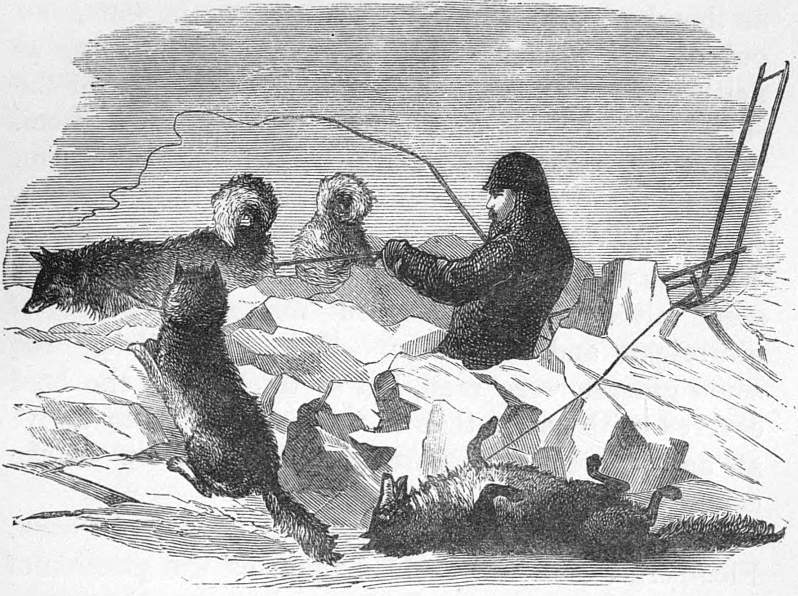
DOG-SLEDGE IN DIFFICULTIES.
Swimming about in this little sheet of water was a small flock of eider-ducks, eleven in number, that appeared to be as much surprised at beholding us as we were at seeing them. They did not, however, seem disposed to fly away. The only weapon we had was a rifle with twelve rounds of ammunition. With this we commenced hostilities, rejoicing in the anticipation of a fresh-meat meal when we returned to the ship. So utterly unconcerned did they appear that we actually succeeded in shooting five before the remainder took flight; but to our great chagrin we were unable to possess ourselves of any of our victims, as they had unfortunately all fallen into the water just out of our reach. This was very tantalizing, as neither of us felt inclined to risk being frozen for the sake even of roast duck by plunging in after them. We were reluctantly compelled to leave them. During the following week, however, they were recovered, having all been frozen together in the water. With the exception of these birds, no animal life was seen, although we observed numerous traces of ptarmigan and lemmings. Tufts of saxifrage and some grasses were seen, but so thickly was the land covered with snow that it was impossible to arrive at any conclusion regarding the vegetation of the country.
In consequence of the report that we brought back, Floe-berg Beach was decided upon as the position of the “Alert’s” winter quarters, and preparations were immediately made for securing the ship, and for making as extensive an exploration of the land to the northward as the duration of light would admit.
The land in our immediate vicinity was also very naturally an object of special interest to us. Speculations were rife regarding its extent and formation. The possibility of obtaining game of any description was a matter of much importance to us who were doomed to pass so many months in these icy solitudes. Alas! any hopes that we had cherished in this respect were soon found to be fallacious. The land, for the succeeding eight months, proved to be as devoid of life as its appearance was sterile and desolate.
On the 9th of September Aldrich went away with the dog-sledges, accompanied by two or three of his messmates, for three days, for the purpose of more thoroughly exploring the country in the hopes of obtaining game.
On the 11th I left the ship with Parr and Egerton and eighteen men, with the object of advancing a couple of boats to the northward along the proposed route of exploration. It was thought that they might prove useful during the future sledging operations of the expedition. We came back in four days, having successfully accomplished our mission.
On our return journey we encountered a furious gale of wind, which broke up the ice along the coast line, and forced us to drag our sledges over the hills, the summits of which were almost bare, the force of the gale having blown the snow completely off. Any one who has ever attempted to drag a sledge over a rough stony road will know the severe toil and labour that is required to be exerted in order to make any progress. Crossing a bay we made a short halt for luncheon on the ice, under the lee of a high hummock, and narrowly escaped destruction from having selected such a spot for a halt. Without our observing it, the ice began breaking up, and it was only by strenuous exertions that we succeeded in reaching the shore in safety, whence we observed the ice on which we had recently been encamped drifting in small fragments to seaward. If this disruption had not been observed in time, nothing short of a miracle could have saved us.
The violence of the gale was so terrific that pebbles and shingle were blown along by its force, mercilessly striking our faces and causing acute pain. Still we had to struggle onwards, for there was no possible lee under which we could pitch our tents and obtain shelter. An attempt to do so was unsuccessful, and had to be abandoned.
One of the men, failing from sheer exhaustion, had to be carried on the sledge. This seriously added to our difficulties, for it increased the load which the wearied sledgers had to drag, whilst it diminished the power of the draggers. But the indomitable spirit and pluck of the British sailor overcame all obstacles, and after an arduous march of eighteen hours in the face of a furious hurricane, we arrived, to our no small relief, alongside the “Alert.” Never was a goal attained with more pleasure and satisfaction than was our Arctic home reached that night by the fatigued and half-blinded sledge travellers. Untrained as they were, this forced march had seriously overtaxed their strength and entailed much suffering. Some few were, on their return, placed under the doctor’s hands.
Meanwhile those remaining on board the ship, but few in number, spent an anxious and trying time.
The young ice, by which the ship was surrounded, had been completely broken up by the fury of the gale, and had disappeared; and had it not been for the protecting grounded floe-bergs, small mercy would have been shown to the good ship “Alert,” by “ye thick-ribbed ice.”
Small fragments of the pack, large enough, however, to be unpleasant and disagreeable neighbours, would occasionally find their way between the floe-bergs, and drift about in our immediate vicinity. These it was our object to secure as speedily as possible, otherwise their incessant movement backwards and forwards with the tide would break up the young ice, or even prevent it from forming. The ominous grinding noise of the pack, as it swayed to and fro in the channel, and the terrible war that appeared to be raging between the floes as they came into furious contact with each other, pulverizing their sides or rending huge fragments from their edges, was a sound and sight that struck us with wonder and awe.
The grandeur and solemnity of the scene gave rise to thoughts of our own weakness and insignificance amidst these wonders of the far north.
On the morning after our return on board, the wind having subsided considerably, and a large channel of water existing between the land and the pack, Captain Nares determined upon seeking more secure and sheltered winter quarters in one of the numerous bays immediately to the northward of our present position, in the hope that the gale would have broken up the ice and so afforded us an entrance.
Steam was quickly raised and the rudder shipped; but from some, at that time, unknown cause we were unable to lower the screw into its place, or rather to enter the shaft. Our chance therefore of getting away was lost, as before midnight the gale was blowing as furiously as ever. The following day, however, the weather again cleared up, and renewed attempts were made to ship the screw, but always without success. Whilst so engaged a shift of wind occurred, and we had the mortification of seeing the whole body of the pack close the channel of water and resume its place along the coast, where it remained during the entire winter, effectually sealing us up. We had good reason to be thankful to our screw for causing our detention, for a subsequent examination of the coast proved only too plainly that the ice had not been broken up and blown out of any of the harbours that we should have sought, and that we should not have found any better sheltered position than the one we then occupied. In all probability we should have been caught by the fast closing ice—an occurrence rather unpleasant even to speculate upon. We afterwards discovered the reason for the failure of our attempts to ship the screw. On lowering it into the water, the ice formed so quickly in the “boss” that it effectually prevented the shaft from entering!
The ship was now secured by lines to the floe-bergs, and by anchors and cables to the shore, until she should be permanently frozen in.
We also busily engaged ourselves in making the necessary preparations for the autumn sledging operations. Travelling garments were issued, tents thoroughly overhauled, and sledges prepared.
On the 22nd of September Aldrich was despatched with three men and two dog-sledges, provisioned for fourteen days, as a sort of pioneering expedition; his orders being to proceed, if possible, as far as Cape Joseph Henry, there to erect a cairn and deposit a record with full information regarding the practicability of travelling, that would be of use to the main party which would follow him in a few days.
By the 25th the ice had again formed around the ship, and was of sufficient thickness to bear heavy weights. This was the day selected for the departure of the sledging parties. The force consisted of three eight-men sledges, officered by Parr and May, the whole under my command. My sledge was named the “Marco Polo;” Parr’s, the “Victoria;” and May’s, the “Hercules.” My orders were to advance as far to the northward, along the land, as possible, and at our extreme position to establish a large depôt of provisions in readiness for the use of the main exploring parties that would be despatched in that direction during the ensuing spring. Our provisions were all carefully weighed and packed; the maximum weight dragged by each man on leaving the ship was 201 lbs., decreasing at the rate of 3 lbs. per diem due to the consumption of provisions. The slight experience that we obtained during the previous few days’ sledging stood us now in good stead; the men who had recently been so employed being regarded as veterans in sledge work by those who were for the first time being initiated into its mysteries. All started in the very best spirits, animated by the same desire to do their utmost, and to achieve, so far as in them lay, success and honour for the expedition.
The details connected with the sledging operations must have a chapter to themselves. I make no apology for not entering more fully into the journeys performed by Aldrich and others, as the description of one sledging expedition suffices for all, and I am, of course, best able to describe those in which I was myself personally engaged.
1 All compass bearings referred to are true, unless stated to be magnetic.
CHAPTER XII.
AUTUMN TRAVELLING.
“When suddenly a grosse fog over spred, With his dull vapour all that desert has, And heaven’s cheerfull face enveloped; That all things one, and one as nothing was, And this great universe seemed one confused mass. “Thereat they greatly were dismay’d, ne wist How to direct theyr way in darknes wide; But feared to wander in that wastefull miste, For tombling into mischiefe unespyde: Worse is the danger hidden than descride.” Spenser.
There are, I am sure, many among those “who stay at home at ease” who have little or no idea of what sledge travelling in the Arctic Regions is like, and who even fail to realize that it entails hard work of any description.
Their imaginations picture the travellers seated on sledges, comfortably wrapped up in shawls and furs, and drawn by a team of dogs or reindeer gaily caparisoned, with their bells jingling as they dash along at a rapid pace over a smooth plain of snow and ice. They imagine that after the toil of the day is over a large fire is built up, and, having obtained some salmon, venison, or other product of the chase, a sumptuous meal is cooked and discussed, after which the sledge travellers compose themselves to sleep in a nice warm snow-house or wooden hut constructed by their attendants. All this sounds very delightful, and is, to my personal knowledge, believed to be a fairly true picture of Arctic life by a large majority of people. Unfortunately it is the very reverse of sledge life on the shores of the Polar Ocean. Let us see what it is like in reality. There, great climatic hardships have to be endured, combined with physical labour of no ordinary description. No change or variety of any sort can be made in the fare, nor can more than a certain allowance be allotted to each individual. When that is consumed, hunger must be borne with patience until the time has arrived for the next meal, for until that is due nothing is obtainable.
For shelter at night time, a tent made of the very lightest material (for economy of weight is the most important point to be considered in sledge travelling) is all the covering to protect the travellers from the furious onslaughts of a biting wind, always accompanied by a blinding snow-drift. So searching is the latter that in spite of all efforts it will penetrate through every little orifice into the tent, covering everything inside with a layer of minute snow crystals, and rendering an uncomfortable night still more comfortless and disagreeable. Rolled up in their bags, with the hard frozen sea as their couch, affording little rest to their aching and frost-bitten limbs, the wearied sledgers vainly attempt in sleep to become oblivious to the present. As for a fire by which circulation might be restored in their numbed extremities, that is quite out of the question. A limited amount of spirits of wine, barely sufficient to cook the allowance of provisions, is all the fuel with which they are supplied. Even if the material for making a fire, such as driftwood, was available, it would be impossible to benefit by it, for it could not be lighted in the tent, whilst outside, under such circumstances as I have related, it would be impracticable.
This is a slight sketch of what has to be endured by the Polar sledge traveller; but a cheerful spirit, a contented mind, and an ardent desire to achieve success are quite sufficient to enable him to withstand the attendant hardships, and even to laugh at and treat them with contempt.
I cannot do better than quote the words of Sir George Nares, who, addressing our men before leaving England, whilst explaining to them the nature of the work that they were about to engage in, and speaking from his own personal previous experience of sledge life, said, “That if they could imagine the hardest work they had ever been called upon to perform in their lives intensified to the utmost degree, it would only be as child’s play in comparison with the work they would have to perform whilst sledging!”
These prophetic words were fully realized, and were often recalled and commented on by the men during their initiation into the work of sledging.
The autumn sledge travelling has been alluded to by a very distinguished and successful explorer in the Arctic Regions, as “the very acme of discomfort.” In the accuracy of this statement we, one and all, fully concurred.
The principal reasons that sledging at this period of the year is more disagreeable than in the spring are, first, because the rapidly decreasing light caused by the sun’s altitude lessening day by day is decidedly opposed to either work or comfort. Before our return from sledging, the sun had illumined for the last time, until its reappearance the following year, the summits of the snow-covered hills in the vicinity of the “Alert’s” winter quarters, and had sunk, slowly and majestically, beneath the southern horizon, bequeathing to us only for a short time a few bright rays until the long polar night wrapped us in its sombre mantle, and enveloped us in gloom and obscurity for many months.
“’Tis gone, that bright and orbèd blaze, Fast fading from our wistful gaze; Yon mantling cloud has hid from sight The last faint pulse of quivering light.”
A few hours of twilight, therefore, were all we had in which to work. Candles we had none. Our breakfast before we started in the morning and our supper after we halted in the evening had to be discussed in gloomy darkness. Our notes had to be written in our journals before entering the tent, even at the risk of frost-bitten fingers.
In the second place, at this time of the year the ice, over which the sledges have to be dragged, is of very recent formation, and is consequently weak and dangerous. The travellers are therefore more liable to immersion by breaking through the thin ice at this period of the season than they are during the spring, or indeed at any other time. Young, and therefore smooth and level ice, covered with a treacherous layer of snow, often entices the unwary to turn from the rougher but stronger floes to travel on its flat plain surface. An immersion is invariably the result. Sometimes the leading men on the drag-ropes break through this weak ice first, and, by so doing, time is given to stop and save the sledge; but very often the ice directly under the sledge gives way without previous warning, when every effort must be at once directed to save the sledge. Although this is always successful it is generally at the expense of the greater part of the biscuit, which is so saturated with salt water as to be uneatable, and the wetting, and the consequent freezing, of the tent with all its appurtenances. Nothing more wretched and miserable can be conceived than having to pass the night in a stiffly frozen sleeping bag, inside a tent, which at the best of times is barely large enough to accommodate the party of men for whom it is allotted, but which has been considerably shrunk by being frozen. Not the least unpleasant part is the process of pitching it, for having become as hard as a piece of board, it is with great difficulty unfolded; more especially as this operation has to be performed after the fatigues of a hard day’s sledging, by wearied men, in such a temperature that it is impossible to expose the hands bare to the cold, and it must therefore be carried out with mittens on.
The constant wetting of the feet also renders the men more liable to frost-bites; whilst the heavy fall of snow, usually experienced in these regions during the autumn, renders the work ten times more arduous. For the air thus becomes so thick that it is impossible to see many yards ahead, and we have to trust solely to a compass as a guide. We might, in truth, fairly quote the lines from Spenser’s “Faërie Queene,” at the heading of the present chapter, as illustrating our difficulties in this respect—
“That all things one, and one as nothing was, And this great universe seemed one confused mass.”
And lastly this continual breaking through the ice of both men and sledge, combined with the heavy and incessant fall of snow, renders the task of walking and dragging a sledge one of extreme labour and anxiety. These were the little difficulties we had to experience during our novitiate in this autumn sledge travelling, and they must be generally expected by explorers who go away so late in the year.
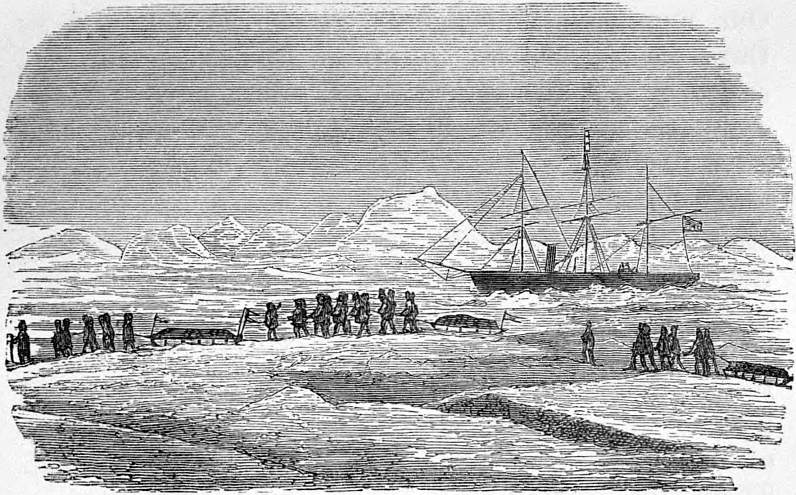
START OF THE AUTUMN SLEDGES.
In a future chapter I propose to give a full account of the routine of sledge life, of the equipment and scale of provisions, and of all other details connected with sledging operations in the Arctic Regions. I will now, therefore, proceed at once to give a brief account of our journey, for the purpose of laying out a depôt in the autumn, which occupied three weeks of very severe and harassing work.
At eight o’clock, on the 25th of September, the three officers commanding sledges, myself and Lieutenants Parr and May, assembled at breakfast in sledging costume, and a rattling good breakfast our caterer gave us. At 8.15 our standards were displayed on the sledges, the ship hoisting the ensign. At 8.30 the crews took up their stations alongside their respective sledges, and the order was given to march. Our men stepped out bravely, and as they did so three hearty cheers resounded from the ship. I called a halt and returned the salute with as much emphasis as twenty-four powerful pairs of lungs could give, and then continued the march. The young ice seemed strong enough to bear, so leaving the ice foot, on which the travelling was heavy, we ventured on the new ice. But we had not gone more than a mile when, to my horror, Parr’s sledge, the “Victoria,” went through! It was a case of all hands to the rescue, and after fifteen minutes of hard tugging and hauling we succeeded in dragging it upon a firm piece of ice. But everything was thoroughly saturated. There was nothing for it but to send back at once for another sledge and dry things. This being done, we again proceeded for about three miles, when suddenly I heard a crack, and looking round, there was my sledge through! We dragged it on shore, and unpacking at once, I was glad to find that we had suffered less than the “Victoria;” but it was bad enough. Our tent and gear at the top were of course saturated, and nearly all our biscuit spoilt. However, I did not think it advisable to return, so re-packing we made another start, and shortly afterwards were rejoined by Parr. After marching for twelve miles I halted for the night with the temperature 3° below zero, the tent frozen hard and shrunk considerably. Next day we marched thirteen miles over ice whose blue uneven surface was as smooth as glass, making it very hard work for the men, who were sorely put to it to maintain their footing. They worked splendidly, trudging merrily along, making light of the heavy loads and the treacherous ice, thinking only of performing a good day’s work, and of advancing the depôt as far north as possible.
On the third day, being unable to round a point of land owing to several lanes of water, we were obliged to unload the sledges and carry the things piecemeal across a neck of land about two miles in width and a hundred feet above the level of the sea. On the same evening snow began to fall, and from that time it fell incessantly until our return to the ship, increasing in depth day by day. This, combined with the softness of the snow as it fell, seriously impeded our advance, and we were frequently obliged to halt our sledges whilst the men were employed clearing a road with the shovels. So impervious was the air, owing to the heavy fall of snow, that it was only occasionally that we were able to obtain glimpses of the land as we journeyed onwards, rendering it most difficult to make out its conformation, or even the direction in which the coast line trended.
From the unaccustomed work of dragging, the shoulders of the men began to evince symptoms of rawness, although they constantly shifted their drag belts from one shoulder to the other. In spite of these little drawbacks, and the dull overcast weather that generally prevailed, the spirits of the men never flagged, and every night the labour of the day would be forgotten, and singing and laughter would be the only sounds heard issuing from our little camp, long after we had comfortably settled ourselves in our sleeping bags.
It was amusing to listen to the quaint remarks and witty conversation of the men, as, reclining in their bags and smoking their pipes, they would, regardless of the generally dreaded presence of the commander, broach lower deck topics, and freely discuss and criticize them. I was much surprised at the extensive Arctic knowledge which they possessed, showing that they had read largely on this subject, and were anxious to learn yet more.
I must own that the subject of eating and drinking monopolized a very large share of the conversation; nor did they only occupy our minds whilst awake, for they frequently formed the subject of our dreams. On one occasion when I aroused the men in the morning one of them said, “Oh! I am sorry you called me so soon, sir, for I was dreaming that I was eating plum pudding, and if you had let me finish it would have been as good as a breakfast to me!” Gales of wind were, of course, serious impediments to our advance, and were of not unfrequent occurrence. They invariably necessitated a halt, as, irrespective of the cold wind being productive of frost-bites, it was almost impossible to make way through the blinding snow-drift, which did not admit of anything being seen even at the distance of a yard or two!
On the 4th of October, half our provisions being consumed, and there being the prospect of very heavy travelling before us on our homeward journey, it was decided to return. The depôt was therefore established, on the brow of a ridge just above our encampment. It consisted of 870 lbs. of pemmican and 240 lbs. of bacon. May and myself pushed on, with the object of reaching Cape Joseph Henry; but the weather was too thick to obtain any view, and, for the same reason, it was impossible to ascertain the trend of the coast or the nature of the travelling to the northward. The floes seemed to be composed of very heavy ice, and the hummocks were piled up to a great height along the coast, especially off any projecting points of land. Lieutenant Aldrich had, however, ascended a hill some two thousand feet in height, and was fortunate in having a fine clear day. From Cape Joseph Henry the land, he saw, trended away to the westward, but there was no indication of anything but the impenetrable polar pack to the north. We reached a latitude of about 82° 50′ N. before turning our steps homewards.
On the return journey the dragging became infinitely more irksome and laborious. The snow had accumulated to such a depth as to render some of the ravines and promontories almost impassable, being above the men’s knees nearly all the time. On one occasion we were compelled to take our sledges up a range of hills two hundred and fifty feet above the level of the sea, in order to pass a precipitous cliff, off which was a stream of water, and then to lower them down a steep incline on the opposite side. To add to our difficulties, a sudden fall of temperature produced many severe frost-bites, principally on the feet and toes. Circulation was always restored as speedily as possible by the application of the warm hand, and the injured part was then dressed with glycerine ointment and lint.
The hills, over which we were obliged to take our sledges, subsequently went by the name of the “Frost-bite Range,” in consequence of the many casualties sustained during the time we were on them.
On the 9th the temperature was 15° below zero, and the boots, stockings, and foot wrappers were frozen to the men’s feet. On coming down the hills the sledges had literally to be lowered to the ice-foot from a height of two hundred and fifty feet, at a very steep angle. Thence it was necessary to follow the shore, where enormous hummocks of ice were piled up, having huge cracks and fissures, into which we sunk to our necks in snow. In crossing some sludgy ice between the hummocks, on the 11th, Lieutenant May unfortunately went through, and was so severely frost-bitten that he eventually had to suffer amputation of one of his great toes.
The sun set at about one in the afternoon. A glorious sight: the colours of the sunrise and sunset seeming to be blended together. This was on Tuesday, and at breakfast on the following Friday all the provisions would be expended. The 13th was the last day of the sun’s appearance.
On the 14th the temperature was down to 25° below zero, and the travelling very heavy; but our sufferings were nearly over. At seven we sighted the ship, and hoisted our sledge standards. All the officers and ship’s company came out to meet and help us, and by 8.50 P.M. we were on board.
Some of the frost-bites were so severe as to render amputation necessary. This arose from the difficulty of finding out the injury in time. A frost-bite steals upon one like a thief in the night, and before the victim is aware it often happens that mortification has set in. No less than half the party were placed on the sick list from being more or less severely frost-bitten.
It was a very great relief and comfort to us to be again on board, and extremely gratifying to receive such a welcome as that extended to us by our messmates. They were already feeling a little anxious at our prolonged absence, knowing that we were only provisioned for twenty days, and fearing that our return journey would be greatly delayed by the late excessive fall of snow.
How comfortable the ward-room looked, with the lamps burning brightly, a cheerful fire blazing in the stove, and, what delighted us almost still more, a clean white cloth spread upon the table, and on it a sumptuous repast, made doubly inviting by a couple of decanters of madeira and port! These little comforts and luxuries, though they may appear to casual readers unimportant and insignificant, are thoroughly enjoyed and appreciated by wearied and foot-sore travellers who have been strangers to light, comfort, and a good meal, though only for three short weeks. The pleasure of a warm bath and the enjoyment of brushing one’s hair are beyond all description! We were all a little thinner when we returned; but, with the exception of the frost-bites, none the worse for our expedition.
So far as the results were concerned we were quite satisfied, considering them perfectly successful.
We had established a depôt of provisions some forty miles to the northward of the ship, which would very materially assist the sledging campaign of the ensuing spring. A large amount of thorough practical experience had been gained, which we hoped would bear good fruit in the coming year. And we had succeeded in reaching and passing the highest latitude attained, to the northward of Spitzbergen, by that distinguished Arctic navigator, Sir Edward Parry, forty-eight years before, during his memorable journey over the frozen sea towards the North Pole.
These were the most important results gained by the autumn sledging.
The disappearance of the sun before our return necessarily prevented a more protracted exploration being made. As it was we only had sufficient light during midday for a very few hours’ work.
Perhaps, as it was our first experience in sledging, it was as well we were not able to remain absent for a greater length of time. As an instance of the manner in which the different articles increased in weight during the autumn travelling, we found on our return to the ship that the tent which had previously weighed 32 lbs. had increased to 55 lbs., the coverlet from 21 lbs. to 48 lbs., the lower robe from 18 lbs. to 40 lbs., the floor-cloth from 11 lbs. to 29 lbs., and everything else in proportion! This increase is due to the absorption of all moisture, which instantly freezes. In the spring, although the temperature is far lower, this moisture, even when frozen, is extracted by exposure to the sun. In the autumn this is impossible, as the sun has disappeared.
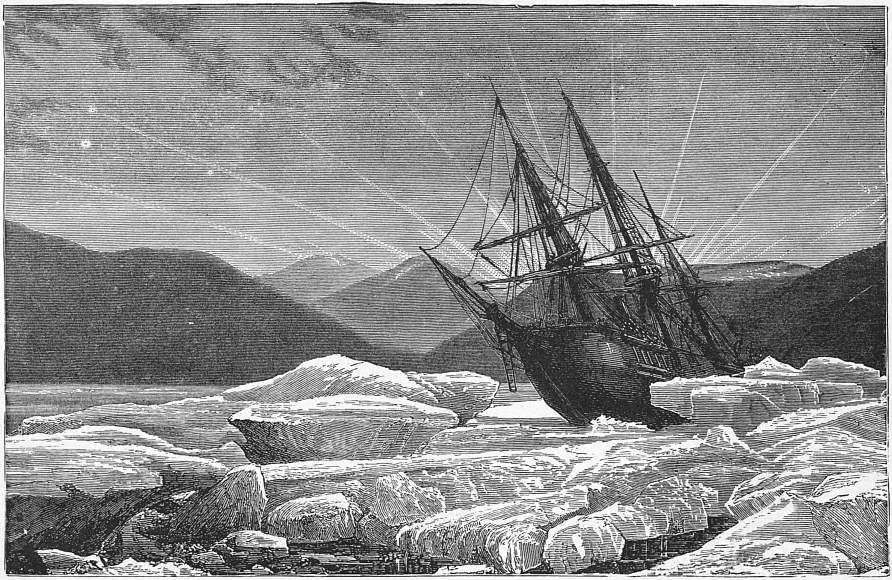
WINTER QUARTERS, H.M.S. “ALERT.”
CHAPTER XIII.
WINTER QUARTERS.
“Let winter come! let polar spirits sweep The dark’ning world and tempest-troubled deep. Though boundless snows the withered heath deform, And the dim sun ne’er wanders through the storm, Yet shall the smile of social love repay With mental light the melancholy day.” Campbell.
The sledge travellers having all returned, the necessary preparations for passing the winter were immediately taken in hand.
Notwithstanding the loss of the sun, which took its final departure on the 11th of October, we had for many days sufficient light, during five or six hours of the day, to enable us to carry out the manifold duties connected with the preparations for a winter in the Arctic Regions.
Although the ship was completely frozen in, and the ice in which she was imprisoned was increasing in thickness day by day, additional precautions for her safety were taken by burying a couple of the largest anchors on shore, and freezing them into their holes by pouring water over them; to these were attached the chain cables. These we felt would be a perfect security for us against any off-shore gale.
Provisions in large quantities were landed as a precaution, in case any unforeseen event should, during the winter, cause the destruction of our ship, and so at one fell swoop deprive us both of home and supplies. Out of the casks and cases so landed a spacious house was constructed, capable, if necessary, of affording accommodation to our entire party. This house, which went by the name of “Markham Hall,” was used as a receptacle for sails, rope, sledge gear, and all articles that could not be conveniently stowed under hatches on board. Its dimensions were forty-nine feet long, by twelve feet wide, and ten feet high. The mainsail was used to roof it over. It was altogether a very grand edifice, and we were, and I think with some reason, very proud at the result of our architectural skill.
The building mania seemed to be very prevalent amongst the officers, the majority of whom employed themselves in constructing snow-houses for various purposes near the ship. One officer went so far as to commence a colonnade, reaching from the shore to the ship, the pillars to be made of frozen blocks of snow, but the undertaking was of too gigantic a nature to be carried out with any hope of success, and was abandoned after a few days’ work.
A wooden observatory, brought out from England for the express purpose, was set up for the transit instrument, and this with a house adjoining, in which was placed the alt-azimuth instrument, being the head-quarters of our astronomical observers, Parr and May, went by the name of “Greenwich.”
DIAGRAM ILLUSTRATING THE MAGNETIC OBSERVATORY AT “KEW.”
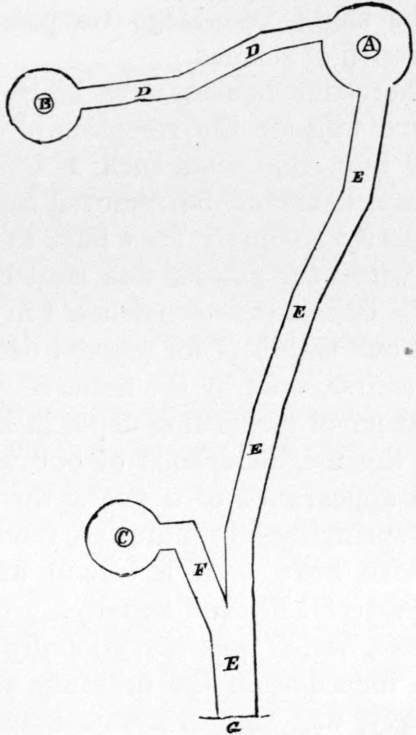
Explanation of Plan.
A The Unifilar House.
B The Barrow Dip Circle House.
C The Declinometer House.
DD Passage connecting A and B, 37½ ft. in length.
EEE The main passage, 120 ft. long.
F Passage leading to Declinometer House, 44 ft. from entrance.
G The main, and only, entrance. Distant from the Alert 504 ft.
All houses and passages were “sub-glacial.”
Snow-houses were constructed on shore for the several magnetic instruments, and these latter were securely fixed by being firmly frozen on snow pedestals. The three houses in which the instruments were placed were connected, one with the other, by sub-glacial passages, one being no less than a hundred and twenty feet in length. The whole establishment, which was most complete and reflected great credit on its architect, was called “Kew.” Giffard and myself were the two officers entrusted with the charge of the magnetic observations, and many a cold and comfortless hour had we to spend, in our endeavours to add to the slight knowledge we possess in this interesting branch of science.
Several other snow-houses were built for various purposes. One was for the reception of our powder, as it is most important that such a dangerous and combustible article should be removed from the ship, where of necessity so many fires have to be kept up. The place in which the powder was stored was called “Woolwich.” Others were constructed in which were deposited all our salt beef for present use, and these buildings, of course, went by the name of “Deptford,” after our great naval victualling depôt in England.
Altogether the neighbourhood of our winter quarters had the appearance of a young thriving settlement rapidly springing into maturity, rendering what would otherwise have been a barren and desolate scene, one of cheerful life and activity.
The salt beef, which was exceptionally tough and salt, more so indeed than the ordinary salt “junk” used in the navy, was kept in a snow-house; because we found, by experiment, that it was rendered more palatable by so doing. In all probability the process of congelation tended to extract, or precipitate, a very large portion of the saline matter with which it was impregnated, and thus deprived it, to some extent, of its hardness and saltness.
By the 26th of October the ship was completely “housed” in by a set of awnings, extending from the after part of the top-gallant forecastle to the mizzen-mast. This “housing” was made of a material called tilt cloth, similar to that used to cover waggons in England. It was spread on spars lashed between the masts, having curtains on each side so fitted that they could readily and easily be triced up when required for purposes of ventilation. Hanging lamps were suspended from the spars over the centre of the deck, which were kept alight night and day. The funnel, which was provided with a hinge, was lowered down, and formed a famous and convenient stow-hole for rope. The number of coils that were deposited in it was truly marvellous.
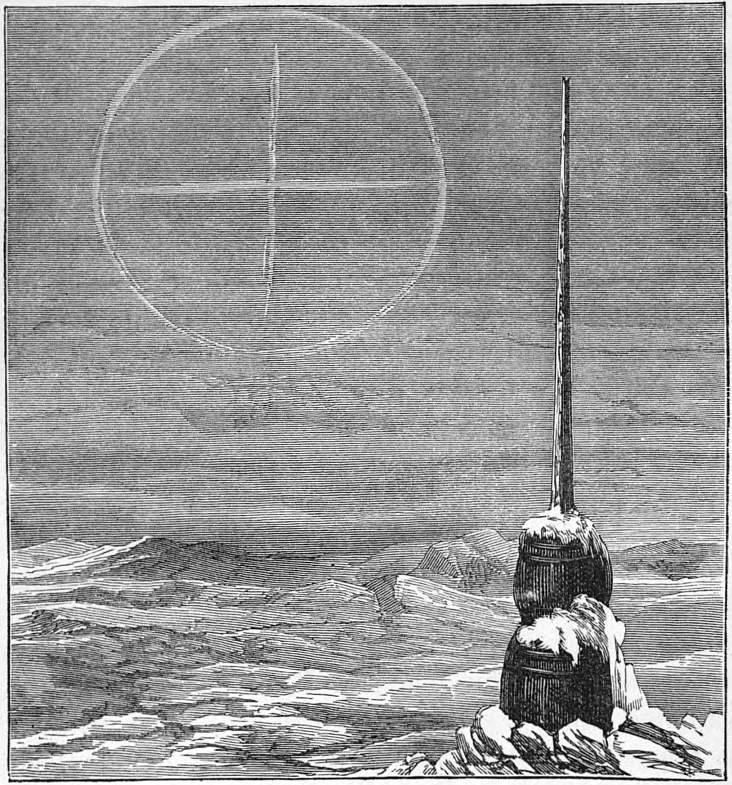
FLAG-STAFF POINT.
Two gangways were cut in the ship’s side: the one on the port side being used as the general one for entrance and exit; the one on the starboard for carrying out all slops and dirt to a large dirt-heap established between the hummocks, some hundred yards from the ship. A smaller dirt-heap was temporarily used nearer the ship, the accumulations being removed to the larger one once or twice a week.
Although, as a rule, the snow was not well adapted for building purposes on account of its consistency, we were able to supply ourselves with blocks from certain places where the snow had drifted in large quantities and hardened by pressure.
A snow wall, constructed from solid blocks obtained from these quarries, was formed round the ship at about six feet distance, and at the height of about four feet. When this was completed the space between the ship’s side and this wall was filled in with snow, reaching as high as the fore and main channels, forming a perfectly solid and impervious embankment that would effectually aid in preserving the warmth of the ship. The upper deck was cleared of all superfluous articles, and was covered with snow about twelve inches deep. A layer of gravel and ashes was strewn over the surface; but I am not sure that we benefited much by this measure, for it was rendered so slippery by being frozen that it was by no means an easy matter to walk on it.
All skylights and hatchways were carefully covered up, two only of the latter being kept open as a means of ingress and egress. These were so constructed with porches and double doors as to prevent the admission of the outside air. The doors, being fitted with weights, were made self-shutting, so that the closing of one door was insured before the opening of the other. Snow walls were also built up round the porches, and in fact round the hatchways and skylights not in use, so as to render them all the more impervious to the cold air.
Round the funnel of the galley fire there was a large space, inclosed by a wall of snow, in which was deposited every morning a supply of ice or frozen snow, to be converted into water sufficient to last twenty-four hours. The ice for this purpose was procured from a large floe about one hundred and fifty yards from the ship, which in all probability was formed by the thawing and subsequent re-freezing of the snow on its surface. When it was difficult to find work for the men to do outside the ship during the winter, they were employed in conveying this ice to a large depôt that was formed close to the vessel, protected from the Eskimo dogs by a snow wall, from which during gales of wind or other bad weather we were able to supply ourselves.
Our boats were all hauled up in a safe position on shore. Sails were left bent, but securely furled and covered. Ropes that were not unrove were carefully hauled taut, so as to prevent our being kept awake during a gale of wind by an uninterrupted “devil’s tattoo”—that is, the continual flapping of a rope against a spar, which produces a very aggravating and monotonous sound.
Former expeditions were supplied with Sylvester’s warming apparatus, which, by means of pipes leading along the whole length of the ship, warmed the “between decks” with hot air. The only means for heating the vessel at our disposal were by stoves. These were placed in various parts of the ship, and put under the charge of men who were periodically selected for this service. Stringent regulations were issued regarding the economical consumption of fuel, and also to guard against all accidents from fire.
As it is necessary in all ships wintering in the Arctic Regions to devote a certain place to the washing and drying of clothes in which a high temperature can be constantly kept, we appointed for this purpose a compartment on the fore part of the lower deck, commonly called the fore-peak. The men had certain days during the week allotted to them for the use of this place, and it was found that clothes washed and hung up one afternoon would be invariably dry on the following morning.
The vapour arising in this room did not reach the deck on which the men lived, but was conveyed through a trap hatch leading into the fore-peak to a large space under the top-gallant forecastle, inclosed by a snow wall and made its exit through an up-take formed of a piece of funnelling. The compartment was heated by a stove, the fire in which was kept burning night and day.
The very difficult question of ventilation below was carefully considered. It is one of the most important and serious matters that can come under the consideration of the commander of an Arctic expedition. Nothing is so essential to the preservation of health as the pure and free circulation of air on the living deck.
In this respect we were not so well off as our predecessors, for they, being supplied with the Sylvester heating apparatus, were able to admit a more constant current of air, and thus keep their habitable deck in a better state and more free from condensation than ours. We found it a very difficult matter to prevent in the slightest degree the accumulation of moisture on the beams overhead, caused by the condensation formed by the number of people living on the deck, and by the vapour arising from the galley fire. Several up-takes and down-takes were fitted in holes cut through the upper deck in our attempts to remedy this serious defect, but as a rule they had little effect in counteracting it. Men were incessantly employed during the winter in wiping the moisture off the beams with cloths. If the hatchway doors were kept open, even for a short time, this moisture was at once converted into ice, which, of course, thawed and dripped immediately as the temperature was raised. This drip was a constant source of annoyance to us during the whole winter, and it was one to which we had, in part, to submit.
Whilst all these necessary preparations for the safety and warmth of the ship were being carried out, the comforts of those who were about to brave the rigours of an Arctic winter were not forgotten. Warm garments were issued, consisting principally of a complete suit of seal-skins and warm woollen guernseys. It must not be supposed that our seal-skins were of the same material as those soft fur jackets so much in vogue with the fair ones at home. Ours were obtained from the ordinary Greenland seals, whose skins are covered with coarse bristly hairs. They were, nevertheless, quite as warm, and were indeed our favourite articles of clothing after the unpleasant aroma, which seems inseparable from clothing of this description, had worn off, or until we had become so accustomed to it as to fail to notice it!
Carpet boots, or moccasins made of moose-skin, were worn on the feet. The former were furnished with tops, made of duffel, reaching as high as the knees, and with cork soles over an inch thick. With any temperature below zero leather boots and shoes must be discontinued, as they freeze so hard that the material loses its flexibility, and renders the foot in consequence more liable to frost-bite. Moccasins, worn over a couple of pairs of blanket wrappers, and a pair of thick woollen stockings reaching above the knee, are undoubtedly the most comfortable foot-gear, and the best adapted for low temperatures. Blanket wrappers are, as their name indicates, strips of blanket, generally about sixteen inches square, worn folded round the feet in lieu of socks and stockings, than which they are infinitely warmer.
As a rule, officers and men were dressed alike. Occasionally some of the former would make their appearance in long fur coats with hoods that they had obtained from the Hudson’s Bay Company’s store and other places in London, but the majority adhered to the clothing supplied to them by Government.
A special winter routine was made out, and commenced shortly after the return of the sledge parties. It was strictly adhered to through the long winter night that ensued.
I must not omit to mention the duty of keeping open the “fire hole”—a very necessary and important precaution, that must be taken, in order to be able to obtain a supply of water in case of fire breaking out on board. As a rule, in all ships that have wintered in the Arctic Regions, the water has frozen below the suction valves of the pumps, thus rendering them totally useless. In order, therefore, to obtain water, a hole was invariably cut through the ice near the ship, which was generally placed in charge of the quarter-master of the watch, whose duty it was from time to time to clear off the young ice from its surface, so that at any moment water might be obtained in buckets. In the “Alert,” in consequence of our valves being much lower, our pumps were never incapacitated from this cause; still they were liable to be rendered useless by the water in the pipes becoming frozen. We therefore always kept our fire-hole in working order. It was close to the bow of the vessel, and was inclosed by a snow hut, so as to guard against the danger of anybody falling in whilst walking about in the dark. By fixing a tide-pole in the hole, and by devising a self-registering apparatus with a line leading from the tide-pole to the forecastle of the “Alert,” we were able to obtain a very complete and valuable series of tidal observations. From having the registering-gauge on board the ship, these observations were continued uninterruptedly, and were unaffected by gales of wind or bad weather, that would otherwise have prevented any one from going outside the vessel in order to note them.
Thermometric observations were, as may be imagined, very carefully attended to, and the temperatures both inside and outside the ship duly registered. Maximum and minimum thermometers, by which the greatest heat and the greatest cold for each consecutive twenty-four hours were recorded, were established in different places, and were noted every day at noon by an officer especially appointed for that duty.
Each compartment in the ship was supplied with one of these thermometers, and on the living deck the temperatures at three different heights—namely, at the deck, about half-way up, and at the beams—were daily registered. For the outside air one of the ice-saw triangles was erected on the floe, sufficiently distant from the ship to neutralize any influence that might be derived from her presence, and on this, at the height of about twelve feet, were placed several thermometers. In addition to these, there were other thermometers on the hill about a quarter of a mile from the ship, and about one hundred yards above the level of the sea, so that we were able to obtain a correct mean of the true temperature of the air. We were also able to ascertain the temperature of the snow, and the ground at different depths; and also, by means of solar radiation thermometers, we succeeded, on the return of the sun, in getting the temperature due to its rays at various altitudes.
CHAPTER XIV.
THE ROYAL ARCTIC THEATRE.
“Haste thee, Nymph, and bring with thee Jest and youthful jollity, Quips, and cranks, and wanton wiles, Nods, and becks, and wreathed smiles, Sport that wrinkled Care derides, And Laughter holding both his sides.” Milton.
Sir Edward Parry, during his first and subsequent winters in the Arctic Regions, fully recognized the importance of not only exercising and improving the minds of those under his command, during the long period of enforced inaction, but also of amusing them, and letting them feel that they also were assisting in the amusement of their shipmates. To do this he instituted an evening school on the lower deck, the officers acting as teachers; and he established periodicals, dramatic and other entertainments, in which he himself joined and took a conspicuous part.
His wise example has been generally followed by the different expeditions that subsequently wintered in the Arctic Regions.
It is, in fact, very necessary to exercise both the physical and mental powers of the men during the dark months, for when once the ship has been safely established in winter quarters little work remains to be done. The officers are constantly employed in taking and working up observations in various branches of science; but the seaman has little to do but reflect on, and possibly brood over, his situation. It is, therefore, absolutely essential that some means should be devised to drive from him all unpleasant thoughts, and to make him feel that it is in his power to relieve the tedium of what would otherwise be a long and monotonous winter.
Each ship had been provided, before leaving England, with a printing-press, and an officer and seaman1 had been instructed in its use.
As soon as it was set up and in working order, the following prospectus was issued by the “firm.”
“THE ARCTIC PRINTING OFFICE.
“Messrs. Giffard and Symons beg to inform the public that they have obtained—at an immense cost and with infinite trouble—possession of the extensive premises, lately occupied by Mr. Clements Markham, situated in Trap Lane, within half a minute’s walk of the foremost Quarter Deck Ladder, and easily accessible to all parts of the city.
“They have fitted up their new establishment—regardless of expense—with all the latest inventions and newest machinery, to enable them to carry on the noble art of printing in a style and with a rapidity hitherto quite unattainable.
“They therefore expect from the public that support and assistance which it always gives to the truly deserving.
“Charges moderate. No credit given. All work required to be executed to be paid for in advance.
“N.B. Everything undertaken promptly and correctly executed.
“H.M.S. ‘Alert,’
“July 28, 1875.”
The “cost” and “trouble” alluded to in this production, that were expended in obtaining a convenient place in which to carry out the “noble art of printing,” were caused by the fact that our photographers were equally anxious, with our printers, to possess themselves of the small cabin lately occupied by my cousin, and which is so grandiloquently alluded to as “extensive premises.” In fact, for some little time it was a very sore and vexed question between those two celebrated and energetic firms. Trap Lane was so called in consequence of the after-hold being immediately outside the door of the cabin; and it occasionally served as a very disagreeable kind of man-trap when, through inadvertence, the hatch had not been replaced. As this part of the ship was, during the early part of her commission, in total darkness, owing to the piles of stores that were stowed in every available corner, it is no wonder that unsuspecting individuals should occasionally have fallen into the trap!
Our printing-press was, it is almost needless to say, of great use to us during the winter; for, although it never printed very much for the public service, it was constantly called into requisition for the purpose of striking off programmes for our dramatic and other entertainments; and on such important events as birthdays and Christmas-day we indulged in the extravagance of printed bills of fare. On the whole the printing establishment on board the “Alert” tended very materially to beguile the tedium of our long nights, and must therefore be regarded as a decided success.
Our school was opened on the 1st of November; from which date, until the reappearance of the sun, the attendance was regular and constant. It was composed of nearly the whole ship’s company, and was divided into classes under the direct superintendence of the officers. Reading, writing, history, arithmetic, and navigation were the principal subjects in which the pupils were instructed.
The school was held on the lower deck between eight and nine o’clock in the evening, the classes occupying the different mess-tables. Only two men out of the entire ship’s company were unable to read and write, and these two men were placed in a class with two others, who were unable to read and write English.2 This class was presided over by the doctor, who kindly volunteered to devote himself to the instruction of the “cripples,” as they were facetiously called.
As an illustration of the improvement which has taken place in the education of the men belonging to the Royal Navy during the last half-century, it may be mentioned that, whereas in Parry’s time it was quite the exception to find a man that could read or write, with us the exception was entirely the other way, only two men out of fifty-five being ignorant of those accomplishments.
Never were seen such painstaking and willing scholars as our men showed themselves to be. It is impossible to conceive a more orderly or well-conducted school, and it was a pleasure to the masters to devote their time to classes that evinced such an earnest desire of acquiring knowledge as did those on board the “Alert.”
Here might be observed a staid old seaman, whose great brawny hand appeared more suited to grasp the marline-spike than the pen, vainly endeavouring, with his elbows squared, his weather-beaten face close down over his work, and his tongue thrust out, to arrive at some satisfactory result in a simple addition sum. As a contrast to this, at the opposite table might be seen a smart young sailor, who had distanced all his competitors in arithmetic, asking abstruse questions in mensuration of such a nature as to make even his tutor feel uncomfortable!
After the classes were dismissed, the men enjoyed an uninterrupted evening to themselves. Games of various descriptions, such as chess, bagatelle, draughts, and cribbage, had been purchased for their amusement before leaving England, and were in constant requisition during the winter. A large space on the starboard side of the deck, abaft the living deck, was allotted to the smokers, and here were held our dramatic and weekly entertainments on Thursdays. On Sundays Divine service was performed in the same place.
Books were also a source of great amusement and interest to many of the men who were studiously inclined, as the well-thumbed volumes in our library soon testified. Several men wrote regular journals, which were even kept up by a few whilst they were sledging. Amongst the officers, chess, backgammon, and a rubber in the captain’s cabin, formed the chief amusements. Although gambling is discountenanced (or ought to be) on board every well-regulated man of war, we so far forgot ourselves as to indulge largely in this vice. Seldom was a game played without a stake on the result! The stakes, too, were exorbitant, frequently as much as one lucifer match per game! It must be remembered that matches were very scarce and precious articles with us, and it was therefore a very high and valuable stake. On one occasion, one of my messmates was so rash as to wager a tallow-candle on the result of a game; but this was an offer of such magnitude that no one was sufficiently brave or sporting to accept it.
Among the many valuable gifts showered upon us by kind and generous friends at home was an excellent piano, and fortunately amongst the officers there was a very talented musician, to whose good nature and willing efforts to please must be attributed many a pleasant hour, when our hearts were warmed by well-known airs bringing back happy home memories.
Thursday evenings were always devoted to dramatic entertainments, magic-lantern exhibitions, instructive lectures, reading, and music both vocal and instrumental. These entertainments were kept up with the same spirit, and without a break, during the whole winter. They went by the name of our “Thursday Pops,” and afforded much pleasure and amusement. They were announced to the general Arctic public by the following printed notice, which was widely circulated.
H.M.S. “ALERT.”
THURSDAY POPULAR ENTERTAINMENTS.
On Thursday, the 11th of November, 1875, will commence a series of popular entertainments, that will consist of lectures, readings, recitations, and music, both vocal and instrumental, etc. No trouble or expense have been spared in obtaining the services of a great number of the most talented men of the day. The entertainment will be given in the airy and commodious hall situated in Funnel Row.
Programme:
Astronomical Lecture (with discussion) Capt. Nares.
Song “I knew that I was dreaming” Mr. Good.
Song “Watercresses” Mr. Shirley.
Reading “The Jumping Frog” Dr. Moss.
Song “An Englishman am I” Mr. Cane.
Song “Broken down” Mr. Bryant.
Glee “The Wreath” Messrs. Aldrich, Pullen, and Rawson.
Song “The White Squall” Mr. Maskell.
God save the Queen.
No encores. Doors open at 7.30. Sledges may be ordered at 9 o’clock
Messrs. Giffard and Symons, Printing Office, Trap Lane.
This was the first notification issued regarding our weekly entertainments, and, coming out a day or two before the performance, it naturally caused considerable excitement and flutter amongst the Arctic playgoing world!
Except on the evenings exclusively devoted to the legitimate drama, these entertainments were always preceded by a lecture delivered by one of the officers, on some interesting and at the same time instructive subject, adapted to the knowledge and intelligence of the audience. A list of the lectures so delivered cannot fail to be of interest.
1. On astronomy Capt. Nares.
2. A few words on magnetism Lieut. Giffard.
3. On geology Capt. Feilden.
4. A few words on meteorology Lieut. Aldrich.
5. A few words on steam Mr. Wootton.
6. Mock moons under the microscope Dr. Moss.
7. On light Lieut. Parr.
8. An historical lecture Mr. White.
9. A few words on astronomy Com. Markham.
10. Our food in the arctic regions Dr. Colan.
11. A few words on arctic plants Rev. H. W. Pullen.
12. On hydrostatics Lieut. May.
13. Sledging experiences Capt. Nares.
Nearly all the officers took part in these lectures, and I have not the slightest doubt that all would have done so had there been any more Thursdays to spare. They were eagerly listened to by the ship’s company, and afforded quite as much pleasure as the readings and songs that followed, in the performance of which they all, with only one or two exceptions, took part.
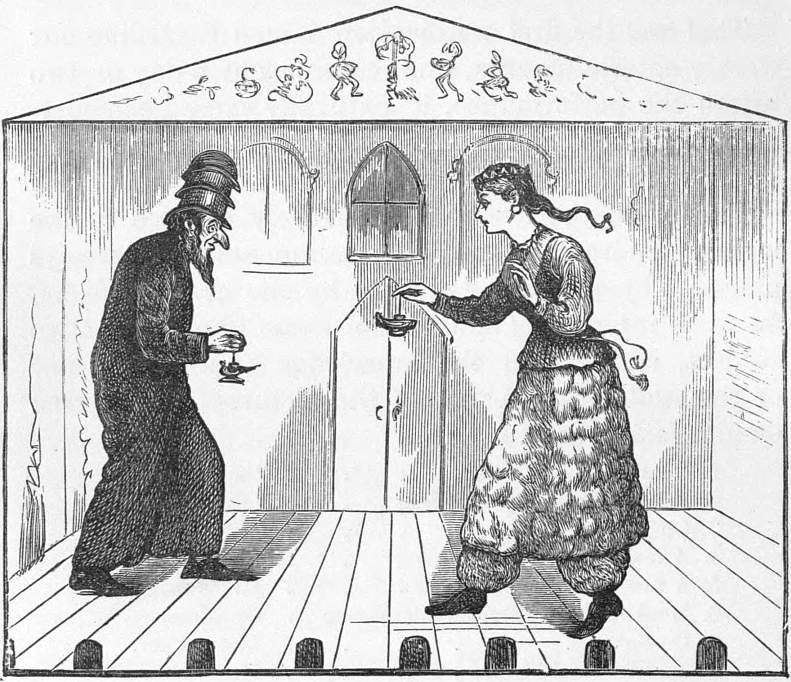
ROYAL ARCTIC THEATRE—SCENE FROM “ALADDIN AND THE WONDERFUL SCAMP.”
The first real dramatic entertainment came off on the following Thursday. Our plan was for the men to act one piece and the officers another, and this was found to work very well. But the rehearsals were a difficulty, and we were frequently compelled to shut ourselves up in our own cabins in order to secure the necessary quiet and privacy to enable us to become perfect in our different parts.
The costumes were, of course, a subject of much discussion and deep interest. The making up of dresses, and the manufacture of wigs from musk-ox skins and oakum, sorely taxed our ingenuity and employed minds and fingers that had hitherto been strangers to such occupations. Many were the needles broken, and many were the fingers pricked, before our ideal costumes were realized. Eiderdown quilts had to be converted into the robes of a lovely oriental princess; old uniform coats were beautified with spangles and tinsel, and appeared as the fashionable habiliments of a dandy of the seventeenth century; whilst a wicked magician, of the Hebrew persuasion, appeared in a coat of unmistakeable clerical cut.
Egerton was an indefatigable stage manager, and the scenic arrangements under the direction of Moss, who was also the artist, could not be excelled. Aldrich at the piano (as our orchestra) was a host in himself, adding materially to the success of the entertainments. In fact, officers and men vied with each other in their endeavours to promote amusement and hilarity, and if their histrionic abilities were not of the highest order, the zeal and energy of the actors fully compensated for this deficiency.
We enjoyed a rare freedom from harsh ill-natured critics. These pests do not venture across the Arctic Circle. All who visited the Royal Arctic Theatre (re-opened after a lapse of twenty-one years) came with a firm resolve to please or be pleased. Acting upon this determination, our entertainments were bound to be successful. The following prologue, composed for the occasion by Pullen, was spoken at the opening of our theatre, on Thursday, the 18th of November, 1875.
“Kind friends, with kindly greetings met to-day, We bid you welcome to our opening play: You, whose indulgent smile forbids the fear Of scornful wit or captious critic here. To-day we welcome you, and not to-night, For all is noon with us—all summer bright; And though the southern sun has ceased to pour His glittering rays upon our ice-bound shore— Has ceased awhile to touch with drops of gold The crystal corners of our hummocks bold; We bear a warm soft light that never fades— A lustrous light amid these Greenland shades; All trustful of each other’s love, we learn With steady flame our lamp of Hope to burn; And suns may set, and twilights disappear— They shall not rob us of our Christmas cheer; Nor blinding drift, nor frozen wave, shall chill Our laughter glad—for laugh, brave boys, we will; Kindling yet once again the genial glow Of happy English homes on Arctic floe. “Yet once again; for none would here forget We are but sons of fathers living yet; In work and play alike, we but renew The deeds of men who taught us what to do. And though, more favoured than the rest, we soar To loftier flights than theirs who went before; Though ours the boast, by skilful guidance led, In virgin climes our shifting scene to spread; We love to read on history’s faithful page, Of ancient triumphs on our Northern stage, And boldly for our brave forerunners claim An Arctic ‘cast’ already known to fame. “Now let the tell-tale curtain rise, and say What we have done to while your hours away. Such as we have, we bring you of our best, And to your kind forbearance leave the rest. One only grief is ours, and you shall share With us the burden of that gentle care. One cherished form we miss—one touch alone— One glance of love—one tender, thrilling tone. Ah! in the sweet homes of our native isle The dear ones move, and minister, and smile. We would not wish them here, but this we know, Their thoughts are with us every step we go: Their life sets northward o’er the cold, grey sea: They live in wondering what our life may be; And heart draws near to heart, and soul to soul, Till each has found its true magnetic pole. “God bless and keep them in His mighty hand— Our wives and sweethearts, and the dear old land!”
The prologue was warmly applauded. At its conclusion the curtain rose, and the following programme, showing the plays that were acted and the cast of characters, was proceeded with.
THE ROYAL ARCTIC THEATRE
Will be re-opened on Thursday next, the 18th instant, by the powerful dramatic company of
Hyperboreans!
Under the distinguished patronage of Capt. Nares, the members of the Arctic Exploring Expedition, and all the nobility and gentry of the neighbourhood.
The world-wide reputation of this company is quite unrivalled. The manager has spared neither trouble nor expense in forming this company, and has selected none but the very best artistes—the ladies being from England—who, having numerous other engagements, can remain for a short time only.
The scenic arrangements, under the control and manipulation of that celebrated artist, Professor Moss, must be acknowledged to be unparalleled in the experience of ages and of the highest order.
The orchestra, under the management of Signore Aldrichi (lately from Milan) cannot fail to be appreciated by the audience.
At 7.30 will commence the celebrated nautical farce
THE CHOPS OF THE CHANNEL.
Characters:
Leander Hellespont Mr. Stuckberry.
Mr. Counter Balance Mr. Woolley.
Gratings (Steward) Mr. Burroughs.
Mrs. Hellespont Mdlle. Francombi.
Mrs. Veneer Mdme. Maskelli.
Time The present day. Scene Saloon of a Boulogne steamer.
Interval of ten minutes.
During the interval the renowned vocalist, Mr. Stone, will sing The Irish Barber.
After which will be performed the screaming tragico-comico burlesque entitled
VILIKINS AND HIS DINAH.
Characters:
Master Grumbleton Gruffin, a rich (soap) merchant of London, the original parient Com. Markham.
Baron Boski Bumble, ancestor of the celebrated beadle, the original lovier so gallant and gay Mr. Egerton.
William Wilkins, socially and convivially known as Vilikins, a young apprentice, in desperate love with Mr. Rawson.
Dinah Gruffin, the sole feminine offspring of the above-mentioned soap-merchant, in love with the aforesaid Vilikins Mdlle. Blanc.
Scene 1 Lawn of Gruffin’s house.
Scene 2 Interior of Gruffin’s house.
Scene 3 Lawn of Gruffin’s house.
God save the Queen.
This, the first appearance of the “Hyperboreans,” was eminently successful, and elicited both laughter and applause from our very appreciative and demonstrative audience. Mademoiselle Blanc (Mr. White) made a fascinating little Dinah of six feet high, dressed in a Dolly Varden costume, whilst the other ladies were all that could be desired, and looked charming in their gorgeous silk and muslin dresses.
In this respect we had a decided advantage over our consort, the “Discovery;” for her space on board being somewhat limited, the building of an ice theatre on the floe became necessary. Here, though the building was spacious and elegant, the temperature was rarely above zero! The ladies were therefore unable to indulge in low dresses, and a close observer might have detected underclothing composed of seal-skins beneath their otherwise gay and brilliant costumes.
Occasionally, as the two following bills will show, we were agreeably surprised by the announcement of an entire change of programme.
H.M.S. “ALERT.”
THURSDAY POPS.
December 16th, 1875.
Great attraction! The latest novelty of the season!! The Wizard of the North!!! For one night only!!!!

Programme: The entertainment will commence with A few Words on Steam . . Mr. Wootton. After which the only and veritable
Wizard OF the North,
en route to his hyperborean domicile,
will exhibit and expound some of his original and inimitable illusions and feats of prestidigitation, consisting of the following wonderful and startling tricks:—
The vanishing egg. The magic die. The mysterious sixpence. The magic shawl. A startling surgical operation. The marvellous watch trick. Tricks with cards. The magic bag trick. The wonderful generating hat. The astounding prestidigitorial metamorphosis, performed with an egg and silk handkerchief. The inexhaustible bottle. Our very able and renowned pianist, Lieut. Aldrich, will, as usual, preside at the orchestra. To commence at 7.30 precisely.