Front matter (continued 2)
Reading edition

CHAPTER V.
SMITH SOUND.
“Now far he sweeps, where scarce a summer smiles, On Behring’s rocks, or Greenland’s naked isles. Cold on his midnight watch the breezes blow, From wastes that slumber in eternal snow, And waft across the waves’ tumultuous roar The wolf’s long howl from Oonalaska’s shore.” Campbell.
No sooner were the ships secured and breakfast discussed, than there was a regular rush for the shore. Some went for a scramble over the neighbouring glacier, named by Dr. Kane, “My brother John’s glacier;” some went to collect specimens; others to take various scientific observations; and others to hunt and shoot—this spot having been found wonderfully prolific of game, more especially of reindeer, during Dr. Hayes’s stay. No signs of any inhabitants were visible. This surprised us, as we were fully expecting to meet the natives of the village of Etah, situated only a couple of miles from the anchorage. A visit to the village during the course of the day proved the huts to be standing, but quite deserted. Traces of their having been recently inhabited were manifest, and portions of seal and walrus meat were discovered in caches, as if the migration was only temporary and a return was meditated. No other signs, however, of any living human being were found.
Leaving to others the exploration of the country in the immediate vicinity of the harbour, Captain Nares and myself started, in one of the whale-boats, with four men, for the purpose of visiting Life-boat Cove, where some of the officers and crew of the “Polaris” spent their second winter, 1872-3, and also to search for an iron boat on Littleton Island, said to have been left there by Dr. Hayes in 1860.
Sailing round Sunrise Point, we encountered a fresh northerly wind dead in our teeth, against which, under oars, we made but slow progress, whilst the cold spray flew aft into our faces where it almost froze. After about five hours’ hard pulling Life-boat Cove was reached, and very glad we all were to get on shore and stretch our legs and restore the circulation of our blood.
Immediately on landing we met with traces of the late occupants. These consisted of a large cairn—which, however, had been demolished by others previous to our arrival, probably by the searching expedition sent out in the “Tigress” in 1873—a basket lined with tin, and a trunk, neither of which contained anything of importance; indeed, their contents and the strong odour pervading them convinced us that they were now the property of Eskimos. Strolling on a little further, a boat was seen, which, although somewhat of European shape, appeared to be of Eskimo construction, as it was simply a framework covered with skins; yet it was undoubtedly built under a white man’s superintendence.
Continuing to advance until we reached the western extreme of the spit of land on which we had landed, we conjectured, from the amount of débris by which we were surrounded, although no remains of a house were visible, that we were on the site of the Americans’ winter quarters. Trunks, boxes, stoves, pieces of wood, gun-barrels, and odds and ends of all descriptions lay strewed about over an area of half a square mile—a desolate scene of ruin and misery!
Some of the boxes were marked with the names of their previous owners, and contained, amongst other things, books, principally relating to the Arctic regions. One trunk contained a few small articles of female apparel, such as a lace collar and black veil, and some faded ribbons; souvenirs from some fair damsel at home, which had probably, from the thoughts their presence created, beguiled many a long and lonely hour during the monotonous winter night. Numerous cairns and caches, under which were deposited lumps of seal blubber, led us to suppose that the natives intended returning, especially with such a mine of wealth to attract them as an abundance of wood and iron, so invaluable to an Eskimo.
Two other boats were also found, constructed in the same rude manner as the first. On one was painted, in good large letters, the word MAUMOKPO; though what it meant we were at a loss to conceive, but concluded it was an Icelandic name.
Two Casella thermometers, marked as low as 130° below zero, were also picked up in perfect order. It is to be regretted that these were not self-registering maximum and minimum thermometers, as it would have been most interesting to have ascertained the greatest amount of heat and cold at this spot during a period of more than two years.
Collecting everything that we considered of the least value, such as books and instruments, for the purpose of returning them to the United States Government, and taking possession of a couple of boats, which we thought would prove useful at some of our depôts, we embarked and proceeded towards Littleton Island, with our prizes in tow. Diligent search was made for the pendulum said to have been left by the “Polaris” people, but without success: also for the box chronometers and transit instrument, but with a like result. We could only come to the conclusion that, if these articles had been left there, somebody had been before us. Every cairn and cache was thoroughly examined, and so was every nook and crannie within a radius of half a mile from where we imagined the house had originally stood. A chronometer-box was picked up, but empty.
On landing at Littleton Island a careful search was instituted for Hayes’s boat, but, although we made the complete circuit of the island, we failed to discover any traces of it whatever. At the south-west end we erected a cairn on the highest hill, about five or six hundred feet above the level of the sea, and obtained a round of angles with the theodolite. The view from the top of this hill was very cheering. Cape Sabine was distinctly visible; whilst farther to the northward could be seen the land about Cape Fraser, with no signs of ice! We were, however, too wary to indulge to excess in hopeful anticipations, knowing full well the vagaries of our capricious enemy, the ice; but still such a scene could not but tend to cheer and exhilarate, and send us back to our ship with light and buoyant hearts.
It was past midnight before we reached the “Alert.” Our sportsmen, we found, had been unsuccessful in their endeavours to shoot any reindeer; one, however, fell to the rifle of an officer of the “Discovery.” Very few were seen, and those so wild as to render an approach within range no easy matter. Several ducks and a few hares, however, were obtained.
Leaving Port Foulke on the following morning, we crossed over to the west side, and erected a large cairn on the summit of Cape Isabella, about one thousand feet above the level of the sea. The ascent of this headland was both arduous and dangerous. The face of the cliff was very precipitous, and it was only by a zig-zag course that it could be effected. At one moment the way led over loose shingle, that gave way under the feet at every step; at another over a broad patch of frozen snow, one false step on whose slippery surface would precipitate one many hundred feet below; and at another we were clinging desperately with hands and feet to the hard, smooth, syenitic granite rocks, of which this cape is composed. Very thankful were we when the summit was reached; but much more so when we found ourselves again at its base, sound in wind and limb. To add to the difficulties, there was a high wind and dense snowstorm.
At a less high elevation, and in a secure niche amongst the rocks, were deposited an empty cask and about one hundred and fifty pounds of preserved beef. The cask was intended for the reception of any letters that might be brought up by a Government ship in the following year, or by any enterprising and adventurous whaling captain who should penetrate so far in order to bring us news. The provisions were left as a small depôt for any sledging party that might be dispatched to the southward. The site was marked by a small cairn. Records were left at each of these cairns detailing the movements and the prospects of the expedition, together with instructions regarding our letters, should any be brought thus far.
Some beautiful little yellow poppies were gathered on the slopes and crests of the hill, whilst the draba and saxifrage were found growing in profusion.
The navigation of these icy seas is most uncertain! Within twenty-four hours of the time that, from the summit of Littleton Island, we had been cheered by the view of an apparently open sea free of ice, and extending in our imagination for miles to the northward, we were battling with the pack, consisting of large floes and loose broken-up fields, that extended on both sides of us and as far north as we could see. From this period our troubles commenced; from this date our progress was one endless and unceasing struggle with the ice: ever on the watch, and never allowing a favourable opportunity to pass unheeded.
Shortly after leaving Cape Isabella the ice was observed stretching across Baird Inlet—the fixed land ice with loose detached streams. As we proceeded more ice was seen, which by degrees completely surrounded us, and we only succeeded, after much boring and charging, in forcing a way through, and into a well-protected little harbour to the southward of Cape Sabine. This bay was formed by a deep indentation in the land having a long jutting-out spit to the S.E. which acted as a famous breakwater, and was protected seawards by Brevoort Island. Here we were detained for five days, although several attempts were made to proceed, which resulted in one instance in a hopeless besetment in the ice for some hours. The pack was impenetrable; our only hope was to wait patiently for a strong wind to open out a passage. The place was in consequence called “Bide-a-wee” Harbour, subsequently changed to Payer Harbour, after the distinguished Austrian Arctic explorer of that name.
During our detention the time of the officers was not unprofitably spent. A rough survey of the place was made, its position was correctly ascertained, a series of magnetic observations were obtained, and long walks were taken in the neighbourhood, during which a large and rich collection was made in the interests of geology and botany. No game of any description was seen. Traces of Eskimo were discovered, but evidently of an ancient date. They consisted of the remains of igdlus or huts, also some bone spear-heads, and the runners and cross-bars of a sledge.1 Tidal observations were also taken in the harbour.
Here also, it may be said, we received our first lessons in the art of sledging; for, wishing to be initiated into its mysteries, a party, consisting of four officers and five men dragging one of our large twenty-feet ice boats on a sledge, started to travel over the pack. Our main object was of course to derive some practical experience in this all-important mode of Arctic exploration, and in this, I think, we succeeded.
We found the ice exceedingly hummocky, with narrow water spaces between, just too broad to admit of our jumping over, yet not sufficiently wide to launch the boat into. So rough was the road that at one time the bows of the boat would be seen rising almost perpendicularly in the air, whilst all hands were engaged in long-standing pulls on the drag-ropes to the tune of “one, two, three, haul;” at another time the sledge would come down the side of a hummock with such rapidity as to give us hardly time to spring out of the way to avoid the sledge and boat coming over us, and many were the falls in consequence. It was, however, rare fun. Once while launching the boat into a pool of water she nearly capsized; as it was she half filled, and everything inside—provisions, clothes, instruments, guns, and ammunition—was thoroughly saturated. A gold watch that happened to be in a coat pocket was not improved by its immersion.
Another source of amusement during our stay in this harbour was chasing “unies,” as narwhals are invariably called by the whalers; but, although a good deal of patience and perseverance was displayed in attempts to harpoon them, these qualities were never rewarded, and the boats always returned unsuccessful from their pursuit.
Our little check in this harbour produced a slight despondency in those who, for the previous few days, had been most sanguine of pushing on. This was always alluded to in the ward-room as the depression of the social barometer, and was for the future daily registered!
On the morning of the 4th of August, a southerly gale having blown all the previous night, a channel of open water was visible as far as Cape Sabine. This was an opportunity not to be lost. Accordingly, at 4 A.M., the anchors were weighed, and, before a fresh but bitter cold wind, both ships made sail, and succeeded, after having made so many futile attempts, in rounding the Cape. Bearing away to the westward we steered up Hayes Sound, keeping close in to the land, the grounded icebergs giving us timely notice of shoal water. At noon, opening a perfectly land-locked bay, and the ice being so closely packed ahead as to defy farther progress, the vessels were steered for the entrance, and we soon found ourselves in a beautiful inlet enclosed by high land, but bounded on one side by one of the grandest sights it is possible to behold: two enormous glaciers coming from different directions, but converging at their termination. They reminded us of two huge giants silently attempting to push and force each other away.
It was indeed a noble sight, and filled us with impatient curiosity for the moment when we could land and indulge in a closer inspection.
Accordingly, the anchors were no sooner let go than several started for the purpose of paying it a visit. Landing abreast of the ship, we had rather a rough and tumble sort of a scramble over loose masses of gneiss, until we emerged on the banks of the bed of the glacier—that is, the bed formed by the water running from the glacier during the summer thaws. The walking was most laborious, at one moment through a wet swampy bog, and at another over rough sharp-pointed stones.
The vegetation appeared luxuriant, and we found the traces of musk-oxen, reindeer, wolves, foxes, and hares in abundance; but, although we were provided with guns, we failed to secure any game, for the simple reason that we saw none. But the traces of musk-oxen were very fresh, and several horns of the reindeer were picked up. After a tedious walk of about four or five miles we arrived at the glacier—the stupendous and sublime work of ages. How insignificant and despicable did we appear in comparison to this gigantic creation of Nature! I can compare it to nothing except, perhaps, a frozen Niagara! The left-hand glacier was rounded off, like a huge icy wave to its end, whilst it receded from our view in long milky undulations until lost in the clouds. The right-hand one—the lateral and terminal sides of which were quite precipitous—was pressing against its neighbour until it had raised a slight ridge between the two. We were naturally desirous of ascending one or both of these glaciers, but time would not admit of such an undertaking, and we were therefore compelled to content ourselves by standing upon a small projection of each glacier, so as to be able to say that we had been on them.
That Eskimos had visited this locality was certain; for we discovered on our way out the site of an old settlement, and on the way back we observed two large cairns that had evidently been used as caches.
Alexandra Bay and Twin Glacier Valley, as they were henceforth designated, were the nearest approach to an Arctic paradise that we saw during our sojourn in the Polar Regions. A sheltered and well-protected harbour, with a locality abounding in game of various descriptions, are of such importance that it is impossible to prize them too highly. They should be the first and grand objects to be taken into consideration whilst selecting a spot for winter quarters.
Although we were not fortunate in obtaining game during our stay of only a few hours in this interesting neighbourhood, I have not the slightest doubt that, had we penetrated a little farther into the interior, or had we remained here a day or two longer, we should have been rewarded by an ample supply, the traces that we observed being both numerous and recent.
From tidal observations made during our brief stay in this harbour, we found that the flood tide in Hayes Sound came from the eastward, but that the ebb coming from the westward was the strongest. Whether Hayes Sound was a strait opening out to the westward or only a deep inlet was, and remains, a matter of uncertainty.
1 The fact of one of these spear-heads being tipped with iron, although they all bear the semblance of great age, would lead one to suppose that the tribe by whom it was left must have had some intercourse with Europeans, unless meteoric iron was used. This would be a very interesting question to decide.
CHAPTER VI.
STRUGGLES WITH THE ICE.
“On those great waters now I am, Of which I have been told, That whosoever hither came Should wonders there behold. “Trim thou the sails, and let good speed Accompany our haste; Sound thou the channels at our need, And anchor for us cast. “A fit and favourable wind To further us provide, And let it wait on us behind, Or lackey by our side.” George Wither.
The morning following our arrival in Alexandra Harbour saw us again battling with the ice in Hayes Sound, having been deluded into leaving our comfortable snug quarters by the report that the pack had drifted to the eastward, leaving a navigable channel extending to the north. The report was fallacious, but we succeeded in threading our way to the N.W. for about twenty miles, when both ships were helplessly beset, with but little hope of extrication without a shift of wind.
Many broad glaciers were in view, winding their long white snaky lengths between the hills, some of which could be traced into the interior for ten or twelve miles, or until lost in illimitable space.
In twenty-four hours, the ice slackening enabled us to bore a way through, eventually emerging into a broad stream of water. How sudden and wonderful are the changes in these regions! From being closely beset, a couple of hours saw us in an apparently open sea with no ice in sight, and bowling along before a fresh southerly gale at the rate of seven knots. Social barometer very high! In the morning not a spoonful of water to be seen in any direction, in the evening not a vestige of ice!
Passing close to the western shore we were able to confirm our views regarding the Henry and Bache Islands of Hayes. They are undoubtedly connected, and therefore not islands; but whether they were also connected with the mainland we were not able to determine. In all probability the supposed islands are a peninsula, apparently of sandstone formation overlying trap, different to the granitic formation of the southern shore of the strait. The land appeared quite bare of vegetation, and bore a strong resemblance to the Silurian limestone formation of the land about Prince Regent Inlet, showing stratifications dipping to the northward at an angle of about 6°.
It does not do to indulge too freely in vain hopes in these regions. A period of eight hours was sufficient to cause our hopeful anticipations of a grand run to the northward to be “considerably eased down;” for in that time we were again stopped by the ice, and compelled to make fast to a floe, until the pack opened sufficiently to allow us to proceed. During the run we passed some very heavy floes—heavier than anything we had hitherto met, and quite sufficient in themselves to crush any unfortunate ship that should happen to get nipped between two of them.
Off Albert Head great excitement was caused by the floe, to which both ships were secured, being driven towards a large grounded iceberg. To be squeezed between the two would be fatal. Our destruction seemed inevitable. Yet we on board were helpless to avert the catastrophe. All that we could do was to prepare for a severe nip: unship the rudder, and lift the screw, and having taken every precaution to ensure the safety of the crew, in the event of the ship’s demolition, we could only look on, and in silence witness, as we thought, the irresistible and destroying powers of the Ice-King.
The “Discovery” was at first in the most critical position, but a slight swerving of the floe relieved her from any immediate danger, whilst the same movement of the ice intensified our own.
Nearer and more swiftly were we hurried towards the grim and motionless berg, up whose sides the floe, as it came into contact with it, was seen to be literally walking and forcing its way, crumbling and falling into shapeless masses at its base.
Escape appeared impossible. It seemed hard at the very commencement of our voyage thus to lose our ship, and with it all hopes of success. Suddenly, when our fate seemed almost decided, the berg turned slightly, splitting up the floe to which we were secured and sending us clear. It was a narrow shave, and although we suffered a slight nip, no material damage was sustained.
Being myself too fully occupied with the work on deck, one of my messmates kindly packed a few of my valuables together, ready to take away in case of having to abandon the ship. On going below after the ship had been secured, I found carefully packed in a haversack my journals, Bible and Prayer-Book, a few photographs, and three boxes of sardines!
It must not be supposed that we passed in idleness those days that we were beset in the ice and unable to advance. As a rule our time was more fully occupied then than when we had leads of water in which we could proceed. Steam had to be kept ready for any sudden emergency, and a constant watch had to be kept on every movement of the pack. Frequently had the ice anchors to be tripped and the vessel moved, in order to avoid bergs or floes closing in upon and nipping us. Occasionally, when the pack opened, or appeared what we called “slack,” we would attempt to bore through; but as this invariably entailed a large consumption of fuel, and gave very little result, it was not resorted to more than was absolutely necessary. Every opening in the ice was taken advantage of, by which we slowly but surely made progress northwards.
The crow’s-nest was never deserted. In it Captain Nares might almost be said to live, rarely coming on deck even for his meals; as for a night’s rest, such a thing to him was quite unknown. From the “nest” the motions of the ice were closely scrutinized, the tides and currents were studied, and the influence of the wind on the pack ascertained. No opportunity was ever lost, and it was entirely due to this unceasing watchfulness that the expedition succeeded in advancing, although it was only inch by inch.
Victoria Head was reached on the morning of the 8th of August, but at the expense of damaged rudder-heads to both ships, caused by the constant backing into the ice whilst engaged in charging and breaking through slight streams that offered impediments to our advance. A detention here enabled us to pay the shore a visit. Great difficulty was experienced in landing on account of the ice-foot adhering to the land, which resembled a perpendicular frozen wall rising to the height of about twelve feet. Indeed it was more overhanging than perpendicular, as the action of the water had considerably undermined its base and therefore rendered it almost inaccessible. By the aid of a long boat-hook staff and some rope we succeeded in clambering up, at the expense of bruised hands, the jagged surface of the ice cutting like penknives. This proceeding was not unattended by a certain amount of danger, for had the ice given way we should have been precipitated into the boat, in which case we should have been extremely lucky to have escaped without a fractured bone or limb.
The loose and rugged slabs of slaty limestone of which the hills were composed made the walking very arduous, added to which a thick fog and snowstorm that overtook us rendered our climb unprofitable so far as ascertaining the nature of the ice to seaward and the prospect of pushing on were concerned. The steep cliffs surrounding this prominent headland are wasted and worn by the combined effects of snow and weather, and present the same “battlemented” appearance so common to the Silurian limestone formation of the cliffs about Prince Regent Inlet and Lancaster Sound. A few fossils were collected, but, with the exception of some sprigs of the stunted willow and a single tuft of saxifrage, the land was devoid of all vegetation. Deep ravines stretched away into the interior, entirely free from both snow and ice. Traces of former inhabitants were discovered along the beach, consisting of the site of an Eskimo settlement and a few small cairns or fox-traps.
Hitherto the traces of these interesting tribes have been continuous along the western side of Smith Sound, and tend, in my opinion, to prove conclusively that the Eskimos were in former days far more numerous than they are at the present time. What has become of them? The solution of this important ethnological question would be of the greatest interest. Have they gradually died out? or have they migrated farther south, and are now represented by the “Arctic Highlanders,” and by tribes settled on both sides of Lancaster Sound who are frequently visited by our whalers?
It is certain that at some remote time there was a movement of Eskimo tribes from Asia towards Greenland in these high latitudes, for traces of their encampments have been found along the shores of the Parry group from Melville Island to Lancaster Sound, where they are still living in Dundas Harbour and in Admiralty Inlet. The late Admiral Sherard Osborn and my cousin, Mr. Clements Markham, paid great attention to this subject during the Arctic Expedition of 1850-51, and prepared a descriptive list of all the Eskimo vestiges along the whole length of the Parry group.1 We now traced similar remains up the western side of the channels leading north from Smith Sound, at Cape Sabine, on the shores of Buchanan Strait, on Norman Lockyer Island, on Capes Hilgard, Louis Napoleon, Hayes, and Fraser, at Radmore Harbour, and Bellot Island. The most northern point where human remains were discovered was at Cape Beechey, in 81° 54′ N. Here our naturalist found the framework of a large wooden sledge, a stone lamp, and a snow scraper made of walrus tusk. Beyond this point there was no sign of any human being having preceded us. This is the utmost northern known limit of Eskimo wandering, and here they appear to have crossed the strait, and to have made their way southward on the Greenland side. The most northern permanent human habitation in the world is now at Etah, near Port Foulke, and, under present climatic conditions, it would be impossible even for the Etah Eskimo to exist at Cape Beechey, in 81° 54′ N., whither their ancestors must have wandered in remote times. There is much yet to learn respecting these marvellous wanderings along the Arctic shores; and our expedition has certainly thrown considerable new light on the question. We have fixed the most northern limit of the Eskimo migrations, and have established the fact that they did not come from the north down Smith Sound, but merely wandered round its shores until the palæocrystic floes in Robeson Channel made them despair of finding there the means of supporting life. We have also proved that the people seen by Captain Clavering on the east coast of Greenland in 1823 could not have come round its northern extreme, but that they had found their way to the neighbourhood of the Pendulum Islands from Cape Farewell. They are useful contributions towards the final solution of a very important ethnological question, which, however, cannot be fully and conclusively settled until all the unknown parts of the Polar area have been explored.
1 See the “Selection of Papers on Arctic Geography and Ethnology,” printed for the use of the Expedition by the Royal Geographical Society, p. 163.
CHAPTER VII.
WALRUS HUNT.—DOG DRIVING.
“So Zembla’s rocks, the beauteous work of frost, Rise white in air, and glitter o’er the coast; Pale suns, unfelt, at distance roll away, And on the impassive ice the lightnings play; Eternal snows the growing mass supply, Till the bright mountains prop the incumbent sky: As Atlas fixed, each hoary pile appears, The gathered winter of a thousand years.” Pope.
During the remainder of the navigable season, I propose to present the narrative of the voyage in the form of a diary, giving the extracts as they were written down at the time, when the events they record were fresh in my memory.
Sunday, August 8th.—Snow fell very heavily during the forenoon, completely covering the surrounding hills, and lying several inches deep on our deck. Clearing up in the afternoon we found ourselves completely beset by the ice and drifting shorewards. Steam was resorted to and every effort made to reach a narrow lane of water, only a hundred yards distant, but without success. At four o’clock the ship experienced a slight nip, the ice piling up as high as our main chains, but fortunately for us it was of too soft a nature to do much damage. Half an hour afterwards the nip eased and the pack commenced to open, showing broad lanes of water. This sudden slackening of the ice was due to the total cessation of wind. We soon extricated ourselves from our unpleasant situation, and lay in eager readiness to take advantage of any opportunity of advancing that might offer itself.
11.30 P.M.—The ways of ice are indeed inscrutable! Five hours ago Grinnell Land loomed in the distance, and we had little prospect of reaching it for some time. Now we are actually made fast to the land-ice in Franklin Pierce Bay on the southern shore of Grinnell Land!
We esteem ourselves particularly fortunate in having reached thus far. Cape Fraser is not far distant, and this appears to be our Rubicon. Once passed, fewer difficulties are anticipated. We may very fairly reason that to the northward of this promontory will be found a “North Water” similar to the one north of Baffin Bay, the ice remaining in the broad part of Smith Sound like the middle pack in Baffin Bay and Davis Straits.
In the latitude of Cape Fraser Kane reported what he called an open Polar Sea, Hayes the same, whilst the “Polaris” actually navigated for some distance this “North Water.” Why-should we find it different?
The ice opened this afternoon in a miraculous manner, in one long lead from land to land, sufficiently wide for us to pass through; and then, as if it had opened expressly for us, closed again, and with such rapidity that our consort, who was following in our wake, having lagged a little behind, was caught and remained beset for some time; eventually, however, boring through and rejoining us.
August 9th.—We succeeded this morning in pushing on for three or four miles, when, being completely stopped by the ice, we were again compelled to make fast. In consequence of the heavy fall of snow yesterday, the surface of the water was coated with a soft sludgy substance, half ice and half snow, which greatly impeded our progress.
The statement made by Dr. Hayes in his interesting work, that “along the entire coast of Grinnell Land no glacier appears,” is slightly inaccurate; for at the head of Franklin Pierce Bay two tolerably large glaciers are situated, whilst another was seen a few miles to the westward on the same coast. Doubtless Dr. Hayes intended to say discharging glaciers, in which case he would, I think, be nearly correct.
For three days were we detained, without the ice allowing us the slightest chance of moving, during which time a complete series of magnetic observations was obtained on the floe, the inclination of the needle being as much as 85° 34′. Both the dredge and trawl were also put into requisition and with good results. Amongst the many zoological curiosities brought to the surface, from a depth of fifteen fathoms, were some crinoids. These echinoderms are very rare, few specimens having been met with, until the deep-sea dredgings of the “Challenger” brought them more into notice.
A small island, since called Norman Lockyer Island after the distinguished astronomer of that name, was visited, and its highest eminence ascended for the purpose of watching the movements of the pack. Landing on the ice-foot that fringed the shore, we stepped on to a long shaly beach that rose in well-defined and regular terraces to at least two hundred feet above the level of the sea, showing the different tidal marks, and illustrating clearly the gradual upheaval of the land. Numerous traces of Eskimo were discovered on this small and remote island, consisting of the sites of several encampments, and a bone harpoon point, all apparently of very ancient date. The highest part of the island is from five to six hundred feet above the sea. It is of limestone formation, and on several of the rocks, especially those at its summit, distinct glacial marks were detected. Vegetation was scanty, although here and there the poppy, saxifrage, and willow could be seen cropping up between the stones.
Here too we succeeded in harpooning a couple of walruses. Three of these large animals were observed on a piece of ice, their large ungainly forms stretched out, lazily enjoying their siesta. Volunteers were not wanting for the purpose of attempting their capture; but as an indiscriminate attack would only lead to failure, it was determined to despatch one of the whale boats, specially fitted with a harpoon gun, and all the necessary implements and gear for securing these animals, in order to effect in a more organized and skilful manner the object we had in view.
Great difficulty was experienced in approaching our prey, as the boat had to be hauled over loose fragments of ice, and pushed through a sludgy consistency of soft ice, snow, and water, in which the oars were useless; so that it was feared the unavoidable noise would disturb and frighten them away. At length, after much trouble and no little exertion, we succeeded in getting within about eight yards, so sound was their repose, without exciting any suspicion in their minds that danger was lurking in their vicinity. At that distance, however, they evinced a degree of restlessness, by lifting their shaggy heads and uttering jerky spasmodic snorts, that showed us only too plainly a retreat was meditated.
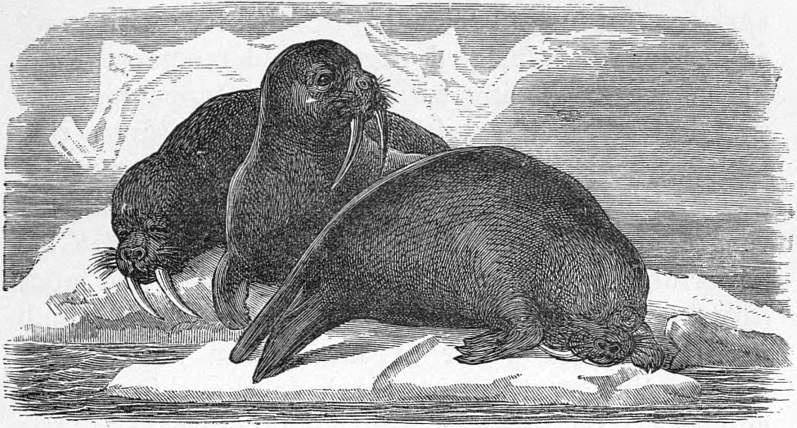
WALRUSES.
Selecting the largest of the three as his victim, our harpooner carefully laid his gun. A moment of breathless suspense followed, to be relieved by the report of the gun, a roar of pain and rage, and the disappearance in the water of the three walruses, while the piece of ice, on which a moment before they had been reposing, was covered with blood, convincing us that our shaft had taken effect. If any further proof was required in corroboration of this fact, a tugging at the line and the sudden moving of the boat was sufficient. Lances and rifles were quickly seized; for these animals, when wounded and maddened by pain, are ugly and dangerous customers, and have frequently been known to rip the planks out of a boat with their formidable tusks, and thus seriously endanger the lives of the crew. We had not long to wait; a disturbance in the water close alongside denoted that our victim was coming to the surface. An instant after, his bearded face with every expression of infuriated rage and demoniacal hate, his fiery eyes glaring with vengeance, appeared, and was immediately saluted with two or three rifle bullets. This warm reception served only to incense and irritate him, and he tried hard to wreak his vengeance on the boat; but his enemies were too powerful, and with the united aid of bullets and lance thrusts the unwieldy beast was forced to succumb to the superior power of his human antagonists. Towing the great carcase back to the ship, it was hauled up on the floe, and quickly flinched.1 The blubber and flesh were packed in barrels, making a very welcome addition to the small amount of food that we had on board for our dogs.
Another walrus was harpooned on the following day, and these were the only two captured by the expedition during their stay in the Arctic regions. Walrus steaks, from this date, were for some time in great demand, whilst the liver was pronounced to be perfectly excellent, and even superior to pig’s fry!
As a rule these animals are exceedingly difficult to kill, for in addition to their enormously thick skulls and coating of almost impenetrable skin and blubber, they are excessively tenacious of life. A rifle bullet, although a walrus may eventually die of the wound, is more than useless, as it will effectually scare him away, and thus all chance of securing him is lost. The only sure way of succeeding in their capture is by the use of the harpoon, and this weapon of course is only available at short distances.
During the temporary delays of the ships in the ice, amusement was not forgotten, and we often had rare fun. It is a very important point in an Arctic expedition to keep the men constantly employed and interested, otherwise they would, more especially when their onward progress was checked, be subject to gloomy moods and fits of despondency. Care, therefore, should be taken to guard against these feelings.
Amongst the numerous games purchased by the expedition before leaving England was a football, which, on occasions of this sort and when the ice would admit of it, would be produced, and a game kept up with great spirit, though with an utter disregard of all orthodox rules. So long as Jack got his kick, no matter in which direction the ball was propelled, he was satisfied! Officers and men would alike mingle in the game, every one determined to carry out the one grand object, namely, that of enjoying themselves. Skating and sliding on the ice were also accomplishments that afforded much pleasure and amusement, and were freely indulged in by all, irrespective of age or rank. Sometimes our Eskimo dogs would be taken out on the floe and harnessed to an empty sledge, whilst some would-be dog driver, anxious to attain proficiency as a whip, would make a start, and be seen tearing round the floe, regardless of weak ice and pools of water, at the rate of ten miles an hour, returning on board thoroughly drenched, but happy in the knowledge that he had succeeded as a dog driver.
Perhaps a few words here in connection with the dogs would not be out of place. As I have before stated, they lived almost entirely in the fore part of the vessel, and were consequently especial favourites with the men, by whom they were fed and greatly petted. Of course they were all named, their appellations being more characteristic than euphonious. They rejoiced in such names as Ginger, so called on account of his colour; Bruin, because he was minus a tail, having been deprived of this appendage in his youthful days; Boss-eye, on account of the obliquity of his vision, or as our men expressed it, because “his eyes were rove cross-jack brace fashion;” Sore-sides, in consequence of the unfortunate dog when it came on board suffering from an unhealed wound in its side. Sallie, Topsy, Sly-boots, Jessie, etc., were the names of others.
The only English dog in the expedition was my black retriever Nellie, an old shipmate and companion, who took no pains to conceal her displeasure and disgust at the introduction of such, in her estimation, a rough and rowdy pack; nor was she ever afterwards induced to cultivate their acquaintance. As she lived in the after part of the ship, she viewed with a jealous eye any attempts on the part of the Eskimo dogs to intrude on what she regarded as her own domain, and would invariably fly at and drive them forward.
Shortly after their appearance on board, and long before they had been used for sledging purposes, a species of rabies, or dog madness, broke out amongst them, which very quickly and alarmingly thinned their number. The first symptom of this disease would generally be the dog falling down in a fit, from which it would partially recover only to rush about in a frantic manner as if totally deprived of all sense and feeling. On some occasions they would rush into the water and be drowned, and at other times wander away from the ship to be no more seen; sometimes their sufferings would terminate in death, whilst at other times they would be shot in order to release the poor things from their pain.
All expeditions have experienced the same kind of disease and mortality amongst their dogs, for which there has hitherto been no remedy. It is a curious fact that hydrophobia is unknown among the Eskimo, and no man bitten by one of these dogs during a mad fit has ever suffered permanent injury from its effects. Frequently whilst employed sledging, they have been attacked by violent fits, resembling cramp, completely prostrating them, causing them to roll over on their sides and foam at the mouth. On these occasions they would be freed from the sledge, which after a time they would follow, when they would be reharnessed and proceed as if nothing had occurred.
Dr. Colan devoted much of his time to the investigation of the nature and causes of this disease, and I have no doubt his researches will throw a flood of light over this matter that will prove of the greatest value to succeeding expeditions in the preservation of their dogs, and be the means of baffling the attacks of this insidious disease.
The dogs when employed in dragging a sledge are always harnessed in line abreast, and never, as generally supposed, ahead of each other in tandem fashion.
From six to ten or a dozen dogs form a team. They are capable of dragging as much as one hundred and fifty pounds per dog; but this is rather an excessive load and should not be exacted for any length of time. So strong and enduring are they that they will frequently perform a journey, over smooth ice, of twenty-five or thirty miles a day with this load; but with light loads and level ice they have been known to travel as much as seventy and even a hundred miles in one day.
There is something very exhilarating and exciting about dog sledging, so long as the weather is fine, temperature not too low, smooth level ice to travel over, and a light sledge to drag. But let all these various conditions be reversed, let the weather be thick and foggy, or a gale of wind blowing with a blinding snow-drift, a temperature of 50° below zero, rough hummocky ice to travel over, and a heavily laden sledge to be dragged by a tired and obstinate team, then dog sledging cannot be regarded as either a comfortable or desirable amusement.
The sensation of dashing along on a light sledge at the rate of ten miles an hour, the fine snow flying into one’s face as the dogs tear through it pell-mell in their headlong career, or perhaps plunging down the side of a steep ravine when the utmost caution is required to prevent the sledge from capsizing and toppling over on the top of the dogs, is both novel and delightful. But when obstacles such as hummocks and deep snow-drifts have to be encountered, especially with a low temperature, the reverse is the case. Directly the sledge receives the slightest check from either of these causes, the dogs lie down, and look at you in the most provoking manner. It is no use having recourse to the whip, for not all the flogging in the world will make them advance until the obstacle has been removed, or the sledge carried over the difficulties that had retarded its progress.
The whip is the main feature in dog driving. To be a good driver it is therefore necessary to use this implement in a dexterous manner. The lash is a thong of sealskin about eighteen or twenty feet long, attached to a short handle of about twelve inches in length. It is, in the hands of an experienced driver, a formidable weapon, the punishment that the dogs receive from it being often very severe. They are guided solely by it, and it is amusing to witness the cunning and intelligence displayed by the outside dogs, who invariably get more than their fair share of the lash, in dodging under the lines of the others and emerging somewhere in the midst of the team in order to escape from its terrible infliction. Another very annoying and distressing piece of work connected with dog sledging is clearing the lines, which in a short time become in a grievously entangled state from the constant dodging about of the dogs, and this it must be remembered has to be done with hands encased in thick woollen mitts, for to bare them would ensure serious frost-bites. In consequence of the amount of provisions that have of necessity to be carried for the use of the dogs, it is almost impossible to use them for long journeys. None were employed during the expedition by any of the extended sledge parties; but for short journeys, or when dispatch was required, they were invaluable.
1 “Flinching” is a whaling term for cutting up a whale or walrus.
CHAPTER VIII.
SLOW PROGRESS THROUGH THE ICE.
“He rose, the coast and country to survey, Anxious and eager to discover more. It looked a wild uncultivated shore, But whether human kind or beast alone Possessed the new-found region was unknown.” Virgil.
Thursday, August 12th.—Early this morning, the floes opening slightly, an attempt was made to proceed; but it was a futile one, the ice remaining perfectly impenetrable. This delay is naturally causing anxiety, as our fuel is rapidly disappearing, from the constant demand for steam, and the navigable season is also as rapidly waning, young ice forming alongside the ship nearly an inch in thickness. Patience, combined with caution and perseverance, is an indispensable qualification for an Arctic navigator. At the same time he must be prepared, when occasion offers, to make a bold dash. Quick determination and an ever-ready eye to seize upon any available opportunity are also necessary attributes of the explorer who hopes to achieve success in ice navigation. Without them failure is inevitable.
In the forenoon both ships were slightly nipped. We succeeded in unshipping our rudder in time; but the “Discovery,” receiving the squeeze more astern, had her rudder very severely injured. She was enabled, however, to patch it up sufficiently for temporary use and thus avoid the necessity of shifting it. In the afternoon the ice began to move to the eastward, enabling us once more to make a start. Hastily shipping our rudders we got under weigh, and having bored through a few streams of ice emerged into a fine lead of water extending between the land and the pack. Passing Cape D’Urville, we opened a large inlet. At its head was a deep ravine, containing two large glaciers which, running respectively from N.E. and N.W., met and formed one terminal face. At 9 P.M. the southern extreme of Dobbin Bay, called Cape Hawks, was passed. This is a magnificent promontory, which has, with some propriety, been compared, in appearance, to the Rock of Gibraltar.
It was a beautifully calm night as both ships silently rounded this bold headland, the water so still and unruffled that it was actually used as an artificial horizon for the purpose of taking an astronomical observation. The Cape itself towered over our heads as we steamed past, its reflection in the still quiet water being clearly visible, whilst deep ravines on either side stretched away apparently for miles into the interior, until lost amid the snow-shining mountains in the far distance. A large glacier at the head of the bay showed out prominently as it glistened in the light of a bright midnight sun, the bay itself being covered with an icy sheet, broken only by a few long low bergs, generated, in all probability, from the selfsame glacier. The few clouds that were visible in the almost cloudless sky presented an exquisite iridescence rarely witnessed, exhibiting clearly defined bright colours, extending in bands in a horizontal direction, the reflection of which in the clear pellucid water materially enhanced the beauties of the landscape. Such a scene, with all its surroundings, could scarcely be equalled in beauty, certainly not surpassed, even in sunny Italy.
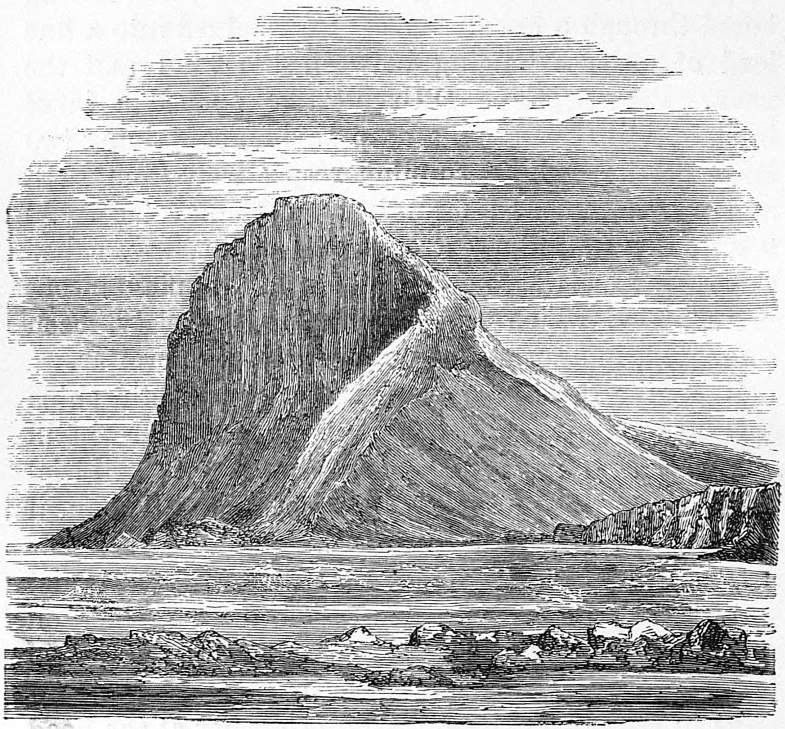
CAPE HAWKS.
Making the ships fast to an iceberg, preparations for landing a large depôt of provisions, similar to the one established at the Cary Islands, were immediately commenced. A jolly-boat, obtained from the “Valorous,” was also deposited here. We have now two large depôts, besides boats, established in our rear, sufficient to sustain a large party for many days, should any untoward accident befall our ship.
Whilst engaged in these operations, an adjacent island—Washington Irving Island—was visited, and a large cairn erected on its summit. Our surprise may be imagined when, on reaching the top, the remains of an old cairn were discovered. At first its origin was attributed to Hayes, who visited the island in 1860, but on closer inspection evidences of a construction at a much earlier date were palpable, the stones of which it was composed being covered with lichen, denoting great age. Hayes, in the published account of his voyage, makes no mention either of having seen this cairn or of having built one on the island. It was, undoubtedly, the work of white men’s hands; the object and necessity for building cairns is unknown, and therefore not practised, by the Eskimos. How then came this structure in such a remote and desolate part of the world? Can it be the work of some obscure navigator of years gone by, who erected this monument as a memento of his visit, but who never returned to relate the results of his adventurous voyage? This must for ever remain a mystery!
Of course it was quickly demolished and its site subjected to a very careful search, in the hopes of discovering some record or clue by which its history might be ascertained; but nothing was found, and we were forced to content ourselves with reconstructing it on a larger scale, and depositing a record at its base detailing the movements of the expedition.
The depôt having been landed, the ships were moved a little farther up the bay, although, to effect this, we were compelled to have recourse to powder, in order to “blast” a passage through the ice. The recent tracks of a bear were observed on the floe, being the only indications of the presence of these animals that we had observed since leaving Melville Bay. It naturally caused a little excitement amongst our sportsmen and would-be bear slayers.
The formation of the land around Dobbin Bay appeared curiously contorted; the stratifications dipping, in some places, to the westward at an angle of about 18°, whilst at others they assumed a perfectly horizontal direction. This irregularity of the strata may probably be accounted for by the trap, or other primary rock, forcing its way upwards through the limestone formation. Where these contortions appear the colour changes from the sombre grey of the surrounding limestone to a bright red and brownish hue.
In the afternoon, it being deemed expedient for the safety of the ships that they should be docked, the requisite instructions were given, and in four hours they were securely placed in two large commodious docks, cut out of the solid floe.
The process of docking is rendered necessary to prevent a ship from being crushed between two floes should she be so unfortunate as to be placed between them with the whole force of the pack driving against the outer one. This operation is frequently necessary whilst following the land-ice, although in these days of steam it is not so frequently practised as of old.
Our ice-saw crews had previously been organized, and, as it is absolutely necessary that the work of construction should be carried out with the utmost expedition, the whole of the officers and ship’s company were stationed so as to take an active part in the proceedings. The instant the order was given for “all hands to cut dock” a most animated scene ensued. Triangles were quickly erected, saws placed in position, the dock measured and marked out by boarding-pikes placed at the several corners, and every one working as if their lives depended upon their own individual exertions. Three persons only were left on board the ship—namely, one officer in charge of the deck, the engineer at the engines, and a man at the helm—and, as it was necessary to keep the ship constantly moving so as to avoid pieces of ice, and also to place her in a good position for being docked, these three had no sinecure offices.
Occasionally a jet of water, followed by a loud report and a shower of fragmentary ice, showed that powder was used to shatter the larger pieces of ice that had been cut, but unless great care is taken in the use of this explosive, it is liable to damage the sides of the dock.
This was our first attempt at dock cutting, which will account for the time occupied in its construction. Ordinarily the work should be completed in about a couple of hours. When two or more ships are in company time is saved by employing all hands to cut one dock large enough to take in all the ships.
The diagram on next page will serve to illustrate the system employed by us whilst engaged in making one of these docks. The last triangular piece of ice that is taken out—namely, the portion marked on the plan by the letters C B F—is removed intact, and being placed across the entrance serves to close the dock and thus keep out all stray pieces of ice.
After four hours of such work as dock cutting entails, it was poor comfort for us to return on board wet, cold, and hungry, only to find that our fires had been allowed to burn out, and that we could neither get a cup of tea to refresh ourselves with, nor a chance of warming ourselves at the stove.1 The Eskimo dogs, being turned out on the floe and tied to one of our anchor lines, made night hideous by their dreary and lamentable wailing.
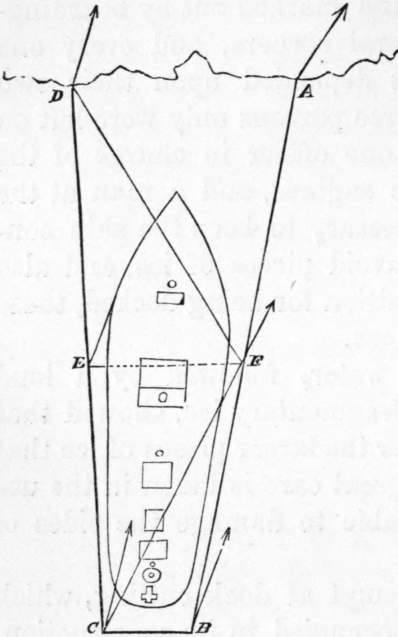
plan of ice dock.
No. 1 saw cuts from A to B 200 ft.
No. 2 ” ” D to C 200 ft.
No. 3 ” ” B to C 35 ft., and then on to F 115 ft.
No. 4 saw cuts from F to D 120 ft., and, if necessary, from E to F 48 ft.
Dimensions of Dock.
Length 200 ft.
Breadth, at entrance 65 ”
Ditto, at head 35 ”
For two days were the ships kept close prisoners; but on Sunday, August 15th, as soon as divine service was finished, a large party of men was actively engaged in cutting and blasting a passage between the floe in which we were imprisoned and the shore, for a lead of water had been observed in the channel which we were naturally desirous of reaching. Although Sunday was as much as possible observed as a day of rest, it was quite out of the question to a party situated as we were altogether to abstain from work on the Sabbath. Our navigable season, we knew, was a short one; no opportunity could we afford to lose; and therefore we were compelled to work as much on Sunday as on week-days should circumstances arise which would make it necessary for us to do so. After about nine hours’ hard work we succeeded in making a passage sufficiently broad for the ships to pass through. Our last explosion was a most effective one; no less than eight blasting charges, or torpedoes, were exploded simultaneously—these varied in size from five to twelve pound charges.
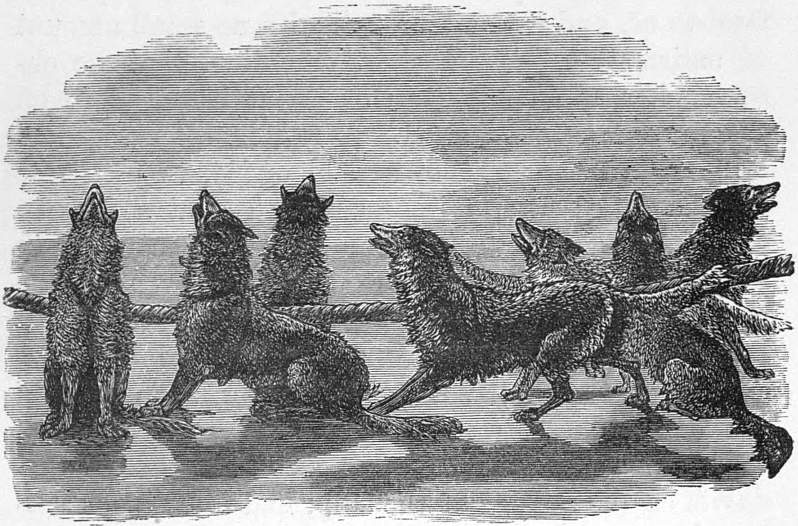
“THE MOANING OF THE TIED.”
The result of this, designated by the men, “feu de joy” was wonderful; the floe split and cracked in all directions, enabling us with our long ice points and poles to clear a splendid channel. Hauling the ships out of dock, we steamed through the passage and into a fine stream of water round Cape Louis Napoleon. So narrow, however, was our channel that in rounding the point, to our great dismay, the “Discovery” grounded. A delay at this moment might have proved fatal to us, and it was therefore with no small amount of satisfaction, after a short detention, that we observed her again afloat. Our joy at being again on the move was short-lived. A few hours sufficed to bring us to the edge of a field of ice, to penetrate which seemed utterly impossible. To cut a dock in such ice, the floes being from ten to twenty feet in thickness, was also out of the question, even had we been provided with saws sufficiently long to do so. Blasting was resorted to, and by this means we were enabled to secure the ship in a small indentation in the ice that afforded some slight protection. So high was the ice that our boats, hanging from the midship davits on the outside of the ship, had to be turned inboard to prevent their being crushed. For three days were we kept in a state of feverish excitement without being able to make any progress, and yet constantly moving the ship to avoid destruction from drifting bergs and closing floes.
The shore was frequently visited, and the heights of Mount Joy and Cape Hayes ascended; but always the same scene met our view to northward—an impassable plain of ice.
Twice in one day were the ships nearly destroyed. A large iceberg that was aground close to us, and therefore protecting us from the pack, suddenly floated and drifted away. This released a large floe to which we were secured, and with which we drifted down rapidly towards another large berg that remained aground. It was an anxious time for us, for in five minutes, unless we could move out of the way, we must be inevitably crushed between the two. All hands were quickly summoned, a line laid out astern and made fast to some large hummocks, and by this we fortunately succeeded in hauling the ship clear; but only just in time, for as our bowsprit cleared the berg, the floe came into contact with it with such irresistible force that hummock was piled upon hummock in a truly alarming manner. Had we been caught, nothing short of a miracle could have saved us.
The noise of the ice as it squeezed against the berg was anything but pleasant to listen to; but still it was better than hearing our own timbers crashing to pieces in the same manner, and we all experienced a strong feeling of relief when the danger was past.
Little rest was enjoyed by any on these days during which we were subjected to the wayward will of the pack. Unshipping and replacing the rudder, and lifting and lowering the screw, were duties that had to be carried out several times during each day, and, although this sort of work is rather depressing and irksome, the spirits of the crew never flagged. They were always ready, cheerful, and willing. No matter what duty they were called upon to perform, it was invariably carried out in the same zealous, hearty manner that was so conspicuously manifested during the whole period of the absence of the expedition as to elicit the unbounded praise and confidence of their leader.
On the 19th of August the ice slackened sufficiently to enable us to proceed, and on that evening, to the intense delight of every one, we succeeded in rounding Cape Fraser.
During the last three weeks we had advanced exactly ninety miles, or at the rate of about four and a quarter miles a day. This cannot be considered a rapid rate of travelling, yet to accomplish even this necessitated a constant and vigilant look-out.
Cape Fraser is a bold promontory some thousand feet in height, terminating in a short projecting point of land about two hundred feet above the level of the sea. Above the talus appeared numerous caves in the cliffs, a peculiarity noticed for the first time, and the summit was studded with irregularities that, to an imaginative mind, might be perverted into gigantic beings, animals, or castellated towers. On one of these ridges was a heap of stones supposed to represent the “Twelve Apostles,” and was so marked on the chart; but as we could never distinguish more than half the number at one time from any point of bearing, it was generally supposed on board that they adhered to true man-of-war regulations, and only appeared in their “watch on deck,” half the number belonging of course to the watch below!
At 10 P.M., being again temporarily stopped, the ships were secured in a little harbour called Maury Bay. During our detention in the vicinity of Cape Fraser, we were able to confirm the observations made by Dr. Bessels of the “Polaris,” relative to the meeting of two tides at or about this point. This fact materially strengthens the argument in favour of the insularity of Greenland, for it has been deduced from a series of tidal observations obtained by us that the tide to the northward of Cape Fraser—that is, the tide in Kennedy and Robeson Channels—is undoubtedly the same as the North Atlantic one, and therefore flows along the northern coast of Greenland.
Contrary to what might generally be expected, we did not encounter any very great accumulation of broken up ice in consequence of the meeting of these two tides: not more than would be caused by the fact of the channel decreasing in size to the northward at this point, and therefore offering greater obstruction to the ice whilst drifting northward, but facilitating its general drift, which is to the southward.
From the summit of Cape John Barrow, which forms one extreme of the little bay in which we were secured, we obtained a good view, and one which delighted and gladdened our hearts.
Northwards we could see as far as Cape L. von Buch; between us leads of water, although covered with much loose ice. To the eastward we could plainly distinguish Cape Constitution, with a large sheet of water along its base; but to get to it we should have had to penetrate a large expanse of pack. This pool of water was in all probability similar to one seen by Morton in the same place in 1855, and reported by him as an “open Polar sea,” on which many imaginative theories have been based!
Our return to the ship was not accomplished without much difficulty, in consequence of our little harbour of refuge having filled with drifting ice, during the time we were on shore, which beset our boat. We were therefore compelled to haul and drag it over and through innumerable fragments of ice, reaching the ship wet and fatigued, but delighted with the intelligence we possessed and the prospect of pushing on.
Friday, August 20th.—At one o’clock this morning, being the top of high water, we made another start.
Taking advantage of the different broad lanes of water, we steamed rapidly past Cape Norton Shaw, and opened out Scoresby Bay—a grand harbour that would suit admirably for a ship’s winter quarters, provided animal life existed. From the appearance of the land we imagined that game would be found in large quantities. A perfect cone-shaped hill on the north-west side is a very prominent feature of this bay. Indeed, the entire coast along which we are passing is composed of long ranges of hills more or less coniform, varying from one to two thousand feet in height. The coast line is very imperfectly delineated on our charts, the distance between the various bays and headlands are erroneous, and the positions are wrong; the error always being that they are placed too much to the northward.
Off Cape McClintock we had another narrow escape from being severely nipped, in consequence of attempting to pass through a channel between two closing floes. Although jammed for a short time, the pressure was not very great, and, the nip easing, the ship was released. Passing Cape Collinson we were again obliged to make fast to a large floe, as all the leads to the northward had closed up, thereby preventing farther progress.
The ice was moving rapidly to the southward—the whole pack drifting bodily—at the rate of from one and a half to two knots an hour. The floe to which we were secured was kept stationary by a couple of grounded icebergs that effectually resisted all its efforts to extricate itself. This rapid drift seemed to indicate the presence of a “North Water,” or at any rate a very loose pack.
Advantage was taken of our temporary delay to establish a small depôt of provisions, consisting of two hundred and forty rations, near Cape Collinson, for the use of a travelling party which, according to existing arrangements, would be dispatched to the southward by the “Discovery” during the following year, for the purpose of visiting Cape Isabella, and bringing up any letters that might have been deposited there for us.
Saturday, August 21st.—Lanes of water appearing continuous to the northward, we got under weigh at half-past two this morning; but after two or three hours’ boring and working under steam and sail we were forced to relinquish the attempt, being unable to penetrate the pack in the direction we wished to proceed. We therefore returned to our former anchorage, under the lea of a friendly berg, the ice continuing to drift south with marvellous rapidity.
Whilst detained here we were assailed by some furious squalls from the S.E., accompanied by a heavy fall of snow. During one of these the “Discovery” was blown away from her anchors, and it was with no little difficulty that she was again secured to the floe in safety. Thinking we should be able to reach some open water to the northward by the removal of the large floe to which we were fast, both ships’ companies were employed in sawing off a large piece of it, which, impinging on one of the stranded icebergs, would, it was thought, release the floe if detached. The distance to cut through was one thousand feet. Notwithstanding the magnitude of the undertaking, every one set to work with a will and resolution that betokened confidence in being able to succeed in anything that was required of them.
Before the work was fairly commenced the ice appeared to slack to the eastward, and the captain, abandoning his former intention, determined to seek a passage through the pack instead of hugging the coast.
Getting under weigh at 9.30 P.M., we bored through a large extent of slack ice, into a fine piece of open water, which, when reached, we found possessed no outlet. It was a perfect salt-water lake surrounded by ice. In this we were obliged to dodge about under sail, waiting patiently for the ice to open and thus allow us a free passage.
As we proceed northwards the ice appears to be heavier and more formidable, and animal life seems to be getting more scarce. Few birds are seen. Occasionally the head of an inquisitive seal is protruded out of the water, but immediately withdrawn (if not killed) on being saluted by half a dozen bullets from the rifles of our keen and enthusiastic sportsmen, who are for ever on the watch to display their prowess in their endeavours to procure food for our dogs, by shooting these animals, who thus pay for their curiosity with their lives.
We appeared to be leaving the region of icebergs, for, although those met with lately were of great size, they were few in number. The one affording us protection this forenoon was no less than six hundred feet in length.
1 An amusing story is related of one of the officers. Whilst engaged in cutting the dock, he, without thinking, put his pipe in his trousers pocket, so as to enable him the more readily to work at his ice-saw. Feeling, after a time, a little warm about his legs, he attributed it to his exertions in working the saw, until a sharp and intolerable pain caused him to put his hand into his pocket. This speedily afforded an explanation: his pipe, being still alight, had burnt a hole through his trousers and shirt and was burning his leg!
CHAPTER IX.
KENNEDY CHANNEL.
2nd Keeper.—“I’ll stay above the hill so both may shoot.”
1st Keeper.—“That cannot be: the noise of thy cross-bow will scare the herd, and so my shoot is lost. Here stand we both, and aim we at the best.”—Henry VI.
“Within a long recess there lies a bay, An island shades it from the rolling sea, And forms a port secure for ships to ride, Broke by the jutting land on either side.” Virgil.
Sunday, August 22nd.—The rapidity of the changes that take place in these icy seas is almost inconceivable. In a few hours from being helplessly imprisoned by a dense pack of ice, we were actually plying, under steam and sail, in a vast expanse of water containing only a few loose streams of ice, through which we had no difficulty in penetrating. Our predictions were indeed realized, and to a greater extent than we had even anticipated. We had reached a “North Water,” in which we were sensible of a very perceptible motion on board the ship. It is true that the pack, apparently as solid and as impenetrable as ever, extended along the west side of Kennedy Channel; but to the northward and along the east side was a clear and open sea, free of ice, with its surface agitated by the fresh northerly wind that was blowing, and rising and falling with true oceanic undulations.
Unfortunately for us, at least so far as making headway was concerned, the wind was not only very strong but directly ahead, compelling us to beat to windward under steam and fore and aft sails. We consoled ourselves, however, with the hope that the same wind would blow all the ice to the southward, and thus enable us to make good progress. The temperature being some six or seven degrees below freezing point caused us to feel the sharp wind in a very unpleasant manner, and made both the crow’s-nest and bridge very disagreeable places of resort. The pleasure of feeling that we were really doing good work was, however, sufficient compensation for the discomfort that was felt.
Stretching over to the eastern side of the channel we passed close to Crozier Island, having Cape Constitution full in view. Its appearance coincides exactly with the description given by Morton.
This cape is the northern extreme of a bay called, by Kane, Lafayette Bay. It is steep and precipitous, and has no ice-foot adhering. Indeed, the base of the headland, as well as the adjacent one, Cape Independence, has the appearance of having been partially undermined by the action of the sea, thus forming an overhanging terrace, up which it would be impossible to ascend. Morton found its ascent totally impracticable, on account of the steep and rugged nature of the cliff. We were unable to detect any signs of a mer de glace over this land, although a light tinge along the summit to the southward of Lafayette Bay would lead one to suppose that it existed. This, however, was the only indication of an ice-cap that was perceived, and it was one on which little or no reliance was placed.
The positions of the various points along this coast are very fairly correct, being as nearly as possible in the latitudes ascribed to them by Dr. Bessels of the “Polaris,” affording a striking contrast to the places on the opposite side of the channel, where the positions are so egregiously inaccurate. The deep inlet on the American chart called Carl Ritter Bay was not to be seen. The only indentation in the land in its assigned position was Richardson Bay, which we must naturally conclude was the one seen and named Carl Ritter by Dr. Hayes.
It was a curious fact that, whereas the land on the west side of the channel was completely covered with snow, the land on the east side was entirely free. This was not the only peculiar feature in which the two sides of the channel differed. Although apparently of the same geological formation, there was a great dissimilarity between the physical appearance of the land on either side. That on the east was flat and table-topped, rising to the height of about one thousand feet, separated into hills by broad valleys, whilst the stratification of the cliffs was regular and horizontal. That on the west side was, on the contrary, composed of conical-shaped hills, rising to an altitude of from two to four thousand feet, and intersected by deep ravines, whilst the stratifications were so distorted that the dip varied as much as from 10° to 45°.
Whilst the land on the east side appeared to have undergone a regular and steady upheaval, that on the west seemed to have been raised suddenly, the deep ravines between the numerous hills resembling the beds of ancient and extinct glaciers.
Monday, August 23rd.—A glorious run has been made during the last twenty-four hours, assisted, for a short time, as we have been, by a strong southerly wind; but alas! by 10 A.M. we arrived at the end of our tether!
Passing the entrance to Bessels Bay, we reached Cape Morton, from whence extended right across Hall Basin our implacable enemy, the ice—solid floes of immense area stretching to the northward as far as the eye could reach, with no opening, no outlet of any description, and no indications of water.
Polaris Bay was ahead of us, and we could plainly discern the position of the Americans’ winter quarters; but with no hopes, for the present, of our reaching so far. We must again, as we have so often had to do before, exercise our patience, and wait for a more favourable opportunity for pushing on. The strong southerly wind now blowing will, in all probability, be succeeded by a calm or a breeze from the northward, either of which will have the effect of opening the ice. The “Discovery” having landed a small depôt of two hundred and forty rations at Cape Morton, for the use of travelling parties that will hereafter be dispatched for the purpose of exploring Petermann Fiord, both ships made sail and beat back to Bessels Bay, where we dropped anchor in seven fathoms, just inside, and under the protection of Hannah Island.
Bessels Bay is a long and narrow indentation in the land, extending in a N.W. and S.E. direction, having numerous small glaciers on either side, the majority of them discharging ones. The bay is in consequence nearly choked with small bergs.
This bay or fiord gives one the idea of having been originally the bed of some large glacier, now extinct, whilst Hannah Island, which lies directly across its mouth, has every appearance of having been its terminal moraine, not only from its position, but also from its composition, for it consists of an immense heap of pebbles and drift, possessing apparently no determined basis, no underlying rock.
We were also able to observe here the undoubted mer de glace under which Greenland is supposed to be buried, and whose outpourings in this locality find their escape in Petermann Fiord and Bessels Bay.
A few eider-ducks, a seal, and some dovekies, with an ivory gull, were seen to-day.
Captain Feilden and Mr. Parr landed on the northern side of the bay, and, ascending a high hill, obtained a good and unobstructed view to the northward. Their report was very desponding—ice, nothing but ice, as far as they could see.
From what we can now observe, the land on the western side of Hall Basin appears to end abruptly somewhere about Cape Union, and does not continue to the northward, as represented in the last American Chart. I put no belief in the land reported to have been seen by some of the men of the “Polaris,” and named President Land. Should the land terminate, as I anticipate, in about lat. 83° N. our chance of reaching a high latitude will of course be much reduced, although we shall have a grand field of exploration to the eastward and westward.
In the evening the captain and myself visited Hannah Island, and erected a cairn, in which a record detailing our movements was deposited, on its summit, in the most conspicuous place about the centre of the island. Here we had an uninterrupted view to the northward; but what we saw only confirmed the report brought on board in the earlier part of the day. The western side of the channel appeared free of ice as far as Cape Lieber, and a lane of water was visible extending from us as far as this cape. By this stream of water appears our only chance of getting on.
Tuesday, August 24th.—The captain left the ship early this morning to ascend the hill immediately above Cape Morton (two thousand feet in height), in order to ascertain from the nature of the ice what our prospects of pushing on were likely to be. During his absence a haul with the dredge was obtained, but with unimportant results: the continual movement of icebergs in the bay, all more or less aground, would hardly admit of much organic life at the bottom. Fossils abounded in the limestone on shore, and a large collection of specimens was made.
At noon the captain was observed, in his boat, off Cape Morton, with the signal flying for the ships “to weigh.”
His orders were speedily executed; and, having picked him up, we were soon running quickly across to the western side. He gave us the very pleasing information that from the summit of Cape Morton he had observed a magnificent lead of water along the west coast, and extending in all probability as far as Cape Beechey. This was indeed delightful intelligence, and served to raise the social barometer many degrees.
Our coal was rapidly diminishing, and we knew that many more days of steaming such as those we had lately had would reduce our fuel to such an extent that we could hope to do little more; for without steam a vessel in these latitudes would indeed be helpless.
11 P.M.—Oh, the hopes and disappointments that we poor Arctic explorers have to endure! First of all a confiding anticipation in the future makes us joyous and expectant, and then we are plunged into the lowest depths of despondency.
Two hours ago we were steaming through a grand expanse of water, looking forward with confidence to reaching, in a few hours, Cape Beechey, or perhaps even Cape Union, both being distinctly visible ahead, whilst Capes Brevoort, Sumner, and Stanton were in sight on our starboard bow.
Passing Cape Baird, however, we were again met by our insatiable enemy, the ice, which defied all our efforts to penetrate it.
We are now slowly picking our way across Lady Franklin Strait towards Cape Bellot, in the hope of being able to reach some place of security where we can remain patiently until a northerly wind shall have cleared a passage for us. Whilst crossing Kennedy Channel we obtained a magnificent view up Petermann Fiord. It is an extensive opening, with no land visible at its head. This is a geographical problem which we hope we shall soon be able to solve. It is difficult to determine at present whether Lady Franklin Strait is really a strait or a deep inlet. We are inclined to the latter belief. This is another question we hope will soon be satisfactorily settled.
Wednesday, August 25th.—At one o’clock this morning, whilst threading our way amongst the ice-floes that bordered the coast, a herd of musk oxen was observed browsing quietly on an adjacent hill. Such an opportunity for obtaining fresh meat was not to be disregarded. A shooting party was quickly organized, and, whilst the boats were being prepared and the hunters getting ready their rifles, the ships were taken into a beautifully snug and land-locked harbour, protected at its mouth by a large island, situated on the northern coast of Lady Franklin Bay.
Here the anchors were let go, and the sportsmen despatched in quest of the game.
Separating into three distinct parties on landing, we advanced cautiously towards the spot where they were last seen grazing, hoping to be able to surround and capture the entire herd. Not only did we all enter keenly into the sport, but our mouths watered at the prospect of again indulging in fresh meat. We pictured to ourselves smoking-hot beefsteaks and savoury calf’s liver, dainties that we had for some time been strangers to, being prepared for us after our return to the ship, never even dreaming of a chance of returning empty-handed.
The disposition of our force was well calculated, for the musk oxen being alarmed, in all probability by the blowing off of steam from one of the ships, started in full flight in the direction of a deep ravine. Here they were met by a couple of the hunters, who discharging their rifles dropped two of the herd. The remainder turned and dashed up the side of a steep hill, but only to be met by two more sportsmen, who made such good use of their time and weapons, that they succeeded in shooting the remainder, seven in number.
One of the first brought down was the bull of the herd, a noble fellow; but so tenacious of life that several shots had to be expended, at a very short range, before he bit the dust.
Elated with our success, and having sent back to the ship for assistance in conveying the meat on board, we commenced skinning, cleaning, and cutting up the animals, so as to guard against the possibility of any delay in doing so being the means of tainting the flesh with the disagreeable musky odour. This, in consequence of the scarcity of knives amongst the party, was a long and tedious process; however, by nine o’clock we had the satisfaction of seeing our “morning’s bag” safely on board, amounting altogether to 2,124 lbs. of good fresh meat. Not a bad morning’s work!
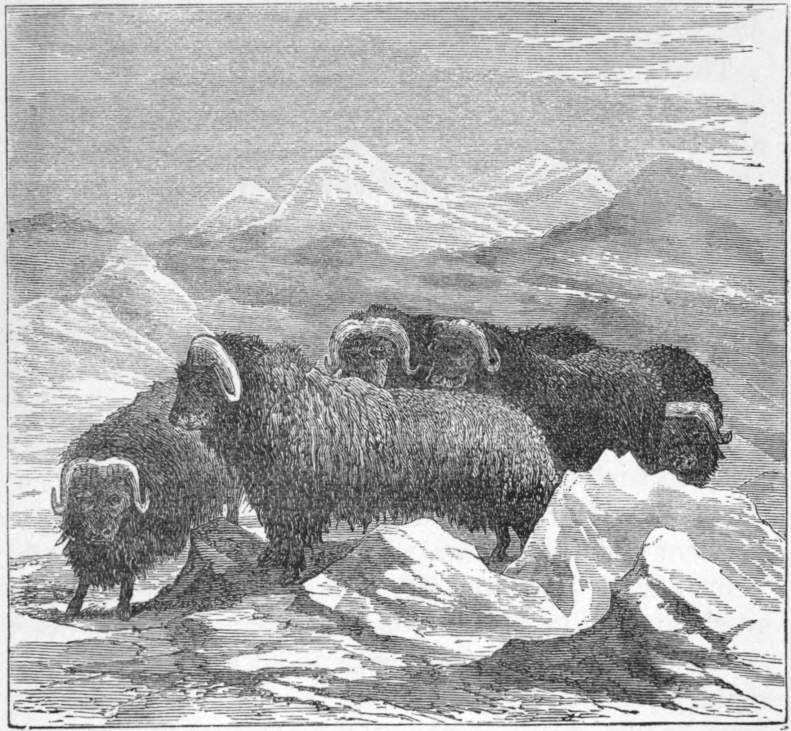
MUSK OXEN.
These animals, from peculiarities they possess, are placed in a genus between the sheep and the ox, and are called ovibos moschatus. They are only met with in high latitudes, although traces of them, it is reported, have been seen as far south as 59° N. lat., but they are rarely seen in any numbers lower than 67° N. lat.
They have been seen, and shot, in large numbers, by the various search expeditions wintering at and about Melville Island, and they were also obtained on the opposite side of Kennedy Channel by the “Polaris” in 1872. The crew of this latter vessel succeeded in shooting twenty-six during the twelve months they passed in this latitude. They are gregarious, usually wandering in small herds, although occasionally single specimens are found. The herd just obtained by us consisted of one old bull and four old cows, and two young bulls and two young cows. They subsist on the scant vegetation of these regions—principally grasses and lichens—which they scrape up from under the snow, when the ground is covered. They hardly give one the impression of being very quick and agile, yet they ascend hills and climb over rocks and rough surfaces with great ease. They are reputed to be very irascible, and have frequently been known, when wounded, to attack a hunter and seriously endanger his life. The horns are very broad, covering the brow and crown of the head, and meeting at their base. Our bullets appeared to have no effect when fired at the head. From the bull we obtained no less than 385 lbs. of meat!
Finding that the harbour in which the ships were anchored possessed all the necessary qualifications for rendering the winter quarters of a vessel in the Arctic Regions comfortable and secure, Captain Nares selected this spot as the place in which he would leave the “Discovery.” It appeared in every way adapted for this purpose. A secure harbour, possessing two narrow entrances, with the water so shallow as to effectually prevent the larger and heavier pieces of ice from drifting into it, with a neighbourhood covered with a more luxuriant and richer vegetation than had hitherto been seen, and giving evidences of being well stocked with game—for, in addition to the musk oxen, numerous and recent traces of wolves, foxes, hares, and lemmings had been observed—the place seemed especially suited for passing the winter in; and its selection as the winter quarters of our consort was never regretted.
We all feel that the navigable season is rapidly drawing to a close, and that very few more days are left us. During the last week the temperature has never been above the freezing point; and the young ice has been forming to an alarming extent, even at midday. An advance, if farther advance is to be made, will be better and more speedily accomplished with one ship only, than by having two to look after. The responsibility is lessened, whilst the knowledge that there is another ship to fall back upon, in case of accidents, removes all anxiety.
When the decision that the two ships were to part company was promulgated, it was received with satisfaction, although we were all sorry to lose the companionship of our numerous friends. The evening was spent in an interchange of visits, and many a sincere and fervent “God speed,” with a silent but expressive squeeze of the hand, was exchanged between the officers and the men of the two Arctic ships.
In order to strengthen our force on board the “Alert,” and to have an extra sledge party for the purpose, if required, of communicating with our consort, an officer, Lieutenant Rawson, and seven men were received from the “Discovery;” the only thing that we were able to give in exchange being 900 lbs. of the musk oxen just procured—a by no means despicable offering!
Everything having been satisfactorily arranged, the “Alert” steamed away from Discovery Harbour on the morning of the 26th, exchanging hearty cheers with her consort as she passed; she hoisting the signal “May Providence prosper your efforts,” to which we replied “Happy Winter;” and thus we separated, happy in the knowledge that a safe refuge was established in our rear, with the unknown before us, fervently praying for a successful issue to our undertaking.
CHAPTER X.
THE CROSSING OF THE THRESHOLD.
“And now there came both mist and snow, And it grew wondrous cold. And ice, mast high, came floating by, As green as emerald. And through the drifts, the snowy cliffs Did send a dismal sheen; Nor shapes of men, nor beasts we ken, The ice was all between. * * * * With sloping masts and dripping prow, As who pursued with yell and blow, Still treads the shadow of his foe, And forwards bends his head, The ship drove fast, loud roared the blast, And Northwards aye we fled.” Coleridge.
Now that we are pursuing our solitary journey northwards, we can the more fully realize that our real work has commenced—the real work towards the achievement of that success which we all so ardently hope will crown our efforts.
Now that we are alone we shall be the more ready to avail ourselves of every opening in the ice that may present itself, every little chance that may occur, which we should be unable to do, if hampered with a second ship.
We had hardly advanced three miles, in fact were still just inside the entrance to the harbour, when the ice, closing in round the point, barred all egress. In endeavouring to steer clear of these fragments, the ship grounded on a projecting spit off a small island, but sustained no injury, floating again immediately she was lightened. As farther advance was out of the question, for the present, in consequence of the pack having drifted in, the vessel was secured under the lee of a natural breakwater at the entrance to Discovery Harbour, ready to take advantage of the first opportunity of making a start that should offer.
Accompanied by Feilden and Rawson, I made an expedition to Distant Cape, whence we obtained a good view of Robeson Channel; but it was anything but an inspiriting one. There appeared to be a perfect block of heavy ice right across to the Greenland coast, although a few thin blue lines, denoting streams of water, could be discerned radiating in the pack to the eastward, but apparently leading to nothing.
Some terns, Sterna Arctica, were obtained on a small island, as also their young and eggs. The nests were simply little round holes, some in the snow, having a few small pebbles as a bed. Some knots, Tringa Canutius, were also obtained; but no amount of search was successful in discovering either the egg or the nest of this bird.
A fine sheet of water, situated on the breakwater, being frozen over, afforded our skaters an opportunity of indulging in their favourite pastime, and of practising both the inside and outside edges to their hearts’ content.
The following day was also one of enforced idleness, and no movement could be made with the ship.
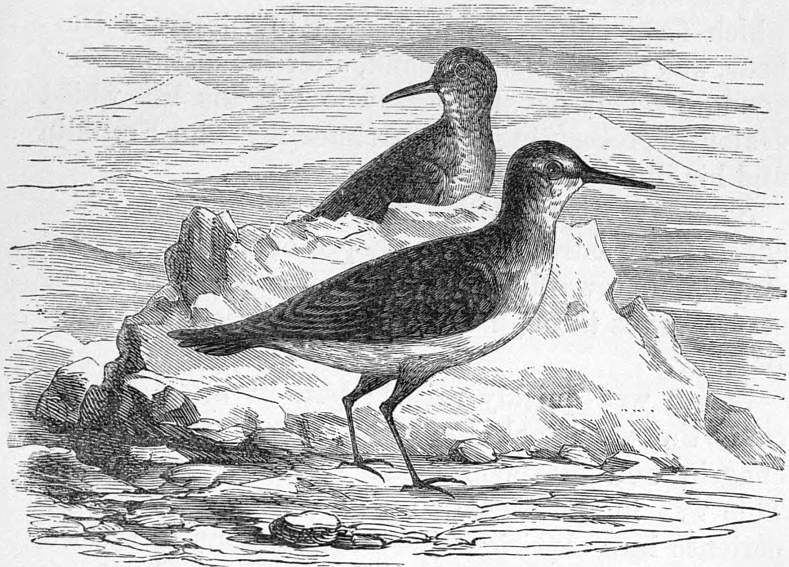
KNOTS.
Snow fell heavily, much to our annoyance, as it prevented us from keeping a perfect watch on the ice in the channel, in consequence of its density. The ice was being set up Lady Franklin Bay at a great pace. Once during the day it appeared inclined to open and give us a chance of proceeding. The skaters and sportsmen were hurriedly called on board; but before steam could be raised the opportunity was lost. In navigating these waters it is necessary to be constantly on the alert, and prepared, at any moment, to take advantage of any chance that may occur; but with the small quantity of fuel we have remaining, it is also necessary to economize and husband that essential aid to advance as much as possible; our fires were therefore always kept low, except when the engines were actually working.
A small fragment of driftwood was picked up on the island. It resembled some hard wood, but was so wasted and worn by attrition that it was impossible, without subjecting it to microscopic examination, to determine to what species it belonged.
The large island off which we were secured, and which forms the main protection to Discovery Harbour, was named Bellot Island, after the distinguished young French naval officer who lost his life whilst zealously prosecuting the search for Sir John Franklin and his ill-fated companions.
Saturday, August 28th.—A thick fog in the morning effectually frustrated all our hopes of advancing; but clearing up towards midday, we were rejoiced at seeing several leads through the ice in the direction of Cape Beechey.
Steam was quickly raised; but, in attempting to cant, the ship took the ground, and much to our chagrin and disappointment remained immovable. This was indeed tantalizing, as we knew by sad experience how capricious were the motions of the ice, and that every moment was of the utmost value to us.
Lightening the ship as much as possible, the rising tide floated her in about a couple of hours, and at 5 P.M., having hoisted up all our boats, we were again able to proceed.
As we rounded the point we hoisted the colours and dipped them three times as a parting farewell to our consort, who had just time to whip up the signal “Good luck” before we were finally shut out from each other’s view.
Rounding Distant Cape, we found the channel full of ice, some of the floes being very massive and of great extent; but between them existed narrow lanes of water, in some places choked by loose slack ice, through which we had little difficulty in penetrating, although at the expense of our rudder, which was so severely injured by the heavy nature of the ice as to be rendered almost useless.
At midnight, when within about a mile of Cape Beechey, ice was encountered stretching right across the channel and pressing so tightly in to the land as to form a dead block to our farther advance. We had then by estimation reached the 82° parallel of latitude. This check was a great damper to our hopes, especially as no bays, or protection of any description for the ship from the pack, could be found in our immediate vicinity.
Our only resource was to return a few miles to the southward and there, in a slight indentation of the land, affording little or no protection, secure the ship to an ice floe, and employ ourselves at once with the rather heavy operations connected with shifting the rudder. This work was performed in about three hours. In the mean time, a small herd of musk oxen having been observed on shore, our sportsmen were despatched in pursuit, and we soon had the satisfaction of hearing that they had succeeded in shooting three, the remainder of the herd having escaped over the hills. This was a very welcome addition to our stock of fresh meat. Our mizzen-rigging was now literally groaning with the amount of meat suspended there; for, in addition to the recent accumulation of musk-ox flesh, the remainder of our sheep, some seven or eight in number, had been slaughtered and added to the general stock. So hard were the portions frozen, that they were very truthfully compared to the legs of mutton and sides of sheep made of wood usually seen hanging in the front of a butcher’s shop in a pantomime!