Front matter (continued 4)
Reading edition
God save the Queen.
Messrs. Giffard and Symons, Printing Office, Trap Lane.
THURSDAY POPS.
H.M.S. “ALERT.”
January 20th, 1876.
GRAND PHANTASMAGORIAL EXHIBITION and MUSICAL ENTERTAINMENT.
To commence with A few Words on Astronomy, by Com. Markham, Illustrated by the aid of a magic lantern. To be followed by a series of
Dissolving Views,
Consisting of coloured representations of Remarkable places in England, Photographic sketches of foreign countries, etc. After which, the wonderful and startling adventures of
Sindbad the Sailor
Will be related by the Rev. H. W. Pullen. In the next place Com. Markham will give a life-like and entertaining display of various specimens in
Natural History;
and Lieut. Aldrich will recite the true and touching
Tale of a Tub.
To conclude with some highly amusing
Comic Scenes.
To commence at 7.30 precisely.
God save the Queen.
Messrs. Giffard and Symons, Printing Office, Trap Lane.
These amusements may be considered light and frivolous, for men engaged in such a serious undertaking as that upon which we were embarked; still they all tended to one point—namely, the successful issue of the enterprise. For they kept the minds of the men employed with pleasant and agreeable thoughts, drove away all feelings of tedium and dulness, and thus assisted largely in promoting the general well-being and satisfactory sanitary condition of the expedition during the long night of nearly one hundred and fifty days. They effectually banished despondency, and assisted in making all hands cheerful, happy, and contented.
1 Lieutenant Giffard and Robert Symons, A.B.
2 Petersen, the Danish interpreter, and the ship’s cook Dominick a native of Gibraltar.

CHAPTER XV.
WINTER OCCUPATIONS AND AMUSEMENTS.
“Darkness, Light’s eldest brother, his birthright Claimed o’er this world, and to heaven chased light.” Donne.
“Behold the wandering moon Riding near her highest noon, Like one that hath been led astray Through the heavens’ wide pathless way; And oft as if her head she bowed, Stooping through a fleecy cloud.” Milton.
The sun, as has been mentioned in a previous chapter, took its final departure on the 11th of October. From this date darkness gradually settled upon us, reaching its greatest intensity on the 21st of December. The type of a leading article in the Times newspaper was taken by us as a test of the darkness. This was last read in the open air at midday on the 6th of November, and then only by a few with a great deal of difficulty. Many unsuccessful attempts were made on subsequent days. For a fortnight on either side of the 21st of December, the difference in the light between noon and midnight, on a clear day, was almost imperceptible, on a dull day it was quite inappreciable. Occasionally, at other times, at midday a faint luminous band might be observed along the southern horizon, but this was all the indication we had of the difference between day and night.
We did not forget to celebrate on the 21st of October the Battle of Trafalgar, remembering that our great naval hero, Nelson,1 was himself an old Arctic navigator. Our caterers provided us with a good dinner, and we were regaled, as a great indulgence on such an auspicious occasion, with an extra glass of wine! Two elaborate bills of fare were placed on the table, on one of which was very creditably sketched the “Alert” in winter quarters, and on the other was depicted the Battle of Trafalgar, with the motto on each, “England expects every man this day to do his duty!” As there was a good dinner on the table, and the cold weather had made us wondrous hungry, we all responded nobly to the call!
The 5th of November was another anniversary that could not pass unnoticed. On that evening the effigy of Guy Fawkes, ingeniously stuffed with squibs and seated on a cask well smeared with tar, was duly paraded round the upper deck, accompanied by the drums and fifes playing the “Rogue’s March.” It was then dragged, on a sledge, to the summit of a neighbouring hummock, and there solemnly burnt in presence of the whole ship’s company. The band continued to play until the lips and fingers of the fifers became so frost-bitten that they were compelled to desist. It was a novel sight to see the dusky forms of the men, clad in seal-skins, dancing round a blazing fire on the top of an enormous mass of ice, whilst in the background was the ship with her masts and yards thickly coated with snow, and all her ropes clearly defined in the bright “bonfire light.” A beautiful balloon, manufactured by Moss out of various coloured tissue-papers, also formed a prominent feature in the evening’s display. Unfortunately, shortly after it was released, and before it had ascended to any very great height, it caught fire and was quickly consumed.
It must not be supposed, because I enumerate all the little incidents connected with the amusements of the men, that other and more important work was neglected. On the contrary, the officers were unceasingly engaged during the winter in taking scientific observations in their respective departments; each officer being awarded some special subject. These included observations in astronomy, magnetism, electricity, meteorology, tides, spectrum analysis, observations for the detection of the polarization of light, chlorine, and specific gravity estimations. The pursuit of these investigations was at times a matter of great difficulty and extreme personal discomfort. It necessitated attendance in, and consequent exposure to, a temperature many degrees below zero, for several hours at a time. Under these circumstances it is no easy matter to handle delicate instruments, the manipulation of which, even in a temperate climate, requires the utmost care and caution. Made extremely brittle by the intense cold, a fall to any of the small metal movable parts of an instrument, such as the needles, would be fatal, yet it is almost impossible to touch them with the uncovered hand. The breath freezing on the arcs and verniers of the instruments during the time of observation, and on the glasses of the telescopes and mirrors, adds seriously to the difficulty; whilst the unequal contraction of different metals during intensely cold weather renders some of the instruments totally useless.
Paraselenæ, or mock moons, and auroras were of frequent occurrence, but none of the latter were sufficiently bright to call for special mention. These phenomena were always carefully examined, and the results recorded. As a rule the auroras consisted of faint coruscations darting across the heavens through the zenith, frequently in the form of an irregular arch terminating at each end on the horizon, and generally accompanied by various small luminous patches.
The lunations of the moon were periods that were always looked forward to, and gladly welcomed, affording as they did, on clear bright days, a marked contrast to the gruesome darkness that generally prevailed. These clear days were not inappropriately termed “moony” ones, and were taken advantage of to perform all work that was considered necessary outside the ship.
“Rising in clouded majesty, at length The moon unveiled her peerless light And o’er the dark her silver mantle threw.”
Even on these bright silvery “moony” days it was unsafe to venture to any distance from the ship, as the sudden “veiling of her peerless light” by fog or clouds would produce total darkness, and so prevent the unfortunate wanderer from finding his way back.
Great attention was paid to the important duty of seeing that a proper amount of exercise was taken by every soul on board. Open-air exercise was the more essential to health, because the air we breathed on board was not as pure as might be desired. This was inevitable, and the evil could only be partially counteracted by strict attention to the enforcing of outdoor exercise. A walk was constructed along the floe near the ship, for a distance of half a mile, marked at every two or three yards by small heaps of empty preserved meat tins, placed there by our industrious doctor. We were thus able to take our exercise along this promenade even on the darkest day, and the number of times that each individual walked up and down during the day was proudly recounted at the dinner-table. The darkness prevented walks to any greater distance for a considerable time. This then was our fashionable lounge, and was called the “Ladies’ Mile” after the drive of the same name in Hyde Park.
Our greatest annoyance was undoubtedly caused by the incessant drip in our cabins and elsewhere on board. So bad was it that all books had to be removed from the shelves, or from any position where they were in contact with the ship’s side or the beams overhead. Especially over our beds did we suffer, and could only make certain of a dry night’s rest by taking the precaution of nailing a blanket over the bed, or sloping one as an awning! No means that we could devise, although many experiments were tried on the living deck of the men as well as by the officers in their cabins, lessened the condensation from which we suffered, and which increased with any rise of temperature. One officer went so far as to light, and keep burning for a whole day, no less than fifty-two candles and one lamp in his cabin, hoping by these means to dry it thoroughly; but although it answered the purpose for a day or two, at an enormous cost, it was soon as bad as ever. During the time of his illumination he succeeded in raising the temperature of his cabin from 40° to 75°! It is decidedly unpleasant, whilst writing, to have a continual stream of water pouring down upon your head and upon your paper; yet it is impossible to prevent this disagreeable drip.
One of my messmates, more fortunate than his brother officers, had brought an umbrella with him, and this being spread over his chair protected him from the wet, and thus enabled him to read or write in comparative comfort, and, what was perhaps of greater consequence, with the perfect preservation of his temper.
It may appear like affectation on my part when I say that any rise of temperature, during the winter, was viewed by us with dissatisfaction. Clad as we were to resist a cold of many degrees below zero, we were made absolutely uncomfortable by the heat when the thermometer indicated any degree with a + sign. The only real good that we derived from such a rise of temperature was that we were able more freely to throw open the doors leading down to the lower deck, and thus admit a thorough circulation of fresh air; on one occasion during the month of November the temperature rose as high as 23°, and in December it reached the unprecedented height (for that season of the year) of 35°! These, of course, were only occasional jumps, never of long duration, and were apparently produced by gales of wind from the S.W. Our experience at the “Alert’s” winter quarters was that a breeze of wind raised the temperature, and that our coldest weather was always registered on perfectly still and clear days! During boisterous tempestuous weather the pack, although stationary, moaned and groaned weirdly, as if unhappy gnomes, imprisoned in the cold grasp of the frozen sea, were bewailing their hard fate, and pleading for release from their icy fetters. The young ice, too, in the vicinity of the ship cracked in a most alarming manner, each crack being accompanied by a sharp and loud report, and formed great fissures, leaving the surface, which had hitherto been smooth and level, rugged and uneven. Well might the “Ancient Mariner,” describing such a scene, say—
“It cracked and growled, and roared and howled, Like noises in a swound.”
This movement of the ice, slight as it was, exposed the “Alert” to great pressure, and although it did not amount to an actual “nip,” nor did it in any way cause injury to the ship, it made her list over several degrees. Now, as we in the ward-room were on a limited allowance of wine, namely two glasses a day, this heeling over of the vessel caused us great annoyance, as it prevented our glasses from being filled to the brim, a custom that had been rigidly followed out since leaving England. This curtailment of our “rights,” as we were pleased to call them, was very naturally regarded with a certain amount of disfavour. In order to lessen, if we could not entirely rectify this evil, we supplied ourselves with ingeniously made little wedges, which, being placed under the lee side of the wine-glass, brought it so nearly upright that we succeeded in very nearly getting our full allowance.
The birthdays of the officers were invariably celebrated by the best dinners that our indefatigable and energetic caterers could provide, always having in view the chance of the ship spending three winters in the Arctic Regions. As a special indulgence we were also allowed on these occasions a glass of port wine after dinner, a treat that we ordinarily had only twice a week. The composition of the menus for these sumptuous feasts was always a subject of anxious care and forethought on the part of those who were entrusted with this important duty. Long and earnest were the consultations that were held, before one of them was satisfactorily composed and placed in the printer’s hands.
MENU.
Potages. Mulligatawny.
Poissons. Pégouse à la Couverture de Laine.2
Entrées. Petits Pâtés d’Homard à la Chasse.3 Rognons à la Pain rôti.
Relevés. Mouton rôti à l’Anglais. Tongues on Gimbals.
Entremets. Poudin aux Raisins. Blanc-manger à la Hummock. Petits Pâtés d’Hahis à la place d’Eccleston.
Dessert. Poudin glacé à la Hyperborean. Figues. Noce. Gâteau à l’lrlandais. Café et Liqueur á la Jesson.
November 11th, 1875.
As we were living in a land in which little could be obtained in the way of change, the object was to diversify as much as possible the names of the same viands, so as to make the guests believe that the dinners were entirely different. The names given to some of the dishes were decidedly original. On the previous page is the first printed bill of fare that was placed on the table.
Shortly after the ship had been established in winter quarters, a careful calculation was made of the amount of fresh meat we possessed.
By fresh meat, I mean meat of the musk-oxen and sheep that we had killed, and not the fresh preserved meat, of which we had an ample supply. It was found we had sufficient to yield fourteen meals, at the rate of one pound per man per meal. It was, therefore, determined to issue a fresh meat meal twice every three weeks, and, at the doctor’s recommendation, this was done on two consecutive days. In his opinion this method of apportioning it was the most conducive to health.
Beer, of which we had been provided with ten hogsheads specially brewed for us by Allsopp, was issued, so long as a cask was “on tap,” twice a week. On these days half the allowance of spirits only was served out.
On Sundays Divine service was regularly performed between decks; the morning and evening services being read on alternate Sundays.
Prayers were read daily on the upper deck. The Holy Communion was celebrated on the first Sunday in every month. Considering the small number of men from among whom the choir was selected, and the necessarily slight amount of practice they could have, the singing at church was very creditable. Aldrich played the accompaniment on a harmonium that we had obtained from the ward-room officers of the “Valorous,” before parting company with that ship at Disco. The credit of originating and instructing the choir was, of course, due to Pullen and Aldrich.
Medical inspections were held regularly on the first day of each month, when every officer and man was minutely questioned and examined. Nothing could be more satisfactory than the medical report of the sanitary condition of the men at the conclusion of these examinations.
The amount of compulsory open-air exercise that had to be taken by each man was two hours a day; but most of the men, that is to say all the working hands exclusive of cooks, stewards, and servants, were invariably at work, outside the ship, for at least five hours a day. A very favourite and at the same time healthy pastime of the men in their leisure hours, when the moon was up, was that of “tabogganing.” This consisted in dragging one of our small satellites or dog-sledges to the summit of a neighbouring hill, and then coming down, two or three on the sledge, at the rate of about sixty or seventy miles an hour! The men enjoyed this amazingly, and used to race one sledge against another. As they were not very expert in the management of these “taboggans,” and had little confidence in their own steering, they would, when they saw there was a chance of their sledge coming to grief, tumble out and roll for some distance after it. Fortunately the snow was soft and they never came to harm.
Rawson, who had acquired a knowledge of this sport in Canada, was the first to introduce it in the far north. The dexterity with which he managed his “taboggan” was marvellous, and he would frequently, accompanied by one of his messmates, come down the steep side of one of the highest floe-bergs in the vicinity of the ship. Poor “Nellie” could never understand whence the motive power of these machines was derived, and used to rush round barking at us in a frantic manner when we first started, until left far behind plunging in the soft snow and struggling to keep pace with us.
It was wonderful how this dog withstood the cold. The colder the day the more she appeared to enjoy it, dashing about in the soft fine snow and picking up pieces of ice in her mouth for the purpose of having them thrown for her. It must be remembered that for any one of us to touch a piece of ice with the uncovered hand in a temperature 50° below zero would have been a very serious matter; yet Nellie was able, in the same temperature, to carry pieces of ice, or bits of metal or stone, in her mouth for hours together. The only cause of annoyance to the poor old doggie was the caking or balling of the snow between her toes, which used to trouble her a good deal. To obviate this, four little flannel moccasins were made for her feet; but, although she enjoyed wearing them and seemed to be proud of her appearance in them, they had to be discontinued, as we were afraid that the tying them on sufficiently tight to prevent their coming off might stop the circulation of the blood and thus produce frost-bite. On the whole, however, Nellie throve wonderfully well, and until the following summer enjoyed perfect health. She was my constant companion wherever I went, attending me during my walks, and lying curled up at my feet in the observatory during the long hours that I was employed taking magnetic observations. She always slept in an arm-chair in my cabin, being provided with her own little blanket, on which her name was embroidered.
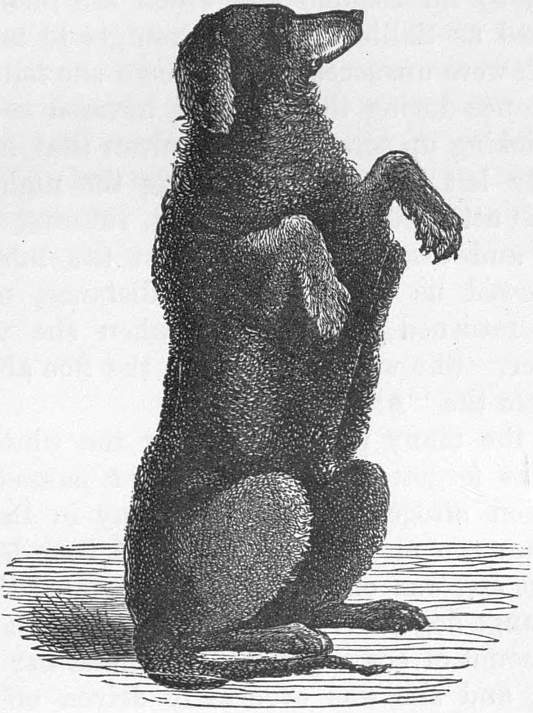
NELLIE.
Before concluding this chapter it will be as well to relate an interesting and rather curious incident connected with one of our Eskimo dogs.
In Aldrich’s sledge journey to Cape Joseph Henry, one of his dogs (Sallie), being attacked with a fit, had to be cast off from the team and was no more seen by him during that journey.
On crossing the floe with my sledge party about a week after, we were suddenly joined, to our great surprise, by an Eskimo dog which the men readily recognized as Sallie; all our attempts to make her approach were unsuccessful, although she followed us at a distance during the day and hovered round our camp, picking up scraps of pemmican that had been purposely left out for her during the night. She eluded all attempts at being caught, running away on the ice and disappearing amongst the hummocks. She followed us faithfully, at a distance, until the day we returned to the ship, when she vanished altogether. She was last seen on the floe about four miles from the “Alert.”
Amid the many preparations for the winter, poor Sallie was forgotten and had almost passed out of recollection altogether, when one day in December, more than two months after she had been last seen, a strange dog was observed hovering round the ship. This strange dog proved to be the long-lost Sallie!
No amount of coaxing would persuade her to come near us, and she was eventually driven off by the other Eskimo dogs, and took refuge on the pack. On the following day she again made her appearance, and this time we succeeded in getting her on board and into a place of safety. She was terribly thin and emaciated; but being well cared for and attended to, she rapidly picked up, and was eventually the strongest and best dog in our whole team.
The question as to how she had existed during her long absence from the ship was a difficult one to solve. At first it was surmised that she had attached herself to a pack of wolves; but this idea was scouted, as no tracks had been seen to lead us to believe that these animals existed in our neighbourhood. It is not probable that she obtained anything from the ship during the time she was missing, or that she picked up scraps from the other dogs, for on her appearance she was at once driven away by her old companions. The only probable conclusion that we could arrive at was that she had supported life by hunting and feasting on lemmings, for the traces of these little animals were the only indications that we had of the existence, outside our own circle, of animal life.
1 Nelson served as a midshipman on board the “Carcass,” in Captain Phipps’ North Polar Expedition in 1773.
2 Blanket wrappers were articles of wearing apparel.
3 The name of the cook was Hunt.
CHAPTER XVI.
AN ARCTIC CHRISTMAS.
“So now is come our joyful’st feast, Let every man be jolly, Eache roome with yvie leaves is drest, And every post with holly; Now all our neighbours’ chimneys smoke, And Christmas blocks are burning; Their ovens they with baked meats choke, And all their spits are turning. Without the door let sorrow lie, And if, for cold, it hap to die, We’ll bury’t in a Christmas pye, And ever more be merry.” Wither.
On the 21st of December the sun reached its greatest southern declination. We felt on that day that we had cause for rejoicing. The sun had arrived at the limit of its southern journey, and now it would, every day, be travelling to the northward, and therefore in our direction. So rapidly had the time passed that Christmas stole upon us unawares, and we were only reminded of its approach by the strong odour of good things being cooked that pervaded the whole ship, bringing to our minds the fact that preparations for its celebration had actually commenced. Nothing was omitted that could possibly add to the comfort and enjoyment of the men on this day. The ship’s stores were thrown open and they were allowed to provide themselves with an unlimited amount, so long as there was no waste, of flour, raisins, sugar, and preserved fruits, and in addition to the regular daily allowance of meat, a pound of musk-ox beef and a pound of mutton were issued to each man. For the two previous days, during which they had been disturbed as little as possible, the men were engaged in making the necessary preparations for spending their Christmas as happily and as socially as if they were in a more genial climate. It must be remembered that this was a day looked forward to by all, not only in the light of a festival, but because it was also regarded as the turning-point of the winter. After Christmas every day would bring us nearer to the sun, whose bright face we all so ardently wished to welcome once more. Moreover, Christmas day, to a community situated as we were, “away from the busy haunts of men,” must always be regarded as an epoch, a day looked forward to, and when passed, a day from which many events are dated.
In addition to the supplies afforded by the stores of the ship, we were largely indebted to kind, and in several instances unknown, friends and well-wishers to the expedition in England for many little articles that assisted to amuse our men during this festive season. Amongst these the kind and generous ladies of Queenstown must not be forgotten. These ladies had, previous to our departure from England, formed themselves into a Committee, and had sent to each ship a large Christmas-box containing many useful, and indeed valuable, articles. Each officer received some little package, personally directed to himself, and every man was presented with some pretty little Christmas-box. Nothing could have been more happily thought of, and it would have done the fair donors good could they but have witnessed the pleasure testified by the recipients at the distribution of the contents of their case.
I must not omit to mention another Christmas-box, kindly sent by Mr. Mason, the inventor, I believe, of “Somebody’s Luggage,” and containing all sorts of amusing little articles suitable either for decorating a table or a Christmas-tree.
Another act of kindness on the part of our friends in England was also much appreciated by both officers and men. A young lady, a relative of one of the officers, had taken the trouble to direct a letter to each individual on board, containing a beautiful Christmas card. To make it appear as if they had been actually delivered through the post, a second-hand postage-stamp had been affixed to each envelope. Her kind forethought afforded a great deal of pleasure to the recipients of those letters.
Christmas eve was spent very merrily by all on board the “Alert.” The piano was carried out from the ward-room to the main deck, where dancing was kept up with great animation until eleven o’clock! It is wonderful how fond the English man-of-war’s man is of dancing. So long as he can obtain music and a partner to dance with, without regard to sex, he will continue to fling his legs about with great vigour until compelled by heat and exhaustion to desist! The men on board the “Alert” were no exception to this rule; one and all joined in the dance, and seemed thoroughly to enjoy it. Poor Aldrich did not get a moment’s peace. As soon as one tune was finished, he was called upon for another. Polka, waltz, and galop followed each other in rapid succession, officers and men joining alike in the general hilarity of the evening.
Christmas morning broke cold and clear; its stillness occasionally interrupted by light puffs of wind from the S.W. Divine service was performed in the forenoon, the pulpit being decorated with branches of artificial holly. When church was over, a little exercise was taken on the “ladies’ mile.” On my return I found my cabin brightened up by small twigs of variegated holly, a delicate and touching attention on the part of some of my messmates, who had provided themselves with artificial branches of this plant before leaving England. At one o’clock, everything being in readiness, the officers were invited to inspect the lower deck. Preceded by our drum and fife band playing the “Roast Beef of Old England,” we paid a formal visit to the men’s quarters. The lower deck was beautifully and tastefully decorated with flags, coloured tinsel paper, and artificial flowers, whilst the different mess tables were literally groaning under the weight of the good cheer that adorned them. Everything had a cheerful and comfortable appearance, and, above all, the radiant healthy-looking faces, beaming with pleasure, that so cordially and heartily greeted us with the compliments of the season. Of course, dancing was the prominent feature of the afternoon, Aldrich, with his usual good nature, being again victimized at the piano. At six o’clock, for on such an important occasion we departed from our usual dinner hour of half-past two, we all assembled in the ward-room for dinner, and great was our astonishment and delight at seeing in the centre of our table a magnificent bouquet of artificial flowers. This was, I believe, the happy thought of a lady who had recently been admitted into the circle of “Arctic relations.” The bright-coloured flowers, reminding us of home associations, were more thoroughly appreciated than even the good dinner which was provided for us, for which reference must be made to the following menu, composed by Pullen:—
H.M.S. “ALERT.”
À la Juliènne soup is the potage we favour, And soles fried au naturel serve us for fish; We have cutlets and green peas of elegant flavour— Beef garnished with mushrooms—a true English dish. Then a mountain of beef from our cold Greenland valleys, Overshadowing proudly boiled mutton hard by, Till our appetite, waning, just playfully dallies With a small slice of ham—then gives in with a sigh. For lo! a real English plum-pudding doth greet us, And a crest of bright holly adorns its bold brow; While the choicest mince pies are yet waiting to meet us: Alas! are we equal to meeting them now? So we drink to our Queen, and we drink to the maiden, The wife, or the mother, that holds us most dear; And may we and our consort sail home richly laden With the spoils of success, ere December next year!
In addition to the bill of fare, the annexed poem by the same accomplished author was printed and placed in front of each member of the mess.
On this glad Christmas Day, While happy bells are flinging O’er bright lands far away Their burst of joyous singing, We love to think that each sweet lay, That sets those echoes ringing, Hushed music from our icy bay To loving hearts is bringing. Hushed music that shall tell How He has left us never, In whose dear sight we dwell, Who aids our high endeavour; Who, from the hearts that love us well, Our short lives will not sever, For whose good gifts our breasts shall swell With grateful praise for ever!
Our drum and fife band, of their own accord, played several airs very creditably during our dinner, which was brought to a conclusion by a few short speeches. In the evening dancing was again kept up with great animation; every one appeared cheerful and happy. In no region of the world could this Christmas-day have been spent with more mirth and more genuine fellowship than it was by the little band of explorers, so far removed from all home ties and associations, who were celebrating it that day, in a latitude farther north than man had ever before penetrated.
On reviewing the events of the year we felt we had much to be thankful for. We had succeeded, in spite of many dangers and difficulties, in establishing our ship in winter quarters in a position farther north than even some of the most sanguine had, at one time, dared to hope. The English flag had been displayed, both by sea and by land, in a higher northern latitude than any flag had ever before been seen, and although our prospects of further exploration in a northerly direction were somewhat damped, owing to the land trending west, we knew that there was much to be done during the ensuing year in defining and exploring the coasts to the east and to the west. A wide field of exploration was still before us, and there was much useful work to be done during the ensuing spring in a hitherto unknown region.
Half our winter had passed, and although the long dark night of one hundred and fifty days might, by some unacquainted with the many resources we possessed to while away the time, be considered dull and monotonous, monotony and despondency were unknown on board the good ship “Alert.” We all looked forward with eager hope to the return of the sun, strong in our determination to do our best, and with our appetites for sledging considerably whetted by the initiation we had received during the autumn.
Hitherto we had, with one exception, enjoyed perfect immunity from sickness, and we all thought that if there was no cold weather in the Arctic Regions to produce frost-bites, the appointments of medical officers to the expedition, so far as their professional qualifications were concerned, were undoubted sinecures. The frost-bites had, however, been very severe, and at the end of the year there still remained on the sick list four of the poor fellows who had been attacked during the autumn sledging, three of whom had suffered amputation of the big toe.
Compelled to keep to their beds, the winter to them must have, indeed, been wearisome; but no word of complaint was ever uttered by them, and they appeared as cheerful and in as good spirits as the best of us. Their only distress was the idea of not being allowed, in consequence of their misfortune, to participate in the spring campaign. The sequel, however, proved, although they took no part in the extended sledging operations, how well and how nobly they worked in their brave endeavours to assist and succour their poor, weak, and stricken comrades; but we must not anticipate.
We had hitherto experienced, in comparison with what we had been led to expect, tolerably mild weather, as Arctic winter weather goes; and the cold had not been so severe as we anticipated; -46.5° or 78½° below freezing-point being, up to the end of the year, the minimum temperature registered. This was by no means an uncomfortable temperature, although superficial frost-bites, especially on the noses and cheekbones, were of constant occurrence. Solitary walks were, of course, prohibited; and it was particularly impressed upon every one that, when they were absent from the ship, they were carefully to watch their companions’ faces in order to detect a frost-bite at once, and so be able to restore circulation before permanent injury could be sustained. Face-covers were occasionally worn, but were not in very great favour. They have the disadvantage of freezing to the face, which they also conceal, and so prevent a comrade from seeing and reporting a frost-bite.
In the neighbourhood of our winter quarters there had, up to this time, been a remarkable absence of all animal life. Occasionally the quarter-masters would report that during the night they heard the howling of wolves in the distance, and one night the Eskimo dogs, who were lying curled up in the snow outside the ship, made a sudden rush for the gangway, and evinced great eagerness to get on board. This stampede was attributed to the presence of wolves, but no tracks of these animals had been seen to justify our arriving at such a conclusion. With the exception sometimes of a peculiar, whistling, moaning sound, caused by the rise and fall of the ice with the tide, the stillness of the nights was undisturbed.
We had long been aware that the ice of which this part of the polar sea was composed consisted of huge massive floes, not of a few seasons’ formation, but the creation of ages, real thick-ribbed ice. Except along the west coasts of Banks and Prince Patrick Islands, no such ice had ever before been met with in the Arctic Regions. It therefore became desirable to apply to it a special name by which it might be provisionally known. After some discussion, Captain Nares decided upon calling the frozen sea, on the southern border of which we were wintering, the “Palæocrystic Sea,” the name being derived from the two Greek words παλαιος ancient, and κρυσταλλος ice. This term was used for the great frozen polar sea during the remaining period of our detention on its borders.1
Atmospheric phenomena, such as halos and paraselenæ, were by no means uncommon, and occasionally we were astonished by the heavenly bodies behaving, as it appeared to us, in a very eccentric manner. On one occasion the star Aldebaran was reported to be jumping about in a strange way. Such unusual behaviour on the part of a star brought us all up in the cold, and there, sure enough, was Aldebaran doing exactly what was reported, and altogether conducting itself in a very erratic and unstarlike manner. The illusion was caused by the fall of minute, and imperceptible, frozen particles; but it was some time before we could satisfy ourselves that the star was not actually in motion, many of the men remaining to this day unconvinced. One of our Scotch quarter-masters informed me, some time afterwards, that it was a “vara curious star;” and although the laws of refraction were explained to him, he still persisted in his belief that the movement of the star was due to itself, and would not believe in any other explanation.
At the beginning of the winter, shortly after the return of the sledge parties, the doctor and myself being busily engaged in the construction of a snow house on shore, observed a most brilliant meteor fall, apparently about a quarter of a mile from us, its course being from S.E. to N.W. It was of a bright emerald-green colour, and was falling so quietly and slowly that we at first thought it was a rocket, or Roman candle, let off by some one astern of the ship, it being distinctly visible for many seconds. When it arrived, in our estimation, at about forty feet from the ground, it suddenly burst, displaying bright red and green colours. It was seen by others, from different points of observation; all being unanimous in their opinion that it was one of the most beautiful sights, of the kind, they had ever witnessed.
1 The word may not be formed on strictly accurate principles, but it is sufficiently expressive of the fact it is intended to represent, and it is now endeared to us by association and by common usage while serving in the far north.
CHAPTER XVII.
A HAPPY NEW YEAR.
The old year dies on southern skies, And leafless woods that moan and quiver; The shadows creep o’er ocean deep, And silent lake and rustling river; And all is gloom around the tomb Of wasted moments, lost for ever. The new year gleams on silver streams, Where meadows smile in sunlit glances; The dark shades flee across the sea, And the wild wavelet laughs and dances; And all is bright where new-born light Brings hope to man and golden chances. O happy year! that tells us here The same sweet, ever-welcome story, That soon, so soon! one radiant noon Shall plunge in light yon summits hoary, That point our way through endless day To joyous triumphs, home, and glory. H. W. Pullen,
H.M.S. “Alert,”
January 1st, 1876.
The above lines, composed by the poet laureate of the expedition, greeted us at the breakfast table on the morning of the 1st of January, 1876.
The New Year was ushered in with every demonstration of joy, gratitude, and hope by our little party assembled together, so far removed from the civilized world. We were joyful because a new year had dawned upon us in undiminished numbers; grateful for the many mercies that had been vouchsafed to us, and hopeful concerning our future prospects. We could not look back with regret upon the past year, for to us it had indeed been eventful; but officers and men looked forward to the coming year with feelings of confidence, resolutely determined faithfully to perform their duties, placing their trust in Him who had hitherto so well watched over and protected them, and firm in their reliance on His continued aid and support.
It is generally the custom in the navy to strike the bell sixteen times at midnight on New Year’s eve—eight bells for the old year and eight bells for the new! Of course with us this custom was rigidly adhered to; but not only did we strike sixteen bells at our midnight, but we also struck the same number at six minutes to eight, which, allowing for the exact difference in time, would be midnight in England, so that we had at least the satisfaction of knowing that our bell was being employed in the same way as many others in the navy at the same time.
Perhaps it may be interesting to my readers to know exactly how we received the New Year! I will, therefore, quote my remarks as they appear, word for word, in my journal.
“At five minutes to twelve, we all congregated round the ward-room table, on which was spread a sumptuous cold collation, consisting of a real English ham, Bologna sausages, brawn, and sardines. Strong whiskey punch, in the brewing of which all had a share, was ladled out to each, and from the encomiums which were passed on its flavour and strength, the old proverb that ‘too many cooks spoil the broth’ was completely upset. As the bell struck, a neat little speech was made by our orator the doctor, the compliments of the season were wished to all, nor were those at home forgotten, our glasses were emptied, and then in true Highland fashion, with one foot on the table, the other on our chair, and with hands joined, we all sang ‘Auld lang syne,’ the drum and fife band accompanying us outside, the song being taken up by the men on the lower deck, who, true to their tastes, had been ‘dancing out the old year.’ Such was the manner in which the year 1876 was inaugurated in latitude 82° 27′ N., where no human being had ever welcomed a new year before.”
A more cheerful, happy, and contented party it would be difficult to imagine anywhere; utterly oblivious of the solemn darkness and desolate sterility that prevailed without, they thought only of the “joyous triumph” that they hoped to achieve, and then of their return to old England. Everything wore a cheerful aspect. No leader could have more reason to be satisfied with the health and spirits of those under his command, than Captain Nares on the 1st of January, 1876.
On that morning, at the usual monthly medical inspection, he had the satisfaction of receiving the report that the men were in a better state of health than they were at the last examination. Appetites, which during mid-winter had been waning, had gradually returned. So contented were we, that many were actually pitying our friends in England, because they were unable to enjoy such delicious musk-ox beef as was put on our table for dinner on New Year’s day!
Our first crop of mustard and cress was gathered on the 2nd of January. It was not an abundant one, but there was sufficient to give a mouthful to each person, and what little we had was certainly very refreshing. It had grown up devoid of all colour, and had a very washed-out appearance. The garden was a small shallow box kept close to the ward-room stove. In consequence of the success attending this—our first—attempt at agriculture, several gardens were started, and we were enabled to issue, at different times, small quantities of this excellent antiscorbutic; though how far the loss of colour detracts from its medicinal qualities is a difficult problem to solve. Although the colour was absent, the fresh taste appeared to remain, there being no perceptible difference between that grown on board the “Alert,” and the same reared in the heat of the sun in more favoured climes. As a rule, the best crops were those grown on a blanket.
On the 8th and 9th of January we experienced a heavy gale of wind from the southward. It was impossible, whilst it lasted, to venture outside the ship, even to take the thermometric observations, although they could be registered only a few yards from the gangway: they had therefore to be discontinued during the time the gale lasted. It blew for forty-eight hours with relentless fury, when it exhausted itself in fitful gusts, more or less strong, until it abated altogether. The housing over the ship suffered sadly from this storm, several tons weight of snow having collected on it from the tremendous drift, in some places breaking it through, and in others “bagging” it down so as to render walking underneath an impossibility.
All our outdoor establishments were completely buried with snow, and we were compelled to send parties of men to excavate them, in order to effect an entrance at all. In fact, our men were for some time engaged in repairing the ravages of the storm. The accumulation of drift on the weather side of the ship was enormous, and took the form of a perfectly solid snow-wreath. This was caused by the eddying wind driving the snow from the side of the vessel to a distance of about four or five feet, where it settled, resembling a great frozen wave, whose curling crest was fully seven feet in height.
On the opposite, or lee, side of the ship the ice had cracked, leaving several large fissures, through which the water oozed and flowed over. The spring tides had also caused the ship to rise in her icy cradle, the greater part of the banking having, in consequence, slipped through between the edge of our dock and the ship’s side and disappeared. This also had to be rectified. Our gale of wind had undoubtedly been productive of much extra work, irrespective of the anxiety and the by no means pleasant time spent, during its duration: for as yet our protecting bergs had not inspired us with absolute confidence regarding the shelter they might afford in such tempestuous weather as we had recently experienced. So well, however, did they answer our purpose during this gale, that all cause for anxiety was from that time removed, and for the future we felt as safe and as secure as if we had been frozen up in a well-sheltered and land-locked harbour.
When the wind was at its height, a piece of musk-ox meat, suspended in the mizzen-rigging, was blown down, and was, of course, at once assailed by the Eskimo dogs who had been admitted into the ship during the gale. Fortunately it was frozen so hard that they were unable to get their teeth through it, and although it had been some time in their clutches before it was rescued, little loss was sustained.
At noon on the 17th of January, a faint tinge of crimson, blended with a slight silvery streak of twilight, could be observed in the southern horizon, and although it was only of short duration, it became more decided and lasted for a longer time on each successive day. These bright harbingers of returning light were anxiously watched, and gladly were they welcomed as they assumed a more decided appearance.
Although there was no despondency or depression of spirits on board the “Alert,” the monotony of the long dark nights could not but be felt, and we all eagerly looked forward to the time when the glorious rays from our bright, though long-absent, sun should again crown the summits of the distant hills with their sparkling and joyous light. All on board were interested for different reasons in the return of the sun: the sledge travellers, because it would bring light and heat to cheer and sustain them on their lonesome and arduous journeys, which they knew would be commenced as soon after its return as possible: the sportsmen regarded it as the precursor of game; and all hailed with delight the symbol of returning day and the assurance of the approaching termination of their long dark night. By the 1st of February, those gifted with sharp eyesight were just able to decipher a leading article in the Times on the floe at noon. It was remarked that one of our officers afflicted with short-sightedness was able, by the dim twilight, to read not only with greater ease and accuracy than others, but also some days before them, and therefore by a dimmer light.
We had hitherto had no exceptionally severe weather; but during the latter part of January we experienced a foretaste of the intense cold that we were a month later destined to endure. With a temperature 50° below zero, it is necessary, when exposed to it, to keep the body in constant motion, otherwise a frost-bite will imperceptibly seize hold of one. On first emerging into this temperature a slight difficulty of breathing would be experienced, and tears would be involuntarily brought to the eyes, which immediately became small nodules of ice, and as such had to be extracted. This is hardly to be wondered at when it is remembered that we had to undergo a transition of temperature from our living-deck to the open air of over 100°! In spite of this cold, however, we were not much troubled with frost-bites, except on the face. Our dearly bought experience, during the autumn sledging, will account for our comparative immunity from these very troublesome and painful attacks.
Apropos of frost-bites it is related, that one of the members of the expedition, on getting up in the morning, during the cold weather, found, to his horror, that one of his toes and a part of his foot were quite black. Thinking he was severely frost-bitten, and wishing at once to assure himself of the fact by the only practical method that suggested itself at the time, he seized a pin, and made a furious dig at the supposed injured part. He very quickly found that, although discoloured, it was not totally devoid of all sensation, nor was the circulation of blood in any way impeded. The fact was, that his servant, on the previous day, had patched up his sock with a piece of fearnought, and, in order to assimilate the colour, had inked it over—which fully accounted for his terrible frost-bite!
It was our invariable custom to keep the hair, especially that growing on the face, as close as possible. In spite, however, of this precaution, it was impossible to prevent the breath from freezing on the short stubbly beard and moustache, which would soon be converted into a perfect mass of ice—a decidedly uncomfortable appendage. On returning from our short walks, we frequently found our cap, comforter, and collar of the coat frozen into one solid and compact mass.
Occasionally an amusing incident occurred to vary the sameness of our daily life, as the following story will show. During the darkest part of the winter one of the magnetic observers had occasion to visit the observatory. Taking his lantern, and accompanied by Nellie, he reached the door, which to his surprise was open. Supposing it to have been blown open by the wind, for it had been blowing very hard the previous night, he entered the long tunnel leading up to the Unifilar House. Before he had gone far a strong animal smell assailed his olfactory organs; this, with the fact of Nellie exhibiting great restlessness, induced him to examine the ground, when he clearly detected the traces of some animal, but of what description he was unable to decide.
He was now placed in rather an unpleasant position, for to advance head-foremost through a narrow passage into a small house in which a great Polar bear might have established himself, was to say the least a rash act; yet he was unwilling to return on board, and probably be for ever after chaffed by his messmates for being frightened at nothing. Putting on a bold front, he determined at all hazards to push on, and ascertain what the animal was that had dared to violate the sacred precincts of the observatory. As he advanced the peculiar odour became stronger, and he was sorely tempted to retreat, thinking discretion was the better part of valour. Arriving at the entrance to the house, however, he plucked up courage, and with the lantern well in front of him, and Nellie close at his heels, he dashed in, and there, lying down and looking almost as frightened as himself, was, not the great white bear that he expected to meet, but “Bruin,” the largest of our Eskimo dogs, who, during the boisterous weather of the preceding night, had sought shelter in our observatory, and had no doubt found it a very snug and comfortable place, infinitely preferable to the bleak and exposed floe. It was a long time before the place was rid of the unpleasant smell peculiar to Eskimo dogs.
As the light increased day by day, the men were employed in re-embarking the stores and provisions landed, and in demolishing “Markham Hall.” It was necessary to accomplish as much as possible, as Captain Nares well knew, before the departure of the sledging parties, for so few men would be left on board that little could be done during their absence, and there was no saying how soon after their return the ship would be able to break out of winter quarters. The Eskimo dogs were also now regularly fed and attended to. Hitherto they had been left to do pretty much as they liked, and their regular meals during the winter had been few, and served at uncertain times. Notwithstanding the small amount of food that was issued to them, they were all in capital condition, in fact a little too “fleshy” for dragging purposes, as they always received the scraps and surplus food from the allowance of the ship’s company, and this was more than enough to keep a much larger pack of dogs than we possessed. They were also regularly exercised in dragging a light sledge, their day’s work increasing as the days lengthened.
We could not but notice the sallowness of complexion which the returning light revealed, only too palpably, in the faces of our companions, caused by the long absence of the sun, and which had hitherto been unnoticed by the light of lamps and candles. Like our mustard and cress, we were devoid of all colour, yet apparently in good and sound health. There is something essentially health-preserving and life-giving in the rays of the sun, without which everything must wither and eventually die. This was, in the sequel, but too fully exemplified in our case. For although we were all in excellent spirits and supposed ourselves to be in perfect health, yet the seeds of that terrible disease, which subsequently crippled us so disastrously, must have already germinated unknown to ourselves.
But little did we suspect, at that time, the approach of the evil that eventually overtook us.
Many of the large floe-bergs near the ship were observed to be literally rent in twain, owing in all probability to the contraction of the ice by the intense cold—the outer part of the floeberg being exposed to a greater cold than the interior. These rents will also account for the loud sharp reports that were frequently heard during the winter, and which were for some time wrapped in mystery.
Towards the end of February a few hares were seen, and two or three were shot; but they were very timid and shy, and seldom gave our sportsmen opportunities of exhibiting their prowess. Lemming tracks were abundant, and occasionally these little animals would be seen running along the snow. Nellie regarded them as being created for her especial enjoyment in hunting, and would vainly endeavour to unsnow them after they had taken refuge in their holes. Woe betide the unfortunate little lemming observed by Nellie at any distance from its habitation. A dash, a gobble, and all was over! In vain did we try to break her of these murderous propensities, not only for the sake of the victims but also for herself, as the swallowing of little balls of fur cannot be conducive to health. All was futile! Nellie considered the chase of these little creatures as an undoubted privilege with which no one should interfere.
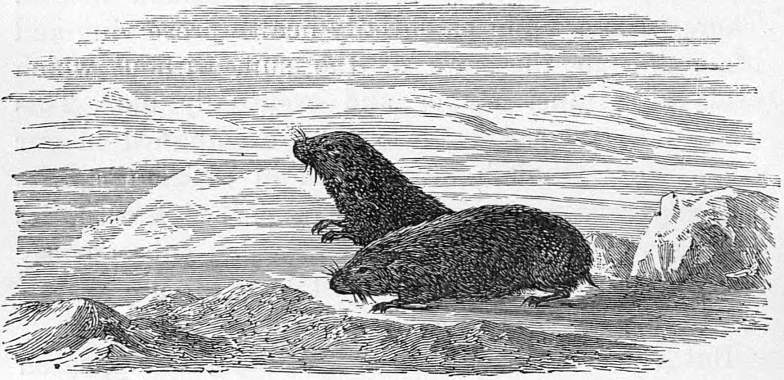
LEMMINGS.
The long twilight enabled us to extend our rambles, and we visited the snow hut built by Rawson last autumn when attempting to get south, about five or six miles from the ship, and in which he had deposited a small quantity of provisions. To our surprise we discovered that, with the exception of the pemmican which was in a tin, and the tobacco, all had disappeared! Biscuit, bacon, tea, sugar, and cocoa, all had gone. A hole through the roof of the house pointed at once to the means of ingress; but who were the thieves? Foxes or wolves had not been seen, nor had any traces of them been observed!
Even supposing these animals to be the depredators, how did they effect their escape from the house after once they had got in? It was simple enough to scrape a hole through the roof and jump down; but it was not so easy to jump straight up a height of six or seven feet through a small hole! Suspicion fell for some time on our long-missing dog Sallie; but it was never satisfactorily ascertained whether dog, wolf, or fox was the culprit. Of one thing there could be no doubt. The robbery had been committed by a very cunning and intelligent beast. Spots of blood on the pemmican tin showed unmistakeably that this also had been attempted, but had proved too hard and strong. The tracks, which were always to and from the floe, were too indistinct to enable us to make out the nature of the animal, but the general idea was that it was a fox.
Of course, with returning daylight, the serious work of sledging and the preparations for the spring campaign occupied our attention to the exclusion of almost everything else. On Saturday, the 26th of February, our school assembled for the last time, the classes being dismissed in the evening only to reassemble again if the ship spent another winter away from England. It would not be fair to dismiss our pupils without a word of commendation. Their attendance was most regular, and their efforts to learn beyond all praise. Nothing could exceed their diligence, nor excel their desire to please and reflect credit upon their masters, and I do hope that many will have benefited by the instruction they received in their Arctic school.
On Thursday, the 24th of February, was performed our last dramatic entertainment. The following was the programme.
ROYAL ARCTIC THEATRE.
H.M.S. “Alert.”
Thursday, 24th February, 1876.
Last performance of the season.

Grand Representation
of the Original pathetico-comico-burlesque operetta entitled the
LITTLE VULGAR BOY,
or
WEEPING BILL.
Founded on the celebrated Ingoldsby Legend, “Misadventures at Margate.”
Written expressly for the occasion by the Rev. H. W. Pullen. Scenery by Professor Moss, M.D. Music by Lieut. Aldrich. Manager: Lieut. May.
Preceded by
Reading “The Blessed Babies” Mr. Hunt.
Song “Fie, for shame” Mr. Symons.
Characters:
Mr. Brown, an old buffer, slightly green Commander Markham.
Mrs. Jones, a landlady, slightly cross, but with a keen eye to business G. Le C. Egerton, Esq.
Jack Robinson; a seafaring man, slightly figurative in his language, and violently in love with Mrs. Jones Lieut. Giffard.
Weeping Bill, a little vulgar boy, slightly out at elbows, and fairly sharp for his age Lieut. Rawson.
K 55, the irrepressible Bobby, slightly self-important, and the natural enemy of Weeping Bill Rev. H. W. Pullen.
Scenes 1 and 3 The Jetty at Margate.
Scenes 2 and 4 Mrs. Jones’s lodgings.
To commence at 7.30 precisely. God save the Queen. Messrs. Giffard and Symons, Printing office, Trap Lane.
This piece, as set forth in the bill, was written expressly for the occasion by Pullen, and not only did he compose it, but he also assisted in its performance. It was a very successful hit, and was most deservedly applauded, loud cries of “Author” following the fall of the curtain.
The ensuing Thursday witnessed the last of our “Thursday Pops,” and this terminated our season’s festivities. At it Captain Nares delivered a very able and instructive lecture on his sledging experiences, bringing a few “facts” home to the men, as to the sort of work they were about to perform, and the kind of life they would have to lead. His announcement that we should, in all probability, spend another winter in the Arctic Regions was hailed with delight. He also announced his intention of returning to England before the third winter, provided no unforeseen event happened to detain the expedition.
The following was the programme for the evening’s entertainment.
THURSDAY POPS.
H.M.S. “Alert.”
Positively the last entertainment this winter.
March 2, 1876.
The season’s festivities will terminate with the following programme:—
1. The Palæocrystic Sea and Sledging Experiences Capt. Nares.
2. Ballad “The Shannon and the Chesapeake” Mr. Cane.
3. Song “Susan’s Sunday out” Mr. Stuckberry.
4. Reading “Two Bab Ballads” Rev. H. W. Pullen.
5. Ballad “Over the Sea” Mr. Maskell.
6. Song “Rummy old Codger” Mr. Pearce.
7. Ballad “Seeing Nelly home” Mr. Self.
8. Recitation “On the Arctic Expedition, by J. D.” Sergt. Wood.
9. Song “Billy Woods the grocer” Mr. Gore.
10. Ballad “Beating of my own heart” Mr. Ayles.
11. Part Song “O who will o’er the downs so free” Messrs. Aldrich, Pullen, May, and Wootton.
To conclude with the grand Palæocrystic Sledging Chorus, by the entire strength of the house.
To commence at 7.30 precisely.
God save the Queen.
Messrs. Giffard and Symons, Printing office, Trap Lane.
This chapter would be incomplete without the words of the “Grand Palæocrystic Sledging Chorus.”
This was also composed by our talented poet laureate, and was most enthusiastically received by the whole ship’s company, who vociferously joined in singing it on all appropriate, and other, occasions.
It brought in the names of all the sledges that were employed in the early part of the spring campaign, and became henceforth, as it were, the “Arctic National Anthem.”
Chorus.
Not very long ago, On the six-foot floe Of the palæocrystic sea, Two ships did ride, Mid the crashing of the tide— The Alert and the Discovery. The sun never shone The gallant crews upon For a hundred and forty-two days; But no darkness and no hummocks Their merry hearts could flummox: So they set to work and acted plays. There was music and song To help the hours along, Brought forth from the good ship’s store; And each man did his best To amuse and cheer the rest: And “nobody can’t do more.”
Air—“The Shannon and the Chesapeake.”
Here’s a health to Marco Polo1— May he reach his northern goal, oh! And advance the flag of England into realms unknown! May the Challenger2 be there, All comers bold to dare, And Victoria3 be victorious in the frozen zone! May our Poppie4 be in sight, With her colours streaming bright, And the Bulldog5 tug on merrily from strand to strand! And the Alexandra6 brave See our banner proudly wave O’er the highest cliffs and summits of the northernmost land! Here’s a health to Hercules,7 Whom the autumn blast did freeze, And all our gallant fellows whom the frost laid low! Just wait a little longer, Till they get a trifle stronger, And they’ll never pull the worse because they’ve lost a toe. Here’s a health, with three times three, To the brave Discovery,8 And our merry, merry guests, so truly welcome here! And a brimming bumper yet To our valiant little pet— The lively Clements Markham,9 with its bold charioteer! Here’s a health to all true blue, To the officers and crew Who man this Expedition neat and handy, oh! And may they ever prove, Both in sledging and in love, That the tars of old Britannia are the dandy, oh!
1 Commander Markham’s sledge.
2 Lieut. Aldrich’s sledge.
3 Lieut. Parr’s sledge.
4 Lieut. Giffard’s sledge.
5 Dr. Moss’s sledge.
6 Mr. White’s sledge.
7 Lieut. May’s sledge.
8 Lieut. Rawson’s sledge.
9 Mr. Egerton’s sledge.
CHAPTER XVIII.
RETURN OF THE SUN.
“Most glorious orb! that were a worship, ere The mystery of thy making was revealed! Thou earliest minister of the Almighty Which gladdened on their mountain tops the hearts Of the Chaldean shepherds, till they poured Themselves in orisons.” Byron.
The 29th of February was the day on which, according to astronomical rules, the reappearance of the sun was to rejoice the hearts and gladden the eyes of our little party. On the previous day, a general holiday had been proclaimed to give the men a chance, by ascending some of the hills in our neighbourhood, of welcoming the sun a day earlier. In this, however, they were doomed to disappointment. The glorious orb would not come out to be welcomed; for the simple reason that it was still just below the horizon. We were, however, rewarded by seeing its rays reflected in the northern sky, which was beautifully illumined with the most brilliant prismatic colours. Cairn Hill, and the hills to the southward by Cape Rawson, were the chief points of observation. The former was abreast of the ship, and about a mile distant; its height being about four hundred and fifty feet above the level of the sea. On the summit was built a large cairn, hence its name. On the cairn was reared a long staff, to which was hoisted an iron oil cask, so as to form a conspicuous landmark to guide wanderers back to their ship.
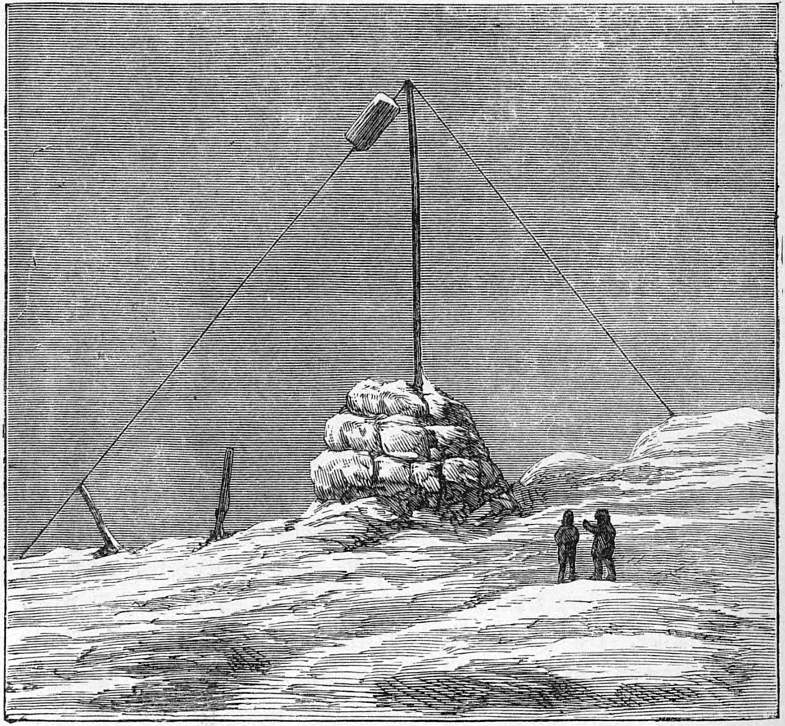
CAIRN HILL.
By ten o’clock on the forenoon of the 29th, the ship was nearly deserted, and officers and men could be seen dotting the floe and snow-covered ranges as they wended their way to the most prominent adjacent hills, on which little knots of men could already be seen assembled, in order to catch a glimpse of the rising sun. We feared, however, on starting, that we should be again disappointed, as there was no clear sea horizon to the southward, and the sun would hardly have sufficient altitude to show itself above the distant land. These fears were not without foundation, as the result proved.
Shortly before noon our excitement was intense as a bright ray shot up vertically from the sun’s position and illumined the summits of the surrounding ranges, whilst a radiant light was shed around.
“As rays around the source of light Stream upward ere he glow in sight, And watching by his future flight Set the clear heavens on fire.”
Our hopes grew high as noon drew near, but again were we disappointed, and again were we compelled to return to the ship, defeated in our object of welcoming back the “Prodigal Sun!”
The next day was cloudy, but on the following one, by going aloft about ten o’clock, we had the satisfaction of announcing that about one-third of the sun’s disc was visible, as it crept slowly along the southern horizon. Instantly the rigging swarmed with men, scrambling up with elephantine agility to greet the fiery orb after its long absence, and looking more like animated bales of furs than human beings. It appeared of a deep reddish orange colour, but was so distorted by refraction that its shape was more that of a truncated cone than a spherical body.
By noon Cairn Hill was covered with expectant visitors, and well were they repaid for the trouble of the ascent. Although little of the sun could be seen above the distant land, we knew that it was there, and what we did see was bright, and appeared with a slight stretch of the imagination to be warm!
Romeo’s words—
“Night’s candles are burnt out, And jocund day stands Tip-toe on the misty mountain tops,”
were on our lips as we beheld the beautiful colours in the northern sky. The roseate tints blending with the violet seemed to belong more to southern climes than to the sterile inclement regions that we were inhabiting. The summits of the hills, the “misty mountain tops,” were bathed in its glorious rays, whilst its luminous beams danced and glimmered along the distant ice-floes. It was a bright and glorious sight, and we remained long admiring it, and revelling in its rays—in fact, until warned by a peculiar sensation in our feet that the temperature was actually 100° below freezing-point; and however ecstatic we might feel at the reappearance of the sun, Jack Frost still reigned supreme, exacting implicit obedience to his will, and making those who disregarded his injunctions suffer for their heedlessness.
Undoubtedly the Arctic Regions, and the farther north the better, would be a good place for Parsees; for none of the followers of Zoroaster could have exhibited more anxiety for the return, and more delight at the appearance, of their deity, than we did before and after the bright rays of the sun first fell upon us! Their god Fire would also receive, during the long cold Polar winter, the utmost homage and attention. Sun and Fire worshippers would require in these regions little to stimulate them to devotion.
Strange to say, our extreme cold came with the returning sun. During the latter end of February the temperature had been gradually getting lower and lower, until on the 4th of March it had fallen to -74°, or 106° below freezing-point. This was the lowest recorded by the expedition, obtained from the mean of several thermometers, and, so far as we could ascertain, the lowest really authentic corrected observation that has ever been registered in any part of the globe. From noon of the 3rd until noon of the 4th the mean temperature was -69°.68, whilst the lowest mean temperature registered for any twenty-four consecutive hours was from four A.M. of the former until four A.M. of the last-mentioned day -70°.31. From six P.M. on March 2nd until six A.M. of March 4th, namely thirty-six consecutive hours, the mean temperature was as low as -69°.93′, and for the week ending March 4th the mean temperature was -60°!
It was amusing to observe the eager excitement with which every one received the latest intelligence regarding the state of the thermometer, and when it was announced that the “lowest on record” had been registered, there was a general shout of exultation. During the intense cold several experiments were tried by exposing various substances to its influence, and with the following results. Glycerine, on which a temperature of -50° had little effect, became, at -70°, perfectly solid and quite transparent. Rectified spirits of wine became of the consistency of hair-oil. Concentrated rum, 40° over-proof, froze hard when exposed in a shallow vessel like a saucer, but when in a large quantity it resembled honey or molasses in consistency. Whiskey froze hard, and we actually broke off bits and ate it! In consequence of this latter proceeding we have since our return to England been, not without reason, accused of “hard drinking,” an accusation we are, of course, unable to refute! Chloroform was the only substance on which the low temperature had no apparent effect. Our temperatures were obtained by taking the mean of ten thermometers that were exposed, to which result was applied the corrections from Kew for each instrument. These had been ascertained when the instruments were tested at the Kew observatory before leaving England. The corrections and errors of the instruments could, of course, only be approximately ascertained after the freezing-point of mercury had been passed, as there was nothing beyond that with which the spirit could be compared. The slightest impurity of the spirit used, or the presence of even the most minute portions of extraneous matter in it, would no doubt seriously affect the accuracy of the observation. As an instance of the range exhibited by these instruments, it may be interesting to know that one thermometer indicated as low a temperature as -82°, while, at the same time, another showed only -60°; but by applying the errors deduced at Kew, the result was as nearly as possible the same. I think that the minimum temperature recorded by us was, if not absolutely correct, as nearly so as it was possible to arrive at.
Although we never again experienced such a severe burst of cold as we did during the first few days of March, the temperature remained extraordinarily low, and mercury was in a frozen state during nearly the whole of that month. The presence of the sun appeared to have little effect on the temperature, but thermometers exposed to its rays would frequently rise as high as zero, and sometimes above that point.
The difference of temperature at the summit and at the base of Cairn Hill, whose height, as has been stated, was four hundred and fifty feet, was 5½°, the thermometer rising as the hill was ascended, and falling again as it was brought down.
Traces of ptarmigan had frequently been observed in the snow, but it was not until the 22nd of March that the first bird was seen, although our sportsmen had been most diligent in their search for them. On that day two of our pedestrians succeeding in flushing one solitary ptarmigan, but, as is usual in such cases, they were without guns. Very few of these birds were afterwards seen in the neighbourhood of the “Alert.” Their appearance caused some little excitement, for we looked upon them as the harbingers of spring, and as a token that our long winter had well-nigh terminated.
On the 25th of March, there was a partial eclipse of the sun, which was clearly visible to all those who took the trouble to go on deck and, with a piece of smoked or coloured glass, examine it in spite of a very low temperature. The first contact was observed at six minutes past four in the afternoon, and the egress at six o’clock. About .65, or little more than half the sun, was obscured.
During the middle of March the quarter-deck housing was removed, and we were again able to enjoy daylight on the upper deck. Although the low temperature did not yet admit of our removing the snow from the hatchways and skylights, yet we were able to clear the tops of our cabin illuminators, and thus obtain below a slight amount of daylight, sufficient at any rate to obviate the necessity of incessant candle-light during the day. It was not until the middle of May, whilst the sledge travellers were absent, that the skylights were cleared and the snow removed from the upper deck.
Fire is the most disastrous accident that can possibly happen to a ship wintering in the Arctic Regions, and it should be most carefully guarded against. It may result in having your house, together with all your provisions, consumed, and yourselves, perhaps not burnt, but destined for even a more terrible fate, namely, turned out on the ice without food and without shelter, exposed to a pitiless temperature, with no covering or protection of any description. Such a situation would prove fatal in a few hours. Men so placed would realize the dreadful fate so vividly and graphically described by Jules Verne as having befallen Captain Hatteras and his companions when their ship was destroyed and they were deserted by their shipmates.
In the “Alert” we had one alarm from fire, which, although it might have ended disastrously, did very little injury. It originated in our “drying-room,” where, through the carelessness of the man in charge, some of the clothes had been allowed to hang in dangerous proximity to the stove. These igniting quickly communicated the fire to the surrounding objects, and for a little time it was doubtful whether the conflagration might not assume a very serious aspect. In spite of the occurrence happening at night-time, the men exerted themselves with such good will that the fire was speedily extinguished, with no further damage done than the destruction of a few clothes, although it was some time before we could rid ourselves of the smoke, which unpleasantly permeated the whole ship. The temperature at the time was 58° below zero, which would have rendered the work of supplying water from the fire-hole not only a difficult, but also a dangerous task, and one which must have resulted in many severe frost-bites.
During the latter part of the month of March the officers were employed in dismounting the various instruments in the observatories, carefully packing and putting them away, as most of them would not be required again until the following winter. This was a very necessary proceeding, as before the return of the officers from sledge travelling the observatories with all their “fixings,” such as pedestals, etc., being composed of snow, would have melted away during the summer thaw. By the end of the month the observatories were entirely stripped and left bare, when they gradually fell into decay. “Woolwich” was also “unsnowed,” and the powder brought off to the ship and stowed in the magazine.
In addition to all this work, the crews of the different sledges destined to take part in the spring campaign were, in this month of March, specially exercised, under their respective officers, for several hours during the day. Their regular daily exercise had also been carefully attended to throughout the winter.
Occasionally they were employed laying out depôts of provisions to the southward, to be used by the sledge parties proceeding northwards from the “Discovery,” or sometimes dragging their laden sledges over the pack in the immediate vicinity of the ship, with the object of gaining experience in crossing ridges of hummocks, and of realizing the kind of travelling with which they were so soon to become more intimately acquainted. These little journeys gave us an insight into the endless difficulties that we were hereafter called upon to contend with, and the obstacles we were destined to surmount. We foresaw that we should have “stiffish” work before us, but we did not doubt that we should render a good and satisfactory account of the duty entrusted to us.
After several cries of “wolf,” one actually did make its appearance on the 1st of April. Early in the morning of that day an animal had been observed, by the quarter-master of the watch, stealthily prowling round the ship. Supposing it to be a bear, the alarm was given and one or two of our hunters went in chase. More would undoubtedly have followed their example, but recollecting the day, they preferred remaining in their warm beds for an hour longer to the risk of being informed, when they came on deck fully equipped for the chase, that it was the 1st of April!
The traces left in the snow showed unmistakeably the character of our visitor. Instead of being a bear, it proved to be a wolf, but so alarmed was it at the disturbance made on board that it scampered over the hills and eluded our pursuit. That same afternoon, however, accompanied by my usual companion Nellie, I took a long walk to the southward, following the trail of the wolf for some distance. On my return, and when about two miles and a half from the ship, I happened to look round, and there, about a hundred yards off, and following in my track, was a tall, gaunt, raw-boned and famished-looking wolf. He was of a yellowish colour, and in size larger than our biggest Eskimo dog. Of course, as is generally the way in cases of this sort, I was totally unprovided with arms of any description, and was therefore unable to add his skin to our natural history collection. I cannot say whether Nellie or her master offered the greatest attraction to this animal; but whichever it might be, he followed us, sometimes at not more than ten yards distance, stopping if we stopped, and advancing when we advanced, until we were within about half a mile from the ship, when some of my messmates coming out to meet me, he bolted over the hills and made his escape. My great anxiety at the time was for my poor old Nellie, who showed a great inclination to become better acquainted with the wolf, and I had the utmost difficulty in restraining her. Whenever she strayed a little from my heel, the brute would make a bolt at her, and I have little doubt that she would have been killed if he had once succeeded in his endeavours. On the same evening we discovered the tracks of four musk-oxen, but although we followed them up for many miles we did not succeed in seeing them. The fact of the latter being in our neighbourhood fully accounted for the presence of the wolf, who was no doubt following their tracks.
CHAPTER XIX.
DETAILS OF SLEDGE TRAVELLING.
“Give me some ink and paper in my tent, I’ll draw the form and model of our battle: Limit each leader to his several charge, And put in just proportions our small force.” Richard III.
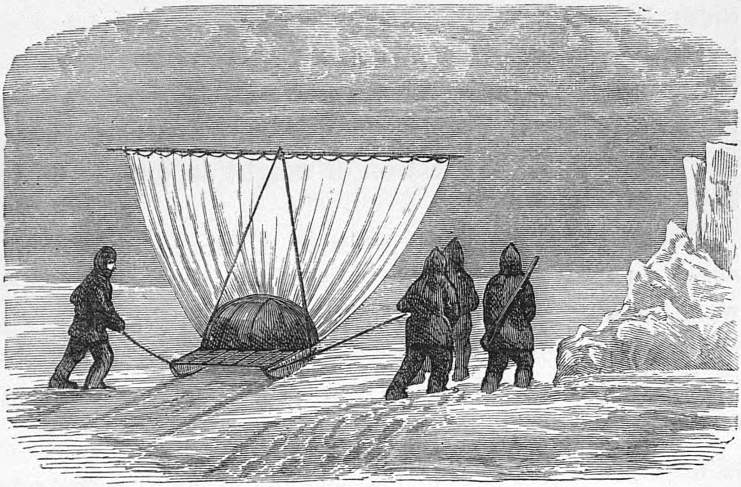
SLEDGE UNDER SAIL.
Hitherto I have purposely abstained from alluding to our spring operations, as I thought that it would be better to devote a separate chapter exclusively to the account of the details of sledge equipment. But it must not be supposed, because I have omitted to say anything about the sledging during the winter, that it was neglected, and that our time was entirely occupied with our amusements and observatory duties. Such was not the case. The preparations for the spring campaign and the organization of our sledge parties in all its details were very carefully thought over and matured during the long dark hours of the winter. All works on this subject had been diligently read, in order that we might benefit by the experience of our predecessors. Nothing was neglected that could in any way conduce to the success of the enterprise, and everything that could possibly add to the health and comfort of those to be employed on work of such an arduous nature was carefully considered. The sledges, tents, and other equipments necessary for travelling had been constructed under the personal superintendence of Sir Leopold McClintock, who is the highest living authority on Arctic sledge travelling. A few alterations, which we trusted would also be improvements, were suggested by the experience gained during the autumn, and these were all carried out before the return of the sun. The results justified our anticipations. Out of the four different kinds of sledges supplied to the expedition those which found most favour with us, and with which the greatest part of the work was done, were the eight-men sledges.1 These dragged easier, and were stronger than either the smaller or larger description of sledges. So long as the travelling remains good, that is smooth and level ice with hard snow on its surface, these sledges may be loaded to 240 lbs. for each man to drag, and a good day’s work to be accomplished. This weight, of course, would only be dragged on first leaving the ship, or a depôt, and decreases at the rate of about 3 lbs. per man per diem, the amount of provisions consumed by each individual. What are called the “constant” weights, which include the sledge, tent, robes, cooking apparatus, pickaxe, shovel, etc., remain unaltered during the journey. The question of weight is one requiring the closest attention.
Every trifling article, even to a small packet of a dozen pins placed in the medicine chest, has to be weighed and recorded in the general equipment. The following table shows the weight of the various articles (being constant weights) required for the equipment of an Arctic sledge for forty-five days:—
Equipment of an Eight-men Sledge, provisioned for an absence of Forty-five Days.
lb. oz.
Sledge (complete) 130 0
Tent (complete) 44 0
Tent poles, five in number 25 0
Coverlet 31 8
Extra coverlet (used only in cold weather) 20 0
Lower robe 23 0
Waterproof floor-cloth 15 0
Sail 9 4
Eight sleeping bags 64 0
Eight knapsacks (packed) 96 0
Two pickaxes 14 8
Shovel 6 8
Store bag 25 0
Cooking gear 29 0
Gun and ammunition 25 0
Medical stores 12 0
Instruments 15 0
————
Constant weights 584 12
Forty-five days’ provisions for eight men (including packages) 1080 0
————
Total 1664 12
which, dragged by seven men, is equivalent to about 238 lbs. per man to drag.
This should never be exceeded, nor should it even be kept up for any length of time.
It will thus be seen that it is impossible for a sledge party to be absent from the ship for more than seven weeks, at the outside, on its own resources. In order, therefore, to enable it to remain away for a longer period, depôts of provisions are established during the autumn on the line of route, and auxiliary sledges are despatched in the spring from which the extended parties may be replenished with provisions after they have been away from the ship some two or three weeks. These auxiliary sledges, on their return, are again completed with provisions and sent out to meet the extended parties on their way back. By these means, a sledging party may remain away for as long as twelve or thirteen weeks.
Depôts can only be laid out when there is a continuous coast line, and under circumstances when a cache containing provisions can easily be discovered. When the frozen ocean has to be traversed, depôts cannot be depended upon; for a movement of the ice, or the misfortune of wandering off the outward bound track during thick weather, would deprive the travellers of any chance of finding their supplies. The result in such a case would probably be fatal. The only way of ensuring an extended absence to a party sledging over the pack, is by sending with it an additional sledge. This, of course, entails the necessity of traversing the same road three times over. For the men must never under any circumstances (other than unavoidable necessity, caused by the sickness of some of the crew) be allowed to drag more than the outside weight of 240 lbs. at any one time.
It would, I think, and I am now speaking from experience, be preferable, when such a journey is necessary, to send a sledge away for only six weeks rather than to provision a party for three months, and compel the men to undergo the monotonous and wearisome work of going over the same ground so often; and, I believe, quite as much work would be accomplished.
The tents were all made of the lightest duck,2 which was sufficient to protect us from the falling or drifting snow, and the keen cutting wind. The space inside was, of necessity, very limited; the width in which each man had to sleep being only fourteen inches. Whilst his head was touching one side of the tent, his feet were in contact with the other. The slightest movement of the sleeper during the night would disturb his neighbours on either side.
The entrance to the tent had a porch attached to it, which was, of course, always carefully closed, and served to exclude the fine snow-drift that would otherwise have penetrated into the interior. The opposite side of the tent was fitted in a similar manner for the protection of the cook whilst engaged in preparing the meals. The duties of the cook during intensely cold weather entail hardships which it is scarcely possible to overrate. The poor cook is never in his sleeping bag until two or three hours after the rest of the party have been comfortably settled for the night, and he has always to rise in the morning a couple of hours before his comrades are disturbed, and this after a hard and fatiguing day’s work. His cooking apparatus consists of a spirit lamp, a stearine lamp, a kettle, and a stew-pan. His fuel is either spirits of wine, or cocoa-nut stearine; and as the allowance of either is strictly limited, he has to be as economical as he possibly can. Should his fuel be consumed before the meal is cooked, he will get no more, and the pemmican will have to be eaten in a semi-frozen state. The odour and smoke emitted by the stearine can only be appreciated by those who have served their apprenticeship as cooks to an Arctic sledge party! Many experiments were tried during the winter to improve our cooking apparatus, but few were attended with success. Mr. White devoted a good deal of thought and time to this important matter. By introducing a cone into the kettle and stew-pan he succeeded in gaining a decided advantage in rapidity of cooking, but then his plan also had its disadvantages, a difficulty of cleaning and an encroachment on valuable space being the chief objections to it. By giving the bottom of the pans and kettles a little more concavity, we gained a slight advantage in point of time, and time in cooking also means an economy of fuel. The tent robes, coverlets, and sleeping bags were all made of duffel. The knapsacks were made of duck, and contained the only spare clothing that each man was allowed to take. The contents consisted of two pairs of blanket wrappers, one pair of wadmill hose, one pair of moccasins, a skull-cap for sleeping in, a woollen cap presented to each person in the expedition by H.I.M. the Empress Eugénie, two pairs of mitts, a flannel shirt, a pair of drawers, a comforter, a pair of snow-spectacles, a towel, and a piece of soap. The latter was rather a superfluous article until the thaw set in.
The store bag contained the pemmican chopper and board, a snow-knife and saw, some spare lashings of hide for the sledge, matches, slow match, twine, and various other small and useful articles.
The scale of provisions to be used whilst sledging was almost identical with that of preceding expeditions, the only difference being that we reduced the allowance of spirits by half and doubled the amount of tea and sugar. The following was the daily ration for each man:—
lb. oz.
Pemmican 1 0
Bacon 0 4
Biscuit 0 14
Preserved potatoes 0 2
Chocolate 0 1
Sugar for ditto 0 0.5
Tea for two meals 0 0.5
Sugar for ditto 0 1.5
Salt 0 0.25
Pepper 0 0.05
Onion powder or curry paste 0 0.125
Rum 0 2
Spirits of wine 0 2
Stearine 0 3
Tobacco (weekly) 0 3.5
This we found a very ample allowance, and one that could not, in my opinion, be improved upon. The different articles were excellent of their kind, and of very superior quality.
Since our return to England, fault has been found with our leader because lime-juice was not included in the scale of dietary for the sledges, during April, as a daily ration. Our scale of diet was necessarily based on that of preceding expeditions, and we had no reason to expect that we should suffer from that dread disease, scurvy, any more than did our predecessors. Lime-juice had never before been taken as a daily ration by an extended sledge party, and Sir Leopold McClintock, the highest living authority, has since publicly declared that, in following the precedents established by former experience as regards the lime-juice, Sir George Nares acted exactly as he would have done under the same circumstances. Moreover, the lime-juice was supplied in a form that made it impossible to use during an Arctic March, April, or May, away from the ship. It was in bottles or very large heavy jars, and, of course, the moment such vessels were placed near a fire to thaw their contents, in such a temperature, they would have been cracked to pieces. This is a conclusive answer to those who, without experience, and ignorant of the conditions under which we travelled, have expressed opinions on this subject. After May, when it was possible to use it, lime-juice was always taken by our sledge parties as a daily ration. When we came home, the use was suggested of lime-juice lozenges, and the Medical Director General has proposed that lime-juice should be mixed with pemmican. It is certainly very much to be regretted that some such arrangements were not made and carried out before the expedition left England. It will be seen (if lime-juice would really have prevented the attack of scurvy) how terribly we had to suffer from the consequences of the omission.
Lieutenant Parr and myself each took two bottles of lime-juice, with the intention of using it when the warm weather of June arrived. It was not possible to use it to any advantage, hard frozen in a bottle, during March, April, or May.
Dr. Colan drew up very careful medical instructions for the commanders of sledges, and each received some elementary surgical instruction. The doctor also paid most anxious attention to the contents of the medical chest, the weight of which was not allowed to exceed 12 lbs.3
The clothing worn by the men engaged in the sledging operations was somewhat different from that in use during the winter. Our under clothing was made of thick flannel. Over this we wore one or two flannel or check shirts, long sleeved woollen waist-coats, thick knitted guernseys, and duffel trousers, the latter reaching about a foot below the knee. All wore broad flannel belts, commonly called cholera belts, round their loins. On our heads we had woollen helmet caps, called by the men “Eugenies,” and over this was worn a thick sealskin cap with ear and neck flaps attached.
Our feet were encased in blanket wrappers, one or two pairs according to the temperature, a pair of thick woollen hose reaching above the knees and worn over the trousers, and moccasins. The latter, as supplied to us, only came up round the ankle, so we fitted them with leggings. Those who were provided with chamois leather made their leggings of that material, but the majority cut the sleeves off their check shirts which, when sewn on to the moccasin, answered admirably, their chief use being to keep the snow from penetrating into the trousers. Some of the moccasins were also soled with leather, obtained by cutting off the upper part of the fishermen’s boots, a pair of which had been supplied to each person. As a rule these soles were quickly worn out, and the men were soon reduced to the bare moccasin, which, however, lasted wonderfully.
Large gauntlet mitts were made during the winter, of fearnought covered with duck, and worn with a strap round the neck. These were only supplied to the sledgers, and were found very useful. At night-time they were used on the feet in the sleeping bags, and certainly assisted very materially in keeping them warm. Finally each person was provided with a suit of duck overalls, to act as “snow repellers,” which were always worn whilst on the march. As an extra precaution against snow-blindness, the men were ordered to paint some device on the backs of these snow jumpers in order to afford a certain amount of relief to the eyes of their comrades. The designs of these devices or crests were left entirely to the artistic imaginations of the men, and they caused a good deal of merriment. They were certainly more quaint than elegant. Donkeys and Polar bears in various wonderful positions appeared to be in the greatest favour. Each crest was accompanied by a motto, invariably a Latin one. Whether these devices relieved us from severe attacks of snow-blindness or not it would be difficult to decide. They served at any rate to amuse us, and often formed the topic of conversation when other subjects were getting scarce. Snow-spectacles were invariably used by the travellers, and were only taken off after the party had halted for the night and had sought the shelter of their tent. In consequence of the adoption of these snow-goggles when we first set out on our travels, we were comparatively exempt from that painful disease, snow-blindness, from which other expeditions have more or less suffered, and which renders the patient so attacked utterly helpless. We occasionally had a few cases, but with one or two exceptions they were in a very mild form.