V.—CHARMS, SPELLS, AMULETS AND DIVINATIONS.
Reading edition
The superstitious regard paid to mirrors as regards their preservative qualities has been noticed in a previous chapter. This probably arises from the fact that in China they are regarded as all-efficacious household charms against the attacks of evil spirits. Nor are magic mirrors, similar in their use to the ink mirrors employed by modern Egyptian necromancers, unknown to the Chinese. At Canton, only a year or two since, a native was exhibiting for the small sum of 30 cash (about 2½d.) a jewel stated to possess magical qualities. In it the curious spectator saw various figures such as a beggar, a mandarin, a woman, &c., and was assured that his or her own future condition would be the same as that of the counterfeit thus seen. There exists a belief in many parts of the Empire that the pointed roof or corner of a house’s gable end may exert an unpleasant influence upon the dwelling in nearest proximity. To counteract this therefore a concave brass mirror—those of glass are still articles de luxe in most districts—set in a wooden frame, is arranged on the wall or roof of the threatened building so as to catch and reflect back the evil influences in question. I can find no trace of any similar practice in Western countries. Small brass mirrors hung near a bed are also all-efficacious to ward off evil influences.
So too those nondescript animals which most people agree to call lions, and which may be seen keeping guard in such disconsolate attitudes on the roofs of most native buildings of importance, are mere charms. The Chinaman in fact, from his cradle upwards, seems to regard himself as ever environed by diabolical agencies, to combat which an all-pervading system of charms and amulets is a prime necessity. While we laugh at this superstition, it is perhaps only a too vivid realisation of the fact of the devil “going about like a roaring lion.” It may be interesting to note here that our own custom of depositing coins, papers, &c., in the foundation stones of new buildings is matched by a similar custom in China. I am unable to trace the superstitious origin of the practice in our own case, but the Chinese place coins under the door-sill and under the kitchen fireplace, when building, simply for luck. In some cases, following out the usual notion of contrariety, these and other charms are attached to the ridge pole of the building.
Another charm of extensive use amongst Chinese women is a small solid silver or golden triangle, having two little swords suspended from the outer angles and a trident from the centre of the base; on the triangle itself lucky characters are engraved. This shape appears to be a favorite one, as women always fold their written charms in a similar manner, and sew them up in pieces of cloth of a triangular pattern.
The idea of an evil eye is no less common amongst the native population out here than it was and still is in Europe; and this belief, implicitly accepted as regards their own countrymen, is intensified as regards foreigners, owing to the outrageous stories circulated about us during recent excitements. I have often been amused in the North at the request not to stare at any child whose interesting appearance might have attracted my attention. In writing letters the Chinese invoke the person addressed, to cast a glance on the epistle “with the clear part of his eye” (or, as we should say, white of the eye) that is, take a favourable view of the matter talked of. A pregnant woman or a man whose wife is pregnant, is called “four-eyed,” and children are guarded against being looked at by either, as it is thought the sight would be unlucky to the children and would cause sickness to attack them. The superstition as to the powers of an “evil eye” may almost be deemed fundamental to humanity, as I have yet to read of a people amongst whom it does not find some degree of credence.
Stone slabs or pillars erected near the entrances of alleys leading into a main street, are supposed to ward off the evil influences proceeding from them. Mr. Doolittle states that in Foochow every family on the first day of the Chinese month nails up a few leaves of the sweet flag (acorus gramineus) and artemisia on each side of the front doorway. They are held to represent swords, and so scare away evil spirits! Other charms, not personal, in Chinese use, are red cloth worn in the pockets, or red silk braided into the hair of children; a knife that has been used to kill a fellow-creature; the Chinese Classics placed under the pillow or kept near the owner; knife-cash cast for the purpose and attached to the ridgepole; pieces of old fishing nets, of which demons are said to be especially afraid as they suppose them to be used by the priests to catch spirits; and gourd shells, which it is supposed will attract to their interior such diseases as small-pox, measles, &c., which might otherwise attack children. Images or drawings of tigers, lizards, snakes, centipedes, &c.—the list is almost inexhaustible—have similar virtues, more especially guarding children from colic and other infantile diseases.
While on his missionary tours in the Canton province he was usually accompanied by a powerful dog, at which, in some of the villages he passed through, the children were somewhat frightened and once or twice very slightly bitten. In such a case the mother would run after him and beg for a hair from the dog’s tail, as a charm against the evil one. The hair thus obtained would be put to the part bitten in the belief that the spirit which the fright suffered by the child had caused to pass into his person, would thereby be attracted from it.
“Characts,” or written charms, are as common in China as in Europe. We settle the origin of our own former confidence in their efficacy by a somewhat off-hand reference to the Jewish phylactery—a derivation I am inclined to doubt—but we have nothing that I know of to guide us in finding the root of the Chinese superstition. However that may be, the fact that written charms have ever been deemed efficacious, wherever the art of writing is known, is curious. Not a very long time ago the still warm body of a deceased male child was picked up in the streets of Hongkong, having affixed to its cap one of these charms, which had evidently been sold to the parents by one of the itinerant fortune-tellers who infest the city. It was kindly placed at my disposal by the Coroner, and a facsimile of it is given on the opposite page.
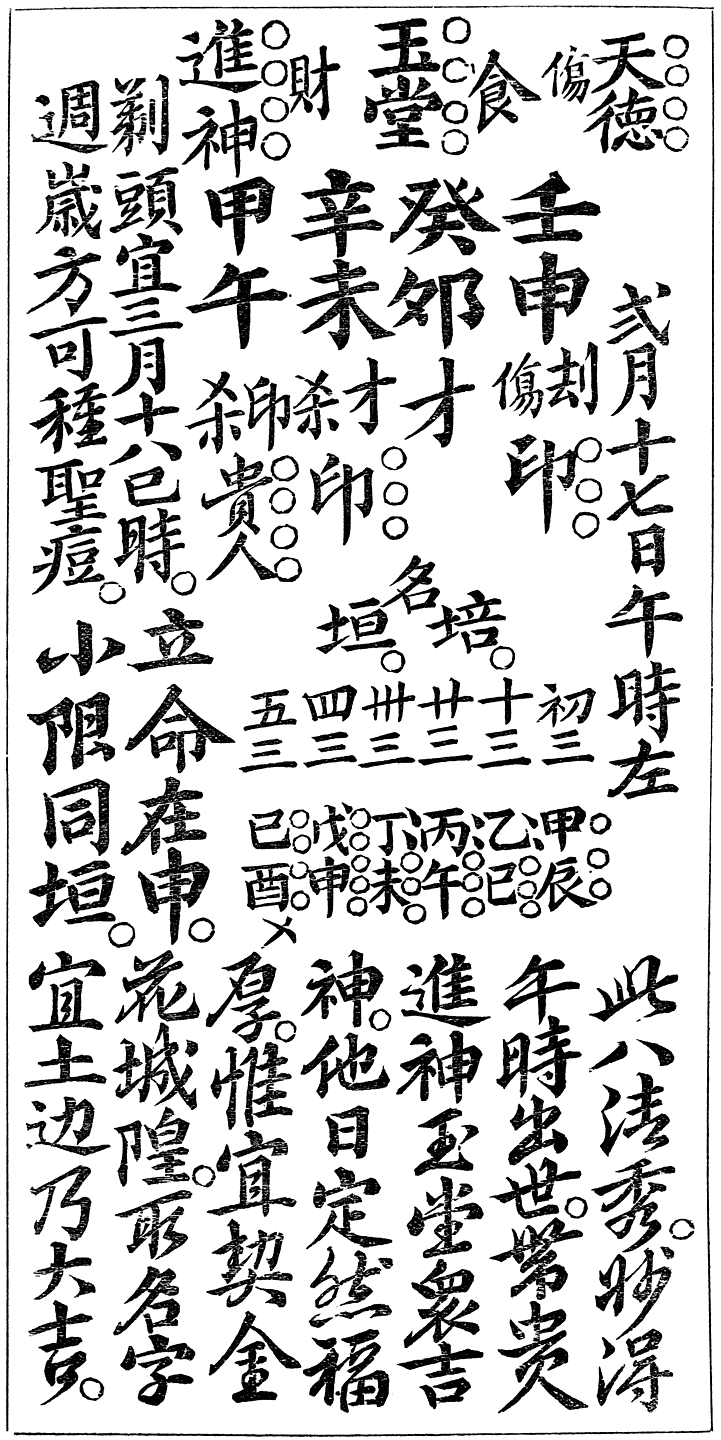
A FORTUNE-TELLER’S CHARM.
It is almost untranslateable, but if you bear in mind that the Chinese words refer to horary or astrological terms, the following will give you some idea of what it meant. The paper refers to an infant born in the yam shan year (1872), 2nd moon, 17th day, at noon; the character for “left” appended to the date signifies that the child is a male, that for right signifying a female.
“Being born in the yam shan year, kwai mou month and kap ng hour, the child is subject to the combined influence of these dates. Under yam shan it will be adverse to the influence of koon (officials) [that is an indication of evil], but will find powerful friends. He will have brothers who will impoverish him. According to the portents under the character kwai mou, he will always have plenty to eat and great wealth. Under Sun mi he will meet with counter influences from an evil spirit. Kap ng indicates that he will meet with good influences indicating wealth and powerful friends, but these good influences will be counteracted by an evil spirit.
“For 3 years, the first epoch under prediction, his fate is good. Thence to the age of 13, the first five years will be bad, the second five good; from 14 to 25 the first five years will be bad, the second very bad; from 26 to 33, five years will be bad, the latter five very good; thence to 43, good and very good fortune will be his fate. For five years after this his fate will be good, continuing till his death, which will happen before he is 53.
“The life of this child indicates purity and prosperity. His good fortune lies in being born at the hour of noon, as this indicates powerful friends and other good influences. His future life will be one of bliss, but he ought to adopt the Kum-fa goddess, in the municipal temple, as his spiritual mother. In selecting a name for him some character should be chosen having To, earth, as a component part. It will then be lucky. The date fixed for shaving the child should be the 18th day of the 3rd moon from 9 to 10 a.m. The child should be a year old before he is vaccinated.”
So much for this written charm;—sad rubbish no doubt, but not much worse than the whining predictions of gypsy crones in enlightened Europe, and harmful chiefly in the widespread belief attached to its value.
Divination is in China as popular as, and probably more respectable than, it was amongst the Israelites in the days of the witch of Endor, and it is not perhaps going too far to say that there is not a single means resorted to in the West by way of lifting the impenetrable veil which hides the future from curious mankind which is not known to and practised by the Chinese. From “Pinking the Bible” to using the Planchette, from tossing for odd and even to invoking spirits to actually speak through crafty media, the whole range of Western superstition in this regard is as familiar to the average Chinaman as to the most enthusiastic spiritualist at home. The coincidences of practice and belief are indeed so startling that many will doubtless see in them a sort of evidence either for their truthfulness, or for a common origin of evil. Divination by the ka pui has been already noted, together with that by bamboo slips. Cash and many other objects are similarly used, the mode of procedure in no way differing from our own. Such modes of consulting the gods are, however, every-day matters. It is when we come to the consulting of media, the use of a forked stick, writing on sand, and similar matters that the Chinese practice becomes singular in its resemblance to superstitions openly avowed at home. I would here remark that I am no spiritualist. But how, without any apparent connection with each other, such beliefs should at once be found in full force in the farthest East and the extreme West is puzzling. Is our Western spiritualism derived from China?
‘Ye sisters three—ye ladies four,
‘O! lead me now to Hades’ door!
‘What would ye do in Hades? Speak!
‘My kindred only would I seek—
‘My kindred seek, one word to say.
‘Then quickly lead me back, I humbly pray.’
“This incantation she repeats three times, and soon after she has spoken it for the third time a sudden change seems to come over her body. Her arms drop down, her limbs are one after the other seized by a sort of torpor, convulsions shake her all over, and cold sweat covers her face and temples. At last she seems fast asleep and now questions may be put to her. ‘What do you see?’ she may be asked. ‘I see nothing,’ is the answer, ‘it is all dark and chilly.’ After a while she is again asked, ‘what do you see now?’ ‘Now,’ she replies, ‘now it is lighter; yes, at a distance I see pagodas and towers and palaces and houses.’ ‘Do you see any human being?’ ‘No, I cannot see distinctly; yes, now I see them, there are men and women with pale sallow complexions, and one approaches me, speaks to me!’ ‘How is that person dressed?’ Then the somnambule describes the dress and the whole appearance of that person, and her description coincides exactly with all that her employers can remember with regard to the peculiarities in dress and general appearance of the deceased relative whose spirit is being conjured up. The identity of the person required being thus established, questions may now be put as to the particular difficulties on account of which the family want to consult the spirit of their ancestor. This spirit, however, is not made to appear, but the somnambule pretending to see it and to be in conversation with it, acts as interpreter, and answers all questions in the name of that spirit and with an unnatural shrill voice. When the curiosity of the audience has been thus satisfied they try to awake the somnambule by shouting her name three times into her ears. Soon her body begins to tremble, one limb after another seems to shake off its torpor, the woman raises herself up, and goes through all the pantomime of a person suddenly roused from a heavy sleep, expressing most dramatically an immense surprise at finding herself in such a place and in such circumstances. Then the somnambule speedily falls into her professional swagger, asks for her wages, which, according to the means of her employers, vary from five cents to five taels or more, and departs chuckling, I imagine, over the credulity of her deluded victims.
I have already referred to the omens deduced from bamboo slips selected or shaken out at random from a bamboo box. Fortune-tellers and joss-house keepers divine future events for their credulous clients in a somewhat similar way. A number of papers are prepared, marked with characters the same as those on the bamboo slips, but also having short sentences added indicative of good or ill luck. A slip being thrown out, the paper containing its character is referred to, and the sentence inscribed on it is accepted as the answer. Street fortune-tellers frequently train birds to select one or more from a heap of papers, each marked with a single ominous character. The fortune-teller then proceeds to explain the prophetic meaning hidden in the character thus chosen. Or, if he does not possess a trained bird, the client himself picks out a paper for similar interpretation. A very popular form of domestic divination is that already noted as availed of at the new year—going out into the street and accepting the first words heard as an omen.