II.—BIRTH, MARRIAGE AND DEATH.
Reading edition
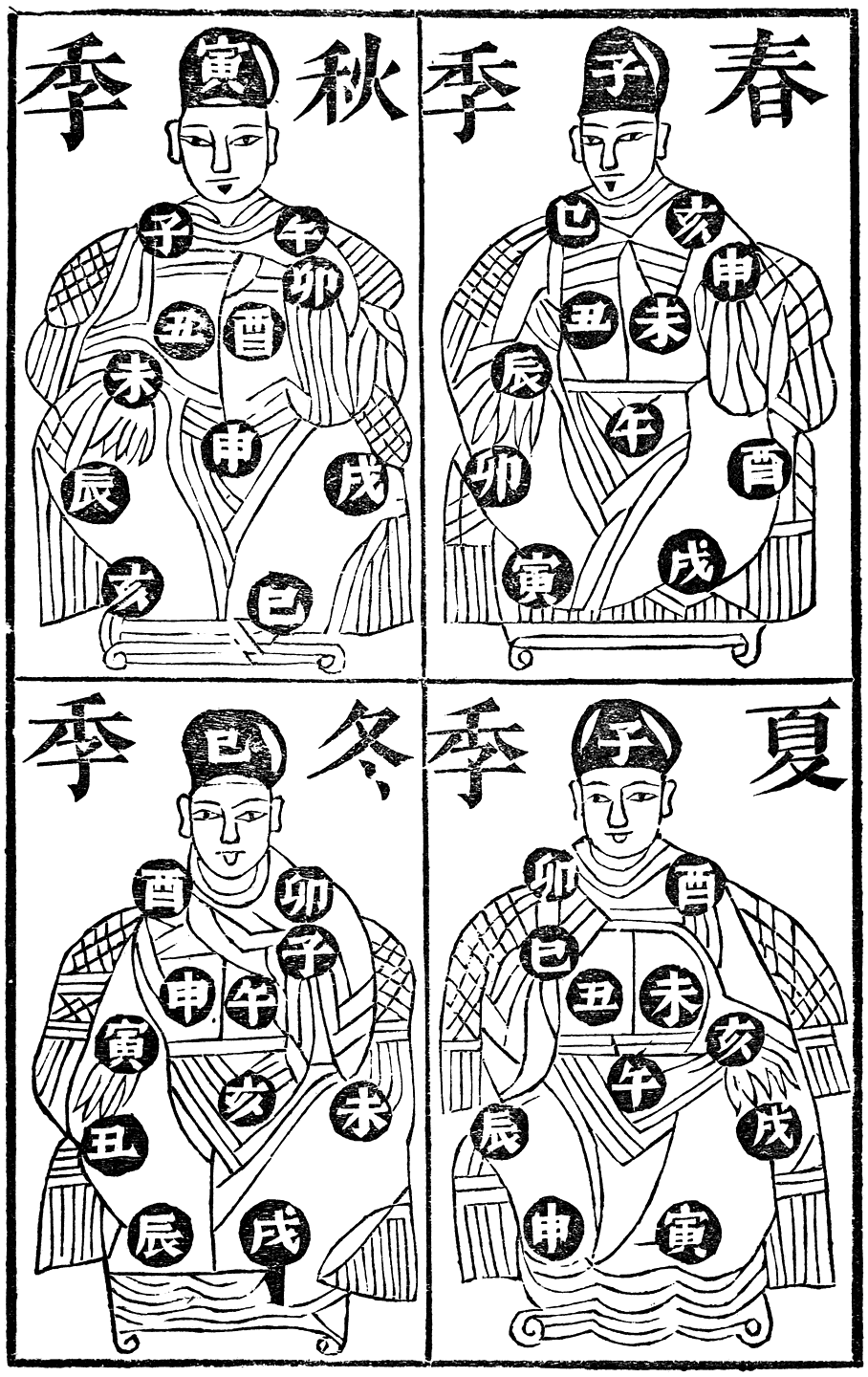
The following verses have been kindly placed at my disposal by a friend, who has taken the trouble to put into rhyme some of the doggerel that accompanies the diagrams above referred to:—
THE RHYME OF THE EMPEROR “ALL-THE-YEAR-ROUND.”
In birth, the Emperor’s forehead shows
A fate that never sorrow knows,
Plebeians that rich and honoured be
And rise to title and degree,
The rank they seek is still bestowed;
Nobles that follow a worthy lord
And women, chaste and well-beloved,
Wed and breed scholars true and proved.
The Emperor’s hands in birth portend
The gains that handicraft attend
Abroad, a welcome rich and free,
As home, a well-found family;
One year shall yield a plenteous store,
Next year shall make that plenty more,
Wealth shall flow in on every side,
Wealth with old age shall still abide.
The Emperor’s shoulders mean, I trow,
An heir to goodly gifts that grow
To more and more as years draw on,
Grandsons and sons to honour come,
Rank comes too when the time is fit,
Old age brings fields and farms with it;
If kith and kin at first were cold
“Bitter, then sweet,” is truth of old.
When on the belly falls the sign,
Shalt have enough, as I divine,
Of clothes and food, of acts or arms,
Of music and the pageant’s charms;
Old age with peace and joy shall crown
Mid-age’s office and renown,
And a delightsome halo spread,
Increasing, round thy honoured head.
If on the loins the sign be found,
Then rank with wealth and years is crowned,
With honour when life’s prime is told
And eld y-blessed with yellow gold,
Yea, though arisen from low degree
His fate is true nobility;
His scions, an illustrious band
Who make a name within the land.
But on the leg—the meaning there
Is toil and sorrow, want and care,
Nor clothes nor food enough shall be,
May all thy kin be kind to thee!
Who day by day must drudge and toil
Nor be content for all thy coil.
Yet, when thy bitter youth is past,
Old age shall bring thee bliss at last.
The Emperor’s foot means this—at last
Peace comes from vigil and from fast,
A life-time of tranquillity!
Have nought to do with rent or fee;
Widowed—renew not married life;
Widower—seek no second wife;
Thy path a wilderness unblest,
Flee to a cell and be at rest!
The practices resorted to previous to the birth of children, either to secure that blessing or to ascertain the sex of the expected infant, form in themselves a curious chapter. An idea that adopting a girl belonging to another family will increase a woman’s own likelihood of having children herself, is based upon the belief that each living woman is in the unseen world represented by a tree; and that, just as grafting succeeds with trees, so adoption (which represents the same process in family life) may succeed as regards children. Another superstition is that each woman is represented in the other world by a vase containing a flower. A sorceress is hired to proceed thither and “change the earth.” A third way of securing children is to obtain from the temple of the Goddess of Children a shoe which has been worn by her. This is taken home and, being placed beside the image or tablet of the goddess, receives equal worship; and, should the desired object be attained, a pair of shoes exactly resembling the one obtained must be returned to the temple. Sometimes several are taken from an equal number of temples, and in that case the goddess from whom the last shoe was received is rewarded with most offerings. A flower is in other cases taken from one of the temple vases in place of a shoe, and is supposed to be nearly as efficacious.
The formula for ascertaining the sex of a coming child is not very far removed from the children’s amusement of prophesying by buttons, commencing “Tinker, Tailor, Soldier, Sailor, &c.” The mother adds to the number of her age in years that of the month, day and hour she was born: thus if twenty years old and she was born in the sixth hour of the third day of the second month, she would have a total of thirty-one. She then takes a series of pictures of the thirty-six assistants of the Goddess of Children, sold for fortune-telling purposes, and according to the sex of the child in the arms of the thirty-first concludes that her own child will be a boy or a girl. If the number of her age, &c., exceed thirty-six, she commences to count the first picture from number thirty-seven. Childless women also resort to a similar process to ascertain whether they will or will not have children. Those curious to ascertain the religious ceremonies made use of prior to birth may be referred to Mr. Doolittle’s work on Chinese Social Life.
The ceremonies of betrothal are of course deeply interwoven with superstitious observances. When children are thus engaged, a pair of fowls, a pair of ducks or geese, and a few pounds of vermicelli, are sent by the bride’s to the bridegroom’s family, who retain the male birds and return the hens. Widows who re-engage themselves are prohibited from wearing gaudy—that is, red or other bright-coloured—skirts, and must confine themselves to black, white or blue. A curious superstition also hinges, in the case of betrothals put an end to by the death of the intended bride, on shoes. The bridegroom goes to the house of mourning and asks for the last pair which she wore previous to death. These he takes home and burns incense to for a space of two years, believing that her spirit will be present, enticed thither by the shoes. In thus doing he acknowledges her as his (intended) wife. As most readers will know, betrothals are managed by go-betweens, who settle the match on behalf of the parents without consulting the principals. The first thing to be examined by the agent is the horoscope of the girl in order to compare it with that of the future husband, and, if all preliminaries are happily arranged, certain articles and presents are interchanged which are mostly intended to have a symbolical meaning. If any unlucky accident happens during the three days allotted for final consideration, the negociation is broken off. If all be right, there are provided, in addition to the betrothment cards, four large needles and two red silk threads, and two of the former threaded with one of the threads are stuck into each card. The red thread is supposed to represent that with which the feet of all mortals are in the spirit-world tied to those who are fated to be husband and wife—in other words, it represents unalterable fate. A similar thread is used to tie together the cups out of which the bride and bridegroom drink. I am unable in the authorities at my command (some twenty works on the Folk-lore of various countries) to trace any resemblance to this custom elsewhere.
Before leaving the subject of marriage I may note that the number three, usually considered lucky, is expressly avoided in many matters of its ceremonial. At the ceremony of worshipping ancestral tablets and relatives, the latter are invited to bow in return, four times instead of three, as the latter, “being an odd number, is regarded as inauspicious.” On the other hand, the bride goes to visit her parents three days after marriage, and the bridegroom, who follows her to the house of his father-in-law, is regaled with three cups of tea and three pipes of tobacco. The sedan, by the way, in which the bride is borne on such visits has painted on it as a charm the image of a Taoist priest who, according to the legend, succeeded by his magical powers in counteracting the powers of the evil spirits who lie in wait on such occasions to harass and make ill the bride.
The use of bride-cake at weddings appears to be, in some form or other, both of remote antiquity and common to nearly every nation. “The ceremony used at the solemnization of a marriage was called confarreation in token of a most firm conjunction between the man and wife with a cake of wheat or barley.” It was and is customary in Yorkshire to cut the bride-cake into little square pieces and then throw them over the bride and bridegroom’s head. In China a quilt is held in front of the bride’s sedan by its corners, and four bread cakes sent from the bridegroom’s family for the purpose are tossed up in the air in succession and caught in the quilt. In neither case is the omen involved in this proceeding very clear, unless it be taken as an offering to the deities who preside over marriages, and in our own case retained as a custom which has lost its primary significance.
One of the most singular coincidences of Chinese with Western intention, is connected with shoes. It is customary at a marriage in South China for the bride to present her husband with a pair of shoes, by way of signifying that for the future she places herself under his control. These are carefully preserved in the family and are never given away, like other worn-out articles, it being deemed, that to part with them portends an early separation between husband and wife. Now, in a work published in 1640, mention is made of an ancient custom, “when at any time a couple were married, the sole of the bridegroom’s shoe was to be laid on the bride’s head, implying with what subjection she should serve her husband.” A writer in an old number of the London Notes and Queries (quoted by Mr. Henderson) remarks:—The throwing shoes after the Bride and Bridegroom … is usually said to be “for luck,” but is rather a symbol of renunciation of all right in the bride by her father or guardian, and the transference of it to her husband. In the Story of Ruth you will recollect that her kinsman plucked off his shoe, as a sign of his renunciation of his claim to marry her. “Over Edom have I cast out my shoe” (Ps. lx. 8), meaning “I have renounced Edom,” is another illustration. So that the ceremony now observed by Chinese brides has in all probability a reference to that current of old in Palestine and at the present day known throughout England.
“I’ll be no submissive wife
No not I!”
Amongst the curious superstitions attaching to death in China is one that, if two “cash” be placed in the sleeve of the dead man and then shaken out, the result of the “toss” will signify the feeling of the departed. Thus, if both turn up obverse or reverse, it is concluded that the defunct is perfectly satisfied, while, if one be obverse and the other not, it signifies that something has been wrongly done. These cash are religiously preserved for similar use after the corpse is buried, when a mode of divination by tossing is resorted to, if it be desired to learn the wishes of the dead man as to family arrangements, the respect paid to his manes, &c. It is also customary in China to carefully reverse the direction of the body before putting it into the coffin—a practice to which I cannot find any Western parallel.
The Chinese idea of watching the dead—a duty which amongst them devolves upon the eldest son and his brothers until the coffin is removed for interment, finds expression also amongst ourselves. Mr. Henderson, in his Folk-lore of the Northern Counties, says: “The corpse must be watched till its burial by one of its kindred and a stranger, who may be relieved, when weary, by another relation and another stranger.” In China the incense stick which is straight (emblematical of the “straight road” which the spirit of the deceased ought to travel) must not be allowed to go out lest the spirit lose its way. With us the “Saining Candle” must be kept burning during the night.
A number of curious practices connected with burial and mourning are without doubt purely Chinese. Thus, on the sixtieth day after death, the family place on a table a number of plates containing offerings of food, &c., accompanied by the never-absent incense. Besides these they place on the table a wash-bowl full of water in which is floating half a duck’s egg. A paper and bamboo duck, astride of which is a paper human image, is then placed on the water beside it. The image personifies the deceased, the duck his means of transport and the egg-shell a boat. The use of both duck and boat to cross the Chinese Styx is not very clear, but they are probably intended to give the deceased a choice of conveyance. A yet more inexplicable practice is that of placing a paper image of the departed in a wheeled sedan-chair of similar material, to which is attached a paper crane as if in the act of drawing the sedan. Ranged in front of the crane are numerous articles of dress, money &c. (all of course in paper), and in some way the crane is supposed to convey both the spirit of the deceased and the goods on their onward passage.
A native practice universally quoted in Europe as illustrative of the contradiction between Chinese customs and our own is that of wearing white for mourning—white being, in China, “an emblem of evil or sorrow.” But the practice is not so opposed to European ideas as some may think. At the funerals of unmarried persons of both sexes, as well as infants, the scarves, hatbands and gloves given in England as mourning used always to be white. The Chinese do not present mourners with these adjuncts of the funeral, but give in place of them white “crying cloths” or, as we should say, pocket handkerchiefs. It may be interesting here to note also that black is not of universal use even in the West. The Egyptians use yellow, the Syrians, Armenians and Cappadocians light sky-blue, and the Ethiopians grey. Henry VIII. is referred to in Hall’s Chronicle as wearing white mourning for the unfortunate Anne Boleyn; while Plutarch (Langley’s Translation) writes that, “The women in their mournynge laide a parte all purple, golde, and sumtuous apparell, and were clothed both they and their kinsfolk in white apparell.” * * * “Of this ceremonie, as I take it (adds the translator) the French quenes toke the occasion, after the death of their housebandes, the kynges, to weare onely white clothying.” The motives however of the Italians in adopting this colour were diametrically the opposite of those influencing the Chinese.—“The white colour was thought fittest for the ded, because it is clere, pure, and sincer, and leaste defiled.”