Part II
Reading edition
Story of Miss Crosbie's Presents
We will begin this history again, by telling what had happened since the first part was concluded.
Sir Charles and Lady Noble had left their fine place soon after the funeral of their daughter, and it was supposed would never return; for the house and park were advertised to be let. After a few months it was taken by a family of the name of Darwell, said to be immensely rich: this family had an only daughter.
No other changes had taken place; everybody else lived where they did in the last part of our history, which is very pleasant, as we may hope to see our old friends all again.
Mr. Fairchild had had a few hundred pounds left him by a friend, from whom he had expected nothing; on the strength of which he bought a plain roomy carriage, which would hold himself and Mrs. Fairchild in the front seat, with a child between them, and two children behind.
The winter was past, and the sweet spring was beginning to show itself, when that happened which shall be related without delay.
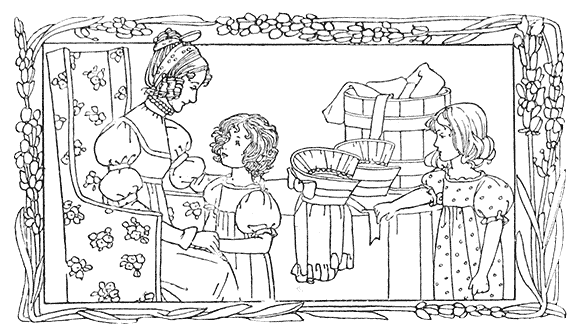
One morning when Henry was with his father in the study, and Lucy and Emily were busy with their needles, seated in the parlour window together, and alone, they saw a gentleman's carriage stop at the gate, and a lady get out. A great number of bandboxes were taken from different parts of the carriage by a servant who was attending the carriage; and before the little girls could make anything of all these wonders, they saw their father first, and then their mother, run out and shake hands with the lady, and seem to invite her to come in. Henry, too, had gone out after his papa, and had been sent back, as they thought, to fetch Betty; for Betty soon appeared, and began, with the help of Henry, who seemed to be delighted at this interruption of his lessons, to carry the boxes into the house.
Lucy and Emily soon discovered that this lady was the elder Miss Crosbie; but they wondered how she had happened to come that day. Miss Crosbie had come from London, where she had been for some time, and was now so far on her way to visit a friend in the country.
She had come to Mr. Fairchild's door in another friend's carriage, and she was come to ask Mr. Fairchild to take her in until the Monday morning.
Mr. and Mrs. Fairchild both assured her that they were most glad to see her; expressed a hope that she would stay longer than Monday, and showed themselves so kind and hospitable, that Miss Crosbie was quite at her ease, and
"What a quantity of boxes she has brought!" she said; "some finery, I dare say, in all of them; how silly for such an old person to be fond of dress!"
"It is very silly," replied Emily, "and particularly for one so ugly. Don't you think Miss Crosbie uncommonly ugly?"
"To be sure I do," she answered; "everybody must: with her little nose, and her gray eyes, and her wide mouth."
"And to be so fond of finery after all!" said Emily. "I am sure if I was like Miss Crosbie, instead of dressing myself out, I would wear a veil and hide my face."
In this way the two little girls kept on chattering; and I fear my reader will say that they are not improved since last she heard anything of them.
When Miss Crosbie came into the parlour, she kissed them both, and made some remarks upon their looks, which showed that she was quite pleased with their appearance. Mrs. Fairchild employed them a little time in going backwards and forwards to Betty, and helping in many things; for when people keep but one maidservant, they must occasionally assist her.
When the room was ready for Miss Crosbie, and a fire lighted, and all the boxes and packages carried up, Mrs. Fairchild showed the lady to her room; and Miss Crosbie, having asked when dinner would be ready, said:
"Well, I shall just have time to change my dress."
"Oh, pray do not trouble yourself to dress," said Mrs. Fairchild; "you are very nice now, and we are plain people."
"You are very good," answered Miss Crosbie, "but I shall not be comfortable in the dress in which I travelled."
Mrs. Fairchild said no more; but having told her little girls, who had gone up with her to the visitor's room, to go and make themselves neat in their Sunday frocks, she hastened to give some orders, and perhaps some help, in the kitchen.
We will not repeat what Lucy and Emily said to each other whilst they were in their little room: all that passed was of the same kind, if not worse than what they had said in the parlour; one encouraging the other, and carrying their ridicule of their mother's visitor farther than either of them intended when they began. When the little girls were dressed, they went into the best parlour, or tea-room, as their mother called it in the old-fashioned way; and there they found a fire burning, and everything in order. John was laying the cloth in the next room, and Henry soon came to them in his Sunday dress, and soon afterwards their father and mother; but Miss Crosbie did not appear till dinner was being served up. She came dressed in a muslin gown, with a long train, and large full sleeves, tied in several places with crimson ribbons; she had her hair frizzed and powdered, and a turban of crimson satin on her head. Her dress was quite out of place; but persons who are always used to be rather over-dressed are not judges of the times and places in which to put on their finery. At the sight of her, Lucy and Emily gave each other a look, which seemed to say, "How very silly!"
The dinner-time passed off very well. Miss Crosbie had a great deal to tell about London and her journey down into the country; and soon after dinner the children had leave to go to their play-room. They were not in the humour to do much good there: they began with talking
"Now, Mrs. Fairchild, you shall see some of the things which I have brought from London; will you come to my room, or shall I send for the bandbox down here?"
"Oh, pray," said Mr. Fairchild, "let us have the box down here, that Henry and I may see the fine sights also."
"You don't mean to say," answered Miss Crosbie, laughing, "that a sensible man like you, Mr. Fairchild, can be amused by the sight of specimens of the fashions?"
"I am amused with anything," said Mr. Fairchild, "which entertains my family. I make a point of enjoying everything which they do, as far as I can."
"Well, then," said Miss Crosbie, "if I had my bandbox here——"
The children all at once offered to fetch it—she explained which they were to bring out of the many which had come with her, and in a very few minutes they had brought it down and set it on the table. Miss Crosbie sent them up again to look in her workbag for her keys, and to bring down a small parcel wrapped in brown paper, which was to be found in the same bag.
The parcel and the keys soon appeared. Miss Crosbie opened the parcel and presented Henry with a neat pocket-book, inside of which were a pencil, a leaf of ass's-skin, a penknife, and a pair of scissors.
"Oh, thank you, thank you, ma'am," said Henry, "how good you are!"
And his father and mother joined in the boy's thanks. There was nothing on Henry's mind particularly to render that gift bitter to him; he had not joined in the ridicule of Miss Crosbie.
She next opened the bandbox, and took out of it two bonnets and two tippets of grass-green silk, lined with pale pink satin. There were also two neatly plaited lace caps to wear under the bonnets, and waist ribbons to suit.
"These, I hope, will please you, my dear Miss Lucy and Miss Emily," she said; "I brought them for you, and I trust you will like them."
It was well at the moment that Emily was not struck by this kindness in the way that Lucy was. She was one full year younger than her sister, and could hardly be supposed to be able to reflect so deeply: she therefore could look joyful, could run forwards to kiss Miss Crosbie, and was ready almost to dance with delight, when she looked at the beautiful things on the table.
Had she not, as it were, pushed herself first, Miss Crosbie must have been struck, as Mrs. Fairchild was, with the manner of Lucy: the little girl first flushed up to her brow, and all over her neck. She came forward to Miss Crosbie but slowly, and with her eyes cast down. She stood one moment, and then, throwing her arms round her neck and pressing her face against her shoulder, she sobbed deeply.
Miss Crosbie was certainly surprised; she did not expect that her present could have made the little girl feel so much. She spoke very kindly to her, put her arms round her, kissed her several times, and said:
"But, my dear, a bonnet and a tippet are not worthy of such deep gratitude; you make me ashamed that I have done so little for you."
"But you are so good, ma'am, so very good!" sobbed Lucy.
Miss Crosbie continued to soothe the little girl, and say kind things to her, which only made her seem to feel the more. Mr. and Mrs. Fairchild were certainly surprised, but they took no notice; and after a little while Lucy became calm, and the affair passed off, Miss Crosbie appearing to be rather pleased at the manner in which her present had been received.
Lucy became quite calm after her fit of crying, but her mother observed that she sighed deeply once or twice. When eight o'clock came, the children, at a hint from their mother, were wishing their friends good-night, when Miss Crosbie asked leave for their staying to supper. Mrs. Fairchild said:
"Not to-night, if you please, Miss Crosbie, but to-morrow night—we will all sup together to-morrow."
Miss Crosbie kissed Lucy affectionately before she left the room, and Mrs. Fairchild again saw the tears in the eyes of her little girl, but she did not appear to take notice of it.
When Lucy and Emily had got into their own room, Lucy at once gave way to her feelings.
"Oh, Emily, Emily!" she said, as she laid her new bonnet and tippet on the drawers, "I am so unhappy; I have been so wicked! to think how kind Miss Crosbie was to bring those beautiful things for us, and to know how I laughed at her, and said cruel things about her, and called her ugly! I have been naughtier than you, because I am older, and because, at the time I did it, I knew I was wrong; and when I saw those beautiful bonnets, I felt as if there had been a thorn put into my heart."
"It is odd," said Emily, "that I did not think of it, even when I saw you crying."
"If Miss Crosbie had not been so kind," replied Lucy, "I should not have cared. I can't forgive myself—I can't forget it!"
Then Lucy cried again, and Emily with her; and they were still weeping when sleep came over them. They were leaning back on their pillow; Emily had her arm over Lucy, and their cheeks were still wet with tears, when their mother came in before she went to bed to look at them.
She was again surprised to see their tears, and stood a while looking at them, being uneasy to think what could have caused them. They did not wake, and she did not like to disturb them; but she went to bed rather uneasy, though she hoped that there was no great cause for being so; and in the morning all her fears were soon removed, for she heard the voices of her little girls before she had quite finished dressing. They were knocking at her door, and asking to speak to her. She went to them immediately, and Lucy told her at once all that had made them unhappy the last evening, telling how they had prayed to be kept from such naughtiness again, and saying what pain Miss Crosbie's kindness had given them.
Mrs. Fairchild heard all they had to say without interrupting them, but her face looked kind and full of pity. When the story was told she put her arms round both of them, and kissed them tenderly, and then talked to them for some time of the want of kindness and good feeling they had shown towards their guest.
"Oh, mamma," said Lucy, "the more you talk the more vexed I am with myself. What am I to do? Shall I go and beg Miss Crosbie's pardon?"
"Shall we, mamma?" added Emily.
"No, no, my children," answered Mrs. Fairchild, half smiling. "What! would you give the poor lady pain by telling her wherefore you come to beg her pardon?"
"No," replied Lucy, thoughtfully, "that will not do, I see."
"But we will not wear our bonnets to-day, mamma," said Emily, "though it is so fine."
"She wishes to see you in them," answered their mother; "she must not be disappointed."
"Now wipe away your tears, my little girls," she added. "We must try to make this day as pleasant as possible to poor Miss Crosbie."
And all went most pleasantly from the time that they met at breakfast till they parted after supper; and Miss Crosbie said:
"Well, Mrs. Fairchild, I have certainly had a most delightful day, and I wish that I could spend all my Sundays with you as I have done this; for, in general, I must confess I do find the Sunday the dullest day of all the
"Then, ma'am," said Lucy, "I hope you will come often again;" and Mrs. Fairchild joined in the invitation.
A Visit to Mrs. Goodriche
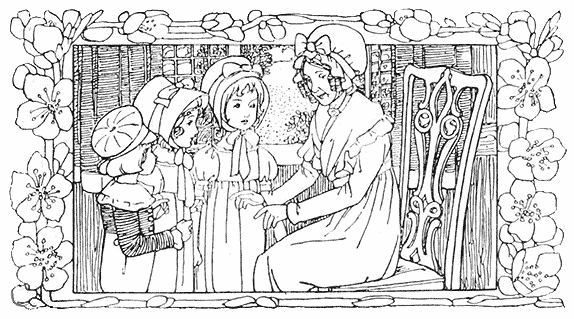
Nothing happened for some weeks after Miss Crosbie went away which could be put down in this history, because almost every day was like another, unless we were to say what lessons the children did, and what the doll was dressed in, and what walks were taken. The spring came on, and a very fine spring it was; and Henry found a place among the trees where he thought a very beautiful arbour might be made, and he got leave to make it, and John helped, and Lucy and Emily were very busy about it, and a most pleasant place it was. The hut in the wood was too far off for the children to run to when they had but little time; but Henry's arbour could be reached in three minutes by the shortest way. Mr. Fairchild was so good as to pay John Trueman to make a thatched roof and sides to it, and the man-servant John found some old boards for seats; but he could not find time to finish the seats as soon as Henry wished.
During this time Mrs. Goodriche came over to visit
But the happiest times of people's lives are often those in which there is least to write and talk about; so we must pass over the spring, and go on to the month of June, the very first day of which was that fixed for the visit to Mrs. Goodriche.
It was a bright morning when the party set out in the carriage which Mr. Fairchild had bought. The dew was not off the ground, for they were to breakfast at Mrs. Goodriche's; but, as Henry said, the day would be too short anyhow, for these happy children thought many days too short.
What a curious old house Mrs. Goodriche's was! it was the very house in which Mrs. Howard had lived, and it had been scarcely altered for Mrs. Goodriche. There was what the old lady had called her summer parlour, because she never sat in it in cold weather; it was low and large, and had double glass doors, which opened upon the old-fashioned garden; and there was a short walk which went from the door to the old arbour. The walls of the room were painted blue, the windows were casements, and had seats in them, and there was a step up from the floor into the garden.
The visitors found Mrs. Goodriche in this summer parlour.
After breakfast the two elder ladies took out their work. Mr. Fairchild walked away somewhere with a book, and the children went into the arbour. Lucy and Emily had their doll's work, and Henry had his knife and some bits of wood; it was very hot, so that they could not run about.
"I love this arbour," said Henry.
Lucy. "So do I; don't you remember, Henry, that we were sitting here once, thinking of poor Emily when she had the fever, when Mrs. Goodriche came to us and told us that Emily was so much better and the fever gone, and how glad we were, and how we jumped and screamed? Oh! that was a dreadful time."
"To me it was not dreadful," replied Emily; "I think I may say it was a happy time, Lucy, for I had thoughts put into my mind in that illness which make everything seem different to me ever since. You know what I mean, Lucy, I can't explain it."
Lucy. "I know what you mean, Emily."
Emily. "I never felt anything like that till I had the fever, so I call the fever a happy time."
"I wish you would not talk about it," said Henry; "Lucy and I were miserable then; were not we, Lucy?"
Mrs. Goodriche dined very early, and after dinner she and Mrs. Fairchild came into the arbour, and there she told the story which she had promised.
Story of the Last Days of Mrs. Howard
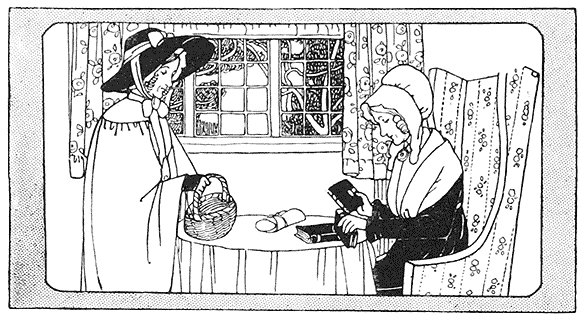
"It was about half a year after the things had happened which are related in the last story of Mrs. Howard, that Betty, one evening when she returned from market upon Crop, came into the parlour to her mistress and said:
"'Ma'am, I have heard a bit of news; Mr. Bennet is going to leave the country.'
"'Indeed, Betty,' said Mrs. Howard: 'how has that happened?'
"'Some relation towards London has left him a property, and our county is glad of anything that takes off the family.'
"'Well, well, Betty,' said Mrs. Howard, and Betty knew that when her mistress said, 'Well, well,' it was a hint to her to say no more on the subject. Mrs. Howard soon heard from other quarters that the Bennets were going, but they were not to be off till the Lady Day next.
"A week or two before that time, Betty had occasion to go again to town. Many things were wanted, and on such occasions Crop did not object to carry panniers.
"When Betty was quite ready, and Crop at the door, and the woman in the house who always came to take care of things on such occasions, she came to ask her mistress if there was anything more not yet mentioned.
"Betty never travelled in cold weather without a long blue cloak, and a black felt hat tied over her mob.
"'Yes, Betty,' replied Mrs. Howard, 'but you must be very particular—you must get me two small neat Bibles with gilt edges, bound in morocco, scarlet or green; I should wish them alike, and a clear print; besides which you must bring a young gentleman's pocket-book, all complete and handsome, with a silver clasp; and lastly, you must bring me a genteel equipage in chased silver, the furniture quite complete and as it should be, and mind it is well wrapped in paper.'
"'Oh, ma'am,' said Betty, 'how shall I be able to choose one that will exactly suit for what you want? I am quite afraid to undertake the bringing of a genteel equipage, there is such a difference of opinion about so tasty a thing.'
"'Betty,' replied Mrs. Howard, 'you know I am always pleased with your taste; and if anyone in the world knows what I like, it is you, my good girl.'
"Mrs. Howard often called Betty a good girl, though she was too old to be so called; but it was a habit in those days in which the old lady lived.
"'I should know your taste, ma'am,' said Betty, smiling, 'by this time, I should think—me who has lived in yours and your lady mother's service four-and-forty years next Candlemas;' and so saying Betty set out."
"Pray, ma'am," asked Lucy, "what is an equipage?"
"A fine carriage and horses, to be sure, Lucy," said Henry. "Lady Noble had an equipage. I heard John
"Oh, Henry," said Emily, "surely what Betty was to bring with her could not be a carriage and horses wrapped in paper."
Mrs. Goodriche smiled, and explained to the children what Mrs. Howard meant: she told them that an equipage was a little case which held a thimble, scissors, a pencil, or other such little matters, and, being either of gold or silver, was hung to the girdle to balance the great watches worn by the grandmothers and great-grandmothers of people now living.
"Thank you, ma'am," said Lucy; "and now please to go on, and tell us what Mrs. Howard meant to do with this equipage."
"When Betty returned," continued Mrs. Goodriche, "Mrs. Howard was well satisfied with what she had done; and the very next Sunday evening she took occasion, after service, to speak to Master and Miss Bennet, and to invite them to tea for the next evening.
"'I wonder,' said Master Jacky to Miss Polly, as they walked home together by their mother, 'what she can want with us. I promise you I shan't go.'
"'What's that you are saying, Jacky?' said Mrs. Bennet.
"Miss Polly then told her mother of the invitation and what her brother had said.
"'You had best go,' said Mrs. Bennet, 'and you may, perhaps, get some pretty present. I was told by one who was told by another, that Betty was in town last week, and laying out money at the silversmith's, and at Mr. Bates the bookseller's, so I would have you go: you don't know but that the old lady may have some keepsakes to give you.'
"'Well then,' said Jacky, 'if Polly goes, I will; for I don't see why she is to have the presents, and me nothing—but as to anything that Mrs. Howard ever gave me yet,' added the rude boy, 'I might put it into my eye and see none the worse.'
"'And whose fault is that?' said Miss Polly.
"'It don't become you to talk, Miss,' replied Jacky; 'for if I have had nothing, you have had no more—so there is half a dozen for one and six for another.'
"By this discourse we may see," said Mrs. Goodriche, "that no great change for the better had yet passed on these rude children.
"But they had got a notion that, as Jacky said, there were presents in the wind, and they set out for Mrs. Howard's determining to behave their best, though they did not tell their thoughts to each other, for Jacky hoped that Polly would disgrace herself and get nothing, and Polly had the same kind wishes for Jacky.
"Mrs. Howard received them in the summer parlour, and they both behaved themselves very well, but more out of spite for each other than from love of what is right in itself; but you shall hear by-and-by how I came to the knowledge of these their thoughts.
"Betty had made a cake, and there was a roast fowl and hot apple-tart for supper; and between tea and supper Mrs. Howard showed them many curious things, pictures, and dolls dressed in the fashions of her youth, and a number of other things which she kept in a Japan cabinet, which always stood in the summer parlour while she lived in this house.
"It was not till after supper that she brought out the two Bibles and the pocket-book and equipage. She then laid them before her on the table, and she spoke to the two children:
"She began by saying that as they were going out of the country and she was far in years, she might, perhaps, never see them again in this world. She then spoke, in her own sweet warm way, of what our dear Saviour has done for us, and when she had said as much as she thought the children could bear, she presented each a Bible, having written their names in them. She next took the other presents in her hands:
"'And these, my dears,' she said, 'I ask you to accept. I am sorry if on former occasions I may have seemed harsh to you, but these little gifts are to prove that I am truly sorry if ever I gave you pain; when you look at them you will think of me, and know that nothing would ever give me more delight than to hear that you were both walking in the ways of holiness.'
"She then put the pocket-book into Jacky's hand, and the equipage into Miss Polly's; but she hardly expected what followed. The two children burst into tears; Jacky rubbed his eyes to hide his; but Miss Polly sprang from her chair, and fell weeping into Mrs. Howard's arms.
"'We will, we will try to do better, ma'am,' she said; 'we will indeed.'
"As the children walked home they said not one word to each other; and a very few days afterwards the family left the country, Mr. Bennet not having had even the decency to call and say good-bye to the old lady.
"Mrs. Howard was half-way between sixty and seventy when the Bennets left the country, and was supposed by many to be older, for she had dressed like an old woman for many years; her hair had long been gray, and she had always been a weakly person, very small and very pale.
"She, however, continued to live in this house as many as seventeen years after the Bennets were gone, and every year till the last had her children's party; but a change
"Betty was younger than Mrs. Howard, but she was called away before her; she had lived forty years with Mrs. Howard in this very house, and the loss could not be made up to her in this world.
"Mrs. Howard had a great-nephew, a surgeon, of the name of Johnson, who lived in a fair village, called Pangbourne, in Berkshire; and when he heard of the death of Betty, and how low his aunt was, he came to her, and persuaded her to leave the country, and go and reside near to him. She was at first unwilling to go, but was at last persuaded; she took nothing with her but her favourite chair, her old round table, her books, and her cabinet. Her nephew got her some very pleasant rooms in a house called the Wood House, about half a mile from the village, towards the hills which are near the place. That side of Pangbourne was in those days almost a continued wood coppice, with occasional tall trees towards the hills, and there was a narrow road and raised path through the wood to the town.
"Mrs. Howard's parlour had an old-fashioned bow-window in it, looking to the road, though somewhat raised above it; and
"Every day her kind nephew came to see her, and now and then she returned his visit; but she was getting very infirm, though she had lost neither sight nor hearing, could read and work as in her younger days, and having got over the first shock of losing Betty, and the fatigue of the change, her faith in God's love was making her as happy
"It was then that she first noticed two little girls passing and returning every day at certain hours to and from the village.
"They were so near of a size that she thought they must be twins. They were very fair, and very pretty, and very neat. They wore light green stuff frocks, with lawn aprons and tippets, and little tight neat silk bonnets of the colour of their frocks. They both always carried a sort of satchel, as if they were going and coming from school; and there was often with them, when they went to the village, either a man or woman servant, such as might be supposed to belong to a farmhouse. They often, however,
"As Mrs. Howard watched them from day to day, she thought them the pleasantest little people she had seen for a long time; and all her ancient love for children, which age and weakness had almost made her fancy was nipped and blighted, began to spring up again and blossom as flowers in May. She wished to get acquainted with these fair ones, but she took her own way to do so.
"She began one morning, when her window was open, by giving them a kind smile as they were walking gravely by, with a man in a smock-frock behind them. On seeing this smile they both stopped short and dropped formal curtseys.
"From that time, for a week or more, these smiles and
"'We shall have a tempest,' said Mrs. Howard to a maid who had been hired to wait upon her; 'I hope the little girls will get home before it comes on—have they far to go?'
"When Mrs. Howard had explained what little girls she meant, the maid told her that they were the children of a farmer of the name of Symonds, and that the house was not a half-mile distant up the lane.
"Whilst Mrs. Howard was talking with the servant, the heavens had grown black, the clouds hung low; there was a creaking, groaning sort of sound among the trees, and the larger birds arose and flew heavily over the woods, uttering harsh cryings.
"'It's coming,' said the servant; and at the same instant the two little ones appeared walking from the village.
"'There they are,' cried Mrs. Howard; and at the same moment a tremendous flash of lightning covered the whole heavens, followed by a peal of awful thunder. Mrs. Howard put her head out of the window, and called the little girls, who, from very fright, were standing still.
"They gladly obeyed the call, the maid went down to meet them, and the next minute they stood curtseying within the parlour-door. The maid had seen a boy who had been sent to meet them, and sent him back to tell his mistress that the Misses were with the lady, and that she would keep them till the storm was over.
"'What lady am I to say?' asked the boy.
"'Our lady,' replied the maid; 'Surgeon Johnson's aunt.'
"The boy ran home, and told Mrs. Symonds not to be uneasy, for the little Misses were safe with Madam Johnson, who lodged at the Wood House; so Mrs. Symonds was made easy about her pretty daughters.
"'Well, my dears,' said Mrs. Howard, putting her hands out to the little people, 'I am glad to see you in my parlour.'
"'Thank you, ma'am,' said one of them; and the other repeated the same words.
"As they spoke they came near, and put each a hand into Mrs. Howard's.
"'Let me look at you, my children,' said the old lady in her pleasant smiling way; 'you are like two lilies growing out of one root; I cannot tell one from the other; what are your names?'
"'I am Mary, ma'am,' said the eldest.
"'And I am Amelia,' added the other.
"'Amelia,' said Mrs. Howard, 'why, that is my name: but which is the oldest?'
"'We came to our mother the same day,' replied Mary; 'but I came first, only a very little while though.'
"'Indeed!' said Mrs. Howard.
"Mrs. Baynes had come into the parlour after the children, to see and hear what was going forward; and now she thought it time to put in a word.
"'Yes, ma'am,' she said, 'they are twins; they are the only ones their mother ever had, and they are two pretty Misses, and very good children. Are not you very good, my precious dears?'
"The two little ones turned to her; and answered both together:
"'No, ma'am.'
"Mrs. Howard rather wondered at this answer, and said:
"'Not good, my dears, how is that?'
"'We wish to be good, ma'am,' said one of the little girls, 'but we are not.'
"'Well to be sure!' remarked Mrs. Baynes; 'but you have a very good mamma, my little dears.'
"'Mamma is good to us,' said Mary.
"'But God is the only real good person,' added Amelia.
"Mrs. Howard was rather surprised, but as the storm was still getting more frightful, she moved her chair, shut the window, and sat in the middle of the room; the two little ones in their fear clinging to her, whilst she put an arm round each of them.
"Mrs. Baynes went out to close the windows, and they were left together.
"Peal came after peal, and flash after flash; and the old lady and children trembled.
"'We ought not to fear,' said Mrs. Howard; 'it is wrong; is not the lightning in the hands of God?'
"'We will try not to be afraid,' said the little ones; and they clung closer to Mrs. Howard.
"And now there came a fearful hailstorm, patter, patter, against the window; and when the hail ceased the rain came pouring down.
"'Now, my loves, let us thank God,' said Mrs. Howard, 'the danger is past.'
"The little ones, with that quick obedience which we see in children only who are well brought up, joined their hands and said, 'Thank God!' but they expressed some fear lest their mother should be frightened about them.
"'We will see about that,' said Mrs. Howard; and she rang the hand-bell which always stood on the table, for bells were not then fixed on cranks and wires in every room as they are now.
"Up came Mrs. Baynes again, and told the little ones that their mother knew where they were, for she had sent her a message by the boy.
"'Then we can stay, ma'am,' said the children, quite pleased: and Mrs. Howard asked to have the dinner sent up, requesting Mrs. Baynes to make up a little more from her own pantry, if she could.
"'That shall be done, ma'am,' she answered; and she
"'We should like to dine with you, ma'am,' said one of the little girls, 'and to drink tea with you sometimes.'
"Mrs. Howard did not yet know one from the other, but she felt that all her old love for children was burning up again in her heart.
"'I am old, my dears,' she answered, 'and cannot bear noise and bustle; if you can be quiet, I shall be glad to see you often, but if you tire me I cannot have you.'
"'I hope we shall be quiet,' they answered; and then they asked her if she was very, very old.
"She told them she was eighty-two; and they said to each other, 'Then we must be very quiet.'
"The maid came in to lay the cloth, and they seemed quite amused by looking at her. The table was very small, but they said there would be quite room; and by Mrs. Howard's direction they went to her bedroom, took off their bonnets, and the maid combed their pretty curling hair.
"They behaved as well as children could possibly do at table, though they prattled a little, and told Mrs. Howard of the animals they had at home, their kittens and the old cat, and an owl in the garden called Ralph, and many other things. When the dinner was removed, Mrs. Howard said she had a great treat for them.
"'What is it, ma'am?' they said.
"'Something very nice,' replied the old lady; and going to the corner cupboard, she brought out a doll's cradle, and a small trunk full of doll's clothes, and the two new dolls both wrapped in the paper in which they had come from London.
"'Now,' she said, 'these are dolls which I keep for my visitors, and when you are here you may play with them.
"'Oh, ma'am! Oh, ma'am!' cried the children; they were too glad to say another word.
"'You may take out the clothes from the trunk and dress them; but, before you go, you must put on their night-dresses, and put them to bed in the cradle, and restore all the other clothes to the trunk.' The little ones quite trembled with joy; they were past speaking. 'Now,' said Mrs. Howard, 'go into the bow-window. The lightning is past. I must keep in my chair, and you must not disturb me. If the day was finer I should let you go into the garden to play, but to-day you cannot.'
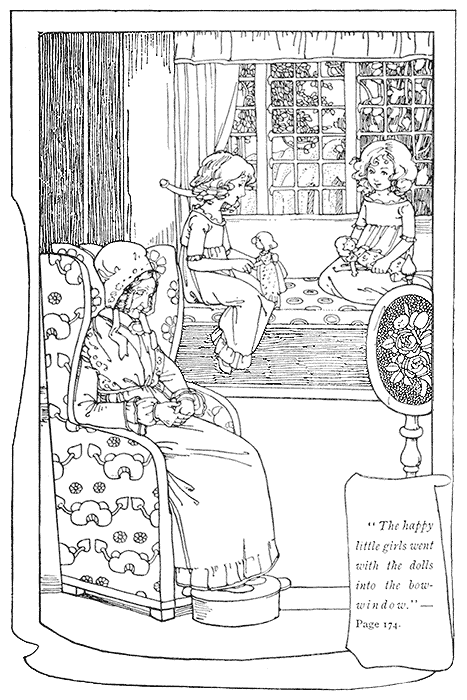
"The happy little girls went with the dolls into the bow-window."—Page 174.
"The happy little girls went with the dolls into the bow-window, and Mrs. Howard got her usual short sleep. They did not make any noise. In all their behaviour they showed that they had been well brought up.
"They drank tea with Mrs. Howard, and were very busy after tea in showing all the clothes to their old kind friend, and in packing them up in the trunk, and putting the dolls in the cradle, and restoring all the things to the place from whence they had been taken.
"Mrs. Howard saw them kiss the dolls, and heard them wish them a good-night when they had done.
"Mrs. Symonds had sent her green market cart and cloaks for her little girls. When the cart came they both kissed Mrs. Howard, and asked her if they had been quiet.
"'Very quiet, my dears,' she answered.
"'Then may we come again?'
"'You may, my darlings,' answered the old lady; 'and next Saturday shall be the day, if all is well.'
"The fair little creatures did come on the day fixed,
"From the day of the thunderstorm till the end of the summer the little girls spent Saturday afternoon, every week, with Mrs. Howard, and now and then stopped an hour with her on other days; and never passed the window without speaking to her, often coming in with flowers, or fruit, or a fresh egg, or some little thing from the garden or poultry-yard. Thus such a friendship grew up between the old lady and these little girls, that one might have thought that Mrs. Howard must have been their grandmother.
"Often and often she would hear them read a chapter, or repeat a hymn, and do what she could to improve their minds; she taught them to sing some fine old psalm tunes, and she also taught them some new stitches in the samplers they were working. Many times she walked between them a little way in the wood, whilst they carried the dolls, and in these walks she often told them stories, so that they loved her more and more every day, and tried more and more to please her.
"All this time Mrs. Symonds had been so busy with the work of the farm that she had not found time to come herself to thank Mrs. Howard for all she was doing for her little ones; and it was rather strange that all this time she had understood that the kind old lady's name was Johnson. The children never called her anything but 'our nice lady,' and never thought of any other name for her.
"But the harvest-time being over, Mr. Symonds told his wife that she must not put off calling on the lady any longer.
"'And be sure,' he said, 'that you take something nice in your hand, or let the boy carry it after you; some nice cakes and butter pats, or anything else; and you may as well go and meet the children as they come home this evening, and go in with them.'
"Mrs. Symonds was one of those old-fashioned wives who never went anywhere but to church, and as her church was not at Pangbourne she seldom passed the Wood House. She, however, made up her basket of presents, and having dressed herself neatly, she took the boy and went to meet her children.
"She met them a little above the Wood House, and they turned back with her, and soon brought her to the door of Mrs. Howard's parlour: there they knocked, and the old lady having called to them to come in, the twins entered, leading their mother.
"But how great was their surprise when their mother, at the sight of Mrs. Howard, uttered a cry, ran forwards and threw her arms round the old lady's neck.
"'Oh, dear, dear Mrs. Howard,' she said, 'is it you? Can it be you?'
"Mrs. Howard did not know Mrs. Symonds, and as she drew herself civilly from her arms, she said:
"'Indeed, ma'am, I have not the pleasure of knowing you.'
"'Not remember Polly Bennet?' replied Mrs. Symonds, 'but I remember you, my best and dearest friend, and shall remember you, for I have cause to do so, when time shall be no more.'
"Mrs. Howard now herself came forward and kissed Mrs. Symonds. The tears stood in the old lady's eyes, and she placed her old thin hands in the other's.
"'And are you,' she said, 'the mother of these dear little girls? and have I lived near you so long and not
"'I have not much to say,' answered Mrs. Symonds; 'my parents are dead, and my brother living far off: and I have been blessed beyond my deservings in a good husband and these dear children.'
"'Dear, indeed,' said Mrs. Howard.
"'But how can I value enough what you have done for me, Mrs. Howard?' said Mrs. Symonds, 'and through me, in some sort, to my mother and father before their death.'
"'I do not understand you,' said Mrs. Howard.
"Mrs. Symonds then told the old lady how she had been affected by the last kindness which she had shown to her and her brother.
"'When you sent for us, dear madam,' she said, 'we accepted your invitation because we expected presents; but with presents we expected also, what we had well deserved, a severe lecture. But when you spoke to us, as you did, with such amazing kindness—when you even almost begged our pardons if you had been hard upon us, which you never were—when you spoke to us of our Saviour, whilst your eyes filled with tears, we were cut to the heart and filled with shame, and we then resolved to read the Bibles you gave us. And we never could forget your words.
"'The work, indeed, is of God; but you, dear lady, were made the minister of it in the commencement. You were the first person who made me and my brother to understand that the new spirit imparted by God to His children is the spirit of love.'
"Mrs. Symonds said much more; indeed she went on speaking till Mrs. Howard burst into tears of joy and thankfulness.
"The little ones were frightened to see their mother and Mrs. Howard weeping, and could not at first be made to understand that they were crying for very joy. When they understood that Mrs. Howard was an old dear friend of their mother's, they became happy again.
"What a pleasant party there was that evening in the bow-window! the white cakes and fresh butter and cream were added to the feast; and what a delightful story was there to tell to Mr. Symonds when his wife and children got home!
"'Tell the old lady,' said Mr. Symonds, 'that I should be ever ready to serve her to the last drop of my blood.'
"From that time," continued Mrs. Goodriche, "till the death of Mrs. Howard, which happened in her ninetieth year, Mr. and Mrs. Symonds were a son and daughter to her. Mary and Amelia never both left her; sometimes one, and sometimes both, being continually with her."
"This is a beautiful story," said Lucy.
"I wish it was longer," said Henry; "can't you tell us more, ma'am?"
"Not now, my dear," said Mrs. Goodriche, "we must go in now; and, indeed, I know not that I have any more to tell."
It was late when the family got home. As they were returning, Mrs. Fairchild told Mr. Fairchild the story of old Mrs. Howard, which pleased him much.
The Fair Little Lady
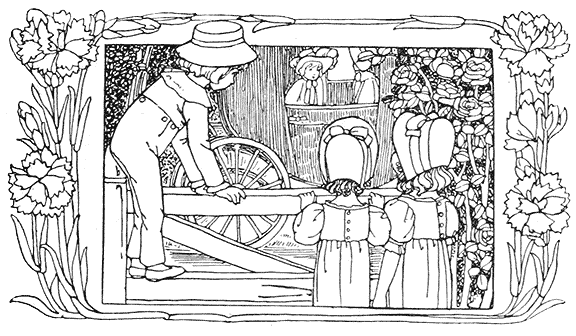
It was not long after that delightful day at Mrs. Goodriche's, when the children, having done their morning lessons, had just gone out of the hall-door, on their way to Henry's arbour, when they heard the wheels of a carriage sounding from a distance.
The sound was not like that of a waggon, which goes along heavily, crashing and breaking the stones in its passage, whilst the feet of the horses come down with a heavy beat upon the ground; but horses and wheels went lightly, and as if the carriage was coming near quickly.
Very few light carriages passed that way, and therefore when anything of the kind was heard or seen, everybody left off what they were doing to look, let them be ever so busy. Lucy and Emily and Henry ran down to the gate which opened on the road. Henry climbed to the top of the highest bar; but the little girls stood on one side, where they were half hidden by a rose-bush.
When they were got there the carriage was heard more
"So, Master Henry," he said, "you are come to see the coach; I just caught sight of it as it went round the corner below, and I promise you it is worth seeing; it beats Sir Charles Noble's to nothing—but here they come."
At first there appeared a groom, dressed in a glazed hat, and a livery, and shining boots; and he was riding a fine horse, and he went forward quickly; he had several dogs running by him. Lucy and Emily were glad that John, with his hoe, was close by, for they did not love strange dogs.
But the groom and his dogs were very soon out of sight; he was riding on to see that the gates were open where the coach was going. Immediately afterwards the coach came in sight—and a fine new coach it was; and there were four horses, with postillions whipping and cutting away; and ladies and gentlemen in the coach.
Lucy and Emily and Henry did not look at the grown people, but at a very pretty little lady, of Emily's age perhaps, who was looking out of the window on their side.
They saw her face, which was fair and very pale, and they saw her curling light hair, and her blue satin hat, which had white feathers in it; and they knew that she saw them, for she rather smiled and looked pleased, and turned to speak about them, they thought, to the lady next to her. But the coach was gone in a minute, not rattling like a hack-chaise, but making a sort of low rumbling sound, and that sound was not heard long.
"Who are those?" said Henry, as he stood at the very top of the gate, like a bird upon a perch, "who are those fine people?"
"They are the great folks," replied John, "who are come
"What is her name, John?" asked Lucy.
"Don't ask me, Miss," replied John; "for though I have heard the name, I could not pretend to speak it properly, it is so unaccountably fine."
"I should like to hear it," said Emily.
"And that you will be sure to do soon, Miss," answered John; "for all the country is talking about the family, and they say they are uncommon grand."
"But, John," said Henry, "when will you come and nail the benches in my hut? Will you come now? Shall I fetch the hammer and nails?"
"No, master," returned John, "you need not fetch them, for I have them here in this basket, and was just going when I saw the coach."
"Away then," cried Henry, jumping from the top of the gate, and running before, whilst John followed close behind him, and Lucy and Emily came afterwards, talking of the fair little lady.
Story of a Holiday
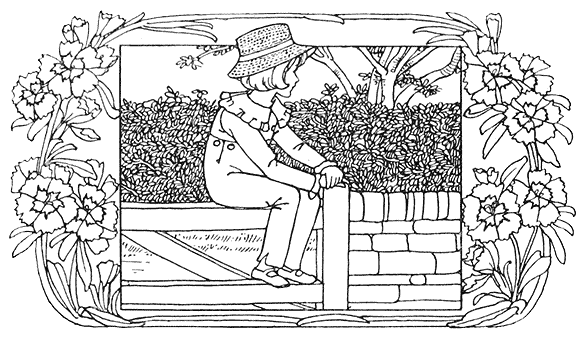
One day a letter came from Mrs. Goodriche to say that she was going early the next day to the town, in a hired chaise, and that she hoped to be back again in the evening; she added that, as she should be quite alone, it would be a great pleasure to her to take up Mrs. Fairchild and one of the little people to go with her to town, and she would set them down again at their gate.
Mrs. Fairchild thought this a very neighbourly offer, and it was soon settled that she should go, and take Lucy with her, and that Mr. Fairchild should get the horse he often rode and attend the carriage.
Lucy very much pressed her mother to take Emily instead of herself, but it was Lucy's turn to go out when there was a scheme only for one, and I don't think that Emily would have taken it from her on any account. So an answer was written to Mrs. Goodriche, and her kind invitation accepted.
There was a good deal of talking and settling with Lucy
It was at last settled that Lucy should choose a book for each of them—Henry's book was to be about a boy—and the rest of their money, if any was left, was to be spent as Lucy thought might please them best. So she took their money, and put it into her purse with her own. She had two shillings, and she had settled it in her own mind that she would buy nothing for herself, but spend some, if not all of it, for her sister and brother.
The family were all up at six o'clock, and soon afterwards they might be seen seated before the open window of the parlour at breakfast, those who were going being quite ready.
Emily and Henry, who were to be left, were to have no lessons to do, but their father and mother advised them not to tire themselves in the early part of the day by running about, but to amuse themselves during the very hottest hours with something quiet. Mr. Fairchild also reminded them that they must not go beyond the bounds in which they were always allowed to play.
"I hope we shall be good, mamma," said Emily, "I hope we shall!" And Henry said the same.
Henry ran out to the gate to look for the carriage after he had taken breakfast, and he got to the very highest bar, and looked along the road, which he could see a great way, because it came down a steep hill from Mrs. Goodriche's house.
It was hardly more than a black speck on the white road when he first saw it, and then he lost sight of it as it descended into the valley, and he heard it rattle and jingle
Emily was with Lucy in their little room, and she was holding her gloves whilst Lucy tied her bonnet, and she was talking over the things that were to be bought, when their brother's voice came up the stairs as loud and sharp as if a stage-coach was coming, which would not wait one moment for those who were going.
"I hope we shall not get into a scrape to-day," said Emily: "Henry has forgotten the day when mamma and papa went out, and we behaved so ill; what can we do to keep ourselves out of mischief?"
Lucy had no time to answer, for Henry was at the door, and there was such a rub-a-dub-dub upon it that her voice could not have been heard. At the same minute the hack-chaise had come jingling up to the gate, and Mrs. Goodriche was looking out with her pleasant smiling face. John, too, had brought the horse to the gate, and everybody who belonged to the house was soon out upon the grass-plot; the dog was there, and quite as set up as Henry himself; and Betty came too, though nobody knew why. Mrs. Fairchild got in first, and then Lucy; and everybody said good-bye as if those who were going were not to come back for a month; and the post-boy cracked his whip, and Mr. Fairchild mounted his horse, and away they went.
Emily and Henry watched them till the turn of the road prevented them from seeing them any longer; and then Henry said:
"Let us run to the chesnut-trees at the top of the round hill, and then we shall be able to see the carriage again going up on the other side; I saw it come down from Mrs. Goodriche's."
"Stay but one moment," said Emily, and she ran upstairs, put on her bonnet and tippet, and was down again in one minute, with her doll on her arm and a little book in her hand.
"Come, come," said Henry, and away they ran along a narrow path, among the shrubs in the garden, out at a little gate, and up the green slope. They were very soon at the top of the small hill, and under the shade of the chesnut-trees. They passed through the grove to the side which was farthest from their house, and then they sat down on the dry and bare root of one of the trees.
For a minute or more they could not see the carriage, because it was down in the valley beneath them, and the road there was much shaded by willows and wych-elms and other trees that love the neighbourhood of water, for the brook which turned the mill was down there. But when the carriage began to go up on the other side, they saw it quite plain; there was the post-boy in his yellow jacket, jogging up and down on his saddle, and Mr. Fairchild sometimes a little before and sometimes a little behind the carriage.
Henry was still in very high spirits; he was apt to be set up by any change, and when he was set up, he was almost sure to get into a scrape, unless something could be thought of to settle him down quietly.
Emily had thought of something, and got it ready; but whilst the carriage was in sight nothing was to be done, for Henry had picked up a branch which had fallen from one of the trees, and as he sat on the root, was jogging up and down, waving his branch like a whip, and imitating those sort of odd noises which drivers make to their horses; such as gee-up! so-ho! and now and then he made a sort of smacking with his lips.
"Are you driving a waggon or a coach?" asked Emily.
"A coach, to be sure," said Henry; "don't you see that I have got a chaise from the Red Lion, and that I am driving Mrs. Fairchild and Mrs. Goodriche and Miss Lucy Fairchild to the town, and here we go on?"
The carriage was long getting up the hill, for it was a very steep one; but when it had reached the top, it got in among trees again, and was soon out of sight; and then Emily said:
"Now, Henry, I am going to curl my doll's hair, and dress her over again, for she is not tidy, and I have got a little book here which you may read to me."
"What book is it?" said Henry.
"You never saw it," she answered; "mamma found it yesterday in a box where she keeps many old things—she did not know that she had saved it—it was hers when she was a little child, and she supposed that it was lost."
"Let me see it, Emily," said Henry.
"Will you read it to me then?" asked Emily.
Henry was a good-natured boy, and loved his sisters, and had much pleasure in doing what they wished him to do; he therefore said at once, "Yes," threw away his branch of fir, and took the book.
This little book, which Mrs. Fairchild had found in her old chest, could not have been much less than a hundred years old; it was the size of a penny book, and had a covering of gilt paper, with many old cuts; its title was, "The History of the Little Boy who, when running after the Echo, found his Papa."
When Henry had seen how many pictures there were, and when he had read the title, he was quite in a hurry to begin the story, and Emily was so much pleased at hearing it, although she had read it before, that she forgot her doll altogether, and let her lie quietly on her lap.
Little Edwy and the Echo
"It was in the time of our good Queen Anne, when none of the trees in the great forest of Norwood, near London, had begun to be cut down, that a very rich gentleman and lady lived there: their name was Lawley.
"They had a fine old house and large garden, with a wall all round it, and the woods were so close upon this garden, that some of the high trees spread their branches over the top of the wall.
"Now, this lady and gentleman were very proud and very grand, and despised all people poorer than themselves, and there were none whom they despised more than the gipsies, who lived in the forest all about.
"There was no place in all England then so full of gipsies as the forest of Norwood.
"Mr. and Mrs. Lawley had been married many years, and had no children; at length they had one son—they
"When he was just old enough to run about without help, he used to wear his trousers inlaid with the finest lace, with golden studs and laced robings; he had a plume of feathers in his cap, which was of velvet, with a button of gold to fasten it up in front under the feathers, so that whoever saw him with the servants who attended him, used to say, 'Whose child is that?'
"He was a pretty boy, too, and, when his first sorrow came, was still too young to have learned any of the proud ways of his father and mother.
"No one is so rich as to be above the reach of trouble, therefore pride and self-sufficiency are never suitable to the state of man.
"Trouble was long in coming to Mr. and Mrs. Lawley, but when it came it was only the more terrible.
"One day, when the proud parents had been absent some hours on a visit to a friend a few miles distant, Edwy was nowhere to be found on their return—his waiting-maid was gone, and had taken away his finest clothes; at least, these were also missing.
"The poor father and mother were almost beside themselves with grief, and all the gentlemen and magistrates about rose up together to find the child, and discover those who had stolen him, but all in vain; of course, the gipsies were suspected and well examined, but nothing could be made of it; nor was it ever made out in what way the little boy was got off; but got off he had been by the gipsies, and carried away to a country among hills, on the borders of the two shires of Worcester and Hereford."
"Did not I know it?" cried Henry, as he stopped to turn over a leaf; "I knew it from the first that the gipsies had him."
"In that country," he continued, as he read on, "there is a valley where two watercourses meet deep in a bottom; where there are many trees, and many bushes, and much broken irregular ground, where also there are rocks, and caves, and holes in these rocks, and every possible convenience for the haunt of wild people. To this place the gipsies carried the little boy, and there they kept him, all the following winter, warm in a hut with some of their own children.
"They had stripped him of his velvet, and feathers, and lace, and gold clasps, and studs, and clothed him in rags, and daubed his fair skin with mud; but they fed him well; and after a little while he seemed to be unconscious of any change.
"Now, the part which comes next of this true and wonderful history has nothing to go upon but the confused and imperfect recollections of a little child.
"The story nowhere tells the age of Edwy when he was stolen, but he had been lost to his parents from the time that the leaves in the forest of Norwood were becoming sear and falling off, till the sweet spring was far advanced towards the summer.
"Probably the cunning gipsies had hoped that during the long months of winter the little child would quite forget the few words which he had learned to speak distinctly in his father's house, or that he would forget also to call himself Edwy; or to cry, as he remembered that he often did, 'Oh, mamma, mamma! papa, papa! come to little Edwy.' The gipsies tried to teach him that his name was not Edwy, but Jack or Tom, or some such name; and to make him say mam and dad, and call himself the gipsy boy, born in a barn. But after he had learned all these words, whenever anything hurt or frightened him, he would cry again, 'Mamma! papa!
"When left behind, there were always two or three children, a great girl, an old woman, or a sick person, staying with him, until the day which set him free from his troubles. It was in the month of May. Who would not like to live like a gipsy in a wood, if all the year round was like that month of May? It was about noon, and Edwy, who had been up before the sun, to breakfast with those who were going out for their day's begging and stealing, had fallen asleep on a bed of dry leaves in the hut, as soon as most of the people were gone; one old woman, who was too lame to tramp, was left with him.
"He slept long, and when he awoke he sat up on his bed of leaves, and looked about him to see who was with him; he saw no one within the hut, and no one at the doorway.
"Little children have great dread of being alone. He listened to hear if there were any voices without, but he could hear nothing but the rush of a waterfall close by, and the distant cry of sheep and lambs. The next thing the little one remembered that he did, was to get up and go out of the door of the hut. The hut was built of rude rafters and wattles in the front of a cave or hole in a rock; it was down low in the glen at the edge of the brook, a little below the waterfall. When the child came out, he looked anxiously for somebody, and was more and more frightened when he could see no creature of his own kind amid all the green leaves, and all along the water's edge above and below.
"Where was the old woman all this time? who can say? but perhaps not far off; perhaps she might have been deaf, and, though near, did not hear the noise made by the child when he came out of the hut.
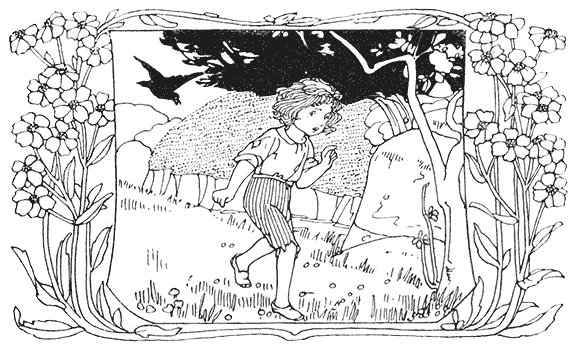
"Edwy did not remember how long he stood by the brook; but this is certain that the longer he felt himself to be alone, the more frightened he became, and soon began to fancy terrible things. There was towards the top of the rock from which the waters fell a huge old yew-tree, or rather bush, which hung forward over the fall. It looked very black in comparison with the tender green of the fresh leaves of the neighbouring trees, and the white and glittering spray of the water. Edwy looked at it and fancied that it moved; his eye was deceived by the dancing motion of the water.
"Whilst he looked and looked, some great black bird came out from the midst of it uttering a harsh croaking noise. The little boy could bear no more; he turned away from the terrible bush and the terrible bird, and ran down the valley, leaving hut and all behind, and crying, as he always did when hurt or frightened, 'Papa! mamma! Oh, come, oh, come to Edwy!'
"He ran and ran, whilst his little bare feet were pierced with pebbles, and his legs torn with briars, until he came to where the valley became narrower, and where one might have thought the rocks and banks on each side had been cleft by the hand of a giant, so nicely would they have fitted could they have been brought together again. The brook ran along a pebble channel between these rocks and banks, and there was a rude path which went in a line with the brook; a path which was used only by the gipsies and a few poor cottagers, whose shortest way from the great road at the end of the valley to their own houses was by that solitary way.
"As Edwy ran, he still cried, 'Mamma! mamma! papa! papa! Oh, come, oh, come to Edwy!'—and he kept up his cry from time to time as he found breath to utter it, till his young voice began to be returned in a sort of hollow murmur.
"When first he observed this, he was even more frightened than before; he stood and looked round, and then he turned with his back towards the hut, and ran and ran again, till he got deeper amongst the rocks. He stopped again, for the high black banks frightened him still more, and setting up his young voice he called again, and his call was the same as before.
"He had scarcely finished his cry, when a voice, from whence he knew not, seemed to answer him; it said, 'Come, come to Edwy;' it said it once, it said it twice, it said it a third time, but it seemed each time more distant.
"The child looked up, the child looked round, he could never describe what he felt; but in his great agitation he cried more loudly, 'Oh, papa! mamma! Come, come to poor Edwy!' It was an echo, the echo of the rocks which repeated the words of the child; and the more loudly he spoke, the more perfect was the echo; but he could catch only the few last words; this time he only heard, 'Poor, poor Edwy!' Edwy had not lost all recollection of some far distant happy home, and of some kind parents far away; and now at that minute he believed that what the echo said came from them, and that they were calling to him, and saying, 'Poor, poor Edwy!' But where were those who called to him? alas! he could not tell. Were they in the holes in the rocks?—his mind was then used to the notion of people living in caves—or were they at the top of the rocks? or were they up high in the blue bright heavens?
"It would have been a sorrowful sight to behold that
"After a while he called again, and called louder still. 'Come, come,' was his cry again, 'Edwy is lost! lost! lost!' Echo repeated the last words as before, 'Lost! lost! lost!' and now the voice sounded from behind him, for he had moved round a corner of a rock.
"The child heard the voice behind, and turned and ran that way; and stopped and called again, and then heard it the other way; and next he shrieked from fear, and echo returned the shriek once more, and thrice, finishing off with broken sounds, which to Edwy's ears appeared as if somebody a long way off was mocking him.
"His terror was now at its highest; indeed he could never remember what he did next, or when he turned to go down the valley; but turn he did, after having run back many paces.
"His steps, however, were guided by One whose eye was never off him, even his kind and heavenly Father; and on he went, neither heeding stones nor briars; every step taking him nearer to the mouth of the glen, and the entrance on the great high road.
"And who had been driving along that road in a fine carriage with four horses?"
"Who?" cried Henry Fairchild, turning over another leaf; "who, but his own papa?—but I must go on."
"Mr. and Mrs. Lawley had given up all hopes of finding their little boy near Norwood, and they had set
"The poor father and mother, therefore, could get no information there; and the next morning they had come on across the country, and along the road into which the gipsies' valley opened.
"Wherever these unhappy parents saw a wild country, full of woods, and where the ground was rough and broken, they thought, if possible, more than ever of their lost child; and at those times Mrs. Lawley always began to weep—indeed, she had done little else since she had missed her boy. The travellers first came in sight of the gipsies' valley, and the vast sweep of woods on each side of it, just as the horses had dragged the coach to the top of a very high hill or bank over which the road went; and then also those in the coach saw before them a very steep descent, so steep that it was thought right to put the drag upon the wheels.
"Mr. Lawley proposed that they should get out and walk down the hill. Mrs. Lawley consented; the coach stopped, everyone got down from it, and Mr. Lawley walked first, followed closely by his servant William; whilst Mrs. Lawley came on afterwards, leaning on the arm of her favourite little maid Barbara. The poor parents, when their grief pressed most heavily on them, were easier with other people than with each other.
"'Oh, Barbara!' said Mrs. Lawley, when the others were gone forward; 'when I remember the pretty ways of my boy, and think of his lovely face and gentle temper, and of the way in which I lost him, my heart is ready to break; and I often remember, with shame and sorrow, the pride in which I indulged, before it pleased God to bring this dreadful affliction upon me.'
"The little maid who walked by her wept too; but she said:
"'Oh, dear mistress! if God would give us but the grace to trust in Him, our grief would soon be at an end. I wish we could trust in Him, for He can and will do everything for us to make us happy.'
"'Ah, Barbara!' said the lady; and she could add no more—she went on in silence.
"Mr. Lawley walked on before with the servant. He, too, was thinking of his boy, and his eye ranged over the wild scene on the right hand of the road. He saw a raven rise from the wood—he heard its croaking noise—it was perhaps the same black bird that had frightened Edwy.
"William remarked to his master that there was a sound of falling water, and said there were sure to be brooks running in the valley. Mr. Lawley was, however, too sad to talk to his servant; he could only say, 'I don't doubt it,' and then they both walked on in silence.
"They came to the bottom of the valley even before the carriage got there. They found that the brook came out upon the road in that place, and that the road was carried over it by a little stone bridge.
"Mr. Lawley stopped upon the bridge; he leaned on the low wall, and looked upon the dark mouth of the glen. William stood a little behind him.
"William was young; his hearing and all his senses were
"His master was surprised to see him vault over the low parapet of the bridge the next moment, and run up the narrow path which led up the glen.
"It was the voice of Edwy, and the answering echo, which William had heard. He had got at just a sufficient distance from the sound of the coach-wheels at the moment when the echo had returned poor little Edwy's wildest shriek.
"The sound was fearful, broken, and not natural; but William was not easily put out; he looked back to his master, and his look was such that Mr. Lawley immediately left the bridge to follow him, though hardly knowing why.
"They both went on up the glen, the man being many yards before the master. Another cry and another answering echo again reached the ear of William, proceeding as from before him. The young man again looked at his master and ran on. The last cry had been heard by Mr. Lawley, who immediately began to step with increasing quickness after his servant, though, as the valley turned and turned among the rocks, he soon lost sight of him.
"Mr. Lawley was by this time come into the very place where the echo had most astonished Edwy, because each reverberation which it had made seemed to sound from opposite sides; and here he heard the cry again, and heard it distinctly. It was the voice of a child first, crying, 'No! no! no! Papa! mamma! Oh, come! Oh, come!'—and then a fearful shriek or laugh of some wild woman's voice.
"Mr. Lawley rushed on, winding swiftly between the rocks, whilst various voices, in various tones, which were all repeated in strange confusion by the echoes, rang in his ears; but amid all these sounds he thought only of that one plaintive cry, 'Papa! mamma! Oh, come! Oh, come!' Suddenly he came out to where he saw his servant again, and with him an old woman, who looked like a witch. She had the hand of a little ragged child, to which she held firmly, though the baby, for such almost he was, struggled hard to get free, crying, 'Papa! mamma! Oh, come! Oh, come!'
"William was arguing with the woman, and he had got the other hand of the child.
"Mr. Lawley rushed on, trembling with hope, trembling with fear—could this boy be his Edwy? William had entered his service since he had lost his child; he could not therefore know him; nor could he himself be sure—so strange, so altered, did the baby look.
"But Edwy knew his own father in a moment; he could not run to meet him, for he was tightly held by the gipsy, but he cried:
"'Oh, papa! papa is come to Edwy!'
"The old woman knew Mr. Lawley, and saw that the child knew him. She had been trying to persuade William that the boy was her grandchild; but it was all up with her now; she let the child's hand go, and whilst he was flying to his father's arms, she disappeared into some well-known hole or hollow in the neighbouring rocks.
"Who can pretend to describe the feelings of the father when he felt the arms of his long-lost boy clinging round his neck, and his little heart beating against his own? or who could say what the mother felt when she saw her husband come out from the mouth of the valley, bearingCould it be her own—her Edwy? She could hardly be sure of her happiness till the boy held out his arms to her, and cried, 'Mamma! mamma!'"
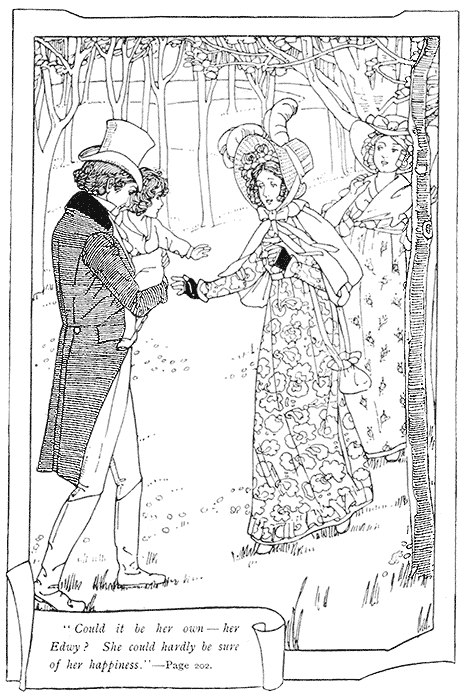
"Could it be her own—her Edwy? She could hardly be sure of her happiness."—Page 202.
"This story is too short," said Henry; "I wish it had been twice as long; I want to hear more of that little boy and of the gipsies."
"It is getting very hot," said Emily, when they had done talking; "let us go into the house, and we will not come out again until it is cool. I hope we shall not be naughty to-day, Henry, but do what papa and mamma will think right."
"Come, then," replied Henry. And they went back to the house and spent the rest of the morning in their play-room: and I am sure that they were very happy in a quiet way, for Henry was making a grotto of moss and shells, fixed on a board with paste; and Emily was just beginning to make a little hermit to be in the grotto, till they both changed their minds a little, and turned the grotto into a gipsy's hut, and instead of a hermit an old woman was made to stand at the door.
Further Story of a Holiday
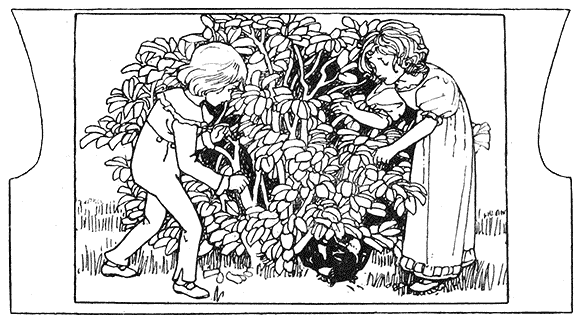
The evening was very cool and pleasant, when Emily and Henry went out to play. Mary Bush had given Henry a young magpie; she had taught it to say a few words, to the great delight of the children. It could say, "Good morning!" "How do you do?" "Oh, pretty Mag!" "Mag's a hungry." "Give Mag her dinner." "A bit of meat for poor Mag." To be sure the bird's words did not come out very clearly. But it was quite enough, as Henry said, if he understood them.
Mag had a large wicker cage, which generally hung up on a nail in the kitchen; but her master, being very fond of her company, used often to take the cage down, with the bird in it, and take it into his play-room or his hut, or hang it upon the bough of a tree before the parlour window, that Mag might enjoy the fresh air. Sometimes, too, Henry let the bird out, that she might enjoy herself a little, for as the feathers of one of her wings were cut close, she could not fly; and she was very tame, and never
"Let us take Mag with us out of doors," said Henry; and the cage was taken down and carried out between the two children, whilst Mag kept chattering all the way, and was, if anything, more pert and brisk than spoiled magpies generally are. They first went to the hut, and set the cage on the bench, whilst Henry and Emily busied themselves in putting a few things to rights about the place, which had been set wrong by a hard shower which had happened the night before. There were a few fallen leaves which had blown into the hut from some laurels growing on the outside; and Henry said:
"I do hate laurels; for they are always untidy, and scattering about their yellow leaves when all the trees about them are in their best order."
Whilst the children were going in and out after these leaves, to pick them up and throw them out of sight, Mag kept hopping from one perch to another, wriggling her tail, twisting her head to one side and another, and crying, "Oh, pretty Mag!" "Mag's a hungry," in a voice more like scolding than anything else.
"What now, mistress?" said Henry.
"She is not in the best possible temper," replied Emily.
"She wants to be out," answered Henry; "she does not like to be shut up."
"But," said Emily, "it would be dangerous to let her out here, so far from the house, and amongst the trees."
Henry was in a humour common not only to small but great boys on occasions. He chose, just then, to think himself wiser than his sister, and, without another word,
And first she strutted round the inside of the hut, crying, "Oh, pretty Mag!" with a vast deal of importance, and then she walked out at the entrance, trailing her tail after her, like a lady in a silk gown.
"She will get amongst the shrubs," said Emily; "and how shall we get her out of them?"
"Never fear," returned Henry; "you know that she cannot fly."
One would have thought that the bird knew what they said, for whilst they spoke, she laid her head on one side, as if turning an ear—stood still a minute, and then paraded onwards—I say paraded, for if she had been walking at a coronation she could not have taken more state upon herself.
"Let us see which way she goes," said Henry.
And the two children walked after her; Emily bringing the light wicker cage with her.
Mag knew as well that they were after her as if she had been what the country people call a Christian, meaning a human creature. And she walked on, not taking to the shrubs, which grew thick about the hut, but along a bit of grass-plot, at the farthest end of which was a row of laurels and other evergreens. These trees hid the back yard of the house from the garden and small portion of land near to it, which Mr. Fairchild had given up to flowering shrubs and ornamental trees.
Behind these evergreens was a row of palings, and as Mag drew near to these laurels, Henry ran forward, crying:
"She will get through the palings, if we don't mind, and into the yard."
Mag let him come near to her, and then gave a long hop, standing still till he was only at arm's length from her. Then she gave a second hop, alighting under a branch of laurel; and when Henry rushed forward to catch her there, she made another spring, and was hidden among the leaves.
"Stop! stop!" cried Henry, "stop there, Emily, where you are; and I will run round and drive her back; and you must be ready to catch her." And away he ran to the nearest wicket, and was on the other side of the laurels and the paling, in the fold-yard, not a minute afterwards.
Emily heard him making a noise on the opposite side of the shrubs, as if he thought Mag was between him and his sister, among the laurels; and he called also to her, bidding her to be ready when the bird appeared.
Emily watched and watched, but no bird came out; and not a minute afterwards she heard Henry cry:
"O there! there! I see her going across the yard towards the barn! Come round! leave the cage! come quickly, Emily!"
She obeyed the call in an instant; down went the cage on the grass. She was at the wicket and in the fold-yard in a minute, and there she saw Mag pacing along the yard, in her coronation step, towards the barn, being, to all appearance, in no manner of hurry, and seeming to be quite unconscious of the near neighbourhood of her master and his sister.
"Hush, hush!" whispered Henry; "don't make a noise." And the two children trod softly and slowly towards the side of the yard where the bird was, as if they had been treading on eggs or groping through the dark and afraid of a post at every step. They thought that Maggy was not conscious of their approach; though Emily did not quite
Once again Henry was at arm's length from her, and had even extended himself as far forward as he could, and stretched out his hand to catch her, when his foot slipped, and down he came at full length in the dust. At the same instant Maggy made a hop, and turned to look back at Henry from the very lowest edge of the thatch of the barn, or rather of a place where the roof of the barn was extended downwards over a low wood-house.
Henry was up in a minute, not heeding the thick brown powder with which his face and hands and pinafore were covered; and Emily had scarcely come up to the place where he had fallen, before he was endeavouring to catch at the bird on the low ledge to which she had hopped.
But Maggy had no mind to be thus caught; she had gotten her liberty, and she was disposed to keep it a little longer; and when she saw the hand near her, she made another hop, and appeared higher up on the slanting thatch.
After some little talking over the matter, Henry proposed getting up the thatch; and how he managed to persuade Emily to do the same, or whether she did not want much persuasion, is not known; but this is very certain, that they both soon climbed upon this thatch, having found a ladder in the yard, which John used in some of his work, and having set it against the wood-house, and from the top of the wood-house made their way to the roof of the barn.
"Now we shall have her!" cried Henry, as he made his way on his hands and knees along the sloping thatch; and again his hand was stretched out to seize the bird, when she made another upward hop, and was as far off as she
"What a tiresome creature!" cried Henry.
"I am sure she does it on purpose," said Emily, "only to vex us; and there she sits looking down upon us, and crying, 'Oh, pretty Mag!' I knew, when she was in the hut, that she was in a wicked humour."
"Let us sit down here a little," said Henry, "and seem not to be thinking about her. Let us seem to be looking another way; perhaps she will then come near to us of her own accord."
"We will try," replied Emily. And the children seated themselves quietly on the thatch; and if they had not been uneasy about the magpie, would never have been better pleased with their seats.
But it might seem that Mag did not choose to be thus passed over, and not to have her friends busy and troubled about her; for as soon as Emily and Henry had planned not to notice her, and to seem to look another way, she began to cry in her usual croaking voice, "How do you do, sir? Good morning, sir! Oh, pretty Mag! Mag's hungry!"
"What a tiresome bird it is," said Henry, impatiently. And Emily began to coax and invite her to come near, holding out her hand as if she had something in it.
Mag was not a bit behind in returning Emily's empty compliments, for she hopped towards her, and very nearly within reach of her hand, still crying, "Good morning! Oh, pretty Mag!"
Emily now thought she had her, and was putting out her arm to catch her when the bird turned swiftly round, and hopping up the thatch, took her station on the very point of the roof.
Henry lost no time, but, turning on his hands and knees,
She waited at a respectful distance till Emily came up; and then, between walking and hopping, made her way across the field, and perched herself on the upper bar of a gate.
The children were now in serious trouble, because they were not suffered, when alone, to go beyond the bounds of the next field.
Beyond the second field was the lane, into which they had followed the pig on that unfortunate day in which they had been left under the care of John; and if the magpie should go over into this lane, what could they do? They did wish to obey their parents this day.
In order, however, to prevent this misfortune, Henry did the very worst thing he possibly could; he began to run and cry, "Mag! Mag!" with a raised voice, whilst the bird, as if resolved to torment him, hopped forward across the other field, perched herself on the stile, and, as he drew near, flew right down from thence into the lane.
When Emily came up, there was poor Henry sitting across the stile in the greatest possible trouble, being more than half tempted to break bounds, and yet feeling that he ought not to do it. And there was Mag, walking up and down, pecking and picking, and wagging her tail; and now
It is often by very small things that the strength of our resolutions to be good is tested.
Henry was hardly tried, yet strength was given him to resist the temptation; and by Emily's persuasion he was induced to wait a little before he ventured to go down into the lane. And Mag seemed as well content to wait, or rather more so than he was.
The children were in hopes that some one might come by who would help them in their distress. And they had not waited a minute before they could see two children just coming in sight, at the very farthest point where the lane was visible from the stile.
These children were—a very ragged boy, without shoes, stockings, or hat, about nine or ten years of age, and a little girl, worse clothed, if possible, than himself, for her petticoat was all in fringes, showing her little legs above the ankle; they both looked miserably thin. Mag waited saucily till these had come nearly opposite the stile, and then only stepped aside; whilst Henry, calling to the boy, told him his trouble, pointing out the bird to him, and asking his help.
The boy looked towards the bird, and then, turning cheerfully to Henry, he said:
"Never fear, master, but I'll catch her for you;" and, dropping the hand of the little girl, he pulled off his ragged jacket, and crept towards Maggy.
Cunning as the creature was, she did not understand that she had a deeper hand to deal with than that of her young master. She therefore let the boy come as near to her as she had let Henry do many times during the chase, and in this way she gave him the opportunity he was seek
"He has her!" cried Emily and Henry at once, and the ragged little girl set up quite a shriek of joy.
"Yes, I has her," added the boy; "but she pulls desperate hard, and would bite me, if she could, through the cloth. Suppose I wraps her in it, and carries her home for you, for we must not let her loose again. Hark! how she skirls, master and miss!"
Henry and Emily approved of this scheme; the boy kept Maggy in the folds of the old jacket, and Emily helped the little girl to get over the stile; and the four children walked quickly towards the house. When they had crossed the two fields, Emily ran forward to fetch the cage, and the boy managed to get Mag into it without getting his fingers bit; after which Henry and Emily had leisure to ask the boy who he was, for they had never seen him before.
He told them that his name was Edward, and that his little sister was called Jane, and that they had no father or mother, but lived with their grandmother in a cottage on the common, just by Sir Charles Noble's park; and that their grandmother was very bad, and could not work, but lay sick in bed; and that they were all half-starved, and he was come out to beg—"Miss and Master," added the boy, "for we could not starve, nor see granny dying of hunger."
What a sad thing it is that stories of this kind are often told to deceive people, and get money out of them on false pretences! But Emily and Henry saw how thin and ragged these poor children were, and Emily thought of a plan of giving them a supper without taking what they gave from her father. So she proposed her scheme to Henry, and he said:
"That will just do; I did not think of it."
Emily then said to the children:
"Sit down here; we will take naughty Mag into the house, and come back to you;" and she and Henry were off in a minute. They ran in to Betty, and asked her what she had for their supper. Betty was shelling peas in the kitchen, and she told them that she was going to cook them for her master and mistress; and she said:
"I suppose, Miss Emily, you and your brother will sup with your parents to-night."
"But, if you please, we would rather have our supper now," said Emily.
"That we would," cried Henry; "so please, Betty, do give us something now."
"Then you must not have a second supper, Master Henry," said Betty, "if I give you something to eat now."
"Very well, Betty," replied both children at once; "but we would like it now, instead of waiting later for papa and mamma."
So Betty gave each a currant turnover or puff, and a slice of bread and some milk.
"May we take our supper out of doors, Betty?" said Emily.
"If you please," replied Betty; and she put the turnovers, as she called the puffs, into a little basket, with two large slices of bread and two cans of milk, and put the basket into Emily's hands.
"You have made beautiful ears and eyes to the turnovers, Betty," said Henry; "I always call them pigs when they are made in that way."
"And they taste much better, don't they, Master Henry?" asked Betty.
"To be sure they do," answered Henry, and away he walked after his sister.
So Emily and Henry gave their supper to the little children; and they were very much pleased with them, because, when they had eaten part of the bread and drunk the milk, they asked leave to take what was left home to their grandmother.
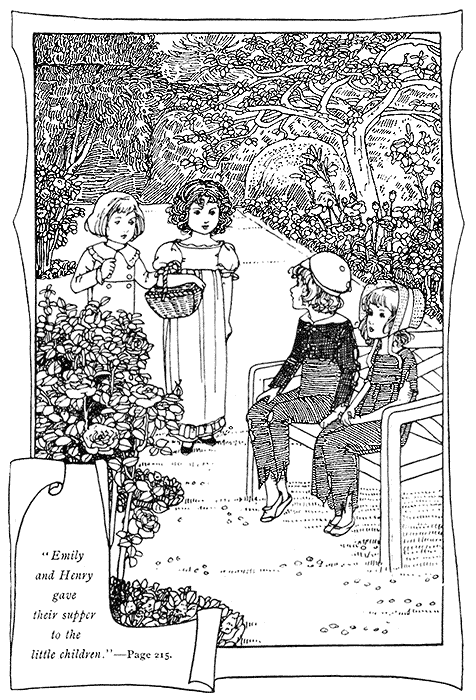
"Emily and Henry gave their supper to the little children."—Page 215.
Emily fetched them a piece of paper to wrap the puffs in, and then she and Henry watched them back into the lane, and afterwards walked quietly home, to be ready when their parents and Lucy should come back.
"The magpie on the stile."—Page 209.
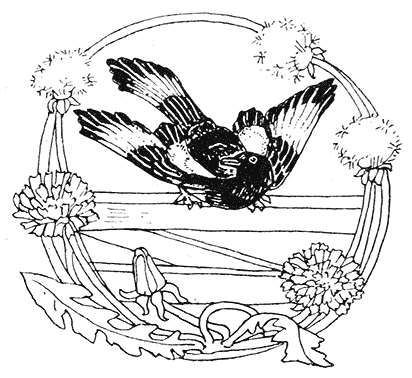
The Happy Evening
Henry had just finished washing his hands and combing his hair, and Emily had only that minute changed her pinafore, when the distant sound of the carriage was heard.
Betty was preparing the peas for supper, and John laid the cloth, when Henry and Emily ran out upon the lawn.
What a happy moment was that when the carriage stopped at the gate, and John opened the door and let down the step, and Lucy jumped out and ran to meet Emily and Henry. One would have thought that the children had been parted a year instead of a day.