Part 1 — The Story in Emily's Book. Part I.
Reading edition
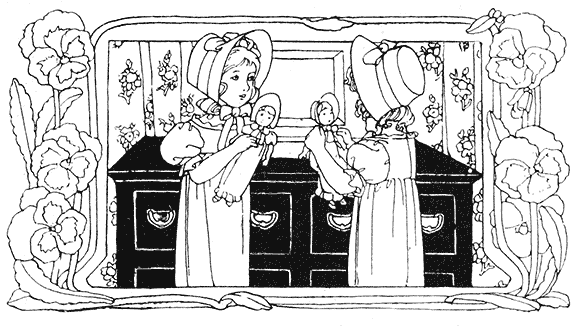
The little books brought by Lucy were not even looked at until the evening came which was to be given up to reading the first of them. Henry had begged that his book might be read last, because he said that he should be sure to like it best; so Emily's was to afford the amusement for the first evening.
Mr. Fairchild gave notice in the morning of his being able to give up that evening to this pleasure; not that he wished to hear the story, but that he meant to be of the party, and the root-house in the wood was the place chosen.
Lucy and Emily had now each a doll to take, and there was some bustle to get them ready after lessons.
Henry took his knife and some little bits of wood to cut and carve whilst the reading was going on; Mrs. Fairchild took her needlework; and there was a basket containing nice white cakes of bread made for the purpose, a little fruit, a bottle of milk, and a cup. The little ones, by
When they all got to the hut they were soon all settled. There were seats in the hut; Henry took the lowest of them. Mrs. Fairchild took out her work; Mr. Fairchild stretched himself on the grass, within sight of his family. Emily and Lucy were to read by turns, and Lucy was to begin. She laid her pretty doll across her lap, and thus she began:
The Story in Emily's Book
"On the borders of Switzerland, towards the north, is a range of hills, of various heights, called the Hartsfells, or, in English, the Hills of the Deer. These hills are not very high for that country, though in England they would be called mountains. In winter they were indeed covered with snow, but in summer all this snow disappeared, being gradually melted, and coming down in beautiful cascades from the heights into the valleys, and so passing away to one or other of the many lakes which were in the neighbourhood.
"The tops of some of the Hartsfells were crowned with ragged rocks, which looked, at a distance, like old towers and walls and battlements; and the sides of these more rocky hills were steep and stony and difficult. Others of these hills sloped gently towards the plain below, and were covered with a fine green sward in the summer—so fine and soft, indeed, that the little children from the villages in the valleys used to climb up to them in order to have the pleasure of rolling down them.
"These greener hills were also adorned with large and beautiful trees under which the shepherds sat when they drove their flocks up on the mountain pastures, called in that country the Alps, to fatten on the short fine grass and sweet herbs, which grew there in the summer-time.
"Then the flowers—who can count the numbers and varieties of the flowers which grew on those hills, and which budded and bloomed through all the lovely months of spring, of summer, and of autumn? Sometimes the shepherds, as they sat in the shade watching their sheep, would play sweet tunes on their pipes and flutes, for a shepherd who could not use a flute was thought little of in those hills. It was sweet to hear those pipes and flutes from a little distance, when all was quiet among the hills, excepting the ever restless and ever dancing waters. There were many villages among the hills, each village having a valley to itself; but there is only one of these of which this story speaks.
"It was called Hartsberg, or the Town of the Deer, and was situated in one of the fairest valleys of the Hartsfells. The valley was accounted to be the fairest, because there was the finest cascade belonging to those hills rushing and roaring at the very farthest point of the valley; and the groves, too, on each side of the valley were very grand and old.
"The village itself was built in the Swiss fashion, chiefly of wood, with roofs of wooden tiles, called shingles; and many of them had covered galleries round the first floor. The only house much better than the others was the Protestant pastor's, though this was not much more than a large cottage, but it stood in a very neat garden.
"There were a few, but a very few, houses separate from this village itself, built on the sides of the hills; and those belonged to peasants, or small farmers.
"In the summer-time strangers sometimes came from a
"Most of the inhabitants of the village were Protestants, but there were a few Roman Catholics, and these had a priest, an elderly man, who was a great friend of Heister Kamp, and might often be seen in her kitchen, talking over with her the affairs of the village. He was called Father St. Goar, and he had a small chapel, and a little bit of a house attached to it. His chapel was less than the Protestant church, but it looked far more grand within, for there was an altar dressed with artificial flowers, and burnished brass candlesticks, and over it waxen figures of the Virgin Mary and her Child, in very gaudy though tarnished dresses.
"And now, having described the place, and some of the people, there is nothing to hinder the story from going on to something more amusing.
"On the right hand of the great waterfall, and perched high on the hill, was an old house standing in a very lovely and fruitful garden; the garden faced the south, and was sheltered from the north and east winds by a grove of ancient trees.
"The garden abounded with fruit and flowers and vegetables, and there were also many bee-hives; behind the house were several sheds and other buildings, and a pen for sheep.
"This house was the property of a family which had resided there longer than the history of the village could tell. The name was Stolberg, and the family, though they had never been rich, had never sought help from others, and were highly respected by all who knew them.
"At the time of this history the household consisted of the venerable mother, Monique Stolberg, her son Martin, a widower, and the three children of Martin; Ella, Jacques, and Margot.
"Ella was not yet fourteen; she was a tall girl of her age, and had been brought up with the greatest care by her grandmother, though made to put her hand to everything required in her station. Ella was spoken of as the best-behaved, most modest, and altogether the finest and fairest of all the girls in the valley.
"Heister Kamp said that she was as proud and lofty as the eagle of the hills. But Ella was not proud; she was only modest and retiring, and said little to strangers.
"Jacques was some years younger than Ella; he loved his parents and sisters, and would do anything for them in his power; but he was hot and hasty, especially to those he did not love.
"Margot was still a little plump, smiling, chattering, child, almost a baby in her ways; but everyone loved her, for she was as a pet lamb, under the eye of the shepherd.
"Monique had received her, before she could walk, from her dying mother, and she had reared her with the tenderest care.
"As to Martin, more need not be said of him but that the wish to please God was ever present with him. He had been the best of sons; and, when his wife died, he was rewarded for his filial piety by the care which his mother took of his children and his house.
"Monique had had one other child besides Martin; a daughter, who had married and gone over the hills with her husband into France; but her marriage had proved unfortunate. She had resided at Vienne, in the south of France, and there she had left one child, Meeta, a girl of about the age of Ella.
"When Martin heard of the death of his sister, and the forlorn state of the orphan, he set himself to go to Vienne; it was winter-time, and he rode to the place on a little mountain pony which he had; but he walked back nearly the whole way, having set Meeta, with her bundle, on the horse.
"Everyone at home was pleased with Meeta when she arrived, though Monique secretly wondered how she could be so merry when her parents were hardly cold in their graves. Meeta was not, however, cold-hearted, but she was thoughtless, and she enjoyed the change of scene, and was pleased with her newly-known relations and their manner of life.
"Little plump baby-like Margot was scarcely less formed in her mind than Meeta, though Meeta was as old as Ella: and of the two, Margot, as will be seen by-and-by, was more to be depended on than Meeta. Margot, when duly admonished on any point, could be prudent, but Meeta could not; yet Meeta was so merry, so obliging, and so good-humoured, that everyone in the cottage soon learned to love her; though some of them, and especially Monique, saw very clearly that there was much to be done to improve her and render her a steady character.
"She was quick, active, and ready to put her hand to assist in anything; but she had no perseverance; she got tired of every job before it was half done, and she could do nothing without talking about it. As to religious prin
"During that time poor Martin Stolberg was much tried by several heavy losses amongst his live stock: a fine cow and several sheep died, and when the poor man had replaced these, he said, with a sigh to his mother, that he must deny himself and his children everything which possibly could be spared, till better days came round again.
"His mother answered, with her usual quiet cheerfulness:
"'So be it, my son, and I doubt not but that all is right, for if everything went smooth in this world we should be apt to forget that we are strangers and pilgrims here, and that this is not our home.'
"When Monique told Ella what her father had said, the young girl got leave to go down to the village, and, when there, she went to Madame Eversil, the pastor's lady, and having told her of her father's difficulties, she asked her if she could point out any means by which she might get a little money to help in these difficulties.
"Monsieur Eversil, though a very simple man, was not so poor as many Swiss pastors are. He had no children, and his lady had had money. Madame wished to assist Ella, whom she much loved; but she rather hesitated before she said to her:
"'I have been accustomed to have my linen taken up to be washed and bleached upon the mountains every summer. The woman who did this for me is just gone out of the country; if you will do it, you will gain enough during the summer to make up for the loss of the cow. But are you not above such work as this, Ella? They say of you that you are proud—is this true?'
"The bright dark eyes of Ella filled with tears, and she looked down upon the polished floor of the parlour in which she was talking with Madame Eversil.
"'I know not, Madame,' she answered, 'whether I am proud or not, but I earnestly desire not to be so; and I thank you for your kind proposal, and as I am sure that I know my grandmother's mind, I accept it most joyfully.'
"It was then settled that Madame Eversil should send all the linen which had been used during the winter, to be washed and whitened and scented with sweet herbs, up to the hill as soon as the snow was cleared from the lower Alps. And Ella went gaily back to tell her grandmother and Meeta what she had done.
"They were both pleased; Meeta loved the thoughts of any new employment, and Monique promised her advice and assistance. Even Jacques, when he came in, said he thought he might help also in drawing water and spreading the linen on the grass.
"'And I,' said little Margot, 'can gather the flowers to lay upon the things—can't I, Ella?'
"So this matter was settled, and everyone in the family was pleased. The winter at length passed away: the cascades flowed freely from the melting snow; the wind blew softly from the south; the grass looked of the brightest, freshest green; and every brake was gay with flowers, amongst which none were more beautiful or abundant than
"Heister Kamp was quite set up by the honour of receiving so many noble persons in her house, and still more pleased in pocketing the silver she got from them.
"There was great benefit also to Father St. Goar from the coming of these strangers, for he never failed to drop in just about the time that the guests had finished their dinner, and was always invited to taste of any savoury dish which remained, to which Heister generally added a bottle of the ordinary wine of the country.
"Things were being carried on in this sort of way when, one morning in the beginning of June, Margot and Meeta and Jacques went higher up the hill towards the waterfall to gather sweet herbs and flowers to strew upon the linen that was spread on the sward before the cottage door.
"Margot could not reach the roses which grew above her head, so she busied herself in plucking the wild thyme and other lowly flowers which grew on either side of the path, putting them into her little basket and calling out from one moment to another:
"'See, Jacques! see, see, Meeta! see how pretty!'
"But Meeta and Jacques were too busy to attend to her, for Meeta had climbed on a huge piece which had fallen from the rock, and was throwing wreaths of roses to Jacques, who was gathering them up; but at length it was
"'Come, Jacques! come, Meeta!' she cried, 'I have found such a pretty little green fishing-net, all spotted with moons; and it has got rings, pretty gold rings; and there are yellow fish in it.' And she quite stamped with eagerness.
"'What does she say?' cried Meeta; 'little magpie, what is it?'
"'A pretty little net,' replied Margot, 'and fish in it, and moons and rings. Oh, come, come!'
"'She has found something strange,' said Jacques; 'I hope nothing that will hurt her.' And down he came tumbling, in his own active way, straight to his little sister, being quickly followed by Meeta.
"Margot was holding up what she had found, crying:
"'Pretty, pretty, pretty!' for it was quite bright and sparkling in the sun.
"'It is a purse!' said Jacques.
"'A green silk purse,' added Meeta, 'with gold spangles and tassels, and gold rings, and it is full of louis d'ors; give it to me, Margot.'
"'No, no, no!' cried the little girl; 'no, it is for grandmother; I shall take it to her.'
"'It is a valuable purse,' said Jacques; 'somebody has lost it; now grandmother will be rich! Let me see it, Margot; let me see what is in it.'
"'No, no, no!' cried the little one, clasping it in both her dimpled hands; 'you shall not have it! it is for grandmother.'
"'Only let me carry it to the door,' said Jacques, 'for fear you should drop anything out of it; and when you come to the door, I will put it into your own hands.'
"Jacques never said what was not true to Margot, and
"They supposed that no one had seen them when they were talking about the purse, but they were mistaken; Father St. Goar was not far off, though hidden from them by a part of the rock which projected between them.
"He heard Margot cry and talk of having found a net, and golden fish in it; but when Meeta and Jacques came near to the child, he could hear no more, because they spoke lower than before. He had heard enough, however; and when he went back to the village, he told Heister Kamp what he had seen, and made her more curious than himself to find out what it could be, though she felt pretty sure that it must be a purse of gold.
"How astonished was Monique when little Margot put the purse in her lap, for she was sitting at work just within the door.
"Meeta would not let Margot tell her own story, but raised her voice so high that Martin himself from one side, and Ella from another, came to see what could have happened. They came in just in time to see Monique empty the purse, and count the golden pieces. There were as many as fifteen on the one side of the purse, and on the other was a ring with a precious stone in it, and four pieces of paper curiously stamped. Martin Stolberg saw at once that these pieces of paper were worth many times the value of the gold, for he or any man might have changed them for ten pounds each.
"'Son,' said Monique, 'Margot found this near the waterfall; it must have been lost by some of the visitors; it is a wonder that we have heard of no one coming to look after it. What can we do with it?'
"'Buy a cow, father,' said Jacques.
"Martin Stolberg shook his head.
"'It is not ours, Jacques,' he said, 'though we have found it; we must keep it honestly for the owner, should he ever come to claim it.'
"'Father,' said Jacques, 'I was not thinking, or I hope I should not have said those words.'
"'I know you spoke hastily, Jacques,' replied Martin; and then having given Margot a few little pieces of copper money as reward for her giving up the little net to her grandmother, he took his venerable parent by the hand, and led her into an inner room, where they settled what was to be done with the purse.
"Martin said that the children must all be seriously enjoined never to mention the subject, because many dishonest persons might, if they could get at the description of the purse and its contents, come forward to claim it, and thus it might be lost to the real owner.
"'But,' he added, 'lest I should be tempted to use any of the money for myself, I will take the purse down to-morrow to the pastor's, and leave it in his care. Where it is, however, must not be known even to the children, lest we should bring inconvenience upon him. In the meantime, dear mother, do you stow the treasure safely away, and charge the young ones not to mention what we have found to anyone.'
"Martin then left the house; and Monique, going up to the room where she slept, and where the great family chest was kept, called all her grandchildren, and letting them see where she put the purse, she charged them, one and all, not to speak one word to any person out of the house about the treasure which had been found.
"'Why must not we, grandmother?' said Margot.
"'Because,' replied Monique, 'if any thieves were to hear that we had got so much money in the house, they
"'And perhaps they might kill us,' replied Margot, trembling all over.
"'We must not speak of it, then,' said Ella, 'to anyone.'
"'Our best way,' remarked Jacques, 'will be not to mention it to each other. We will never speak of it.'
"'How can we help it?' said Meeta; 'I can never help talking of what I am thinking about.'
"'That is a mistake of yours, Meeta,' said Monique; 'you never talk of some things which happened at Vienne, which you think would be no credit to you.'
"'You mean about our being so very poor, and being forced to sell our clothes, grandmother? I don't think that I should go to talk of that to strangers.'
"'Then you can keep some things to yourself, Meeta,' said Monique; 'and we shall not excuse you if you are so imprudent as to let out this affair of the treasure we have found to anyone.'
"'Don't fear me, grandmother,' returned Meeta; 'nobody shall hear from me—but we must watch little Margot.'
"That same evening, Martin Stolberg carried the purse and all the contents down to the house of the good pastor. He gave as his reason for so doing, that, being himself somewhat pressed for money, he did not dare to trust himself with this treasure."