Part 2 — The Story in Emily's Book. Part II. (continued 2)
Reading edition
Poor Bessy's fingers had never plied so quickly and so carefully before. They were put in motion by a feeling of the warmest gratitude and love for Mrs. Fairchild.
No punishment, no severity, could have produced the effect wrought by this well-timed kindness of Mrs. Fairchild; and it gave to her the sweetest hopes of poor Bessy, when she observed how strongly and deeply she felt that kindness.
They worked and talked till tea-time, and after tea they set to work again. Betty came up about seven o'clock with the crape and the bonnet, the plaitings of which—for it was a reeved bonnet—she had smoothed with a small Italian iron, and restored wonderfully. Then she sat down and sewed with Miss Bessy at the frock, whilst Mrs. Fairchild trimmed the bonnet.
At eight o'clock the work was got on so finely that Bessy cried out:
"Another half-hour, if they will but stay away, and it will be done; and oh, how I do thank you, dear Mrs. Fairchild, and dear Betty! I will really try in future to do better; I never wished to do better as I do now."
"There is an early moon, miss," said Betty; "I should not wonder if they stayed till it was up."
It struck nine, and they were not come; another five minutes and the work was finished. Bessy jumped up from the foot of the bed and kissed Mrs. Fairchild first, and then Betty; and then came a bustle to put everything away.
Mrs. Fairchild showed Bessy how to lay aside her bonnet in the bandbox, and her frock in a drawer, with a clean handkerchief over each. The tippet, which was the only one thing which had escaped mischief, for the plain reason that it had not been worn on the Sunday with the frock, was laid in the same drawer; and then the needles and silk and cotton were collected, and the bits and shreds picked up, and the room restored to order as if nothing wonderful had happened.
The last thing Mrs. Fairchild did in that room was to take up the gloves and give them to Betty, to see what could be done with them the next day, and then she, with the happy young girl, put on shawls and walked on the gravel before the house, for it was still hot.
"Well, we have had a happy, happy evening, dear Mrs. Fairchild," said Bessy; "I never thought I should love you so much."
The party did not come home till ten o'clock; they had had such an evening as Lucy and Emily had never known before; but they had often thought of poor Bessy, and wished for her many times, and their mother too. Mrs. Goodriche had also been uneasy about Bessy. How surprised, then, they were to see her looking so cheerful, and Mrs. Fairchild also seeming to be equally happy.
"I will tell you all about it when we get to our room, aunt," whispered Bessy; "but I do not deserve such kindness. Mrs. Fairchild says I had better not speak about it now."
They had had tea and a handsome supper; so when they had talked the evening over, and Mr. Fairchild had read a chapter, they all went to their rooms.
The History of Little Bernard Low
The rest of Mrs. Goodriche's visit passed off very quietly and very pleasantly. Bessy became from day to day more manageable, and Lucy and Emily began to love her very much.
Mrs. Goodriche was inquiring everywhere for a house close by, and there was none which seemed as if it could be made to suit her. She and Bessy returned home therefore at the end of a fortnight, and Bessy was very sorry to leave her young friends.
It was four or five days after Mrs. Goodriche had left them before Mr. Fairchild proposed that they should read that famous book which Henry talked so much about.
"But where shall we go to read it?" he asked.
"Oh! to the hut in the wood, papa, if you please," answered Lucy; and in less than an hour everybody was ready to set out: and when everybody was seated as they had been the time before, the book was opened, and Lucy waited to read only till Henry and Emily had seen the picture at the beginning. I will tell you what the picture was when we come to the place of it in the story.
The History of Little Bernard Low
THE STORY IN HENRY'S BOOK
"Mr. Low was a clergyman, and had a good living in that part of this country where the hills of Wales extend towards the plains of England, forming sweet valleys, often covered with woods, and rendered fruitful and beautiful by rills which have their sources in the distant hills.
"
"The name of the valley in which Mr. Low's living was situated was Rookdale; his own house stood alone amongst woods and waterfalls, but there was a village nearer to the mouth of the valley, and in that village, besides some farmers and many cottagers, lived another clergyman of the name of Evans. He was a worthy humble man, and came from the very wildest parts of Wales. He was a needy man, and was forced to work hard to get a decent living for himself, his sister, Miss Grizzy Evans, and an orphan nephew, Stephen Poppleton. Mr. Low gave him fifty pounds a year to help him in the care of his parish, which spread far and wide over the high grounds which surrounded Rookdale; and he added something to his gains by teaching the children of the farmers in the parish, and by taking in two or three boys as boarders; he could not take many, because his house was small and inconvenient. We shall know more of Mr. Evans when we have read the few next pages.
"Mr. Low's living was a very good one, and brought in much money. The house too was good, and he kept
"When Bernard was born, it seemed as if no one could make too much of him. The old woman, Susan Berkley, who had been Mr. Low's own nurse, and had always lived in the family, was so fond of Bernard that she could not refuse him anything; and Mrs. Low was what people call so wrapped up in her boy, that she could never make enough of him. In this respect she was very weak, but those who have lost children well know how strong the temptation is to over-indulge those who are left. At first Mr. Low did not observe how far these plans of indulgence were being carried; indeed, he did not open his eyes fully to the mischief till Bernard was become one of the most troublesome, selfish boys in the whole valley. At five years old he was the torment of the whole house, though even then he was cunning enough to hide some of his worst tempers from his father. He had found out that when he pretended to be ill, mother, nurse, and sister were all frightened out of their senses, and that at such times he could get his way in everything, however improper. He did not care what pain he gave them if he could get what he wanted.
"His father, however, did at length find out the mischief that was going on; and as he feared that his wife and nurse would not have the firmness to check the boy if he remained always at home, he proposed that Bernard should be sent as a day boarder to Mr. Evans.
"'I have been much to blame,' said Mr. Low, 'in not speaking before of the way in which Bernard has been managed. I blame myself greatly for this neglect, and I now feel that no more time must be lost; and I think it will be easier for us to part with him for a few hours every day, than to send him to a distance.'
"Mrs. Low was a gentle person, and wished to do right; she shed tears, but made no resistance. Lucilla thought that her papa was right; she had lately seen how naughty Bernard was getting; so Mr. Low had no opposition either from his wife or daughter. When nurse, however, was told that her darling was to go to school to Parson Evans, she was very angry; and though she did not dare to speak her mind to her master, she had no fear of telling it to her mistress and the young lady.
"'Well, to be sure,' she said, 'master has curious notions, to think of sending such a delicate babe as Master Bernard to be kicked about by a parcel of boys, and to be made to eat anything that's set before him, whether he likes it or not. So good a child as he is too: so meek and so tender, that if he but suspects a cross word, he is ready to jump out of himself, and falls a-crying and quaking, and won't be appeased anyhow, till the fit's over with him. Indeed, mistress, if you give him up in this point, I won't say what the consequences may be.'
"'But, nurse,' said Lucilla, 'really Bernard does want to be kept a little in order.'
"'And that from you, Miss?' answered the nurse; 'what would you feel, was you to see him laid in his grave beside his precious little brothers?'
"Lucilla could not answer this question, and Mrs. Low could not speak for weeping; so nurse was left to say all
"On hearing this, Bernard thought it a proper occasion to show off his meek spirit, and so much noise did he make, and so rebellious and stubborn was his behaviour, that his father, who heard him from a distance, made up his mind to go that very evening to speak about him to Mr. Evans. Mr. Low did not find the worthy man at home; he had walked out with his nephew and three boys who boarded in the house; but Mr. Low found Miss Evans in a small parlour, dressed, as she always was in an evening, with some pretensions to fashion and smartness: she was very busy with a huge basket of stockings, which she was mending.
"When Mr. Low told her his business, she was quite delighted, for she had lived in that humble village till she thought Mr. Low one of the greatest men in the world, because she never saw any greater. She answered for her brother that he would receive Master Bernard and give him every care; 'and for me, sir,' she added, 'I promise you that the young gentleman shall have the best of everything our poor table will afford.'
"'I wish,' replied Mr. Low, 'that he may be treated exactly as the other boys, my good madam, and no bustle whatever made with him.'
"Soon after Mr. Low was gone, Mr. Evans and his nephew, and three pupils, passed the parlour window. Miss Grizzy tapped on the glass, and beckoned to her brother to come to her, which he did, immediately followed by his nephew.
"'Who do you think has been here, brother, whilst you have been out?' said she; 'who but Mr. Low?' and she
"'Very good, sister,' replied Mr. Evans, 'all is well;' and he went out again at the parlour door, seeming to be much pleased. Stephen remained behind, and the moment the door was shut, he said:
"'You seem to be much set up, Aunt Grizzy, at the thought of this boy's coming; you must know, surely, that he is a shocking spoiled child, and that there will be no possibility of pleasing him.'
"'We must try, however,' answered Miss Evans; 'I know, as well as you can do, what he is, a little proud, petted, selfish thing: for is he not the talk of the parish? I have often wondered how Mr. Low could have been so long blind to the need of sending him to school; but then think, nephew, Mr. Low offers as much as if the boy boarded here entirely, and he is only to dine; and I doubt not but that there will be pretty presents too—you know that both Mr. and Mrs. Low are very thoughtful in that way.'
"'But if you can't keep the little plague in good humour,' answered Stephen, 'instead of presents we may have disputes and quarrels; and where will you be then, aunt?'
"'I hope, Stephen, that you will not be creating these quarrels; that you will bear and forbear, and pay Master Low proper respect, and see that Meekin and Griffith and Price do the same: you know well that not one of them are of such high families as Master Low.'
"'You had best not say that to Griffith, aunt,' answered Stephen; 'he has a very high notion, I can tell you, of his family, though his father is only a shopkeeper.'
"Miss Evans put up her lip and said:
"'Well, mind me, Stephen, no quarrelling, I say, with
"When nurse had said all that was in her mind, she became more calm upon the subject of Bernard's going to school; and so thoroughly did the child tease during the few days that passed before he went, that she was almost obliged to confess to herself that it was not altogether a very bad thing that he was to have lessons to learn, and some employment from home during part of every day.
"But when Bernard was actually to go, there was such a to-do about it, that he might just as well have stayed at home, as to any good which might be expected from it in the way of making him think less of himself.
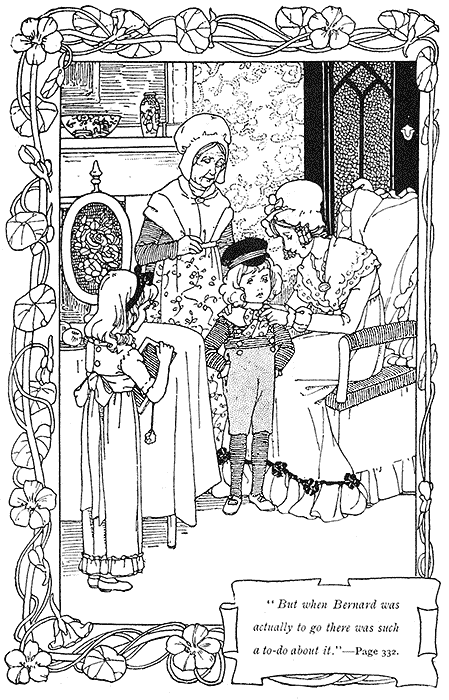
"But when Bernard was actually to go there was such a to-do about it."—Page 332.
"Lucilla had had a little pony for several years; this pony was to be saddled for Bernard, and he was to ride to and from school, whilst a servant attended him. His mother took the occasion to send a present of fruit and nice vegetables by this servant to Miss Grizzy; and there was a note written to Mr. Evans all about Bernard, and a great deal said in it about getting his feet wet; and shoes were sent that he might change them when he came in from play. Nurse also was sent down about two hours after him, with some messages to Miss Evans and to hear how the darling got on.
"Bernard was very sulky all that first morning. He was quite eight years old; Mr. Evans therefore was much surprised at his being a very poor reader. Indeed he could not in any way stammer out the first chapter in the Bible, and Mr. Evans was obliged to put him into the spelling-book at the first page. He called him up between each Latin lesson he gave, but found that each time he called him, he read rather worse than the time before. The simple truth is that he did not choose to do better.
"Griffith whispered to Meekin, the last time Bernard was up, 'Mind what I say, he is no better than a fool;' and Meekin passed the same words to Price, and then it was a settled thing with these three boys, that Bernard Low was a fool, and a very proper person to play any fun upon.
"But whilst these boys were settling this matter amongst them, Miss Grizzy had sent for Stephen into the parlour, and given him some of the fine pears and walnuts which Mrs. Low had sent.
"'Here, nephew,' she said, 'is the earnest of many more little presents which we may expect; but everything depends on your behaviour to the boy. We must keep him in good humour—we must show him every possible favour in a quiet way, and you must not let Griffith and the others tease him.'
"'This is an uncommon good pear,' said Stephen, as he bit a great piece out of one of them.
"'Is it not?' replied his aunt; 'but, Stephen, do you hear me? you must not let Griffith be playing his tricks on Master Low.'
"'I understand,' answered Stephen, taking another bite at the pear. 'Don't you think I know on which side my bread is buttered yet, aunt?' he asked; 'though I am near fifteen years of age, and half through Homer? but you must allow that Bernard Low is an abominably disagreeable fellow, and one that one should like to duck in a horse-pond—a whining, puling, mother-spoiled brat; however, I will see that he shan't be quizzed to his face, and I suppose that's all you require, is not it?'
"So he put all that remained of what his aunt had given him of the fruit into his pocket, for himself, and left the room. He went straight to the yard where the boys played, and scarcely got there in time to hinder Griffith
"Bernard was already beginning to whine and put his finger in his eye, when Stephen came in and called out:
"'Eh, what's that there? David Griffith, let the child alone; he has not been used to your horseplay.'
"And as Stephen was much bigger and stronger than the other boys, they all thought it best to give way.
"Bernard was let off, and he walked away, not in the best of tempers, into the house, and into Miss Evans's own parlour, where she was seated at her usual employment, darning stockings.
"'Well, Master Low,' she said, 'I hope you find everything agreeable; I am sure it shall not be my fault if you do not; you have only to say the word and anything you don't like shall be changed, if it is in my power.'
"'I don't like that boy,' answered Bernard; 'that David Griffith.'
"'Never mind him, never mind him, Master Low,' replied Miss Evans; 'any time that he don't make himself agreeable, only come to me; I am always glad to see you here to sit in my parlour, and warm yourself if it is cold. You know how much I respect your papa and mamma; there is nothing I would not do for them.'
"Bernard had been so much used to flattery and fond words, that he did not value them at all; he thought that they were only his due; and he did not so much as say 'Thank you' to Miss Evans, nor even look smiling nor pleasant; but he walked up to her round table, and
"'My brother's, Master Low,' she answered.
"'Does he wear such things as those?' said Bernard; 'but I suppose he must, because he is poor, and a curate, and a schoolmaster—my papa wears silk.'
"'Your papa,' said Miss Evans, 'is a rich man, Master Low, and a rector; and he can afford many things we must not think of.'
"'When shall we dine?' asked the boy.
"'Very soon, my dear,' answered Miss Evans.
"And then Master Bernard turned off to some other question, as impertinently expressed as those he had put before.
"The dinner was set out in the room used for a schoolroom; an ill-shaped room, with walls that had been washed with salmon colour, but which were all scratched and inked. Each boy had a stool to sit upon; the cloth was coarse, though clean, and all the things set upon the table were coarse also.
"When called to dinner by a rough maidservant, Miss Evans led Bernard in by the hand, and set him by herself on a chair at the head of the table.
"'Sister,' said Mr. Evans, in a low voice, 'last come, last served—Master Low should sit below Price.'
"'Leave me to judge for myself, brother,' answered Miss Evans; 'you may depend on my judgment.'
"And Bernard kept his seat, and had the nicest bits placed on his plate.
"Bernard would have been quite as well contented, or, perhaps we may say, not in the least more discontented, had he been set down at once in his proper place, and served after the other boys.
"Then the other boys were not quite pleased; but
"Many a trick would they have played him, no doubt, if Stephen had not watched them. But as Stephen hated the spoiled child as much as they did, he never hindered their speaking ill of him, and quizzing him, when he did not hear or understand.
"Griffith soon gave him a nickname—this name was Noddy; there was no wit in it, but the boys found great amusement in talking of this Noddy, and of all his faults and follies, before the face of Bernard himself. When he asked who this Noddy was, they told him that they were sure he must have seen him very often, for his family lived at Rookdale.
"Mr. Evans himself was the only person in the family at school who really strove to do his duty by Bernard—he gave his heart to improve him; and he did get him on in his learning more than might have been expected. But there were too many things against the poor child to make it possible for him to improve his temper and his character.
"He went to school from the autumn until Christmas: at Christmas he was at home for a month, and made even his nurse long for the end of the holidays; and then he went again after the holidays, and continued to go every day till the spring appeared again. There was no intention then of changing the plan, though Mr. Low was not at all satisfied with him.
"Bernard was now become so cunning that he did not show the worst of his tempers before his father, nor even before his mother; but to his sister he appeared just as he
"Lucilla was one of those young people who love God and all their fellow-creatures, and desire to do them good. She had always loved Bernard, and she loved him still, though she saw him getting more and more naughty from day to day. She believed, however, that he still loved her as well as he could love any person besides himself, and she thought a long time of some way which she might take to make him sensible of his faults.
"During that winter she had often spoken to him in her kind and gentle way, and shown him the certain end of evil behaviour; but she felt that he paid no more attention to her than he would have done to the buzzing of a fly; but now that the spring was come, and they could get out together into the fields and gardens and woods, before and after school-time, and on half-holidays, she thought she might have a better chance with him, and she formed a thousand plans for making the time they might thus pass together pleasant, before she could hit upon one which she thought might do.
"In a shadowy and sweet nook of the garden was an artificial piece of rock-work, which her mother, when first married, had caused to be made there, the fragments of rock having been brought from a little distance. There Lucilla, with the gardener's assistance, scooped a hollow place, a few feet square, and arranged a pretty little hermitage: dressing a doll like an old man, and painting a piece of glass to fix in the back of the hermitage, to look like the window of a chapel. She next sent and bought a few common tools, and thought, as Bernard was very fond of clipping and cutting, she could tempt him to work to help finish this hermitage. There was a root-house close to the place, where she thought they might
"Mr. Evans always gave a week's holiday at Whitsuntide, and Lucilla thought that this should be her time for trying what she could do with Bernard."
Second Part of the History of Little Bernard Low
SECOND PART OF HENRY'S STORY
"Meekin and Griffith and Price went home to spend the Whitsun holidays on the Saturday evening, and Bernard came home also, with the expectation of an idle time, which was to last till the Monday after the next.
"The weather was very fine; all the early shrubs and flowers were in bloom, the cuckoo was still in the woods, and the leaves had not lost their tender young green.
"The young men in Rookdale were very fond of ringing the bells when there was a holiday, and they rang away great part of Sunday and of Monday also.
"The bells were soft and sweet, though rather sad; but the lads in the belfry found nothing sad in pulling at the ropes, and going up and down with them.
"Lucilla missed Bernard during several hours of the Sunday; she did not guess that he had gone into the belfry with the young men, and that he had persuaded the cook to give him a jug of beer to send to them. The
"The Monday morning was as bright as the Sunday had been, and it was enough to make the old young again to hear the man who was mowing the lawn whetting his scythe whilst the dew was on the grass, and the various songs of the birds in the trees.
"Lucilla had fixed upon this day to show Bernard the hermitage; but she was rather put out, when she came down to breakfast, to see that there was a very sulky flush on his cheeks, and that he was complaining of his father to his mother, whilst his father was not in the room.
"'Now, mamma,' said Bernard, 'do ask papa; it's a holiday, and a fine day, and I want to go. And why can't I go? Papa is so cross.'
"'My dear, you can't go to L—— (that was the nearest town to Rookdale) to-day,' replied his mother; 'your papa is too busy to ride with you.'
"'Can't John go?' asked Bernard.
"'He is engaged also,' said Mrs. Low.
"'Can't Ralph go?' returned Bernard.
"'Ralph is too young to be trusted with your papa's horse,' said Mrs. Low.
"'But I must go.'
"'But indeed you can't.'
"'I can walk. What's to hinder my walking?'
"'Now do be content, my dear—stay with your sister—she has nothing to do but to be with you;' and thus the mother and son went on until Mr. Low came in, and then Bernard became what Griffith would have called glum, for Griffith used many odd words.
"There was no more said about going to L—— after Mr. Low came in; but it was quite certain that Bernard's sour looks were not lost on his father.
"When breakfast was over, Lucilla said:
"'Now, Bernard, come with me—I have a pleasure for you.' When she had put on her bonnet she led him to her grotto, and showed him what she had done already, and gave him the tools and some little bits of wood, and said, 'Now you must make my hermit a table and a chair—he must have a table; and whilst you make these I will finish his dress, and fasten the flax on for his beard, and make him a rosary with beads.'
"Lucilla watched her brother's face whilst she showed him the things, and told him what she hoped he would do; and she saw that he never smiled once. Spoiled children sometimes laugh loud, but they smile very little; they have generally very grave faces.
"When they had looked at the grotto, they went into the root-house; there were seats round it, and a table in the middle. Lucilla sat down, and pulled her needle and thread and beads and bits of silk and cloth out of her basket; and Bernard sat down too with the tools and bits of wood and board before him.
"He first took up one tool and then another, and examined them, and called them over. There was a nail-passer, and a hammer, and a strong knife, and one or two more things very useful to a young boy in making toys, or anything else in a small way; in short, everything that was safe for such a one to have. But Bernard was out of humour, and looked for something to find fault with, so of course he could find nothing to please him.
"'This nail-driver is too small, Lucilla,' he said; 'where did you get it?'
"'At L——,' she answered.
"'What did you give for it?' he asked. 'If you gave much, they have cheated you; and the hammer, what did you give for that?'
"Lucilla either did not remember, or did not choose to tell him; and, without noticing his questions, she said:
"'What will you make first?'
"Bernard did not answer.
"'Suppose you take this little square bit of deal,' said Lucilla, 'and put legs to it, Bernard?'
"The boy took up the deal, turned it about, and, as Lucilla hoped, was about to prepare a leg; for he took up a slender slip of wood, and began paring it. She then went on with her work, looking up from time to time, whilst Bernard went on cutting the slip. He pared and pared, and notched awhile, till that slip was reduced to mere splinters. Still Lucilla seemed to take no notice, but began to talk of anything she could think of. Amongst other things, she talked of the pleasant week they had before them, and of a scheme which their father had proposed of their all going to drink tea some evening at a cottage in the wood; she said, how pleasant it would be for them all to be together. No answer again—Bernard had just spoiled another slip of wood, which he finished off by wilfully snapping it in two; after which he stared his sister full in the face, as if he was resolved to make her notice him.
"She saw what he was about, and therefore seemed as if she did not even see him. She was sad, but she went on talking. The bells had struck up again: they sounded sweetly, and they seemed sometimes to come as if directly from the church, and then again as if from the woods and hills on the opposite side. Lucilla remarked how odd this was, and said she could not account for it; and then she added, 'Do you know, Bernard, that I never hear bells ring without thinking of Alfred? he used to love to hear them; he called them music, and once asked me if there
"'I say,' said Bernard, 'these bits of wood are not worth burning.'
"'You cut into them too deeply,' answered Lucilla.
"'There goes!' returned Bernard, snapping another; then, laying down the knife, he took up the nail-passer, using it to bore a hole in the board which formed the table of the root-house.
"'You must not do that,' said Lucilla, almost drawn out of her patience.
"'Who says so?' answered Bernard.
"'It is mischief,' said Lucilla. 'It is papa's table; he will be vexed if he sees it.'
"'What for?' said the tiresome boy.
"Lucilla did not answer.
"'What for?' repeated Bernard, throwing down the nail-passer, and taking up the hammer, with which he knocked away on the place where he had made the hole.
"'Oh, my beads!' cried his sister; for the hammering had overturned the little box in which they were, and she had only time to save them, or most of them, from rolling down on the gravel.
"'Well,' said Bernard, 'if that does not please you, what can I do next?'
"Lucilla sighed; she could not speak at the moment, she was so very sad, and so much disappointed.
"'I thought,' said Bernard, after a minute, 'that you promised me a pleasure. What is it?'
"Lucilla's eyes filled with tears; she rubbed them
"Bernard yawned, then stretched; and after a while he said:
"'Come, Lucilla, let us have a walk.'
"'Anything,' thought Lucilla, 'that will put you into a better state of mind.' So she gathered up her work, put it into her basket, and arose, leaving the tools and the work on her table; then, giving one sad look at her grotto, she led the way to a wicket not very far off, which opened on a path made by her father through some part of the large and beautiful wood which skirted part of the garden. Bernard followed her, and they went on together for some time in silence.
"The path first led them down into a deep hollow, through the bottom of which ran a pure stream of water, which had its source in the hills above. The rays of the sun, which here and there shone through the trees, sparkled and danced in the running stream. A gentle breeze was rustling among the leaves; and besides the song of many birds, the clear note of the cuckoo was heard from some distance.
"The path led them to a little bridge of a single plank and a hand-rail, over which they crossed, and began to go up still among woods to the other side, where the bank was very much more steep.
"Still they spoke not: Lucilla was thinking of Bernard, and grieving for his wayward humours; and Bernard was thinking that Lucilla was not half such good company as Ralph the stable-boy, or even as Miss Evans or Stephen; and yet he had some sort of love for Lucilla, though he did not like her company. He was, however, the first to speak.
"'Lucilla,' he said, 'do you know a lad in the parish called Noddy?'
"'Noddy?' replied Lucilla.
"'There is such a one,' said Bernard; 'Griffith knows him well, and they say he is the oddest fellow—a sort of fool, and everybody's laughing-stock. They will have it that I have seen him often; but if I have, I don't know him.'
"'There may be many boys in the parish unknown to me,' answered Lucilla.
"'I have asked Ralph about him,' said Bernard; 'but I can't get anything out of him; he always falls a-laughing when I speak the word.'
"Lucilla felt herself more and more sad about her brother, and said to him:
"'Really, Bernard, you are too intimate with Ralph; he may be a very good boy, but you ought not to be so free with him as you are.'
"Bernard walked on, and made no answer.
"It was rather hard work, even for these two young people, to climb this bank, which was, indeed, the foot of a very steep hill; at last they came out on one side of the wood, on a very sweet field, covered with fine grass, but nearly as steep as the path by which they had come. The prospect from the top of this field was very lovely, for immediately below was the deep dell in which the water flowed, and up a little above it their father's house and garden, and beyond that the tower of the church and the trees in the churchyard were seen; and still farther on, hills of all shapes, near and far off, and woods, and downs, and farmhouses. What pleased the little girl most was a road which looked like a white thread winding away over the heights, and passing out of sight near around hill, with a clump of firs at the top.
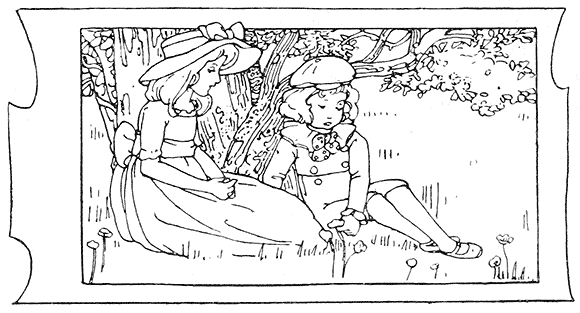
"'Let us sit down here under the shade of a tree,' said Lucilla; and she sat down, whilst Bernard stretched himself by her side.
"Lucilla began to speak, after their long silence, by pointing out the different things which they saw before them, telling the names of the hills, and showing the farm-houses.
"'And there,' she said, 'look at that winding road and that round hill. Beyond that hill is a common covered with gorse, where there are many rabbits, and also many sheep. Nurse's son lives on that common: he was papa's foster-brother. You know he is nurse's only child, and has got a pretty cottage there. When poor little Alfred was beginning to get weak and unwell, soon after Henry died; and mamma was ill too, and obliged to go somewhere for her health, it was advised by the doctors that Alfred should also change the air: and as the air of that common was thought very fine, I went with my brother and nurse to spend the summer at her son's cottage; and, Bernard, though I was then but six years old, I remember everything there as if I had left it but yesterday, for nurse has so often talked about that time to me.
"'Sweet little Alfred! He seemed to get quite well and strong; he rode about the common on a donkey sometimes, and sometimes he played with me, and sometimes we used to sit on the little heaps covered with sweet short herbs, and talk of many things.
"'His chief delight was to talk of some place far away, where he always fancied we were to go soon: he was to see Henry there, and Henry would have wings, and his Saviour would be with them to take care of them, and I was to come, and papa and mamma. I suppose that he spoke the words of a baby; but the thoughts which were in his heart were very sweet. He was merry, too, Bernard, more merry than you are, and full of little tricks to make me laugh. But when we had been three months at the cottage he grew languid and pale again; he was brought home, and from that time grew worse and worse; and he
"Lucilla for a minute could say no more; she covered her face with her hands, and large tears fell from her eyes. Bernard did not speak, but he had an odd feeling in his throat, and wished that Lucilla was not there to see him cry, for he felt he wanted to cry.
"Lucilla soon spoke again, and went on in the kindest, most gentle way, to tell her brother how much more bitter his ill-behaviour was to their mother than even the death of her elder boys; saying everything which a loving, gentle girl could say to lead him to better behaviour.
"Suddenly, whilst she was speaking, she saw her father and mother coming from the little wicket which lay in full view below them, and taking their way slowly, and as if talking to each other, along the path in the wood. Sometimes the trees partly hid them, then Lucilla saw them clearly again, and then not at all. She pointed them out to Bernard, and said:
"'Now, now, dear brother, is your time; you can run down one bank and up another in a few minutes; you can run to mamma, and beg her pardon for being sullen and disobedient to her this morning at breakfast; and then, my dear, dear brother, you will have made a good beginning, and we shall all be so happy.'
"Bernard had laid himself at full length on the grass, amusing himself, whilst his sister spoke, with kicking his legs. He was trying with all his might and main to harden himself against what she said; and succeeded in making himself as stupid as a mere brick.
"When she pressed him to run to his father, he drew up his legs and lay with his knees above all the rest of him, and his eyes staring up to the tree above his head, so that an owl could not have looked more stupid.
"Lucilla felt more sad than she had done before, when she saw how determined he was not to listen to her. She knew not what next to do or say; but whilst she was thinking, a dog was heard to bark on the other side the hedge which was behind them, and a voice saying, 'Be quiet, Pincher.'
"'Why, that is Stephen,' cried Bernard, jumping on his feet; 'what can he be doing here?'
"He flew to the hedge, he sprang up the bank, and called to Stephen, who was walking along the path on the other side with his dog Pincher.
"'Stop, stop!' cried Bernard; 'stop and I will come to you. Good-bye, Lucilla, you can go home by yourself;' and the next minute the rude boy had tumbled over the fence, and was running after Stephen.
"Poor Bernard little thought what he lost when he refused to listen to Lucilla, and what great pleasure he would have gained, had he done what she required of him, and run to beg his father's pardon.
"No one can say what a day may bring forth; and who could have foreseen the very strange thing which had happened whilst Lucilla and Bernard were out that morning? It was an affair of very serious business, which must be told: but as most young people hate business, it shall be told as shortly as possible.
"Mr. Low's brother had been a very wild boy, and had run away; so that for many years Mr. Low had heard nothing about him. At last he got a letter; it was a kind and humble one: in this letter Mr. John Low sent word, that after many adventures he had made some money, and bought a farm in America, on the banks of the Hudson, above New York; that he was doing very well, that he had never married, and only wished that his brother would come and see him. Mr. Low had answered thisDory, who brought the letter, to take him and his family back with him to America, he having undertaken to pay all the costs. The letter finished with the most earnest entreaties that they would all come.
"With Mr. John Low's letter came another from Captain Lewis, of the Dory, saying he should go back in less than a fortnight, and pressing Mr. Low to attend to his brother's request; adding that he almost feared that his friend, Mr. John Low, would hardly be found alive when they reached New York.
"Mr. and Mrs. Low were talking over this letter, and forming their plans about it, when their children saw them walking so gravely in the wood. They had come to the resolution to go with Captain Lewis, and they had a long discourse about Bernard. They resolved at once to take Lucilla with them; they wished her to see her uncle, and to see the New World, and her company would be pleasant to them; but they had many doubts about Bernard. Mr. Low was quite against taking him, and he took this occasion to tell his wife that they had both been to blame in spoiling him as they had done, and that he considered his present ill-behaviour as a punishment which he himself deserved, for having suffered his boy to be so spoiled.
"Mrs. Low had not much to say; she thought her husband was right.
"Now, had Bernard listened to Lucilla, and had he come just at that minute before his parents and begged
"Everything was settled after Mr. Low had made up his mind, even before Bernard returned; for Stephen was going a long walk to see Meekin's father, who was a farmer in the next parish, and Bernard went with him. Stephen would not take him, however, till he had come back to where Lucilla was, to ask her if she thought Mr. Low would be pleased if he took him.
"Stephen could speak very properly and well, when it served his turn to do so; and Lucilla thought him a very nice person, and to be trusted, for he was older than Bernard, by several years, and was often trusted to walk with the boys. She could not say that she could give leave, but she promised to tell her father where Bernard was gone, and with whom. Everything was therefore settled before the spoiled boy came home late in the evening. Mr. Low agreed with Mr. Evans that he should take care of his church; and as Mr. Evans was going to have his house painted and a new schoolroom built, it was also settled that he should come and reside at the rectory until Mr. Low returned. Miss Evans was immensely pleased at the thought of this. Bernard was to remain under Mr. Evans's care; Mr. Low's servants were all to be put on board wages and sent home, excepting the gardener. Even nurse was to go to her son, for Mr. Low said that nurse was the one who spoiled Bernard most. The boys were to have a large laundry, which was in the yard, for their schoolroom, and the drying yard for their play-ground; and Mr. Evans and his family were to come in the day Mr. Low left.
"Mr. Low had also to ask leave for being absent from his living, and Mrs. Low had packing to do; so that there was a vast deal to get through, for it was necessary for them to be in London, where Captain Lewis was, in a very few days.
"As Lucilla, who had not yet heard of all this great bustle, walked quietly home, her heart was very sad on account of her brother. She came back by the grotto, and took up her work-basket, putting away the hermit and the tools and bits of wood in a corner of the little cave out of sight; and taking her basket in her hand, she walked towards home, thinking to return to her little hermitage the next day at latest.
"Poor Lucilla could not help shedding a few tears as she passed slowly along the shrubbery, to think how all her little plans had ended in nothing. She did not just then remember that verse, 'Cast thy bread upon the waters, and after many days thou shalt find it.'"
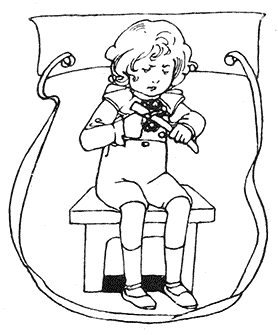
"He took up a slip of wood."—Page 344.
Third Part of the History of Little Bernard Low
THIRD PART OF HENRY'S STORY
"As this history has been very long, and there is more to write about it, we will not say much of what happened the next seven days; for both houses, that is, Mr. Low's and Mr. Evans's, were all in a bustle, and everybody was pleased at the changes which were coming. Even Bernard, after he had roared, and cried, and sulked for the first two days, had altered his manner, and taken up the behaviour of Harry in the old spelling-book—what we may call the don't-care behaviour—for, as he told nurse, if his father did not love him enough to take the trouble of him in the voyage he was taking, he did not care, not he; he should be very happy at home without him. He should cry no more: he wondered why he cried at first, for he had not cared all the while; and so he went whistling about the house the tune of the 'Jolly Miller' which he had heard Ralph sing:
"'There was a jolly miller once Lived on the River Dee; He work'd and sang from morn till night, No man so blithe as he. "'And this the burden of his song For ever used to be— I care for nobody, no, not I, And nobody cares for me.'
"Bernard, however, did not let his father hear him whistling this tune, nor did he say, 'I don't care,' before him.
"The Monday following that in which he had walked with Lucilla was the day fixed for the many changes. Very early in the morning, nurse's son brought a donkey for his mother. The old woman cried, and said she should have no peace till she came back again, and told Mrs. Low that she was sure she should never live in comfort with her son's wife Joan. She kissed Bernard twenty times, and begged him to come and see her; and Bernard did his best not to cry. There was an early breakfast, but nobody sat at the table two minutes together; something was to be done every moment. Mr. Low walked in and out five or six times. The housemaid and the cook came in to say good-bye; they were going to walk to their homes; and Ralph was to go with his sister, the cook. People, too, were coming with packages from Mr. Evans's, and the bustle kept Bernard from thinking very deeply on what was going to happen; and yet he could not eat his breakfast, nor whistle, for he was not in his usual spirits.
"At length the chaise came from the inn, and the trunks were brought down to be fastened on.
"Bernard placed himself at the window to look at what was being done without; and again he felt the same choking he had had on the hill.
"He heard his mother say, 'When shall we start, my dear?' and his father answer, 'In less than half an hour.'
"Lucilla saw him run out and followed him; she was weeping very bitterly; she threw her arms round him, and they both cried together. She kissed him many times, and they would not have parted then, had they not heard themselves called. Lucilla hastily then put a very pretty little Bible in his hand, and gave him another kiss.
"There only remained a tender parting between the boy and his parents; and whilst they were still blessing him they were driven away, and the poor child was left standing alone on the gravel. His eyes followed the carriage as long as it could be seen from that place; and then, observing some people coming in at the gate, he ran away. He took the path through the shrubbery, and across a field, to a high green bank, from which he could trace the road a long way, even as far off as where it passed under the round hill with the clump of firs on it, near to nurse's son's house.
"He sat down on the bank, waiting until the carriage should come in sight again: for when it got down into the bottom of the valley, where there were many trees, it was hid from his view.
"This was perhaps the first time in Bernard's life in which he ever had any really useful thoughts. He was made then to have some little notion that he owed his present trouble to his having been a very
"Bernard did not consider that it would actually have
"When Bernard saw the carriage again, it looked like a speck on the white road. The speck seemed to grow smaller and smaller, and at last it disappeared round the foot of the little hill. Then the poor boy cried and cried again, until he could cry no longer, and every tear seemed to be dried up.
"No one can say how long he sat there, but it was a long time; at last he heard a voice, saying, 'Master Low! Master Low! where are you?' and the next minute old Jacob, the gardener, appeared.
"Now Jacob was the only servant who had not helped to spoil Bernard, and therefore Bernard had never liked him, but always called him cross old Jacob. He was glad, however, to see him then; and yet he did not speak first to him.
"'I am glad I have found you, Master,' said the old man; 'I have been hunting you everywhere; and so has Mr. Evans. They be all come—Miss Grizzy herself, and the two maids, and Master Stephen, and a power of traps; and the lad that cleans the shoes and knives. But I shan't let him meddle with the horses, which he is forward enough to do. But you must come along with me. Master; they are all in trouble about you.'
"'Surely,' said Bernard, forgetting that one good thought which he had had a little before, 'I may go anywhere I please on my own papa's grounds; everything here is papa's, Jacob, and I am at home here.'
"'True,' replied Jacob, 'and so am I too; but neither you nor I is master here.'
"'That is just like you, Jacob,' answered Bernard; 'but I am the master's son, and you are a servant.'
"'I could answer you from Scripture,' said Jacob, 'if I would.'
"'Do then!' cried Bernard.
"'Now I say, that the heir, as long as he is a child, differeth nothing from a servant, though he be lord of all; but is under tutors and governors until the time appointed of the father' (Gal. iv. 1, 2).
"Bernard made no answer to this, but, getting up, walked before Jacob to the house. At the door he was met by Mr. Evans, who spoke to him kindly, said he hoped to make him happy, and to do everything for his good in his father's absence. He added also that Griffith and Meekin and Price were come, and were in the laundry, which was then to be called the schoolroom; but that he should not call any of them that day to lessons; only he hoped that he would not go far from the house, as he was now accountable for his safety.
"Mr. Evans then walked away, and Bernard went to his own room, where he had much difficulty to prevent himself from crying again; but happening to light upon some penny pictures and a pair of scissors, he amused himself with cutting them all to pieces; first cutting out the figures, then the houses, and then the trees, till he had spoiled them all.
"At one o'clock the bell rang for dinner. Bernard did not stir till somebody had had the trouble of coming up to call him. The dinner was laid in the family dining-room. Miss Grizzy was seated at the head of the table when Bernard came in; she was in very good humour, and smart as usual. Mr. Evans was in Mr. Low's place at the bottom; the boys on each side.
"'Master Low,' said Miss Evans, as he came in, 'I hope you are well; here we are, you see, in your papa's handsome room, and here is your chair by me. I don't ask
"All that was proud and selfish in the heart of poor Bernard was awake and busy long before Miss Evans had finished her speech. The boy looked round the table for what he liked best; but instead of asking, told the servant to take his plate for it, saying:
"'Don't give me fat, I don't like it.'
"'No fat for Master Low,' cried Miss Evans: and then again speaking to the boy, 'You have a charming house here, Master Low; I had no notion how good it was till I went over it this morning. I tell the young gentlemen here that they must be very careful not to do mischief.'
"'They cannot do any, sister,' said Mr. Evans, 'if they keep to their places. They must not go into the garden, there is abundant room for them to play in elsewhere, and they shall have as much fruit as is good for them. Mind, boys, on honour, no going into the garden. You shall not need, for as Mr. Low kindly leaves us the use of the fruit, you shall have your full share.'
"'You hear, young gentlemen,' said Miss Evans; 'Master Meekin, Master Griffith, Master Price——'
"'And Master Low,' added Mr. Evans, 'you are, on honour, not to go into the garden.'
"'Master Low!' repeated Miss Grizzy; 'Master Low not to go into his papa's garden?'
"Mr. Evans never disputed with his sister before the boys, and not, indeed, very often when alone with her, for he loved peace and quietness, and she would always have many last words; so he said no more; and she, tapping Bernard gently on the back, said, in a low voice:
"'That would be hard, would not it, to keep you out of your dear papa's own garden?'
"'I should think so,' answered Bernard, in the same low voice.
"This was only the beginning; and as Miss Grizzy went on as she had begun, in setting up Bernard, and flattering him to the very utmost in her power, there is much reason to fear that he was not likely to be the better for being left with her.
"Griffith, with his friends Meekin and Price, would soon have given him a lesson or two of another kind, had not Stephen watched them; but Stephen had been well tutored by his aunt, and as much was gained them from Mr. Low's friendship, besides the honour of having Master Low at school, they cared for nothing so much as keeping the naughty boy in good humour.
"As to Mr. Evans, he was a simple, earnest man, not suspecting evil of others, and anxious to do good. He was kind to all his pupils; he never made a difference: and it was for his sake that any boys remained in the house; so that he really caused the family to prosper, whilst his sister fancied it was all her own doing.
"The next day Mr. Evans began to give his lessons; and kept them on most regularly till the Midsummer holidays. He was not aware that Bernard had any other indulgence but being helped first at table, which he did not quite like; and he kept him as close as the others at his lessons.
"But Miss Grizzy, and Stephen, and Bernard were too deep for him; and there was no end of the indulgences given in private to the boy. He had cakes, and puffs, and strawberries and cream given him, when nobody saw it, by Miss Evans.
"Stephen never took notice when he went beyond
"Miss Grizzy all this while disliked him as much as Stephen did, and that was with their whole hearts.
"Stephen called him a little proud, insolent puppy. And Miss Evans said he was the most greedy child she ever saw, and so wasteful and thankless, and one of the worst-mannered boys she ever had to deal with.
"Stephen said the same to Meekin and Griffith and Price; he laid all the partiality with which they charged him on his aunt, and said he only wished he could have his way with him, and he would soon bring down his airs, and teach him what he was made of.
"The same boys met again after the holidays, and things went on much in the same way.
"Several letters were received from Mr. Low from different places; at length one came, stating their arrival in New York, and their being about to go up the Hudson to Mr. John Low's house.
"The great indulgence with which Bernard was treated, and the bustle that was made about him, together with the real kindness of Mr. Evans, made him very hard and careless about his parents.
"He used often to say, 'I do very well here; if papa stays longer than he at first intended I shall not fret after him, and I dare say he will not fret after me, for if he had loved me so very much he would not have left me behind.'
"Bernard could not forgive his father for leaving him; but whenever he talked in this way not even Stephen could keep Griffith from speaking his mind to him.
"'There you go again,' Griffith would say; 'always blaming your father, when the fault is all your own. Don't you know, Bernard, that there is nobody that can bear with you who thinks they have not something to get by you?'
"The name Noddy, which Stephen had forbidden, was got up again after the Midsummer holidays; and everything that Bernard did to make himself disagreeable was set down to this Noddy.
"At last Bernard got to the truth of this matter by being told by Meekin that if he wished to see Noddy, he must take a peep in the looking-glass. On hearing this, Bernard struck Meekin, and if Stephen had not come in, the spoiled boy for once would have got his deserts.
"Letters were again received from Mr. Low about December; he said in them that his poor brother was very ill, not likely to live through the winter; that it was impossible for him to leave him, and that at all events he meant to stay till the season for crossing the sea should be better. Lucilla at the same time wrote a long letter to her brother.
"The Christmas holidays passed, and nothing particular happened; the same boys met again after Christmas, and another boy came also; but Bernard despised him as much as he did Meekin and Griffith and Price, because he had heard it said that his father kept a shop.
"January passed, and February, and March; another letter had come from Mr. Low; poor Mr. John Low was dead, and Mr. Low was busy settling his affairs. Mr. John Low had left his brother a good deal of money, but Mr. Low did not say anything about that; Miss Grizzy therefore made it out that there was none.
"Another letter arrived at the end of March to say that Captain Lewis was to sail for England in the Dory in a few days, and that Mr. Low hoped to come with him. There was another sweet letter from Lucilla, telling how many pretty things she had collected for her dear brother.
"It was about four weeks after these two last letters had been received, when one morning Mr. Evans came in a great hurry, and with a face of much trouble, into the school-room, and called out Stephen. Stephen came back five minutes afterwards, and told the boys that his uncle had been called suddenly away, and they had leave to play.
"'Good news—good news!' cried Griffith, and away ran the four pupils, with Stephen after them; whilst Bernard went into the house to see what he could get.
"As he came into the hall he saw that the parlour door was open, and he heard people talking within. Miss Grizzy was in the parlour, and she was talking to a neighbour who had dropped in. The coming of that neighbour, Bernard thought, had something to do with the holiday so suddenly given, and by listening he thought he might find something out about this holiday.
"The words Bernard heard were these:
"'I know, Mrs. Smith, better than most, that the family had nothing to depend upon but the living. To be sure, the living is very good, and much might be saved out of it for the children, but if what we hear is true they will come but poorly off, I fear.'
"'You forget, Miss Evans,' answered Mrs. Smith, 'that if what we hear be true—and I fear it is—there is only one left to provide for.'
"As Bernard drew closer to the door to hear more, he knocked his foot against it, and Miss Grizzy called out:
"'Who is there?'
"Bernard walked into the parlour at the call, in his usual manner, and without taking any notice of Mrs. Smith, he said:
"'I want some bread and butter.'
"'What, already?' cried Miss Grizzy tartly; 'don't you see that I am talking business with my neighbour, Master Low? Come, you had best go to play, and mind to shut the door after you.'
"Bernard looked at her with a look which seemed to say, 'What's the matter now?' and walked away, leaving the door as wide open as he could push it.
"He walked into the garden, but old Jacob was not there, and then he went to the back of the house to look for the other boys. He had heard their voices at a distance, when he got there, and saw them in the very field where he had sat with Lucilla. Their voices came straight over the valley; but it was a long way to go, down first and up again, to them. However, he set out to go, and in his way had to pass by the door of a cottage near the brook. In this cottage lived an old woman, who had been supported for some years by his father's family, though she could do little in return. She was sitting on the step, with her face on her knees, crying bitterly.
"'What now, Betty?' said Bernard.
"'Ah, Master Low!' she said, looking up, 'is it you, my precious master, and do you say, what's the matter now? Have not they told you? The hardened creatures to keep such news from you!'
"And she then told him the real cause of the breaking up of the school, the absence of Mr. Evans and Jacob, and the visit of Mrs. Smith. News had come that day to Rookdale, that the Dory had been lost at sea, and gone down with every creature on board: having been seen to
"Mr. Evans had gone immediately to discover the truth of this account, which was in a newspaper. It is not known where he went, or to whom he wrote letters; but this is certain, that he only obtained confirmation of the dreadful news, and as weeks passed, and nothing was heard from Mr. Low or of the Dory, every one, of course, believed that poor Bernard was an orphan.
"Miss Grizzy began to think where the money was to come from to pay for Bernard's keep; for what had been said was very true, Mr. Low had had little to depend upon but his living; or if he had saved anything, it could not be known where his savings were, till his papers could be looked up, and that could not be done until it was as certain as might be that he was really dead.
"Poor Bernard!—now his time of trial had come: he was quite unprepared for the story old Betty told him. Mr. Evans had wished it might for the present be kept from him. He fell down like one struck with death when he heard the story.
"The old woman screamed; at her cry, Stephen and the boys, who were not far off, came running to her; more help was called, Bernard was lifted up, and carried to the house and put to bed.
"When laid on his bed, it was found that the sudden shock had made him very ill, and there was fear of inflammation of the brain. The doctor was sent for, he was bled more than once, his head was shaved, and a large blister put upon it. He was reduced to be as weak as a baby: he called often, when he knew not what he said, for his father and his mother, and his own sweet Lucilla; and when he recollected that he had heard they were dead, he called for his nurse.
"Nurse came the moment she heard of his illness; but Mr. Evans was not come home, he was absent more than ten days, and Miss Grizzy would not let nurse see him.
"Miss Grizzy was the person who watched by Bernard's bed, and saw that everything the doctor ordered was done; but Bernard fancied she was not the same Miss Grizzy that used to smile upon him and flatter him in past times, she looked so grave, and said so often, 'That must be done, Master Low.'
"Bernard, however, did not think much about her; his whole mind was filled, till his head got well, with thoughts of his parents and sister, and even of his little brothers, whom he had never seen. And in this time of suffering and weakness he began to be sincerely sorry for his past naughtiness.
"Mr. Evans came back without any hope respecting Mr. Low. He was very much grieved, especially for Bernard, and showed his kindness by visiting him often in his room; and when the boy was better, another friend showed himself; this was Griffith, who had made up his mind never again to quiz Bernard so long as he lived. He came often to him, and even read to him in the Bible Lucilla had given. Jacob too showed his deep affection for his little master. But Jacob himself was soon afterwards taken ill, and Miss Grizzy contrived that he should be sent away till he got better. So Bernard was made to feel that those were not his real friends who flattered him when all seemed to be well with him.
"Time passed on, Bernard's health was restored, and he was able to come down as usual. He went down to dinner the first day on a Sunday. He had been well enough to go down the Monday before, but Miss Grizzy
"'You are older than Larkin, Low,' said Stephen, 'and must give up the place of pet to him.' Bernard sat down. He did not just then understand the reason of being put out of his place—he had this to learn amongst other things. He was not asked what he would like, but helped in his turn; and when dinner was over, he was not asked if he would like to stay in the parlour, but told, if he felt tired, to go and lie on his own bed. At tea he was treated like the other boys, and at supper also, and from that time this went on. If Mr. Evans saw it, he did not interfere; but this good man was very absent, and many things passed before him which he did not notice.
"After a few days, one would have thought that Miss Evans and her nephew had ceased to care altogether about Bernard's feelings; they began to talk before him of who was to have the house and living, and that it was necessary to take great care of the house and furniture; and Bernard was told that he must not run rampaging about as he had done formerly; for, as Miss Grizzy said, there was little enough left, she feared, for his maintenance, and there was no need to make things worse.
"It was a hard lesson for the spoiled boy to be taught to be patient under these mortifications, and never to fire up and answer these cruel hints; but he was patient, he bore much and said little. He felt that he deserved to be humbled in this way, and he tried to be submissive.
"Another month or six weeks went, and Bernard had only two earthly comforts: one was from the gentleness
"'Why,' said Meekin, 'did not you give him the name?'
"'I did,' answered Griffith; 'but he shan't hear it now, never again.'
"The season of Whitsuntide had come round, and the boys were to go home for a week, and only Meekin, Low, and Stephen were left. The bells were not set to ring as usual on Sunday morning; the ringers were thoughtful enough to refuse to ring; but Stephen was resolved to have a peal, and he and Meekin and the big boy who worked about the place, and one other whom they contrived to muster, had one peal on the Sunday, and several others on the Monday.
"The return of Whitsuntide made Bernard more unhappy than he had been for many days. He remembered that time a year ago so very exactly, and what everybody had then said and done—his own bad behaviour especially. He had a very sad Sunday, and got up even more sad on the Monday morning.
"Miss Grizzy had put him out of his old sleeping-room after his recovery, into a little room which looked over the stable yard. Before he was dressed he heard talking in the yard. He dressed in haste, and ran to the window, and there he saw just below him a young man called Benjamin, the same who had helped to ring the bells with Stephen and Meekin and the servant boy—all gathered together examining Lucilla's pony. Bernard could not hear what they said, and the bell rang for breakfast before he had time to ask.
"When he came down, he was sorry to find that Mr. Evans was gone out. He asked Meekin how long he was to stay from home; and Stephen answered:
"'Maybe all the week; maybe a month; maybe he
"'Oh! I hope not,' said Bernard, speaking hastily and without thinking.
"'You do, do you?' answered Stephen spitefully; 'well, we shall see.'
"'It don't become you, Low, to speak in such a way now,' said Miss Grizzy, 'you are not master here, now. You can't count upon this place being yours more than my brother's any longer; it is just as well that you know the truth, and know at once what to expect. The living went from the family when your father died, and it is feared that there will not be much left for your keep when the things are sold, and everything paid.'
"The tears stood in Bernard's eyes—not that he attended to all the words Miss Grizzy said; he was thinking of that day a year ago, of his own ill behaviour, and of the kindness of his sweet Lucilla.
"'Oh!' he thought, 'how could I have run away from my gentle sister to go to that cruel Stephen?'
"Stephen and Meekin walked off in a hurry, after they had breakfasted, and Miss Grizzy sent Bernard after them. He followed them slowly, and yet did not like to stay long behind them.
"They were gone again into the yard, and there was Benjamin, and the servant boy, and the pony. Stephen was talking of the pony, and giving his orders: the pony had a long tail, and his mane wanted putting in order.
"'You must dock the tail close, Ben,' were the words that Bernard heard; 'she will sell for nothing in that fashion.'
"'Oh, no, no!' cried Bernard, running forward, 'Lucilla would not like it; she said she would always have it long to flitch away the flies.'
"'Who bid you speak?' said Stephen.
"'Is she not my horse now?' cried Bernard.
"'No more yours than mine,' replied Stephen.
"'Don't cut her tail, Benjamin,' returned Bernard.
"'Hold your peace,' said Stephen.
"'Only stay till Mr. Evans comes home,' said Bernard.
"'Do it now,' said Stephen.
"Bernard was beside himself; he called Stephen cruel, deceitful, and anything else he could think of, and he tried to seize the halter of the pony.
"Stephen dragged him away, and in the scuffle thought Bernard had struck him; Meekin swore that he did.
"Stephen, when set up, was furiously passionate, and without taking time for thought, he snatched a switch from the hand of Ben, and laid it on Bernard till his back and even the sides of his face were covered with wheals. The poor boy ran, and Stephen after him. Stephen was even the more provoked because Benjamin cried to him to desist.
"Bernard at last got away from him by a little gate which led into the garden, and he continued to run until he had come to the arbour and the grotto. He had never gone to that corner of the shrubbery since the news had come of the loss of the Dory; and at first, when he almost dropped down on one of the benches, he scarcely recollected where he was. He was seated exactly where he had sat with Lucilla on the last Whitsun-Monday. The mouth of the grotto was exactly before him; the winter's wind had driven the dead damp leaves into it, and there had been no one to clear them away. The highest point of the little window in the back, which Lucilla herself had painted on a piece of board, just peeped above the heap of leaves. Bernard thought of the tools Lucilla had bought; they were lying, no doubt, rusting in a corner.
"'Oh, Lucilla!' he cried; and bursting into tears, he laid his hands on the table, and stooped his face upon them: the board was quite wet with his tears when he looked up again.
"He was startled by the sudden ringing out of the bells. Stephen and the boys had gone to cool themselves in the belfry, after leaving the pony undocked in the field.
"How did those bells remind the unhappy boy of the year before, for he had heard them when sitting in that very place with Lucilla! He remembered his hardness and pride at that time, and like the Prodigal Son to his father, he cried to his God, 'I have sinned against heaven and before Thee, and am not worthy to be called Thy son.'
"Could Lucilla have foreknown in what spirit her dear brother would have spoken those words in that place, at the end of twelve months after she had brought him there, she would have been filled with joy, and would have said, 'My God, I thank Thee, for Thou hast heard my prayers.'
"When Bernard was getting more calm, his tears were made to flow again by the sight of the broken splinters and one of Lucilla's beads on the gravel at his feet. He took up the bead, wrapped it in a bit of paper, put it into his waistcoat pocket, and went out of the shrubbery by the wicket close by into the wood.
"As he walked along his wandering eye at last settled upon that spot of ground, at the foot of the round hill with the crown of fir-trees, where the carriage which had taken away his parents had disappeared. He thought then of his nurse, and that she had been one of those to whom he had behaved ill.
"'Poor nurse!' he said to himself, 'I will go to beg her pardon, and I will get her to let me live with her, and never let me come back to this place again. Nurse will
"Oh, what a long and dreary way did he find it! The first half-mile was tolerably level, but the next two miles and a half were all uphill, only with a very little going down sometimes. The sun was shining without clouds, and his bones were sore, and he was getting hungry; and what was worse than all, his heart was very sad, and the road was solitary. He scarcely met anyone, excepting a party of people with asses; still he often caught sight of the round hill, and found himself getting nearer to it: he thought it looked higher, and higher, and higher as he went on, and he had to go beyond it. It was quite noonday before he reached the foot of it; and there he had to ask a man, who was breaking stones on the road, the nearest way to the common. The man showed him a deep lane a little further, up which he was to go, and when he had got to the end of it, he saw the common and the rabbit-burrows, and sheep, and geese, and many cottages. He asked at many doors before he could learn where nurse lived; but when he saw her house he was pleased, because it looked larger and neater than the others, and he thought there would be room for him. It stood in a pretty garden, surrounded with a neat quickset hedge, nicely shorn.
"He opened the wicket-gate without fear, and walked up to the door. He saw a neat kitchen within, for the door was half open; he knocked, and called, 'Is nurse at home?' No one answered at first, but soon he heard a step, and nurse's daughter-in-law appeared.
"She was a tall, hard-looking woman, and the first words she said, were:
"'Surely it is not you, Master Low, and in such a plight? Why, you have been a-fighting.'
"'I want nurse,' said Bernard.
"'What, mother-in-law?' answered the woman; 'you can't see her.'
"'Why?' answered Bernard.
"'She is sick in bed,' said the woman.
"'Let me go up and see her, if you please,' said Bernard.
"'You can't do no such thing,' said the woman; 'she is not in the house, and if she was she could not have much to say to you. Has not Miss Grizzy forbid her to come about you? and times are hard, Master Low. You has run away from school, I doubt not, by the look of you. You has been a-fighting. Don't think that we shall go to harbour you here, and get nothing but cross words for our pains. Miss Grizzy told mother that there would be nothing a-coming to you when all was paid. So go back as fast as you can; you can't come in. Go back, there's a good lad.'
"She then, in her great goodness, handed him a crust and a bit of dry cheese, and pushed him from the door; for she was afraid that her husband and his mother, who were both out, might come in before the child was gone.
"Bernard hardly knew what he did when he took the bread and cheese, and felt the hand of the woman pushing him out. He could not eat what was given him, for he was parched with thirst, and his young heart was almost broken by his disappointment. Even to nurse he had behaved ill, and now he thought that even she had forsaken him. He dragged himself back through the deep lane, and being again in the highroad at the foot of the
"About the time when Bernard was turned from nurse's door, the dinner-bell at his papa's house was ringing, and Miss Evans waiting at the head of the table ready to carve.
"Before the bell had done tinkling, Stephen and Meekin came in, and Miss Grizzy said:
"'Where is Low? I suppose he does not expect us to wait for him.'
"Stephen looked at Meekin, and Meekin looked at Stephen. Stephen was not quite easy in the thought of the severe beating which he had given Bernard; but as it was expected that Mr. Evans would not return till the evening of the next day, he trusted that there would be nothing about Bernard to lead his uncle to inquire about what had happened in his absence.
"'The boy is sulking somewhere,' he thought, 'and when he is hungry he will show himself;' and with this thought he went to the bottom of the table; and they had all just seated themselves, when in walked Mr. Evans.
"Miss Grizzy set up a shriek of wonder, and Stephen turned scarlet.
"Mr. Evans had set out with the intention of going to the Bishop, under whom he and Mr. Low lived, to ask him about some little difficulty which had arisen in the management of the parish, and to beg that things might remain as they were, until more decided news could be got of the loss of the ship.
"The worthy man was not thinking of himself, but of poor Bernard. He had hardly gone ten miles of the thirty
"When he had, in a few words, explained how it happened that he was at home so soon, he was preparing to sit down to dinner, when he missed Bernard.
"'Where is Master Low?' he said, looking round. 'Where is Bernard, sister? Stephen, where is the child?'
"There was a certain something in the flushed features and stammering answers of Stephen which struck even the unsuspicious Mr. Evans, and when he was once roused he could show great firmness. He insisted that the little boy should appear; and when he did not answer to any call, or to the repeated ringing of the bell, he ordered the dinner away.
"'No one in the house shall dine, sister Grizzy,'
"'Sir,' said Meekin, 'he struck Mr. Stephen.'
"'No, Master Meekin,' said the boy who was waiting at table, 'I did not see as he did; nor Ben neither, and he was by.'
"'No matter now,' said Mr. Evans; 'be off, all of you, and bring the child to me.'
"And Mr. Evans sat down, having no expectation but that Bernard would be brought in, with the tear in his eye, but safe and sound, in a few minutes. He waited alone, maybe a quarter of an hour, and then went out, becoming more frightened every moment.
"There was a set of people, such as sell pottery,
"The old woman of the party told him that they had met such a boy, and told him also exactly where. It struck Mr. Evans at once that the child had set out to go to nurse's; and without losing another minute he called Tom, ordered him to saddle the pony, and was on his way towards nurse's not ten minutes after he had spoken to the old woman. He made the pony go at a very brisk trot, wherever the steepness of the road would allow.
"Bernard had really fallen asleep under the hedge after some time, and had only just awakened when Mr. Evans came trotting round the foot of the hill.
"The worthy man no sooner saw him than he came almost cantering up, sprang from the quiet pony, and caught him in his arms.
"'My son! my child!' he said, whilst his eyes filled with tears; 'my poor boy, why are you here? What has happened? Do you not know that when you lost a better father, you became to me like a son, and that I then resolved to be a father to you so long as you needed one? If anything goes wrong with you, my boy, under my roof, come to me and tell me, as you would have done to your own father, and be sure that so long as I have a loaf you shall have a son's portion of it.'
"No one can describe the effect of Mr. Evans's kindness on the heart of poor Bernard; again and again he fell on his neck and kissed him; and so full of love and gentleness was the child that he whispered:
"'Don't ask me why I ran away; I promise you that when I run again from the same people, I will run to you;
"'It shall not happen again,' said Mr. Evans, who had observed the marks of the strokes on the child's face; 'it shall not happen again; I will prevent it; but I will ask no questions.'
"So saying, he lifted Bernard on the pony with the long tail, and taking the bridle in his hand, they set off together down the hill.
"Mr. Evans had gone off in such a hurry that he had not told anyone that he had heard of Bernard; and therefore, without planning any such thing, he had left the people at home in the greatest trouble, their alarm becoming more and more every minute in which the child could not be found.
"Mr. Evans and Bernard had first, in their way from the round hill, to go down a very steep bit of road, into a kind of hollow where were a brook and many trees, and then beyond which was a rise, and then another deep descent. When Bernard came to the brook, he begged that he might get off and drink a little water in the hollow of his hand; and when he had done so, he tried to make Mr. Evans mount the pony whilst he walked. But the kind man would not hear of any such thing; he lifted Bernard on the horse again, and they were just going to ascend the bank, when they heard a voice behind them, crying: 'Stop, stop, Master Bernard.'
"They looked back, and there was nurse; she had come home about an hour before, and having heard by some chance who had been at the cottage and been sent away, she had had a violent quarrel with her daughter-in-law, and had come posting after her boy.
"But before Mr. Evans and Bernard knew the voice, there was a sound of carriage-wheels coming from behind
"'That is nurse,' said Mr. Evans; 'but we must not stop just here, or the carriage will be upon us; a little above there is room for the pony to stand aside, and the ground is there more level for the feet.'
"So for the next minute or more the three parties all went on, Mr. Evans and Bernard going up slowly towards the level place; the carriage coming rapidly down the road, being drawn by horses used to steeper hills than that; and nurse behind at the top of her speed after the carriage.
"Those in the carriage had known nurse as they passed, though she never once looked up to them; and they knew also Bernard, and good Mr. Evans, and the long-tailed pony.
"When Mr. Evans had reached the bit of level ground, which might have been fifty feet, or more, from the bottom of the valley, he stopped, and lifted Bernard off the pony to wait for nurse.
"The carriage, too, stopped at the brook, and there was a cry from it. 'Bernard, Bernard! It is our dear, dear Bernard; open the door, open the door.' The door was burst open from within, and out sprang Lucilla, flying forward to her brother. She was followed by Mr. and Mrs. Low, as soon as the postboy could let down the steps.
"Bernard made one effort to rush to meet Lucilla, and then fell unconscious upon the ground.
"It is impossible to give an account of such a scene; the people who were present could tell nothing about it themselves. Mr. and Mrs. Low and Lucilla could not
"They had suffered much in a terrible storm, and been driven far out of their course, and been obliged to lie for months in some far-off harbour for repairs, and had had a long and weary voyage. But they had written letters, and supposed all this was known at home. The letters, however, having been sent from a very out-of-the-way place, had never arrived, but this they could not know.
"They were not surprised at anything, when they found that all their friends and neighbours had thought them dead; and when Bernard, having had his temples bathed with water, opened his eyes and recovered his colour, and began to shed tears, they were no longer frightened about him. He was then lifted into the carriage, and held in the arms of his own father; nurse got upon a trunk behind, Mr. Evans mounted the pony, and on they went, having now only down hill to go to the village.
"'Let us pass quietly, if possible, through the village,' said Mr. Low, 'that we may get our dear boy home as soon as possible;' but Mr. Low could not have everything as he wished. The news was told at the very first house, which was the turn-pike, by Mr. Evans before the carriage, and by nurse behind it; and the whole street was up in a moment. There was such joy, that men, women, and children set up shouts; and four young men, who were enjoying the Whitsun holidays, flew to the church and set the bells a-ringing before the carriage came in sight of the rectory.
"'Surely,' said Miss Grizzy to the dairy-maid, 'those lads are not gone off to the belfry, and that plague of a boy, young Low, not found yet! I always said he was the most ill-conditioned child that ever lived; and I
"Before she could finish her speech there was a sound of wheels and of horses, and the barking of all the dogs about, and of doors opening; and the very next minute in came nurse with the news into the dairy.
"Miss Grizzy was almost as ready to faint as Bernard had been—but not from pleasure; all her unkindnesses to the child rose before her mind, and it was with the greatest difficulty that she could put on even the appearance of being glad, whilst her worthy brother's heart was lifted up with joy.
"When Stephen heard the news, as he came skulking in to tell his aunt he could find Bernard nowhere, he walked himself off with Meekin, and did not return till night; but he need not have done so, for Bernard never uttered a complaint against him or anybody else, though he spoke continually of the very great kindness of Mr. Evans.
"The happiness of Lucilla that evening was complete. Bernard had hardly spoken to her before she found how changed he was.
"Mr. Low was equally thankful; and Mrs. Low and nurse, though they did not understand the cause of the change so clearly, yet felt that their darling was a new and improved creature. Mr. Low, having it now in his power, did much to assist Mr. Evans in many ways; he felt all his kindnesses; he helped to furnish his new rooms, and raised his salary as a curate.
"Miss Grizzy and Stephen left him almost immediately. Miss Grizzy went to keep the house of a cross old uncle, and Stephen went to his parents. Mr. Evans took nurse for a housekeeper, and whether she managed well or ill for him people do not agree; but this is certain, that all the boys, especially the little ones, liked her so much that Mr.
"The last we heard of Mr. Low's family was that Bernard and Lucilla had furnished the grotto so beautifully that every person in the neighbourhood came to see it; and that this brother and sister were the delight of their parents, and the comforters of every poor old person or orphan child in the parish."
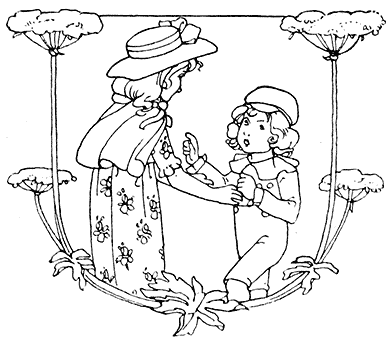
The Birthday Feast
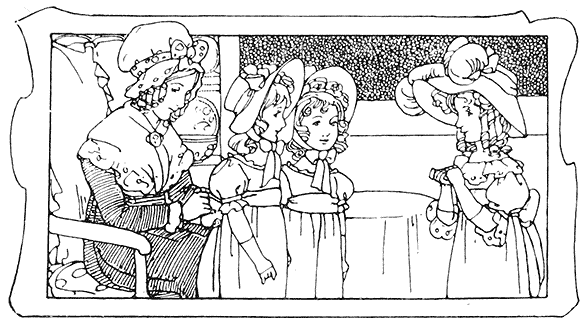
"Well," said Henry Fairchild, "it is just as I knew it would be;
"No, no!" replied Emily; "if a story is stupid, its being long only makes it worse."
"But it is not stupid," says Henry, "as it comes in at the end so nicely, and in so much bustle. I do love a story that ends in a great bustle."
"Well," said Emily, "my story finishes with as great a bustle as yours; and we must say that Lucy has chosen two very nice books; so, Lucy, we thank you with all our hearts."
We have been so busy over the stories which Lucy brought, that we have taken no notice of the note and parcel which came from Miss Darwell.
The note was to invite the Misses Fairchild and Master Fairchild to spend her birthday with her. She asked them to come very early, and they were to come in their playing dresses, and then they could bring others with them,
Mrs. Fairchild's children were not so rich as Miss Darwell, but they were as well brought up; and Mrs. Colvin had heard this, and was glad to have the opportunity of seeing these children.
The parcel contained a few small presents, which Emily and Lucy thought a great deal of, and put by amongst their treasures.
The day of Miss Darwell's birthday came, after what Henry called a very long time. Time seems very long to children; they think a month as long as old people think a year. Henry talked of a year or two past as of a time a long while ago.
Lucy and Emily looked out the very first thing that morning to see what weather it was; but Henry did more, he got up and went out as soon as he heard anyone stir, and saw John cleaning the horse, that he might be ready for Mr. and Mrs. Fairchild in the afternoon.