Part I
Reading edition
Mr. and Mrs. Fairchild lived very far from any town; their house stood in the midst of a garden, which in the summer-time was full of fruit and sweet flowers. Mr. Fairchild kept only two servants, Betty and John: Betty's business was to clean the house, cook the dinner, and milk the cow; and John waited at table, worked in the garden, fed the pig, and took care of the meadow in which the cow grazed.
Mr. and Mrs. Fairchild had three children: Lucy, who was about nine years old when these stories began; Emily, who was next in age; and Henry, who was between six and seven. These little children did not go to school: Mrs. Fairchild taught Lucy and Emily, and Mr. Fairchild taught little Henry. Lucy and Emily learned to read, and to do various kinds of needlework. Lucy had begun to write, and took great pains with her writing; their mother also taught them to sing psalms and hymns, and they could sing several very sweetly. Little Henry, too, had a great notion of singing.
Besides working and reading, the little girls could do many useful things; they made their beds, rubbed the chairs and tables in their rooms, fed the fowls; and when John was busy, they laid the cloth for dinner, and were ready to fetch anything which their parents might want.
Mr. Fairchild taught Henry everything that was proper for little boys in his station to learn; and when he had finished his lessons in a morning, his papa used to take him very often to work in the garden; for Mr. Fairchild had great pleasure in helping John to keep the garden clean. Henry had a little basket, and he used to carry the weeds and rubbish in his basket out of the garden, and do many such other little things as he was set to do.
I must not forget to say that Mr. Fairchild had a school for poor boys in the next village, and Mrs. Fairchild one for girls. I do not mean that they taught the children entirely themselves, but they paid a master and mistress to teach them; and they used to take a walk two or three times a week to see the children, and to give rewards to those who had behaved well. When Lucy and Emily and Henry were obedient, their parents were so kind as to let them go with them to see the schools; and then they always contrived to have some little thing ready to carry with them as presents to the good children.
The Birthday Walk
"It is Lucy's birthday," said Mr. Fairchild, as he came into the parlour one fine morning in May; "we will go to see John Trueman, and take some cake to his little children, and afterwards we will go on to visit Nurse, and carry her some tea and sugar."
Nurse was a pious old woman, who had taken care of Lucy when she was a baby, and now lived with her son and his wife Joan in a little cottage not far distant, called Brookside Cottage, because a clear stream of water ran just before the door.
"And shall we stay at Nurse's all day, papa?" said the children.
"Ask your mamma, my dears," said Mr. Fairchild.
"With all my heart," said Mrs. Fairchild; "and we will take Betty with us to carry our dinner."
So when the children had breakfasted, and Betty was ready, they all set out. And first they went down the lane towards John Trueman's cottage. There is not a pleasanter lane near any village in England; the hedge on each side is of hawthorn, which was then in blossom, and the grass was soft under the feet as a velvet cushion; on
Lucy and Emily and Henry ran gaily along before Mr. and Mrs. Fairchild, and Betty came after with the basket. Before they came up to the gate of John Trueman's cottage, the children stopped to take the cake out of Betty's basket, and to cut shares of it for John's little ones. Whilst they were doing this, their father and mother had reached the cottage, and were sitting down at the door when they came up.
John Trueman's cottage was a neat little place, standing in a garden, adorned with pinks and rosemary and southernwood. John himself was gone out to his daily work when Mr. and Mrs. Fairchild came to his house; but his wife Mary was at home, and was just giving a crust of bread and a bit of cheese to a very poor woman who had stopped at the gate with a baby in her arms.
"Why, Mary," said Mr. Fairchild, "I hope it is a sign that you are getting rich, as you have bread and cheese to spare."
"Sir," she answered, "this poor woman is in want, and my children will never miss what I have given her."
"You are very right," answered Mrs. Fairchild; and at the same time she slipped a shilling into the poor woman's hand.
John and Mary Trueman had six children: the eldest, Thomas, was working in the garden; and little Billy, his youngest brother, who was but three years old, was carrying out the weeds as his brother plucked them up; Mary, the eldest daughter, was taking care of the baby; and Kitty, the second, sat sewing: whilst her brother Charles, a little boy of seven years of age, read the Bible aloud to her. They were all neat and clean, though dressed in very coarse clothes.
When Lucy and Emily and Henry divided the cake amongst the poor children, they looked very much pleased; but they said that they would not eat any of it till their father came in at night.
"If that is the case," said Mrs. Fairchild, "you shall have a little tea and sugar to give your father with your cake;" so she gave them some out of the basket.
As Mr. and Mrs. Fairchild and their children passed through the village they stopped at the schools, and found everything as they could wish—the children all clean, neat, cheerful, and busy, and the master and mistress very attentive. They were much pleased to see everything in such good order in the schools, and having passed this part of the village, they turned aside into a large meadow, through which was the path to Nurse's cottage. Many sheep with their lambs were feeding in this meadow, and here also were abundance of primroses, cowslips, daisies, and buttercups, and the songs of the birds which were in the hedgerows were exceedingly delightful.
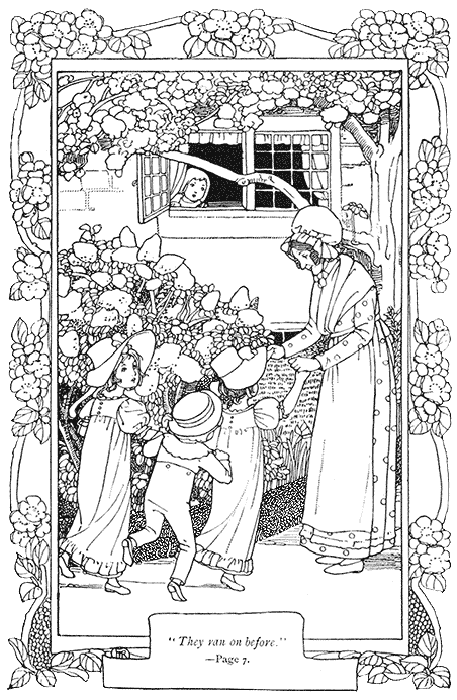
"They ran on before."—Page 7.
As soon as the children came in sight of Nurse's little cottage they ran on before to kiss Nurse, and to tell her that they were come to spend the day with her. The poor woman was very glad, because she loved Mr. Fairchild's children very dearly; she therefore kissed them, and took them to see her little grandson Tommy, who was asleep in the cradle. By this time Mr. and Mrs. Fairchild and Betty were come up, and whilst Betty prepared the dinner, Mr. and Mrs. Fairchild sat talking with Nurse at the door of the cottage.
Betty and Joan laid the cloth upon the fresh grass before the cottage-door, and when Joan had boiled some potatoes, Mr. and Mrs. Fairchild sat down to dinner with the children, after which the children went to play in the
"What a happy day we have had!" said Lucy as she walked home between her father and mother. "Everything has gone well with us since we set out, and everyone we have seen has been kind and good to us; and the weather has been so fine, and everything looks so pretty all around us!"
"Here were abundance of flowers."—Page 7.
Mrs. Fairchild's Story
The next morning, when Lucy and Emily were sitting at work with Mrs. Fairchild, Henry came in from his father's study.
"I have finished all my lessons, mamma," he said. "I have made all the haste I could because papa said that you would tell us a story to-day; and now I am come to hear it."
So Henry placed himself before his mother, and Lucy and Emily hearkened, whilst Mrs. Fairchild told her story.
"My mother died," said Mrs. Fairchild, "many years ago, when I was a very little child—so little that I remember nothing more of her than being taken to kiss her when she lay sick in bed. Soon afterwards I can recollect seeing her funeral procession go out of the garden-gate as I stood in the nursery window; and I also remember some days afterwards being taken to strew flowers upon her grave in the village churchyard.
"After my mother's death my father sent me to live with my aunts, Mrs. Grace and Mrs. Penelope, two old ladies, who, having never been married, had no families to take up their attention, and were so kind as to undertake
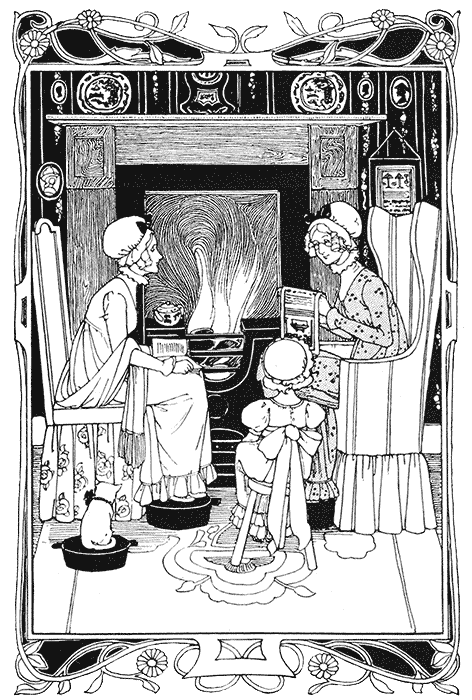
"Mrs. Grace taught me to sew, and Mrs. Penelope taught me to read."—Page 10.
"I was but a very little girl when I came to live with my aunts, and they kept me under their care till I was married. As far as they knew what was right, they took great pains with me. Mrs. Grace taught me to sew, and Mrs. Penelope taught me to read. I had a writing-and music-master, who came from Reading to teach me twice a week; and I was taught all kinds of household work by my aunts' maid. We spent one day exactly like another. I was made to rise early, and to dress myself very neatly, to breakfast with my aunts. At breakfast I was not allowed to speak one word. After breakfast I worked two hours with my Aunt Grace, and read an hour with my Aunt Penelope; we then, if it was fine weather, took a walk, or, if not, an airing in the coach—I, and my aunts, and little Shock, the lap-dog, together. At dinner I was not allowed to speak, and after dinner I attended my masters, or learned my tasks. The only time I had to play was while my aunts were dressing to go out, for they
"Now, although my aunts took so much pains with me in their way, I was a very naughty girl; I had no good principles."
"What do you mean by good principles?" asked Lucy.
"A person of good principles, my dear," said Mrs. Fairchild, "is one who does not do well for fear of the people he lives with, but from the fear of God. A child who has good principles will behave just the same when his mamma is out of the room as when she is looking at him—at least he will wish to do so; and if he is by his own wicked heart at any time tempted to sin, he will be grieved, although no person knows his sin. But when I lived with my aunts, if I could escape punishment, I did not care what naughty things I did.
"My Aunt Grace was very fond of Shock. She used to give me skim-milk at breakfast, but she gave Shock cream; and she often made me carry him when I went out a-walking. For this reason I hated him, and when we were out of my aunts' hearing I used to pull his tail and his ears and make the poor little thing howl sadly. My Aunt Penelope had a large tabby cat, which I also hated and used ill. I remember once being sent out of the dining-room to carry Shock his dinner, Shock being ill, and laid on a cushion in my aunts' bedroom. As I was going upstairs I was so unfortunate as to break the plate, which was fine blue china. I gathered up the pieces, and running up into the room, set them before Shock; after which I fetched the cat and shut her up in the room with Shock. When my aunts came up after dinner and found the broken plate, they were much surprised, and Mrs. Bridget, the favourite maid, was called to beat the cat for
"Besides those things which I have told you, I did many other naughty things. Whenever I was sent into the store-room, where the sugar and sweetmeats were kept, I always stole some. I used very often at night, when my aunts were gone out, and Mrs. Bridget also (for Mrs. Bridget generally went out when her mistress did to see some of her acquaintances in the town), to get up and go down into the kitchen, where I used to sit upon the housemaid's knee and eat toasted cheese and bread sopped in beer. Whenever my aunts found out any of my naughty tricks, they used to talk to me of my wickedness, and to tell me that if I went on in this manner I certainly should make God very angry. When I heard them talk of God's anger I used to be frightened, and resolved to do better; but I seldom kept any of my good resolutions. From day to day I went on in the same way, getting worse, I think, instead of better, until I was twelve years of age.
"One Saturday morning in the middle of summer my aunts called me to them and said, 'My dear, we are going from home, and shall not return till Monday morning. We cannot take you with us, as we could wish, because you have not been invited. Bridget will go with us, therefore there will be no person to keep you in order; but we hope, as you are not now a little child, that you may be trusted a few days by yourself.'
"Then they talked to me of the Commandments of God, and explained them to me, and spoke of the very great sin and danger of breaking them; and they talked to me till I really felt frightened, and determined that I would be good all the while they were from home.
"When the coach was ready my aunts set out, and I took my books and went to sit in the arbour with Shock, who was left under my care. I stayed in the arbour till evening, when one of the maid-servants brought me my supper. I gave part of it to Shock, and, when I had eaten the rest, went to bed. As I lay in my bed I felt very glad that I had gone through that evening without doing anything I thought naughty, and was sure I should do as well the next day.
"The next morning I was awakened by the bells ringing for church. I got up, ate my breakfast, and when I was dressed went with the maid to church. When we came home my dinner was given me. All this while I had kept my aunts' words pretty well in my memory, but they now began to wear a little from my mind. When I had done my dinner I went to play in the garden.
"Behind the garden, on the hill, was a little field full of cherry-trees. Cherries were now quite ripe. My aunts had given me leave every day to pick up a few cherries if there were any fallen from the trees, but I was not allowed to gather any. Accordingly I went to look if there were any cherries fallen. I found a few, and was eating them, when I heard somebody call me, 'Miss! Miss!' and, looking up, saw a little girl who was employed about the house, in weeding the garden, and running errands. My aunts had often forbid me to play or hold any discourse with this little girl, which was certainly very proper, as the education of the child was very different from that which had been given me. I was heedless of this command, and answered her by saying: 'What are you doing here, Nanny?'
"'There is a ladder, Miss,' she replied, 'against a tree at the upper end of the orchard. If you please, I will get up into it and throw you down some cherries.'
"At first I said 'No,' and then I said 'Yes.' So Nanny and I repaired to the tree in question, and Nanny mounted into the tree.
"'Oh, Miss! Miss!' said she as soon as she had reached the top of the ladder, 'I can see from where I am all the town, and both the churches; and here is such plenty of cherries! Do come up! Only just step on the ladder, and then you can sit on this bough and eat as many cherries as you please.'"
"And did you get into the tree, mamma?" said Lucy.
"Yes, my dear, I did," said Mrs. Fairchild; "and sat down on one of the branches to eat cherries and look about me."
"Oh, mamma!" said Emily, "suppose your aunts had come home then!"
"You shall hear, my dear," continued Mrs. Fairchild. "My aunts, as I thought, and as they expected, were not to come home till the Monday morning; but something happened whilst they were out—I forget what—which obliged them to return sooner than they had expected, and they got home just at the time when I was in the cherry-orchard. They called for me, but not finding me immediately, they sent the servants different ways to look for me. The person who happened to come to look for me in the cherry-orchard was Mrs. Bridget, who was the only one of the servants who would have told of me. She soon spied me with Nanny in the cherry-tree. She made us both come down, and dragged us by the arms into the presence of my aunts, who were exceedingly angry; I think I never saw them so angry. Nanny was given up to her mother to be punished; and I was shut up in a dark room, where I was kept several days upon bread and water. At the end of three days my aunts sent for me, and talked to me for a long time.
"'Is it not very strange at your age, niece,' said Mrs. Penelope, 'that you cannot be trusted for one day, after all the pains we have taken with you, after all we have taught you?'
"'And,' said my Aunt Grace, 'think of the shame and disgrace of climbing trees in such low company, after all the care and pains we have taken with you, and the delicate manner in which we have reared you!'
"In this way they talked to me, whilst I cried very much.
"'Indeed, indeed, Aunt Grace and Aunt Penelope,' I said, 'I did mean to behave well when you went out; I made many resolutions, but I broke them all; I wished to be good, but I could not be good.'
"When my aunts had talked to me a long time, they forgave me, and I was allowed to go about as usual, but I was not happy; I felt that I was naughty, and did not know how to make myself good. One afternoon, soon after all this had happened, while my aunts and I were drinking tea in the parlour, with the window open towards the garden, an old gentleman came in at the front gate, whom I had never seen before. He was dressed in plain black clothes, exceedingly clean; his gray hair curled about his neck, and in his hand he had a strong walking-stick. I was the first who saw him, as I was nearest the window, and I called to my aunts to look at him.
"'Why, it is my Cousin Thomas!' cried my Aunt Penelope. 'Who would have expected to have seen him here?'
"With that both my aunts ran out to meet him and bring him in. The old gentleman was a clergyman, and a near relation of our family, and had lived many years upon his living in the North, without seeing any of his relations.
"'I have often promised to come and see you, cousins,'
"My aunts told him how glad they were to see him, and presented me to him. He received me very kindly, and told me that he remembered my mother. The more I saw of this gentleman, the more pleased I was with him. He had many entertaining stories to tell; and he spoke of everybody in the kindest way possible. He often used to take me out with him a-walking, and show me the flowers, and teach me their names. One day he went out into the town, and bought a beautiful little Bible for me; and when he gave it to me he said: 'Read this, dear child, and pray to God to send His Holy Spirit to help you to understand it; and it shall be a lamp unto your feet, and a light unto your path.'"
"I know that verse, mamma," said Lucy; "it is in the Psalms."
"The old gentleman stayed with my aunts two months, and every day he used to take me with him to walk in the fields, the woods, and in the pleasant meadows on the banks of the Thames. His kind words to me at those times I shall never forget; he, with God's blessing, brought me to the knowledge of my dear Saviour, and showed me the wickedness of my own heart, and made me understand that I never could do any good but through the help of God."
"When the good old gentleman was gone, did you behave better than you did before he came, mamma?" said Lucy.
"After he left us, my dear, I was very different from what I was before," said Mrs. Fairchild. "I had learned to know the weakness of my heart, and to ask God to help me to be good; and when I had done wrong, I knew whose forgiveness to ask; and I do not think that I ever fell into those great sins which I had been guilty of before—such as lying, stealing, and deceiving my aunts."
On Envy
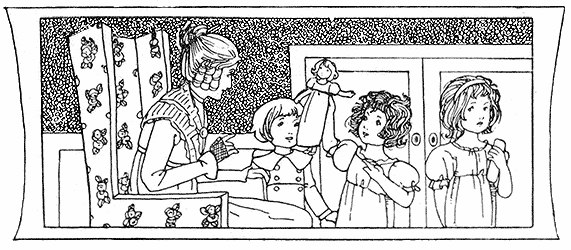
"Who can go with me to the village this morning," said Mr. Fairchild, one winter's day, "to carry this basket of little books to the school?"
"Lucy cannot go," said Mrs. Fairchild, "because her feet are sore with chilblains, and Henry has a bad cold; but Emily can go."
"Make haste, Emily," said Mr. Fairchild, "and put on your thick shoes and warm coat, for it is very cold."
As soon as Emily was ready, she set off with her father. It was a very cold day, and the ground was quite hard with the frost. Mr. Fairchild walked first, and Emily came after him with the little basket. They gave the basket to the schoolmaster, and returned. As they were coming back, Emily saw something bright upon the ground; and when she stooped to pick it up, she saw that it was a ring set round with little white shining stones.
"Oh, papa, papa!" she said, "see what I have found! What a beautiful ring!"
When Mr. Fairchild looked at it, he was quite surprised.
"Why, my dear," said he, "I think that this is Lady Noble's diamond ring; how came it to be lying in this place?"
Whilst they were looking at the ring they heard the sound of a carriage; it was Sir Charles Noble's, and Lady Noble was in it.
"Oh, Mr. Fairchild!" she called out of the window of the carriage, "I am in great trouble; I have lost my diamond ring, and it is of very great value. I went to the village this morning in the carriage, and as I came back, pulled off my glove to get sixpence out of my purse to give to a poor man somewhere in this lane, and I suppose that my ring dropped off at the time. I don't know what I shall do; Sir Charles will be sadly vexed."
"Make yourself quite happy, madam," said Mr. Fairchild, "here is your ring; Emily just this moment picked it up."
Lady Noble was exceedingly glad when she received back her ring. She thanked Emily twenty times, and said, "I think I have something in the carriage which you will like very much, Miss Emily; it is just come from London, and was intended for my daughter Augusta; but I will send for another for her."
So saying, she presented Emily with a new doll packed up in paper, and with it a little trunk, with a lock and key, full of clothes for the doll. Emily was so delighted that she almost forgot to thank Lady Noble; but Mr. Fairchild, who was not quite so much overjoyed as his daughter, remembered to return thanks for this pretty present.
So Lady Noble put the ring on her finger, and ordered the coachman to drive home.
"Oh, papa, papa!" said Emily, "how beautiful this doll is! I have just torn the paper a bit, and I can see its face; it has blue eyes and red lips, and hair like Henry's. Oh, how beautiful! Please, papa, to carry the box for me; I cannot carry both the box and the doll. Oh, this beautiful doll! this lovely doll!" So she went on talking
Her mother asked her several times where she had got this pretty doll; but Emily was too busy to answer her. When Mr. Fairchild came in with the trunk of clothes, he told all the story; how that Lady Noble had given Emily the doll for finding her diamond ring.
When Emily had unpacked the doll, she opened the box, which was full of as pretty doll's things as ever you saw.
Whilst Emily was examining all these things, Henry stood by admiring them and turning them about; but Lucy, after having once looked at the doll without touching it, went to a corner of the room, and sat down in her little chair without speaking a word.
"Come, Lucy," said Emily, "help me to dress my doll."
"Can't you dress it yourself?" answered Lucy, taking up a little book, and pretending to read.
"Come, Lucy," said Henry, "you never saw so beautiful a doll before."
"Don't tease me, Henry," said Lucy; "don't you see I am reading?"
"Put up your book now, Lucy," said Emily, "and come and help me to dress this sweet little doll. I will be its mamma, and you shall be its nurse, and it shall sleep between us in our bed."
"I don't want dolls in my bed," said Lucy; "don't tease me, Emily."
"Then Henry shall be its nurse," said Emily. "Come, Henry, we will go into our play-room, and put this pretty
"Do let me alone," answered Lucy; "I want to read."
So Henry and Emily went to play, and Lucy sat still in the corner of the parlour. After a few minutes her mamma, who was at work by the fire, looked at her, and saw that she was crying; the tears ran down her cheeks, and fell upon her book. Then Mrs. Fairchild called Lucy to her, and said:
"My dear child, you are crying; can you tell me what makes you unhappy?"
"Nothing, mamma," answered Lucy; "I am not unhappy."
"People do not cry when they are pleased and happy, my dear," said Mrs. Fairchild.
Lucy stood silent.
"I am your mother, my dear," said Mrs. Fairchild, "and I love you very much; if anything vexes you, whom should you tell it to but to your own mother?" Then Mrs. Fairchild kissed her, and put her arms round her.
Lucy began to cry more.
"Oh, mamma, mamma! dear mamma!" she said, "I don't know what vexes me, or why I have been crying."
"Are you speaking the truth?" said Mrs. Fairchild. "Do not hide anything from me. Is there anything in your heart, my dear child, do you think, which makes you unhappy?"
"Indeed, mamma," said Lucy, "I think there is. I am sorry that Emily has got that pretty doll. Pray do not hate me for it, mamma; I know it is wicked in me to be sorry that Emily is happy, but I feel that I cannot help it."
"My dear child," said Mrs. Fairchild, "I am glad you
"Do you ever feel envious, mamma?" said Lucy. "I never saw you unhappy because other people had better things than you had."
"My heart, my dear child," answered Mrs. Fairchild, "is no better than yours. There was a time when I was very envious. When I was first married I had no children for seven or eight years; I wished very much to have a baby, as you wished just now for Emily's doll; and whenever I saw a woman with a pretty baby in her arms, I was ready to cry for vexation."
"Do you ever feel any envy now, mamma?" said Lucy.
"I cannot say that I never feel it, my dear; but I bless God that this wicked passion has not the power over me which it used to have."
"Oh, mamma, mamma!" said Lucy, "how unhappy wickedness makes us! I have been very miserable this morning; and what for? only because of the naughtiness of my heart, for I have had nothing else to make me miserable."
Then Mrs. Fairchild took Lucy by the hand, and went into her closet, where they prayed that the Holy Spirit would take the wicked passion of envy out of Lucy's heart. And as they prayed in the name of the Lord Jesus Christ,
"She saw that it was a ring."——Page 19.
Story of the Apples
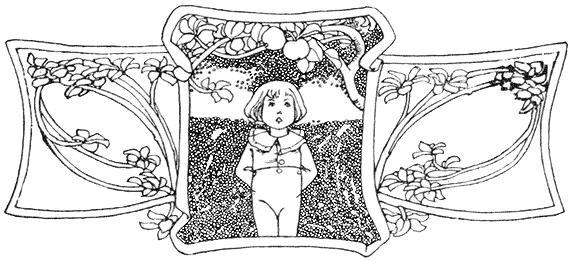
Just opposite Mr. Fairchild's parlour window was a young apple-tree, which had never yet brought forth any fruit; at length it produced two blossoms, from which came two apples. As these apples grew they became very beautiful, and promised to be very fine fruit.
"I desire," said Mr. Fairchild, one morning, to his children, "that none of you touch the apples on that young tree, for I wish to see what kind of fruit they will be when they are quite ripe."
That same evening, as Henry and his sisters were playing in the parlour window, Henry said:
"Those are beautiful apples indeed that are upon that tree."
"Do not look upon them, Henry," said Lucy.
"Why not, Lucy?" asked Henry.
"Because papa has forbidden us to meddle with them."
Henry. "Well, I am not going to meddle with them; I am only looking at them."
Lucy. "Oh! but if you look much at them, you will begin to wish for them, and may be tempted to take them at last."
Henry. "How can you think of any such thing, Lucy? Do you take me for a thief?"
The next evening the children were playing again in the parlour window. Henry said to his sister, "I dare say that those beautiful apples will taste very good when papa gathers them."
"There, now, Henry!" said Lucy; "I told you that the next thing would be wishing for those apples. Why do you look at them?"
"Well, and if I do wish for them, is there any harm in that," answered Henry, "if I do not touch them?"
Lucy. "Oh! but now you have set your heart upon them, the devil may tempt you to take one of them, as he tempted Eve to eat the forbidden fruit. You should not have looked at them, Henry."
Henry. "Oh, I shan't touch the apples! Don't be afraid."
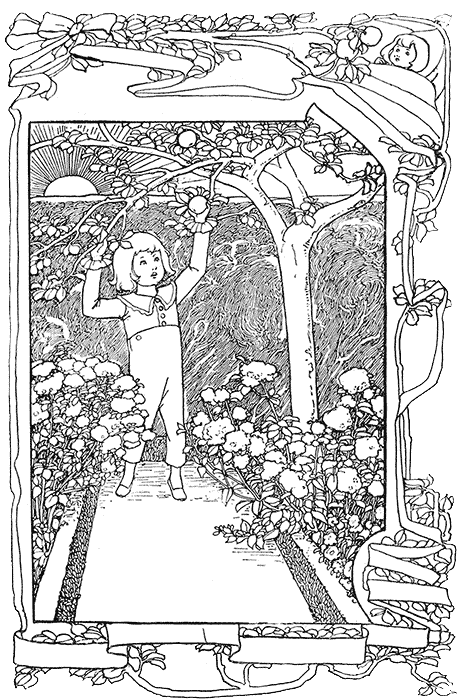
"There was one he could just reach."—Page 26.
Now Henry did not mean to steal the apples, it is true; but when people give way to sinful desires, their passions get so much power over them that they cannot say, "I will sin so far, and no further." That night, whenever Henry awoke, he thought of the beautiful apples. He got up before his parents, or his sisters, and went down into the garden. There was nobody up but John, who was in the stable. Henry went and stood under the apple-tree. He looked at the apples; there was one which he could just reach as he stood on his tip-toe. He stretched out his hand and plucked it from the tree, and ran with it, as he thought, out of sight behind the stable. Having eaten it in haste, he returned to the house.
When Mr. Fairchild got up, he went into the garden and looked at the apple-tree, and saw that one of the apples was missing; he looked round the tree to see if it had fallen down, and he perceived the mark of a child's
The children made no answer.
"If you have, any of you, taken the apple, and will tell me the truth, I will forgive you," said Mr. Fairchild.
"I did not take it, indeed, papa," said Lucy.
"And I did not take it," said Emily.
"I did not—indeed I did not," said Henry; but Henry looked very red when he spoke.
"Well," said Mr. Fairchild, "I must call in John, and ask him if he can tell who took the apple. But before John is called in, I tell you once more, my dear children, that if any of you took the apple and will confess it, even now I will freely forgive you."
Henry now wished to tell his father the truth; but he was ashamed to own his wickedness, and he hoped that it would never be found out that he was the thief.
When John came in, Mr. Fairchild said:
"John, there is one of the apples taken from the young apple-tree opposite the parlour window."
"Sir," said John, "I did not take it, but I think I can guess which way it went." Then John looked very hard at Henry, and Henry trembled and shook all over. "I saw Master Henry this morning run behind the stable with a large apple in his hand, and he stayed there till he had eaten it, and then he came out."
"Henry," said Mr. Fairchild, "is this true? Are you a thief—and a liar, too?" And Mr. Fairchild's voice was very terrible when he spoke.
Then Henry fell down upon his knees and confessed his wickedness.
"Go from my sight, bad boy!" said Mr. Fairchild; "if you had told the truth at first, I should have forgiven you, but now I will not forgive you."
Then Mr. Fairchild ordered John to take Henry, and lock him up in a little room at the top of the house, where he could not speak to any person. Poor Henry cried sadly, and Lucy and Emily cried too; but Mr. Fairchild would not excuse Henry.
"It is better," he said, "that he should be punished in this world whilst he is a little boy than grow up to be a liar and a thief."
So poor Henry was locked up by himself in a little room at the very top of the house. He sat down on a small box and cried sadly. He hoped that his mother and father would have sent him some breakfast; but they did not. At twelve o'clock he looked out of the window and saw his mother and sisters walking in the meadows at a little distance, and he saw his father come and fetch them in to dinner, as he supposed; and then he hoped that he should have some dinner sent him; but no dinner came. Some time after he saw Betty go down into the meadow to milk the cow; then he knew that it was five o'clock, and that it would soon be night; then he began to cry again.
"Oh! I am afraid," he said, "that papa will make me stay here all night! and I shall be alone, for God will not take care of me because of my wickedness."
Soon afterwards Henry saw the sun go down behind the hills, and he heard the rooks as they were going to rest in their nests at the top of some tall trees near the house. Soon afterwards it became dusk, and then quite dark. "Oh! dear, dear," said Henry, when he found himself sitting alone in the dark, "what a wicked boy I have been to-day! I stole an apple, and told two or three lies about it! I have made my papa and mamma unhappy, and my
Then Henry cried very sadly indeed. After which he knelt down and prayed that God would forgive him, till he found himself getting more happy in his mind.
When he got up from his prayer he heard the step of someone coming upstairs; he thought it was his mother, and his little heart was very glad indeed. Henry was right: it was indeed his mother come to see her poor little boy. He soon heard her unlock the door, and in a moment he ran into her arms.
"Is Henry sorry for his naughtiness?" said Mrs. Fairchild, as she sat down and took him upon her lap. "Are you sorry, my dear child, for your very great naughtiness?"
"Oh, indeed I am!" said Henry, sobbing and crying; "I am very sorry, pray forgive me. I have asked God to forgive me; and I think that He has heard my prayer, for I feel happier than I did."
"But have you thought, Henry, of the great wrong which you have done?"
"Yes, mamma, I have been thinking of it a great deal; I know that what I did this morning was a very great sin."
"Why do you say this morning?" said Mrs. Fairchild; "the sin that you committed was the work of several days."
"How, mamma?" said Henry; "I was not two minutes stealing the apple, and papa found it out before breakfast."
"Still, my dear," said Mrs. Fairchild, "that sin was the work of many days." Henry listened to his mother, and she went on speaking: "Do you remember those little chickens which came out of the eggs in the hen's nest last Monday morning?"
"Yes, mamma," said Henry.
"Do you think," said Mrs. Fairchild, "that they were made the moment before they came out?"
"No, mamma," said Henry; "papa said they were growing in the egg-shell a long time before they came out alive."
Mrs. Fairchild. "In the same manner the great sin you committed this morning was growing in your heart some days before it came out."
"How, mamma?" said Henry. "I do not understand."
Mrs. Fairchild. "All wrong things which we do are first formed in our hearts; and sometimes our sins are very long before they come to their full growth. The great sin you committed this morning began to be formed in your heart three days ago. Do you remember that that very day in which your father forbade you to touch the apples, you stood in the parlour window and looked at them, and you admired their beautiful appearance? This was the beginning of your sin. Your sister Lucy told you at the time not to look at them, and she did well; for by looking at forbidden things we are led to desire them, and when we desire them very much we proceed to take them. Your father forbade you to touch these apples; therefore, my dear child, you ought not to have allowed yourself to think of them for one moment. When you first thought about them, you did not suppose that this thought would end in so very great a sin as you have now been guilty of."
"Oh, mamma," said Henry, "I will try to remember what you have said to me all my life."
Mrs. Fairchild kissed little Henry then, and said:
"God bless you, my child, and give you a holy heart, which may never think or design any evil."
Mrs. Fairchild then led Henry down into the parlour, where
"Henry," said Mr. Fairchild, "you have had a sad day of it; but I did not punish you, my child, because I do not love you, but because I do."
Then Mr. Fairchild cut a large piece of bread-and-butter for Henry, which he was very glad of, for he was very hungry.
"Behind the stable."—Page 26.
Story of an Unhappy Day
It happened that Mr. and Mrs. Fairchild had had nothing for a long time to interrupt them in the care and management of their children; so that they had had it in their power to teach them and guard them from all evil influences. I will tell you exactly how they lived and spent their time; Emily and Lucy slept together in a little closet on one side of their mother and father's room; and Henry had a little room on the other side, where he slept. As soon as the children got up, they used to go into their father and mother's room to prayers; after which Henry went with Mr. Fairchild into the garden, whilst Lucy and Emily made their beds and rubbed the furniture; afterwards they all met at breakfast, dressed neatly but very plain. At breakfast the children ate what their mother gave them, and seldom spoke till they were spoken to. After breakfast Betty and John were called in and all went to prayers. Then Henry went into his father's study to his lessons; and Lucy and Emily stayed with their mother, working and reading till twelve o'clock, when they used to go out to take a walk all together; sometimes they went to the schools, and sometimes they went to see a poor
Now all this time the little ones were in the presence of their father and mother, and kept carefully from doing openly naughty things by the watchful eyes of their dear parents. One day it happened, when they had been living a long time in this happy way, that Lucy said to Mrs. Fairchild, "Mamma, I think that Emily and Henry and I are much better children than we used to be; we have not been punished for a very long time."
"My dear," said Mrs. Fairchild, "do not boast or think well of yourself; it is always a bad sign when people boast of themselves. If you have not done any very naughty thing lately, it is not because there is any goodness or wisdom in you, but because your papa and I have been always with you, carefully watching and guiding you from morning till night."
That same evening a letter came for Mr. Fairchild, from an old lady who lived about four miles off, begging that he and Mrs. Fairchild would come over, if it was convenient, to see her the next day to settle some business of consequence. This old lady's name was Mrs. Goodriche, and she lived in a very neat little house just under a hill, with Sukey her maid. It was the very house in which Mrs. Howard lived about fifty years ago, as we shall hear later on.
When Mr. Fairchild got the letter he ordered John to
Now it happened, very unluckily, that Mrs. Fairchild, at this time, had given Betty leave to go for two or three days to see her father, and she was not yet returned; so there was nobody left in the house to take care of the children but John. And now I will tell you how these children spent the day whilst their father and mother were out.
When Lucy and Emily awoke, they began playing in their beds. Emily made babies of the pillows, and Lucy pulled off the sheets and tied them round her, in imitation of Lady Noble's long-trained gown; and thus they spent their time till Henry came to the door to tell them that breakfast was ready.
"And I have persuaded John," said Henry, "to make us toast and butter; and it looks so nice! Make haste and come down; do, sisters, do!" And he continued to drum upon the door with a stick until his sisters were dressed.
Emily and Lucy put on their clothes as quickly as they could and went downstairs with their brother, without praying, washing themselves, combing their hair, making their bed, or doing any one thing they ought to have done.
John had, indeed, made a large quantity of toast and butter; but the children were not satisfied with what John had made, for when they had eaten all that he had provided, yet they would toast more themselves, and put butter on it before the fire as they had seen Betty do; so the hearth was covered with crumbs and grease, and they wasted almost as much as they ate.
After breakfast, they took out their books to learn their lessons; but they had eaten so much that they could not learn with any pleasure; and Lucy, who thought she would be very clever, began to scold Henry and Emily for their idleness; and Henry and Emily, in their turn, found fault with her; so that they began to dispute, and would soon, I fear, have proceeded to something worse if Henry had not spied a little pig in the garden.
"Oh, sisters," said he, "there is a pig in the garden, in the flower-bed! Look! look! And what mischief it will do! Papa will be very angry. Come, sisters, let us hunt it out."
So saying, down went Henry's book, and away he ran into the garden, followed by Emily and Lucy, running as fast as they could. They soon drove the pig out of the garden, and it would have been well if they had stopped there; but, instead of that, they followed it down into the lane. Now, there was a place where a spring ran across the lane, over which was a narrow bridge for the use of people that way. Now the pig did not stand to look for the bridge, but went splash, splash, through the midst of the water: and after him went Henry, Lucy, and Emily, though they were up to their knees in mud and dirt.
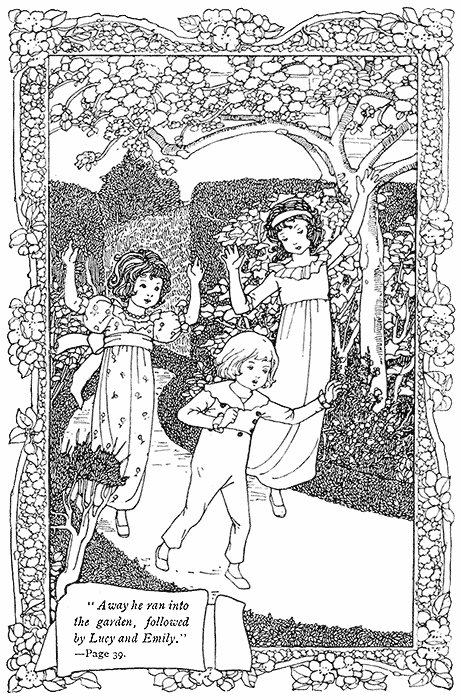
"Away he ran into the garden, followed by Lucy and Emily."—Page 39.
In this dirty condition they ran on till they came close to a house where a farmer and his wife lived whose name was Freeman. These people were not such as lived in the fear of God, neither did they bring up their children well; on which account Mr. Fairchild had often forbidden Lucy and Emily and Henry to go to their house. However, when the children were opposite this house, Mrs. Freeman saw them through the kitchen window; and seeing they were covered with mud, she came out and brought them in, and dried their clothes by the fire; which
Mrs. Freeman would have had them stay all day and play with their children; and Henry and his sisters would have been very glad to have accepted her invitation, but they were afraid: so Mrs. Freeman let them go; but, before they went, she gave them each a large piece of cake, and something sweet to drink, which she said would do them good. Now this sweet stuff was cider; and as they were never used to drink anything but water, it made them quite giddy for a little while; so that when they got back into the lane, first one tumbled down, and then another; and their faces became flushed, and their heads began to ache, so that they were forced to sit down for a time under a tree, on the side of the lane, and there they were when John came to find them; for John, who was in the stable when they ran out of the garden, was much frightened when he returned to the house, and could not find them there.
"Ah, you naughty children!" said he, when he found them, "you have almost frightened me out of my life! Where have you been?"
"We have been in the lane," said Lucy, blushing.
This was not all the truth; but one fault always leads to another.
So John brought them home, and locked them up in their play-room, whilst he got their dinner ready.
When the children found themselves shut up in their play-room, and could not get out, they sat themselves down, and began to think how naughty they had been. They were silent for a few minutes; at last Lucy spoke:
"Oh, Henry! oh, Emily! how naughty we have been! And yet I thought I would be so good when papa and
Then all the children began to cry. At length Henry said:
"I'll tell you what we will do, Lucy; we will be good all the evening; we will not do one naughty thing."
"So we will, Henry," said Emily. "When John lets us out, how good we will be! and then we can tell the truth, that we were naughty in the morning, but we were good all the evening."
John made some nice apple-dumplings for the children, and when they were ready, and he had put some butter and sugar upon them (for John was a good-natured man), he fetched the children down; and after they had each ate as much apple-dumpling as he thought proper, he told them they might play in the barn, bidding them not to stir out of it till supper-time.
Henry and Lucy and Emily were delighted with this permission; and, as Lucy ran along to the barn with her brother and sister, she said:
"Now let us be very good. We are not to do anything naughty all this evening."
"We will be very good indeed," answered Emily.
"Better than we ever were in all our lives," added Henry.
So they all went into the barn, and when John fastened them in he said to himself, "Sure they will be safe now, till I have looked to the pigs and milked the cow; for there is nothing in the barn but straw and hay, and they cannot hurt themselves with that, sure."
But John was mistaken. As soon as he was gone, Henry spied a swing, which Mr. Fairchild had made in the barn for the children, but which he never allowed them to use when he was not with them, because swings are very dangerous things, unless there are very careful persons to
"Oh, Lucy!" said Henry, "there is the swing. There can be no harm in our swinging a little. If papa was here, I am sure he would let us swing. If you and Emily will help to lift me up, I will untie it and let it down, and then we will swing so nicely."
So Emily and Lucy lifted Henry up, and he untied the swing, and let it down into its right place; but as he was getting down, his coat caught upon a bit of wood on the side of the barn, and was much torn. However, the children did not trouble themselves very much about this accident. First Emily got into the swing, then Henry, then Lucy; and then Emily would get in again.
"Now, Lucy," she said, "swing me high, and I will shut my eyes; you can't think how pleasant it is to swing with one's eyes shut. Swing me higher! swing me higher!"
So she went on calling to Lucy, and Lucy trying to swing her higher and higher, till at last the swing turned, and down came Emily to the floor. There happened providentially to be some straw on the floor, or she would have been killed. As it was, however, she was sadly hurt; she lay for some minutes without speaking, and her mouth and nose poured out blood.
Henry and Lucy thought she was dead; and, oh! how frightened they were! They screamed so violently that John came running to see what was the matter; and, poor man! he was sadly frightened when he saw Emily lying on the floor covered with blood. He lifted her up and brought her into the house; he saw she was not dead, but he did not know how much she might be hurt. When he had washed her face from the blood, and given her a little water to drink, she recovered a little; but her nose and one
When Emily was a little recovered, John placed her in a little chair by the kitchen fire, and he took his blue pocket-handkerchief and tied Lucy and Henry to the kitchen-table, saying:
"You unlucky rogues! you have given me trouble enough to-day—that you have. I will not let you go out of my sight again till master and mistress come home. Thank God you have not killed your sister! Who would have thought of your loosing the swing!"
In this manner Henry and Lucy and Emily remained till it was nearly dark, and then they heard the sound of the horse's feet coming up to the kitchen door, for Mr. and Mrs. Fairchild were come. John hastened to untie the children, who trembled from head to foot.
"Oh, John, John! what shall we do—what shall we say?" said Lucy.
"The truth, the truth, and all the truth," said John; "it is the best thing you can do now."
When Mr. and Mrs. Fairchild came in, they thought their children would have run to meet them; but they were so conscious of their naughtiness that they all crept behind John, and Emily hid her face.
"Emily, Lucy, Henry!" said Mrs. Fairchild, "you keep back; what is the matter?"
"Oh, mamma, mamma! papa, papa!" said Lucy, coming forward, "we have been very wicked children to-day; we are not fit to come near you."
"What have you done, Lucy?" said Mrs. Fairchild. "Tell us the whole truth."
Then Lucy told her parents everything which she and her brother and sister had done; she did not hide anything from them. You may be sure that Mr. and Mrs.
"I am glad that you have told the truth, my children," said Mr. Fairchild; "but the faults that you have committed are very serious ones. You have disobeyed your parents; and, in consequence of your disobedience, Emily might have lost her life, if God had not been very merciful to you. And now go all of you to your beds."
The children did as their father bade them, and went silently up to their beds, where they cried sadly, thinking upon their naughtiness. The next morning they all three came into their mother's room, and begged her to kiss them and forgive them.
"I cannot refuse to pardon you, my children," said Mrs. Fairchild; "but, indeed, you made me and your father very unhappy last night."
Then the children looked at their mother's eyes, and they were full of tears; and they felt more and more sorry to think how greatly they had grieved their kind mother; and when Mrs. Fairchild kissed them, and put her arms round their necks, they cried more than ever.
Story of Ambition; or, The Wish to be Great
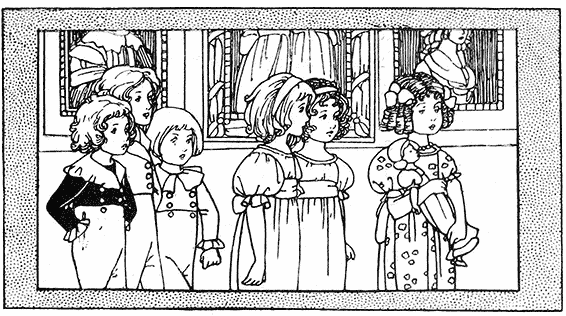
Twice every year Sir Charles and Lady Noble used to invite Mr. and Mrs. Fairchild and their children to spend a day with them at their house. Mr. and Mrs. Fairchild did not much like to go, because Sir Charles and his lady were very proud, and their children were not brought up in the fear of God; yet, as the visit only happened twice a year, Mr. Fairchild thought it better to go than to have a quarrel with his neighbour. Mrs. Fairchild always had two plain muslin frocks, with white mittens and neat black shoes, for Lucy and Emily to wear when they went to see Lady Noble. As Mr. Fairchild's house was as much as two miles distance from Sir Charles Noble's, Sir Charles always used to send his carriage for them, and to bring them back again at night.
One morning, just at breakfast-time, Mr. Fairchild came into the parlour, saying to Mrs. Fairchild:
"Here, my dear, is a note from Sir Charles Noble, inviting us to spend the day to-morrow, and the children."
"Well, my dear," said Mrs. Fairchild, "as Sir Charles Noble has been so kind as to ask us, we must not offend him by refusing to go."
The next morning Mr. Fairchild desired his wife and children to be ready at twelve o'clock, which was the time fixed for the coach to be at Mr. Fairchild's door. Accordingly, soon after eleven, Mrs. Fairchild dressed Lucy and Emily, and made them sit quietly down till the carriage came. As Lucy and Emily sat in the corner of the room, Lucy looked at Emily, and said:
"Sister, how pretty you look!"
"And how nice you look, Lucy!" said Emily. "These frocks are very pretty, and make us look very well."
"My dear little girls," said Mrs. Fairchild, who overheard what they said to each other, "do not be conceited because you have got your best frocks on. You now think well of yourselves, because you fancy you are well dressed; by-and-by, when you get to Lady Noble's, you will find Miss Augusta much finer dressed than yourselves; then you will be out of humour with yourselves for as little reason as you now are pleased."
At this moment Henry came in his Sunday coat to tell his mother that Sir Charles Noble's carriage was come. Mrs. Fairchild was quite ready; and Lucy and Emily were in such a hurry that Emily had nearly tumbled downstairs over her sister, and Lucy was upon the point of slipping down on the step of the hall-door; however, they all got into the coach without any accident, and the coachman drove away, and that so rapidly that they soon came in sight of Sir Charles Noble's house.
As it is not likely that you ever saw Sir Charles Noble's house, I will give you some account of it. It is a very large house, built of smooth white stone; it stands in a fine park, or green lawn, scattered over with tall trees and
When the carriage drove up to the hall-door, a smart footman came out, opened the carriage-door, and showed Mr. and Mrs. Fairchild through a great many rooms into a grand parlour, where Lady Noble was sitting upon a sofa, by a large fire, with several other ladies, all of whom were handsomely dressed. Now, as I told you before, Lady Noble was a proud woman; so she did not take much notice of Mrs. Fairchild when she came in, although she ordered the servants to set a chair for her. Miss Augusta Noble was seated on the sofa by her mamma, playing with a very beautiful wax doll; and her two brothers, William and Edward, were standing by her; but they never came forward to Mrs. Fairchild's children to say that they were glad to see them, or to show them any kind of civility. If children knew how disagreeable they make themselves when they are rude and ill-behaved, surely they would never be so, but would strive to be civil and courteous to everyone.
Soon after Mrs. Fairchild was seated, a servant came to say that Miss Noble's and Master William's and Master Edward's dinners were ready.
"Go, Augusta," said Lady Noble, "to your dinner, and take Master and Misses Fairchild with you; and, after you have dined, show them your playthings and your baby-house."
Miss Augusta got up, and, as she passed by Emily and Lucy, she said in a very haughty way, "Mamma says you must come with me."
So Emily and Lucy followed Miss Augusta, and the little boys came after them. She went up a pair of grand stairs, and along a very long gallery full of pictures, till they came to a large room, where Miss Augusta's governess
"Here are Mrs. Fairchild's children come to dine with me, ma'am," said Miss Augusta, as she opened the door; "this is Lucy, and this is Emily, and that is Henry."
The governess did not take much notice of Mrs. Fairchild's children, but said, "Miss Augusta, I wish you would shut the door after you, for it is very cold."
I do not know whether Miss Augusta heard her governess, but she never offered to go back to shut the door.
The governess, whose name was Beaumont, then called to Master Edward, who was just coming in, to shut the door after him.
"You may shut it yourself, if you want it shut," answered the rude boy.
When Lucy heard this she immediately ran and shut the door, upon which Miss Beaumont looked more civilly at her than she had done before, and thanked her for her attention.
Whilst Lucy was shutting the door, Miss Augusta began to stir the fire.
"Miss Augusta," said the lady, "has not your mamma often forbidden you to touch the fire? Some day you will set your frock on fire."
Miss Augusta did not heed what her governess said this time any more than the last, but went on raking the fire; till at length Miss Beaumont, fearing some mischief, forced the poker out of her hand. Miss Augusta looked very much displeased, and was going to make a pert answer, when her mother and the other ladies came into the room to
"Are my children well behaved?" said Lady Noble, speaking to the governess. "I thought I heard you finding fault with Augusta when I came in."
"Oh, no, ma'am," said the governess; "Miss Augusta is a good young lady; I seldom have reason to find fault with her."
Lucy and Emily looked at Miss Beaumont, and wondered to hear her say that Miss Augusta was good, but they were silent.
"I am happy to say," said Lady Noble, speaking to Mrs. Fairchild, "that mine are promising children. Augusta has a good heart."
Just at that moment a servant came in, and set a plate of apples on the table.
"Miss Beaumont," said Lady Noble, "take care that Augusta does not eat above one apple; you know that she was unwell yesterday from eating too many."
Miss Beaumont assured Lady Noble that she would attend to her wishes, and the ladies left the room. When they were gone the governess gave two apples to each of the children, excepting Augusta, to whom she gave only one. The rest of the apples she took out of the plate, and put in her work-bag for her own eating.
When everyone had done dinner and the table-cloth was taken away, Lady Noble's children got up and left the table, and Henry and Emily were following, but Lucy whispered to them to say grace. Accordingly they stood still by the table, and, putting their hands together, they said the grace which they had been used to say after dinner at home.
"What are you doing?" said Augusta.
"We are saying grace," answered Lucy.
"Oh, I forgot," said Augusta; "your mamma is religious, and makes you do all these things. How tiresome it must be! And where's the use of it? It will be time enough to be religious, you know, when we get old, and expect to die."
"Oh, but," said little Henry, "perhaps we may never live to be old; many children die younger than we are."
Whilst Henry was speaking, William and Edward stood listening to him with their mouths wide open, and when he had finished his speech they broke out into a fit of laughter.
"When our parson dies, you shall be parson, Henry," said Edward; "but I'll never go to church when you preach."
"No, he shan't be parson—he shall be clerk," said William; "then he will have all the graves to dig."
"I'll tell you what," said Henry: "your mamma was never worse out in her life than when she said hers were good children."
"Take that for your sauciness, you little beggar!" said Master William, giving Henry a blow on the side of the head; and he would have given him several more had not Lucy and Emily run in between.
"If you fight in this room, boys, I shall tell my mamma," said Miss Augusta. "Come, go downstairs; we don't want you here. Go and feed your dogs."
William and Edward accordingly went off, and left the little girls and Henry to play quietly. Lucy and Emily were very much pleased with the baby-house and the dolls, and Henry got upon the rocking-horse; and so they amused themselves for a while. At length Miss Beaumont, who had been sitting at work, went to fetch a book from an adjoining room. As soon as she was out of sight, Miss
"Oh, Miss Augusta, what are you doing?" said Emily.
"She is stealing," said Henry.
"Stealing!" said Miss Augusta, coming back into the corner of the room where the baby-house was; "what a vulgar boy you are! What words you use!"
"You don't like to be called a thief," said Henry, "though you are not ashamed to steal, I see."
"Do, Miss Augusta, put the apples back," said Emily; "your mamma said you must have but one, you know, to-day, and you have had one already."
"Hush, hush!" said Miss Augusta; "here's my governess coming back. Don't say a word."
So saying, she slipped the apples into the bosom of her frock, and ran out of the room.
"Where are you going, Miss Augusta?" exclaimed Miss Beaumont.
"Mamma has sent for me," answered Augusta; "I shall be back immediately."
When Miss Augusta had eaten the apples, she came back quietly, and sat down to play with Lucy and Emily as if nothing had happened. Soon after the governess looked into her work-bag, and found that two of the apples were gone.
"Miss Augusta," she said, "you have taken two apples: there are two gone."
"I have not touched them," said Miss Augusta.
"Some of you have," said Miss Beaumont, looking at the other children.
"I can't tell who has," said Miss Augusta; "but I know it was not me."
Lucy and Emily felt very angry, but they did not speak;
"I see," said Miss Beaumont, "that some of you have taken the apples, and I desire that you Miss Emily, and you Miss Lucy, and you Master Henry, will come and sit down quietly by me, for I don't know what mischief you may do next."
Now the governess did not really suppose that Mrs. Fairchild's children had taken the apples; but she chose to scold them because she was not afraid of offending their parents, but she was very much afraid of offending Miss Augusta and her mamma. So she made Lucy and Emily and Henry sit quietly down by her side before the fire. It was now getting dark, and a maid-servant came in with a candle, and, setting it upon the table, said,
"Miss Augusta, it is time for you to be dressed to go down to tea with the ladies."
"Well," said Miss Augusta, "bring me my clothes, and I will be dressed by the fireside."
The servant then went into the closet I before spoke of, and soon returned with a beautiful muslin frock, wrought with flowers, a rose-coloured sash and shoes, and a pearl necklace. Emily and Lucy had never seen such fine clothes before; and when they saw Miss Augusta dressed in them they could not help looking at their own plain frocks and black shoes and feeling quite ashamed of them, though there was no more reason to be ashamed of their clothes at that time than there was of their being proud of them when they were first put on.
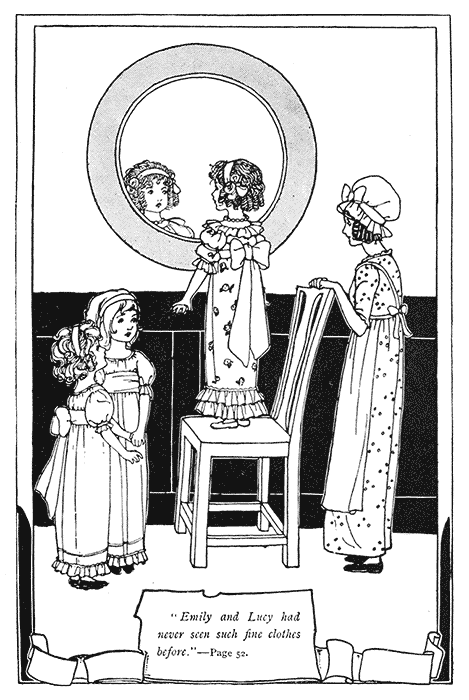
"Emily and Lucy had never seen such fine clothes before."—Page 52.
When Miss Augusta was dressed, she said to the maid-servant,
"Take the candle and light me down to the hall." Then, turning to Emily and Lucy, she added, "Will you
So Miss Augusta walked first, with the maid-servant, and Henry, and Lucy, and Emily followed. They went along the great gallery, and down the stairs, and through several fine rooms, all lighted up with many lamps and candles, till they came to the door where Sir Charles and Lady Noble, and Mr. and Mrs. Fairchild, and a great many ladies and gentlemen were sitting in a circle round a fire. Lucy and Emily and Henry went and stood behind their mother's chair, and nobody took any notice of them; but Miss Augusta went in among the company, curtseying to one, giving her hand to another, and nodding and smiling at another. "What a charming girl Miss Augusta has grown!" said one of the ladies. "Your daughter, Lady Noble, will be quite a beauty," said another. "What an elegant frock Miss Augusta has on!" said a third lady. "That rose-coloured sash makes her sweet complexion more lovely than ever," said one of the gentlemen; and so they went on flattering her till she grew more conceited and full of herself than ever; and during all the rest of the evening she took no more notice of Mrs. Fairchild's children than if they had not been in the room.
After the company had all drank tea, several tables were set out, and the ladies and gentlemen began to make parties for playing at cards. As Mr. and Mrs. Fairchild never played at cards, they asked for the coach, and, when it was ready, wished Sir Charles and Lady Noble good-night, and came away.
"Well," said little Henry, "Sir Charles Noble's may be a very fine house, and everything may be very fine in it,
Now all this while Emily and Lucy did not speak a word; and what do you think was the reason? It was this: that the sight of Miss Augusta's fine clothes and playthings, and beautiful rooms in which she lived, with the number of people she had to attend her, had made them both out of humour with their own humble way of living, and small house and plain clothes. Their hearts were full of the desire of being great, like Miss Augusta, and having things like her; but they did not dare to tell their thoughts to their mother.
When they got home, Mrs. Fairchild gave a baked apple to each of the children, and some warm milk and water to drink; and after they had prayed, she sent them to bed. When Emily and Lucy had got into bed, and Betty had taken away the candle, Lucy said,
"Oh, Emily! I wish our papa and mamma were like Sir Charles and Lady Noble. What a beautiful frock that was that Miss Augusta had on! and I dare say that she has a great many more like it. And that sash!—I never saw so fine a colour."
Emily. "And then the ladies and gentlemen said she was so pretty, and even her governess did not dare to find fault with her!"
Lucy. "But Betty finds fault with us, and John, too; and papa and mamma make us work so hard! and we have such coarse clothes! Even our best frocks are not so good as those Miss Augusta wears every morning."
In this manner they went on talking till Mrs. Fairchild came upstairs and into their room. As they had thick curtains round their bed, it being very cold weather, they did not see their mamma come into the room, and so she
Lucy. "Yes, mamma, I remember it very well; you told me it was envy. But I do not feel envy now; I do not wish to take Miss Augusta's things from her, or to hurt her; Emily and I only wish to be like her, and to have the same things she has."
"What you now feel, my dears," said Mrs. Fairchild, "is not exactly envy, though it is very like it; it is what is called ambition. Ambition is the desire to be greater than we are. Ambition makes people unhappy and discontented with what they are and what they have."
"I do not exactly understand, mamma," said Emily, "what ambition makes people do."
"Why, my dear," said Mrs. Fairchild, "suppose that Betty was ambitious, she would be discontented at being a servant, and would want to be as high as her mistress; and if I were ambitious, I should strive to be equal to Lady Noble; and Lady Noble would want to be as great as the duchess, who lives at that beautiful house which we passed by when we went to see your grandmamma; the duchess, if she were ambitious, would wish to be like the Queen."
Emily. "But the Queen could be no higher, so she could not be ambitious."
Mrs. Fairchild. "My dear, you are much mistaken. When you are old enough to read history, you will find that when Kings and Queens are ambitious, it does more harm even than when little people are so. When Kings are ambitious, they desire to be greater than other Kings, and then they fight with them, and cause many cruel wars and dreadful miseries. So, my dear children, you see that there is no end to the mischief which ambition does; and whenever this desire to be great comes, it makes us unhappy, and in the end ruins us."
Then Mrs. Fairchild showed to her children how much God loves people who are lowly and humble; and she knelt by the bedside and prayed that God would take all desire to be great out of her dear little girls' hearts.
"Dressed."—Page 52.
The All-Seeing God
I must tell you of a sad temptation into which Emily fell about this time. It is a sad story, but you shall hear it.
There was a room in Mrs. Fairchild's house which was not often used. In this room was a closet, full of shelves, where Mrs. Fairchild used to keep her sugar and tea, and sweetmeats and pickles, and many other things. Now, as Betty was very honest, and John, too, Mrs. Fairchild would often leave this closet unlocked for weeks together, and never missed anything out of it. One day, at the time that damsons were ripe, Mrs. Fairchild and Betty boiled up a great many damsons in sugar, to use in the winter; and when they had put them in jars and tied them down, they put them in the closet I before spoke of. Emily and Lucy saw their mother boil the damsons, and helped Betty to cover them and carry them to the closet. As Emily was carrying one of the jars she perceived that it was tied down so loosely that she could put in her finger and get at the fruit. Accordingly, she took out one of the damsons and ate it. It was so nice that she was tempted to take another; and was going even to take aShe then opened the closet door, and took two or three damsons, which she ate in great haste. She then went to her own room, and washed her hands and her mouth, and went down into the parlour, where Mr. and Mrs. Fairchild were just going to tea.
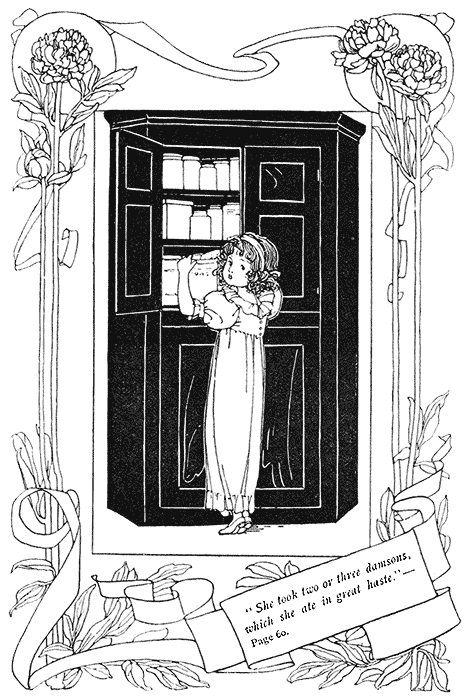
"She took two or three damsons, which she ate in great haste."—Page 60.
Although her parents never suspected what naughty thing Emily had been doing, and behaved just as usual to her, yet Emily felt frightened and uneasy before them; and every time they spoke to her, though it was only to ask the commonest question, she stared and looked frightened.
I am sorry to say that the next day, when it was beginning to get dark, Emily went again to the closet and took some more damsons; and so she did for several days, though she knew she was doing wrong.
On the Sunday following, it happened to be so rainy that nobody could go to church, in consequence of which Mr. Fairchild called all the family into the parlour and read the Morning Service and a sermon. Some sermons are hard and difficult for children to understand, but this
The meaning of these verses was explained in the sermon. It was first shown that the Lord is a spirit; and, secondly, that there is no place where He is not: that if a person could go up into heaven, he would find God there; if he were to go down to hell, there also would he find God: that God is in every part of the earth, and of the sea, and of the sky; and that, being always present in every place, He knows everything we do and everything we say, and even every thought of our hearts, however secret we may think it. Then the sermon went on to show how foolish and mad it is for people to do wicked things in secret and dark places, trusting that God will not know it. "If I say, Surely the darkness shall cover me, even the night shall be light about me," for no night is dark unto God.
While Mr. Fairchild was reading, Emily felt frightened and unhappy, thinking of the wickedness she was guilty of every day; and she even thought that she never would be guilty again of the same sin; but when the evening came all her good resolutions left her, for she confided in her own strength; and she went again to the room where the damsons were kept. However, when she came to the door of the closet, she thought of the sermon which her father had read in the morning, and stood still a few moments to consider what she should do. "There is nobody in this room," she said; "and nobody sees me, it is true, but God is in this room; He sees me; His eye is now upon me. I will not take any more damsons. I will go back, I think. But yet, as I am come so far, and am just got to the closet, I will just take one damson—it shall be the last. I will never come here again without mamma's leave." So she opened the closet door and took one damson, and then
When Emily got into the parlour, she immediately saw the red stain on her frock. She did not stay till it was observed, but ran out again instantly, and went upstairs and washed her frock. As the stain had not dried in, it came out with very little trouble; but not till Emily had wetted all the bosom of her frock and sleeves, and that so much that all her inner clothes were thoroughly wet, even to the skin; to hide this, she put her pinafore on to go down to tea. When she came down, "Where have you been, Emily?" said Mrs. Fairchild; "we have almost done tea."
"I have been playing with the cat upstairs, mamma," said Emily. But when she told this sad untruth she felt very unhappy, and her complexion changed once or twice from red to pale.
It was a cold evening, and Emily kept as much away from the fire and candle as she could, lest any spots should be left in her frock, and her mother should see them. She had no opportunity, therefore, of drying or warming herself, and she soon began to feel quite chilled and trembling. Soon after a burning heat came into the palms of her hands, and a soreness about her throat; however, she did not dare to complain, but sat till bedtime, getting every minute more and more uncomfortable.
It was some time after she was in bed, and even after her parents came to bed, before she could sleep; at last she fell asleep, but her sleep was disturbed by
"Oh, my dear," said Mrs. Fairchild, "this child is in a burning fever! Only feel her hands!"
It was true, indeed; and when Mr. Fairchild felt her, he was so much frightened that he resolved to watch by her all night, and in the morning, as soon as it was light, to send John for the doctor. But what do you suppose Emily felt all this time, knowing, as she did, how she had brought on this illness, and how she had deceived for many days this dear father and mother, who now gave up their own rest to attend her?
Emily continued to get worse during the night: neither was the doctor able, when he came, to stop the fever which followed the severe chill she had taken, though he did his uttermost. It would have grieved you to have seen poor Lucy and Henry. They could neither read nor play, they missed their dear sister so much. They continually said to each other, "Oh, Emily! dear Emily! there is no pleasure without our dear Emily!"
The next day, when the doctor came, Emily was so very ill that he thought it right that Lucy and Henry should be sent out of the house. Accordingly, John got the horse ready, and took them to Mrs. Goodriche's. Poor Lucy and Henry! How bitterly they cried when they went out of the gate, thinking that perhaps they might never see their dear Emily any more! It was a terrible trial to poor Mr. and Mrs. Fairchild. They had no comfort but in praying and watching by poor Emily's bed. And all
Emily was exceedingly ill for nine days, and everyone feared that if the fever continued a few days longer she must die; when, by the mercy of God, it suddenly left her, and she fell asleep and continued sleeping for many hours.
When she awoke, she was very weak, but her fever was gone. She kissed her parents, and wanted to tell them of the naughty things she had done, which had been the cause of the illness, but they would not allow her to speak.
From that day she got better, and at the end of another week was so well that she was able to sit up and tell Mrs. Fairchild all the history of her stealing the damsons, and of the sad way in which she had got the fever.
"Oh, mamma," said Emily, "what a naughty girl have I been! What trouble have I given to you, and to papa, and to the doctor, and to Betty! I thought that God would take no notice of my sin. I thought He did not see when I was stealing in the dark. But I was much mistaken. His eye was upon me all the time. And yet how good, how very good, He has been to me! When I was ill, I might have died. And oh, mamma! mamma! how unhappy you would have been then!"
Emily's Recovery, and the Old Story of Mrs. Howard
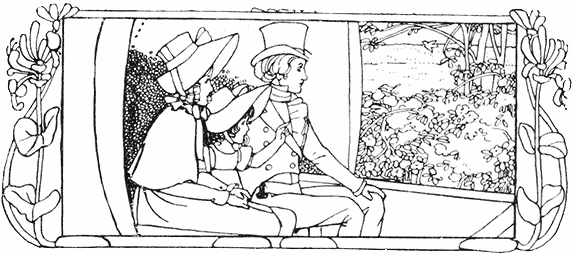
After Emily's fever was gone, she got rapidly better every day. Her kind mother never left her, but sat by her bed and talked to her, and provided everything which was likely to do her good.
When she was well enough, Mr. Fairchild borrowed Farmer Jones's covered cart for two days; and he set out, with Mrs. Fairchild and Emily, to fetch Henry and Lucy from Mrs. Goodriche's. It was a lovely morning at the finest season of the year. The little birds were singing in the hedges, and the grass and leaves of the trees shone with the dew. When John drove the cart out of the garden-gate and down the lane, "Oh," said Emily, "how sweet the honeysuckles and the wild roses smell in the hedges! There, mamma, are some young lambs playing in the fields by their mothers; and there is one quite white—not a spot about it. It turns its pretty face towards us. How mild and gentle it looks!"
Whilst they were talking, the cart had come alongside a wood, which was exceedingly shady and beautiful. Many
"What sound is that which I hear among the trees?" said Emily. "It is very sweet and soft."
"That is the cooing of wood-pigeons or doves," said Mr. Fairchild. "And look, Emily, there they are! They are sitting upon the branch of a tree; there are two of them."
"Oh, I see them!" said Emily. "Oh, how soft and pretty they look! But now the noise of the cart has frightened them; they are flown away."
By this time the cart had passed through the wood, and they were come in sight of Mrs. Goodriche's white house standing in a little garden under a hill.
"Oh, mamma, mamma!" said Emily, "there is Mrs. Goodriche's house! And I shall see my dear Lucy and Henry in a very little time."
Just as Emily spoke, they saw Lucy and Henry step out of the house-door, and come running towards the cart. It would have pleased you to the heart had you seen how rejoiced these dear children were to meet each other. Mr. Fairchild lifted Henry and Lucy into the cart; and they cried for joy when they put their arms around dear Emily's neck.
"Oh, Emily, Emily!" said Henry. "If you had died, I never would have played again."
"God be praised!" said Mr. Fairchild. "Our dear Emily has been spared to us."
When the cart came up to Mrs. Goodriche's garden-gate, the good old lady came to receive Mr. and Mrs. Fairchild, and to kiss Emily; and Sukey peeped out of the kitchen-window, not less pleased than her mistress to see Emily in good health.
Whilst Sukey was getting the dinner, Emily and herbrother and sister went to play in the garden. Henry showed Emily some rabbits which Mrs. Goodriche had, and some young ducks which had been hatched a few days before, with many other pretty things. When dinner was ready, Mrs. Fairchild called the children in, and they all sat down, full of joy, to eat roast fowl and some boiled bacon, with a nice cold currant and raspberry pie.
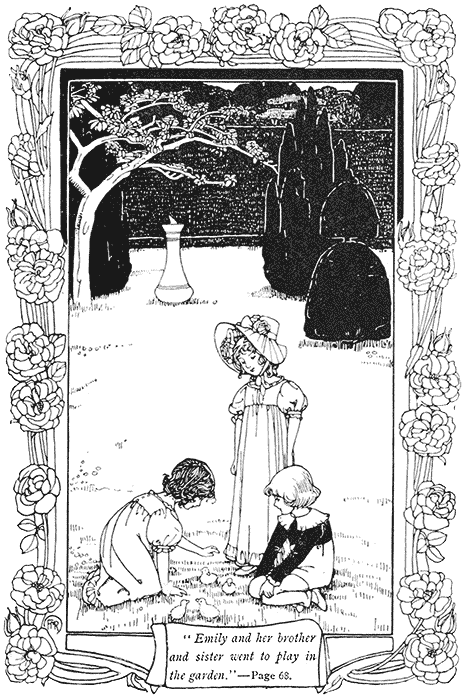
"Emily and her brother and sister went to play in the garden."—Page 68.
After dinner Mr. and Mrs. Fairchild and Mrs. Goodriche, with the children, walked as far as the wood where Emily had seen the doves, to gather strawberries, which they mixed with some cream and sugar at night for their supper.
The next morning, after breakfast, Mr. Fairchild went out to take a walk. Then Mrs. Goodriche called the three children to her, and said:
"Now, my dear children, I will tell you a story. Come, sit round me upon these little stools, and hearken."
The children were very much pleased when they heard Mrs. Goodriche say she would tell them a story, for Mrs. Goodriche could tell a great many pretty stories.
The Old Story of Mrs. Howard
"About fifty years ago," said Mrs. Goodriche, "a little old lady, named Mrs. Howard, lived in this house with her maid Betty. She had an old horse called Crop, which grazed in that meadow, and carried Betty to market once a week. Mrs. Howard was one of the kindest and most good-natured old ladies in England. Three or four times every year Betty had orders, when she went to market, to bring all manner of playthings and little books from the toy-shop. These playthings and pretty little books Mrs.
"At that time there were in this country two families of the name of Cartwright and Bennet; the former much beloved by the neighbours on account of their good qualities; the latter as much disliked for their bad ones.
"Mr. Bennet was a rich farmer, and lived in a good old house, with everything handsome and plentiful about him; but nobody cared to go near him or to visit his wife, because their manners were so rough and disobliging; and their two children, Master Jacky and Miss Polly, were brought up only to please themselves and to care for nobody else. But, on the contrary, Mr. and Mrs. Cartwright made their house so agreeable by their civil and courteous manners that high and low, rich and poor, loved to go there; and Master Billy and Miss Patty Cartwright were spoken well of throughout the whole neighbourhood for their pretty and modest behaviour.
"It happened once upon a time that Betty went to town at the end of the Midsummer Fair, and brought some of the prettiest toys and books which had been seen in this country for a long time; amongst these was a jointed doll with flaxen hair, and a history of the Bible full of coloured pictures, exceedingly pretty. Soon after Betty brought these things home, Mrs. Howard said to her: 'Betty, you must make a cake and put some plums in it, and a large apple-pie, and some custards and cheesecakes; and we
"Accordingly, Betty made the cake, and the cheesecakes, and custards, and the large apple-pie; and Mrs. Howard sent to invite Master and Miss Cartwright, and Master Bennet and his sister, to spend the next day with her.
"In those days little misses did not wear muslin or linen frocks, which, when they are dirtied, may easily be washed and made clean again; but they wore stuff, silk, and satin slips, with lace or gauze ruffles, and bibs, and aprons, and little round caps with artificial flowers. Children were then taught to be very careful never to dirty their best clothes, and to fold them up very smooth when they pulled them off.
"When Mrs. Bennet received Mrs. Howard's invitation for her children, she called them to her, and said:
"'My dears, you are to go to-morrow to see Mrs. Howard; and I have been told that she has by her some very pretty toys, which she means to give away to those children who please her best. You have seen the gilt coach-and-four which she gave last year to Miss Cartwright, and the little watch which Master Cartwright received from her last Christmas; and why should not you also have some of these fine toys? Only try to please the old lady to-morrow, and I dare say she will give you some; for I am sure you are quite as good as Master and Miss Cartwright, though you are not quite so sly.'
"'Oh!' said Master Bennet, 'I should like to get the toys, if it was only to triumph over Master Cartwright. But what must we do to please Mrs. Howard?'
"'Why,' said Mrs. Bennet, 'when your best things are put on to-morrow, you must take care not to rumple or soil them before you appear in Mrs. Howard's presence; and when you come into her parlour you must stop at the door, and bow low and curtsey; and when you are desired to sit down, you must sit still till dinner is brought in; and when dinner is ready, you must stand up and say grace before you eat; and you must take whatever is offered you, without saying, "I will have this," and "I will have that," as you do at home.'
"Mrs. Bennet gave her children a great many other rules for their behaviour in Mrs. Howard's presence, which I have not time to repeat now," said Mrs. Goodriche; "all of which Master Jacky and Miss Polly promised to remember, for they were very desirous to get the playthings.
"And now I will tell you what Mrs. Cartwright said to her children when she got Mrs. Howard's invitation. She called them to her, and said:
"'Here, Billy—here, Patty, is a note from Mrs. Howard to invite you to spend the day with her to-morrow; and I am glad of it, because I know you love to go to Mrs. Howard's, she is so good to all children, and has been particularly kind to you. I hear she has some pretty playthings by her now to give away; but don't you be greedy of them, my dears. You have a variety of playthings, you know—more than most children have, and it does not become anyone to be covetous. And remember, my dear children, to behave civilly and politely to everybody.'
"And now I will tell you how these children behaved. About eleven o'clock Mrs. Cartwright had her two children dressed in their best, and sent them with the maid-servant to Mrs. Howard's. As they were walking quietly over a corn-field, through which they must needs pass, they saw
"'Oh!' said Miss Patty, 'there are Master and Miss Bennet—on the way, I suppose, to Mrs. Howard's. I am sorry we have met with them; I am afraid they will get us into some mischief.'
"'Why should you say so?' said Master Cartwright. 'Let us speak of things as we may find them.'
"When Master and Miss Cartwright came near the stile, Master Bennet called to them:
"'What a long time you have been coming over the field! We have been waiting for you this half-hour,' said he. 'Come, now, let us join company. I suppose that you are going, as we are, to Mrs. Howard's.'
"Master Cartwright answered civilly, and all the children, with the two servants, got over the stile and went down a pretty lane which was beyond.
"The children walked on quietly till they came to a duck-pond, partly overgrown with weeds, which was at the farther end of the lane. When they came near to this, Master Bennet whispered to his sister:
"'I'll see now if I can't spoil Miss Patty's smart silk slip.'
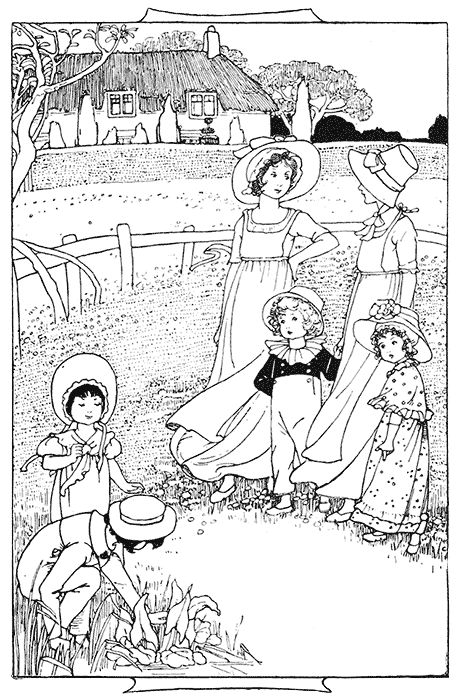
"I'll see now if I can't spoil Miss Patty's smart silk slip."—Page 77.
"'Do, Jack,' answered Miss Polly.
"Master Bennet then, winking at his sister, went up to the pond, and pulling up some of the weeds, which were all wet and muddy, he threw them at Miss Cartwright's slip, saying, at the same time:
"'There, Miss, there is a present for you.'
"But, as it happened, Miss Cartwright saw the weeds coming, and caught them in her hand, and threw them from her. Upon this Master Bennet was going to pluck more weeds, but Mr. Cartwright's maid-servant held his hands, whilst little Billy and his sister ran forwards to
"'There, now,' said Miss Polly, 'those spiteful children have gone to tell Mrs. Howard what you have done, brother, and we shall not get any toys. You are always in mischief, that you are.'
"'I am sure you told me to throw the weeds,' answered Master Bennet.
"'I am sure I did not,' said Miss Polly.
"'But you knew that I was going to do it,' said he.
"'But I did not,' said she.
"'But you did, for I told you,' said he.
"In this manner this brother and sister went on scolding each other till they came to Mrs. Howard's gate. There Miss Polly smoothed her apron, and Master Jacky combed his hair with his pocket-comb, and they walked hand-in-hand into Mrs. Howard's parlour as if nothing had happened. They made a low bow and curtsey at the door, as their mamma had bidden them; and Mrs. Howard received them very kindly, for Master and Miss Cartwright had not mentioned a word of their ill-behaviour on the road.
"Besides Master and Miss Cartwright, there were several other children sitting in Mrs. Howard's parlour, waiting till dinner should be set on the table. My mother was there," said Mrs. Goodriche—"she was then a very little girl—and your grandmother and great-uncle, both young ones; with many others now dead and gone. In one corner of the parlour was a cupboard with glass doors, where Mrs. Howard had placed such of those pretty toys (as I before spoke of) which she meant to give away in the afternoon. The prettiest of these was the jointed doll, neatly dressed in a green satin slip, and gauze apron and bib.