Part 2 — The Story in Emily's Book. Part II.
Reading edition
Lucy had read first, and when she had finished the half of the story, Mrs. Fairchild proposed that they should take what was in the basket, before they went on to the second part.
Mr. Fairchild was called in, and Mrs. Fairchild served each person from the store.
"I am quite sure," said Emily, "that Monique Stolberg never made nicer cakes than these."
"Papa," said Lucy, "I cannot help thinking that your book is not half so pretty as ours. You don't know what a pleasant story we have been reading, and we have half of it left to read. Shall I tell it to you, papa?" she added; and springing up, she placed herself close to him, putting one arm round his neck, and in a few minutes she made him as well acquainted with Monique, and Martin, and Ella, and Meeta, and Jacques, and Margot, and Heister Kamp, and Father St. Goar, as she was herself; "and now, papa," she said, "will any of the children, do you think, betray the secret?"
"Yes," said Mr. Fairchild, smiling, "one of them will."
"And who will that be, papa?" said Emily.
"Not Jacques," replied Henry, though he was not asked; "I am sure it will not be Jacques."
"Wherefore, Henry?" said Mr. Fairchild.
"Because he is a boy," replied Henry, "and boys never tell secrets."
"And are never imprudent!" answered Mr. Fairchild, smiling; "that is something new to me; but in this case I do not think it will be Jacques who will tell this secret."
"Not Ella, papa?" asked Lucy.
"I am sure it will not be Ella," added Lucy; "it must be between Meeta and little Margot."
"Probably," said Mr. Fairchild; "and I have a notion which of the two it will be; and I shall whisper my suspicions to Henry; as he, being a boy, will be sure to keep my secret till the truth comes out of itself. Of course he might be trusted with a thing much more important than this."
Mr. Fairchild then whispered either the name of Meeta or Margot to Henry; at any rate, he whispered a name beginning with an "M," and Henry looked not a little set up in having been thus chosen as his father's confidant.
When every one of the children were satisfied, they placed the cup and the fragments in the basket, and then they all settled themselves in readiness for the rest of the story.
"We must now turn, a little while, from the quiet, happy family in Martin Stolberg's cottage to Heister Kamp. What Father St. Goar had told her about Stolberg's children having found something curious near the waterfall had worked in her mind for above a week, for so long it was since Margot had found the purse; and she had
"On the Sunday morning they did indeed pass by to go to church, but their father and grandmother were with them; and she knew well enough that she should have no chance of any of them when the older and wiser people were present.
"The family came to church in the afternoon, but Heister was at chapel then.
"In the evening, however, she made up her mind to climb the hill as far as the cascade, hoping there to meet one or two of the children standing about the place.
"It was hot work for Heister to make her way up the hill so far, but what will not curious people do to satisfy their curiosity? And just then the village was particularly dull and quiet, as no stranger had happened to come for the last ten days, and many of the poor women had left their houses and gone up with their flocks to the châlets on the mountains.
"When Heister got near Stolberg's cottage she met Jacques. He was going down on an errand to the pastor's from his father. He made a bow, and would have passed, when Heister stopped him to ask after his grandmother's health. When she had got an answer to this inquiry, she asked him various other questions about the lambs, the bees, and other matters belonging to the farm and garden; and then, with great seeming innocence, she said:
"'You were looking for some herbs the other day, were you not, by the waterfall, and your sister found a very rare one, did she not? I ask you because I have many a chance of parting with scarce plants, dried and put into paper, to the strangers who come into the house.'
"'I don't think,' answered Jacques, 'that little Margot would know a scarce plant if she found one.'
"'But she did find something very curious that day,' said Heister.
"'What day?' asked Jacques.
"'It might be ten days since,' said Heister.
"'Ten days?' repeated Jacques; 'what makes you remember ten days ago so particularly?'
"'Well, but was it not about ten days ago,' returned Heister, 'that she found something very curious in the grass, and called on you to come and look at it?'
"'There is scarce a day,' answered Jacques, 'in which she does not call me to come to her and see something she has met with more wonderful than ordinary. What was it she said when she called me that day you speak of? If you can tell me, why then I shall better know how to answer you.'
"'She spoke of having found a net with golden fish and moons,' replied Heister; 'what could she mean?'
"'It is difficult to know what she does mean sometimes,' said Jacques; 'for the dear little lamb talks so fast that we do not attend to half she says. But is she not a nice little creature, Madame Kamp, and a merry one too?'
"'Yes, to be sure,' replied Heister; 'but about the net and the fish—what could the little one mean?'
"'Who heard her talk of them?' asked Jacques. 'Ask those who heard her, madame. They ought to be able to tell you more about it. But I must wish you good evening, as I am in haste to go to the pastor's.'
"Heister saw that she could make nothing of Jacques, so she let him go, pretending that she was herself going no higher, but about to turn another way.
"As soon, however, as Jacques was out of sight, she came back into the path which ran at the bottom of the cottage garden, and there she saw little Margot seated on the bank under the hedge, with a nosegay in her hand.
"The little one was dressed in her clean Sunday clothes, in the fashion of the country, and she wore a full striped petticoat which Monique had spun of lamb's-wool, a white jacket with short sleeves like the body of a frock, and a flowered chintz apron. Her pretty hair was left to curl naturally, and no child could have had a fairer, softer, purer complexion.
"'Now,' thought Heister, 'I shall have it;' and she walked smilingly up to the child, and spoke fondly to her, asking her, 'where she got that pretty new apron?'
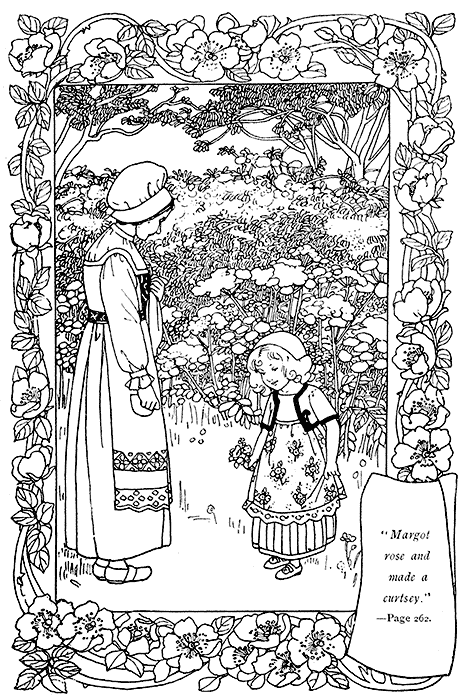
"Margot rose and made a curtsey."—Page 262.
"Margot rose, made a curtsey, as she had been taught, and said:
"'Grandmother made it, madame.'
"Heister praised her pretty face, her bright eyes, her nice curling hair; and then she asked her if she had any pretty flowers to give her.
"Margot immediately offered her nosegay, but she refused it, saying she did not want such flowers as those, but such curious ones as she sometimes found near the waterfall.
"'I have got none now,' answered Margot.
"'But you found a very curious one the other day, did you not, my pretty little damsel?' said Heister.
"'Yes, madame,' said Margot, brightening up; 'yes, madame, I did.'
"'Ay, I have it now,' thought Heister; and she patted the little one as she said, 'Was it not bright and shining like gold, and was there not something about it like moons?'
"'Oh, no, madame,' replied the child; 'it was some pretty blue flowers that come every year. Jacques said they are called gentians; but I call them fairies' eyes, for they are just the very colour I always fancy the fairy of the Hartsfell's eyes must be—they are so very blue.'
"'Well, well!' exclaimed Heister, hastily, 'I dare say
"'Oh! it was the wild strawberries,' cried Margot; 'the pretty mountain strawberries. Grandmother thanked me for bringing her home the strawberries, for she said she had not tasted them since she was a girl.'
"'Pshaw, child,' said Heister Kamp impatiently; 'it is not that I want to know. What was it you called a golden fish and moons?'
"'Moons!' repeated Margot, colouring up to her very brow, 'moons, madame?'
"'Ay, moons, child. What do you mean by moons?'
"Poor little Margot! she was sadly put to for an answer, for she remembered what her grandmother had told her about keeping the secret of the purse; and not being old enough to evade a direct reply, she burst into tears, taking up her apron to her face.
"'So you will not tell me what you call moons?' said Heister angrily; then, softening her tone, she added, 'Here, my pretty Margot, is a sou (or penny) for you, if you will tell me what you mean by moons and golden fish.' But seeing the child irresolute, she added, 'If you do not choose to tell, get out of my way, you little sulky thing.'
"Margot waited no more, but the next moment the prudent little girl was up the bank and in the cottage, where she found her grandmother alone, to whom she told her troubles. Monique kissed her, wiped away her tears, and, taking her on her knee, she made the little one's eyes once more beam forth with smiles."
"There," said Henry, "just as papa said—he knew it would be Meeta."
"Oh, Henry!" said Mrs. Fairchild, smiling, "how nicely you have kept papa's secret! You see you would not have done so well as little Margot did with Heister Kamp."
Henry made no answer, and Emily went on.
"Jacques had made up his mind never to allude to the affair of the treasure by a single word, so he kept his meeting with Heister to himself; and when you have read a little more, you will say how unlucky it was that he did so, or that Meeta was not present when Margot had been with her grandmother; but when you have read to the end, you will say it was all right as it was.
"In the evening of the next day, Ella, with the help of Monique and Meeta, finished the getting up of a portion of the fine linen of Madame Eversil. It was therefore placed neatly in a basket covered with a white cloth, and sprinkled over with the fairest and choicest of flowers which could be gathered; and then Ella, being neatly dressed, raised it on her head, and set off with it to the village.
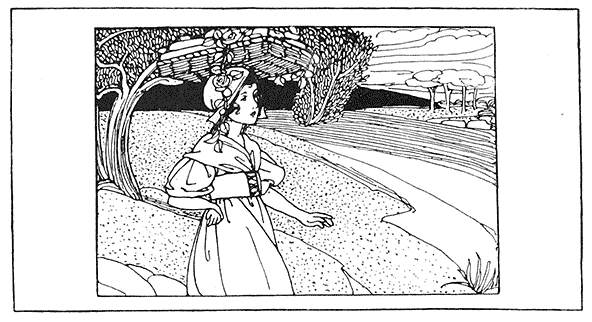
"I wish we had a picture of Ella, just as she was that evening, going gaily down the hill with the basket so nicely balanced on her head, that she hardly ever put her hand to steady it, though she went skipping down the hill like the harts which in former times had given their name to the place.
"She was dressed much as her little sister had been the evening before, only that she wore a linen kerchief and a linen cap, and her dark hair was simply braided. She loved to go to the pastor's, and she loved to be in motion; so she was very happy.
"Her light basket travelled safely on her head, and nothing happened to disarrange it, excepting that one end of a long wreath of scarlet roses escaped from the inner
"When Ella entered the little street, she saw no one till she came opposite the Lion d'Or, or Golden Lion, the house of Madame Kamp, and there she saw Heister, seated in the porch, knitting herself a petticoat of dyed wool in long stripes of various colours, with needles longer than her arm.
"Heister liked knitting—it is the most convenient work for one who loves talking; the fingers may go whilst the tongue is most busy.
"Ella would have gone on without noticing Madame Kamp, but Heister had no mind that she should.
"'Good evening, Ella Stolberg,' she cried, 'whither away in such haste?—but I know, to Madame Eversil's. Can't you stop a minute? I have a word to say to you.'
"Ella stopped, though not willingly.
"'You look very bright and fair this evening, Ella,' said the cunning woman; 'and that garland hanging from your basket would be an ornament to Saint Flora herself; whose fancy was that, my girl? But it is a shame, Ella, that such a girl as you should be employed in getting up other people's linen—you above all, when there is no manner of necessity for it. I am much mistaken,' she added, with a cunning look, 'if there are not more gold-fish in your father's net than ever found their way into mine.'
"Ella was a little startled at this speech, and felt herself getting redder than she wished. She suddenly caught at her basket, brought it down from her head, and said, 'What garland is it you mean, neighbour?' and she busied herself in arranging the flowers again.
"'Well, but the fish, Ella—the silver and golden fish in the net,' said Heister, 'what have you to say about them?'
"Ella placed the basket on her head as she replied gaily:
"'If there are gold and silver fish in plenty in the Hartsberg lakes, neighbour, it is but fair that they should sometimes be caught in nets. Fishes have no reason to guide them from danger; they are easily caught in nets. I must not, then, take example from them, else I shall, too, some day, perhaps, be caught. Jacques lays many a snare or nets for the birds of the mountains,' she added, as if to turn the conversation; 'and once Margot found a young one caught, but she cried so bitterly about it that we took it home and nursed it till it got well. Did you ever see our starling, neighbour?'
"'A pretty turn off!' said Heister; 'but you know that I mean the gold and silver fish to be louis-d'ors and francs, Ella. Has not your father now, girl, got more of these than he ever had in his life before?'
"'I know this,' replied Ella, calmly, 'that I do firmly believe that my father never was so short of money as he is now: and this reminds me I must not linger, as I promised Madame Eversil a portion of her linen to-day: so good-evening, madame.'
"Heister looked after Ella as she walked away, and muttered:
"'The saucy cunning girl! but I am not deceived; I can trust Father St. Goar better than any one of those Stolbergs.'
"About an hour before Ella had passed the Lion d'Or, a wild dark woman had come to the house to sell horn and wooden spoons. Heister had taken a few, and in return had given her a handful of broken victuals and a cup of wine; she had not carried these things away to eat and drink them, but had merely gone round the corner of the house, and sat herself down there in the dust. She
"Ella had hardly turned into the gate of the pastor's house when Meeta appeared, going along after her. Monique had forgotten to send by Ella a pot of honey which she meant as a present to the pastor; and Meeta had offered to carry it, saying that she would have great pleasure in the errand, and would return with Ella. Monique gave permission; and Meeta appeared opposite to the Golden Lion not five minutes after Ella was gone.
"'A very good evening to you, Meeta,' cried Heister from the porch; 'whither away in such haste? Stop a bit, I beseech you, and give a few minutes of your company to a neighbour. And how are all at home on the hill? I have been telling Ella, your cousin Ella, that she looked like the saint of the May. But you, Meeta, why, you might be painted for our Lady herself—so fresh and blooming, with your bright eyes and ruddy cheeks. But Ella tells me that things go hard with poor good Martin Stolberg—that he is short of money; and I am sorry, for I hoped that he had met with some good luck lately, and I fear that what I heard is not true.'
"'What luck?' asked Meeta.
"'Someone told me,' said Heister, 'that the little one had found a purse.'
"'A purse?' repeated Meeta.
"'What is a net,' answered Heister, 'with gold fish in it but a purse with gold pieces inside?'
"'Where—where,' cried Meeta, 'could you have heard that? for grandmother was so very particular in making us promise not to mention it.'
"'Heard it!' repeated the cunning widow; 'why, is not everything known that is done in the valley?'
"'But how?' asked Meeta; 'yet I can guess: Margot has told you. I said I thought Margot would tell all about it. But do tell me, how came you to hear it?'
"'Oh! there are a thousand ways of getting at the truth,' replied Heister; 'for if anything does happen out of the very commonest way, is it not talked of in my house by those who come and go? But this thing is in everybody's mouth, and people don't scruple to say that there were a vast number of golden pieces in the purse—some say a hundred.'
"'Nay, nay,' replied Meeta, 'that is overdoing it; I really don't think there are more than fifteen.'
"'Well,' returned Heister, 'I don't want to know exactly how many there are—I am not curious; no one troubles herself less with other people's affairs than I do; but I am glad this good luck has come to Martin Stolberg, above all others in the valley.'
"'That is very kind of you,' replied Meeta, 'but I do not see what luck it is to him, for the money is not his, and he could not think of spending it: it is all put by in some safe place in the house.'
"'Very good, very right,' answered Heister. 'No, no! Martin could never have such a thought. But where in the world can you find a place in the house safe enough for so many pieces? I should doubt whether they could count as many together even at Madame Eversil's. So you say there are fifteen, pretty Meeta? and though no doubt they take but little house-room, yet I should be sorry to keep so many in my poor little cottage, for I know not where I could stow them safely. I suppose neighbour Monique keeps them in her blue cupboard near the kitchen-stove?—a very good and a very safe place, no doubt, for them.'
"'Oh, no,' cried Meeta, 'she has them in her chest
"'And who else did tell me but yourself, giddy one?' cried Heister Kamp, laughing. 'It was all guess with me, I promise you, till you had it all out. Ella and Jacques, and even little Margot, would not tell me a word about it; and I really began to think that Father St. Goar had mistaken what the little one had said, till you let the cat out of the bag. But you ought to make haste after Ella, so don't let me hinder you.' And she arose and went laughing into the house, whilst Meeta hastened after her cousin.
"We cannot suppose that Meeta's reflections were very pleasant, for, as soon as she was left to herself, she felt how very imprudent she had been. She tried, however, to comfort herself with thinking that she had done no harm. 'For what can it signify,' she said to herself, 'if Heister does know the truth?' But she would take care not to mention at home what she had said to Madame Kamp; and in this Meeta found, to her cost, that she could keep a secret."
"There now!" cried Henry, as Emily was turning over a leaf, "papa was right; he told me who would betray the secret."
"We all guessed," said Lucy; "but, Emily, do go on."
"The gipsy, or zingara (as they call such people in Switzerland and Germany), for such she was, had heard
"Three or four days passed quietly after the evening in which Meeta and Ella went to the village; but on the fourth morning a message came from Madame Eversil to Monique, to tell her that she had just heard of a party of persons of great consequence who were coming from a distance to dine at her house; she sent to beg her to come down immediately to help in getting the dinner, and, if she had no objection, to bring Ella with her to wait on the ladies and at table.
"Martin Stolberg had gone off early that morning to market, at the nearest town, three leagues off; Jacques had gone up on the higher pastures with the flocks; and when Monique and Ella went down to the pastor's, only Meeta and Margot were left at the cottage.
"Ella dressed herself in her Sunday clothes, and carried the basket, which her grandmother had packed, down the hill. Monique had filled the basket with everything she thought might be useful—a bottle of cream, new-laid eggs, and fresh flowers. She bade Margot and Meeta be good girls, and keep close at home, when she parted from them, with a kiss to each; and the next minute she and Ella were going down the hill."
"I know what is coming next," cried Henry, as Emily turned over a leaf; "but do make haste, Emily."
"Nothing could be more still and quiet than the cottage and all about it seemed to be when Meeta and Margot were left in it; for nothing was heard, when the children
"Every cottager on those hills keeps a dog. Wolf was the name of Martin Stolberg's dog: Wolf was of the true shepherd's breed, and a most careful watch he kept both day and night; but he had gone that morning with Jacques to the Alps above the waterfall.
"Monique had told the two girls that they might have peas for dinner, so it was their first business to gather these peas, and bring them into the house. Margot then sat down to shell them, but she did not sit within the house, because of the litter she always made when she shelled peas; so she sat on a little plot of grass under a tall tree, on one side of the straight path which led from the garden-gate to the house-door. Meeta remained within, being busy in setting the kitchen in order before she sat down to her sewing; and thus they were both engaged, when Margot saw two people come up to the wicket. Margot was very shy, as children are who do not see many strangers, and without waiting to look again at these persons, she jumped up and hid herself behind the large trunk of a tree, peeping at the people who were walking on to the house. The first was a very tall large woman: she wore a petticoat, all patched with various colours, which hardly came down to her ankles; she had long black and gray hair, which hung loose over her shoulders; a man's hat, and a cloak thrown back from the front, and hanging in jags and tatters behind. She came up the path with long steps like a man's, and was followed by a young man, perhaps her son, who seemed, by his ragged dirty dress, to be fit to bear her company.
"Meeta did not see these people till the large form of the woman darkened the gateway. She was placing some
"'Mistress!' said the woman in a loud harsh voice, 'I am dying with thirst; can you give me anything to drink?' and as she said so, she walked in and sat herself on the first seat she could find. The man came in after her, and began looking curiously about him.
"'I have nothing but water or milk to offer you,' answered Meeta, whose face was become as white as the cloth she held in her hand.
"'It does not matter,' said the woman; 'we have other business here besides satisfying our thirst; it was you, was it not, that told the hostess of the inn below that your uncle found a purse of gold and put it by? The purse is ours, we lost it near this place; we are come to claim it.'
"'Yes,' said the man, advancing a step or two towards Meeta; 'it is ours, and we must have it.'
"'My uncle,' answered the trembling girl, 'is not at home; I cannot give you the purse.'
"'You can't?' replied the man; 'we will see to that, young mistress; we knew your uncle was out when we came here, else we had not come; but we heard you say that you could tell, as well as he could, where he put the purse; if you do not do it willingly, we will make you.'
"Meeta began to declare and profess most solemnly that she did not know where the keys were kept; indeed, she believed that her grandmother had taken them away in her pocket.
"The fierce man used such language as Meeta had never heard before; and the woman, laying her heavy hand on her shoulder, gave her a terrible shake.
"'Tell us,' said she, 'where is the chest into which the
"Meeta, in her excessive terror, uttered two or three fearful shrieks; and would, no doubt, have gone on shrieking, if the horrible people had not threatened to silence her voice for ever.
"Little Margot, from behind her tree, heard those cries; and it is marvellous how the wits of a little child are sometimes sharpened, in cases of great trial; she thought, and thought truly, that she could do Meeta no good by running to her, but that she might help her by flying, as fast as her young feet could carry her, to the village. It was down hill all the way, and it was all straight running, if she could get unseen into the path on the other side of the hedge. So she threw herself on her hands and feet, and crept on all fours to where the hedge was thinnest, and, neither minding tears nor scratches, the hardy child came tumbling out on the path on the side of the village, jumping up on her feet; and no little lapwing could have flown the path more swiftly than she did."
"Well done, Margot!" cried Henry; but Emily did not stop to answer him.
"Jacques, at the very time in which Margot had begun to run down the hill, was watching his flock on the side of a green and not very steep peak, scarcely a quarter of a mile, as a bird would fly, from the cottage, though, to drive his flock up to it, he had perhaps the greater part of a mile to go. On the top of this peak were a few dark pines which might be seen for miles. Jacques was seated quietly beneath the shade of one of these trees; his sheep were feeding about him, his dog apparently sleeping at his feet, and his eyes being occupied at one moment in taking a
"Wolf had been supposed by his master to be asleep some minutes, when suddenly the creature uttered a short sleepy bark, and then, raising his head and pricking his ears, he remained a minute in the attitude of deep attention and anxious listening.
"'What is it, Wolf?' said Jacques: 'what is it, boy?'
"The dog drew his ears forward, every hair in his rough coat began to bristle itself; he sprang upon his four feet—he stood a moment.
"'What does he see?' cried Jacques, getting up also, and grasping his crooked staff; 'eh, Wolf, what is it?'
"The dog heeded not his master's voice. He had heard some sound as he lay with his ear to the ground; he had made out the quarter from which it came whilst he stood listening at Jacques' feet. He had judged that there was no time for delay; and the next moment he was bounding down the slope, straight as an arrow in its course. There Jacques saw him bounding and leaping over all impediments, reaching the bottom of a ravine, or dry watercourse, at the foot of a small hill, and again running with unabated speed up the opposite bank. Jacques thought he was going directly towards the cottage, for the young shepherd could see him all the way; but as if on second thoughts, the faithful creature left the cottage, when near to it, on the right, and passing over the brow of the hill, was soon out of sight in the direction of the village.
"Jacques knew not what to think, but he had little doubt that the dog was aware of something wrong; so the boy did not waver; his sheep were quiet, he was forced to
"Whilst Margot was running to the village, Wolf running after Margot (for such he afterwards proved was his purpose), and Jacques after Wolf, the fierce man had frightened poor Meeta out of all the small discretion which she ever had at command; and she told him that she had seen her grandmother put the purse in the great chest above stairs, that she did not know whether her uncle had taken the key, though, perchance, little Margot might know, as she slept with her grandmother.
"She could not have done a more imprudent thing than mention Margot, for the woman immediately started, like one suddenly reminded of an oversight, at the mention of the child's name, and ran out instantly to seek her; at the same time the man drove Meeta before him up the ladder or stairs to where the great old chest which contained all the spare linen and other treasures of the family stood, and had stood almost as long as the house had been a house. There, without waiting the ceremony of looking for the key, he wrenched the chest open, pulling out every article which it contained, opening every bundle, and scattering everything on the floor, telling Meeta that, if he did not find the purse, she should either tell him where it was or suffer his severest vengeance.
"So dreadful were the oaths he used that the poor girl was ready to faint, and the whitest linen in that chest was not so white as her cheeks and lips.
"The woman, in the meantime, was seeking Margot, and, with the cunning of a gipsy, had traced the impression of the little feet to the corner of the garden, where a bit of cloth torn from the child's apron showed the place
"Now there were four running all at once; Margot first, the gipsy after her and gaining fast upon her, Wolf springing over every impediment and gaining ground on the gipsy, and Jacques after the dog; and there was another party too coming to where Margot was. These last were coming from the pastor's house; and there was a lady seated on Madame Eversil's mule, on a Spanish saddle, and a little page in a rich livery was leading the mule. The pastor was walking immediately behind her with two gentlemen, her husband and her son. This lady was a countess, and she it was who had lost the purse a few weeks before, when she had come to see the cascade.
"In going home that day the carriage had been overturned, and she had been so much hurt that she never thought of her purse until a few days afterwards, and then she supposed that it must have been lost where the carriage had been overturned. She caused great search to be made about that place; and it might have appeared to be quite by accident that Monsieur Eversil heard of that search; but there is nothing which happens in this world by accident. He knew the count and countess, and wrote to them to tell them that if they would come again to Hartsberg and take dinner in his humble house, he would give them good news of the purse.
"When they came he told them of the honesty of the family of the Stolbergs; and when he had placed the purse
"'I must see that little Margot,' she said, 'and if she is like her sister, I shall love her vastly;' and then it was settled that the mule should be saddled, and that she and the gentlemen should go up the hill, whilst Madame Eversil remained to look after dinner.
"This party were also on the hill, though lower down and hidden by the winding of the way, when Margot set out to run; but none of Margot's friends would have been in time to save her, if it had not been for Wolf. The wicked gipsy had resolved, if she could catch her, to stop her cries one way or another; to take her in her arms, hold her hand over her mouth, and to run with her to some place in the hills, not far off, some cave or hole known only to herself and her own people; and if the poor child had once been brought there, she would never have been suffered to go free again among her friends to tell where the zingari hole was.
"When Margot knew that the woman was after her she increased her speed, but all in vain; the gipsy came on like the giant with the seven-leagued boots; she caught the terrified child in her arms, put a corner of her ragged cloak into her mouth, and, turning out of the path down into a hollow of the hills, hoped to be clear in a minute more.
"But she was not to have that minute; Wolf was behind; he had flown with the swiftness of the wild hart, and when within leaping distance of the old woman, he
"Jacques did not understand the cause of this terrible war; he only saw that his dog was tearing the flesh of a woman; he did not at first see Margot, who had sunk in terror on the grass; therefore he called off his dog with a voice of authority, and the moment Wolf had loosed his hold of the woman, she fled from the place, and was never more seen in that country. But now all this party had met round Margot, looking all amazement at each other, whilst the little one sat sobbing on the ground, and Wolf stood looking anxiously at his young master, panting from his late exertions, and licking his bloody fangs, for there was no one to explain anything but the child.
"'What is all this, Jacques?' asked the pastor.
"'What is it, Margot?' said Jacques, taking his little sister in his arms, and soothing her as he well knew how to do; whilst she, clinging close to him, could not at first find one word to say.
"Jacques carried the child, and they all went back into the path, where the countess sat, anxiously waiting for them, on her mule.
"All that Margot could say to be understood was:
"'Run, run, to poor Meeta—they will kill her; the man will kill her, and Wolf is not there.'
"Jacques repeated her words to the pastor.
"'I have it, Jacques,' replied the good man; 'these vagrants are after the treasure; maybe there are others in the cottage; put the child down, my boy, leave her to walk by the lady, and let us all run forward.'
"'Nay, nay,' said the lady, 'put the sweet child in my arms and hasten on.' So it was done, and the gentle lady took the little peasant before her, whilst she soothed her with her gentle tones and kindly words.
"'And what,' said she, 'was that naughty woman going to do with you? and who was it that saved you?'
"'Good Wolf came, madame,' said the child, 'and he saved me; but poor Meeta—they will kill poor Meeta!'
"When Jacques and those who were with him had reached the cottage, they found the doors all open, but no one below; they went up the stairs, and there they found Meeta extended on the floor in a deep fainting fit. The chest stood open, and all its contents scattered about, but no man was there; he had probably taken alarm at the various cries and howlings which he had heard, and had made good his escape.
"Meeta was lifted up and laid on the bed, and water being dashed in her face, she opened her eyes, but for a while could say nothing to be understood.
"She was soon able to arise, and to come down the stairs with the arm of the pastor, though her head was still dizzy and she trembled all over. In the kitchen they found the lady and little Margot; and it was then that, between Meeta and Margot, they were able to make out what had happened. Then it was that everyone patted the head of Wolf and smiled upon him, calling him
"'And so,' said the countess to the little one, 'it was you, my pretty child, who found the silken net with the golden fish and pretty moons; and it was through my carelessness in losing it that all this mischief of to-day is come. I cannot bear to think of what might have happened to you, poor baby;' and the lady stooped and kissed the child, and it was seen that she had tears in her eyes.
"'All is now well, lady, through the care of
"'I am the guilty person,' said Meeta, coming forward; 'I will not throw suspicion on others by hiding my fault;' and she then repeated her conversation with Heister Kamp, but she could give no account of how the secret had passed on to the gipsies.
"'I am sure,' said the pastor, 'that Heister would be above having to do with such people; but she is a woman of excessive curiosity, and such people are dangerous to others, as well as injurious to themselves.'
"'A secret, my good girl,' said the countess, smiling, 'may be compared to a bird in a cage; whilst shut up within our own breasts, it is safe; but when we open the door, either of the cage or of the heart, to let the inmate out, we can never tell whither it may fly; but you have owned the truth, and you have suffered severely—let all be forgotten.'
"'I have a proposal to make,' said the pastor; 'we will go back and dine, and in the evening we will all come up and sup together; the good man shall find us feasting when he comes home.'
"'Agreed,' cried the count and countess; 'you must set the house in order, and we will send up the entertainment,' she added, speaking to Meeta and Jacques; 'and we will be with you in a few hours. Let us then see this little fair one in all the bravery of her Sunday attire.'
"And all was done as the lady and pastor wished. Meeta set everything in proper order. Jacques brought his flocks from the pasture, and gave his best help. All the Sunday dresses were put on, and Margot was standing at the wicket in her very best apron, when the mule and the lady appeared again, followed by the pastor and Monique, Ella, and people without number, bearing the things needful for such a supper as had not often been enjoyed under that roof.
"Oh, what a happy meeting was that! How delighted was the lady with Margot, and what a beautiful little enamelled box for containing sweetmeats did she give her from her pocket! But there were no sweetmeats in it; there were what Margot called golden fish.
"Wolf had a glorious evening; he went about again to be patted, and he had as much to eat, for once in his life, as he could conveniently swallow.
"Meeta was forgiven by everyone, because she had not hidden her fault; and the whole party were just sitting down to supper before the porch when Martin Stolberg came home.
"Who shall say how astonished he was, or how grateful when the countess placed in his hand all the gold which had been found in the purse?—the count adding, that in a few days he might look for a fine young cow and two
"The lady did not overlook Meeta and Ella; she assured them that she would remember them when the cow was brought; and truly there was an ample store of linen and flowered aprons, and kerchiefs and caps of fine linen, in packets directed to each. But the little one, like Benjamin, had more than her share even of these presents also; and she had well deserved them, for she had shared her golden fish with her brother, sister, and cousin.
"The young count took upon himself to make presents to Jacques; he sent him a strong set of gardener's and carpenter's tools, and a Sunday suit of better clothes than Jacques had ever worn before.
"Martin put his gold into the pastor's hands till he should require it, being in no mind to keep much treasure in his house.
"It is only necessary to add, that the count took proper steps for finding the wicked gipsy and her son, but they had left the country and could not be found; neither were they ever again seen by the peasants of the Hartsberg."
"Well," said Henry, when Emily had finished reading, "that is a beautiful book: it made me so hot when they were all running, my feet felt as if they would run too—they quite shook—I could not keep them quiet."
"And how nicely you kept papa's secret!" said Mrs. Fairchild; "you showed that you were not much more clever than Meeta."
"But then, mamma," replied Henry, "papa's secret was not of so much consequence as Meeta's was."
"Now, mamma," said Emily, "when do you think the day will come for Henry's story?"
Mrs. Fairchild answered:
"Papa will tell us when he can spare an evening."
"My book, I am certain," said Henry, "will be prettier than yours, Emily."
"Why must it be prettier?" asked his mother.
"Because Lucy said it is all about boys; I like boys' stories—there are so few books about boys."
"But I think it is a grave story," said Lucy.
"Never mind," answered Henry, "if it be about boys."
"Meeta offered to carry the honey."—Page 269.
Guests at Mr. Fairchild's
The night after Emily's story had been read, there was a violent thunderstorm and rain, which continued more or less till daybreak; it was fine again after sunrise.
At breakfast a note was brought by a boy from Mrs. Goodriche: these were the words of it:
"Dear Mr. Fairchild,
"Since that happy day we spent together, we have been in what Sukey calls a peck of troubles; and, to crown all, last night one of our old chimneys was struck with lightning: part of it fell immediately, but I am thankful to be able to say, that by the care of Providence no one was hurt.
"We are all got into a corner out of the reach of it, should it fall, though it might yet stand for years as it is. I have other things to talk to you about, and was thinking of coming over to you if this accident had not happened. Now I must ask you to come to me; I have sent for
"I must be off immediately after breakfast," said Mr. Fairchild; and he did set off, in his little carriage, as soon as he had set Henry to work.
Mr. Fairchild saw the top of the ragged chimney over the trees in the garden. As soon as he came up to the gate, he himself put up the horse and carriage, for he could see no man about, and then went in at the back door, expecting to find Mrs. Goodriche at that end of the house farthest from the chimney.
Sukey was the first person he saw.
"Oh, sir," she said, "I am so glad you are come! We shall be all right now."
"Nay," said Mr. Fairchild, jestingly, "I hope you don't expect me to repair the chimney."
"Is that Mr. Fairchild?" cried the cheerful voice of Mrs. Goodriche; and the next minute she came out of her parlour, followed by a tall round-faced girl of about twelve years of age, in very deep mourning.
"My niece, Mr. Fairchild," said Mrs. Goodriche; "but tell me, have you breakfasted?" And when she heard that he had; "Come with me, kind friend," she said, "we will first look at the ruin, and then I have other things to talk to you, and to consult you about. So, Bessy, do you stay behind; you are not to make one in our consultations."
Mrs. Goodriche and Mr. Fairchild then walked into the garden; and we will tell, in as few words as possible, what they talked about.
First they spoke of the chimney, and Mr. Fairchild said that he could give no opinion about it till the owner of the house and the masons came, and they were expected every hour.
Mrs. Goodriche said that she had lived in that house nearly twenty years, and should be sorry to leave it; but that she and Sukey, on windy nights, often felt that they should be glad to be out of it.
"And yet," said Mr. Fairchild, "it may stand long after you and I; still it is a wide, dull place for two persons, and very solitary."
"I wish I could get a house your way," replied Mrs. Goodriche; "though now we shall be more than myself and Sukey; and this brings me to the subject I wanted to consult you about before the business of the chimney."
Mr. Fairchild knew that Mrs. Goodriche had had one only brother, who had gone abroad, when young, as a merchant. He had married, and had one son; this son had also married, and Bessy was the only child of this son. Mrs. Goodriche's brother had died years ago, as had also his son's wife; at which time her nephew had sent his daughter home and placed her in a school in some seaport in the south of England, where she had, it seems, learned little or nothing.
Within the last month, Mrs. Goodriche had heard of the death of her nephew, and that she was left as guardian of his daughter.
"I had an acquaintance going to Plymouth only last week," she added; "and I got him to take charge of Bessy and bring her here. She has been with me only a few days, and is very glad to leave school, which does not speak well for her governess; or if not for her governess, for herself. As to what she is, I can as yet say little," added the old lady, "except that she seems to be affectionate and good-tempered; but she is also idle, wasteful, and ignorant in the extreme. She can't read even English easily enough to amuse herself with any book; and as to sewing, she is ready at a sampler, but could not put the
"You mean to keep her with you?" asked Mr. Fairchild.
"I do," said Mrs. Goodriche; "I think it my duty, and I am far from disliking the poor thing. She has had so much schooling, and gained so little by it, that if I could get a good writing and maybe a ciphering master to attend her, I think I could do the rest myself, and impart to her some of the old-fashioned notions of industry, and neatness, and management. But this is a subject I wanted to consult you and Mrs. Fairchild about, for I so much like your plans with your own dear children."
Mrs. Fairchild had asked her husband to invite Mrs. Goodriche to their house until the chimney should be repaired; but Mr. Fairchild was doubtful whether this message should be delivered, when he heard that Miss Bessy was to remain with her great-aunt. After a little thought, however, he gave the message, stating his difficulty at the same time.
"Well," said Mrs. Goodriche, "I hardly know what to say: I should like to come to you, and I should like Bessy to see your children and your family plans; but as I know so little of her, I know not whether it would be right to let her mix with your children. You shall think the matter over, my good friend, and consult your wife; and be sure, whichever way the thing is settled, I shall not be offended."
When the men came to look at the chimney, it was found that the mischief might be remedied by a few days'
"I think," said Mrs. Goodriche, "that I must give notice to quit this coming Midsummer. I shall still have half a year to look about me. The fright last night seems to have been sent to oblige me to settle my plans. I feel that this place is not exactly what will suit my niece—young people must have company; and if they are not where they can find their equals, they will fly to their inferiors. Bessy will make intimacies with every cottager in the wood, and I shall not be able to help it."
"I believe you are right, Mrs. Goodriche," replied Mr. Fairchild; "and I wish we could find a house for you in our village."
Mr. Fairchild looked very anxiously at Bessy when he saw her again. There was a great appearance of good temper and kindness about her which pleased him. She had a round rosy face and laughing eyes; but her clothes, although quite new, were already out of place, and falling from one shoulder. She talked incessantly, whether heeded or not, and seldom said anything to the purpose.
"If I were to begin to find fault with her," said Mrs. Goodriche to Mr. Fairchild, "I could never have done: not that she is constantly committing heavy offences, but she never does anything in the right way. What shall I do with her, my good friend?"
"We will talk over the affair at home," replied Mr. Fairchild; "and you shall see me again to-morrow."
The next day accordingly brought Mr. Fairchild, and with him Mrs. Fairchild.
"Well, my good madam," said he, "we have settled it; we shall be glad to see you and Miss Bessy. We have spoken to Lucy and Emily; and they have promised to attend to all our wishes, and to inform us if anything
"To-morrow, then," replied Mrs. Goodriche; "to-morrow evening, by which time I shall have settled things at home, and provided a person to be with Sukey."
After an early dinner, Mr. and Mrs. Fairchild went home.
The next morning Mrs. Fairchild had some conversation with her little girls.
"You have never, my dears," she said, "been in a house for any time with a young person whose character we do not know; but it seems that it is required of us now to receive such a one. Mrs. Goodriche is an old and very dear friend; she is in trouble, and she has some hopes that her niece may be benefited by being for a while in an orderly family. You and Emily may be some help to her; but if you are led by her, or are unkind to her, or show that you think yourselves better than she is, you may not only be hurt yourselves, but very much hurt her instead of doing her good."
"Oh, mamma," replied Lucy, "I hope that we shall not do that: pray tell us every day exactly what to do."
"Be assured that I will, my children," said Mrs. Fairchild; "and we will not fear. You will not dislike Bessy—she is a good-tempered, merry girl; but you must not let her be alone with Henry: her very good humour may make her a dangerous companion to him."
Mr. Fairchild went, after dinner, to fetch Mrs. Goodriche and Bessy; and just before tea Henry came in to say the carriage was coming. He ran out again as fast as he could to set the gate open.
Mrs. Fairchild and the little girls met their visitors at the door.
Bessy jumped out of the carriage, and without waiting
"And that was Henry," she said, "who stood at the gate: he is a nice little fellow! I know all the names, and John's and Betty's too. Sukey has told me about Betty—just such another as herself. What a pretty place this is!—not like aunt's old barn of a house. I feel at home here already."
Whilst the young lady was prattling in this manner, Mrs. Fairchild was showing Mrs. Goodriche to her sleeping-room. She had put up a little couch-bed in the corner of the same room for Bessy, as she had no other room to give; and this had been settled between the ladies the day before. Mrs. Goodriche had told her niece to follow her upstairs, which Miss Bessy might perchance have done, after a while, had not Betty appeared coming from the kitchen to carry up the luggage.
"That is Betty," said Miss Bessy. "How do you do, Betty? Sukey told me to remember her to you."
"Very well, thank you, Miss," said Betty, with a low curtsey, as she bustled by with a bandbox.
Mrs. Goodriche now appeared, and speaking to her niece from the stair-head said:
"Come up, Bessy, and put yourself to rights before tea."
"Shan't I do, Miss Lucy?" said Bessy; "aunty is so particular; she does not know that I made a monstrous slit in my frock as I got into the carriage. I pinned it up, however, as well as I could, though I was forced to take the pins out of my dress for it. I shall run it up to-morrow, for, if she sees it, poor I will be forced to darn it thread by thread; so do lend me a pin or two, dear girls."
Betty now appeared again with a message to the young lady to go upstairs to her aunt, and then Bessy hurried off so rapidly, taking two steps at a time, that Lucy and Emily expected she would have a second slit in her dress to mend the next day. She did not appear again till told that tea was ready, when she came down after her aunt. Mrs. Goodriche looked all kind and calm as usual; she seemed quite pleased to find herself with her friends, though no doubt she was a little uneasy lest her niece should disgrace herself. As Bessy passed Lucy to go to a seat near Mrs. Fairchild, she whispered:
"Aunt has found out the slit, and poor I will be set to the darning to-morrow."
The whole party were seated before Henry came in; he had been seeing John put up the carriage. John had been busy, and Henry trying to help—so Henry was not like the boy who helped his brother to do nothing.
"Well, Master Henry," said Miss Bessy, calling over to the other end of the table, "so you speak to my aunt, and say you are glad she is come, and you don't speak to me."
"Because, ma'am——" Henry began.
"Eh?" cried Miss Bessy, "don't call me ma'am;" and she burst into a giggle, which made Henry open his eyes and look very hard at her.
This made her laugh the more; and, as she had her teacup in her hand, she spilt a quantity of tea on the unfortunate black frock.
"Bessy," said Mrs. Goodriche gently, "you had better set down your cup and wipe your frock, or I shall have to ask Mrs. Fairchild to lend you one of Henry's pinafores."
"It is not hurt, aunt; it will all come out. I threw a cup of milk over it the other day, and no one could see
"Well, then, Miss Bessy," said Mrs. Goodriche, "when you wear that frock, or any other of your frocks which people should not look hard at, I would advise you to keep in the background."
"Aunt is making sport of me, Mrs. Fairchild," said Bessy, with another giggle; "do you know what she means? She is advising me, in her cunning way, always to keep in the background of company."
"Always?" said Mr. Fairchild, smiling; "why, have you not any dresses which would bear close inspection?"
"Not many, I fear!" replied Miss Bessy; "I was always uncommon unlucky in tearing my clothes and getting them stained."
"Suppose we say careless," said Mrs. Goodriche; "but it is no laughing matter, niece. Have you never heard the old saying, 'Wilful waste makes woful want'?"
"Well, well," replied the niece, with something like a sigh, "I can't help it—I never could;" but before Mrs. Goodriche could say another word, she cried out, "You have got a magpie—have you not, Henry?"
"How could you know that?" asked Henry.
"Sukey told me," she answered, "and Mary Lampet told her. Mary was with the person who gave you the magpie, when she sent it to you."
"Who is Mary Lampet?" said Henry.
"One of Bessy's new friends," said Mrs. Goodriche; "a woman who sometimes comes for a day's work to my house."
"And such a curious old body," said Miss Bessy; "she wears a blue striped petticoat, and she generally has a pipe in her mouth."
"Never mind her, my dear," said Mrs. Goodriche:
Instead of noticing this remark, Miss Bessy looked round the table.
"One, two, three, four, five, six, seven," she said; "aunt, you are wrong, I am not one of the youngest; there are three older, and three younger than me. I am Jack in the middle; and therefore I have a right to talk to the old people, and to the young ones too; and therefore I may talk most."
Henry was being gradually worked up by Miss Bessy to think that he might be as free as she was; and he began with, "Well now, is not that very odd?"
"My dear Henry," said Mr. Fairchild, "did not you hear Mrs. Goodriche say she thought that young people should not have all the talk to themselves?"
"Don't scold him," said Bessy; "he meant no harm."
Mrs. Goodriche looked distressed; her niece saw it, and was quiet for at least a minute or two, and then she began to talk again as if nothing had happened.
When tea was over, and everybody risen from the table, before it was settled what was to be done next, Henry walked out through the glass doors into the garden—he was going to feed Mag.
Bessy saw him, and called after him; he did not answer her—perhaps he did not hear her. She called again—he was farther off, and did not turn.
"You little rogue!" she cried out; "but I will pay you;" and off she ran after him.
He heard her step and her voice as she called him; he took to his heels through the shrubbery, and to the gate
There the three were in the fold-yard, Bessy trying to catch Henry, who was dodging about round John, when Mr. Fairchild, who had followed Bessy, came up.
"Miss Goodriche," he said, "let me lead you to your aunt, she is asking for you. My dear young lady," he added, drawing her a little aside, "let me venture to point out to you, as a father, that it is not becoming in a girl of your years to be romping with a servant man."
"I was after Henry, sir!" she replied: "it was after him I was going, sir, I assure you."
"I dare say you set off to run after Henry, my dear young lady," he replied; "but when I first saw you, you were pushing John about, first on one side and then on the other, in a way I should call romping; and am I not right when I say that I think, even now, you have not spoken one word to him, and that you only guess he is my servant John? What would you think, Miss Goodriche, if you were to see my daughter Lucy suddenly run and do the same by yonder labourer in that meadow?—and yet she may know him quite as well, if not better, than you do John."
"La! Mr. Fairchild," cried Miss Bessy, laughing, "how you do put things! I never thought what I was doing. It must have looked uncommon strange, but I hope I shan't do it again."
"Then you had better go in with me to your aunt, and if she approves, you shall help Lucy and Emily in their little gardens."
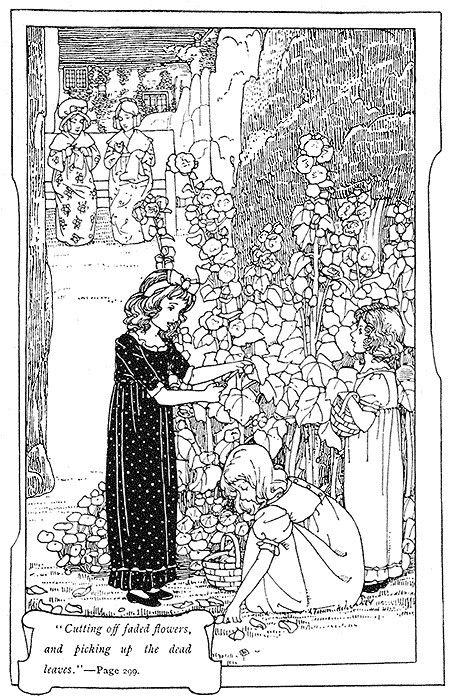
"Cutting off faded flowers, and picking up the dead leaves."—Page 299.
Mrs. Fairchild and Mrs. Goodriche were only waiting for Miss Bessy to follow the little girls into the garden; and there, whilst they worked and chatted together, Lucy and Emily and Miss Goodriche were employed in cutting off faded flowers, and picking up the dead leaves from the ground.
"Off she ran after him."—Page 295.
More about Bessy
It may be supposed that Mrs. Goodriche gave some good advice to her niece whilst they were in their room, for Miss Bessy came down looking rather sulky, and said very little at breakfast; only that she attempted several times to hold discourse with Lucy in whispers, for which they were quietly called to order by Lucy's father.
Mr. Fairchild said:
"You must not whisper at table, my dears, for we are met to make ourselves agreeable either by talking or attentive listening."
After breakfast Mrs. Fairchild said:
"As we hope your visit, Mrs. Goodriche, will be a long one, we will, if you please, go on with our plans. I shall go into my school-room with my little girls, and leave you and Bessy to yourselves; you will see us again about twelve o'clock."
"Very right," replied Mrs. Goodriche, with a smile;
So Mrs. Goodriche went to her room, and when she came back with two large bags and several books, there was no Miss Bessy to be found.
She, however, was, for an old person, very active, with all her senses about her, and off she trotted after her niece, finding her, after some trouble, chattering to Mag, who was hung in a cage before the kitchen window. She brought her into the parlour, saying:
"Come, niece, let us follow a good example, and make the best use of these quiet morning hours."
Bessy muttered something which Mrs. Goodriche did not choose to hear, but when she got into the parlour, she threw herself back on the sofa as if she were dying of fatigue.
Mrs. Goodriche handed a Bible to her, saying:
"We will begin the morning with our best book: you shall read a chapter whilst I go on with my work; come, find your place—where did we leave off?"
Bessy opened the Bible, fetching at the same time a deep sigh, and, after some minutes, began to read.
Mrs. Goodriche could have sighed too, but she did not.
Bessy was a most careless reader; she hated all books; indeed, her aunt thought that, from never having been exercised in anything but learning columns of spelling, she had hardly the power of putting any sense, in her own mind, to the simplest story-book which could be put into her hands.
It was heavy work to sit and hear her blunder through a chapter; but, when that was finished, the kind aunt tried at some little explanation; after which she set her to write in a copy-book. Mrs. Goodriche dictated what she was to write: it was generally something of what she had herself
This exercise filled up nearly an hour, and a most heavy hour it was: and then Mrs. Goodriche produced a story-book—one lent to her by Mrs. Fairchild—which, being rather of a large size, did not quite appear to be only fit for children; what this book was I do not know.
"Now, my dear," she said, "you will have great pleasure in reading this book to me, I am sure; but before we begin I must fetch another bit of work: I have done what I brought down."
"La!" said Miss Bessy, "how fond you are of sewing!"
"Don't you remember, Bessy," replied Mrs. Goodriche, "that I never attend to anything you say when you begin with 'la'!"
"We always said it at school," she answered.
"May be so," replied Mrs. Goodriche, "and you may say it here, if you please; but, as I tell you, I shall never attend to anything you say when you put in any words of that kind."
"La!" cried Miss Bessy again, really not knowing that she was saying the word.
Mrs. Goodriche went up for her work, and when she returned, as she might have expected, her bird was flown; and when she looked for her, she saw her amongst some gooseberry bushes, feeding herself as fast as she could. When she got her into the parlour again, "Bessy," she said, "did you ever read the story of Dame Trot and her Cat?"
"I know it," answered Bessy.
"Now," added Mrs. Goodriche, "I am thinking that I am very like Dame Trot; she never left her house but she found her cat at some prank when she returned, and I
Bessy, before she took her book, rubbed her hands down the sides of her frock to clean them from any soil they might have got from the gooseberries. It was a new black cotton, with small white spots, and was none the better for having been made a hand-towel.
Mrs. Goodriche saw this neat trick, but she felt that if she found fault with everything amiss in her niece, she should have nothing else to do; so she let that pass.
Bessy, at last, opened the book and began to read.
The first story began with the account of a lady and gentleman who had one son and a daughter, of whom they were vastly fond, and whom they indulged in everything they could desire, which (as the writer sagely hinted) they had cause to repent before many years had passed.
"Whilst their children were little, there was nothing in the shape of toys which were not got for them; dolls, whips, tops, carts, and all other sorts of playthings, were heaped up in confusion in their play-room; but they were not content with wooden toys—they had no delight in those but to break them in pieces. They were ever greedy after nice things to eat, and when they got them, made themselves often sick by eating too much of them. Once Master Tommy actually ate up——"
In this place Bessy stopped to turn over a leaf with her thumb, and then went on, first repeating the last words of the first page.
"—Master Tommy actually ate up the real moon out of the sky."
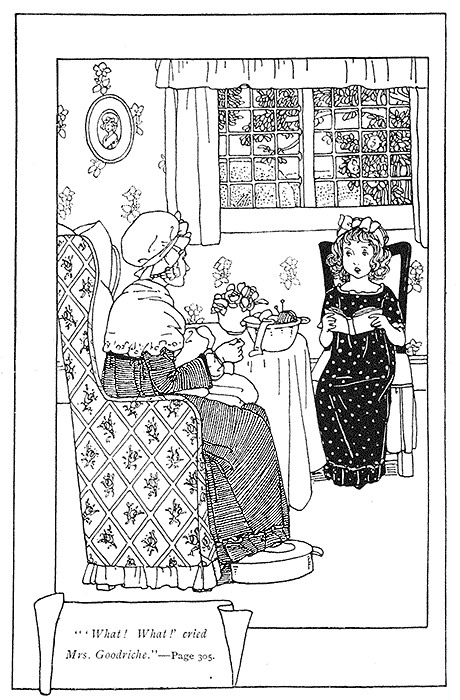
"'What! What!' cried Mrs. Goodriche."—Page 305.
"Yes, it is here," replied Bessy; "the real moon out of the sky—these are the very words."
"Nonsense!" said Mrs. Goodriche; "dear child, you are reading nonsense; don't you perceive it?"
"I don't know," replied Bessy, gaping; "I was not attending—what is it?"
"Don't you know what you have been reading?" asked Mrs. Goodriche.
"To be sure I do," answered Bessy, "or how could I have told the words right?"
"But the sense?" asked Mrs. Goodriche.
"I was not happening," replied Bessy, "just to be thinking about that. I was thinking just then, aunt, of the horrid fright Sukey was in when the bricks came rolling down, and how she did scream."
"Give me the book," said Mrs. Goodriche, almost at the end of her patience; "we will read no more to-day; go up and fetch that unfortunate bombazine frock, it must be darned; you have no other here, or indeed made, but that you have on."
Away ran Bessy, glad to be moving; and when Mrs. Goodriche had looked at the book, she found that Bessy had turned over two leaves,—that Tommy had once eaten a whole pound-cake in a very short time, and that he had cried the whole of the evening for the real moon out of the sky.
It might have been thought, from the time that she was absent, that Bessy had gone to the top of the barn to fetch her frock; the truth is, that it was some time before she could find it; she had thrown it on the drawers when she had taken it off, and it had slipped down behind them, to use an expression of her own. It was all covered over with dust, and the trimming crumpled past recovery; but she gave it a good shaking, and down she came, not in the least troubled at the accident. When she got into the parlour, she found Lucy and Emily seated each with
Mrs. Goodriche had desired to hear the story in Emily's new book, and they were each to read four pages at once, then to pass the book; and they had settled to begin with the eldest.
"I always think," said Lucy, "that when everything is done but our work, it is so comfortable; and when there is to be reading, I work so fast."
There was a little delay whilst Bessy was set to darn, and then Mrs. Goodriche read her four pages, and read them very pleasantly. The book was next given to Mrs. Fairchild, who passed it to Bessy.
"Where does it begin?" she said.
"At the top of the ninth page, Bessy," said Mrs. Fairchild.
There was another pause; and then Bessy started much like a person running a race, reading as fast as she could, till, like the same runner, when he comes to a stumbling-stone, she broke down over the first hard word, which happened to be at the end of the second sentence.
Mrs. Fairchild gently set her right, and she went on a little till she came to another word, which she miscalled, so that Mrs. Goodriche, who had not heard the story before, could not understand what she was reading about.
Emily looked down, and became quite red.
Lucy looked up full of wonder, and half inclined to smile; but a gentle look from her mother reminded her what civility and kindness required of her. Her mother's look seemed to say, "You ought to pity and not to laugh at one who has not been so well taught as yourself;" and she instantly looked down, and seemed to give her whole thoughts to her work.
"Bessy," said Mrs. Goodriche, "you had best pass the
"I shall never make much of reading, aunt," she answered carelessly; "I hate it so."
The reading then went on till one o'clock, and there was enough of the story left for another day. The work was then put up, and the children were at liberty till dinner-time; but the day was very hot, so there could be no walk till the evening.
"Now," said Mrs. Goodriche, "before we part, you shall see something out of this bag; it is full of pieces from my old great store-chest; there are three pieces of old brocade silk," and she spread them out on the table. They all looked as if they had been short sleeves; one was green, with purple and gold flowers as large as roses; another was pink, what is called clouded with blue, green, and violet: and the third was dove-colour, with running stripes of satin. "Now," she said, "each of you, my little girls, shall have one of these pieces, and you shall make what you please of it; and when you have made the best you can of the silk, you shall show your work to me, and I shall see who is worthy of more pieces, for I have more in this bag."
"If any of you, my dears," said Mrs. Fairchild, "should want little bits of ribbon or lining to help out what you wish to make, I shall gladly supply them; indeed," she added, "I may as well give what may be wanted now;" and having fetched a bag of odds and ends, she gave out some bits of coloured ribbon to suit the silks, with sewing silks and linings, such as her bag would afford, placing her gifts in equal portions on the three pieces of silk.
"And now," said Mrs. Goodriche, "who is to choose first?"
"Lucy and Emily," said Bessy; and Lucy wished Bessy to choose first. After a little while this matter was settled; Emily had the green with the golden flowers, Lucy the clouded pink, and Bessy the striped; but before they took them from the table, Mrs. Goodriche told them that they were only to have them on these conditions—that they were not to consult each other about the use they were to make of them; nor to get anybody to help in cutting them out, and not to tell what they were doing till they brought what they had made to her.
"Then, Lucy, you must not ask me," said Emily; "I will not ask you."
"I shall make no inquiries," said Mrs. Fairchild; "you may work at your things in any of your play hours excepting the walking time. Emily may work in my room, and Lucy in her own, because you must not be together; and if I come into my room, I shall not look at what you are doing, Emily."
Lucy and Emily took up their bits, all joy and delight, and full of thought; but Bessy was not so well pleased; she hated work as much as reading, and perhaps from the same reason, that she had neither got over the drudgery of work nor of reading. The beginning of all learning is dry, and stupid, and painful; but many things are delightful, when we can do them easily, which are most disagreeable when we first begin them.
After this day, things passed on till the end of the week much as we have said. Lucy and Emily were always very busy in their different places, from dinner to tea-time. Henry was often, at those times, with John; and where Miss Bessy was Mrs. Goodriche did not know, because she had proposed to go and work in Henry's arbour. Her aunt could not follow her everywhere, so she only made herself sure that she did not go beyond the garden, and
"When am I to see the pieces of work?" said Mrs. Goodriche on the Saturday morning.
"Before tea, ma'am," replied Lucy; "Emily and I are ready, but we don't know whether Bessy is—we can wait if she is not."
"Oh, I am ready," answered Bessy; "my silk is done."
The tea-things were on the table when Emily came in first with an open basket—whatever was in it was hidden by a piece of white paper. Lucy followed with a neat little parcel, carefully rolled up; and Bessy followed, with a hand in one of her pockets, and a smile on her face, though she looked red and rather confused.
"I shall look at the little market-woman with her basket first," said Mrs. Goodriche; and Emily went up to her with a sweet pleasant smile, as if she felt sure that she had some very pretty things to show. She took up the white paper, and discovered three pin-cushions, very nicely made: they were so contrived that there was a gold and purple flower in the centre of each pin-cushion on both sides: the cushions were square, well stuffed, and pinched in the middle of each side; they had a tassel at every corner, made of the odd bits of silk roved, and to each of them was a long bit of ribbon. Emily's face flushed like a rosebud when she laid them on the table. "Very, very good," said Mrs. Goodriche; "and you did them all yourself?"
"Yes, ma'am," said Emily. "I made the insides first, and stuffed them with bran, before I put the silk on."
"Now for Lucy," said Mrs. Goodriche; and Lucy, opening her parcel, showed an old-fashioned housewife with many pockets: she had managed her silk so, that
"Very, very good, too," said Mrs. Goodriche; "let it be placed by the pin-cushions; and now for Bessy."
Bessy began to giggle and to move herself about in a very uneasy way.
"If you have nothing to show, Bessy," said her aunt; "or if you are not ready, we will excuse you."
"It does not signify," answered Bessy, "I am as ready now as I ever shall be. I can make nothing of the silk."
"Have you lost it?" asked her aunt.
"No," she answered; "I have it—you may as well see it at once;" and diving again into her pocket, she brought out what looked very like a piece of blotting-paper which had been well used, and laid it on the table. "I could not help it," she said; "but I had it on the table one morning, when I was in this room alone, and I tumbled over the inkstand right upon it; and I thought it was lucky that almost all the ink had fallen on the silk, and not on the cloth; so, as it was spoiled already, I used it to wipe up the rest of the ink, and that is the whole truth."
Mrs. Goodriche, though vexed, could not keep herself from smiling, which Bessy seeing, tried to turn the whole affair into a laugh; but it was not a merry laugh.
"Well, take it away, my dear," said Mrs. Goodriche; "put it by to wipe your pens with;" and away ran Bessy out of the room, not to laugh when by herself, but to cry: and this, we are glad to say, was not the first time that the poor motherless girl had shed tears for her own follies within the last day or two.
When she had left the room, Mrs. Goodriche said:
"Poor young creature! I am sorry for her."
"Yes, ma'am," said Lucy, "because she has had no mamma for many years; but Emily and I begin to love her, she is so good-tempered."
"God will bless her," said Mrs. Fairchild; "He has shown His love by giving her a friend who will be a mother to her."
"But now, my little girls," said Mrs. Goodriche, "these things which you have made so prettily are your own."
"Thank you, ma'am," they both answered; "and may we do what we like with them?"
"To be sure," replied Mrs. Goodriche.
"Then," said Emily, "I shall give one to Mary Bush, and another to Margery, and another to Mrs. Trueman, for their best pin-cushions."
"And I shall give this housewife to nurse," said Lucy.
"I suppose," said Mrs. Goodriche, "that you will like to have them furnished for the poor women; I will give what pins and needles can be found on Monday morning; and at the same time I have for each of you a piece of nice flowered chintz for your dolls."
The little girls kissed the old lady with all their hearts, and ran away with the things which they had made: it was agreed that they were not to talk of them again before Bessy.
Bessy's Misfortunes
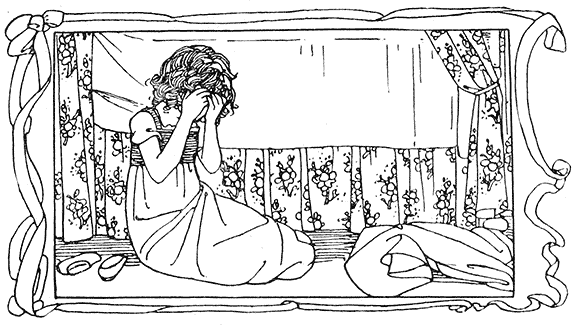
The Sunday morning was very fine, and there was a nice large party going to church together. We have not mentioned Mr. Somers lately, but he was still there, and very much beloved. His mother had lately come to live with him; she was a very old friend of Mrs. Goodriche, and when the two old ladies saw each other from their pews, they were vastly pleased. They hastened to meet each other after service; and Mrs. Somers begged all Mrs. Goodriche's party to come into the Parsonage House, which was close to the church.
Mrs. Fairchild said there were too many for all to go in; so she directed Betty to see the young ladies home: they had some way to walk, but had hardly got out of the village when Betty said:
"We shall surely have a shower—we shall be caught in the rain if we are not sharp."
"May we run, Betty?" asked Lucy and Emily; and having got leave, they set off at full speed, and got into the house just in time.
"Come, Miss Goodriche," said Betty; "you can run, I know, as well as the best of them, so why don't you set off too? As for me, I have not got my best bonnet on, for I foresaw there would be showers, and I have nothing else that can hurt. A very few drops would make that pretty crape bonnet of yours not fit to be seen."
"We shall be at home before the rain comes," said Bessy; "and I am sure that if it is only a few drops they will not hurt my bonnet; I want to stay with you. I want to ask you about the people I saw at church. Come, now, tell me, Betty, what was that family that sat just before us?"
Betty was walking away as fast as she could, and she answered:
"Miss, I can't stop to talk—it has begun to rain behind us on the hills; we shall have it in no time; and there is no house this way to run into."
"O la! Betty," cried Miss Bessy next; "my shoe-string is unpinned: do, for pity, lend me a big pin."
"Why, Miss," said Betty, "sure you don't pin your shoe-strings?"
"Only when I am in a hurry," she answered.
Betty found a pin, and the shoe was put to rights as well as might be; but two minutes at least were lost whilst this was being done.
"Now come on, Miss, as fast as you can," said Betty; "the drops are already falling on the dust at our feet."
They went on a few paces without another word, and then Miss Bessy screamed:
"Oh, Betty, the other string has gone snap: have you another pin?"
"Miss, Miss!" said Betty, fumbling for a pin, and in her hurry not being able to find one. Once more Miss Bessy was what soldiers call in marching order, and they made,
"Let us go over the field," said Bessy.
"No, no," replied Betty, bustling on. "If the gate on the other side should be locked—and John often keeps it so—we should be quite at fault."
"And what sort of a gate must it be," said Bessy, "that you and I could not get over?"
"We had better keep the road, Miss," replied Betty; "the grass must be wet already with the little rain which is come."
"And yet it has scarce laid the dust in the road," returned Bessy; "so if you choose to keep to the road, I shall take the field; so good-bye to you;" and the next minute she was over the stile, and running across the grass.
Betty looked after her a minute, and then saying, "Those who have the care of you have their hands full," she hurried on; but with all her haste she was like one who had been dipped in a well before she got in.
Almost the moment in which the two had parted, the shower had come down in right good earnest, driving and gathering and splashing the dust up on Betty's white stockings, and causing her to be very glad that she had not put on her best-made bonnet and new black ribbons. Betty had never worn a coloured bonnet in her life.
In the meantime Miss Bessy was flying along the field, throwing up the wet at every step from the long grass. The pins in her shoes at first acted as spurs, pricking her for many steps, and then crooking and giving way; so that she had the comfort of running slipshod the rest of the
Bessy tried to pull some of them out, and in so doing thoroughly soaked her gloves, and then only succeeded in pulling aside one or two of them; but she mounted the gate, and in coming down, her foot slipping, she fell flat on the ground, leaving part of her frock on the thorns, which at the time she did not perceive.
"It can't be helped," she thought, as she rose again, and ran on to the house without further misfortune. She thought herself lucky in getting in by the front door without being seen; and her aunt was not at home, which was another piece of luck, she believed; and she hastened to change her dress, cramming all her wet things into a closet in the room used for hanging up frocks and gowns when taken off. She did not, as it happened, throw her frock and bonnet on the floor of the closet; and she thought she had been very careful when she hung the frock on a peg and the bonnet over it. She had some trouble in getting off her wet gloves, which stuck as close to her hands as if they had been part of them; and these, with the shoes and other inferior parts of her dress, found their places on the floor of the closet. They were all out of the way before her aunt could come; for though it had ceased to rain as soon as she came in, she knew it would take some time for the walk from the Parsonage House.
Such good use did Bessy make of her time that she had
The first inquiry which Mrs. Fairchild and Mrs. Goodriche made was whether the young people and Betty had escaped the shower. Lucy, who knew no more than that they had all come in soon after each other, answered:
"Oh yes, but we had a run for it."
Betty was not there to tell her story, and Bessy thought it was quite as well to let the affair pass.
Thoughtful people often wonder how giddy ones can be so thoughtless as they are, and giddy ones wonder how their thoughtful friends can attend to so many things as they do. Many persons are naturally thoughtless, but this fault may be repaired by management in childhood. Poor Bessy had had no such careful management; and her carelessness had come to such a pass, that from the time in which she had hung up her wet and spoiled clothes in the closet, she troubled herself about them no more till the time came when she wanted to put them on.
Still, she learned much, as it proved, from the misfortunes of that Sunday. After dinner it began to pour again, and Mrs. Fairchild took Bessy with her own children into a quiet room, and there she read the Bible and talked to them. Having been well used to talk to children and young people, she made all she said so pleasant, that Bessy was quite surprised when Betty knocked at the door and said tea was ready.
The rest of the Sunday evening passed off so very pleasantly that even Bessy yawned only three times, and that was just before supper—and yet it rained—rained—rained.
The next morning rose in great brightness, promising a charming day. The forenoon was spent as usual; and after the lessons and work, Mrs. Goodriche furnished the pin-
Whilst all this business was going on, Bessy was somewhere about in the garden.
Now it was not a very common thing for a loud knock to be heard at Mr. Fairchild's door. But it was Mr. Somers who knocked, and he came in all in a hurry. He came to say that a lady, who lived about two miles distant in another parish, had called. He told the lady's name to Mrs. Fairchild: and Mrs. Fairchild said she knew her, though they had not visited. This lady had a nice house and a pretty orchard; and she had come, only an hour before, to say that Miss Pimlico, with all her young ladies, were coming to spend the evening with her, and that they were to have tea in the open air, and to amuse themselves in any way they liked. The lady hoped that Mr. Somers and his mother would come, and that they would, if possible, bring with them Mr. and Mrs. Fairchild and their nice children, and make a pleasant evening of it.
"We told her that Mrs. Goodriche and her niece were at Mr. Fairchild's," added Mr. Somers; "and she said, 'Let them come also, by all means; the more the merrier;' and then she kindly entered into what carriages we could muster.
"I told her," he continued, "that Mr. Fairchild had a carriage which would hold two grown-up persons and three little ones, and that mine could do as much if needful; proving that we had even one seat to spare—so come, you must all go. Mrs. Goodriche and my mother shall have the back seat of my carriage, and I shall make interest for Miss Lucy to sit by me in the front seat."
All the children present looked anxiously to hear
"At four I shall hope to call for Mrs. Goodriche and Miss Lucy," said Mr. Somers. "I have a poor woman to call on by the way, if this lady does not object. We may therefore set out about half an hour before you. So now, good-bye;" and he walked away.
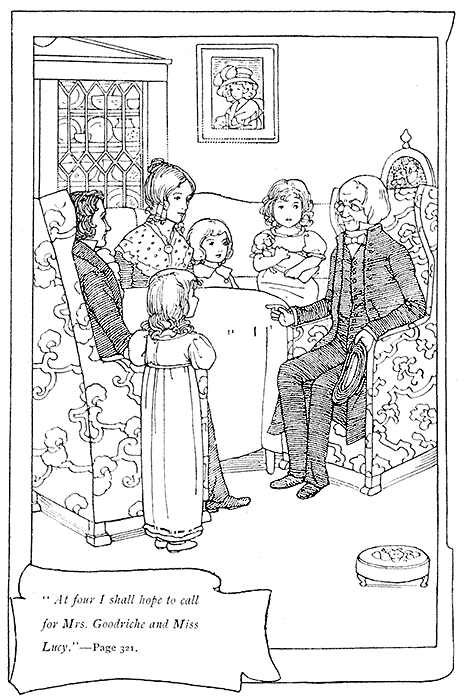
"At four I shall hope to call for Mrs. Goodriche and Miss Lucy."—Page 321.
How merry and happy were the faces round the table at dinner! Mrs. Goodriche and Lucy had only just time to get ready before Mr. Somers came for them.
When they were gone the rest of the party found it was time to get dressed. John brought the carriage to the gate at the time fixed; and Henry, who had been watching for it ever since he had been dressed, came in to give notice. Emily and her father immediately went to the gate; and Mrs. Fairchild, thinking that Bessy might want a little attention and help, went to her room. As she knocked at the door she thought she heard low sobs within; she called Bessy twice, and no answer being given she walked in.
There was a sight indeed! Bessy was sitting at the foot of the bed without a frock, and sobbing and crying most piteously. On the floor, on one side of her, were her best shoes, shrunk up and wrinkled and covered with mud in the most extraordinary way. In another part of the floor lay the unfortunate frock, all draggled and splashed round the bottom, and, as Mrs. Fairchild could see without lifting it up, wanting a part of one breadth. On the drawers was the bonnet, which was of reeved crape made upon wire, and not one at all suited for a careless girl; but it was made by a milliner at Plymouth. What with soaking, crumpling, and here and there a rent from some bough, it had lost all appearance of what it had been: it looked a heap of old crape gathered carelessly together; and the
"Oh, ma'am! Oh, Mrs. Fairchild!" cried the unfortunate Bessy, "what can I do? What shall I do?"
Mrs. Fairchild lifted up the dress, but as hastily laid it down again, for she saw it would take some hours to make it fit to be worn. The bonnet, shoes, and gloves all equally required time and attention.
"I am afraid," she said kindly, "it will not do for you to attempt to put on these things; and, what is worse, I have none that will fit you. My dresses are as much too large as Lucy's are too small."
"Oh, do, dear Mrs. Fairchild," cried the sobbing Bessy, "at least, let me try one of your gowns."
Though aware the attempt would be useless, the kind lady brought one of her white dresses, to see if anyhow it could be made to fit; but even Bessy, after a while, acknowledged it would not do, being so very much too large for her.
Mrs. Fairchild next examined the young lady's everyday cotton; but, alas! that was too dirty to think of its being shown beside the best dresses of the other little misses. Then, too, if a dress could have been procured, bonnet, shoes, and gloves would have also been requisite; and these could not have been obtained even amongst Miss Bessy's own clothes; for if her best were unfit to be seen, her commoner ones were scarce worth picking up in the street.
"It will not do, I see," said Miss Bessy; "you had better go without me, Mrs. Fairchild."
"I am afraid it must be as you say," replied that lady, "and most sincerely sorry am I for you, my dear."
So saying, she left the room, and then came another burst of tears, and more sobs, for three or four minutes afterwards.
Bessy, who still sat on the bed, heard the carriage drive away. "Oh, how cruel!" she thought, or rather spoke—"how cruel of Mrs. Fairchild to go away, and hardly to say one word to me! But I know she despises me; she can think nobody worth anything but her own children:" then there was another burst of tears, and more sobs.
After a little time, all spent in crying, she heard her door open again, and turning round, she saw Mrs. Fairchild come in without her bonnet, in her usual dress, and with a work-bag in her hand. She came straight up to the weeping girl, and kissing her, "Now, Bessy," she said, "wipe away those tears, and we will have a happy and, I hope, useful evening. Betty will be ready to help us immediately, and we shall set to work and see what we can do in putting your things to rights. The carriage is gone with all the rest of the party, and I have sent a message to your aunt by Mr. Fairchild. He will make the best of the affair, and if you will help, we will try to put all these things to rights."
"Oh, Mrs. Fairchild," said Bessy, throwing herself into her arms, "and have you given up your pleasure for such a naughty girl as I am?"
"I have given up no pleasure so great as I shall receive, dear Miss Goodriche, if I can see you trying to do right this evening: trying for once to work hard, and to overcome those habits which give your aunt so much pain. Come, put on your frock, and let us set to work immediately."
The eyes of poor Bessy again filled with tears, but they were tears of gratitude and love; and she hastened to put on her frock, and then do anything which Mrs. Fairchild directed: and, first of all, the crape trimmings were taken from the bonnet and the skirt of the frock; Betty was then called, and she took them to her kitchen to do what