Part I (continued 2)
Reading edition
"By the time Master and Miss Bennet had made their
"After the children had got their dinner, it being a very pleasant afternoon, Mrs. Howard gave them leave to play in the garden, and in the little croft, where she kept her old horse Crop.
"'But take care, my dears,' she said to the little girls, 'not to soil your slips or tear your aprons.'
"The children were much pleased with this permission to play; and after they were gone out, Mrs. Howard put on her hood and cloak, and said to Betty:
"'I shall drink tea, Betty, in my bower at the end of the grass walk; do you bring my little tea-table there, and the strawberries and cream, and the cake which you made yesterday; and when we have finished our tea, bring those toys which are in the glass cupboard to divide amongst the children.'
"'And I think, madam,' said Betty, 'that Master and Miss Bennet will gain some of them to-day, for I thought they behaved very well at dinner.'
"'Indeed, Betty,' said Mrs. Howard, 'I must say I never saw them behave so mannerly as they did at dinner, and if they do but keep it up till night, I shall not send them home without some pretty present, I assure you.'
"When Mrs. Howard had given her orders to Betty, she took her gold-headed stick in her hand, and went down the grass walk to her bower. It was a pretty bower, as I have heard my mother say, formed of honeysuckles
"Whilst the children were all engaged with their sports in the croft, a poor old man, who had been gathering sticks, came by that way, bending under the weight of the load. When he appeared, the children ceased from their play, and stood looking at him.
"'Poor man!' said Miss Patty Cartwright, 'those sticks are too heavy for you to carry. Have you far to go?'
"'No, my pretty miss,' said the old man; 'only a very little way.'
"'I cannot help to carry your sticks,' said Master Cartwright, 'because I have my best coat on. I could take off that, to be sure, but then my other things would be spoiled; but I have got a penny here, if you please to accept it.' So saying, he forced the penny into the poor man's hand.
"In the meantime, Master Bennet went behind the old man, and giving the sticks a sly pull, the string that tied them together broke, and they all came tumbling on the ground. The children screamed, but nobody was hurt.
"'Oh, my sticks!' said the poor man; 'the string is broke! What shall I do to gather them together again? I have been all day making this little faggot.'
"'We will help you,' said Master Cartwright; 'we can
"So all the little ones set to work (excepting Master and Miss Bennet, who stood by laughing), and in a little while they made up the poor man's bundle of sticks again, and such as had a penny in their pockets gave it him. Miss Patty Cartwright had not a penny, but she had a silver sixpence, which she gave to the old man, and ran before him to open the gate (which led out of the field), wishing him good-night, and curtseying to him as civilly as if he had been the first lord of the land.
"Now the children never suspected that Mrs. Howard had heard and seen all this, or else Master and Miss Bennet, I am sure, would not have behaved as they did. They thought Mrs. Howard was in the parlour, where they had left her.
"By this time everything was ready for tea, and the cake set upon the table, with the strawberries and cream.
"'And now, Betty,' said Mrs. Howard, 'you may call the children; and be sure, when tea is over, to bring the toys.'
"Master and Miss Bennet looked as demure when they came in to tea as they had done at dinner, and a stranger would have thought them as well-behaved children as Master and Miss Cartwright; but children who behave well in the sight of their parents, or in company, and rudely or impertinently in private, or among servants or their playfellows, cannot be called well-bred.
"After the young people had had their tea and cake, and strawberries and cream, Betty came with the playthings, and placed them on the table before Mrs. Howard. You would, perhaps, like to know what these playthings were:—First of all was the jointed doll, dressed, as I before said, in a green satin slip, and a gauze bib and
"'My dear children, I sent for these pretty toys from the fair, in order to encourage you to be good: there is nothing that gives me greater pleasure than to see children polite and mannerly, endeavouring to please everybody, "in honour preferring one another," as God hath commanded us to do. Pride and ill manners, my dear children, are great faults; but humility, and a wish to please everyone rather than ourselves, make us resemble the blessed Lord Jesus Christ, who did not despise the poorest among men. Many persons are polite and good-mannered when in company with their betters, because, if they were not so, people would have nothing to say to them: but really well-behaved persons are courteous and civil, not only when they are among their betters, but when they are with servants, or with poor people.'
"Then Mrs. Howard took the jointed doll, and the History of the Bible, and gave the one to Miss Patty Cartwright, and the other to Master Billy, saying:
"'I give you these, my children, because I observed your good manners, not only to me, but to the poor old man who passed through the croft with his bundle of sticks. To you, Master Bennet, and to you, Miss Polly, I shall not give anything; because you showed, by your
"Then Mrs. Howard gave the rest of the toys among the lesser children, commending them for helping the old man to gather his sticks together; and thus she dismissed them to their own houses, all of them, except Master Jacky and Miss Polly, jumping and skipping for joy."
When Mrs. Goodriche had finished her story, Lucy said:
"What a pretty story that is! I think Master and Miss Cartwright deserved those pretty toys—they were nice children: but I did not know that having rude manners was so very great a fault."
"If you will think a minute, my dear," said Mrs. Goodriche, "you will find that rude manners must be one sign of badness of heart: a person who has always a lowly opinion of himself, and proper love for his neighbour, will never be guilty of rudeness; it is only when we think ourselves better than others, or of more consequence than they are, that we venture to be rude. I have heard you say how rude Miss Augusta Noble was the last time you were at her house. Now, why was she rude, but because she thought herself better than her company? This is pride, and a great sin it is."
Sad Story of a Disobedient Child
When Mr. Fairchild returned from his walk he found John ready with the cart, so, wishing Mrs. Goodriche a good-evening, and thanking her for her kindness, they returned home.
The next morning Mr. Fairchild got up early, and went down to the village. Breakfast was ready, and Mrs. Fairchild and the children waiting at the table, when he came back.
"Get your breakfast, my dear," said he to Mrs. Fairchild; "don't wait for me." So saying, he went into his study and shut the door.
Mrs. Fairchild, supposing that he had some letters to write, got her breakfast quietly; after which she sent Lucy to ask her father if he would not choose any breakfast. When Mr. Fairchild heard Lucy's voice at the study-door, he came out, and followed her into the parlour.
When Mrs. Fairchild looked at her husband's face she saw that something had grieved him very much. She was frightened, and said:
"My dear, I am sure something is the matter; what is it? Tell me the worst at once; pray do!"
"Indeed, my dear," said Mr. Fairchild, "I have heard something this morning which has shocked me dreadfully. I was not willing to tell you before you had breakfasted. I know what you will feel when you hear it."
"Do tell me," said Mrs. Fairchild, turning quite white.
"Poor Augusta Noble!" said Mr. Fairchild.
"What, papa?" said Lucy and Emily and Henry, in one voice.
"She is dead!" exclaimed Mr. Fairchild.
The children turned as pale as their mother; and poor Mrs. Fairchild nearly fainted.
"Oh! poor Lady Noble! poor Lady Noble!" said she, as soon as she could speak. "Poor Lady Noble!"
Whilst the children were crying over the sad news Mrs. Barker came into the parlour. Mrs. Barker was a kind woman, and, as she lived by herself, was always at liberty to go amongst her neighbours in times of trouble.
"Ah, Mrs. Fairchild," she said, "I know what troubles you: we are all in grief through the whole village."
"What was the cause of the poor child's death?" asked Mrs. Fairchild. "I never heard that she was ill."
"Ah! Mrs. Fairchild, the manner of her death is the worst part of the story, and that which must grieve her parents more than all. You know that poor Miss Augusta was always the darling of her mother, who brought her up in great pride; and she chose a foolish governess for her who had no good influence upon her."
"I never thought much of Miss Beaumont," said Mrs. Fairchild.
"As Miss Augusta was brought up without the fear of God," continued Mrs. Barker, "she had, of course, no notion of obedience to her parents, further than just trying to please them in their presence; she lived in the constant practice of disobeying them, and the governess continually
"But," said Mrs. Fairchild, "how did she lose her life through disobedience to her parents? Pray tell me, Mrs. Barker."
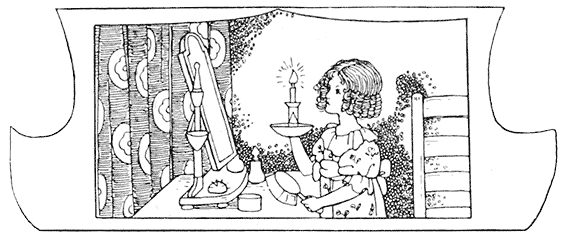
"The story is so sad I hardly like to tell it you," answered Mrs. Barker; "but you must know it sooner or later. Miss Augusta had a custom of playing with fire, and carrying candles about, though Lady Noble had often warned her of the danger of this habit, and strictly charged her governess to prevent it. But it seems that the governess, being afraid of offending, had suffered her very often to be guilty of this piece of disobedience, without telling Lady Noble. And the night before last, when Lady Noble was playing at cards in the drawing-room with some visitors, Miss Augusta took a candle off the hall table, and carried it upstairs to the governess's room. No one was there, and it is supposed that Miss Augusta was looking in the glass with a candle in her hand, when the flame caught her dress; but this is not known. Lady Noble's maid, who was in the next room, was alarmed by her dreadful screams, and, hastening to discover the cause, found poor Augusta in a blaze from head to foot. The unhappy young lady was so dreadfully burnt that she never spoke afterwards, but died in agonies last night."
When Mrs. Fairchild and the children heard this dreadful story they were very much grieved. Mrs. Barker stayed with them all day; and it was, indeed, a day of mourning through all the house.
The Two Books
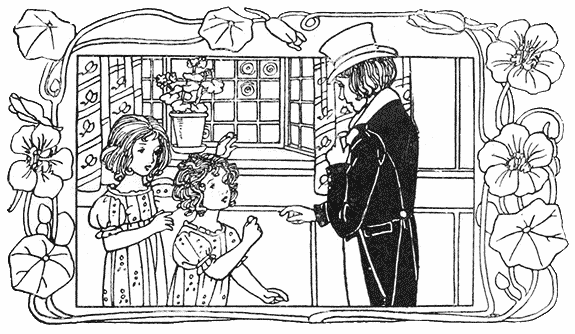
It was the time of the Midsummer Fair, and John asked Mr. Fairchild's leave to go to the fair.
"You may go, John," said Mr. Fairchild; "and take the horse, and bring everything that is wanting in the family."
So John got the horse ready, and set out early in the morning to go to the fair; but before he went Emily and Lucy gave him what money they had, and begged him to bring them each a book. Emily gave him twopence, and Lucy gave him threepence.
"You must please choose a book for me with pictures in it," said Emily.
"I do not care about pictures," said Lucy, "if it is a pretty book. So pray don't forget, John."
In the evening, after tea, the children and their father and mother, as usual, got ready to take a walk; and the children begged Mr. and Mrs. Fairchild to go with them to meet John. "For John," said Henry, "will be
So Mr. and Mrs. Fairchild took the road which led towards the town where the fair was held, and the children ran before them. It was a fine evening. The hedges were full of wild roses, which smelt most sweet; and the haymakers were making hay in the fields on each side of the road.
"I cannot think where John can be," said Henry. "I thought he would be here long before now."
By this time they were come to the brow of a rising ground; and looking before them, behold, there was John at a distance! The children all ran forward to meet him.
"Where are the books, John? Oh, where are the books?" they all said with one voice.
John, who was a very good-natured man, as I have before said, smiled, and, stopping his horse, began to feel in his pockets; and soon brought out, from among other things, two little gilt books; the largest of which he gave to Lucy, and the other to Emily, saying:
"Here is two pennyworth—and here is three pennyworth."
"Indeed, John, you are very good," said the children. "What beautiful books!"
"My book," said Emily, "is 'The History of the Orphan Boy,' and there are a great many pictures in it: the first is a picture of a funeral—that must be the funeral of the poor little boy's papa and mamma, I suppose."
"Let me see, let me see," said Henry. "Oh, how pretty! And what's your book, Lucy?"
"There are not many pictures in my book," said Lucy; "but there is one at the beginning: it is the picture of a
"Oh, that must be very pretty," said Henry.
By this time Mr. and Mrs. Fairchild were come up.
"Oh, papa! oh, mamma!" said the little ones, "what beautiful books John has brought!"
"Indeed," said Mr. Fairchild, when he had looked at them a little while, "they appear to be very nice books, and the pictures in them are very pretty."
"Henry shall read them to us, my dears," said Mrs. Fairchild, "whilst we sit at work; I should like to hear them very much."
"To-morrow," said Mr. Fairchild, looking at his wife, "we begin to make hay in the Primrose Meadow. What do you say? Shall we go after breakfast, and take a cold dinner with us, and spend the day under the trees at the corner of the meadow? Then we can watch the haymakers, and Henry can read the books whilst you and his sisters are sewing."
"Oh, do let us go! do let us go!" said the children; "do, mamma, say yes."
"With all my heart, my dears," said Mrs. Fairchild.
The next morning early the children got everything ready to go into the Primrose Meadow. They had each of them a little basket, with a lid to it, in which they packed up their work and the new books; and, as soon as the family had breakfasted, they all set out for the Primrose Meadow: Mr. Fairchild, with a book in his pocket for his own reading; Mrs. Fairchild, with her work-bag hanging on her arm; Betty, with a basket of bread and meat and a cold fruit-pie; and the children with their work-baskets and Emily's doll, for the little girls
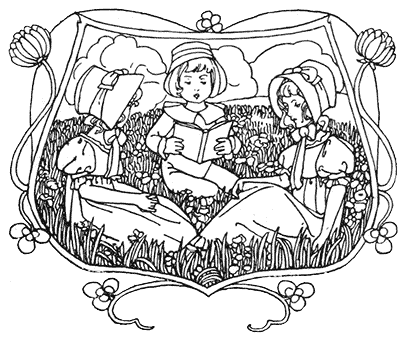
The people were very busy making hay in the meadow when Mr. Fairchild and his family arrived. Mrs. Fairchild sat down under the shade of a large oak-tree which grew in the corner of the coppice, and Lucy and Henry, with Emily, placed themselves by her. The little girls pulled out their work, and Henry the new books. Mr. Fairchild took his book to a little distance, that he might not be disturbed by Henry's reading, and he stretched himself upon a green bank.
"Now, mamma," said Henry, "are you ready to hear my story? And have you done fidgeting, sisters?" For Lucy and Emily had been bustling to make a bed for their doll in the grass with their pocket-handkerchiefs.
"Brother," answered Lucy, "we are quite ready to hear you—read away; there is nothing now to disturb you, unless you find fault with the little birds who are chirping with all their might in these trees, and those bees which are buzzing amongst the flowers in the grass."
"First," said Henry, "look at the picture at the beginning of the book—the picture of the funeral going through the churchyard."
"Let me see, brother," said Emily.
"Why, you have seen it several times," said Henry; "and now I want to read."
"Still, my dear," said Mrs. Fairchild, "you might
Henry immediately got up, and showed his sister the picture, after which he sat down again and began to read the story in Emily's book.
"Henry reads the story."—Page 91.
The History of the Orphan Boy
"In a little flowery valley near Tenterden there lived once a certain farmer who had a wife and one little boy, whose name was Marten. The farmer and his wife were people who feared God and loved their neighbours, and though they were not rich, they were contented. In the same parish lived two gentlemen, named Squire Broom and Squire Blake, as the country people called them. Squire Broom was a man who feared God; but Squire Blake was one of those men who cared for nothing beyond the things of this world. He was a very rich man, and was considered by the neighbours to be good-tempered. His lady kept a plentiful house, and was glad to see anyone who came. They had no children, and, as they had been married many years, it was thought they never would have any. Squire Broom was not so rich as Squire Blake, and, though a very worthy man, was not of such pleasing manners, so that many people did not like him, though in times of distress he was one of the kindest friends in the world. Squire Broom had a very large family, which he brought up in an orderly,
"When little Marten was about three years of age his father was killed as he was going to Tenterden market by a fall from his horse. This was so great a grief to his mother, who loved her husband very dearly, that she fell immediately into a bad state of health; and though she lived as much as two years after her husband, yet she was all that time a dying woman. There was nothing in the thoughts of death which made this poor woman unhappy at any time, excepting when she considered that she must leave her little Marten to strangers; and this grieved her the more because little Marten was a very tender child, and had always been so from his birth.
"It happened a few weeks before her death, as little Marten's mother was lying on her couch, that one Mrs. Short, who lived in Tenterden, and spent her time in gossiping from house to house, came bustling into the room where Marten's mother lay.
"'I am come to tell you,' said she, 'that Squire Blake's lady will be here just now.'
"'It is some time since I have seen Mrs. Blake,' said Marten's mother; 'but it is kind of her to visit me in my trouble.'
"Whilst she was speaking Mr. Blake's carriage came up to the door, and Mrs. Blake stepped out. She came into the parlour in a very free and friendly manner, and, taking Marten's mother by the hand, she said she was very sorry to see her looking so ill.
"'Indeed,' said the sick woman, 'I am very ill, dear madam, and I think that I cannot live longer than a few weeks; but God's will be done! I have no trouble in leaving this world but on account of little Marten; yet I
"Mrs. Blake then answered:
"'As you have begun to speak upon the subject, I will tell you what particularly brought me here to-day.'
"She then told her that, as she and Mr. Blake had a large fortune and no family, they were willing to take little Marten at her death and provide for him as their own. This was a very great and kind offer, and most people would have accepted it with joy; but the pious mother recollected that Mr. Blake was one who declared himself to be without religion; and she could not think of leaving her little boy to such a man. Accordingly she thanked Mrs. Blake for her kind offer—for a very kind offer it was—and said that she should feel obliged to her till her dying moment.
"'But,' added she, 'I cannot accept of your friendship for my little boy, as I have a very dear Friend who would be disobliged if I did so.'
"Mrs. Blake turned red, and was offended; for she had never once thought it possible that Marten's mother should refuse her offer; and Mrs. Short lifted up her hands and eyes, and looked as if she thought the poor sick woman little better than a fool.
"'Well,' said Mrs. Blake, 'I am surprised, I must confess. However, you must know your own affairs best; but this I must say, that I think Marten may live long enough without having such another offer.'
"'And I must say that you are standing in the child's way,' said Mrs. Short. 'Why, Mr. Blake can do ten times more for the child than his father could have done, had he lived a hundred years; and I think it very ungrateful and foolish in you to make such a return for Mr. and Mrs. Blake's kindness.'
"'And pray,' said Mrs. Blake, 'who is this dear Friend who would be so much disobliged by your allowing us to take the boy?'
"'I suppose it is Squire Broom,' said Mrs. Short; 'for who else can it be?'
"'Yes,' said Mrs. Blake, 'I have no doubt it is, for Mr. Broom never loved my husband. But,' added she, looking at Marten's mother, 'you do very wrong if you think Mr. Broom could do as much for the child (even if he were willing) as my husband. Mr. Broom is not rich, and he has a great many children; whereas Mr. Blake has a very handsome fortune, and no near relation in the world. However, as you have once refused, I do not think I would take the boy now if you were to ask me.'
"'I am very sorry,' answered Marten's mother, 'to appear unthankful to you; and perhaps, as I am a dying woman, I ought to tell you the true reason of my refusing your offer, though it may make you angry. I do not doubt but that you would be kind to little Marten, and I know that you have more to give him than his father could have had.'
"She then, in a very delicate manner, hinted at Mr. Blake's irreligious opinions, and acknowledged that it was on the account of these that she had refused his protection for her son.
"'The Lord Jesus Christ,' added she, 'is the dear Friend I spoke of, my dear madam, and the One I am afraid to offend by accepting Mr. Blake's offer. You are welcome to tell Mr. Blake all I say.'
"Mrs. Blake made no answer, but got up, and, wishing Marten's mother and Mrs. Short a good-morning, went away very much offended.
"When Mrs. Short was left with the sick woman she failed not to speak her mind to her, and that very plainly,
"Marten's mother answered: 'I am willing to be counted a fool for Christ's sake.'
"The next day Marten's mother sent for Squire Broom; and when she had told him all that had passed between herself and Mrs. Blake, she asked him if he would take charge of poor little Marten when she was dead, and also of what little money she might leave behind her; and see that the child was put to a good school. Squire Broom promised that he would be a friend to the boy to the best of his power, and Marten's mother was sure that he would do what he promised, for he was a good man. And now, not to make our story too long, I must tell you that Marten's mother grew weaker and weaker, and about three weeks after she had had this conversation with Mrs. Blake she was found one morning dead in her bed; and it was supposed she died without pain, as Susan, the maid, who slept in the same room, had not heard her move or utter a sigh. She was buried in Tenterden churchyard, and Squire Broom, as he had promised, took charge of all her affairs.
"And now, after having done with little Marten's good mother, I shall give you the history of the little boy himself, from the day when he was awoke and found his poor mother dead; and you shall judge whether God heard his mother's prayer, and whether He took care of the poor little orphan.
"Marten's mother was buried on Saturday evening. On Sunday little Marten went and stood by his mother's grave, and no one but Susan could persuade him to come away. On Monday morning Squire Broom came in a one-horse chaise to take him to school at Ashford. The master of the school at that time was a conscientious man but
"Little Marten cried very much when he was put into the one-horse chaise with Squire Broom.
"'Oh, let me stay with Susan! let me live with Susan!' he said.
"'What!' said Squire Broom, 'and never learn to read? You must go to school to learn to read, and other things a man should know.'
"'Susan shall teach me to read,' said little Marten.
"Squire Broom promised him that he should come back in the summer, and see Susan, and little Marten tried to stop crying.
"When little Marten got to Ashford school he was turned into a large stone hall, where about fifty boys were playing; he had never seen so many boys before, and he was frightened, and he crept into a corner. They all got round him, and asked him a great many questions, which frightened him more; and he began to cry and call for Susan. This set the boys a-laughing, and they began to pull him about and tease him.
"Little Marten was a pretty child; he was very fair, and had beautiful blue eyes and red lips, and his dark brown hair curled all over his head; but he had always been very tender in his health; and the kickings and thumpings and beatings he got amongst the boys, instead of making him hardy, made him the more sickly and drooping.
"The boys used to rise very early, and, after they had been an hour in school, they played in the churchyard (for the schoolroom stands in the churchyard) till the bell rang to call them to breakfast. In the schoolroom there was only one fireplace, and the lesser boys could never get near it, so that little Marten used to be so numbed with cold in the mornings (for winter was coming) that he
"As the winter advanced it became colder and colder, and little Marten got a very bad cough, and grew very thin. Several people remarked to the schoolmaster, 'Little Marten is not well; he gets very thin.' 'Oh, he will be better,' the master would answer, 'when he is more used to us. Many children, when they first come to school, pine after home; but what can I do for him? I must not make any difference between him and the other boys.'
"One morning in the beginning of December, when the boys were playing in the churchyard before breakfast, little Marten, not being able to run, or scarcely to walk, by reason of his chilblains, came creeping after them; his lips were blue and cold, and his cheeks white. He looked about for some place where he might be sheltered a little from the cold wind; and at length he ventured to creep into the porch of an old house, which stood on one side of the churchyard. The door of the house was open a little way, and Marten peeped in: he saw within a small neat kitchen, where was a bright fire; an elderly maid-servant was preparing breakfast before the fire; the tea-kettle was
"Whilst Marten was peeping in, and longing for a bit of toast-and-butter, a little old lady, dressed in a gray silk gown, wearing a mob-cap and long ruffles, came into the kitchen by the inner door. She first spoke to the parrot, then stroked the cat; and then, turning towards the porch-door, she said (speaking to the maid):
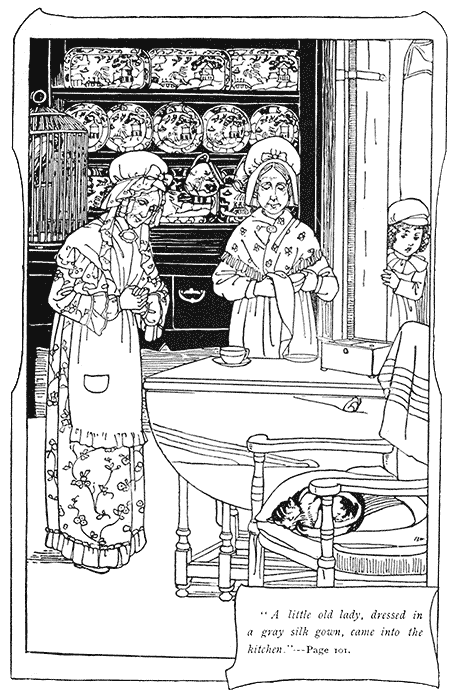
"A little old lady, dressed in a gray silk gown, came into the kitchen."—Page 101.
"'Hannah, why do you leave the door open? The wind comes in very cold.' So saying, she was going to push the door to, when she saw poor little Marten. She observed his black coat, his little bleeding hands, and his pale face, and she felt very sorry for him. 'What little fellow are you?' she said, as she held the door in her hand. 'Where do you come from, and what do you want at my door?'
"'My name is Marten,' he answered, 'and I am very cold.'
"'Do you belong to the school, my dear?' said she.
"'Yes, ma'am,' he answered; 'my mother is dead, and I am very cold.'
"'Poor little creature!' said the old lady, whose name was Lovel. 'Do you hear what he says, Hannah? His mother is dead, and he is very cold! Do, Hannah, run over to the school-house, and ask the master if he will give this little boy leave to stay and breakfast with me.'
"Hannah set down a tea-cup which she was wiping, and looking at Marten:
"'Poor young creature!' she said. 'It is a pity that such a babe as this should be in a public school. Come in, little one, whilst I run over to your master and ask leave for you to stay a little with my mistress.'
"Hannah soon returned with the master's leave, and poor little Marten went gladly upstairs into Mrs. Lovel's parlour. There Mrs. Lovel took off his wet shoes and damp stockings, and hung them to the fire, while she rubbed his little numbed feet till they were warm. In the meantime Hannah brought up the tea-things and toast-and-butter, and set all things in order upon the round table.
"'You are very good,' said little Marten to Mrs. Lovel; 'I will come and see you every day.'
"'You shall come as often as you please,' said Mrs. Lovel, 'if you are a good little boy.'
"'Then I will come at breakfast-time, and at dinner-time, and at supper-time,' said Marten.
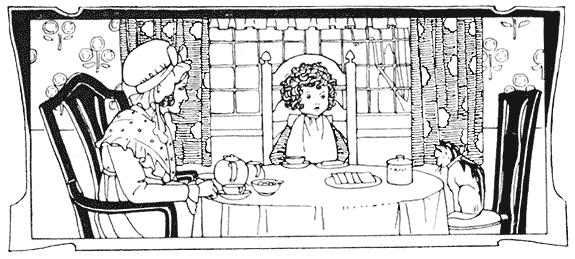
"Mrs. Lovel smiled and looked at Hannah, who was bringing up the cream-pot, followed by the cat. Puss took her place very gravely at one corner of the table, without touching anything.
"'Is that your cat, ma'am?' said Marten.
"'Yes,' said Mrs. Lovel; 'and see how well she behaves: she never asks for anything, but waits till she is served. Do you think you can behave as well?'
"'I will try, ma'am,' said Marten.
"Mrs. Lovel then bade Marten fetch himself a chair, and they both sat down to breakfast. Marten behaved so well at breakfast that Mrs. Lovel invited him to come to her at dinner-time, and said she would send Hannah to his master for leave. She then put on his dry shoes and stockings; and as the bell rang, she sent him over to school. When school broke up at twelve o'clock, she sent Hannah again for him; and he came running upstairs, full of joy.
"'This is a half-holiday, ma'am,' he said, 'and I may stay with you till bed-time: and I will come again to breakfast in the morning.'
"'Very well,' said Mrs. Lovel; 'but if you come here so often you must do everything I bid you, and everything which Hannah bids you.'
"'The same as I did to my poor mother, and to Susan?' said Marten.
"'Yes, my dear,' said Mrs. Lovel.
"'Then I will, ma'am,' said Marten.
"So Marten sat down to dinner with Mrs. Lovel; and at dinner he told her all he knew of himself and his mother; and after dinner, when she gave him leave, he went down to the kitchen to visit Hannah, and to talk to the parrot, and to look about him till tea-time. At tea-time he came up again; and after tea Mrs. Lovel brought out a large Bible full of pictures, and told him one or two stories out of the Bible, showing him the pictures. At night Hannah carried him home, and he went warm and comfortable to bed.
"Mrs. Lovel grew every day fonder of little Marten; and, as the little boy promised, he went to Mrs. Lovel's at breakfast, dinner, and supper; and Mrs. Lovel took the same care of him as his mother would have done, had she been living. She took charge of his clothes, mending them when they wanted it; prepared warm and soft woollen stockings for him, procured him a great-coat to wear in school, and got him some thick shoes to play in. She also would see that he learned his lessons well every day, to carry up to his master: she then practised him in reading out of school hours, so that it was surprising how quickly he now got on with his books. But the best of all was, that Mrs. Lovel from day to day gave such holy teaching to little Marten as was best adapted to make him a good man in after-life; and God blessed her teaching, and the boy soon became all that she could desire.
"A little before Christmas, Squire Broom came over to
"'I have got another mother, sir,' he said, 'a very good mother; and I love her with all my heart; and her name is Lovel; and you must come to see her.'
"'Why, my little man,' said Squire Broom, 'you look very well, and quite fat.'
"When Squire Broom heard from the master what a kind friend Marten had found, and was told by all his friends in Ashford what a worthy woman Mrs. Lovel was (everybody in Ashford knew Mrs. Lovel's good character), he was very much pleased on little Marten's account, and said his poor mother's prayers were now answered.
"Little Marten could not be contented till he had brought Squire Broom to see Mrs. Lovel, and to drink tea with her. During this visit, Mrs. Lovel asked Mr. Broom if Marten might spend his Christmas holidays with her; and from that time the little boy spent all his holidays with Mrs. Lovel. In the summer holidays she often took him to a farmhouse in the country, where she had lodgings; and there he had the pleasure of seeing the haymaking, and hop-gathering, and all the country work, and of running about the fields. Once or twice she took him to Tenterden to see his old friends, particularly Susan, who lived with her mother in Tenterden.
"Marten became a fine boy; and as he grew in stature he grew in grace. He was very fond of reading; and soon he became one of the best scholars of his age in the school. As Mrs. Lovel got older, her eyes became dim; and then Marten read to her, and managed her accounts, and was in all things as a dutiful son to her.
"Marten continued with Mrs. Lovel till it was time he should leave school; and as he wished to become a clergyman, in order that he might spend his life in the service of God, Mrs. Lovel paid for his going to the University.
"When Marten had been the proper time at the University, he was ordained a clergyman; and he then returned to Mrs. Lovel, and soon afterwards he got a living in a pretty village in Kent. There he went to reside; and Mrs. Lovel, who was now become very old indeed, lived with him. He was as kind to her, and to Hannah, as if he had been their own child: and, indeed, it was but his duty to be so: he did everything to make their last years happy, and their deaths easy. Mrs. Lovel left all she had, when she died, to Marten; so that he was enabled to live in great comfort. Some time after Mrs. Lovel's death, he married Squire Broom's youngest daughter, who made him a kind and good wife, and helped him to bring up their children well. Susan, who was now an elderly woman, took the place of Hannah when Hannah died, and never left her master till she herself died of old age."
By this time it was one o'clock; and the haymakers left off their work, and sat down in a row, by the brook-side, to eat their dinner. Mr. Fairchild called to his children from the place where he was lying, at a little distance, saying:
"My dears, I begin to feel hungry. Lucy and Emily, see what Betty brought in the basket this morning; and you, Henry, go to the brook, and bring some water."
So Henry took an empty pitcher out of the basket, and ran gaily down to the brook to fetch some water, whilst Lucy and Emily spread a clean napkin on the grass, on which they placed the knives and forks and plates, with the loaf and cheese, and the fruit-pie, and a bottle of beer for their papa; for Betty was gone back to the house; and when they had said grace, they dined: after which the children went to play in the coppice and amongst the hay, for a little while. When they had played as much as their mamma thought fit, they came back, and sat down to work, as they had done in the morning, whilst Henry read the story in Lucy's book.
The History of Little Henri; or, The Good Son
"Every person who lives in England has heard of France. A small arm of the sea parts this country from France; but though a person may pass from England to France in a few hours, yet there is a great difference in the manners and customs of the French and English. A few years ago the French were governed by a king who had so much power, that, if he did not like any person, he could condemn him to be shut up for life at his pleasure, and nobody dared to inquire after him. The religion of the French was, and still is, Roman Catholic.
"About one hundred and fifty years ago, there lived in France a certain great man, called the Baron of Bellemont: he was a proud man, and very rich; and his castle stood in one of the beautiful valleys of the Pyrenees, not far from the dwelling-places of those holy people the Waldenses."
"What are Waldenses, mamma?" said Henry.
"Why, my dear," answered Mrs. Fairchild, "many hundred years ago, when many of the nations of Europe were very wicked, a certain set of persons retired from the sight of the rest of mankind, and hid themselves in valleys amongst hills, where they led innocent and holy lives. These people, in some places, were called Waldenses; in others, Valdenses; and some were called The poor Men of Lyons, because there was a city called Lyons near their dwelling-places."
"The Baron de Bellemont," continued Henry, reading again, "lived in a castle not far from the valley of the Waldenses. He had one daughter, of the name of Adelaide, who was very beautiful; and as she was to have much of her father's riches at his death, everybody flattered and seemed to admire her, and many rich and great men in France sought to marry her. The Baron had also a poor niece living with him, named Maria. Maria was not handsome, and she was poor; therefore, nobody who came to the castle took any notice of her: and her cousin Adelaide treated her more like a servant than a relation. Maria had been nursed among the Waldenses, and had learned, with God's blessing, all the holy doctrines of these people from her nurse.
"When Adelaide and Maria were about twenty years of age, they were both married. Adelaide was married to the young Marquis de Roseville, one of the handsomest and richest men in France, and went to live in Paris with her husband, where she was introduced to the court of the king, and lived amongst the greatest and gayest people in France."
"Where is Paris, mamma?" said Lucy.
"You know, my dear," answered Mrs. Fairchild, "that
"Maria's husband," continued Henry, "was one of the pastors of the Waldenses, of the name of Claude: he lived in a small and neat cottage in a beautiful valley; he was a holy young man, and all his time and thoughts were given up to teaching his people and serving his God. Maria was much happier in her little cottage with her kind husband than she had been in the castle of the Baron. She kept her house clean, and assisted her husband in dressing their little garden and taking care of a few goats, which afforded them abundance of milk.
"When the Marchioness of Roseville had been married twelve months she brought the Marquis a son, to whom his parents gave the name of Theodore. This child was so beautiful that he was spoken of in Paris as a wonder, and his parents, who were very proud and vain before, became more and more so. All the Marchioness's love seemed to be fixed upon this child, so that when, at the end of two years more, she had a second son born, she showed no affection whatever for him, although he was a lovely infant, not less beautiful than his brother, and of a tender and delicate constitution.
"When this little infant, who was called Henri, was little more than two months old, the Marquis and Marchioness undertook a journey to the Castle of Bellemont, to visit the old Baron, bringing their two sons with them. The fatigue of the journey was almost too much for poor little Henri, who, when he arrived at his grandfather's castle, was so ill that it was supposed he could not live; but his mother, having no love but for the eldest
"As soon as Maria heard of her cousin's arrival at Bellemont she hastened over to see her, though she did not expect to be very kindly received. Maria, by this time, had two children, the youngest of which was more than a year old, and a very healthy child. When this kind woman saw poor little Henri, and found that his parents did not love him, she begged her cousin to allow her to take the poor infant to her cottage in the valleys, where she promised to take great care of him, and to be as a tender mother to him. The Marchioness was glad to be freed from the charge of the sick child, and Maria was equally glad to have the poor baby to comfort. Accordingly, she took the little Henri home with her, and he was brought up amongst her own children.
"When the Marquis and Marchioness had remained a while at the Castle of Bellemont, they returned with their favourite Theodore to Paris; and there they delivered themselves up to all the vicious habits of that dissipated place. The Marchioness never stayed at home a single day, but spent her whole time in visiting, dancing, and playing at cards, and going to public gardens, plays, and musical entertainments. She painted her face, and dressed herself in every kind of rich and vain ornament, and tried to set herself off for admiration; but she had little regard for her husband, and never thought of God. She was bold in her manners, fond of herself, and hardhearted to everybody else. The only person for whom she seemed to care was her son Theodore; for as for little Henri, she seemed to have forgotten that she had such a child; but she delighted in seeing her handsome Theodore well dressed, and encouraged him to prattle before company, and to show himself off in public places, even when
"In this manner they went on till Theodore was as much as fifteen years of age. In the meantime the old Baron had died and left all his money to his daughter; but the Marquis and Marchioness were none the better for all the riches left them by the Baron, for they became more and more wasteful, and more and more wicked.
"About this time the King, who was a very wicked man, began to talk of driving the Waldenses out of their pleasant valleys, or forcing them to become Roman Catholics. He consulted the great men in Paris about it; and they gave it as their opinion that it would be right either to make them become Roman Catholics, or drive them out of the country. The Marquis, among the rest, gave his opinion against the Waldenses; never considering that he had a relation amongst them, and that his little son Henri was at that very time living with them.
"Whilst these things were being talked of in the King's
"Whilst all these things of which I have been telling you were happening at Paris, little Henri had been growing up in the humble yet pleasant cottage of Maria and the pious Claude. During the first years of his infancy he had been very delicate and tender, and no one would have reared him who had not loved him as tenderly as Maria had done; but from the time that she first saw him in the Castle of Bellemont, she had loved him with all the love of the tenderest mother.
"Henri was very beautiful, though always pale, never having very strong health. He always had the greatest fear of doing anything which might displease God; he was gentle and humble to all around him, and to his little cousins, the sons of Claude, he was most affectionate and mild. When they were old enough, these three little boys used to go with the Pastor Claude when he went to visit
"Many of the cottages which Claude and his little boys used to visit were placed in spots of ground so beautiful that they would have reminded you of the Garden of Eden; some in deep and shady valleys, where the brooks of clear water ran murmuring among groves of trees and over mossy banks; some on high lawns on the sides of the mountains, where the eagles and mountain birds found shelter in the lofty forest trees; some of these cottages stood on the brows of rugged rocks, which jutted out from the side of the hills, on spots so steep and high that Claude's own little stout boys could scarcely climb them; and Claude was often obliged to carry little Henri up these steeps in his arms. In these different situations were flowers of various colours and of various kinds, and many beautiful trees, besides birds innumerable and wild animals of various sorts. Claude knew the names and natures of all these; and he often passed the time, as he walked, in teaching these things to his children. Neither did he neglect, as they got older, to give them such instructions as they could get from books. He taught his little boys first to read French, and afterwards he made them well acquainted with Latin and the history of ancient times, particularly the history of such holy people as have lived and died in the service of God—the saints and martyrs of old days. He also taught his little boys to write; and they could sing sweetly many of the old hymns and psalms which from time immemorial had been practised among the Waldenses.
"Claude's own little sons were obliged to do many
"In this manner Henri was brought up amongst the Waldenses till he was more than twelve years of age, at which time the servant came from his father, the Marquis, to bring him to Paris.
"When the Marquis's letter arrived, all the little family in the Pastor Claude's house were full of grief.
"'You must go, my dear child,' said the Pastor; 'you must go, my beloved Henri, for the Marquis is your father, and you must obey him; but oh! my heart aches when I think of the hard trials and temptations to which you will be exposed in the wicked world.'
"'Yet I have confidence,' said Maria, wiping away her tears; 'I have prayed for this boy—this my dear boy; I have prayed for him a thousand and a thousand times; and I know that he is given to us: this our child will not be lost; I know he will not. He will be able to do all things well, Christ strengthening him.'
"'Oh, Maria!' said the Pastor Claude, 'your faith puts me to shame; why should I doubt the goodness of God any more than you do?'
"In the meantime Henri's grief was so great that, for some hours after the servant came, he could not speak. He looked on his dear father and mother, as he always called Claude and Maria, and on their two boys, who were like brothers to him; he looked on the cottage where he
"Whilst Maria, with many tears, was preparing things for Henri's journey, the Pastor took the opportunity of talking privately to him, and giving him some advice which he hoped might be useful to him. He took the child by the hand, and leading him into a solitary path above the cottage, where they could walk unseen and unheard, he explained to him the dangerous situation into which he was about to enter; he told him, with as much tenderness as possible, what his father's and his mother's characters were; that they never knew the fear of God, and that they acted as most persons do who are rich and powerful, and who are not led by Divine grace; and he pointed out to him how he ought to behave to his parents, telling him that he must not be led away, but must persevere in well-doing. These, with many other things, the good Claude besought Henri always to have in remembrance, as he hoped to see his Redeemer in the land which is very far off; and he ended by giving him a little Bible, in a small velvet bag, which he had received from his own father, and which he had been accustomed to carry in his pocket in all his visits to his poor people. In these days, Bibles are so common that every little boy and girl may have one; but this was not the case in former days; Bibles were very scarce and very difficult to get; and this Henri knew, and therefore he knew how to value this present.
"It would only trouble you were I to describe the sorrow of Claude's family when, the next morning, Henri, according to his father's orders, was dressed in a rich suit
"'Farewell, farewell, sweet and happy home! Farewell, lovely, lovely hills! Farewell, beloved friends! I shall never, never see you again!'
"'Do not give way to grief, sir,' said the servant; 'you are going to be a great man; you will see all the fine things in Paris, and be brought before the King.'
"The servant then gave him a long account of the grandeur and pleasures of Paris; but Henri did not hear one word he said, for he was listening to the last faint sounds of the hymn, as they became more and more distant.
"Nothing particular happened to Henri on his journey; and at the end of several days he arrived at the gates of his father's grand house at Paris. The Marchioness that evening (as was common with her) gave a ball and supper to a number of friends; and on this occasion the house was lighted up, and set off with all manner of ornaments. The company was just come, and the music
"'How could we live so long a stranger to this charming child?'
"His mother had expected that her son would have had an awkward and low appearance; she was, therefore, greatly surprised at his courteous and polite manners, which delighted her as much as his beauty.
"All that evening Henri remained silent, modest, and serious, and as soon as his parents would give him leave, he asked to go to bed. He was shown into a room richly furnished, and so large that the whole of Claude's little cottage would have gone into it. The servant who attended him would have undressed him; but he begged to be left alone, saying he had been used to dress and undress himself. As soon as the servant was gone, he took out his Bible and read a chapter; after which, kneeling down, he prayed his Almighty Father to take care of him now, in this time of temptation, when he feared he might be drawn aside to forget his God.
"The young son of the Marquis de Roseville did not awake early, having been much tired with his journey. When he had dressed, he was taken to breakfast in his mother's dressing-room; she was alone, as the Marquis had gone out after the ball the night before, and was not returned. The Marchioness kissed Henri, and made him sit down by her, showing him every proof of her love; nevertheless, everything he saw and heard made him wish himself back again in the cottage amongst the hills. He
"Whilst the Marchioness and Henri sat at breakfast, she asked him a great many questions about his education and manner of life among the mountains. He did not hide anything from her, but told her that he never intended to become a Roman Catholic. She answered that there was time enough yet before he need trouble himself about religion.
"'You have a long life before you, Henri,' she said, 'and have many pleasures to enjoy; it will be well enough to become devout when you are near death.'
"'May not death be near now?' said Henri, looking very serious. 'Had my brother Theodore any greater reason to expect death than I have? And yet he was suddenly called away.'
"The Marchioness looked grave for a moment; then smiled, and said:
"'Oh Henri, Henri, how laughable it is to hear one at your age speaking so seriously! Yet everything sounds prettily out of your mouth,' she added, kissing him, 'for you are a charming boy. But come,' she said, 'I will be dressed; and we will go out and pay visits, and I will show you something of this fine city.'
"When the Marchioness was dressed, she and Henri went out in the carriage; and, returning at dinner-time, they found the Marquis at home: he looked pale and fatigued, but was pleased to embrace his son, with whom he seemed better and better satisfied as he saw more of him.
"The next day a tutor was appointed for Henri: he was a Roman Catholic priest; but although he bore the character of a clergyman, he seemed to have no thought
"When Henri had been in Paris about six months, it happened that one day his father went to the King's palace to pay his court: so it was, that something had vexed the King that day, and he did not receive the Marquis so cordially as he had been used to do. This affronted the Marquis so much (for he was a very proud man) that from that time he gave himself up altogether to abusing the King, and contriving how to do him mischief; and he invited to his house all the people of consequence in Paris who were discontented with the King: so that his house was filled with bad people, who were always contriving mischief against the King. These people used to meet almost every evening to sup at the Marquis's; and you would be shocked if I were to repeat to you the language which they used, and how they used to rail against their King. On these occasions they drank abundance of wine; after which they used to play at cards for large sums of money; and the Marquis and
"Poor Henri, although so young, understood very well the wicked way in which his father and mother went on; and though he did not dare to speak to his father about the manner of life he led, yet he spoke several times to his mother. Sometimes the Marchioness would laugh at Henri when he talked to her in this way; and sometimes she would be quite angry, and tell him that he was meddling with things he could not understand.
"Abusing the King, and forming schemes against the Government, are called treason. It was not long before the treasonable practices of the Marquis, and the bad company he kept, were made known to the King, who, one night, without giving notice to anyone, sent certain persons with a guard to seize the Marquis, and convey him to a strong castle in a very distant part of France, where he was to be confined for life; at the same time the King gave orders to seize all the Marquis's property for his own use. It was one night in the spring, just after the Marquis's wicked companions had taken their leave, that the persons sent by the King rushed into the Marquis's house, and making him a prisoner in the name of the King, forced him into a carriage, with his wife and son, scarcely giving them time to gather together a little linen, and a few other necessary things, to take with them: amongst these, Henri did not forget his little Bible, and an old Book of Martyrs, which he had bought at a bookstall a few days before.
"The Marquis and his family, well guarded, were hurried away so fast that before the dawn of morning they were some miles from Paris. The Marquis then asked
"At the end of several days, towards the evening, they entered into a deep road between two high hills, which were so near each other that from one hill the cottages and little gardens and sheepfolds, with the cows and sheep feeding, might be plainly seen on the other. As they went on farther, they saw a little village on the right hand among some trees; and, above the village, a large old castle, with high walls and towers, and an immense gateway with an iron gate.
"When the Marquis saw the castle he groaned, for he supposed that this was the place in which he was to be confined; and the Marchioness broke out afresh in crying and lamenting herself; but Henri said not one word. The carriage took the road straight to the castle, and the guard kept close, as if they were afraid the Marquis should strive to get away. They passed through the little village, and then saw the great gate of the castle right before them higher up the hill. It was almost dusk before the carriage stopped at the castle gate; and the guards called to the porter (that is, the man who has the care of the gate) to open the gate, and call the Governor of the castle. When the porter opened the gate, the guard took the Marquis out of the carriage, and, all
"'Do not afflict yourself, madam,' he said: 'I am the King's servant, and must obey the King's orders; but if I find that you and the Marquis are patient under your punishment, I shall make you as comfortable as my duty to the King will allow.'
"To this kind speech the Marchioness only answered by breaking out like a child, crying afresh; and the Marquis was so sullen that he would not speak at all; but Henri, running up and kissing the hand of the old gentleman, said:
"'Oh, sir, God will reward you for your kindness to my poor father and mother: you must pardon them if they are not able to speak.'
"'You are a fine boy,' said the old gentleman; 'and it is a pity that at your age you should share your parents' punishment, and be shut up in this place.'
"'Where my father and mother are,' answered Henri, 'I shall be best contented, sir; I do not wish to be parted from them.'
"When Henri awoke, he was surprised to find it was daylight; he sat up and looked around him on the prison-room; it was a large and airy room, receiving light from a window strongly grated with iron. In two corners of the room were two old-fashioned but clean and comfortable-
"Henri's poor father and mother had fallen asleep on the floor, after having wearied themselves with their violent grief; the Marquis had made a pillow of his cloak, and the Marchioness of a small bundle which she had brought in her hand out of the carriage. Henri looked at them till his eyes were full of tears; they looked pale and sorrowful even in their sleep. He got up gently, for fear of disturbing his poor parents, and went to the window: the air from the opposite hill blew sweet and fresh in at the casement; it reminded Henri of the air which he used to breathe in Claude's cottage. The window was exceedingly high from the court of the castle; so that the little village below, and the opposite green hill, with its cottages and flocks and herds, were all to be seen from thence above the walls of the court.
"'What reason have we to be thankful!' said Henri; 'I was afraid my poor father might have been shut down in a dismal vault, without light and fresh air. If the Governor of the castle will but allow us to stay here, and give us only bread and water, we may be happy; and I have my little Bible, and my Book of Martyrs.'
"Whilst Henri stood at the window, he heard someone unbar the door; and an old man came in with a basket, in which was a comfortable breakfast.
"'I have orders,' said he, 'from my lord the Governor, to give you everything which is convenient.'
"'God bless your lord,' said Henri; and he begged the old man to return his thanks to him.
"'I shall come again presently,' said the old man,
"'Your lord the Governor is a kind man,' said Henri.
"'Yes,' said the old man, 'and if your noble father will but make himself contented, and not try to get away, he will have nothing to complain of here, and you would do well to tell him so. My young gentleman, excuse an old man for giving his advice.'
"Henri went up to the old man, and, taking his hand, thanked him for his kindness.
"When the old man was gone, Henri, full of joy and thankfulness, began to take the things out of the basket, and to set them in order upon the table; and now Henri found the use of having been brought up to wait upon himself and upon others; he soon set out the little table in the neatest way, and set a chair for each of his parents; and all this so quietly that the poor Marquis and Marchioness did not wake till he had done. The Marchioness first opened her eyes, and looked round her. Henri ran to her, and kissing her, said:
"'Dear mother, see what comforts we have still got! We are fallen into good hands; look around on this room, how light, how airy, and how pleasant it is!'
"Henri then told her all the kindness of the Governor, and showed her the breakfast prepared for them; but she still looked sullen and unthankful, and began to blame the Marquis, as he lay asleep, as the cause of all her affliction.
"'Oh, mother, dear mother!' cried Henri. 'Look at my poor father; how pale he looks, and how he sighs in his sleep! You once loved him, dear mother; oh now, love him again, and comfort him in his trouble!'
"In this manner Henri talked to his mother, till she
"'My child, my Henri,' she said, 'you are too good for me!'
"Yet still Henri could not persuade her to take any breakfast; she placed herself in a chair in a corner of the room, and, leaning her head upon her hands, continued crying without ceasing.
"When the Marquis awoke, Henri endeavoured to comfort him, as he had done his mother; the Marquis embraced him, and called him his beloved child and only comfort, but he complained that he was ill, and put his hand to his head. Henri brought him a cup of coffee, which he made him drink; and the old man coming in with the linen and other things which had been brought from Paris, they put some clean linen on the Marquis, and the old man and Henri assisted him to bed. The Marquis continued to get worse, and before night he was in a violent fever. This fever continued many days, and brought him very near to death. Whilst this illness lasted Henri never left him, and the Governor of the castle not only provided him with everything he wanted, but brought a doctor from the village to see him.
"For many days the poor Marquis did not seem to know anything that passed, or to know where he was, or who was with him, but seemed in great horror of mind, expressing great dread of death; but when his fever left him, though he was very weak, he recovered his recollection, and expressed himself very thankful for the kindness he had received, particularly from the Governor and the doctor. As to Henri, he kissed him often, called him his darling son, and could not bear him to leave him for a moment. It was lovely to see how Henri watched by his poor father, and how he talked to him, sometimes sooth
"'And all this happiness, dear father,' he would say, 'came from our being religious; for all the ways of religion are ways of pleasantness, and all her paths are peace.'
"'Claude and Maria,' said the Marquis one day to Henri, 'were very good people; they always led innocent lives; they had no sins to trouble their consciences, therefore they were happy; but I have many evil actions to remember, Henri.'
"'Oh, dear father,' said Henri, 'do let me read the Bible to you. I have got a little Bible, and I will, if you please, read a little to you every day, as you can bear it.'
"The Marquis did not refuse to hear Henri read; accordingly, every day his good son used to read certain portions of Scripture to his father. The Marquis, having nothing else to take his attention—no cards, no wine, no gay companions—and being still confined by weakness to his bed, often lay for many hours listening to the Word of God. At first, as he afterwards owned, he had no pleasure in it, and would rather have avoided hearing it; but how could he refuse his darling son, when he begged him to hear a little—only a little more?
"In the meantime, the Marchioness appeared sullen, proud, and unforgiving: she seldom came near her husband, but sometimes spent the day in crying and lamenting herself, and sometimes in looking over the few things which she had brought with her from Paris. The Governor of the castle, seeing her so miserable, told her that he had no orders from the King to keep her or her son in confinement, and that she had liberty to depart when she pleased, and to take her son with her; but
"When the Marquis was first able to leave his bed, and sit in his chair opposite the window, Henri was very happy: he brought him clean linen, and helped him to dress; and when he had led him to his chair, he set a table before him, and arranged upon it, as neatly as he could, the little dinner which the old man had brought in the basket, with a bottle of weak but pleasant wine which the Governor had sent him.
"'Dear father,' said Henri, 'you begin to look well; you look even better than you did when you were at Paris. Oh! if you could but learn to love God, you might now be happier than ever you were in all your life; and we might all be happy if my poor mother would but come to you and love you as she used to do. Oh! come, dear mother,' added Henri, going up to her and taking her hand; 'come to my father, come to my poor father! You loved him once, love him again.'
"In this manner Henri begged and entreated his mother to be reconciled to his father. The Marchioness at first seemed obstinate; but at last she was overcome, and running to her husband, put her arms round his neck, and kissed him affectionately; whilst he, embracing her, called her his beloved wife, his own Adelaide. This little family then sat down to their dinner, enjoying the lovely prospect, and the soft and delightful breezes from the opposite hill; and after they had dined, Henri sang to his parents some of the sweet hymns he had learnt when living in the valleys of Piedmont.
"Henri had done a great work; he had made peace between his father and his mother; and now he saw, with great delight, his poor father gaining strength daily; and though sometimes full of sorrow, yet upon
"About this time the Governor of the castle invited Henri to dine with him. Henri was much pleased with the Governor, who received him kindly, and took him to walk with him in the village.
"'I am glad to hear,' said the Governor, 'that your father is more contented than he was at first; and you may tell him from me, that if he will endeavour to make himself easy, and not attempt to escape, I will always do everything in my power to make him comfortable; and now, if you can tell me what I can send him which you think will please him or your mother, if in my power you shall have it.'
"'Oh, sir!' said Henri, 'God has certainly put it into your heart to be kind to my dear father.'
"Henri then mentioned that he had heard his father say that in his younger days he had been very fond of drawing; and he begged of the Governor a small box of colours, and some paper; and also needles and thread and linen for his mother. With what joy did Henri run back to his father and mother, in the evening, with these things! They received him as if he had been a long while absent from them, instead of only a few hours.
"What Henri had brought afforded great amusement to the poor Marquis and Marchioness; the Marquis passing his time in drawing, and the Marchioness with her needlework, whilst Henri continually read and talked to them, giving them accounts of the holy and happy lives which the Waldenses led, and the sweet lessons which Claude used to give to his children.
"In this manner the summer passed away, and the winter came. The Governor then, finding that the Marquis was content, and made no attempt to escape, allowed the
"In this manner the winter passed away, and the spring arrived, at which time the Governor gave the Marquis permission, attended by a guard, to walk with his family every day upon the roof of the castle. There the Marquis enjoyed the fresh air and the beautiful prospect, and he said that all the pleasures of Paris were not to be compared to his happiness on such occasions.
"At the end of the fourth year of the Marquis's confinement the small-pox broke out in the village, and the infection was brought to the castle. The Marquis and Henri were both seized by the dreadful disease, and both died in consequence. After their deaths, the poor Marchioness, hearing that the Waldenses had been driven from their happy valleys by the King, removed into a small house in the village near, where the Governor supported and protected her till her dying day."
A Story of Besetting Sins
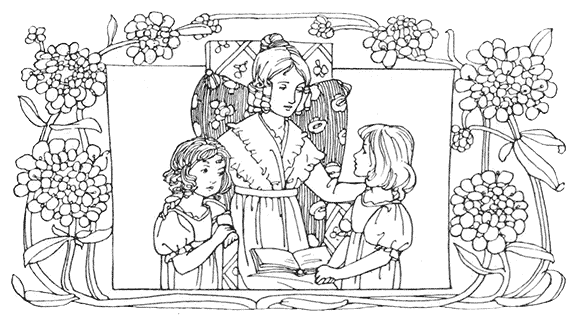
One Sunday, soon after the death of poor Miss Augusta Noble, Mrs. Fairchild, having a bad cold, could not go to church with the rest of the family. When the children were come home from church, Mrs. Fairchild asked Lucy what the sermon was about.
"Mamma," said Lucy, taking her Bible out of her little basket, "I will show you the text; it is in Heb. xii. 1: 'Let us lay aside every weight, and the sin which doth so easily beset us.'"
When Mrs. Fairchild had looked at the text, she said:
"And do you remember anything more of the sermon, Lucy?"
"Indeed, mamma," said Lucy, "I did not understand the sermon; it was all about besetting sins. What are they, mamma?"
"I will explain," said Mrs. Fairchild. "Though our hearts are all naturally sinful, yet every man is not inclined alike to every kind of sin. One man, perhaps, is inclined
"Oh! now I know what besetting sins mean," answered Lucy. "Has everybody a besetting sin, mamma?"
"Yes, my dear," answered Mrs. Fairchild; "we all have, although we do not all know what they are."
"Have I a besetting sin, mamma?" said Lucy.
"Yes, my dear," said Mrs. Fairchild.
"What is it, mamma?" asked Lucy.
"Can you not tell what fault you fall into oftener than any other?" said Mrs. Fairchild.
Lucy considered a little, and then answered she did not know.
"I think, my dear," said Mrs. Fairchild, "although it is hard to judge any other person's heart, that your besetting sin is envy. I think I have often observed this fault in you. You were envious about Emily's doll, and about poor Miss Augusta Noble's fine house and clothes and servants, and about the muslin and ribbon I gave to Emily one day, and the strawberry your papa gave to Henry; and I have often thought you showed envy on other occasions."
Lucy looked grave when her mother spoke, and the tears came into her eyes.
"Mamma," she said, "I am a naughty girl; my heart is full of envy at times; but I pray that God would take this sin out of my heart; and I hate myself for it—you don't know how much, mamma."
"My dear child," said Mrs. Fairchild, kissing Lucy, "if you really grieve for your sins, and call in faith upon the Lord Jesus Christ, you will surely in God's good time be set free from them. And now, my dear," added Mrs. Fairchild, "you know what is meant by the sin which
"Yes, mamma," said Lucy, "and you have told me what my own besetting sin is, and I feel that you have found out the right one. But mamma, you said that many people do not know their own besetting sins."
"Yes, my dear," answered Mrs. Fairchild. "Careless people do not know their hearts, and have no idea of their besetting sins; indeed, they would laugh if you were to speak of such things before them."
Whilst Mrs. Fairchild was speaking these last words, they heard the dinner-bell ring; so they broke off their talk and went downstairs. Whilst Mr. and Mrs. Fairchild and all the family were sitting at dinner, they saw through the window a man on horseback, carrying a large basket, ride up to the door. Mrs. Fairchild sent John out to see who this person was; and John presently returned with a letter, and a haunch of venison packed in a basket.
"Sir," said John, "the man says that he is one of Mr. Crosbie of London's servants; and that he has brought you a letter with his master's compliments, and also a haunch of venison."
"Mr. Crosbie's servant!" said Mr. Fairchild, taking the letter and reading it aloud as follows:
"Dear Mr. Fairchild,
"I and my wife, and my sister Miss Crosbie, and my daughter Betsy, have been taking a journey for our health this summer. We left London three months ago, and have been down as far as Yorkshire. We are now returning home, and have turned a little out of our way to see you, as it is as much as twelve years since we met; so you may look for us, no accident happening, to-morrow, a little before two. We hope to dine with you, and to go on
"I remain, dear Mr. Fairchild, Your old friend, "Obadiah Crosbie.
"P.S.—You will find the haunch excellent; we dined upon the neck yesterday, and it was the best I ever tasted."
When Mr. Fairchild had finished the letter, he smiled, and said:
"I shall be very glad to see our old friends, but I am sorry poor Mr. Crosbie still thinks so much about eating. It always was his besetting sin, and it seems to have grown stronger upon him as he has got older."
"Who is Mr. Crosbie, papa?" said Lucy.
"Mr. Crosbie, my dear," said Mr. Fairchild, "lives in London. He has a large fortune which he got in trade. He has given up business some years, and now lives upon his fortune. When your mamma and I were in London, twelve years ago, we were at Mr. Crosbie's house, where
When John went to church that same evening, Mr. Fairchild desired him to tell nurse to come the next day to help Betty, for nurse was a very good cook; and the next morning Mrs. Fairchild prepared everything to receive Mr. and Mrs. Crosbie; and Mr. Fairchild invited Mr. Somers, the clergyman of the parish, to meet them at dinner. When the clock struck one, Mrs. Fairchild dressed herself and the children, and then went into a little tea-room, the window of which opened upon a small grass plot, surrounded by rose-bushes and other flowering shrubs. Mr. Somers came in a little before two, and sat with Mrs. Fairchild.
When the clock struck two, Mr. Crosbie's family were not come, and Mr. Fairchild sent Henry to the garden gate to look if he could see the carriage at a distance. When Henry returned he said that he could see the carriage, but it was still a good way off.
"I am afraid the venison will be over-roasted," said Mrs. Fairchild, smiling.
Henry soon after went to the gate, and got there just in time to open it wide for Mr. Crosbie's carriage. Mr. and Mrs. Fairchild ran out to receive their friends.
"I am glad to see you once again," said Mr. Crosbie, as he stepped out of the coach, followed by Mrs. Crosbie, Miss Crosbie, Miss Betsy, and Mrs. Crosbie's maid.
Mr. Crosbie was a very fat man, with a red face, yet he looked good-humoured, and had, in his younger days, been handsome. Mrs. Crosbie was a little thin woman, and there was nothing in her appearance which pleased Emily and Lucy, though she spoke civilly to them. Miss Crosbie was as old as her brother, but she did not look so, for her
"Have you any company, Mrs. Fairchild?" said Miss Crosbie, as Mrs. Fairchild was leading them into the parlour.
"Only one gentleman, Mr. Somers, our rector," said Mrs. Fairchild.
"Oh! then I must not appear in this gown! and my hair, too, is all rough," said Miss Crosbie; "I must put on another gown; I am quite frightful to look at!"
"Indeed," said Mrs. Fairchild, "your dress is very nice; there is no need to trouble yourself to alter it."
"Oh, sister," said Mrs. Crosbie, "don't think of changing your dress; Mrs. Fairchild's dinner is ready, I dare say."
Miss Crosbie would not be persuaded, but, calling the maid to attend her, ran upstairs to change her dress: and Mrs. Fairchild sent Lucy after her. The rest of the company then went into the tea-room, where they sat round the window, and Mr. Crosbie said:
"What a pretty place you have here, Mr. Fairchild; and a good wife, as I well know—and these pretty children! You ought to be a happy man."
"And so I am, thank God," said Mr. Fairchild, "as happy as any man in the world."
"I should have been with you an hour ago," said Mr. Crosbie, "that I might have walked over your garden before dinner, but for my wife there."
"What of your wife there?" said Mrs. Crosbie, turning sharply towards him. "Now mind, Mr. Crosbie, if the venison is over-roasted, don't say it is my fault."
Mr. Crosbie took out his watch.
"It is now twenty-five minutes past two," said he; "the
Mrs. Crosbie answered:
"You are always giving people to understand that I am ill-tempered, Mr. Crosbie; which I think is very unhandsome of you, Mr. Crosbie. There is not another person in the world who thinks me ill-tempered but you. Ask Thomas, or my maid, what they know of my temper, and ask your sister, who has lived with me long enough."
"Why don't you ask me what I think of it, mamma?" said Miss Betsy, pertly.
"Hold your tongue, miss!" said Mrs. Crosbie.
"Must I not speak?" said Miss Betsy in a low voice, but loud enough for her mamma to hear her.
When Miss Betsy first came in, Emily admired her very much; for, besides the sky-blue hat and feather, she had blue satin shoes, and a very large pair of gold earrings; but when she heard her speak so boldly to her mother she did not like her so much. By this time John came to tell the company that dinner was on the table; and Mr. Crosbie got up, saying:
"The venison smells well—exceedingly well."
"But where is Miss Crosbie?" asked Mr. Fairchild.
"Oh, my aunt thought herself not smart enough to show herself before Mr. Somers," said Miss Betsy pertly.
"Be silent, miss," said Mrs. Crosbie.
"Don't wait for her, then," said Mr. Crosbie; "let us go in to dinner. My sister loves a little finery; she would rather lose her dinner than not be dressed smart; I never wait for her at any meal. Come, come! Ladies lead the way; I am very hungry."
So Mrs. Fairchild sent Emily to tell Miss Crosbie that
"Mrs. Crosbie," said Mr. Crosbie, looking at the venison, then at his wife, "the venison is too much roasted; I told you it would be so."
"What! finding fault with me again, Mr. Crosbie?" said Mrs. Crosbie. "Do you hear Mr. Fairchild finding fault with his wife in this manner?"
"Perhaps the venison is better than you think, Mr. Crosbie," said Mr. Somers; "let me help you to some. Mr. Fairchild, I know, is not fond of carving."
Mr. Crosbie thanked Mr. Somers; and Mr. Somers had just begun to cut the venison, when Mr. Crosbie called out, as if in agony:
"Oh, Mr. Somers, you will spoil the venison! You must not cut it that way upon any account. Do put the haunch by me, and let me help myself."
"What confusion you are making at the table, Mr. Crosbie!" said Mrs. Crosbie. "You are putting every dish out of its place! Surely Mr. Somers knows how to carve as well as you do."
"But papa is afraid Mr. Somers won't give him all the nice bits," said Miss Betsy.
"Learn to be silent, miss!" said Mr. Crosbie.
Miss Betsy was going to answer her father, when Miss Crosbie came into the room, newly dressed in a very elegant manner. She came smiling in, followed by Lucy and Emily, who went to sit at a small table with Henry.
"Sister," said Mrs. Crosbie, "where was the need of your dressing again? If we had waited for you, the dinner would have been spoiled."
"But we did not wait for Miss Crosbie, so there was no harm done," said Mr. Fairchild, smiling.
"My aunt would not lose an opportunity of showing her new-fashioned gown for the world!" said Miss Betsy.
"Indeed, niece," answered Miss Crosbie, "I do not know why you should say that I am fond of showing my clothes. I wish to be neat and clean, but no person cares less than I do about fashions and finery."
"La!" says Miss Betsy, whispering to Mrs. Fairchild "hear my aunt! she says she does not care about finery! That's like mamma saying how good-natured she is!"
"Fie, fie, Miss Betsy!" said Mrs. Fairchild, speaking low; "you forget your respect to your elders."
Miss Betsy coloured, and stared at Mrs. Fairchild. She had not been used to be found fault with; for she was spoiled by both her parents; and she felt quite angry.
"Indeed!" she said, "I never was thought disrespectful to anyone before. Can't I see people's faults? Can't I see that mamma is cross, and my aunt fond of fine clothes, and that papa loves eating?"
"Hush! hush!" said Mrs. Fairchild, in a low voice; "your papa and mamma will hear you."
"And I don't care if they do," said Miss Betsy: "they know what I think."
"What's that you are saying there, Miss Betsy?" said Mr. Crosbie.
"Oh, don't ask, brother," said Miss Crosbie; "I know it is something saucy, by my niece's looks."
"And why should you suppose I am saying anything saucy, aunt?" said Miss Betsy; "I am sure you are not accustomed to hear me say saucy things."
"Miss! Miss! be quiet!" said Mrs. Crosbie; for she was afraid Mr. and Mrs. Fairchild would think her daughter ill-behaved.
"What, mamma!" answered Miss Betsy, "am I to sit quietly and hear my aunt find fault with me before company—and for being impertinent, too, to my elders—as if I were a mere child?"
"Well, well—enough!" said Mr. Crosbie. "What is that pie, Mrs. Fairchild, in the middle of the table? I must have some, if you please."
Mr. and Mrs. Fairchild were not sorry when dinner was over, and Mrs. Crosbie proposed that Mrs. Fairchild should show her the garden. Accordingly, the ladies and children got up, and left the gentlemen together; for Mr. Crosbie never stirred for some time after dinner. When Mrs. Crosbie had got into the garden, and had looked about her, she said:
"Ah, Mrs. Fairchild, how happy you are! Such a pretty house and garden!—such a kind husband!—such good children!" Then she sighed, and gave Mrs. Fairchild to understand that she was not so happy herself.
After tea, Mr. Crosbie and his family took their leave, and went off to the next inn upon the London road, where they were to sleep; for Mr. Crosbie was in haste to be at home, and would not stay, although Mr. and Mrs. Fairchild begged that they would—at least till the next day. When they were gone, Mr. Fairchild and Henry took a walk towards the village with Mr. Somers, whilst the little girls remained at home with their mother.
"Dear Lucy," said Mrs. Fairchild, as soon as she was alone with her little girls, "do you remember what we were speaking about yesterday, before Mr. Crosbie's letter came?"
"Yes, mamma," said Lucy; "we were speaking of besetting sins, and you said that everybody has a besetting sin, and you told me what you believed mine to be."
"True, my dear," answered Mrs. Fairchild: "I told you
"Oh, yes!" said Emily; "she said, 'I am not saucy; of all faults, sauciness is not one of my faults, I am sure;' and I thought all the time she looked as saucy and impertinent as possible."
"And how Mr. Crosbie did eat!" said Lucy; "he ate half the haunch of venison! And then he was helped twice to pigeon-pie; and then he ate apple-tart and custard; and then——"
"Well, well! you have said enough, Lucy," said Mrs. Fairchild, interrupting her. "I do not speak of our poor friends' faults out of malice, or for the sake of making a mockery of them; but to show you how people may live in the constant practice of one particular sin without being at all conscious of it, and perhaps thinking themselves very good all the time. We are all quick enough, my dear Emily and Lucy, in finding out other people's faults; but, as I said before, we are often very blind to our own."
"Mamma," said Lucy, "do you know any prayer about besetting sins?"
"Yes, my dear," answered Mrs. Fairchild; "I have one in my own book of prayers; and I will copy it out for you to-morrow morning."
So Mrs. Fairchild broke off her conversation with her little girls, and bade them go and play a little before bedtime.
"Miss Betsy."—Page 137.
A Visit to Mary Bush
Not very long after the death of poor Miss Augusta Noble, a note came from Sir Charles and Lady Noble, inviting Mr. and Mrs. Fairchild to dinner the next day; but not mentioning the children, as they used to do when they sent their invitations.
"Poor Lady Noble!" said Mr. Fairchild; "I wish we could give her any comfort! but we will certainly go."
The next day, when Sir Charles's carriage came for Mr. and Mrs. Fairchild, they kissed the children, and told them when they had dined, they might, if they pleased, go with Betty to see old Mary Bush. Mary Bush was one of the old women who lived at the end of the coppice; and, being a good woman, Mr. and Mrs. Fairchild were not afraid of trusting their children with her. The children were very much pleased, and made haste to get their dinner; after which Lucy packed up a little tea and sugar, which her mamma had given her, in a basket;
"Betty, are you ready?" said Henry; "Lucy has got the tea and sugar, and Emily has got Miss Dolly, and I have got my hat and stick. So come, Betty, come!"
"But who is to milk the cow?" said John, pretending to look grave; "Betty must stay to milk the cow at five o'clock."
"No, John!" said the children, all gathering round him; "good John, will you be so kind as to milk the cow, and let Betty go?"
"Well, I will see about it," said John, putting the cork into the cream bottle.
"There's a good John!" said Emily.
"I love you, John!" said Henry. "And now, Betty, come, make haste away."
So the children set out; and they went out across the garden to a little wicket-gate which Mr. Fairchild had opened towards the coppice, and came into Henry's favourite Sunday walk. The green trees arched over their heads; and on each side the pathway was a mossy bank, out of which sprang such kind of flowers as love shady places—such as the wood anemone and wild vetch: thrushes and blackbirds were singing sweetly amongst the branches of the trees.
"This is my walk," said Henry; "and I say it is the prettiest in the country."
"No, Henry," said Emily; "it is not so pretty as the walk to the hut at the top of the hill: for there you can look all over the coppice, and see the birds flying over the tops of the trees."
"Sister," said Lucy, "now you shall carry my basket, and I will have the doll a little."
"With all my heart," said Emily.
"Why don't you give Miss to me?" said Henry.
"Oh, yes!" said Emily. "Did I not give her to you one day; and did you not hang her upon a tree in the garden, with a bit of string round her neck, and say she was a thief?"
"Lucy," said Henry, "let us have a race to that tree which has fallen down over the path."
So away they ran; and when they got to the tree they sat down upon the trunk until Betty came up with Emily. On one side of the fallen tree was a place where the wood had been cut away, and the woodmen had made themselves a little hut, which they had now left empty. Round this hut were scattered many dry sticks and chips.
"Master Henry," said Betty, "here are some nice sticks: let us gather a few together; they will do to make a fire to boil Mary Bush's kettle."
"Oh, yes, Betty," answered the children: and they set to work, and soon gathered a great many sticks; and Betty tied them together with a piece of packthread which Henry pulled out of his pocket; then Betty took off her bonnet, and placed the bundle upon her head. They went on to Mary Bush's. The children wanted to help to carry the sticks, but Betty would not let them, saying they were too heavy for them.
"But we can carry the bread and butter," said Lucy; so Betty allowed them to do it.
When they had walked a little farther, they came in sight of Mary Bush's house, down in a kind of little valley or dingle, deeply shaded by trees. In the very deepest part of the dingle was a stream of water falling from a rock. The light from above fell upon the water as it
Mary Bush's cottage was so large, that, after the death of her husband, she had let half of it to one Goodman Grey, who lived in it, with his old wife Margery, and cultivated the garden, which was a very good one. John Trueman's wife was Mary Bush's eldest daughter; and Joan, nurse's son's wife, her youngest; and it was said of them that there were not two better wives and mothers in the parish: so Mary Bush was very happy in her children.
When the children and Betty came up to the cottage, they found Mary Bush spinning at the door.
"We are come to drink tea with you, Mary," said Lucy.
"And we have brought bread and butter, and tea and cream with us," said Emily.
"And a bundle of sticks," said Henry, "to boil the kettle."
"Welcome, welcome, my little loves," said old Mary, as she got up and set her spinning-wheel on one side. "Come in, little dears."
Mary had but one room, and a little pantry, but it was a very neat room; there was a bed in one corner, covered with a clean linen quilt; there were also a nice oaken dresser, a clock, two arm-chairs, two three-legged stools, a small round table, a corner cupboard, and some shelves for plates and dishes. The fireplace and all about it were always very neat and clean, and in winter you would probably see a small bright fire on the hearth.