[Illustration: After half of May had passed away, and when the spring hunt was over, Oo-koo-hoo and Amik, poling up the turbulent little streams, and following as closely as possible the routes of their fur trails, went the round of their trapping paths, removed their snares, sprung their deadfalls, and gathering their steel traps loaded them aboard their canoes. That work completed, packing began in readiness for the … See Chapter VII.]
Reading edition
So, when all was in readiness, the deerskin lodge coverings were taken down, rolled up, and stored out of harm's way upon a stage. Then, with hearts light with happiness and canoes heavy with the wealth of the forest, we paddled away with pleasant memories of our forest home, and looked forward to our arrival at Fort Consolation.
Soon after entering Bear River the canoes were turned toward the western bank and halted at a point near one of their old camping grounds. Then Naudin—Amik's wife—left the others, and took her way among the trees to an opening in the wood. There stood two little wooden crosses that marked the graves of two of her children—one a still-born girl and the other a boy who had died at the age of three. Upon the boy's grave she placed some food and a little bow and some arrows, and bowed low over it and wept aloud. But at the grave of her still-born child she forgot her grief and smiled with joy as she placed upon the mound a handful of fresh flowers, a few pretty feathers, and some handsome furs. Sitting there in the warm sunshine, she closed her eyes—as she told me afterward—and fancied she heard the little maid dancing among the rustling leaves and singing to her.
Like all Indian women of the Strong Woods, she believed that her still-born child would never grow larger or older; that it would never leave her; that it would always love her, though she lived to be a great-grandmother; that when sorrow and pain bowed her low this little maid would laugh and dance and talk and sing to her, and thus change her grief into joy. That is why an Indian mother puts pretty things upon the grave of her still-born child, and that is why she never mourns over it.
As our journey progressed those enemies of comfort and pleasure, the black flies, appeared, and at sunrise and sunset caused much annoyance, especially among the children. Then, too, at night if the breeze subsided, mosquitoes swarmed from the leeward side of bushes and drove slumber away.
One afternoon, while resting, we observed signs of beaver and Oo-koo-hoo, being reminded of an incident he once witnessed, related it to me:
"Once, my son, while paddling alone, I rounded the bend of a river, and hearing a splash just beyond the turn, silently propelled my canoe beneath a screen of overhanging branches. After waiting and watching awhile, I saw an otter fishing in the stream. A moment later I beheld a beaver—evidently a female—swimming just beyond the otter, and pursued by two other beavers—evidently males. The males, perceiving the otter swimming in the direction of the female, probably came to the conclusion that he was about to pay his court to her, for they suddenly swerved from their course and attacked the innocent otter. He dived to escape his assailants, and they dived after him. When he rose for breath, they came up, too, and made after him; so he dived again. Evidently, they were trying to wind their quarry, for whenever he came up for breath they endeavoured to reach him before he got it. In a short time they had so exhausted him that he refused to dive again before he gained his breath. He made for the shore. The beavers rushed after him, overtook him, and just as he gained the bank, ripped his throat open. Then I shot one of the beavers and tossed it into my canoe along with the otter."
The journey to the Post was a delight all the way—save when the flies were busy. One night those almost invisible little torments, the sand flies, caused us—or rather me—much misery until Granny built such a large fire that it attracted the attention of the little brutes, and into it they all dived, or apparently did—just as she said they would—for in less than half an hour not a single sand fly remained.
On our way to God's Lake we had considerable sport in the way of shooting white-water. One morning we landed at the head of a portage, and, as the rapid was not a dangerous one, Oo-koo-hoo and Amik determined to run it, but first went ashore to examine the channel. On their return Oo-koo-hoo instructed the others to follow his lead about four canoe-lengths apart, so that in case of mishap they could help each other. Down the canoes plunged one after the other. The children wielded their little paddles, screaming with delight as they swiftly glided through the foaming spray past shores still lined here and there with walls of ice.
As the canoes rounded a sharp bend in the rapid Oo-koo-hoo descried a black bear walking on the ice that overhung the eastern bank. The animal seemed as much surprised as any of us, and, instead of making off, rose upon its haunches and gazed in amazement at the passing canoes. But as we swept by there was no thought of firing guns. The sight of the bear reminded Oo-koo-hoo of an experience some friends of his once had with a black bear; and when we reached slack water he told it to me.
The friends in question were a mother and her daughter, and late one afternoon they were returning from berry picking. As they rounded a bend in the river the daughter in the bow suddenly stopped paddling, and—without turning her face toward her mother in the stern—excitedly whispered: "Muskwa! Muskwa!"
Then as the older woman caught sight of a dark object fifty paces away, she uttered a few hurried commands. Both fell to paddling with all their might. With straining backs, stiffened arms, and bending blades, they fairly lifted the canoe at every stroke; and the waters gave a tearing sound as the slashing blades sent little whirlpools far behind. Their hearts were fired with the spirit of the chase, and—though their only weapons were their skinning knives—they felt no fear. On they raced to head the bear, who was swimming desperately to gain the shore. They overhauled him. He turned at bay. The daughter soused a blanket in the water and threw it over his head. The mother in the stern reached over as the canoe glided by, seized him by an ear as he struggled blindly beneath the smothering mantle, and drove her knife into his throat. A broad circle of crimson coloured the water round the blanket. The canoe was quickly brought about; the mother slipped a noose over his head, and in triumph they towed the carcass to their camp.
On the last morning of our trip there was a flutter of pleasant excitement among our little party; and by the time the sun appeared and breakfast was over, everybody was laughing and talking, for we had made such progress that we expected to reach Fort Consolation by ten o'clock that forenoon. Quickly we loaded the canoes again, and away we paddled. In a few hours the beautiful expanse of God's Lake appeared before us. When we sighted the old fort, a joyous shout rang out; paddles were waved overhead, and tears of joy rose to the eyes of the women—and of some of the men.
Going ashore, we quickly made our toilets, donning our very finest in order to make a good appearance on our arrival at the Fort—as is the custom of the Northland. Bear's grease was employed with lavish profusion, even Oo-koo-hoo and Amik and the boys using it on their hair; while the women and girls greased and wove their tresses into a single elongated braid which hung down behind. The men put on their fancy silk-worked moccasins; tied silk handkerchiefs about their necks—the reverse of cow-boy fashion—and beaded garters around their legs; while the women placed many brass rings upon their fingers, bright plaid shawls about their shoulders, gay silk handkerchiefs over their heads, and beaded leggings upon their legs. How I regretted I had not brought along my top-hat—that idiotic symbol of civilization—for if I could have worn it on that occasion, the Indians at Fort Consolation would have been so filled with merriment that they would have in all probability remembered me for many a year as the one white man with a sense of humour.
For in truth, it is just as Ohiyesa (Charles A. Eastman) the full-blooded Sioux, says in his book on Indian Boyhood: "There is scarcely anything so exasperating to me as the idea that the natives of this country have no sense of humour and no faculty for mirth. This phase of their character is well understood by those whose fortune or misfortune it has been to live among them day in and day out at their homes. I don't believe I ever heard a real hearty laugh away from the Indians' fireside. I have often spent an entire evening in laughing with them until I could laugh no more."
CONTEST OF WITS
When we arrived at Fort Consolation, Oo-koo-hoo and his party were greeted by a swarm of their copper-coloured friends, among whom were The Little Pine and his father, mother, and sister. Making his way through the press, The Owl strode toward the trading room to shake hands with Factor Mackenzie; but the trader, hearing of Oo-koo-hoo's arrival, hastened from his house to welcome the famous hunter; and The Owl greeted him with:
"Quay, quay, Hu-ge-mow" (good day, Master).
On their way to the Indian shop they passed the canoe shed, where skilled hands were finishing two handsome six-fathom canoes for the use of the Fur Brigade; and they stopped to examine them.
The building of a six-fathom or "North" canoe generally takes place under a shed erected for the purpose, where there is a clear, level space and plenty of working room. Two principal stakes are driven at a distance apart of thirty-six feet, the length of the craft to be. These are connected by two rows of smaller stakes diverging and converging so as to form the shape of the canoe. The smaller stakes are five feet apart at the centre. Pieces of birch bark are soaked in water for a day and no more, sewn together with wat-tap—the roots of cedar or spruce gathered in spring—placed between the stakes with the outer side down, and then made fast. The well-soaked ribs are then put in place and as soon as they are loaded with stones the bark assumes its proper form. The gunwales, into which the ends of the ribs are mortised, are bound into position with wat-tap. The thwarts are next adjusted. The stones and stakes are then removed; the seams are covered with a mixture of one part grease to nine parts spruce gum; the craft is tested, and is then held in readiness for its maiden voyage.
On entering the Indian shop or trading room, Oo-koo-hoo was ready to talk about anything under the sun save business, as he wanted to force the Trader to solicit his patronage; but as the Factor was trying to make the hunter do the same thing, they parted company a little later without having mentioned the word "trade."
No wonder the Indians are glad to return to their tribal summer camping grounds; for it is there that they rest and play and spend their summer holidays. It is there, too, that the young people enjoy the most favourable opportunity for doing their courting; as every event—such as the departure or the return of the Fur Brigade—calls for a festival of dancing which not infrequently lasts for several days. Also, in many other ways, the boys and girls have chances of becoming acquainted. Since young hunters often claim their sweethearts during the winter, many "marriages" take place after the Indian fashion. On their return to the Post, however, the young couples are generally married over again, and this time after the white man's custom—"in the face of the Church." The way the young people "keep company" at the summer camping grounds presents no feature of special interest. It is during the winter season in the forest many miles beyond the Post that the old customs have full sway. The re-marrying the young couples "in the face of the Church" frequently demands extreme vigilance, for in the confusion of the matrimonial busy season when the Indians first come in the little papoose is apt to be christened—unless the clergyman is very careful—before the parents have had time to arrange for their church wedding.
Meanwhile, the women having erected the canvas lodge and put in order one of their last-year's birch-bark wigwams, called upon the Factor's wife and presented her with a handsome work-bag made of beautifully marked skins from the necks of the loons Oo-koo-hoo had shot with his bow and arrow for that purpose.
After leaving the Indian shop, the hunter returned to his camp to talk matters over with Amik and the women. He told them that he intended selling most of his furs to the Company, but that he thought it wise to stay away from the Factor until next day. But as Granny, being a Roman Catholic, wanted to have Father Jois marry Neykia and The Little Pine, she suggested that Oo-koo-hoo go and call upon the priest at once. Notwithstanding that her mother was a Presbyterian, Neykia had joined the Roman Catholic Church and when asked why she had done so, she said it was because she thought the candles looked so pretty burning on the altar.
Though The Owl was not in the least interested in any one of the white man's many religions, nor in the priest, the clergyman, or the minister of the three different denominations represented at the Post, he now called upon the priest as his wife wished him to. During the course of their conversation the priest said:
"My son, that was a beautiful silver fox you sold the Company three years ago. I, myself, would have paid you well for it."
"Would you look as well upon a black fox?" asked Oo-koo-hoo in surprise, as it is an unwritten law of the country that missionaries are not to carry on trade with the Indians.
"Yes. Have you one?" questioned the priest.
"I have never seen a finer," replied the hunter.
"But do either of the traders know you have it?" asked the priest.
"No," answered Oo-koo-hoo, with a shake of his head.
Later, when the priest saw the skin, he was delighted with it, and a bargain was soon made. Oo-koo-hoo was to get one hundred "skins" for the black fox, and he was told to call next day. But after returning to camp, he grew impatient and went back to the priest to demand his pay. The priest said he would give him a tent and a rifle worth more than fifty skins and that he would say ten masses for him and his family, which would be a very generous equivalent for the other fifty skins. But Oo-koo-hoo, suddenly flaring up, began to storm at the priest, and demanded the black fox back. But the priest sternly motioned for silence with upraised hand, and whispered: "This is God's House. There must be no noise or anger here." And without another word he withdrew to get the rifle and the tent. When he returned with an old tent and a second-hand rifle, Oo-koo-hoo would not deign to touch them. Without more ado, he turned on his heel and walked away.
On reaching camp, the old hunter learned from the children that the women had gone to pay a visit to the nuns; so he followed them, and, without even speaking to the Sisters, ordered the women to come home. On the way he eased his wrath by telling them that never again would he buy prayers or masses from the priest with black fox skins, and that if they ever wanted masses, he would pay for them with nothing but the skins of skunks. He did not see why he had to pay for masses, anyway, when Free Trader Spear had made them a standing offer of all the prayers they wanted free of charge, provided that he, Oo-koo-hoo, would trade with him. He added that he had half a mind to accept Spear's offer, just to spite the priest.
So after meditating for a while upon his steadfast belief that any fool of an Indian is better than a white man, and that the only good white men are the dead ones, he got into his canoe and paddled across the lake to interview the opposition trader.
When he told Spear what a splendid black fox he had, and how the priest had already offered him a hundred skins for it, the Free Trader said:
"I'll give you a hundred and ten for it," and the old reprobate added, "and I'll throw into the bargain half-a-dozen prayers for the women."
The offer was at once accepted. On handing over the goods to Oo-koo-hoo, the trader asked where the black fox was, and was told that it was in keeping of the priest. So without delay Mr. Spear paddled back with The Owl to get the skin. When the priest learned how the hunter had stolen a march on him, he was righteously indignant; but he dared not complain, since he was not supposed to deal in furs. There was nothing to do but hand over the magnificent skin to the Free Trader although he knew right well that in London or Paris it would bring twenty times the price paid for it.
Next day old Granny came crying to Oo-koo-hoo and complaining that the priest had refused to officiate at the wedding on the day agreed upon. The nuns had told her that his refusal was due to his determination to discipline The Owl for his rudeness and irreverence. That seemed to worry the hunter considerably, for, though he cared nothing for the priest's benediction, he did want the wedding to come off upon the day appointed. It touched his pride to be balked in his plans. He had already invited all the Indians at the Post to the ceremony. Great preparations were being made. If the wedding were put off even a single day, everybody would be curious to know why; and sooner or later it would be known that he had had to bow to the will of the priest. The thought rankled. So he went to the Factor and told him the whole affair.
"Ma brither," said the Factor, "we are auld freens; it is weel that we shud staun' thegither. If ye will trade a' yir furs wi' me this day, I'll get the meenister o' the Presybyterian Kirk tae mairry yir gran'dochter. He'll be gled eneuch tae gi'e Father Jois a dour by mairryin' twa o' his fowk. Sell me yir furs, an' I'll warrant ye ye'll hae the laff on Father Jois."
MISSIONARIES AND INDIANS
That settled it. Factor Mackenzie got all the furs Oo-koo-hoo and his family possessed. The Factor and the hunter were now the best of friends, and they even went so far as to exchange presents—and that's going some … for a Scotsman.
Should the foregoing amuse the Protestant reader, the following may be of interest to the Roman Catholic. One winter, while halting at a certain Hudson's Bay post, I met a Protestant clergyman, who having spent a number of years as a missionary among the natives on the coast of Hudson Bay excited my interest as to his work among the Indians. That night, after supper, I questioned him as to his spiritual work among the "barbarians" of the forest, and in the presence of the Hudson's Bay trader, he turned to me and, with the air of being intensely bored by the subject, he replied: "Mr. Heming … the only interest I ever take in the Indian … is when I bury him."
But while I have cited two types of clergymen I have known—the name of the priest being, of course, fictitious—merely to point out the kind of missionaries that should never be sent among the Indians, I not only wish to state that they are very much the exception to the rule, but I also want to make known my unbounded respect and admiration for that host of splendid men—and women—of all denominations, who have devoted their lives to the spiritual welfare of the people of the wilderness, and some of whom have already left behind them hallowed names of imperishable memory.
But the lot of the missionary among the Indians is not altogether a joyous one. In his distant and isolated outpost there are privations to endure and hardships to suffer. Frequently, too, it happens that he is placed in a position exceedingly embarrassing to a man of gentle breeding and kindly spirit.
A well-known Canadian priest was being entertained by an Indian family. The hospitable old grandmother undertook to prepare a meal for him. Determined to set before the "black-robe" a really dainty dish—something after the fashion of a Hamburg steak—and possessing no machine for mincing the meat, she simply chewed it up nice and fine in her own mouth. After cooking it to a turn, she set it before her honoured guest, and was at a loss to understand why the good man had so suddenly lost his appetite.
But there is often a brighter and also a graver side to the missionary's life among the red men. Incidents occur which appeal irresistibly to his sense of humour.
One Sunday afternoon a certain noted bishop of the English Church in Canada, who had spent most of his life as a missionary in the far Northwest, was discoursing at considerable length to a band of Dog-rib Indians camped at the mouth of Hay River on Great Slave Lake. His Lordship dwelt earnestly upon the virtue of brotherly love, and enlarged upon the beauty of the Divine saying—"It is more blessed to give than to receive." After the service an old Indian walked up to the preacher, piously repeated the sacred text, and intimated that he was prepared to become the humble instrument for bringing upon his reverence the promised blessing. To that end he was willing to receive his lordship's hat.
The good bishop was taken aback. Realizing, however, that there was nothing else for him to do, he took off his hat and bestowed it with commendable cheerfulness upon his new disciple.
Another red man, jealous of his brother who was now parading in all the splendour of the bishop's hat, claimed upon the same ground the prelate's gaiters, and received them.
The two Indians, envious each of the other's acquisition, began to discuss with growing anger the comparative value of the articles. Unable to arrive at an agreement, they resolved to put up the hat and gaiters as a stake and gamble for them.
The impressive head-gear and antique gaiters of an Anglican bishop never appeared to greater advantage than they did upon the old Indian, the winner of the game, when he proudly strutted before his dusky, admiring brethren, displaying on head and bare legs the Episcopal insignia, and having for his only other garment an old shirt whose dingy tail fluttered coyly in the summer breeze.
NEYKIA'S WEDDING
At ten o'clock, on the morning of Neykia's wedding, a motley mass of natives clothed in many colours crowded about the little church, which, for lack of space, they could not enter. Presently the crowd surged back from the door and formed on either side of the path, leaving an opening down the centre. A tall half-breed with a shock of wavy black hair stepped from the doorway, raised his violin, and adjusting it into position, struck up a lively tune to the accompaniment of the wailing of a broken concertina played by another half-breed who preceded the newly married couple. Neykia wore a silk handkerchief over her head, a light-coloured cotton waist open at the throat, a silk sash over one shoulder, and a short skirt revealing beaded leggings and moccasins. Behind the bride and groom walked Oo-koo-hoo and the fathers of the bridal couple, then the mothers and the rest of the relations, while the clergy and the other guests brought up the rear. As the little procession moved along, the men, lined up on either side of the path, crossed their guns over the heads of the wedding party, and discharged a feu de joie.
On reaching a certain log-house the procession broke up. The older people went in to partake of the wedding breakfast, while the bride and groom went over to one of the warehouses and amused themselves dancing with their young friends until they were summoned to the second table of the marriage feast. Everybody at the Post had contributed something toward either the feast or the dance. Out of respect for Oo-koo-hoo the Factor had furnished a liberal stock of groceries and had, in addition, granted the free use of the buildings. The clerk had sent in a quantity of candies and tobacco. The priest had given potatoes; the clergyman had supplied a copy of the Bible in syllabic characters; and the minister had given the silver-plated wedding ring. The nuns had presented a supply of skim-milk and butter. Mr. Spear provided jam, pickles, and coal-oil for the lamps. The Mounted Police contributed two dollars to pay for the "band"—the fiddle and the concertina—and ammunition enough for the feu de joie. The friends and relations had given a plentiful store of fresh, dried, and pounded fish; and had also furnished a lavish supply of moose, caribou, and bear meat; as well as dainty bits of beaver, lynx, muskrat, and skunk.
The bridal party having dined, they and their elders opened the ball officially. The first dance was—as it always is—the Double Jig, then followed in regular order the same dances as those of the New Year's feast. After a frolic of several hours' duration some of the dancers grew weary and returned to the banquet room for refreshments. And thus for three days and three nights the festivities continued.
THE WEDDING SPEECHES
During a lull in the dancing on the afternoon of the wedding day Little Pine's sister went up to him and said: "Brother, may I kiss you? Are you ashamed?" He answered: "No." She kissed him, took his wife's hand, placed it in his with her own over both, and addressed the young wife:
"As you have taken my place, do to him as I have done; listen to him, work for him, and, if need be, die for him."
Then she lowered her head and began to cry.
Ne-Geek, The Otter, Neykia's oldest brother, then went up to Little Pine and asked:
"Are you man enough to work for her, to feed her, and to protect her?"
"Yes," replied the new-made husband.
The Otter put the husband's hand on his sister's hand, and—looking him straight in the eyes … shook his clenched fist at him and said in a threatening tone … "Beware!"
In the midst of one of the dances Oo-koo-hoo walked up to the "band" and knocked up the fiddle to command silence. Pulling his capote tightly about him, he assumed a dignified attitude, slowly looked round the room to see that he had the attention of all present, and began to address the assemblage:
"The step which Shing-wauk has taken is a very serious one. Now he will have to think for two. Now he must supply the wants of two. Now he will realize what trouble is. But the One who made us … The Great Mystery … The Master of Life … made us right. The man has his work to do, and the woman has hers. The man must hunt and kill animals, and the woman must skin and dress them. The man must always stand by her and she by him. The two together are strong … and there is no need of outside assistance. Remember … my grandchildren … you are starting out together that way …"
To illustrate his meaning, he held up two fingers parallel, and added:
"If your tracks fork … they will soon be as far apart as sunrise is from sunset … and you will find many ready to come in between. Carry on in the way you have begun … for that is the way you should end. And remember … if your tracks once fork … they will never come together again … my grandchildren … I have spoken."
After Little Pine's father, as well as several of the guests, had made their remarks, Naudin, Neykia's mother, rose to address her daughter. Overcome with nervousness, she pulled her shawl so far over her face as to leave only a tiny peep-hole through which to look. Hesitatingly she began:
"My daughter, you never knew what trouble is, now you will know. You never knew what hard work is, now you will soon learn. Never let your husband want for anything. Never allow another woman to do anything for him; if you do … you are lost. When you have children, my daughter, and they grow up, your sons will always be sons to you, even though they be gray-headed. But with your daughters it will not be so; when they marry, they will be lost to you. Once married, they are gone for ever."
She stepped up to her daughter, kissed her, and sank to the floor, weeping copiously.
Then Amik rose to speak. He beckoned to his daughter. She advanced and knelt down, holding the fringe of his legging while he addressed her:
"Neykia, my daughter, you have taken this man. Be good to him, work for him, live for him, and if need be, die for him. Kiss me, Neykia, my daughter; kiss me for the last time."
She kissed him, and he added:
"You have kissed me for the last time: henceforth never kiss any man but your husband."
Raising his hand with untutored dignity, he pronounced the words:
"Remember … I have spoken."
VIII
BUSINESS AND ROMANCE
FAREWELL ATHABASCA
Though Wawe Pesim (The Egg Moon), or June, had already brought summer to the Great Northern Forest, the beautiful Athabasca still waited in vain. Son-in-law had not yet appeared. After all—was he but a fond parents' dream? I wondered.
Soon the picturesque and romantic Fur Brigade would be sweeping southward on its voyage from the last entrenchments of the Red Gods to the newest outposts of civilization—a civilization that has debauched, infected, plundered, and murdered the red man ever since its first onset upon the eastern shores of North America. If you don't believe this, read history, especially the history of the American fur trade.
Meanwhile, canoes laden with furs and in charge of Hudson's Bay traders or clerks from outlying "Flying Posts" had arrived; and among the voyageurs was that amusing character, Old Billy Brass. A little later, too, Chief Factor Thompson arrived from the North. Now in the fur loft many hands were busily engaged in sorting, folding, and packing in collapsible moulds—that determined the size and shape of the fur packs—a great variety of skins. Also they were energetically weighing, cording, and covering the fur packs with burlap—leaving two ears of that material at each end to facilitate handling them, as each pack weighed eighty pounds.
A fur pack of one hundred pounds—for the weight varies according to the difficulty of transportation in certain regions—contains on an average fourteen bear, sixty otter, seventy beaver, one hundred and ten fox skins, or six hundred muskrat skins. A pack of assorted furs contains about eighty skins and the most valuable ones are placed in the centre.
During the next few days the great "North" or six-fathom canoes—made of birch bark and capable of carrying from three to four tons of freight in addition to their crews of from eight to twelve men—were brought out of the canoe house, and together with the two new ones, had their bows and sterns painted white in readiness for their finishing touch of decoration in the way of some symbol of the fur trade.
As the principal Indian canoemen, who were to join the Fur Brigade, were already familiar with my ability as an artist, they waited upon the Factor and requested him to solicit my help in the final decorating of those beautiful canoes. So it came to pass that on the bow of one a leaping otter appeared and on the bows of others, a rearing bear, a flying goose, a rampant caribou, a galloping fox, a leaping lynx, a rampant moose, and on still another the coat-of-arms of the Hudson's Bay Company. Each in turn had its admirers, but Oo-koo-hoo, who was to have charge of all the voyageurs, sidled up to Factor Mackenzie and whispered that if Hu-ge-mow—Master—would let him take his choice of the canoes, he would not only give the Factor a dollar in return for the privilege, but he would promise to keep that particular canoe at the very head of the whole brigade, and never once allow another canoe to pass it during the voyage.
The Factor was not only interested in the Indian's appreciation of art, as well as amused over the idea that he would accept a bribe of a dollar, but he was curious to know which canoe the Indian most favoured. It was the one that displayed the Great Company's coat-of-arms; so Oo-koo-hoo, the famous white-water-man, not only won his choice and retained his dollar, but furthermore, he and his crew actually did keep the bow of that canoe ahead of all others—no matter where or when the other crews contested for the honour of leading the Fur Brigade.
The next morning, at sunrise, the Fur Brigade was to take its departure. Now it was time I visited Spearhead, to thank my friends, the Free Trader and his family, for all their kindness to me, and to bid them farewell; so I borrowed a small canoe and paddled across the lake. When I arrived they invited me to dine with them. At the table that day there was less talking—everyone seemed to be in a thoughtful mood.
The windows and doors were open and the baggy mosquito netting sagged away from the hot sun as the cool breeze whispered through its close-knit mesh. Outside, I could see the heifer and her mother lying in the shade of a tree on the far side of the stump-lot, and near the doorway the ducks and geese were sauntering about the grass and every now and then making sudden little rushes—as though they were trying to catch something. There, too, in the pathway, the chickens were scratching about and ruffling their feathers in little dust holes—as though they were trying to get rid of something. An unexpected grunt at the doorway attracted my attention and I saw a pig leering at me from the corners of its half-closed eyes—the very same pig the Free Trader and his wife had chosen to add to their daughter's wedding dowry—then it gave a familiar little nod, as though it recognized me; and I fancied, too, that its ugly chops broke into an insolent smile. What was it thinking about?… Was it Son-in-law? I wondered.
I glanced at Athabasca. How beautiful she looked! The reflected sunlight in the room cast a delightful sheen over her lustrous brown hair, and seemed to enhance the beauty of her charmingly sun-browned skin, that added so much to the whiteness of her even teeth, and to the brilliancy of her soft brown eyes. In a dreamy way she was looking far out through the window and away off toward the distant hills. She, too, set me wondering; was she thinking of Son-in-law?
At that moment, however, the pig gave another impatient grunt which startled Athabasca and caused her to look directly at me. I blushed scarlet, then; so did she—but, of course, only out of sympathy.
"Yes, we'll send her to that finishing school in Toronto," her mother mused, while Free Trader Spear scratched his head once more, and three house flies lazily sat on the sugar bowl and hummed a vulgar tune.
After dinner Mr. Spear invited me into the trading room to see some of the furs he had secured. Among them were four silver fox skins as well as the black one he had bought from Oo-koo-hoo. They were indeed fine skins.
It was now time for me to take my departure, so I returned to the living room, but found no one there. Presently, however, Mrs. Spear entered, and though she sat down opposite me, she never once looked my way. She seemed agitated about something. Clasping her fingers together, she twirled her thumbs about one another, then she twirled them back the other way; later she took to tapping her moccasined toe upon the bare floor, I wondered what was coming. I couldn't make it out. For all the while she was looking at a certain crack in the floor. Once more she renewed the twirling action of her thumbs, and even increased the action of her toe upon the floor.
What did it all mean? Had I done anything to displease her? No; I could think of nothing of the sort, so I felt a little easier. Suddenly, however, she glanced up and, looking straight at me, began:
"Mr. Heming … we have only one child … and we love her dearly …"
But the pause that followed was so long drawn out that I began to lose interest, especially as the flies were once more humming the same old tune. A little later, however, I was almost startled when Mrs. Spear exclaimed:
"But I'll lend you a photograph of Athabasca for six weeks!"
Thereupon Mrs. Spear left her chair and going upstairs presently returned with a photograph wrapped in a silk handkerchief; and as at that very moment the Free Trader and his daughter entered the room, I, without comment, slipped the photograph into my inside pocket, and wished them all good-bye; though they insisted upon walking down to the landing to wave me farewell on my way to Fort Consolation.
MUSTERING THE FUR BRIGADE
Next morning, soon after dawn, the church bells were ringing and everyone was up and astir; and presently all were on their way to one or another of the little log chapels on the hill; where, a little later, they saw the stalwart men of the Fur Brigade kneeling before the altar as they partook of the holy sacrament before starting upon their voyage to the frontier of civilization.
Strange, isn't it, that the writers of northern novels never depict a scene like that? Probably because they have never been inside a northern church.
Next, breakfasts were hurriedly eaten, then the voyageurs assembled upon the beach placed those big, beautifully formed, six-fathom canoes upon the water, and paddled them to the landing. Then Chief Factor Thompson and Factor Mackenzie joined the throng; and that veteran voyageur, Oo-koo-hoo, who was to command the Fur Brigade, touched his hat and conversed with the officers. A few moments later the old guide waved his swarthy men into line. From them he chose the bowmen, calling each by name, and motioning them to rank beside him; then, in turn, each bowman selected a man for his crew; until, for each of the eight canoes, eight men were chosen. Then work began.
Some went off with tump-line in hand to the warehouse, ascended the massive stairs, and entered the fur loft. Tiers of empty shelves circled the room, where the furs were stored during the winter; but upon the floor were stacked packs of valuable pelts—the harvest of the fur trade. The old-fashioned scales, the collapsible mould, and the giant fur press told of the work that had been done. Every pack weighed eighty pounds. Loading up, they rapidly carried the fur to the landing. In the storeroom the voyageurs gathered up the "tripping" kit of paddles, tents, axes, tarpaulins, sponges; and a box for each crew containing frying-pans, tea pails, tin plates, and tea-dishes. In the trading room the crews were supplied with provisions of flour, pork, and tea, at the rate of three pounds a day for each man. They were also given tobacco. Most of the voyageurs received "advances" from the clerk in the way of clothing, knives, pipes, and things deemed essential for the voyage. Birch bark, spruce roots, and gum were supplied for repairing the canoes.
All was now in readiness. The loading of freight began, and when each canoe had received its allotted cargo the voyageurs indulged in much handshaking with their friends, a little quiet talking and affectionate kissing with their families and sweethearts. Then, paddle in hand, they boarded their canoes and took their places.
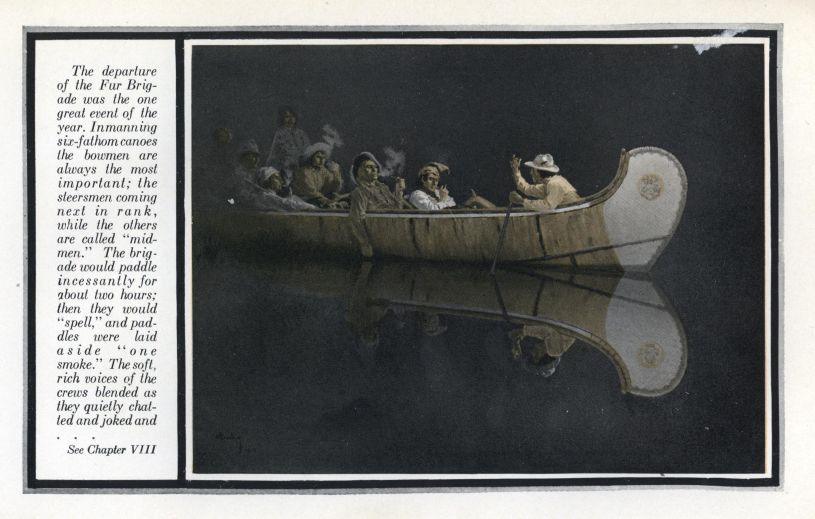
In manning a six-fathom canoe the bowman is always the most important; the steersman comes next in rank, while the others are called "midmen."
DEPARTURE OF THE FUR BRIGADE
Factor Mackenzie and his senior officer, sitting in the guide's or chief voyageur's canoe, which, of course, was Oo-koo-hoo's, gave the word; and all together the paddle blades dipped, the water swirled, and on the gunwales the paddle handles thudded as the canoes heaved away.
The going and coming of the Fur Brigade was the one great event of the year to those nomadic people who stood watching and waving to the fast-vanishing flotilla. Were they not bidding farewell to fathers, husbands, brothers, sons, or lovers, chosen as the best men from their village? Had they not lent a hand in the winning of the treasure that was floating away? If only the pelts in those packs could speak, what tales they would unfold!
As I looked back the animated picture of the little settlement wherein we figured but a moment before gradually faded into distance. The wild-looking assembly was blotted from the shore. But still above the rapidly dwindling buildings waved the flag of the oldest chartered trading association in the world—the Hudson's Bay Company.
Between eleven and twelve o'clock the brigade went ashore for a "snack." The canoes were snubbed to overhanging trees, and upon a rocky flat the fires burned. Hurriedly drinking the hot tea, the men seized pieces of frying pork and, placing them upon their broken bannock, ravenously devoured both as they returned to the canoes. No time was lost. Away we went again. Then the brigade would paddle incessantly for about two hours; then they would "spell", and paddles were laid aside "one smoke." As the way slackened the steersmen bunched the canoes. The soft, rich voices of the crews blended as they quietly chatted and joked and laughed together.