[Illustration: "There's the York Factory packet from Hudson Bay to Winnipeg, a distance of seven hundred miles. In winter it is hauled by dogs between Selkirk and Or ford House, but between the latter post and York Factory it is hauled by men with toboggans. All mails in and out from Hudson Bay to or from the next post in the interior are hauled by men. Dogs are seldom used on those routes, on account of …" See Chapter V.] (continued 2)
Reading edition
THE BEAR IN HIS WASH
It is not an uncommon occurrence for a hunter, when travelling through the winter woods, to discover the place where a bear is hibernating; the secret being given away by the condensed breath of the brute forming hoar frost about the imperfectly blocked entrance to the wash. The Indians' hunting dogs are experts at finding such hidden treasure, and when they do locate such a claim, they do their best to acquaint their master of the fact.
One day when Oo-koo-hoo was snowshoeing across a beaver meadow, his dogs, having gained the wooded slope beyond, began racing about as though they had scented game and were trying to connect a broken trail. So The Owl got out his pipe and sat down to have a smoke while his dogs were busily engaged. Presently they centred on a certain spot, and Oo-koo-hoo, going over, discovered the tell-tale hoar frost. Twisting out of his snowshoes—for an Indian never has to touch his hands to them when he puts them on or takes them off—he used one of them for a shovel, and digging away the snow, he came upon a bear's wash. It was quite a cave and dark inside, and as the dogs refused to enter, the hunter crawled into the entrance and reaching in as far as he could with his hand, felt the forms of two bears. Making sure of the exact position of the head of one of them, he then shoved his gun in until the muzzle was close to the ear of one of the bears and then he fired. The explosion aroused the other bear and as it crawled out Oo-koo-hoo killed it with his axe. The latter was a brown bear while the former was a black.
When a bear in his den shows fight and threatens danger, the hunter may wedge two crossed poles against the opening of the wash, leaving only enough space for the brute to squeeze through and thus prevent it from making a sudden rush. Then when the bear does try to come out, the hunter, standing over the opening, kills it with the back of his axe. Sometimes a second hole is dug in order to prod the beast with a pole to make it leave its den. The white hunter frequently uses fire to smoke a bear out, but not infrequently he succeeds in ruining the coat by singeing the hair. It requires more skill, however, to find a bear's wash than it does to kill him in his den. The Indians hunt for bear washes in the vicinity of good fishing grounds or in a district where berries have been plentiful.
One winter when I happened to be spending a few days at Brunswick House an old Indian woman came to call upon the Hudson's Bay trader's wife, and, while she was having afternoon tea, she casually remarked that while on her way to the Post she had espied a bear wash. Digging down into its den with one of her snowshoes, she had killed the brute with her axe, and if the other guests would care to see her prize, it was lying on her sled, just outside the door. What a contrast to the way the Wild West movie actors would have done the deadly work with the aid of all their absurd artillery! Nevertheless, that kindly spoken, smiling-faced, motherly old lady, did the deed with nothing but her little axe.
But while the men of the wilderness laugh over the serious drivel of most fiction writers who make a specialty of northern tales, nothing is so supremely ludicrous as the attempts made by the average movie director to depict northern life in Canada. Never have I seen a photoplay that truthfully illustrated northern Canadian life.
THE WOLVERINE AND GILL NET
Next day we again set out on a moose trail, but, as ill luck followed us in the way of a heavy snowstorm, we gave up the chase and continued on our way. It was hard going and we stopped often. Once we halted to rest beside a number of otter tracks. Otters leave a surprisingly big trail for animals of their size. A good imitation could be made of an otter's trail by pressing down into the snow, in a horizontal position, a long, irregular stove pipe of the usual size. The reason the otter's trail is so formed, is that the animal, when travelling through deep snow, progresses on its belly and propels itself principally by its hind legs, especially when going down hill. When making a hillside descent an otter prefers to use an old, well-worn track and glides down it with the ease and grace of a toboggan on its slide. It was the sight of the otter's trail that set Oo-koo-hoo thinking of his younger days.
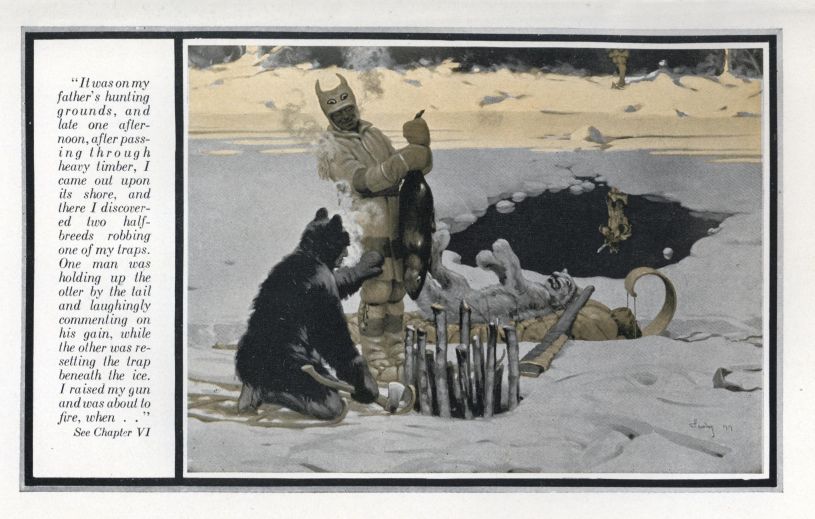
"Years ago, my son, I very nearly killed a man. It happened at just such a place as this: a little lake with a patch of open water above a spring. It was on my father's hunting grounds, and late one afternoon, after passing through heavy timber, I came out upon its shore, and there I discovered two men robbing one of my otter traps. One man was holding up the otter by the tail and laughingly commenting on his gain, while the other was resetting the trap beneath the ice. I raised my gun and was about to fire, when it occurred to me that, after all, a man's life was worth more than an otter's skin; so I let them go, and left it to the Redcoats (Mounted Police) to settle with them. I knew them both. They were half-breeds from near Montreal, and were well learned in the ways of the whites."