[Illustration: Minutes passed while the rising moon cast golden ripples upon the water and two beavers, rising from below, swam toward and mounted the roof of their island home. A twig snapping behind the hunter, he turned his head, and as he caught the vanishing glimpse of a lynx in a tree, he was instantly startled by a tremendous report and a splashing upheaval … See Chapter II.]
Reading edition
"Did you bring back anything?"
"No, my son," Oo-koo-hoo replied, "that hunting-ground belongs to an old friend of mine."
WOODCRAFT OF TRAILING
After a while the subject of woodcraft arose. When I inquired as to how I could best locate the north in case I happened to be travelling on a cloudy day without a compass, the old hunter replied, that though he never used a compass, he found no difficulty in determining the north at any time, as the woods were full of signs. For instance, the branches of trees had a general tendency to be less numerous and shorter on the north side, and the bark on the north side was usually finer in texture and of a smoother surface. Also moss was more often found on the north side of vertical trees. The tops of pine trees usually leant toward the southeast—but that that was not always a sure sign in all localities, as in some places the tree tops were affected by the prevailing winds. The stumps of trees furnished a surer indication. They showed the rings of growth to be greater in thickness on the north side. When trees were shattered by lightning, the cracks more often opened on the south side for lightning generally struck from that direction. Snow was usually deeper on the south side of trees on account of the prevailing northerly winds; and if one dug away the crust from around a tree they would come to fine, granulated snow much sooner on the north side, thus proving where the shadow usually fell. Furthermore, as the snowdrifts always pointed in the direction whither the wind had gone, knowing the direction of the prevailing winds, one had no trouble in locating the north even on the snow-covered surface of a great lake.
The old woodman cautioned me that if, while travelling alone upon a big lake, I should be overtaken by a blizzard, in no case should I try to fight it, but stop right in my tracks, take off my snowshoes, dig a hole in the snow, turn my sled over on its side to form a wind-break, crawl into the hole with the dogs, and wait until the storm subsided. If a blizzard came head-on it was useless to try to fight it, for it would easily win; but if the wind were fair and if one were still sure of his bearings, he might drift with the wind, although at heavy risk, as the wind is apt to change its course and the tripper lose his way. There was always one consolation, however, and that was that the greater the storm the sooner it was over. Another thing I should remember when travelling on a lake or over an open country, in a violent snow-storm—I should allow for drifting, much in the same way as one would if travelling by canoe.
By that time, however, the women and children had gone to sleep upon their evergreen beds, while we three men continued to converse in whispers over the glow of the fading fire. Next I asked Oo-koo-hoo in which direction men usually turned when lost in the woods—to the right or to the left? He replied that circumstances had much to do with that, for the character of the country affected the man's turning, as it was natural to follow the line of least resistance; also it depended somewhat on the man's build—whether one leg were shorter than the other. But though he had repeatedly experimented, he could not arrive at any definite conclusion. However, when trying blindfolded men on a frozen lake, he noticed that they had a tendency to turn to the south regardless of whether they were facing east or west. And he concluded by remarking that he thought people were very foolish to put so much faith in certain statements, simply because they were twice-told tales.
Upon my questioning him as to how a hunter would act, if, for instance, he were trailing a moose, and suspected that he was being followed by enemies, say a pack of wolves, or strange hunters, he informed me that if that happened to him—that if he suspected some enemy were following his trail—he would not stop, nor even look around, but at the first favourable opportunity, when he was sure he couldn't be observed, he would leave the game trail, circle back a mile or so through the woods, and upon cutting his old track would at once learn what was following him. Then if it were worth while he could trail his pursuers and, coming up behind them, could take them unaware. But if all this happened on a lake or in open country, where he could not circle back under cover, he would suddenly turn in his tracks, as though upon a pivot, and without losing the least headway or causing a moment's delay in his pace, he would continue walking, but now in a backward direction, long enough to give himself ample time to scrutinize his distant trail. By manoeuvring thus, he could study his pursuers without arousing their suspicion, for whether they were animals or men, the chances would be—if they were some distance away—that they would never notice that he had turned about, and was now inspecting his own tracks.
As regards trailing game, whether large or small, he cautioned me to watch my quarry carefully, and instantly to become rigid at the first sign that the game was about to turn round or raise its head to peer in my direction. More than that, I should not only remain motionless while the animal was gazing toward me, but I should assume at once some form that suggested the character of the surrounding trees or bushes or rocks. For example, among straight-boled, perfectly vertical trees, I should stand upright; among uprooted trees, I should assume the character of an overturned stump, by standing with inclined body, bent legs, and arms and fingers thrust out at such angles as to suggest the roots of a fallen tree. And he added that if I doubted the wisdom of such an act, I should test it at a distance of fifty or a hundred paces, and prove the difficulty of detecting a man who assumed a characteristic landscape pose among trees or rocks. That was years before the World War had brought the word camouflage into general use; for as a matter of fact, the forest Indians had been practising camouflage for centuries and, no doubt, that was one reason why many of the Indians in the Canadian Expeditionary Force did such remarkable work as snipers.
INDIANS IN THE WORLD WAR
For instance: Sampson Comego destroyed twenty-eight of the enemy. Philip Macdonald killed forty, Johnny Ballantyne fifty-eight. "One of their number, Lance-Corporal Johnson Paudash," as the Department of Indian Affairs states, "received the Military Medal for his distinguished gallantry in saving life under heavy fire and for giving a warning that the enemy were preparing a counter-attack at Hill Seventy; the counter-attack took place twenty-five minutes after Paudash gave the information. It is said that a serious reverse was averted as a result of his action. Like other Indian soldiers, he won a splendid record as a sniper, and is officially credited with having destroyed no less than eighty-eight of the enemy. Another Indian who won fame at the front was Lance-Corporal Norwest; he was one of the foremost snipers in the army and was officially credited with one hundred and fifteen observed hits. He won the Military Medal and bar. Still another, Corporal Francis Pegahmagabow, won the Military Medal and two bars. He distinguished himself signally as a sniper and bears the extraordinary record of having killed three hundred and seventy-eight of the enemy. His Military Medal and two bars were awarded, however, for his distinguished conduct at Mount Sorrell, Amiens, and Passchendaele. At Passchendaele, Corporal Pegahmagabow led his company through an engagement with a single casualty, and subsequently captured three hundred Germans at Mount Sorrell.
"The fine record of the Indians in the great war appears in a peculiarly favourable light when it is remembered that their services were absolutely voluntary, as they were specially exempted from the operation of the Military Service Act, and that they were prepared to give their lives for their country without compulsion or even the fear of compulsion."
Many military medals were won by the Canadian Indians; Captain A. G. E. Smith of the Grand River Band of the Iroquois having been decorated seven times by the Governments of England, France, and Poland, and many distinguished themselves by great acts upon the battlefield. "Another Indian to be decorated was Dave Kisek. During the heavy fighting around Cambrai he unstrapped a machine gun from his shoulder and advanced about one hundred yards to the German position, where he ran along the top of their trench, doing deadly execution with his machine gun. He, single-handed, took thirty prisoners upon this occasion. This Indian came from the remote regions of the Patricia district. Sergeant Clear Sky was awarded the Military Medal for one of the most gallant and unselfish deeds that is recorded in the annals of the Canadian Expeditionary Force. During a heavy gas attack he noticed a wounded man lying in 'No Man's Land' whose gas mask had been rendered useless. Clear Sky crawled to him through the poisonous fumes, removed his own mask, and placed it on the wounded man, whose life was in consequence saved. Sergeant Clear Sky was himself severely gassed as a result of his heroic action. Joe Thunder was awarded the Military Medal for a feat of arms of an exceptionally dramatic character. He was separated from his platoon and surrounded by six Germans, each of whom he bayoneted. George McLean received the Distinguished Conduct Medal in recognition of the performance of a feat which was an extraordinary one even for the great war. Private McLean, single-handed, destroyed nineteen of the enemy with bombs and captured fourteen."
And yet not a single Canadian Indian has claimed that he won the World War—not even Pegahmagabow, who shot three hundred and seventy-eight Germans.
APPROACHING GAME
But to return to the land of peace. Of course, in attempting to deceive game, one must always guard against approaching down wind, for most animals grow more frantic over the scent than they do over the sight of man. Later on, when I went hunting with Oo-koo-hoo, he used to make me laugh, for at one moment he would be a jolly old Indian gentleman, and just as likely as not the next instant he would be posing as a rotten pine stump that had been violently overturned, and now resembled an object against which a bear might like to rub his back and scratch himself.
Often have I proved the value of the old hunter's methods, and I could recite not a few instances of how easy it is to deceive either birds or animals; but I shall mention only one, which happened on the borderline of Alaska. I was running through a grove of heavy timber, where the moss was so deep that my tread made no sound, when suddenly rounding a large boulder, I came upon a black bear less than fourteen paces away. It was sitting upon its haunches, directly in the footpath I was following. As good luck would have it, I saw him first, and for the fun of it, I instantly became an old gray stump—or tried to look like one. Presently the bear's head swung round, and at first he seemed a bit uneasy over the fact that he had not seen that stump before. It appeared to puzzle him, for he even twisted about to get a better view; but after watching me for about five minutes he contentedly turned his head away. A few minutes later, however, he looked again, and becoming reassured, yawned deliberately in my face. But by that time, being troubled with a kink in my back, I had to straighten up. Then, strange to say, as I walked quietly and slowly round him to gain the path ahead, the brute did not even get up off his haunches—but such behaviour on the part of a bear rarely happens.
Perhaps you wonder why I didn't shoot the brute. I never carry a gun. For when one is provided with food, one can carry no more useless thing than a gun; so far as protection is concerned, there is no more need to carry a gun in the north woods, than to carry a gun down Broadway; in fact, the wolves of Broadway—especially those of the female species—are much more dangerous to man than the wolves of the Great Northern Forest.
SUNDAY IN CAMP
Next morning being Sunday, we did not strike camp, and the first thing the women attended to, even while breakfast was under way, was the starting of a fire of damp, rotten wood, which smoked but never blazed, and over which, at a distance of about four feet, they leant the stretched deerskins, hair side up, to dry. Besides those, other frames were made and erected over another slow fire, and here the flakes or slabs of moose flesh were hung to be dried and smoked into what is called jerked meat. The fat, being chopped up and melted in a pail, was then poured into the moose bladder and other entrails to cool and be handy for future use. Of course, it would take several days to dry out the deerskins; so each morning when we were about to travel, the skins were unlaced and rolled up, to be re-stretched and placed over another fire the following evening.
Sunday was pleasantly spent, notwithstanding that so many different religious denominations were represented in camp: for while old Ojistoh counted her beads according to the Roman Catholic faith, Amik and Naudin were singing hymns, as the former was an English Churchman and his wife a Presbyterian; but Oo-koo-hoo would join in none of it as he had no faith whatever in the various religions of the white men and so he remained a pagan. Part of the day we spent in pottering about, in doing a little mending here and there, smoking, telling stories, or in strolling through the woods; as both Oo-koo-hoo and Amik were opposed to doing actual work on Sunday. In the afternoon I turned to sketching, and my drawing excited so much interest that Amik tried his hand, and in a crude way his sketches of animals and birds were quite graphic in character. One sketch I made, that of the baby, so pleased Neykia, that I gave it to her, and when she realized my intention she seized it with such eagerness that she crumpled and almost tore the paper; for as the Ojibways have no word to express their thanks, they show their gratitude by the eagerness with which they accept a present.
That, however, reminds me of having read in one of the leading American magazines an account of a noted American illustrator's trip into the woods of Quebec. While there he presented a red handkerchief to an Indian girl. The fact that she snatched it from him, and then ran away, was to him—as he stated—a sign that she was willing to comply with any evil intentions he might entertain toward her. Such absolute rot! The polite little maid was merely trying to express her unbounded thanks for his gift.
The only thing that interrupted our paddling the following day was our going ashore to portage around a picturesque waterfall where two huge rocks, on the very brink of the cascade, split the river into three. When we had carried up the canoes, we found the children making a great to-do about wasps attacking them; for they had put down their packs beside a wasps' hole; and old Granny, seeing the commotion, had put down her end of the canoe, and with disgust exclaimed:
"Oh, my foolish people, always standing around and waiting for old Granny to fix everything!" So saying, she pulled a big bunch of long, dry grass, and lighting it, ran with a blanket over her head, and placed the fire against the wasps' hole; in a moment they ceased their attack and utterly disappeared.
We were now nearing the fork of Crane River, that in its three-mile course came from Crane Lake, on the shore of which was Oo-koo-hoo's last winter's camping ground; the men therefore decided that it was best for Amik to push on in the light canoe and get the two deerskin winter tepee coverings, as well as their traps, that had been cached there last spring; and then return to the fork of the river where the family would go into camp and wait for him.
NEARING TRIP'S END
Transferring most of the cargo to the other canoes, Amik and I provided ourselves with a little snack and started at once for Oo-koo-koo's old camping ground. It appeared about a three-mile paddle to the fork of the river. Nothing save the quacking of ducks rushing by on the wing, the occasional rise of a crane in front of us, the soaring of an eagle overhead, and the rippling wakes left by muskrats as they scurried away, enlivened our hurried trip. We found the leather lodge coverings in good order upon a stage, and securing them along with several bundles of steel traps that hung from trees, we put all aboard and found we had quite a load, for not only were the tepee coverings bulky, each bundle being about two feet thick by four feet long, but they were heavy, too, for each weighed about a hundred pounds. Then, too, the traps were quite a load in themselves. I didn't stop to count them, but it is surprising the number of traps a keen, hard-working hunter employs; and they ranged all the way from small ones for rat and ermine to ponderous ones for bears. Also we gathered up a few odds and ends such as old axes, an iron pot, a couple of slush scoops, a bundle of fish-nets, and a lot of old snowshoes. Crane Lake, like many another northern mere, was a charming little body of water nestling among beautiful hills. After a cup of tea and some bannock, we once more plied our paddles.
Now it was down stream and we glided swiftly along, arriving at the confluence of the Crane and Caribou just before twilight and found smiling faces and a good supper awaiting our return. How human some Indians are, much more so than many a cold-blooded white.
Next day we wanted to make the Height-of-land portage for our camp. As it meant a long, stiff paddle against a strong current for most of the distance, we were up early, if not bright, and on our way before sunrise. This time, however, no rapids impeded us and we reached the portage on the farther shore of Height-of-land Lake, tired and hungry, but happy over a day's work well done. It was a pretty little lake about two miles long, surrounded by low-lying land in the midst of a range of great rock-bound hills, and its waters had a whimsical fashion of running either east or west according to which way the wind struck it. Thus its waters became divided and, flowing either way, travel afar to their final destinations in oceans thousands of miles apart. But the western outlet, Moose Creek, being too shallow for canoes, a portage of a couple of miles was made the following day, to the fork of an incoming stream that doubles its waters and makes the creek navigable. When we camped that night the hour was late. Then a two-days' run—the second of which we travelled due north—took us into Moose Lake; but not without shooting three rapids, each of which the Indians examined carefully before we undertook the sport that all enjoyed so much. An eastern storm, however, caught us on Moose Lake and not only sent us ashore on an island, but windbound us there for two days while cold showers pelted us. Another day and a half up Bear River, with a portage round Crane Falls, landed us on the western shore of Bear Lake at the mouth of Muskrat Creek—and there we were to spend the winter.
There, too, I remembered Thoreau when he said: "As I ran down the hill toward the reddening west, with the rainbow over my shoulder, and some faint tinkling sounds borne to my ear through the cleansed air, from I know not what quarter, my Good Genius seemed to say,—'Go fish and hunt far and wide day by day,—farther and wider,—and rest thee by many brooks and hearth-sides without misgiving. Remember thy Creator in the days of thy youth. Rise free from care before the dawn, and seek adventures. Let the noon find thee by other lakes, and the night overtake thee everywhere at home'." And furthermore: "Let not to get a living be thy trade, but thy sport. Enjoy the land, but own it not. Through want of enterprise and faith men are where they are, buying and selling, and spending their lives like serfs."
III
OO-KOO-HOO'S EL DORADO
OUR WINTER CAMP
Bear Lake was beautiful. Its shores were fringed here and there with marshy reeds or sandy beaches; and its rivulets, flowing in and out, connected it with other meres in other regions. At dawn moose and caribou came thither to drink; bears roamed its surrounding slopes; lynxes, foxes, fishers, martens, ermines, and minks lived in its bordering woods. Otters, muskrats, and beavers swam its inrushing creeks; wolverines prowled its rocky glens, and nightly concerts of howling wolves echoed along its shores. The eagles and the hawks built their nests in its towering trees, while the cranes fished and the ruffed grouse drummed. Nightly, too, the owls and the loons hooted and laughed at the quacking ducks and the honking geese as they flew swiftly by in the light of the moon. Salmon-trout, whitefish, pike, and pickerel rippled its placid waters, and brook-trout leaped above the shimmering pools of its crystal streams. It was Oo-koo-hoo's happiest hunting ground, and truly it was a hunter's paradise … a poet's heaven … an artist's home.
"What fools we mortals be!"—when we live in the city!
The site chosen for the lodges was on one of two points jutting into the lake, separated by the waters of Muskrat Greek. On its northwest side ran a heavily timbered ridge that broke the force of the winter winds from the west and the north, and thus protected Oo-koo-hoo's camp, which stood on the southeast side of the little stream. Such a site in such a region afforded wood, water, fruit, fish, fowl, and game; and, moreover, an enchanting view of the surrounding country. Furthermore, that section of The Owl's game-lands had not been hunted for forty-two moons.
Immediately after dinner the men began cutting lodge poles, while the women cleared the tepee sites and levelled the ground. On asking Oo-koo-hoo how many poles would be required for the canvas lodge which he had kindly offered me the use of for the coming winter, he replied:
"My son, cut a pole for every moon, and cut them thirteen feet in length, and the base of the tepee, too, should be thirteen feet across." Then looking at me with his small, shrewd, but pleasant eyes, he added: "Thirteen is our lucky number. It always brings good fortune. Besides, most canoes are made of thirteen pieces, and when we kill big game, we always cut the carcasses into thirteen parts. My son, when I have time I shall carve a different symbol upon each of the thirteen poles of your lodge; they shall represent the thirteen moons of the year, and thus they will enable you to keep track of the phase of the season through which you are passing."
All the poles were of green pine or spruce. The thin ends of three of the stoutest were lashed together; on being erected, they formed a tripod against which the other poles were leant, while their butts, placed in a circle, were spread an equal distance apart. Over that framework the lodge covering was spread by inserting the end of a pole into the pocket of each of the two windshields, and then hoisting the covering into place. Next the lapping edges, brought together over the doorway, were fastened securely together with wooden pins, while the bottom edge was pegged down all round the lodge with wooden stakes. In the centre of the floor-space six little cut logs were fastened down in the form of a hexagon, and the earth scooped from within the hexagon was banked against the logs to form a permanent and limited fireplace. The surrounding floor space was covered with a layer of fir-brush, then a layer of rushes, and finally, where the beds were to be laid, a heavy mattress of balsam twigs laid, shingle-fashion, one upon another, with their stems down. Thus a springy, comfortable bed was formed, and the lodge perfumed with a delightful forest aroma. Above the fireplace was hung a stage, or framework of light sticks, upon which to dry or smoke the meat. Around the wall on the inner side was hung a canvas curtain that overlapped the floor, and thus protected the lodgers from draught while they were sitting about the fire. The doorway was two feet by five, and was covered with a raw deerskin hung from the top. A stick across the lower edge kept the skin taut. A log at the bottom of the doorway answered for a doorstep and in winter kept out the snow. Now the lodge was ready for occupation.
As there are six different ways of building campfires, it should be explained that my friends built theirs according to the Ojibway custom; that is, in the so-called "lodge fashion", by placing the sticks upright, leaning them together, and crossing them over one another in the manner of lodge poles. When the fire was lighted, the windshields formed a perfect draught to carry the smoke up through the permanently open flue in the apex of the structure, and one soon realized that of all tents or dwellings, no healthier abode was ever contrived by man. Indeed, if the stupid, meddlesome agents of civilization had been wise enough to have left the Indians in their tepees, instead of forcing them to live in houses—the ventilation of which was never understood—they would have been spared at least one of civilization's diseases—tuberculosis—and many more tribesmen would have been alive to-day.
On entering an Indian tepee one usually finds the first space, on the right of the doorway, occupied by the woodpile; the next, by the wife; the third, by the baby; and the fourth, by the husband. Opposite these, on the other side of the fire, the older children are ranged. To the visitor is allotted the warmest place in the lodge, the place of honour, farthest from and directly opposite the doorway. When the dogs are allowed in the tepee, they know their place to be the first space on the left, between the entrance and the children.
While the two leather lodges of the Indians stood close together with stages near at hand upon which to store food and implements out of reach of the dogs and wild animals, my tepee, the canvas one, stood by itself a little farther up the creek. Taking particular pains in making my bed, and settling everything for service and comfort, I turned in that night in a happy mood and fell asleep contemplating the season of adventure before me and the great charm of living in such simplicity. "In the savage state every family owns a shelter as good as the best, and sufficient for its coarser and simpler wants," says Thoreau, "but I think that I speak within bounds when I say that, though birds of the air have their nests, and the foxes their holes, and the savages their wigwams, in modern civilized society not more than one half the families own a shelter. In the large towns and cities, where civilization especially prevails, the number of those who own a shelter is a very small fraction of the whole. The rest pay an annual tax for this outside garment of all, become indispensable summer and winter, which would buy a village of Indian wigwams but now helps to keep them poor as long as they live.… But how happens it that he who is said to enjoy these things is so commonly a poor civilized man, while the savage, who has them not, is rich as a savage?"
Next morning, while roaming about the point, I discovered two well-worn game trails that, converging together, led directly to the extreme outer end of our point. The tracks were the wild animals' highways through that part of the woods, and were used by them when they desired to make a short cut across that end of the lake by way of a neighbouring island. Worn fairly smooth, and from three to five inches in depth, by from eight to ten inches in width, these tracks were entirely free of grass or moss. In following them a few hundred paces, I could plainly recognize the prints of the moose, the bear, the wolf, and the fox; and a few smaller and lesser impressions with regard to the origin of which I was not so sure. The trails were much like the buffalo trails one used to see upon the plains. To my delight, my lodge door was not more than ten paces from that wild Broadway of the Wilderness.
INDIAN POLITENESS
After breakfast Oo-koo-hoo suggested that a "lop-stick" should be cut in honour of the white man's visit. Selecting a tall spruce, Amik, with a half-axe in hand, began to ascend it. When he had climbed about three parts of the way up he began to chop off the surrounding branches and continued to do so as he descended, until he was about halfway down, when he desisted and came to earth. The result was a strange-looking tree with a long bare trunk, surmounted by a tuft of branches that could be seen and recognized for miles around.
Cutting lop-sticks is an old custom of the forest Indians. Such trees are used to mark portages, camping grounds, meeting places, or dangerous channels where submerged rocks lie in wait for the unsuspecting voyageur. In fact, they are to the Indian what lighthouses are to the mariner. Yet, sometimes they are used to celebrate the beginning of a young man's hunting career, or to mark the grave of a famous hunter. When made to indicate a wilderness rendezvous, the meeting place is commonly used for the purpose of coming in contact with their nearest neighbours or friends, and halting a day or so, while upon their voyage to the post, in order to discuss their affairs—the winter's hunt, the strange tracks they have seen, the strange sounds they have heard, the raiding of their hunting ground, and the like. Always at such meetings a fire is kindled regardless of the season, an ancient custom of their old religion, but used to-day more for the purpose of lighting pipes. Beside the fire a post stripped of its bark is erected, and on it a fire-bag containing tobacco for the use of all hands is hung. Around the fire the women and children spread a carpet of brush, upon which the men sit while conversing. At such meetings one never hears two Indians talk at once—a fine example for white people to heed—nor do they openly contradict one another as the vulgar white man does, for such an offence would be considered, by the savage, rude—and the offender would be regarded as no better than a white man; for they believe themselves to be not only the wisest and the bravest, but the politest people in the world; and when one stops to compare the average Indian with the average white man in North America, one must grant that the savage is right.
In relation to their politeness I can go beyond my own observation and quote the experience of Sir Alexander Henry—whom they called Coseagon—while he was held a prisoner.
"I could not let all this pass without modestly remarking that his account of the beginning of things was subject to great uncertainty as being trusted to memory only, from woman to woman through so many generations, and might have been greatly altered, whereas the account I gave them was written down by direction of the Great Spirit himself and preserved carefully in a book which was never altered, but had ever remained the same and was undoubtedly the truth. 'Coseagon,' says Canassatego, 'you are yet almost as rude as when you first came among us. When young it seems you were not well taught, you did not learn the civil behaviour of men. We excused you; it was the fault of your instructors. But why have you not more improved since you have long had the opportunity from our example? You see I always believe your stories. That is, I never contradict them. Why do you not believe mine?' Contradiction, or a direct denial of the truth of what another says, is among the Indians deemed extremely rude. Only great superiority, as of a father to a child, or of an old counsellor to some boy, can excuse it. Alaquippy and the other Indians kindly made some apology for me, saying I should be wiser in time, and they concluded with an observation which they thought very polite and respectful toward me, that my stories might be best for the white people, but Indian stories were undoubtedly best for Indians."
Furthermore, if we compare the philosophy of the red man and the white, we find that just because the white man has invented a lot of asinine fashions and customs, a lot of unnecessary gear and junk, and feeds himself on unhealthy concoctions that give him indigestion and make his teeth fall out, he flatters himself that he is the wisest man on earth, whereas, all things considered, in my humble opinion, he is the prize fool of the universe—for removing himself so far from nature. And when the female follower of Dame Fashion goes mincing along the cement-paved street in her sharp-toed, French-heeled slippers, on her way to the factory, she flatters herself that she knows better than God how to perfect the human foot; then the All Wise One, in His just wrath, strikes back at her by presenting her with a luxuriant crop of varicose veins, corns, ingrowing nails, fallen arches, and bunions that supply her with suffering in plenty for the rest of her days. Her red sister, on the contrary, in moccasined feet, walks naturally through the forest; and The Master of Life, beholding her becoming humility, rewards her with painless pleasure.
But to return to the Indians' meeting places in the wilderness. The important meetings held in the forest are always opened by smoking. No man speaks without first standing up, and his delivery is always slow and in short, clear sentences. In the past there were great orators among the red men as many of the old writers and traders affirm—but again I quote Sir Alexander Henry:
"Old Canassatego, a warrior, counsellor, and the chief man of our village, used to come frequently to smoke and talk with me, while I worked at my new business (mending of gun locks), and many of the younger men would come and sit with him, pleased to hear our conversations. As he soon saw I was curious on that head he took a good deal of pains to instruct me in the principles of their eloquence, an art (it may seem strange to say it, but it is strictly true) carried much higher among these savages than is now in any part of Europe, as it is their only polite art, as they practice it from their infancy, as everything of consequence is transacted in councils, and all the force of their government consists in persuasion."
Once when questioning Oo-koo-hoo regarding old Indian customs, he informed me that among Indians bowing was a very recent innovation, and that the men of the olden time—the fire-worshippers or sun-worshippers—never deigned to bow to one another: they bowed to none but the Deity. They took not the Great Spirit's name in vain; nor did they mention it save in a whisper, and with bowed head. He regretted that since coming in contact with the irreverent and blaspheming white men, his people had lost much of their old-time godly spirit.
TRAPPING EQUIPMENT
For the next few days the work done by the men was confined to odd jobs in preparation for the coming winter, and the laying out of their future trapping trails. They built some stages upon which to store the canoes, and others nearer the lodges, upon which to place their guns, sleds, and snowshoes. They cut and shaved axe-handles and helved them. They overhauled traps, and got ready all their trapping gear. It was always interesting to watch Oo-koo-hoo and Amik, even when they were engaged upon the most trivial forest work, for much of it was new to me and it was all so different from the ways of civilization. Then, too, they had taken the boys in hand and were instructing them in relation to the hunter's art.
The first thing they did with the traps, after seeing that the old ones were in working order, was to boil both the new ones and the old ones for about half an hour in pots in which was placed either pine, or spruce, or cedar brush. This they did—Oo-koo-hoo explained—to cleanse the old traps and to soften the temper of the new ones, thus lessening the chances of their breaking in zero weather; and also to free both old and new from all man-smell and to perfume them with the natural scent of the forest trees, of which no animal is afraid. The traps they used were the No. 1, "Rat," for muskrats, ermines, and minks; the No. 2, "Mink," for minks, martens, skunks, and foxes; the No. 3, "Fox," for foxes, minks, martens, fishers, wolves, wolverines, skunks, otters, and beavers; the No. 4, "Beaver," for beavers, otters, wolves, wolverines, and fishers; the No. 5, "Otter," for otters, beavers, wolves, wolverines, and small bears; and the "Bear" trap in two sizes—A, large, and B, small, for all kinds of bears and deer. Traps with teeth they did not use, as they said the teeth injured the fur.
Next to the knife, the woodsman uses no more useful implement than the axe. Even with the professional hunter, the gun takes third place to the knife and the axe. As between the two makes of axes—the American and the Canadian—the former appears the best. It is really a good fair-weather axe, but winter work proves the superiority of the Canadian implement. The latter does not chip so readily in cold weather. Furthermore, the eye of the American axe is too small for the soft-wood helve usually made in the northern forest, since in many parts no wood harder than birch is to be had. But to reduce the high temper of the American axe, the hunter can heat the head in fire until it becomes a slight bluish tinge and then dip it in either fish oil or beaver oil. The sizes of axes run: "Trappers," 1 1/2 lbs.; "Voyageurs," 2 1/2 lbs., "Chopping," 3 1/2 lbs., and "Felling," 4 lbs.
At last the eventful morning arrived. Now we were to go a-hunting. The trap-setting party was to be composed of four persons: Oo-koo-hoo, the two boys, and myself. Our ne-mar-win—provisions—for four, to last a week, consisted of: one pound of tea, eight pounds of dried meat, four pounds of grease, four pounds of dried fish, and a number of small bannocks; the rest of our grub was to be secured by hunting.
Of course, while hunting, Oo-koo-hoo always carried his gun loaded—lacking the cap—but it was charged with nothing heavier than powder and shot, so that the hunter might be ready at any moment for small game; yet if he encountered big game, all he had to do was to ram down a ball, slip on a cap, and then be ready to fire at a moose or a bear.
SETTING FOX TRAP
After the usual affectionate good-bye, and the waving of farewell as we moved in single file into the denser forest, we followed a game trail that wound in and out among the trees and rocks—always along the line of least resistance—and for a while headed westward through the valley of Muskrat Creek. Oo-koo-hoo led the way and, as he walked along, would occasionally turn and, pointing at the trail, whisper:
"My white son, see, a moose passed two days ago … That's fox—this morning," and when we were overlooking the stream, he remarked: "This is a good place for muskrats, but I'll come for them by canoe."
The principal object of the trip was to set fox and marten traps. Hilly timberland of spruce or pine, without much brushwood, is the most likely place for martens; and in fairly open country foxes may be found. The favourite haunt of beavers, otters, fishers, minks, and muskrats is a marshy region containing little lakes and streams; while for lynxes, a willowy valley interspersed with poplars is the usual resort.
Coming to an open space along the creek, the wise old Owl concluded from the fox signs he had already seen, and from the condition of the soil on a cut bank, that it was a desirable place in which to set a steel trap for foxes. Laying aside his kit, he put on his trapping mits, to prevent any trace of man-smell being left about the trap, and with the aid of his trowel he dug into the bank a horizontal hole about two feet deep and about a foot in diameter. He wedged the chain-ring of the trap over the small end of a five-foot pole to be used as a clog or drag-anchor in case the fox tried to make away with the trap. The pole was then buried at one side of the hole. Digging a trench from the pole to the back of the hole, he carefully set the trap, laid it in the trench near the back of the hole, so that it rested about half an inch below the surface of the surrounding earth, covered it with thin layers of birch bark (sewed together with watap—thin spruce roots) then, sifting earth over it, covered all signs of both trap and chain, and finally, with a crane's wing brushed the sand into natural form. Placing at the back of the hole a duck's head that Ne-geek had shot for the purpose, Oo-koo-hoo scattered a few feathers about. Some of these, as well as the pan of the trap, had been previously daubed with a most stinking concoction called "fox bait"—hereafter called "mixed bait" to prevent confusing this with other baits.
It was composed of half a pound of soft grease, half an ounce of aniseed, an eighth of an ounce of asafoetida, six to ten rotten birds' eggs, and the glands taken from a female fox—all thoroughly mixed in a jar and then buried underground to rot it, as well as for safe keeping. The reason for such a concoction is that the cold in winter does not affect the stench of asafoetida; aniseed forms a strong attraction for many kinds of animals; foxes are fond of eggs; and no stronger lure exists for an animal than the smell of the female gland. So powerful is the fetor of this "mixed bait," and so delicious is the merest whiff of it, that it forms not only an irresistible but a long-range allurement for many kinds of fur-bearers. Indeed, so pungent was it, that Oo-koo-hoo carried merely a little of it in a cap-box, and found that a tiny daub was quite sufficient to do his work. The reason for using the two kinds of bait was that while the mixed bait would attract the animal to the trap by its scent, the sight of the duck's head would induce the fox to enter the hole, step upon the unseen trap while reaching to secure its favourite food, and thus be caught by a foreleg.
The mention of an animal being caught by a foreleg reminds me of the strange experience that Louison Laferte, a French half-breed, manservant at Fort Rae, once had with a wolf. Louison was quite a wag and at all times loved a joke. One day while visiting one of his trapping paths with his four-dog team he came upon a wolf caught in one of his traps by the foreleg. After stunning the brute, he found that its leg was in no way injured, for it had been in the trap but a short time. Louison, in a sudden fit of frolic humour, unharnessed his Number 3 dog and harnessed in its place the unconscious wolf. When the wild brute came to, and leaped up, the half-breed shouted: "Ma-a-r-r-che!" and whipped up his dogs. Off they went, the two leading dogs pulling the wolf along from in front, while the sled-dog nipped him from behind and encouraged him to go ahead. Thus into Fort Rae drove the gay Louison with an untamed timber-wolf in harness actually helping to haul his sled as one of his dog-team. The half-breed kept the wolf for more than a month trying to train it, but it proved so intractable and so vicious that fearing for the children around the Post, eventually he killed it.
DOG TRAILING FOX
It is generally conceded by the most experienced fur-hunters of the northern forest, that while the wolverine is a crafty brute and difficult to hunt, yet of all forest creatures the coloured fox is the hardest to trap. In hunting the two animals with dogs, however, there is little comparison. The wolverine, being a heavy, short-legged beast, can soon be overhauled in an open country or on a beaten trail by a dog, or in deep snow even by a man on snowshoes; while the chances of a fox being run down by a dog are not so good. Some hunters, however, kill many foxes by running them down with dogs, and for such work they use a light-weight, long-legged dog possessed of both long sight and keen scent. Hunters declare that no animal, not even the wolf, has so much endurance as a good hunting-dog.
When a hunting-dog sights a fox on a frozen lake he runs straight for him. The fox, on realizing that he is being pursued, leaps wildly into the air two or three times, and then makes off at tremendous speed—much faster than the dog can run. But in about half a mile the fox, becoming played out, stops to rest a moment and to look around to see if the dog is still following. Then, on seeing the dog still in pursuit, he sets off in another great burst of speed. Meanwhile, the dog has gained on him, and the fox, discovering this, bolts off at a different angle. The dog, however, observing what has happened, takes advantage of his quarry, and cuts the corner and thereby makes another gain. The fox, now more alarmed than ever, makes another turn, and the dog cuts another corner and makes another gain. Thus the race goes on until the fox comes to the conclusion that the dog is sure to get him, loses both heart and wind and finally lies down from sheer exhaustion. The dog rushes at him, seizes him between the forelegs, and with one crunch the hunt is over.
It is much the same in the deep snow of the timberland. There the fox will start off with great bounds that sink him deep into the snow and make the scent only the stronger for the dog. Meanwhile, the dog lopes steadily along, though far out of sight. The fox stops to listen and learn if his enemy is still pursuing him. When the dog finally comes into view, the fox changes his course, and the dog cuts the corner, and thus the story ends in the usual way.
OTHER WAYS OF TRAPPING
As the methods of hunting the wolf, the marten, the lynx, and the wolverine are founded on the various ways of trapping the fox, a full description of how foxes are hunted may be of interest. Then, too, the reader will be enabled to understand more easily, without unnecessary repetition, the modes of trapping other animals. My description, however, will apply only to the hunting of the crafty coloured foxes of the forest, and not to their stupid brethren of the Arctic coasts—the white and the blue foxes.
Of course, every Indian tribe believes its own manner of hunting to be the master way, but it is conceded by experienced fur-traders that the Ojibway method is the best. When setting a fox trap in the winter time, the first thing an Ojibway does is to jab into the snow, small end down, and in an upright position, the clog or drag-pole. With his knife he then cuts a hole in the snow exactly the size of the set trap, the plate of which has already been daubed with mixed bait. In this hole the trap is placed in such a position that it rests about half an inch below the surface of the snow. A thin shield of birch bark covers this, and then with a crane's wing the snow is brushed over both trap and chain so that no sign remains. Then in addition to the mixed bait, he plants about the spot food bait, such as bits of rotten fish or duck.
Most hunters have a regular system for setting their traps so that they may know exactly where and how they are placed. Usually he sets them east and west, then cutting a notch on a branch—about a foot from the butt—he measures that distance from the trap, and thrusts the branch into the snow in an upright position, as though it were growing naturally. The stick serves not only to mark the trap, but in an open space to furnish the same attraction for a fox as a tree does for a dog; besides, when the hunter is going his rounds, at the sight of the branch he will remember where and how his trap is set, and can read all the signs without going too near. The object of laying the sheet of birch bark over the trap is that when any part of the bark is touched the trap may go off; besides, it forms a hollow space beneath, and thus allows the animal's foot to sink deeper into the trap, to be caught farther up, and to be held more securely.
The foregoing is the usual way of setting a fox trap, yet the Wood Crees and the Swampy Crees set their fox traps on mounds of snow about the size of muskrat houses. For that purpose they bank the snow into a mound about eighteen inches high, bury the drag-pole at the bottom, set the trap exactly in the crest of the mound, and, covering up all traces of trap and chain with powdered snow, sprinkle food bait and mixed bait around the bottom of the mound. The approaching fox, catching scent of the mixed bait, follows it up and then eats some of the food bait, which presently gives him the desire to go and sit upon the mound—which is the habit of foxes in such a condition—and thus he is caught.
A curious thing once happened to a Dog-rib Indian at Great Slave Lake. One day he found a wolf caught in one of his traps and foolishly allowed his hunting-dog to rush at it. The wolf leaped about so furiously that it broke the trap chain, and ran out upon the lake, too far for the hunter's gun. In pursuit of the wolf, the dog drew too near and was seized and overpowered by the wolf. In order to save his dog the hunter rushed out upon the lake; and when within fair range, dropped upon one knee and fired. Unluckily, the ball struck the trap, smashed it, and set the wolf free; and all the hunter got for his pains was a dead dog and a broken trap—while the wolf went scot free.
The Chipewyan and Slave Indians set their traps inside a lodge made of eight or ten poles, seven or eight feet in length, placed together lodge fashion and banked round with a wall of brush to prevent the fox entering except by the doorway. The trap is set in the usual way, just outside the entrance, the chain being fastened to one of the door poles. Instead, however, of being placed on the snow around the trap, the mixed bait is put on a bit of rabbit skin fastened in the centre of the lodge; the idea being that the fox will step on the trap when he endeavours to enter. The Louchieux Indian sets his trap the foregoing way, but in addition he sets a snare in the doorway of the lodge, not so much to catch and hold the fox, as to check him from leaping in without treading on the trap.
Oo-koo-hoo told me that whenever a trap set in the usual way had failed to catch a fox, he then tried to take advantage of the cautious and suspicious nature of the animal by casting about on the snow little bits of iron, and re-setting and covering his trap on the crest of some little mound close at hand without any bait whatever. The fox, returning to the spot where he had scented and seen the bait before, would now scent the iron, and becoming puzzled over the mystery would try to solve it by going to the top of the mound to sit down and think it over; and thus he would be caught.
Another way to try for a fox that has been nipped in a trap and yet has got away is to take into account the strange fact that the animal will surely come back to investigate the source of the trouble. The hunter re-sets the trap in its old position and in the usual way; then, a short distance off, he builds a little brush tepee, something like a lynx-lodge, which has a base of about four feet, and by means of a snare fastened to a tossing-pole, he hangs a rabbit with its hind feet about six inches above the snow. A mixed-bait stick is placed a little farther back, in order to attract the fox, while another trap is set just below the rabbit. The idea of re-setting the first trap in the old position is to put the fox off his guard when he approaches the dead rabbit hanging in the snare. As, no doubt, he has seen a rabbit hang many times before, and snares so baited he has often robbed. The Indian in his extreme care to avoid communicating man-smell to the rabbit will even remain to leeward of it while he handles it, lest man-scent should blow against the rabbit and adhere to the fur. If that happened, the fox would be so suspicious that he would not go near the rabbit.
But to illustrate how stupid the white fox of the Arctic coast is in comparison with the coloured fox of the forest, the following story is worth repeating. It happened near Fort Churchill on the northwest coast of Hudson Bay. The trader at the post had given a certain Eskimo a spoon-bait, or spoon-hook, the first he had ever seen; and as he thought it a very wonderful thing, he always carried it about with him. The next fall, while going along the coast, he saw a pack of white foxes approaching, and having with him neither a trap nor a gun, he thought of his spoon-hook. Tearing a rag off his shirt, he rubbed on it some porpoise oil which he was carrying in a bladder, fastened the rag about the hook, laid it on a log directly in the path of the approaching foxes, and, going to the end of the line, lay down out of sight to watch what would happen. When the foxes drew near, one of them seized the bait, and the Eskimo, jerking the line, caught the fox by the tongue. In that way the native caught six foxes before he returned to the post; but then, as everyone in the Far North knows, white foxes are proverbially stupid creatures.
The more expert the hunter, the more pride he takes in his work. Before leaving a trap, he will examine its surroundings carefully and decide from which angle he wishes the animal to approach; then by arranging cut brush in a natural way in the snow he will block all other approaches, and thus compel the unsuspecting fox to carry out his wishes.
When a fox springs a trap without being caught, he rarely pauses to eat the bait, but leaps away in fright. The hunter, however, knowing that the fox will soon return, not only leaves the trap as the fox left it, but sets another trap, or even two more, without bait, close to the first, where he thinks the fox will tread when he makes his second visit. If that fails, he will trace the fox's trail to where it passes between thick brush and there he will set a trap in the usual way, but without bait, right in the fox's track. Then he will cut brush and shore up the natural bushes in such a way that, no other opening being left, the fox must return by his own track, and run the chance of being caught. Should that method also fail, the hunter will set another trap in the trail close to the first, in the hope that if one trap does not catch the fox, the next will.
Another device is to break a bit of glass into tiny slivers which the hunter mixes with grease and forms into little tablets that he leaves on the snow. If the fox scents them, the chances are that he will swallow each tablet at a single gulp. Presently he will feel a pain in his stomach. At first this will cause him to leap about, but as his sufferings will only increase, he will lie down for an hour or so. When he finally rises to move away, he will feel the pain again. Once more he will lie down, and the chances are that he will remain there until found either dead or alive by the hunter.
FASHIONABLE FOOLS
If my readers, especially my women readers, should feel regret at the great suffering resulting from fur-hunting, they should recall to mind its chief contributory cause—those devotees of fashionable civilization who mince around during the sweltering days of July and August in furs. The mere thought of them once so filled with wrath a former acting Prime Minister of Canada—Sir George Foster—that he lost his usual flow of suave and classic oratory, and rearing up, roared out in the House of Parliament: "Such women get my goat!"
Truly, there is much suffering in the wilderness, especially on account of civilization; but if my readers will be patient enough to wade through these few paragraphs of pain, they may later on find enough novelty, beauty, and charm in the forest to reward them for reading on to the end.
But to return to foxes—they are much given to playing dead. Once, while travelling in Athabasca with Caspar Whitney, the noted American writer on Sport and Travel, we came upon a black fox caught in a steel trap. One of our dog-drivers stunned it and covered it with a mound of snow in order to protect its pelt from other animals, so that when the unknown trapper came along he would find his prize in good order. Three days later, when I passed that way, the fox was sitting upon the mound of snow, and was as alive as when first seen. This time, however, my half-breed made sure by first hitting the fox on the snout to stun it, and then gently pressing his moccasined foot over its heart until it was dead—the proper way of killing small fur-bearing animals without either injuring the fur or inflicting unnecessary pain.
Colin Campbell, a half-breed at York Factory, once had a different experience. He had been on a visit to an Indian camp with his dog-train and on his way back found a white fox in one of his traps. He stunned it in the usual way and pressed his foot over its heart; and when he was sure it was dead, placed it inside his sled-wrapper and drove home. On arriving at the Fort he unhitched his sled from the dogs, and leaving them harnessed, pulled his sled, still containing its load, into the trading room; where, upon opening the wrapper to remove the load, the fox leaped out and, as the door was closed, bolted in fright straight through the window, carrying the glass with it, and escaped before the dogs could be released from their harness.
There are, however, other ways of catching the fox. One is to chop a hole in the ice on a river or lake, fill the hole with water and place in it a "hung" white-fish, in such a position that, when the water freezes, about one third of the fish will protrude above the ice. Then in the usual way, but without bait or sign, set one or two traps near the fish. When the fox arrives, he may succeed in eating the fish's head, but when he tries to dig the rest of the fish out of the ice, he will become too interested to remain cautious, and in shifting his place of stance will soon be taken prisoner. But sometimes a knowing old fox will first dig about in the snow, and on finding the trap, will thereafter be able to eat the fish in safety.
Mention of the fish bait recalls what strange things occasionally happen in relation to hunting. A half-breed hunter, named Pierre Geraud, living near Fort Isle a la Crosse, in laying out his trapping trail one winter, had set one of his mink deadfalls in a swamp close to the water-line; and on visiting the trap after the spring flood, found a large pike caught in it. All the signs showed that when the flood had been at its height the fish had been swimming about, and on discovering the bait set for mink had seized it, and in trying to make away with it had set off the trap, the heavy drop-log falling and killing the fish.
When I expressed surprise that an animal should have intelligence enough not only to find a buried trap, but to dig it up and then spring it without being caught, Oo-koo-hoo explained that it was not so much a matter of animal intelligence as of man's stupidity; for whenever that happened it did not prove to the animal's credit, but to man's discredit; the careless hunter having simply left enough man-smell on the trap to form a guide that told the animal exactly where the trap lay. Then, the overwhelming curiosity of the fox had compelled it to investigate the mystery by digging it up, and when found, the fox in its usual way would play with the strange object; just as a domestic kitten would do, and so the fox would set off the trap.
THE LAST RESORT
On my first trips into the forest, whenever I questioned an Indian hunter as to the cause of this or that, the completeness of his graphic explanation always puzzled me; for I could not understand how it was that when he was not an eye-witness, he knew all the details of the affair as well as though the dead animal itself had told him the full story. But when I, too, began to study Nature's book on woodcraft, it amazed me no longer; for then I realized that to those who had studied enough it was easy to read the drama of the forest; especially in the winter, for then Nature never fails to record it, and every story is always published just where it happens. Even to those who have not taken the Indian degree in woodcraft, it is not difficult to read in winter time the annals of animal life in the forest, for then Nature describes with ample detail many an interesting story. In winter time, too, even a blind Indian can follow a trail of which a town-bred man with normal sight could see no trace.
If his steel traps fail, the Indian may resort to still another method—the gun trap—regardless of the fact that this may lessen the value of the animal's pelt. A gun, first carefully cleaned and loaded with the exception of the cap, is placed in a nearly horizontal position about two feet above the snow and lashed securely to two posts; the barrel slanting downward to a point about a foot in height and eight feet away. At that precise spot the bait stick is so fixed that when the fox seizes the bait, its head will be directly in line with the gun-barrel. Fastened to the bait by one end will be a thong, the other end of which will be attached to the trigger, and will discharge the gun when the bait is seized. When all is in readiness, the cap is put on the nipple, and a birch-bark shelter arranged to keep the gun-lock free from falling snow. Brush is then placed in the snow in such a way that it will cause the fox to approach from only one direction, and that the one the hunter desires. It is not a good trap, being very uncertain, as whiskey-jacks, ermine, mice, or rabbits may meddle with it, and set it off. It is seldom used except for wolverine.
Frequently the value an Indian places upon a certain pelt is determined not according to its quality, but according to the trouble the animal caused him in securing it, and for that reason he will sometimes expect more for a red fox pelt than for the skin of a beautiful black fox. Then, in order to retain the Indian's goodwill, the experienced trader will humour him by giving the price asked, and count on making up his loss in another way.
In hunting fur-bearers poison should never be used, since it bleaches the fur and thus reduces its value. Moreover, it is apt to kill in an almost endless chain many forest creatures besides the animal sought, as they may feed on the first victim to the deadly drug.
The hunter's last resort in trapping the coloured fox is to set a snare for him. In setting a snare the Chipewyan and northern Indians always use a tossing-pole, while most of the southern and eastern Indians use a spring-pole; the difference being that a tossing-pole is usually made by bending down a small tree—the size of the tree being determined by the size of the game—to the top of which is fastened the snare; or the tossing-pole may be made by cutting a pole for that purpose. The result, however, being that the moment the snare is sprung the tossing-pole flies free, and hauling the game into the air, holds it there out of reach of other animals that might rob the hunter of his prize. A spring-pole is made by setting a springy pole in such a position that when the snare is sprung, the tension is released, and the pole, springing up, hauls the animal against a stationary bar set horizontally above the loop of the snare, and holds the quarry there. Many kinds of animals are caught with snares, and in size they run all the way from rabbits to bears and even to the great bull-moose.
HUNTER CAUGHT IN SNARE
Snares, steel traps, and deadfalls that are set for large game are dangerous even for man to approach carelessly, and sometimes even the trapper himself has the misfortune to be caught in the very trap he has set for some other animal. Early one winter, in fact, just after the first heavy snowfall, and while some bears were still roaming about, before turning in for their long winter sleep, an Indian hunter—I have forgotten his name—assisted by his son, had just set a powerful snare for bears. Soon after starting for home, the hunter, discovering that he had left his pipe by the trap, told his son to go on to camp, and he would return to recover his treasure. On arriving at the snare, he saw his pipe lying just beyond his reach at the back of the loop, but instead of walking round the brush fence and picking it up from behind, as he should have done, he foolishly put his leg through the snare in order to reach and dislodge his pipe. By some evil chance his foot caught upon the loop; and instantly he was violently jerked, heels over head, into the air, and there hung head downward struggling for his life. He had made the tossing-pole from a strong tree, up which his son had climbed with a line, and by their combined weight they had forced the tree top over and down until they could secure it by setting the snare. The tossing-pole, when the snare went off, sprung up with such force that it not only dislocated the hunter's right leg at the knee, but it threw his knife out of its sheath, and, consequently, he had no means by which he could cut the line, nor could he unfasten it or even climb up—for he was hanging clear of the tree. Presently, however, he began to bleed from the nose and ears; and in his violent effort to struggle free, he noticed that he was swinging from side to side; then it dawned upon him that if he could only increase the radius of his swing he might manage to reach and seize hold of the tree, climb up to slacken the line, unfasten the snare, and set himself free. This, after much violent effort, he finally accomplished; but even when he reached the ground, everything seemed utterly hopeless, for on account of his dislocated leg, he could not walk. So there he lay all night long. During twilight, as fate ordained, the wounded man had a visitor; it was a bear, and no doubt the very bear for which he had set his snare. But the bear, in approaching, did not notice the man until it was almost on top of him, and then it became so frightened that it tore up into a neighbouring tree and there remained for hours. By midnight, however, it came down, and then it was the suffering hunter's turn to become alarmed, for the big brute passed very close to him before it finally walked away. A little after sunrise the hunter's son arrived, but not being able to carry his father, and fearing lest the bear might return before he could secure help, he decided to leave his father there, while he went in search of the bear. Tracking it, he soon came upon it and shot it dead. Back he hastened to camp and, with his mother, returned with a sled and hauled the wounded man home.
THE FOX AT HOME
The "coloured" foxes, including the red, the cross, the silver, and the black—the latter three being merely colour phases of the former and not separate species, as has frequently been proved, but all four having been found in the same litter—mate in February and March. They pair and remain faithful partners. The father also helps in feeding and caring for the young which are born about fifty days after the mating season. The litter contains from three to ten, and when a few weeks old the young are as playful and as interesting as domestic kittens. The den in which they are born may be a hollow tree, a hollow log, or more often an underground tunnel with several entrances and a storeroom besides the living chamber. The nest is never lined, but left quite bare and is kept clean. Their principal food is derived from mice, birds, fowl, and rabbits; and the parents frequently cache food for both their young and themselves. No wonder they are good providers, for what with their keen sense of scent and their great speed they seldom fail in their hunts. They are fond of open country and have an individual range of very few miles, perhaps ten at the most. In winter they run singly until the mating season; seldom are the tracks of more than two foxes seen together, and their principal enemies are men, wolves, lynxes, and dogs.
As the district through which we were passing was rich in fox-signs, Oo-koo-hoo set a number of traps. Such work takes time, and when we reached a well-wooded grove of second-growth birch, poplars, and—along a little creek—willows, we began to think of where we should camp for the night. Besides, the old hunter deemed it an ideal spot in which to set lynx and rabbit snares. So while the boys cut wood for the fire and brush for our beds, and then turned to the cooking of supper, Oo-koo-hoo cut a great mass of birch, poplar, and willow branches and tops, and threw them into piles, not only to attract the rabbits thither, but to afford them a prolonged feast for many weeks, and thus fatten them for his own use; moreover, the gathering of the rabbits would prove a strong attraction for the lynxes of the region. Sometimes, at such a spot, hundreds of rabbits will feed, and in winter time the place may become such a network of runways that if it happens to be a fairly open hillside one can see from half a mile away the shadows of the endless tracks that mark the glistening snow in all directions.
During the years of great plenty—which the Indians and traders assert come about every seventh year—the number of rabbits in some sections of the northern forest is almost beyond belief. Then a plague suddenly overtakes them, almost wiping them out of existence, and several years elapse before the disease disappears and they begin to increase again. The plague, of course, is the rabbit's greatest enemy, then follows the lynx, the fox, the wolf, and many other animals and even birds such as the owl and the hawk; but somewhere among that destructive group man plays a prominent part.
THE RABBIT AND THE HUNTER
The rabbit, or more properly the varying-hare, of the northern forest is also called the snowshoe rabbit, from the fact that nature has provided it with remarkable feet that allow it to run with ease over the deepest and softest snow. It wears a coat that changes colour with the changing seasons: brown in summer and white in winter. Its food is derived principally from the bark of the poplar, the willow, and the birch. In winter time rabbits are found to be fattest when the moon is full, and that is accounted for by the fact that they feed at night, and feed most when the moon is giving light. Besides, on stormy nights, especially between moons, they remain more under cover and feel less inclined to venture out even to secure their needed food. In all the north woods there is no animal that is of more use to man, beast, or bird, than the rabbit, nor is there any animal that is so friendly to all alike; yet no other creature of the wilderness is so preyed upon as the rabbit. But in winter its safety lies not so much in the great speed it possesses as in its snowshoe feet and in its skill in dodging. Rabbits mate in March and April, the usual litter of three or four being born about a month later. The nest is usually on the ground in some sheltered place under brushwood that forms a good protection, and the nest is lined with leaves, grass, or their own cast-off fur.
A rabbit snare is made of fine babiche, sinew, cord, or wire, and the loop is hung over a rabbit runway just high enough to catch it round the neck. In its struggles it sets off the spring or tossing-pole, thus usually ending its sufferings. When thus caught the flesh is tender and sweet; but when caught by a leg the flesh is flabby and tasteless, the reason being that when caught by the neck the rabbit is killed almost instantly; but when snared by a leg it hangs struggling in pain for hours before it finally bleeds at the nose and dies, or is frozen to death. When the latter happens, however, the rabbit is usually thrown to a dog or used for trap bait. The reason Oo-koo-hoo set the rabbit snares was not so much for present needs as to provide meals for the hunter while on his future rounds; also to keep on hand a goodly supply of trap bait.
Expert hunters, when they have time, prefer to hunt rabbits by calling them. In the rutting season they imitate the love-call of the female, and in other seasons they mimic the cries of the young; in either case, the unsuspecting animals come loping from all directions, and the hunter bowls them over with fine shot. Calling takes much practice, but when the hunter has become an adept, it is the easiest and the quickest way of catching them.
In relation to setting snares for rabbits, Mrs. Wm. Cornwallis King, the wife of a well-known Hudson's Bay Company's chief trader, once had an unusual experience. She had set for rabbits a number of snares made of piano wire, and when visiting them one morning she was astonished and delighted, too, to find caught in one of her snares a beautiful silver fox; stranger still, the fox was caught by its tongue. As usual, after investigation, the snow told the whole story in a graphic way. It showed that the fox had been pursuing a rabbit, both going on the full run, and the latter always dodging in the effort to escape from its enemy. Finally, the rabbit had bolted past the snare, and the panting fox, with its tongue hanging out, following close behind, accidentally had touched its wet tongue against the wire, and the frost of many degrees below zero had instantly frozen it there. Then the fox, struggling to get free, had set off the snare, which closing on its tongue had hauled it into the air, where it had hung with just the tip of its tail and its hind toes resting on the snow. When Mrs. King found it, it was dead.
That evening, when the fire sank low and we turned in, a pack of timber wolves for fully an hour sang us a most interesting lullaby; such a one, indeed, that it made the goose-flesh run up and down our backs—or rather my back—just as really fine music always does; and to tell the truth, I enjoyed it more than many a human concert I have heard.
HUNTING THE LYNX
It was cool next morning and cloudy and threatening snow. Five rabbits had been caught during the night, and after breakfast we turned to setting lynx snares. The steel trap is set for the lynx much in the same way as it is for the fox; but for the lynx, a snare is preferable. It is set with or without a tossing-pole, at the entrance of a brush-lodge, the base of which is about five feet wide. The bait used is made by rubbing beaver castorum on a bit of rabbit skin placed in a split stick set vertically in the centre of the lodge. A surer way, however, is to also set a steel trap in front of the lodge door, so that if the lynx does not enter, he may be caught while looking in. The Indians often hunt them with dogs, for, when pursued, the lynx soon takes to a tree and then is easily shot. But the most proficient hunters like to hunt them by calling. They imitate its screech and also its whistle, for the lynx whistles somewhat like a jack-rabbit, though the sound is coarser and louder. Some Indians are very successful in this mode of hunting.
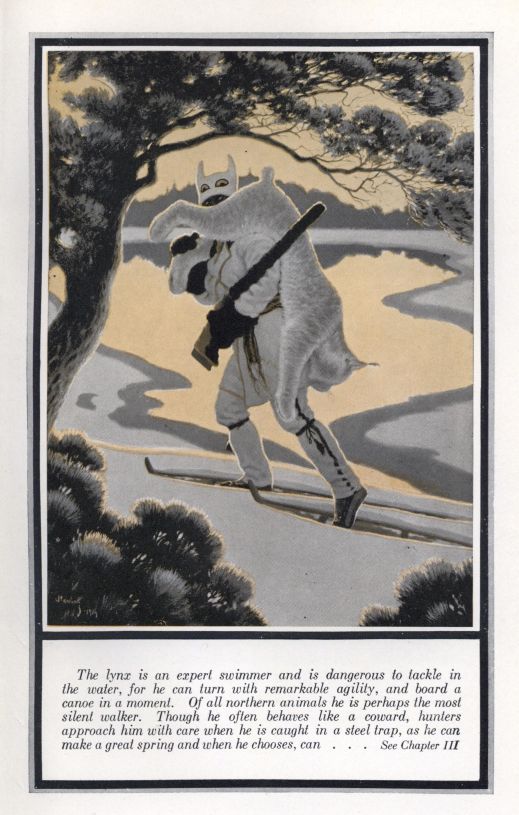
Besides being able to whistle, the lynx far surpasses the domestic cat in the range and volume of his evening song; and during the rutting season, at sunrise and sunset, he has a peculiar habit of beating or drumming with his forepaws on the hard snow or earth. No doubt it is a form of challenge, used much in the same way as the drumming of cock-grouse; martens and rabbits do the same. The lynx is a wonderful swimmer and is dangerous to tackle in the water, for he can turn with remarkable agility, and board a canoe in a moment. Of all northern animals he is perhaps the most silent walker, for in the night a band of five or six lynxes may pass close beside one's tent and never be heard, though a single rabbit, passing at the same distance, may make enough noise to awaken a sound sleeper. Though he often behaves like a coward, hunters approach him with care when he is caught in a steel trap, as he can make a great spring and when he chooses, can fight desperately. While in summer he is a poor runner, in winter he is greatly aided by his big feet, which act as snowshoes and help him over the soft snow and the deep drifts. Few animals succeed in killing him, for what with his unusual speed in water and the fact that he can climb a tree with almost the ease of a monkey, his chances of escape are always good.