[Illustration: Next morning we found that everything was covered with a heavy blanket of clinging snow, and the streams and the lake beginning to freeze over. We found, also to our amazement that a big bull-moose had been standing on the bank of Muskrat Creek and watching the smoke rising from our lodges as the fires were lighted at sunrise. After a hurried breakfast, we set out in pursuit of the moose, which we … See Chapter III.]
Reading edition
After a hurried breakfast, we three men set out in pursuit of the moose which we overtook within a mile, and then there was meat to haul on sleds to our camp. That day the temperature fell rapidly, and by night the little streams were strongly frozen, and around the lake the ice stretched far out from the shore. So we gathered up the canoes and stored them for the winter upside down upon stages made for the purpose; and that night before we turned in we saw, for the first time that season, Akwutinoowe—"The Freezing Moon."
IV
OO-KOO-HOO PLAYS THE GAME
TRAILING THE BEAR
"My son, a good hunter is never long in doubt; for when he discovers a bear track and follows it for a few hundred paces, he knows whether the track was made by day or by night, whether the bear was large or small, old or young, male or female; whether its coat was in condition or not; whether the beast was merely wandering or travelling with a purpose in view; whether it was frightened or undisturbed; whether going fast or slow; and whether seeking friends or food. Also, the hunter knows which way the wind was blowing when the track was made, he knows whether the bear felt tired or active, and, furthermore, whether or not it wanted to go to bed."
I laughed aloud.
Instantly the old man's kindly face was clouded with a frown and he exclaimed:
"My son … that was the laugh of a monias (greenhorn)", and glaring at me, he added: "At first, I thought better of you, but now I am sure that all white men are fools!"
Realizing my mistake, I sobered, and suggested that if he would explain I would have a chance to learn the ways of a great hunter.
"My son, it is a simple matter to read a track—that is, when one has learned the game. For then one has but to look, remember, and reason, and then the whole story unfolds before your eyes; just as when you open and read what you white men call a book. And some day, my son, if you try hard to learn, you, too, may be able to read the tales of the Strong Woods Country. Now listen to your grandfather and he will explain: under ordinary conditions a deep, clear track implies action; a faint, shallow one, inaction; the length of the stride indicates the speed; if, when travelling slow, hair is found upon the underwood, the animal passed at night, for in daylight a bear is as careful as a lynx to avoid striking things; if the bear is young or middle aged, the claw marks are sharp and clean cut; if it is old, they are blunt and blurred. The tracks of the male, though larger, are not so round as those of the female, and the male's toes are not only longer and spread farther apart, but the underside of his foot is not so hairy as that of his mate. Then, too, as you know, there are other signs by which a tracker tells the sex of his quarry. Now if the bear was travelling with a definite purpose in mind, he would travel straight, or as nearly straight as he could through the woods, and in order to save time, he might even occasionally climb a tree to spy out the lay of the land—as he frequently does. Then, again, if he were feeding, the ground and growth beside his trail would show it; if suddenly startled, he would leave the familiar sign that all large animals usually leave when frightened; and, moreover, it would be left within fifty paces of the place where he took fright. Furthermore, if he were tired and wanted to rest, he would begin circling down wind, so that he could come about close to his back trail, and then lie down, facing down wind, in such a position that he could see anything he could not scent, and scent anything he could not see. Thus if an enemy approached, his eyes would guard his front while his scent would guard his rear. And now, my son, as a bear usually travels up wind, even a monias of a white man could surmise which way the wind was blowing when the track was made. And always remember, my son, that only fools laugh at common sense. But don't get discouraged, keep on trying hard to learn, and then perhaps some day, if you live long enough, you may become almost as wise as an ordinary Indian."
The perfect season for hunting the black bear, and in fact all other fur-bearing animals, is between the coming of the snow in late autumn and the going of the snow in early spring, for during that intervening season the coat is in its prime; but as the bear spends much of the winter in hibernation, the hunter must make the best of his two short opportunities; that is, unless he already knows where the bear will "den up," and is counting on killing him in his o-wazhe—or as the white hunters and traders call it "wash"—his den. His wash may consist of a hollow tree or a hollow log, a cave, or any suitable shelter formed by an uprooted tree.
The finest wash I ever saw was in the woods of Quebec, where, many years ago, three birch saplings had taken root in a huge, hollow pine stump, and where, as time passed, the stump, gradually decaying, had allowed the roots of the fast-growing birches to penetrate through the cracks in the stump to the ground. The roots eventually formed the rafters of a moss- and rotten-wood chinked, water-tight roof to the little cavern in which the old pine stump had once stood and where two winters ago slept a bear. There was but a single entrance between two of the now massive birch roots, and it must have proved a tight squeeze when its tenant last entered. The den was shown to me by a hunter who the spring before had happened that way. While pausing to listen to some distant sound, he had heard a stranger one within ten feet of where he stood. He had heard deep breathing and turning to look down at the roots of the birches, he had discovered a full-grown black bear lying there with its head protruding out of the den. The head was turned toward him and the eyes were fixed upon him with a friendly expression. Without moving a single step the hunter raised his rifle and fired, instantly killing the bear that lay motionless scarcely beyond the muzzle of his gun.
THE TRUTH ABOUT BEARS
The black bear's coat is all of a glossy black, save just the muzzle, which is light brown. In weight the black bear runs from two hundred to five hundred pounds. Though he is found throughout the Great Northern Forest, he is a comparative stay-at-home, for he seldom roams, even in summer time, more than ten miles from his den, where, if undisturbed, he goes into the same winter quarters, year after year. Consequently, his paths are often clearly defined and well-beaten, for he has the habit of treading repeatedly in his old tracks, and occasionally he blazes his trail by clawing and biting, as high as he can reach, a neighbouring tree. There, too, he frequently leaves other signs—as a dog does at a post. Dog-like, also, other bears that happen along manifest pleasure or rage according to whether the sign has been left by friend or foe. The mating season is in June, though the female rarely bears young except every second year. The young are born in January while the mother is hibernating; and the cubs, usually two in number, are at birth very small, weighing only about ten ounces. The she-bear makes a good mother, for though she shows great affection for her babies, she nevertheless reprimands them, and cuffs them as well, whenever they misbehave or fail to comply with her wishes. The cubs are easily tamed, and being natural little romps, they soon become proficient wrestlers and boxers, and in latter years, show so much agility in the manly art that they strike and parry with amazing power, speed, and skill. When hurt, however, the cubs whimper and cry just like children, and if the little tots are badly wounded, the distress of the mother is pitiful to see, for she moans and sheds tears just as any tender-hearted human mother would. Bear-cubs are droll little mischiefs. Not only do they, when tamed, frequently get into trouble through the pranks they play, but they like to imitate at any risk to themselves the doings of others. As the following example shows:
Years ago, near Fort Pelly, on the Assiniboine River, an old Indian killed a she-bear that was followed by two cubs. Though he skinned and cut up the carcass of the mother, he did not touch the whimpering babes, and on going to camp, he sent his wife out with a horse to bring in the meat. When the Indian woman arrived at the spot, she found the two cubs cuddled up against the dressed meat of their mother, and crying as if their poor hearts would break. Their affectionate behaviour so touched the motherly heart of the old woman that, after loading the meat aboard the travois—a framework of poles stretched out behind the horse—she picked up the sobbing children and, wrapping them in a blanket to keep them from falling off the travois, bestrode her horse, and brought them whimpering into camp.
For some time she kept them tethered beside her lodge where she took good care of them, but when they grew larger and seemed well behaved, she released them and allowed them to run and play with the dogs around camp. In the fall it was her habit to take a hand-net and go down to the river to fish. Standing upon a rock and every once in a while casting in her net, she would land a fish on the bank. For several days the cubs watched her with interest, and then one day, it seems, they decided they ought to try and help their foster-mother; so wading in on their hind legs till the water covered their little round tummies, they would stand perfectly still until a fish would swim near. Then they would make a violent lunge for it, and striking lightning-like blows with their paws, they, too, would land a fish upon the bank. Over and over they repeated the manoeuvre, with evident excitement and pleasure. At last, every time the old woman picked up her net to go fishing, these two went along and helped her with her work. So fond of the sport did they become that, presently, they didn't even wait for her to accompany them, but scurried down to the river by themselves and would often have a day's fishing caught and ready for her before she had put in her appearance.
But a few months later, when the cubs had grown still larger and stronger, they became so boisterous and mischievous that they not only handled the dogs too roughly, but when the old Indian and his wife left camp at any time, they went on the rampage: chasing the dogs about, ransacking the larder, turning the camp topsy-turvy, and scattering everything in confusion. So the old couple decided that it was now high time to put their skins upon the skin-stretcher in readiness to sell to the fur-trader.
The black bear is a good swimmer and an excellent tree climber, and the speed with which he can rush up a hillside is surprising. His diet is a varied one, for he is always ready to eat vegetables, roots, berries, insects, nuts, fish, eggs, meat, fruit, and of course sugar or honey; furthermore, he is a killer of small game—when he is extra-hungry. The black bear has been given so bad a name by uninformed writers and dishonest story-tellers that most people dread to meet him in the woods; whereas, in truth he is usually more frightened at meeting human beings than they are of meeting him—for man is always his greatest and most dangerous enemy. Though I have seen many bears in the bush—seventeen on one trip—they never caused me any anxiety, and at once took flight. But on one of two rare occasions they did not run, perhaps because they were three in number and all full-grown.
It happened up on the borderline of Alaska. I was walking alone through the mountains on my way to Stewart, and wishing to cross the Marmot River, I took advantage of a great, permanent snowslide that had been annually added to by avalanches from the snow-capped glaciers. The snowslide not only completely blocked the cañon, but on either side it reached many hundreds of feet up the almost perpendicular mountains, yet in the middle, where it bridged the river, it was no more than two hundred feet high, though it was about two thousand feet in width. Year in and year out that great snow-bridge spanned the little river, and now when I wanted to make use of it, I had no sooner started over than I discovered three bears with the same intention. They, too, had just come out of the woods, and were only forty paces from me—as I afterward measured. We were all going in the same direction, and though we were exactly opposite one another and all walking in a parallel line, no one ran, and for two thousand feet or more, without stick or stone between us, we had a good opportunity to study each other. As usual, I was armed—as I always take care to be—with a penknife and a pocket handkerchief.
Occasionally one reads in the daily press shocking stories of the ferocity of bears. What a pity that the truth of these stories cannot always be run to earth! Billy Le Heup, a prospector and guide of northern Ontario, once having occasion to call for his mail in a little backwoods settlement, opened a newspaper and was shocked to learn that a most harrowing affliction had befallen an old friend of his, by name—But I'm sorry I have forgotten it, so let us call him Jones. The paper reported that while several of Jones's children were out berry-picking, a great, black bear had attacked them, and killing the youngest, a little girl, had devoured her entirely, save only one tiny fragment; for when the rescue party went in search of the poor little child they found nothing but her blood-stained right hand. Le Heup was so overcome with sorrow and so filled with indignation that he then and there determined to get together a few trapper friends of his and at once start by canoe for the scene of the tragedy, only a few miles away; there to condole with the poor father, trail the huge brute and wreak vengeance upon the child-eating monster. So Bill, with several of the best bear-hunters in that region, all well armed, set out in haste for the Jones's clearing. When they arrived, Jones was splitting wood outside his shack. The sorrowing trappers, with downcast eyes, moved slowly toward the bereaved father, and Le Heup, appointed spokesman, offered their condolences on the terrible death of his favourite child. Jones was completely dumbfounded. When it was explained to him what a dreadful thing had happened to his child, he swore he had no idea a bear had ever eaten any one of his children; but he was willing to put their story to the proof, so as he had a lot of children, he called them all out of the house to check them over. To the joyful surprise of the visitors, there among them was little Eva—supposed to be eaten, and she even retained her right hand. Thus another newspaper libel upon the poor old black bear—the buffoon of the forest—was shown to be devoid of truth; yet that story was published in the Toronto papers, and, no doubt, was copied all over the United States.
But though the black bear is a shy, playful brute, usually ready for flight if danger approaches, the tyro should remember that if wounded or cornered he will readily fight. Furthermore, if one is unlucky enough to get between a bear cub and its mother, and if the cub should cry out as though you were giving it pain, the mother will attack you as readily as any mother would—be she chicken, moose, or woman.
THE WAYS OF THE BEAVER
A few days later Oo-koo-hoo and Amik set out to hunt beavers—those wonderful amphibious animals of the Northland that display more intelligence, perseverance, prudence, and morality than many a highly civilized human being.
In appearance the beaver somewhat resembles a greatly magnified muskrat, save that the beaver's hairless, scaly tail is very broad and flat. The coat of the beaver is brown, and the darker the colour the higher the price it brings. An adult beaver may measure from thirty-five to forty-five inches in length, and weigh anywhere from thirty to sixty pounds. The beaver's home is usually in the form of an island house, built in the waters of a small lake or slowly running stream, to afford protection from prowling enemies, much in the same way that the old feudal lords surrounded the ramparts of their castles with broad moats and flooded the intervening space with a deep canal of water, in order to check the advance of enemy raiders. The surrounding shores of the beaver's castle are nearly always wooded with poplars, as it is upon the bark of that tree that the beaver depends most for his food; though at times, other hardwoods contribute to his feast as well as water-lily roots and other vegetation.
The beaver's island-like lodge is a dome-shaped structure that rises from four to seven feet above the water, and measures from ten to thirty feet in diameter on the water-line. It is composed mostly of barkless sticks and poles from one to four inches in diameter, although at times much heavier material is used; and it is tightly chinked with stones and mud and matted vegetation. Frequently, I have watched the building of their lodges. A foundation of water-logged poles and sticks is laid upon the lake or river bottom, next mud and stones are added, then another lot of branches, thus the structure rises in a fairly solid mound until its dome-like top reaches the desired height above the water-line. Then the beavers tunnel their two runways into the centre of the mass from an underwater level on the outside to an over-water level on the inside of the mound. Next, by gnawing away the inside sticks and excavating the inner mass, the inside chamber is formed, measuring anywhere from four to fourteen feet in width, and a little over two feet in height, with its walls finished fairly smooth. Furthermore, the chamber is provided with two floors each of which covers about half the room. While the lower floor rises from three to six inches above the water level, the upper floor rises from four to eight inches above the lower floor. The tunnels open in the lower floor and it is the lower floor or level that is used as a drying place and a dining room. The upper level, covered with a mattress of shredded wood, grass, or moss, forms the living and sleeping half of the chamber. Though in winter time most of their meals are eaten in the house, the green, bark-covered sticks being brought into the chamber through the straightest tunnel, the house is kept quite clean and free of all rubbish or filth. In fact, beavers are better housekeepers than some human beings I have known.
A certain amount of ventilation is derived from a few little chinks in the apex of the roof. During the first freezing nights of late fall the beavers plaster the above-water dome of their house with mud which they carry up between their forelegs and chin from the lake bottom, and placing it upon the roof of their house, spread it about in a thick coating, not with their tails, but with their forefeet, where it soon freezes into so solid a mass that it protects the inmates from the attacks of both the severest winter weather and the most savage of four-footed enemies. So strong indeed does the roof then become that even a moose could stand upon it without it giving way. While some writers doubt that beavers plaster the outside of their house with mud, I wish to add that I have not only examined their houses before and after the plastering was done, but on several moonlight nights I have actually sat within forty feet of them and watched them do it.
The winter supply of food, being mostly poplar bark, is derived from the branches of green trees which the beavers cut down in the autumn for that very purpose. While engaged in gnawing down trees the beavers usually work in pairs—one cutting while the other rests and also acts as a sentinel to give warning in case an enemy approaches. While cutting down trees they stand or sit in an upright position upon their hind legs and are firmly supported by the tripod formed by the spreading out of their hind feet and tail. They generally choose trees nearest the water on an inclined bank, and usually leaning toward the stream; and while they show no particular skill in felling trees in a certain position, they do display great perseverance, for if it happens, as it sometimes does, that a tree in its descent is checked and eventually held up by its neighbours, the beavers will cut the trunk for the second time, and in some cases even for the third time, in order to bring it down.
At night I have frequently sat by the hour at a time, with the brush-screened bow of my canoe within ten feet of a party of beavers, while they were busily engaged in cutting the branches off a tree that they had felled into the water the previous evening. They work quickly, too, for some mornings I have paddled past a big tree lying in the water, which they had dropped the night before and—on returning next day—have found all the branches removed, though some of them would have measured five inches in diameter. But watching beavers work at night is not only interesting, it is easy to do, and I have frequently taken both women and children to share in the sport. Sometimes, right in the heart of the wilderness, I have placed children within fifteen feet of beavers while they were engaged in cutting up a tree.
When branches measure from one to three inches in diameter they are usually cut in lengths of from five to ten feet, and the thicker the branch the shorter they cut the lengths. If the cutting is done on land, the butt of the long thinner length is seized by the beaver's teeth and with the weight resting upon the animal's back, is dragged along the ground—over a specially cleared road—and eventually deposited in the water. The shorter lengths, sometimes no longer than a couple of feet, but measuring perhaps six or eight inches in diameter, are rolled along the ground by the beaver pushing the log with the forefeet or shoulder. When the wood is placed in the water, the beaver propels it to its under-water storage place near its lodge, where—the wood being green and heavy—it is easily secured from floating up and away, by placing a little mud over one end or by interlocking the stick with the rest of the pile. The green wood, however, soon becomes waterlogged and gives no further trouble. Thus, when the lake or river is frozen over, the beaver—for it does not hibernate—may live in comfort all winter long in its weather-proof lodge with plenty of food stored beneath the ice and just beyond the watery doorway of its home.
HUNTING THE BEAVER
The hunters, arriving at a small lake that lay about three miles to the northwest of Rear Lake, crossed it, and turning up a winding creek, followed the little river until they came to a beaver dam which caused the stream to expand into another little lake that flooded far beyond its old water-line. In it was to be seen three beaver lodges.
Oo-koo-hoo said the scene was somewhat altered since he had visited it four years before, as the dam had been increased both in height and length, and the pond, increasing, too, had reached out close to many a tree that formerly stood some distance from the water. It was a beautiful little mere containing a few spruce-crowned islands, and surrounded by thickly wooded hills whose bases were well fringed with poplars, birches, willows, and alders—an ideal home for beaver. Among the little islands stood three snow-capped beaver lodges. Here and there wide-spreading, wind-packed carpets of snow covered the ice, while in between big stretches of clear, glassy ice, acting as skylights, lit up the beavers' submarine gardens around their ice-locked homes.
The hunters were accompanied by three of their dogs, and before they had time to decide where they should first begin work, the dogs began barking at a point between the west lodge and the bank; so they went over to investigate. Evidently the dogs had spied a beaver, for now, though none was in sight, the canines were rushing back and forth in great excitement over a fairly deep submarine runway or clear passageway, through the shallow, rush-matted water under the ice.
Chopping a hole through the ice with his axe, Oo-koo-hoo drove down a couple of crossed poles to block the passageway, and Amik, finding other runways, did likewise at other places. Several of the passageways led to the bank, where, Oo-koo-hoo said, they had what is called "bank lodges"—natural cavities in the river bank to which the beavers had counted on resorting in case their house was raided. In other places, where the snow obscured the view, the Indians knocked on the ice with the backs of their axes, to find and follow the hollow-sounding ice that told of runways below, that other stakes might be driven down. The rapping sound, however, instead of driving the beavers out of their lodge, had a tendency to make them remain at home, for as Oo-koo-hoo explained, cutting ice and working around their homes does not always frighten the beavers.
Securing two stouter poles, the hunters now chopped the butts into wedge-shaped chisels, with which they proposed to break open the beavers' lodge. Work was begun about a foot above the level of the snow on the south side, as they explained that the lodge would not only be thinner on that side, but that the sun would make it slightly softer, too—and before much headway was made the dogs, all alert, discovered that several of the beavers had rushed out of their house, but finding the passageways blocked had returned home.
Now, strange to say, as soon as the side of the house was broken open and daylight let in, the beavers, becoming curious over the inflowing light that dazzled their eyes, actually came toward the newly made hole to investigate. Then Oo-koo-hoo, with the aid of a crooked stick, suddenly jerked one of the unsuspecting animals out of the hole and Amik knocked it on the head. Thus they secured four large ones, but left a number of smaller ones unharmed, as Oo-koo-hoo never made a practice of taking a whole family.
In that house the portion of the chamber used for sleeping quarters was covered with a thick mattress of dry "snake-grass," and the whole interior was remarkably clean. After blocking and patching up the hole and covering the place with snow, the hunters threw water over it until it froze into a solid mass, then they removed the stakes from the runways and left the rest of the beavers in peace. Loading their catch upon their toboggans, all set out for home.
BEAVER DAMS AND CANALS
Besides erecting their remarkably strong houses there are two other ways in which the beavers display wonderful skill: in the building of their dams and in the excavating of their canals. Their dams are built for the purpose of retarding, raising, and storing water, in order—in summer time—to circumvent their enemies by placing a well-watered moat between their foe and their castle; also to flood a wider area so that the far-reaching waters of their pond may lap close to the roots of many otherwise inaccessible trees and thus enable them to fell and float them to their lodge; and—in winter time—to raise the water high enough to secure their pond from freezing solid and imprisoning them in their lodges where they would starve to death, or if they gnawed their way to freedom, the intense cold of mid-winter would freeze their hairless tails and cause their death; furthermore, should they escape from the weather, they would be at the mercy of all their enemies and would not long survive.
A dam, in the beginning, is usually erected in a small way, just to raise and expand the waters of some small creek or even those of a spring; then, as the years go by, it is constantly added to, to increase the depth and expansion of the pond, and thus the dam grows from a small one of a few yards in length to a big one of several hundred feet—sometimes to even four or five hundred feet in length—that may bank up the water four or five feet above the stream just outside the dam, and turn the pond into a great reservoir covering hundreds of acres of land.
The dam is more often built of branches laid parallel to the current with their butts pointing up stream, and weighted down with mud and stones; thus layer after layer is added until the structure rises to the desired height and strength. Some dams contain hundreds of tons of material. They are usually built upon a solid bottom, not of rock—though big, stationary boulders often are included in the construction for the extra support they furnish. When thus used, boulders often cause the beavers to divert the line of the dam out of its usual graceful and scientific curve that well withstands the pressure from even a large body of water.
The beavers excavate canals—sometimes hundreds of feet in length—to enable them to reach more easily and float home the wood they have cut from freshly felled trees lying far beyond the reaches of their pond. The canals measure from two to three feet in width and a foot to a foot and a half in depth, and are not only surprisingly clean-cut and straight but occasionally they are even provided with locks, or rather little dams, to raise the water from one level to another—generally about a foot at a time—to offset the disadvantage of the wood lying on higher and more distant ground than is reached by the waters of the residential pond. Sometimes their canals are fed by springs, but more often by the drainage of rainwater. The building of many of their dams and canals displays remarkable skill and a fine sense of engineering, together with a spirit of perseverance that is astounding. Is it any wonder that the Indians say that the beavers were once human beings, whom, for the punishment of some misconduct The Master of Life condemned to get down and grovel upon the ground as four-footed animals for the rest of their days.
"Yes, my son," replied Oo-koo-hoo, when we were discussing beavers, "they are a very clever and a very wise people, and it would be better for us if we emulated them more than we do, for as you know, they believe in not talking but in working and making good use of the brains The Master of Life has given them, and that is the only way to be really happy in this world. Besides, he is always true to his wife—a fine example to men—furthermore, he is a good provider who looks after his children, and is a decent, clean-living fellow who never goes out of his way to quarrel with any one, but just minds his own business and cuts wood."
Could any nation choose a creature more fit for a national emblem? I believe not. For would any wise man compare a useless, screeching eagle, or a useless, roaring lion—each a creature of prey—to a silent, hard-working, and useful beaver who remains true to his wife all his life, who builds a comfortable home for his children, provides them well with food and teaches them … not how to kill other creatures … but how to work, … how to construct strong, comfortable houses, how to build dams to protect, not only their children, but their homes, too, how to chop down trees for food, how to dig canals to float the food home, how to store it for the winter, how to keep the home clean and in good order, how to mind their own business and never seek a quarrel, and, at the same time, how to defend themselves desperately if an enemy attacks them.
For his size, the beaver is powerful, so powerful, indeed, that Oo-koo-hoo said: "Remember, my son, the beaver is a very strong animal, he can drag a man after him, and the only way for a hunter to hold him—if he is caught in a trap—is to lift him off his feet."
Notwithstanding his great strength, however, he is a peace-loving chap, but when a just occasion arises, you ought to see him fight!
BEAVER FIGHTS WOLVERINE
One spring while hunting along a river, some years ago, Oo-koo-hoo discovered a beaver at work upon the bank, and wishing to observe him for a while, kept perfectly still. The beaver was cutting poplar sticks to take them through a hole in the ice to the under-water entrance of his near-by home for his family to feed upon. But presently Oo-koo-hoo discovered another moving object; it was a wolverine, and it was stalking the beaver. When it drew near enough to the unsuspecting worker, it made a sudden spring and landed upon his back. A desperate fight ensued. The wolverine was trying to cut the spinal cord at the back of the beaver's neck; but the short, stout neck caused trouble, and before the wolverine had managed it, the beaver, realizing that the only chance for life was to make for the water-hole, lunged toward it, and with the wolverine still on his back, dived in. On being submerged, the wolverine let go and swam around and around in an effort to get out; but the beaver, now in his element, took advantage of the fact, and rising beneath the foe, leaped at it, and with one bite of his powerful, chisel-like teeth, gripped it by the throat, then let go and sank to watch it bleed to death. A little later, the beaver had the satisfaction of seeing old Oo-koo-hoo walk off with the wolverine's skin.
No … beavers do not believe in divorce … and on their wedding day—usually in February—they promise to be true to each other for the rest of their lives, and, moreover, unlike many human beings, they keep their promise. About three months later the husband, seeing his wife is getting ready to welcome new relations, leaves his comfortable home just to be out of the way, and takes up new quarters in a hole in the river bank. While he is there the children—any number from one to six—arrive, and then can be heard much gentle whimpering, just as though human babies were now living in the old homestead.
When the beaver children grow older they romp in the water much as puppies do on land. If danger approaches, the first beaver to sense it slaps the surface of the water with his broad, powerful tail, making a noise that resounds through the forest as though a strong man had struck the water a violent blow with the broad side of a paddle blade. Instantly the first beaver's nearest companion signals the danger to others by doing the same; then a second later they plunge out of sight in the water and leave behind nothing but a great sound—as though an elephant had fallen in.
When married and settled down, the beaver is very domestic—a great stay-at-home—but when seeking a mate, he travels far and wide, and leaves here and there along the shore scent signals, in the hope of more easily attracting and winning a bride. Beavers are full grown at three years of age, and by that time they have learned how to erect houses, build dams, dig canals, chop down trees, cut up wood, float it home and store it for the winter, and by that time too, they have, no doubt, learned that man is their worst enemy, though the wolverine, wolf, otter, lynx, and fisher are ever ready to pounce upon them whenever a chance offers.
USEFULNESS OP BEAVER
But I had almost forgotten that I owed the reader an explanation when I said that the beaver was a very useful creature. I was not thinking of the value of his fur, because that is as nothing compared to the great service he has been rendering mankind, not only to-day, but for endless generations. How? By the great work he has been doing during the past hundreds and thousands of years. How? By going into rocky, useless valleys and building the dams that checked the rushing rivers that were constantly robbing much rich soil from the surrounding country and carrying it down and out to sea. And his dams, moreover, not only held up those treacherous highwaymen, but took the loot from them and let it settle in the valleys, where, as years rolled on, it grew and grew into endless great expansions of level meadow lands that now afford much of the most fertile farming soil to be found in North America; and thus the great industry of those silent workers, who lived ages and ages ago, is even to-day benefiting mankind. And thus, too, that great work is being steadily carried on by the living beavers of to-day. Could any country in the world have chosen a more inspiring creature than Canada has chosen for her national symbol?
When, on his fall and spring expeditions, Oo-koo-hoo was hunting beavers with the waters free of ice, he placed steel traps in their runways, either just below the surface of the water, or on the bank; and the only bait he used in both cases was the rubbing of castorum on near-by bushes. Also, he built deadfalls much like those he built for bear, but of course much smaller; and again the bait was castorum, but this time it was rubbed on a bit of rabbit skin which was then attached to the bait stick of the deadfall. The deadfalls he built for beavers were nearly always made of dead tamarack—never of green poplar—otherwise the beavers would have pulled them to pieces for the sake of the wood.
Further, Oo-koo-hoo told me that in the spring he sometimes broke open beaver dams and set traps near the breaks in order to catch the beavers when they came to repair the damage. Such a mode of trapping was, he said, equally successful whether or not there was ice upon the water. He also told me that he had seen other Indians catch beaver with a net made of No. 10 twine, with a three-and-a-half-inch mesh, but that, though the method worked rather well, he had never tried it. The way of all others, that he liked best, was to hunt them by calling, and the best time for that was during the mornings and evenings of the rutting season.
Later in the year, when the ice is gone, and the beaver is swimming, say a foot under water, the hunter can easily follow his course from the appearance of the surface. The same applies to the muskrat, mink, and otter. Muskrats and beavers swim much alike, as they are usually going in search of roots, and, knowing exactly where to find them, they swim straight; but minks and otters swim a zig-zag course for the reason that they are always looking for fish and therefore are constantly turning their heads about; and that rule applies whether their heads are above or below the surface.
When a beaver—providing he has not slapped the water with his tail—or an otter dives, an observant hunter can judge fairly well as to where the animal is heading for, by simply noting the twist of the tail, a point that helps the hunter to gauge the place where it may rise. The same applies to whales when they sound, though I found—while whale hunting—that few whalers realized it, and fewer still took advantage of it, for much time was lost while waiting for the whale to rise before the boat could be headed in the right direction. But then the average Indian is much more observant than the average white man.
If a beaver is caught in a steel trap, he will do his utmost to plunge into water and remain there even though he should drown, yet his house may not be in that river or pond; but if he is wounded, he will either try to reach his house or take to the woods.
When in pursuit of beavers it is advisable to watch for them on moonlight nights about eight or nine o'clock, and it is best to be in a canoe, as then there is less danger of the beaver sinking before he can be removed from the water. The hunter, while waiting for a shot, makes a noise with the handle of his knife against a stick in imitation of a beaver cutting wood—a sound somewhat similar to that of the boring of a large auger. It is astonishing how far, on a still night, beavers will hear such a sound and come to help their friends at work. When Oo-koo-hoo shot beaver he charged his gun with four slugs and fired for the head, as he explained that ordinary shot was too fine and scattered too much, while a single ball was too large.
OO-KOO-HOO SHOOTS A BEAR
The following morning Oo-koo-hoo and I set out to go the round of the northern trapping trail which for some distance followed the valley of Beaver River, upon the bank of which traps, snares, and deadfalls for bears were set. Along that section of the river there were also traps set for otters, beavers, and muskrats; but the hunting of these amphibious animals was pursued with more diligence in the spring than in the winter. Though we hauled a hunting toboggan, the snow was not yet deep enough for snowshoes, but what a feast of reading the forest afforded us! What tragedies were written in the snow! Here we followed a mink's track as it skirted the river bank that wound in and out among the trees, showing that the mink had leaped here, crouched there, or had been scratching beyond in the snow. Evidently it was in search of food. Presently we noticed another track, that of an ermine. The two trails were converging. Now, apparently, the mink had seen its enemy, and, therefore, in order to get past the ermine and escape trouble, it had increased its speed. At this point the ermine had spied it and had redoubled its speed. Now they had both bounded along with all their might. But as ill-fate would have it, they had met. A violent struggle had ensued. Blood was spattered upon the snow. From the battle-ground only one trail led away. It was that of the ermine. But though the snow was marked by the footprints of only one animal, the trail of two tails plainly showed. It was evident that the ermine had seized its victim by the throat and throwing it over its back, had carried it away. Many other tracks of beasts and birds were printed upon the snow and told in vivid detail stories of life in the winter wilderness.
Beaver River was now frozen firmly enough to bear a man, except in a few places where rapid water kept the ice thin or left the stream open; and as we tramped along we examined a number of traps, from two of which we took an otter and a beaver. But the bear and the wolf traps remained undisturbed though we saw a number of wolf tracks near at hand. Turning westward we ascended a slope and came suddenly upon the fresh track of a bear. It was fairly large, and was travelling slowly; merely sauntering along as though looking for a den in which to pass the winter.
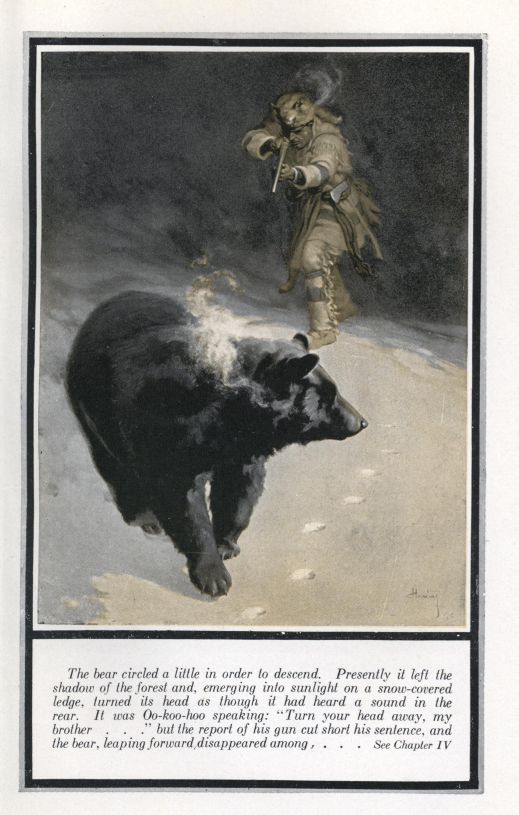
At once Oo-koo-hoo was all alert. Carefully re-charging his gun with ball, and seeing that his knife and axe were at hand, he left the toboggan behind, lest it make a noise among the trees and alarm the quarry. In less than a quarter of a mile, however, we came upon a sign that the bear had passed but a few minutes before. The hunter paused to suggest that it would better his approach if I were to follow a little farther in the rear; then he noiselessly continued his pursuit. Slowly he moved forward, cautiously avoiding the snapping of a twig or the scraping of underbrush. After peering through the shrubbery ahead or halting a moment to reexamine the track, he would move on again, but with scarcely any perceptible motion of the upper part of his body. When in doubt, he would stand stock-still and try by sight or hearing to get news of the bear. Luckily, there was no wind, so it made little difference which way we turned in following the trail. But just then there happened a disturbing and irritating thing, for a whiskey jack—Canada Jay—took to following us, and chirping about it, too. Crossing a rocky patch on the hillside, the bear came into view as it circled a little in order to descend. Presently it left the shadow of the forest and emerging into sunlight on a snow-covered ledge, turned its head as though it had heard a sound in the rear. It was Oo-koo-hoo speaking: