[Illustration: Going to the brink, saw a "York boat" in the act of shooting the cataract. It was one of the boats of "The Goods Brigade" transporting supplies for the northern posts of the Hudson's Bay Company. As the craft measured forty feet in length and was manned by eight men, it was capable of carrying about seventy packs, each weighing about a hundred pounds. But of these boat brigades … See Chapter II.]
Reading edition
After supper, when twilight was deepening, and tobacco—in the smoking of which the women conscientiously joined—was freely forthcoming, the subject of conversation turned to woodcraft. Since it fell to Oo-koo-hoo, as the principal hunter, to keep the party supplied with game while en route, I was wondering what he would do in case he saw a bear and went ashore to trail it. Would he himself skin and cut up the bear, or would he want the women to help him? If the latter, what sign or signal would he use so that they might keep in touch with him? But when I questioned Oo-koo-hoo, he replied:
"My white son"—for that is what he sometimes called me—"I see you are just like all white men, but if you are observant and listen to those who are wiser than you, you may some day rank almost the equal of an Indian."
Afterward, when I became better acquainted with him, I learned that with regard to white men in general, he held the same opinion that all Indians do, and that is, that they are perfect fools. When I agreed with the old gentleman, and assured him he was absolutely right, and that the biggest fool I ever knew was the one who was talking to him, he laughed outright, and replied that now he knew that I was quite different from most white men, and that he believed some day I would be the equal of an Indian. When I first heard his opinion of white men, I regarded him as a pretty sane man, but afterward, when I tried to get him to include not only his brother Indians, but also himself under the same definition, I could not get him to agree with me, therefore I was disappointed in him. He was not the philosopher I had at first taken him to be; for life has taught me that all men are fools—of one kind or another.
OO-KOO-HOO'S WOODCRAFT
But to return to woodcraft. Emerson says: "Men are naturally hunters and inquisitive of woodcraft, and I suppose that such a gazetteer as wood-cutters and Indians should furnish facts for would take place in the most sumptuous drawing rooms of all the 'Wreaths' and 'Flora's Chaplets' of the bookshops" and believing that to be true, I shall therefore tell you not only how my Indian friends managed to keep their bearings while travelling without a compass, but how, without the aid of writing, they continued to leave various messages for their companions. When I asked Oo-koo-hoo how he would signal, in case he went ashore to trail game—when the other canoes were out of sight behind him—and he should want someone to follow him to help carry back the meat, he replied that he would cut a small bushy-topped sapling and plant it upright in the river near his landing place on the shore. That, he said, would signify that he wished his party to go ashore and camp on the first good camping ground; while, at the same time, it would warn them not to kindle a fire until they had first examined the tracks to make sure whether the smoke would frighten the game. Then someone would follow his trail to render him assistance, providing they saw that he had blazed a tree. If he did not want them to follow him, he would shove two sticks into the ground so that they would slant across the trail in the form of an X, but if he wanted them to follow he would blaze a tree. If he wanted them to hurry, he would blaze the same tree twice. If he wanted them to follow as fast as they could with caution, he would blaze the same tree three times, but if he desired them to abandon all caution and to follow with all speed, he would cut a long blaze and tear it off.
Then, again, if he were leaving the game trail to circle his quarry, and if he wished them to follow his tracks instead of those of the game, he would cut a long blaze on one tree and a small one on another tree, which would signify that he had left the game trail at a point between the two trees and that they were to follow his tracks instead of those of the game. But if he wished them to stop and come no farther, he would drop some article of his clothing on the trail. Should, however, the game trail happen to cross a muskeg where there were no trees to blaze, he would place moss upon the bushes to answer instead of blazes, and in case the ground was hard and left an invisible trail, he would cut a stick and shoving the small end into the trail, would slant the butt in the direction he had gone.
If traversing water where there were no saplings at hand, and he wished to let his followers know where he had left the water to cross a muskeg, he would try to secure a pole, which he would leave standing in the water, with grass protruding from the split upper end, and the pole slanting to show in which direction he had gone. If, on the arrival at the fork of a river, he wished to let his followers know up which fork he had paddled—say, for instance, if it were the right one—he would shove a long stick into either bank of the left fork in such a way that it would point straight across the channel of the left fork, to signify, as it were, that the channel was blocked. Then, a little farther up the right fork, he would plant a sapling or pole in the water, slanting in the direction he had gone—to prove to the follower that he was now on the right trail. Oo-koo-hoo further explained that if he were about to cross a lake and he wished to let his follower know the exact point upon which he intended to land, he would cut two poles, placing the larger nearest the woods and the smaller nearest the water, both in an upright position and in an exact line with the point to which he was going to head, so that the follower by taking sight from one pole to the other would learn the exact spot on the other shore where he should land—even though it were several miles away. But if he were not sure just where he intended to land, he would cut a willow branch and twist it into the form of a hoop and hang it upon the smaller pole—that would signify that he might land at any point of the surrounding shore of the lake.
If he wanted to signal his family to camp at any particular point along his trail, he would leave some article of his clothing and place near it a number of sticks standing in the form of the poles of a lodge, thus suggesting to them that they should erect their tepee upon that spot. If he had wounded big game and expected soon to overtake and kill it, and if he wanted help to carry back the meat, he would blaze a tree and upon that smooth surface would make a sketch, either with knife or charcoal, of the animal he was pursuing. If a full day had elapsed since the placing of crossed sticks over the trail, the follower would abandon all caution and follow at top speed, as he would realize that some misfortune had befallen the hunter. The second man, or follower, however, never blazes trees as he trails the first hunter, but simply breaks off twigs or bends branches in the direction in which he is going, so that should it be necessary that a third man should also follow, he could readily distinguish the difference between the two trails. If a hunter wishes to leave a good trail over a treeless district, he, as far as possible, chooses soft ground and treads upon his heels.
When a hunter is trailing an animal, he avoids stepping upon the animal's trail, so that should it be necessary for him to go back and re-trail his quarry, the animal's tracks shall not be obliterated. If, in circling about his quarry, the hunter should happen to cut his own trail, he takes great care to cut it at right angles, so that, should he have to circle several times, he may never be at a loss to know which was his original trail. If the hunter should wish to leave a danger signal behind him, he will take two saplings, one from either side of the trail, and twist them together in such a way that they shall block the passage of the follower, requiring him to pause in order to disentangle them or to pass around them; and if the hunter were to repeat such a signal two or three times, it would signify that the follower should use great caution and circle down wind in order to still-hunt the hunter's trail in exactly the same way he would still-hunt a moose. Then, again, if the hunter should wish to let the follower know the exact time of day he had passed a certain spot, he would draw on the earth or snow a bow with an arrow placed at right angles to the bow, but pointing straight in the direction where the sun had been at that precise moment.
THE BEAR'S DEDUCTION
Owing to their knowledge of wood-craft some Indians are very clever at deduction.
On Great Slave Lake near Fort Rae an Indian cripple, named Simpson's Brother, had joined a party of canoe-men for the purpose of hunting eggs. After paddling toward a group of islands, the party separated, finally landing on different isles. They had agreed, however, to meet at sunset on a certain island and there eat and sleep together. While at work several of the Indians saw Simpson's Brother alone on a little rocky islet, busily engaged in gathering eggs. Toward evening, the party met at their rendezvous and took supper together, but strange to say, Simpson's Brother did not appear. After smoking and talking for a while, some grew anxious about the cripple. The Bear began to fear lest some mishap had befallen him; but The Caribou scoffed at the idea: he was sure that Simpson's Brother was still working and that he would soon return with more eggs than any of them. The Bear, however, thought they ought to search for him, as his canoe might have drifted away. But The Mink replied that if anything like that had happened, the cripple would certainly have fired his gun. "But how could he fire his gun if his canoe had drifted away?" asked The Bear, "for would not his gun be in his canoe?" So they all paddled off to investigate the mystery. On nearing the island, they saw the Brother's canoe adrift. When they overhauled it, sure enough his gun was aboard. They then landed on the little isle where the cripple had been at work and began calling aloud for him. As they received no answer, some of the Indians claimed that he must be asleep. The Bear replied that if he was asleep their shouting would have awakened him and he would have answered, but that now they had best search the island.
So they divided into two parties and searched the shore in different directions until they finally met on the other side, then they scattered and examined every nook and corner of the place—but all in vain. Some now contended that the others were mistaken, and that that could not be the island on which the Brother had been working; but The Bear—though he had not seen the cripple there—insisted that it was. They asked him to prove it.
"The wind has been blowing steadily from the north," replied The Bear, "the other islands are all south of this one, and you know that we found his canoe adrift south of here and north of all the other islands. That is sufficient proof." Then he added: "The reason Simpson's Brother did not answer is because he is not on the island, but in the water."
Again they all clamoured for proof and The Bear answered: "But first I must find where he landed, and the quickest way to find that place is to remember that the wind was blowing too strong for him to land on the north shore, and that the running swells were too strong for him to land on either the east or west sides, therefore he landed on the south side—the sheltered side. Now let us go and see where he drew up his canoe."
But one of the others argued that that would be impossible as Simpson's Brother was not such a fool as to act like a white man and drag his canoe over the rocks. The Bear, however, persisted that there would be some sign, at least where the bow touched shore when the cripple got out, and that he, The Bear, would go and find it. But first he would go and examine the nests to learn from which of them the cripple had removed the eggs. Thus they would learn where he had been working; and the finding of the landing place would be made easier. So The Bear set to work. From the empty nests he soon learned where the cripple had been working, and after a careful search he presently found on a big rock a little white spot no larger than a man's finger nail.
"There, my friends, is where Simpson's Brother landed, for that white mark is of gum and proves where the bow of the canoe bumped the rock."
They then asked The Bear where he thought the cripple was, and pointing, he replied:
"If we search long enough we shall find him in the deep water down there; for when Simpson's Brother was getting aboard his canoe, he slipped and in falling struck his head upon the rock; the blow stunned him, and without a struggle he slid into the water, and was drowned."
When they had brought their canoes round and had peered into the deep water, true enough, they discovered the body on the bottom of the lake. Securing a long pole, they fastened a gun worm to one end and, reaching down, twisted it into the cripple's clothing and brought the body to the surface. Sadly they placed it in the unfortunate man's canoe, towed the craft and its burden to the other island, and sent to Fort Rae for the priest, Father Roure, to come and perform the burial service.
BEASTS WITH HUMAN SOULS
Next morning we arose with dawn. After a hearty breakfast of fish—taken from the gill-net that had been set overnight below the rapid—the work of portaging round the rapids was begun and by about ten o'clock was finished. Noon overtook us near the mouth of Caribou River, up which we were to ascend on the first half of our journey to Oo-koo-hoo's hunting grounds. About two o'clock we entered that stream and headed westerly toward a spur of mountains that lay about a week's travel away and through which we had to pass to gain our winter camping ground. An hour later, as Oo-koo-hoo and I preceded the party, paddling up one of the channels caused by a number of large islands dividing the river into mere creeks, we chanced upon a woodland caribou bull, as it stood among the rushes in a marshy bend watching us from a distance of not more than forty yards. As I crouched down to be out of the hunter's way, I heard him say:
"I'm sorry, my brother, but we need you for both food and clothing, so turn your eyes away before I fire." The next moment the woods echoed the report of his smooth-bore muzzle-loader—the kind of gun used by about 90 per cent. of the fur hunters of the forest. Why? Because of the simplicity of its ammunition. Such a gun never requires a variety of cumbersome shells for different kinds of game, but with varying charges of powder and shot or ball, is ready for anything from a rat or duck to a bear or moose.
Before bleeding the deer, Oo-koo-hoo did a curious thing: with his sharp knife he destroyed the deer's eyes. When I questioned him as to his purpose he replied: "As long as the eyes remain perfect, the spirit remains within the head, and I could not bear to skin the deer with its spirit looking at me." Though Oo-koo-hoo was in many ways a wise old man, he held some beliefs that were past my understanding, and others that, when I tried to analyze them, seemed to be founded on the working of a sensitive conscience.
Hearing the report of the gun, the others hurried to the scene. While the deer was being bled the old grandmother caught the blood in a pail—into which she threw a pinch of salt to clot the blood—as she wished to use it for the making of a blood pudding. Then the carcass was loaded aboard Oo-koo-hoo's canoe, rather, indeed, overloading it. Accordingly, I accepted Amik's invitation to board his craft, and at the first good place we all went ashore to clear the ground for the night's camp. There was a porcupine there, and though it moved but slowly away, my friends did not kill it, for they had plenty to eat, and did not want to be bothered with taking care of those dangerous little quills that the women dye and use to such good advantage in their fancy work. As to the Indian method of dressing meat and skins—more anon, when we are finally settled upon the fur trail.
That evening, while flames were leaping after ascending sparks, and shadows were dancing behind us among the trees, we lounged about the fire on packs and blankets and discussed the events of the day. When I asked Oo-koo-hoo why he had addressed the deer in such a manner, he replied that it was the proper and regular way to speak to an animal, because every creature in the forest, whether beast, bird, or fish, contained the spirit of some former human being. He further explained that whenever the men of the olden time killed an unusually large animal with an extra fine coat, they did not save the skin to sell to the trader, but burnt the carcass, pelt and all, and in that way they returned the body to the spirit again. Thus they not only paid homage to the spirit, but proved themselves unselfish men. He went on to say that from the time of the Great, Great Long Ago, the Indian had always believed—as he did to-day—that every bull moose contained the spirit of a famous Indian chief, that every caribou bull contained the spirit of a lesser chief, and so on down through the whole of the animal creation. Bears, however, or rather the spirits animating them, possessed the greatest power to render good or evil, and for that reason the hunter usually took the greatest care to address Bruin properly before he slew him.
It is no wonder that the Indians still retain such ideas when, as Lord Avebury says: "We do not now, most of us, believe that animals have souls, and yet probably the majority of mankind from Buddha to Wesley and Kingsley have done so."
Another thing Oo-koo-hoo told me was that out of respect to the dignified spirit possessed by the bull moose, women were never allowed to eat of the head, nor was a moose head to be placed upon a sled upon which a woman had ever sat; for if that were done, bad luck would follow the hunter to the end of his days. He knew of a hunter who on one occasion had been guilty of that irreverence; afterward, whenever that hunter would see a moose, the moose—instead of trying to escape—would indifferently bark at him, and even follow him back close to camp; and when that hunter would go out again, other moose would do the very same thing. Moreover, the hunter was afraid to kill any moose that acted that way, for he well knew that the animal was simply warning him of some great danger that was surely going to befall him. So, in the end, the hunter fretted himself to death. Therefore every hunter should take great care to burn all the bones of a moose's head and never on any account allow a woman to eat thereof or to feed it to the dogs. In burning the head, the hunter was merely paying the homage due to so noble a creature.
Again, a hunter might find that though he had formerly been a good moose hunter, and had always observed every custom, yet he now utterly failed to secure a moose at all. He might come upon plenty of tracks, but the moose would always escape, and prove the efforts of an experienced moose hunter of no more avail than those of a greenhorn. In such a case, there was but one thing to do, and that was to secure the whole skin—head, legs, and all—of a fawn, stuff it into its natural shape, set it up in the woods, wait till the new moon was in the first crescent, and then, just after sundown, engage a young girl to shoot five arrows at it from the regular hunting distance. If she missed, it was proof that the spirit had rejected the girl, and that another would have to be secured to do the shooting. If success were then attained, the hunter might go upon his hunt, well knowing he would soon be rewarded by bringing down a moose. Of course such ideas seem strange to us, but, after all, are we in a position to ridicule the Indians' belief? I think not, if we but recall the weird ideas our ancestors held.
The Indian, like the white man, has many superstitions, some ugly, and some beautiful, and of the latter class, I quote one: he believes that the spirits of still-born children or very young infants take flight, when they die, and enter the bodies of birds. A delightful thought—especially for the mother. For as Kingsley says of St. Francis, "perfectly sure that he himself was a spiritual being, he thought it at least possible that birds might be spiritual beings likewise, incarnate like himself in mortal flesh; and saw no degradation to the dignity of human nature in claiming kindred lovingly, with creatures so beautiful, so wonderful, who praised God in the forest, even as angels did in heaven."
The forest Indian, however, is not content with merely stating that the spirits of infants enter birds; but he goes on to say that while the spirits of Indian children always enter the beings of the finest singers and the most beautiful of all the birds, the spirits of the children of white people enter the bodies of stupid, ugly birds that just squawk around, and are neither interesting to look at nor pleasant to listen to, but are quarrelsome, and thievish. When I asked Oo-koo-hoo to name a few birds into which the spirits of white children entered, he mentioned, among others, the woodpecker—which the Indians consider to have, proportionately, the longest and sharpest tongue of all birds. That reminds me of the reply I received from one of the characters in this book, when I wrote him, among others, requesting that he grant me permission to make use of his name, in order to add authority to my text. Like others, he begged me to refrain from quoting his name, as he was afraid that the information he had given me might be the cause of the Hudson's Bay Company stopping his pension. I had suggested that he refer the matter to his wife as she, too, figures in this story, and the following is part of his reply: "This being an affair between you and I—I have not consulted my wife. For as you know, the human female tongue is very similar to that of the female woodpecker: unusually long, and much too pointed to be of any use."
THE HONESTY OF INDIANS
But to return to the Indian's reproach of the white man's dishonesty; when he states that the spirits of white children enter only those birds that are counted great thieves, one cannot wonder at it, for as far as honesty is concerned, a comparison between the forest Indian and the white man brands the latter as a thief. Not only is that the private opinion of all the old fur traders I have met, but I could quote many other authorities; let two, however, suffice: Charles Mair, the author of "Tecumseh," and a member of the Indian Treaty Expedition of 1899, says:
"The writer, and doubtless some of his readers, can recall the time when to go to 'Peace River' seemed almost like going to another sphere, where, it was conjectured, life was lived very differently from that of civilized man. And, truly, it was to enter into an unfamiliar state of things; a region in which a primitive people, not without fault or depravities, lived on Nature's food, and throve on her unfailing harvest of fur. A region in which they often left their beaver, silver fox, or marten packs—the envy of Fashion—lying by the dog-trail, or hanging to some sheltering tree, because no one stole, and took their fellow's word without question, because no one lied. A very simple folk indeed, in whose language profanity was unknown, and who had no desire to leave their congenital solitudes for any other spot on earth: solitudes which so charmed the educated minds who brought the white man's religion, or traffic, to their doors, that, like the Lotus-eaters, they, too, felt little craving to depart. Yet they were not regions of sloth or idleness, but of necessary toil; of the laborious chase and the endless activities of aboriginal life: the regions of a people familiar with its fauna and flora—of skilled but unconscious naturalists, who knew no science … But theft such as white men practice was a puzzle to these people, amongst whom it was unknown."
Another example worth quoting is taken from Sir William Butler's "The Wild North Land":
"The 'Moose That Walks' arrived at Hudson's Hope early in the spring. He was sorely in want of gunpowder and shot, for it was the season when the beaver leave their winter houses and when it is easy to shoot them. So he carried his thirty martens' skins to the fort, to barter them for shot, powder, and tobacco.
"There was no person at the Hope. The dwelling-house was closed, the store shut up, the man in charge had not yet come up from St. John's; now what was to be done? Inside that wooden house lay piles and piles of all that the 'Moose that Walks' most needed. There was a whole keg of powder; there were bags of shot, and tobacco—there was as much as the Moose could smoke in his whole life.
"Through a rent in the parchment window the Moose looked at all those wonderful things, and at the red flannel shirts, and at the four flint guns and the spotted cotton handerchiefs, each worth a sable skin at one end of the fur trade, half a six-pence at the other. There was tea, too—tea, that magic medicine before which life's cares vanished like snow in spring sunshine.
"The Moose sat down to think about all these things, but thinking only made matters worse. He was short of ammunition, therefore he had no food, and to think of food when one is very hungry is an unsatisfactory business. It is true that the Moose that Walks had only to walk in through that parchment window and help himself until he was tired. But no, that would not do.
"'Ah,' my Christian friend will exclaim, 'Ah, yes, the poor Indian had known the good missionary, and had learnt the lesson of honesty and respect for his neighbour's property.'
"Yes; he had learnt the lesson of honesty, but his teacher, my friend, had been other than human. The good missionary had never reached the Hope of Hudson, nor improved the morals of the Moose That Walks.
"But let us go on. After waiting two days he determined to set off for St. John's, two full days' travel. He set out, but his heart failed him, and he turned back again.
"At last, on the fourth day, he entered the parchment window, leaving outside his comrade, to whom he jealously denied admittance. Then he took from the cask of powder three skins' worth, from the tobacco four skins' worth, from the shot the same; and sticking the requisite number of martens' skins in the powder barrel and the shot bag and the tobacco case, he hung up his remaining skins on a nail to the credit of his account, and departed from this El Dorado, this Bank of England of the Red Man in the wilderness. And when it was all over he went his way, thinking he had done a very reprehensible act, and one by no means to be proud of."
If it were necessary further to establish the honesty of the forest Indian, I could add many proofs from my own experience, but one will suffice:
Years ago, during my first visit to the Hudson's Bay Post on Lake Temagami, when the only white man living in all that beautiful region was old Malcolm MacLean, a "freeman" of the H. B. Co., who had married an Indian woman and become a trapper, I was invited to be the guest of the half-breed Hudson's Bay trader, Johnnie Turner, and was given a bedroom in his log house. The window of my room on the ground floor was always left wide open, and in fact was never once closed during my stay of a week or more. Inside my room, a foot from the open window, a lidless cigar box was nailed to the wall, yet it contained a heap of bills of varying denominations—ones, fives, and tens, and even twenties; how much in all I don't know for I never had the curiosity to count them—though, at the time, I guessed that there were many hundreds of dollars. It was the trader's bank. Nevertheless, beside that open window was the favourite lounging place of all the Indian trappers and hunters who visited the Post, and during my stay a group of Indians that numbered from three or four to thirty or forty were daily loitering in the shade within a few feet of that open window. Sometimes, when I was in my room, they would even intrude their heads and shoulders through the window and talk to me. Several times I saw them glance at the heap of money, but they no more thought of touching it than I did; yet day or night it could have been taken with the greatest ease, and the thief never discovered—but, of course, there wasn't a thief in all that region.
But now that the white man has made Lake Temagami a fashionable summer resort, and the civilized Christians flock there from New York, Toronto, Pittsburgh, and Montreal, how long would the trader's money remain in an open box beside an open window on a dark night?
TRACKING UP RAPIDS
After breakfast next morning, while ascending Caribou River, we encountered a series of rapids that extended for nearly a quarter of a mile. Here and there, in midstream, rocks protruded above the foaming water, and from their leeward ends flowed eddying currents of back water that from their dark, undulating appearance rather suggested that every boulder possessed a tail. It was always for those long, flowing tails that the canoes were steered in their slow upward struggle from one rock to another; for each tail formed a little harbour in which the canoe could not only make easier headway, but also might hover for a moment while the paddlers caught their breath. Then out again they would creep, and once more the battle would rage and, working with might and main, the paddlers would force the canoe gradually ahead and over into the eddy of another boulder. Sometimes the water would leap over the gunwales and come aboard with a savage hiss. At other times the canoes seemed to become discouraged and, with their heads almost buried beneath the angry, spitting waves, would balk in midstream and not move forward so much as a foot to the minute. It was dangerous work, for if at any time a canoe became inclined across the current, even to the slightest degree, it might be rolled over and over, like a barrel descending an incline. Dangerous work it was, but it was interesting to see how powerfully the Indians propelled their canoes, how skilfully they guided them, and how adroitly even the little children handled their paddles. However, we landed safely at the head of the rapids, and upon going ashore to drain the canoes, partook of a refreshing snack of tea and bannock. Then to the canoes again. The aspect of the river was now very beautiful, beautiful enough to ponder over and to dream, so we took it easy. While pipes were going we gazed, in peace and restfulness, at the reflections, for they were wonderful.
After dinner we encountered another rapid, but though it was much shorter than the former, the current ran too strong to attempt the ascent with the aid of only paddles or poles. The northern tripper has the choice between five methods of circumventing "white waters," and his selection depends upon the strength of the current: first, paddling; second, poling; third, wading; fourth, tracking; and fifth, portaging. You are already familiar with the method of paddling, and also with that of portaging, and a description of poling will shortly follow. Wading is resorted to only when the trippers, unprovided with poles, have been defeated in their effort to ascend with no other aid than their paddles. Then they leap overboard and seizing hold of the gunwales drag the craft up the rapids before it can be overcome by the turbulent water, and either driven down stream or capsized. Again, when the trippers encounter, in shallow water, such obstacles as jammed timbers, wading allows them carefully to ease their craft around or over the obstruction.
When tracking their six-fathom canoes, or "York boats," or "sturgeon scows," the voyageurs of the north brigades use very long lines, one end of which is attached to the bow of the craft while to the other end is secured a leather harness of breast straps called otapanapi into which each hauler adjusts himself. Thus, while the majority of the crew land upon the shore and, so harnessed, walk off briskly in single file along the river bank, their mates aboard endeavour, with the aid of either paddles, sweeps, or poles, to keep the craft in a safe channel.
In the present instance we had to resort to tracking, but it was of a light character, for the canoes were not too heavily loaded, nor was the current too strong for us to make fair headway along the rough, pathless bank of the wild little stream. In each canoe one person remained aboard to hold the bow off shore with a paddle or pole, while the others scrambled along the river bank, either to help haul upon a line, or, in the case of the younger children and the dogs, simply to walk in order to relieve the craft of their weight and also for safety's sake, should the canoe overturn. The greatest danger is for the steersman to lose control and allow the canoe to get out of line with the current, as the least headway in a wrong direction is apt to capsize it.
With us all went well until a scream from the children announced that Ah-ging-goos, the second son, had fallen in, and anxiety reigned until the well-drenched Chipmunk partly crawled and was partly hauled ashore; and then laughter echoed in the river valley, for The Chipmunk was at times much given to frisking about and showing off, and this time he got his reward.
But before we had ascended half the length of the rapids we encountered the usual troubles that overtake the tracker—those of clearing our lines of trees and bushes, slipping into the muck of small inlets, stumbling over stones, cutting the lines upon sharp rocks, or having them caught by gnarled roots of driftwood. As we approached the last lap of white water the canoes passed through a rocky basin that held a thirty- or forty-yard section of the river in a slack and unruffled pool. While ascending this last section, the last canoe, the one in which the old grandmother was wielding the paddle, broke away from Oo-koo-hoo, the strain severing his well-worn line, and away Grandmother went, racing backward down through the turbulent foam. With her usual presence of mind she exercised such skill in guiding her canoe that it never for a moment swerved out of the true line of the current, and thus she saved herself and all her precious cargo. Then, the moment she struck slack water, she in with her paddle, and out with her pole, stood up in her unsteady craft, bent her powerful old frame, and—her pipe still clenched between her ancient teeth—with all her might and main she actually poled her canoe right up to the very head of the rapids, and came safely ashore. It was thrilling to watch her—for we could render no aid—and when she landed we hailed her with approval for her courage, strength, and skill; but Grandmother was annoyed—her pipe was out.
TRAVELLING AT NIGHT
While we rested a few minutes, the women espied, in a little springy dell, some unusually fine moss, which they at once began to gather. Indian women dry it and use it in a number of ways, especially for packing about the little naked bodies of their babies when lacing them to their cradle boards. The incident, however, reminds me of what once happened to an Indian woman and her eight-year-old daughter when they were gathering moss about a mile from their camp on the shore of Great Slave Lake. They were working in a muskeg, and the mother, observing a clump of gnarled spruces a little way off, sent her daughter there to see if there were any berries. Instead of fruit the child found a nice round hole that led into a cavern beneath the roots of the trees that stood upon the little knoll; and she called to her mother to come and see it. On kneeling down and peering within, the mother discovered a bear inside, and instantly turning about, hauled up her skirt and sat down in such a way that her figure completely blocked the hole and shut out all light. Then she despatched her child on the run for camp, to tell Father to come immediately with his gun and shoot the bear.
To one who is not versed in woodcraft, such an act displays remarkable bravery, but to an Indian woman it meant no such thing, it was merely the outcome of her knowledge of bears, for she well knew that as long as all light was blocked from the hole the bear would lie still. But perhaps you wonder why she pulled up her skirt. To prevent it from being soiled or torn? No, that was not the reason. Again it was her knowledge of bears that prompted her, for she knew that if by any strange chance the bear did move about in the dark, and if he did happen to touch her bare figure—for Indian ladies never wear lingerie—the bear would have been so mystified on encountering a living thing in the dark that he would make never another move until light solved the mystery. However, Father came with a rush, and shot the bear, and the brute was a big one, too.
During the rest of the afternoon we found the current quite slack and therefore, making better headway, we gained Caribou Lake about an hour before sundown; and on finding a fair wind beneath a clear sky that promised moonlight, it was decided to sail as far down the lake as the breeze would favour us, and then go ashore upon some neighbouring isle for the balance of the night. So two stout poles were secured and laid across our two large canoes as they rested about a foot apart and parallel to one another. Then, the poles being lashed to the thwarts, a single "four-point" blanket was rigged horizontally to two masts, one standing in each canoe and both guyed with tump-lines, and leaning away from each other in order to spread the improvised sail. Two canoes so rigged cannot only make good headway, but can with safety run before a very strong wind. While Oo-koo-hoo's canoe was kept free, he nevertheless counted on having it towed, as it could then be cast off without a moment's delay in case of our coming unexpectedly upon tempting game.
Supper was no sooner over than we were lying lazily in our canoes and, to the music of babbling water and foaming wakes, rushing toward the setting sun. Soon twilight overtook us, and wrapping shadows about us, accompanied us for a while. Next starlight appeared and with myriads of twinkling lanterns showed us our way among the now silhouetted islands. Then the moon uprose and pushed a shiny head through the upper branches of the eastern trees. At first it merely peeped as though to make sure we were not afraid; then it came out boldly in glory and quickly turning our wake into a path of molten gold, began to soar above the forest.
For a while I could hear the childish prattle of the children and the crooning of Naudin as she hushed, with swaying body, her baby to her breast.
Then even those gentle sounds died away as the little forms snuggled down beneath the blankets among the dogs and bales. Occasionally a loon called to us, or an owl swooped, ghost-like, overhead, and as we passed among pine-crested isles, those weather-beaten old monarchs just stood there, and whispering to one another, shook their heads as we swept by.
Then for a few moments a mother moose with her two calves stood knee deep in a water-lily bay, and watched us on our way. But Oo-koo-hoo was now too drowsy to think of anything but sleep. So hour after hour went by while the moon rose higher and higher, and circling round to the westward, began to descend in front of us.
POLING UP RAPIDS
Out of the east came dawn with a sweep of radiant splendour. Still we sailed westward, ever westward, until the sun rose and through the rising mist showed us that the mouth of Caribou River opened right before us; then, happily, we landed on a little island to breakfast, and to drowse away a couple of hours on mossy beds beneath the shade of wind-blown pines.
Besides shooting a few ducks and a beaver, and seeing a distant moose, nothing happened that was eventful enough to deflect my interest from the endless variety of charming scenery that came into view as we swept round bend after bend of that woodland river; at least, not until about four o'clock, when we arrived at the foot of another rapid. This Oo-koo-hoo and Amik examined carefully from the river bank, and decided that it could be ascended by poling. So from green wood we cut suitable poles of about two inches in diameter and from seven to nine feet in length and knifed them carefully to rid them of bark and knots. Then, for this was a shoal rapids, both bowman and sternman stood up, the better to put the full force of their strength and weight into the work; the children, however, merely knelt to the work of wielding their slender poles; but in deep water, or where there were many boulders and consequently greater risk if the canoe were overturned, all would have knelt to do the work.
Going bow-on straight for the mid-stream current, we plied our poles to good advantage. Each man remembered, however, to lift his pole only when his mate's had been planted firmly in the river bottom. Then he would fix his own a little farther ahead and throw all his weight and strength upon it, while at the same moment his companion went the same round. Then he would firmly re-fix his pole a little farther up stream, and then once again shoved in unison. Thus foot by foot we crept up stream. It was hard but joyous work, for standing up in a canoe surrounded by a powerful and treacherous current gave us the thrill of adventure.
OO-KOO-HOO VISITS BEAVERS
All the canoes having mounted the white water, however, in safety, it was decided, though sunset was several hours away, to spend the night at the head of the rapids, as the place afforded an excellent camping ground and besides, the next day was Sunday, a day upon which all good trippers cease to travel. While the canvas tepee, and my tent, too, were being erected, we heard the dogs barking and growling several hundred yards away, so Amik, slipping on his powder horn and bullet pouch, ran to investigate. Presently the report of his gun was added to the din, then silence reigned; and when we went to see what had happened we found that the hunter had shot a two-year-old moose heifer that the dogs had bayed. Then, as was her custom, Granny came with her pail to catch the blood, and to select the entrails she needed to hold it. By supper time the moose had not only been skinned but the carcass dressed, too. After the meal was over, Granny washed the entrails inside and out and then stuffed them with a mixture of blood and oatmeal that she had prepared and seasoned with salt, and hung her home-made sausages high up inside the tepee to let them congeal and also to be out of reach of the dogs. In the meantime, Amik had made two frames, and Naudin and her daughters had stretched and laced into them, not only the moose hide, but the skin of the caribou as well; and when the meat was cut up and hung from the branches of a tree, it was time to sit around the fire and have our evening talk.
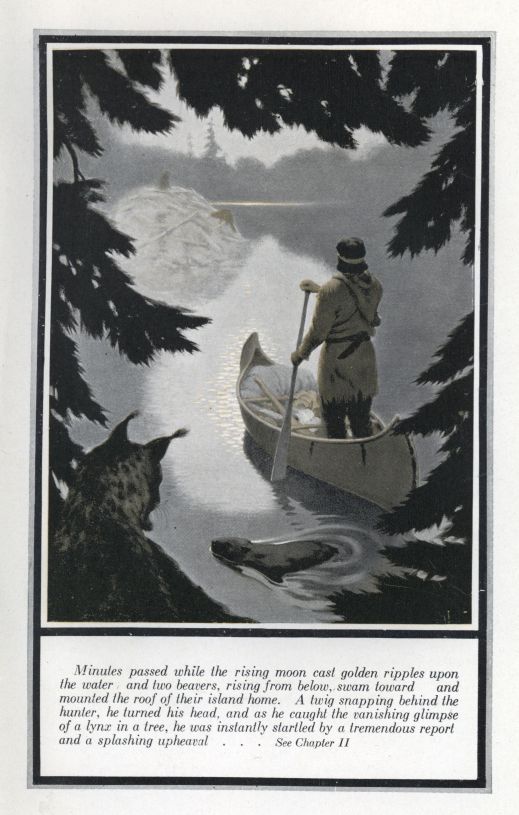
But Oo-koo-hoo, slipping away in his hunting canoe, paddled up a little creek into a small lake in which he knew a colony of beavers lived. He was gone about an hour and upon his return he told us about it. On gaining the little mere, he, without removing his paddle from the water, propelled his canoe slowly and silently along the shore in the shadow of the overhanging trees, until a large beaver lodge appeared in the rising mist; and then standing up in his canoe—in order to get a better view—he became motionless. Minutes passed while the rising moon cast golden ripples upon the water, and two beavers, rising from below, swam toward and mounted the roof of their island home. Then, while the moonlight faded and glowed, other beavers appeared and swam hither and thither; some hauling old barkless poles, others bringing freshly cut poplar branches, and all busily engaged. A twig snapping behind the hunter, he turned his head, and as he caught a vanishing glimpse of a lynx in a tree, he was instantly startled by a tremendous report and a splashing upheaval of water beside his canoe. A beaver had been swimming there, and on seeing the hunter move, had struck the water with its powerful tail, to warn its mates before it dived. The lynx had been watching the beaver.