RECIPES. (continued 6)
Reading edition
931. Cardons à la Moëlle.
—Prepared exactly the same as in No. 930.
932. Chicory, with Cream or White Sauce.
—Clean and pick three large heads of chicory; throw away all the outer green leaves; wash them in two waters, drain, and blanch them in boiling, salted water. Remove them after ten minutes, and cool them in fresh water. Take them out, and press out the water thoroughly; then chop up the chicory, and place it with four ounces of butter in a saucepan, and cook a quarter of an hour, or until dry. Pour over it two glassfuls of cream or milk, a very little at a time, reduce, and grate in a third of a pinch of nutmeg; add a pinch of salt and half a pinch of pepper; stir well together, leave it on for five minutes, and serve with six heart-shaped croûtons (No. 133) around the dish.
933. Chicory, with Gravy.
—Take six large, fine, fresh heads of chicory, pare any outer leaves that may be damaged, leaving the root intact; wash well in two waters, remove, and put them to blanch for ten minutes in salted boiling water. Take them out, put them back into cold water, and let them cool off thoroughly. Drain neatly, and cut them in halves. Put a piece of lard skin at the bottom of a sautoire, add one carrot, one onion, both cut up, and a bouquet (No. 254). Place the chicory on top, season with half a pinch of salt, half a pinch of pepper, and a third of a pinch of nutmeg, and cover with a buttered paper. Place the sautoire on the stove, and when the chicory is a golden color (not letting it take longer than ten minutes), moisten with half a pint of white broth (No. 99). Put it in the oven for thirty minutes; arrange the chicory on a hot dish, strain the sauce over, and serve.
934. Chicory for Garnishing.
—Prepare exactly as for No. 933, using it when needed.
935. Cucumbers à la Poulette.
—Peel three fine, large cucumbers, blanch them in salted boiling water for five minutes, drain, and cut them into pieces one inch thick. Place them in a sautoire with one ounce of butter, strew over them a pinch of very fine flour, stir well, and moisten with half a pint of white broth (No. 99), seasoning with half a pinch of salt, and the same of pepper. Stir well until it boils, and reduce the whole for fifteen minutes, adding a teaspoonful of chopped parsley, a third of a pinch of nutmeg, two beaten egg yolks, and two tablespoonfuls of sweet cream. Cook again, without letting it come to a boil, for three minutes, and serve.
936. Cucumbers à la Béchamel.
—Peel, pare nicely, and blanch six small, fine cucumbers in salted boiling water for five minutes. Remove, drain, and place them in a sautoire with half a pint of good béchamel sauce (No. 154), half an ounce of butter, the third of a pinch of nutmeg, and three tablespoonfuls of milk. Cook all together for fifteen minutes, and pour the whole on a hot dish, and serve.
937. Stuffed Cucumbers.
—Peel six small cucumbers, pare them carefully and shapely; cut off the lower ends, and with a vegetable-spoon empty them, after extracting all the seeds. Place them in slightly acidulated water; rinse them well, and parboil them in boiling water for three minutes. Remove them, and put in cold water to cool. Drain them, and fill the insides with a cooked forcemeat made of the breasts of chickens (No. 226). Line a sautoire with slices of pork-skin; add the cucumbers, season with a pinch of salt and half a pinch of pepper, a bouquet (No. 254), a glassful of white wine, two cloves, and a spoonful of dripping from any kind of roast. Cover with a piece of buttered paper, and place it in a slow oven to cook gently for twenty minutes. When done, transfer them carefully to a hot dish; free them entirely from any fat, pour half a pint of Madeira sauce (No. 185) over them, and serve.
938. Stewed Cucumbers for Garnishing.
—-Peel and slice three large, fine cucumbers; marinate them with a pinch of salt, half a pinch of pepper, a tablespoonful of vinegar, and one sliced onion. Leave them in for one hour; strain, and put the whole into a saucepan with a pint of Espagnole sauce (No. 151). Cook for twenty minutes; strain through a fine sieve, and use for any garnishing required.
939. Spinach Blanched au Naturel.
—Take a peck of fresh, sound spinach, cut off the stalks, pare neatly, wash it twice in plenty of water, lifting it out with the hands. Place it in boiling salted water, and boil it for fifteen minutes. Remove, and drain it thoroughly; place it in cold water again, and let it cool. Lift and drain, pressing it well; lay it on a wooden board, and hash it very fine.
940. Spinach à l’Anglaise.
—Proceed exactly the same as for No. 939, but the spinach must not be hashed; when well drained put it into a saucepan with one ounce of butter; mix well for five minutes, and it will be ready for any use desired.
941. Spinach à la Vieille Mode.
—After the spinach is blanched and well chopped, as for No. 939, put it in a saucepan with an ounce of butter and the third of a pinch of grated nutmeg. Stir with a wooden spoon, and cook for five minutes, adding an ounce of butter kneaded with two tablespoonfuls of flour, two tablespoonfuls of powdered sugar, and half a pint of milk. Stir frequently, and cook for ten minutes; then serve, garnished with six sippets of bread fried in butter.
942. Spinach à la Maître d’hôtel.
—After blanching the spinach as for No. 939, and chopping it very fine, put it dry into a saucepan. Place it to simmer on a moderate fire, seasoning with a pinch of salt, half a pinch of pepper, and the third of a pinch of grated nutmeg. When warm, add an ounce and a half of butter; stir well, and let it heat for fifteen minutes. Lay it on a hot dish, and decorate it with six bread croûtons (No. 133); then serve.
943. Spinach, with Gravy.
—When the spinach is blanched and well drained (No. 939), put it in a saucepan with half a cupful of veal-stock (either the reduced gravy of a fricandeau, or a glaze), cook for ten minutes, and when ready to serve, add a good ounce of butter; melt well together, and serve with six pieces of fried bread.
944. Spinach, with Sugar.
—Season the blanched spinach (No. 939) with a very little salt, three lumps of sugar, a little crushed lemon-peel, and two pulverized macaroons. Cook slowly all together for ten minutes, and serve surrounded by six lady-fingers (No. 1231).
945. String Beans, Blanched.
—Take two quarts of fresh, tender string beans; break off the tops and bottoms carefully; string both sides, and pare both edges neatly; wash them well in cold water, lift them, and drain. Place them in boiling salted water, and cook for twenty-five minutes. Drain again, and return them to cold water, letting them get thoroughly cool. Lift them out, and dry. They are now ready to use when required, for salads or any other purpose.
946. String Beans, with Cream.
—Place the blanched beans (No. 945) in a saucepan with an ounce of butter, and cook on the stove for five minutes, tossing them well. Season with half a pinch of salt, the same of pepper, and add half a bunch of chives and two sprigs of parsley tied together. Pour in half a cupful of fresh cream or milk, diluted with two egg yolks. Heat well, without boiling, for five minutes. Then serve as a hors-d’œuvre or entremet. Sugar may be added with advantage, if desired.
947. String Beans au Blanc.
—String the fresh string beans (No. 945); if too large, cut them lengthwise, and cook them in water with salt and butter; drain, and place them in a saucepan with one ounce of butter; add a teaspoonful of parsley and the same of chopped chives. Cook for five minutes, and when done, thicken the gravy with half a cupful of cream, two egg yolks, and the juice of a lemon. Mix well together for two minutes, and serve.
948. String Beans à l’Anglaise.
—Blanch and cook the beans as for No. 945, keep them warm, and of a light green color; place them in a hot dish, pour over them a gill of good melted butter, sprinkle a little chopped parsley on top, and serve very hot.
949. String Beans à la Bretonne.
—Cut a medium-sized onion in dice-shaped pieces, and place them in a saucepan with an ounce and a half of butter; let it get a good golden color on the stove for five minutes; then add a tablespoonful of flour. Stir well, and moisten it with a pint of white broth (No. 99). Stir well again, until it comes to a boil; season with half a pinch each of salt and pepper. Add the cooked string beans, with a clove of crushed garlic, to the sauce; cook for ten minutes; place in a hot dish; sprinkle a teaspoonful of chopped parsley over it, and serve.
950. Beans Panachées.
—Place half a pint of cooked string beans (No. 945) and the same quantity of flageolets or Lima beans in a sautoire with an ounce and a half of good butter; season with half a pinch each of salt and pepper; toss them well while cooking for five minutes. Place them in a hot dish; sprinkle a light pinch of chopped parsley over them, and send to the table.
951. Red Beans à la Bourguignonne.
—Take a quart of sound red beans; pick out all the small stones that are likely to be mixed with them; wash them thoroughly, lay them in plenty of cold water, and let them soak for six hours. Drain, and put them in a saucepan, covering them with fresh water, adding an ounce of butter, a bouquet (No. 254), and a medium-sized onion with two cloves stuck in. Boil for twenty minutes, stirring in a good glassful of red wine; season with a pinch of salt and half a pinch of pepper, and let it cook again for forty-five minutes. Remove, take out the bouquet and onion, and place the beans in a hot, deep dish; decorate with six small glazed onions (No. 972) around the dish, and serve.
Dried red beans, white beans, Lima beans, split dried peas, lentils, or any other kind of dried beans, should always be soaked six hours in fresh water before using them.
952. Fresh Lima Beans.
—Take a quart of fresh, shelled Lima beans, or three quarts of unshelled; parboil them in salted water for about twenty minutes, then take them from the fire, drain, and let cool in fresh water. Drain again, and place them in a sautoire with an ounce and a half of good butter, seasoning with half a pinch each of salt and pepper, and the third of a pinch of nutmeg. Cook for five minutes, tossing well; then moisten with two tablespoonfuls of cream, adding a pinch of chopped parsley; mix well together, and serve.
953. Stuffed Lettuce.
—Pick, clean, pare nicely, and wash thoroughly six lettuce-heads; parboil them for five minutes, drain them well, and fill the insides with godiveau (No. 221) or sausage forcemeat (No. 220). Tie each head, and put them in a sautoire, laying them down carefully, and adding a gill of Madeira sauce (No. 185), and a gill of white broth (No. 99). Season with half a pinch each of salt and pepper, cover with buttered paper, and cook in the oven for fifteen minutes. Arrange on a hot dish, untie, pour the sauce over, and serve.
954. Macaroni à la Crême.
—Boil for three-quarters of an hour three-quarters of a pound of Italian macaroni in plenty of salted water, adding a small piece of butter (half an ounce), and an onion stuck with two cloves. Drain well, and put it back into a saucepan with a third of a pound of butter, a third of a pound of grated Swiss cheese, the same quantity of grated Parmesan cheese, a third of a pinch of nutmeg, and a pinch of pepper. Moisten with half a pint of white broth (No. 99) and four tablespoonfuls of cream. Cook all together for five minutes, stirring well, and when the macaroni becomes ropy, dish it up, and serve.
955. Macaroni au Gratin.
—After the macaroni is prepared as for No. 954, place it in a baking-dish, sprinkle over it a little bread-crumbs and grated cheese; pour over it a little clarified butter, and place it in the baking oven for ten minutes, or until it assumes a golden color; then serve.
956. Macaroni à l’Italienne.
—Prepare three-quarters of a pound of sound Italian macaroni as for No. 954; place it in a saucepan with a gill of tomato sauce (No. 205), a gill of Madeira sauce (No. 185), and a quarter of a pound of grated Parmesan cheese; season with half a pinch of pepper and the third of a pinch of nutmeg; then let cook slowly for ten minutes, tossing frequently. Arrange on a hot dish, and serve with some grated cheese, separately.
957. Macaroni à la Napolitaine.
—Boil the macaroni in salt and water as for No. 954; drain, place it in a saucepan, and add half a pint of good Espagnole sauce (No. 151), half a pint of tomato sauce (No. 205), a quarter of a pound of grated cheese, two truffles, six mushrooms, and half an ounce of cooked, smoked beef-tongue, all cut up in dice-shaped pieces. Cook together on a brisk stove for ten minutes, tossing them well meanwhile, and serve.
958. Macaroni à la Milanaise.
—Prepare exactly the same as for No. 957, cutting the truffles, mushrooms, and beef-tongue julienne-shaped.
959. Spaghetti à la Napolitaine.
—Boil three-quarters of a pound of sound, fine spaghetti as for the macaroni in No. 954; drain,and put it back into a saucepan with half a pint of tomato sauce (No. 205), half a pint of Espagnole (No. 151), six mushrooms, two truffles, and a small piece of cooked, smoked, red beef-tongue, all cut up dice-shaped. Season with half a pinch of pepper and the third of a pinch of nutmeg, adding a quarter of a pound of grated Parmesan cheese. Cook for ten minutes, tossing well, and serve with a little cheese, separately.
960. Spaghetti à l’Italienne.
—Place the spaghetti in a saucepan as for No. 959; add a pint of tomato sauce (No. 205), and a quarter of a pound of grated Parmesan cheese; season with half a pinch of pepper and a third of a pinch of nutmeg, and cook for ten minutes, tossing well, and serving as in No. 959.
961. Spaghetti au Gratin.
—Prepare three-quarters of a pound of boiled spaghetti as in No. 959, place it in a saucepan, moistening with half a pint of Allemande sauce (No. 210), and half a pint of béchamel sauce (No. 154). Season with one pinch of pepper, and the third of a pinch of nutmeg, adding a quarter of a pound of grated cheese. Toss well, put it in a baking-dish, sprinkle the top with grated cheese and fresh bread-crumbs; pour over it a very little clarified butter, and place it in the oven. When of a fine golden color, after about fifteen minutes, take from the oven, and serve.
962. Boiled Green Corn.
—Pare off the outer leaves and silk of six young and tender ears of corn, and place them in a saucepan, covering them with water. Add half a cupful of milk, half an ounce of butter, and a handful of salt. Cook for twenty minutes, and serve on a folded napkin.
963. Corn Sauté à la Crême.
—Take six ears of cooked green corn, prepared as for No. 962, drain, cut off the corn from the cobs with a sharp knife, being very careful that none of the cob adheres to the corn. Place it in a sautoire with a gill of hot béchamel sauce (No. 154), half a cupful of cream, and half an ounce of butter; season with half a pinch each of salt and pepper, and the third of a pinch of nutmeg. Cook gently on the stove for five minutes, place in a hot dish, and serve.
964. Corn Sauté au Beurre.
—Proceed as for No. 963, adding one ounce of butter, but suppressing the other ingredients. Season the same, but cook only for eight minutes, tossing it well. Place in a hot dish, and serve.
965. Corn Fritters.
—Prepare four young, tender, good-sized, fresh ears of green corn exactly as for No. 963; after draining it carefully, place it in a china bowl; season with a pinch of salt and half a pinch of pepper, and add two fresh eggs, a quarter of a pound of well-sifted flour, and half a pint of cold milk. Do not beat the mixture, but stir it vigorously with a wooden spoon for five minutes, and it will be sufficiently firm. Butter well a frying-pan, take a kitchen ladle that contains the equivalent of a gill, and with this put the preparation into the pan in twelve parts; be careful they do not touch one another, and let them get a good golden color on each side for four minutes. Dress them on a folded napkin, and serve.
966. Barley Fritters.
—The same as in No. 965, substituting boiled barley for corn.
967. Glazed Turnips, with Gravy.
—Pare, and cut pear-shaped, twelve equal-sized, small white turnips; parboil them for five minutes, and drain them when done. Butter the bottom of a sautoire capable of holding them, one beside the other, and let them get a golden color, adding half a pint of powdered sugar. Moisten with half a pint of white broth (No. 99), half a pinch of salt, and add a very small stick of cinnamon. Cover with a buttered paper cut the shape of the sautoire, and place it in the oven to cook for twenty minutes. When the turnips are cooked, lift off the paper. Place the turnips on a hot dish, and reduce the gravy to a glaze for six minutes. Arrange them nicely on a dish, pour half a gill of good broth (No. 99) into the saucepan to loosen the glaze, remove the cinnamon, and throw the sauce over the turnips.
968. Onions, with Cream.
—Peel twelve medium-sized, sound onions; pare the roots without cutting them, and place them in a saucepan; cover with salted water, add a bouquet (No. 254), and cook for forty-five minutes. Lift them from the saucepan, and lay them on a dish; cover them with half a pint of cream sauce (No. 181), mixed with two tablespoonfuls of the broth they were cooked in, and serve.
969. Fried Onions.
—Peel, pare, and slice round-shaped, four medium-sized onions. Lay them first in milk, then in flour, and fry them in very hot fat for eight minutes. Lift them up and lay them on a cloth to dry. Serve on a dish with a folded napkin, with a little fried parsley.
970. Stuffed Onions.
—Peel six medium-sized Spanish onions; empty out the centres with a vegetable-scoop; parboil them for three minutes, and turn them upside down on a cloth to drain. Fill the insides with sausage forcemeat (No. 220). Line the bottom of a sautoire with a piece of lard skin, and one carrot and one onion, both cut up; lay the onions on top, and moisten with half a pint of broth (No. 99). Cover with a buttered paper; then put it in the oven to glaze for forty minutes, taking care to baste frequently. Place them in a hot dish; strain the gravy over them, and serve.
971. Minced Onions.
—Peel and pare three medium-sized onions; cut them in two, and mince them into fine slices. Place them in a sautoire, with half an ounce of butter, and let them get a good golden color on the stove for ten minutes, tossing them briskly. Place them in a bowl, and use when required.
972. Glazed Onions for Garnishing.
—Select one quart of small onions; peel the sides only, and pare the roots neatly, being careful not to cut them. Place them in a sautoire with half an ounce of clarified butter, and sprinkle them with half a pinch of powdered sugar. Glaze them in a slow oven for fifteen minutes; place them in a stone jar, and use for garnishing when required.
973. Sorrel au Maigre.
—Pick off the stems from half a peck of sorrel; wash it in several waters, drain, and chop up with a head of well-cleansed lettuce. Add half a bunch of chervil, and chop all together very fine. Place all in a saucepan, stir well together on the hot stove for three minutes, and then place it in the oven until the vegetables are well dissolved; then add an ounce and a half of butter, and stir again for about ten minutes, or until the sorrel is reduced to a pulp. Season with a pinch of salt and half a pinch of pepper, and pour into it a thickening of two egg yolks and half a cupful of cream; stir well, without boiling, and serve.
974. Sorrel au Gras.
—Dissolve the same quantity of sorrel as in No. 973, adding enough butter to form it into a perfect pulp (one ounce and a half will answer); stir it until it begins to bubble; then moisten it with half a pint of gravy or good stock, roast-beef gravy, or reduced broth. Cook it for five minutes, and use this purée as a sauce for various meats.
975. Stuffed Peppers.
—Fry for one minute only, six medium-sized green peppers in very hot fat; drain and skin them properly, and cut a round piece off the bottom to use for a cover. Remove the insides, and fill them with a good sausage forcemeat (No. 220); put on the round cover previously cut off, and lay them on an oiled baking-tin. Moisten the peppers lightly with sweet oil, and place them in a slow oven to cook for fifteen minutes; then arrange them on a hot dish, and serve with a gill of demi-glace sauce (No. 185).
976. Green Peas à l’Ancienne Mode.
—Take three quarts of unshelled, young, tender green peas; shell them carefully, and keep them wrapped up in a wet napkin until needed. Clean, drain, and tie up a lettuce-head; put it in a saucepan with the peas; season with a pinch of salt; cover with a glassful of water, and add a quarter of a pound of very good butter. After cooking for a quarter of an hour, remove the lettuce, and when ready to serve, thicken the peas with three spoonfuls of cream, diluted with one egg yolk, adding half a pinch of white pepper, and a spoonful of powdered sugar. Let all thicken together for five minutes, and serve immediately in a tureen.
977. Green Peas à la Française.
—Shell carefully three quarts of fine, young, tender, fresh green peas, and place them in a saucepan with one ounce of butter and half a cupful of water. Knead together with a wooden spoon; strain off the water, and add a bouquet (No. 254), one small onion, a well-cleansed lettuce-heart, half a pinch of salt, and a teaspoonful of powdered sugar. Cover the saucepan, and cook very slowly for half an hour; remove the bouquet and onion; lay the lettuce upon a dish, incorporate into the peas half an ounce of fresh butter, and cook until it thickens, which will require at least five minutes. Pour the peas dome-formed over the lettuce, and send to the table.
978. Green Peas à l’Anglaise.
—Procure the same quantity of green peas as for No. 977; put them in a saucepan, and cover them with boiling water. Add a handful of salt, and boil quickly, without covering, for fifteen minutes. Skim the water as soon as the scum rises. When done, strain them through a colander, return them to the saucepan, and toss them well, adding an ounce and a half of fresh butter. Dish them in a vegetable-dish, place another half ounce of butter in the middle, and serve.
979. Green Peas à la Bourgeoise.
—Shell three quarts of tender green peas; put them in a saucepan, and toss the peas quickly in a gill of light roux (No. 135); moisten with a pint of boiling water, adding half a pinch each of salt and pepper, a bouquet (No. 254), and a raw lettuce-heart. Reduce it for twenty minutes, or until all the juice has evaporated; then add two raw egg yolks well beaten, with three tablespoonfuls of sweet cream. Stir quickly for four minutes, without allowing it to boil, and then serve, removing the bouquet.
980. Green Peas, with Cream.
—Put one ounce of butter in a saucepan with one tablespoonful of flour kneaded well together. Dissolve it; then add the shelled peas as for No. 977, a bouquet (No. 254), a quarter of a bunch of chives, a pinch of salt, and half a pinch of pepper. Cook in their own juice for twenty minutes, then take the saucepan from off the fire. Pour the gravy from the peas into another vessel, add to it half a cupful of cream and a teaspoonful of powdered sugar; pour this sauce over the peas, and heat up once again without boiling, for two minutes, before serving.
981. Green Peas, With Bacon.
—Brown in a saucepan half an ounce of butter with two ounces of small, dice-shaped pieces of bacon, and when of a good golden color, take them out, and put a spoonful of flour into the fat to make a roux. Moisten with a pint of white broth (No. 99); replace the bacon, add the raw shelled peas, as for No. 977, one whole onion, a bouquet (No. 254), and half a pinch of pepper. Cover, and let cook on the corner of the stove for thirty minutes; place in a hot, deep dish, and serve.
982. Potatoes, Boiled Plain.
—Take twelve medium-sized, fine, sound potatoes; wash them thoroughly, peel off a piece of the skin, about half an inch wide, around each potato, to ensure mealiness, and lay them in a saucepan, covering them with cold water, and adding half a handful of salt; place the lid on, and cook for forty-five minutes. Drain, lay a napkin on a hot dish, in which you envelop the potatoes, and serve.
983. Broiled Potatoes.
—Peel six medium-sized, sound, cooked potatoes; cut them in halves; lay them on a dish, and season them with a pinch of salt. Pour two tablespoonfuls of melted butter over them, and roll them well in it. Arrange them on a double broiler, and broil them on a moderate fire for three minutes on each side. Place them in a hot dish, with a folded napkin, and serve.
984. Potatoes à la Génevroise.
—Peel, wash, and drain four medium-sized, sound potatoes; cut them into julienne-shaped pieces, and wash and drain them again. Season with a pinch of salt and half a pinch of pepper. Butter lightly six tartlet-molds with clarified butter; cover the bottoms with grated Parmesan cheese; arrange a layer of potatoes on top, sprinkle more cheese over them, and continue until all are filled, finishing by sprinkling cheese over the surface and dropping a little clarified butter over all. Set them on a very hot stove for two minutes; then place in a hot oven, and bake them for twenty-five minutes. Unmold, and place them in a hot dish, with a folded napkin, and serve.
985. Potatoes, Maître d’Hôtel.
—Take eight medium-sized potatoes, boiled as for No. 982; peel them, cut them into slices, and place them in a saucepan, with an ounce of butter and a pinch of chopped parsley, and season with half a pinch each of salt and pepper, the third of a pinch of nutmeg, and the juice of half a lemon. Warm all together, toss well, and add half a cupful of cream; heat slightly once more, and serve.
986. Potatoes, Parisienne.
—Take six good-sized, well-cleansed potatoes; with a round vegetable-spoon cut out the Parisian potatoes; then put them in fresh water; wash well, and drain. Melt an ounce of butter in a sautoire, throw in the potatoes, and season with half a pinch of salt. Place the sautoire in the oven; cook for twenty minutes, and serve on a hot dish with a folded napkin.
987. Potatoes à l’Anglaise à Crû.
—Wash well six medium-sized, sound potatoes; cut them into quarters, pare them neatly, clove-garlic-shaped; wash again, drain, and place them in a saucepan. Cover with water, throw in a heavy pinch of salt, put the lid on, and cook for twenty minutes. Drain, and put them in a saucepan, with an ounce of butter, a pinch of chopped parsley, heat slowly for five minutes, toss gently, and serve.
988. Potatoes à l’Anglaise.
—Wash well six good-sized potatoes; boil them in salted water for forty-five minutes; peel, and cut them each into quarters. Melt an ounce of butter in a saucepan; add the sliced potatoes, half a pinch of salt, and the third of a pinch of pepper. Cook them on a very slow fire for five minutes, tossing them well, and serve on a very hot dish, sprinkling a little chopped parsley over them.
989. Potatoes, with Bacon.
—Cut one ounce of bacon or pork into small pieces; put them in a saucepan, with half an ounce of butter; cook for five minutes; add a spoonful of flour; stir, and brown well for four minutes. Moisten with a pint of white broth (No. 99), and cook for five minutes longer. Put in eight well-peeled, washed, and sliced raw potatoes; season with half a pinch of pepper and the third of a pinch of nutmeg; lay the lid on, and cook for twenty-five minutes. Then skim off the fat, and serve in a hot, deep dish.
990. Potatoes à l’Italienne.
—Boil eight medium-sized potatoes in boiling water, as for No. 982; peel, put them in a saucepan, and mash them. Add a piece of butter of one ounce, and a piece of fresh bread the size of a French roll, suppressing the crust, and soaking it in milk. Add two more tablespoonfuls of milk, in order to form a pliable paste, three fresh egg yolks, and the whites of the three beaten to a froth; season with half a pinch of salt, half a pinch of pepper, and the third of a pinch of nutmeg. Mix well together, and pile it high on a baking-dish; pour over it a little melted butter; sprinkle a little Parmesan cheese over; place it in the oven, and after ten minutes, when of a good golden color, serve.
991. Potatoes à la Lyonnaise.
—Cut eight potatoes, boiled, as for No. 982, into round slices; lay them in a frying-pan with an ounce and a half of butter, and the round slices of a previously fried onion, and season with half a pinch each of salt and pepper. Cook well together for six minutes, until well browned; toss them well, and serve with a pinch of chopped parsley sprinkled over the whole.
992. Stuffed Potatoes.
—Wash and peel about six large potatoes; cut them, lengthwise, in two, and scoop out the centres carefully with a knife or spoon. Fill the cavities with a sausage forcemeat (No. 220), letting it bulge out a little on the top; butter a baking-pan, arrange the potatoes on it, and cook in a slow oven for half an hour, or until nicely browned, then serve.
993. Fried Potatoes.
—Peel and wash six large potatoes, cut them up into fine slices, a quarter of an inch in thickness; plunge them into very hot, clarified beef suet or fat, and cook slowly. When they are soft, lift them out with a skimmer (it generally takes ten minutes to cook them); heat the fat again to boiling-point, and put the potatoes back. Smooth them down with a skimmer, and after two minutes they will swell up considerably; lift them out with the skimmer, drain, sprinkle a pinch of salt over, and serve on a hot dish with a folded napkin. These potatoes answer for garnishing chops and other meats.
994. Potatoes Sautées au Beurre.
—Peel and clean eighteen small, round, raw potatoes, new ones if possible; place two ounces of butter in a saucepan; place it on a hot fire, adding the potatoes; cook them until they are a golden color, which will take fifteen minutes, then drain. Sprinkle over them a pinch of table-salt, and arrange them on a dish without any further seasoning than a little chopped parsley; then serve.
995. Potatoes Sautées.
—Take eight good-sized boiled and peeled potatoes (No. 982); cut them in slices a quarter of an inch in thickness; place them in a frying-pan with an ounce and a half of good butter. Season with a pinch of salt and half a pinch of pepper; toss well for eight minutes, dress on a very hot dish, and serve with a little parsley sprinkled over.
996. Potato Balls.
—Peel, clean neatly, and boil in salted water for thirty minutes, eight good-sized, sound, round, yellow potatoes; drain and return them to the same pan, and mash them well, adding two egg yolks, and the whites beaten to a froth, three tablespoonfuls of cream, a teaspoonful of chopped parsley, very little chives, half a pinch of salt, and the third of a pinch of nutmeg. Mix well together for two minutes, and dip about half a tablespoonful at a time into frying batter (No. 1185). Slide them into very hot fat, and leave them in for three minutes; this swells them, and forms them into a species of fritters. Place in a very hot dish with a folded napkin, and serve.
997. Potato Croquettes and Quenelles.
—Peel, wash, and drain nicely eight medium-sized mealy potatoes; cut them in quarters, put them in a saucepan, cover them with water, add a pinch of salt, cook for thirty minutes, and drain. Lay them in a mortar with an ounce of fresh butter, pound them well, and add three raw egg yolks. Season with half a pinch each of salt and pepper and the third of a pinch of nutmeg; mix well, and then divide into twelve parts, shaping each one like a cork, or any other shape desired. Dip them separately into beaten egg, and roll them in fresh bread-crumbs; fry a golden color for three minutes, and serve on a dish with a folded napkin.
998. Mashed Potatoes.
—Peel, wash, drain, and cut into quarters eight good-sized potatoes; put them in a sautoire, cover with water, add a good pinch of salt, and boil for thirty minutes. Drain, rub them through a purée strainer, and put them in a saucepan with an ounce of butter, and half a pinch each of salt and white pepper. Stir well, adding half a cupful of hot milk, until it becomes of a good consistency. Serve, garnished with six pieces of bread fried in butter.
999. Potatoes à l’Hollandaise.
—After boiling eight good-sized potatoes as for No. 982, peel, and cut them into quarters; put them in a sautoire with an ounce of butter and half a pinch of chopped parsley; season with half a pinch each of salt and pepper, toss them gently, and warm them slightly for five minutes. Place in a hot dish, and serve.
Sweet potatoes à l’Hollandaise are prepared the same way.
1000. Potatoes à la Gastronome.
—Peel, clean, and with a No. 3 tube cut twelve medium-sized potatoes into inch-and-a-half-long pieces. Place them in a saucepan; cover with water, add a pinch of salt, and cook for twenty-five minutes. Drain, and place them in a hot dish; pour a gill of hot Périgueux sauce (No. 191) over them, and serve.
1001. Potatoes à la Bignon.
—Prepare twelve potatoes as for No. 982; empty them with a potato-scoop, leaving the bottoms uncut; blanch them in boiling water for two minutes; drain, and fill them with sausage forcemeat (No. 220). Lay them in a buttered sautoire; place it in the oven, and cook for twenty minutes. Use for any garnishing desired.
1002. Hashed Potatoes, Sautées.
—Hash eight medium-sized, cold, boiled potatoes; place an ounce and a half of good butter in a frying-pan, add the potatoes, season with half a pinch each of salt and pepper, and toss them well in the pan for two minutes. Give them the shape of an omelet, and let them take a golden color, which will require five minutes. With a spoon take up all the butter which lies at the bottom of the pan; slide the potatoes carefully on a hot dish, and serve.
1003. Hashed Potatoes, with Cream.
—Hash eight cold, boiled potatoes, and place them in a sautoire; add half a cupful of cream and half an ounce of butter; season with half a pinch each of salt and pepper, and the third of a pinch of nutmeg; stir well with a wooden spoon for five minutes, until well heated, and serve.
1004. Hashed Potatoes, with Cream au Gratin.
—Prepare the potatoes as for No. 1003; place them in a dish (a silver dish preferred); sprinkle over them two tablespoonfuls of grated Parmesan cheese, and two tablespoonfuls of fresh bread-crumbs; spread well over them a piece of butter the size of a nut; then place the dish in the oven. After ten minutes, when a good golden color, serve.
1005. Potatoes en Surprise.
—Prepare some potatoes as for croquettes (No. 997); form them into twelve balls the size of a good-sized egg; scoop out the centres, and fill in with a salpicon (No. 256). Close the opening with a little more potato; dip them in beaten egg, then in fresh bread-crumbs, and fry them in very hot fat for three minutes. Lift, drain, and serve them on a hot dish with a folded napkin.
1006. Potatoes à la Duchesse.
—Place some croquette preparation (No. 997) in a bag, and squeeze it upon a buttered baking-sheet, forming it into any shape required, and with a light hair brush cover the surface with a beaten egg. Brown lightly in the oven for eight minutes, and serve for various garnishings.
Balls can also be formed about the size of an egg; spread a little flour on the table; place the balls on top, and flatten them, shaping them nicely; cover the surface with a beaten egg; brown lightly in the oven on a buttered baking-sheet for eight minutes, and serve.
1007. Potatoes à la Rice.
—Peel, wash, and drain eight medium-sized potatoes. Cut them into half-an-inch-square pieces; place them in a frying-pan with an ounce and a half of butter; season with a pinch of salt, toss well, and let them get a golden color (fifteen minutes will suffice). Drain the butter from the bottom of the pan, and place the potatoes in a hot dish; sprinkle a pinch of chopped parsley over, and serve.
1008. Potatoes à la Windsor.
—Peel, and clean nicely, twelve large potatoes; cut them into balls with a Parisian potato-scoop, then place them in a saucepan, covering them with water containing a pinch of salt. Cook for fifteen minutes; then strain them and place them in another saucepan with an ounce of fresh butter and a pinch of chopped parsley. Warm them well for five minutes, and add the juice of half a lemon before serving.
1009. Potatoes, Château.
—Cut six medium-sized potatoes into quarters, and pare them like cloves of garlic; wash them well, and drain. Fry them slowly in moderately heated fat for ten minutes; lift, drain thoroughly, and put them in a sautoire with half an ounce of butter. Season with half a pinch of salt, heat well for two minutes, and serve.
1010. Potatoes, Soufflées.
—Peel eight good, mealy potatoes, and cut them into even pieces a quarter of an inch in thickness, shaping them as oval as possible. Fry them in moderately heated fat for eight minutes; then lift them out, and lay them aside for a few moments; plunge them into boiling hot fat, and the potatoes will swell considerably. Drain, and serve them on a dish with a folded napkin.
Sweet potatoes soufflées are prepared the same way.
N. B.—When cutting the potatoes for a soufflée, a continuous, sharp, and rapid cut should be made, so as to have them to perfection.
1011. Potatoes, Saratoga.
—Peel and clean six medium-sized potatoes; cut them with a sharp Saratoga potato-knife into thin slices; place them in cold water, wash thoroughly, drain, and plunge them into very hot fat for eight minutes. Take them out, drain thoroughly, and sprinkle over them half a pinch of salt. Serve them on a dish with a folded napkin.
1012. Potatoes à la Hanna.
—Peel, wash, and drain six medium-sized potatoes; cut them into as thin slices as possible; then wash them well again. Take a flat mold large enough to contain the potatoes, butter it well; put in a layer of potatoes, then a very light layer of grated cheese; season with a very little salt, and the same of pepper. Cover with another layer of potatoes, season again the same as before (the whole not to exceed half a pinch of each); then spread half an ounce of butter over them. Place the mold in the oven, and cook for thirty minutes; remove, turn it upside down on a hot dish, unmold, and serve.
1013. Potatoes, Julienne.
—Peel and clean six medium-sized potatoes; cut them into square pieces two inches long by the third of an inch wide; wash well, and drain; place them in very hot fat for six minutes, then lift them out, and lay them on a cloth to drain. Sprinkle half a pinch of salt over, and serve them on a dish with a folded napkin.
1014. Potatoes en Paille (Straw).
—Prepare the same as in No. 1013, cutting a little thinner.
1015. Rice, Plain Boiled.
—Clean and wash neatly a quarter of a pound of Italian rice; place it in a saucepan with a pint and a half of cold water and a pinch of salt; put the lid on, and boil for twenty-two minutes. Pour through a colander, being careful to let it drain thoroughly without crushing the rice, otherwise it will be spoiled. When well dried, return it to the saucepan, put the lid on, and leave it on the corner of the stove to dry gradually for five or six minutes. It will now be ready to use as required.
1016. Rice à la Ristori.
—Wash well and drain a quarter of a pound of good Italian rice; shred two ounces of bacon into small pieces, and place them in a saucepan with a medium-sized, chopped-up, raw cabbage, letting them steam for thirty minutes. Add a pinch of salt, half a pinch of pepper, and a teaspoonful of chopped parsley; put in the rice, and moisten with half a pint of white broth (No. 99). Cook for fully a quarter of an hour longer, and serve with grated Parmesan cheese sprinkled over it.
1017. Risotto à la Milanaise.
—Chop rather fine one good-sized, very sound, peeled onion. Melt two ounces of very good butter in a saucepan on a very brisk fire; add the onions, brown them for six or seven minutes, or until they have obtained a good golden color; then add ten ounces of well-picked Italian rice (a heaped cupful), with two good-sized chopped truffles; stir well with the spatula without ceasing for one and a half minutes, then add one quart of boiling and strained white broth (No. 99), lightly stir once only, and cook for fourteen minutes. Add six fine chopped mushrooms, and little by little, at intervals, another quart of boiling white broth—stirring almost constantly with the wooden spatula while cooking, very rapidly, for ten minutes more. Season with a heavy half-teaspoonful of salt, a light saltspoonful of white pepper, adding one and a half ounces of grated Swiss cheese, and a heaped teaspoonful of Spanish branch saffron, diluted in two tablespoonfuls of hot white broth, and strained. Cook for three or four minutes longer, stirring continually meanwhile; then pour it into a hot soup-tureen, and send to the table with a little grated Swiss cheese, separate. A little beef-marrow can be added to advantage, by making a small cavity in the centre, while yet in the pan, one minute before the time to serve, and plunging into it one tablespoonful of marrow.
1018. Oyster-plant Sauté au Beurre.
—Scrape nicely a large bunch of fine oyster-plant; plunge it into cold water containing two tablespoonfuls of vinegar, so as to prevent it from turning black. Take it from the water, drain, and cut it into two-inch-long pieces. Place them in a saucepan, with two tablespoonfuls of vinegar and two tablespoonfuls of flour; mix well; cover with plenty of cold water and a handful of salt; put the lid on, and let them boil slowly for forty minutes. Then drain, and return them to a sautoire, with an ounce and a half of the best butter procurable; season with half a pinch of pepper, the juice of half a lemon, and a teaspoonful of chopped parsley. Heat well for five minutes, tossing occasionally; then place them in a hot, deep dish, and serve.
1019. Oyster-plant à la Poulette.
—Scrape nicely a good-sized bunch of fine, fresh oyster-plant; plunge it at once into acidulated water, and when well washed, drain, and cut it into two-inch pieces. Place them in a saucepan, and boil them in plenty of water, adding two pinches of salt, two tablespoonfuls of vinegar, and the same quantity of diluted flour. After forty minutes, or as soon as they bend to the finger, they are done. Lift them out, drain them well, and serve with a pint of hot poulette sauce (No. 598) poured over them.
1020. Oyster-plant Sauté à la Crême.
—To be cooked the same as for No. 1019; but after draining them, place them in a sautoire with a gill of béchamel sauce (No. 154) and a gill of sweet cream. Season with half a pinch of salt, a quarter of a pinch of pepper, and the third of a pinch of nutmeg. Let all heat well together for five minutes, stirring lightly with a wooden spoon, and serve in a hot, deep dish.
1021. Fried Oyster-plant.
—Cook a good bunch of oyster-plant as for No. 1019, and, when done, put it in a dish, and season with half a pinch each of salt and pepper, and a tablespoonful of vinegar. Dip it well in a good fritter batter (No. 1190), and fry it in very hot fat for five minutes, separating the pieces with a spoon. Lift them up with a skimmer, drain on a cloth, sprinkle a very little salt over them, and serve on a folded napkin, decorating with a little fried parsley.
1022. Succotash.
—Place six medium-sized, freshly cooked, and scraped ears of green corn (a can of canned corn will answer the purpose) in a saucepan, with half a pint of boiled Lima beans, adding a good-sized piece of butter weighing about an ounce, a pinch of salt, half a pinch of pepper, the third of a pinch of grated nutmeg, and half a pint of milk. Heat it well for five minutes, add two tablespoonfuls of good, hot béchamel (No. 154); stir thoroughly, and serve.
1023. Stuffed Tomatoes.
—Wash and dry well six fine, sound red tomatoes. Cut the top of each up, without detaching, so that it will serve as a cover. Scoop out the inside of each with a vegetable-scoop; and place on a plate for further action. Season the inside of the six emptied tomatoes with one pinch of salt and half a pinch of pepper, equally divided. Chop very fine one medium-sized, sound, peeled onion; place it in a saucepan with half an ounce of butter; and cook for three minutes on a brisk fire, being careful not to let get brown. Add six chopped mushrooms and one ounce of sausage-meat. Season with one pinch of salt and half a pinch of pepper; cook for three minutes, stirring once in a while. Add now the tomatoes which were scooped out, with half a cupful of fresh bread-crumbs and a teaspoonful of fresh chopped parsley. Mix well together, and cook for two minutes longer, or until it comes to a boil; then place in a bowl to cool. Stuff the emptied tomatoes with the above preparation, close down the covers, gently lay them on a tin plate (dish), cover them with a buttered paper, and cook in a moderate oven for eighteen minutes, and serve.
Stuffed tomatoes are served as a garnishing in various ways.
For egg-plants the same stuffing is used, but instead of tomatoes, use the scooped out egg-plant.
Green peppers the same, using half a very finely chopped-up green pepper in place of the tomatoes.
1024. Stuffed Tomatoes à la Reine.
—Prepare six tomatoes exactly the same as in No. 1023, substituting chicken forcemeat (No. 226) for the sausage meat, and pouring a gill of hot Madeira sauce (No. 185) on a hot dish, and dressing the tomatoes over.
1025. Broiled Tomatoes.
—Take six good-sized, firm, red, fresh tomatoes; pare the underparts in case anything adheres, wipe them nicely, and slit them in halves. Lay them on a dish; season with a good pinch of salt, half a pinch of pepper, and a tablespoonful of sweet oil; mix well together; keep the tomatoes in as good shape as when cut, then arrange them in a double broiler. Put them on a moderate fire, and cook for eight minutes on each side. Place in a hot dish; spread a gill of maître d’hôtel butter (No. 145) over them, and serve.
1026. Tomatoes à la Bock.
—Wipe neatly and peel eight fine, sound, fresh tomatoes; cut each one into six equal-sized pieces, and place them in a saucepan with two ounces of fresh butter, seasoning with a pinch of salt, half a pinch of pepper, and the third of a pinch of nutmeg. Cover the pan, and place it on the hot stove to cook for fifteen minutes. Take from off the fire, pour the tomatoes into a deep, hot vegetable-dish, and send them to the table very hot.
1027. Stewed Tomatoes.
—Plunge six good-sized, fresh, sound tomatoes into boiling water for half a minute; drain, nicely peel them, cut each one into six pieces; put them into a saucepan with an ounce and a half of good butter, season with half a pinch each of salt and pepper, and the third of a pinch of nutmeg. Cook slowly for twenty minutes, and add a very little powdered sugar (half a teaspoonful will be sufficient). Stir well, and cook for two minutes longer; then place in a hot, deep dish, and serve.
1028. Roasted Tomatoes.
—Plunge in boiling water for half a minute six good-sized red, sound tomatoes; drain, and peel them neatly, then cut away the tops without detaching them entirely, and remove the seeds with a teaspoon. Divide an ounce of good butter into six equal parts, and put a piece into each tomato, seasoning with a light saltspoonful of salt, and half the quantity of pepper. Close the tops, and lay them in a buttered baking-dish, moistening each tomato with a very little sweet oil. Put them in a hot oven, and bake for twelve minutes. Remove, and with a cake-turner dress them on a hot dish, and serve.
1029. Tomatoes à la Marseillaise.
—Take six good-sized, firm, red tomatoes; wipe, and cut them in halves through the sides. Place half a gill of sweet oil in a frying-pan; let it heat well; lay in it the tomatoes on the sides which were cut, and cook briskly for one minute. Butter well a tin baking-dish, and lay the tomatoes in this on the uncooked side, and season with half a pinch each of salt and pepper. Make a stuffing with one shallot, finely chopped, two cloves of crushed garlic, two hard-boiled egg yolks, a teaspoonful of chopped chives, the same of parsley, two medium-sized, finely chopped anchovies, and an ounce of butter. Mix well together in a bowl, and cover the tops of the tomatoes with the stuffing, dividing it equally. Sprinkle a little fresh bread-crumbs over them; drip three or four drops of clarified butter over each tomato; then place them in a very hot oven for eight minutes. Place them neatly on a hot dish, and serve.
1030. Okras, Plain Boiled.
—Take twenty-four medium-sized, sound okras, and wash them well in cold water. Drain thoroughly, and pare both ends. Have a saucepan containing salted boiling water, into which plunge the okras, and let them cook for fifteen minutes. Lift them out with a skimmer, and lay them on a cloth to drain. Use the boiled okras for sautéing, salad, or any other purpose desired.
1031. Okras, Sautés à la Créole.
—Prepare twenty-four okras as for No. 1030. Place in a sautoire one ounce of good butter, one medium-sized minced onion, and a medium-sized, minced green pepper. Place on the stove for six minutes, until it is of a golden color, and add two raw, peeled tomatoes cut into pieces, three tablespoonfuls of Espagnole (No. 151), a pinch of salt, the third of a pinch of pepper, and one crushed clove of garlic. Add the okras, put the lid on, and cook slowly for fifteen minutes. Place in a hot, deep dish, sprinkle over them a teaspoonful of chopped parsley, and serve.
1032. Macédoine of Vegetables.
—Cut a small, raw carrot with a vegetable-scoop; put it into salted boiling water, and cook for fifteen minutes; repeat with a small, raw turnip, cooking each separately; drain, and place them in a saucepan with half a gill of cooked peas, the same quantity of cooked half-inch lengths of string beans, two tablespoonfuls of cooked flageolets, and a small piece of cauliflower, if at hand. Moisten with half a pint of hot béchamel (No. 154), and season with half a pinch each of salt and pepper, and the third of a pinch of nutmeg. Let it simmer well for ten minutes, and use when required.
1033. Jardinière of Vegetables.
—Prepare exactly as in No. 1032, substituting half a pint of hot Madeira sauce (No. 185) for the béchamel.
1034. Boiled Hominy.
—Wash a quart of very white hominy in fresh water; drain, put in a saucepan with a quart of cold water, and place it on the fire, adding a pinch of salt. Boil for thirty minutes, stirring it well, and serve.
1035. Fried Hominy.
—After preparing the hominy as for No. 1034, put it to cool, and cut it into six slices. Dip each slice in beaten egg, roll them in fresh bread-crumbs, and fry in very hot fat until of a good golden color, for four minutes. Serve on a folded napkin, or use for garnishing when required.
A pinch of salt represents 205 grains, or a tablespoonful.
Half a pinch of pepper represents 38 grains, or a teaspoonful.
A third of a pinch of nutmeg represents 13 grains, or half a teaspoonful.
SALADS.
1036. Salad à l’Italienne.
—Pare well a good-sized carrot and a good-sized turnip; cut them with a vegetable-scoop, and cook them in separate salted waters; the carrot fifteen minutes, and the turnip ten. Drain, let cool, then place them in a salad-bowl, dome-shaped. Cut two good-sized truffles into julienne-shaped pieces; keep them apart, and cut up six mushrooms the same way, also the breast of a cooked, medium-sized chicken, cut likewise. Cover the vegetables with a cluster of the truffles, the same of the mushrooms, and repeat with the chicken, keeping each article separate; form a small cavity in the centre of the dome, pour into it a teaspoonful of anchovy sauce, a tablespoonful of vinegar, one tablespoonful of sweet oil, a pinch of salt, and half a pinch of pepper. Cover the cavity with a piece of cooked cauliflower, or Brussels-sprouts, or in default of both, cooked asparagus-tops will answer the purpose; send to the table, and mix well before serving it to the guests.
1037. Anchovy Salad.
—Have eighteen bottled anchovies (or the same quantity of Norwegian anchovies if possible), soak them in cold water for two hours, so they are thoroughly unsalted, then drain them in a cloth, and remove the bones. Clean and pare a small head of lettuce, cut it into small pieces, and put it in a salad-bowl, covering it with two tablespoonfuls of Tartare sauce (No. 207). Decorate with the anchovies, two hard-boiled eggs cut in quarters, twelve capers, six stoned olives, and a small, cooked, sliced beet-root; season with half a pinch of pepper and one tablespoonful of vinegar. When ready to serve mix well together.
1038. Barbe de Capucine.
—Take two bunches of clear, white, fresh barbe de capucine; clean, and wipe them carefully and thoroughly, but do not wash the salad, as it loses its taste, and renders it too soft to use; cut it into three shreds, and place it in a salad-bowl. Mix well, in a wooden salad-spoon, two spoonfuls of vinegar, half a pinch of salt, and the third of a pinch of pepper, and pour it over the salad, then add one spoonful of oil, mix well, and serve immediately.
1039. Beef Salad.
—Take one pound of lean, boiled, cold beef, the rump-part in preference; suppress all the fat, then cut it into pieces an inch and a half in length, as thinly as possible. Place the pieces in a bowl, season with a pinch of salt, half a pinch of pepper, and two medium-sized, cooked, and sliced potatoes, also a pinch of parsley, two tablespoonfuls of vinegar, and the same of sweet oil. Mix all well together, then arrange in a serving salad-bowl; decorate with six medium-sized pickles or beets, and serve.
1040. Cauliflower Salad.
—Take a medium-sized head of cooked cauliflower; pare off the root, and detach it into equal-sized flowerets; place these in a salad-bowl, seasoning with a pinch of salt, half a pinch of pepper, and sprinkle over a pinch of chopped parsley; add three tablespoonfuls of vinegar, two of good oil, and mix all well together with a wooden spoon, then serve.
1041. Celery Salad.
—If the heads of celery be large and white, use two; if they should be small, use three. Pare off the green stalks, trim the roots nicely, and cut it into short shreds; wash thoroughly in cold water, lift it up with the hands, and drain in a cloth. When well drained, place the celery in a salad-bowl, and season with a pinch of salt, half a pinch of pepper, and one and a half wooden salad-spoonfuls of vinegar, also the same quantity of oil. Mix well, and serve.
1042. Celery Salad, Mayonnaise Dressing.
—Prepare the celery exactly the same as for No. 1041; and when in the salad-bowl, season with half a pinch of salt, half a pinch of pepper, and three tablespoonfuls of mayonnaise dressing (No. 206). Mix well just before serving.
1043. Chapon, for Chicory and Escarole Salad.
—Cut a thin crust, off a French loaf of bread, two inches long by one inch square, sprinkle over it a very little salt, then take a good-sized clove of sound garlic; rub it over both sides of the bread-crust, reject the peel which adheres, and lay the crust at the bottom of the salad-bowl; place the salad over, and mix thoroughly together, serving immediately.
1044. Chicken Salad.
—Take a young, tender chicken of two and a half pounds; boil it in the soup-stock for one hour, or should it be a fowl, it will take from half to three-quarters of an hour longer; when cooked, let it get thoroughly cold. Bone the chicken, cut it up into small pieces, and put them into a deep dish; season with a pinch of salt, half a pinch of pepper, one tablespoonful of vinegar, and six leaves of chopped lettuce, or a few leaves of the white of celery in preference, cut up. Mix well, place it in a salad-bowl, and cover with half a cupful of mayonnaise dressing (No. 206); decorate the top with a chopped, hard-boiled egg, a tablespoonful of capers, twelve stoned olives, quarters of two hard-boiled eggs, and six small, white lettuce leaves around the dish, then serve.
1045. Chicory Salad, Plain.
—Procure two medium-sized heads of white, fine, fresh chicory; pare off the green leaves, and cut away the root. Wash thoroughly, drain well in a salad-shaker or a linen napkin, then place it in a salad-bowl; season with half a pinch of salt and the third of a pinch of pepper, diluted in a salad-spoonful of vinegar, and add one and a half salad-spoonfuls of sweet oil. Mix thoroughly together, and send to the table.
1046. Chicory Salad au Chapon.
—Prepare the salad exactly the same as for the above (No. 1045), only adding a chapon (No. 1043).
1047. Crab Salad.
—Take twelve hard-shelled, live crabs; boil them in salted water, with half a cupful of vinegar, for twenty minutes; then drain and shell them. Pare off the gills; put a finger in the centre, to prevent the sand getting in the cavity; wash thoroughly and quickly under the faucet, then pick the meat from the shell; put it in a salad-bowl and proceed the same as for the salmon salad (No. 1066).
1048. Dandelion Salad, Plain.
—Procure a quart of very fresh, white dandelion; pare the roots and stale leaves, if any; then wash thoroughly in two different waters; drain nicely on a cloth, and place in a salad-bowl. Dilute a pinch of salt and half a pinch of pepper in a salad-spoonful of vinegar, adding one and a half spoonfuls of sweet oil; mix thoroughly together, and serve.
1049. Dandelion Salad, with Eggs.
—Proceed the same as for the above (No. 1048), only adding, when serving, two hard-boiled eggs cut in quarters.
1050. Dandelion and Beet-root Salad.
—Take half the quantity of dandelion salad as for the plain (No. 1048); put it in a salad-bowl, adding two medium-sized, cooked beet-roots (No. 919); cut into thin slices, and season it exactly the same as for No. 1049.
1051. Dandelion à la Contoise.
—Pare and clean a quart of fine white dandelion; wash well in two different waters; then drain in a cloth, and place it in a salad-bowl. Season with a third of a pinch of salt and half a pinch of pepper; cut two ounces of bacon in dice-shaped pieces, put them in a frying-pan, place it on the stove, and let them get a good golden color, for about five minutes; put them into the salad; then place two tablespoonfuls of vinegar in the pan, and let it heat for half a minute; pour it over all, mix well together and serve.
1052. Doucette Salad, Plain.
—Take a quart of very fresh doucette, pare off the outer stale leaves, if any; also the roots, and wash well in two waters; drain in a napkin, and then place it in a serving salad-bowl. Season with one pinch of salt, and a half pinch of pepper diluted in a wooden salad-spoonful of vinegar; also with one and a half spoonfuls of sweet oil. Mix well together when ready to serve, but not before.
1053. Doucette Salad, with Beet-roots.
—Use a pint of doucette only, and three medium-sized cooked beet-roots, cut in slices; place them all in a salad-bowl, and season the same as for the above (No. 1052).
1054. Doucette Salad, with Hard-boiled Eggs.
—Proceed the same as for doucette salad (No. 1052), only when ready to serve, decorate with two hard-boiled eggs cut into quarters.
1055. Escarole Salad.
—Have two heads of fine, white escarole; pare off the green leaves and cores. If the escarole be tolerably clean, wipe it carefully without washing it, as it should not be washed unless plenty of earth adheres to it. Place it in a salad-bowl, and season with half a pinch of salt and the third of a pinch of pepper, mixed in a wooden salad-spoonful of tarragon-vinegar, adding one and a half spoonfuls of oil. Mix well just before serving.
1056. Lamb-tongue Salad.
—Have six cooked, pickled lamb’s tongues; pare them neatly, and cut them into very thin slices; lay them in a dish, adding two cooked and sliced potatoes, a pinch of salt, half a pinch of pepper, two tablespoonfuls of vinegar, and the same quantity of sweet oil. Mix the whole well together, then dress it in a bowl, sprinkle a little chopped parsley over, and decorate with a few small lettuce-leaves. Send to the table.
1057. Lettuce Salad, Plain.
—Take two fine, white heads of lettuce; pare off the outer green leaves and stems; cut the leaves in two, wash well in cold water, drain thoroughly in a wire basket, then place it in a salad-bowl, with the hearts on top. Mix half a pinch of salt and the third of a pinch of pepper in one salad-spoonful of vinegar, adding one and a half salad-spoonfuls of good sweet oil; pour this seasoning over the lettuce, mix all well together, and send to the table.
Lettuce salad should never be dressed longer than five minutes before the time to serve it.
1058. Lettuce Salad with Hard-boiled Eggs.
—Dress a lettuce salad the same as for the above (No. 1057), and just before serving add two hard-boiled eggs cut in quarters.
1059. Lettuce Salad with Cream.
—Prepare a lettuce salad the same as for No. 1057, substituting three tablespoonfuls of sweet cream for the oil.
1060. Lettuce and Tomato Salad.
—Take a white head of lettuce, pare off the outer green leaves and core, wash, drain in a wire basket, then cut the leaves in two, and put them in a bowl. Have two fine, firm, peeled red tomatoes, prepared as for No. 1070, cut them into thin slices, and place them over the lettuce, seasoning as follows: Mix a pinch of salt and half a pinch of pepper in a wooden salad-spoonful of vinegar; add a spoonful and a half of oil, mix well, and serve.
1061. Lobster Salad.
—Take three pounds of boiled lobster; shell, and cut the meat into small pieces; lay them in a deep dish, seasoning with a pinch of salt, half a pinch of pepper, and a tablespoonful of vinegar, adding a few branches of the white of celery, likewise cut up. Mix well together, then transfer it to a salad-bowl, and pour over half a cupful of good mayonnaise dressing (No. 206), decorate with two hard-boiled eggs cut into quarters, six leaves of lettuce, twelve stoned olives, a tablespoonful of capers, and a little of the lobster coral, hashed well. Decorate nicely, according to taste, and serve.
1062. Lobster Salad à la Plummer.
—Take two fine, freshly boiled, medium-sized lobsters; cut them in two, and pick out all the meat from the shell, carefully abstracting the gall. Cut the meat into small, equal-sized, square pieces, and place them in a salad-bowl; shell three hard-boiled eggs, lay them on a plate, and with a knife chop them up as thoroughly as hashed potatoes; then add this to the lobster, also two finely chopped shallots, two teaspoonfuls of freshly chopped chives, and one and a half teaspoonfuls of finely chopped parsley. Take half a head of good and well-cleaned lettuce, chop it up very fine, add it to the lobster; then season with a pinch and a half of salt, a light pinch of fresh and finely crushed white pepper—two tablespoonfuls of vinegar, two tablespoonfuls of good sweet oil, and three tablespoonfuls of mayonnaise sauce (No. 206). Gently but thoroughly mix the whole together, then wipe well the edges of the salad-bowl with a napkin, and send this delicious salad to the table.
1063. Salad Macédoine.
—Have a medium-sized carrot and turnip; peel, and wash them well, then cut them with a vegetable-scoop; put them into separate boiling salted waters, and cook the carrot fifteen minutes, and the turnip ten. Drain, and let thoroughly cool; place them in a salad-bowl with three tablespoonfuls of cooked peas, the same quantity of string beans cut into small pieces, a pinch of salt, half a pinch of pepper, two tablespoonfuls of sweet oil, and one and a half tablespoonfuls of vinegar. Mix all thoroughly together. If there be any cooked cauliflower on hand, use it for decorating the bowl, or a few asparagus-tops or Brussels-sprouts will answer. Send to the table at once.
1064. Romaine Salad.
—Take two good-sized hearts of fine romaine; remove the outer greens; wipe, washing it carefully. Drain, then place it in a salad-bowl, sprinkling over a teaspoonful of chopped chives, half a teaspoonful of chopped chervil, the same of tarragon, and season with one pinch of salt, and half a pinch of pepper, diluted in a wooden salad-spoonful of vinegar, and one and a half spoonfuls of sweet oil. Mix thoroughly together, and serve immediately.
1065. Russian Salad.
—Cut up separately, in small dice-shaped pieces, one ounce of cooked roast beef, same of cooked ham, same of cooked beef-tongue, same of cooked chicken, same of lean leg of cooked mutton, and two truffles cut into very small dice-shaped pieces. Put them in a salad-bowl, separating each kind by six boned anchovies; then pour a tablespoonful of Tartare sauce (No. 207) in the centre, covering the sauce with two chopped leaves of lettuce. Send it as it is to the table; for it should be mixed together just before serving only.
1066. Salmon Salad.
—Procure a piece of good salmon, plunge it into cold, salted water; add half a cupful of vinegar, one sliced carrot, one sliced onion, a bouquet (No. 254), and let cook for thirty minutes; drain, put aside to cool; then pare off the skin, and bone the salmon completely. When done, tear or break it into small pieces. Place these in a bowl, seasoning with a pinch of salt, a pinch of pepper, three tablespoonfuls of vinegar, two tablespoonfuls of sweet oil, and a pinch of chopped parsley. Mix all well together; then decorate the salad-bowl with six small lettuce-leaves, six stoned olives, twelve capers, and two hard-boiled eggs cut in quarters. Send to the table.
1067. Shrimp Salad.
—Have a quart, or two pint boxes, of boiled and skinned shrimps, and proceed the same as for lobster salad (No. 1061).
1068. String-bean Salad.
—Take a quart of cooked string beans, and prepare it exactly the same as the cauliflower salad (No. 1040).
1069. Suédoise Salad.
—Cut two ounces of cooked beef-tongue into small pieces; cut two cooked potatoes the same; also half a peeled apple, half a cooked beet-root, and half a cooked carrot. Place these in a bowl, adding the fillets of a boned herring cut in small pieces, and season with half a pinch each of salt and pepper, a teaspoonful of diluted mustard, one tablespoonful of vinegar, and one and a half tablespoonfuls of oil. Mix all well together, then transfer to a serving salad-bowl, sprinkle over a pinch of chopped parsley, and serve.
1070. Tomato Salad, French Dressing.
—Take six fine, firm, red tomatoes; wipe them neatly, and plunge them into boiling water for one minute; drain in a cloth, remove the skins, pare off the stem side, let get cool, and then cut them into very thin slices; or, if preferred, into quarters, keeping them in a bowl, so that the juice be not wasted. Season with a pinch of salt, half a pinch of pepper, a wooden salad-spoonful of vinegar, and the same quantity of oil. Mix thoroughly together, and serve as cold as possible. A teaspoonful of chopped chives may be added, if desired, which will give a delicious flavor.
1071. Tomato Salad, Mayonnaise Dressing.
—Prepare six tomatoes, the same as for the above (No. 1070), and when sliced, or quartered, in the salad-bowl, season with a pinch of salt, half a pinch of pepper, and two good tablespoonfuls of mayonnaise dressing (No. 206); mix well, and serve very cold.
1072. Watercress Salad.
—Procure three bunches of sound, fresh watercress; clean, and pare off the stalks, wash well, then dry in a cloth, place it in a salad-bowl, seasoning with half a pinch of salt, just a little pepper, and two wooden salad-spoonfuls of vinegar; mix well, and serve. Watercress salad does not require any oil.
1073. Potato Salad.
—Peel ten medium-sized, sound, freshly cooked potatoes; cut them into small slices, lay them in a salad-bowl, and add a finely chopped onion and a teaspoonful of chopped parsley. Season with a pinch and a half of salt, one pinch of pepper, half a gill of vinegar, and three tablespoonfuls of sweet oil, then mix thoroughly and gently with a spoon and fork, without breaking the potatoes. Wipe the bowl neatly with a napkin, and send the salad to the table.
1074. Herring Salad.
—Take three medium-sized, smoked herrings, lay them on the corner of the stove for half a minute on each side, then tear off the skin, cut off the heads, and split them in two; remove the bones, and cut them up into small square pieces. Place them in a salad-bowl with half a hashed onion, two hard-boiled eggs, cut in pieces, a cold boiled potato cut the same, and a teaspoonful of chopped parsley. Season with half a pinch of salt, one pinch of pepper, three tablespoonfuls of vinegar, and two of oil. Mix well together, and decorate with a small, cooked beet-root cut in slices, also twelve capers; then serve.
1075. Japanese Salad.
—Mince three medium-sized truffles very fine, also two large, cold, boiled potatoes; put the whole into a bowl, and season with half a pinch each of salt and pepper, and the third of a pinch of nutmeg; pour half a glassful of champagne over all, and let rest for two hours, then add eighteen whole cooked mussels (No. 379), a teaspoonful of chopped chives, and the same quantity of chopped parsley. Mix all well together, then dress the salad into a bowl, decorating it with six small, white lettuce-leaves and six fillets of anchovies; then serve.
A pinch of salt represents 205 grains, or a tablespoonful.
Half a pinch of pepper represents 38 grains, or a teaspoonful.
A third of a pinch of nutmeg represents 13 grains, or half a teaspoonful.
DESSERTS: PASTRY, JELLIES, ICES, PRESERVES, ETC.
1076. Feuilletage, or Puff Paste.
—Have ready one pound of flour, one pound of fresh butter, one pint of ice-water, and a saltspoonful of salt. If the butter be salted instead of fresh, no salt is necessary, but wash the butter well before using it. Put the flour on the table, make a hollow space in the centre, then put in it one ounce of the butter, adding the pint of ice-water and the salt, and mix the whole well together, incorporating it gradually. Put it aside in a cool place for five minutes. Have ready the remaining fifteen ounces of butter, which must be very firm; sprinkle the space of a square foot of the table with a very little flour, place the dough on it, then lengthen and widen with a wooden roller to the thickness of half an inch, and lay the fifteen ounces of butter in one lump in the centre. Fold over the four edges so as to enclose it, then flatten again lightly with the roller until it forms a piece two inches thick, and then put it away to cool for ten minutes. Roll it again lengthwise, fold it in four, and let it rest for another five minutes; then repeat the same twice more, rolling it each time in a contrary direction. After five minutes it will be ready for use. This feuilletage, or puff paste, if put away carefully in a cool place, will keep for three days, and can be used for the following purposes: vol-au-vents of chickens, oysters, clams, shrimps, lobsters, codfish, crabs, and crawfish; also for making chicken patties, bouchées à la reine, all kinds of tarts, allumettes, mille-feuilles, chaussons, turnovers, petits pâtés à la religieuse, etc., etc.
1077. Paste for Pies.
—Sift on a table one pound of flour; make a hollow space in the centre, pour into it a pint of cold water, two ounces of butter, and half a saltspoonful of salt; then, with the hand, knead the ingredients well together for two minutes, and gradually and slowly incorporate the flour with the rest for four minutes. Lay the paste on a dish, and put it to rest in a cool place for three minutes. Have ready six ounces of well-washed butter in one lump, as for feuilletage (No. 1076); return the paste to the table, flatten it slightly, then put the lump of butter in the centre, fold over the edges, so as to enclose the butter, then roll it out lengthwise with the pastry roller, and refold the paste into three folds. Let it rest again in a cool place for three minutes, then roll it again, fold it as before, and set it in the ice-box for five minutes; the paste will now be ready to use, and by keeping it in the ice-box it will remain in good condition for three days.
1078. Pâte-à-Foucer, Foundation Paste.
—Sift one pound of flour on the table, make a hollow in the centre, and pour into it half a pound of well-washed butter, a saltspoonful of salt, and a gill of cold water. Knead well the salt, butter, and water, using the hand, for two minutes, then incorporate the flour gradually, which will take three minutes more, and knead sharply with the hands. Detach it from the table, and roll it into a ball, then press it again on the table in different directions for two minutes; remove again from the table. Flour the table slightly, lay the paste over, and with the fingers of the right hand press down the paste in the centre, and with the left bring up the edges all around to the centre, repeat this three times, and when finished the paste must have its original shape; lay it on a dish, cover with a towel, and set it in a cool place to rest for twenty minutes.
1079. How to Make a Pastry-bag, for General Use.
—Cut a piece of white duck-cloth as follows: twenty-four inches wide at the top, twenty inches deep, and three inches at the lower end. Fold,and sew up lengthwise, so as to make a perfect cornet-bag. Hem the top and the bottom, and the pastry bag will then be ready for use.
The accompanying design will show how it should be made.
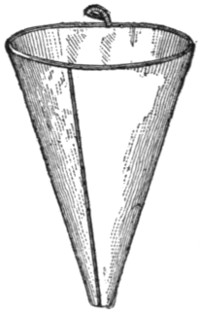
PASTRY-BAG.
This pastry-bag is essential and useful for kitchen and pastry use, being both facile and economical, but care must be taken to wash it thoroughly, and immediately after using it, and to let it dry perfectly, otherwise it will soon become useless.
1080. How to Clean and Prepare Sultana Currants and Raisins for Pastry.
—To avoid the trouble of preparing them each time they are needed, it were better to clean many at a time, for they will keep in perfect condition for five or six months, if put away in a well-closed tin box. Procure ten pounds of currants or Sultana raisins, lay them on a table, and should they be damp, dredge a little flour over to prevent them adhering to the hands. Rub them thoroughly, then take a wire sieve, No. 3 (or as fine a one as will prevent them passing through), place the currants on it, and shake them well for two or three minutes, so that they be perfectly free from flour and stalks. Lay the sieve containing the currants in a large dish-pan, filling it to the level of the sieve with hot water, then, with a skimmer, stir them, so that they get washed thoroughly for at least five minutes. Lift up the sieve, and let them drain in the same for three minutes. Cover an iron oven-pan with a sheet of brown paper, pour the currants on it, spreading them out evenly, and set it in a very slow oven for ten minutes; remove, and lay them aside in the warmest spot on the kitchen shelf, and leave them to dry thoroughly for at least two days. If in the country, the pan can be left out in the sun during the day. When dry, lay them on the table, and should any more foreign matter be found among them, pick it out carefully with the fingers, and examine them well to see whether they be free of stones, stalks, stems, sand, &c. When finished, put them away in a closed tin box, and they will then be ready for use.
1081. How to Clean Malaga Raisins.
—Have as many Malaga raisins as deemed necessary, but it were better to purchase five pounds at a time. Lay the raisins on a table, have a bowl of cold water on the right hand, and the raisins in front; pick off the dry stalks adhering to them, then, either using a small knife or the fingers, pick out the seeds, taking care to wet the fingers in the bowl of water, so as to prevent them sticking while seeding them. Close up again, giving them their original form; when finished, put them in a tin can, cover well, and place in a moderate temperature for use when required. Raisins prepared in this way will surely keep six months.
1082. Mince Pie.
—Put into a vessel two ounces of currants, prepared as for No. 1080, two ounces of Sultana, and three ounces of Malaga raisins, as for No. 1081, one ounce of finely chopped citron, two ounces of well-chopped, cold, boiled beef, and two ounces of beef-suet, also chopped very fine. Mix the whole well together for five minutes, then add one ounce of powdered sugar, a saltspoonful of salt, one drachm of ground allspice, half a drachm of ground cloves, half a drachm of ground cinnamon, and mix together for one minute. Peel, core, and chop up very fine three large, sound apples, add them to the preparation, then pour in half a gill each of brandy and sherry wine, mixing again for three minutes. Take half a pound of pie-paste as for No. 1077, cut out a piece of three ounces, roll it round-shaped, ten inches in diameter, and lightly butter a pie-plate nine and a half inches in diameter. Arrange the paste over, and pour the preparation in the centre, flattening it evenly, and leaving an inch space clear around the edge of the plate; take the remaining five ounces of paste, roll it out round-shaped, the same as before, fold it in two, and, with a knife, make incisions in the centre, of half an inch each. Moisten lightly the edge of the plate with a little beaten egg, then cover with the paste, pressing down with the hand all around the edge, so as to inclose the preparation entirely, then moisten the surface slightly with the beaten egg. Place in a moderate oven, and let bake for fifty minutes; remove it to the oven-door, sprinkle plenty of powdered sugar over, return it to the oven, closing the door for two minutes, so that the sugar melts entirely, then slide it carefully onto a dessert-dish, and serve either hot or cold.
1083. Apple Pie.
—Peel, core, and slice four medium-sized, fine, sound apples; put them into a vessel, and add three ounces of powdered sugar and a saltspoonful of ground cinnamon. Have a plate covered as for the above (No. 1082); arrange the apples on top, cover, and finish exactly the same as for the mince pie. Serve cold.
1084. Pear Pie.
—Peel and slice six medium-sized, fine, sound, pears; put them into a vessel with three ounces of powdered sugar; put this over a lined plate, and proceed exactly the same as for mince pie (No. 1082).
1085. Rhubarb Pie.
—Pare off the leaves, and peel the stalks neatly from two bunches of fine rhubarb, cut them into small pieces about half an inch long, and put them in a vessel with three ounces of powdered sugar; mix well; lay them on the pie-plate, cover, and bake the same as for mince pie (No. 1082).
1086. Lemon Pie.
—Take one and a half pounds of apple sauce (No. 1328), put it in a vessel, adding one ounce of powdered sugar, and one ounce of corn-starch; grate in the peel of a medium-sized lemon, squeezing in the juice of two others, and mix the whole well together with a spatula for three minutes. Pour the preparation over a lined plate, as for mince pie (No. 1082), cover, and finish exactly the same.
1087. Pineapple Pie.
—Procure a medium-sized, fine, sound, pineapple; pare, peel, and slice it into fine slices, laying them in a vessel, and mixing in three ounces of powdered sugar. Have a pie-plate lined with paste, as for mince pie (No. 1082), spread over one tablespoonful of apple sauce (No. 1328); arrange the pineapple nicely on top, then take three ounces of pie-paste, roll it out lengthwise, two feet long, and fold it carefully in two, so as to make a long narrow strip; roll it slightly again until about thirty inches long by one wide, paring off both sides evenly, so as to have it exactly the one inch in width. Moisten the edge of the pie-plate with beaten egg, and arrange the strip around, fastening the two ends together, one over the other; glaze the surface of the strip with beaten egg, then place the pie in a moderate oven, and let bake for fifty minutes. Remove to the door, dredge the pie well with powdered sugar, return to the oven for two minutes to allow the sugar to melt, then spread evenly over the top two ounces of apple jelly (No. 1327), and send to the table.
1088. Pear Pie, Open.
—Peel and slice six medium-sized fine and sound pears; place them in a vessel with three ounces of powdered sugar, mix well, and proceed exactly the same as for pineapple pie (No. 1087).
1089. Huckleberry Pie.
—Put in a vessel one pint and a half of well-picked and cleaned huckleberries, add two ounces of powdered sugar, mix well, and proceed the same as for pineapple pie (No. 1087).
1090. Fresh Currant Pie.
—Put in a vessel a pint and a half of well-picked and cleaned currants, with four ounces of powdered sugar, and proceed exactly the same as for pineapple pie (No. 1087).
1091. Gooseberry Pie.
—To be prepared the same as the above (No. 1090), only using one pint and a half of gooseberries instead of the currants.
1092. Peach Pie.
—Wipe neatly and slice eight fine, sound, medium-sized peaches; put them in a vessel with three ounces of powdered sugar, and proceed exactly the same as for pineapple pie (No. 1087).
1093. Green-gage Pie.
—Select one dozen ripe, sound, green-gages; cut them in two, remove the stones, and put them in a vessel with three ounces of powdered sugar. Finish the same as for pineapple pie (No. 1087).
1094. Plum Pie.
—To be prepared as for the above (No. 1093), substituting one dozen plums for the green-gages.
1095. Strawberry Pie.
—Have a pie-plate lined as for pineapple pie (No. 1087), lay in three-quarters of a pound of apple sauce (No. 1328), arrange the strip around, then place it in the oven for thirty minutes only; remove to the oven door, dredge profusely the strip with powdered sugar, return to the oven, close the door, and leave it for two minutes to let the sugar melt. Take it out, and let it get thoroughly cold, then, with a spoon, remove half of the apple sauce, and fill the interior with a pint and a half of well-picked and cleaned strawberries, mixed with two ounces of powdered sugar. Spread two ounces of apple jelly (No. 1327) evenly over the strawberries, and serve.
1096. Raspberry Pie.
—Have the pie prepared exactly the same as for strawberry pie (No. 1095), and fill it with a pint and a half of well-picked and cleaned raspberries mixed with two ounces of powdered sugar, and spread evenly over the top two ounces of apple jelly (No. 1327); then serve.
1097. Blackberry Pie.
—Blackberry pie is to be prepared exactly the same as strawberry pie (No. 1095), only substituting a pint and a half of well-picked and cleaned blackberries for the strawberries.
1098. Cherry Pie.
—Procure two pounds of fine, sound cherries; pick off the stalks, then stone them with the hands, and place them in a vessel with four ounces of powdered sugar, mixing well. Have ready a lined pie-plate, fill it with the cherries, arrange the strip around, and proceed the same as for pineapple pie (No. 1087), then serve.
1099. Pumpkin Pie.
—Have a deep pie-plate, one and a half inches deep by nine and a half wide; line it with four ounces of pie-paste (No. 1077). Cut a two-pound piece off a sound pumpkin, peel it well with a knife, remove the seeds and soft parts, then cut it into twelve pieces; place them in a saucepan with three quarts of cold water, leave the pan on the hot stove, and let cook for twenty-five minutes. Take from the fire, put the pumpkin in a drainer, leaving it for one hour, then press out the water thoroughly with the hand, and rub it through a sieve into another vessel. Add two ounces of powdered sugar, and break in three whole eggs; add a saltspoonful of ground cloves, a saltspoonful of ground allspice, half a saltspoonful of salt, and the same quantity of cinnamon; mix all together for two minutes, and pour in half a pint of cold milk, mixing well again for one minute, then strain through a sieve into another vessel, and use the preparation to fill up the pie-plate, then lay it carefully in a moderate oven, and let bake for thirty minutes. Take it from the oven, put aside to cool, and cut it into six equal parts; dress them on a dessert dish with a folded napkin, sprinkle liberally with powdered sugar, and serve.
1100. Custard Pie.
—Put four ounces of powdered sugar into a vessel; break in five whole eggs, and with a pastry whip beat together for three minutes. Add one quart of cold milk, and flavor with a teaspoonful of lemon essence; mixing well together for two minutes longer; strain through a sieve into another vessel. Have a deep pie-plate lined exactly the same as for pumpkin pie (No. 1099), and fill it with the above preparation. Place it in a moderate oven, and let bake for thirty minutes, then remove, and let get thoroughly cold; cut the pie into six equal pieces, and with the blade of a knife dress them onto a dessert-dish with a folded napkin, and serve.
1101. Cocoanut Pie.
—Prepare and proceed exactly the same as for custard pie (No. 1100), and when filled, before placing it in the oven, spread evenly over six ounces of dried cocoanut; baking and serving it exactly the same.
1102. Lemon Cream Pie, Méringué.
—Boil one pint of water in a saucepan; put in another vessel four ounces of powdered sugar, mix in one ounce of corn-starch, grate in the rind of a sound lemon, squeezing in the juice, and mingle well together with the spatula for one minute. Break in two whole eggs, beat all together for one minute, and add it to the boiling water in the pan, stirring sharply with a wire whip until it comes to a boil; then take from off the fire. Have ready a lined, flat pie-plate as for mince pie (No. 1082), put it in the oven, and let it bake for ten minutes, so that the crust gets a good golden color. Remove from the oven, and pour the preparation into it, then let it get thoroughly cold. Beat in a copper basin three egg whites to a stiff froth, using a wire pastry-whip; mix in three ounces of powdered sugar, and with a spoon lay half of it over the pie, using a knife to flatten it evenly on the top and sides. Slide down a fancy tube (No. 3) into a pastry-bag (No. 1079), and pour the rest of the froth into it, then decorate the top of the pie artistically, laying it in any fanciful design. Sprinkle plenty of sugar over, place it in a slow oven for ten minutes to let get a pale brown color, then remove it, put it away to cool, slide it carefully onto a dessert-dish, and send to the table.
1103. Apple Pie, Méringué.
—Butter and line a pie-plate as for mince pie (No. 1082); put in a vessel one pound of apple sauce (No. 1328), one ounce of powdered sugar, and one ounce of corn-starch. Mix well for one minute, then grate in the rind of a sound lemon, squeezing in the juice as well; add half a saltspoonful of grated nutmeg, and mix the whole well together for two minutes, then with this fill the pie-plate. Place it in the oven, and let bake for twenty minutes; remove, let get thoroughly cold, and finish the same as for lemon pie, méringué (No. 1102), serving it as for the above.
1104. Cranberry Pie.
—Put one quart of fresh cranberries in a saucepan with a gill of cold water and three ounces of powdered sugar; place on a hot stove, stir lightly with the spatula, and let cook for fifteen minutes. Remove from the fire, and rub through a sieve into a vessel, then pour it into a lined pie-plate, the same as for mince pie (No. 1082). Place it in the oven, and let bake for twenty minutes, then take it out, and let cool thoroughly, and finish by decorating it exactly the same as for lemon cream pie, méringué (No. 1102); return it to the oven for ten minutes, then serve as for the lemon pie.
1105. Pie à la Martha Washington.
—Peel four ounces of almonds; put them in a mortar with two ounces of powdered sugar, then pound them thoroughly, adding gradually one raw egg. When well pounded, add two ounces more of powdered sugar, two ounces of melted fresh butter, half a gill of rum, half a saltspoonful of ground cinnamon, six drops of orange-flower water, and break in another whole egg. Pound the whole briskly for five minutes, then add two ounces of well-pounded macaroons (No. 1210), and mix again for two minutes more. Line a pie-plate as for mince pie (No. 1082), pour all the preparation over, cover, and bake exactly the same as for the mince pie; when arranged on a dessert-dish, decorate the top and sides artistically with two ounces of candied cherries, three ounces of pear, one of angelica, two of apricot, and two of pineapple, all the fruits being candied, then send to the table.