POLITICAL SONGS AND SQUIBS.
Reading edition
THEODORE HOOK.
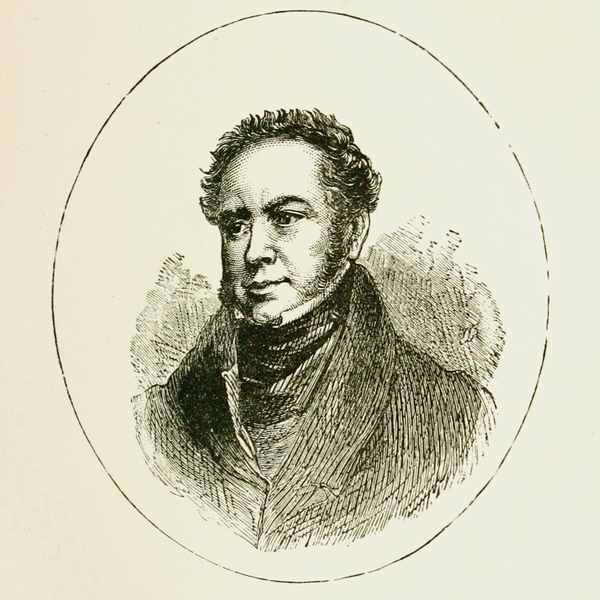
FROM A DRAWING MADE BY MR. EDDIS For the collection of Mr. Magrath, long the respected Secretary of the Athenæum Club.
POLITICAL SONGS AND SQUIBS.
[The following is from The Arcadian, a magazine which Hook edited and principally wrote in 1820, and which only reached two numbers.]
CARMEN ÆSTUALE.
A Song for the Summer, to be sung by J. C. H——, Esq.,[19] now a Prisoner in His Majesty's Gaol of Newgate.
Tune—"Whare ha' ye bin a' the day, my boy Tammy?"
Where have ye been a' the Spring, My boy Cammy? Where have ye been a' the Spring, My boy Cammy? I have been in Newgate keep, Doomed to dine, to drink, to sleep, Side by side with rogue and sweep, In dungeon dark and clammy.[20] What took you to Newgate keep, My boy Cammy? What took you to Newgate keep, My boy Cammy? I did once my goose-quill take, To shew a Whig a small mistake. Did you do't for freedom's sake? Freedom's my eye and Tammy! What then did you do it for, My boy Cammy? What then did you do it for, My boy Cammy? Because I thought if I were sent To jail, for libelling Parliament, I might chance to circumvent Next election, Lamby.[21] How would that throw out George Lamb, My boy Cammy? How would that throw out George Lamb, My boy Cammy? Because, with tag-rag and bobtail, Nothing does but going to jail; We have seldom found it fail; Voyez vous, mon ami! How do you make that out, My boy Cammy? How do you make that out, My boy Cammy? See what all the rest have done— Abbott, Burdett, Waddington, Blandford, Hunt, and Wat—son, And now, like them, here am I! Did the Speaker talk to you, My boy Cammy? Did the Speaker talk to you, My boy Cammy? No;—my visit to Papa Wreck'd my prospects of éclat; I was never at the bar, Where I thought they'd ha' me. Why, then, 'tis a stupid job, My boy Cammy? Why, then, 'tis a stupid job, My boy Cammy? No;—because when I come out They'll have a car, without a doubt, And, in triumph, all about, The biped beasts will draw me. You've mistaken quite your game, My boy Cammy; You've mistaken quite your game, My boy Cammy. Of fulsome stuff, like that, we're sick, Besides, we all see through the trick; Before we drag, we'll see you "kick" Before your prison, d—mme!
ASS-ASS-INATION.[22]
"Write me down an Ass."—Shakspeare.
The Earl of Grosvenor is an Ass- —erter of our freedom; And were he Canterbury's Grace, The Gospels in his Sovereign's face, He'd rather throw, than read 'em. My Lord of Grantham is an Ass- —ailer of Black Wooler. But, if this blustering York Hussar Were tried in any real war, 'Tis thought he might be cooler. Lord Enniskillen is an Ass- —enter to Lord Grantham; Bold, generous, noisy, swearing friends— Till they have gain'd their private ends, And that their patrons want 'em. The Earl of Harewood is an Ass- —ured help in trouble; For, when his Lordship condescends, Out of a scrape to help his friends, He only makes it double. The Earl of Morley is an Ass- —istant to Lord Granville; His head outside is rich in shoot; But to beat anything into 't I'd rather thump an anvil. Crazy Lord Erskine is an Ass- —ortment of all follies: He was the first to slur the Queen; But since his trip to Gretna Green, He's wondrous kind to dollies. The good Lord Kenyon is an Ass- —uager of dissension; With feeble voice, and maudlin eye, He would have pray'd for infamy, And granted sin a pension. The Lord Ashburton is an Ass- —iduous attender; No voter for the Queen is stouter, Although he knows no more about her, Than of the Witch of Endor. The Duke of Leinster is an Ass- —ociate whom she flatters; Though, by two uncles he has seen, To hate a King, and love a Queen, Are rather ticklish matters. In short, each Whig Lord is an Ass- —emblage of all merit; And to reward their virtuous lives, May all their daughters and their wives The Queen's good taste inherit. Lord Blessington's a stage-struck Ass- —umer of Lothario; But by his talents, wit, or grace, (Had he but eyes to find his place,) He's fitter for Paddy Cary O! Lord Steward Cholmondeley is an Ass- —imilate Polonius! He dares not blame "the mob-led Queen," Though he best knows, her loves have been What others call erroneous. Lord Arden's an official Ass- —ignee of naval prizes; And, as the moon affects the seas, His loyalty obeys his fees, And with them falls or rises. Lord Hampden is a twaddling Ass- —assin of our patience; This Guelphic Knight, so dire and thin, Rides his white horse in the train of sin, Like Death in the Revelations!
MICHAEL'S DINNER; OR, STAUNCH FRIENDS TO REFORM.
Fair Reform—celestial maid! Hope of Britons!—hope of Britons! Calls her followers to her aid; She has fit ones!—she has fit ones! They would brave, in danger's day, Death to win her!—Death to win her! If they met not by the way Michael's dinner—Michael's dinner! Lambton leads the patriot van; Noble fellow—generous fellow! Quite the dandy of the clan— Rather yellow—rather yellow! Of fair Liberty he tells Tales bewitching—tales bewitching; But they vanish, when he smells Michael's kitchen—Michael's kitchen! Lawyer Brougham is next in rank; Prates like Babel—prates like Babel; He has never eat or drank At Bribery's table—Bribery's table; What, then, now can stop his mouth, In this hot age—in this hot age? 'Tis, if he would tell the truth, Michael's potage—Michael's potage! Hobhouse, who pretends to νους, Cur of Burdett—cur of Burdett; Fired his pop-gun, but the House Never heard it—never heard it; He foresaw, from Canning's lash, Stripes too cutting—stripes too cutting, So he sneak'd away to hash Michael's mutton—Michael's mutton. Where was, on that famous night, Hume the surgeon?—Hume the surgeon? Who pretends to set us right By constant purging—constant purging; No division yet expecting— Fond of work, he—fond of work, he— At the moment was dissecting Michael's turkey—Michael's turkey! Fergusson his place may choose In the bevy—in the bevy; He's the real Taylor's goose, Hot and heavy—hot and heavy— He'd out-do, with sword and flame, Senna-cherib—Senna-cherib. What, that evening, made him tame? Michael's spare-rib—Michael's spare-rib. Thus the social round they form, In Privy-Gardens—Privy-Gardens; And they care about Reform Not three farthings—not three farthings. To yawn and vote let others stay, Who can bear it—who can bear it; They, much wiser, drink away Michael's claret—Michael's claret. While ye thus, in claret, Sirs, Lose your reason—lose your reason; England will recover hers, Lost last season—lost last season! Faction's mobs—Sedition's hordes Must grow thinner—must grow thinner, When plain Common Sense records Michael's dinner—Michael's dinner!
MRS. MUGGINS'S VISIT TO THE QUEEN.
Tune—"Have you been to Abingdon?"
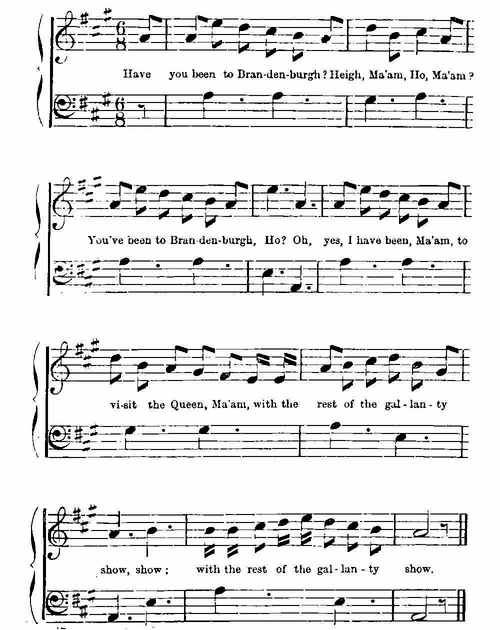
Have you been to Bran-den-burgh? Heigh, Ma'am, Ho, Ma'am? You've been to Bran-den-burgh, Ho? Oh, yes, I have been, Ma'am, to vi-sit the Queen, Ma'am, with the rest of the gal-lan-ty show, show; with the rest of the gal-lan-ty show.
And who were your company—Heigh, Ma'am, ho, Ma'am? Who were your company, ho? —We happen'd to drop in, With Gem'men from Wapping, And Ladies from Blowbladder-Row——Row, And Ladies from Blowbladder-Row. What saw you at Brandenburgh,—Heigh, Ma'am, ho, Ma'am? What saw you at Brandenburgh, ho? —We saw a great dame, With a face red as flame, And a character spotless as snow——snow, And a character spotless as snow. And what said her Majesty—Heigh, Ma'am, ho, Ma'am? What said her Majesty, ho? —What I understood's, She's come for our goods, And when she has got them, she'll go——go, And when she has got them, she'll go. And who were attending her—Heigh, Ma'am, ho, Ma'am? Who were attending her, ho? Lord Hood for a man, For a Maid, Lady Anne, And Alderman Wood for a beau——beau, And Alderman Wood for a beau. And the Alderman's family—Heigh, Ma'am, ho, Ma'am? The Alderman's family, ho? —Yes—Georgy, and Kitty, One fat—t'other pretty, And the son who was brought up at Bow——Bow, The son who was brought up at Bow. And had she no Countesses—Heigh, Ma'am, ho, Ma'am? Had she no Countesses, ho? —O yes!—painted Jersey, Who might have worn kersey, Had folks their deserts here, below——low, Had folks their deserts here below. And had she no other, Ma'am—Heigh, Ma'am, ho, Ma'am? Had she no other, Ma'am, ho? —There was one Lady Grey, Whose temper, they say, Like her Lord's, is as sweet as a sloe——sloe, Like her Lord's, is as sweet as a sloe. Was no one from Croxteth there—Heigh, Ma'am, ho, Ma'am? No one from Croxteth there, ho? —Oh, no—Lady Sefton Would sooner have left town, Both her and her daughters—than go——go, Both her and her daughters—than go. And had she no Commoners—Heigh, Ma'am, ho, Ma'am? Had she no Commoners, ho? —I happen'd to look, And could find in her book Only Fergusson, Taylor, and Co.——Co., Fergusson, Taylor, and Co. And had she no son-in-law—Heigh, Ma'am, ho, Ma'am? Had she no son-in-law, ho? —Yes; time-serving Leopold, A puppet that we uphold, Though neither for use nor for show——show, Neither for use nor for show. And did they meet tenderly—Heigh, Ma'am, ho, Ma'am? Did they meet tenderly, ho? —They were both so intent, About taxes and rent, That they never once thought of their woe——woe, They never once thought of their woe. And had she no Counsellors—Heigh, Ma'am, ho, Ma'am? Had she no Counsellors, ho? —Yes; one Mr. Brougham, Who sneak'd out of her room, Pretending the Circuit to go——go, Pretending the Circuit to go. How fared he at Lancaster—Heigh, Ma'am, ho, Ma'am? How fared he at Lancaster, ho? —They physick'd and bled, And they blister'd his head, And kept him uncommonly low——low, And kept him uncommonly low. Had she no solicitor—Heigh, Ma'am, ho, Ma'am? Had she no solicitor, ho? —Yes, one Mr. Vizard, Who, being no wizard, She overboard hasten'd to throw——throw, She overboard hasten'd to throw. And has she two Chamberlains—Heigh, Ma'am, ho, Ma'am? Has she two Chamberlains, ho? —Yes! both strapping fellows, Would make a man jealous, With whiskers as black as a crow——crow, With whiskers as black as a crow. And had she no beggar's brat—Heigh, Ma'am, ho, Ma'am? Had she no beggar's brat, ho? —Yes, one, pale and silly, Whom she calls Sir Billy; But whose brat he is, I don't know——know, But whose brat he is, I don't know. And has she a Clergyman—Heigh, Ma'am, ho, Ma'am? Has she a Clergyman, ho? —Yes, one Doctor Fellowes, Who puffs like a bellows, The coals of sedition to blow——blow, The coals of sedition to blow. And has she no General—Heigh, Ma'am, ho, Ma'am? Has she no General, ho? —Yes, poor prating Wilson, Who, if he e'er kills one, 'Tis more by a word than a blow——blow, 'Tis more by a word than a blow. And has she a Banking-house—Heigh, Ma'am, ho, Ma'am? Has she a Banking-house, ho? —When Coutts was unhandsome, She shifted to Ransome, To whom she does nothing but owe——owe, To whom she does nothing but owe. Has she a good table, Ma'am—Heigh, Ma'am, ho, Ma'am? Has she a good table, Ma'am, ho? —There is one Mrs. Wilde, Who her cook-maid is styled, But they say that her soups are so-so——so, They say that her soups are so-so. And what are her drinkables—Heigh, Ma'am, ho, Ma'am? What are her drinkables, ho? —It being but noon, She said 'twas too soon For any thing else but Noyeau——yeau, Any thing else but Noyeau. And has she a bed-fellow—Heigh, Ma'am, ho, Ma'am? Has she a bed-fellow, ho? —I asked one Vassalli, Who said, "Fi-donc, allez, Ma chère, you no business to know——know, You have no business to know." How spent she her time abroad—Heigh, Ma'am, ho, Ma'am? How spent she her time abroad, ho? —In hugging her valet, And dancing a ballet, And kissing Pope Pius's toe——toe, Kissing Pope Pius's toe. Was she at Jerusalem—Heigh, Ma'am, ho, Ma'am? Was she at Jerusalem, ho? —She borrow'd an ass, To ride on—but, alas! She couldn't get donkey to go——go, She couldn't get donkey to go. What did she in Africa—Heigh, Ma'am, ho, Ma'am? What did she in Africa, ho? —She set, at Algiers, All the Turks by the ears, Till they found she was fifty or so——so, Till they found she was fifty or so. What did she in Lombardy—Heigh, Ma'am, ho, Ma'am? What did she in Lombardy, ho? —Her tradesmen she pilfer'd, Bamboozled Lord Guilford, And choused Marietti and Co.——Co., And choused Marietti and Co. What did she at Napoli—Heigh, Ma'am, ho, Ma'am? What did she at Napoli, ho? —With sorrow I speak it, She went, mother—naked, And laurell'd the bust of King Joe——Joe, And laurell'd the bust of King Joe. Will she have a drawing-room—Heigh, Ma'am, ho, Ma'am? Will she have a drawing-room, ho? —Oh, yes, I presume, That she might find a room, If she could but find any to go——go, If she could but find any to go. Will she soon sail for Italy—Heigh, Ma'am, ho, Ma'am? Soon sail for Italy, ho? —She'll go there no more, Since what Barbara swore, She fears German spies on the Po——Po, She fears German spies on the Po. Will she go to Switzerland—Heigh, Ma'am, ho, Ma'am? Will she go to Switzerland, ho? —She says that the Swiss, Never tell when they kiss, So she's all for the Paÿs de Vaud——Vaud, She's all for the Paÿs de Vaud.
HUNTING THE HARE.
Would you hear of the triumph of purity? Would you share in the joy of the Queen? List to my song; and, in perfect security, Witness a row where you durst not have been: All kinds of Addresses, From collars of S.S.'s To venders of cresses, Came up like a fair; And all thro' September, October, November, And down to December, They hunted this Hare! First there appear'd, with the title of visitors, Folks, whom of fair reputation they call, Who, in good truth, and to candid inquisitors, Seem to have no reputation at all, The Woods', hen and chicken, And Damer, moon-stricken, And Russells, come thick in, To greet the fat dame; And the Duchess of Leinster, (Well behaved while a spinster,) With drabs of Westminster, Now mixes her name! Next, in great state, came the Countess of Tankerville, With all the sons and the daughters she had; Those who themselves are annoy'd by a canker vile, Joy to discover another as bad: So Lady Moll came on, With ci-devant Grammont, And (awful as Ammon) Her eloquent spouse! And frothy Grey Bennett, That very day se'nnight, Went down in his dennett, To Brandenburgh House. Bold, yet half blushing, the gay Lady Jersey, Drove up to the entrance—but halted outside, While Sefton's fair tribe, from the banks of the Mersey, Who promised to keep her in countenance—shyed! But this never hinders The sham Lady Lindors, Who stoutly goes indoors— Old Rush does the same; Great scorn of all such is!— But Bedford's brave Duchess, To get in her clutches, Delighted the dame. Lank Lady Anne brought her sister of Somerset; The least she could do for the wages she clears: If the merits of either were up to the hammer set, They'd fetch much the same as Lord Archibald's ears. Not so Lady Sarah, For she, under care o' Some Hume or O'Meara, Lies sick in her bed; Yet her name they twist in By means they persist in Of even enlisting The names of the dead! Then came the premature wife of her pen-man, Her guide, her adviser—in short, Mrs. Brougham, And then the spare rib of Go-sin-no-more Denman, And sweet Mrs. Williams, and young Mrs. Hume; Old Barber, and Taylor, And Hood, could not fail her. But the Muse can't detail, or Discuss what remains;— Except Mrs. Wilde, Who, for roast and for boil'd, While as cook-maid she toil'd, Was the pride of Devaynes. The Earl-King, fearing the tumult should ever end, Sends her his brother, while he keeps away; Honour'd by courtesy, by his gown reverend, But neither by nature, came sanctified Grey, With the Norwich Archdeacon, Who thinks he may speak on, Because, like a beacon, His head is so light; And sea-beaten Madocks, And some other sad dogs, Who (like stinking haddocks) By rotting grow bright. Damsels of Marybone, deck'd out in articles, Borrow'd of brokers for shillings and pence; The eye of vulgarity any thing smart tickles; Drabs love a ride at another's expence; So swarming like loaches, In ten hackney coaches, They make their approaches And pull at the bell; And then they flaunt brave in, Preceded by Craven, And, clean and new shaven, Topographical Gell. Next came a motley assemblage of what I call Mummers, and mountebanks, wildly array'd; Hod-men, and coal-heavers, landmen and nautical, Tag-rag and bobtail, a strange masquerade! A rout of sham sailors, Escap'd from their jailors, As sea-bred as tailors, In Shropshire or Wilts: But mark Oldi's smile and hers, Greeting, as Highlanders, Half a score Mile-Enders, Shivering in kilts! Noel and Moore are the pink of her quality, Judge what must be the more mean partisans! What sweepings of kennels—what scums of rascality— Hired and attired to enact artisans; Sham painters, and stainers, Smiths, coopers, cordwainers, And glaziers—chief gainers, In such a turmoil, Though chandlers and joiners, And forgers and coiners, And pocket-purloiners, All share in the spoil. Verdant green-grocers, all mounted on Jack-asses, (Lately called Guildfords, in honour of Fred,) Sweet nymphs of Billingsgate, tipsy as Bacchuses, Roll'd in like porpoises, heels over head! And the better to charm her, Three tinkers in armour, All hired by Harmer, Brave Thistlewood's friend; Those stout men of metal, Who think they can settle The State, if a kettle They're able to mend. Next come the presents—Whitechapel (where Jewsbury) Sends needles to hem Dr. Fellowes's lawn; Cracknells from Cowes—sweet simnels from Shrewsbury— Rump-steaks from Dublin—and collars of brawn— A pig—and a blanket— A sturgeon from Stangate— The donors all thank-ed By Royal desire! Old Parr gave his benison To Parkins's venison, But the pamphlet of Tennyson He threw in the fire. Last came the Lack-wit address of Sir Bunbury, Bearding the Crown with his sinecure wrath! 'Twould look, I fear, too like a libel, to unbury All the exploits of this Knight of the Bath: From service retreated; By Wilson out-prated; Like him, self-created; His star is his sin! It's splendour is lost in The honours of Austin, And Hownam, who crost in With faint-away Flynn! And now, e'er I send off my song to the town sellers, ('Twill fetch rather more than the speeches of Hume,) We'll give one huzza to her pure privy Councillors, Lushington, Williams, Wilde, Denman and Brougham. With Vizard and Cobbett, And Hunt who would mob it, And Cam who would job it As Dad did before; With Waithman the prate-man, And Pearson the plate man, And Matthew the great man, Who found us the hare.[23]
THE CITY CONCERT.
"Paulo Minora canemus."
Tune—"Alley Croker."
When Caroline, the great and big, Was feasted in the City, Sir, United Radical and Whig, In malice or in pity, Sir, Invited every Cockney dame The Royal cause to lift on; No matter what her rank or name, If she had but a shift on. Oh! such shifts! the flaunting belles of Drury Are neat to those of Crooked Lane, Ram Alley, and Old Jewry. A few there were, not so obscure, Who boasted of clean linen; But they, as all their friends assure, Were driven by their men, in; Who thought that after such delay The Queen would be extinguish-ed, Unless the blustering Times could say, That some few were "distinguish-ed." Oh, poor Times! how sad a scrape you have got in, Whose proud distinction is at best, 'twixt addled eggs and rotten. To face at once so rank a crowd The Queen was thought unable, So Thorp, he begg'd to be allow'd To hand her to a table, Where wine, and something better still, That smelt like Maraschino, Might, if administer'd with skill, Give courage to the Queen Oh. Oh the Queen! the sober Queen of Britain, She very soon was in a state an armed chair to sit on. When safely seated in this chair, The females were paraded, And like a showman, the Lord Mayor, The honours of the day did. Mrs. Thorp herself came first, ("Her maiden name was Twigs, ma'am,") Who curtseying low, cried, "May I burst, But I adore your wig, Ma'am. Oh your wig! your wig so black and curl'd, Ma'am, That like the whiskers of a Jew it looks for all the world, Ma'am." The Queen, who thought this speech a scoff, Exclaim'd, "Mon Dieu quel fardeau." So Mrs. Mayor was hurried off, And up flounced Dame Ricardo. Quoth Thorp, "This lady whom you view, Her head so lofty carrying, Is one, whom an Oporto Jew Cut off his son for marrying." Oh the son! his figure would not please ill One whose taste might chance to lie between an owl and weasel. The Queen, at seeing Mrs. Sykes, Was ready to affront her; No German Princess more dislikes These gentry of the counter. "But mean and vulgar as you think her," Said Thorp, "you needs must thank her, Because her dad, though once a tinker, Did become a banker." Oh, the dad! fit sire of such a filly, At the race-ball at Doncaster they call'd her orange-lily. Next Mrs. Wilde the presence graced, The splendour to increase, Ma'am; "Though lowly born, she has a taste, And been, like you, in Greece, Ma'am; And though she wed a peaceful squire, Was for a tar more fitted, For she is used to standing fire, And was brought up at Spit-head." Oh, the fire of poor Devaynes's kitchen, From whose hot coals she stole the blush that makes her so bewitching. Scowling Williams next produces What he calls his family; It is a mode he oddly chooses Down our throats to cram a lie; His real wife is safe in bed, Not dreaming of such folly; Perhaps the fellow, in her stead, Has brought his Vauxhall dolly. Oh, the drab! her crime is doubly heinous, Who could condescend to be that yellow Vulcan's Venus? So far so well; but now the Quire For harmony enlisted, "Threw all the fat into the fire," (As Mrs. Wilde express'd it.) The blundering dogs began to sing, With all their might and energies, "God preserve our noble King, And confound his enemies!" Oh, the Brutes! the Queen was well nigh fainting, And would have blush'd, if one could blush beneath three coats of painting. In anger, for her coach she roar'd, And into it, when ready, She trundled, handed by my Lord, And followed by my Lady. And so they drove home in the dark, The beau and his two graces, Like (as a florist might remark) Under a Hood two faces. Oh, the Hood! convenient garb for lovers, For none but they can truly say how many sins it covers.
INVITATIONS TO DINNER.
On Lord Castlereagh's Calling upon his Friends to Attend Regularly, and not to Give or Accept Invitations to Dinner.
Hark! I hear the sounds of sorrow Fill each office corridor; Castlereagh cries—"From to-morrow, Statesmen, ye must dine no more! "No more let's see each office man on Foot, about the hour of seven, Teazing Arbuthnot and Duncannon, To find a pair until eleven. "No more let's hear Sir George, or Binning, Or Huskisson, or Wellesley Pole, Hinting, in sounds so soft and winning, That soup and fish are apt to cool. "Let Michael spread, in Privy-Gardens, The board for Fergusson and Co.; Let Sefton's cook exhaust his lardings; They but allure away the foe. "But some there are who never dine, (Who ne'er are ask'd to dine, at least,) Who swallow Ayles's tea like wine, And reckon Bellamy's a feast. "They can abjure risolles and pâtés, And we must imitate their powers; Besides, they keep their vigils gratis; We are paid for keeping ours. "But, Placemen! if ye heed my summons, A mental feast I shall prepare; Our House shall truly be, of Commons, And Rickman's roll a bill of fare. "Ley spreads upon the spacious table A cloth—(no matter what its hue), The Chaplain, fast as he is able, Says grace, and bids us all fall to. "Without four soups, I should be loth Such splendid guests to entertain; So Western shall be Barley-broth, And Wood a Potage à la Reine! "Mulligatawney, or Scotch porridge, Either, Mackintosh may be; And—(not his merits to disparage), Spring Rice is Printanier au ris. "For fish—that bench the Speaker's left on Out-rivals Groves', to all beholders; No one can see my good Lord Sefton But thinks of a cod's head and shoulders! "Brougham's crooked shifts, and talents boasted, His slippery tricks no more conceal: Dragg'd into light, cut up, and roasted, What is he but spitch-cock'd eel? "Calvert is Salmon—on a dish Ne'er lay a thicker or a rounder; Palmer's an undoubted fish, And flat enough to be a flounder. "Sir Ronald's Lobster, if you crack His scarlet shell and straggling claws; Old Markham is a muddy Jack; And Warre and Davis Shrimps for sauce. "Of Flesh and Fowl, too, there are plenty:— Taylor is chick for Fricasees; Coke's Norfolk bustard may content ye; Rutlandshire supplies us Geese! "Nugent would a meal afford one Who liked Calves-head without the brain; Rump-steaks we'll slice from generous Gordon, There 'tis cut and come again! "Creevey's Tripe, unsavoury stuff, Fit meat alone for dog or cat he; Henry Bennett is a Puff; And Ossulston a petit pâté. "Hobhouse is Cow-heel—which to cram Would need a true Saint Giles's taste; We'll put aside that dish of Lamb, Too delicate for such a feast. "Grant is a Sheep's pate broil'd and singed, And none more empty or more hot is; Hume is a monstrous bore's-head, fringed And garnish'd round with many a nottice. "Yorkshire puddings, rich in grease, Are the types of Sykes and Wyvill; Guise's brains are Gloucester cheese; Peppery Lamberton is a devil! "Parnell's a potato, mealy, Thick, as ever Ireland grew; Newport's butter-milk; and Heley Hutchinson's an Irish-stew. "For the rest, as housewives tell us, How they serve their broken trash— Wilson, Bernal, Moore, and Ellice, Make an economic Hash! "Come, then, hungry friends, fall to 't, And, if patiently ye dine, Kind Liverpool shall find ye fruit, And jovial Bathurst choose your wine!"
VACATION REMINISCENCES; OR, WHIG OPERATIONS UP TO EASTER.
Tune-"Bow, wow, wow."
A pack of Hounds of Whiggish breed, who sought to get their name up, And all throw off in gallant style whene'er they put the game up, At Brookes's met to form their plans "In vulgum voces spargere"— Not Brookes's Club, as heretofore, but Brookes's great Menagerie. Bow, wow, wow, Tol de riddle, tol de riddle, Bow, wow, wow. When "loaves and fishes" form'd the only object of the chase, Sir, No dogs had better noses, or could go a better pace, Sir; And all excell'd in "giving tongue" whene'er they took their station, To growl about the grievances of this unhappy nation. Bow, wow, wow. Small Bennet, Lushington, and Wood, engaged to raise the ghost of A certain Royal Funeral, already made the most of; While Wilson, in his grief at being laid upon the shelf, Sir, Thought the most important subject for discussion was—Himself, Sir. Bow, wow, wow. Says Joseph Hume, "Though Croker's cuts have made an alter'd mon o' me, I'll still be foremost in the throng for preaching up economy; I'll hunt down all the charges in our armies and our navies"— "And I will be your whipper-in," cries gallant Colonel Davies. Bow, wow, wow. Then Curwen would repeal the tax on tallow, cheese, or leather. Says Calcraft, "I've a better plan, and let us pull together; Vansittart means to ease the Malt, so let us work the Salt Tax— If Salt should be the word with him—why then we'll try the Malt Tax." Bow, wow, wow. Young Normanby—surprising change!—the motley party graces, And wars against his flesh and blood, to prate at useless places; And Hobhouse swears that every place and placeman he will bark at, Except the first Commissioner for Nabob's debts at Arcot. Bow, wow, wow. There's Joseph Yorke, while he a Lord of Admiralty flourish'd, No patriotic schemes of close retrenchment ever nourish'd; But since, O most unlucky day! his "stern was to the board room," He sternly vows for idle Lords we cannot now afford room. Bow, wow, wow. Then Calvert, who, of course, opposes all unfair monopolies, Steps forth to regulate the sale of Bread in the metropolis. "The poor," he says, "shall never have their quartern loaf too dear, Sir, If they will only hold their tongues about the price of Beer, Sir." Bow, wow, wow. Says Creevy, "I must needs confess, when I was at the India Board, I ne'er did much but read the news, or loll upon the window-board; But since my hopes of lolling there again are all demolish'd, I'll prove the whole concern so bad, it ought to be abolish'd." Bow, wow, wow. "I care not who," says Lawyer Brougham, "from place or pension budges; What salaries ye lower, so ye leave alone the Judges; Who knows but I, by chance, may be hereafter for the Bench meant, Then that is surely not a proper object for retrenchment." Bow, wow, wow. "'Tis wisely said," George Tierney cries, who to the last had tarried, "Too far by patriotic feelings some of ye are carried; Economy 'tis very well at times to snarl and bite for, But have a care, lest bye-and-bye there's nothing left to fight for." Bow, wow, wow. But, spite of Tierney, they have things and notices in plenty, too, To keep the Mountain pack at work till June or July, Twenty-two; And there's no doubt they'll do as much to serve the grateful nation, As they had done before they parted for the short vacation. Bow, wow, wow.
REMINISCENCES. (Continued.)
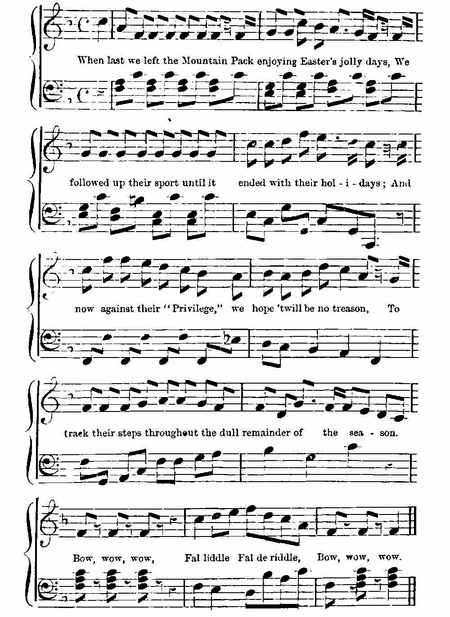
When last we left the Mountain Pack enjoying Easter's jolly days, We followed up their sport until it ended with their hol-i-days; And now against their "Privilege," we hope 'twill be no treason, To track their steps throughout the dull remainder of the sea-son. Bow, wow, wow, Fal liddle Fal de riddle, Bow, wow, wow.
George Tierney is a cunning dog, and prudently does think it, The wisest to run mute, and when a question rises, blink it; To bunglers he has left it to "give tongue" and talk prophetics, To Hume in figures, Cam in Greek, and Bennet in pathetics. Bow, wow, wow. Brougham vents a loud complaint, that Royal influence increases, And holds that Members of the House should give up all their places; But, shifting Master Harry, pray which way would int'rest turn you, If George the Fourth forthwith was pleased to make you his Attorney? Bow, wow, wow. Says Jarvy Sefton, "I've a charming little job in petto, From Salford's ancient County Court some modern fees to get O! Just help me through with that, and I'll cry aye to all your movements, For war, the plague, economy, or any great improvements." Bow, wow, wow. Sir Francis Burdett next appears, once idol of the people, Who says, the thought of raising rents should never make men sleep ill; For, though so pure a patriot, his gains he would increase, Sir, And does not care if quartern loaves five shillings were a-piece, Sir. Bow, wow, wow. But what a noble stir he made on Hunt's incarceration, Because his name he holds in such exalted estimation; He always, to be sure, has shewn for him favour and affection, As witness, how he praised him at the Westminster Election. Bow, wow, wow. Says Bridegroom Coke, "For speaking in the House I've lost my head, Sir; But never mind, I'll tell you what I mean to do instead, Sir, I'll work as hard as I'm allow'd by Anne and the physicians, And send you once a week, at least, a bag full of petitions." Bow, wow, wow. Says Gaffer Western, "Though we once, amongst our many whimsies, Cried out with all our might for gold, and grumbled at the 'flimsies,' Since Ministers now pay in cash, and think to cut a caper, We'll turn about and badger them to pay again in paper." Bow, wow, wow. Then Johnny Russell made a speech, and some of it was pointed, too, About "Reform in Parliament," and "state of things in ninety-two;" But though 'twas call'd a sharp harangue, and he had clearly read for't, He never spoke of throwing open Tavistock or Bedford. Bow, wow, wow. Dull Joseph Hume, the stupidest of all the northern doctors, Fell foul, in his good-natured way, of Royal droits and proctors; And hoped that then five thousand pounds at least disbursed had been, Sir, To satisfy some Captain's claims who—votes for Aberdeen, Sir. Bow, wow, wow. Then Courteney moved, and others thought they could do much better, Than vote a breach of Privilege, a certain printed letter; But when they had its writer up, as all reporters teach, Sir, The House forgot its privilege, and only shew'd its breach, Sir! Bow, wow, wow. Then Abercrombie gentle, seized with one of Quixote's frenzies, Sets off, post haste in chaise and four, to call out Lawyer Menzies; But when he got to Ferrybridge he long'd to join the pack again, So after dinner, he and Althorpe—order'd horses back again. Bow, wow, wow. Wise Scarlett, who is just your man to browbeat, pose, or plead, Sir, Produced a poor-bill, which, 'tis said, was very poor indeed, Sir; And Denman spoke when he'd been made a serjeant in the morning, And what he said betray'd that he'd been dining at the Horn Inn. Bow, wow, wow. While Whitbread, Calvert, Buxton all, kept up the price of beer, Sir, Young Yellow Lambton seem'd to think the poor were charged too dear, Sir; But, though he loves his countrymen, he'd not, to save their souls, Sir, Make any alteration in the present price of coals, Sir. Bow, wow, wow. Grey Bennet having got a list of members holding places, Began to foam of hospitals and of ophthalmic cases; When "scissors cut as well as knives," when patients should take blue pills, His oratory—"all my eye"—the dullest he of pupils. Bow, wow, wow. Then as for Davies, Lennard, Ellis, Hutchinson, and Creevy, Ricardo, Williams, Curwen, Smith, or Moses Bernal Levi; They've done as much as smirking Rice or Thanet's Pat Concannon, Or gaiter'd Michael Angelo, or stiff-neck'd Lord Dungannon. Bow, wow, wow. Then Mackintosh (poor Gerald's friend), who doles out legal knowledge Three times a week to Guinea-pigs at Haileybury College, Conceived the penal laws too hard on rogues of all descriptions, From those who only rob, to those who—carry off subscriptions. Bow, wow, wow. Great Matthew Wood, a citizen, who never can be idle, Brought forward as a mighty hit—the case of Jailor Bridle; Of several other things he spoke, the brightest he of Members, But what they were, nor you, nor I, nor any one remembers. Bow, wow, wow. At length, then, for the present, there's an end to all their labours, The Mountain Pack are now let loose to howl it with their neighbours; And so we bid them thus adieu, until the next campaign, Sir, When if they bark, or snap, or bite, we'll—whip 'em in again, Sir. Bow, wow, wow.
GAFFER GREY.
A Song.
(With alterations and additions) written by the late patriotic Whig Citizen, Thomas Holcroft, and addressed to his Friend and Patron, the Head of all the Whigs.
Ho!—Why do'st thou shiver and shake, Gaffer Grey? And why does thy nose look so blue? "'Tis the people grow cold, And I—prosy and old, And my speeches, they say, are not new, Well-a-day!" Then clap a new tail on the rump, Gaffer Grey, Or the Whiggamores must go to pot "Nay, but credit I've none, All the Grenvilles have run, Except Nugent—who's not worth the shot, Well-a-day!" Then hie to the house—you know where, Gaffer Grey, And steal up the stairs—you know when. "No, 'though roughshod, I swore To march in, through the door, I shall ne'er pass that threshold again, Well-a-day!" There's Brougham, who can shift, like his nose, Gaffer Grey, Who browbeats the Parliament down. "Pshaw, he shifts for himself, Whilst he pockets the pelf, And would sell the whole squad for a gown, Well-a-day!" There's the Patriot in Ilchester Jail, Gaffer Grey, Who will talk by the job—or the day. "He's a low-minded carl, Fit only to snarl, And just as well out of the way, Well-a-day!" There's Hume with his tots and his vots, Gaffer Grey, With his scalpel cuts through thick and thin. "Oh, he's worse than the other, He'd cut up his brother, If only to keep his hand in, Well-a-day!" Little Michael has beeves and fat ale, Gaffer Grey, Buona Roti—surnamed by the pack. "His dinners be d——d; When the starvelings are cramm'd, Duncannon can't whistle them back, Well-a-day!" There's Creevy, your crony of old, Gaffer Grey, Who shew'd up the Board of Control. "He's heavy and lame, And his speeches the same, Are uncommonly prosy and dull, Well-a-day!" There's Wooler, the Bibliopole bold, Gaffer Grey, Who at laws and at lawgivers laughs. "Very well in his way, But I beg leave to say, I've a mortal aversion to Raffs, Well-a-day!" There's Bennet the Arch Philanthrope, Gaffer Grey, Who weeps for man, woman, and brute. "He may weep as he will, If he'll keep his tongue still; But your best sort of weeper's—a Mute! Well-a-day!" There's Lambton, a sure card at hand, Gaffer Grey, Not given to blush or to flinch. "He's a good sort of fellow, Though rather too yellow, And only of use at a pinch, Well-a-day!" There's Lushington, Denman, and Co., Gaffer Grey, And their friend—what's his name—Mister Wood; "No—the sweet Queen is gone, Their vocation is done, And they cannot do harm, if they would, Well-a-day!" There's Sefton the Good!—four-in-hand, Gaffer Grey, And there's Grosvenor the Great!—from his beeves. "One wants for his head A new lining, 'tis said; And the other—some strawberry leaves, Well-a-day!" There's Ossulston, gallant as high, Gaffer Grey, Can prove his descent—without flaw. "He was named for a stick, 'Twas a sad scurvy trick, For he look'd like—a Frog with a Straw! Well-a-day!" Your chance is but bad, I confess, Gaffer Grey, But freedom may still be your butt. "Talk of freedom—my eye! If in the State Pie I could get but a finger, I'd cut,— Happy day!" The times are not yet come to that, Gaffer Grey. What then?—"Whilst there's life there is hope: Though John Bull turns his back On the talented Pack, You may still get Pat Bull from the Pope By your play!"
THE IDLE APPRENTICE TURNED INFORMER.
A New Ballad, by T. C., Esq.[24]
Tune—"When I was Maid, oh then, oh then!"
I once was a placeman, but then, but then, I once was a placeman, but then 'Twas in the pure day Of Lansdowne and Grey, And the rest of the talented men—men! And the rest of the talented men! I had been a lawyer, but then, but then, I had been a lawyer, but then I hated the fag Of the wig and the bag, And envied the Parliament men—men, And envied the Parliament men. So I married a widow, and then, and then, So I married a window, and then Folks wonder'd to see That a woman could be So fond of a face like a wen—wen, So fond of a face like a wen. But she had a borough, and then, and then, She had a borough, and then, By the help of the dame, I got into the same, But never could do it again—again, Never could do it again. So I found out another, and then, and then, So I found out another, and then The worthy Lord Thanet, He chose me to man it, As free——as a sheep in a pen—pen! As free as a sheep in a pen! At last we got power, and then, and then, At last we got power, and then A salary clean Of hundreds fifteen, Made me the most happy of men—men, Made me the most happy of men. The first quarter-day came, and then, and then, The first quarter-day came, and then I reckon'd my score, But I never did more Till quarter-day came round again—'gain, Till quarter-day came round again. Despatches came sometimes, but then, but then, Despatches came sometimes, but then I handed them slyly To Morpeth or Hiley, And limp'd back to Brookes's again—'gain, And limp'd back to Brookes's again. If Ossulston call'd on me, then, oh then, If Ossulston call'd on me then, We stroll'd through the Park, And the folks would remark, We look'd like an owl and a wren—wren, We look'd like an owl and a wren. If I walk'd with dear Sefton, oh then, oh then, If I walk'd with dear Sefton, oh then, The people would stare, And think us a pair Of mummers, that parodied men—men, Of mummers, that parodied men. If I stay'd at the office, oh then, oh then, If I stay'd at the office, oh then, I damn'd all the Hindoos— Look'd out of the windows— And sometimes I mended a pen—pen! And sometimes I mended a pen! Such toil made me sulky, and then, and then, Such toil made me sulky, and then, If I ask'd for old Wright, He came in in a fright, As if to a bear in his den—den, As if to a bear in his den. This lasted a twelvemonth, and then, oh then, This lasted a twelvemonth, and then, To end all our cares, They kick'd us down stairs, As a hint not to come back again—'gain, As a hint not to come back again. The tumble was heavy, and then, oh then, The tumble was heavy, and then I grew very sour At placemen and power, And croak'd like a frog in a fen—fen, And croak'd like a frog in a fen. I vow'd to have vengeance, and then, oh then, I vow'd to have vengeance, and then 'Tis a vulgar belief, At catching a thief, An accomplice is equal to ten—ten, An accomplice is equal to ten. So I turn'd informer, and then, oh then, I turn'd informer, and then I tried to expose My friends and my foes, As equally infamous men—men, As equally infamous men. The Whigs they cashier'd me, and then, oh then, The Whigs they cashier'd me, and then Grey haughtily swore He'd trust me no more, Not even with cutting a pen—pen, Not even with cutting a pen. Next Canning chastised me, and then, oh then, Next Canning chastised me, and then, If what is called shame, Were aught but a name, I could ne'er show my visage again—'gain, I could ne'er show my visage again.
THE QUEEN'S SUBSCRIPTION.[25]
Tune—"The Black Joke."
Whoe'er knows St. James's, knows where the Whigs met In behalf of the Queen, a subscription to get, For her Black Wig and her Character white. By Truth and by Wisdom supported she stood— Truth's part play'd by Brougham, that of Wisdom by Wood— They cursed, and they swore that she ne'er did amiss, Though the Baron, they own'd, was so rude as to kiss The Black Wig with the Character white. At Brookes's they met—but demurr'd to the call Of producing the cash—as they had none at all For the Black Wig and the Character white. Coke growl'd about rents, swore the funds ought to pay; But Baring grimaced, and Ricardo squeak'd "Nay!" And the young ones exclaim'd, in a querulous tone, They each had to pay for a Saint of their own, With a Black Wig and a Character white. But though the subscription was tardy, and they Had nothing to give, they had plenty to say For the Black Wig and the Character white. Lord Tavistock stammer'd three words in her praise, And Sefton his voice and his shoulders did raise; And Calcraft his nose cock'd, and Grant cock'd his eye, And hypocrite Bennet pretended to cry For the Black Wig and her Character white. Fitzwilliam, that reverend proselyte, rose— (We'll make him speak verse since he cannot speak prose) For the Black Wig and her Character white. "You seem," quoth the sage, "all averse to give cash, And, in truth, you are right—what is money but trash?" Let's give something better to end all these quarrels, And raise a subscription of virtue and morals, For the Black Wig and her Character white. Besides, 'tis no merit one's surplus to share, Then let us give that which the least we can spare To the Black Wig and her Character white. For me I have changed all my friends at the brunt, From Fox, Pitt, and Burke, down to Cobbett and Hunt, As fickle in age as I was in my youth: So freely subscribe my political truth To the Black Wig and her Character white. Old Tierney set down, with a sorrowful face, The hopes of his life, all the prospects of place, To the Black Wig and her Character white. The message which Brougham had advised and had penn'd, Poor Tierney had rashly advanced to defend, And not to subscribe would be rather uncivil, So he gives very frankly—he gives—to the Devil The Black Wig and her Character white. Such cheap contributions delighted the pack, And, for once, they were ready their leaders to back, For the Black Wig and her Character white. Silly Billy, God bless him! subscribed all his sense; Of loyalty Grey made a gallant expense; The Gospels, Lord Grosvenor flung down in a boast; And Erskine gave nobly—himself, as a toast; For the Black Wig and her Character white. Bald Bedford, his still balder eloquence gave; And Blessington thought that his coup-d'œil might save The Black Wig and her Character white. Big Nugent bestow'd all his graces upon her, Ned Ellice his credit, and Guildford his honour; The Heathcotes, their sense—both the old and the young— And Hume gave—a notice, and Lambton gave—tongue For the Black Wig and her Character white. By Fergusson back'd, Michael Angelo Taylor Supposed that his statesman-like views might avail her Black Wig and her Character white. Charles Calvert and Hurst their gentility join; And Grenfell was ready, his visage to coin; And Creevy, of other donations bereft, Subscribed all the courage that Warrender left, To the Black Wig and her Character white. Grave Folkstone, who once before leap'd in the dark, Transfers his devotions from Mary Ann Clarke To the Black Wig and her Character white. And Wetherell and Tennyson, soi-disant Lawyers, Would give her their fees—if they had but employers. Scarlett offers his law and his wit too,—for Scarlett Chimes in—as he pleasantly tell us—with Harlot In a Black Wig and a Character white. But some with whom nominal morals ran low, Contrived other modes their devotion to show, To the Black Wig and her Character white. Burdett gave the bond he recover'd from Scott— And Wilson the thanks in the field he had got— And Leinster a visiting card of his rib's— And Foley a draft upon—Howard and Gibbs! For the Black Wig and her Character white. But as to the rest it were tedious to sing, How they sacrificed love of their Country and King, To the Black Wig and her Character white. Such talents, such virtues, how much they surpass Baring's stock, Grenfell's copper, or Lushington's brass! Endow'd with such treasures, who would not dispense With the paltry account of pounds, shillings, and pence, For the Black Wig and her Character white? But when the great Lady was told of the kind Of efforts the Whigs made for raising the wind For her Black Wig and her Character white, She rose in a fury, and roar'd out, "God-zounds! Run, Vizard, secure me Lord Liverpool's pounds; Of the virtues of Whigs I have more than my share, And their talents and truth are not worth half an hair Of my Black Wig and my Character white."
OPPOSITION.
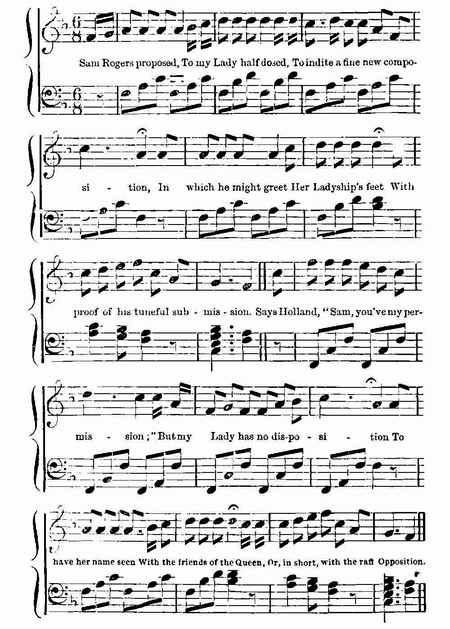
Sam Rogers proposed, To my Lady half dosed, To indite a fine new compo- si - tion, In which he might greet Her Ladyship's feet With proof of his tuneful sub - mis-sion. Says Holland, "Sam, you've my per- mis - sion;" But my Lady has no dis-po - si - tion To have her name seen With the friends of the Queen, Or, in short, with the raff Opposition.
We don't mean to rob Poor Sam of his job, But we have a shrewdish suspicion, It will be fifteen years Before it appears, So painful is Sam's parturition; He's not like the Northern Magician, Who writes while he's shooting or fishing, So we'll borrow Sam's hint, And put into print An ode to the Whig Opposition. There's Tierney, the sly, With his grey sunken eye, Which rolls with a scowl of suspicion, He hates all the Broughams, And despises the Humes, And sits with a look of contrition. He pleads a sham indisposition, And shirks in the House his position; Nor can he be blamed For feeling ashamed To lead such a raff Opposition. There is he whom they call Squire Brougham of Brougham Hall, Who would pass for a man of condition; In blood, to be sure, He may match Peter Moore, But the Hall is a mere imposition; The fellow's a hack politician, A tailor in all but ambition, Who offer'd to bilk For a gown of black silk The Queen—and her whole Opposition. There's Wilson—poor Bob, Who headed a mob, And in consequence lost his commission, Considers it hard, That haranguing the Guard Should be voted an act of sedition; Besides, 'twas his greatest ambition To witness one real ignition; To shot and to danger His skin was a stranger, Till the day of the Park Opposition. There's Sefton, who drives His ladies by fives, In a gig of the latest edition; Which looks like a cart Of the Guards when they start With their wives on a Dutch expedition: He greases with anti-attrition— Would his tongue had the same composition!— For, whenever he speaks, It hitches and squeaks Like the drag of the Bath Opposition. There's little Spring Rice, Of Newport the Vice, Who was painted in last Exhibition, Was ready to swear That Limerick and Clare Were dying from pure inanition; But how did he mend their condition? Did he visit those scenes of perdition? No!—Erin was undone, While he talk'd in London, And smirk'd with the fat Opposition. There's stultified Hume, Who (some people assume) Is an excellent arithmetician, Began as a Tory,— But honour and glory Soon gave such an ass his dismission; Now Joe was a sort of physician, But being no frequent practician, For want of another Dissected his brother, Though the corps made a strong Opposition. There's the new rara avis, The once Colonel Davis, Now Statesman as much as Tactician, He seems to presume To emulate Hume, But, in truth, there is no competition; For Davis sold out his commission— But Hume's more plebeian ambition Is cribbing the winnings Of Constantine Jennings, The hopes of the whole Opposition. Lord Althorpe, who bent His way beyond Trent To challenge a hostile collision, At Ferrybridge found He might choose his own ground, And therefore abandon'd his mission; Then—aware of the force of derision, He spoke on some turnpike petition, And explain'd, without end, How he and his friend Return'd to rejoin Opposition. There's that little thing Bennet— Once turn'd from the Senate, On poor Tyrwhit Jones's petition, The quack, from whom they, Doom'd to Botany Bay, So justly expect manumission. For think what would be his condition, If laws were to have no remission; For, if folks don't tell fibs, Messrs. Howard and Gibbs Have claims on this pure Opposition. The Grosvenor-gate fillies May rail at Achilles, And blush at his naked condition, But Nugent's tight dress,— Which we can't well express,— Is, to us, a more gross exposition. But strange are the freaks of ambition; Which, when a man once sets his wish on, If his head chance to fail, He must try how his tail Can give weight to a light Opposition. There's Williams and Scarlett, Who spoke for "The Harlot," With airs like the Greek Rhetorician; Williams knows some small Greek, But Scarlett can't speak Plain English, without much tuition:[26] In Cambridge, his great erudition Stands as high as Lord Byron's Politian! "Naked feet, naked feet" Will kick through the street Fat Scarlett and his Opposition. There's Wood, who, for hops, Goes offering to shops An excellent new composition, And proves that the plant, The staple of Kent, Is a Tory and vile imposition; But he gets very little commission, The folks eye his drugs with suspicion; The profit much less is Than getting Addresses, Or plate from the Queen's Opposition. There's Creevey, the crawler, That under-bred brawler, Once Clerk to the Indian Commission, He told us himself That the mere love of pelf Had placed him in such a position! A Negro exposed to vendition Would have blush'd to have made such admission; Yet the bird who at best Bewrays his own nest, Is the Phœnix of this Opposition! If we could take part in Debates like Dick Martin, And venture to tell our volition, We should certainly pray, By night and by day, For men in their present position. The country has made its decision, Which needs neither change nor revision; May the King, of his grace, Keep out the whole race Of this wonderful wise Opposition!
THE INVITATION.
(From One of the Patronesses of the Ladies' Fancy Ball.)
Tune—"Run, Neighbours, Run," &c.
Come, ladies, come, 'tis now the time for capering, Freedom's flag, at Willis's, is just unfurl'd; We, with French dances, will overcome French vapouring, And with ice and Roman punch amaze the world: There's I myself, and Lady L. you'll seldom meet a rummer set, With Lady Grosvenor, Lady Foley, and her Grace of Somerset, While Lady Jersey fags herself, regardless of the bustle, Ma'am, With Lady Cowper, Lady Anne, and Lady William Russell, Ma'am. Come, ladies, come, 'tis now the time for capering, Freedom's flag, at Willis's, is just unfurl'd. Oh, such a treat—'twill be pleasant, past conception, Ma'am, Such a crowd of patriot dames were never, never seen; Most of them at Brandenburgh have met a warm reception, Ma'am, And were boon companions of our gracious Queen! In smiles array'd, my Lady Grey, with such a noble work elate, The lemonade, and water-ice, will undertake to circulate, With meat in slices, laid on bread, about the rooms to hand which, is Of course the task of Lady S., the head of all the Sandwiches. Come, ladies, come, 'tis now the time for capering, Freedom's flag, at Willis's, is just unfurl'd. Then, Ma'am, for company!—there ne'er has been a rush in town Half so great as there will be to this Whig thing: Mrs. Brougham and Mrs. Wilde, the Doctor, Mrs. Lushington, Mrs. Ellis, Mrs. Baring, Lord and Lady King; The Duke of Gloucester, Mr. Forster, little Colonel Higgins, Ma'am, Mrs. Barber Beaumont, Mrs. Byng, and Mrs. Figgins, Ma'am; Lady Morgan, Lady Stanhope, old Sir Robert Baker, Ma'am, And Mrs. Smith, and Mrs. Frith, and Lord and Lady Dacre, Ma'am. Come, ladies, come, 'tis now the time for capering, Freedom's flag, at Willis's, is just unfurl'd. Then for amusement, so charmingly diversified; Poets, painters, patriots, peers, will all be there, Wilson's wise letter, by Tommy Campbell versified, Cammy Hob will give us to an old Greek air; Lord Nugent, in silk pantaloons, will dance a grand bolero, And little Moore, to patriot words, will sing us Lil'bulero, And Doctor Hume, his spirits raised by half a pint of Farintosh, Will stump a Highland pas de deux with Gerald's Jemmy Macintosh. Come, ladies, come, 'tis now the time for capering, Freedom's flag, at Willis's, is just unfurl'd. The supper will be Pic-nic—I'm sure I scarce can pen it, Ma'am, But calf's-head soup I know is sent by Doctor Hume; Syllabubs and trifles from Mr. Henry Bennet, Ma'am; And lamb in various shapes and ways by Mr. Brougham. The Maberlys' send mushrooms and saddles two of mutton, Ma'am; A cod's head and shoulders Sefton volunteers to put on, Ma'am; Chicken-pies from Taylor come, and lobsters from Sir Ronald, Ma'am, And gooseberry fool in Scottish pints from Mr. James Macdonald, Ma'am. Come, ladies, come, 'tis now the time for capering, Freedom's flag, at Willis's, is just unfurl'd. Silly Billy volunteer'd to get a royal stag shot, To treat the Whigs with venison, but it would not do; His Highness was unlucky—so he sent a goose from Bagshot, While little Rice has furnish'd us with Irish stew; Lord Nugent sends a round of beef with cucumber and mustard, Ma'am, And Lady Anne from Holkham sends us up a fine old bustard, Ma'am, Peter Moore finds pipes and punch, while Lambton makes the gravies, Ma'am, And many little nameless items come from Colonel Davies, Ma'am. Run, ladies, run, 'tis now the time for capering, Freedom's flag, at Willis's, is just unfurl'd. As for the Spaniards, the Cortes, or King Ferdinand, I hope, dear Ma'am, you'll not suppose I care one pin, A motley ball at Almack's is consider'd quite "a bird in hand" By those, who on the decent nights cannot get in! Then come yourself, I hope you will, and bring your eldest daughter, Ma'am, And Susan Smith, who ran away, if Mr. Smith has caught her, Ma'am; Our husbands wish it, and they pay for every-thing to cram us with, The principle's the same as that which took us all to Hammersmith. Come, madam, come, 'tis now the time for capering, Pleasure's flag, at Willis's, is just unfurl'd.
THE BEGGARS. A New Song.
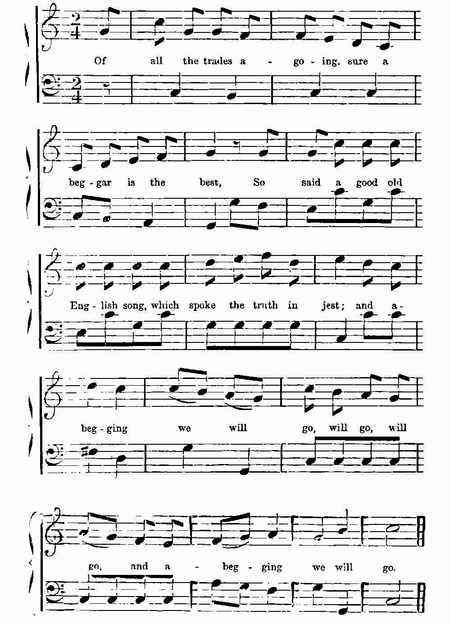
Of all the trades a - go - ing, sure a beg - gar is the best, So said a good old Eng - lish song, which spoke the truth in jest; and a- beg - ging we will go, will go, will go, and a - beg - ging we will go.
Of all the beggars going, who prey on public pence, The Whig excels in wants and woes, in tricks and impudence; So a begging we will go, will go, will go, so a begging we will go. The beggar in the public ways, his ills, as merits shews, Is lame, or blind, or idiot-struck, or wants his hands or toes; When a begging he will go, will go, will go, when a begging he will go. So, by their faults, the starving Whigs attempt to raise the wind, In Council, fools—in action, lame—in understanding, blind; And a begging they do go, do go, do go, and a begging they do go. Old Charles was the leader, the Bampfylde Moore Carew, Of that audacious, lying, tricking, filthy, drunken crew; And a begging he did go, did go, did go, and a begging he did go. This cunning Fox, he pray'd, and whined, and swore from door to door, That fall'n from a good estate, his virtues kept him poor; So a begging he did go, did go, did go, so a begging he did go. In fact, the rogue play'd, wench'd, and drank two sinecures away, And only begg'd to have the means to wench, and drink, and play; So a begging he did go, did go, did go, so a begging he did go. And all the Club at Brookes's, most generous of men— Gave readily, what they were sure of—winning back again. When a begging he did go, did go, did go, when a begging he did go. Scots Gerald next went begging, a sufferer by the law; He sent the French red cap about, sedition's alms to draw; And a begging he did go, did go, did go, and a begging he did go. But, whether this subscription succeeded ill or well, We never heard; but some folks say that Mackintosh could tell; And a begging he did go, did go, did go, and a begging he did go. When bloody Bellingham destroy'd a man he ne'er had known, On the lamented felon's grave their sanguine alms were strown; And a begging they did go, did go, did go, and a begging they did go. To take man's life, by law or war, Whigs count a horrid thing, But this was an assassin of a servant of the King; So a begging they did go, did go, did go, so a begging they did go. When vulgar Hone to market brought his pointless parody, And season'd his sedition with a spice of blasphemy, Then a begging he did go, did go, did go, then a begging he did go. His graceless Grace of Bedford the bold example sets, And pays his mite to comfort him—I wish he'd pay his debts; For a begging they do go, do go, do go, for a begging they do go. And by his sire's example led, my Lord of Tavistock, Subscribes ten pounds, to prove himself—a chip of the old block: And a begging they did go, did go, did go, and a begging they did go. And Sefton on his death-bed, as it was thought to be, Encouraged the blasphemer, just to vex the Ministry; When a begging he did go, did go, did go, when a begging he did go. When Cobbett stole the bones of Paine, it was with the intent To raise a penny rate, to buy a seat in Parliament; And a begging he did go, did go, did go, and a begging he did go. But the pure Whigs of Coventry had quite another sense, And much preferred receiving pounds to giving him their pence; For a begging they do go, do go, do go, for a begging they do go. When guilty of a libel, the bold Burdett was found, And sentenced by a Tory Judge to pay two thousand pound, A begging he did go, did go, did go, a begging he did go. He afterwards refused the aid; but not till the account Had shewn him that they ne'er could raise a quarter the amount, Though a begging they did go, did go, did go, though a begging they did go. From begging for the poor they took to begging for the Great, And begg'd that they might buy the Queen annuities and plate; And a begging they did go, did go, did go, and a begging they did go. We have not heard if their success in this was bad or good, But hope it was the latter, for the sake of Matthew Wood; For a begging he did go, did go, did go, for a begging he did go. A begging he did go indeed, this patriot and sage, But 'twas for his own profit when the Queen went off the stage; And a begging he did go, did go, did go, and a begging he did go. But we have reason to suspect that this subscription pines, And is about as profitable as his Cornish mines; So a begging he will go, will go, will go, so a begging he will go. And next, lest any class of crime, unhonour'd, should escape, The tender Waithman recommends the case of Mr. Snape; And a begging he does go, does go, does go, and a begging he does go. We know not whether Brougham has yet subscribed, but think he must, The crime being only forgery—a petty breach of trust; So a begging they will go, will go, will go, so a begging they will go. When Captain Romeo ran away from Naples, in a funk, With nothing but a pound of maccaroni in his trunk, A begging he did go, did go, did go, a begging he did go. To keep this pilot of the cause of Italy afloat, Enthusiast Bennett's generous hand subscribes—a one-pound note! And a begging he did go, did go, did go, and a begging he did go. We have not breath to spend on all the vicious or the vile— On Wooler, Watson, Waddington, Hunt, Honey, and Carlile, But a begging they all go, all go, all go, but a begging they all go. From all the jails, in all the land, their begging-boxes spread, And e'en the grave, at Faction's call, delivers up its dead; And a begging they do go, do go, do go, and a begging they do go. But lastly comes a beggar-man, who would be knighthood's shame, But that the title he assumes is only a false name; When a begging he does go, does go, does go, when a begging he does go. The soldier, or the sailor, who accosts one in the street, Can shew the scars he got, or tell the enemy he beat; When a begging he does go, does go, does go, when a begging he does go. But here's a bold impostor, the sauciest of the batch, Who never won a fight at all, and never got a scratch; Yet a begging he does go, does go, does go, and a begging he does go. He has not dealt in blows and blood as silly people think, But is a very hero,—in the way of pen and ink; But a begging he does go, does go, does go, but a begging he does go. And thus he can produce us, of the battles he has seen, Certificates on paper—having none upon his skin, When a begging he does go, does go, does go, when a begging he does go. While other soldiers Paris took, and France at freedom set, This rival hero storm'd a jail, and rescued Lavalette. And a begging he did go, did go, did go, and a begging he did go. So as from no French foeman's head he ere won laurel leaf, He hires a French advocate to praise him from his brief; And a begging he does go, does go, does go, and a begging he does go. Thus we have seen subscriptions which disgrace our factious times, For every shade, both light and deep, of follies and of crimes; When a begging they do go, do go, do go, when a begging they do go. For drunkards, gamblers, libellers, thieves, smugglers, defamators, For forgers and blasphemers, and for murderers and traitors, A begging they do go, do go, do go, a begging they do go. To Wilson's list we wish success; because we hope the money Will go to the poor families of Francis and of Hopney; Since a begging they do go, do go, do go, since a begging they do go. For all folks must agree, else differ how they may, That they were kill'd upon the field, whence Wilson sneak'd away; Though a begging he does go, does go, does go, though a begging he does go.
BUBBLES OF 1825.
Tune—"Run, Neighbours, run."
Run, neighbours, run, you're just in time to get a share, In all the famous projects that amuse John Bull; Run, take a peep on 'Change, for anxious crowds beset us there, Each trying which can make himself the greatest gull. No sooner are they puff'd, than an universal wish there is For shares in mines, insurances, in foreign loans, and fisheries: No matter where the project lies, so violent the mania, In Africa, New Providence, Peru, or Pennsylvania! Run, neighbours, run, you're just in time to get a share In all the famous bubbles that amuse John Bull. Few folks for news very anxious at this crisis are, For marriages, and deaths, and births, no thirst exists; All take the papers in, to find out what the prices are Of shares in this or that, upon the brokers' lists. The doctor leaves his patient, the pedagogue his Lexicon, For mines of Real Monte, or for those of Anglo-Mexican: E'en Chili bonds don't cool the rage, nor those still more romantic, sir, For new canals to join the seas, Pacific and Atlantic, sir. Run, neighbours, run, you're just in time to get a share In all the famous bubbles that amuse John Bull. At home we have projects too for draining surplus capital, And honest Master Johnny of his cash to chouse; Tho' t'other day, Judge Abbott gave a rather sharpish slap at all, And Eldon launch'd his thunder from the Upper House. Investment banks to lend a lift to people who are undone— Proposals for assurance—there's no end of that in London; And one amongst the number, who in Parliament now press their Bills, For lending cash at eight per cent. on coats and inexpressibles. Run, neighbours, run, you're just in time to get a share In all the famous bubbles that amuse John Bull. No more with her bright pails the milkman's rosy daughter works, A Company must serve you now with milk and cream; Perhaps they've some connection with the advertising water-works, That promise to supply you from the limpid stream. Another body corporate would fain some pence and shillings get, By selling fish at Hungerford, and knocking up old Billingsgate; Another takes your linen, when it's dirty, to the suds, sir, And brings it home in carriages with four nice bits of blood, sir. Run, neighbours, run, you're just in time to get a share In all the famous bubbles that amuse John Bull. When Greenwich coaches go by steam on roads of iron railing, sir, How pleasant it will be to see a dozen in a line; And ships of heavy burden over hills and valleys sailing, sir, Shall cross from Bristol's Channel to the Tweed or Tyne. And Dame Speculation, if she ever fully hath her ends, Will give us docks at Bermondsey, St. Saviour's, and St. Catherine's; While side-long bridges over mud shall fill the folks with wonder, sir, And lamp-light tunnels all day long, convey Cockneys under, sir. Run, neighbours, run, you're just in time to get a share In all the famous bubbles that amuse John Bull. A tunnel underneath the sea, from Calais straight to Dover, sir, That qualmish folks may cross by land from shore to shore, With sluices made to drown the French, if e'er they would come over, sir, Has long been talk'd of, till at length 'tis thought a monstrous bore. Amongst the many scheming folks, I take it he's no ninny, sir, Who bargains with the Ashantees to fish the coast of Guinea, sir. For, secretly, 'tis known, that another brilliant view he has, Of lighting up the famous town of Timbuctoo with oil gas. Run, neighbours, run, you're just in time to get a share In all the famous bubbles that amuse John Bull. Then a company is form'd, though not yet advertising, To build, upon a splendid scale, a large balloon, And send up tools and broken stones for fresh Mac-Adamizing The new discover'd turnpike-roads which cross the moon. But the most inviting scheme of all, is one proposed for carrying Large furnaces to melt the ice which hems poor Captain Parry in; They'll then have steam-boats twice a week to all the newly-seen land, And call for goods and passengers at Labrador and Greenland! Run, neighbours, run, you're just in time to get a share In all the famous bubbles that amuse John Bull.
THE GRAND REVOLUTION!
Tune—"The Tight Little Island."
"Ye Whigs, now attend, and list to a friend, If you value a free Constitution, Every nerve let us strain for the patriots of Spain, And cry up their brave Revolution. Huzza! for the brave Revolution! Success to the brave Revolution! We'll all to a man, bawl as loud as we can, Huzza! for the brave Revolution! "When Boney invaded their country, and waded Through oceans of blood to make Joe king, We ne'er made a push, and cared not a rush If Spain had a king, or had no king: But then there was no Revolution! No enlightening, wise Revolution! They only fought then, for their king back again, And not for a brave Revolution! "We once made a rout, most valiant and stout, For Naples to throw off her yoke, sirs, But Tories so wary, vow'd base Carbonari Were thieves, and their valour all smoke, sirs! To nought came their grand Revolution! Upset was their grand Revolution! Poor, thick-headed calves, they were rebels by halves And made nought of their grand Revolution! "Then we spouted for weeks, in aid of the Greeks, But they proved rather lax in their works, sirs, For the brave Parguinotes, in cutting of throats, Excell'd e'en the murderous Turks, sirs; So we gave up the Greek Revolution, None thought of the Greek Revolution, Folks cared not a straw whether Turkish Bashaw Ruled the roast—or the Greek Revolution. "But Spain, with true bravery, spurning her slavery, Vows she'll have freedom, or die now, And all that she'll need will be trifles indeed, Such as arms, ammunition, and rhino! Success to her brave resolutions! And just to collect contributions, At dinner we'll meet in Bishopsgate-street, In aid of her brave resolutions!" So to feasting they went, on a Friday in Lent, And muster'd what forces they could, sirs; There was Duke San Lorenzo, with plenty of friends, O, Great Sussex, and Alderman Wood, sirs! The Spaniards push'd hard their petition For money to buy ammunition, But they met with a balk, for Whigs are all talk, With nought else would they help their petition. They didn't ask Hume, for fear, in a fume, At the cost of the war he'd be nibbling, So they left him to fight in the Commons all night, With Palmerston's estimates quibbling. He there with much circumlocution, Moved many a wise resolution, While the still wiser Whigs were feasting like pigs, In the cause of the grand Revolution! Don Holland of Kensington, while his Whig friends in town, Grand tavern-speeches were planning, Wrote a note just to tell the brave Arguelles How much wiser the Whigs are than Canning. "All England one feeling displays, sir, Never mind what the Minister says, sir! At him you may hoot—and the Council to boot, For England is all in a blaze, sir!" As the Whigs had for years rung peace in our ears, When for war the whole nation did burn, sirs, 'Twould surely be hard, if they now were debarr'd From crying for war in their turn, sirs! So Mackintosh made an oration, As bold as a war proclamation, Then finish'd his boast, with this apposite toast, "May peace be preserved to the nation!" Then leave 'em to prate, and spout, and debate, We all know there's nought but a show meant; Let 'em blow hot and cold—be shy, or be bold, As the humour prevails at the moment: Let 'em cry up the grand Revolution! The gallant and brave Revolution! And all to a man—bawl as loud as they can, "Huzza! for the brave Revolution!"
THIS IMITATION OF BUNBURY'S "LITTLE GREY MAN,"
Preserved among the Tales of Wonder, is, without permission, inscribed to a Major-General of the British Army, Knight Commander of the Order of the Bath, Agent for the Ionian Islands, and a Pensioner of the present Administration, &c., &c., &c.
Oh! deep was the sorrow, and sad was the day, When death took our gracious old Monarch away, And gave us a Queen, lost to honour and fame, Whose manners are folly, whose conduct is shame; Who with aliens and vagabonds long having stroll'd, Soon caught up their morals, loose, brazen, and bold. She had traversed the globe in all quarters, to show To what depth of debasement a Princess could go; And with front unabash'd, when her guilt was display'd, The altar insulted with impious parade; Whilst sick with disgust at a scene so profane, Not one decent female would move in her train. She paid a vile rabble to shout round her car, Her teachers, so pious, were Fellowes and Parr; Her councillors, Aldermen Waithman and Wood, Could she find nothing worse? She might try if she could. Abroad there was nothing more low than her groom, At home there are Wilson, Moore, Hobhouse, and Hume. Oh! what will the rancour of party not do! Ye Howards and Russells, this sigh is for you! To an union so base can ye bend your proud will? Yes, great though the peril, unmeasured the ill, Through the country delusion and clamour must ring, And your rivals to strike, you must menace your King. In Suffolk, to aid in so loyal a plan, From Mildenhall upstarts a little dark man; His hue it was bilious, his eyes they were ghast, Long and pale were his fingers that held a quill fast, And grimly he scowl'd, whilst his rancour and spleen Distill'd in a spurious Address to the Queen. How spotless and pure was this paragon shown! How safe, through its friends, an attack on the Throne, Their motives were wicked, their actions were base;— Some wonder'd, no doubt, at so alter'd a case, Who cannot forget, though 'tis plain that he can, The favours they heap'd on this dark little man. From childhood the imp in the Palace was rear'd, Its bounties his parents, his kindred all shared; With rapid advancement, too rapid by half, He outstripp'd the foremost of line or of staff; But soon from the chances of service withdrew, With the profits and safety of office in view. To Liverpool, Bathurst, and colleagues he bow'd; He courted their smiles, and attachment he vow'd; Obtain'd a snug place, with the means to do ill, To some who despised, but remember it still: He was fearlessly trusted, and laugh'd in his sleeve— "Those you mean to betray you must ever deceive." Indulged by his patrons, the confident elf, No talent imagined except in himself; Of the merits of others a censor severe, Even Wellington might not escape from his sneer; But they trusted him still, not suspecting his plan, Ah, little they knew of the dark little man! Next a General's apparel he put on, so new, The coat of fine scarlet, the facings of blue, With gold all embroider'd so costly; and last The loop with the plume that waved high in the blast, 'Twould have vex'd you at heart, if such sights ever can, To have gazed on the dizen'd-out little dark man. That Order, of Heroes the dying bequest, Its ribbon that blush'd as it cover'd his breast; The Star and the Badge that tried valour should wear, As if he had earn'd them, he took to his share: Like a pigmy he climb'd up on Honour's high tree, And blazon'd his name with a large K. C. B. Now the battle of battles was won!!—O'er his foes Triumphant the lion of England arose, And gave peace to the world.—No longer, 'twas plain, The little dark man could his office retain; Reluctant he went, but he pocketed clear, In pension and place, fifteen hundred a year. He growl'd and intrigued but in vain—he is gone! Soon forgotten by most, and regretted by none: But to sink in oblivion he cannot endure, The moment seems tempting, the victims secure. Strike! strike at your friends! The foul blow it was sped, And with terrible justice recoil'd on his head. The little dark man then he set up a yell, And the Hundred of Lackford was roused by the spell; He raised up his head, and he raised up his chin, And he grinn'd, and he shouted a horrible grin, And he laugh'd a faint laugh, and his cap up he cast; But pension and sinecure still he holds fast. When a score and three days make the age of the year, To St. Stephen's, the Lords and the Commons repair: E'er a score and three more, so the King might decree The country another election may see. But the brave men of Suffolk have seen through his plan, And will baffle the arts of the little dark man.
HUMPTY-DUMPTY.
Rich and furr'd was the robe he wore, And a bright gold chain on his breast he bore; But, och! his speaking was far beyond Waithman himself, with his snow-white wand. "Humpty! do'st thou not fear to stray With the Lady, so far from the King's highway? Are Britain's sons so dull or so cold, As still to be cheated with tinsel for gold?" "Mistress Dumpty! I feel not the least alarm— No placemen ever dare do me harm; For though they vote her and me a bore, They love their own heads, and their places more." On he went—in her coach to ride, While he cozen'd the Lady who sat by his side And lost for ever was she who was led By Humpty's honour—and Dumpty's head!
PARODY.
While Johnny Gale Jones the memorial was keeping, Of penny subscriptions from traitors and thieves, Hard by at his elbow, sly Watson stood peeping, And counting the sums at the end of the leaves. But oh, what a grin on his visage shone bright, When, after perusing whole pages of shame— 'Midst his soi-disant betters, In vilely-form'd letters, The Doctor beheld little Waddington's name! "Hail, imp of sedition!" he cried, while he nodded His head, and the spectacles drew from his eyes, "Magnanimous pigmy! since Carlile's been quodded, We wanted some shopman, about of your size! For, though many we've had, yet unbless'd was their lot, When Murray and Sharpe with the constables came, And for want of good bail They were sent off to jail, And their mittimus sign'd with an Alderman's name." Then come, the last crown of thy toils is remaining, The greatest, the grandest that thou hast yet known; Though proud was thy task my placard-board sustaining, Still prouder to utter placards of thine own! High perch'd on that counter, where Carlile once stood, Issue torrents of blasphemy, treason, and shame, While snug in your box, Well secur'd with two locks, We'll defy them to get little Waddington's name.
"THE YOUNG MAY MOON." (A Parody.)
The Old Whig Club is meeting, Duke, 'Tis now the time for eating, Duke, How sweet to joke, To sing and smoke, While these foolish men stand treating, Duke! Then harangue, and not in vain, my Duke, At them again and again, my Duke! The best of all ways To speak in these days, Is to steal a few thoughts from Tom Paine, my Duke! Now all the Whigs are sleeping, Duke, But the mob, through the casement peeping, Duke, At you and your star, Which we really are Surpris'd at your meanness in keeping, Duke! Go home, your task is done, my Duke, The watchmen's boxes shun, my Duke, Or, in watching the flight Of traitors by night, They may happen to take you for one, my Duke!
DISAPPOINTMENT.
Ye Aldermen! list to my lay— Oh, list, ere your bumpers ye fill— Her Majesty's dead!—lack-a-day! She remember'd me not in her will. Oh, folly! oh baneful ill-luck! That I ever to court her begun; She was Queen, and I could not but suck— But she died, and poor Matty's undone! Perhaps I was void of all thought, Perhaps it was plain to foresee, That a Queen so complete would be sought By a courtier more knowing than me. But self-love each hope can inspire, It banishes wisdom the while; And I thought she would surely admire My countenance, whiskers, and smile. She is dead though, and I am undone! Ye that witness the woes I endure, Oh let me instruct you to shun What I cannot instruct you to cure: Beware how you loiter in vain Amid nymphs of a higher degree; It is not for me to explain How fair and how fickle they be. Alas! that her lawyers e'er met, They alone were the cause of my woes; Their tricks I can never forget— Those lawyers undid my repose. Yet the Times may diminish my pain, If the Statesman and Traveller agree— Which I rear'd for her pleasure in vain— Yes, the Times shall have comfort for me. Mrs. W—d, ope your doors then apace; To your deepest recesses I fly; I must hide my poor woe-begone face. I must vanish from every eye. But my sad, my deplorable lay, My reed shall resound with it still:— How her Majesty died t'other day, And remember'd me not in her will.
THEODORE OF PUT-KNEE.
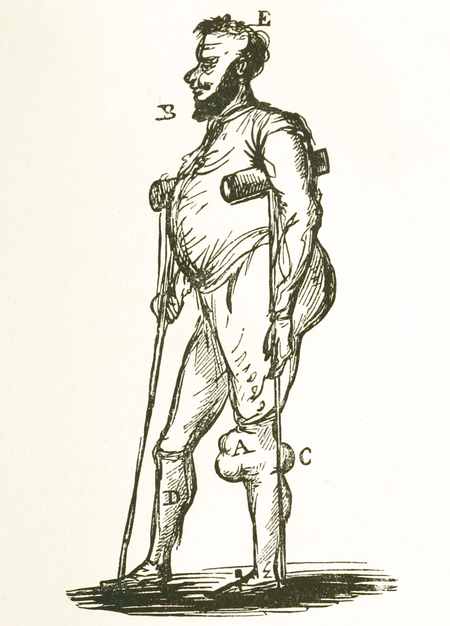
A my bad knee.D my well leg.
B my beard.E the place where my hair was when I was young.
C my crural tendon,
" or muscle—
" or artery—
" or something,—as big as your fist.