MISCELLANIES, IN VERSE AND PROSE. (continued 4)
Reading edition
PROSPECTUS FOR A GENERAL BURYING COMPANY.
Capital, £500,000. Shares, £50.
The immediate object of this institution is to rob death of its terrors, and, by following the example of our Parisian friends, blend the graceful with the grave, and mingle the picturesque with the pathetic:—in short, the directors feel confident, that when their scheme is fully developed, the whole system of inhumation will be changed, and the feelings and associations connected with interments in general, assume so novel a character, that it will be rather pleasant than otherwise to follow our friends and relations to the tomb.
It is proposed to purchase an extensive domain in the neighbourhood of Primrose Hill and Caen Wood, where the diversified undulations of ground, and the soothing commixture of trees and water, afford the most flattering promise of success in the undertaking. No difficulty is anticipated in the purchase of the property, since the will of the late noble owner distinctly points out that it shall remain "grass land" to all eternity; and, "since all flesh is grass," no reasonable objection can be raised to its appropriation as a public cemetery.
The public cemetery, like the Daily Advertiser, will be open to all parties—dead or alive, of all religions, or, indeed, of none; and it does not need the practical knowledge attainable by a visit to the French metropolis to convince the world that by laying out the ground in a parklike manner, with umbrageous walks, alcoves, bowers, and fish-ponds, a link will be created between the past and present generation, and the horrid idea of having deposited a parent, a husband, or a sister, in a cold, damp grave, or a gloomy vault, refined into the agreeable recollection that they repose in a picturesque garden or a shady grove, at an easy distance from the most fashionable part of the town.
The directors intend opening a convenient hotel and tavern on the spot, at which persons visiting the cemetery, either as mourners or in search of quiet retreats for themselves, may procure every sort of refreshment. A table-d'hôte will be constantly prepared at five shillings a-head, for which cold meat and vin de grave will be furnished; and on Tuesdays, Thursdays, and Saturdays, during the summer, after burying-hours, Collinet's band will be regularly engaged for quadrilles, and the grounds illuminated with variegated lamps.
A committee of taste will be appointed to regulate the designs of tombs; and the directors think it may save trouble to state in the outset that no allusions to death, nor any representations of skulls, cross-bones, skeletons, or other disagreeable objects, will be permitted. The Royal Society of Literature will be solicited to revise the inscriptions, epitaphs, and elegies, and twelve ladies belonging to the different corps-de-ballet of the King's Theatre, and the Theatres Royal Covent Garden and Drury Lane, are engaged to enliven the ground as mourners at newly-erected tombs.
These young ladies may be engaged by the day or hour, at a moderate price, and find their own garlands.
Mr. Samuel Rogers is appointed master of the ceremonies, and will appear dressed in the uniform of the establishment.
The directors have appointed Mr. Botibol, of Soho-square, their artificial florist, who will provide all sorts of flowers for strewing graves; but ladies and gentlemen are requested not to leave the decorations on the tombs at night, but to return them to the directress at the bar of the tavern: and, it may be necessary to add, that no ladies will be allowed to appear at the dances with the same ornaments which have been previously used in the grounds funereally.
Lord Graves has been solicited to accept the office of president, and Sir Isaac Coffin that of vice-president. The College of Surgeons will be constant visitors of the Institution, and under such patronage ultimate success appears to be a dead certainty. Ladies and gentlemen wishing to be buried in romantic situations are requested to make early application to Mr. Ebers, of Bond-street, where the grave-book, with a plan of the cemetery, may be seen.
Persons subscribing for family mausoleums are entitled to free admission to all the balls of the season.
Gloves, hatbands, white pocket-handkerchiefs, cephalic snuff, and fragrant essence of onions, for producing tears, to be had of the waiters.
N.B. No objection to burying persons in fancy dresses.
Postscript.—The prospectus says that "an eligible site having offered itself"—this must have been a very curious site indeed—the temptation is too great to be resisted, and the public are invited to unite in a joint stock, "Capital £200,000, in shares of £25 each," to contrive something more agreeable for our resting-places than mere vaults and churchyards, and prepare a retreat, after the fashion of the cemetery of Père la Chaise, in the neighbourhood of that ever gay and lively city—Paris.
"Within this area," continues the prospectus, "public bodies and individuals may obtain ground for interment, and liberty to erect mausoleums and monuments after their own designs; and vaults and catacombs will also be constructed for general use."
This is giving great latitude—mausoleums and monuments erected promiscuously, after the designs of their future inhabitants, will no doubt present a beautiful variety of tastes and elevations. It should seem, however, that the vaults and catacombs are not to be used exclusively for burying, for, in contradistinction to the interments to which the mausoleums and monuments are to be appropriated, the prospectus states that the vaults and catacombs are for general use. Déjeuners à la fourchette, or petits soupers by moonlight, perhaps. We say by moonlight, because illuminating the gardens in the evening does not yet appear to form part of the design.
The following condition we have no doubt will be highly advantageous in a pecuniary point of view to the proprietary, but it sounds disagreeable:—
"Subscribers on or before the 30th day of June, 1830, will be entitled to tickets of precedence, after the rate of one ticket for every five shares; which ticket will entitle the holder to a preference, according to the numerical order of the shares, in the choice of a situation for a grave or a monument. These tickets to be transferable without the shares upon which they shall have been granted, and capable of being held by persons who may not be subscribers or proprietors."
Now, however seriously captious sticklers for rank and pre-eminence may regard the article of precedence, we must say that the case of going out of the world differs a good deal from that of going out of a drawing-room; and we suspect, if the committee of this deadly-lively society could contrive to invert the order of departure, they would dispose of a much greater number of shares than are likely to go off under "existing circumstances." To the pleasure of walking about a burying-ground, with a plan in one's hand, like the Opera House box-book, to select a good place, we confess ourselves somewhat insensible; but we have no doubt that if this job takes, in less than five years we shall see "Graves in a good situation to let," posted at Sams' and Ebers', and "a transferable admission to a catacomb," to be sold for the season, just as a ticket for the pit is at present.
LETTER FROM JOHN TROT TO JOHN BULL.
Sir,—I feel great diffidence in addressing you, and should hesitate a long time before I ventured to throw myself upon your consideration, and through you upon that of the public; but the state of my case is desperate, and since it has recently been decided that beggary is a crime, and that those who dare to relieve distress with their own money are punishable by law, I prefer at once appealing to you.
The fact is, sir, that I am a superannuated lady's footman, my present situation is unbearable—I began the world in the service of the Margravine of Anspach, and was then accounted—I say it with all possible modesty—a remarkably fine young man. Her highness never admitted low persons (I mean in stature) to the honour of her livery; and many a time, until the present Sir Lumley Skeffington chose a cream-coloured coach for her highness instead of a yellow, have I, under favour of the foreign scarlet, been taken for one of the élite of Carlton House.
The Margravine went away, and I became the hanger-on of a duchess's carriage, who shall be nameless, since she is no more. The black breeches and gold bands did not quite suit my taste, and I rejoice to find that they are now out to all intents and purposes. However, speaking figuratively, as well as literally, I hung on until her grace dropped off, then me voilà! I had an offer from the Lord Mayor's household. The livery was handsome, and one changes one's master there, like an almanack, every year; but the Lord Mayors have an unpleasant smell about them, and they go to the Old Bailey and the Blue-coat School, and all those horrible places, where one might catch unpleasant disorders, so I declined, and made a push for Pall Mall—but it would not do.
I then, sir, thought of Mr. Coutts,—the late very respectable banker,—but just as I expected a character from the late Mr. Raymond, of Drury-lane Theatre, he was taken ill and died, and when I was about to renew my negotiations, a melancholy circumstance occurred which determined me not to engage in a place where I might, perhaps, be kicked out at a moment's warning.
There was a house, which shall be nameless, in Surrey, where an opening presented itself, but tallow-candles were whispered to me, and I fell back. I had at that time a fancy for Sir H—— W—— W——'s service, for I thought the sugar-loaf buttons were becoming; but the story about the sister and the annuity disgusted me, and I cut that. So I went on, sipping and smelling and never coming to the point, like Macheath, in the operative mendicant's opera; for I was made for a lady's footman, and I will even now back myself against any other two yards and an eighth of humanity behind a carriage, or at candle-light in that capacity. However, to my distress.
I embarked in the service of a nouveau riche (not Hayne, upon my honour), one of the mushrooms who blazed for a season, and then not only went out, but went off, me voilà!! again I looked round me. I was then nearly fifty, called myself young, bought Tyrian dye, which turned my hair blue, and rubbed the bald place on the crown of my head with Russia oil, which smelt unpleasantly. Still no place; the ladies all voted me too old, too fat, too this thing and too that thing, until at last, dear Mr. Bull, I got a situation in a place where I daresay you have never been, but which I know you have heard of, called Montagu-place, Bedford-square, next door but one to your excellent friend, Mrs. Ramsbottom.
And now hear me. In this dreadful solitude, all one sees is the new painted house of Old Cavendish (what a place for a Cavendish!) at the corner a mews, where a man lets glass-coaches (I heard Mr. Raikes make a joke at my master's about a singer in a glass-coach, he called him Veluti in Speculum; Mr. Raikes dines with us on off days, and always makes this joke everywhere), and a gothic window out of a modern house in Russell-square. Well, sir, in this infernal place I am obliged to be up every morning before nine (the butler has been in the family twenty years, wears cotton stockings, and never washes his feet); they allow no eggs, only cold meat for breakfast; there is no regular housekeeper; my mistress's own maid is a dowdy, with fingers like radishes unwashed, with squat nails, not nice; the two housemaids absolute gorgons, and the coachman, who is admitted to the privilege of our servants' hall, a dreadful person, smelling of the stable worse even than Mrs. Hopkins' batch. Oh, Giovi Omnipotente! as the Dutch say, what am I to do?
A particularly ill-done dinner is put down about one; sometimes coarse shoulders of mutton (a joint for which my cousin John left the service of a noble lord in the Cabinet some years since), or cold meat, or hashes, or perhaps that workhouse turbot, a brill, or some skate, with very secondary butter for sauce. However, this I could bear; but the carriage, built by some man nobody ever heard of, is called to the door, the steps are so hard and stiff there is hardly any pulling them down; my mistress having thick legs and no daughters, makes things worse, and after having rammed and jammed an infernal brass fist with a stick in it, which my master considers elegant, by way of handle to his coach, till I get it fast, up I mount and away we go, and anybody may see my calves in cotton (no silk in the morning) shaking like elongated moulds of blancmange all the way we rattle along,—all the fault of the builder, no Leader, no Goddal, Baxter and Macklew, no Houlditch, but some goth in Whitechapel. This I could bear; but will you believe it, sir? my master drinks port wine at and after dinner, and enforces my attendance in the room—what can I do?—no claret, no flirtations, no look-out, sniffing the drift air of St. Giles's, and seeing nothing but hackney-coaches. I cannot give up the place, although I don't get more than a half-pay lieutenant in the navy after all; but I am an oppressed man, I feel myself injured, and am, I confess, discontented: if you would take me in hand, and recommend me to some person of taste and judgment, I would go for half the money; but till I am sure of another berth, I should be foolish to risk the bird in hand. Will you say one word in your correspondence, or put in my letter altogether? It may excite inquiry and compassion, and if anybody wishes to communicate with me, any of the Highgate or Kentish Town stages will bring the letter; for, upon my word, I hardly know whether this district is within the range of the regular twopenny post.
I am, Sir, yours in affliction,
John Trot.
To John Bull, Esq.
THE MARCH OF INTELLECT.
It happened on the 31st of March, 1926, that the then Duke and Duchess of Bedford were sitting in their good but old house, No. 17, Liberality-place (the corner of Riego-street), near to where old Hammersmith stood before the great improvements, and, although it was past two o'clock, the breakfast equipage still remained upon the table.
It may be necessary to state that the illustrious family in question, having embraced the Roman Catholic faith (which at that period was the established religion of the country), had been allowed to retain their titles and honourable distinctions, although Woburn Abbey had been long before restored to the Church, and was, at the time of which we treat, occupied by a worshipful community of holy friars. The duke's family estates in Old London had been, of course, divided by the Equitable Convention amongst the numerous persons whose distressed situation gave them the strongest claims, and his grace and his family had been for a long time receiving the compensation annuity allotted to his ancestors.
"Where is Lady Elizabeth?" said his grace to the duchess.
"She is making the beds, duke," replied her grace.
"What, again to-day?" said his grace. "Where are Stubbs, Hogsflesh, and Figgins, the females whom, were it not contrary to law, I should call the housemaids?"
"They are gone," said her grace, "on a sketching tour with the manciple, Mr. Nicholson, and his nephew."
"Why are not these things removed?" said his grace, eyeing the breakfast-table, upon which (the piece of furniture being of oak without covering) stood a huge jar of honey, several saucers of beet-root, a large pot of half cold decoction of sassafrage, and an urn full of bean-juice, the use of cotton, sugar, tea, and coffee, having been utterly abolished by law in the year 1888.
"I have rung several times," said the duchess, "and sent Lady Maria up-stairs into the assistants' drawing-room to get some of them to remove the things, but they have kept her, I believe, to sing to them; I know they are very fond of hearing her, and often do so."
His grace, whose appetite seemed renewed by the sight of the still lingering viands which graced the board, seemed determined to make the best of a bad bargain, and sat down to commence an attack upon some potted seal and pickled fish from Baffin's Bay and Behring's Straits, which some of their friends who had gone over there to pass the summer (as was the fashion of those times) in the East India steamships (which always touched there) had given them; and having consumed a pretty fair portion of the remnants, his favourite daughter, Lady Maria, made her appearance.
"Well, Maria," said his grace, "where have you been all this time?"
"Mr. Curry," said her ladyship, "the young person who is good enough to look after our horses, had a dispute with the lady who assists Mr. Biggs in dressing the dinner for us, whether it was necessary at chess to say check to the queen when the queen was in danger or not. I was unable to decide the question, and I assure you I got so terribly laughed at, that I ran away as fast as I could."
"Was Duggins in the assistants' drawing-room, my love?" said the duke.
"No," said Lady Maria.
"I wanted him to take a message for me," said his grace, in a sort of demi-soliloquy.
"I'm sure he cannot go, then," said Lady Maria, "because I know he is gone to the House of Parliament (there was but one at that time), for he told the other gentleman who cleans the plate, that he could not be back to attend at dinner, however consonant with his wishes, because he had promised to wait for the division."
"Ah," sighed the duke, "this comes of his having been elected for Westminster."
At this moment Lord William Cobbett Russell made his appearance, extremely hot and evidently tired, having under his arm a largish parcel.
"What have you there, Willy?" said her grace.
"My new breeches," said his lordship;—"I have called upon the worthy citizen who made them, over and over again, and never could get them, for of course I could not expect him to send them, and he is always either at the academy or the gymnasium: however, to-day I caught him just as he was in a hot debate with a gentleman who was cleaning his windows, as to whether the solidity of a prism is equal to the product of its base by its altitude. I confess I was pleased to catch him at home; but unluckily the question was referred to me, and not comprehending it, I was deucedly glad to get off, which I did as fast as I could, both parties calling after me—'There is a lord for you—look at my lord!'—and hooting me in a manner which, however constitutional, I cannot help thinking deucedly disagreeable."
At this period, what in former times was called a footman, named Dowbiggin, made his appearance, who entered the room, as the duke hoped, to remove the breakfast-things—but it was, in fact, to ask Lady Maria to sketch in a tree in a landscape, which he was in the course of painting.
"Dowbiggin," said his grace in despair, "I wish you would take away these breakfast-things."
"Indeed!" said Dowbiggin, looking at the duke with the most ineffable contempt—"you do—that's capital—what right have you to ask me to do any such thing?"
"Why, Mr. Dowbiggin," said the duchess, who was a bit of a tartar in her way—"his grace pays you, and feeds you, and clothes you, to——"
"Well, duchess," said Dowbiggin, "and what then? Let his grace show me his superiority. I am ready to do anything for him—but please to recollect I asked him yesterday, when I did remove the coffee, to tell me what the Altaic chain is called, when, after having united all the rivers which supply the Jenisei, it stretches as far as the Baikal lake—and what did he answer? he made a French pun, and said 'Je ne sais pas, Dobiggin'—now, if it can be shown by any statute that I, who am perfectly competent to answer any question I propose, am first to be put off with a quibble by way of reply; and secondly, to be required to work for a man who does not know as much as I do myself, merely because he is a duke, why, I'll do it; but if not, I will resist in a constitutional manner such illiberal oppression, and such ridiculous control, even though I am transported to Scotland for it. Now, Lady Maria, go on with the tree."
"Willy," said the duke to his son, "when you have put away your small-clothes, go and ask Mr. Martingale if he will be kind enough to let the horses be put to our carriage, since the duchess and I wish to go to mass."
"You need not send to Martingale," said Dowbiggin; "he is gone to the Society of Arts to hear a lecture on astronomy."
"Then, Willy, go and endeavour to harness the horses yourself," said the duke to his son, who instantly obeyed.
"You had better mind about those horses, sir," said Dowbiggin, still watching the progress of his tree; "the two German philosophers and Father O'Flynn have been with them to-day, and there appears little doubt that the great system will spread, and that even these animals which we have been taught to despise, will express their sentiments before long."
"The sentiments of a coach-horse!" sighed the duchess.
"Thanks, Lady Maria," said Dowbiggin; "now I'll go to work merrily; and, duke, whenever you can fudge up an answer to my question about the Altaic chain, send one of the girls, and I'll take away the things."
Dowbiggin disappeared, and the duke, who was anxious to get the parlour cleared (for the house, except two rooms, was all appropriated to the assistants), resolved to inquire of his priest, when he was out, what the proper answer would be to Dowbiggin's question, which he had tried to evade by the offensive quibble, when Lord William Cobbett Russell re-appeared, as white as a sheet.
"My dear father," cried his lordship, "it's all over now. The philosophers have carried the thing too far; the chestnut mare swears she'll be d—d if she goes out to-day."
"What," said the duke, "has their liberality gone to this—do horses talk? My dear William, you and I know that asses have written before this; but for horses to speak!"
"Perhaps, Willy," said the duchess, "it is merely yea and nay, or probably only the female horses who talk at all."
"Yes, mother, yes," said her son, "both of them spoke; and not only that, but Nap, the dog you were once so fond of, called after me to say, that we had no right to keep him tied up in that dismal yard, and that he would appeal to Parliament if we did not let him out.
"My dear duchess," said the duke, who was even more alarmed at the spread of intelligence than her grace, "there is but one thing for us to do—let us pack up all we can, and if we can get a few well-disposed post-horses, before they get too much enlightened, to take us towards the coast, let us be off."
What happened further, this historical fragment does not explain; but it is believed that the family escaped with their clothes and a few valuables, leaving their property in the possession of their assistants, who, by extending, with a liberal anxiety (natural in men who have become learned and great by similar means themselves), the benefits of enlightenment, in turn gave way to the superior claims of inferior animals, and were themselves compelled eventually to relinquish happiness, power, and tranquillity in favour of monkeys, horses, jackasses, dogs, and all manner of beasts.
SUNDAY BILLS.
We regret to see that a well-meaning gentleman of the name of Peter, is trying to get up a second edition of the exploded Agnew absurdity. Whatever the object of these efforts may be, it is clear that nothing can more effectually tend to array the country in two classes against each other,—the one of Atheists and Liberals, and the other of Puritans and Fanatics.
How can a gentleman of honour, like Sir Andrew Agnew, prevail upon himself—we are quite sure he is too independent to permit any other person to prevail upon him—to declare in the House of Commons that all classes of operatives are anxious for the closest restrictions on the Sabbath which the House can enforce? It is not the case. As far as working goes, the operatives are at this moment entirely protected; no master can compel his journeymen to work on Sunday; and as for menial servants, they are excepted out of the bill.
MULREADY ENVELOPE.
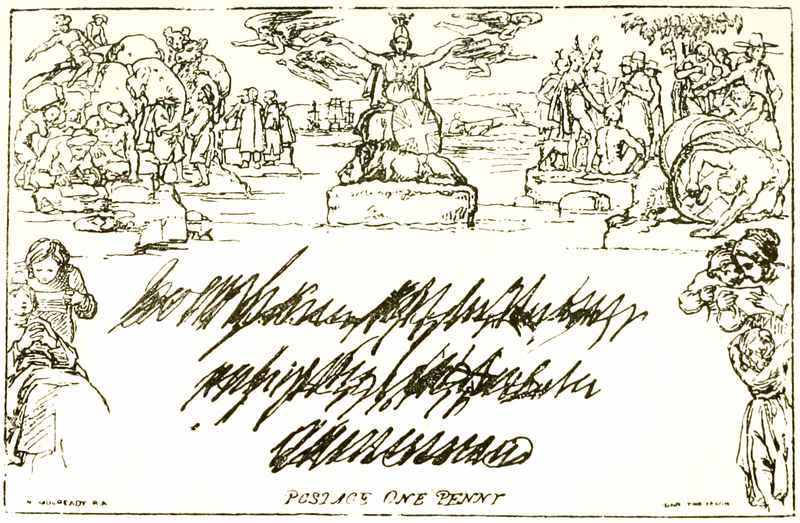
[See Hook's travestie on another page.]
Does Sir Andrew Agnew believe, or wish anybody else to believe, that the operatives want to be "cribbed, cabined, and confined" on a Sunday, debarred from their excursions to tea-gardens, their little voyages upon the river, their social pipes and ale, or to have their wives and sweethearts mulcted of their cakes and tea upon the only day in the week in which they can enjoy them? Does he really mean seriously to say that hard-working people, who for six consecutive days have been shut up to labour and toil, in heated rooms, in factories, or in gas-lit workshops, desire that they may be hindered from breathing the pure air on the seventh?
And what to the poor—or, indeed, to the rich—is an excursion without refreshment—without the enjoyment of the Sunday's dinner, the weekly festival at which his family enjoy his society, and in his society the treat of something "good to eat?" Why may not these relations, if they prefer good air to bad, go to those "Ordinaries on Sundays at two o'clock," which may be seen announced on every sign-board round London? or why, if they prefer it, may they not travel thither in chaises or other carriages, if they can afford it? Whether this is sinful or not, Messrs. Agnew and Peter may perhaps decide; but of this we are sure, that the operatives, except the already benighted Puritan Radicals, must be, and are opposed, heart and soul, to the monstrous restrictions which a couple of very small men are endeavouring to bring them under, because they think it right, and good, and wise.
The beneficial effects of the measure upon society may be guessed from the following dialogue between Snip, a tailor, and Snob, a shoemaker, living in the same house, each having a wife—one having a child.—(Time, Sunday morning.)
Snip. Vell, Snob, arn't you shaved? Vy, the bells is a-going for Church—ye von't be ready in time.
Snob. Church—bless your heart, I can't go to church to-day—the bill's come into play.
Snip. Ah! I know that to my cost.
Snob. How can I go to church? Ve used to send our bit of wittels to the bakus, and then I and Sal used to go to church, and so give Jenny Walker sixpence to mind the babby till we come back; then arter dinner Sal and I and the babby used to go to Chalk Farm, as reglar as clockwork, every blessed Sunday. She had a cup of the best bohea, with milk hot from the cow—I smoked my pipe and had a pint of ale. Little Jenny used to go to church in the arternoon, and come and jine us, and so help bring babby back. Now we marn't get the things baked at the bakus, and Jenny marn't come and earn sixpence by looking arter the babby—so Sal has to cook the wittels, and I have to mind the child—so there's no church for us.
Snip. My missus says she won't do no work Sundays, cause she's afeard of her life of Bill Byers—so we avn't got a morsel of grub for dinner, and neither of us knows where to get none—I won't go to church with this here beard on, six days long; and Jim, him as is the barber over the way, won't shave me for fear of the five pound penalty, so I shall stop where I is.
Snob. Come along into our place—my Sal isn't so partic'lar—she's read the hact itself, and swears she's a hexception—we got a line of mutton, vith the kidney in it, and a peck of tatys—come along wi' your old woman, and let's be jolly.
Snip. Jolly! Hark, Mr. S——, there's one on 'em over the way—don't ye know 'em?—that's one o' Byers's boys—if he hears you laugh to-day, two-pun-ten for you.
Snob. Peter's pence—eh?—well, if we maint speak of a Sunday in the street, let's come in—ours, you know, is a back room, up two pair—they can't hear us there—come along—I say, what shall we have to drink?
Snip. There's nothing but vater for us as can't afford vine—public-houses is shut—no sarving Sabbath-day.
Snob. Vell, never mind—ve'll try and cheat the old un. There are cunninger dogs than the law-makers, and them is the law-breakers. Go and ask missus to come and join us.
Snip. Oh, she'll come, and jump too; and I tells ye what—as we know'd we could not have no heavy wet to-day, she got a couple of bottles of Jacky, as will nourish us through the arternoon.
Snob. So it will, Bill; and we won't stir out at all. If we can't have a drop o' short, or a swig o' heavy among the rurals in the harbours—what's the country to us, we can't live upon hair?
Snip. No, not by no means. If I could but get my chin scraped, I'd try and make myself comfortable.
Snob. Is barber Jem at home?
Snip. Yes, shut up in his back parlour a-making wigs, where nobody can see him.
Snob. I tell ye vot, let's ax him to eat a bit of our mutton. He han't got nobody to cook for him, poor buffer, so we'll ax him over; and then if he brings his soap and a kipple of razors in his vestcoat pockets, he can shave us two, just by way of amusement, while Sal's getting the line ready.
Snip. Amusement!—that's quite gone out,—there's my poor missus, who used to get from eighteen to four-and-twenty shillings a-week a-manty making in Crambo Alley, can't get a stitch o' work to do—nobody wears nothing now—they used only to put on their bits of things onest a-week, to show 'em like, and now they marnt go out a-pleasuring o' Sundays, they buys nothing.
Snob. Vell, come along up stairs, we'll have a day on it. please the pigs; your two bottles of Jacky will last us till bed-time, and I'll toss you up who pays for both—I'm not going to swelter out in the sun to walk.
Snip. Nor I—I'll be with you in a twinkling, and when we have got my missus and barber Jem, we'll just lock the door, and drink confusion to the reformers.
For the sequel we have not room in detail. Snip, Snob, and barber Jem, ensconced in their fast-hold, pass the Sabbath with the females, in hidden intoxication and carefully-concealed profligacy—drunkenness progresses. Barber Jem contributes from his store over the way to the replenishment of the gin-bottle. Jealousy grows out of familiarity: the women tear each other's caps, and scratch each other's faces. Snob knocks Snip over the balusters, and barber Jem is taken to the station-house dead-drunk.
In better society things will grow even worse. The mind restricted to drudgery through the week must have relaxation at the end of it; and the tradesmen and clerks, and their ladies, sweethearts, and wives, have a right, in this Christian and civilized country, to share the innocent pleasures of the male part of the creation on the only day upon which they can properly enjoy them. What can be more innocent than going to Richmond, walking upon the hill, or paddling about by the water? What more agreeable or healthy than steaming to Gravesend (where the animosity of the people towards the aristocracy has recently been evinced by their conduct towards the Pier)? What more natural than to eat and drink when arrived there?—No; that is contrary to the law. What! of nature or nations!—No; of Agnew and of Peter. Surely if young ladies are satisfied with soles and eels, and ducks and peas, and sage and onions, and port wine and punch, and such things as these, all eaten fairly and above-board at open windows or in the open air, such persons as Peter and Agnew should rejoice thereat. Confine them in London, deny them harmless gaiety, pen them up with their lovers and friends, tell them they must not stir out, and, like the Snips and Snobs of inferior life, they will turn their thoughts into other channels, and soles and eels, and ducks and peas, will shortly sink in their estimation, only, however, to give place to a catalogue of other things too numerous to mention in the short space of an advertisement.
Oh, if these Agnews and Peters would but be content to take man as God has been pleased to make him, and allow him the free agency with which the Divinity has invested him, how much more wisely would they act! If they themselves believe that piety consists in eating cold meat on Sundays, in avoiding carriages, in eschewing all sorts of social conversation; if they see perdition in a plum-bun, and utter destruction in a glass of mild ale, let them henceforth live on frigid sheep, moan, mump, and be miserable, and fast, and grieve, in direct opposition to the spirit and character of Christians, observing the Protestant Sunday; but do not let them meddle with matters which cannot concern them, and by their success in which they would infallibly corrupt the body of the people, and endanger the safety of the commonwealth.
THE SPINSTER'S PROGRESS.
At 15.—Dimpled cheeks, sparkling eyes, coral lips, and ivory teeth—a sylph in figure. All anxiety for coming out—looks about her with an arch yet timid expression, and blushes amazingly upon the slightest provocation.
16.—Bolder and plumper—draws, sings, plays the harp, dines at table when there are small parties—gets fond of plays, to which she goes in a private box—dreams of a hero—hates her governess—is devoted to poetry.
17.—Having no mother who values herself on her youth, is presented by an aunt—first terrified, then charmed. Comes out—Almack's—Opera—begins to flirt—selects the most agreeable but most objectionable man in the room as the object of her affections—he, eminently pleasant, but dreadfully poor—talks of love in a cottage, and a casement window all over woodbine.
18.—Discards the sighing swain, and fancies herself desperately devoted to a Lancer, who has amused himself by praising her perfections. Delights in fêtes and déjeuners—dances herself into half a consumption. Becomes an intimate friend of Henry's sister.
19.—Votes Henry stupid—too fond of himself to care for her—talks a little louder than the year before—takes care to show that she understands the best-concealed bon-mots of the French plays—shows off her bright eyes, and becomes the centre of four satellites who flicker round her.
20.—Begins to wonder why none of the sighers propose—gets a little peevish—becomes a politician—rallies the Whigs—avows Toryism—all women are Tories, except two or three who may be anything—gets praised beyond measure by her party—discards Italian music, and sings party songs—called charming, delightful, and "so natural."
21.—Enraptured with her new system—pursues it with redoubled ardour—takes to riding constantly on horseback—canters every day half-way to the House of Lords with the dear Earl, through St. James's Park, by the side of her uncle—makes up parties and excursions—becomes a comet instead of a star, and changes her satellites for a Tail, by which she is followed as regularly as the great Agitator is. Sees her name in the papers as the proposer of pic-nics, and the patroness of fancy fairs.
22.—Pursues the same course—autumn comes—country-house—large party of shooting men—juxtaposition—constant association—sociability in the evening—sportive gambols—snug suppers—an offer—which, being made by the only dandy she did not care about in the mêlée, she refuses.
23.—Regrets it—tries to get him back—he won't come, but marries a rich grocer's widow for her money. Takes to flirting desperately—dresses fantastically—tries a new style of singing—affects a taste—lives with the Italians, calls them divine and charming—gets her uncle to give suppers.
24.—Thinks she has been too forward—retires, and becomes melancholy—affects sentiment, and writes verses in an Annual—makes acquaintances with the savans, and the authors and authoresses—wonders she is not married.
25.—Goes abroad with her uncle and a delightful family—so kind and so charming—stays the year there.
26.—Comes home full of new airs and graces—more surprised than ever that she is still single, and begins to fancy she could live very comfortably, if not in a cottage, at least upon a very moderate scale.
27.—Thinks the conversation of rational men infinitely preferable to flirting.
28.—Looks at matrimony as desirable in the way of an establishment, in case of the death of her uncle—leaves off dancing generally—talks of getting old.
29.—Same system—still ineffective—still talks of getting aged—surprised that men do not laugh as they did, when she said so a year or two before.
30.—Begins to inquire when a spinster becomes an old maid.
31.—Dresses more fantastically than ever—rouges a little—country-house not so agreeable as it used to be—goes everywhere in town—becomes good-natured to young girls, and joins in acting charades and dumb proverbs.
32.—Hates balls, or, if she goes to them, likes to sit still and talk to clever middle-aged gentlemen.
33.—Wonders why men of sense prefer flirting with girls to the enjoyment of rational conversation with sensible women.
34.—Uncle dies—break-up of establishment—remains with her aunt—feels old enough to go about without a chaperon.
35.—Takes to cards, where they are played—gives up harp, pianoforte, and singing—beaten out of the field by her juniors.
36.—Quarrels with her cousin, who is just married to the prize Marquess of the season—goes into Wales on a visit to a distant relation.
37.—Returns to London—tries society—fancies herself neglected, and "never goes out"—makes up little tea-parties at her aunt's—very pleasant to everybody else, but never satisfactory to herself.
38.—Feels delight in recounting all the unhappy marriages she can recollect—takes a boy out of an orphan-school, dresses him up in a green jacket, with three rows of sugar-loaf buttons, and calls him a page—patronizes a poet.
39.—Gets fractious—resolves upon making the best of it—turns gourmand—goes to every dinner to which she either is or is not invited—relishes port wine; laughs at it as a good joke—stays in London all the year.
40.—Spasmodic—camphor-julep—a little more rouge—fancies herself in love with a Captain in the Guards—lets him know it—he not susceptible—she uncommonly angry—makes up a horrid story about him and some poor innocent girl of her acquaintance—they are eternally separated by her means—she happy.
41.—Takes to wearing "a front"—port wine gets more popular—avows a resolution never to marry—who would sacrifice her liberty?—quite sure she has seen enough of that sort of thing—Umph!
42.—Turns moralist—is shocked at the vices of the world—establishes a school out of the produce of a fancy fair—subscribes—consults with the rector—excellent man—he endeavours to dissuade her from an extravagant course of proceeding which she has adopted—her regard turns to hate, and she puts herself under the spiritual guidance of a Ranter.
43.—Learns the Unknown Tongues, and likes them—sees none of her old friends—continues during the whole season enveloped in her new devotions.—Her page, having outgrown his green inexpressibles, is dismissed at the desire of her new pastor.
44.—Renounces the Oly Oly Bom school of piety, and gets a pug and a poodle—meets the man she refused when she was two-and-twenty—he grown plump and jolly, driving his wife and two great healthy-looking boys, nearly men, and two lovely girls, nearly women—recollects him—he does not remember her—wishes the family at Old Nick—comes home and pinches her poodle's ears.
45.—Returns to cards at the Dowager's parties, and smells to snuff if offered her.
46.—Her aunt dies.
47.—Lives upon her relations; but by the end of the season feels assured that she must do something else next year.
48.—Goes into the country and selects a cousin, plain and poor—proposes they should live together—scheme succeeds.
49.—Retires to Cheltenham—house in a row near the promenade—subscribes to everything—takes snuff and carries a box—all in fun—goes out to tea in a fly—plays whist—loses—comes back at eleven—camphor julep, and to bed—but not to sleep.
50.—Finds all efforts to be comfortable unavailing—vents all her spleen upon her unhappy cousin, and lavishes all her affections upon a tabby cat, a great, fat, useless Tommy, with a blue riband and a bell round its neck. And there, so far as I have traced it, ends my Spinster's progress up to fifty.
ERRORS OF THE PRESS.
Sir,—We hear a great deal of the licentiousness of the press, and I am not disposed to say that there may not be some good grounds for the complaint; but I beg to assert that, to my own knowledge, much is charged to the account of the licentiousness which is, in truth, only attributable to the errors of the press; and I have had the mortification to see articles of the most innocent information, from my own pen, conveyed to the public with all the colour of libels, by the mere mistake of a single letter.
For instance, I had occasion to report that a certain "noble lord was confined to his house with a violent cold;" next morning, I found that this innocuous piece of intelligence was metamorphosed into a direct inroad on the peace of a noble family, by representing his lordship as being "confined with a violent scold." In the same way, on the occasion of a recent entertainment given by a noble leader of fashion, I had said, very truly, "that, amidst the festivities, the first point of attraction and admiration were her ladyship's looks:" this deserved compliment was changed by the printer into a satire on the whole company, as if the chief point of attraction had been "her ladyship's cooks." In a description of the regatta at Cowes, I was made to represent a lady of fashion as having formed a hasty and ill-assorted match "with a boy," when, in fact, I had only said that the Lady Louisa had, indeed, broken adrift, but had "luckily, before any mischief was done, been made fast to a buoy."
When I reported that "Lord A. had entertained Colonel B., Major C., the Hon. Mr. D., and a few other fashionable friends at dinner," I little expected to find these gentlemen represented as a company of "fashionable fiends." At the particular request of an eminent coachmaker, I mentioned that a noble person, well known for his good taste in equipages, and who happens to have a large and fine family, had launched "a new green cab;" but judge of my horror at seeing it stated, that "his lordship had, this season, brought out another green cub." And I have lately had the misfortune of being the involuntary cause of what is called a hoax upon the public: having announced that Lord K. had made a bet that he would "trot a mile" on the Harrow Road in three minutes, an immense crowd assembled, and was ready to proceed to outrage because his lordship did not "trot a mule," as the printer's error had led them to expect.
Of a more serious kind are the injuries done to private individuals, which no one deplores more than I—the innocent cause of them. I was once employed to recommend to public attention the astonishing talents and performances of that musical wonder "The infant Lyra." I did my best; but the printer gave the whole a most unhappy and malicious appearance by making me, by the transposition of a letter, attribute all these prodigies to "the Infant Lyar." On a late occasion, one of the papers talked of "the general satisfaction given by the royal lump." This looked like a brutal allusion to the temporary illness of an illustrious duke. The truth was, Mr. Editor, that I myself penned that paragraph for an ingenious artist in Bond Street, in order to recommend an improved kind of argand, which he denominated the "Royal Lamp;" and I never can sufficiently regret the injustice done to the gallant General Saldanha, who, in an account of his conduct at Oporto, which I drew up under his own eye, was stated to have "behaved like a hero;" but when it came to be printed, it unhappily appeared as if the general had "behaved like a hare."
What I wrote of "the Horticultural fête" was altered into "the Horticultural fate," as if there was a destiny affecting all the entertainments of that society. When the late Mr. Canning offered Lord F. the office of "Secretary of State," the public were led by a mere transposition of the letters, to believe that a new office was to be instituted under the title of "Secretary of Taste;" and what gave the more effect to this mistake was the noble lord's admitted fitness for the latter office. I once ventured to bear my humble testimony to the assiduous attendance of a certain reverend dean on the "Minster," but had the mortification to find myself insinuating blame against the worthy divine, for his assiduous attendance on the "Minister;" and what was still worse, having to communicate the deserved elevation of "Doctor Jebb" to an Irish mitre, I was made to announce that "Doctor Jobb" was to be the new Irish Bishop. I remember reporting the case of a poor French lady, who "appeared at Bow Street with her pug-dog in her arms," but the printer most ungallantly stated the fair stranger to have appeared "with a pig in her arms;" and on the next day of her attendance a vast crowd had assembled to look at this extraordinary pet, and the poor Frenchwoman narrowly escaped being pelted for disappointing their expectations. In something the same way, a respectable tradesman in Oxford Street has had his shop-windows broken, to the loss of near ten pounds, because, having invited the public to inspect his extensive assortment of a fine manufacture called "linos," the printer chose "to invite the public to inspect a large assortment of the finest lions."
I am, sir, a warm friend of his Majesty's Government (for the time being), and cannot but deeply feel that even my political views are sometimes distorted. Amongst the benefits to be expected from recent measures in Ireland, I had enumerated the "increase of tillage,"—this was changed into increase of "pillage," and copied into all the ultra-Tory papers; and when I said that these same measures of conciliation would induce every loyal and well-disposed subject to unite "in quieting Ireland," it was perverted into a sneer, as if all loyal and well-disposed subjects should unite "in quitting Ireland."
Pray, sir, do me the justice to lay this explanatory letter before the public; above all, let it be correctly printed.
I am, sir, your humble servant,
A Court Reporter.
We very often suffer in a similar manner. About two years since, we represented Mr. Peel as having joined a party of "fiends" in Hampshire for the purpose of shooting "peasants;" and only last week, in a Scotch paper, we saw it gravely stated that a "surgeon" was taken alive in the river, and sold to the inhabitants at 6d. and 10d. per lb.
THE VISIT TO WRIGGLESWORTH[63]
It is said that a certain place not mentionable to "ears polite" is paved with "good intentions." Whether it will ever be macadamized (for that, I believe, is the term for "unstoning," now fast gaining ground, as I am looking over my paper, which, in all probability, everybody else will overlook) I cannot pretend to say; but certain it is, that although I was beyond measure mortified by the results of the Twickenham prank, my exclusion from the society of the Miss Dods, and my absolutely necessary escape from an association with them, I was very soon reconciled to my fate after the arrival of Devil Daly (as I used subsequently to call him) at my lodgings in Suffolk Street.
The instant he had been dislodged from the cottage by the appearance of the young ladies whose family he had so seriously outraged on the previous evening, instead of walking his horse back to Smart's, at the Toy, at Hampton Court, he cantered up to visit me in London; not so much from any particular affection for me, but because, although himself the victim, there was something so exciting and delightful to him in a joke, that he could not deny himself the pleasure of narrating to me the history of the arrival of the sylphs, and his extraordinary ruse of the bleeding nose. I never saw him in higher spirits, and, quoad my resolutions, I could not, for the life of me, refuse to join him in a stroll about town, which, although the season was somewhat advanced, was yet agreeably full, with a pledge to dine with him somewhere afterwards.
In those days clubs were scarce, although then hearts were plenty; there were no clubs of note at that period but White's, Brookes's, and Boodle's. To be sure, there was the Cocoa Tree, and there was Graham's, but the number of members was small, the system confined, and therefore, although Daly and I were as proud as Lucifer, and as "fine as fine could be," men had no resource when they wished to enjoy the "feast of reason and the flow of soul"—the one in the shape of a cutlet, and the other in the tapering form of a bottle of claret—but to repair to a coffee-house, a place which, I find, is now (I speak while I am arranging my papers) obsolete—a dear, nice, uncomfortable room, with a bar opening into it, a sanded floor, an argand lamp smoking a tin tray in the middle of its ceiling, boxes along its sides, with hard carpet-covered benches, schoolboy tables, and partitions, with rods, and rings, and curtains, like those of a churchwarden's pew in a country church.
I selected Dejex's, at the corner of Leicester Place. Attention and civility, a good cuisine, and good wine, formed its particular attractions, and the courteous attention of "mine host" gave a new zest to his cookery and his claret. I own I love attention and civility—not that which seems to be extracted by dint of money, or by force of the relative situations of guest and landlord, but that anxious desire to please, that consideration of one's little peculiarities, and that cheerfulness of greeting which, even if it be assumed, is always satisfactory. To Dejex's we resolved to go, and having "secured our box" and taken our stroll, we found ourselves seated and served by a little after six o'clock.
There was something irresistibly, practically, engaging about Daly, and I never felt more completely assured of the influence over me of a man with whom I had been so short a time acquainted, than I was when I found myself again—in the course of eight and forty hours—associated with him in a place which, of all others, was the most likely to afford him some opportunity of exhibiting his eccentricities; for the company consisted in a great degree of emigrés of the ancient régime, who, until the master-hand of Wellington was raised to cut the Gordion knot of their difficulties, which negotiation had for years in vain attempted to untwist, "had made England the asylum for their persecuted race." Yet, however much their misfortunes—the natural results of anarchy and revolution—might excite our sympathies and demand our assistance, some of them, it must be admitted, were, to our then unaccustomed eyes, extremely strange specimens of humanity; they were what Mr. Daly, in his peculiar phraseology, called "uncommon gigs;" and one very venerable ci-devant marquis, who wore spectacles, the said Daly, as he advanced up the room, somewhat too loudly, I thought, pronounced to be "a gig with lamps."
However, we got through dinner, and had safely demolished our admirable omelette soufflée without any outbreaking on the part of my mercurial companion; the coffee-room began to thin, and I began to be more at my ease than before, when Daly proceeded to recount some of his adventures, which proved to me that, however deeply the scene of the preceding day at Twickenham might have impressed itself on me, it was to him a "trifle light as air."
"But how," said I, "shall I ever reconcile the Dods? I am destined to meet those people; you are not."
"I was destined to meet them this morning," replied Daly, "and, if it had not been for this 'bleeding piece of earth,'" laying hold of his nose, "I could not well have escaped; but for you, rely upon it, it will all turn out right. In a week they will have utterly forgotten you."
"What," said I, "will Fanny so soon lose all recollection of me?"
"To be sure she will," said Daly. "As somebody says,
'Fancy's visions, like the sand, Every idle mark receive; Lines are traced by every hand, Which no lasting impress leave.'"
"But her hand," said I.
"You took and shook," replied he, "and very wisely too; but recollect it was nearly dark when we made our exit."
"And you insulted the father——"
"——who first affronted me," said Daly; "and even if the girls did know me this morning, and recognise me as assistant clerk to the deputy-assistant surveyor of the Paddington Canal Company, the deuce is in it if the whole family must not respect me as a high-minded, honourable, and conscientious assistant clerk."
"Yes, but it was quite light enough when we arrived," said I, "to see them and their beauties; why not light enough for them to see our deformities?"
"Deformities!" said Daly; "speak for yourself, Mr. Gurney; women don't care so much for men's beauty as you may suppose. Here am I—plain, but genteel, like a Wedgwood teapot—I make my way, and whatever you may think of yourself and Miss Fanny, I flatter myself Gussy, as her ma' called her, was equally well pleased with your humble servant."
"And yet we may never see either of them again," said I.
"I am not so sure of that," said Daly; "I have done worse to a father than I did to Dod in the course of my life, and yet have come to be domesticated in the family afterwards."
"As how?" said I.
"Some three years since," said Daly, "I was down at my friend's Sir Marmaduke Wrigglesworth's, in Surrey—charming place—nice wife—excellent shooting—capital cook—and inexhaustible cellars. 'Marmaduke,' said I, 'I hate battues; here you have a party staying for the wholesale slaughter of pheasants—eleven double barrels all of a row—more chance of homicide than sport; do me the kindness to let me off, and permit me to "range the fields" by myself, and I will consent to be laughed at for my small gains when the card comes in before dinner.' 'Do as you like,' said Wrigglesworth; 'this is Liberty Hall; shoot alone or in company—with dogs or without—have the keeper or not—comme il vous plaira.' Accordingly, away I went, more eager for the sport, as having to render an account of my single exploits, young enough to do my day's work well, and strong enough to bring my day's work home. I admit I was not quite so well pleased with what I saw, or rather what I did not see, as I went on: birds were scarce, wild, and shy, and I did not get a shot for the first hour, except at a venerable rabbit, who had retired from public life, but who had somewhat incautiously left his tail out of the burrow which he had selected for his final retreat; at him I went, and he died—first tenant of my bag."
"A tenant in tail," said I, punning professionally.
"Well, sir," continued Daly, who never stopped for anybody, "on I went, until at last, after three hours' ploughing and plodding, I fell in with one of the nicest little snug copses you ever set your eyes on. In I went—whurr went the pheasants—bang went the barrels—down came the birds—and, by the time I had crossed the copse, three cocks and—heu mihi!—two hens graced my store."
"Pretty sport for the time," said I.
"No sooner, however," said Daly, "had I emerged from the thicket, than I found myself upon a sort of parkish-looking lawn, on the rise of which stood a very respectable house, at the door of which I could distinguish a group of persons standing, and from the court-yard of which I saw some sort of servant leading forth a stout short-legged pony, with a thick neck and a stumpy tail—evidently master's favourite—equal to fourteen stone, warranted never to shy, trip, or stumble. Upon its back did I see a portly gentleman bestride himself, and forthwith begin to canter towards me, followed at a somewhat splitting pace by two keepers on foot, each armed either with guns or sticks, which I could not easily distinguish."
"I foresee," said I.
"So did I," said Daly; "the moment I saw the governor coming full tilt, I knew I had been trespassing, and the moment I stepped upon his infernal lawn, felt that I had put my foot into it."
"Well," said I, "what happened?"
"Why," continued Daly, "I standing still, and he moving somewhat rapidly, the elder of the two had the best of it, and I was very soon within six inches of his cob's nose, and within about half a yard of his own. 'You are a pretty fellow, sir,' said the irate gentleman, 'to come poaching and killing the birds in my preserves, close to my house—why, what the devil are you thinking of, you rascal? Here, Stephens—Thomson——'
"'Sir,' said I, 'I am extremely sorry——'
"'Sorry,' interrupted Mr. Bagswash—(for such was the gentleman's name)—'sorry, yes, and well you may be sorry; Botany Bay is too good for a fellow like you, sir. Lay hands on him.'
"'One moment, sir,' said I, 'I am a gentleman.' Whereupon Squire Bagswash and his keepers burst into an unseemly fit of laughing.
"'A pretty gentleman too,' said Bagswash.
"'I thank you, sir,' said I, 'I don't want compliments, I only want a hearing. I am staying on a visit at Sir Marmaduke Wrigglesworth's, and here is my card.' Saying which I produced—from what I happened by the merest but luckiest accident in the world to have about me, my card-case—my visiting ticket.
"'Young man,' said my opponent, having read it, 'is this genuine? My name, sir, is Bagswash; I am personally known to Sir Marmaduke. Is what you are saying true?'
"'Sir,' said I, 'I am not accustomed to have my word doubted. I admit, that not being perfectly acquainted with the boundaries of the Wrigglesworth property, I have transgressed and trespassed. I am sorry for it; and sorry that you should have so far forgotten yourself as to use language which, I am quite sure, in a more temperate mood you would regret.'
"'Sir,' said Bagswash, half doubting, and certainly more than half fearing me, 'I don't know that I have used any strong expressions, I—'
"'Rascal, I think,' said I, bowing profoundly.
"'If I did, I—really,' said Bagswash, 'I—might—but I was irritated—sir, this is my manor.'
"'Why, sir,' said I, 'as to your manner, I do think it might have been a little more courteous—I——'
"'Yes, sir,' said my antagonist, who evidently was anxious to justify his coarseness and vulgarity, 'but—the manor, I mean—for I can't pun, sir, and I hate puns, sir; the manor, I mean, costs me a very large sum annually—a very large sum indeed, sir, to preserve; and therefore when I see what I conceive to be a poacher immediately under my nose, actually in my homestead—upon my lawn, I may say—shooting right and left, it does put me in a passion, and I own I was warm, and perhaps hasty; but it is a provocation, and I should like to know, under all the circumstances, what you yourself would say if you were me at this moment?'
"'Say, sir!' said I; 'I haven't the smallest hesitation about that, sir. If I were you at this moment, I should say,—"Mr. Daly, I beg your pardon for the hasty way in which I spoke when I thought you a poacher; and, in order to show that although passionate I am not vindictive, I hope, as it is just luncheon-time, and you must have walked a long way and haven't had very good sport, that you will do me and Mrs. Bagswash the favour to come in and take a cutlet, or a little cold meat, as the case may be, and make up our differences with a glass or two of wine."
"'By Jove,' cried Bagswash, 'you are a queer fellow—the very spit of your father, whom I knew before I retired to these parts.'
"'Oh,' whispered one of the keepers to the other, 'master does know him—he had a father.'
"'Oh,' said the other; and they both immediately lowered their sticks to the ground.
"'And,' continued the squire, 'you have only just anticipated me in an invitation, except that I apprehended some more serious requisition on your part.'
"'Not a bit, sir,' said I; 'there are a vast many gentlemen in the world who don't look like gentlemen, and the shooting jacket and gaiters equalise appearances so much, that Nature must have done a vast deal to give a man an aristocratic appearance under so rough a husk—but as to any meeting, except at your hospitable table, I have not the slightest wish for it. In my opinion, sir, one luncheon is preferable to two balls.'
"'Ah!' said Bagswash, 'I am glad o' that, in spite of your pun. Run up, Stephens, and tell them to get luncheon as soon as possible. Mr. Daly, a friend of Sir Marmaduke Wrigglesworth, is coming to join our family party.'"
"Well, Daly," said I, "there your presence of mind served you well."
"Hear the sequel," said Daly. "Encouraged by the acquiescence of Bagswash, as I was yesterday by the invitation of Dod, I proceeded towards the house, placing, ever and anon, my hand on the neck of his cob, or the pommel of the saddle, in order to mark to the distant group the familiar nature of our acquaintance; and in this fashion we reached the mansion, upon the steps of which a bevy of graces, in number more like the Muses, welcomed us. I had a reputation even then, and the moment the girls had heard who was coming, they made up their minds to mirth—even the big Mrs. Bagswash rolled herself into the hall, like a fillet of veal upon castors, to do me honour.
"Bating the parents," continued Daly, "I never saw a more prepossessing family. I forget all their names; but one was slim and sylph-like, another plump and pleasant, a third a wicked-looking brunette, a fourth a demure and bashful blonde: all I felt as I entered the house was, that if I had brought eight friends with me, I might, by giving each his choice, have had some one of the 'tuneful nine' left entirely to myself."
"And," said I, "were you the only man?"
"No," replied Daly, "there were two yahoos, in white cord breeches and leather gaiters, and a boy with a frill and a frock, upon which a favourable eruption of brass sugar-loaf buttons had taken place; a Dr. Somebody, who turned out to be the nearest apothecary; and a very pale, long-legged youth, the curate of the parish."
"A largeish luncheon-party," said I.
"Well," said Daly, "I sat down, having first very much ingratiated myself with old Bagswash, who was as chary of his pheasants as if they had been of the golden breed, by insisting upon it that his man Stephens should disencumber my bag of the birds which I had shot on his land, retaining my solitary rabbit, in order to grace my tale when I reached Wrigglesworth; and there I found myself placed between mine hostess, and number one of the daughters—a very nice, pretty thing—not what one should call well set up, but Nature, as I said about gentlemen to her papa, had done a great deal for her; poor thing, how I pitied her!—and pity is akin to love. So, after luncheon, and some wine, do you know, Gurney, I almost began to subside into a tenderer feeling. But then, one of nine!"
"Well, and how did it end?" said I.
"Why," replied Daly, "it would have ended, I have no doubt, as prosperously as it begun, had not my new friend, Bagswash, committed himself by begging me to drink some London Particular Madeira—Duff, Murphy, Gordon, or something of that sort. The moment I tasted it I knew what it was, and, rather elated by circumstances, and my other previous libations, I had the temerity to address the dear, interesting, white-necked creature next me, and, in a tone of confidential condolence, begged her not to be deceived, for that although her amiable papa might be a judge of other things, he evidently knew nothing of wine, and that the stuff he called 'London Particular' was neither more nor less than infernally bad Teneriffe.
"The male Bagswash was unconscious of the imputation, but the queen B. overheard me, and, looking towards what might literally be called her open countenance, I saw symptoms of fire breaking out, and in less than a minute afterwards the domestic Proserpine exclaimed 'Come, girls, let us go—too much of your pa's Tenreefe will do you a mischief.' Up she got, and out she wheeled herself, and the moment she set the example, away went the nine she Bagswashes, like so many goslings after the maternal goose.
"I," continued Daly, "regretted the retreat, for I had had an opportunity to insinuate myself, and never saw an audience more thoroughly prepared to be gratified; indeed, so convinced were they, from what they had heard of me, that I was a vastly agreeable person, and talked epigrams, that when, while they were all sitting with their ears open to catch my facetiæ, I happened to observe (the first observation I had made, too, and that, in reply to a question of the big Bagswash) that I thought mustard went remarkably well with cold boiled beef, they all burst out into an immoderate fit of laughter; and the doctor, who had been tutored into a belief in my superlative wit, exclaimed, 'Oh, oh, that's too bad!' which every fool cries out, either when he thinks a thing remarkably good, or does not comprehend it in the least, which last was the case—as indeed it was with all the rest of the party—with my new-found medical friend."
"Did you contrive," said I, "to affront the rest of the company before you quitted it?"
"Not all of them," said Daly; "no; I believe I got off pretty well, but evidently the worse for wear; for, Teneriffe or not Teneriffe, it is my maxim to stick to the wreck as long as she floats, and as long as I could get anybody to sit, I staid; the curate and the boy with the frill went with the ladies, but Bagswash and the parish Paracelsus remained. However, at last, seeing all the bottles empty, and no disposition on the part of Baggy to replenish, I made a move, and never did I see a man more happy at having got out of a scrape than mine host. He sent his kindest regards to the Wrigglesworths—hoped to see me soon again—did I know my road home? In short, I cannot enumerate the civilities he heaped upon me, which, considering his respect for my friend Sir Marmaduke, and the fact of his having nine unmarried daughters, I duly appreciated, and forthwith bent my way homewards."
"Glad, I should think," said I, "to be safe out."
"On the contrary," said Daly, "I should like to have remained where I was; if it had not been for the anger of the respectable cat-of-nine-tails about the Teneriffe, it would have been a very agreeable domicile. However, once started, onwards I went, rejecting, indignantly, the offer of Bagswash to send a man to show me the way;—nothing I hate so much; as if a man who had followed his nose into a place could not follow his nose out of it."
"I trust," said I, "that your intrepidity was crowned with success?"
"Rather crippled," replied Daly, "as you shall hear; however, there are two ends to my story, or, rather, a story and a sequel."
"Pray go on," said I, knowing that so long as his breath lasted, his tongue would wag, as a cherry-clapper does while the wind blows.
"Gad, sir," said he, "I walked off—I admit the Teneriffe to have been potent—and I thought of one thing, and another thing, and I believe I thought of all the things in the world, except the way which I was going. They say, you know, some men have every sense but common sense—my case to a hair. Common sense is like flour; the other sort of sense is like sugar and gilding, and all the rest of those things—beautiful to adorn a cake and embellish the pâtisserie, but, without the flour, mere ornaments; now, without the ornaments, the flour will make bread. I never had the flour—never shall have. So you perceive that the sugar and the flummery being my staple, on I went and went, until I began to think I had missed my way, and just then I found myself stopped by a gate opening into—or, rather, shutting me out of—a remarkably well-stocked farm-yard—ricks, stacks, stables, barns—everything comfortable and convenient; with half a million cocks and hens, walking about like ladies and gentlemen, all as happy as happy could be. Over the gate I stepped, waded my way through the straw, and, leaning over the hatch of one of his outhouses, who should I see but the farmer himself. As I advanced, he touched his hat, and civilly asked whether I had had much sport?
"'Not much,' said I, recollecting that the whole contents of my bag now amounted to one elderly rabbit, with a Cape tail; 'I am on my way to Wrigglesworth, and out of it, too, as I think. How far have I to go?'
"'Seven miles, I count,' said the farmer. 'You are coming right away from it, sir. Wrigglesworth lies over there, on your left.'
"'Thank you,' said I, 'thank you. If you will just give me a sort of concise direction,—I am a dab at topography. Merely give me the points, and I'll go across a country I never saw in my life before.'
"'Well, sir,' said the kind fellow, 'if so be as that is the case, I'll tell you. When you get out of the gate down there, turn to your left, and keep on straight till you come to Pussy's Nob; then away to the right, over Sumpter's Green, and you'll soon see the Crooked Billet. Don't go near that, but turn short round by Wheatley's Copse; keep on, till you come to the stile on your left; go over that, through Timsbury's Lane, and that will bring you out by the Three Mackerel, and there they'll be sure to put you in the right road.'
"'Thank you,' said I to the farmer, 'I will follow your instructions most implicitly; but I suppose I shall have no chance of getting a shot, now, in that direction—even at a pheasant-roosting—eh?'
"'No, sir,' said the farmer, 'can't say as how I think you will get many more shots this evening.'
"'Well,' said I, 'now both my barrels are loaded. I've got nothing in my bag but an old buck rabbit with a nob tail; and as I hate going home with no proofs of my sport, and the one head—or tail—that I have bagged takes the domestic character, what shall I give you to have a shot with both barrels at all those ducks in the pond, and the fowls on the side of it, standing here, and to carry away what I kill?'
"'You'll kill a woundy sight on 'em, I think, at that distance,' said the considerate farmer.
"'Perhaps yes—perhaps no,' said I.
"'And to have all you kill?' said he, doubtingly.
"'Yes; all I kill fairly out-and-out,' said I.
"'Why, you shall give me half-a-guinea,' said the man.
"'Half-a-guinea!' echoed I. 'No, no; if I kill three or four of them it will be the outside. No; I'll tell you what I'll do. I'll stand here—won't move an inch; and you shall have a seven-shilling piece for the slaughter.'
"'Well, sir,' said the farmer, hitching up his lower garments, 'a bargain's a bargain. Hand over the twine.'
"Whereupon," said Daly, "I tipped him that beautiful miniature portrait of half-a-guinea, and told him I was ready to take my shots. He nodded assent; and, having pocketed the money, bade me proceed. I did so. Crack went one barrel—bang! slap went the other—bang!—and such a fluttering, and cackling, and squashing, and squabbling you never heard. I ran forward, and secured, as my spoil, four hens in high condition, a very respectable cock, fit companion for my rabbit; and from the pond fished, with the butt-end of my Manton, two extremely corpulent ducks, who had paid the debt of nature in the most decided manner; these I got out, the others I got up, and stuffed them all incontinently into my bag, delighted to think what a display I should make at Wrigglesworth, where it was quite clear I could, by no possibility, arrive in time for dinner. However, that was my joke, and it seemed to be the farmer's; he laughed quite as much as I did."
"Inherent good humour, I suppose," said I.
"Why, as for that," said Daly, "you shall judge. I bagged my birds in the first instance; and then, having secured my booty, began to rally my victim; and having acknowledged his civility in giving me my travelling directions, said to him, with a low bow, 'Thank you for the game, sir.'
"'Yes, sir,' said the farmer, 'you are a deuced sight better shot than I counted upon, considering what you had in your bag afore.'
"'Yes,' said I, 'I think you are what you may call "done." Seven shillings won't pay for the poultry in my pouch, I guess.'
"'No,' said the farmer, 'nor three times the money, I count.'
"'Well, then,' replied I, 'I think I have the best of the bargain.'
"'Not much,' said the man.
"'Not much!' cried I; 'why, a guinea's worth of fowls for a seven-shilling piece——'
"'Yees, sir, that's true,' said the fellow, turning slowly away from the hatch, and grinning as he turned; 'but they are none on 'em mine.'
"I could have killed him for his roguery; but there was so much fun in it——"
"——So much in your own way," cried I.
"Exactly so," said Daly; "that, instead of breaking his head, which he most righteously deserved, I joined in his infernal horse-laugh, and made the best of my way out of the farm-yard, lest I should be immediately apprehended by the right owner as a robber of hen-roosts."
"And," said I, "you carried home your spoils."
"Not I," exclaimed my unstoppable companion. "Take some wine—help yourself—and listen; for the sequel is most terrible. I had such a night of it!"
"How?" said I.
"Why," said Daly, "out of the gate I went, turned to my left, and got to Pussy's Nob; but it began to get dusk, and very soon afterwards dark; and when I began veering away over Sumpter's Green, I found myself on a wide common, without path, guide, or guide-post. As the darkness increased, so did the declivity; and when I had lost all power of seeing, I was gratified by feeling myself in a sort of quagmire, which, for all I knew, might get softer and thicker every step I took. I looked out for the stars, and saw a few: but they were of no kind of use to me; for I had not the slightest idea what direction, even under their guidance, I ought to take. I resolved to avoid the bogs; and kept edging away, until I at length reached a gap, which, as it led off the infernal common, I hoped might lead me to some habitation."
"Where spring-guns and steel-traps were set every night," said I.
"Not a bit of it," said Daly. "I went on, following my nose, until I found myself at the edge of a copse, which I began to think looked extremely like Squire Bagswash's preserve. However, it was not that; but I heard people talking at no great distance, and a call of 'Halloo!' How to act I did not exactly know, with a gun and a bagfull of cocks and hens, and a venerable rabbit to boot. What could I do? To have answered the call would have been to be detected as a poacher in the dark. I resolved, at all events, on getting rid of my poultry in the first instance, and accordingly emptied my store, rabbit, tail, and all, and proceeded somewhat more gaily after having thrown out my ballast; yet not without some apprehension, either of being shot by the keepers for a poacher, or by the poachers for a keeper; I so got clear of the whistling firs and moaning larches as fast as I could, still utterly ignorant of my course."
"And getting late," said I.
"It must then have been past eight," said Daly. "On I trudged; scrambled over the furrows of one field, and through the turnips in another; and so on and on, until at last I was forced to sit myself down on a gate and rest; and, I give you my word, although I have known a great deal of the world, I never was so dead beat in my life as I was then. Not a house could I see. The glimmering of a rushlight in a cottage window would, in my eyes, have been thrice more brilliant than the whole regalia of England collected. But no: there were no cottages—no rushlights; and I do believe I went the length of swearing at my own stupidity in undertaking my solitary excursion. Only one set-off was there to the whole thing;—I had seen the Bagswashes, male and female, and laid in materials for an historiette for the next evening—that is, if I really survived the present one; but I began to feel cold, and hungry, and thirsty. However, it appeared pretty certain that out of the fields I must get, if I went straight on end, and could not well fail of fetching up in a road somewhere at last."
"Which, as you are here alive to tell the tale," said I, "of course you did."
"Why, yes," said Daly, "I did; but it was not for a long time; and then I had come to a full stop; and, striking the butt of my Manton on the ground, I swore, by stock and barrel, that I would not budge from under a huge tree which overshadowed me till daylight came to my aid. I was ravenous—I was chilled—I was wretched—I was tired to death; but why tire myself more?—and accordingly, feeling, and I daresay looking, very like the dear Don of La Mancha, I sat myself down with my back against the trunk, and, if you'll believe me, fell fast asleep."
"Asleep!" said I.
"Fast as a church," said Daly, "and dreamt—dreamt, first, that I was starving,—that, I think, must have been a sort of waking vision; then, that I was at a ball; and then I dreamt of being safe back at mine host's hospitable mansion; and then I had a confused, hurly-burly kind of a dream, either that I was Sir Marmaduke Wrigglesworth, or that Lady Wrigglesworth was Mrs. Daly, or something of that sort, and that I tumbled out of bed, which tumble was to me a 'dying fall;' for I rolled over on my side, and woke—in no bed—in no house, but where I had lain me down, under the tree before-mentioned."
"You must have caught your death of cold?" said I.
"No, Dalys and cats are very tenacious," said my jocular friend; "I roused myself—sat up and listened—recollected where I was, and heard at the same moment what was really 'sweet music to mine ear,' the sound of a bell-team. Ho! ho! says I—you are there, are you?—where there are bells there are horses—where there's a team there's a waggon—where there's a waggon there's a road—up I jumped, and as fast as I could, just roused from my slumbers, scrambled over brambles and clambered over fences, until I caught sight of the waggoner's lantern waggling on the side of the tilt like a bright pendulum to regulate the wheels; the moment I saw that I knew I was landed, and, after encountering a few of those thumps and bumps which 'flesh is heir to,' found myself on a high road. Waggons, even those called 'flies,' may be overtaken, and although dead beat, and sore of foot, I soon came up with the eight plaited-tailed animals which were dragging the mountain, second only in size to the Juggernaut idol.
"My first object was to ascertain where I was, and what the direction of the vast pile before me. I found, to my particular satisfaction, that I was within two miles of Ripley, and that the edifice was moving towards London—the result was, an involuntary spring upon the shafts of the vehicle, and a look at the waggoner, which, by the light of his revolver, was perfectly intelligible. The gun, the gaiters, the grace, and the gentility, spoke the gentleman, and he gave me leave to assume the post which he himself was prevented by Act of Parliament from occupying. All my sorrows fled the moment I felt myself moved along without any personal exertion, and the smiles which had nearly been exhausted during my toil and trouble, returned, as Moore sings, to 'gild my brow.' 'I have had walking enough,' said I to myself, 'and grieving enough—nunc est ridendum.'"
"Excellent wag!" said I.
"Excellent waggon, rather," said Daly, "for so it proved; and after three-quarters of an hour's hard tugging by the 'bell assemblée' before me, I was dropped, gun, gaiters, bag, and all, at the door of the Talbot—facing the Green. I tipped my driver—bade adieu to the tilt—and began knocking loudly at the door of mine ostlery."
"And a nice enough inn it is," said I.
"It turned out to be past midnight," said Daly; "and, by the merest luck in the world, the exemplary widow who then occupied it had not gone to her rest, or roost. She personally answered my call, and replied to my knock. After a few preliminary 'Who's there's?' she opened the door; and the moment she recognised me—for I was well known upon the road—her delight, as you may conceive, was unspeakable.
"'Bless my heart, Mr. Daly,' said the widow, 'what a time o' night to be strolling about with your gun! Why, where do you come from?'
"'That,' said I, 'is about the last question in the world I can answer satisfactorily. I have been wandering across a country with which I am not particularly well acquainted—have tired myself to death, and fallen asleep.'
"'Fallen indeed,' said mine hostess, 'into a ditch, Mr. Daly, I should think. Why, dear me, what a condition you are in!'
"'Exactly,' said I; 'recumbent repose in October under an oak, is not particularly delicate; however, my darling, give me some supper, some hot brandy and water, and order me the most comfortable bed in the house, for I am a-tired.'
"'Why, sir,' asked the dear woman, 'where is your servant with your clothes—you cannot think of sleeping here in that condition?'
"'Not exactly,' said I; 'I shall take off my clothes when I go to bed—and as for my servant, he is snug and happy at Sir Marmaduke Wrigglesworth's (where I ought to be too), unless they have sent him out with a rake and a lantern to search for me and drag all the horse-ponds in the neighbourhood. I tell you I am hungry—and tired—and shall be very sleepy;—out with your tit-bits and delicacies—something piquant—nice—savoury, eh—and after that, a comfortable nest.'
"'You shall have something to eat,' said the widow, 'and something to drink, for those I can give you myself; but as for a bed, I haven't one in the house—crammed full from top to bottom.'
"'I'm very tired,' said I; I can sleep compact like a dog on a hearth-rug—half a bed will do for me.'
"'Come, Mr. Daly,' said the landlady, 'none of your nonsense—I have no bed whatever to-night, and here it is almost one o'clock—you had better let me ring up the next turn-out, and get back to Wrigglesworth.'
"'Thank you, Fanny,' said I; 'I used to call her Fanny in her husband's time, and he was killed, switching a rasper, three years before; 'not I—I should not get there till nearly four—all the family "in a deep sleep buried,"—no, no—none of your nonsense—where am I to rest?'
"'I told you the truth,' said the widow; 'there's not a bed disengaged.'
"'Not one?' said I—looking, as I fancied, most insinuatingly, and helping myself to a glass of brandy from a bottle covered with a gilt bunch of grapes, at the same time gently pressing the tip of mine hostess's little finger.
"'Not one, upon my life, Mr. Daly,' replied she; 'indeed, we are so full, that my sister Jane, who is here, is obliged to sleep with me.'
"'That's very unfortunate indeed,' said I; 'however, I rejoice that you have so much custom—all's good for trade—at all events, let me eat—let me warm myself—both in the sunshine of those bright eyes, and in the blaze of the parlour fire.'
"Mine hostess proceeded to make me exceedingly comfortable—I ate cold fowl and ham, and drank hot brandy and water, and eventually punch. Mine hostess sipped shrub—a liquor which, if it were liqueur, would rank fathoms above either Curaçao or Maraschino—till at last the clock striking two, reminded her it was time to go to bed.
"'Ah,' said I, 'that is extremely just and proper. But, alas! I am like my melancholy little friend who was "very gentil, but whose hair came a leetle through the top of his hat,"—I have no bed to go to.'
"'It's very provoking,' said the landlady, 'so tired as you are, too.'
"'It is, indeed,' replied I—seeing a proposition of some sort or other on the tip of her tongue.
"'Now,' said she, looking remarkably serious, 'can I trust you—will you promise me, if I give you a bed, to do as I bid you, Mr. Daly?'
"'Your commands,' said I, 'shall be obeyed to the letter—only let me rest myself quietly and comfortably—it is all I ask—for never was poor devil so tired in his life as I.'
"'Take a drop more punch, Mr. Daly,' said my landlady, 'it will make you sleep the sounder.'
"'No fear of that,' said I; 'but what do you propose?'
"'Why,' said mine hostess, 'I have one bed unoccupied.'
"'Why didn't you say so before?' cried I.
"'I'll tell you why,' said my fair friend; 'it's a double-bedded room, and the other bed is occupied by a——'
"'——snoring farmer, from Farnham,' said I; 'or perhaps a tight-skinned sailor, walking his way to town from Portsmouth.'
"'No,' said she, looking very pathetic—and very pretty by the way—'by a lady.'
"'A lady,' said I, 'oh, charming thought!——'
"'There it is,' interrupted the lady, 'that's just what I expected, you are all fire and tow—alight in a moment—now I shall not say another word, and you must sleep, if you will sleep here, in the arm-chair by the fire.'
"'No,' said I, 'no—don't be angry—I didn't know—I thought——'
"'Yes, Mr. Daly, that's what you are always thinking, I believe,' said mine hostess, 'but that won't do—the lady who occupies the other bed in the double-bedded room is a sad invalid; she has been stopping here for some time, and the only rest she gets is by dint of laudanum, which the doctor gives her in large doses, and she sleeps soundly during the night, which makes up for the sufferings she endures by day. If you choose to behave well—and, tired as you are, I don't like to turn you out or leave you here—you shall have the other bed. You must go gently into the room, and when you are in bed I will come and take away your candle; and as I sleep in the next room, if you don't remain perfectly quiet I shall insist upon your getting up and coming down again here into the bar.'
"'Agreed,' said I, 'I only ask for a bed—all I want is rest—I am scarcely able to walk or stand, therefore I agree to your condition; let me finish my punch, and marshal me the way I should go.'
"After looking at me suspiciously and hesitatingly for a minute or two, my dear landlady agreed to trust me; and accordingly having seen that my bed was properly prepared she returned, and, lighting a candle, preceded me upstairs, and opening the door of the room put her finger to her lips to enforce silence, whispering me, that when I was in bed I should knock against the wainscot which separated her room from that in which I was to repose, and that she would come and fetch my candle.
"I promised to obey all her injunctions. The curtains of the other bed were closely drawn—I never felt so awkward in my life—but I had promised; yet one peep before the light vanished—no—perhaps the lady would wake and scream, and I should be forthwith ejected. I resolved to keep my faith, at all events till mine hostess was herself asleep, and then see—as far as utter darkness would permit—how the affair would terminate.
"Accordingly, I hurried off my clothes—washed my face, hands, and mouth as gently and quietly as possible, and having concluded my brief preparations for depositing myself on my much longed-for couch, gave the concerted signal, and scarcely was well in my place before my dear landlady entered the room on tip-toe, and, coming up close to the bedside and having whispered 'Now, remember your promise,' took the glimmering light away, and left me in the dark with my fair and slumbering companion.
"There was something very strange in my position; I was tired to death, but somehow I could not sleep. I lay and listened to hear whether my fair incognita would sneeze—or cough—or cry 'hem'—or play off any little coquettish trick which, under the circumstances, I thought probable enough. I durst not move, for I knew I was watched; however, I sat up in the bed and began to wonder. Is it, thought I, an old woman or a young woman?—an invalid is interesting, and, bless her, she must be uncommonly genteel, for she does not snore in the least—a few minutes served to convince me that my landlady did—and I rather rejoiced in the sound of her slumbers, since I thought I might perhaps succeed in attracting the attention of my sleeping partner; and the fact that a gentleman of my very respectable pretensions was so whimsically associated with her—knowing mine hostess's archness—induced me to attribute her readiness to quarter me upon the slumbering beauty, to a foreknowledge on her part that my introduction would not be considered altogether an intrusion.
"After I had satisfied myself that my landlady was really safe, I had recourse to some slight coughs, which do occasionally infest one; but no, my signals were not answered: the dose of laudanum had been particularly strong that night. At last I thought I heard a slight movement. I began to listen till I heard the beating of my own heart, and felt a sort of drumming palpitation in my ears. I held my breath: pshaw, thought I, this woman has been cheating me, the other bed is tenantless,—a trick to try me,—and for what a stupid dolt she will set me down if I don't convince her that I had at least curiosity enough in my composition to ascertain what was in it.
"My feelings fired at the thought. Up I got,—groped my way across the room,—the white dimity drapery being just visible amidst the 'palpable obscure.' I reached the bed,—I paused,—I heard nothing;—I partly opened the curtains at the side, and said in a soft, very soft voice, 'Hem!' No answer. 'Ma'am,—ma'am,' still silent;—'are you there?' said I;—and, placing my hand on the pillow, found she was. Dear, unconscious creature, there she lay, comfortably cuddled up in the clothes, and sleeping, or seeming to sleep, soundly. I was, I admit, on the point of proceeding to awaken her, in order to announce my presence, when, in stepping towards the head of the bed, my foot came in contact with a chair which stood on its right-hand side, which was overthrown with a crash that, in an instant, roused—not my dear opium-drinker—but my lynx-like landlady. I heard her jump out of bed. I jumped into mine, but, in less than two minutes, there she was, like Margaret's 'grimly ghost,' standing before me, loading me with reproaches, and ordering me, in the most peremptory terms, to take the candle, descend the stairs, and dress myself in the parlour behind the bar, and wait until she came down to eject me from the house; seeing that she could have no kind of confidence in a gentleman who had so much confidence in himself.
"Vain were my pantomimic supplications: she would listen to nothing but immediate abdication; and I could not well be angry with her, for she had put faith in me, and perhaps run the risk of losing a valuable customer by indulging me with the luxuries of ease and rest which, under no other circumstances, she could have afforded me. I implicitly obeyed her commands; and, as soon as she had retired to dress herself, collected my wearing apparel, and slunk downstairs to prepare for my departure, which seemed inevitable. As I passed along the passages, I heard multifarious snorings in all directions, which convinced me of the truth of my landlady's assertions as to the influx of company, and made me repent more sorely than before, that I could not for once in my life act with discretion and decorum.
"I had scarcely finished dressing myself when my landlady made her appearance in the parlour.
"'I really am surprised, sir,' said she, 'at your conduct. I thought, as a gentleman, you might have been trusted, considering the circumstances under which I ventured to put you into that room.'