MISCELLANIES, IN VERSE AND PROSE. (continued 6)
Reading edition
"There," said I, "this scene is exhibited to us by our evil genius, to tantalize us with the prospect we may not enjoy."
"You are wrong," said Daly, "quite wrong—be quiet—beautiful girls, cool wine, and agreeable society, are worth making a dash for. Those girls will we become acquainted with—that society will we join—those wines will we imbibe."
"Do you know them?" said I.
"Never saw them by any chance in my life," said Daly; "but here goes—the thing is settled—arranged—done. Have you a pocket-book and a pencil about you? if you have, lend them to me; say nothing, and I will manage the rest. Assent to all I assert, and stay in the boat till we are invited to partake of the collation."
"But, my dear sir," said I.
"Mum," said Daly, at the same moment pulling the head of his funny 'chock block,' as the sailors say, into the bank of the garden, upon whose velvet surface he jumped with the activity of an opera dancer. I sat in amazement, doubting what he was about to do, and what I should do myself. The first thing I saw was my friend pacing in measured steps along the front of the terrace. He then affected to write down something in my book—then he stopped—raised his hand to his eyes, as if to make an horizon in order to obtain a level—then noted something more—and then began to pace the ground afresh.
"Bring the staff out of the boat," said he to me, with an air of command, which was so extremely well assumed, that I scarcely knew whether he were in joke or in earnest. I obeyed, and landed with the staff. Without any further ceremony, he stuck the pole into the lawn—a measure which, as he whispered to me, while in the act of taking it, he felt assured would bring things to a crisis.
Sure enough, after a certain ringing of the dinner-room bell, which we heard, and which conveyed to Daly's mind a conviction that he had created a sensation, a butler, bien poudre, in a blue coat, white waistcoat, and black et ceteras, followed at a properly-graduated distance by a strapping footman, in a blue-and-scarlet livery, were seen approaching. I thought the next step would be our sudden and unceremonious expulsion from the Eden he had trespassed upon—not so my friend, who continued pacing, and measuring, and "jotting down," until the minister for the home department was at his elbow.
"I beg your pardon, gentlemen," said the butler, "but—my master's compliments, begs to know what your pleasure here is—it is not usual for strangers to land—and——"
"Exactly like the man in the boat, sir," said Daly, "only quite the reverse. I am not here for pleasure—business calls me here—duty, sir—duty. Here, Mr. Higgins, carry the staff to that stump."
These words were addressed to me, and I, completely infatuated—fascinated, like the bird by the rattle-snake—did as I was told, not daring to rebel, lest a dénoûment might ensue, which would éclater in our being jointly and severally kicked into the river, in which case, from the very little, or rather the very great deal, which I had seen of my companion during our short acquaintance, I felt perfectly certain that I should sink, and he would swim; and that, while I was floundering in all the agonies of ignominy and disgrace, he would be capering and flourishing with the two pretty girls in the dining-room, laying all the blame of the affair upon my most incompetent shoulders, and cracking his jokes upon the tyro who had so blunderingly botched the business.
The butler, who found that he made very little impression upon Daly, seemed inclined to come at me, which, as I had not the slightest idea of the game my companion was playing, nor the faintest notion what he expected to be the result, alarmed me considerably. Daly was too much on the alert, however, to permit me to be cross-questioned.
"Sir," said he to the butler, "present my compliments to your master, and make my humble apologies for the liberty I am obliged to take. I am the acting deputy-assistant surveyor of the Grand Junction Paddington Canal Company, and an Act of Parliament is just about to be applied for, to construct and cut a branch from the basin at Brentford into the river Thames, near this point. A great deal depends upon my decision as to the line it will take, and I should not have ventured to land without apprising your master of my business, but that no time is to be lost, inasmuch as my plan for the cut must be ready for the committee to-morrow."
"Cut a canal through my master's grounds, sir?" said the butler.
"Right through," said Daly, poking the fore-finger of his right hand very nearly into the butler's left eye; "and what I am now so particular about is, I am most anxious that the line should not take down the corner of the conservatory."
"Dear me, sir," said the man, "my mistress would go mad at the very thought of such a thing. Will you just wait, sir, while I speak to Sir Timothy?"
"Certainly," said he; "and assure him—assure Sir Timothy—that I will do all I can to preserve the elevation of his mansion; for, as it all depends upon my opinion, I shall, of course, be extremely scrupulous how I decide."
"I am sure, sir," said the astounded and mollified butler, "Sir Timothy will be greatly obliged to you. I'll be back directly, sir."
Saying which, the butler returned to the house, and giving a significant look at the strapping footman, with the grenadier shoulders and balustrade legs, which seemed to imply that he need not kick us into the water till he had consulted his master, the fellow followed him, which afforded me an opportunity of asking my volatile friend what the deuce he was at.
"Leave me alone," said he,—
"'Women and wine compare so well, They run in a perfect parallel.'
I am the company's acting deputy-assistant surveyor, and having surveyed this company, I mean to be made a participator in those good things of which they seem to be in full possession. Yes, Mr. Gurney, as King Arthur says—
'It is our royal will and pleasure to be drunk; And this, our friend, shall be as drunk as we.'
Who knows but we may make an agreeable and permanent acquaintance with this interesting family?"
"But," said I, "you don't even know their name."
"You are in error," replied Daly; "the man's name is known to me."
"Then perhaps you are known to him," said I.
"That is a non sequitur," said Daly; "I knew nothing of him before I landed here—now I am au-fait—my friend in the powder and sticking-plasters calls his master Sir Timothy. There are hundreds of Sir Timothies; but what do I, upon hearing this little distinctive appellation, but glance my eye to the livery-button of the lacquey—and what do I see there? a serpent issuing from and piercing a garb or gerb. The crest is unique—ergo, my new acquaintance is neither more nor less than Sir Timothy Dod."
"Why," said I, "you are, like myself, a bit of a herald, too!"
"Exactly," replied Daly; "in my composition are
'Arts with arms contending;'
I am a bit of every thing; but somehow all my accomplishments are so jumbled, and each is so minute in itself, that they are patched together in my mind like the squares of a harlequin's jacket, only to make their master ridiculous. Here, however, comes Sir Timothy himself. You are my clerk—keep the staff and the joke up, and you shall be repaid with some of Tim's very best Lafitte, or I'm an ass."
"Good-day, sir," said Sir Timothy, somewhat warmed with the intelligence given him by the butler, and the exertion of trotting him across his lawn. "My servant tells me that you are here for the purpose of deciding upon the line of some new branch of the Paddington Canal;—it is very extraordinary I never should have heard of it!"
"You ought, Sir Timothy," said Daly, "to have been apprised of it. Do you understand much of ground-plans, Sir Timothy?"
"No, sir; very little indeed," replied the worthy knight.
"So much the better," I heard Daly distinctly say, for he could not resist an impulse. "If you will just cast your eye over this paper, I will endeavour to explain, sir. A, there you see;—A is your house, Sir Timothy; B is the conservatory; C is the river,—that perhaps you will think strange?"
"No, sir," said Sir Timothy, "not at all."
"Then, sir, D, E, F, and G are the points, from which I take the direct line from the bridge at Brentford; and thus you perceive, by continuing that line to the corner of Twickenham churchyard, where the embouchure is to be——"
"The what, sir?" said Sir Timothy.
"The mouth, sir,—the entrance to the new branch, the canal will clip your conservatory diagonally to the extent of about eighteen feet six inches, and leave it deprived of its original dimensions somewhat in the shape of a cocked-hat box. You see—so, sir,—H, I, K."
"I give you my honour, sir," said Sir Timothy, "such a thing would drive Lady Dod mad!"
"I admit it would be a dreadful cut," said Daly; "and then the noise of the bargemen and the barge-horses close under the windows,—clanking chains,—horrible oaths,—disgusting language——"
"My daughters' bed-rooms are at that end of the house," said Sir Timothy. "What am I to do, sir? What interest can I make? Are the magistrates—are the——"
"No, sir," said Daly, with a face of the most imperturbable gravity; "all that would be perfectly unavailing. The decision as to the line rests entirely with me; and, as I said to Mr. Higgins, my assistant,—Higgins," continued he, calling me to him, "let me present you to Sir Timothy Dod,—I said to Higgins, what a pity it would be to disturb the Dods,—what a cut at their comforts;—it goes against my heart to send in the plan, but the line is so decidedly the shortest. 'Ah, sir!' says Higgins to me, with a deep sigh, I assure you,—'but do consider the conservatory.'"
"I'm sure, sir," said Sir Timothy, extending his hand to me, "I feel very grateful for your kindness. It would indeed be a sad thing; and must the decision be made so soon?"
"Immediately, sir," said Daly; "but we are keeping you out here in the open air without your hat. I am afraid, sir, you may catch cold."
"Oh no, sir," said Sir Timothy; "don't mind that. Perhaps, gentlemen, you will do me the kindness to walk in. The servants shall take care of your boat. I will introduce you to Lady Dod, she must try what her influence can effect, and I am sure you have the disposition to serve us. Here, Philip, James, George, some of you, come and make this boat fast, and stay down by her while the gentlemen stop. Let me show you the way, gentlemen."
I never shall forget the look which Daly gave me as we followed the respectable knight to his lady and family,—the triumphant chuckle of his countenance, the daring laugh in his eyes; while I, who only saw in the success of the design the beginning of a signal defeat, scarce knew whether I was walking on my head or my heels: resistance or remonstrance was equally vain under the circumstances, and in a few minutes we found ourselves in the presence of Lady Dod and her daughters, breathing an atmosphere redolent with the fumes of the departed dinner, and the still remaining fruit and wine. I never was so abashed in my life. My friend, on the contrary, seemed perfectly at home; and, placing himself beside her ladyship, made a sign for me to occupy a vacant seat between the young ladies. Never did I see two more lovely girls.
The courtesy of Sir Timothy, the sweetness of my lady, and the constrained fun of the girls, were, I admit, when I recovered my composure in some degree, a good treat; while Daly, "helping himself and passing the bottle" to me, kept up a fire of conversation, which, if the senior Dods had known anything of the world, would have convinced them in ten minutes that the part of acting deputy-assistant measurer was an assumed one. It certainly was a sight to see the respectable lady of the house pleading the cause of her conservatory, and piling the choicest fruits upon the plate of the arbiter of her destinies, while Fanny's civilities to me were displayed with equal zeal and far superior grace. I would have given the world to have owned the truth; and I am sure, if we had done so, we should not have been the worse received; for, independently of the excellence of the joke and the impudence of the proceeding, the relief which would have been afforded to the minds of the whole Doddery would have ensured us their eternal favour and affection.
Daly having finished the claret, and taken a last "stopper over all" (as the sailors say) of sherry, gave me the signal for departure. I, too, gladly took the hint, and drew back my chair. Fanny looked as if she thought we were in a hurry; however, it was getting late, and my master had some distance to pull. We accordingly rose and prepared to take leave. I bowed my adieu to the girls, and shook hands with Fanny, at which I saw Augusta toss back her head and throw up her sparkling eyes, as much as to say, "Well, Fanny," meaning exactly the reverse. I bowed low to my Lady Dod, and Sir Timothy attended us to our boat. I stepped in; Daly was at the bow; Sir Timothy desired the man who had been left in charge of the funny to go away; and then I saw, with doubt and trepidation, the respectable dupe of Daly's consummate impudence shake him by the hand with a peculiarity of manner which particularly attracted my attention. I saw him in the execution of this manœuvre press upon his palm a bank-note, with a flourish in the corner like the top of a raspberry tartlet.
I never was more agitated. If Daly took this bribe for saving the corner of the conservatory, it was an act of swindling. The strawberries, grapes, and claret, were fit matters of joke, although I admit that it was carrying the joke a little too far; but money,—if he took that, I was resolved to avow the whole affair to Sir Timothy, show up my companion, and leave him to the fate he deserved. Judge my mingled delight and horror when I heard him say,——
"Sir! what I have done in your house or in your society to induce you to believe me capable of taking a bribe to compromise my duty, I really don't know. Mr. Higgins, I call you to witness that this person has had the insolence to put a fifty-pound bank-note into my hand. Witness, too, the manner in which I throw it back to him." Here he suited the word to the action. "Learn, old gentleman," continued he, with an anger so well feigned that I almost believed him in earnest, "that neither fifty nor fifty thousand pounds will warp an honest man from the duty he owes to his employers; and so, sir, good-night, and rely upon it, your conservatory goes,—rely upon it, Sir Timothy;—it comes in the right line, and the short line, and down it goes—and I feel it incumbent on me not only to tell the history of your petty bribe, but to prove my unimpeachable integrity by running the canal right under your dining-room windows; and so, sir, good-night."
Saying which he jumped into the boat, and, pulling away manfully, left his unfortunate victim in all the horrors of defeated corruption, and the certainty of the destruction of his most favourite object, for the preservation of which he had actually crammed his betrayers, and committed himself to a perfect stranger.
THE BALLET.
Not being at this present writing in love with any opera dancer, we can see with "eyes unprejudiced," that the performances to which we allude (ballets) are in the highest possible degree objectionable as referring to taste, and disgusting as relating to decency.
First, then, as to taste—nobody upon earth, we should think, can be bold enough to assert that the horizontal elevation of the female leg, and the rapid twisting of the body—the subsequent attitude and expansion of the arms—are graceful—we mean merely as to dancing. No man certainly, except those whose intellects and appetites are more debased than those of men in general, can feel either amusement or gratification in such an exhibition.
Woman is so charming, so fascinating, so winning, and so ruling by the attractions which properly belong to her—by her delicacy—her gentleness—and her modesty—that we honestly confess, whenever we see a lovely girl doing that which degrades her, which must lower her even in her own estimation, we feel a pang of regret, and lament to find conduct applauded to the very echo which reduces the beautiful creatures before us to a mere animal in a state of exhibition.
But if there really be men who take delight in the "Ionici motus" of the Italian Opera, surely our own women should be spared the sight of such indelicacies: nothing which the Roman satirist mentions as tending to destroy the delicate feelings of the female sex could possibly be worse than those which week after week may be seen in the Haymarket.
We have strenuously attacked, for its unnatural indecency, the custom of dressing actresses in men's attire upon the English stage, but a lady in small clothes is better on a public theatre than a lady with no clothes at all.
We are quite ready to admit, without in the smallest degree lamenting, the superiority of foreigners over the natives of England in the art and mystery of cutting capers, and if the ladies and gentlemen annually imported jumped as high as the volteurs in Potier's "Danaides" at the Porte St. Martin, neither would our envy nor our grief be excited; but we certainly do eye with mistrust and jealousy the avidity with which "foreign manners," "foreign customs," and "foreign morality," are received into our dear and much-loved country.
While custom sanctions the nightly commission of waltzing in our best society, it perhaps is only matter of consolation to the matrons who permit their daughters to be operated upon in the mysteries of that dance, to see that women can be found to commit grosser indelicacies even on a public stage.
A correspondent of the Spectator, in the 67th Number, Vol. I., describes accurately under another name the mechanical part of the foreign waltz of these days, and says:—"I suppose this diversion was first invented to keep up a good understanding between young men and women; but I am sure, had you been here, you would have seen great matter for speculation."
We say so now; but the waltz has proved a bad speculation to the very dowagers who allow it to be committed; for, as can be proved by reference to fashionable parish registers, there have been fewer marriages in good society by one half, annually upon the average, since the introduction of this irritating indecency into England.
If, therefore, the public dances at the King's Theatre are looked at, merely as authorities for the conduct of private balls, the matter is still worse; but we have too high an opinion of our countrywomen in general to think this of them, and we are sure that we are speaking the sentiment of the most amiable and the most charming when we raise the voice of rebuke against the dress and deportment of the Italian Corps de Ballet.
One advocate we are certain to have in the person of an old gentlewoman next to whom we sat last Saturday se'nnight, who clearly had never been at the Opera during the whole course of her long and doubtlessly respectable life, till that very evening.
When the ballet commenced, she appeared delighted; but when one of the principal females began to elevate her leg beyond the horizontal, she began evidently to fidget, and make a sort of see-saw motion with her head and body, in pure agitation; at every lofty jump I heard her ejaculate a little "Oh!" at a somewhat lengthened pirouette she exclaimed, sotte voce, "Ah!" with a sigh; but at length, when a tremendous whirl had divested the greater part of the performer's figure of drapery—the band ceasing at the moment to give time to the twirl—the poor old lady screamed out, "Oh, la!"—which was heard all over the house, and caused a shout of laughter at the expense of a poor, sober-minded Englishwoman, whose nerves had not been screwed up to a sufficiently fashionable pitch to witness what she saw was a perfect, but thought must have been an accidental exposure, of more of a woman's person than is usually given to the gaze of the million.
Whitlings and whipsters, dandies, demireps, and dancers may rank us with our fat friend in the tabby silk, to whom we have just referred, if they please; but we will always run the risk of being counted unfashionable rather than immoral.
So few people moving in the world take the trouble of thinking for themselves, that it is necessary to open their eyes to their own improprieties; the natural answer to a question, "How can you suffer your daughters to witness such exhibitions?" is, "Why, everybody else goes, why should not they?" And then, the numerous avocations of an Opera-house evening divert the attention from the stage. True; but there is a class of women differently situated, who are subject to the nuisance, merely because those who do not care about it are indifferent to its correction; we mean the daughters and wives of respectable aldermen and drysalters, and tradesmen of a superior class, who are rattled and shaken to the Opera once or twice in the season, in a hackney-coach, and come into the pit all over finery, with long straws abstracted from "their carriage," sticking in their flounces.
Who is there that does not know that the Lady Patronesses of Almack's have interdicted pantaloons, tight or loose, at their assemblies? We have seen a MS. instruction (which, alas! never was printed) from this mighty conclave, announcing their fiat in these words: "Gentlemen will not be admitted without breeches and stockings!"
No sooner was this mandate, in whatever terms the published one was couched, fulminated from King Street, than the "lean and slippered pantaloon" was exterminated, and, as the Directresses directed, "short hose" were the order of the day.
If the same lovely and honourable ladies were to take the Opera House under their purifying control, and issue, in the same spirit at least, an order that "Ladies will not be permitted to appear without ——" (whatever may be the proper names for the drapery of females) we are quite convinced that they would render a great service to society, and extricate the national character from a reproach which the tacit endurance of such grossnesses has, in the minds of all moderate people, unfortunately cast upon it at present.—John Bull, 1823.
TOLL-GATES AND THEIR KEEPERS.
Few persons can have passed through life, or London, without having experienced more or less insult from the authoritative manner and coarse language of the fellows who keep the different toll-bars round the metropolis; but even were those persons uniformly civil and well-behaved, the innumerable demands which they are authorised to make, and the necessary frequency of their conversation and appeals to the traveller, are of themselves enough to provoke the impatience of the most placid passenger in Christendom.
AT THE ZOOLOGICAL GARDENS.
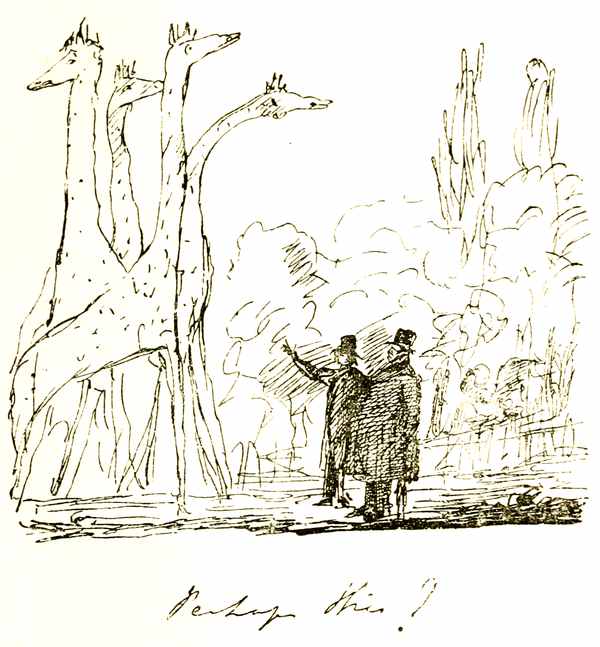
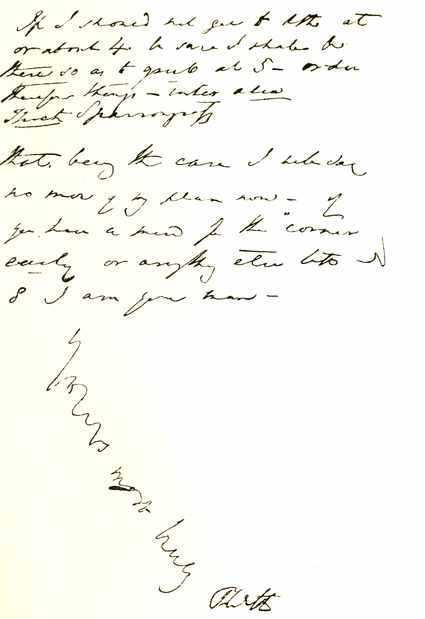
Hook, in his letter to Broderip (facsimile given elsewhere) suggests that as they are going to Ascot races tête-à-tête, it might be as well to speak of it as neck-and-neck. A rough sketch is enclosed of the Zoological Gardens, Hook pointing with pride to the necks of the giraffes.
We will select one line of about three or four miles, which will answer by way of an example of what we mean: A man, driving himself (without a servant), starts from Bishopsgate-street for Kilburn. The day is cold and rainy—his fingers are benumbed; his two coats buttoned up; his money in tight pantaloon-pockets; his horse restive, apt to kick if the reins touch his tail; his gloves soaked with wet; and himself half-an-hour too late for dinner. He has to pull up in the middle of the street in Shoreditch, and pay a toll;—he means to return, therefore he takes a ticket, letter A. On reaching Shoreditch Church, he turns into the Curtain Road, pulls up again, drags off his wet glove with his teeth, his other hand being fully occupied in holding up the reins and the whip; pays again; gets another ticket, number 482; drags on his glove; buttons up his coats, and rattles away into Old Street Road; another gate; more pulling and poking, and unbuttoning and squeezing. He pays, and takes another ticket, letter L. The operation of getting all to rights takes place once more, nor is it repeated until he reaches Goswell Street Road; here he performs all the ceremonies we have already described, for a fourth time, and gets a fourth ticket, 732, which is to clear him through the gates in the New Road, as far as the bottom of Pentonville;—arrived there, he performs once more all the same evolutions, and procures a fifth ticket, letter X, which, unless some sinister accident occur, is to carry him clear to the Paddington Road; but opening the fine space of the Regent's Park, at the top of Portland Street, the north breeze blowing fresh from Hampstead, bursts upon his buggy, and all the tickets which he had received from all the gates which he has paid, and which he had stuffed seriatim between the cushion and lining of his dennet, suddenly rise, like a covey of partridges, from the corner, and he sees the dingy vouchers for his expenditure proceeding down Portland Street at full speed. They are rescued, however, muddy and filthy as they are, by the sweeper of the crossing, who is, of course, rewarded by the driver for his attention with a larger sum than he had originally disbursed for all the gates; and when deposited again in the vehicle, not in their former order of arrangement, the unfortunate traveller spends at least ten minutes at the next gate in selecting the particular ticket which is there required to insure his free passage.
Conquering all these difficulties, he reaches Paddington Gate, where he pays afresh, and obtains a ticket, 691, with which he proceeds swimmingly until stopped again at Kilburn, to pay a toll, which would clear him all the way to Stanmore, if he were not going to dine at a house three doors beyond the very turnpike, where he pays for the seventh time, and where he obtains a seventh ticket, letter G.
He dines and "wines;" and the bee's-wing from the citizen's port gives new velocity to Time. The dennet was ordered at eleven; and, although neither tides nor the old gentleman just mentioned, wait for any man, except Tom Hill, horses and dennets will. It is nearer midnight than eleven when the visitor departs, even better buttoned up than in the morning, his lamps giving cheerfulness to the equipage, and light to the road; and his horse whisking along (his nostrils pouring forth breath like smoke from safety-valves), and the whole affair actually in motion at the rate of ten miles per hour. Stopped at Paddington. "Pay here?"—"L."—"Won't do."—"G?"—(The horse fidgety all this time, and the driver trying to read the dirty tickets by the little light which is emitted through the tops of his lamps,)—"X?"—"It's no letter, I tell you?"—"482,"—"No." At this juncture the clock strikes twelve—the driver is told that his reading and rummaging are alike useless, for that a new day has begun. The coats are, therefore, unbuttoned—the gloves pulled off—the money to be fished out—the driver discovers that his last shilling was paid to the ostler at the inn where his horse was fed and that he must change a sovereign to pay the gate. This operation the toll-keeper performs; nor does the driver discover, until the morning, that one of the half-crowns and four of the shillings which he has received, are bad. Satisfied, however, with what has occurred, he determines at all hazards to drive home over the stones, and avoid all further importunities from the turnpike-keepers. Accordingly, away he goes along Oxford Street, over the pavement, working into one hole and tumbling into another, like a ball on a trou madame table, until, at the end of George Street, St. Giles's, snap goes his axle-tree; away goes his horse, dashing the dennet against a post at the corner of Plumtree Street, leaving the driver, with his collar-bone and left arm broken, on the pavement, at the mercy of two or three popish bricklayers and a couple of women of the town, who humanely lift him to the coach-stand, and deposit him in a hackney-chariot, having previously cut off the skirts of both his coats, and relieved him, not only of his loose change, but of a gold repeater, a snuff-box, and a pocket-book full of notes and memoranda, of no use but to the owner.
The unhappy victim at length reaches home, in agonies from the continued roughness of the pre-adamite pavement, is put to bed—doctors are sent for, the fractures are reduced, and in seven weeks he is able to crawl into his counting-house to write a cheque for a new dennet, and give his people orders to shoot his valuable horse, who has so dreadfully injured himself on the fatal night as to be past recovery.
TOM SHERIDAN'S ADVENTURE.[66]
Tom Sheridan was staying at Lord Craven's at Benham (or rather Hampstead), and one day proceeded on a shooting excursion, like Hawthorn, with only "his dog and his gun," on foot, and unattended by companion or keeper; the sport was bad—the birds few and shy—and he walked and walked in search of game, until, unconsciously, he entered the domain of some neighbouring squire.
A very short time after, he perceived advancing towards him, at the top of his speed, a jolly, comfortable-looking gentleman, followed by a servant, armed, as it appeared, for conflict. Tom took up a position, and waited the approach of the enemy.
"Hallo! you sir," said the squire, when within half-earshot, "what are you doing here, sir, eh?"
"I'm shooting, sir," said Tom.
"Do you know where you are, sir?" said the squire.
"I'm here, sir," said Tom.
"Here, sir," said the squire, growing angry; "and do you know where here is, sir? These, sir, are my manors; what d'ye think of that, sir, eh?"
"Why, sir, as to your manners," said Tom, "I can't say they seem over agreeable."
"I don't want any jokes, sir," said the squire, "I hate jokes. Who are you, sir?—what are you?"
"Why, sir," said Tom, "my name is Sheridan—I am staying at Lord Craven's—I have come out for some sport—I have not had any, and I am not aware that I am trespassing."
"Sheridan!" said the squire, cooling a little; "oh, from Lord Craven's, eh? Well, sir, I could not know that, sir—I——'
"No, sir," said Tom, "but you need not have been in a passion."
"Not in a passion! Mr. Sheridan," said the squire, "you don't know, sir, what these preserves have cost me, and the pains and trouble I have been at with them; it's all very well for you to talk, but if you were in my place I should like to know what you would say upon such an occasion."
"Why, sir," said Tom, "if I were in your place, under all the circumstances, I should say—'I am convinced, Mr. Sheridan, you did not mean to annoy me; and, as you look a good deal tired, perhaps you'll come up to my house and take some refreshment?'"
The squire was hit hard by this nonchalance, and (as the newspapers say), "it is needless to add," acted upon Sheridan's suggestion.
"So far," said poor Tom, "the story tells for me,—now you shall hear the sequel."
After having regaled himself at the squire's house, and having said five hundred more good things than he swallowed; having delighted his host, and more than half won the hearts of his wife and daughters, the sportsman proceeded on his return homewards.
In the course of his walk he passed through a farm-yard; in the front of the farm-house was a green, in the centre of which was a pond, in the pond were ducks innumerable swimming and diving; on its verdant banks a motley group of gallant cocks and pert partlets, picking and feeding—the farmer was leaning over the hatch of the barn, which stood near two cottages on the side of the green.
Tom hated to go back with an empty bag; and having failed in his attempts at higher game, it struck him as a good joke to ridicule the exploits of the day himself, in order to prevent any one else from doing it for him, and he thought to carry home a certain number of the domestic inhabitants of the pond and its vicinity would serve the purpose admirably. Accordingly, up he goes to the farmer and accosts him very civilly—
"My good friend," says Tom, "I'll make you an offer."
"Of what, sur?" says the farmer.
"Why," replies Tom, "I've been out all day fagging after birds, and haven't had a shot—now, both my barrels are loaded—I should like to take home something; what shall I give you to let me have a shot with each barrel at those ducks and fowls—I standing here—and to have whatever I kill?"
"What sort of a shot are you?" said the farmer.
"Fairish," said Tom, "fairish."
"And to have all you kill?" said the farmer, "eh?"
"Exactly so," said Tom.
"Half a guinea," said the farmer.
"That's too much," said Tom. "I'll tell you what I'll do—I'll give you a seven-shilling piece, which happens to be all the money I have in my pocket."
"Well," said the man, "hand it over."
The payment was made—Tom, true to his bargain, took his post by the barn-door, and let fly with one barrel and then with the other; and such quacking and splashing, and screaming and fluttering, had never been seen in that place before.
Away ran Tom, and, delighted at his success, picked up first a hen, then a chicken, then fished out a dying duck or two, and so on, until he numbered eight head of domestic game, with which his bag was nobly distended.
"Those were right good shots, sir," said the farmer.
"Yes," said Tom, "eight ducks and fowls were more than you bargained for, old fellow—worth rather more, I suspect, than seven shillings—eh?"
"Why, yes," said the man, scratching his head—"I think they be; but what do I care for that—they are none of them mine!"
"Here," said Tom, "I was for once in my life beaten, and made off as fast as I could, for fear the right owner of my game might make his appearance—not but that I could have given the fellow that took me in seven times as much as I did for his cunning and coolness."
POLLY HIGGINBOTTOM.[67]
In Chester's town a man there dwelt, Not rich as Crœsus, but a buck; The pangs of love he clearly felt— His name was Thomas Clutterbuck. The lady he did most approve Most guineas gold had got 'em; And Clutterbuck fell deep in love With Polly Higginbottom. O Thomas Clutterbuck! And O Polly Higginbottom! I sing the loves—the smiling lives— Of Clutterbuck and Higginbottom. A little trip he did propose:— Upon the Dee they got 'em; The wind blew high—he blew his nose, And sung to Polly Higginbottom. The strain was sweet—the stream was deep— He thought his notes had caught her; But she, alas! first fell—asleep; And then fell—in the water. O Polly Higginbottom! She went to the bottom— I sing the death—the doleful death!— Of pretty Polly Higginbottom! Yet still he strain'd his little throat; To love he did invite her; And never miss'd her—till his boat, He thought, went rather lighter. But when he found that she was lost, The summum of his wishes— He boldly paid the waterman, And jump'd among the fishes. O Polly Higginbottom, He comes to the bottom! I sing the death—the double death— Of Clutterbuck and Higginbottom. Round Chester stalk the river ghosts Of this young man and fair maid: His head looks like a salmon-trout; Her tail is like a mermaid. Moral. Learn this, ye constant lovers all, Who live on England's island— The way to shun a watery death Is making love on dry land! O Polly Higginbottom, Who lies at the bottom! So sing the ghosts—the water-ghosts— Of Clutterbuck and Higginbottom.
SONG.[68]
Mary once had lovers two— Whining—pining—sighing: "Ah!" cries one, "what shall I do? Mary dear, I'm dying!" T' other vow'd him just the same— Dead in grief's vagary; But sighs could never raise a flame In the heart of Mary. A youth there came, all blithe and gay— Merry—laughing—singing— Sporting—courting, all the day— And set the bells a-ringing. Soon he tripp'd it off to church, Lightly, gay, and airy; Leaving t' others in the lurch, Sighing—after Mary.
PHILIP.
In the famed town of Cadiz Lived the fairest of ladies, Donna Louisa Isabella: And she had a lover, Who did his mind discover; And she thought him a charming fellow. Now this fairest of ladies Had a father lived in Cadiz, And he lock'd her within a high tower: And her lover coming thither, He promised to be with her At a certain appointed hour. He was there at the time, And he call'd out in rhyme— For his heart was consumed to a cinder— "You have nothing now to fear, Since your Philip now is here;— Louisa, pray come to the window!" The lady appears, And quiets all his fears; For his boldness she likes him the better. "All I want," says he, "to do, Is to get convey'd to you— This very interesting letter!"
THE BLACKSMITH.
A blacksmith, you'll own, is so clever, And great in the world is his place; And the reason I've guess'd, why for ever A blacksmith's deserving of grace. Great lawyers who plead and who preach, While many good causes they mar, May yield to the blacksmith to teach, For he labours still more at the bar! When great men do wrong in the State, The Commons try hard at their polls; While the blacksmith, as certain as fate, Could have 'em haul'd over the coals. And if rogues put their name to a draft, The law for their hanging will teaze; But blacksmiths are free from all craft, And may forge just as much as they please. The vices of trade he holds cheap, And laughs at the world as it rails, For, spite of the pother they keep, They can't make a smith eat his nails! And if, to his praise be it spoke, To raise him still higher and higher; You may say, and without any joke, All he gets is got out of the fire! Then let blacksmiths be toasted round, For well it may always be said, When a fortune by blacksmiths is found, They must hit the right nail o' the head. No irony now I'm about, To his metal you'll find him still true, Since I've hammer'd his history out, I hope 'twill be temper'd by you.
"MY FATHER DID SO BEFORE ME."[69]
When I was a chicken I went to school, My master would call me an obstinate fool, For I ruled the roast, and I roasted all rule, And he wonder'd how ever he bore me. His tables I blotted, his windows I broke, I fired his wig, and I laughed at the smoke, And always replied if he row'd at the joke, Why—my father did so before me. I met a young girl, and I pray'd to the miss, I fell on my knee, and I ask'd for a kiss, She twice said no, but she once said yes, And in marriage declared she'd restore me. We loved and we quarrell'd, like April our strife, I guzzled my stoup, and I buried my wife; But the thing that consoled me at this time of life Was—my father did so before me. Then now I'm resolv'd at all sorrows to blink— Since winking's the tippy I'll tip 'em the wink, I'll never get drunk when I cannot get drink, Nor ever let misery bore me. I sneer at the Fates, and I laugh at their spite, I sit down contented to sit up all night, And when my time comes, from the world take my flight, For—my father did so before me.
"THROUGHOUT MY LIFE THE GIRLS I'VE PLEASED."
Throughout my life the girls I've pleased, So merry, so blithe and gay; I've coax'd, I've flatter'd, I've sigh'd, and teased, And stole their young hearts away. With their lips so red, and their eyes so bright, Their nut-brown locks and their teeth so white, The lasses were always my delight, And I am the boy for them. With my capering, tapering, twirling toe, My billet-doux note or letter a; My sighing—pining—whining—oh! My person—eye—etcetera! My taste is wondrous civil, too; For mark, ye ladies, this— There's nought you say, there's nought you do, To me can come amiss. If serious be your turn of mind, To grunt and groan I'm then inclined; But if you'll laugh, why, still you'll find That I'm the boy for you. With my capering, etc. Then as to person, what of that? Of all the girls I've seen, If they've been plump, I've loved them fat; If thin, admired them lean; And as to height, make no ado; It matters not, I tell you true, Whether two feet six, or six feet two, Still I am the boy for you. With my capering, etc.
THE CHAMBERMAID.
When clouds obscure the evening sky, And rains in torrents pour, The inn with joy the travellers spy, And seek its welcome door. 'Tis there I stand to please them all, And follow still my trade; I smile and run whene'er they call, A merry little chambermaid. But when appears the dawn of day, Farewell to every guest, They take their leaves and onward stray, Some east and others west. And when that horrid bore, the bill, Is call'd for, read, and paid, I cry, "I hope, give what you will, You'll not forget the chambermaid." Thus happy might I pass my life, But love rules in my breast, And till I'm made a happy wife, I ne'er shall be at rest. Then Fortune's gifts in vain she sheds, For love I leave my trade; And give my all to him who weds The merry little chambermaid.
SONG.[70]
When I was a very little fellow, To Italy I went Upon music intent, With a voice very pliable and mellow. Il sondo to my earo Si suito e so clearo. I like it;—I love it;—I adore, oh And den it was I resolved to have some more, Che il gela del timore Sua Pace in tanta pena Tanta Smorza l'ardore, Gia sento in ogni vena. To Turkey then I bent my way; Tink, tink, a ting a ring, oh! When cymbals jingle, music play, Ting, ting a ting a ring, oh! Yet then I change; To Germany I range; And Holland, too, mynher vat is der name, Bazzoon, O Gloch da cram bo Vat can a, do, do! Then turn again To flippant Spain, Fast as ever I can go, Where pretty sets With castanets Tack a rack to the merry Fandango. In France I there Learn'd many an air, And music made my gain With Comment ça, Monsieur? Ha! Ha! Miron ton ton ton tain! But near home I got land, And lilted I into Scotland, Where Donald loo'd fair Maggie bonnie; She loo'd Jock and hated Johnny; Wi bit love between 'em ganging, Sawney gied the lad a banging. And now to Hibernia, the true land of harmony, Tippling your whiskey to Shelim a gig, Music, love, wine, and true friendship so charming ye, Blood and ouns, boderoo, fizle my gig. In England, no music is fit to be read, Save one glorious tune that's in every one's head. 'Tis a tune we delight in, So glorious to sing; God save great George our King, Long live our noble King! God save the King.
SIR TILBURY TOTT.[71]
The plump Lady Tott to her husband one day Said, "Let us go driving this evening, I pray." (Lady Tott was an alderman's daughter.) "Well, where shall we go?" said Sir Tilbury Tott; "Why, my love," said my lady, "the weather is hot, Suppose we drive round by the water,— The water,— Suppose we drive round by the water." The dinner was ended, the claret was "done," The knight getting up—getting down was the sun,— And my lady agog for heart-slaughter; When Sir Tilbury, lazy, like cows after grains, Said, "The weather is lowering, my love; see, it rains,— Only look at the drops in the water,— The water,— Only look at the drops in the water." Lady Tott, who, when earnestly fix'd on a drive, Overcame all excuses Sir Til might contrive, Had her bonnet and parasol brought her: Says she, "Dear Sir Til, don't let me ask in vain; The dots in the pond which you take to be rain, Are nothing but flies in the water,— The water,— Are nothing but flies in the water." Sir Tilbury saw that he could not escape; So he put on his coat, with a three-doubled cape, And then by the hand gently caught her; And lifting her up to his high one-horse "shay," She settled her "things," and the pair drove away, And skirted the edge of the water,— The water,— And skirted the edge of the water. Sir Til was quite right; on the top of his crown, Like small shot in volleys, the rain pepper'd down,— Only small shot would do much more slaughter,— Till the gay Lady Tott, who was getting quite wet, Said, "My dear Sir T. T.," in a kind of half pet, "Turn back, for I'm drench'd with rain-water,— Rain-water,— Turn back, for I'm drench'd with rain-water." "Oh, dear Lady T," said Til, winking his eye, "You everything know so much better than I;" (For, when angry, with kindness he fought her.) "You may fancy this rain, as I did before, But you show'd me my folly;—'tis really no more Than the skimming of flies in the water,— The water,— Than the skimming of flies in the water." He drove her about for an hour or two, Till her ladyship's clothes were completely soak'd through, Then home to Tott Cottage he brought her, And said, "Now, Lady T., by the joke of to-night, I'll reign over you; for you'll own that I'm right, And know rain, ma'am, from flies in the water,— The water,— Know rain, ma'am, from flies in the water."
VENICE PRESERVED.[72]
Tune—"The Sprig of Shillelagh."
Och, tell me truth now, and did you ne'er hear Of a pair of big traitors, call'd Jaffier and Pierre, Who thought that their country was shockingly served? Who met in the dark, and the night, and the fogs,— Who "howl'd at the moon" and call'd themselves "dogs," Till Jaffier to Pierre pledged his honour and life, And into the bargain his iligant wife,— By which very means was ould Venice preserved. The ringleaders held a snug club in the town, The object of which was to knock the Doge down, Because from his duty they thought he had swerved. They met every evening, and more was their fault, At the house of a gentleman, Mr. Renault, Who—och, the spalpeen!—when they all went away, Stay'd at home, and made love to the sweet Mrs. J.,— By which, in the end, was ould Venice preserved. When Jaffier came back, his most delicate belle— Belvidera they call'd her—determined to tell How she by old Renault that night had been served. This blew up a breeze, and made Jaffier repent Of the plots he had laid: to the Senate he went. He got safe home by twelve: his wife bade him not fail; And by half-after-one he was snug in the gaol,— By which, as we'll see, was ould Venice preserved. The Doge and the Court, when J.'s story they'd heard, Thought it good for the country to forfeit their word, And break the conditions they should have observed. So they sent the police out to clear every street, And seize whomsoever by chance they might meet; And before the bright sun was aloft in the sky, Twenty-two of the party were sentenced to die,— And that was the way was ould Venice preserved. Mr. Jaffier, who 'peach'd, was let off at the time; But that wouldn't do, he committed a crime, Which punishment more than his others deserved; So when Pierre was condemn'd, to the scaffold he went, Pierre whisper'd and nodded, and J. said "Content." They mounted together, till kind Mr. J., Having stabb'd Mr. P., served himself the same way,— And so was their honour in Venice preserved. But och! what a scene, when the beautiful Bell, At her father's, found out how her dear husband fell! The sight would the stoutest of hearts have unnerved. She did nothing but tumble, and squabble, and rave, And try to scratch J., with her nails from the grave. This lasted three months, when, cured of her pain, She chuck'd off her weeds, and got married again,— By which very means was this Venus preserved.
DAYLIGHT DINNERS.[73]
When Summer's smiles rejoice the plains, And deck the vale with flowers; And blushing nymphs, and gentle swains, With love beguile the hours; Oh! then conceive the ills that mock The well-dress'd London sinner, Invited just at seven o'clock To join a "daylight dinner." The sun, no trees the eye to shade, Glares full into the windows, And scorches widow, wife, and maid Just as it does the Hindoos; One's shoes look brown, one's black looks grey, One's legs if thin, look thinner; There's nothing equals, in its way, A London daylight dinner. The cloth seems blue, the plate's like lead, The faded carpet dirty, Grey hairs peep out from each dark head, And twenty looks like thirty. You sit beside an heiress gay, And do your best to win her, But oh!—what can one do or say, If 'tis a daylight dinner? A lovely dame just forty-one, At night a charming creature, My praise unqualified had won, In figure, form, and feature, That she was born, without a doubt, Before the days of Jenner, By sitting next her, I found out, Once at a daylight dinner. Freckles, and moles, and holes, and spots, The envious sun discloses, And little bumps, and little dots, On chins, and cheeks, and noses. Last Monday, Kate, when next me placed (A most determined grinner), Betray'd four teeth of mineral paste, Eating a daylight dinner.
CLUBS.
Tune—"Bow, wow, wow."
If any man loves comfort and has little cash to buy it, he Should get into a crowded club—a most select society; While solitude and mutton-cutlets serve infelix uxor, he May have his club (like Hercules) and revel there in luxury. Bow, wow, wow, etc. Yes, Clubs knock taverns on the head! e'en Hatchetts can't demolish them; Joy grieves to see their magnitude, and Long longs to abolish them. The Inns are out! hotels for single men scarce keep alive on it, While none but houses that are in the Family way thrive on it! Bow, wow, wow, etc. There's first the Athenæum club, so wise, there's not a man of it That has not sense enough for six, (in fact, that is the plan of it:) The very waiters answer you with eloquence Socratical, And always place the knives and forks in order mathematical. Bow, wow, wow, etc. Then opposite the mental club you'll find the regimental one, A meeting made of men of war, and yet a very gentle one; If uniform good living please your palate, here's excess of it, Especially at private dinners, when they make a mess of it! Bow, wow, wow, etc. E'en Isis has a house in Town! and Cam abandons her city! The Master now hangs out at the United University; In Common Room she gave a route! (a novel freak to hit upon) Where Masters gave the Mistresses of Arts no chairs to sit upon! Bow, wow, wow, etc. The Union Club is quite superb—it's best apartment daily is The lounge of lawyers, doctors, merchants, beaux cum multis aliis: At half-past six, the joint concern, for eighteenpence, is given you— Half-pints of port are sent in ketchup bottles to enliven you! Bow, wow, wow, etc. The travellers are in Pall Mall, and smoke cigars so cosily, And dream they climb the highest Alps, or rove the plains of Moselai; The world for them has nothing new, they have explor'd all parts of it, And now they are club-footed! and they sit and look at charts of it. Bow, wow, wow, etc. The Orientals homeward bound, now seek their clubs much sallower, And while they eat green fat, they find their own fat growing yellower: Their soup is made more savoury, till bile to shadows dwindles 'em, And Messrs. Savory and Moore with seidlitz draughts rekindles 'em. Bow, wow, wow, etc. Then there are clubs where persons Parliamentary preponderate, And clubs for men upon the turf—(I wonder they aren't under it)— Clubs where the winning ways of sharper folks pervert the use of clubs, Where knaves will make subscribers cry, "Egad, this is the deuce of clubs." Bow, wow, wow, etc. For country Squires the only club in London now is Boodles, sirs, The Crockford club for playful men, the Alfred club for noodles, sirs, These are the stages which all men propose to play their parts upon, For clubs are what the Londoners have clearly set their hearts upon. Bow, wow, wow, etc.
VISITINGS.
N.B.—A lady having presented the Author, on a visit, with her thumb to shake hands with, the Muse opened her mouth and spake as follows:—
Some women at parting scarce give you So much as a simple good-bye, And from others as long as you live, you Will never be bless'd with a sigh; Some will press you so warmly, you'd linger Beside them for ever, and some Will give you an icy forefinger, But Fanny presents you a thumb. Some will give you a look of indifference, Others will give you a smile; While some of the colder and stiffer ones, Bow in their own chilly style. There are some who look merry at parting, And some who look wofully glum; Some give you a blessing at starting, But Fanny just gives you a thumb. There are some who will go to the door with you, Some ring for the man or the maid; Some who do less, and some more, with you, And a few would be glad if you stay'd. A good many wish you'd be slack again, Their way on a visit to come; Two or three give you leave to go back again, But Fanny gives only her thumb. With a number, ten minutes are longer Than you find yourself welcome to stay; While some, whose affections are stronger, Would like to detain you all day. Some offer you sherry and biscuit, Others give not a drop nor a crumb; Some a sandwich, from sirloin or brisket, But Fanny gives simply her thumb. Some look with a sort of a squint to you, Some whisper they've visits to make; Some glance at their watches—a hint to you, Which, if you are wise, you will take. Some faintly invite you to dinner, (So faint, you may see it's all hum, Unless you're a silly beginner,) But Fanny presents you a thumb. Some chatter—thirteen to the dozen— Some don't speak a word all the time; Some open the albums they've chosen, And beg you to scribble in rhyme; Some bellow so loud, they admonish Your ear to take care of its drum; Some give you an ogle quite tonish, But Fanny gives nought, save her thumb. Some wonder how long you've been absent, Despair of your coming again; While some have a coach or a cab sent, To take you away if it rain. Some shut up their windows in summer, Some won't stir the fire, though you're numb; Some give you hot punch in a rummer, But Fanny gives only her thumb. Some talk about scandal, or lovers, Some talk about Byron or Scott; Some offer you eggs laid by plovers, Some offer the luck of the pot; A great many offer you nothing, They sit, like automata, dumb, The silly ones give you a loathing, But Fanny gives merely her thumb. Some bore you with six-year-old gabies, In the shape of a master or miss; Others hold up their slobbering babies, Which you must be a brute not to kiss: Some tell you their household disasters, While others their instruments strum; Some give you receipts for corn plasters, But Fanny presents you her thumb. Some talk of the play they've been last at, And some of the steam-driven coach; While those who are prudes look aghast at Each piece of new scandal you broach: Some talk of converting the Hindoos, To relish, like Christians, their rum; Some give you a view from their windows, But Fanny gives only her thumb. Some ask what you think of the tussel, man, Between the all-lies and the Porte; And Cod-rington's thrashing the muscle-man (Puns being such people's forte). The men speak of change in the Cabinet; The women—how can they sit mum? Give their thoughts upon laces and tabinet, But Fanny gives merely her thumb. Some speak of the Marquis of Lansdowne, Who, to prove the old proverb, has set About thief-catching—laying wise plans down In the Hue and Cry weekly gazette. Some think that the Whigs are but noodles (But such are, of course, the mere scum); Some give you long tales of their poodles, But Fanny presents you her thumb. Good luck to them all!—where I visit, I meet with warm hearts and warm hands; But that's not a common thing, is it? For I neither have houses nor lands: Not a look but the soul has a part in it, (How different the looks are of some!) Oh! give me a hand with a heart in it, And the devil take finger and thumb.
TO MR. ——, WHO PUTS OVER HIS DOOR
"PEN AND QUILL MANUFACTURER."
You put above your door, and in your bills, You're manufacturer of pens and quills; And for the first you well may feel a pride, Your pens are better far than most I've tried; But for the quills your words are somewhat loose— Who manufactures quills must be a Goose.
EPIGRAM ON TWINING'S TEA.
It seems as if nature had curiously plann'd, That men's names with their trades should agree; There's Twining the Tea-man, who lives in the Strand, Would be whining if robb'd of his T.
ON THE LATIN GERUNDS.
When Dido's spouse to Dido would not come, She mourn'd in silence, and was Di, Do, Dumb!
THE SPLENDID ANNUAL;[74]
Or, Fortunes and Misfortunes of a Lord Mayor.
Literature, even in this literary age, is not the ordinary pursuit of the citizens of London, although every merchant is necessarily a man of letters, and underwriters are as common as cucumbers. Notwithstanding, however, my being a citizen, I am tempted to disclose the miseries and misfortunes of my life in these pages, because, having heard the "Anniversary" called a splendid annual, I hope for sympathy from its readers, seeing that I have been a "splendid annual" myself.
My name is Scropps—I am an Alderman—I was Sheriff—I have been Lord Mayor—and the three great eras of my existence were the year of my shrievalty, the year of my mayoralty, and the year after it. Until I had passed through this ordeal I had no conception of the extremes of happiness and wretchedness to which a human being may be carried, nor ever believed that society presented to its members an eminence so exalted as that which I once touched, or imagined a fall so great as that which I experienced.
I came originally from that place to which persons of bad character are sent—I mean Coventry, where my father for many years contributed his share to the success of parliamentary candidates, the happiness of new married couples, and even the gratification of ambitious courtiers, by taking part in the manufacture of ribands for election cockades, wedding favours, and cordons of chivalry; but trade failed, and, like his betters, he became bankrupt, but, unlike his betters, without any consequent advantage to himself; and I, at the age of fifteen, was thrown upon the world with nothing but a strong constitution, a moderate education, and fifteen shillings and elevenpence three farthings in my pocket.
With these qualifications I started from my native town on a pedestrian excursion to London; and, although I fell into none of those romantic adventures of which I had read at school, I met with more kindness than the world generally gets credit for, and on the fourth day after my departure, having slept soundly, if not magnificently, every night, and eaten with an appetite which my mode of travelling was admirably calculated to stimulate, reached the great metropolis, having preserved of my patrimony no less a sum than nine shillings and sevenpence.
The bells of one of the churches in the city were ringing merrily as I descended the heights of Islington; and were it not that my patronymic Scropps never could, under the most improved system of campanology, be jingled into anything harmonious, I have no doubt I, like my great predecessor Whittington, might have heard in that peal a prediction of my future exaltation; certain it is I did not; and, wearied with my journey, I took up my lodging for the night at a very humble house near Smithfield, to which I had been kindly recommended by the driver of a return post-chaise, of whose liberal offer of the moiety of his bar to town, I had availed myself at Barnet.
As it is not my intention to deduce a moral from my progress in the world at this period of my life, I need not here dilate upon the good policy of honesty, or the advantages of temperance and perseverance, by which I worked my way upwards, until, after meriting the confidence of an excellent master, I found myself enjoying it fully. To his business I succeeded at his death, having several years before, with his sanction, married a young and deserving woman, about my own age, of whose prudence and skill in household matters I had long had a daily experience. In the subordinate character of his sole domestic servant, in which she figured when I first knew her, she had but few opportunities of displaying her intellectual qualities, but when she rose in the world, and felt the cheering influence of prosperity, her mind, like a balloon soaring into regions where the bright sun beams on it, expanded, and she became, as she remains, the kind unsophisticated partner of my sorrows and my pleasures, the friend of my heart, and the guiding-star of my destinies.
To be brief, Providence blessed my efforts and increased my means; I became a wholesale dealer in everything, from barrels of gunpowder down to pickled herrings; in the civic acceptation of the word I was a merchant, amongst the vulgar I am called a drysalter. I accumulated wealth; with my fortune my family also grew, and one male Scropps, and four female ditto, grace my board at least once in every week; for I hold it an article of faith to have a sirloin of roasted beef upon my table on Sundays, and all my children round me to partake of it: this may be prejudice—no matter—so long as he could afford it, my poor father did so before me; I plead that precedent, and am not ashamed of the custom.
Passing over the minor gradations of my life, the removal from one residence to another, the enlargement of this warehouse, the rebuilding of that, the anxiety of a canvass for common councilman, activity in the company of which I am liveryman, inquests, and vestries, and ward meetings, and all the other pleasing toils to which an active citizen is subject, let us come at once to the first marked epoch of my life—the year of my Shrievalty. The announcement of my nomination and election filled Mrs. S. with delight; and when I took my children to Great Queen Street, Lincoln's Inn Fields, to look at the gay chariot brushing up for me, I confess I felt proud and happy to be able to show my progeny the arms of London, those of the Spectacle-makers' Company, and those of the Scroppses (recently found at a trivial expense) all figuring upon the same panels. They looked magnificent upon the pea-green ground, and the wheels, "white picked-out crimson," looked so chaste, and the hammercloth, and the fringe, and the festoons, and the Scropps' crests all looked so rich, and the silk linings and white tassels, and the squabs and the yellow cushions and the crimson carpet looked so comfortable, that, as I stood contemplating the equipage, I said to myself, "What have I done to deserve this? O that my poor father were alive to see his boy Jack going to Westminster, to chop sticks and count hobnails, in a carriage like this!" My children were like mad things; and in the afternoon, when I put on my first new brown court suit (lined, like my chariot, with white silk), and fitted up with cut steel buttons, just to try the effect, it all appeared like a dream; the sword, which I tried on, every night for half an hour after I went up to bed, to practise walking with it, was very inconvenient at first; but use is second nature; and so by rehearsing and rehearsing I made myself perfect before that auspicious day, when Sheriffs flourish and geese prevail—namely, the twenty-ninth of September.
The twelve months which followed were very delightful, for, independently of the positive honour and éclat they produced, I had the Mayoralty in prospectu (having attained my aldermanic gown by an immense majority the preceding year), and as I used during the sessions to sit in my box at the Old Bailey, with my bag at my back and my bouquet on my book, my thoughts were wholly devoted to one object of contemplation; culprits stood trembling to hear the verdict of a jury, and I regarded them not; convicts knelt to receive the fatal fiat of the Recorder, and I heeded not their sufferings, as I watched the Lord Mayor seated in the centre of the bench, with the sword of justice stuck up in a goblet over his head—there, thought I, if I live two years, shall I sit—however, even as it was, it was very agreeable. When executions, the chief drawbacks to my delight, happened, I found, after a little seasoning, I took the thing coolly, and enjoyed my toast and tea after the patients were turned off, just as if nothing had happened; for, in my time, we hanged at eight and breakfasted at a quarter after, so that without much hurry we were able to finish our muffins just in time for the cutting down at nine. I had to go to the House of Commons with a petition, and to Court with an address—trying situation for one of the Scroppses—however, the want of state in Parliament, and the very little attention paid to us by the members, put me quite at my ease at Westminster; while the gracious urbanity of our accomplished monarch[75] on his throne made me equally comfortable at St. James's. Still I was but a secondary person, or rather only one of two secondary persons—the chief of bailiffs and principal Jack Ketch; there was a step to gain—and, as I often mentioned to Mrs. Scropps, I was sure my heart would never be still until I had reached the pinnacle.
Behold at length the time arrived! Guildhall crowded to excess—the hustings thronged—the aldermen retire—they return—their choice is announced to the people—it has fallen upon John Ebenezer Scropps, Esq. Alderman and spectacle-maker—a sudden shout is heard—"Scropps for ever!" resounds—the whole assembly seems to vanish from my sight—I come forward—am invested with the chain—I bow—make a speech—tumble over the train of the Recorder, and tread upon the tenderest toe of Mr. Deputy Pod—leave the hall in ecstasy, and drive home to Mrs. Scropps in a state of mind bordering upon insanity.
The days wore on, each one seemed as long as a week, until at length the 8th of November arrived, and then did it seem certain that I should be Lord Mayor—I was sworn in—the civic insignia were delivered to me—I returned them to the proper officers—my chaplain was near me—the esquires of my household were behind me—the thing was done—never shall I forget the tingling sensation I felt in my ear when I was first called "My Lord"—I even doubted if it were addressed to me, and hesitated to answer—but it was so—the reign of splendour had begun, and after going through the accustomed ceremonies, I got home and retired to bed early, in order to be fresh for the fatigues of the ensuing day.
Sleep I did not—how was it to be expected?—some part of the night I was in consultation with Mrs. Scropps upon the different arrangements; settling about the girls, their places at the banquet, and their partners at the ball; the wind down the chimney sounded like the shouts of the people; the cocks crowing in the mews at the back of the house I took for trumpets sounding my approach; and the ordinary incidental noises in the family I fancied the popguns at Stangate, announcing my disembarkation at Westminster—thus I tossed and tumbled until the long wished-for day dawned, and I jumped up anxiously to realize the visions of the night. I was not long at my toilet—I was soon shaved and dressed—but just as I was settling myself comfortably into my beautiful brown broadcloth inexpressibles, crack went something, and I discovered that a seam had ripped half a foot long. Had it been consistent with the dignity of a Lord Mayor to swear, I should, I believe, at that moment, have anathematized the offending tailor;—as it was, what was to be done?—I heard trumpets in earnest, carriages drawing up and setting down; sheriffs and chaplains, mace bearers, train bearers, sword bearers, water bailiffs, remembrancers, Mr. Common Hunt, the town clerk, and the deputy town clerk, all bustling about—the bells ringing—and I late, with a hole in my inexpressibles! There was but one remedy—my wife's maid, kind, intelligent creature, civil and obliging, and ready to turn her hand to anything, came to my aid, and in less than fifteen minutes her activity, exerted in the midst of the confusion, repaired the injury, and turned me out fit to be seen by the whole corporation of London.
When I was dressed, I tapped at Mrs. Scropps's door, went in, and asked her if she thought I should do; the dear soul, after settling my point-lace frill (which she had been good enough to pick off her own petticoat on purpose) and putting my bag straight, gave me the sweetest salute imaginable.
"I wish your Lordship health and happiness," said she.
"Sally," said I, "your Ladyship is an angel;" and so, having kissed each of my daughters, who were in progress of dressing, I descended the stairs, to begin the auspicious day in which I reached the apex of my greatness. Never shall I forget the bows—the civilities—the congratulations—Sheriffs bending before me—the Recorder smiling—the Common Serjeant at my feet—the pageant was intoxicating; and when, after having breakfasted, I stepped into that glazed and gilded house upon wheels, called the stage coach, and saw my sword-bearer pop himself into one of the boots, with the sword of state in his hands, I was lost in ecstasy. I threw myself back upon the seat of the vehicle, with all possible dignity, but not without damage; for, in my efforts at ease and elegance, I snapped off the cut steel hilt of my own rapier, by accidentally bumping the whole weight of my body right, or rather wrong, directly upon the top of it.
But what was a sword hilt and a bruise to me—pride knows no pain—I felt none—I was the Lord Mayor, the greatest man in the greatest city of the greatest nation in the world. The people realised my expectation; and "Bravo! Scropps," and "Scropps for ever!" resounded again and again, as we proceeded slowly and majestically towards the river, through a fog which prevented our being advantageously seen, and which got down the throat of the sword-bearer, who was a little troubled with asthma, and who coughed incessantly during our progress, much to my annoyance, not to speak of the ungraceful movements which his convulsive barkings gave to the red velvet scabbard of the honourable glaive, as it stuck out of the coach window.
We embarked in my barge. A new scene of splendour here awaited me: guns, flags, banners, in short, every thing that taste and fancy could suggest, or a water-bailiff provide, were awaiting me. In the gilded bark was a cold collation. I ate, or tried to eat, but I tasted nothing. Fowls, pâtees, game, beef, ham—all had the same flavour; champagne, hock, and Madeira, were all alike to me. "Lord Mayor" was all I saw, all I heard, all I swallowed; every thing was pervaded and absorbed by the one captivating word; and the repeated appeals to "My Lordship" were sweeter than nectar.
Well, sir, at Westminster I was presented and received; and what do you think I then did—I, John Ebenezer Scropps, of Coventry?—I desired the Recorder to invite the Judges to dine with me at the Guildhall!—I, who remember when two of the oldest and most innocent of the twelve came the circuit, trembling at the very sight of them, and believing them some extraordinary creatures, upon whom all the hair and fur, that I saw, grew naturally; I not only asked these formidable beings to dine with me, but, as if I thought it beneath my dignity to do so in my own proper person, actually deputed a judge of my own to do it for me. I never shall forget their lordships' bows in return; mandarins on a mantelpiece are fools to them.
Then came the return. We re-embarked; and then, in reality, did I hear the guns at Stangate saluting me. I stood it like a man, although I have always a fear of accidents from the wadding. The tide was with us; we soon reached Blackfriars' Bridge; we landed once more in the sphere of my greatness. At the corner of Fleet Street was the Lady Mayoress, waiting for the procession; there she was, Sally Scropps—my own Sally—(her maiden name was Snob,)—with a plume of feathers that half filled the coach, and young Sally, and Jenny, and Maria, all crammed in the front seat, with their backs to my horses, which were pawing the mud, and snorting, and smoking like steam-engines, with nostrils like safety-valves; not to speak of four of my footmen hanging behind the carriage, like bees in a swarm. There had not been so much riband in my family since my poor father's failure at Coventry; and yet, how often, over and over again, although the poor old man had been dead more than twenty years, did I during that morning, in the midst of my splendour, think of him, and wish to my heart that he could see me in my greatness. Even in the midst of my triumph, I seemed to defer to my good kind parent—in heaven, as I hope and trust—as if I were anxious for his judgment, and his opinion, as to how I should perform the manifold arduous duties of the day.
Up Ludgate Hill we went—the fog grew thicker and thicker—but then the beautiful women at the windows—those high up could only just see my knees, and the paste buckles in my shoes. This I regretted; but every now and then I bowed condescendingly to the people, in order to show my courtesy, and my chain and collar, which I had discovered during the morning shone the brighter for being shaken. But else I maintained a proper dignity throughout my progress; and, although I said an occasional word or two to my chaplain, and smiled occasionally at Mr. Water-bailiff, I took no more notice of Mr. Sword and Mr. Mace, than I should have taken of Gog and Magog.
At length we reached Guildhall. As I crossed that beautiful building, lighted brilliantly, and filled with splendidly dressed company, and heard the deafening shouts which pealed through its roof as I entered it, I felt a good deal flurried. I retired to a private room, adjusted my dress, shook out my frill, rubbed up my chain and collar, and prepared to receive my guests. They came, and shall I ever forget it? Dinner was announced; the bands played "Oh! the roast beef of Old England." Onwards we went. A prince of the blood—of the blood royal of my own country—led out Sally—my own Sally—the Lady Mayoress; the Lord Chancellor handed out young Sally—I saw it done—I thought I should have fainted; the Prime Minister took Maria; the Lord Privy Seal gave his arm to Jenny; and Mrs. Snob, my wife's mother—a wonderful woman at her age, bating her corpulency—was escorted to table by the Right Honourable the Lord Chief Justice of the King's Bench, in his full robes and collar of SS. Oh, if my poor father could have but seen that!
At the ball, my eldest girl danced with the Secretary of State for Foreign Affairs, and found him very chatty, though a bit of a "swell;" Maria danced with the Lord Privy Seal; and my youngest with a very handsome man, who wore a riband and star, but who he was, we none of us could ever find out; no matter—never did I see such a day, although it was but the first of three hundred and sixty-five splendid visions.
It would be tedious to expatiate in detail upon all the pleasures of this happy year, thus auspiciously begun. Each month brought its fresh pleasures; each week its new amusements; each day its festival. Public meetings, under the sanction of the Right Honourable the Lord Mayor; concerts and balls, under the patronage of the Lady Mayoress. Then came Easter, and its dinner—Blue-coat boys and buns; then to St. Paul's one Sunday, and to some other church another Sunday. And then came summer; and then there was swan-hopping up the river, and white-baiting down the river; Crown and Sceptre below, navigation barge above; music, flags, streamers, guns, and company. Turtle every day in the week; peas a pound per pint, and grapes a guinea a pound; not to speak of dabbling in rose-water, served in gold, nor the loving cup, nor the esquires of my household, all in full dress at my elbow.
The days, which before had seemed weeks, were now turned to minutes; scarcely had I swallowed my breakfast, when I was in the justice room; and before I had mittimused half a dozen paupers for begging about the streets, luncheon was ready; this hardly over, in comes a despatch or a deputation; and so on till dinner, which was barely ended before supper was announced. We all became delighted with the Mansion House. My girls grew graceful by the new confidence their high station gave them; Maria refused a good offer because her lover had an ugly name; and my dearest Sarah was absolutely persecuted by Sir Patrick O'Donahoo, who had what is called the run of the house, and who scarcely ever dined out of it during my mayoralty, whether I was at home or not. What did it matter? There was plenty to eat and drink; the money must be spent, and the victuals cooked; and so as we made ourselves happy, it was of no great consequence having one or two more or less at table. We got used to the place—the establishment had got used to us; we became, in fact, easy in our dignity, and happy in our state, when, lo and behold, the ninth of another November came—the anniversary of my exaltation—the conclusion of my reign.
Again did we go to Guildhall; again were we toasted and addressed; again we were handed in and led out; the girls again flirted with Cabinet ministers, and danced with ambassadors; and at two o'clock in the morning drove home from the scene of gaiety to our old residence in Budge Row, Walbrook. Never in this world did pickled herrings and turpentine smell so powerfully as when we entered the house upon that occasion; and although my wife and the young ones stuck to the drinkables at Guildhall as long as was decent, in order to keep up their spirits, their natural feelings would have way, and a sort of shuddering disgust seemed to fill all their minds on their return home. The passage looked so narrow, the drawing-room looked so small, the staircase was so dark, and the ceilings were so low. However, being tired, we all slept well—at least, I did; for I was in no humour to talk; and the only topic I could think upon, before I dropped off, was a calculation of the amount of expenses which I had incurred during the just expired year of my magnificence.
In the morning we assembled at breakfast; a note which had arrived by the twopenny post lay on the table; it was addressed "Mrs. Scropps, Budge Row." The girls, one after another, took it up, read the undignified superscription, and laid it down again. My old and excellent friend Bucklesbury called to inquire after us. What were his first words?—they were the first I had heard from a stranger since my change;—"Well, Scropps, how are you, old boy? Done up, eh?"
"Scropps—old boy"—no deference, no respect, no "My lord, I hope your lordship passed a comfortable night; and how is her ladyship, and your lordship's amiable daughters?" not a bit of it—"How's Mrs. S. and the gals?" There was nothing in this; it was quite natural—all as it had been—all as it must be—all as it should be; but how very unlike what it was only one day before! The very servants themselves, who, when amidst the strapping, state-fed, lace-loaded lackeys of the Mansion House (transferred, with the chairs and tables, from one lord mayor to another), dared not speak, nor look, nor say their lives were their own, strutted about, and banged the doors, and talked of their "missis," as if she had been an apple-woman.
So much for domestic matters. I went out—I was shoved about in Cheapside, in the most remorseless manner, by the money-hunting crowd. My right eye had the narrowest possible escape of being poked out by the tray of a brawny butcher-boy, who, when I civilly remonstrated, turned round and said, "Vy, I say, who are you, I vonder, as is so partiklar about your hye-sight?" I felt an involuntary shudder. "Who am I?—to-day," thought I, "I am John Ebenezer Scropps; two days ago I was Lord Mayor of London;" and so the rencontre ended, evidently to the advantage of the bristly brute. It was, however, too much for me. I admit the weakness; but the effect of contrast was too powerful—the change was too sudden—and I determined to go to Brighton for a few weeks to refresh myself and be weaned from my dignity.
We went—we drove to the Royal Hotel; in the hall stood one of his Majesty's ministers, one of my former guests, speaking to his lady and daughter: my girls passed close to him,—he had handed one of them to dinner the year before, but he appeared entirely to have forgotten her. By-and-by, when we were going out in a fly to take the air, one of the waiters desired the fly-man to pull off, because Sir Something Somebody's carriage could not come up,—it was clear that the name of Scropps had lost its influence.
We secluded ourselves in a private house, where we did nothing but sigh and look at the sea. We had been totally spoiled for our proper sphere, and could not get into a better; the indifference of our inferiors mortified us, and the familiarity of our equals disgusted us,—our potentiality was gone, and we were so much degraded that a puppy of a fellow had the impertinence to ask Jenny if she was going to one of the Old Ship balls. "Of course," said the coxcomb, "I don't mean the 'Almacks,' for they are uncommonly select."
In short, do what we would, go where we might, we were outraged and annoyed, or, at least, thought ourselves so; and beyond all bitterness was the reflection that the days of our dignity and delight never might return. There were at Brighton no less than three men who called me Jack, and that, out of flies or in libraries, and one of these chose occasionally, by way of making himself particularly agreeable, to address me by the familiar appellation of Jacky. At length, and that only three weeks after my fall, an over-grown tallow-chandler met us on the Steyne, and stopped our party to observe, "as how he thought he owed me for two barrels of coal-tar, for doing over his pig-styes." This settled it,—we departed from Brighton, and made a tour of the coast; but we never rallied, and business, which must be minded, drove us before Christmas to Budge Row, where we are again settled down.
Maria has grown thin—Sarah has turned Methodist—and Jenny, who danced with his Excellency the Portuguese Ambassador, who was called angelic by the Right Honourable the Lord Privy Seal; and who, moreover, refused a man of fortune because he had an ugly name, is going to be married to Lieutenant Stodge, on the half-pay of the Royal Marines—and what then? I am sure if it were not for the females of my family I should be perfectly at my ease in my proper sphere, out of which the course of our civic constitution raised me. It was very pleasant at first—but I have toiled long and laboured hard; I have done my duty, and Providence has blessed my works. If we were discomposed at the sudden change in our station, I it is who was to blame, for having aspired to honours which I knew were not to last. However, the ambition was not dishonourable, nor did I disgrace the station while I held it. Indeed, I ought to apologize for making public the weakness by which we were all affected; especially as I have myself already learned to laugh at what we all severely felt at first—the miseries of a Splendid Annual.
LETTER TO MR. BRODERIP, THE MAGISTRATE, ONE OF HOOK'S FIRMEST FRIENDS.
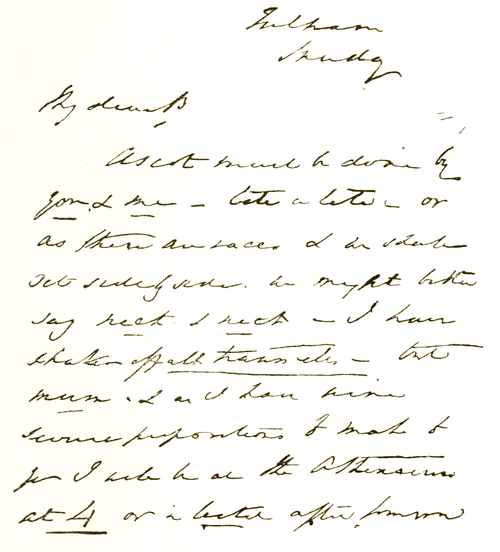
[Continued on another page.]
LETTER TO MR. BRODERIP [CONTINUATION].