ANECDOTES, HOAXES, AND JESTS
Reading edition
OF
THEODORE HOOK.
Collected from various sources.
ANECDOTES, HOAXES, AND JESTS.
THE BERNERS-STREET HOAX.
(1809.)
In walking down Berners Street one day, his companion called Hook's attention to the particularly neat and modest appearance of a house, the residence, as appeared from the door-plate, of some decent shopkeeper's widow. "I'll lay you a guinea," said Theodore, "that in one week that nice modest dwelling shall be the most famous in all London." The bet was taken—in the course of four or five days Hook had written and despatched one thousand letters, conveying orders to tradesmen of every sort within the bills of mortality, all to be executed on one particular day, and as nearly as possible at one fixed hour. From waggons of coals and potatoes to books, prints, feathers, ices, jellies, and cranberry tarts—nothing in any way whatever available to any human being but was commanded from scores of rival dealers scattered over our "province of bricks," from Wapping to Lambeth, from Whitechapel to Paddington. In 1809 Oxford Road was not approachable either from Westminster, or Mayfair, or from the City, otherwise than through a complicated series of lanes. It may be feebly and afar off guessed what the crash and jam and tumult of that day was. Hook had provided himself with a lodging nearly opposite the fated No. ——; and there, with a couple of trusty allies, he watched the development of the mid-day melodrame. But some of the dramatis personæ were seldom if ever alluded to in later times. He had no objection to bodying forth the arrival of the lord mayor and his chaplain, invited to take the death-bed confession of a peculating common councilman; but he would rather have buried in oblivion that precisely the same sort of liberty was taken with the Governor of the Bank, the chairman of the East India Company, a lord chief justice, a Cabinet minister,—above all, with the Archbishop of Canterbury, and his Royal Highness the Commander-in-Chief. They all obeyed the summons—every pious and patriotic feeling had been most movingly appealed to; we are not sure that they all reached Berners Street: but the Duke of York's military punctuality and crimson liveries brought him to the point of attack before the poor widow's astonishment had risen to terror and despair. Perhaps no assassination, no conspiracy, no royal demise or ministerial revolution of recent times was a greater godsend to the newspapers than this audacious piece of mischief. In Hook's own theatrical world he was instantly suspected, but no sign escaped either him or his confidants. The affair was beyond that circle a serious one. Fierce were the growlings of the doctors and surgeons, scores of whom had been cheated of valuable hours. Attorneys, teachers of all kinds, male and female, hair-dressers, tailors, popular preachers, and parliamentary philanthropists, had been victimized in person, and were in their various notes vociferous. But the tangible material damage done was itself no joking matter. There had been an awful smashing of glass, china, harpsichords, and coach-panels. Many a horse had fallen never to rise again. Beer-barrels and wine-barrels had been overturned and exhausted with impunity amidst the press of countless multitudes. It had been a fine field-day for the pickpockets. There arose a fervent hue and cry for the detection of the wholesale deceiver and destroyer.
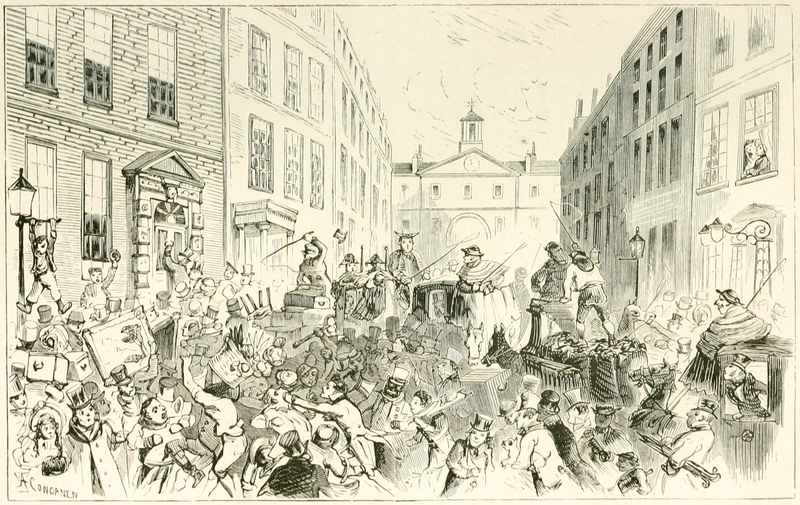
THE BERNERS STREET HOAX.
Mr. Theodore found it convenient to be laid up for a week or two by a severe fit of illness, and then promoted re-convalescence by a country tour. He is said to have on this occasion revisited Oxford, and professed an intention of at length commencing residence under the discipline of Alma Mater. But if this was so, it went no farther; by-and-by the storm blew over, as it would have done had Berners Street been burnt to the ground, and the Lord Mayor's coach blown up with all its cargo—and the Great Unknown re-appeared with tranquillity in the Green Room.
The gambol once shown, it was imitated ad nauseam in many English towns, and also in Paris, with numberless unmeritorious variations. Gilbert Gurney expresses high scorn of these plagiarists.
ROMEO COATES.
Some two or three years later Hook performed another hoax more limited in scale, but to our mind quite as inexcusable. The Regent gave a fête of surpassing magnificence at Carlton House, on the 17th of June. Romeo Coates was then in his glory—murdering Shakspeare at the Haymarket, and driving the bright pink cockle-shell with the life-large chanticleers in gilt brass about the streets and park. Theodore, who could imitate any handwriting, contrived to get one of the Chamberlain's tickets into his possession for an hour, and produced a facsimile commanding the presence of Signor Romeo. He then equipped himself in some scarlet uniform, and delivered in person the flattering missive. The delight of Romeo must be imagined. Hook was in attendance when the time for his sallying forth arrived, and had the satisfaction of seeing him swing into his chariot bedizened in all his finery, with a diamond-hilted sword and the air of Louis le Grand. The line of carriages being an Alexandrine, Theodore was also by the "care colonne" when the amateur's vehicle reached its point—saw him mount up the stair and enter the vestibule. The stranger, it is known, passed into the interior without remark or question; but when he had to show his ticket to the Private Secretary, that eye caught the imposture. Mr. Coates was politely informed that a mistake had occurred, and had to retrace his steps to the portico. The blazoned chariot had driven off: in wrath and confusion he must pick his steps as he might to the first stand of hackney-coaches. Hook was at his elbow, well muffled up. No such discomfiture since the Knight of the Woful Countenance was unhorsed by the Bachelor Sampson Carrasco. We must not omit to say that the Prince, when aware of what had occurred, signified extreme regret that any one of his household should have detected the trick, or acted on its detection. Mr. Coates was, as he said, an inoffensive gentleman, and his presence might have amused many of the guests, and could have done harm to no one. His Royal Highness sent his Secretary next morning to apologize in person, and to signify that as the arrangements and ornaments were still entire, he hoped Mr. Coates would come and look at them. And Romeo went. In this performance Hook had no confidant. To do him justice, he never told the story without some signs of compunction.
HOOK, MATHEWS, AND THE ALDERMAN.
No mirth in this world ever surpassed the fascination of these early mountebankeries. We have seen austere judges, venerable prelates, grand lords, and superfine ladies, all alike overwhelmed and convulsed as he went over the minutest details of such an episode as that, for example, of his and Mathews, as they were rowing to Richmond, being suddenly bitten by the sight of a placard at the foot of a Barnes garden,—"Nobody permitted to land here—offenders prosecuted with the utmost rigour of law"—their instant disembarkation on the forbidden paradise—the fishing-line converted into a surveyor's measuring-tape—their solemn pacing to and fro on the beautiful lawn—Hook the surveyor, with his book and pencil in hand—Mathews the clerk, with the cord and walking-stick, both soon pinned into the exquisite turf—the opening of the parlour-window, and fiery approach of the napkined alderman—the comedians' cool, indifferent reception of him, and his indignant inquiries—the gradual announcement of their being the agents of the Canal Company, settling where the new cut is to cross the old gentleman's pleasaunce—his alarm and horror, which call forth the unaffected regrets and commiserations of the unfortunate officials, "who are never more pained than with such a duty"—the alderman's suggestion that they had better walk in and talk the matter over—their anxious examination of watches, and reluctant admission that they might spare a quarter of an hour—"but alas! no use, they fear, none whatever"—the entry of the dining-room—the turkey just served—the pressing invitation to taste a morsel—the excellent dinner—the fine old madeira—the bottle of pink champagne, "a present from my lord mayor"—the discussion of half-a-dozen of claret and of the projected branch of the canal—the city knight's arguments getting more and more weighty—"Really this business must be reconsidered"—"One bottle more, dear gentlemen"—till at last it is getting dark—they are eight miles from Westminster Bridge—Hook bursts out into song, and narrates in extempore verse the whole transaction, winding up with—
"And we greatly approve of your fare, Your cellar's as prime as your cook; And this clerk here is Mathews the player, And I'm—Mr. Theodore Hook."—(Exeunt.)[76]
A STRANGE DINNER.
Of Hook's pursuits at the Mauritius, few particulars, save those given in the letter to Mathews, have reached us: they were probably not far dissimilar in spirit from those in which he had indulged at home; at least, an anecdote or two corroborative of the "solum non animum mutant," etc., which we have heard him relate, would lead to such an inference. One of these bore reference to the reception with which a respectable family, that had been recommended to his notice by some common friend in England, was greeted on its arrival at the island. Hook was, of course, all kindness and hospitality—an invitation to La Réduite, a country retreat belonging to the Governor, and at which the Treasurer also occasionally resided, was immediately forwarded to the strangers. Equally, as a matter of course, their agreeable host took upon himself the task of "lionizing" the neighbourhood; and more especially of pointing out to their observation the beauties, architectural and otherwise, of Port Louis.
For this purpose, the morning following that of debarcation was selected. The town at that period, and it has received but few additions since, was of moderate extent, stretching something in the shape of an amphitheatre almost three miles along the coast, and bounded inland at a distance scarcely exceeding half a mile, by an open space called the "Champ de Mars." Along this narrow slip, the streets of which are straight and laid out at right angles after the French fashion, did Mr. Hook conduct his new acquaintances; up one lane, down another, along the Rue Marengo, by the Government House, backwards and forwards, right and left, till every building of the least pretensions to importance had been visited by every possible mode of approach, and on each occasion honoured with a different name and fresh history. The Joss House was multiplied by six; the old East India Company barracks did duty for public asylums for lunatics, or private residences of the Queen of Madagascar; churches, prisons, the Royal College and theatre, were examined again and again, and so on till the miserable party, completely fatigued with the extreme heat, and seeing no symptoms of a termination to the walk, pleaded inability to proceed. One ventured to observe, that though of a much greater size than the view from the harbour would have led him to suppose, the town exhibited a singular sameness of style in the principal edifices. "A natural thing enough in an infant colony," suggested Hook.
The prospect of a luxurious "tiffin" which was awaiting their return, served in some manner to restore the spirits of the travellers, and they took their seats with a full determination of doing ample justice to the far-famed delicacies of the island. The first course presented to the eyes of the astonished but still unsuspecting strangers, comprised nearly every species of uneatable that could be got together. An enormous gourd graced the centre of the table, strange de-appetizing dishes were placed around, and in turn pressed upon the attention of the guests.
"Allow me to offer you a little cat-curry," exclaimed the host; "there is an absurd prejudice against these things in Europe, I know, but this I can really recommend; or, perhaps, you would prefer a little devilled monkey; that is, I believe, a dish of fried snakes opposite you, Mr. J——."
Mr. J—— recoiled in alarm.
"Hand those lizards round, they seem particularly fine."
Nastiness after nastiness was proffered in vain; the perplexed Cockneys struggled hard to maintain a decent composure, but with difficulty kept their ground before the unsavoury abominations. What was to be done?—it was clearly the cuisine de pays, and the host appeared evidently distressed at their want of appreciation of his fare. One gentleman at length, in sheer despair, thought he "would just try a lizard."
"Pray do so," eagerly returned Hook; "you will find the flavour a little peculiar at first, I daresay; but it is astonishing how soon it becomes pleasant to the palate."
But however rapidly a taste for the saurian delicacy might be acquired, the adventurous individual in question was not destined to make the experiment. In endeavouring to help himself to one of those unpromising dainties, the tail became separated from its body—it was too much for his nerve—turning a little pale, he pushed aside his plate, and begged to be excused. Since the celebrated "feast after the manner of the ancients," such a collation had never been put down before hungry men: the jest, however, was not pushed to extremes, a second course succeeded; and on the choice viands of which it consisted the guests proceeded to fall with what appetite they might.
Equally absurd, though perhaps hardly becoming the dignity of a treasurer and accountant-general, was a piece of pleasantry played off at the expense of the authorities of the island! It was on the occasion of a public dinner given at the Government House, and at which the governor himself, confined by ill health to his country residence, was unable to be present. The officer next in rank was, therefore, called upon to preside; but whether from the soup, or the fish, or the cucumber—if there happened to be any—disagreeing with him, or from whatever cause, he was compelled to quit the banquet at an early hour, and was conveyed, utterly incapable of either giving or receiving any command, to his quarters. The task of occupying the chair, and proposing the remainder of the loyal and usual toasts, now devolved on Hook; and, as each separate health was given and duly signalled, it was responded to by an immediate salute from a battery in the square below, according to special orders. The appointed list having been gone through, the greater portion of the company departed; but the chairman, so far from showing any disposition to quit his post, begged gentlemen "to fill their glasses, and drink a bumper to that gallant and distinguished officer, Captain Dobbs,"—up went the signal—bang! bang! bang! roared the artillery. "Lieutenant Hobbs" followed, with the same result. "Ensign Snobbs," and bang! bang! bang! greeted the announcement of his name. Quick as the guns could be reloaded, up again went the signal, and off went his Majesty's twenty-fours, to the honour, successively, of every individual present, soldier or civilian.
In vain the subaltern on duty, who had expected at the termination of the accustomed formalities to be permitted to join the party, sent up a remonstrance. The directions he had received were as imperative as those delivered by Denmark's king:—
"Let the kettle to the trumpet speak, The trumpet to the cannoneer without, The cannon to the heavens—the heaven to earth."
Such a bombardment had not been heard since the capture of the island, and it was not till the noisy compliment had been paid to cook and scullion, who were summoned from the kitchen to return thanks in propria personâ, and the powder as well as patience of the indignant gunners were exhausted, that the firing ceased. Something in the shape of a reprimand was talked of; but as, after all, the principal share of blame was not to be attached to the facetious deputy, the affair was permitted to rest.
LUDICROUS ADVENTURE AT SUNBURY.
In the course of Hook's numerous suburban excursions, or possibly during his brief sojourn with Doctor Curtis, at Sunbury, he had become acquainted with a young lady, a resident in the neighbourhood, possessed of an amiable disposition and great personal attractions. Theodore was a favourite both with her family and herself, but her affections, unfortunately, were fixed upon another. Notwithstanding, however, the evident preference shown to his rival, the young gentleman prosecuted his suit with all the ardour and blindness of eighteen. It was to no purpose that good-humoured hints were thrown out on the part of his inamorata, that, highly agreeable as his society could not fail to be, another held that place in her regards for which he was in vain contending. He determined to set all upon a single cast, and to throw himself, and whatever loose silver might be remaining from the proceeds of his last operetta, at the fair one's feet.
On the day fixed for the final appeal, he found the ground already in the occupation of the enemy; and it was not till towards the close of the evening that an opportunity was to be snatched of making a formal proposal for the lady's hand: as might have been expected, it was declined, firmly but kindly; and off rushed the rejected swain, in a frenzy of rage, to his hotel, whither—for the little village in those days boasted but of one—he was soon followed by the successful candidate, Mr. P——.
It so happened that, in addition to the contretemps of being lodged beneath the same roof, the rivals actually occupied adjoining chambers, and were separated from each other merely by a thin boarded partition: everything that passed in one apartment was consequently pretty distinctly audible in the next; and the first sounds that greeted Mr. P—— on his arrival were certain strong objurgations and maledictions, in which his own name was constantly recurring, and which proceeded from the neighbouring room. Every now and then a boot-jack or a clothes-brush was hurled against the wall; next a noise would be heard as of a portmanteau being kicked across the floor, accompanied by such epithets as might be supposed most galling and appropriate to a discomfited foe. Then a pause—a burst of lamentation or an attempt at irony—then again more invectives, more railing, more boot-jacks, and so on for half the night did the hapless lover continue to bewail the bad taste of women in general, and the especial want of discernment in his own mistress; and to heap bitter abuse and inflict imaginary chastisement upon the person of his more favoured opponent.
Mr. P—— was a Welshman, and for a moment the hot blood of the Tudors and Llewellyns bubbled up; but "cool reflection at length came across:" the irresistible absurdity of the position struck with full force upon a mind rendered more than usually complacent by the agreeable assurances so lately received, and he threw himself on the bed in a fit of perfectly Homeric laughter. Early on the next morning Hook started for town; but whether he ever learnt the perilous vicinity in which he had passed the few preceding hours, we know not. The anecdote reached us from a different quarter.
During this period he was not so thoroughly engrossed by the anxieties of love, but that he found time and sufficient spirits for the indulgence of those lively pleasantries, which must doubtless have contributed much to recommend him to the favour of the lady's guardian, if not to her own. The name of the inn, "The Flower Pot," which was the scene of the absurd adventure just related, suggested one of these. There resided, it seems, at Sunbury, in a large house, an elderly gentleman, a bachelor, of somewhat eccentric disposition, whose ruling passion was for his garden. This, albeit prodigality was by no means a besetting sin of the proprietor, was kept in the most admirable order, and decorated, regardless of expense, with a profusion of ornaments in the very height of suburban fashion—leaden cupids, slate sun-dials, grottoes of oyster-shells and looking-glass, heaps of flints and overburned bricks, denominated rockwork, and beyond all, and above all, with a magnificent vase filled with a flaming cluster of fuchsias, geraniums, and a number of plants with brilliant blossoms and unutterable names, which faced the entrance. Here, one fine afternoon, when the flowers had reached their acme of refulgence, Mr. Theodore pulled up his dennet. A powerful tug at the bell brought a sort of half-gardener, half-groom, to the gate in double-quick time.
"Take the mare round to the stable, put her in a loose box, and rub her down well. I'll come and see her fed myself in a few minutes; none of you rascals are to be trusted!"
So saying, the young gentleman threw the reins to the domestic, marched leisurely along the broad, brown-sugar-looking walk, dexterously cutting off here and there an overgrown carnation with the lash of his driving-whip, and entered the hall. Giving another tremendous jerk to the bell-wire in passing, he walked into the dining-room, the door of which happened to be open, took up a magazine, and threw himself at full length upon the sofa. A tidily-dressed maid servant appeared at the summons.
"Bring me a glass of brandy-and-water, my dear, and send 'Boots.'"
"'Boots,' and 'brandy-and-water,'—La, sir!" exclaimed the astonished girl.
"You may fetch me a pair of slippers yourself, if you like; so make haste, and you shall have a kiss when you come back."
Duped by the authoritative air assumed by the visitor, (it would be indecorous to suppose another motive,) the attendant disappeared, and speedily returning with the slippers, observed,
"If you please, sir, I have brought you a pair, but they are master's, and he is rather particular."
"Particular! Nonsense! where's the brandy-and-water?"
"He never leaves out the spirits, sir; he always keeps the key himself, sir, in his own pocket."
"He must be a deuced odd sort of fellow, then: send him here immediately."
"Master is dressing, sir; he will be down directly," was the reply; and, accordingly, after the lapse of a few minutes, Mr. —— made his appearance in full evening costume.
"My good friend," commenced Hook, without raising his eyes from the paper, "allow me to observe, that the rules of your establishment are a little inconvenient to travellers: I have been here above a quarter of an hour, and have not been able to get so much as a glass of brandy-and-water—bring one immediately—hot; and let me know what you have got for dinner."
"I really beg your pardon," said old Mr. ——, as soon as he could find words; "I really beg your pardon, but I am quite at a loss——"
"So am I, my good man—for a glass of brandy-and-water—bring that, and another for yourself, and then I shall be happy to hear whatever you have to say."
"But, sir, you must permit me to state——"
"I was never in such a detestable house in my life," exclaimed Hook, starting up; "what do you stand chattering there for, instead of attending to my order: am I to be kept here starving all night? Bring the brandy-and-water, d'ye hear?"
The old gentleman was struck positively speechless; his face purpled, he seemed in imminent peril of choking with the sudden conflux of ire, indignation, and astonishment.
"Why, the fellow's drunk!" pursued Theodore; "disgracefully drunk, at this time of day! and in his own parlour, too! I shall feel it my duty, sir, to lay a statement of this inexcusable conduct before the bench."
Mr. —— sprang to the bell. "John—Thomas—turn this impudent scoundrel out of the house!"
The arrival of the servants necessarily led to an explanation. Nothing could exceed Mr. Hook's regret; what could be done? what apology could be made? He was a perfect stranger to Sunbury; had been directed to the "Flower Pot," as the inn affording the best accommodation; and, on seeing what he imagined to be a gigantic representation of the sign in question at the garden-gate, he had naturally entered, and acted upon that erroneous impression. This was the unkindest cut of all. To find a stranger reclining in full possession of his sofa and slippers was bad enough; to be treated as a dilatory innkeeper was worse; and to be taxed with insolence and intoxication, was still more trying to a gentleman of respectable character and excitable nerves; but to hear the highest achievement of art he possessed—the admiration of himself and friends, and the envy of all Sunbury, his darling vase, compared with which the "Warwick" and the "Barberini" were as common washpots—to hear this likened to an alehouse sign, was a humiliation which dwarfed into insignificance all preceding insults. But as to whether Hook contrived to soothe the anger he had provoked, and to win a way, as was his wont, into the good graces of his victim—or whether this last affront proved irremediable, and he was compelled to seek further entertainment for himself and horse at the "Flower Pot" minor, unfortunately our informant is at fault.
CHARLES MATHEWS AND HOOK.
It was about the year 1803 that my husband first became intimate with Mr. Theodore Hook. The election for Westminster had recently taken place, and Mr. Sheridan was chosen one of its representatives, on which occasion the actors of Drury Lane celebrated their proprietor's triumph, by giving him a dinner at the Piazza coffee-house. To this dinner Mr. Hook was invited.
In the course of the day many persons sung, and Mr. Hook being in turn solicited, displayed, to the delight and surprise of all present, his wondrous talent in extemporaneous singing. The company was numerous, and generally strangers to Mr. Hook; but, without a moment's premeditation, he composed a verse upon every person in the room, full of the most pointed wit, and with the truest rhymes, unhesitatingly gathering into his subject, as he rapidly proceeded, in addition to what had passed during the dinner, every trivial incident of the moment. Every action was turned to account; every circumstance, the look, the gesture, or any other accidental effects, served as occasion for more wit; and even the singer's ignorance of the names and condition of many of the party seemed to give greater facility to his brilliant hits than even acquaintance with them might have furnished. Mr. Sheridan was astonished at his extraordinary faculty, and declared that he could not have imagined such power possible, had he not witnessed it. No description, he said, could have convinced him of so peculiar an instance of genius, and he protested that he should not have believed it to be an unstudied effort, had he not seen proof that no anticipation could have been formed of what might arise to furnish matter and opportunities for the exercise of this rare talent.—Memoirs of Charles Mathews, Comedian, by Mrs. Mathews. Lond. 1838.
HOOK'S "FIRST APPEARANCE."
It was on the evening of Monday, January 30th, 1809, at the "Grange Theatre," that Mr. Theodore Hook, then a slim youth of fine figure, his head covered with black clustering curls, made his "first appearance upon any stage," and in no instance do I remember a more decided case of what is called stage-fright. He had been as bold and easy during the rehearsals as if he had been a practised stager. All the novices seemed fluttered but himself; but when he entered at night as Sir Callaghan O'Brallaghan, the Irish officer, in "Love à la Mode," he turned pale at the first sight of the audience, and exhibited such palpable terror, that I almost supported him on my arm; his frame shook, his voice failed him, and not a word of his first scene, nor a note of the song he attempted at the piano-forte (which he had sung so well in the morning), were audible to anybody but myself.
It was curious to see a person of Mr. Hook's wondrous nerve and self-possession suddenly subdued in such a way, at a mere make-believe in a room, containing only friends—invulnerable as he was to fear in all things else! He recovered, however, before the piece concluded, and afterwards acted Vapour in the farce of "My Grandmother," imitating Mr. Farley excellently; and a character in an admirable burlesque tragedy of his own writing, called "Ass-ass-ination," previously to which he hoaxed the audience with a prologue, purposely unintelligible, but speciously delivered; the first and last word of each line were only to be distinguished, bearing in them all the cant and rhymes of such addresses (some heard and others guessed at, as the speaker's ingenuity served, for of course all was extempore). At the close of this, great applause followed; and one elderly, important gentleman was heard to whisper to another sitting next him, "An excellent prologue, but abominably inarticulate!"
HOOK AND DOWTON THE ACTOR.
On one occasion poor Dowton was well-nigh frightened from his propriety by the sudden appearance of his young friend upon the stage, who, in appropriate costume, and with an ultra-melodramatic strut, advanced in place of the regular walking gentleman to offer him a letter. At another, during the heat of a contested Westminster election, the whole house was electrified by a solemn cry, proceeding apparently from the fiend in the "Wood Demon," of "She-ri-dan for e-ver!" and uttered in the deepest bass the speaking-trumpet was capable of producing. This last piece of facetiousness was rather seriously resented by Graham, one of the proprietors of the Haymarket, who threatened its perpetrator with perpetual suspension of his "privilege," and it required all the interest of influential friends, backed by an ample apology on the part of the culprit, who promised the most strict observance of decorum for the future, to obtain a reversal of the decree.
LETTER FROM MAURITIUS.
From "La Réduit, Mauritius," under date March 24, 1814, Theodore Hook addressed the following humorous letter to Charles Mathews:—
"My dear Mathews,—Uninteresting as a letter must be from an individual in a little African island, to you who are at the very head-quarters and emporium of news and gaiety, I shall risk annoying you and write, begging you to take along with you that the stupidity of my epistle proceeds in a great measure from the dearth of anything worth the name of intelligence; for if I had anything to say, say it I would.
"I have received so much powerful assistance from your public talents in my short dramatic career, and have enjoyed so very many pleasant hours in your private society, that I feel a great pride and gratification from this distance, where flattery cannot be suspected, nor interested motives attach themselves to praise, to express how warmly I feel and how I appreciate both your exertions and your powers.
"You have read enough of this island, I daresay, not to imagine that we live in huts on the sea-coast, or that, like our gallant forefathers, we paint ourselves blue, and vote pantaloons a prejudice. We are here surrounded by every luxury which art can furnish, or dissipation suggest, in a climate the most delightful, in a country the most beautiful, society the most gay, and pursuits the most fascinating.
"This is, by heavens, a Paradise, and not without angels. The women are all handsome (not so handsome as English women), all accomplished, their manners extremely good, wit brilliant, and good-nature wonderful; this is picking out the best! The "οι πολλοι," as we say at Oxford, are, if I may use the word, mindless—all blank—dance like devils, and better than any people, for, like all fools, they are fond of it, and naturally excel in proportion to their mental debility; for the greater the fool the better the dancer.
"In short, the whole island is like fairy-land; every hour seems happier than the last; the mildness of the air (the sweetness of which, as it passes over spice-plantations and orange-groves, is hardly conceivable), the clearness of the atmosphere, the coolness of the evenings, and the loveliness of the place itself, all combine to render it fascination. The very thought of ever quitting it is like the apprehension of the death or long parting with some near relation, and if it were not that this feeling is counteracted by having some friends at home, there is no inducement that would draw me from such a perfect Thule.
"Make my kind remembrances to Mrs. Mathews, and tell her that I hope to shake hands with her when we are both twaddlers—that is, when she is as much of a twaddler as old age can make her; and that when I return upon crutches from foreign parts, I trust she will direct her son to pay me every attention due to my infirmities.
"We have operas in the winter, which sets in about July; our races, too, begin in July; we have an excellent beef-steak club, and the best Freemasons' lodge in the world. We have subscription concerts, and balls, and the parties in private houses here are seldom less than from two to three hundred. At the last ball given at the Government-house, upwards of seven hundred and fifty ladies were present, which, considering that the greater proportion of the female population are not admissible, proves the number of inhabitants, and the extent of the society.
"Pshaw! my letter is all about myself. Egotism from beginning to end. Like Argus, there are at least an hundred I's in it. Well, damn my I's, I will substitute the other vowel, and assure you that, although at this distance, I am sincerely and truly yours, and that you will find even in Mauritius U and I are not far asunder.
"I daresay some of my fat-headed friends in that little island where the beef grows fancy that I am making a fortune, considering that I am Treasurer! and Accountant-general! Fresh butter, my dear fellow, is ten shillings per pound; a coat costs thirty pounds English; a pair of gloves, fifteen shillings; a bottle of claret, the best, ten pence; and pine-apples a penny a piece. Thus, you see, while the articles necessary to existence are exorbitant, luxuries are dirt cheap, and a pretty life we do lead. Breakfast at eight, always up by gun-fire, five o'clock; bathe and ride before breakfast, after breakfast lounge about; at one have a regular meal, yclep'd a tiffen—hot meats, vegetables, &c.—and at this we sit generally through the heat of the day, drinking our wine, and munching our fruit; at five, or half-past, the carriages come to the door, and we go either in them or in palanquins to dress, which operation performed, we drive out to the race-ground, and through the Champ de Mars, the Hyde Park here, till half-past six; come into town, and at seven dine, where we remain till ten or eleven, and then join the French parties, as there is regularly a ball somewhere or other every night: these things, blended with business, make out the day and evening."
EVADING A COACH FARE.
Everybody has heard of the ingenious manner in which Sheridan evaded payment of a considerable sum for coach-hire, by inveigling Richardson into the vehicle, getting up a quarrel, no very difficult matter, then jumping out in disgust, and leaving his irritable friend to recover his composure and pay the fare. Hook, who, like all men of genius, augmented the resources of his own wit by a judicious borrowing from that of others, seems to have caught at this idea when once, under similar circumstances, he found himself, after a long and agreeable ride, without money to satisfy the coachman—a friend happened to be passing—he was hailed and taken up—but unfortunately proved to be, on inquiry, as unprepared for any pecuniary transaction as Theodore himself. A dull copyist would have broken down at once; but with a promptitude and felicity of conception that amply redeem the plagiarism, with whatever else he may be left chargeable, Hook pulled the check-string and bade the driver proceed as rapidly as possible to No. —, —— Street, at the West End of the town, the residence of a well-known "surgeon, &c." Arrived, he ordered the coachman to "knock and ring," as desired, with energy, and on the door opening, told his friend to follow, and hastily entered the house. "Mr. ——, is he at home? I must see him immediately!" Mr. —— soon made his appearance, when Hook, in an agitated and hurried tone, commenced:—
"My dear sir, I trust you are disengaged!" Mr. —— bowed; "he was disengaged." "Thank Heaven!—pardon my incoherence, sir—make allowance for the feelings of a husband—perhaps a father—your attendance, sir, is instantly required—instantly—by Mrs. ——, No. —, &c., pray lose not a moment; it is a very peculiar case, I assure you."
"I will start directly," replied the medical man; "I have only to run upstairs, get my apparatus, and step into my carriage."
"Ah! exactly," returned Hook; "but I am in agony till I see you fairly off—don't think of ordering out your own carriage—here's one at the door—jump into that."
Mr. ——, with a great mahogany case under his arm, made the jump, and quickly found himself at the house to which he had been directed: it was the abode of a very stiff-mannered, middle-aged maiden lady, not unknown to Hook; one, moreover, to whom he owed a grudge, a kind of debt he rarely failed to pay. The doctor was admitted, but on explaining the object of his visit, soon found it convenient to make a precipitate retreat from the claws of the infuriate spinster into the arms of the hackney-coachman, who deposited him in safety at his own door, which, however, he declined quitting without the full amount of his fare.
UNSUCCESSFUL HUNT FOR A DINNER.
Theodore Hook thus writes to Charles Mathews from the "Prince of Wales's Coffee House, 8 o'clock, September 21st, 1825:"—
"Dear Mat.,—I never went sporting for a dinner that I bagged my bird in my life. Broderip asked me to dine with him to-day, and went out and forgot it; so, I said to myself, says I, I want to ask Mat., or Mrs. Mat., two questions about Charles's 'Trip to Rome.' So on, says I, I'll go to Millfield Lane. I did. On my way I forgot why Broderip forgot his engagement;—natural enough—modern Aristophanes—beautiful view—charming grounds—pleasant company,—poor me, of course, rejected. Well, up I goes. Man with powder and an apron opens gate—expecting company—doesn't know whether Mr. Mathews is at home or no—goes to see—good butler, but cannot lie steadily; so out comes a woman. Satire on the sex to think they have more composure than man in a quandary.—Master not at home.—Novelty, says I, Mathews at Home, anybody can see: but, to see Mat. not at home, is not to be bought. 'Thank you, ma'am,' says I; and downhill I tumbled. At its foot, ex pede, I discovered (not Herculem) but the reason why you chose to deny yourself. Why didn't you come out and speak? I most ardently eschew your mutton, beef, veal, and ham. I only wanted three words of you.—That's your affair. Now, thinks I, Broderip has cut me, and Mathews has denied himself, I'll go and dine with Nash. Nash dined out, waiting for the great gentleman from Berkshire. I called upon Lyon (James), but, like his namesake, he had abdicated. Met Sir Hudson Lowe—did not ask me; called at Elliott's—they dined out; so I damned my fate, and ordered dinner at seven here, and here I am; and so I will punish your long legs with a threepenny. Write to me, or ask Mrs. Mat. to write, and tell me of the name of the tune of 'The Trip to Rome,' which it is essential to know; and, if she can furnish me with the second verse complete, I should be obliged, for Charles has sent only half the stanza.
"Despatch in all this is important: it is a very, very clever production, and Charles shall be, what I am sure he will, an honour and a blessing to you both; and so I, in the dumps as I am, pray he may."
HOOK AT LORD MELVILLE'S TRIAL.
On the occasion of Lord Melville's trial, Theodore Hook was present with a friend.
They went early, and were engaged in conversation when the Peers began to enter. At this moment a country-looking lady, whom he afterwards found to be a resident at Rye, in Sussex, touched his arm, and said: "I beg your pardon, sir, but pray who are those gentlemen in red now coming in?" "Those, ma'am," returned Theodore, "are the Barons of England; in these cases the junior peers always come first." "Thank you, sir, much obliged to you. Louisa, my dear (turning to a girl about fourteen), tell Jane (about ten), those are the Barons of England; and the juniors (that's the youngest, you know,) always goes first. Tell her to be sure and remember that when we get home." "Dear me, ma!" said Louisa, "can that gentleman be one of the youngest? I am sure he looks very old." Human nature, added Hook, could not stand this; any one, though with no more mischief in him than a dove, must have been excited to a hoax. "And pray, sir," continued the lady, "what gentlemen are those?" pointing to the Bishops, who came next in order, in the dress which they wear on state occasions, viz., the scarlet and lawn sleeves over their doctors' robes. "Gentlemen, ma'am!" said Hook, "those are not gentlemen; those are ladies, elderly ladies—the Dowager Peeresses in their own right." The fair inquirer fixed a penetrating glance upon his countenance, saying, as plainly as an eye can say, "Are you quizzing me or no?" Not a muscle moved; till at last, tolerably satisfied with her scrutiny, she turned round and whispered, "Louisa, dear, the gentleman says that these are elderly ladies, and Dowager Peeresses in their own right; tell Jane not to forget that!" All went on smoothly till the Speaker of the House of Commons attracted her attention by the rich embroidery of his robes. "Pray, sir," said she, "and who is that fine-looking person opposite?" "That, madam," was the answer, "is Cardinal Wolsey!" "No, sir!" cried the lady, drawing herself up, and casting at her informant a look of angry disdain, "we knows a little better than that; Cardinal Wolsey has been dead many a good year!" "No such thing, my dear madam, I assure you," replied Hook, with a gravity that must have been almost preternatural; "it has been, I know, so reported in the country, but without the least foundation; in fact, those rascally newspapers will say anything." The good old gentlewoman appeared thunderstruck, opened her eyes to their full extent, and gasped like a dying carp; vox faucibus hæsit, seizing a daughter with each hand, she hurried without a word from the spot.—Ingoldsby Legends, 3rd series, p. 69.
THE THIRTY-NINE ARTICLES.
Hook had been entered at St. Mary's Hall: his friends would have preferred a residence at Exeter College, but to this, as entailing a somewhat more strict observance of discipline than was compatible with his habits, he himself positively objected. A compromise was effected, and he was placed under the charge of his brother, and presented by him to the Vice-Chancellor, Dr. Parsons, Head of Balliol, and afterwards Bishop of Peterborough, for matriculation. The ceremony was well-nigh stopped in limine, in consequence of an ill-timed piece of facetiousness on the part of the candidate. On being asked if he was prepared to subscribe to the Thirty-nine Articles:
"Oh, certainly, sir," replied Theodore; "forty, if you please."[77]
The horror of the Vice-Chancellor may be imagined. The young gentleman was desired to withdraw; and it required all the interest of his brother, who fortunately happened to be a personal friend of Dr. Parsons, to induce the latter to overlook the offence. The joke, such as it is, was probably picked out of one of Foote's farces, who makes Mrs. Simony, if we mistake not, say, when speaking of her husband the Doctor (intended for the unfortunate Dr. Dodd), "He believes in all the Thirty-nine Articles; ay, and so he would if there were forty of them."—Barham.
"CHAFFING" A PROCTOR.
On the evening of Hook's arrival at the University, he contrived to give his brother the slip, and joined a party of old schoolfellows in a carouse at one of the taverns. Sundry bowls of "Bishop," and of a popular compound yclept "Egg-flip"—the Cambridge men call it "Silky," to the nondum graduati of Oxford it is known by a nomen accidentale which we have forgotten,—having been discussed; songs, amatory and Bacchanalian, having been sung with full choruses; and altogether the jocularity having begun to pass "the limit of becoming mirth," the Proctor made his appearance; and, advancing to the table at which the "Freshman"—fresh in every sense of the word—was presiding, put the usual question,—
"Pray, sir, are you a member of this University?"
"No, sir," replied Hook, rising and bowing respectfully. "Pray, sir, are you?"
A little disconcerted at the extreme gravity of the other, the Proctor held out his ample sleeve—"You see this, sir?"
"Ah," returned Hook, having examined the fabric with great earnestness for a few seconds, "yes; I perceive—Manchester velvet—and may I take the liberty, sir, of inquiring how much you might have paid per yard for the article?"
The quiet imperturbability of manner with which this was uttered was more than the Rev. gentleman could stand; and, muttering something about "supposing it was a mistake," he effected a retreat, amid shouts of laughter from Hook's companions, in which the other occupants of the coffee-room, the waiters, and even his own "bull-dogs" were constrained to join.—Barham.
SUMMARY PROCEEDINGS OF WINTER.
Of Hook's improvisations, while at the Mauritius, a stanza of one, in which the names of the company seem to have furnished, each, the subject of an epigram, is extant; it runs as follows:—
"We have next Mr. Winter, assessor of taxes, I'd advise you to pay him whatever he axes, Or you'll find, and I say it without any flummery, Tho' his name may be Winter, his actions are summary."
"SOMETHING WRONG IN THE CHEST."
At St. Helena, Hook encountered the late Lord Charles Somerset, on his way to assume the governorship of the Cape. Lord Charles, who had met him in London occasionally, and knew nothing of his arrest, said, "I hope you are not going home for your health, Mr. Hook." "Why," said Theodore, "I am sorry to say, they think there is something wrong in the chest."—Quarterly Review, vol. lxxiii., p. 73.
WARREN'S BLACKING.
In the art of punning, whatever be its merits or de-merits, Hook had few rivals, and but one superior, if indeed one—we mean Mr. Thomas Hood. Among the innumerable "Theodores" on record, it will be difficult, of course, to pick out the best; but what he himself considered to be such, was addressed to the late unfortunate Mr. F——, an artist, who subsequently committed suicide at the "Salopian" coffee-house for love, as it is said, of a popular actress. They were walking in the neighbourhood of Kensington, when the latter pointing out on a dead wall an incomplete or half-effaced inscription, running "Warren's B——," was puzzled at the moment for the want of the context.
"'Tis lacking that should follow," observed Hook, in explanation. Nearly as good was his remark on the Duke of Darmstadt's brass band.
"They well-nigh stun one," said he, in reference to a morning concert, "with those terrible wind instruments, which roar away in defiance of all rule, except that which Hoyle addresses to young whist-players when in doubt—trump it!"
THE WINE-CELLAR AND THE BOOK-SELLER.
Theodore Hook's saying to some man with whom a bibliopolist dined the other day, and got extremely drunk, "Why, you appear to me to have emptied your wine-cellar into your book-seller."—Moore's Diary, Feb., 1836.
SIR ROBERT PEEL'S ANECDOTES OF THEODORE HOOK.
The late Sir Robert Peel was strongly impressed with Hook's conversational powers and the genuine readiness of his wit; in illustration of this, he used to relate, among others, the following anecdote:—One morning, at Drayton Manor, where Hook was staying as a guest, some one after breakfast happened to read out from the newspaper a paragraph, in which a well-known coroner was charged with having had a corpse unnecessarily disinterred. The ladies were very severe in condemnation of such unfeeling conduct; a gallant captain, however, who was present, took up the cudgels in behalf of the accused, maintaining that he was a very kind-hearted man, and incapable of doing anything without strong reasons, calculated to annoy the friends of the deceased. The contest waxed warm: "Come," said Captain ——, at length, turning to Hook, who was poring over the Times in a corner of the room, and who had taken no part in the discussion, "you know W——, what do you think of him? Is he not a good-tempered, good-natured fellow?"
"Indeed he is," replied Hook, laying aside his paper, "I should say he was just the very man to give a body a lift."
On the same authority, we may repeat a pun made at the expense of the Duke of Rutland. There was a grand entertainment at Belvoir Castle, on the occasion of the coming of age of the Marquis of Granby; the company were going out to see the fireworks, when Hook came, in great tribulation, to the Duke, who was standing near Sir Robert, and said, "Now isn't this provoking! I've lost my hat—what can I do?" "Why the deuce," returned his grace, "did you part with your hat?—I never do!" "Yes," rejoined Theodore, "but you have especially good reasons for sticking to your Beaver."[78]
A RECEIPT AGAINST NIGHT AIR.
"Theodore Hook," writes a friend, "had a receipt of his own to prevent invalids from being exposed to the night air. I remember his once taking me home from a party in his cab, between four and five o'clock on a brilliant morning in July. I made some remark, soon after we had passed Hyde Park Corner, about the reviving quality of the air after the heated rooms we had been in. 'Ah,' said Hook, 'you may depend on it, my dear fellow, that there is nothing more injurious to health than the night air. I was very ill some months ago, and my doctor gave me particular orders not to expose myself to it.' 'I hope,' said I, 'you attended to them?' 'O yes!' said he, 'strictly; I came up every day to Crockford's or some other place to dinner, and I made it a rule on no account to go home again till about this hour in the morning.'"
PUNTING.
"In the course of our fishing, we had been punted down the river opposite to Lord ——'s house, and while seated in front of it, he remarked that he used to be on very friendly terms with the noble owner; but that a coolness had lately sprung up between them, in consequence of his lordship having taken umbrage at the epitaph (pointed with a clever but objectionable pun) he had composed for his late brother, so unhappily notorious for the charges brought against him of false play at whist. On seeing the present Peer out on the river fishing, Hook had received from him, instead of his usual courteous greeting, a very stiff, ceremonious bow; but, determined not to notice it, he only replied:—
"'What, my lord, following the family occupation, eh?—punting, I see—punting!'"
An impromptu of Hook's on the same subject, ran the round of the club-houses. It will be remembered that the nobleman alluded to brought an action for defamation against certain of his accusers, which, however, he thought proper to abandon at the last moment.
EPIGRAM. "Cease your humming, The case is 'on;' Defendant's Cumming; Plaintiff's—gone!"
"LIST" SHOES.
The Duke of B——, who was to have been one of the knights at the Eglinton Tournament, was lamenting that he was obliged to excuse himself, on the ground of an attack of the gout.
"How," said he, "could I ever get my poor puffed legs into those abominable iron boots?"
"It will be quite as appropriate," replied Hook, "if your Grace goes in your list shoes."
"THE ABATTOIR."
When Messrs. Abbott and Egerton, in 1836, took the old Coburg Theatre (the Victoria), for the purpose of bringing forward the legitimate drama, the former gentleman asked Hook if he could suggest a new name, the old being too much identified with blue fire and broad swords to suit the proposed change of performance. "Why," said Theodore, "as, of course, you will butcher everything you attempt, suppose you call it the Abattoir."
PUTNEY BRIDGE.
Hook's residence at Putney afforded occasion for the delivery of one of the best of his best bon-mots. A friend, viewing Putney bridge from the little terrace that overhung the Thames, observed that he had been informed that it was a very good investment, and, turning to his host, inquired "if such was the case—if the bridge really answered?"
"I don't know," said Theodore, "but you have only to cross it, and you are sure to be tolled."
"MR. THOMPSON IS TIRED."
Some years ago an ingenious representation of the destruction of a Swiss village by an avalanche was exhibited at the Diorama in the Regent's Park, the effect of which was greatly increased by a clever vocal imitation of the dreary winter wind whistling through the mountains; but this sound ceasing whilst the exigencies of the scene still demanded its continuance, Theodore Hook, who was present, exclaimed, "Bless me, Mr. Thompson is tired," which set the spectators laughing, nor could they at all resume the awe-struck gravity with which they had previously witnessed the tragic picture.—Edinburgh Review, July, 1859.
THE ORIGINAL "PAUL PRY."
Tom Hill, the real original "Paul Pry," was reported to be of great age; and Theodore Hook circulated the apology that his baptismal register could not be found, because it was burnt in the Tower of London.—Henry Crabb Robinson's Diary.
Mr. Hill died aged not more than eighty-three—though Hook and all his friends always affected to consider him as quite a Methuselah. James Smith once said that it was impossible to discover his age, for the parish register had been burnt in the fire of London; but Hook capped this: "Pooh pooh! he's one of the Little Hills that are spoken of as skipping in the Psalms." As a mere octogenarian he was wonderful enough. No human being would, from his appearance, gait, or habits, have guessed him to be sixty. Till within three months of his death, he rose at five usually, and brought the materials of his breakfast home with him to the Adelphi from a walk to Billingsgate; and at dinner he would eat and drink like an adjutant of five-and-twenty. One secret was that a "banyan day" uniformly followed a festivity. He then nursed himself most carefully on tea and dry toast, tasted neither meat nor wine, and went to bed by eight o'clock. But perhaps the grand secret was, the easy, imperturbable serenity of his temper. He had been kind and generous in the day of his wealth, and, though his evening was comparatively poor, his cheerful heart kept its even beat.
HOOK AND TOM HILL.
Notwithstanding the real affection he felt for him, Hook was sometimes led, as is the case with spoiled children, whether of larger or lesser growth, to trespass overmuch upon the good nature of his friend—almost worshipper—and to allow himself liberties which no degree of intimacy could justify. An instance of the kind occurred at Sydenham, when Hook, resenting the introduction of a comparative stranger to their saturnalia, chose to assume all sorts of extraordinary and offensive airs, to the great discomfiture of his host, who, with the warmest desire to "see everybody comfortable," had not always, perhaps, tact commensurate with his benevolence. Having completely mystified the unwelcome guest during the hour or two before dinner, when that meal was served Mr. Hook was not to be found; search was made throughout the house, but in vain. The garden was scoured and a peep taken into the pond, but no Hook! The party at length sat down, and a servant soon after informed them that he had discovered the lost one—in bed! Hook now thought fit to make his appearance, which he did in strange guise, with his long black hair plastered over his face, and his whole head and shoulders dripping with water. "Feeling a little fatigued," he said, "he had retired to rest; and, by way of thoroughly arousing himself, had just taken a plunge in the water-butt;" at the same moment, and before he had time to partake of any of the good things before him, Mr. Hook's carriage was announced; and merely observing that he had recollected an engagement to dine that day in town he bowed and quitted the company.
HOOK'S POLITENESS.
Hook was once observed, during dinner, nodding like a Chinese mandarin in a tea-shop. On being asked the reason, he replied, "Why, when no one else asks me to take champagne, I take sherry with the épergne and bow to the flowers."—Mark Lemon's Jest Book.
A BISCUIT AND A GLASS OF SHERRY.
Mr. Price was an American by birth, and a proficient, it is said, in the national accomplishment—duelling; in this country he was more favourably known as a bon vivant of taste, and a giver of bachelor dinners of a high order; he was, moreover, the first promulgator of one of those Transatlantic beverages, which are justly the admiration of the curious. It is a species of punch, in which gin, maraschino, and iced soda-water are blended in a certain occult and scientific way, and is esteemed of sovereign worth in very hot weather, or in cases where an obstinate and unaccountable thirst has somehow survived the repeated efforts made to quench it the preceding day.
Hook, one afternoon succeeding a banquet at the Freemasons' Tavern, where the port had been particularly fiery, or the salmon had disagreed with him, happened to drop in at "the Club," and found the mighty master with an amphora of his potent elixir before him: the former was with some difficulty—probably no great deal—induced to give an opinion as to its merits; but it was a matter not to be decided lightly, and some half-dozen pints of the beguiling compound were discussed ere the authoritative "imbibatur" went forth. In the evening, at Lord Canterbury's, Hook was observed to eat even less than usual, and, on being asked whether he was unwell, replied—
"Oh no, not exactly; but my stomach won't bear trifling with, and I was foolish enough to take a biscuit and a glass of sherry by way of luncheon."
MUCH ALIKE.
Two silly brothers, twins, were very much about town in Hook's time; and they took every pains, by dressing alike, to deceive their friends as to their identity. Tom Hill was expatiating upon these modern Dromios, at which Hook grew impatient. "Well," said Hill, "you will admit that they resemble each other wonderfully: they are as like as two peas." "They are," retorted Hook, "and quite as green!"
PRIVATE MEDICAL PRACTICE.
Hook, in "Cousin William," calls the aunt and uncle bold Buchan-eers, from their fondness for rash domestic medical practice, and doctoring themselves from Buchan. In describing the original of this aunt, at the Garrick, one morning, he declared that the old lady was so delighted with everything pertaining to physic, that she drank wine every six hours out of dose-glasses, and filled her gold-fish globes with leeches, the evolutions of which she watched by the hour.
HOOK'S STREET FUN.
Hook's street fun was irrepressible. We read of his walking up to a pompous person in the trottoir in the Strand, and saying to him, "I beg your pardon, sir, but may I ask, Are you anybody particular??"—but he did not wait for the answer of the magnifico.
A MISNOMER.
Hook said the title of Bentley's new magazine was ominous: "Miss-sell-any;" but his prophecy was not borne out by the event.
"CONTINGENCIES."
Theodore Hook used to describe contingencies as "things that never happen."—Life of Ingoldsby.
"THE WIDOW'S MITE."
After his marriage, Lord John Russell was christened by Hook "the Widow's Mite."—Ingoldsby.
HOOK'S EXTEMPORE VERSES.
Theodore Hook, in his twentieth year, gave evidence of the possession of a talent, compared with which mimicry in its perfection, available enough as an auxiliary, sinks into insignificance—that of the improvisatore. Men of mark are found bearing testimony to the inspirations of his genius; marvellous at the early age referred to, but far surpassed by his later performances. Coleridge, for example, at the termination of a somewhat prolonged revel held at the cottage of Mr. Mansel Reynolds, is said to have proclaimed, in his declamatory manner, that he had never met a man who could bring such various and amazing resources of mind to bear on the mere whim or folly of the moment; while the poet Campbell spoke of him as "a wonderful creature," who sang extempore songs, "not to my admiration, but to my astonishment." Those who have been in the habit of attending public meetings, or have listened to the harangues, so glibly "done into English" by next morning, of the orators of St. Stephen's, cannot fail to have remarked how rarely even respectable prose is delivered where opportunity for preparation has been wanting. But in the art, if art it may be called, of pouring forth extemporaneous poetry, music and words, rhyme and reason, all impromptu, Hook stood alone—rival he had none; of course he had his imitators:
"The charming extempore verses of Twiss's,"
for example, will not readily be forgotten; another gentleman, also, found reason to remember his attempt at rivalry. Ambitious of distinction, he took an opportunity of striking off into verse immediately after one of Hook's happiest efforts. Theodore's bright eye flashed, and fixed on the intruder, who soon began to flounder in the meshes of his stanza, when he was put out of his misery at once by the following couplet from the master, given, however, with a good-humoured smile that robbed it of all offence:—
"I see, sir, I see, sir, what 'tis that you're hatching; But mocking, you see, sir, is not always catching."
There can be no doubt as to the perfect genuineness of these marvellous efforts of the human intellect; the word was given and the "numbers came," gushing fresh and sparkling from the fount. His companions at the table, and the observations that had fallen from them, afforded not unfrequently matter for his good-natured muse. But as often a subject impossible in any way to have been anticipated, was proposed by one of the company, generally the most incredulous, and with scarce a moment's consideration, he would place himself at the piano-forte, run over the keys, and break forth into a medley of merriment, of which, unhappily, no idea can be conveyed, for the benefit and conversion of the sceptic.
The names of those present were frequently woven into the rhyme, or made to supply points to the verse. He is said once to have encountered a pair of most unmanageable patronymics, those of Sir Moses Ximenes, and Mr. Rosenagen, a young Dane; the line antiphonetic to the former has escaped us; the latter, reserved till near the conclusion, was thus played upon:—
"Yet more of my Muse is required, Alas! I fear she is done; But no! like a fiddler that's tired, I'll Rosen-agen, and go on."
HOOK EXTEMPORISES A MELODRAMA.
Hook placed himself at the piano-forte, and gave a most extraordinary display of his powers, both as a musician and an improvisatore. His assumed object was to give a specimen of the burlettas formerly produced at Sadler's Wells, and he went through the whole of one which he composed upon the spot. He commenced with the tuning of the instruments, the prompter's bell, the rapping of the fiddlestick by the leader of the band, and the overture, till, the curtain being supposed to rise, he proceeded to describe—
The first scene.—A country village—cottage, (O. P.)—church (P. S.) Large tree near wing. Bridge over a river occupying the centre of the background. Music.—Little men in red coats seen riding over bridge. Enter—Gaffer from cottage, to the symphony usually played on introducing old folks on such occasions. Gaffer, in recitative, intimates that he is aware that the purpose of the Squire in thus early—
"A crossing over the water, Is to hunt not the stag, but my lovely daughter."
Sings a song and retires, to observe Squire's motions, expressing a determination to balk his intentions:—
"For a peasant's a man, and a squire's no more, And a father has feelings, though never so poor."
Enter Squire with his train.—Grand chorus of huntsmen—"Merry-toned horn, Blithe is the morn," "Hark forward, away, Glorious Day," "Bright Phœbus," "Aurora," etc., etc.
The Squire dismisses all save his confidant, to whom, in recitative, he avows his design of carrying off the old man's daughter, then sings under her window. The casement up one pair of stairs opens. Susan appears at it and sings—asking whether the voice which has been serenading her is that of her "true blue William, who, on the seas,—is blown about by every breeze." The Squire, hiding behind the tree, she descends to satisfy herself; is accosted by him, and refuses his offer; he attempts force. The old man interferes, lectures the Squire, locks up his daughter, and exit (P. S.). Squire sings a song expressive of rage, and his determination to obtain the girl, and exit (P. S.).
Whistle—Scene changes with a slap.—Public-house door; sailors carousing, with long pig-tails, checked shirts, glazed hats, and blue trousers. Chorus—"Jolly tars, Plough the main,—Kiss the girls, Sea again." William, in recitative, states that he has been "With brave Rodney," and has got "Gold galore;" tells his messmates he has heard a landlubber means to run away with his sweetheart, and asks their assistance. They promise it.
"Tip us your fin! We'll stick t'ye, my hearty, And beat him! Haven't we beat Boneyparty?"
Solo, by William, "Girl of my heart, Never part." Chorus of sailors—"Shiver my timbers," "Smoke and fire, d——n the Squire," etc., etc. (Whistle—scene closes—slap.)
Scene—the village as before. Enter Squire; reconnoitres in recitative; beckons on gipsies, headed by confidant in red. Chorus of Gipsies entering—"Hark? hark? Butcher's dogs bark! Bow, wow, wow. Not now, not now." "Silence, hush! Behind the bush. Hush, hush, hush!" "Bow, wow, wow." "Hush, hush." "Bow, wow." "Hush hush! hush!" Enter Susan from cottage. Recitative,
"What can keep father so long at market? The sun has set, altho' it's not quite dark yet. —Butter and eggs, —Weary legs."
Gipsies rush on and seize her; she screams; Squire comes forward. Recitative Affettuoso—"She scornful, imploring, furious, frightened!" Squire offers to seize her; True Blue rushes down and interposes; music agitato; sailors in pigtails beat off gipsies; confidant runs up the tree; True Blue collars Squire.
Enter Gaffer:—
"Hey-day! What's all this clatter? William ashore?—Why, what's the matter?"
William releases Squire, turns to Sue; she screams and runs to him; embrace; "Lovely Sue; Own True Blue;" faints; Gaffer goes for gin; she recovers and refuses it; Gaffer winks, and drinks it himself; Squire, recitative—"Never knew about True Blue, constant Sue;" "Devilish glad; here, my lad; what says dad?" William, recitative—"Thank ye, Squire; heart's desire; roam no more; moored ashore." Squire joins lovers—"Take her hand; house, and bit of land; my own ground;
"And for a portion, here's two hundred pound!"
Grand chorus; huntsmen, gipsies, and sailors with pigtails; Solo, Susan—"Constant Sue; own True Blue." Chorus; Solo, William—"Dearest wife, laid up for life." Chorus; Solo, Squire—"Happy lovers, truth discovers." Chorus; Solo, Gaffer—"Curtain draws, your applause." Grand chorus; huntsmen, gipsies, sailors in pigtails; William and Susan in centre; Gaffer (O.P.), Squire (P.S.), retire singing—
"Blithe and gay—Hark away! Merry, merry May; Bill and Susan's wedding-day."
—Diary of Thomas Ingoldsby (Rev. R. H. Barham), November 6th, 1827.
"ASS-ASS-INATION."
"Ass-ass-ination," a sort of burlesque on Hamlet, was another of Hook's extravaganzas, broad enough "for the meanest capacity," but amusing withal, abounding in point and pun, as well as local hits, and quite worthy the attention of any country manager, whether amateur or professional, who may happen to be at a loss for Christmas novelties. Take, by way of sample, the opening scene:—
Enter Princess, with a light.
Princess. 'Tis midnight! Suspicion's gone to sleep. Credulity has warmed the bed, and Dulness tucked him up. My father is not dead; I've hoaxed the public; I've shut my regal daddy in the coal-hole, and now am Regent. The dirty work is done, and I'll to bed! to bed! to bed!
[Exit on tiptoe, P. S.
Re-enter, O. P. and P. S., Amatavelli and Mumptifoni, each peeping in.
Ama. Have you been listening?
Mum. I have.
Ama. How like a courtier!—'tis well. Falalaria, our Princess Regent, loves——
Mum. (With a considerable degree of self-complacency.) I think she does!
Ama. Not you—another.
Mum. Then, by my soul, he dies!
Ama. Nay! by my soul, he lives! 'Tis Blubbero, the mighty King of Finland.
Mum. From Finland!—pshaw! A king of dolphins and Prince of Whales.
"WEATHER OR NO."
The last time that Theodore Hook dined at Amen Corner, he was unusually late, and dinner was served before he made his appearance. Mr. Barham apologized for having sat down without him, observing that he had quite given him up, and had supposed "that the weather had deterred him."
"Oh!" replied Hook, "I had determined to come, weather or no."—Life of Rev. R. H. Barham.
DIAMOND CUT DIAMOND.
Hook told a story of a gentleman driving his Irish servant in his cab, and saying to him, half jocularly, half in anger:
"If the gallows had its due, you rascal, where would you be now?"
"Faith, then, your honour, it's riding in this cab I'd be, all alone by myself may be!"
TOM MOORE.—LOSING A HAT.
Words cannot do justice to Theodore Hook's talent for improvisation: it was perfectly wonderful. He was one day sitting at the pianoforte, singing an extempore song as fluently as if he had had the words and music before him, when Moore happened to look into the room, and Hook instantly introduced a long parenthesis,
"And here's Mr. Moore, Peeping in at the door," &c.
The last time I saw Hook was in the lobby of Lord Canterbury's house after a large evening party there. He was walking up and down, singing with great gravity, to the astonishment of the footmen, "Shepherds, I have lost my hat."—Rogers's Table Talk.
"GOOD NIGHT."
Wherever Hook came he was a welcome guest; and his arrival was the signal for hilarity and festivity. The dining-room and the drawing-room were alike his theatres; the former was enlivened by the jest and song, the latter by music and improvisation, of which he was master beyond any man that perhaps England ever beheld. Our untractable language was to him as easy as the fascile Italian, and whether seated at the genial board, with a few choice companions, or at the pianoforte, surrounded by admiring beauty, his performances in this way were the delight and admiration of all who heard them. They were, indeed, very extraordinary. Some of them might have been printed as finished ballads; and others, though not so perfect in parts as metrical compositions, were so studded with bright conceits, and often so touched with exquisite sentiment and pathos, that their effect upon the audience was evinced by shouts of laughter, or starting tears.
We remember one beautiful example of the latter. At a party at Prior's Bank, Fulham, it was morning before the guests departed, yet Hook remained to the last, and a light of other days brightened his features as he again opened the piano and began a recitative. Another extempore song had been begged by a bevy of lovely dames, and Hook hastened to comply with their request—the subject this time being "Good Night." The singer had proceeded through a few verses, and at length uttered a happy thought, which excited a joyous laugh in a fair young boy standing by his side. At this moment one of the servants suddenly opened the drawing-room shutters, and a flood of light fell upon the lad's head. The effect was very touching, but it became a thousand times more so as Hook, availing himself of the incident, placed his hand upon the youth's brow, and in tremulous tones uttered a verse of which only the concluding lines are remembered:—
"For you is the dawn of the morning, For me is the solemn good night."
He rose from the piano, burst into tears, and left the room. Few of those who were present saw him afterwards.