Volume 10 — Terminal Essay. (continued 4)
Richard Francis Burton translation · Edition 2
Outside the Sotadic Zone, I have said, Le Vice is sporadic, not endemic: yet the physical and moral effect of great cities where puberty, they say, is induced earlier than in country sites, has been the same in most lands, causing modesty to decay and pederasty to flourish. The Badawi Arab is wholly pure of Le Vice; yet San’á the capital of Al-Yaman and other centres of population have long been and still are thoroughly infected. History tells us of Zú Shanátir, tyrant of “Arabia Felix,” in A.D. 478, who used to entice young men into his palace and cause them after use to be cast out of the windows: this unkindly ruler was at last poinarded by the youth Zerash, known from his long ringlets as “Zú Nowás.” The negro race is mostly untainted by sodomy and tribadism. Yet Joan dos Sanctos[418] found in Cacongo of West Africa certain “Chibudi, which are men attyred like women and 247behaue themselves womanly, ashamed to be called men; are also married to men, and esteem that vnnaturale damnation an honor.” Madagascar also delighted in dancing and singing boys dressed as girls. In the Empire of Dahomey I noted a corps of prostitutes kept for the use of the Amazon-soldieresses.
North of the Sotadic Zone we find local but notable instances. Master Christopher Burrough[419] describes on the western side of the Volga “a very fine stone castle, called by the name Oueak, and adioyning to the same a Towne called by the Russes, Sodom, * * * which was swallowed into the earth by the iustice of God, for the wickednesse of the people.” Again: although as a rule Christianity has steadily opposed pathologic love both in writing and preaching, there have been remarkable exceptions. Perhaps the most curious idea was that of certain medical writers in the middle ages: “Usus et amplexus pueri, bene temperatus, salutaris medicina” (Tardieu). Bayle notices (under “Vayer”) the infamous book of Giovanni della Casa, Archbishop of Benevento, “De laudibus Sodomiæ,”[420] vulgarly known as “Capitolo del Forno.” The same writer refers (under “Sixte iv”) to the report that the Dominican Order, which systematically decried Le Vice, had presented a request to the Cardinal di Santa Lucia that sodomy might be lawful during three months per annum, June to August; and that the Cardinal had underwritten the petition “Be it done as they demand.” Hence the Fæda Venus of Battista Mantovano. Bayle rejects the history for a curious reason, venery being colder in summer than in winter, and quotes the proverb “Aux mois qui n’ont pas d’ R, peu embrasser et bien boire.” But in the case of a celibate priesthood such scandals are inevitable: witness the famous Jesuit epitaph Ci-gît un Jésuite, etc.
In our modern capitals, London, Berlin and Paris for instance, 248the Vice seems subject to periodical outbreaks. For many years, also, England sent her pederasts to Italy, and especially to Naples whence originated the term “Il vizio Inglese.” It would be invidious to detail the scandals which of late years have startled the public in London and Dublin: for these the curious will consult the police reports. Berlin, despite her strong flavour of Phariseeism, Puritanism and Chauvinism in religion, manners and morals, is not a whit better than her neighbours. Dr. Gaspar,[421] a well-known authority on the subject, adduces many interesting cases especially an old Count Cajus and his six accomplices. Amongst his many correspondents one suggested to him that not only Plato and Julius Cæsar but also Winckelmann and Platen (?) belonged to the Society; and he had found it flourishing in Palermo, the Louvre, the Scottish Highlands and St. Petersburg, to name only a few places. Frederick the Great is said to have addressed these words to his nephew, “Je puis vous assurer, par mon expérience personnelle, que ce plaisir est peu agréable à cultiver.” This suggests the popular anecdote of Voltaire and the Englishman who agreed upon an “experience” and found it far from satisfactory. A few days afterwards the latter informed the Sage of Ferney that he had tried it again and provoked the exclamation, “Once a philospher: twice a sodomite!” The last revival of the kind in Germany is a society at Frankfort and its neighbourhood, self-styled Les Cravates Noires in opposition, I suppose, to Les Cravates Blanches of A. Belot.
Paris is by no means more depraved than Berlin and London; but, whilst the latter hushes up the scandal, Frenchmen do not: hence we see a more copious account of it submitted to the public. For France of the xviith century consult the “Histoire de la Prostitution chez tous les Peuples du Monde,” and “La France 249devenue Italienne,” a treatise which generally follows “L’Histoire Amoureuse des Gaules” by Bussy, Comte de Rabutin.[422] The head-quarters of male prostitution were then in the Champ Flory, i.e., Champ de Flore, the privileged rendezvous of low courtesans. In the xviiith century, “quand le Français à tête folle,” as Voltaire sings, invented the term “Péché philosophique,” there was a temporary recrudescence; and, after the death of Pidauzet de Mairobert (March, 1779), his “Apologie de la Secte Anandryne” was published in L’Espion Anglais. In those days the Allée des Veuves in the Champs Elysees had a “fief reservé des Ebugors”[423]—“veuve” in the language of Sodom being the maîtresse en titre, the favourite youth.
At the decisive moment of monarchical decomposition Mirabeau[424] declares that pederasty was reglementée and adds, Le goût des pédérastes, quoique moins en vogue que du temps de Henri III. (the French Heliogabalus), sous le règne desquel les hommes se provoquaient mutuellement[425] sous les portiques du Louvre, fait des progrès considérables. On sait que cette ville (Paris) est un 250chef-d’œuvre de police; en conséquence, il y a des lieux publics autorisés à cet effet. Les jeunes gens qui se destinent à la profession, sont soigneusement enclassés; car les systèmes réglementaires s’étendent jusques-là. On les examine; ceux qui peuvent être agents et patients, qui sont beaux, vermeils, bien faits, potelés, sont réservés pour les grands seigneurs, ou se font payer très-cher par les évêques et les financiers. Ceux qui sont privés de leurs testicules, ou en termes de l’art (car notre langue est plus chaste que nos mœurs), qui n’ont pas le poids du tisserand, mais qui donnent et reçoivent, forment la seconde classe; ils sont encore chers, parceque les femmes en usent tandis qu’ils servent aux hommes. Ceux qui ne sont plus susceptibles d’érection tant ils sont usés, quoiqu’ils aient tous ces organes nécessaires au plaisir, s’inscrivent comme patiens purs, et composent la troisième classe: mais celle qui préside à ces plaisirs, vérifie leur impuissance. Pour cet effet, on les place tout nus sur un matelas ouvert par la moitié inférieure; deux filles les caressent de leur mieux, pendant qu’une troisième frappe doucement avec des orties naissantes le siège des désirs vénériens. Après un quart d’heure de cet essai, on leur introduit dans l’anus un poivre long rouge qui cause une irritation considérable; on pose sur les échauboulures produites par les orties, de la moutarde fine de Caudebec, et l’on passe le gland au camphre. Ceux qui résistent à ces épreuves et ne donnent aucun signe d’érection, servent comme patiens à un tiers de paie seulement.[426]
The Restoration and the Empire made the police more vigilant in matters of politics than of morals. The favourite club, which had its mot de passe, was in the Rue Doyenne, old quarter St. Thomas des Louvre; and the house was a hôtel of the xviith century. Two street-doors, on the right for the male gynæceum and the left for the female, opened at 4 p.m. in winter and 8 p.m. in summer. 251A decoy-lad, charmingly dressed in women’s clothes, with big haunches and small waist, promenaded outside; and this continued till 1826 when the police put down the house.
Under Louis Philippe, the conquest of Algiers had evil results, according to the Marquis de Boissy. He complained without ambages of mœurs Arabes in French regiments, and declared that the result of the African wars was an éffrayable débordement pédérastique, even as the vérole resulted from the Italian campaigns of that age of passion, the xvith century. From the military the fléau spread to civilian society and the Vice took such expansion and intensity that it may be said to have been democratised in cities and large towns; at least so we gather from the Dossier des Agissements des Pédérastes. A general gathering of “La Sainte Congrégation des glorieux Pédérastes” was held in the old Petite Rue des Marais where, after the theatre, many resorted under pretext of making water. They ranged themselves along the walls of a vast garden and exposed their podices: bourgeois, richards and nobles came with full purses, touched the part which most attracted them and were duly followed by it. At the Allée des Veuves the crowd was dangerous from 7 to 8 p.m.: no policeman or ronde de nuit dared venture in it; cords were stretched from tree to tree and armed guards drove away strangers amongst whom, they say, was once Victor Hugo. This nuisance was at length suppressed by the municipal administration.
The Empire did not improve morals. Balls of sodomites were held at No. 8 Place de la Madeleine where, on Jan. 2, ’64, some one hundred and fifty men met, all so well dressed as women that even the landlord did not recognise them. There was also a club for sotadic debauchery called the Cent Gardes and the Dragons de l’Impératrice.[427] They copied the imperial toilette and kept it in 252the general wardrobe: hence “faire l’Impératrice” meant to be used carnally. The site, a splendid hotel in the Alleé des Veuves, was discovered by the Procureur-Général who registered all the names; but, as these belonged to not a few senators and dignitaries, the Emperor wisely quashed proceedings. The club was broken up on July 16, ’64. During the same year La Petite Revue, edited by M. Loredan Larchy, son of the General, printed an article, “Les échappés de Sodome”: it discusses the letter of M. Castagnary to the Progrès de Lyons and declares that the Vice had been adopted by plusieurs corps de troupes. For its latest developments as regards the chantage of the tantes (pathics), the reader will consult the last issues of Dr. Tardieu’s well-known Études.[428] He declares that the servant-class is most infected; and that the Vice is commonest between the ages of fifteen and twenty-five.
The pederasty of The Nights may briefly be distributed into three categories. The first is the funny form, as the unseemly practical joke of masterful Queen Budúr (vol. iii. 300–306) and the not less hardi jest of the slave-princess Zumurrud (vol. iv. 226). The second is in the grimmest and most earnest phase of the 253perversion, for instance where Abu Nowas[429] debauches the three youths (vol. v. 64–69); whilst in the third form it is wisely and learnedly discussed, to be severely blamed, by the Shaykhah or Reverend Woman (vol. v. 154).
To conclude this part of my subject, the éclaircissement des obscénités. Many readers will regret the absence from The Nights of that modesty which distinguishes “Amadis de Gaul;” whose author when leaving a man and a maid together says, “And nothing shall be here related; for these and suchlike things which are conformable neither to good conscience nor nature, man ought in reason lightly to pass over, holding them in slight esteem as they deserve.” Nor have we less respect for Palmerin of England who after a risqué scene declares, “Herein is no offence offered to the wise by wanton speeches, or encouragement to the loose by lascivious matter.” But these are not oriental ideas and we must e’en take the Eastern as we find him. He still holds “Naturalia non sunt turpia,” together with “Mundis omnia munda”; and, as Bacon assures us the mixture of a lie doth add to pleasure, so the Arab enjoys the startling and lively contrast of extreme virtue and horrible vice placed in juxtaposition.
Those who have read through these ten volumes will agree with me that the proportion of offensive matter bears a very small ratio to the mass of the work. In an age saturated with cant and hypocrisy, here and there a venal pen will mourn over the “Pornography” of The Nights, dwell upon the “Ethics of Dirt” and the “Garbage of the Brothel;” and will lament the “wanton dissemination (!) of ancient and filthy fiction.” This self-constituted 254Censor morum reads Aristophanes and Plato, Horace and Virgil, perhaps even Martial and Petronius, because “veiled in the decent obscurity of a learned language;” he allows men Latinè loqui; but he is scandalised at stumbling-blocks much less important in plain English. To be consistent he must begin by bowdlerising not only the classics, with which boys’ and youths’ minds and memories are soaked and saturated at schools and colleges, but also Boccaccio and Chaucer, Shakespeare and Rabelais; Burton, Sterne, Swift and a long list of works which are yearly reprinted and republished without a word of protest. Lastly, why does not this inconsistent puritan purge the Old Testament of its allusions to human ordure and the pudenda; to carnal copulation and impudent whoredom, to adultery and fornication, to onanism, sodomy and bestiality? But this he will not do, the whited sepulchre! To the interested critic of the Edinburgh Review (No. 335 of July, 1886), I return my warmest thanks for his direct and deliberate falsehoods:—lies are one-legged and short-lived, and venom evaporates.[430] It appears to me that when I show to such men, so “respectable” and so impure, a landscape of magnificent prospects whose vistas are adorned with every charm of nature and art, they point their unclean noses at a little heap of muck here and there lying in a field-corner.
255
§ V ON THE PROSE-RHYME AND THE POETRY OF THE NIGHTS.
A.—The Saj’a.
According to promise in my Foreword (p. xiv.), I here proceed to offer a few observations concerning the Saj’a or rhymed prose and the Shi’r, or measured sentence, that is, the verse of The Nights. The former has in composition, metrical or unmetrical, three distinct forms. Saj’a mutawázi (parallel), the most common, is when the ending words of sentences agree in measure, assonance and final letter, in fact our full rhyme: next is Saj’a mutarraf (the affluent), when the periods, hemistichs or couplets end in words whose terminal letters correspond, although differing in measure and number; and thirdly, Saj’a muwázanah (equilibrium) is applied to the balance which affects words corresponding in measure but differing in final letters.[431]
Al-Saj’a, the fine style or style fleuri, also termed Al-Badí’a, or euphuism, is the basis of all Arabic euphony. The whole of the Koran is written in it; and the same is the case with the Makámát of Al-Hariri and the prime master-pieces of rhetorical composition: without it no translation of the Holy Book can be satisfactory or final, and where it is not the Assemblies become the prose of prose. Thus universally used the assonance has necessarily been abused, and its excess has given rise to the saying “Al-Saj’a faj’a”—prose rhyme’s a pest. English translators have, unwisely 256I think, agreed in rejecting it, while Germans have not. Mr. Preston assures us that “rhyming prose is extremely ungraceful in English and introduces an air of flippancy”: this was certainly not the case with Friedrich Rückert’s version of the great original, and I see no reason why it should be so or become so in our tongue. Torrens (Pref. p. vii.) declares that “the effect of the irregular sentence with the iteration of a jingling rhyme is not pleasant in our language:” he therefore systematically neglects it and gives his style the semblance of being “scamped” with the object of saving study and trouble. Mr. Payne (ix. 379) deems it an “excrescence born of the excessive facilities for rhyme afforded by the language,” and of Eastern delight in antithesis of all kinds whether of sound or of thought; and, aiming elaborately at grace of style, he omits it wholly, even in the proverbs.
The weight of authority was against me but my plan compelled me to disregard it. The dilemma was simply either to use the Saj’a or to follow Mr. Payne’s method and “arrange the disjecta membra of the original in their natural order;” that is to remodel the text. Intending to produce a faithful copy of the Arabic, I was compelled to adopt the former and still hold it to be the better alternative. Moreover I question Mr. Payne’s dictum (ix. 383) that “the Seja-form is utterly foreign to the genius of English prose and that its preservation would be fatal to all vigour and harmony of style.” The English translator of Palmerin of England, Anthony Munday, attempted it in places with great success as I have before noted (vol. viii. 60); and my late friend Edward Eastwick made artistic use of it in his Gulistan. Had I rejected the “Cadence of the cooing-dove” because un-English, I should have adopted the balanced periods of the Anglican marriage service[432] or the essentially English system of alliteration, 257requiring some such artful aid to distinguish from the vulgar recitative style the elevated and classical tirades in The Nights. My attempt has found with reviewers more favour than I expected; and a kindly critic writes of it, “These melodious fragments, these little eddies of song set like gems in the prose, have a charming effect on the ear. They come as dulcet surprises and mostly recur in highly-wrought situations, or they are used to convey a vivid sense of something exquisite in nature or art. Their introduction seems due to whim or caprice, but really it arises from a profound study of the situation, as if the Tale-teller felt suddenly compelled to break into the rhythmic strain.”
B.—The Verse.
The Shi’r or metrical part of The Nights is considerable, amounting to not less than ten thousand lines and these I could not but render in rhyme or rather in monorhyme. This portion has been a bugbear to translators. De Sacy noticed the difficulty of the task (p. 283). Lane held the poetry untranslatable because abounding in the figure Tajnís, our paronomasia or paragram, of which there are seven distinct varieties,[433] not to speak of other rhetorical flourishes. He therefore omitted the greater part of the verse as tedious and, through the loss of measure and rhyme, “generally intolerable to the reader.” He proved his position by the bald literalism of the passages which he rendered in truly prosaic prose and succeeded in changing the facies and presentment of the work. For the Shi’r, like the Saj’a, is not introduced arbitrarily; and its unequal distribution throughout The Nights may 258be accounted for by rule of art. Some tales, like Omar bin al-Nu’man and Tawaddud, contain very little because the theme is historical or realistic; whilst in stories of love and courtship, as that of Rose-in-hood, the proportion may rise to one-fifth of the whole. And this is true to nature. Love, as Addison said, makes even the mechanic (the British mechanic!) poetical, and Joe Hume of material memory once fought a duel about a fair object of dispute.
Before discussing the verse of The Nights it may be advisable to enlarge a little upon the prosody of the Arabs. We know nothing of the origin of their poetry, which is lost in the depths of antiquity, and the oldest bards of whom we have any remains belong to the famous epoch of the war Al-Basús, which would place them about A.D. 500. Moreover, when the Muse of Arabia first shows she is not only fully developed and mature, she has lost all her first youth, her beauté du diable, and she is assuming the characteristics of an age beyond “middle age.” No one can study the earliest poetry without perceiving that it results from the cultivation of centuries and that it has already assumed that artificial type and conventional process of treatment which presages inevitable decay. Its noblest period is included in the century preceding the Apostolate of Mohammed and the oldest of that epoch is the prince of Arab songsters, Imr al-Kays, “The Wandering King.” The Christian Fathers characteristically termed poetry Vinum Dæmonorum. The stricter Moslems called their bards “enemies of Allah;” and when the Prophet, who hated verse and could not even quote it correctly, was asked who was the best poet of the Peninsula he answered that the “Man of Al-Kays,” i.e. the worshipper of the Priapus-idol, would usher them all into Hell. Here he only echoed the general verdict of his countrymen who loved poetry and, as a rule, despised poets. The earliest complete pieces of any volume and substance saved from the wreck of old Arabic literature and familiar in our day are the seven Kasídahs (purpose-odes or tendence-elegies) which are popularly known as 259the Gilded or the Suspended Poems; and in all of these we find, with an elaboration of material and formal art which can go no further, a subject-matter of trite imagery and stock ideas which suggest a long ascending line of model ancestors and predecessors.
Scholars are agreed upon the fact that many of the earliest and best Arab poets were, as Mohammed boasted himself, unalphabetic[434] or rather could neither read nor write. They addressed the ear and the mind, not the eye. They “spoke verse,” learning it by rote and dictating it to the Ráwi, and this reciter again transmitted it to the musician whose pipe or zither accompanied the minstrel’s song. In fact the general practice of writing began only at the end of the first century after The Flight.
The rude and primitive measure of Arab song, upon which the most complicated system of metres subsequently arose, was called Al-Rajaz, literally “the trembling,” because it reminded the highly imaginative hearer of a pregnant she-camel’s weak and tottering steps. This was the carol of the camel-driver, the lover’s lay and the warrior’s chaunt of the heroic ages; and its simple, unconstrained flow adapted it well for extempore effusions. Its merits and demerits have been extensively discussed amongst Arab grammarians and many, noticing that it was not originally divided into hemistichs, make an essential difference between the Shá’ir who speaks poetry and the Rájiz who speaks Rajaz. It consisted, to describe it technically, of iambic dipodia (⏑ ‑ ⏑ ‑), 260the first three syllables being optionally long or short. It can generally be read like our iambs and, being familiar, is pleasant to the English ear. The dipodia are repeated either twice or thrice; in the former case Rajaz is held by some authorities, as Al-Akhfash (Sa’íd ibn Másadah), to be mere prose. Although Labíd and Antar composed in iambics, the first Kásídah or regular poem in Rajaz was by Al-Aghlab al-Ajibi temp. Mohammed: the Alfíyah-grammar of Ibn Málik is in Rajaz Muzdawij, the hemistichs rhyming and the assonance being confined to the couplet. Al-Hariri also affects Rajaz in the third and fifth Assemblies. So far Arabic metre is true to Nature: in impassioned speech the movement of language is iambic: we say “I will, I will,” not “I will.”
For many generations the Sons of the Desert were satisfied with Nature’s teaching; the fine perceptions and the nicely trained ear of the bard needing no aid from art. But in time came the inevitable prosodist under the formidable name of Abu Abd al-Rahmán al-Khalíl, i. Ahmad, i. Amrú, i. Tamím al-Faráhidi (of the Faráhid sept), al-Azdi (of the Azd clan), al-Yahmadi (of the Yahmad tribe), popularly known as Al-Khalíl ibn Ahmad al-Basri, of Bassorah, where he died æt. 68, scanning verses they say, in A.H. 170 (= 786–87). Ibn Khallikán relates (i. 493) on the authority of Hamzah al-Isfaháni how this “father of Arabic grammar and discoverer of the rules of prosody” invented the science as he walked past a coppersmith’s shop on hearing the strokes of a hammer upon a metal basin: “two objects devoid of any quality which could serve as a proof and an illustration of anything else than their own form and shape and incapable of leading to any other knowledge than that of their own nature.”[435] 261According to others he was passing through the Fullers’ Bazar at Basrah when his ear was struck by the Dak-dak (دق دق) and the Dakak-dakak (دقق دقق) of the workmen. In these two onomatopoetics we trace the expression which characterises the Arab tongue: all syllables are composed of consonant and vowel, the latter long or short as Bā and Bă; or of a vowelled consonant followed by a consonant as Bal, Bau (بو).
The grammarian, true to the traditions of his craft which looks for all poetry to the Badawi,[436] adopted for metrical details the language of the Desert. The distich, which amongst Arabs is looked upon as one line, he named “Bayt,” nighting-place, tent or house; and the hemistich Misrá’ah, the one leaf of a folding door. To this “scenic” simile all the parts of the verse were more or less adapted. The metres, our feet, were called “Arkán,” the stakes and stays of the tent; the syllables were “Usúl” or roots divided into three kinds: the first or “Sabab” (the tent-rope) is composed of two letters, a vowelled and a quiescent consonant as “Lam.”[437] The “Watad” or tent-peg of three letters is of two varieties; the Majmú’, or united, a foot in which the two first consonants are moved by vowels and the last is jazmated or made quiescent by apocope as “Lakad;” and the Mafrúk, or disunited, when the two moved consonants 262are separated by one jazmated, as “Kabla.” And lastly the “Fásilah” or intervening space, applied to the main pole of the tent, consists of four letters.
The metres were called Buhúr or “seas” (plur. of Bahr), also meaning the space within the tent-walls, the equivoque alluding to pearls and other treasures of the deep. Al-Khalil, the systematiser, found in general use only five Dáirah (circles, classes or groups of metre); and he characterised the harmonious and stately measures, all built upon the original Rajaz, as Al-Tawíl (the long)[438], Al-Kámil (the complete), Al-Wáfir (the copious), Al-Basít (the extended) and Al-Khafíf (the light).[439] These embrace all the Mu’allakát and the Hamásah, the great Anthology of Abú Tammám; but the crave for variety and the extension of foreign intercourse had multiplied wants and Al-Khalil deduced, from the original five Dáirah, fifteen, to which Al-Akhfash (ob. A.D. 830) added a sixteenth, Al-Khabab. The Persians extended the number to nineteen: the first four were peculiarly Arab; the fourteenth, the fifteenth and seventeenth peculiarly Persian and all the rest were Arab and Persian.[440]
Arabic metre so far resembles that of Greece and Rome that the value of syllables depends upon the “quantity” or position of their consonants, not upon accent as in English and the Neo-Latin tongues. Al-Khalil was doubtless familiar with the classic prosody of Europe but he rejected it as unsuited to the genius of Arabic and like a true Eastern Gelehrte he adopted a process devised by himself. Instead of scansion by pyrrhics and spondees, iambs and trochees, anapaests and similar simplifications he invented a system of weights (“wuzún”). Of these there are 263nine[441] memorial words used as quantitive signs, all built upon the root “fa’l” which has rendered such notable service to Arabic and Hebrew[442] grammar and varying from the simple “fa’ál,” in Persian “fa’úl,” (⏓ ‑) to the complicated “Mutafá’ilun” (⏑ ⏑ ‑ ⏑ ‑), anapaest + iamb. Thus the prosodist would scan the Shahnámeh of Firdausi as
Fa’úlun, fa’úlun, fa’úlun, fa’úl.
⏑ ‑ ‑ | ⏑ ‑ ‑ | ⏑ ‑ ‑ |⏒ ‑
These weights also show another peculiarity of Arabic verse. In English we have few if any spondees: the Arabic contains about three longs to one short; hence its gravity, stateliness and dignity. But these longs again are peculiar, and sometimes strike the European ear as shorts, thus adding a difficulty for those who would represent Oriental metres by western feet, ictus and accent. German Arabists can register an occasional success in such attempts: Englishmen none. My late friend Professor Palmer of Cambridge tried the tour de force of dancing on one leg instead of two and notably failed: Mr. Lyall also strove to imitate Arabic metre and produced only prose bewitched.[443] Mr. Payne appears 264to me to have wasted trouble in “observing the exterior form of the stanza, the movement of the rhyme and (as far as possible) the identity in number of the syllables composing the beits.” There is only one part of his admirable version concerning which I have heard competent readers complain; and that is the metrical, because here and there it sounds strange to their ears.
I have already stated my conviction that there are two and only two ways of translating Arabic poetry into English. One is to represent it by good heroic or lyric verse as did Sir William Jones; the other is to render it after French fashion, by measured and balanced Prose, the little sister of Poetry. It is thus and thus only that we can preserve the peculiar cachet of the original. This old-world Oriental song is spirit-stirring as a “blast of that dread horn,” albeit the words be thin. It is heady as the “Golden Wine” of Libanus, to the tongue water and brandy to the brain—the clean contrary of our nineteenth century effusions. Technically speaking, it can be vehicled only by the verse of the old English ballad or by the prose of the Book of Job. And Badawi poetry is a perfect expositor of Badawi life, especially in the good and gladsome old Pagan days ere Al-Islam, like the creed which it abolished, overcast the minds of men with its dull grey pall of realistic superstition. They combined to form a marvellous picture—those contrasts of splendour and squalor amongst the sons of the sand. Under airs pure as æther, golden and ultramarine above and melting over the horizon into a diaphanous green which suggested a reflection of Kaf, that unseen mountain-wall of emerald, the so-called Desert changed face twice a year; now brown and dry as summer-dust; then green as Hope, beautified with infinite verdure and broad sheetings of rain-water. The vernal and autumnal shiftings of camp, disruptions of homesteads and partings of kith and kin, friends and lovers, made the life many-sided as it was vigorous and noble, the outcome of hardy 265frames, strong minds and spirits breathing the very essence of liberty and independence. The day began with the dawn-drink, “generous wine bought with shining ore,” poured into the crystal goblet from the leather bottle swinging before the cooling breeze. The rest was spent in the practice of weapons; in the favourite arrow-game known as Al-Maysar, gambling which at least had the merit of feeding the poor; in racing for which the Badawin had a mania, and in the chase, the foray and the fray which formed the serious business of his life. And how picturesque the hunting scenes; the greyhound, like the mare, of purest blood; the falcon cast at francolin and coney; the gazelle standing at gaze; the desert ass scudding over the ground-waves; the wild cows or bovine antelopes browsing with their calves and the ostrich-chickens flocking round the parent bird! The Musámarah or night-talk round the camp-fire was enlivened by the lute-girl and the gleeman, whom the austere Prophet described as “roving distraught in every vale” and whose motto in Horatian vein was, “To-day we shall drink, to-morrow be sober; wine this day, that day work.” Regularly once a year, during the three peaceful months when war and even blood revenge were held sacrilegious, the tribes met at Ukádh (Ocaz) and other fairsteads, where they held high festival and the bards strave in song and prided themselves upon doing honour to women and to the successful warriors of their tribe. Brief, the object of Arab life was to be—to be free, to be brave, to be wise; while the endeavours of other peoples was and is to have—to have wealth, to have knowledge, to have a name; and while moderns make their “epitome of life” to be, to do and to suffer. Lastly the Arab’s end was honourable as his life was stirring: few Badawin had the crowning misfortune of dying “the straw-death.”
The poetical forms in The Nights are as follows:—The Misrá’ah or hemistich is half the “Bayt” which, for want of a better word I have rendered couplet: this, however, though formally separated 266in MSS. is looked upon as one line, one verse; hence a word can be divided, the former part pertaining to the first and the latter to the second moiety of the distich. As the Arabs ignore blank verse, when we come upon a rhymeless couplet we know that it is an extract from a longer composition in monorhyme. The Kit’ah is a fragment, either an occasional piece or more frequently a portion of a Ghazal (ode) or Kasídah (elegy), other than the Matlá, the initial Bayt with rhyming distichs. The Ghazal and Kasídah differ mainly in length: the former is popularly limited to eighteen couplets: the latter begins at fifteen and is of indefinite number. Both are built upon monorhyme, which appears twice in the first couplet and ends all the others, e.g., aa + ba + ca, etc.; nor may the same assonance be repeated, unless at least seven couplets intervene. In the best poets, as in the old classic verse of France, the sense must be completed in one couplet and not run on to a second; and, as the parts cohere very loosely, separate quotation can generally be made without injuring their proper effect. A favourite form is the Rubá’í or quatrain, made familiar to English ears by Mr. Fitzgerald’s masterly adaptation of Omar-i-Khayyám: the movement is generally aa + ba; but it also appears as ab + cb, in which case it is a Kit’ah or fragment. The Murabbá, tetrastichs or four-fold song, occurs once only in The Nights (vol. i. 98); it is a succession of double Bayts or of four-lined stanzas rhyming aa + bc + dc + ec: in strict form the first three hemistichs rhyme with one another only, independently of the rest of the poem, and the fourth with that of every other stanza, e.g., aa + ab + cb + db. The Mukhammas, cinquains or pentastichs (Night cmlxiv.), represents a stanza of two distichs and a hemistich in monorhyme, the fifth line being the “bob” or burden: each succeeding stanza affects a new rhyme, except in the fifth line, e.g., aaaab + ccccb + ddddb and so forth. The Muwwál is a simple popular song in four to six lines; specimens of it are given in the Egyptian grammar of my friend the late Dr. 267Wilhelm Spitta.[444] The Muwashshah, or ornamented verse, has two main divisions: one applies to our acrostics in which the initials form a word or words; the other is a kind of Musaddas, or sex-tines, which occurs once only in The Nights (cmlxxxvii.) It consists of three couplets or six-line strophes: all the hemistichs of the first are in monorhyme; in the second and following stanzas the three first hemistichs take a new rhyme, but the fourth resumes the assonance of the first set and is followed by the third couplet of No. 1, serving as bob or refrain, e.g., aaaaaa + bbbaaa + cccaaa and so forth. It is the most complicated of all the measures and is held to be of Morisco or Hispano-Moorish origin.
Mr. Lane (Lex.) lays down, on the lines of Ibn Khallikan (i. 476, etc.) and other representative literati, as our sole authorities for pure Arabic, the precedence in following order. First of all ranks the Jáhili (Ignoramus) of The Ignorance, the Ἀραβίας ἄρειον ἔθνος: these pagans left hemistichs, couplets, pieces and elegies which once composed a large corpus and which is now mostly forgotten. Hammád al-Ráwiyah, the Reciter, a man of Persian descent (ob. A.H. 160 = 777) who first collected the Mu’allakát, once recited by rote in a séance before Caliph Al-Walid two thousand poems of præ-Mohammedan bards.[445] After the Jáhili stands the Mukhadram or Muhadrim, the “Spurious,” because half Pagan half Moslem, who flourished either immediately before or soon after the preaching of Mohammed. The Islámi or full-blooded Moslem at the end of the first century A.H. (= 720) began the process of corruption in language; and, lastly, he was followed 268by the Muwallad of the second century who fused Arabic with non-Arabic and in whom purity of diction disappeared.
I have noticed (1 § A.) that the versical portion of The Nights may be distributed into three categories. First are the olden poems which are held classical by all modern Arabs; then comes the mediæval poetry, the effusions of that brilliant throng which adorned the splendid Court of Harun al-Rashid and which ended with Al-Haríri (ob. A.H. 516); and, lastly, are the various pièces de circonstance suggested to editors or scribes by the occasion. It is not my object to enter upon the historical part of the subject: a mere sketch would have neither value nor interest whilst a finished picture would lead too far: I must be contented to notice a few of the most famous names.
Of the præ-islamites we have Ádi bin Zayd al-Ibadi the “celebrated poet” of Ibn Kkallikán (i. 188); Nábighat (the full-grown) al-Zubyáni who flourished at the Court of Al-Nu’man in A.D. 580–602, and whose poem is compared with the “Suspendeds,”[446] and Al-Mutalammis the “pertinacious” satirist, friend and intimate with Tarafah of the “Prize Poem.” About Mohammed’s day we find Imr al-Kays “with whom poetry began,” to end with Zú al-Rummah; Amrú bin Mádi Karab al-Zubaydi, Labíd; Ka’b ibn Zuhayr, the father one of the Mu’allakah-poets, and the son author of the Burdah or Mantle-poem (see vol. iv. 115), and Abbás bin Mirdás who lampooned the Prophet and had “his tongue cut out” i.e. received a double share of booty from Ali. In the days of Caliph Omar we have Alkamah bin Olátha followed by Jamíl bin Ma’mar of the Banu Ozrah (ob. A.H. 82), who loved Azzá. Then came Al-Kuthayyir (the dwarf, ironicè), the lover of Buthaynah, “who was so lean that birds might be cut to bits with her bones:” the latter was also a poetess (Ibn Khall. i. 87), like Hind bint al-Nu’man who made herself so disagreeable to Al-Hajjáj 269(ob. A.H. 95). Jarír al-Khatafah, the noblest of the Islami poets in the first century, is noticed at full length by Ibn Khallikan (i. 294) together with his rival in poetry and debauchery, Abú Firás Hammám or Homaym bin Ghalib al-Farazdak, the Tamími, the Ommiade poet “without whose verse half Arabic would be lost[447]:” he exchanged satires with Jarír and died forty days before him (A.H. 110). Another contemporary, forming the poetical triumvirate of the period, was the debauched Christian poet Al-Akhtal al-Taghlibi. They were followed by Al-Ahwas al-Ansári whose witty lampoons banished him to Dahlak Island in the Red Sea (ob. A.H. 179 = 795); by Bashshár ibn Burd and by Yúnus ibn Habib (ob. A.H. 182).
The well-known names of the Harun-cycle are Al-Asma’i, rhetorician and poet, whose epic with Antar for hero is not forgotten (ob. A.H. 216); Isaac of Mosul (Ishak bin Ibrahim of Persian origin); Al-’Utbi “the Poet” (ob. A.H. 228); Abu al-Abbás al-Rakáshi; Abu al-Atahiyah, the lover of Otbah; Muslim bin al-Walíd al-Ansari; Abú Tammám of Tay, compiler of the Hamásah (ob. A.H. 230), “a Muwallad of the first class” (says Ibn Khallikan i. 392); the famous or infamous Abu Nowás; Abu Mus’ab (Ahmad ibn Ali) who died in A.H. 242; the satirist Dibil al-Khuzáí (ob. A.H. 246) and a host of others quos nunc perscribere longum est. They were followed by Al-Bohtori “the Poet” (ob. A.H. 286); the royal author Abdullah ibn al-Mu’tazz (ob. A.H. 315); Ibn Abbád the Sahib (ob. A.H. 334); Mansúr al-Halláj the martyred Sufi; the Sahib ibn Abbad; Abu Faras al-Hamdáni (ob. A.H. 357); Al-Námi (ob. A.H. 399) who had many encounters with that model Chauvinist Al-Mutanabbi, nicknamed Al-Mutanabbih (the “wide-awake”), killed A.H. 354; Al-Manázi of Manazjird (ob. A.H. 427); Al-Tughrai author of the 270Lámiyat al-’Ajam (ob. A.H. 375); Al-Haríri the model rhetorician (ob. A.H. 516); Al-Hájiri al-Irbili, of Arbela (ob. A.H. 632); Bahá al-Din al-Sinjari, (ob. A.H. 622); Al-Kátib or the Scribe (ob. A.H. 656); Abdun al-Andalúsi the Spaniard (our xiith century) and about the same time Al-Náwaji, author of the Halbat al-Kumayt or “Race-course of the Bay-horse”—poetical slang for wine.[448]
Of the third category, the pièces d’occasion, little need be said: I may refer readers to my notes on the doggrels in vol. ii. 34, 35, 56, 179, 182, 186 and 261; in vol. v. 55 and in vol. viii. 50.
Having a mortal aversion to the details of Arabic prosody I have persuaded my friend Dr. Steingass, to undertake in the following pages the subject as far as concerns the poetry of The Nights. He has been kind enough to collaborate with me from the beginning, and to his minute lexicographical knowledge I am deeply indebted for discovering not a few blemishes which would have been “nuts to the critic.” The learned Arabist’s notes will be highly interesting to students: mine (§ V.) are intended to give a superficial and popular idea of the Arab’s verse-mechanism.
“The principle of Arabic Prosody” (called ’Arúz, pattern standard, or ’Ilm al-’Arúz, science of the ’Arúz), in so far 271resembles that of classical poetry, as it chiefly rests on metrical weight, not on accent, or in other words a verse is measured by short and long quantities, while the accent only regulates its rhythm. In Greek and Latin, however, the quantity of the syllables depends on their vowels, which may be either naturally short or long, or become long by position, i.e. if followed by two or more consonants. We all remember from our school-days what a fine string of rules had to be committed to and kept in memory, before we were able to scan a Latin or Greek verse, without breaking its neck by tripping over false quantities. In Arabic, on the other hand, the answer to the question, what is metrically long or short, is exceedingly simple, and flows with stringent cogency from the nature of the Arabic Alphabet. This, strictly speaking, knows only consonants (Harf, pl. Hurúf). The vowels which are required, in order to articulate the consonants, were at first not represented in writing at all. They had to be supplied by the reader, and are not improperly called “motions” (Harakát), because they move or lead on as it were, one letter to another. They are three in number, a (Fathah), i (Kasrah), u (Zammah), originally sounded as the corresponding English vowels in bat, bit and butt respectively, but in certain cases modifying their pronunciation under the influence of a neighbouring consonant. When the necessity made itself felt to represent them in writing, especially for the sake of fixing the correct reading of the Koran, they were rendered by additional signs, placed above or beneath the consonant, after which they are pronounced, in a similar way as it is done in some systems of English shorthand. A consonant followed by a short vowel is called a “moved letter” (Muharrakah); a consonant without such vowel is called “resting” or “quiescent” (Sákinah), and can stand only at the end of a syllable or word.
And now we are able to formulate the one simple rule, which determines the prosodical quantity in Arabic: any moved letter, 272as ta, li, mu, is counted short; any moved letter followed by a quiescent one, as taf, lun, mus, i.e. any closed syllable beginning and terminating with a consonant and having a short vowel between, forms a long quantity. This is certainly a relief in comparison with the numerous rules of classical Prosody, proved by not a few exceptions, which for instance in Dr. Smith’s elementary Latin Grammar fill eight closely printed pages.
Before I proceed to show how from the prosodical unities, the moved and the quiescent letter, first the metrical elements, then the feet and lastly the metres are built up, it will be necessary to obviate a few misunderstandings, to which our mode of transliterating Arabic into the Roman character might give rise.
The line:
“Love in my heart they lit and went their ways,” (vol. i. 232)
runs in Arabic:
“Akámú al-wajda fí kalbí wa sárú.” (Mac. Ed. i. 179).
Here, according to our ideas, the word akámú would begin with a short vowel a, and contain two long vowels á and ú; according to Arabic views neither is the case. The word begins with “Alif,” and its second syllable ká closes in Alif after Fathah (a), in the same way, as the third syllable mú closes in the letter Wáw (w) after Zammah (u).
The question, therefore, arises, what is “Alif.” It is the first of the twenty-eight Arabic letters, and has through the medium of the Greek Alpha nominally entered into our alphabet, where it now plays rather a misleading part. Curiously enough, however, Greek itself has preserved for us the key to the real nature of the letter. In Ἀλφα the initial a is preceded by the so-called spiritus lenis (᾿), a sign which must be placed in front or at the top of any vowel beginning a Greek word, and which represents that slight aspiration or soft breathing almost involuntarily uttered, when we try to pronounce a vowel by itself. We need not go far to find 273how deeply rooted this tendency is and to what exaggerations it will sometimes lead. Witness the gentleman, who after mentioning that he had been visiting his “favourite haunts” on the scenes of his early life, was sympathetically asked, how the dear old ladies were. This spiritus lenis is the silent h of the French “homme” and the English “honour,” corresponding exactly to the Arabic Hamzah, whose mere prop the Alif is, when it stands at the beginning of a word: a native Arabic Dictionary does not begin with Báb al-Alif (Gate or Chapter of the Alif), but with Báb al-Hamzah. What the Greeks call Alpha and have transmitted to us as a name for the vowel a, is in fact nothing else but the Arabic Hamzah-Alif ( أ ), moved by Fathah, i.e. bearing the sign ﹷ for a at the top ( أَ ), just as it might have the sign Zammah ( ﹹ ) superscribed to express u ( أُ ), or the sign Kasrah ( ﹻ ) subjoined to represent i ( إِ ). In each case the Hamzah-Alif, although scarcely audible to our ear, is the real letter and might fitly be rendered in transliteration by the above-mentioned silent h, wherever we make an Arabic word begin with a vowel not preceded by any other sign. This latter restriction refers to the sign ’, which in Sir Richard Burton’s translation of The Nights, as frequently in books published in this country, is used to represent the Arabic letter ع in whose very name ’Ayn it occurs. The ’Ayn is “described as produced by a smart compression of the upper part of the windpipe and forcible emission of breath,” imparting a guttural tinge to a following or preceding vowel-sound; but it is by no means a mere guttural vowel, as Professor Palmer styles it. For Europeans, who do not belong to the Israelitic dispensation, as well as for Turks and Persians, its exact pronunciation is most difficult, if not impossible to acquire.
In reading Arabic from transliteration for the purpose of scanning poetry, we have therefore in the first instance to keep in mind that no Arabic word or syllable can begin with a vowel. 274Where our mode of rendering Arabic in the Roman character would make this appear to be the case, either Hamzah (silent h), or ’Ayn (represented by the sign ’) is the real initial, and the only element to be taken in account as a letter. It follows as a self-evident corollary that wherever a single consonant stands between two vowels, it never closes the previous syllable, but always opens the next one. Our word “Akámú,” for instance, can only be divided into the syllables: A (properly Ha)-ká-mú, never into Ak-á-mú or Ak-ám-ú.
It has been stated above that the syllable ká is closed by the letter Alif after Fathah, in the same way as the syllable mú is closed by the letter Wáw, and I may add now, as the word fí is closed by the letter Yá (y). To make this perfectly clear, I must repeat that the Arabic Alphabet, as it was originally written, deals only with consonants. The signs for the short vowel-sounds were added later for a special purpose, and are generally not represented even in printed books, e.g. in the various editions of The Nights, where only quotations from the Koran or poetical passages are provided with the vowel-points. But among those consonants there are three, called weak letters (Hurúf al-’illah), which have a particular organic affinity to these vowel-sounds: the guttural Hamzah, which is akin to a, the palatal Yá, which is related to i, and the labial Wáw, which is homogeneous with u. Where any of the weak letters follows a vowel of its own class, either at the end of a word or being itself followed by another consonant, it draws out or lengthens the preceding vowel and is in this sense called a letter of prolongation (Harf al-Madd). Thus, bearing in mind that the Hamzah is in reality a silent h, the syllable ká might be written kah, similarly to the German word “sah,” where the h is not pronounced either, but imparts a lengthened sound to the a. In like manner mú and fí are written in Arabic muw and fiy respectively, and form long quantities not because they contain a vowel long by nature, but because their initial 275“Muharrakah” is followed by a “Sákinah,” exactly as in the previously mentioned syllables taf, lun, mus.[449] In the Roman transliteration, Akámú forms a word of five letters, two of which are consonants, and three vowels; in Arabic it represents the combination H(a)k(a)hm(u)w, consisting also of five letters but all consonants, the intervening vowels being expressed in writing either merely by superadded external signs, or more frequently not at all. Metrically it represents one short and two long quantities (⏑ ‑ ‑), forming in Latin a trisyllabic foot, called Bacchíus, and in Arabic a quinqueliteral “Rukn” (pillar) or “Juz” (part, portion), the technical designation for which we shall introduce presently.
There is one important remark more to be made with regard to the Hamzah: at the beginning of a word it is either conjunctive, Hamzat al-Wasl, or disjunctive, Hamzat al Kat’. The difference is best illustrated by reference to the French so-called aspirated h, as compared with the above mentioned silent h. If the latter, as initial of a noun, is preceded by the article, the article loses its vowel, and, ignoring the silent h altogether, is read with the following noun almost as one word: le homme becomes l’homme (pronounced lomme) as le ami becomes l’ami. This resembles very closely the Arabic Hamzah Wasl. If, on the other hand, a French word begins with an aspirated h, as for instance héros, the article does not drop its vowel before the noun, nor is the h sounded as in the English word “hero,” but the effect of the aspirate is simply to keep the two vowel sounds apart, so as to pronounce le éros with a slight hiatus between, and this is exactly what happens in the case of the Arabic Hamzah Kat’.
With regard to the Wasl, however, Arabic goes a step further 276than French. In the French example, quoted above, we have seen it is the silent h and the preceding vowel, which are eliminated; in Arabic both the Hamzah and its own Harakah, i.e. the short vowel following it, are supplanted by their antecedent. Another example will make this clear. The most common instance of the Hamzah Wasl is the article al (for h(a)l = the Hebrew hal), where it is moved by Fathah. But it has this sound only at the beginning of a sentence or speech, as in “Al-hamdu” at the head of the Fatihah, or in “Alláhu” at the beginning of the third Surah. If the two words stand in grammatical connection, as in the sentence “Praise be to God,” we cannot say “Al-Hamdu li-Alláhi,” but the junction (Wasl) between the dative particle li and the noun which it governs must take place. According to the French principle, this junction would be effected at the cost of the preceding element and li Alláhi would become l’Alláhí; in Arabic, on the contrary, the kasrated l of the particle takes the place of the following fathated Hamzah and we read li ’lláhi instead. Proceeding in the Fatihah we meet with the verse “Iyyáka na’budu wa iyyáka nasta’ínu,” Thee do we worship and of Thee do we ask aid. Here the Hamzah of iyyáka (properly hiyyáka with silent h) is disjunctive, and therefore its pronunciation remains the same at the beginning and in the middle of the sentence, or to put it differently, instead of coalescing with the preceding wa into wa’yyáka, the two words are kept separate, by the Hamzah reading wa iyyáka, just as it was the case with the French Le héros.
If the conjunctive Hamzah is preceded by a quiescent letter, this takes generally Kasrah: “Tálat al-Laylah,” the night was longsome, would become Tálati ’l-Laylah. If, however, the quiescent letter is one of prolongation, it mostly drops out altogether, and the Harakah of the next preceding letter becomes the connecting vowel between the two words, which in our 277parlance would mean, that the end-vowel of the first word is shortened before the elided initial of the second. Thus “fí al-bayti,” in the house, which in Arabic is written f(i)y h(a)lb(a)yt(i) and which we transliterate fí ’l-bayti, is in poetry read fil-bayti, where we must remember, that the syllable fil, in spite of its short vowel, represents a long quantity, because it consists of a moved letter followed by a quiescent one. Fíl would be overlong and could, according to Arabic prosody, stand only in certain cases at the end of a verse, i.e. in pause, where a natural tendency prevails to prolong a sound.
The attentive reader will now be able to fix the prosodical value of the line quoted above with unerring security. For metrical purposes it syllabifies into: A-ká-mul-vaj-da fí kal-bí wa sá-rú, containing three short and eight long quantities. The initial unaccented a is short, for the same reason why the syllables da and wa are so, that is, because it corresponds to an Arabic letter, the Hamzah or silent h, moved by Fathah. The syllables ká, fí, bí, sá, rú, are long for the same reason, why the syllables mul, waj, kal are so, that is, because the accent in the transliteration corresponds to a quiescent Arabic letter, following a moved one. The same simple criterion applies to the whole list, in which I give in alphabetical order the first lines and the metre of all the poetical pieces contained in the Mac. edition, and which will be found at the end of this volume.
The prosodical unities, then, in Arabic are the moved and the quiescent letter, and we are now going to show how they combine into metrical elements, feet, and metres.
i. The metrical elements (Usúl) are:
1. The Sabab,[450] which consists of two letters and is either khafíf (light) or sakíl (heavy). A moved letter followed by a 278quiescent, i.e. a closed syllable, like the aforementioned taf, lun, mus, to which we may now add fá = fah, ’í = ’iy, ’ú = ’uw, form a Sabab khafíf, corresponding to the classical long quantity (‑). Two moved letters in succession, like muta, ’ala, constitute a Sabab sakíl, for which the classical name would be Pyrrhic (⏑ ⏑). As in Latin and Greek, they are equal in weight and can frequently interchange, that is to say, the Sabab khafíf can be evolved into a sakíl by moving its second Harf, or the latter contracted into the former, by making its second letter quiescent.
2. The Watad, consisting of three letters, one of which is quiescent. If the quiescent follows the two moved ones, the Watad is called majmú’ (collected or joined), as fa’ú (= fa’uw), mafá (= mafah), ’ilun, and it corresponds to the classical Iambus (⏑ ‑). If, on the contrary, the quiescent intervenes or separates between the two moved letters, as in fá’i (= fah’i), látu (= lahtu), taf’i, the Watad is called mafrúk (separated), and has its classical equivalent in the Trochee (‑ ⏑).
3. The Fásilah,[451] containing four letters, i.e. three moved ones followed by a quiescent, and which, in fact, is only a shorter name for a Sabab sakíl followed by a Sabab khafíf, as muta + fá, or ’ala + tun, both of the measure of the classical Anapaest (⏑ ‑ ⏑).
ii. These three elements, the Sabab, Watad and Fásilah, combine further into feet Arkán, pl. of Rukn, or Ajzá, pl. of Juz, two words explained supra p. 275. The technical terms by which the feet are named, are derivatives of the root fa’l, to do, which as the student will remember, serves in Arabic 279Grammar to form the Auzán or weights, in accordance with which words are derived from roots. It consists of the three letters Fá (f), ’Ayn (’), Lám (l), and, like any other Arabic root, cannot strictly speaking be pronounced, for the introduction of any vowel-sound would make it cease to be a root and change it into an individual word. The above fa’l, for instance, where the initial Fá is moved by Fathah (a), is the Infinitive or verbal noun, “to do,” “doing.” If the ’Ayn also is moved by Fathah, we obtain fa’al, meaning in colloquial Arabic “he did” (the classical or literary form would be fa’ala). Pronouncing the first letter with Zammah (u), the second with Kasrah (i), i.e., fu’il, we say “it was done” (classically fu’ila). Many more forms are derived by prefixing, inserting or subjoining certain additional letters called Hurúf al-Ziyádah (letters of increase) to the original radicals: fá’il, for instance, with an Alif of prolongation in the first syllable, means “doer;” maf’úl (= maf’uwl), where the quiescent Fá is preceded by a fathated Mím (m), and the zammated ’Ayn followed by a lengthening Waw, means “done”; Mufá’alah, where in addition to a prefixed and inserted letter, the feminine termination ah is subjoined after the Lám means “to do a thing reciprocally.” Since these and similar changes are with unvarying regularity applicable to all roots, the grammarians use the derivatives of Fa’l as model-forms for the corresponding derivations of any other root, whose letters are in this case called its Fá, ’Ayn and Lám. From a root, e.g., which has Káf (k) for its first letter or Fá, Tá (t) for its second letter or ’Ayn, and Bá (b) for its third letter or Lám
fa’l would be katb = to write, writing;
fa’al would be katab = he wrote;
fu’il would be kutib = it was written;
fá’il would be kátib = writer, scribe;
maf’úl would be maktúb = written, letter;
280mufá’alah would be mukátabah = to write reciprocally, correspondence.
The advantage of this system is evident. It enables the student, who has once grasped the original meaning of a root, to form scores of words himself, and in his readings, to understand hundreds, nay thousands, of words, without recourse to the Dictionary, as soon as he has learned to distinguish their radical letters from the letters of increase, and recognises in them a familiar root. We cannot wonder, therefore, that the inventor of Arabic Prosody, readily availed himself of the same plan for his own ends. The Taf’íl, as it is here called, that is the representation of the metrical feet by current derivatives of fa’l, has in this case, of course, nothing to do with the etymological meaning of those typical forms. But it proves none the less useful in another direction: in simply naming a particular foot it shows at the same time its prosodical measure and character, as will now be explained in detail.
We have seen supra p. 275 that the word Akámú consists of a short syllable followed by two long ones (⏑ ‑ ‑), and consequently forms a foot, which the classics would call Bacchíus. In Latin there is no connection between this name and the metrical value of the foot: we must learn both by heart. But if we are told that its Taf’íl in Arabic is Fa’úlun, we understand at once that it is composed of the Watad majmú’ fa’ú (⏑ ‑) and the Sabab khafíf lun (‑), and as the Watad contains three, the Sabab two letters, it forms a quinqueliteral foot or Juz khamásí.
In combining into feet, the Watad has the precedence over the Sabab and the Fásilah, and again the Watad majmú’ over the Watad mafrúk. Hence the Prosodists distinguish between Ajzá aslíyah or primary feet (from Asl, root), in which this precedence is observed, and Ájzá far’íyah or secondary feet (from Far’ = branch), in which it is reversed. The former are four in number:—
2811. Fa’ú.lun, consisting, as we have just seen of a Watad majmú’ followed by a Sabab khafíf, = the Latin Bacchíus (⏑ ‑ ‑).
2. Mafá.’í.lun, i.e. Watad majmú’ followed by two Sabab khafíf = the Latin Epitritus primus (⏑ ‑ ‑ ‑).
3. Mufá.’alatun, i.e. Watad majmú’ followed by Fásilah = the Latin Iambus followed by Anapaest (⏑ ‑ ⏑ ⏑ ‑).
4. Fá’i.lá.tun, i.e. Watad mafrúk followed by two Sabab khafíf = the Latin Epitritus secundus (‑ ⏑ ‑ ‑).
The number of the secondary feet increases to six, for as No. 2 and 4 contain two Sabab, they “branch out” into two derived feet each, according to both Sabab or only one changing place with regard to the Watad. They are:
5. Fá.’ilun, i.e. Sabab khafíf followed by Watad majmú’, = the Latin Creticus (‑ ⏑ ‑). The primary Fa’ú.lun becomes by transposition Lun.fa’ú. To bring this into conformity with a current derivative of fa’l, the initial Sabab must be made to contain the first letter of the root, and the Watad the two remaining ones in their proper order. Fá is therefore substituted for lun, and ’ilun for fa’ú, forming together the above Fá.’ilun. By similar substitutions, which it would be tedious to specify in each separate case, Mafá.’í.lun becomes:
6. Mus.taf.’ilun, for ’Í.lun.mafá, i.e. two Sabab khafíf, followed by Watad majmú’ = the Latin Epitritus tertius (‑ ‑ ⏑ ‑), or:
7. Fá.’ilá.tun, for Lun.mafá.’í, i.e. Watad majmú’ between two Sabab khafíf = the Latin Epitritus secundus (‑ ⏑ ‑ ‑).
8. Mutafá.’ilun (for ’Alatun.mufá, the reversed Mufá.’alatun) i.e. Fásilah followed by Watad majmú’ = the Latin Anapaest succeeded by Iambus (⏑ ⏑ ‑ ⏑ ‑). The last two secondary feet are transpositions of No. 4, Fá’.i lá.tun, namely:
9. Maf.’ú.látu, for Lá.tun.fá’i, i.e. two Sabab khafíf, followed by Watad mafrúk = the Latin Epitritus quartus (‑ ‑ ‑ ⏑).
28210. Mus.taf’i.lun, for Tun.fá’i.lá, i.e. Watad mafrúk between two Sabab khafíf = the Latin Epitritus tertius (‑ ‑ ⏑ ‑).[452]
The “branch”-foot Fá.’ilun (No. 5), like its “root” Fa’úlun (No. 1), is quinqueliteral. All other feet, primary or secondary, consist necessarily of seven letters, as they contain a triliteral Watad (see supra i. 2) with either two biliteral Sabab khafíf (i. 1,) or a quadriliteral Fásilah (i. 3). They are, therefore, called Sabá’í = seven lettered.
iii. The same principle of the Watad taking precedence over Sabab and Fásilah, rules the arrangement of the Arabic metres, which are divided into five circles (Dawáir, pl. of Dáirah) so called for reasons presently to be explained. The first is named:
A. Dáirat al-Mukhtalif, circle of “the varied” metre, because it is composed of feet of various length, the five-lettered Fa’úlun (supra ii. 1) and the seven-lettered Mafá’ílun (ii. 2) with their secondaries Fá’ilun, Mustaf.’ilun and Fá.’ilátun (ii. 5–7), and it comprises three Buhúr or metres (pl. of Bahr, sea), the Tawíl, Madíd and Basít.
1. Al-Tawíl, consisting of twice
Fa’ú.lun Mafá.’ílun Fa’ú.lun Mafá.’ílun,
the classical scheme for which would be
⏑ ‑ ‑ | ⏑ ‑ ‑ ‑ | ⏑ ‑ ‑ | ⏑ ‑ ‑ ‑ |
If we transfer the Watad Fa’ú from the beginning of the line to the end, it would read:
Lun.mafá’í Lun.fa’ú Lun.mafá’í Lun.fa’ú which, after the substitutions indicated above (ii. 7 and 5) becomes:
2832. Al-Madíd, consisting of twice
Fá.’ilátun Fá.’ilun Fá.’ilátun Fá.’ilun,
which may be represented by the classical scheme
‑ ⏑ ‑ ‑ | ‑ ⏑ ‑ | ‑ ⏑ ‑ ‑ | ‑ ⏑ ‑ |
If again, returning to the Tawíl, we make the break after the Watad of the second foot we obtain the line:
’Ílun.fa’ú Lun.mafá ’Ílun.fa’u Lun.mafá, and as metrically ’Ílun.fa’ú (two Sabab followed by Watad) and Lun.mafá (one Sabab followed by Watad) are = ’Ílun.mafá and Lun.fa’ú respectively, their Taf’il is effected by the same substitutions as in ii. 5 and 6, and they become:
3. Basít, consisting of twice
Mustaf.’ilun Fá.’ilun Mustaf.’ilun Fá.’ilun,
in conformity with the classical scheme:
‑ ‑ ⏑ ‑ | ‑ ⏑ ‑ | ‑ ‑ ⏑ ‑ | ‑ ⏑ ‑ |
Thus one metre evolves from another by a kind of rotation, which suggested to the Prosodists an ingenious device of representing them by circles (hence the name Dáirah), round the circumference of which on the outside the complete Taf’íl of the original metre is written, while each moved letter is faced by a small loop, each quiescent by a small vertical stroke[453] inside the circle. Then, in the case of this present Dáirat al-Mukhtalif for instance, the loop corresponding to the initial f of the first Fa’úlun is marked as the beginning of the Tawíl, that corresponding to its l (of the Sabab lun) as the beginning of the Madid, and that corresponding to the ’Ayn of the next Mafá’ílun as the beginning of the Basít. The same process applies to all the following circles, but our limited space compels us simply to enumerate them, together with their Buhúr, without further reference to the mode of their evolution.
284
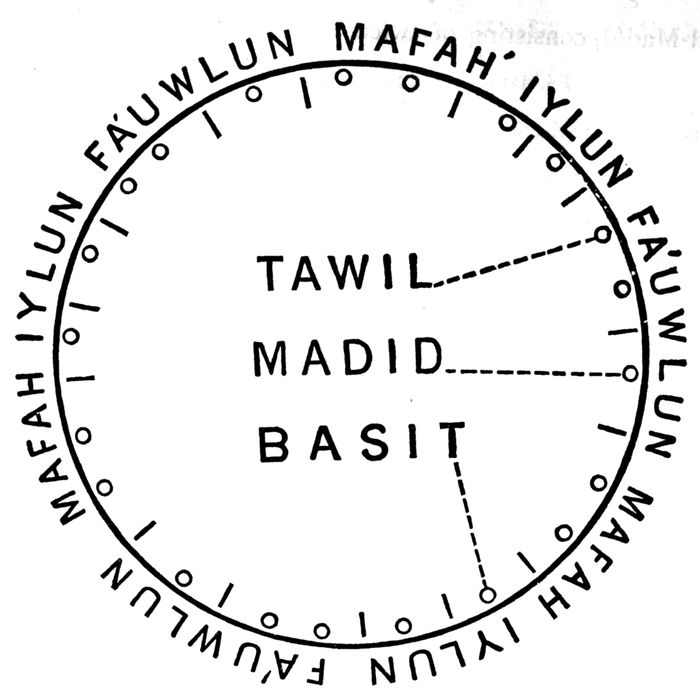
B. Dairat al-Mútalif, circle of “the agreeing” metre, so called because all its feet agree in length, consisting of seven letters each. It contains:
1. Al-Wáfir, composed of twice
Mufá.’alatun Mufá.’alatun Mufá’alatun (ii. 3).
= ⏑ ‑ ⏑ ⏑ ‑ | ⏑ ‑ ⏑ ⏑ ‑ | ⏑ ‑ ⏑ ⏑ ‑ |
where the Iambus in each foot precedes the Anapaest, and its reversal:
2. Al-Kámil, consisting of twice
Mutafá.’ilun Mutafá.’ilun Mutafá.’ilun (ii. 8)
= ⏑ ⏑ ‑ ⏑ ‑ | ⏑ ⏑ ‑ ⏑ ‑ | ⏑ ⏑ ‑ ⏑ ‑ | ⏑ ⏑ ‑ ⏑ ‑ |
where the Anapaest takes the first place in every foot.
C. Dáirat al-Mujtalab, circle of “the brought on” metre, so called because its seven-lettered feet are brought on from the first circle.
2851. Al-Hazaj, consisting of twice
Mafá.’ílun Mafá.’ílun Mafá.’ílun (ii. 2)
= ⏑ ‑ ‑ ‑ | ⏑ ‑ ‑ ‑ | ⏑ ‑ ‑ ‑ | ⏑ ‑ ‑ ‑ |
2. Al-Rajaz, consisting of twice
Mustaf.’ilun Mustaf.’ilun Mustaf.’ilun,
and, in this full form, almost identical with the Iambic Trimeter of the Greek Drama:
‑ ‑ ⏑ ‑ | ‑ ‑ ⏑ ‑ | ‑ ‑ ⏑ ‑ |
3. Al-Ramal, consisting of twice
Fá.’ilátun Fá.’ilátun Fá.’ilátun,
the trochaic counterpart of the preceding metre
= ‑ ⏑ ‑ ‑ | ‑ ⏑ ‑ ‑ | ‑ ⏑ ‑ ‑ |
D. Dáirat al-Mushtabih, circle of “the intricate” metre, so called from its intricate nature, primary mingling with secondary feet, and one foot of the same verse containing a Watad majmú’, another a Watad mafrúk, i.e. the iambic rhythm alternating with the trochaic and vice versa. Its Buhúr are:
1. Al-Sarí’, twice
Mustaf.’ilun Mustaf.’ilun Maf’ú.látu (ii. 6 and 9)
= ‑ ‑ ⏑ ‑ | ‑ ‑ ⏑ ‑ | ‑ ‑ ‑ ⏑
2. Al-Munsarih, twice
Mustaf.’ilun Mafú.látu Mustaf.’ilun (ii. 6. 9. 6)
= ‑ ‑ ⏑ ‑ | ‑ ‑ ‑ ⏑ | ‑ ‑ ⏑ ‑ |
3. Al-Khafíf, twice
Fá.’ílátun Mustaf’i.lun Fá.’ílátun (ii. 7. 10. 7)
= ‑ ⏑ ‑ ‑ | ‑ ‑ ⏑ ‑ | ‑ ⏑ ‑ ‑ |
4. Al-Muzári’, twice
Mafá.’ílun Fá’i.látun Mafá.’ílun (ii. 2. 4. 2)
= ⏑ ‑ ‑ ‑ | ‑ ⏑ ‑ ‑ | ⏑ ‑ ‑ ‑ |
5. Al-Muktazib, twice
Maf’ú.látu Mustaf.’ilun Maf’ú.látu (ii. 9. 6. 9)
= ‑ ‑ ‑ ⏑ | ‑ ‑ ⏑ ‑ | ‑ ‑ ‑ ⏑ |
2866. Al-Mujtass, twice
Mustaf’i.lun Fá.’ilátun Mustaf’i.lun (ii. 10. 7. 10)
= ‑ ‑ ⏑ ‑ | ‑ ⏑ ‑ ‑ | ‑ ‑ ⏑ ‑ |
E. Dáirat al-Muttafik, circle of “the concordant” metre, so called for the same reason why circle B is called “the agreeing,” i.e. because the feet all harmonise in length, being here, however quinqueliteral, not seven-lettered as in the Mútalif. Al-Khalíl, the inventor of the ’Ilm al-’Arúz, assigns to it only one metre:
1. Al-Mutakárib, twice
Fa’úlun Fa’úlun Fa’úlun Fa’úlun (ii. 1)
= ⏑ ‑ ‑ | ⏑ ‑ ‑ | ⏑ ‑ ‑ | ⏑ ‑ ‑ |
Later Prosodists added:
2. Al-Mutadárak, twice
Fá’ilun Fá’ilun Fá’ilun Fá’ilun (ii. 5)
= ‑ ⏑ ‑ | ‑ ⏑ ‑ | ‑ ⏑ ‑ | ‑ ⏑ ‑ |
The feet and metres as given above, are however to a certain extent merely theoretical; in practice the former admit of numerous licenses and the latter of variations brought about by modification or partial suppression of the feet final in a verse. An Arabic poem (Kasídah, or if numbering less than ten couplets, Kat’ah) consists of Bayts or couplets, bound together by a continuous rhyme, which connects the first two lines and is repeated at the end of every second line throughout the poem. The last foot of every odd line is called ’Arúz (fem. in contradistinction of Arúz in the sense of Prosody which is masc.) pl. A’áiriz, that of every even line is called Zarb, pl. Azrub, and the remaining feet may be termed Hashw (stuffing), although in stricter parlance a further distinction is made between the first foot of every odd and even line as well.
Now with regard to the Hashw on the one hand, and the ’Aruz and Zarb on the other, the changes which the normal feet undergo, are of two kinds: Zuháf (deviation) and ’Illah (defect). Zuháf 287applies, as a rule, occasionally and optionally to the second letter of a Sabab in those feet which compose the Hashw or body-part of a verse, making a long syllable short by suppressing its quiescent final, or contracting two short quantities in a long one, by rendering quiescent a moved letter which stands second in a Sabab sakíl. In Mustaf’ilun (ii. 6. = ‑ ‑ ⏑ ‑), for instance, the s of the first syllable, or the f of the second, or both may be dropped and it will become accordingly Mutaf’ilun, by substitution Mafá’ilun, (⏑ ‑ ⏑ ‑) or Musta’ilun, by substitution, Mufta’ilun (‑ ⏑ ⏑ ‑), or Muta’ilun, by substitution Fa’ilatun (⏑ ⏑ ⏑ ‑).[454] This means that wherever the foot Mustaf.’ilun occurs in the Hashw of a poem, we can represent it by the scheme ⏓ ⏓ ⏑ ‑ i.e. the Epitritus tertius can, by poetical license change into Diiambus, Choriambus or Paeon quartus. In Mufá’alatun (ii. 3. = ⏑ ‑ ⏑ ⏑ ‑) and Mutafá’ilun (ii. 8. = ⏑ ⏑ ‑ ⏑ ‑), again, the Sabab ’ala and muta may become khafíf by suppression of their final Harakah and thus turn into Mufá’altun, by substitution Mafá’ílun (ii. 2. = ⏑ ‑ ‑ ‑), and Mutfá’ilun, by substitution Mustaf’ilun (ii. 6. = ‑ ‑ ⏑ ‑ as above). In other words the two feet correspond to the schemes ⏑ _ ⏑ ‑ ⏑ _ and ⏑ ‑ ⏑ _ ⏑ _, where a Spondee can take the place of the Anapaest after or before the Iambus respectively.
’Illah, the second way of modifying the primitive or normal feet, applies to both Sabab and Watad, but only in the ’Aruz and Zarb of a couplet, being at the same time constant and obligatory. Besides the changes already mentioned, it consists in adding one or two letters to a Sabab or Watad, or curtailing them more or less, even to cutting them off altogether. We cannot here exhaust this matter any more than those touched upon until now, but must be satisfied with an example or two, to show the proceeding in general and indicate its object.
288We have seen that the metre Basít consists of the two lines:
Mustaf.’ilun Fá.’ilun Mustaf’ilun Fá’ilun
Mustaf’ilun Fá’ilun Mustaf’ilun Fá’ilun.
This complete form, however, is not in use amongst Arab poets. If by the Zuháf Khabn, here acting as ’Illah, the Alif in the final Fá’ilun is suppressed, changing it into Fa’ilun (⏑ ⏑ ‑), it becomes the first ’Aruz, called makhbúnah, of the Basít, the first Zarb of which is obtained by submitting the final Fá’ilun of the second line to the same process. A second Zarb results, if in Fá’ilun the final n of the Watad ’ilun is cut off and the preceding l made quiescent by the ’Illah Kat’ thus giving Fá’il and by substitution Fa’lun (‑ ‑). Thus the formula becomes:—
Mustaf’ilun Fá’ilun Mustaf’ilun Fa’ilun
Mustaf’ilun Fá’ilun Mustaf’ilun { Fa’ilun
Fa’lun
As in the Hashw, i.e. the first three feet of each line, the Khabn can likewise be applied to the medial Fá’ilun, and for Mustaf’ilun the poetical licenses, explained above, may be introduced, this first ’Arúz or Class of the Basít with its two Zarb or subdivisions will be represented by the scheme
⏑ ⏑ ⏑ ⏑ ⏑ │
‑ ‑ ⏑ ‑ ‑ ⏑ ‑ ‑ ‑ ⏑ ‑ ⏑ ⏑ ‑
⏑ ⏑ ⏑ ⏑ ⏑ { ⏑ ⏑ ‑
‑ ‑ ⏑ ‑ ‑ ⏑ ‑ ‑ ‑ ⏑ ‑ ‑ ‑
that is to say in the first subdivision of this form of the Basít both lines of each couplet end with an Anapaest and every second line of the other subdivision terminates in a Spondee.
The Basít has four more A’áriz, three called majzúah, because each line is shortened by a Juz or foot, one called mashtúrah (halved), because the number of feet is reduced from four to two, and we may here notice that the former kind of lessening the number of feet is frequent with the hexametrical circles (B. C. D.), while the latter kind can naturally only occur in those circles, whose couplet forms an octameter (A. E.). Besides being 289majzúah, the second ’Aruz is sahíhah (perfect) consisting of the normal foot Mustaf’ilun. It has three Azrub: 1. Mustaf’ilán (‑ ‑ ⏑ ‑, with an overlong final syllable, see supra p. 277), produced by the ’Illah Tazyíl, i.e. addition of a quiescent letter at the end (Mustaf’ilunn, by substitution Mustaf’ilán); 2. Mustaf’ilun, like the ’Aruz; 3. Maf’úlun (‑ ‑ ‑), produced by the ’Illah Kat’ (see the preceding page; Mustaf’ilun, by dropping the final n and making the l quiescent becomes Mustaf’il and by substitution Maf’úlun). Hence the formula is:
Mustaf’ilun Fá’ilun Mustaf’ilun
{ Mustaf’ilán
Mustaf’ilun Fá’ilun Mustaf’ilun
Maf’úlun,
which, with its allowable licenses, may be represented by the scheme:
⏑ ⏑ │ ⏑ │
‑ ‑ ⏑ ‑ ‑ ⏑ ‑ ‑ ‑ ⏑ ‑
{ ⏑ ⏑
‑ ‑ ⏑ ‑
⏑ ⏑ │ ⏑ ‑ ‑ ⏑ ‑
‑ ‑ ⏑ ‑ ‑ ⏑ ‑ ⏑
‑ ‑ ‑
The above will suffice to illustrate the general method of the Prosodists, and we must refer the reader for the remaining classes and subdivisions of the Basít as well as the other metres to more special treatises on the subject, to which this Essay is intended merely as an introduction, with a view to facilitate the first steps of the student in an important, but I fear somewhat neglected field of Arabic learning.
If we now turn to the poetical pieces contained in The Nights, we find that out of the fifteen metres, known to al-Khalíl, or the sixteen of later Prosodists, instances of thirteen occur in the Mac. N. edition, but in vastly different proportions. The total number amounts to 1,385 pieces (some, however, repeated several times), out of which 1,128 belong to the first two circles, leaving only 257 for the remaining three. The same disproportionality 290obtains with regard to the metres of each circle. The Mukhtalif is represented by 331 instances of Tawíl and 330 of Basít against 3 of Madíd; the Mutalif by 321 instances of Kámil against 143 of Wáfir; the Mujtalab by 32 instances of Ramal and 30 of Rajaz against 1 of Hazaj; the Mushtabih by 72 instances of Khafíf and 52 of Sarí’ against 18 of Munsarih and 15 of Mujtass; and lastly the Muttafik by 37 instances of Mutakárib. Neither the Mutadárak (E. 2), nor the Muzári’ and Muktazib (D. 4. 5) are met with.
Finally it remains for me to quote a couplet of each metre, showing how to scan them, and what relation they bear to the theoretical formulas exhibited on p. 282 to p. 286.
It is characteristic for the preponderance of the Tawíl over all the other metres, that the first four lines, with which my alphabetical list begins, are written in it. One of these belongs to a poem which has for its author Bahá al-Dín Zuhayr (born A.D. 1186 at Mekkah or in its vicinity, ob. 1249 at Cairo), and is to be found in full in Professor Palmer’s edition of his works, p. 164. Sir Richard Burton translates the first Bayt (vol. i. 290):
An I quit Cairo and her pleasances ✿ Where can I hope to find so gladsome ways?
Professor Palmer renders it:
Must I leave Egypt where such joys abound?
What place can ever charm me so again
In Arabic it scans:
⏑ ‑ ⏑ | ⏑ ‑ ‑ ‑ | ‑ ⏑ ‑ | ⏑ ‑ ⏑ ‑
A-arhalu ’an Misrin wa tíbi na’ímihi[455]
⏑ ‑ ⏑ | ⏑ ‑ ‑ ‑ | ‑ ⏑ ‑ | ⏑ ‑ ⏑ ‑
Fa-ayyu makánin ba’dahá li-ya sháiku.
291In referring to iii. A. I. p. 282, it will be seen that in the Hashw Fa’úlun (⏑ ‑ ‑) has become Fa’úlu (⏑ ‑ ⏑) by a Zuháf called Kabz (suppression of the fifth letter of a foot if it is quiescent), and that in the ’Arúz and Zarb Mafá’ílun (⏑ ‑ ‑ ‑) has changed into Mafá’ilun (⏑ ‑ ⏑ ‑) by the same Zuháf acting as ’Illah. The latter alteration shows the couplet to be of the second Zarb of the first ’Arúz of the Tawíl. If the second line did terminate in Mafá’ílun, as in the original scheme, it would be the first Zarb of the same ’Arúz; if it did end in Fa’úlun (⏑ ‑ ‑) or Mafá’íl (⏑ ‑ ‑) it would represent the third or fourth subdivision of this first class respectively. The Tawíl has one other ’Arúz, Fa’úlun, with a twofold Zarb, either Fa’úlun also, or Mafá’ilun.
The first instance of the Basít occurring in The Nights are the lines translated vol. i. p. 25:
Containeth Time a twain of days, this of blessing, that of bane ✿ And holdeth Life a twain of halves, this of pleasure, that of pain.
In Arabic (Mac. N. i. 11):
‑ ‑ ⏑ ‑ | ‑ ⏑ ‑ | ‑ ‑ ⏑ ‑ | ⏑ ⏑ ‑ |
Al-Dahru yaumáni zá amnun wa zá hazaru
‑ ‑ ⏑ ‑ | ‑ ⏑ ‑ | ‑ ‑ ⏑ ‑ | ⏑ ⏑ ‑ |
Wa ’l-’Ayshu shatráni zá safwun wa zá kadaru.
Turning back to p. 283, where the A’áríz and Azrub of the Basít are shown, the student will have no difficulty to recognise the Bayt as one belonging to the first Zarb of the first ’Arúz.
As an example of the Madíd we quote the original of the lines (vol. v. 131):—
I had a heart, and with it lived my life ✿ ’Twas seared with fire and burnt with loving-lowe.
They read in Arabic:—
‑ ⏑ ‑ ‑ | ‑ ⏑ ‑ | ⏑ ⏑ ‑ |
Kána lí kalbun a’íshu bihi
‑ ⏑ ‑ ‑ | ‑ ⏑ ‑ | ⏑ ‑ |
Fa’ktawà bi’l-nári wa’htarak.
If we compare this with the formula (iii. A. 2 p. 283), we find that 292either line of the couplet is shortened by a foot; it is, therefore, majzú. The first ’Arúz of this abbreviated metre is Fá’ilátun (‑ ⏑ ‑ ‑), and is called sahíhah (perfect) because it consists of the normal third foot. In the second ’Arúz Fá’ilátun loses its end syllable tun by the ’Illah Hafz (suppression of a final Sabab khafíf), and becomes Fá’ilá (‑ ⏑ ‑), for which Fá’ilun is substituted. Shortening the first syllable of Fá’ilun, i.e. eliminating the Alif by Khabn, we obtain the third ’Arúz Fa’ilun (⏑ ⏑ ‑) as that of the present lines, which has two Azrub: Fa’ilun, like the ’Arúz, and Fa’lun (‑ ‑), here, again by Khabn, further reduced to Fa’al (⏑ ‑).
Ishak of Mosul, who improvises the piece, calls it “so difficult and so rare, that it went nigh to deaden the quick and to quicken the dead;” indeed, the native poets consider the metre Madíd as the most difficult of all, and it is scarcely ever attempted by later writers. This accounts for its rare occurrence in The Nights, where only two more instances are to be found, Mac. N. ii. 244 and iii. 404.
The second and third circle will best be spoken of together, as the Wáfir and Kámil have a natural affinity to the Hazaj and Rajaz. Let us revert to the line:—
⏑ ‑ ‑ ‑ | ⏑ ‑ ‑ ‑ | ⏑ ‑ ‑ |
Akámú ’l-wajda fí kalbí wa sárú.
Translated, as it were, into the language of the Prosodists it will be:—
Mafá’ílun[456] ’Mafá’ílun Fa’úlun,
and this, standing by itself, might prima facie be taken for a line of the Hazaj (iii. C. 1), with the third Mafá’ílun shortened by Hafz (see above) into Mafá’í for which Fa’úlun would be substituted. 293We have seen (p. 287) that and how the foot Mufá’alatun can change into Mafá’ílun, and if in any poem which otherwise would belong to the metre Hazaj, the former measure appears even in one foot only along with the latter, it is considered to be the original measure, and the poem counts no longer as Hazaj but as Wáfir. In the piece now under consideration, it is the second Bayt where the characteristic foot of the Wáfir first appears:—
⏑ ‑ ‑ ‑ | ⏑ ‑ ⏑ ⏑ ‑ | ⏑ ‑ ‑ |
Naat ’anní’l-rubú’u wa sákiníhá
⏑ ‑ ⏑ ⏑ ‑ | ⏑ ‑ ⏑ ⏑ ‑ | ⏑ ‑ ‑ |
Wa kad ba’uda ’l-mazáru fa-lá mazáru.
Anglicè (vol. iii. 296):—
Far lies the camp and those who camp therein; ✿ Far is her tent-shrine where I ne’er shall tent.
It must, however, be remarked that the Hazaj is not in use as a hexameter, but only with an ’Arúz majzúah or shortened by one foot. Hence it is only in the second ’Arúz of the Wáfir, which is likewise majzúah, that the ambiguity as to the real nature of the metre can arise[457]; and the isolated couplet:—
⏑ ‑ ‑ ‑ | ⏑ ‑ ‑ ‑ | ⏑ ‑ ‑ |
Yarídu ’l-mar-u an yu’tà munáhu
⏑ ‑ ‑ ‑ | ⏑ ‑ ‑ ‑ | ⏑ ‑ ‑ |
Wa yabà ’lláhu illá má yurídu
Man wills his wish to him accorded be, ✿ But Allah naught accords save what he wills (vol. iv. 157),
being hexametrical, forms undoubtedly part of a poem in Wáfir although it does not contain the foot Mufá’alatun at all. Thus 294the solitary instance of Hazaj in The Nights is Abú Nuwás’ abomination, beginning with:—
⏑ ‑ ‑ ‑ | ⏑ ‑ ‑ ‑ |
Fa-lá tas’au ilà ghayrí
⏑ ‑ ‑ ‑ | ⏑ ‑ ‑ ‑ |
Fa-’indí ma’dinu ’l-khayri (Mac. N. ii. 377).
Steer ye your steps to none but me ✿ Who have a mine of luxury (vol. v. 65).
If in the second ’Arúz of the Wáfir Maf’áílun (⏑ ‑ ‑ ‑) is further shortened to Mafá’ilun (⏑ ‑ ⏑ ‑), the metre resembles the second ’Arúz of Rajaz, where, as we have seen, the latter foot can, by license, take the place of the normal Mustaf’ilun (‑ ‑ ⏑ ‑).
The Kámil bears a similar relation to the Rajaz, as the Wáfir bears to the Hazaj. By way of illustration we quote from Mac. N. ii. 8 the first two Bayts of a little poem taken from the 23rd Assembly of Al-Hariri:—
‑ ‑ ⏑ ‑ | ‑ ‑ ⏑ ‑ | ⏑ ⏑ ‑ ⏑ ‑ |
Yá khátiba ’l-dunyá ’l-daniyyati innahá
⏑ ⏑ ‑ ⏑ ‑ | ⏑ ⏑ ‑ ⏑ ‑ | ‑ ‑ ‑ |
Sharaku ’l-radà wa karáratu ’l-akdári
‑ ‑ ⏑ ‑ | ‑ ‑ ⏑ ‑ | ‑ ‑ ⏑ ‑ |
Dárun matà má azhakat fí yaumihá
‑ ‑ ⏑ ‑ | ‑ ‑ ⏑ ‑ | ‑ ‑ ‑ |
Abkat ghadan bu’dan lahá min dári.
In Sir Richard Burton’s translation (vol. iii. 319):—
O thou who woo’st a World unworthy, learn ✿ ’Tis house of evils, ’tis Perdition’s net:
A house where whoso laughs this day shall weep ✿ The next; then perish house of fume and fret.
The ’Arúz of the first couplet is Mutafá’ilun, assigning the piece to the first or perfect (sahíhah) class of the Kámil. In the Hashw of the opening line and in that of the whole second Bayt this normal Mutafá’ilun has, by license, become Mustaf’ilun, and the same change has taken place in the ’Arúz of the second couplet; for it is a peculiarity which this metre shares with a few others, to 295allow certain alterations of the kind Zuháf in the ’Arúz and Zarb as well as in the Hashw. This class has three subdivisions: the Zarb of the first is Mutafá’ilun, like the ’Arúz; the Zarb of the second is Fa’alátun (⏑ ⏑ ‑ ‑), a substitution for Mutafá’il which latter is obtained from Mutafá’ilun by suppressing the final n and rendering the l quiescent; the Zarb of the third is Fa’lun (‑ ‑) for Mútfá, derived from Mutafá’ilun by cutting off the Watad ’ilun and dropping the medial a of the remaining Mutafá.
If we make the ’Ayn of the second Zarb Fa’alátun also quiescent by the permitted Zuháf Izmár, it changes into Fa’látun, by substitution Maf’úlun (‑ ‑ ‑) which terminates the rhyming lines of the foregoing quotation. Consequently the two couplets taken together, belong to the second Zarb of the first ’Arúz of the Kámil, and the metre of the poem with its licenses may be represented by the scheme:
‑ ‑ ‑
⏑ ⏑ ‑ ⏑ ‑ ⏑ ⏑ ‑ ⏑ ‑ ⏑ ⏑ ‑ ⏑ ‑
‑ ‑ ‑
⏑ ⏑ ‑ ⏑ ‑ ⏑ ⏑ ‑ ⏑ ‑ ⏑ ⏑ ‑ ‑
Taken isolated, on the other hand, the second Bayt might be of the metre Rajaz, whose first ’Arúz Mustaf’ilun has two Azrub: one equal to the Arúz, the other Maf’úlun as above, but here substituted for Mustaf’il after applying the ’Illah Kat’ (see p. 288) to Mustaf’ilun. If this were the metre of the poem throughout, the scheme with the licenses peculiar to the Rajaz would be:
⏑ ⏑ ⏑ ⏑ ⏑ ⏑
‑ ‑ ⏑ ‑ ‑ ‑ ⏑ ‑ ‑ ‑ ⏑ ‑
⏑ ⏑ ⏑ ⏑ ⏑
‑ ‑ ⏑ ‑ ‑ ‑ ⏑ ‑ ‑ ‑ ‑
The pith of Al-Hariri’s Assembly is that the knight errant, not to say the arrant wight of the Romance, Abú Sayd of Sarúj, accuses before the Wáli of Baghdad his pretended pupil, in reality his son, to have appropriated a poem of his by lopping off two 296feet of every Bayt. If this is done in the quoted lines, they read:
‑ ‑ ⏑ ‑ | ‑ ‑ ⏑ ‑ |
Yá khátiba ’l-dunyá ’l-daniy
⏑ ⏑ ‑ ⏑ ‑ | ⏑ ⏑ ‑ ⏑ ‑ |
Yati innahá sharaku ’l-radà
‑ ‑ ⏑ ‑ | ‑ ‑ ⏑ ‑ |
Dárun matà má azhakat
‑ ‑ ⏑ ‑ | ‑ ‑ ⏑ ‑ |
Fí yaumihá abkat ghadá,
with a different rhyme and of a different variation of metre. The amputated piece belongs to the fourth Zarb of the third ’Aruz of Kámil, and its second couplet tallies with the second subdivision of the second class of Rajaz.
The Rajaz, a iambic metre pure and simple, is the most popular, because the easiest, in which even the Prophet was caught napping sometimes, at the dangerous risk of following the perilous leadership of Imru ’l-Kays. It is the metre of improvisation, of ditties, and of numerous didactic poems. In the latter case, when the composition is called Urjúzah, the two lines of every Bayt rhyme, and each Bayt has a rhyme of its own. This is the form in which for instance, Ibn Málik’s Alfíyah is written, as well as the remarkable grammatical work of the modern native scholar, Nasíf al-Yazijí, of which a notice will be found in Chenery’s Introduction to his Translation of Al-Hariri.
While the Hazaj and Rajaz connect the third circle with the first and second, the Ramal forms the link between the third and fourth Dáirah. Its measure Fá’ilátun (‑ ⏑ ‑ ‑) and the reversal of it, Maf’úlátu (‑ ‑ ‑ ⏑), affect the trochaic rhythm, as opposed to the iambic of the two first-named metres. The iambic movement has a ring of gladness about it, the trochaic a wail of sadness: the former resembles a nimble pedestrian, striding apace with an elastic step and a cheerful heart; the latter is like a man toiling along on the desert path, where his foot is ever and anon 297sliding back in the burning sand (Raml, whence probably the name of the metre). Both combined in regular alternation, impart an agitated character to the verse, admirably fit to express the conflicting emotions of a passion-stirred mind.
Examples of these more or less plaintive and pathetic metres are numerous in the Tale of Uns al-Wujúd and the Wazir’s Daughter, which, being throughout a story of love, as has been noted, vol. v. 33, abounds in verse, and, in particular, contains ten out of the thirty-two instances of Ramal occurring in The Nights. We quote:
Ramal, first Zarb of the first ’Arúz (Mac. N. ii. 361):
‑ ⏑ ‑ ‑ | ⏑ ⏑ ‑ ‑ | ‑ ⏑ ‑ |
Inna li ’l-bulbuli sautan fí ’l-sahar
‑ ⏑ ‑ ‑ | ⏑ ⏑ ‑ ‑ | ‑ ⏑ ‑ |
Ashghala ’l-’áshika ’an husni ’l-watar
The Bulbul’s note, whenas dawn is nigh ✿ Tells the lover from strains of strings to fly (vol. v. 48).
Sarí’, second Zarb of the first ’Arúz (Mac. N. ii. 359):
⏑ ‑ ⏑ ‑ | ‑ ‑ ⏑ ‑ | ‑ ⏑ ‑ |
Wa fákhitin kad kála fí nauhihi
‑ ‑ ⏑ ‑ | ‑ ‑ ⏑ ‑ | ‑ ⏑ ‑ |
Yá Dáiman shukran ’alà balwatí
I heard a ringdove chanting soft and plaintively, ✿ “I thank Thee, O Eternal, for this misery” (vol. v. 47).
Khafíf, full or perfect form (sahíh), both in Zarb and ’Arúz (Mac. N. ii. 356):
‑ ⏑ ‑ ‑ | ⏑ ‑ ⏑ ‑ | ‑ ⏑ ‑ ‑ |
Yá li-man ashtakí ’l-gharáma ’llazí bí
⏑ ⏑ ‑ ‑ | ⏑ ‑ ⏑ ‑ | ‑ ⏑ ‑ ‑ |
Wa shujúní wa furkatí ’an habíbí
O to whom now of my desire complaining sore shall I ✿ Bewail my parting from my fere compellèd thus to fly (vol. v. 44).
Mujtass, the only ’Arúz (majzúah sahíhah, i.e. shortened by one foot and perfect) with equal Zarb (Mac. N. ii. 367):
298‑ ‑ ⏑ ‑ | ⏑ ⏑ ‑ ‑ |
Ruddú ’alayya habíbí
‑ ‑ ⏑ ‑ | ‑ ⏑ ‑ ‑ |
Lá hajatan lí bi-málin
To me restore my dear ✿ I want not wealth untold (vol. v. 55).
As an instance of the Munsarih, I give the second occurring in The Nights, because it affords me an opportunity to show the student how useful a knowledge of the laws of Prosody frequently proves for ascertaining the correct reading of a text. Mac. N. i. 33 we find the line:
‑ ⏑ ⏑ ‑ | ‑ ⏑ ⏑ ‑ | ‑ ⏑ ⏑ ‑ |
Arba’atun má ’jtama’at kattu izá.
This would be Rajaz with the license Mufta’ilun for Mustaf’ilun. But the following lines of the fragment evince, that the metre is Munsarih; hence, a clerical error must lurk somewhere in the second foot. In fact, on page 833 of the same volume, we find the piece repeated, and here the first couplet reads
‑ ⏑ ⏑ ‑ | ‑ ⏑ ‑ ⏑ | ‑ ⏑ ⏑ ‑ |
Arba’atun má ’jtama’na kattu siwà
⏑ ‑ ⏑ ‑ | ‑ ⏑ ‑ ⏑ | ‑ ⏑ ⏑ ‑ |
Alà azá mujhatí wa safki damí
Four things which ne’er conjoin unless it be ✿ To storm my vitals and to shed my blood (vol. iii. 237).
The Mutakárib, the last of the metres employed in The Nights, has gained a truly historical importance by the part which it plays in Persian literature. In the form of trimetrical double-lines, with a several rhyme for each couplet, it has become the “Nibelungen-” stanza of the Persian epos: Firdausí’s immortal “Book of Kings” and Nizámi’s Iskander-námah are written in it, not to mention a host of Masnawis in which Sufic mysticism combats Mohammedan orthodoxy. On account of its warlike and heroical character, therefore, I choose for an example the knightly Jamrakán’s challenge to the single fight in which he conquers his scarcely less valiant adversary Kaurajan, Mac. N. iii. 296:
299⏑ ‑ ‑ | ⏑ ‑ ⏑ | ⏑ ‑ ‑ | ⏑ ‑ ‑
Aná ’l-Jamrakánu kawiyyn ’l-janáni
⏑ ‑ ‑ | ⏑ ‑ ⏑ | ⏑ ‑ ‑ | ⏑ ‑ ‑
Jamí’u ’l-fawárisi takhshà kitálí.
Here the third syllable of the second foot in each line is shortened by license, and the final Kasrah of the first line, standing in pause, is long, the metre being the full form of the Mutakárib as exhibited p. 286, iii. E. i. If we suppress the Kasrah of al-Janáni, which is also allowable in pause, and make the second line to rhyme with the first, saying, for instance:
⏑ ‑ ‑ | ⏑ ‑ ⏑ | ⏑ ‑ ‑ | ⏑ ‑
Aná ’l-Jamrakánu kawiyyu ’l-janán
⏑ ‑ ‑ | ⏑ ‑ ‑ | ⏑ ‑ ‑ | ⏑ ‑
La-yakshà kitálí shijá’u ’l-zamán,
we obtain the powerful and melodious metre in which the Sháhnámah sings of Rustam’s lofty deeds, of the tender love of Rúdabah and the tragic downfall of Siyawush.
Shall I confess that in writing the foregoing pages it has been my ambition to become a conqueror, in a modest way, myself: to conquer, I mean, the prejudice frequently entertained, and shared even by my accomplished countryman, Rückert, that Arabic Prosody is a clumsy and repulsive doctrine. I have tried to show that it springs naturally from the character of the language, and, intimately connected, as it is, with the grammatical system of the Arabs, it appears to me quite worthy of the acumen of a people, to whom, amongst other things, we owe the invention of Algebra, the stepping-stone of our whole modern system of Mathematics. I cannot refrain, therefore, from concluding with a little anecdote anent al-Khalíl, which Ibn Khallikán tells in the following words. His son went one day into the room where his father was, and on finding him scanning a piece of poetry by the rules of prosody, he ran out and told the people that his father had lost his wits. 300They went in immediately and related to al-Khalíl what they had heard, on which he addressed his son in these terms: