THE SECOND BOOK OF THE COURTIER BY COUNT BALDESAR CASTIGLIONE
Leonard Eckstein Opdycke translation
TO MESSER ALFONSO ARIOSTO
1.—I have often considered not without wonder whence arises a fault, which, as it is universally found among old people, may be believed to be proper and natural to them. And this is, that they nearly all praise bygone times and censure the present, inveighing against our acts and ways and everything which they in their youth did not do; affirming too that every good custom and good manner of living, every virtue, in short every thing, is always going from bad to worse.
And verily it seems quite contrary to reason and worthy to be wondered at, that ripe age, which in other matters is wont to make men’s judgment more perfect with long experience, should in this matter so corrupt it that they do not perceive that if the world were always growing worse, and if fathers were generally better than children, we should long since have reached that last grade of badness beyond which it is impossible to grow worse. And yet we see that not only in our days but in bygone times this failing has always been peculiar to old age, which is clearly gathered from the works of many ancient authors, and especially of the comic writers, who better than the others set forth the image of human life.
Now the cause of this wrong judgment among old people I for my part take to be, that the fleeting years despoil them of many good things, and among others in great part rob the blood of vital spirits; whence the complexion changes, and those organs become weak through which the soul exerts its powers.[148] Thus in old age the sweet flowers of contentment fall from our hearts, like leaves from a tree in autumn, and in place of serene and sunny thoughts, comes cloudy and turbid sadness with its train of thousand ills. So that not the body only but the mind also is infirm; of bygone pleasures naught is left but a 76lingering memory and the image of that precious time of tender youth, in which (when it is with us) sky and earth and all things seem to us ever making merry and laughing before our eyes, and the sweet springtide of happiness seems to blossom in our thought, as in a delightful and lovely garden.
Therefore in the evening chill of life, when our sun begins to sink to its setting and steals away those pleasures, we should fare better if in losing them, we could lose the memory of them also, and as Themistocles said, find an art that shall teach us to forget. For so deceitful are our bodily senses, that they often cheat even the judgment of our minds. Thus it seems to me that old people are in like case with those who keep their eyes fixed upon the land as they leave port, and think their ship is standing still and the shore recedes, although it is the other way. For both the port and also time and its pleasures remain the same, and one after another we take flight in the ship of mortality upon that boisterous sea which absorbs and devours everything, and are never suffered to touch shore again, but always tossed by adverse winds we are wrecked upon some rock at last.
Since therefore the senile mind is an unfit subject for many pleasures, it cannot enjoy them; and just as to men in fever, when the palate is spoiled by corrupt vapours, all wines seem bitter, however precious and delicate they be,—so old men, because of their infirmity (which yet does not deprive them of appetite), find pleasures flat and cold and very different from those which they remember tasting of old, although the pleasures are intrinsically the same. Thus they feel themselves despoiled, and they lament and call the present times bad, not perceiving that the change lies in themselves and not in the times; and on the other hand they call to mind their bygone pleasures, and bring back the time when these were enjoyed and praise it as good, because it seems to carry with it a savour of what they felt when it was present. For in truth our minds hold all things hateful that have been with us in our sorrows, and love those that have been with us in our joys.
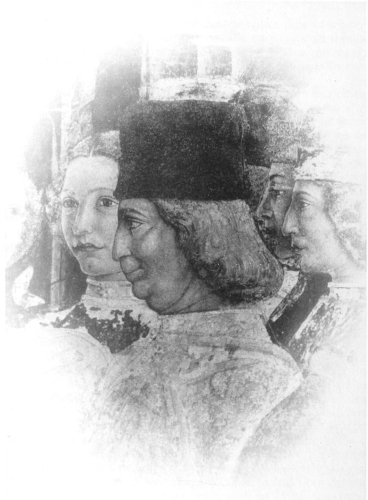
BORSO D’ESTE DUKE OF FERRARA 1413-1471
Enlarged from Anderson’s photograph (no. 11375) of a part of the injured fresco, “Triumph of Minerva,” in the Palazzo Schifanoia at Ferrara, painted about 1468 by Francesco Cossa (1438?-1480?). See Gustave Gruyer’s L’Art Ferrarais, ii, 581.
This is why it is sometimes highest bliss for a lover to look at a window although closed, because he there had once the happiness 77to gaze upon the lady of his love; and in the same way to look at a ring, a letter, a garden or other place, or what you will, which seems to him a conscious witness of his joys. And on the contrary, a gorgeous and beautiful room will often be irksome to a man who has been prisoner or has suffered some other sorrow there. And I once knew some who would not drink from a cup like that from which in illness they had taken medicine. For just as to the one the window or ring or letter recalls the sweet memory that gives him such delight and seems part of his bygone joy,—so to the other, the room or cup brings his illness or imprisonment to mind. I believe that the same cause leads old people to praise bygone times and to censure the present.
2.—Therefore as they speak of other things, so do they also of courts, affirming those which they remember, to have been far more excellent and full of eminent men than those which we see to-day. And as soon as such discussions are started, they begin to extol with boundless praise the courtiers of Duke Filippo or Duke Borso;[149] and they narrate the sayings of Niccolò Piccinino;[150] and they remind us that there were no murders in those days (or very few at most), no brawls, no ambushes, no deceits, but a certain frank and kindly good will among all men, a loyal confidence; and that in the courts of that time such good behaviour and decorum prevailed, that courtiers were all like monks, and woe to him who should have spoken insultingly to another, or so much as made a less than decorous gesture to a woman. And on the other hand they say everything is the reverse in these days, and that not only have courtiers lost their fraternal love and gentle mode of life, but that nothing prevails in courts but envy, malice, immorality and very dissolute living, with every sort of vice,—the women lascivious without shame, the men effeminate. They condemn our dress also as indecorous and too womanish.
In short they censure an infinity of things, among which many indeed merit censure, for it cannot be denied that there are many bad and wicked men among us, or that this age of ours is much fuller of vice than that which they praise.[151] Yet it seems to me that they ill discern the cause of this difference, and that they are 78foolish. For they would have the world contain all good and no evil, which is impossible; because, since evil is opposed to good and good to evil, it is almost necessary, by force of opposition and counterpoise as it were, that the one should sustain and fortify the other, and that if either wanes or waxes, so must the other also, since there is no contrary without its contrary.
Who does not know that there would be no justice in the world, if there were no wrongs? No courage, if there were no cowards? No continence, if there were no incontinence? No health, if there were no infirmity? No truth, if there were no lying? No good fortune, if there were no misfortunes? Thus, according to Plato,[152] Socrates well says it is surprising that Æsop did not write a fable showing that as God had never been able to join pleasure and pain together, He joined them by their extremities, so that the beginning of the one should be the end of the other; for we see that no joy can give us pleasure, unless sorrow precedes it. Who can hold rest dear, unless he has first felt the hardship of fatigue? Who enjoys food, drink and sleep, unless he has first endured hunger, thirst and wakefulness? Hence I believe that sufferings and diseases were given man by nature not chiefly to make him subject to them (since it does not seem fitting that she who is mother of every good should give us such evils of her own determined purpose), but as nature created health, joy and other blessings,—diseases, sorrows and other ills followed after them as a consequence. In like manner, the virtues having been bestowed upon the world by grace and gift of nature, at once by force of that same bounden opposition, the vices became their fellows by necessity; so that always as the one waxes or wanes, thus likewise must needs the other wax or wane.
3.—So when our old men praise bygone courts for not containing such vicious men as some that our courts contain, they do not perceive that their courts did not contain such virtuous men as some that ours contain; which is no marvel, for no evil is so bad as that which springs from the corrupted seed of good, and hence, as nature now puts forth far better wits than she did then, those who devote themselves to good, do far better than was formerly done, and likewise those who devote themselves to evil, do far worse. Therefore we must not on that account say that those 79who refrained from evil because they did not know how to do evil, deserved any praise for it; for although they did little harm, they did the worst they could. And that the wits of those times were generally inferior to those of our time, can be well enough perceived in all that we see of those times, both in letters and in pictures, statues, buildings, and every other thing.
These old men censure us also for many a thing that in itself is neither good nor evil, simply because they did not do it. And they say it is not seemly for young men to ride through the city on horse, still less in pumps, to wear fur linings or long skirts in winter, or to wear a cap before reaching at least the age of eighteen years, and the like; wherein they certainly are wrong, for besides being convenient and useful, these customs have been introduced by usage and meet universal favour, just as formerly it was to go about in gala dress with open breeches and polished pumps, and for greater elegance to carry a sparrow-hawk on the wrist all day without reason, to dance without touching the lady’s hand, and to follow many other fashions that now would be as very clumsy as they then were highly prized.
Therefore let it be allowed us also to follow the custom of our time without being slandered by these old men, who in their wish to praise themselves, often say: “When I was twenty years old, I still slept with my mother and sisters, nor did I for a long time afterwards know what women are; while now, boys hardly have hair on their heads before they know more tricks than grown men did in our time.” Nor do they perceive that in saying this they acknowledge that our boys have more mind than their old men had.
Let them cease then to censure our time as full of vices, for in removing the vices they would remove the virtues too; and let them remember that among the worthies of old, in the ages when there lived those spirits who were glorious and truly divine in every virtue, and those more than human minds,—there were also to be found many very bad men; who (if they were living) would be as eminently bad among our bad men, as the good men of that time would be eminently good. And of this, all history gives ample proof.
804.—But I think these old men have now sufficient answer. So we will end this homily, perhaps already too diffuse but not wholly irrelevant to our subject; and as it is enough for us to have shown that the courts of our time were worthy of no less praise than those which old men praise so highly,—we will pursue the discussion about the Courtier, from which we may easily understand what rank the court of Urbino held among other courts, and of what quality were the Prince and Lady to whom such noble spirits did service, and how fortunate they might hold themselves who lived in such companionship.
5.—Now the following day having arrived, there were many and diverse discussions among the cavaliers and ladies of the court concerning the debate of the evening before; which in great part arose because my lord Prefect, eager to know what had been said, questioned nearly everyone about it, and (as is always wont to be the case) he received different answers; for some praised one thing and some another, and among many too there was disagreement as to the Count’s real opinion, since everyone’s memory did not quite fully retain the things that were said.
Thus the matter was discussed nearly all day; and as soon as night set in, my lord Prefect desired that food be served and took all the gentlemen away to supper. When they had done eating, he repaired to the room of my lady Duchess, who, on seeing such a numerous company and earlier than the custom was, said:
“Methinks, messer Federico, it is a heavy burden that is placed upon your shoulders, and great the expectation you must satisfy.”
Then without waiting for messer Federico to reply, the Unico Aretino said:
“And what, forsooth, is this great burden? Who is so foolish that when he knows how to do a thing, does not do it in proper season?”
So, discoursing of this, everyone sat down in the usual place and order, with eager expectation for the debate appointed.
6.—Then messer Federico turned to the Unico, and said:
“So, my lord Unico, you do not think that a laborious part and a great burden are imposed on me this evening, having to show in what way, manner and time the Courtier ought to employ 81his good accomplishments and practise those things that have been said to befit him?”
“It seems to me no great matter,” replied the Unico; “and I think it is quite enough to say that the Courtier should have good judgment, as the Count last evening rightly said he must; and this being so, I think that without other precepts he ought to be able to use what he knows seasonably and in a well bred way. To try to reduce this to more exact rules would be too difficult and perhaps superfluous. For I know no man so stupid as to wish to fence when others are intent on dancing; or to go through the street dancing a morris-dance, however admirably he might know how; or in trying to comfort a mother whose child has died, to begin with pleasantries and witticism. Surely methinks no gentleman would do this, who was not altogether a fool.”
Then messer Federico said:
“It seems to me, my lord Unico, that you run too much to extremes. For one may sometimes be silly in a way that is not so easily seen, and faults are not always of the same degree: and it may be that a man will refrain from public and too patent folly,—such as that would be of which you tell, to dance a morris-dance about the piazza,—and yet cannot refrain from praising himself out of season, from displaying a tiresome conceit, from occasionally saying something to cause laughter, which falls cold and wholly flat from being said inopportunely. And these faults are often covered by a kind of veil that does not suffer them to be seen by him who commits them, unless he searches for them with care; and although our eyes see little for many reasons, they most of all are clouded by conceit, since everyone likes to make a show in that wherein he believes himself proficient, whether his belief be true or false.
“Therefore it seems to me that the right course in this regard lies in a certain prudent and judicious choice, and in discerning the more or less which all things gain or lose by being done opportunely or out of season. And although the Courtier may possess good enough judgment to perceive these distinctions, yet I think it would surely be easier for him to attain what he is seeking, if we were to broaden his mind by a few precepts, and 82show him the way and as it were the foundations upon which he must build,—than if he were to follow generalities only.
7.—“Last evening the Count spoke about Courtiership so fully and so beautifully, that he has aroused in me no little fear and doubt whether I shall be able to satisfy this noble company so well in what I have to say, as he did in what it fell to him to say. Yet to make myself a sharer in his fame as far as I can, and to be sure of avoiding this one mistake at least, I shall contradict him in nothing.
“Accepting his opinions then, and among others his opinion as to the Courtier’s noble birth, capacities, bodily form and grace of feature,—I say that to win praise justly and good opinion from everyone and favour from the princes whom he serves, I deem it necessary for the Courtier to know how to dispose his whole life, and to make the most of his good qualities in intercourse with all men everywhere, without exciting envy thereby. And how difficult this in itself is, we may infer from the fewness of those who are seen to reach the goal; for by nature we all are more ready to censure mistakes than to praise things well done, and many men, from a kind of innate malignity and although they clearly see the good, seem to strive with every effort and pains to find either some hidden fault in us or at least some semblance of fault.
“Thus it is needful for our Courtier to be cautious in his every action, and always to mingle good sense with what he says or does. And let him not only take care that his separate parts and qualities are excellent, but let him order the tenour of his life in such fashion, that the whole may be in keeping with these parts and be seen to be always and in everything accordant with his own self and form one single body of all these good qualities; so that his every act may be the result and compound of all his faculties, as the Stoics say is the duty of him who is wise.
“Still, although in every action one faculty is always chief, yet all are so enlinked together, that they make for one end and may all further and serve every purpose. Hence he must know how to make the most of them, and by means of contrast and as it were foil to the one, he must make the other more clearly 83seen;—like good painters, who display and show forth the lights of projecting objects by the use of shadow, and likewise deepen the shadows of flat objects by means of light, and so assemble their divers colours that both the one and the other are better displayed by reason of that diversity, and the placing of figures in opposition one to another aids them to perform that office which is the painter’s aim.
“Thus gentleness is very admirable in a man of noble birth who is valiant and strong. And as his boldness seems greater when accompanied by modesty, so his modesty is enhanced and set off by his boldness.[153] Hence to speak little, to do much, and not to boast of praiseworthy deeds but to conceal them tactfully,—enhances both these attributes in the case of one who knows how to employ this method with discretion; and so it is with all other good qualities.
“Therefore in what our Courtier does or says I would have him follow a few universal rules, which I think comprise briefly all that I have to say. And for the first and most important let him above all avoid affectation, as the Count rightly advised last evening. Next let him consider well what thing it is that he is doing or saying, the place where he is doing it, in whose presence, the cause that impels him, his age, his profession, the object he has in view, and the means that may conduce thereto; and so, with these precautions let him apply himself discreetly to whatever he has a mind to do or say.”
8.—After messer Federico had spoken thus, he seemed to pause a little. Whereupon my lord Morello da Ortona at once said:
“These rules of yours teach little, it seems to me; and for my part I know as much about it now, as I did before you propounded them. Still I remember having heard them several times before also from the friars to whom I made confession, and who called them ‘the circumstances,’ I think.”
Then messer Federico laughed and said:
“If you remember rightly, the Count declared last evening that the Courtier’s chief business should be that of arms, and spoke at length about the way in which he ought to practise it; therefore we will not repeat this. Yet among our rules we may also lay it down that when our Courtier finds himself in a skirmish 84or action or battle, or in other such affairs, he ought to arrange discreetly to withdraw from the crowd, and to perform those glorious and brave deeds that he has to do, with as little company as he can, and in sight of all the noblest and most respected men in the army, and especially in the presence and (if it is possible) before the very eyes of his king or of the prince whom he serves; for in truth it is very proper to make the most of one’s good deeds. And I think that just as it is wrong to seek false and unmerited renown, so it is wrong also to defraud oneself of the honour that is one’s due, and not to seek that praise which alone is the true reward of worthy effort.
“And I remember having in my time known some men who were very stupid in this regard, although valiant, and who put their lives as much in danger to capture a flock of sheep, as to be the first to scale the walls of a beleaguered town; which our Courtier will not do if he bears in mind the motive that leads him into war, which should be honour only. And again if he happens to be playing at arms in public shows,—such as jousts, tourneys, stick-throwing, or any other bodily exercise,—mindful of the place and presence in which he is, he will contrive to be not less elegant and graceful than unerring with his weapons, and to feast the spectators’ eyes with all those things which he thinks may give him an added grace. He will take care that his horse is bravely caparisoned, that his attire becomes him, that his mottoes are appropriate and his devices clever, so that they may attract the eyes of the bystanders as the loadstone attracts iron. He will never be among the last to show themselves, knowing that the crowd and especially women gaze much more attentively upon the first than upon the last; for their eyes and minds, which at the start are eager for novelty and observe and are impressed by every trifle, are afterwards not only sated by repetition but even grow weary. Thus there was an excellent actor of ancient times, who for this reason always wished to be the first to perform his part in the play.
“So too, even in speaking of arms, our Courtier will have regard to the profession of those with whom he converses, and will govern himself accordingly,—speaking in one way with men 85and in another way with women. And if he wishes to touch on something that is to his credit, he will do so covertly, as if by chance in passing, and with the discreetness and caution that Count Ludovico expounded to us yesterday.
9.—“Does it not seem to you now, my lord Morello, that our rules may teach something? Does it not seem to you that our friend, of whom I was telling you a few days since, quite forgot with whom and why he was speaking, when to entertain a lady he had never seen before, he began his talk by telling her that he had slain so many men, and that he was a terrible fellow and knew how to handle a sword with both hands? Nor did he leave her until he had tried to explain to her how certain blows of the battle-axe ought to be parried when one is armed and how when unarmed, and to show the different ways of grasping the handle; so that the poor soul was on the rack, and thought the hour seemed a thousand years before she could send him off, almost fearing that he would slay her like the others. Such are the mistakes committed by those who pay no regard to the ‘circumstances,’ of which you say you heard from the friars.
“Next I say that of bodily exercises there are some that are almost never practised except in public,—such as jousts, tourneys, stick-throwing, and all the rest that have to do with arms. Hence when our Courtier has to take part in these, he must first contrive to be so well equipped in point of horses, weapons and dress, that he lacks nothing. And if he does not feel himself well provided with everything, let him on no account engage, for if he fails to do well, the excuse cannot be made that these things are not his business. Then he must carefully consider in whose presence he is seen and of what sort the company is, for it would not be seemly for a gentleman to honour a rustic festival with his presence, where the spectators and the company are of low degree.”
10.—Then my lord Gaspar Pallavicino said:
“In our Lombard country we do not make these distinctions. On the contrary, there are many young gentlemen who dance all day with peasants in the sun on holidays, and play with them at throwing the bar, wrestling, running and leaping. And I do not think it amiss, for there the rivalry is not of birth, but of 86strength and agility, wherein villagers are often quite a match for nobles; and this condescension seems to have in it a pleasant touch of generosity.”
Messer Federico replied:
“This dancing of yours in the sun pleases me not in any way, nor do I see what gain there is in it. But in my opinion whoever cares to wrestle or run or leap with peasants, ought to do so as a matter of practice and out of courtesy as we say, not in rivalry with them. And a man ought to be almost sure of winning; else let him not engage, because it is too unseemly and shameful a thing, and beneath his dignity, to see a gentleman vanquished by a peasant, and especially at wrestling. Hence I think it is well to abstain, at least in the presence of many, for the gain of beating is very small and the loss of being beaten is very great.
“The game of tennis also is nearly always played in public, and is one of those sports to which a crowd lends much distinction. Therefore I would have our Courtier practise this, and all the others except the handling of arms, as something that is not his profession, and let him show that he does not seek or expect praise for it, nor let him seem to devote much care or time to it, although he may do it admirably. Nor let him be like some men who delight in music, and in speaking with anyone always begin to sing under their breath whenever there is a pause in the conversation. Others always go dancing as they pass through streets and churches. Others, when they meet a friend in the piazza or anywhere else, at once put themselves in posture as if for fencing or wrestling, according to their favourite humour.”
Here messer Cesare Gonzaga said:
“A young cardinal we have in Rome does better than that; for out of pride in his fine bodily frame, he conducts into his garden all who come to visit him (even although he has never seen them before), and urgently presses them to strip to the doublet and try a turn with him at leaping.”
11.—Messer Federico laughed; then he went on:
“There are certain other exercises that can be practised in public and in private, like dancing; and in this I think the Courtier ought to have a care, for when dancing in the presence 87of many and in a place full of people, it seems to me that he should preserve a certain dignity, albeit tempered with a lithe and airy grace of movement; and although he may feel himself to be very nimble and a master of time and measure, let him not attempt those agilities of foot and double steps which we find very becoming in our friend Barletta, but which perhaps would be little suited to a gentleman. Yet in a room privately, as we are now, I think he may try both, and may dance morris-dances and brawls;[154] but not in public unless he be masked, when it is not displeasing even though he be recognized by all.
“Indeed there is no better way of displaying oneself in such matters at public sports, either armed or unarmed; because disguise carries with it a certain freedom and licence, which among other things enable a man to choose a part for which he feels himself qualified, and to use care and elaboration upon the chief point of the thing wherein he would display himself, and a certain nonchalance as to that which does not count,—which greatly enhances the charm: as for a youth to array himself like an old man, yet in easy dress so as to be able to show his vigour; a cavalier in the guise of a rustic shepherd or some other like costume, but with a perfect horse and gracefully bedecked in character;—because the mind of the spectators is quick to fill out the image of that which is presented to the eyes at first glance; and then seeing the thing turn out much better than the costume promised, they are amused and delighted.
“But in these sports and shows where masks are worn, it would not be seemly for a prince to try to enact the part of a prince, because that pleasure which the spectators find in novelty would be in great measure lacking, since it is news to no one that the prince is the prince; and he, conscious that besides being the prince he is trying to play the prince, loses the freedom to do all those things that are beneath a prince’s dignity. And if there were any contest in these sports, especially with arms, he might even make men think that he chose to impersonate a prince in order not to be beaten but spared by others; moreover were he to do in sport the same that it behooves him to do in earnest upon occasion, he would deprive his own proper action of dignity, and make it almost seem as if that too were sport. But at such 88times, if the prince lays aside his character of prince, and mingles equally with his inferiors yet in such fashion as to be recognizable, by renouncing his own rank he attains a higher one, in that he prefers to excel the rest not by authority but by merit, and to show that his worth is not enhanced by the fact that he is a prince.
12.—“I say then that in these martial sports the Courtier ought to use the like discretion, according to his rank. In horseback vaulting too, in wrestling, running and leaping, I should be well pleased to have him shun the vulgar crowd, or at most let himself be very rarely seen; for there is not on earth a thing so excellent but the ignorant will tire of it and hold it of small account, if they see it often.
“As to music I hold the same opinion: hence I would not have our Courtier behave like many, who are no sooner come anywhere (even into the presence of gentlemen with whom they have no acquaintance), than without waiting to be urged they set about doing what they know and often what they do not know; so that it seems as if they had come only for the purpose of showing themselves, and had that for their chief profession. Therefore let the Courtier resort to music as a pastime and almost unwillingly, and not before vulgar people nor very many. And although he may know and understand that which he is doing, in this too I would have him hide the study and pains that are necessary in everything one would do well, and seem to value this accomplishment lightly in himself, but by practising it admirably make others value it highly.”
13.—Then my lord Gaspar Pallavicino said:
“There are many kinds of music, vocal as well as instrumental: therefore I should like to hear which is the best of all, and at what time the Courtier ought to perform it.”[155]
Messer Federico replied:
“I regard as beautiful music, to sing well by note, with ease and in beautiful style; but as even far more beautiful, to sing to the accompaniment of the viol,[156] because nearly all the sweetness lies in the solo part, and we note and observe the fine manner and the melody with much greater attention when our ears are not occupied with more than a single voice, and moreover 89every little fault is more clearly discerned,—which is not the case when several sing together, because each singer helps his neighbour. But above all, singing to the viol by way of recitative seems to me most delightful, which adds to the words a charm and grace that are very admirable.
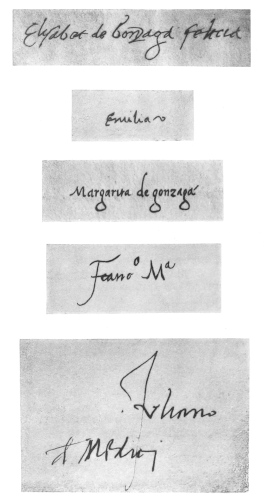
ELISABET DE GONZAGA FELTRIA
“My Lady Duchess”
EMILIA
“My Lady Emilia”
MARGARITA DE GONZAGA
“Madonna Margarita”
FRANCO MA
“My Lord Prefect”
JULIANO DE MEDICI
“My Lord Magnifico”
AUTOGRAPH SIGNATURES OF INTERLOCUTORS
From negatives, made by Premi and by Signor Lanzoni, from originals preserved in the Royal State Archives at Mantua and selected by the Director, Signor Alessandro Luzio.
“All keyed instruments also are pleasing to the ear, because they produce very perfect consonances, and upon them one can play many things that fill the mind with musical delight. And not less charming is the music of the stringed quartet, which is most sweet and exquisite. The human voice lends much ornament and grace to all these instruments, with which I would have our Courtier at least to some degree acquainted, albeit the more he excels with them, the better,—without troubling himself much with those that Minerva forbade to Alcibiades, because it seems that they are ungraceful.[157]
“Then, as to the time for enjoying these various kinds of music, I think it is whenever a man finds himself in familiar and beloved companionship and there are not other occupations. But above all it is fitting where ladies are present, because their aspect fills the listener’s heart with sweetness, renders it more sensitive to the tenderness of the music, and quickens the musician’s soul.
“As I have already said, it pleases me well that we should avoid the crowd, and especially the ignoble crowd. But discretion must needs be the spice of everything, for it would be quite impossible to foresee all the cases that occur; and if the Courtier rightly understands himself, he will adapt himself to the occasion and will perceive when the minds of his hearers are disposed to listen and when not. He will take his own age into account: for it is indeed unseemly and unlovely in the extreme to see a man of any quality,—old, hoary and toothless, full of wrinkles,—playing on a viol and singing in the midst of a company of ladies, even though he be a passable performer. And the reason of this is that in singing the words are usually amourous, and love is a ridiculous thing in old men,—albeit it is sometimes pleased among its other miracles to kindle frozen hearts in spite of years.”
14.—Then the Magnifico replied:
90“Do not deprive old men of this pleasure, messer Federico; for in my time I have known old men who had right perfect voices and hands very dexterous upon their instruments, far more than some young men.”
“I do not wish,” said messer Federico, “to deprive old men of this pleasure, but I do wish to deprive you and these ladies of the pleasure of laughing at such folly. And if old men wish to sing to the viol, let them do so in secret and only to drive from their minds those painful thoughts and grievous troubles with which our life is filled, and to taste that rapture which I believe Pythagoras and Socrates found in music.[158] And even although they practise it not, by somewhat accustoming their minds to it they will enjoy it far more when they hear it than a man who knows nothing of it. For just as the arms of a smith, who is weak in his other members, become stronger by exercise than those of another man who is more robust but unaccustomed to use his arms,—in like manner ears practised in harmony will perceive it better and more speedily and will appreciate it with far greater pleasure, than others, however good and sharp they be, that are not versed in the varieties of musical consonance; because these modulations do not penetrate ears unused to hearing them, but pass aside without leaving any savour of themselves; albeit even the beasts have some enjoyment in melody.
“This then is the pleasure it is fitting old men should take in music. I say the like of dancing, for in truth we ought to give up these exercises before our age forces us to give them up against our will.”
Here my lord Morello replied with a little heat:
“So it is better to exclude all old men, and to say that only young men have a right to be called Courtiers.”
Then messer Federico laughed, and said:
“You see, my lord Morello, that they who like these things strive to seem young when they are not, and hence they dye their hair and shave twice a week.[159] And this is because nature silently tells them that such things are proper only to the young.”
All the ladies laughed, for each one of them felt that these 91words fitted my lord Morello; and he seemed rather stung by them. Messer Federico soon continued:
15.—“But there are many other ways of entertaining ladies that are proper to old men.”
“What are they?” said my lord Morello. “Telling stories?”
“That is one,” replied messer Federico. “But as you know, every age brings its own thoughts with it, and has some peculiar virtue and some peculiar vice. Thus, while old men are ordinarily more prudent than young men, more continent and wiser, so too they are more garrulous, miserly, querulous and timid; they are always scolding about the house, harsh to their children, and wish everyone to follow their way. And on the contrary young men are spirited, generous, frank, but prone to quarrel, voluble, loving and hating in an instant, eager in all their pleasures, unfriendly to him who counsels well.
“But of all ages, that of manhood is the most temperate, because it has left the faults of youth behind and has not yet reached those of old age. Being placed then at the two extremes, young and old must needs learn from reason how to correct the faults that nature implants in them. Thus, old men ought to guard against much self-praise and the other evil habits that we have said are peculiar to them, and to use that prudence and knowledge which they have gained from long experience, and to be like oracles consulted of all men; and in telling what they know, they ought to have the grace to speak to the point and temper the gravity of their years with a certain mild and sportive humour. In this way they will be good Courtiers, enjoy their intercourse with men and with ladies, and be always welcome,—without singing or dancing; and when need arises they will display their worth in affairs of importance.
16.—“Let young men use this same care and judgment, not indeed in copying old men’s ways,—for that which befits the one would not at all befit the other, and we are wont to say that over wisdom is a bad sign in the young,—but in correcting their own natural faults. Hence I greatly like to see a youth, and especially when handling weapons, who has a touch of the grave and taciturn; who is master of himself, without those restless manners which are often seen at that age; because such 92youths seem to have a certain something in them above the rest. Moreover this quietness of manner has in it a kind of impressive boldness, because it seems the result not of anger but of judgment, and governed more by reason than by passion. This is nearly always found in all men of high courage, and we see it also among those brute animals that have more nobility and strength than their fellows,—as in the lion and the eagle.
“Nor is this strange; for an impetuous and sudden movement,—which without words or other signs of wrath abruptly bursts with all its force at once from the quiet that is its contrary, as it were like the discharge of a cannon,—is far more violent and furious than that which increases by degrees and grows hotter little by little. Therefore they who talk much and move about and cannot stand still, when they have an enterprise on foot, seem thus to exhaust their powers; and as our friend messer Pietro Monte well says, they act like boys who sing from fear when they walk at night, as if to keep up their courage by their singing.
“Again, just as calm and thoughtful youthfulness is very praiseworthy in a young man, because the levity which is the fault peculiar to his age seems to be tempered and corrected,—so in an old man a green and lively old age is to be highly esteemed, because his stoutness of heart seems to be so great as to warm and strengthen his feeble and chill years, and to keep him in that middle state which is the best part of our life.
17.—“But in brief not even all these qualities in our Courtier will suffice to win universal favour of lords, cavaliers and ladies, unless he has also a gentle and amiable manner in daily talk. And I verily believe it to be difficult to give any rule for this, because of the infinite variety of things that arise in conversation, and because among all the men on earth no two are found who have minds quite alike. So whoever has to prepare himself for conversation with many, must needs be guided by his own judgment, and distinguishing the differences between one man and another, must daily change his style and method according to the character of the person with whom he has to converse. Nor could I for my part give other rules in this matter than those already given, which our friend my lord Morello has learned at the confessional from his youth up.”
93Here my lady Emilia laughed, and said:
“You shirk labour too much, messer Federico. But you shall not succeed, for you must talk on until it is time to go to bed.”
“And what, my Lady, if I have nothing to say?” replied messer Federico.
“There you shall show your wit,” said my lady Emilia. “And if what I once heard be true, that there was a man so clever and eloquent that he did not lack material to write a book in praise of a fly, others in praise of the fourth day ague, and another in praise of baldness,—will you also not have the courage to find something to say about Courtiership for one evening?”[160]
“We have already said enough about it to make two books,” replied messer Federico. “But since my excuse is of no avail, I will talk until you think I have fulfilled, if not my duty, at least the limit of my powers.
18.—“I think that the conversation which the Courtier ought most to try in every way to make acceptable, is that which he holds with his prince; and although this word ‘conversation’ implies a certain equality that seems impossible between a lord and his inferior, yet we will call it so for the present. Therefore, besides daily showing everyone that he possesses the worth we have already described, I would have the Courtier strive, with all the thoughts and forces of his mind, to love and almost to adore the prince whom he serves, above every other thing, and mould his wishes, habits and all his ways to his prince’s liking.”
Without waiting for more, Pietro da Napoli here said:
“We already have enough Courtiers of this kind, for methinks you have in a few words described for us a noble flatterer.”
“You are much in errour,” replied messer Federico; “for flatterers love neither their prince nor their friends, which I tell you I wish chiefly in our Courtier.
“Moreover it is possible without flattery to obey and further the wishes of him we serve, for I am speaking of those wishes that are reasonable and right, or of those that in themselves are neither good nor evil, such as would be a liking for play or a devotion to one kind of exercise above another. And I would have the Courtier bend himself to this even if he be by nature alien to it, 94so that on seeing him his lord shall always feel that he will have something agreeable to say; which will come about if he has the good judgment to perceive what his prince likes, and the wit and prudence to bend himself thereto, and a deliberate purpose to like that which perhaps he by nature dislikes. And adopting these precautions, he will never be out of humour or melancholy before his prince, nor so taciturn as many are who seem to bear a grudge against their patrons, which is a truly odious thing. He will not be given to evil speaking, especially against his own lords; which often happens, for in courts there seems to rage a fury[161] of such sort that those who have been most favoured by their lord and have been raised to eminence from the lowest state, are always complaining and speaking ill of him; which is unseemly not only in such as these, but even in those who chance to have been ill used.
“Our Courtier will show no foolish presumption; he will not be a bearer of evil tidings; he will not be thoughtless in sometimes saying things that offend instead of pleasing as he intends. He will not be obstinate and disputatious, as some are who seem to delight in nothing but to be troublesome and disagreeable like flies, and who make a point of spitefully contradicting everyone without discrimination. He will not be an idle or untruthful tattler, nor a boaster nor pointless flatterer, but modest and reserved, always and especially in public showing that reverence and respect which befit the servant towards the master; and he will not behave like many, who on meeting any great prince, with whom if only they have spoken but once, press forward with a certain smiling and friendly look, as if they wished to caress an equal or show favour to an inferior.
“He will very rarely or almost never ask anything of his lord for himself, lest his lord, being reluctant to deny it to him directly, may sometimes grant it with an ill grace, which is much worse. Even in asking for others he will choose his time discreetly and ask proper and reasonable things; and he will so frame his request, by omitting what he knows may displease and by skilfully doing away with difficulties, that his lord shall always grant it, or shall not think him offended by refusal even if it be denied; for when lords have denied a favour to an importunate 95suitor, they often reflect that he who asked it with such eagerness, must have desired it greatly, and so having failed to obtain it, must feel ill will towards him who denied it; and believing this, they begin to hate the man and can never more look upon him with favour.
19.—“He will not seek to intrude unasked into his master’s chamber or private retreats, even though he be of great consequence; for when great lords are in private, they often like a little liberty to say and do what they please, and do not wish to be seen or heard by any who may criticise them; and it is very proper. Hence I think those men do ill who blame great lords for consorting privately with persons who are of little worth save in matters of personal service, for I do not see why lords should not have the same freedom to relax their minds that we fain would have to relax ours. But if a Courtier accustomed to deal with important matters, chances to find himself in private with his lord, he must put on another face, postpone grave concerns to another place and time, and give the conversation a cast that shall amuse and please his lord, so as not to disturb that repose of mind of which I speak.
“In this however, as in everything else, let him above all take care not to weary his lord, and let him wait for favours to be offered him rather than angle for them so openly as many do, who are so greedy that it seems as if they must die if they do not get what they seek; and if they happen to meet any disfavour or to see others favoured, they suffer such anguish that they can in no wise hide their envy. Thus they make everyone laugh at them, and often are the cause that leads their master to bestow favour on the first comer simply to spite them. Then again, if they find themselves in at all more than common favour, they become so intoxicated by it that they stand palsied[162] with joy, and seem not to know what to do with their hands and feet, and they can hardly keep from calling on the company to come and see and congratulate them as upon something to which they are quite unused.
“Of such sort I would not have our Courtier. I am quite willing that he should like favours, but not that he should value them so highly as to seem unable to do without them. And 96when he receives them, let him not seem unused or strange to them, or marvel that they are offered him; nor let him refuse them, as some do who refrain from accepting them out of mere ignorance, and thus seem to the bystanders to be conscious of not deserving them.
“Yet a man ought always to be a little more backward than his rank warrants; to accept not too readily the favours and honours that are offered him; and to refuse them modestly, showing that he values them highly, yet in such fashion as to give the donor cause to offer them again with far more urgency. For the greater the reluctance with which they are accepted, the more highly will the prince who gives them think himself esteemed, and the benefit that he bestows will seem the greater, the more the recipient seems to prize it and to hold himself honoured by it. Moreover these are the true and solid favours that make a man esteemed by those who see him from without; for, being unsought, they are assumed by everyone to be the reward of true worth, the more so when they are accompanied by modesty.”
20.—Then messer Cesare Gonzaga said:
“Methinks you have stolen this passage from the Evangelist, where he says: ‘When thou art bidden to a wedding, go and sit down in the lowest room; that when he that bade thee cometh, he may say: Friend, go up higher: and thus shalt thou have honour in the presence of them that sit at meat with thee.’”[163]
Messer Federico laughed, and said:
“It were too great sacrilege to steal from the Evangelist; but you are more learned in Holy Writ than I thought;” then he went on: “You see what great danger those men sometimes run who boldly begin conversation before a lord without being invited; and to put them down, the lord often makes no reply and turns his head another way, and even if he replies to them, everyone sees that he does it with an ill grace.
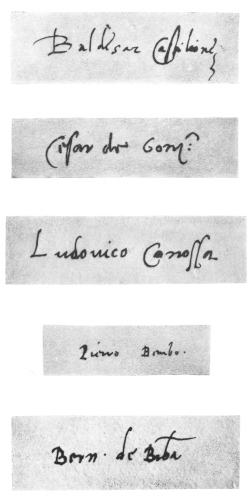
BALDESAR CASTIGLIONE
CESAR DE GONZAGA
LUDOVICO CANOSSA
PIETRO BEMBO
BERNARDO DE BIBBIENA
AUTOGRAPH SIGNATURES OF THE AUTHOR AND OF
FOUR OF HIS FRIENDS
From negatives, made by Premi and by Signor Lanzoni, from originals preserved in the Royal State Archives at Mantua and selected by the Director, Signor Alessandro Luzio.
“To have the favour of princes, then, there is no better way than to deserve it. And when we see another man who is pleasing to a prince for any reason, we must not think to reach the same height ourselves by imitating him, for all things are 97not proper to all men. Thus there will sometimes be found a man who by nature is so ready at jesting that whatever he may say carries laughter with it, and he seems to have been born solely for that; and if another man, who has a sober habit of mind (however excellently endowed) tries to do the like, it will fall so cold and flat as to disgust those who hear him, and he will prove exactly like that ass who tried to copy the dog by frolicking with their master.[164] Hence every man must understand himself and his own powers, and govern himself accordingly, and consider what things he ought to imitate, and what things he ought not.”
21.—Here Vincenzo Calmeta said:
“Before you go on, if I heard aright I think you said awhile ago that the best way to win favours is to deserve them, and that the Courtier ought to wait for them to be offered him rather than ask for them presumptuously. I greatly fear this rule is little to the purpose, and I think experience very clearly teaches us the contrary. For to-day very few are favoured by their lords, save the presumptuous; and I know you can give good testimony as to some, who on finding themselves in small favour with their princes, have made themselves acceptable solely by their presumption. While as for those who have risen through modesty, I for my part do not know any, and I even give you time to think about it and believe you will find few. And if you consider the court of France, which is to-day one of the noblest in Christendom, you will find that all men who have universal favour there are somewhat presumptuous, and not only towards one another but towards the king himself.”
“Now do not say that,” replied messer Federico; “for in France there are very modest and courteous gentlemen. It is true that they behave with a certain freedom and unceremonious familiarity, which are proper and natural to them; and therefore it ought not to be called presumption, because in this very manner of theirs, whilst they deride and make sport of the presumptuous, yet they rate highly those who seem to them to have worth and modesty.”
Calmeta replied:
“Look at the Spaniards, who it seems are our masters in 98Courtiership, and consider how many you will find who are not very presumptuous with ladies and with gentlemen; and even more so than the French, because at first sight they show the greatest modesty. And in this they are truly clever, for as I said, the princes of our time all favour only those who have such manners.”
22.—Then messer Federico replied:
“I will by no means suffer you, messer Vincenzo, to cast this reproach upon the princes of our time. For indeed there are also many who love modesty, which I do not however say alone suffices to make a man acceptable; but I do say that when united to high worth, it greatly honours its possessor. And although it be silent about itself, praiseworthy deeds speak aloud and are far more admirable than if they were accompanied by presumption and rashness. I will not indeed deny that there are many presumptuous Spaniards, but I say that those who are much esteemed are as a rule very modest.
“Again, there are also some men who are so reserved that they shun human company beyond reason, and so far exceed a certain limit of moderation that they come to be regarded as either too timid or too proud. For these I have no praise, nor would I have modesty so dry and arid as to become clownishness; but let the Courtier be fluent on occasion, and prudent and sagacious in discussing statecraft, and let him have the good sense to adapt himself to the customs of the nations where he finds himself; then in lesser matters let him be agreeable and speak well about everything.
“But above all, he should make for right; not envious, not evil-tongued: nor let him ever bring himself to seek grace or favour by foul ways or dishonourable means.”
Then Calmeta said:
“I assure you that all other ways are more uncertain and longer than this one which you censure. For to repeat, princes at the present day love only those who tread that path.”
“Say not so,” then replied messer Federico, “for that would be too clear an argument that the princes of our time are all vicious and wicked,—which is not true, since several good ones are to be found. But if our Courtier should chance to find himself 99in the service of one who is vicious and malign, let him depart as soon as he discovers it, lest he suffer that keen anguish which all good men feel who serve the wicked.”
“We must needs pray God,” replied Calmeta, “to send us good masters, for when we have them, we are forced to endure them such as they are; because an infinity of reasons constrain a gentleman not to leave the patron he has once begun to serve; but the misfortune consists in beginning to serve a bad patron, and Courtiers in this condition are like those unhappy birds that are hatched in a gloomy valley.”
“It seems to me,” said messer Federico, “that duty ought to outweigh all other reasons. And provided a gentleman does not leave his patron when at war or in adversity,—lest he be thought to have done so to better his fortunes or because he feared that he might lack opportunity for gain,—I think that at any other time he rightly may and ought to leave a service that is like to disgrace him before all good men; for everyone assumes that whoever serves the good is good, and that whoever serves the wicked is wicked.”
23.—Then my lord Ludovico Pio said:
“I should like to have you clear a doubt that is in my mind; that is, whether a gentleman in the service of a prince is bound to obey him in all things that he commands, even if they be dishonourable and infamous.”
“In dishonourable things we are not bound to obey any man,” replied messer Federico.
“And how,” returned my lord Ludovico, “if I am in the service of a prince who uses me well and trusts to my doing for him all that can be done, commanding me to go kill a man or do anything else you please,—ought I to refuse to do it?”
“You ought,” replied messer Federico, “to obey your lord in all things that are advantageous and honourable to him, not in those that bring him injury and disgrace. Therefore if he were to command you to commit an act of treachery, not only would you not be bound to do it, but you would be bound not to do it,—both for your own sake and for the sake of not being a minister to your lord’s disgrace. True it is that many things which are evil seem at first sight good, and many seem evil and yet are 100good. Hence in our lords’ service it is sometimes permitted to kill not one man but ten thousand, and to do many other things that would seem evil to a man who did not rightly consider them, and yet are not evil.”
Then my lord Gaspar Pallavicino replied:
“On your faith, I pray you discuss this a little, and teach us how the really good can be distinguished from that which only seems so.”
“Pardon me,” said messer Federico; “I am unwilling to enter upon that, for there would be too much to say; but let the whole matter be left to your own wisdom.”
24.—“At least clear another doubt for me,” returned my lord Gaspar.
“And what doubt?” said messer Federico.
“It is this,” replied my lord Gaspar. “I should like to know,—my lord having charged me exactly what I must do in an enterprise or any other business whatever, if I being engaged upon it think that my doing more or less or otherwise than I was charged, may make the affair turn out better and more advantageously for him who gave me the task,—whether I ought to govern myself by the original plan without exceeding the limits of my command, or on the contrary to do that which seems to me better.”
Then messer Federico replied:
“In this I should give you the precept and example of Manlius Torquatus (who in like case slew his son, from too stern a sense of duty), if I thought he deserved much credit, which I do not.[165] And yet I dare not blame him against the verdict of so many centuries. For without doubt it is a very perilous thing to deviate from our superiors’ commands, relying more on our own judgment than on theirs whom we ought in reason to obey; because if our expectation fails and the affair turns out ill, we run into the errour of disobedience and ruin that which we have to do, without any possibility of excuse or hope of pardon. On the other hand, if the affair turns out according to our wish, we must give the credit to fortune and be content at that. Moreover in this way a fashion is set of rating the commands of our superiors lightly; and following the example of one man who 101happened to succeed and who perhaps was prudent and had reasoned well and been aided by fortune too,—a thousand other ignorant featherheads will make bold to do as they please in the most important matters, and for the sake of showing that they are sagacious and have authority, to deviate from their masters’ commands; which is a very evil thing and often the cause of numberless mistakes.
“But I think that in such a case the man whom it concerns ought to consider carefully, and as it were to place in the balance the profit and advantage that he stands to win by acting contrary to orders, in case his design turns out according to his hopes; and on the other hand to weigh the evil and disadvantage that will accrue if the affair chances to turn out ill through his disobedience of orders. And if he finds the damage in case of failure to be greater and more serious than the gain in case of success, he ought to restrain himself and carry out his orders to the letter; while on the contrary if the gain in case of success is like to be more serious than the damage in case of failure, I think he may properly venture to do that which his reason and judgment dictate, and somewhat disregard the very letter of his orders,—so as to act like good merchants, who to gain much risk little, but never risk much to gain little.
“I strongly approve of the Courtier’s observing above all the character of the prince whom he serves, and of his governing himself accordingly: for if it be severe, as is the case with many, I should never advise anyone who was my friend to change one jot the order given him; lest that might befall him which is recorded as having befallen a master engineer of the Athenians, to whom Publius Crassus Mucianus,[166] when he was in Asia and wished to besiege a fortified place, sent to ask for one of two ship’s masts that he had seen at Athens, in order to make a ram wherewith to batter down the wall, and said he wished the larger one. Being very intelligent, the engineer knew that the larger mast was unsuitable for the purpose, and as the smaller one was easier to transport and better adapted for making the machine in question, he sent it to Mucianus. The latter, hearing how things had gone, sent for the poor engineer, asked why he had disobeyed his orders, and refusing to listen to any excuse 102from him, caused him to be stripped naked and so flogged and scourged with rods that he died, because it seemed to Mucianus that instead of obeying, the man had tried to offer advice. So we had best use great caution with these rigourous men.
25.—“But now let us leave this subject of intercourse with princes, and come to conversation with our equals or with those that are nearly so: for we must pay heed to this also, since it is universally more practised and a man more often finds himself engaged in it than in conversation with princes.
“There are however some simpletons, who, even in the company of the best friend they have in the world, on meeting a man who is better dressed, at once attach themselves to him, and then if they happen on one still better dressed, they do the like to him. And later, when the prince is passing through the squares or churches or other public places, they elbow their way past everyone until they reach his side: and even if they have naught to say to him, they still must talk, and go on babbling, and laugh and clap their hands and head, to show they have business of importance, so that the crowd may see them in favour. But since these fellows deign to speak only with their lords, I would not have us deign to speak of them.”
26.—Then the Magnifico Giuliano said:
“As you have mentioned those who are so fond of the company of well dressed men, I should like you to show us, messer Federico, in what manner the Courtier ought to dress, and what costume is suitable to him, and in what way he ought to govern himself in all matters of bodily adornment. For in this we find an infinite variety: some who dress after the French fashion, some after the Spanish, some who wish to appear German; nor is therethere lack of those who even dress after the style of Turks: some who wear their beards, some not. Hence in this medley it were well to know how to choose the best.”
Messer Federico said:
“Indeed I should not know how to give a precise rule about dress, except that a man ought to follow the custom of the majority; and since (as you say) this custom is so various, and the Italians are so fond of arraying themselves after foreign fashions, I think every man may dress as he pleases.
103“But I do not know by what fate it happens that Italy has not, as it was wont to have, a costume that should be recognized as Italian: for although the putting of these new fashions into use may have made the former ones seem very rude, yet the old ones were perhaps a badge of freedom, as the new ones have proved an augury of servitude, which I think is now very clearly fulfilled.[167] And as it is recorded that when Darius had the Persian sword which he wore at his side fashioned after the Macedonian style, the year before he fought with Alexander, this was interpreted by the soothsayers to signify that they into whose fashion Darius had transformed his Persian sword, should come to rule over Persia.[168] So our having changed our Italian garb for that of strangers seems to signify that all those for whose garb we have exchanged our own must come to conquer us: which has been but too true, for there is now left no nation that has not made us its prey: so that little more is left to prey upon, and yet they do not cease preying upon us.
27.—“But I do not wish to touch on painful subjects. Therefore it will be well to speak of our Courtier’s clothes; which I think, provided they be not out of the common or inappropriate to his profession, may do very well in other respects if only they satisfy him who wears them. True it is that I for my part should not like them to be extreme in any wise, as the French are sometimes wont to be in over amplitude, and the Germans in over scantiness,—but as they both are, only corrected and improved in form by the Italians. Moreover I always like them to tend a little towards the grave and sober rather than the gay. Thus I think black is more suitable for garments than any other colour is; and if it is not black, let it at least be somewhat dark. And this I say of ordinary attire, for there is no doubt that bright and cheerful colours are more suitable over armour, and for gala use also dress may be fringed, showy and magnificent; likewise on public occasions, such as festivals, shows, masquerades, and the like. For such garments carry with them a certain liveliness and gaiety that accord very well with arms and sports. But for the rest I would have our Courtier’s dress display that sobriety which the Spanish nation greatly affect, for things external often bear witness to the things within.”
104Then messer Cesare Gonzaga said:
“This would give me little concern, for if a gentleman is of worth in other things, his attire will never enhance or lessen his reputation.”
“You say truly,” replied messer Federico. “Yet what one of us is there, who, on seeing a gentleman pass by with a garment on his back quartered in divers colours, or with a mass of strings and knotted ribbons and cross lacings, does not take him for a fool or a buffoon?”
“Neither for a fool,” said messer Pietro Bembo, “nor for a buffoon would he be taken by anyone who had lived any time in Lombardy, for all men go about like that.”
“Then,” said my lady Duchess, laughing, “if all men go about like that, we must not cast it at them as a fault, since this attire is as fitting and proper to them as it is for the Venetians to wear puffed sleeves,[169] or for the Florentines to wear the hood.”
“I am not speaking,” said messer Federico, “more of Lombardy than of other places, for both the foolish and the wise are to be found in every nation. But to say what I think is important in attire, I wish that our Courtier may be neat and dainty throughout his dress, and have a certain air of modest elegance, yet not of a womanish or vain style. Nor would I have him more careful of one thing than of another, like many we see who take such pains with their hair that they forget the rest; others devote themselves to their teeth, others to their beard, others to their boots, others to their bonnets, others to their coifs;[170] and the result is that these few details of elegance seem borrowed by them, while all the rest, being very tasteless, is recognized as their own. And this kind of dress I would have our Courtier shun, by my advice; adding also that he ought to consider how he wishes to seem and of what sort he wishes to be esteemed, and to dress accordingly and contrive that his attire shall aid him to be so regarded even by those who neither hear him speak nor witness any act of his.”
28.—Then my lord Gaspar Pallavicino said:
“Methinks it is not fitting, or even customary among persons of worth, to judge men’s quality by their dress rather than by their words and acts; for many would make mistakes, nor is it 105without reason that we have the proverb, ‘dress makes not the monk.’”
“I do not say,” replied messer Federico, “that fixed opinions of men’s worth are to be formed only in this way, or that they are not better known by their words and acts than by their dress: but I do say that dress is no bad index of the wearer’s fancy, although it may be sometimes wrong; and not only this, but all ways and manners, as well as acts and words, are an indication of the qualities of the man in whom they are seen.”
“And what things do you find,” replied my lord Gaspar, “from which we may form an opinion, that are neither words nor acts?”
Then messer Federico said:
“You are too subtle a logician. But to tell you what I mean, there are some acts that still endure after they are performed, such as building, writing, and the like; others do not endure, such as those I have now in mind. In this sense, therefore, I do not say that walking, laughing, looking, and the like, are acts,—and yet all these outward things often give knowledge of those within. Tell me, did you not judge that friend of ours, of whom we were speaking only this morning, to be a light and frivolous man as soon as you saw him walking with that twist of his head, wriggling about, and with affable demeanour inviting the by-standers to doff their caps to him? So, too, when you see anyone gazing too intently with dull eyes after the manner of an idiot, or laughing as stupidly as those goitrous mutes in the mountains of Bergamo,[171]—do you not set him down a very simpleton, although he neither speak nor do aught else? Thus you see that these ways and manners (which I do not for the present regard as acts) in great measure make men known to us.
29.—“But another thing seems to me to give and to take away from reputation greatly, and this is our choice of the friends with whom we are to live in intimate relations; for doubtless reason requires that they who are joined in close amity and fast companionship, shall have their desires, souls, judgments and minds also in accord. Thus, he who consorts with the ignorant or wicked, is deemed ignorant or wicked; and on the contrary, he who consorts with the good, the wise, and the discreet, is himself 106deemed to be the like. Because by nature everything seems to join willingly with its like. Therefore I think we ought to use great care in beginning these friendships, for he who knows one of two close friends, at once imagines the other to be of the same quality.”
Then messer Pietro Bembo replied:
“I certainly think we ought to take great care to limit ourselves to friends of like mind with us, as you say, not only because of the gain or loss of reputation, but because there are to-day very few true friends to be found, nor do I believe that the world any longer contains a Pylades and Orestes, a Theseus and Pirithous, or a Scipio and Lælius.[172] On the contrary, by some fatality it happens every day that two friends, who have lived in very cordial love for many years, yet in some way cheat each other at last, either through malice, or jealousy, or fickleness, or some other evil cause: and each gives the other the blame which perhaps both deserve.
“Therefore, since it has more than once happened to me to be deceived by him whom I most loved above every other person, and by whom I was sure I was loved,—I have sometimes thought to myself that it would be well for us never to trust anyone in the world, nor so to give ourselves up to any friend (however dear and loved he be) as to reveal all our thoughts to him, as we should to ourselves; for there are so many dark corners and recesses in our minds that it is impossible for human wit to penetrate the deceptions they conceal. Hence I think it were well to love and serve one more than another according to merit and worth; yet never to be so sure of friendship’s sweet enticement, that we at last have cause to rue our trust.”
30.—Then messer Federico said:
“Verily the loss would be far greater than the gain, if human intercourse were to be deprived of that highest pitch of friendship which in my opinion gives us all the good our life has in it; and therefore I will in no wise admit that what you say is reasonable, nay rather I venture to assert, and for the clearest reasons, that without this perfect friendship men would be far unhappier than all other creatures. And if some profanely stain this sacred name of friendship, we ought not on that account to uproot it from our 107hearts, and for the guilt of the wicked deprive the good of such felicity. And for my part I think there are here among us more than one pair of friends, whose love is steadfast and without deceit and lasting unto death with like desires, no less than if they were those ancients whom you mentioned awhile ago; and it happens thus when a man chooses a friend, not only from heaven-born impulse, but like himself in character. And in all this I am speaking of the good and virtuous, for the friendship of the wicked is not friendship.
“I am well pleased that so close a tie as this should not join or bind more than two, for otherwise perhaps it would be dangerous; because, as you know, it is harder to attune three musical instruments together, than two. Therefore, I would that our Courtier might have one special and hearty friend, if possible, of the kind we have described; then that he might love, honour and respect all others according to their worth and merits, and always contrive to consort more with such as are in high esteem and noble and of known virtue, than with the ignoble and those of little worth; in such wise that he may be loved and honoured by them also. And he will accomplish this if he be courteous, kind, generous, affable and mild with others, zealous and active to serve and guard his friends’ welfare and honour both absent and present, enduring such of their natural defects as are endurable, without breaking with them for slight cause, and correcting in himself those that are kindly pointed out; never thrusting himself before others to reach the first and most honoured places; nor acting like some, who seem to despise the world and insist with a kind of tiresome preciseness on laying down the law for everyone, and who, besides being unseasonably contentious in every little thing, censure that which they do not do themselves, and are always seeking occasion for complaint against their friends,—which is a very odious thing.”
31.—Messer Federico pausing here, my lord Gaspar Pallavicino said:
“I should like to have you speak a little more in detail than you do about this matter of converse with our friends; for in truth you keep much to generalities, and show us things in passing, as it were.”
108“How ‘in passing’?” replied messer Federico. “Perhaps you would have me tell the very words that you must use? Do you not think we have talked enough about this?”
“Enough I think,” replied my lord Gaspar. “Yet I should like to hear a few more details about the manner of intercourse with men and women; for the thing seems to me of great importance, seeing that most of our time at courts is given to it; and if it were always the same, it would soon become tedious.”
“I think,” replied messer Federico, “we have given the Courtier knowledge of so many things, that he can easily vary his conversation and adapt himself to the quality of the persons with whom he has to do, presupposing he has good sense and governs himself by it, and sometimes turns to grave matters and sometimes to festivals and games, according to the occasion.”
“And what games?” said my lord Gaspar.
Then messer Federico replied, laughing:
“Let us ask advice of Fra Serafino, who invents new ones every day.”
“Jesting apart,” answered my lord Gaspar, “do you think it would be a vice in the Courtier to play at cards and dice?”
“Not I,” said messer Federico, “unless he did so too constantly and neglected more important matters for them, or indeed unless he played for nothing else but to win money, and cheated the company, and showed such grief and vexation at losing as to argue himself a miser.”
“And what,” replied my lord Gaspar, “do you say of the game of chess?”
“It is certainly a pleasant and ingenious amusement,” said messer Federico. “But I think there is one defect in it. And that is, there is too much to know, so that whoever would excel in the game of chess must spend much time on it, methinks, and give it as much study as if he would learn some noble science or do anything else of importance you please; and yet in the end with all his pains he has learned nothing but a game. Therefore I think a very unusual thing is true of it, namely that mediocrity is more praiseworthy than excellence.”
My lord Gaspar replied:
109“Many Spaniards excel in this and divers other games, yet without giving them much study or neglecting other things.”
“Believe me,” replied messer Federico, “they do give much study thereto, although covertly. But those other games you speak of, besides chess, are perhaps like many I have seen played (although of little moment), which serve only to make the vulgar marvel; wherefore methinks they deserve no other praise or reward than that which Alexander the Great gave the fellow who at a good distance impaled chick-peas on the point of a needle.[173]
32.—“But since it appears that fortune exerts immense power over men’s opinions as over many other things, we sometimes see that a gentleman, however well conditioned he may be and endowed with many graces, is unacceptable to a prince, and goes against the grain as we say;[174] and this without any apparent reason, so that as soon as he comes into the prince’s presence and before he is known by the others, although he be keen and ready with retorts, and display himself to advantage in gestures, manners, words, and all else that is becoming,—the prince will show small esteem for him, nay will soon put some affront upon him. And thus it will come about that the others will follow the prince’s lead, and everyone will regard the man as of little worth, nor will there be any to prize or esteem him, or laugh at his amusing talk or hold him in any respect; nay, all will begin to deride and persecute him. Nor will it be enough for the poor man to make good retorts or take things as if said in jest, for the very pages will set upon him, so that even if he were the sturdiest man in the world, he must perforce remain foiled and ridiculed.
“And on the other hand, if the prince shows favour to a very dolt, who knows neither how to speak nor how to act,—his manners and ways (however silly and uncouth they be) will often be praised by everyone with exclamations and astonishment, and the whole court will seem to admire and respect him, and everyone will appear to laugh at his jests and at certain rustic and stupid jokes that ought to excite rather disgust than laughter: to such degree are men firm and fixed in the opinions that are engendered by the favour and disfavour of lords.
110“Therefore I would have our Courtier set off his worth as best he can, with cleverness and skill, and whenever he has to go where he is strange and unknown, let him take care that good opinion of him precedes him, and see to it that men there shall know of his being highly rated in other places, among other lords, ladies and gentlemen; for that fame which seems to spring from many judgments, begets a kind of firm belief in a man’s worth, which, in minds thus disposed and prepared, is then easily maintained and increased by his conduct: moreover he escapes that annoyance which I feel when asked who I am and what my name is.”
33.—“I do not see how this can help,” replied messer Bernardo Bibbiena; “for it has several times happened to me, and I think to many others, that having been led by the word of persons of judgment to imagine something to be of great excellence before I saw it,—on seeing it I found it paltry and was much disappointed of what I expected. And the reason was simply that I had put too much trust in report and formed in my mind so high an expectation, that although the real thing was great and excellent, yet when afterwards measured by the fact, it seemed very paltry by comparison with what I had imagined. And I fear it may be so with our Courtier too. Therefore I do not see the advantage of raising such expectations and sending our fame before us; for the mind often imagines things that it is impossible to fulfil, and thus we lose more than we gain.”
Here messer Federico said:
“The things that you and many others find inferior to their reputation, are for the most part of such sort that the eye can judge of them at a glance,—as if you had never been at Naples or Rome, and from hearing them so much talked of, you were to imagine something far beyond what they afterwards proved to be when seen; but such is not the case with men’s character, because that which is outwardly seen is the least part. Thus, on first hearing a gentleman speak, if you should not find in him that worth which you had previously imagined, you would not at once reverse your good opinion of him, as you would in those matters whereof the eye is instant judge, but you would wait from day to day to discover some other hidden virtue, still holding 111fast to the good impression you had received from so many lips; and later, if he were thus richly endowed (as I assume our Courtier to be), your confidence in his reputation would be hourly confirmed, because his acts would justify it, and you would be always imagining something more than you saw.
34.—“And surely it cannot be denied that these first impressions have very great weight, and that we ought to be very careful regarding them. And to the end that you may see how important they are, I tell you that in my time I knew a gentleman, who, while he was of very gentle aspect and modest manners and also valiant in arms, yet did not so greatly excel in any of these things but that he had many equals and even superiors. However, fate so willed that a lady chanced to fall most ardently in love with him, and her love increasing daily with the signs that the young man gave of loving her in return, and there being no way for them to speak together, she was moved by excess of passion to reveal her desires to another lady through whom she hoped to secure some assistance. This lady was in no wise inferior to the first in rank or beauty; whence it came to pass, that on hearing the young man (whom she had never seen) spoken of so tenderly, and perceiving that he was extravagantly loved by her friend (whom she knew to be very discreet and of excellent judgment), she straightway imagined him to be the handsomest and wisest and most discreet and in short the most lovable man in the world. And thus, without having seen him, she became so passionately enamoured of him, that she began making every effort to secure him, not for her friend but for herself, and inducing him to return her love: which she succeeded in doing with little effort, for in truth she was a lady rather to be wooed than to woo others.
“Now hear the end of my tale. Not long afterwards it happened that a letter, which this second lady had written to her lover, fell into the hands of still another lady, also very noble and of good character and rarest beauty,—who, being like most ladies curious and eager to learn secrets and especially other ladies’, opened this letter, and on reading it saw that it was written with the fervour of ardent love. And the sweet, impassioned words that she read first moved her to compassion 112for that lady, for she well knew from whom the letter came and to whom it was going; then they gained such power, that as she turned them over in her mind and considered what sort of man he must be who could arouse such love in the lady, she too straightway fell in love with him; and the letter had perhaps a greater effect than if it had been sent by the young man to her. And as it sometimes happens that a poisoned dish, intended for a prince, kills the first comer who tastes it, so in her over greediness this poor lady drank the love poison that had been prepared for another.
“What more shall I say? The affair became well known, and spread abroad so that many other ladies besides these, partly to spite the others and partly to imitate them, used every effort and pains to possess themselves of the man’s love, and contended for it with one another as boys contend for cherries. And all this began with the first impression of that lady who saw him so beloved by another.”
35.—Here my lord Gaspar Pallavicino replied, laughing:
“To give reasons in support of your opinion, you cite the doings of women, who for the most part are quite unreasonable. And if you cared to tell the whole truth, this favourite of so many women must have been a dunce and at bottom a man of little worth. For their way is always to favour the meanest, and like sheep to do what they see others doing, whether it be good or evil. Moreover they are so jealous among themselves, that even if the man had been a monster, they would have tried to steal him from one another.”
Here many began to speak, and nearly everyone wanted to contradict my lord Gaspar; but my lady Duchess imposed silence on all, and then said, laughing:
“If the evil you say of women were not so far from the truth, that the saying of it casts blame and shame on him who says it rather than on them, I should allow you to be answered. But I am not willing that, by being confronted with the arguments which it is possible to cite, you should be cured of this evil habit, in order that you may suffer very grievous punishment for your fault: which shall be the bad opinion wherein you will be held by all who hear you argue in such fashion.”
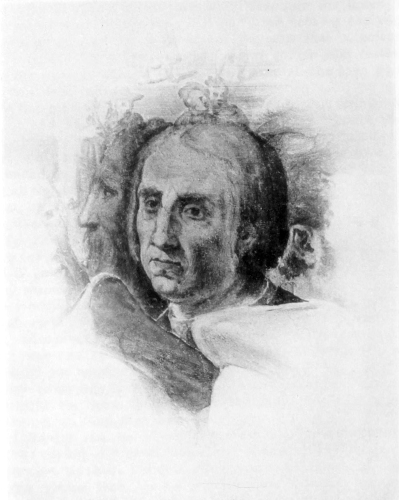
GIACOPO SANNAZARO 1458-1530
Head enlarged from a photograph, specially made by Alinari, of a part of the fresco, “Leo X’s Entry into Florence,” in the Palazzo Vecchio at Florence, by Giorgio Vasari (1511-1574). See Milanesi’s edition of Vasari’s Opere, viii, 142.
113Then messer Federico replied:
“My lord Gaspar, do not say that women are so very unreasonable, even if they are sometimes moved to love by others’ judgment rather than by their own; for gentlemen and many wise men do the same. And if I may say the truth, you yourself and all the rest of us here do often and even now trust more to the opinion of others than to our own. And in proof of this, it is not long ago that certain verses, handed about this court under the name of Sannazaro,[175] seemed very excellent to everyone and were praised with wonder and applause; then, it being known for certain that they were by another hand, they promptly sank in reputation and were thought less than mediocre. And a certain motet,[176] which was sung before my lady Duchess, found no favour and was not thought good until it was known to be the work of Josquin de Près.[177]
“What clearer proof of the weight of opinion would you have? Do you not remember that in drinking a certain wine, you at one time pronounced it perfect, and at another most insipid? And this because you believed there were two kinds of wine, one from the Genoese Riviera, and the other from this country; and even when the mistake was discovered, you would not at all believe it,—so firmly fixed in your mind was that wrong opinion, although you had received it from the report of others.