THE SECOND BOOK OF THE COURTIER BY COUNT BALDESAR CASTIGLIONE (continued 2)
Leonard Eckstein Opdycke translation
36.—“Hence the Courtier ought to take great care to make a good impression at the start, and to consider how mischievous and fatal a thing it is to do otherwise. And they of all men run this danger, who pride themselves on being very amusing and on having acquired by these pleasantries of theirs a certain freedom that makes it proper and permissible for them to do and say whatever occurs to them, without taking thought about it. Thus they often begin a thing they know not how to finish, and then try to help matters by raising a laugh; and yet they do this so clumsily that it does not succeed, insomuch that they rouse the utmost disgust in him who sees or hears them, and fail most lamentably.
“Sometimes, thinking it to be droll and witty, they say the foulest and most indecent things before and even to honourable ladies; and the more they make these ladies blush, the more 114they rate themselves good Courtiers, and they laugh and pride themselves on having such a fine accomplishment, as they deem it. Yet they commit all this folly with no other aim than to be esteemed jovial fellows: this is the one name which seems to them worthy of praise and of which they boast more than of any other; and to acquire it, they utter the grossest and most shameful vileness in the world. Often they throw one another down-stairs, clap billets of wood and bricks on one another’s backs, cast handfulls of dust in one another’s eyes, make one another’s horses run into ditches or down some hill; then at table they throw soups, sauces, jellies and every kind of thing in one another’s faces:[178] and then they laugh. And he who can excel the others in these things, esteems himself to be the best Courtier and the most gallant, and thinks he has won great glory. And if they sometimes invite a gentleman to these carouses of theirs, and he does not choose to join in their unmannerly jokes, they at once say he stands too much on his dignity, and holds himself aloof, and is not a jovial fellow. But I have worse to tell you. There are some who rival one another and award the palm to him who can eat and drink the vilest and most offensive things; and they devise dishes so abhorrent to human sense that it is impossible to recall them without extreme disgust.”
37.—“And what may these be?” said my lord Ludovico Pio.
Messer Federico replied:
“Ask the Marquess Febus, who has often seen them in France, and perhaps has taken part.”
The Marquess Febus replied:
“I have seen none of these things done in France that are not done in Italy as well. But what is good among the Italians in dress, sports, banquets, handling arms, and in everything else that befits a Courtier,—all comes from the French.”
Messer Federico replied:
“I do not say that very noble and modest cavaliers are not also to be found among the French, and I myself have known many who were truly worthy of every praise. But some are little circumspect, and generally speaking it seems to me that as regards breeding the Spaniards have more in common with the 115Italians than the French have; because that grave reserve peculiar to the Spaniards befits us far more than the quick vivacity which among the French we see in almost every movement, and which is not unseemly in them, nay is charming, for it is so natural and proper to them as not to seem at all affected. There are very many Italians who earnestly strive to copy this manner; and they can only shake their heads in speaking and make clumsy crosswise bows, and walk so fast that their lackeys cannot keep up with them when they pass through the city. And with these ways they seem to themselves to be good Frenchmen and to have the same freedom of manner, which in truth rarely happens save with those who have been bred in France and have acquired the manner in their youth.
“The same is true of knowing many languages; which I approve highly in the Courtier, especially Spanish and French, because the intercourse of both these nations with Italy is very frequent, and they have more in common with us than any of the others have; and their two princes,[179] being very powerful in war and very glorious in peace, always have their courts full of noble cavaliers, who spread throughout the world; and it is necessary for us also to converse with them.
38.—“I do not care at present to go more into detail in speaking of things that are too well known, such as that our Courtier ought not to avow himself a great eater or drinker, or given to excess in any evil habit, or vile and ungoverned in his life, with certain peasant ways that recall the hoe and plough a thousand miles away; because a man of this kind not only may not hope to become a good Courtier, but can be set to no more fitting business than feeding sheep.
“And finally I say it were well for the Courtier to know perfectly that which we have said befits him, so that every possible thing may be easy to him, and everyone may marvel at him,—he at no one. But be it understood that there ought not to be in him that lofty and ungenial indifference which some men have who show they are not surprised at what others do because they imagine they can do it better, and who disparage it by silence as not worth speaking of; and they almost seem to imply that no one is their equal or even able to fathom the profundity 116of their knowledge. Wherefore the Courtier ought to shun these odious ways, and to praise the fine achievements of other men with kindness and good will; and although he may feel that he is admirable and far superior to all, yet he ought to appear not to think so.
“But since such complete perfection as this is very rarely and perhaps never found in human nature, a man who is conscious of being lacking in some particular, ought not to despond thereat or lose hope of reaching a high standard, even though he cannot attain that perfect and supreme excellence to which he aspires. For in every art there are many grades that are honourable besides the highest, and whoever aims at the highest will seldom fail to rise more than half-way. Therefore if our Courtier excels in anything besides arms, I would have him get profit and esteem from it in fine fashion; and I would have him so discreet and sensible as to be able with skill and address to attract men to see and hear that wherein he thinks he excels, always appearing not to do it from ostentation, but by chance and at others’ request rather than by his own wish. And in everything he has to do or say, let him if possible come ready and prepared, yet appearing to act impromptu throughout. In those things, however, wherein he feels himself to be mediocre, let him touch in passing, without dwelling much upon them, albeit in such fashion that he may be thought to know more about them than he shows himself to know: like certain poets, who sometimes touched lightly upon the profoundest depths of philosophy and other sciences, of which perhaps they understood little. Then, in that of which he knows he is wholly ignorant, I would never have him make any pretence or seek to win any fame; nay if need be, let him frankly confess his ignorance.”
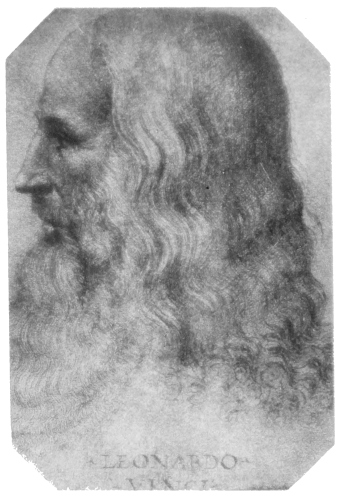
LEONARDO DA VINCI “...ONE OF THE FIRST PAINTERS OF THE WORLD...” 1452-1519
Reduced from Braun’s photograph (no. 79.207) of Leonardo’s drawing in the Royal Library at Windsor. For an account of this and other less authentic portraits, see Müntz’s life of Leonardo da Vinci (London: 1898), ii, 225 et seq.
39.—“That,” said Calmeta, “is not what Nicoletto[180] would have done, who was a very excellent philosopher but knew no more about law than about flying. When a Podestà[181] of Padua had decided to give him a lectureship in law, he was never willing (although urged thereto by many scholars) to undeceive the Podestà and confess his ignorance,—always saying that he did not agree with the opinion of Socrates in this matter, and that it was not seemly for a philosopher ever to say that he was ignorant of anything.”
117Messer Federico replied:
“I do not say that of his own notion and unasked by others, the Courtier should volunteer to tell his ignorance; for I too dislike this folly of self-accusal and depreciation. And therefore I sometimes inwardly laugh at certain men, who needlessly and of their own accord narrate things that perhaps occurred without their fault but yet imply a shade of disgrace; like a cavalier whom you all know, and who, whenever he heard mention made of the battle that was fought against King Charles in the Parmesan,[182] at once began to tell the manner of his flight, nor seemed to have seen or heard aught else that day; again, speaking of a certain famous joust, he always described how he had fallen, and in his conversation he often seemed to seek an opportunity to tell how he had received a sound cudgelling one night as he was on his way to meet a lady.
“I would not have our Courtier tell such follies. It seems to me, however, that when occasion offers for displaying himself in something of which he is quite ignorant, he ought to avoid it; and if compelled by necessity, he ought to confess his ignorance frankly rather than put himself to that risk. And in this way he will escape the censure that many nowadays deserve, who from some perverse instinct or unreasonable design always set themselves to do that which they do not know, and forsake that which they do know. And as an instance of this, I know a very excellent musician, who, having abandoned music, gave himself up wholly to composing verses, and thinks himself very great therein, and makes all men laugh at him; and now he has lost even his music.
“Another man, one of the first painters of the world, despises the art wherein he is most rare, and has set himself to study philosophy; in which he has such strange conceptions and new chimeras, that he could not with all his painter’s art depict them.[183] And of such as these, a countless number could be found.
“Some indeed there are who know they excel in one thing and yet make their chief business of another, of which they are not ignorant either; but every time they have occasion to display themselves in that wherein they feel themselves proficient, they do it gallantly. And it sometimes comes to pass that the company, 118seeing them do well in that which is not their profession, think they can do far better in that which they make their profession. This art, if it be accompanied by good judgment, is by no means unpleasing to me.”
40.—Then my lord Gaspar Pallavicino replied:
“This seems to me not art but mere deceit; nor do I think it fitting for him who would be a man of honour, ever to deceive.”
“It is an embellishment, which graces what he does,” said messer Federico, “rather than deceit; and even if it be deceit, it is not to be censured. Will you not also say that of two men fencing, the one who touches the other, deceives him? And this is because the one has more art than the other. And if you have a jewel that is beautiful without setting, and it afterwards comes into the hands of a good goldsmith, who by skilful setting makes it look far more beautiful, will you not say that this goldsmith deceives the eyes of anyone who sees it? And yet he deserves praise for his deceit, for with good judgment and art his master hand often adds grace and beauty to ivory or silver, or to a beautiful stone by encircling it with fine gold. Therefore let us not say that art,—or such deceit as this, if you will call it so,—deserves any censure.
“Nor is it unseemly for a man who is conscious of doing something well, dexterously to seek occasion for showing himself therein, and at the same time to conceal what he thinks undeserving of praise,—but always with a touch of wary dissimulation. Do you not remember that without appearing to seek them, King Ferdinand[32] found opportunities now and then to go about in his doublet? and this because he felt himself to be very agile; and that, as his hands were not over good, he rarely or almost never took off his gloves? And there were very few that perceived his cunning. Moreover I think I have read that Julius Cæsar liked to wear the laurel wreath to hide his baldness.[184] But in all these matters it is needful to be very cautious and to use good judgment, in order not to go beyond bounds; for in avoiding one errour a man often runs into another, and in his wish to win praise, receives censure.
41.—“Hence in our mode of life and conversation, it is a very 119safe thing to govern ourselves with a certain decorous discretion, which in truth is a very great and very strong shield against envy, which we ought to avoid as much as possible. Moreover I wish our Courtier to guard against getting the name of a liar or a boaster, which sometimes befalls even those who do not deserve it. Therefore in his talk let him always take care not to go beyond the probable, and also not to tell too often those truths that have the look of falsehood,[185]—like many who never speak save of miracles, and wish to carry such authority that every incredible thing shall be believed from them. Others, at the beginning of a friendship and in order to gain favour with their new friend, swear the first day they speak with him that there is no one in the world whom they love more than him, and that they would gladly die to do him service, and like things beyond reason. And when they part from him, they pretend to weep and to be unable to speak a word from grief. Thus, in their wish to be thought very loving, they come to be esteemed liars and silly flatterers.
“But it would be too long and tedious to recount all the faults that may be committed in our manner of conversation. Hence as regards what I desire in the Courtier, let it suffice to say, besides the things already said, that he should be of such sort as never to be without something to say that is good and well suited to those with whom he is speaking, and that he should know how to refresh the minds of his hearers with a certain sweetness, and by his amusing witticisms and pleasantries to move them cleverly to mirth and laughter, so that without ever becoming tedious or producing satiety, he may give pleasure continually.
42.—“At last I think my lady Emilia will give me leave to be silent. And if she refuse me, I shall by my own talk stand convicted of not being the good Courtier whereof I have spoken for not only does good talk (which perhaps you have neither now nor ever heard from me), but even such talk as I usually have at command (whatever that may be worth), quite fail me.”
Then my lord Prefect said, laughing:
“I am not willing to let this false opinion,—that you are not a most admirable Courtier,—rest in the mind of any of us; for it is 120certain that your desire to be silent proceeds rather from a wish to escape labour than from lack of something to say. So, to the end that nothing may seem to be neglected in such worthy company as this and such admirable talk, be pleased to teach us how we must employ the pleasantries that you have just mentioned, and to show us the art that pertains to all this kind of amusing talk, so as to excite laughter and mirth in gentle fashion; for indeed methinks it is very important and well befitting the Courtier.”
“My Lord,” replied messer Federico, “pleasantries and witticisms are the gift and grace of nature rather than of art; but in this matter certain nations are to be found more ready than others, like the Tuscans, who in truth are very clever. It seems to me that the use of witticism is very natural to the Spaniards too. Yet there are many, both of these and of all other nations, who from over loquacity sometimes go beyond bounds and become silly and pointless, because they do not consider the kind of person with whom they are speaking, the place where they are, the occasion, or the soberness and modesty which they ought above all things to maintain.”
43.—Then my lord Prefect replied:
“You deny that there is any art in pleasantries, and yet by speaking ill of those who use them not with modesty and soberness and who regard not the occasion and the persons with whom they are speaking, methinks you show that even this can be taught and has some method in it.”
“These rules, my Lord,” replied messer Federico, “are so universal that they fit and apply to everything. But I said there is no art in pleasantries, because I think there are only two kinds of them to be found: one of which stretches out in long and continuous talk, as we see in the case of certain men who narrate and describe so gracefully and amusingly something that has happened to them or that they have seen or heard, that they set it before our eyes with gestures and words and almost make us touch it with the hand; and for lack of other word, we may perhaps call this the humourous or urbane manner. The other kind of witticism is very short, and consists solely in sayings that are quick and sharp, such as are 121often heard among us, or biting; nor are they acceptable unless they sting a little. By the ancients also they were called apothegms: at present some call them arguzie.[186]
“So I say that in the first kind, which is humourous narrative, there is no need of any art, because nature herself creates and fashions men fitted to narrate amusingly, and gives them features, gestures, voice and words proper to imitate what they will. In the other kind, that of arguzie, what can art avail? For whatever it be, a pungent saying must dart forth and hit the mark before he who utters it shall seem to have given it a thought; otherwise it is flat and has no savour. Therefore I think it is all the work of intellect and nature.”
Then messer Pietro Bembo took up the talk, and said:
“My lord Prefect does not deny what you say, that nature and intellect play the chief part, especially as regards conception. Still it is certain that every man’s mind, however fine his intellect may be, conceives both good things and bad, and more or less; yet judgment and art then polish and correct them, and cull out the good and reject the bad. So lay aside what pertains to intellect, and explain to us what consists in art; that is, of the pleasantries and witticisms that excite laughter, tell us what are befitting the Courtier and what are not, and in what time and way they should be used; for this is what my lord Prefect asks of you.”
44.—Then messer Federico said laughingly:
“There is no one of us here to whom I do not yield in everything, and especially in being jocular; unless perhaps nonsense, which often makes others laugh more than bright sayings, be also counted as pleasantry.” And then turning to Count Ludovico and to messer Bernardo Bibbiena, he said: “Here are the masters of witticism, from whom I must first learn what to say if I am to speak of jocose sayings.”[187]
Count Ludovico replied:
“Methinks you are already beginning to practise what you say you know nothing of, I mean in that you try to make these gentlemen laugh by ridiculing messer Bernardo and me; for every one of them knows you far excel us in that for which you praise us. If you are fatigued, then, you had better beg my lady 122Duchess to postpone the rest of our talk until to-morrow, instead of trying to escape fatigue by subterfuge.”
Messer Federico began to make answer, but my lady Emilia quickly interrupted him and said:
“It is not in order for the discussion to spend itself in your praises; it is enough that you are all well known. But as I remember, Sir Count, that you accused me last evening of not distributing the labour equally, it were well to let messer Federico rest awhile, and to give messer Bernardo Bibbiena the task of speaking about pleasantries, because we not only know him to be very amusing in continuous talk, but we remember that he has several times promised us to try to write upon this subject, and hence we may believe that he has already thought much about it, and therefore ought to satisfy us fully. Afterwards, when we have finished discussing pleasantries, messer Federico shall go on with what he has left to say about the Courtier.”
Thereupon messer Federico said:
“My Lady, I do not know what I have left to say; but like the wayfarer at noon, weary with the fatigue of his long journey, I will refresh myself with messer Bernardo’s talk and the sound of his words, as if under some delightful and shady tree, with the soft murmur of a plashing spring. Then perhaps, being revived a little, I shall be able to say something more.”
Messer Bernardo replied, laughing:
“If I show you my head, you shall see what shade is to be expected from the leafage of my tree.[188] As for listening to the murmur of that plashing spring, perhaps you may; for I was once turned into a spring, not by any of the ancient gods but by our friend Fra Mariano,[60] and I have never stood in need of water from then till now.”
Then everyone began to laugh, for this pleasantry referred to by messer Bernardo happened at Rome in the presence of Cardinal Galeotto of San Pietro ad Vincula,[189] and was well known to all.
45.—The laughter having ceased, my lady Emilia said:
“Now stop making us laugh by your use of pleasantries, and teach us how we are to use them, and from what they are 123derived, and all you know about the subject. And to lose no more time, begin at once.”

BERNARDO DOVIZI DA BIBBIENA 1470-1520
Reduced from Braun’s photograph (no. 42.158) of the portrait, in the Pitti Gallery at Florence, long attributed to Raphael (1483-1520), but regarded by Morelli as the work of a pupil.
“I fear,” said messer Bernardo, “that the hour is late; and to the end that my talk about pleasantries may not itself lack pleasantry and be tedious, perhaps it will be well to postpone it until to-morrow.”
Here many replied together that it was still far from the usual hour for ending the discussion. Then, turning to my lady Duchess and to my lady Emilia, messer Bernardo said:
“I do not wish to escape this task; although, just as I am wont to marvel at the presumption of those who venture to sing to the viol before our friend Giacomo Sansecondo,[190] so I ought not to talk about pleasantries before an audience who understand what I should say far better than I.
“However, not to give any of these gentlemen a pretext for refusing the charge that may be laid upon them, I will tell as briefly as I can what occurs to me concerning the causes that excite laughter; which is so peculiar to us that in defining man we are wont to say that he is a laughing animal. For laughter is found only among men, and is nearly always the sign of a certain hilarity felt inwardly in the mind, which is by nature drawn towards amusement and longs for repose and recreation; wherefore we see many things devised by men to this end, such as festivals and different kinds of shows. And since we love those who furnish us this recreation, it was the custom of ancient rulers (Roman, Athenian and many others), in order to gain the people’s good will and to feast the eyes and minds of the multitude, to erect great theatres and other public edifices, and therein to exhibit new sports, horse and chariot races, combats, strange beasts, comedies, tragedies and mimes. Nor were such shows eschewed by grave philosophers, who in sports of this kind and banquets often relaxed their minds when fatigued by lofty discourse and spiritual meditation; which thing all kinds of men also like to do: for not only toilers in the field, sailors, and all those who perform hard and rough labour with their hands, but holy priests, and prisoners awaiting death from hour to hour, all seek continually some remedy and solace for their refreshment. Hence everything that moves to laughter, cheers 124the mind and gives pleasure, and for the moment frees us from the memory of those weary troubles of which our life is full. So laughter, as you see, is very delightful to all, and greatly to be praised is he who excites it reasonably and in a graceful way.
“But what laughter is, and where it abides, and how it sometimes seizes upon our veins, eyes, mouths and sides, and seems as if it would make us burst, so that with all our effort it cannot be restrained,—I will leave Democritus to tell, who could not even if he were to promise.[191]
46.—“Now the occasion and as it were the source from which the laughable springs, lies in a kind of distortion; for we laugh only at those things that have incongruity in them and that seem amiss without being so. I know not how to explain it otherwise; but if you think of it yourselves, you will see that what we laugh at is nearly always something that is incongruous and yet is not amiss.
“Next I will try to tell you, as far as my judgment shall show me, what the means are that the Courtier ought to use for the purpose of exciting laughter, and within what bounds; because it is not seemly for the Courtier to be always making men laugh, nor yet by those means that are made use of by fools or drunken men, by the silly, the nonsensical, and likewise by buffoons. And although these kinds of men seem to be in demand at courts, yet they deserve not to be called Courtiers, but each by his own name, and to be held for what they are.
“Moreover we must diligently consider the bounds and limits of exciting laughter by derision, and who it is we deride; for laughter is not aroused by jeering at a poor unfortunate nor yet at an open rascal and blackguard, because the latter seems to merit greater punishment than that of being ridiculed, and the mind of man is not prone to flout the wretched, unless they boast of their wretchedness and are proud and saucy. We ought also to treat with respect those who are universal favourites and beloved by all and powerful, for by jeering at these persons a man may sometimes bring dangerous enmities upon himself. Yet it is proper to flout and laugh at the vices of those who are neither so wretched as to excite pity, nor so wicked as to seem worthy 125of capital punishment, nor so great that a touch of their wrath can do much harm.
47.—“Again, you must know that from the same occasion whence we draw our laughable witticisms, we may likewise draw serious phrases of praise or censure, and sometimes by using the same words. Thus in praising a generous man who shares all he has with his friends, we are wont to say that what he has is not his own; the same may be said in censuring a man who has stolen or by other evil means acquired what he possesses. Also we say, ‘That lady is of great price,’ meaning to praise her for discretion and goodness; the same thing might be said in dispraise of her, implying that anyone may have her.
“But for this purpose we have a chance to use the same situations oftener than the same words. Thus recently a lady being at mass in church with three cavaliers, one of whom served her in love,[192] a poor beggar came up and taking his stand before the lady began to beg alms of her; and he repeated his petition several times to her with much importunity and pitiful groaning; yet for all that she gave him no alms, nor still did she refuse it to him with a sign to go in peace, but continued to stand abstracted as if she were thinking of something else. Then the cavalier in love said to his two companions:
“‘You see what I have to expect from my lady, who is so hard-hearted that she not only gives no alms to that naked starving wretch who is begging it of her so eagerly and often, but she will not even send him away. So much does she delight to see a man languishing in misery before her and vainly imploring her pity.’
“One of his two friends replied:
“‘This is not hardness of heart, but a silent lesson from the lady to teach you that she is never pleased with an importunate suitor.’
“The other replied:
“‘Nay, it is a warning to him that while she never grants what is asked of her, still she likes to be entreated for it.’
“You see how the lady’s failure to send the poor man away, gave rise to one saying of grave censure, one of moderate praise, and another of biting satire.
12648.—“Proceeding now to declare the kinds of pleasantries that are pertinent to our subject, I say that in my opinion there are three varieties, although messer Federico mentioned only two: namely, that which consists in rendering the effect of a thing by means of urbane and amusing long narrative, and that which consists in the swift and keen readiness of a single phrase. But we will add a third sort called practical joking, in which long narratives and short sayings have place, and also some action.
“Now the first, which consists in continuous talk, is of such sort as almost to amount to story-telling. And to give you an instance: just at the time when Pope Alexander the Sixth died and Pius the Third was created pope,[193] your fellow Mantuan, my lady Duchess, messer Antonio Agnello,[194] being at Rome and in the palace, happened to speak of the death of the one pope and of the other’s creation, and in discussing this with some of his friends, he said:
“‘My Lords, even in the days of Catullus[195] doors began to speak without a tongue and to listen without ears, and thus to reveal adulteries. Now, although men are not of such worth as they were in those times, it may be that the doors (many of which are made of antique marbles, at least here in Rome) have the same powers that they then had; and for my part I believe that these two here could clear away all our doubts if we cared to learn from them.’
“Then the gentlemen present were very curious, and waited to see how the affair was going to end. Whereupon messer Antonio, continuing to walk up and down, raised his eyes as if by chance to one of the two doors of the hall in which they were strolling, stopped a moment, and pointed out to his companions the inscription over it, which was the name of Pope Alexander, followed by a V and an I, signifying Sixth as you know; and he said:
“‘See what the door says: Alessandro Papa vi, which means that he became pope by the violence that he used, and that he accomplished more by violence than by reason. Now let us see if from the other we can learn anything about the new pope.’ And turning to the other door as if by accident, he showed the 127inscription, N PP V, which signified Nicolaus Papa Quintus;[196] and he at once said: ‘Alas, bad news; this one says, Nihil Papa Valet.’
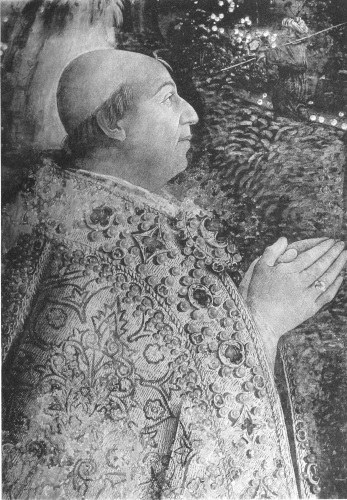
POPE ALEXANDER VI RODERIGO LENZUOLI (BORGIA) 1431-1503
Reduced from Alinari’s photograph (no. 17412) of a part of the fresco, “The Resurrection,” in the Borgian Apartments in the Vatican, by Bernardino di Betto di Biagio, better known as Pinturicchio, (1454-1513).
49.—“Now you see how elegant and admirable this kind of pleasantry is, and how becoming to a Courtier, whether the thing that is said be true or not; because in such a case it is allowable for a man to fabricate as much as he pleases, without blame; and in speaking the truth, to adorn it with a little falsity, overstating or understating as the occasion requires. But in these matters perfect grace and true cleverness consist in picturing forth what we wish to say, with both word and gesture, so well and with such ease that they who hear may seem to see before their eyes the thing we tell them. And this graphic method is so effective that it sometimes adorns and makes highly amusing a thing that in itself is neither very jocular nor clever.
“And although this kind of narrative requires gesture and the aid of the speaking voice, its quality is sometimes found in written compositions also. Who does not laugh, when, in the Eighth Day of his Decameron,[197] Giovanni Boccaccio tells how the priest of Varlungo tried to chant a Kyrie and a Sanctus on discovering that his Belcolore was in the church. There are amusing narratives also in his stories of Calandrino,[198] and in many others. Of the same sort seems to be the raising of a laugh by mimicry or imitation, as we say,—wherein I have thus far seen no one more admirable than our friend messer Roberto da Bari.”[48]
50.—“This would be no small praise,” said messer Roberto, “if it were true; because I should of course try to imitate the good rather than the bad, and if I could make myself like some men I know, I should deem myself very fortunate. I fear, however, that I know how to imitate only those things which excite laughter, and which you just now said consist essentially in the imperfect.”
Messer Bernardo replied:
“Imperfect, yes; but not unpleasantly so. And you must know that this imitation of which we are speaking, cannot be without cleverness; for besides the way of governing words and gestures and setting before our hearers’ eyes the face and manners of the man we are speaking of, we must needs be discreet, and pay great heed to the place and time, and to the persons 128with whom we are speaking, and not descend to buffoonery or go beyond bounds;—which rules you observe admirably and therefore know them all, I think. For in truth it would little befit a gentleman to make faces, to weep and laugh, and mimic voices, to wrestle with himself as Berto[65] does, or dress like a clown before everyone, like Strascino,[199]—and things of that kind, which are very fitting in those men because it is their profession.
“But for us it is needful to give only a fleeting and covert imitation, always preserving the dignity of a gentleman, without uttering foul words or performing acts that are less than seemly, without contorting the face or person beyond measure; but to order our movements in such fashion that whoever hears and sees us may from our words and gestures imagine far more than what he sees and hears, and so be moved to laughter.
“Moreover in our imitation we ought to avoid too stinging jibes, especially at deformities of face or person; for while bodily defects often furnish excellent material for laughter to a man who uses them with discretion, yet to employ this method too bitterly is the act not only of a buffoon but of an enemy. So, although it be difficult, in this regard we must, as I have said, keep to the manner of our friend messer Roberto, who mimics all men and not without marking their defects sharply even to their face, and yet no one is annoyed or seems to take it amiss. And I will give no instance of this, because in him we see countless examples of it every day.
51.—“Another thing excites much laughter, although it is included under the head of narration; and that is to describe gracefully certain defects of others,—unimportant ones however and undeserving greater punishment, such as follies, sometimes mere absurdities or sometimes accompanied by a quick and pungent dash of liveliness; likewise certain extreme affectations; sometimes a huge and well-constructed lie. As when, a few days since, our friend Cesare told of a delightful absurdity, which was that finding himself before the Podestà of this place,[200] he saw a peasant come in to complain of being robbed of a donkey. The fellow told of his poverty and of the trick played upon him by the thief, and then, to make out his loss the heavier, he said: ‘Masters, if you had seen my donkey, you would have better understood 129how much cause I have to grieve; for when he had his pack on, he looked like a very Tullius.’[201]
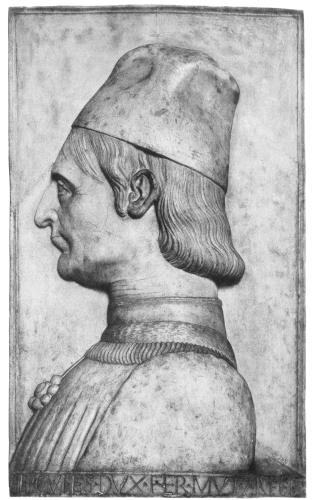
ERCOLE D’ESTE DUKE OF FERRARA 1431-1505
Reduced from a photograph, specially made by Mansell, of an anonymous bas-relief in the South Kensington Museum,—possibly the work of Sperandio di Bartolommeo de’ Savelli (1425?-1500?).
“And one of our friends, meeting a flock of goats with a great he-goat at their head, stopped and said with a look of admiration: ‘See what a he-goat! He looks like a Saint Paul.’[202]
“My lord Gaspar tells of having known an old servant of Duke Ercole of Ferrara,[203] who offered the duke his two sons as pages; but before they could begin their service, both the boys died. When the duke heard this, he condoled with the father kindly, saying that he was very sorry, for the only time when he had seen them, they had seemed to him very pretty and gentle boys. The father replied: ‘My Lord, you saw nothing; for within the last few days they had grown far handsomer and more virtuous than I could possibly have believed, and already they sang together like two sparrow-hawks.’
“And not long since one of our doctors stood looking at a man who had been condemned to be flogged about the piazza, and taking pity on him, because (although his shoulders were bleeding freely) the poor wretch walked as slowly as if he had been out for a stroll to pass the time, the doctor said to him: ‘Step out, poor fellow, and make haste to be done with your pain.’ Whereat the goodman turned, and gazing at the doctor as if amazed, he stood awhile without speaking, and then said: ‘When you come to be flogged, you will go your own gait; so I choose to go mine now.’
“You surely must still remember that absurd story which my lord Duke[2] lately told of a certain abbot, who, being present one day when Duke Federico[26] was discussing what to do with the great mass of earth that had been excavated to lay the foundations of this palace, which was then building, said: ‘My Lord, I have thought of an excellent place to put it. Give orders to have an immense pit made, and it can be put in without further difficulty.’ Duke Federico replied, not without laughter: ‘And where shall we put the earth to be dug out of this pit of yours?’ The abbot continued: ‘Have it made large enough to hold both.’ And so, for all the duke repeated several times that the larger the pit was made, the more earth would be dug out of it, the man could never get it into his brain that it could not be 130made large enough to hold both, and kept replying: ‘Make it so much the larger.’ Now you see what good judgment this abbot had.”
52.—Then messer Pietro Bembo said:
“And why do you not tell the story of your friend the Florentine commander who was besieged in Castellina[204] by the Duke of Calabria? Finding one day some poisoned crossbow missiles that had been shot in from the camp, he wrote to the duke that if the warfare was to be carried on so barbarously, he too would have medicine put on his cannon shot, and then woe to the one who had the worst of it.”[205]
Messer Bernardo laughed, and said:
“Messer Pietro, if you do not hold your peace, I will tell all the things I have seen and heard about your dear Venetians (which are not few), and especially when they try to play the horseman.”
“Do not so, I beg of you,” replied messer Pietro, “and I will keep quiet about two other delightful tales that I know of the Florentines.”[206]
Messer Bernardo said:
“They must have rather been Sienese, who often slip in this way; as was recently the case with one, who, on hearing some letters read in council wherein the phrase ‘the aforesaid’ was used (to avoid such frequent repetition of the name of the man who was spoken of), said to the man who was reading: ‘Stop there a moment and tell me, is this Aforesaid a friend to our commune?’”
Messer Pietro laughed, then said:
“I am speaking of Florentines, not of Sienese.”
“Speak out freely then,” added my lady Emilia, “and do not stand so much on ceremony.”
Messer Pietro continued:
“When the Florentine Signory was waging war against the Pisans,[207] they sometimes found their money exhausted by their great expenses; and the method of finding money for daily needs being discussed in council one day, after many ways had been proposed, one of the oldest citizens said: ‘I have thought of two methods whereby we could soon get a goodly sum of 131money without much trouble. And one of these is, that since we have no revenue greater than from the customs levied at the gates of Florence, and since we have eleven gates, let us at once have eleven more made, and thus we shall double our revenue. The other method is to give orders that the mints be forthwith opened in Pistoia and Prato,[208] just the same as in Florence, and that nothing be done there day and night but mint money, and that all the money be ducats of gold; and in my judgment this course is the quicker and the less costly.’”
53.—There was much laughter at this citizen’s keen sagacity: and the laughter being quieted, my lady Emilia said:
“Messer Bernardo, will you allow messer Pietro to ridicule the Florentines in this fashion, without returning blow for blow?”
“I forgive him this affront,” replied messer Bernardo, still laughing, “for if he has displeased me by ridiculing the Florentines, he has pleased me by obeying you, as I also would always do.”
Then messer Cesare said:
“I heard a delightful blunder made by a Brescian who had been at Venice this year for the feast of the Ascension, and in my presence was describing to some of his companions the fine things that he had seen there; and how much merchandise there was, and how much silverware, spices, cloth and stuffs; then the Signory went forth with great pomp to wed the sea in the Bucentaur,[209] on board of which there were so many finely dressed gentlemen, so much music and singing, that it seemed a paradise. And on being asked by one of his companions which kind of music he liked best among those that he had heard, he said: ‘They all were good; but among the rest I saw a man playing on a certain strange trumpet, which he thrust down his throat more than two palms at every flourish, and then he straightway drew it out and thrust it down again; so that you never saw a greater marvel.’”
Then everyone laughed, perceiving the silly mistake of the man, who had imagined that the player thrust down his throat that part of the trombone which disappears by sliding into itself.
54.—Messer Bernardo then continued:
“Moreover common affectations are tedious, but they excite 132much laughter when they are beyond measure: like those we sometimes hear from certain mouths regarding greatness or courage or nobility; or sometimes from women, regarding beauty or fastidiousness. As was not long since the case with a lady who remained sad and abstracted at some great festival; and when asked what she was thinking about that should make her so gloomy, she replied: ‘I was thinking of a matter that troubles me greatly whenever it occurs to me, nor can I lift it from my heart; and this is, that on the universal Judgment Day, when all men’s naked bodies must rise and appear before the tribunal of Christ, I cannot endure the distress I feel at the thought that my body will have to be seen unclothed among the rest.’ Being extravagant, such affectations as these cause laughter rather than tedium.
“You all are familiar with those splendid lies so well composed that they move to laughter. A very excellent one was but lately told me by a friend of ours who never suffers us to be without them.”
55.—Then the Magnifico Giuliano said:
“Be that as it may, it cannot be more excellent or more ingenious than one which a fellow-Tuscan of ours, a merchant of Lucca, affirmed the other day as a positive fact.”
“Tell it to us,” added my lady Duchess.
The Magnifico Giuliano replied, laughing:
“This merchant, so he tells the story, once finding himself in Poland, decided to buy a quantity of sables with the intention of carrying them into Italy and making great profit thereby. And after much effort, being unable to enter Muscovy himself (by reason of the war that was then waging between the King of Poland and the Duke of Muscovy), he arranged with the help of some people of the country, that on an appointed day certain Muscovite merchants should come with their sables to the frontier of Poland, and he promised to be there in order to strike the bargain. Accordingly, proceeding with his companions towards Muscovy, the man of Lucca reached the Dnieper, which he found all frozen as hard as marble, and saw that the Muscovites (who on account of the war were themselves suspicious of the Poles) were already on the other bank, but approached no 133nearer than the width of the river. So, having recognized each other, the Muscovites after some signalling began to speak with a loud voice, and to ask the price that they wished for their sables; but such was the extreme cold that they were not heard, for before reaching the other bank (where the man of Lucca and his interpreters were) the words froze in the air, and remained there frozen and caught in such manner that the Poles, who knew the custom, set about making a great fire in the very middle of the river; because to their thinking that was the limit reached by the warm voice before it was stopped by freezing, and the river was quite solid enough to bear the fire easily. So, when this was done, the words (which had remained frozen for the space of an hour) in due course began to melt and to fall in a murmur, like snow from the mountains in May; and thus they were at once heard very well, although the men had already gone. But as the merchant thought that the words asked too high a price for the sables, he would not accept the offer and so returned without them.”[210]
56.—Thereupon everyone laughed, and messer Bernardo said:
“Of a truth the story I wish to tell you is not so ingenious; however it is a fine one, and runs as follows:
“Speaking a few days since of the country or World recently discovered by the Portuguese mariners,[211] and of the various animals and other things which they bring back to Portugal, that friend of whom I told you affirmed that he had seen a monkey of a form very different from those we are accustomed to see, which played chess most admirably. And among other occasions, the gentleman who had brought her, being one day before the King of Portugal[212] and engaged in a game of chess with her, the monkey made several moves so skilfully as to press him hard and at last checkmated him. Being vexed, as all are wont to be who lose at that game, the gentleman took up the king-piece (which was very large, such as the Portuguese use) and gave the monkey a smart blow upon the head; whereupon she leaped aside crying loudly, and seemed to ask justice of the king for the wrong that had been done her. Then the gentleman invited her to play again; and after refusing awhile by means of signs, she finally began to play once more, and, as she had done the 134first time, she again had the better of him. At last, seeing that she would be able to checkmate the gentleman, the monkey tried a new trick to guard against being struck again; and without showing what she was at, she quietly put her right paw under the gentleman’s left elbow, which was luxuriously resting on a taffety[213] cushion, and (quickly snatching the cushion) with her left paw she at the same time checkmated him with a pawn, while with her right she held the cushion over her head as a shield against his blows; she then leaped joyfully to the king as if to parade her victory. Now you see how wise, wary and discreet the monkey was.”
Then messer Cesare Gonzaga said:
“It must be that this was a doctor among monkeys, and of great authority; and I think that the Republic of Indian Monkeys sent her to Portugal to make a name in a foreign land.”
Thereupon everyone laughed, both at the story and at the addition given to it by messer Cesare.
57.—So, continuing the discussion, messer Bernardo said:
“You have now heard what occurs to me concerning those pleasantries that render the effect of a thing by continuous talk; therefore it is now well to speak of those that consist in a single saying and have a quick keenness compressed into a phrase or word. And just as in the first kind,—that of humourous talk,—we must in our narrative and mimicry avoid resembling buffoons and parasites and those who make others laugh by their sheer absurdities, so in these short sayings the Courtier must take care not to appear malicious and spiteful, and not to utter witticisms and arguzie solely to annoy and cut to the quick; because for the sin of their tongue such men often suffer in all their members.
58.—“Now of the ready pleasantries that are contained in a short saying, those are keenest that arise from ambiguity. Yet they do not always move to laughter, for they are oftener applauded as ingenious than as comic. As was said a few days since by our friend messer Annibal Paleotto[214] to someone who was recommending a tutor to teach his sons grammar, and who, after praising the tutor as very learned, said that by way of stipend the man desired not only money but a room furnished for living and sleeping, because he had no letto (bed): whereupon 135messer Annibal at once replied: ‘And how can he be learned if he has not letto (read)?’ You see how well he played upon the double meaning of the phrase, non aver letto [to have no bed, or, not to have read].
“But while this punning witticism has much sharpness, where a man takes words in a sense different from that in which everyone else takes them, it seems (as I have said) to excite wonderment rather than laughter, except when it is combined with some other kind of saying.
“Now that kind of witticism which is most used to excite laughter, is when we are prepared to hear one thing and the speaker says another, and it is called ‘the unexpected.’ And if punning be combined with this, the witticism becomes most spicy: as the other day, when there was a discussion about making a fine brick floor (un bel mattonato) for my lady Duchess’s closet, after much talk you, Giancristoforo, said: ‘If we could fetch the Bishop of Potenza[215] and flatten him out well, it would be the very thing, for he is the craziest creature born (il più bel matto nato).’ Everyone laughed heartily, for by dividing the word matto-nato you made the pun. Moreover saying that it would be well to flatten out a bishop and lay him in the floor of a room, was unexpected to the listener; and so the sally was very keen and laughable.
59.—“But of punning witticisms there are many kinds; therefore we must be careful and play very lightly with our words, and avoid those that make the sally flat or that seem forced; and also those (as we have said) that are too biting. As where several companions found themselves at the house of one of their friends who was blind of one eye, and the blind man bade the company stay to dinner, all took their leave save one, who said: ‘I will stay with you because I see you have a vacant place for one;’ and at the same time he pointed with his finger to the empty socket. You see this is too bitter and rude, for it wounded without cause, and the speaker had not first been stung himself. Moreover he said that which might be said of all blind men; and such universal things give no pleasure, because it seems possible that they may have been thought out beforehand. And of this kind was that gibe at a man without nose: 136‘And where do you hang your spectacles?’[216] or ‘With what do you smell the roses in their season?’
60.—“But among other witticisms those have very good grace that are made by taking the very words and sense from another man’s taunt and turning them against him and striking him with his own weapons; as where a litigant—whose adversary had said to him in the judge’s presence: ‘Why do you bark so?’—at once replied: ‘Because I see a thief.’
“And another instance of this was when Galeotto da Narni,[217] on his way through Siena, stopped in the street to ask for the inn; and a Sienese, seeing how fat he was, said, laughing: ‘Other men carry their wallets behind, but this one carries his in front.’ Galeotto at once replied: ‘That is the way we do in a land of thieves.’
61.—“There is still another kind, which we call playing on words,[218] and this consists in changing a word by either adding or omitting a letter or a syllable; as when someone said: ‘You are better versed in the Latrin tongue than in the Greek.’ And you, my Lady, had a letter addressed to you, ‘To my lady Emilia Impia.’[219]
“Moreover it is a pleasant thing to quote a verse or two, applying it to a purpose different from that which the author intends, or some other familiar saw; sometimes to the same purpose, but changing some word. As when a gentleman, who had an ugly and disagreeable wife, was asked how he was, he replied: ‘Judge yourself of my state, when Furiarum maxima juxta me cubat.’[220] And messer Geronimo Donato,[221] while going the rounds of the Stazioni[222] at Rome in Lent with several other gentlemen, met a bevy of beautiful Roman ladies; and one of the gentlemen saying: ‘Quot coelum stellas, tot habet tua Roma puellas,’[223] he at once replied: Pascua quotque haedos, tot habet tua Roma cinaedos,[224] pointing to a company of young men who were coming from the other direction.
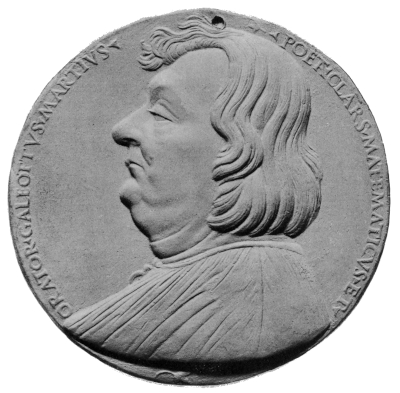
GALEOTTO MARZI DA NARNI 1427?-1490?
Enlarged from a cast, kindly furnished by M. Pierre Valton, of an anonymous medal in his collection at Paris. See Armand’s Les Médailleurs Italiens, ii, 35, no. 25.
“In like fashion messer Marcantonio della Torre[225] addressed the Bishop of Padua. There being a nunnery at Padua in charge of a friar reputed to be of very pure life and learned as well, it came to pass that, as the friar frequented the convent familiarly and often confessed the nuns, five of them (more than 137half of all there were) became pregnant; and the affair being discovered, the friar wished to flee but knew not how. The bishop had him taken into custody, and he soon confessed that he had brought the five nuns to this pass, being tempted of the devil; wherefore the bishop was firmly resolved to punish him roundly. But as the man was learned, he had many friends who all tried to help him, and along with the rest messer Marcantonio went to the bishop to implore some measure of pardon for him. The bishop would in no wise listen to them; and after they had pleaded hard, and recommended the culprit, and urged in excuse the opportunities of his position, the frailty of human nature, and many other things,—at last the bishop said: ‘I will do nothing for him, because I shall have to render God an account of the matter.’ And when they repeated their arguments, the bishop said: ‘What answer shall I make to God on the Day of Judgment, when he says to me, Give an account of thy stewardship?’[226] Then messer Marcantonio at once said: ‘My Lord, say that which the Evangelist says: Lord, thou deliveredst unto me five talents: behold I have gained besides them five talents more.’[227] Whereupon the bishop could not keep from laughing, and greatly softened his anger and the punishment intended for the offender.
62.—“It is also amusing to interpret names, and to pretend some reason why the man who is spoken of bears such a name, or why something is done. As a few days ago, when Proto da Lucca[228] (who is very amusing, as you know) asked for the bishopric of Caglio, the Pope replied: ‘Knowest thou not that in the Spanish tongue caglio means I keep silence? And thou art a babbler; wherefore it would be unseemly for a bishop never to be able to repeat his title without telling an untruth. So be thou silent (caglia) now.’ Here Proto made a reply, which, although it was not of this sort, yet was not less to the point; for having several times repeated his request, and seeing that it was of no avail, at last he said: ‘Holy Father, if your Holiness grant me this bishopric, it will not be without advantage, for I shall leave your Holiness two offices (ufficii).’ ‘And what offices have you to leave?’ said the Pope. Proto replied: ‘The full office (ufficio grande), and the Madonna’s office (ufficio della 138Madonna).’[229] Then the Pope could not keep from laughing, although he was a very grave man.
“Still another man at Padua said that Calfurnio[230] was so named because he was accustomed to heat (scaldare) ovens (forni). And when I one day asked Fedra[231] why it was that on Good Friday, while the Church offered prayer not only for Christians but even for pagans and Jews, no mention is made of cardinals along with bishops and other prelates,—he answered me that cardinals were included in that prayer which says: ‘Let us pray for heretics and schismatics.’
“And our friend Count Ludovico said that the reason why I censured a lady for using a certain cosmetic that gave a high polish, was because I saw myself in her face, when it was painted, as in a mirrour; and being ill favoured I could have no wish to see myself.
“Of this kind was that retort of messer Camillo Paleotto[232] to messer Antonio Porcaro,[233] who, in speaking of a companion who told the priest at confession that he fasted zealously, attended mass and the sacred offices, and did all the good in the world, said: ‘The man praises himself instead of owning his sins;’ to which messer Camillo replied: ‘Nay, he confesses these things because he thinks it a great sin to do them.’
“Do you not remember what a good thing my lord Prefect said the other day? When Giantommaso Galeotto[234] was surprised at a man’s asking two hundred ducats for a horse, because, as Giantommaso said, it was not worth a farthing and among other defects was so afraid of weapons that no one could make it come near them,—my lord Prefect (wishing to twit the man with cowardice) said: ‘If the horse has this trick of running away from weapons, I wonder that he does not ask a thousand ducats for it.’
63.—“Moreover the very same word is sometimes employed, but in a sense different from the usual one. As when my lord Duke,[2] being about to cross a very rapid river, said to a trumpeter: ‘Cross over’ (passa); and the trumpeter turned cap in hand, and said respectfully: ‘After your Lordship’ (passi la Signoria Vostra).
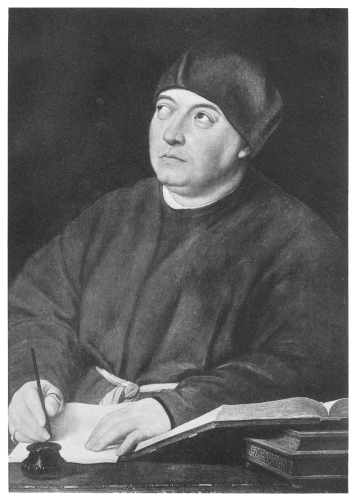
TOMMASO INGHIRAMI “FEDRA” 1470?-1516
Reduced from Braun’s photograph (no. 42.171) of the portrait, in the Pitti Gallery at Florence, long attributed to Raphael (1483-1520), but pronounced by Morelli to be a copy, by a non-Italian painter, of the original Raphael owned by the Inghirami family at Volterra and now ruined by restoration.
“Another amusing kind of banter is where a man takes the 139speaker’s words but not his sense. As was the case this year when a German at Rome, meeting one evening with our friend messer Filippo Beroaldo,[235] whose pupil he was, said: Domine magister, Deus det vobis bonum sero;[236] and Beroaldo at once replied: Tibi malum cito.[237]
“Again, Diego de Chignones[238] being at the Great Captain’s[239] table, another Spaniard, who was eating with them, said: ‘Vino,‘ meaning to ask for drink; Diego replied: ’Y no lo conocistes,’[240] meaning to taunt the man with being a heretic.[241]
“Another time messer Giacomo Sadoleto[242] asked Beroaldo,[235] who was saying how much he wished to go to Bologna: ‘What is it that so presses you at this time to leave Rome, where there are so many pleasures, to go to Bologna, which is full of turmoil?’ Beroaldo replied: ‘On three counts I am forced to go to Bologna,’ and lifted three fingers of his left hand to enumerate three reasons for his going; when messer Giacomo quickly interrupted him and said: ‘These three Counts that make you go to Bologna are: first, Count Ludovico da San Bonifacio; second, Count Ercole Rangone; third, the Count of Pepoli.’ Whereupon everyone laughed, because these three Counts had been pupils of Beroaldo, and were fine youths studying at Bologna.[243]
“Now we laugh heartily at this kind of witticism, because it carries with it a response different from the one we are expecting to hear, and in such matters we are naturally amused by our very mistake and laugh to find ourselves cheated of what we expect.
64.—“But the modes of speech and the figures that are graceful in grave and serious talk, are nearly always becoming in pleasantries and games as well. You see that words set in opposition produce much grace, when one contrasting clause is balanced by another. The same method is often very witty. Thus a Genoese, who was very prodigal in spending, was reproached by a very miserly usurer, who said to him: ‘When will you ever cease throwing away your riches?’ And he replied: ‘When you cease stealing other men’s.’
“And since, as we have said, the same situations that give opportunity for biting pleasantries may also give opportunity for serious words of praise,—it is a very graceful and becoming 140method in either case for a man to admit or confirm what another speaker says, but to interpret it in a manner different from what was intended. Thus a village priest was saying mass to his flock not long since, and after he had announced the festivals of the week, he began the general confession in the people’s name, saying: ‘I have sinned by doing evil, by saying evil, by thinking evil,’ and so forth, making mention of all the deadly sins. Whereupon a friend and close familiar of the priest, in order to make sport of him, said to the bystanders: ‘Bear witness all of you to what by his own mouth he confesses he has done, for I mean to report him to the bishop.’
“This same method was used by Sallaza dalla Pedrada[244] in complimenting a lady with whom he was speaking. First he praised her for her virtuous qualities and then for still being beautiful; and she replying that she did not deserve such praise because she was already old, he said to her: ‘My Lady, your only sign of age is your resemblance to the angels, who were the first and oldest creatures that God ever made.’
65.—“Just as serious sayings are useful for praising, in like fashion we find great utility also in jocose sayings for taunting, and in well arranged metaphors, especially if they take the form of repartee, and if he who replies preserves the same metaphor used by his interlocutor. And of this kind was the answer made to messer Palla degli Strozzi,[245] who being exiled from Florence, sent back a servant on a certain matter of business and said to him rather threateningly: ‘Thou wilt tell Cosimo de’ Medici from me that the hen is hatching.’[246] The messenger did the errand commanded him, and Cosimo at once replied without hesitation: ‘And thou wilt tell messer Palla from me that hens cannot hatch well away from their nests.’
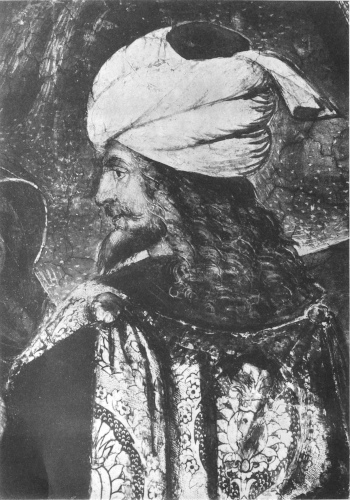
DJEM OTHMAN 1459-1495
Enlarged from Anderson’s photograph (no. 4268) of a part of the fresco, “The Dispute of St. Catherine,” in the Borgian Apartments in the Vatican, by Bernardino di Betto di Biagio, better known as Pinturicchio, (1454-1513). For the iconographical identification of this head, the translator is indebted to Professor Adolfo Venturi.
“Again, with a metaphor messer Camillo Porcaro[247] gracefully praised my lord Marcantonio Colonna;[248] who, having heard that messer Camillo had been extolling in an oration certain Italian gentlemen famous as warriors, and had spoken very highly of him among the rest, he expressed his thanks and said: ‘Messer Camillo, you have treated your friends as some merchants treat their money when it is found to contain a false ducat; for in order to be rid of it, they put the piece among many good ones, 141and in this way pass it on. So you, to do me honour (although I am of little worth), have put me in company with such worthy and excellent cavaliers, that by virtue of their merit I shall perhaps pass as good.’ Then messer Camillo replied: ‘Those who forge ducats are wont to gild them so well that they seem to the eye much finer than the good ones; so, if there were forgers of men as there are of ducats, we should have reason to suspect that you were false, being as you are of far finer and brighter metal than any of the rest.’
“You see that this situation gave opportunity for both kinds of witticism; and so do many others, of which countless instances could be given and especially in serious sayings. Like the one uttered by the Great Captain, who, being seated at table and all the places being already taken, saw that there remained standing two Italian cavaliers who had served very gallantly in the war; and he at once rose himself and caused all the others to rise and make room for these two, saying: ‘Allow these cavaliers to sit at their meat, for had it not been for them, the rest of us should now have no meat to eat.’ Another time he said to Diego Garzia,[249] who was urging him to retire from a dangerous position where the cannon shot were falling: ‘Since God hath put no fear in your heart, do not try to put any in mine.’
“And King Louis,[250] who is to-day king of France, being told soon after his accession that then was the time to punish his enemies who had so grievously wronged him while he was Duke of Orleans, replied that it was not seemly for the King of France to avenge the wrongs of the Duke of Orleans.
66.—“Taunts are also often humourously uttered with a grave air and without exciting laughter. As when Djem Othman,[251] brother to the Grand Turk,[252] being a captive at Rome, said that jousting as we practise it in Italy seemed to him too great a matter for play and too paltry for earnest. And on being told how agile and active King Ferdinand the Younger was in running, leaping, vaulting, and the like,—he said that in his country slaves practised these exercises, while gentlemen studied the liberal arts from boyhood, and prided themselves thereon.
“Almost of the same kind, too, but somewhat more laughable, 142was what the Archbishop of Florence said to the Alexandrian cardinal:[253] that men have only their goods, their body, and their soul; their goods are put in peril by the lawyers, their body by the physicians, and their soul by the theologians.”
Then the Magnifico Giuliano replied:
“To this you might add what Nicoletto[254] said: that we seldom find a lawyer who goes to law, a physician who takes physic, or a theologian who is a good Christian.”
67.—Messer Bernardo laughed, then went on:
“Of these there are countless instances, uttered by great lords and very weighty men. But we often laugh at similes also, such as the one that our friend Pistoia[255] wrote to Serafino: ‘Send back the wallet that looks like you;’ because, if you remember rightly, Serafino looked very like a wallet.
“Moreover there are some who delight to liken men and women to horses, dogs, birds, and often to chests, stools, carts, candle-sticks; which is sometimes good and sometimes very flat. Therefore in this it is needful to consider time, place, persons, and the other things that we have mentioned so many times.”
Then my lord Gaspar Pallavicino said:
“An amusing comparison was the one that our friend my lord Giovanni Gonzaga[256] made between Alexander the Great and his own son Alessandro.”[257]
“I do not know it,” replied messer Bernardo.
My lord Gaspar said:
“My lord Giovanni was playing with three dice, and as was his wont had lost many ducats and was still losing; and his son my lord Alessandro (who, although only a lad, is as fond of play as the father is) stood looking at him with great attention and seemed very sad. Count Pianella,[258] who was present with many other gentlemen, said: ‘You see, my Lord, that my lord Alessandro is little pleased at your losing, and is waiting anxiously for you to win so that he may have some of your winnings. Therefore put him out of his misery, and before you lose everything give him at least a ducat, in order that he too may go and play with his fellows.’ Then my lord Giovanni said: ‘You are wrong, for Alessandro is not thinking of any such trifle. But as it is written that when he was a boy, Alexander the Great began 143to weep on hearing that his father Philip[259] had won a great battle and subdued some kingdom, and when he was asked why he wept, he replied that it was because he feared his father would subdue so many lands as to leave nothing for him to subdue; in the same way my son Alessandro is now grieving and about to weep, seeing that I his father am losing, because he fears I am losing so much that I shall leave nothing for him to lose.’”
68.—After some laughter at this, messer Bernardo continued:
“Moreover we must avoid impiety in our witticism, (because from this it is only a step to try to be jocular by blaspheming and to invent new forms of blasphemy); otherwise we seem to seek applause by that for which we deserve not only blame but heavy punishment, which is an abominable thing. And therefore those of us who like to show their pleasantry by little reverence to God, deserve to be chased from the society of every gentleman.
“And they, no less, who are indecent and foul of speech, and show no respect for ladies’ presence and seem to have no other pleasure than to make them blush with shame, and who to that end are continually seeking witticisms and arguzie. As in Ferrara this year at a banquet attended by many ladies, there were a Florentine and a Sienese, who are usually hostile, as you know. To taunt the Florentine, the Sienese said: ‘We have married Siena to the Emperor and have given him Florence for dowry.’ He said this because it was reported at the time that the Sienese had given the Emperor a certain sum of money and that he had taken their city under his protection. The Florentine quickly retorted: ‘Siena will first be possessed’ (he used the Italian word, but with the French meaning); ‘then the dowry will be disputed at leisure.’[260] You see that the retort was clever, but, being made in the presence of ladies, it became indecent and unseemly.”
69.—Then my lord Gaspar Pallavicino said:
“Women delight to hear nothing else; and you would deprive them of it. Moreover for my part I have found myself blushing with shame at words uttered by women far oftener than by men.”
“Of such women I was not speaking,” said messer Bernardo; 144“but of virtuous ladies, who deserve reverence and honour from every gentleman.”
My lord Gaspar said:
“We should have to invent a subtle rule by which to distinguish them, for most often those who are seemingly the best, in fact are quite the contrary.”
Then messer Bernardo said, laughing:
“If we had not present here my lord Magnifico, who is everywhere accounted the champion of women, I should undertake to answer you; but I am unwilling to do him wrong.”
Here my lady Emilia said, also laughing:
“Women have need of no champion against an accuser of so little weight. So leave my lord Gaspar in his perverse opinion,—which arises from his never having found a lady to look at him, rather than from any fault on their part,—and go on with your talk about pleasantries.”
70.—Then messer Bernardo said:
“In truth, my Lady, methinks I have told of many situations from which we can derive sharp witticisms, which then have the more grace the more they are accompanied by fine narrative. Still many others might be mentioned. As when, by overstatement or understatement, we say things that outrageously exceed the probable; and of this sort was what Mario da Volterra[261] said of a prelate, that he held himself so great a man that when he entered St. Peter’s, he stooped in order not to strike his head against the architrave of the portal. Again, our friend here the Magnifico said that his servant Galpino was so lean and light that in blowing the fire to kindle it one morning, the fellow had been carried by the smoke all the way up the chimney to the very top; but happening to be brought crosswise against one of the openings, he had the good luck not to be blown away with the smoke.
“Another time messer Agostino Bevazzano[262] said that a miser, who had been unwilling to sell his grain while it was dear, afterwards hanged himself in despair from a rafter of his bedroom when he found that the price had greatly fallen; and one of his servants ran in on hearing the noise, saw the miser hanging, and quickly cut the rope and thus rescued him from death. Then, 145having come to himself, the miser insisted that his servant should pay him for the rope that had been cut.
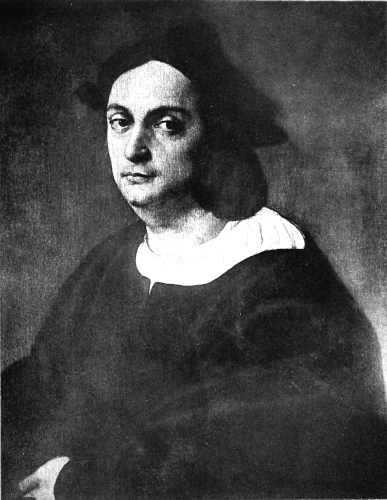
AGOSTINO BEVAZZANO Flor. 1500
Reduced from Braun’s photograph (no. 43.161) of a part of the double portrait once owned by Bembo and now in the Doria Gallery at Rome. Although by some critics regarded as an old copy, the picture is affirmed by both Morelli and Berenson to be the work of Raphael (1483-1520), probably painted in April 1516.
“Of the same sort also seems to be what Lorenzo de’ Medici said to a dull buffoon: ‘You would not make me laugh if you tickled me.’ And in like fashion he answered another simpleton who had found him abed very late one morning, and who had reproved him for sleeping so late, saying: ‘I have already been at the New Market and the Old, then outside the San Gallo gate and around the walls for exercise, and have done a thousand things besides; and you are still asleep?’ Then Lorenzo said: ‘What I dreamed in one hour is worth more than what you accomplished in four.’
71.—“It is also fine when in a retort we censure something without apparently meaning to censure it. For instance, the Marquess Federico of Mantua,[263] father to our lady Duchess, being at table with many gentlemen, one of them said after eating an entire bowl of stew: ‘Pardon me, my lord Marquess;’ and so saying he began to gulp down the broth that remained. Then the Marquess said quickly: ‘Ask pardon rather of the swine, for you do me no wrong at all.’
“Again, to censure a tyrant who was falsely reputed to be generous, messer Niccolò Leonico[264] said: ‘Think what generosity rules him, for he gives away not his own things only, but other men’s as well!’
72.—“Another very pretty form of pleasantry is that which consists in a kind of innuendo, when we say one thing and tacitly imply another. Of course I do not mean another thing of a completely different kind, like calling a dwarf gigantic and a negro white or a very ugly man handsome, for the difference is too obvious,—although even these sometimes cause laughter; but I mean when with stern and serious air we humourously say something in jest which is not our real thought. For instance, when a gentleman told a palpable lie to messer Agostino Foglietta[265] and affirmed it stoutly on seeing that he had much difficulty in believing it, messer Agostino said at last: ‘Fair sir, if I may ever hope to receive kindness from you, do me the favour to be content even if I do not believe anything you say.’ But as the other repeated, and under oath, that it was the truth, he finally 146said: ‘Since you will have it so, I will believe it for your sake, for indeed I would do even a greater thing than this for you.’
“Don Giovanni di Cardona[266] said something nearly of this sort about a man who wished to leave Rome: ‘To my thinking the fellow is ill advised, for he is so great a rascal that by staying on at Rome he might in time become a cardinal.’ Of this sort also is what was said by Alfonso Santacroce,[267] who had shortly before suffered some outrage from the Cardinal of Pavia.[268] While strolling with several gentlemen near the place of public execution outside Bologna, he saw a man who had recently been hanged, and turning towards the body with a thoughtful air, he said loud enough for everyone to hear him: ‘Happy thou, who hast naught to do with the Cardinal of Pavia.’
73.—“And this sort of pleasantry which is tinged with irony seems very becoming to great men, because it is dignified and sharp, and can be used in jocose as well as in serious matters. Hence many ancients (and those among the most esteemed) have used it, like Cato and Scipio Africanus the Younger; but above all men, the philosopher Socrates is said to have excelled in it. And in our own times King Alfonso I of Aragon,[269] who, being about to eat one morning, took off the many precious rings that he had on his fingers, in order not to wet them in washing his hands, and so gave them to the first person he happened on, almost without looking to see who it was. This servant supposed that the king had taken no notice who received them, and by reason of weightier cares would easily forget them altogether; and in this he was the more confirmed, seeing that the king did not ask for them again; and as he saw days, weeks and months pass without hearing a word about them, he thought he was surely safe. Accordingly, nearly a year after this had happened, he presented himself again one morning as the king was about to eat, and held out his hand to receive the rings; whereupon the king bent close to his ear and said to him: ‘Let the first ones suffice thee, because these will do for someone else.’ You see how biting, clever and dignified the sally was, and how truly worthy the exalted spirit of an Alexander.
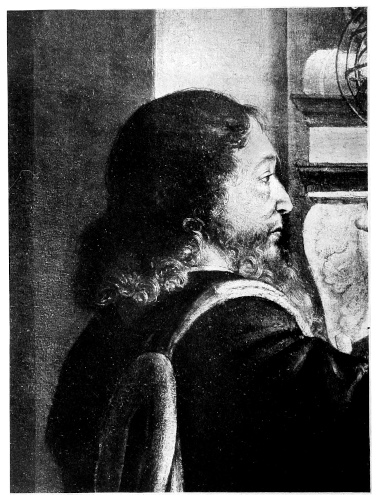
OTTAVIANO UBALDINI Died 1498
Enlarged from Braun’s photograph (no. 19.553) of the painting, “Astronomy,” by Melozzo degli Ambrosi da Forli (1438-1494). The picture, of which this head is a detail, was one of a series of panels painted to decorate Duke Federico di Montefeltro’s library in the palace of Urbino, but is now in the Royal Museum at Berlin. For iconographical identification, see Schmarzow’s Melozzo da Forli, ein Beitrag zur Kunst- und Kulturgeschichte Italiens im XV Jahrhundert (Berlin: 1886), p. 84.
74.—“Similar to this manner (which savours of the ironical) is another method, that of describing an evil thing in polite terms. 147As the Great Captain said to one of his cavaliers, who, after the battle of Cerignola,[270] when the danger was over, came forward in the richest armour possible to describe, accoutered as if for battle. And then the Great Captain turned to Don Ugo di Cardona[271] and said: ‘Have no more fear of storm, for Saint Elmo has appeared;’ and with this polite speech he stung the man to the quick, because you know that Saint Elmo[272] always appears to mariners after the tempest and gives token of fair weather; and thus the Great Captain meant that this cavalier’s appearance was a token that the danger was quite passed.
“Another time my lord Ottaviano Ubaldini,[273] being at Florence in the company of some citizens of great influence, and the talk being about soldiers, one of them asked him if he knew Antonello da Forli,[274] who had at that time fled from Florentine territory. My lord Ottaviano replied: ‘I do not know him, but have always heard him spoken of as a prompt soldier.’ Whereupon another Florentine said: ‘You see how prompt he is, when he takes his departure without asking leave.’
75.—“Those witticisms also are very clever in which we take from our interlocutor’s lips something that he does not mean. And of this kind, methinks, was my lord Duke’s reply to the castellan who lost San Leo[275] when this duchy was taken by Pope Alexander and given to Duke Valentino;[276] and it was this: my lord Duke being in Venice at the time I have mentioned, many of his subjects came continually to give him secret news how things were faring in his state; and among the rest came this castellan, who, after having excused himself as best he could, ascribing the blame to mischance, said: ‘Have no anxiety, my Lord, because I still have heart to take measures for the recovery of San Leo.’ Then my lord Duke replied: ‘Trouble yourself no more about the matter, for the mere loss of it was a measure that rendered its recovery possible.’
“There are certain other sayings when a man known to be clever says something that seems to proceed from foolishness. For instance, messer Camillo Paleotto[232] said of someone the other day: ‘He was such a fool that he died as soon as he began to grow rich.’
“Of like kind with this is a spicy and keen dissimulation, 148where a man (discreet, as I have said) pretends not to understand something that he does understand. Like what was said by the Marquess Federico of Mantua, who,—being pestered by a tiresome fellow who complained that some of his neighbours were snaring doves out of his dovecote, and all the while held one of them in his hand, hanging dead just as he had found it with its foot caught in the snare,—replied that the matter should be looked to. The fellow repeated the story of his loss not once only but many times, always displaying the dove that had been hanged, and saying: ‘And what, my Lord, do you think ought to be done in this case?’ At last the Marquess said: ‘I think the dove ought on no account to be buried in church, for having hanged itself, it must be believed to have committed suicide.’[277]
“Somewhat of the same fashion was the retort made by Scipio Nasica[278] to Ennius. Once when Scipio went to Ennius’s house to speak with him and called him down from the street, one of his maids replied that he was not at home; and Scipio distinctly heard Ennius himself tell the maid to say he was not at home, and so went away. Not long afterwards Ennius came to Scipio’s house and likewise called to him from below; whereupon Scipio himself replied in a loud voice that he was not at home. Then Ennius replied: ‘How? Do I not know thy voice?’ Scipio said: ‘Thou art too rude. The other day I believed thy maid when she said thou wert not at home, and now thou wilt not believe the like from me in person.’
76.—“It is also a fine thing when a man is struck in the very same place where he first struck his fellow. As in the case of messer Alonso Carillo,[279] who, being at the Spanish court and having committed some youthful peccadilloes of no great importance, was put in prison by the king’s order and left there overnight. The next day he was taken out, and so going to the palace in the morning, he reached the hall where there were many cavaliers and ladies. And as they were laughing at his imprisonment, my lady Boadilla[280] said: ‘Signor Alonso, your mishap weighed on me heavily, for all your acquaintance thought the king would have you hanged.’ Then Alonso said quickly: ‘My Lady, I was much afraid of it myself; but then I had hope that you would ask me to be your husband.’ You see how 149sharp and clever this was, because in Spain (as in many other countries too) the custom is that when a man is led to the gallows, his life is given him if a public courtesan begs him for her husband.
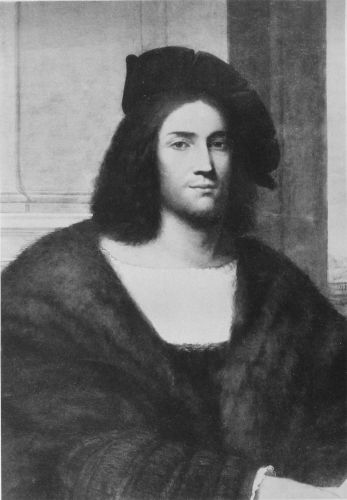
RAPHAEL 1483-1520
Enlarged from a part of Weinwurm’s photograph (no. 1384) of the portrait, in the National Gallery at Buda-Pest, by Sebastiano Luciani “del Piombo” (1485-1547). In the Scarpia collection at La Motta di Livenza, this picture passed for years as a portrait by Raphael of the Ferrarese courtier-poet Antonio Tebaldeo. On purely intrinsic evidence, both Morelli and Berenson identify it as a portrait of Raphael at the age of 26 or 27 years.
“In this manner also the painter Raphael replied to two cardinals with whom he was on familiar terms, and who (to make him talk) were finding fault in his presence with a picture that he had painted,—in which St. Peter and St. Paul were represented,—saying that these two figures were too red in the face. Then Raphael at once said: ‘My Lords, be not concerned; because I painted them so with full intention, since we have reason to believe that St. Peter and St. Paul are as red in Heaven as you see them here, for shame that their Church should be governed by such men as you.’[281]
77.—“Very keen also are those witticisms that have a certain latent spice of fun in them. As where a husband was making great lament and weeping for his wife, who had hanged herself on a fig-tree, another man approached him and plucking him by the robe, said: ‘Brother, might I as a great favour have a small branch of that fig-tree to graft upon some tree in my garden?’
“Some other witticisms need an air of patience and are slowly uttered with a certain gravity. As where a rustic, who was carrying a box on his shoulders, jostled it against Cato, and then said: ‘Have a care.’ Cato replied: ‘Hast thou aught else but that chest upon thy shoulders?’[282]
“Moreover we laugh when a man has made a blunder, and to mend it says something of set purpose that seems silly and yet tends to the object he has in view, and thus keeps himself in countenance. For instance, in the Florentine Council not long ago there were (as often happens in these republics) two enemies, and one of them, who was of the Altoviti family, fell asleep. And although his adversary, who was of the Alamanni family, was not speaking and had not spoken, yet to raise a laugh the man who sat next Altoviti woke him with a touch of the elbow, and said: ‘Do you not hear what So and So says? Make answer, as the Signors are asking for your opinion.’ Thereupon Altoviti rose to his feet all drowsy as he was, and said without stopping to think: ‘My Lords, I say just the opposite 150of what Alamanni said.’ Alamanni replied: ‘But I said nothing.’ ‘Then,’ said Altoviti at once, ‘the opposite of whatever you may say.’
“Of this kind also was what your Urbino physician, master Serafino, said to a rustic, who had received a hard blow in the eye so that it was forced quite out, yet decided to seek aid from master Serafino. On seeing him, although aware that it was impossible to cure him, still in order to force money from his hands (just as the blow had forced the eye from his head), the doctor readily promised to cure him, and accordingly demanded money from him every day, affirming that he would begin to recover his sight within five or six days. The poor rustic gave what little he had; then, seeing that the affair was progressing slowly, he began to complain of the physician, and to say that he felt no benefit at all and saw no more with that eye than as if he had it not in his head. At last master Serafino, seeing that he would be able to extort little more from the man, said: ‘Brother, you must have patience. You have lost your eye and there is no longer any help for it; and may God grant that you do not lose your other eye as well.’ On hearing this, the rustic began to weep and complain loudly, and said: ‘Master, you have ruined me and stolen my money. I will complain to my lord Duke;’ and he made the greatest outcry in the world. Then, to clear himself, master Serafino said angrily: ‘Ah, wretched traitor! So you would have two eyes, as city-folk and rich men have? To perdition with you!’ and accompanied these words with such fury that the poor rustic was frightened into silence and quietly went his way in peace, believing himself to be in the wrong.
78.—“It is also fine to explain or interpret a thing jocosely. As when at the court of Spain there appeared one morning in the palace a cavalier who was very ugly, and his wife who was very beautiful, both dressed in white damask (damasco),—the queen[283] said to Alonso Carillo: ‘What think you of these two, Alonso?’ ‘My Lady,’ replied Alonso, ‘I think she is the dama (lady), and he is the asco,’ which means monster.
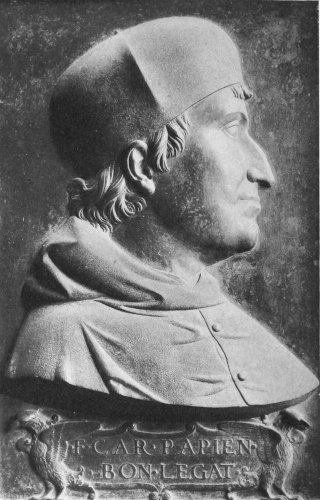
FRANCESCO ALIDOSI CARDINAL OF PAVIA Died 1511
Reduced from Giraudon’s photograph (no. 1528) of an anonymous bas-relief in the Louvre. The features strikingly resemble those of Francesco Francia’s medal of Alidosi, but are very unlike those shown in a picture by Raphael (in the Prado Gallery at Madrid), which M. Müntz regards as a portrait of the same personage. See L’Archivio Storico dell’Arte for 1891, pp. 328-32.
“Another time Rafaello de’ Pazzi[284] saw a letter which the Prior of Messina[285] had written to a lady of his acquaintance, the 151superscription of which read, ‘This missive is to be delivered to the author of my woes.’ ‘Methinks,’ said Rafaello, ‘this letter is intended for Paolo Tolosa.’[286] Imagine how the bystanders laughed, when everyone knew that Paolo Tolosa had lent the Prior ten thousand ducats, and that he, being a great spendthrift, found no means to repay them.
“Akin to this is the giving of friendly admonition in the form of advice, yet covertly. As Cosimo de’ Medici did to one of his friends, who was very rich but of moderate education and who had secured through Cosimo a mission away from Florence. When on setting out the man asked Cosimo what course he thought ought to be taken in order to do well in the mission, Cosimo replied: ‘Wear rose-colour,[287] and say little.’ Of the same kind was what Count Ludovico said to a man who wished to travel incognito through a certain dangerous place and knew not how to disguise himself; and being asked about it, the count replied: ‘Dress like a doctor or some other man of sense.’ Again, Gianotto de’ Pazzi[288] said to someone who wished to make a jerkin of as varied colours as he could find: ‘Imitate the Cardinal of Pavia in word and deed.’
79.—“We laugh also at some things that have no connection. As when someone said the other day to messer Antonio Rizzo[289] about a certain man from Forli: ‘You may know he is a fool, for his name is Bartolommeo.’ And another: ‘You are looking for a Master Stall, and have no horses!’ And: ‘All the fellow lacks is money and brains.’
“And we laugh at certain other things that seem to have sequence. As recently, when a friend of ours was suspected of having had the renunciation[290] of a benefice forged, upon another priest’s falling sick, Antonio Torello[291] said to our friend: ‘Why do you delay to send for that notary of yours and see about filching this other benefice?’ Likewise at some things that have no sequence. As the other day, when the pope sent for messer Gianluca da Pontremolo and messer Domenico dalla Porta (who are both hunchbacks as you know),[292] and made them auditors, saying that he wished to set the Wheel right,—messer Latino Giovenale[293] said: ‘His Holiness is in errour if he thinks to make the Wheel right with two wrongs (due torti).’