NOTES (continued 2)
Leonard Eckstein Opdycke translation
Note 100 page 50. Giorgio Barbarelli, known as Giorgione or “Big George,” (born about 1478; died 1511), was a native of Castelfranco, a town about forty miles north-west of Venice, and was reputed to be a natural son of one Giacopo Barbarelli, a Venetian, and a peasant girl. Lack of data renders a consecutive account of his life and work impossible. He was brought up in Venice, and bred as a painter in the school of the Bellini. Vasari says that he played upon the lute and sang well, and was of a gentle disposition. Although he seems to have been exceptionally independent of great people, he enjoyed the especial favour of the Marchioness Isabella d'Este of Mantua. In a letter written from Venice in the year before that of the Courtier dialogues, Albert Dürer declared Giorgione to be the greatest painter in the city, which could then boast of the Bellini, Palma Vecchio, Carpaccio and Titian. One of the most acute of recent critics, Mr. Bernhard Berenson, ascribes to him only 344seventeen existing pictures, of which the best known is the Fête Champêtre in the Louvre, while the only one whose authenticity is entirely free from doubt is the “Madonna and Saints” in the Duomo at Castelfranco. The Urbino collection comprised two portraits by Giorgione, one of which is supposed to have represented Duke Guidobaldo, but unfortunately is lost.
Note 101 page 51. Isocrates, (born 436; died 338 B.C.), an Athenian orator, was a pupil of Socrates, and became the instructor of many famous orators. His diction was of the purest Attic, and his writings were highly prized by the Alexandrian grammarians. The first printed edition of his works (1493) was edited by Castiglione’s Greek master, Chalcondylas. Lysias, (died about 380 B.C.), an Athenian orator, abandoned the stilted monotony of the older speakers, and employed the simple language of every-day life, but with purity and grace. Æschines, (born 389; died 314 B.C.), was the rival and finally unsuccessful antagonist of Demosthenes.
Note 102 page 51. Caius Papirius Carbo, (Consul in 120 B.C.), was an adherent of the Gracchi, but became a renegade and finally committed suicide. He was generally suspected of murdering Scipio Africanus the Younger. While abominating the man’s character, Cicero praises his oratory. Caius Lælius Sapiens was Consul in 140 B.C. His friendship with Scipio is commemorated in Cicero’s De Amicitia. While he was in his own time regarded as the model orator, later grammarians resorted to his works for archaisms. Scipio Africanus the Younger, (died 129 B.C.), captured Carthage in the Third Punic War, and was leader of the aristocratic party at Rome against the popular reforms of the Gracchi. His works, of which only a few fragments survive, are praised by Cicero and were long held in esteem. Galba, see note 87. Publius Sulpicius Rufus, (born 124; died 88 B.C.), was a tribune of the plebs. Cicero says: “Of all the orators I ever heard, Sulpicius was the most dignified, and, so to speak, the most tragic.” Caius Aurelius Cotta, (Consul 75 B.C.), is characterized by Cicero, who had argued a cause against him, as a most acute and subtle orator, but his style seems to have been dry and unimpassioned. Caius Sempronius Gracchus, (died 121 B.C.), a son of the famous Cornelia, and brother-in-law of Scipio Africanus the Younger, is noted chiefly for his vain struggle in behalf of popular rights. Only fragments of his oratory have survived. Marcus Antonius and Crassus, see note 85.
Note 103 page 51. “In a certain place,” i.e., De Oratore, II, xxiii, 97.
Note 104 page 51. The Italian virtù has here its Latin meaning of natural vigour. See also note 330.
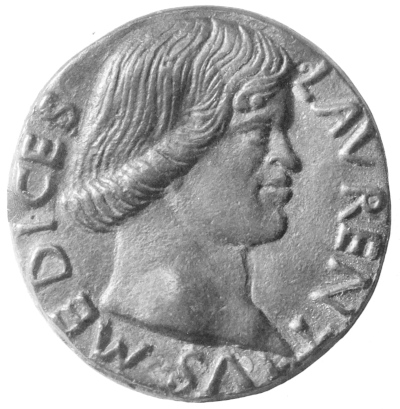
LORENZO DE' MEDICI 1448-1492
Enlarged from a negative, specially made by Alinari through the courtesy of Professor I. B. Supino, of a medal, in the National Museum at Florence, by Antonio del Pollaiuolo (1429-1498).
Note 105 page 51. Angelo Poliziano, (born 1454; died 1494), was a native of Montepulciano (about twenty-seven miles south-east of Siena), of which his name is a Latinized form. To English students he is better known as Politian, 345and as the author of the oft-cited line, “Tempora mutantur, nos et mutamur in illis.” His father Benedetto Ambrogini died poor, leaving a widow and five young children almost destitute. At the age of ten, Angelo studied at Florence, and composed Latin poems and Greek epigrams while yet a boy. At thirteen, he published Latin epistles; at sixteen, he began his Latin translation of the Iliad; at seventeen, he distributed Greek poems among the learned men of Florence; and at eighteen, he edited Catullus. He was received into Lorenzo de' Medici’s household, and before he was thirty years old, he was professor of Latin and Greek at the University of Florence and was entrusted with the care of Lorenzo’s children. His pupils included the chief students of Europe. A born poet, entitled to the middle place of honour between Petrarch and Ariosto, he was the first Italian to combine perfect mastery of Latin and a correct sense of Greek with genius for his own native literature. Towards the close of his life, he entered holy orders and became a canon of the Cathedral at Florence. He was ill formed, and had squinting eyes and an enormous nose. His morals were lax. He was succeeded by Bembo as dictator of Italian letters.
Note 106 page 51. Lorenzo de' Medici, (born 1448; died 1492), was the grandson of Cosimo, Pater Patriæ, and father of Giuliano of The Courtier. On the death of his father Pietro in 1469, he succeeded jointly with his brother Giuliano to the family wealth and political predominance. Giuliano’s assassination in the Piazzi conspiracy of 1478 (which Poliziano witnessed and narrated in Latin) left Lorenzo sole ruler, but like his predecessors, he governed the republic without any title, by free use of money and great adroitness in securing the elevation of his adherents to the chief offices of state. He was a man of marvellous range of mental power,—an epitome of Renaissance versatility. Never relaxing his hold on public affairs, among philosophers he passed for a sage; among men of letters, for an original and graceful poet; among scholars, for a Hellenist sensitive to every nicety of Attic idiom; among artists, for a connoisseur of consummate taste; among libertines, for a merry and untiring roysterer; among the pious, for an accomplished theologian. “He was no less famous for his jokes and repartees than for his pithy apothegms and maxims, as good a judge of cattle as of statues, as much at home in the bosom of his family as in the riot of an orgy, as ready to discourse on Plato as to plan a campaign or to plot the death of a dangerous citizen.” (Symonds.)
Note 107 page 51. Francesco Cattani da Diacceto, (born 1466; died 1522), was a native of Florence, studied at Pisa, and returning to his native city became intimate with Ficino, of whose philosophy he may be said to have been the heir. For many years he lectured at Florence with such success that the Venetians tried to entice him to the University of Padua, in vain. A partisan of the Medici, he enjoyed the favour of Leo X and of Cardinal Giulio, afterwards Clement VII. All his works (written in Latin) are of a philosophical character. His style is said to be sprightly and correct, and despite the ridicule then cast upon the vulgar tongue, he himself translated several of his books into Italian, 346notably the Tre Libri d'Amore, with which Castiglione shows familiarity in the Fourth Book of The Courtier.
Note 108 page 52. Caius Silius Italicus, (died 100 A.D.), was Consul under Nero and a follower of Cicero in the art of oratory. After a prosperous public career, he retired to a life of literary ease. His most important work was a long epic poem on the Second Punic War, and soon sank into oblivion. Cornelius Tacitus, (died probably after 117 A.D.), was Consul and orator as well as historian.
Note 109 page 54. Marcus Terentius Varro, (born 116; died about 27 B.C.), was somewhat older than Cæsar, Cicero and Sallust, but outlived them all. He was regarded as the most learned of the Romans, and was made director of the public library by Cæsar, although he had been a partisan of Pompey. Of his seventy-four works, which embraced nearly all branches of knowledge, only two survive. They were much esteemed by the Christian Fathers.
Note 110 page 55. Catullus was born about 87 B.C. His 39th ode begins: “Because Egnatius has white teeth, he smiles wherever he goes” (Egnatius, quod candidos habet dentes, renidet usque quaque). Later in the same ode, he says: “Nothing is more pointless than a pointless laugh” (Nam risu inepto res ineptior nulla est).
Note 111 page 57. Monseigneur d'Angoulême, afterwards Francis I, (born 1494; died 1547), was the son of Count Charles d'Angoulême and Louise of Savoy. His governor, Sieur de Boisy, strove to inspire him with a taste for arms and a love of letters and art, and it was from romances of chivalry that he derived much of his education and many of his ideas of government. He succeeded his cousin Louis XII in January 1515, and one of the earliest functions at his court was the marriage of his aunt Filiberta of Savoy to Giuliano de' Medici, who is here represented by Castiglione (with what truth remains uncertain) as having visited the French court shortly before the date of the Courtier dialogues. Writing in 1515, the Venetian ambassador describes the young king as being really handsome (the evidence of our nearly contemporaneous medal illustration to the contrary), courageous, an excellent musician, and very learned for one of his age and rank. Under his rule, relations between France and Italy became closer and more active, and there began to penetrate beyond the Alps that Italian influence which he later greatly increased by marrying his son to Giuliano de' Medici’s great-niece Caterina. His education had included a study of Italian literature and customs, and besides Federico Fregoso and Ludovico da Canossa he received and honoured many other illustrious Italians, among whom were Leonardo da Vinci and Benvenuto Cellini. He caused search to be made in Italy for rare MSS., and had them copied for his library. His reign, although clouded by defeats and humiliations, began a true literary and artistic Renaissance in France.
Note 112 page 57. The reference here is to the famous Sorbonne (founded 347by Robert Sorbon in 1253) towards which Francis was for religious reasons hostile during the early years of his reign, and to which he raised up a rival by founding the Collège de France in 1530.
Note 113 page 58. Lucius Licinius Lucullus, a Roman general and Consul (74 B.C.), noted chiefly for his wealth, luxury, and patronage of art and letters. Lucius Cornelius Sulla, a Roman general, Consul (88 B.C.), and dictator, was the first Roman to lead an army against the city, and the first to publish lists of his enemies, proscribing them and offering a reward for their death. Cneius Pompeius, or Pompey, (born 106; died 48 B.C.), a member of the Triumvirate with Cæsar and Crassus, and the finally unsuccessful champion of the conservative party against the power of Cæsar. Marcus Junius Brutus, (born 85; died 42 B.C.), a statesman and scholar, who adhered to Pompey, joined Cassius in the assassination of Cæsar, and was finally defeated by Mark Antony. Hannibal, (born 247 B.C.), the famous Carthaginian general who conquered Spain, crossed the Alps, overran Italy, was defeated by Scipio the Elder, became chief magistrate of Carthage, and committed suicide in exile about 183 B.C.
Note 114 page 59. In the last chapter of his “Prince,” Machiavelli (who was Castiglione’s contemporary) says: “Although military excellence seems to be extinct in Italy, this arises from the fact that the old methods were not good and there has been no one who knew how to devise new ones. We have great excellence in the members, if only it were not lacking in the heads. In duels and engagements between small numbers, see how superior the Italians are in strength, in dexterity, in resource. But when it comes to armies, they make no showing; and it all proceeds from the weakness of the heads. Whence it arises that in so much time, in so many battles fought in the last twenty years, when an army has been purely Italian, it has always succeeded ill.” Compare this opinion with Montaigne’s remark (Essais, II, c. 24) that the officers of Charles VIII ascribed their easy Italian conquests to the fact that “the princes and nobility of Italy took more pleasure in becoming ingenious and learned than in becoming vigorous and warlike.”
Note 115 page 59. In 1524 Castiglione wrote to his mother at Mantua regarding the education of his son, who had just begun to study the Greek alphabet, as follows: “As to Camillo’s learning Greek, I have had a letter also from Michael, who says so many things that he seems to me a flatterer. It is enough that the boy shows good capacity and inclination, and good pronunciation. As for Latin, I should be glad to have him attend more to Greek at present, for those who know are of opinion that one ought to begin with Greek; because Latin is natural to us, and we almost acquire it even though we spend little labour upon it; but Greek is not so.”
Note 116 page 59. The reader will hardly need to be reminded that the habit of versification was very prevalent in all ranks of Italian society in 348Castiglione’s day. Varchi (1502-1565) informs us that the vernacular was generally despised in the Florence of that time, and adds: “And I remember, when I was a lad, that the first and most important command which fathers usually gave to their children, and masters to their pupils, was that they must on no account whatever read anything in the vulgar tongue.”
Note 117 page 59. In the Vita Nuova (c. 25), Dante says: “And the first who began to speak like a native poet was moved thereto because he would have his words understood of woman.”
Note 118 page 59. Aristippus, (flor. 400 B.C.), was a Greek philosopher, whose school took its name from his birthplace, Cyrene in Africa. He was for some time a follower of Socrates, and afterwards lived at the court of Dionysius, tyrant of Syracuse. Diogenes Laertius relates that when Aristippus was asked what was the greatest thing he had gained from philosophy, he replied: “The power to meet all men with confidence.”
Note 119 page 60. Among Plutarch’s works is a tract entitled “How to Tell Friend from Flatterer.” In 1532 Erasmus published a Latin version of it dedicated to Henry VIII of England.
Note 120 page 61. The first quatrain of a well-known sonnet by Petrarch:
Giunto Alessandro alla famosa tomba
Del fero Achille, sospirando disse:
O fortunato, cite sì chiara tromba
Trovasti, e chi di te sì alto scrisse!
of which Mr. John Jay Chapman has kindly furnished the following translation:
When Alexander reached the sacred mound
Where dread Achilles sleeps, “O child of Fame,”
He sighed. “Thy deeds are happy that they found
Old Homer’s tongue to clarion thy name.”
In his oration Pro Archia, Cicero describes Alexander as exclaiming: “O fortunate youth, who found Homer as herald of thy valour!” (O fortunate, inquit, adulescens qui tuæ virtutis Homerum præconem inveneris!).
Note 121 page 62. In an earlier version, this passage reads: “Grasso de' Medici will in this matter have the same advantage over Messer Pietro Bembo that a hogshead has over a barrel.” Bembo was slender, while Grasso (fat man) was probably the nickname of a corpulent soldier in the service of the Medici, possibly identical with a certain Grasso to whom Bembo desired to be commended in a letter to Bibbiena, 5 February 1506.
Note 122 page 63. The instrument used in Socrates’s time κιθάρα was certainly 349not the modern cithern, but more probably a kind of large lyre, supported by a ribbon and played with a plectrum of metal, wood or ivory.
Note 123 page 63. In a note to this passage, Cian says: “Abito [rendered ‘habit of mind’] is a special condition or habitual quality of the mind, which manifests itself outwardly in a special costume [rendered ‘habitual tendency’], or equally habitual behaviour, which in turn reacts upon the disposition and moral attitude of the individual.”
Note 124 page 64. Lycurgus probably lived in the 9th century B.C., and was the reputed author of the Spartan laws and institutions.
Note 125 page 64. Epaminondas, a Theban general, defeated the Spartans at Leuctra in 371 B.C. and at Mantinea in 362 B.C., and lost his life in the latter battle.
Note 126 page 64. Themistocles, the Athenian statesman and general, persuaded the Greeks to resist the second Persian invasion by naval force at Salamis in 480 B.C.
Note 127 page 64. One of the finest of the Pompeian frescoes represents the centaur Chiron teaching Achilles to play upon the lyre.
Note 128 page 64. The reference here is of course to the familiar story of Orpheus and the beasts.
Note 129 page 64. Castiglione doubtless had in mind the legend of Arion, a Greek poet of Lesbos, who probably flourished about 700 B.C. We have a fragment of his verse addressed to Poseidon and telling of the dolphins, who had wafted the poet safely to land when he had lost his course.
Note 130 page 65. As we shall see, the Magnifico’s request was not complied with until the second evening (page 81).
Note 131 page 65. Quintus Fabius Pictor was a Roman general who served in the Second Punic War, and wrote a Greek history of Rome, much esteemed by the ancients, but now lost. Pliny affirms that Fabius painted the temple in the 450th year after the founding of Rome (i.e. 300 B.C.), and that the painting was still extant about the beginning of our era.
Note 132 page 66. The Apollo Belvedere was discovered in 1503, the Laocoön group in 1506, and other famous antique statues only a few years earlier.
Note 133 page 66. The comparative merits of painting and sculpture were a frequent subject of discussion during this period. The Renaissance writers 350had inherited from antiquity a fondness for seeking superiority or inferiority in matters between which there exists such a diversity of character as to render comparison unprofitable. According to Vasari, Giorgione maintained “that in one picture the painter could display various aspects without the necessity of walking round his work, and could even display, at one glance, all the different aspects that could be presented by the figure of a man, even though the latter should assume several attitudes,—a thing which could not be accomplished by sculpture without compelling the observer to change his place, so that the work is not presented at one view, but at different views. He declared, further, that he could execute a single figure in painting, in such a manner as to show the front, back, and profiles of both sides at one and the same time.... He painted a nude figure, with its back turned to the spectator, and at the feet of the figure was a limpid stream, wherein the reflection of the front was painted with the utmost exactitude: on one side was a highly burnished corselet, of which the figure had divested itself, and wherein the left side was reflected perfectly, every part of the figure being clearly apparent: and on the other side was a mirror, in which the right profile of the nude form was also exhibited. By this beautiful and admirable fancy, Giorgione desired to prove that painting is, in effect, the superior art, requiring more talent and demanding higher effort.”
In one of his letters, Michelangelo wrote: “My opinion is that all painting is the better the nearer it approaches to relief, and relief is worse in proportion as it inclines to painting. And so I have been wont to think that sculpture is the lamp of painting, and that the difference between them might be likened to the difference between the sun and moon.... By sculpture I understand an art which operates by taking away superfluous material; by painting, one that attains its result by laying material on. It is enough that both emanate from the same human intelligence, and consequently sculpture and painting ought to live in amity together, without these lengthy disputations. More time is wasted in talking about the problem than would go to the making of figures in both species.”
Note 134 page 68. In his “Treatise on Painting,” Leonardo da Vinci says: “The first marvel we find in painting is the apparent detachment from the wall or other plane, and the cheating of keen perceptions by something that is not separate from the surface.”
Note 135 page 68. “Grottoes,” i.e. the Catacombs. Speaking in his autobiography of the remains of ancient art found in the Catacombs, Benvenuto Cellini says: “These grotesques have received this name from the moderns because they were found by scholars at Rome in certain subterranean caverns, which had anciently been rooms, chambers, studios, halls and the like. Since these scholars found them in these cavernous places (which had been built by the ancients on the surface and had become low), and since such low places are known at Rome by the name Grottoes, for that reason they received the name grotesques.” Cellini here tries to explain the origin of the name applied 351to ornaments (such as the arabesques of the Renaissance) in which figures, human to the waist, terminate in scrolls, leafage, etc., and are combined with animal forms and impossible flowers. In this sense the word was used as early as 1502 in a contract between the Cardinal of Siena and the painter Pinturicchio. It had of course not yet reached its modern signification, so fully discussed in the appendix to Volume IV of Ruskin’s “Modern Painters.” In Castiglione’s time it was not known that the catacomb decorations were Christian, and in any case they were founded on pagan models.
Note 136 page 69. Demetrius I of Macedon, (died 283 B.C.), was the son of Antigonus, who was one of Alexander’s most illustrious generals and succeeded to the Macedonian throne.
Note 137 page 69. Of Metrodorus, nothing more is known than Pliny’s account of the incident recorded in our text.
Note 138 page 69. Lucius Æmilius Paulus, (died 160 B.C.), was a Roman general, Consul, and statesman of the aristocratic party. The incident mentioned in the text occurred after his victory over King Perseus of Macedon in 168 B.C.
Note 139 page 70. Campaspe, according to Pliny, was the name of the beautiful slave given by Alexander to Apelles, as narrated at page 68.
Note 140 page 70. Zeuxis, (flor. 400 B.C.), belonged to the Ionian school of Greek painting, which was characterized by sensuous beauty and accurate imitation of nature. He lived at Athens, and his idealism is said to have been rather of form than of character. The picture referred to in the text represented Helen of Troy, was regarded as his masterpiece, and was probably identical with a picture mentioned as being at Rome. The story of the five maidens is said to have been cited by Tintoretto in support of his maxim, “Art must perfect Nature.”
Note 141 page 71. The Marquesses Febus and Gerardino di Ceva were sons of the Marquess Giovanni (who was living as late as 1491), and belonged to one of the most illustrious families of Piedmont and indeed of all Italy. They were born towards the close of the 15th century and died about the third decade of the 16th, having obtained the investiture of their fief in 1521. They sided sometimes with the Emperor and sometimes with France, as best suited them, and left rather a bad name. To escape punishment for killing a cousin, Gerardino stabbed himself, and Febus also died “disperato,” leaving two daughters in grief and shame.
Note 142 page 71. Ettore Romano Giovenale was a cavalier of whom little more is known than that he was in Francesco Maria’s service, fought successfully as one of the thirteen Italian champions at Barletta, was afterwards 352in the service of the Duke of Ferrara, who dismissed him for an act of treachery.
Note 143 page 71. Collo Vincenzo Calmeta of Castelnuovo, (died 1508), was a courtly poet and prose writer, who had been secretary to the Duchess Beatrice d'Este of Milan. Later he enjoyed the especial favour of this lady’s sister, the Marchioness Isabella d'Este of Mantua, and also of the Duchess of Urbino, who protected him from the displeasure of her brother the Marquess of Mantua, and at whose court he improvised verse somewhat after the manner of the Unico Aretino. In a letter (1504) from Urbino to Isabella d'Este, Emilia Pia wrote: “Of news here there is none that is not known to you, except that Calmeta is continually composing songs and divers other things, and this carnival has written a new comedy, which he would have sent you if he had thought it would give you pleasure.” Among Calmeta’s works were a verse compendium of Ovid’s Ars Amandi, and a biography of his friend and fellow improvisatore, Serafino Ciminelli d'Aquila (see note 255). As known to us, his poetical writings do not rise above mediocrity, and wholly fail to explain the esteem in which they were held.
Note 144 page 71. Orazio Florido was a native of Fano, one of the Adriatic coast towns nearest to Urbino. Having been chancellor to Duke Guidobaldo, he became secretary to Duke Francesco Maria. When Francesco was combating the usurper Lorenzo de' Medici in 1517, he sent one of his officers with Florido under protection of a safe-conduct to challenge Lorenzo to personal combat. In spite of the safe-conduct, Florido was detained and sent to Leo X at Rome, where he was basely tortured in the hope of extorting political secrets from him. He remained steadfastly faithful to his master, and afterwards made a tour of the courts of Europe seeking aid for his lord.
Note 145 page 73. Margarita Gonzaga was a niece of the Duchess of Urbino, being a natural daughter of the Marquess Gianfrancesco of Mantua. She was for many years one of the ornaments of the Urbino court. Various mentions of her in contemporary letters show her as a woman of unusual beauty, sprightly wit and gay disposition. She had several suitors, apparently including Filippo Beroaldo, who is mentioned later in The Courtier (page 139).
Note 146 page 73. Of Barletta nothing more is known than what is contained in this and another shorter mention of him in The Courtier (page 87).
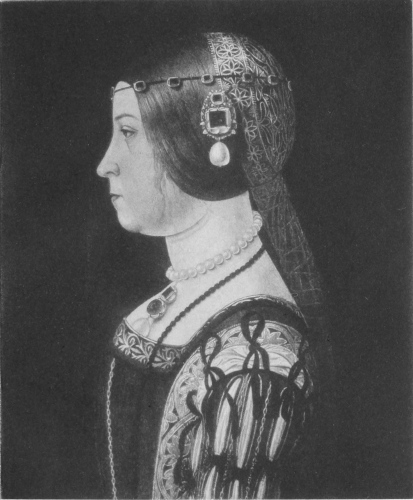
BEATRICE D'ESTE DUCHESS OF MILAN 1475-1497
Reduced from Braun’s photograph (no. 42.371) of the portrait, in the Pitti Gallery at Florence, attributed to Piero della Francesca (1420-1492). For an account of this and other portraits, see l'Archivio Storico dell'Arte for 1889, p. 264. Some of the events of her short life are mentioned in note 398 at page 399 of this volume.
Note 147 page 73. The original reads: havendo prima danzato una bassa, ballarono una Roegarze. The danza bassa was of Spanish origin and is believed to have consisted of sliding steps and of posturing, in which the feet were not lifted. The verb ballare seems to be derived from the low Latin balla, a ball. In the Middle Ages the game of ball was accompanied with 353dance and song, and we may well believe that a class of dances, thus originating and denominated generally balli, were more animated than the danza bassa. Although a Greek derivation has been ascribed to the word roegarze, Cian affirms that the dance thus named was of French origin. The earliest French translator of The Courtier renders the word by rouergoise, which is apparently derived from Rouergue, the name of an ancient French province to the south-west of Lyons.
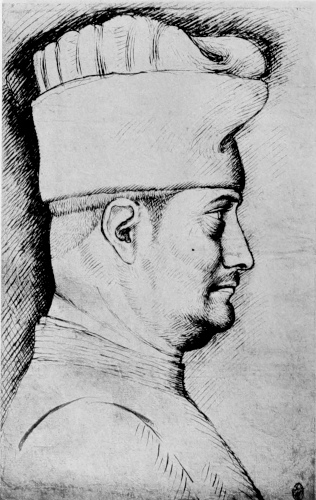
FILIPPO MARIA VISCONTI DUKE OF MILAN 1391-1447
Reduced from Giraudon’s photograph (no. 254) of a drawing, in the Louvre, by Vittore Pisano, better known as Pisanello, (1380?-1451?).
355
NOTES TO THE SECOND BOOK OF THE COURTIER
Note 148 page 75. This passage reflects the medico-philosophical theories which the Renaissance inherited from antiquity, and which regarded “the vital spirits” as something far more tangible and material than what we call the principle of life or vital spark. Compare the early conception of electricity as a fluid substance. “Complexion” is of course here used to mean temperament or constitution, and not the mere colour and texture of the skin.
Note 149 page 77. Duke Filippo Maria Visconti, (born 1391; died 1447), was the son of Giangaleotto and Caterina Visconti, and brother of Giovanni Maria Visconti, whom he succeeded as Duke of Milan in 1412. He married Beatrice di Tenda (widow of Facino Cane), who brought him nearly a half million of florins dowry, besides her husband’s soldiers and cities, and thus enabled him gradually to win back the Lombard part of his father’s duchy, which his brother had lost. He was very ugly in person, and so sensitive that he rarely appeared in public. Wily but unstable, he was continually plotting schemes that seemed to have no object, and he mistrusted his own generals, even Francesco Sforza, who turned against him, forced him to a ruinous peace, and after his death was soon able to seize his duchy. In him the cruel selfishness of the Renaissance tyrant did not degenerate into mad thirst for blood, as in the case of his terrible brother. He read Dante, Petrarch and French romances of chivalry, and even dallied with the Latin classics, but genuine learning was neglected and despised at his court.
Duke Borso d'Este, (born 1413; died 1471), like his brother and predecessor, was a natural son of Duke Niccolò III. Kindly and just, he was idolized by the Ferrarese and especially by the women. He patronized letters and art and was fond of splendid living, yet in spite of the luxury of his court, he left a treasure of about a million pounds sterling. The art of printing was established at Ferrara shortly before his death. He appears to have been himself ignorant of Latin, and encouraged the literary use of Italian and the study of French romance. Histories of Ferrara, as well as the writings of contemporary humanists, are full of his generous deeds. His mild sway passed into a proverb, and the time of “the good Duke Borso” was long remembered as a kind of golden age.
Note 150 page 77. Niccolὸ Piccinino, (born 1380; died 1444), was so humbly born as to possess no other surname than that conferred on him in ridicule of his small stature. Having served under the famous Braccio da Montone, he married the latter’s niece, and achieved such distinction as a soldier as to share with Francesco Sforza the fame of being the first condottiere of his day. 356He became the friend and general of Duke Federico of Urbino. His rough wit was highly esteemed.
Note 151 page 77. This consciousness of the corruption then prevailing in Italy is even more frankly expressed by Machiavelli: “It is but too true that we Italians are in a special degree irreligious and corrupt.” (Discorsi, I, 12.)
Note 152 page 78. The reference here is to Plato’s Phædo, c. 3. Socrates is said to have turned Æsop’s fables into verse.
Note 153 page 83. The Italian noun fierezza (rendered “boldness”) and the adjective fiero (more anciently fero, the epithet applied by Petrarch to Achilles, see note 120) are derived from the Latin ferus (wild, untamed, impetuous), the root of which we see in our English word ferocious. While retaining its etymological signification, fiero was used to mean also: haughty, intrepid, strong, sturdy.
Note 154 page 87. “Brawls” (Italian, brandi; French, branles) were a kind of animated figured dance, said to be of Spanish origin and to have resembled the modern cotillon. A letter by Castiglione mentions this dance as having been performed by figures dressed as birds in one of the interludes when Bibbiena’s Calandra was first presented at Urbino. This and other passages suggest that the use of masks was even more common in Italian society of the author’s time, than at the present day.
Note 155 page 88. Castiglione’s letters show that he possessed and played upon a variety of musical instruments, and it is known that in Duke Federico’s time, the palace of Urbino was well supplied with instruments and musicians.
Note 156 page 88. Viol is the generic name for the family of bowed instruments that succeeded the mediæval fiddle and preceded the violin. Invented in the 15th century, it differed from a violin in having deeper ribs, a flat back, and a broad centre-piece on which the sound post rested. Its neck was broad and thin; it had from five to seven strings, and was made in four sizes, of which the lowest pitched (the violone or double bass) is still in use. The tone of the instrument is said to have been penetrating rather than powerful.
Note 157 page 89. Wind instruments, and especially the flute, are here referred to. According to Plutarch, Alcibiades maintained that they were regarded with disfavour by Pallas and Apollo because the face is distorted in playing upon them.
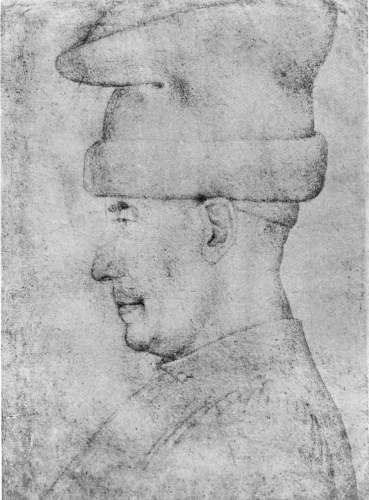
NICCOLÒ PICCININO 1380-1444
Reduced from Giraudon’s photograph (no. 252) of a drawing, in the Louvre, by Vittore Pisano, better known as Pisanello, (1380?-1451?).
Note 158 page 90. The Pythagoreans supposed the intervals between the heavenly bodies to be determined by the laws of musical harmony. Hence arose the celebrated doctrine of “the music of the spheres” (already referred to by Castiglione in the text, page 63); for in their motion the heavenly bodies 357must each occasion a certain sound or note depending on their distances and velocities, which notes together formed a musical harmony, inaudible to man because he has been accustomed to it from the first and has never had an opportunity to contrast it with silence, or because it exceeds his powers of hearing. Pythagoras himself (died about 500 B.C.) taught his disciples to sing to the accompaniment of the lyre, and to chaunt hymns to the gods and to virtuous men.
Note 159 page 90. As the Italian commentator, Count Vesme, suggests, the author may have meant to say, “shave twice a day.” A weekly visit to the barber may, however, have been usually regarded as sufficient at this time.
Note 160 page 93. In the beginning of his Encomium on Folly (which was well known in Italy when Castiglione wrote The Courtier), Erasmus pretends that, “although there has been no lack of those who, at great cost of oil and sleep, have exalted ... the fourth-day ague, the fly, and baldness, with most tedious praise,” Folly is languishing without a eulogist. Among the works of Lucian (flor. 160 A.D.) there is a brief humourous book in praise of the fly; the philosopher Favorinus (flor. 120 A.D.) is said to have written a eulogy on the fourth-day ague; and there is another on baldness by the early Christian writer, Synesius (flor. 400 A.D.). The men of the Renaissance delighted in similar displays of wit.
Note 161 page 94. The Italian procella (rendered ‘fury’) primarily means a tempest, and is so translated in the earliest French and English versions of The Courtier (estourbillon, storm). The still earlier Spanish version has pestilencia.
Note 162 page 95. The Italian impedito (rendered ‘palsied’) literally means entangled as to the feet.
Note 163 page 96. St. Luke, iv, 8 and 10.
Note 164 page 97. In Æsop’s fable, Asinus Domino Blandiens, an ass receives a sound cudgelling for his efforts to win his master’s favour by caresses that he was ill fitted to bestow.
Note 165 page 100. Titus Manlius,—called Torquatus from the chain (torques) that he took from the body of a gigantic Gaul whom he had slain in single combat,—was a favourite hero of Roman story. The incident referred to here occurred shortly before a Roman victory over the Latins at the foot of Vesuvius. Manlius and his colleague in command had proclaimed that no Roman might engage a Latin singly on pain of death, but a son of Manlius accepted a challenge from one of the enemy, slew his adversary, and bore the bloody spoils in triumph to his father, who thereupon caused the young man to be put to death before the assembled army. Manlius was Consul in 340 B.C.
358
Note 166 page 101. Publius Licinius Crassus Mucianus was Roman Consul in 131 B.C. According to Livy, the incident narrated in the text occurred during an unsuccessful campaign against Pergamus, which ended in Crassus’s voluntary death.
Note 167 page 103. Rome was sacked only the year before The Courtier was first published. Italy had become the plaything of foreign conquest.
Note 168 page 103. Darius III was King of Persia 336-330 B.C. This story about his sword seems to be founded on the following passage in Quintus Curtius Rufus’s History of Alexander the Great: “At the beginning of his reign, Darius ordered his Persian scabbard to be altered to the form which the Greeks used; whereupon the Chaldeans prophesied that the empire of the Persians would pass to those whose arms he had imitated.”
Note 169 page 104. It will be remembered that Bembo was a Venetian.
Note 170 page 104. The coif (cuffia) here mentioned seems to have been a kind of turban made of cloth wound about the head, with the two ends hanging at the ears.
Note 171 page 105. These unfortunate creatures still abound near Bergamo.
Note 172 page 106. Pylades and Orestes, like Pirithous and Theseus, are the famous friends of Greek legend. The historical and no less tender love between Scipio and Lælius forms the subject of Cicero’s De Amicitia. See note 102.
Note 173 page 109. The fellow’s reward is said to have been a measure of the peas.
Note 174 page 109. The Italian phrase here rendered ‘goes against the grain’ is non gli avrà sangue (more usually non ci avrà il suo sangue), and might be more precisely translated ‘will not suit his humour.’ The ‘as we say’ suggests that the idiom was of recent origin in Castiglione’s time.
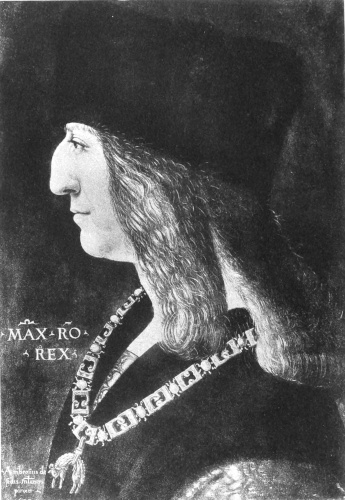
MAXIMILIAN I EMPEROR OF GERMANY 1459-1519
Reduced from Braun’s photograph (no. 34.074) of the portrait, in the Imperial Museum at Vienna, by Ambrogio da Predis (flor. 1500). In Morelli’s “Italian Painters” (London: 1892), pp. 180-9, the picture is described as injured by restoration. See note 390.
Note 175 page 113. Giacopo Sannazaro, (born 1458; died 1530), was a native of Naples, and the son of Giacopo Niccolò and Masella di San Magno. His boyhood was spent with his mother at San Cipriano, near her birthplace Salerno. He soon made such progress in Latin and Greek that he was admitted to the academy of the famous Pontormo, of whom he became the close friend. Their effigies may be seen together in the Neapolitan church of Monte Oliveto. He received a villa and a pension from the scholarly Aragonese dynasty, to which he remained faithful with pen and sword, following Federico III into exile (see note 401) in 1501, and returning to Naples only after his king’s death in 1504. He seems to have had a peaceful and honourable old 359age, active in works of piety and charity, and employing his leisure in study and in the society of a certain noble lady for whom he had formed a lasting Platonic friendship. His writings include marine eclogues, elegies, etc., in Latin, but his best known work is L'Arcadia, an Italian prose romance interspersed with verse, of which sixty editions are said to have appeared before 1600. It is regarded by Mahaffy as having originated the idea that the Greek Arcadia was the especial home of pastoral poetry, and probably served Sidney as a model for his poem of the same name. Hardly less famous were Sannazaro’s anti-Borgian epigrams, to which Symonds ascribes no small part of the gruesome legend of Lucrezia’s crimes. He was buried in a church built by him near the so-called tomb of Virgil, and his monument behind the high altar bears the Latin inscription by Bembo, in which he is described as “near alike to Virgil’s muse and sepulchre.”
Note 176 page 113. Motet is “a term which for the last three hundred years has been almost exclusively applied to certain pieces of church music, of moderate length, adapted to Latin words (selected, for the most part, either from Holy Scripture, or the Roman office-books), and intended to be sung at high mass, either in place of, or immediately after, the Plain Chaunt Offertorium of the Day.“ (Grove.) The motet was sometimes founded on the air of some non-sacred song, as in the case of Josquin’s Stabat Mater, which was based upon the ballad Comme Femme. (Ambros.)
Note 177 page 113. Josquin (more properly Josse) de Près, (born about 1450; died 1521), seems to have been a native of St. Quentin, Hainault, Belgium, and was one of the celebrated musicians of the Renaissance. Having been the pupil of Ockenheim, the greatest composer of the day, he was at the papal court of Sixtus IV, and successively in the service of Lorenzo de' Medici, Louis XII of France, and the Emperor Maximilian I. He returned to Italy about 1503 and lived at the court of Ferrara. He is the earliest composer whose works are preserved in such quantity as adequately to present his power, and was called “the father of harmony” by Dr. Burney. Music began to be printed (1498) when Josquin was in his prime.
Note 178 page 114. Other contemporary evidence amply confirms this account of the occasional grossness that marked the table manners of the period.
Note 179 page 115. The two princes here referred to are Ferdinand the Catholic of Spain (see note 392) and Louis XII of France (see note 250).
Note 180 page 116. Paolo Niccolò Vernia, called Nicoletto (little Nick) from his shortness of stature, (died 1499), was a native of Chieti, near the Adriatic. He probably studied at Padua, and remained there teaching physics, although in 1444 he took his degree in philosophy, and fourteen years later in medicine. He wrote chiefly on philosophy, but was noted also as a wit.
360
Note 181 page 116. “When Frederick Barbarossa attempted to govern the rebellious Lombard cities in the common interest of the Empire, he established in their midst a foreign judge, called ‘Podestà,’ quasi habens potestatem Imperatoris in hac parte.... The title of ‘Podestà’ was subsequently conferred upon the official summoned to maintain an equal balance between the burghers and the nobles.” Symonds’s “Renaissance in Italy,” ed. 1883, i, 61.
Note 182 page 117. This was the battle of Fornovo (6 July 1495), in which the Italian forces under the Marquess Gianfrancesco Gonzaga of Mantua failed to prevent the retreat of Charles VIII towards France. Both sides claimed a victory, and the marquess even went so far as to have it commemorated by Mantegna in a picture, “The Madonna of Victory” (Louvre), which contains his portrait. Castiglione’s father died from the effect of wounds received in this battle.
Note 183 page 117. The reference here is plainly to Leonardo da Vinci (see note 96). His contemporaries would naturally regard as chimerical such devices as steam cannon, paddle wheels for boats, and flying machines, or such hints as that contained in his Codex Atlanticus, where he suggests the possibility of steam navigation. “He was the first to explain correctly the dim illumination seen over the rest of the surface of the moon when the bright part is only a thin crescent. He pointed out that when the moon was nearly new, the half of the earth which was then illuminated by the sun was turned nearly directly towards the moon, and that the moon was in consequence illuminated slightly by this ‘earthshine,’ just as we are by moonshine. This explanation ... tended to break down the supposed barrier between terrestrial and celestial bodies.” Arthur Berry’s “Short History of Astronomy” (London, 1898), p. 91.
Note 184 page 118. Suetonius mentions this characteristic of Cæsar.
Note 185 page 119. This is one of the few passages in The Courtier that are plainly reminiscent of Dante, who says: “To that truth which hath the face of falsehood, man must ever close his lips” (Sempre a quel ver che ha faccia di menzogna, De' l’uom chiuder la labbra). Inferno, xvi, 124-5.
Note 186 page 121. The translator admits being at a loss to find an adequate equivalent for the Italian argusie. Our unfamiliar English adjective ‘argute’ suggests that kind of pungent and witty conceits which Castiglione is describing.
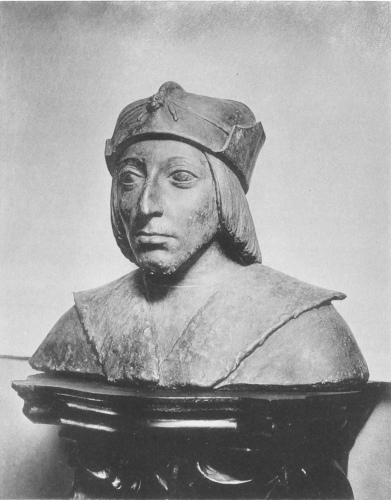
CHARLES VIII OF FRANCE 1470-1498
Reduced from Alinari’s photograph (no. 2749) of the anonymous bronze bust in the National Museum at Florence. See note 388.
Note 187 page 121. Bibbiena’s reputation as a wit was well established, while Canossa seems also to have deserved the same epithet, if we may judge from a story that has been preserved of him. The count had at Rome a fine collection of silver plate, including a flagon with a lid in the form of a tiger. A friend having borrowed this flagon and kept it for two months, returned it 361only on demand and with the request that the count lend him a certain salt-cellar, which had a crab for a cover. Ludovico sent word that if the tiger, which is the swiftest of beasts, had been two months coming home, the crab, being slower than all others, would by the same rule be absent for years, and that on this account he was unwilling to let it go.
Note 188 page 122. The allusion is of course to Bibbiena’s early baldness.
Note 189 page 122. Cardinal Galeotto della Rovere, (born about 1477; died 1508), was the favourite nephew of Julius II, being a son of the pope’s sister Luchina by her first husband Gianfrancesco Franciotti, a patrician of Lucca. Like all his mother’s other children, he was adopted as of the della Rovere name. Having been made Bishop of Lucca, he was created a cardinal on his uncle’s election as pope, appointed pontifical vice-chancellor, and soon given a great number of benefices. Generous and amiable, and a patron of artists and authors, he was much beloved at the court of Urbino, as is shown by several documents, among which is a letter by Emilia Pia mentioning two sonnets of his, in one of which (written the day before his last illness) he foretold his early death.
Note 190 page 123. Giacomo Sansecondo, a noted musician who flourished between the years 1493 and 1522 at the courts of Milan, Mantua, Ferrara, Urbino and Rome, where he attained a wide celebrity in the pontificate of Leo X. He seems to have ended his days in adversity, in some degree relieved by his friend Castiglione, whose letters contain several affectionate mentions of him.
Note 191 page 124. Democritus, (flor. 400 B.C.), was the atomistic philosopher of Abdera in Thrace. He possessed an ample fortune, and his cheerful disposition led him to look on the bright and humourous side of things, a fact taken by later writers to mean that he laughed at the follies of mankind.
Note 192 page 125. The phrase ‘served her in love’ and the conventional relation that it denoted, were drawn from mediæval life and literature north of the Alps, and with some changes survived in Italy during the Renaissance, until the cavalier servente became in the 18th century a recognized institution. Attendance upon the lady at church was a characteristic feature of the cavalier’s service.
Note 193 page 126. Pius III, Francesco Todeschini, (born 1439; died 1503), was a native of Siena and a nephew of the illustrious Æneas Silvius Piccolomini (Pius II). The suddenness of his predecessor Alexander VI's death took the sacred college by surprise, and they unanimously elected their weakest member as pope. His short pontificate of twenty-six days was filled with disturbances, and he was believed to have died from poison.
Note 194 page 126. Antonio Agnello, (died after 1527), belonged to one of the most noted families of Mantua, and seems to have been the son of 362Giulio Agnello and Margarita Crema. Besides being an able man of affairs (employed by the Palæologus rulers of Montferrat), he was a graceful poet, and became the friend of Bembo and Castiglione.
Note 195 page 126. The poet Caius Valerius Catullus, (born about 87 B.C.), was a native of Verona and a friend of Cæsar and Cicero. His extant works include one hundred and sixteen poems, lyric, epigrammatic, elegiac, etc. His 69th Ode is a dialogue between the author and a door.
Note 196 page 127. Pope Nicholas V, Tommaso Parentucelli, (born 1398; died 1455), was a native of Pisa, whence his family were exiled in his infancy. Although his father died when he was nine years old, and in spite of great poverty, he contrived to study at the University of Bologna. Later he served as tutor in the Albizzi and Strozzi families at Florence, thus earning enough money to return and take his theological degree at Bologna. He then entered the service of the archbishop of the latter city, whom he accompanied to Florence, and there became a friend of Cosimo de' Medici and a member of the literary society of the place. In 1443 he was made Bishop of Bologna, and four years later was elected pope, an elevation that he owed solely to his reputation for learning and to the comparatively small esteem in which the office was then held. The humanists were delighted at the election of one of their own number. As pope, he devoted his revenues to maintaining a splendid court, to the rebuilding of the fortifications and palaces of Rome, and to the enrichment of scholars. During his pontificate the city became a work-shop of erudition. He founded the Vatican Library, for which he collected five thousand volumes, and the list prepared by him for Cosimo de' Medici to use in beginning the Library of San Marco, was followed also by Duke Federico of Urbino. He was a small, ugly man.
Nihil Papa Valet, ‘the Pope is good for nothing.’nothing.’
Note 197 page 127. I.e., in the second tale of the Eighth Day.
Note 198 page 127. Calandrino is an unfortunate and very amusing character appearing in the third and sixth tales of the Eighth Day and in the fifth tale of the Ninth Day.
Note 199 page 128. Niccolò Campani, called Strascino, (born 1478; died between 1522 and 1533), was an excellent actor of Sienese rustic comedies and farces, and the author of verses and of a Lament that was very popular in the 16th century. He frequented the court of Leo X, and several of Castiglione’s letters (1521) tell of efforts to secure the actor’s services for the Marquess of Mantua, and of furnishing him with twenty-five ducats, a horse, and a papal pass, for the purpose.
Note 200 page 128. ‘This place,’ i.e., Urbino.
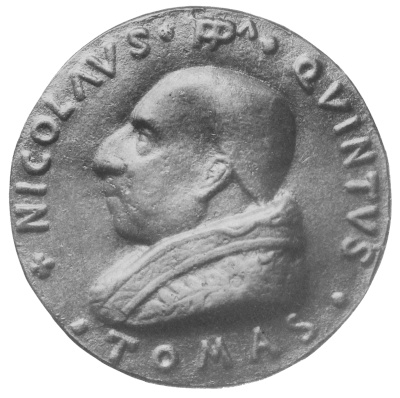
POPE NICHOLAS V TOMMASO PARENTUCELLI 1398-1455
Enlarged from a coloured cast of a medal, in the King’s Library at the British Museum, by Andrea Guazzalotti (1435-1495). See Armand’s Les Médailleurs Italiens, i, 49, no. 6.
Note 201 page 129. The reader will hardly need to be reminded that the 363great Roman orator was often spoken of as Tullius or Tully rather than as Cicero.
Note 202 page 129. When The Courtier was expurgated by Antonio Ciccarelli in 1584 (see List of Editions), Dante’s name was here substituted for that of St. Paul. The word becco (rendered ‘he-goat’) has long been used by the Italians as a term of jocose reproach applied to a man whose wife is unfaithful.
Note 203 page 129. Duke Ercole I d'Este, (born 1431; died 1505), was the legitimate son of Duke Niccolò III and Rizzarda di Saluzzo. Bred at the Neapolitan court, he became Duke of Ferrara on the death of his half-brother Borso (see note 149) in 1471. In 1473 he married Eleanora of Aragon, daughter of Ferdinand I of Naples. Among the six children of this union were: Isabella, who became Marchioness of Mantua (see note 397); Beatrice, who became Duchess of Milan (see note 398); Alfonso, who married Lucrezia Borgia and succeeded his father as duke; and the Cardinal Ippolito already mentioned (see note 64). Although his reign was far from peaceful, his court was noted for its luxury and for the brilliancy of art and letters with which it was adorned. He was an especial patron of the theatre, no less than five comedies of Plautus being performed during the wedding festivities of his son Alfonso in 1502. On the other hand, he maintained relations with Savonarola, who was a native of Ferrara.
Note 204 page 130. Castellina was a small walled town in the Chianti hills, which was held as a Florentine outpost against Siena. The siege referred to in the text took place in 1478, when the place capitulated to the Neapolitan and papal troops after holding out for forty days. Duke of Calabria was the title regularly borne by the heir of each Aragonese king of Naples. The personage here meant must have been Alfonso the Younger (see note 31).
Note 205 page 130. While the meaning is not free from doubt, the point of the story seems to lie in the absurdity of the Florentine’s supposing that after being discharged from a cannon, a projectile would retain any poison previously applied to it.
Note 206 page 130. It will be remembered that Bembo was a Venetian, while Bibbiena’s birthplace was a Florentine town.
Note 207 page 130. This war lasted from 1494 to 1509, and proved ruinous to both sides. Castiglione’s use of the past tense in speaking of it here doubtless arose from the fact that he was writing several years after the date that he assigns to the dialogues.
Note 208 page 131. Pistoia and Prato were two small cities which lay to the north-west of Florence and were subject to its rule. Modern issues of 364“fiat” money are but a slight modification of the method proposed by the worthy Florentine.
Note 209 page 131. Bucentaur was the name of the state galley of the Venetian Republic, used (among other occasions) in the symbolic ceremony of wedding the Adriatic, which was enjoined upon the Venetians by Alexander III (pope 1159-1181) to commemorate their victory over the fleet of Frederick Barbarossa. On each Ascension Day a ring was dropped from the Bucentaur into the Adriatic, with the words, “we espouse thee, sea, in token of true and lasting dominion.” The vessel bore the image of a centaur as figure-head. Of the last of several successive Bucentaurs (demolished in 1824), a few fragments are preserved in the Arsenal at Venice. In the 15th and 16th centuries the name was applied to state vessels of ceremony elsewhere. By some the word is supposed to be derived from the Greek βοῦς (ox) and κένταυρος (centaur); by others it is regarded as a corruption of the Latin ducentorum (of two hundred oars), or of the Italian buzino d’oro (golden bark).
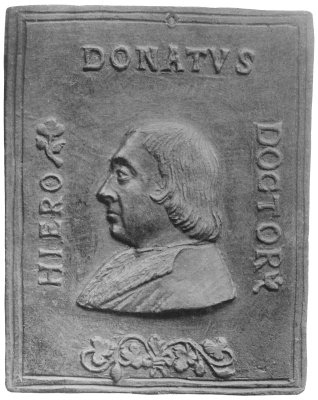
GIROLAMO DONATO 1457-1511
Enlarged from a photograph, courteously furnished by the Director of the Municipal Art Museum at Milan, of a small anonymous bas-relief belonging to the Taverna collection. See Armand’s Les Médailleurs Italiens, ii, 226, no. 11.
Note 210 page 133. This tale, not unworthy of Munchausen, may have been suggested to Castiglione by a passage in one of the minor works of Plutarch, who relates that Antiphanes (a friend of Plato) said that “he visited a certain city where words froze as soon as spoken, by reason of the great cold; and later, sounds uttered in winter melted in the spring and were heard by the inhabitants.” Although Plutarch represents the story as told in illustration of the way in which “those who came as young men to listen to Plato’s talk, understood it only long afterwards, when they had grown old,” it is worth noting that an Antiphanes, of Berga in Thrace, is known as a writer on the marvellous and incredible.
Note 211 page 133. Vasco da Gama rounded the southern extremity of Africa and reached India nine years before the date of the Courtier dialogues.
Note 212 page 133. This must have been Emanuel I, who was King of Portugal from 1495 until his death in 1521, and who promoted the expeditions of da Gama and other Portuguese navigators.
Note 213 page 134. Taffety was a very light soft silk fabric. There is extant a letter of Bembo’s (1541), in which the aged cardinal orders two cushions filled with swan’s down and covered with crimson taffety. The word is said to be derived from the Persian taftah (twisted, woven). Taft is the name of a town in central Persia.
Note 214 page 134. Annibal Paleotto, (died 1516), belonged to an ancient and honourable Bolognese family (with which Castiglione is known to have been on friendly terms), and was the son of an eminent jurist, Vincenzo Paleotto, who died in 1498. Leo X made Annibale a senator of Bologna in 1514, the brief being written by Bembo.
365
Note 215 page 135. Giacopo di Nino was Bishop of Potenza from 1506 until 1521, and seems to have been a butt for the ridicule of Leo X's court.
Note 216 page 136. An earlier version of this passage reads: “And of this kind was what Rinaldo in the Morgante said to the Giant: ‘Where do you hang your spectacles?’” The Morgante Maggiore is a serio-burlesque romantic poem by Luigi Pulci (1431-1487), introducing, among other characters of mediæval romance, Rinaldo, his cousin Orlando, and the giant Morgante.
Note 217 page 136. Galeotto Marzi da Narni, (born about 1427; died about 1490), a singular example of the adventurer-humanist, studied at the universities of Padua and Bologna, and taught at the latter place. He twice visited the court of Matthias Corvinus of Hungary, for whom he wrote a book on jests. He was something of an astrologer and also the author of a work on chiromancy. Being accused of heresy, he was imprisoned at Venice in 1477, and condemned to make public recantation in the Piazzetta with a crown of devils on his head. He is said to have been learned and witty. The story given in the text became almost proverbial.
Note 218 page 136. The present form (bisticcio) of bischisso (rendered ‘playing on words’) has a meaning somewhat different from that indicated in the text,—being the term applied to a succession of words the similarity of whose sound renders them difficult to pronounce, e.g., “Peter Piper picked a peck of pickled peppers.”
Note 219 page 136. At this time the general use of family names was comparatively recent, and their form was somewhat variable. Thus, such surnames as Pio and Fregoso were treated as still being, what they doubtless originally were, merely personal epithets, and so were given the feminine form (Pia, Fregosa) when applied to women. The adjective pia means dutiful, pious, kind, while impia or empia of course means the reverse.
Note 220 page 136. “The greatest of the Furies is my bedfellow.” With a change of one syllable in the Latin, this becomes Furiarum maxima juxta accubat (“The greatest of the Furies lies hard by”), Æneid, V, 605-6.
Note 221 page 136. Geronimo Donato, (born 1457; died 1511), was a native of Venice, where he held many public offices, besides being sent abroad as ambassador of the Republic, especially to the courts of Alexander VI and Julius II. He also enjoyed no small fame as a cultivator of science, art and letters (particularly Greek and theology). The incident narrated in the text occurred during his embassy to Alexander, to whom on another occasion he made a far wittier retort. Being jestingly asked by the pope where Venice got its right of lordship over the Adriatic, he answered: “Let your Holiness show me the title deed to the Patrimony of St. Peter, and on the back of it will 366be found inscribed the grant to the Venetians of their dominion over the Adriatic.”
Note 222 page 136. In the Roman Church a “station” (stasione) is a church where indulgences are granted at certain seasons. In earlier times such churches were visited in solemn procession, which afterwards came to be regarded as an opportunity for social recreation. The word is used also to designate the indulgences earned by visiting, on appointed days, many churches founded by popes.
Note 223 page 136. “As many stars as heaven, so many girls hath thy Rome,” Ovid’s Ars Amandi, I, 59.
Note 224 page 136. “As many kids as the pasture, so many satyrs hath thy Rome,” is as close an English rendering as Donato’s Latin will bear.
Note 225 page 136. Marcantonio della Torre belonged to an ancient noble family of Verona, was a famous anatomist, and is said to have included Leonardo da Vinci among his pupils. He died at the age of thirty, and was highly praised for his learning. His father Geronimo lectured on medicine at Padua.
Pietro Barozzi became Archbishop of Padua in 1487, and died in 1507. Bandello (who had read The Courtier in MS.) relates the same story in somewhat wittier form, but gives the name of the prelate as Gerardo Landriano, Bishop of Como.
Note 226 page 137. St. Luke, xvi, 2.
Note 227 page 137. St. Matthew, xxv, 20.
Note 228 page 137. Proto da Lucca was one of the most famous buffoons who enlivened the pontifical court at the beginning of the 16th century. If, as seems probable, the incident in question occurred in January 1506 (when Bernardino Lei died and was succeeded by Antonio da Castriani as Bishop of Cagli, a town near Urbino), the pope in question must have been Julius II, to whom the epithet ‘very grave’ would be entirely appropriate.
Note 229 page 138. The play is upon the word ‘office’ in its two meanings of post or employment, and breviary or prayer-book. In the latter sense, the ‘full office’ contained the psalms, lessons, etc.,—while the ‘Madonna’s office’ was much abbreviated.
Note 230 page 138. Giovanni Calfurnio, (born 1443; died 1503), was a gentle and laborious humanist, born at or near Bergamo, but long resident at Padua, where he held the chair of rhetoric. His chief work consisted in correcting and commenting upon the texts of Latin poets. The ‘another man at 367Padua’ was probably Raffaele Regio (a fellow professor with Calfurnio), who publicly ridiculed his colleague as the son of a charcoal-burner. Calfurnio seems to have published very little; on his death he bequeathed his library to the church of San Giovanni in Verdara, from which his tomb and portrait relief have recently been removed to a cloister of the monastery of St. Antony at Padua.
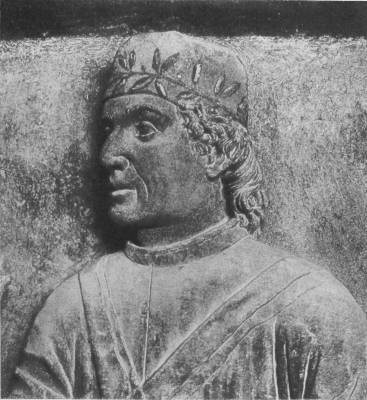
GIOVANNI CALFURNIO Died 1503
From a photograph, specially made by Agostini, of the anonymous tomb relief removed from the Church of San Giovanni di Verdara to a cloister in the Monastery of Sant'Antonio at Padua.
Note 231 page 138. Tommaso Inghirami, “Fedra,” (born 1470; died 1516), was a native patrician of Volterra (a town about midway between Pisa and Siena), being the son of Paolo Inghirami and Lucrezia Barlettani. Having passed his early boyhood at Florence, he removed to Rome in 1483, where he played the part of Phædra in Seneca’s tragedy Hippolytus (upon which Racine founded his Phèdre) with such success that the name clung to him for life. The play being interrupted by an accident to the scenery, he filled the interval by improvising Latin verses for the entertainment of the audience. The performance took place in the mausoleum of the Emperor Hadrian, which was afterwards converted into the fortress known as the Castle of St. Angelo. Tommaso was employed by Alexander VI in diplomatic affairs, crowned poet by the Emperor Maximilian I, and made a canon of the Lateran and of the Vatican. He seems to have been connected with the Vatican Library as early as 1505, and became its prefect. Although Erasmus called him the Cicero of his time, his fame now rests rather on his portrait in the Pitti Gallery at Florence, than on his works.
Note 232 page 138. Camillo Paleotto was a brother of the Annibal Paleotto already mentioned (see note 214). On his father’s death in 1498, he went to Rome, where he became the friend of Federico Fregoso, Bembo and Castiglione. He taught rhetoric at Bologna and was Chancellor of the Senate there. There also he is said to have died in 1530, although a letter of Bembo’s speaks of him in 1518 as then already dead.
Note 233 page 138. Antonio Porcaro, or Porzio, belonged to a noble Roman family, and was a brother of the Camillo Porcaro mentioned in The Courtier (at page 140). He had also a twin brother Valerio, whom he so closely resembled that the two were often mistaken, one for the other, as Bibbiena says in the preface to his Calandra,—the plot of which is founded upon a similar resemblance. Little more is known of Antonio than that he suffered some grievous wrong from Alexander VI.
Note 234 page 138. Regarding Giantommaso Galeotto, Cian furnishes no information. The Spanish annotator, Fabié, adds Marcio (Marzio) to his name,—thus apparently treating him as identical with the Galeotto da Narni mentioned above at page 136,—and says that he “died, by reason of his great corpulence, from a fall from his horse, being in the train of Charles VIII of France, when the latter entered Milan.” As “My lord Prefect” was only four years old when Charles entered Milan in 1494, this identification seems clearly erroneous.
368
Note 235 page 139. Filippo Beroaldo, (born 1472; died 1518), belonged to a noble Bolognese family. Having been one of his famous uncle Filippo the elder’s most brilliant pupils in the classics, he was at the age of twenty-six made professor of literature at Bologna, and afterwards at Rome. In 1511 he successfully defended Duke Francesco Maria of Urbino against the charge of murdering Cardinal Alidosi. Instead of seeking to extenuate the deed, as done in heat and under strong provocation, he boldly justified it on the ground that his client was the instrument chosen by the Almighty to rid the world of a monster of wickedness, and eloquently appealed to the tribunal to spare a hero whose promise of future usefulness was precious to Italy. Beroaldo was secretary to Cardinal Giovanni de' Medici, and on the latter’s election as pope, he was made Provost of the Roman Academy, while at Inghirami’s death he was made Librarian of the Vatican, as a reward for editing the recently discovered first five books of Tacitus’s Annals. He died at Rome, partly (it is said) from vexation at not being paid the stipend of his office. Bembo wrote his epitaph. Although he was celebrated for erudition and eloquence rather than for authorship, he left three books of odes, and one of epigrams,—in Latin.
Note 236 page 139. The pupil obviously used the phrase in its low Latin meaning, “Master, God give you good evening.” Beroaldo jocosely accepted it in its classical meaning, “Master, God give you good, late.”
Note 237 page 139. “Evil to thee, soon.”
Note 238 page 139. Diego de Chignones, (died 1512), was a Spanish cavalier, of whom Branthôme writes as follows: “This Great Captain had for lieutenant, with a company of one hundred men-at-arms, Don Diego de Quignones, who supported him in his combats and victories, and was truly a good and brave lieutenant to him. After the Great Captain’s death, he had sole command of his company of an hundred men-at-arms, as he well deserved to have. He commanded it at the battle of Ravenna, where he died like a brave and valiant captain. And if all had behaved as he did (say the old Spaniards), the victory that the French won there would have cost them dearer than it did, although it cost them dear.”
Note 239 page 139. Don Gonzalvo Hernand y Aguilar, better known as Consalvo de Cordoba, or The Great Captain, (born 1443; died 1515), was a native of Montilla, near Cordova, and belonged to an ancient family of Spanish grandees. His father’s name was Pietro, and his mother’s was Elvira Errea. Bred to war in early youth and knighted on the field of battle at the age of sixteen, he followed the fortunes of Ferdinand the Catholic, and took an active part in the conquest of Granada. In 1494 he was sent to Italy to aid Ferdinand II of Naples against Charles VIII, won a long succession of victories over the French, and was finally made Constable and Viceroy of Naples. Later, Ferdinand the Catholic, listening to slanderous reports regarding 369him, deprived him of office, and in 1507 recalled him to Spain, where he died in disgrace. His good qualities were much admired by Castiglione, who had fought against him, but his fame was not unstained by acts of cruelty and bad faith, which (it is fair to say) were common at the time and seem to have been committed only against his master’s foes. Giorgione is said to have painted his portrait at Venice, and a life of him by Paolo Giovio was published at Florence in 1552.
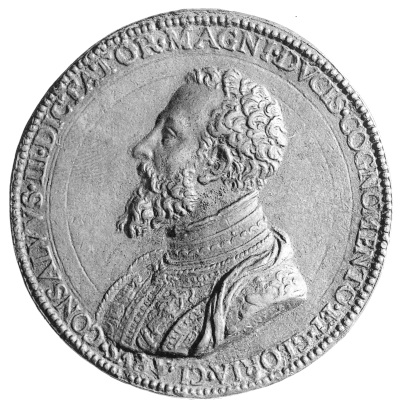
CONSALVO DE CORDOBA “THE GREAT CAPTAIN” 1443-1515
Enlarged from a negative, specially made by Alinari through the courtesy of Professor I. B. Supino, of Annibal’s medal in the National Museum at Florence. See Armand’s Les Médailleurs Italiens, i, 176.
Note 240 page 139. The Spanish word vino means not only “wine” but also “he came.” In pronunciation it would be easily mistaken for Y-no. Y no lo conocistes is the Spanish for “And thou knewest Him not.” Compare St. John, i, 11.
Note 241 page 139. The word marano (here rendered “heretic”) meant a renegade Moor, and is said by Symonds to have been generally used in Italy at this time as a term of reproach against Spaniards.
Note 242 page 139. Giacomo Sadoleto, (born 1477; died 1547), was a native of Modena and the son of a noted jurist, Giovanni Sadoleto. He studied Latin at Ferrara and Greek at Rome, where he settled in the pontificate of Alexander VI and acquired a great reputation for learning. Leo X appointed him a secretary at the same time with Bembo, (who shared with him the name of being the best Latinist of the day), and soon made him Bishop of Carpentras, a town fifteen miles north-east of Avignon. He was secretary also to Clement VII, to whom he boldly declared that the sack of Rome (1527) was inflicted by God as a punishment for human wickedness. Paul III created him a cardinal in 1536. A sincerely pious man, he was conscious of the evils of the Church and did not escape suspicion of heresy. He was a close friend of Vittoria Colonna, and the Roman Academy often met at his house on the Quirinal. Besides Latin poems (one of which, on the newly discovered Laocoön group, made him famous), his works include commentaries on the Psalms and the Epistle to the Romans, and a Latin exhortation to the princes and people of Germany against Lutheran heresies. Although far from rich, he was very charitable, especially in providing young men of his flock with the means of education.
Note 243 page 139. Ludovico da San Bonifacio is identified by Cian as a Paduan, who held the offices of prothonotary and private chamberlain under Leo X, successfully disputed with Bembo the possession of a canonry at Padua in 1514, was sent to different courts by Leo, and died at Padua in 1545.
Ercole Rangone, (died 1572), belonged to an illustrious family of Modena, and achieved some note as a soldier and diplomatist, having commanded the Florentine forces in 1529, and served as Ferrarese ambassador to France, Spain and Germany. He was esteemed by Castiglione, of whose wife Ippolita Torello he seems to have been a kinsman.
The Count of Pepoli probably belonged to a noble Bolognese family of that name, but has not been identified with certainty.
370
Note 244 page 140. Of Sallaza dalla Pedrada nothing seems to be known beyond the mention of him in the text.
Note 245 page 140. Palla degli Strozzi, (born 1372; died 1462), was a wealthy and cultivated Florentine patrician. Having honourably filled high offices of state, he was banished by Cosimo de' Medici in 1434 for ten years to Padua. Himself an enthusiastic scholar and patron of classical studies, he caused many Greek MSS. to be brought into Italy (including works of Plato, Aristotle and Plutarch), and was the first Italian to collect books for the express purpose of founding a public library, in the execution of which design he was prevented by his exile from anticipating Cosimo. He employed learned Greeks to read to him, and was instrumental in inducing Chrysoloras to teach at Florence,—an engagement regarded by Symonds as having secured the future of Hellenic study in Europe. The story narrated of him in the text is elsewhere told of an exile belonging to the Albizzi family.
Note 246 page 140. Cosimo de' Medici, Pater Patriæ, (born 1389; died 1464), was a Florentine banker, statesman and patron of literature and art. In his father Giovanni’s house of business he cultivated the rare faculty for finance that he afterwards employed in public administration and private commerce. He inherited his father’s vast fortune in 1429, and made it a practice to lend money to needy citizens and at the same time to involve the affairs of Florence with his own,—thus not only attaching individuals to his interests, but rendering it difficult to control state expenditures apart from his own bank. He understood also how to use his money without exciting jealousy, and while he spent large sums on public works, he declined the architect Brunelleschi’s plans for a residence more befitting a prince than a citizen. He was an early riser, and temperate and simple in his life. While ruling Florence with despotic power, he seemed intent on the routine of his counting-house, and put forward other men to execute his political schemes. Despite occasional checks, he so firmly established the influence of his family as the real rulers of Florence that they were not permanently expelled until the nineteenth century. Much of his power was due to sympathy with the intellectual movement of the age, and although he was not a Greek scholar, he had a solid education, and collected MSS., gems, coins and inscriptions, employing his commercial agents in the work. During a year of exile, he built a library at Venice, and later he built one at Florence and another at Fiesole. His house was the centre of a literary and philosophical society, which included all the wits of Florence and the strangers who flocked to that capital of culture.
Note 247 page 140. Camillo Porcaro, or Porzio, (died 1517), was a brother of the Antonio Porcaro already mentioned in The Courtier (at page 138; see note 233). He was a professor of rhetoric at Rome, and a canon of St. Peter’s. Leo X made him Bishop of Teramo, a town near the Adriatic north-east of Rome. He was a member of the Roman Academy, and some of his Latin verse has survived.
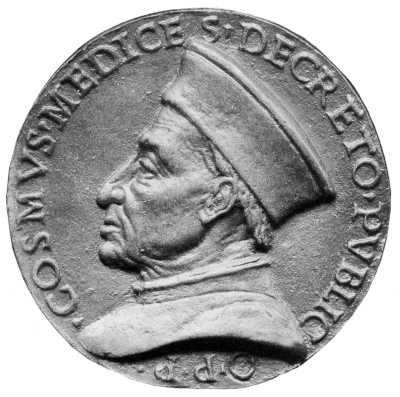
COSIMO DE' MEDICI PATER PATRIÆ 1389-1464
Enlarged from a coloured cast of a medal (no. 31), in the King’s Library at the British Museum, attributed to Niccolò Fiorentino.
371
Note 248 page 140. Marcantonio Colonna, (died 1522), the son of Pierantonio Colonna and Bernardina Conti, was a second cousin of Vittoria Colonna. His wife Lucrezia Gara della Rovere was a niece of Julius II and sister of the Cardinal Galeotto della Rovere already mentioned (at page 122; see note 189). In 1502 he fled from Rome to escape the persecution of the Borgias, repaired to the kingdom of Naples, and took service under the “Great Captain.” He served also in the armies of Julius II, Maximilian I, and Francis I, and took part in nearly all the wars of his time. He was cited as a model of physical beauty and martial prowess.
Note 249 page 141. Diego Garzia is regarded by the Spanish annotator, Fabié, as identical with the famous warrior Diego Garcia de Paredes, (born 1466; died 1530), who began the life of a soldier at the age of twelve, and had a brilliant share, with the “Great Captain,” in the expulsion of the Moors from Spain and later in the Italian campaigns. He was a man of great height and strength, and is said on one occasion to have stopped the wheel of a rapidly moving wind-mill with his single hand. Charles V made him a Knight of the Golden Spur, and he is often called the Chevalier Bayard of Spain.
Note 250 page 141. Louis XII, (born 1462; died 1515), was the son of Duke Charles d'Orléans and Anne of Cleves. He accompanied Charles VIII into Italy in 1494, became king on his cousin’s death in 1498, and the following year married Charles’s widow Anne of Brittany. In 1500 he expelled Duke Ludovico Sforza of Milan, to whose duchy he laid claim as the grandson of Valentina Visconti. The following year he conquered Naples in alliance with Ferdinand the Catholic, but quarrelled with his ally over the division of the country, with the result that his force was defeated by the “Great Captain” at Garigliano in 1503, and withdrew from Naples in 1504. He joined the League of Cambray against Venice in 1508, but in 1511 the Holy League was formed against him, and in 1513 the French were again compelled to leave Italy. On the death of Anne of Brittany in 1514, he married Mary, the youthful sister of Henry VIII of England, to whom in dying (1 January 1515) he is reported to have said: “Dear, I leave thee my death as a New Year’s gift.” He was sincerely regretted by his subjects, and was known as “The Father of His People.” Michelet says of him: “He was a good man, honest by nature, sometimes absurd, indiscreet, talkative, testy; but he had a heart, and the only way for men to flatter him was to persuade him that they desired the good of his subjects.” Among his sayings was “Good king, stingy king; I prefer to be ridiculous to my courtiers, than deaf to my people.”
Note 251 page 141. Djem or Zizim, (born 1459; died 1495), was a son of Mahomet II, the conqueror of Constantinople. On the death of his father in 1481, he tried to dispossess his brother as sultan, but being defeated, he sought refuge at Rhodes, where the Knights of the Order of St. John received him for a while, and then sent him to France. In 1489 he was surrendered to the custody of Innocent VIII, from whom he passed into the hands of Alexander VI. 372Both these pontiffs received a subsidy for his maintenance from his brother the sultan. In 1495 Charles VIII took him to Naples, where he was imprisoned and soon died from the effect (it is supposed) of poison administered at Rome by order of Alexander VI. Of his life at the papal court, we get the following glimpse in a letter from Mantegna to the Marquess of Mantua: “The Turk’s brother is here, strictly guarded in the palace of his Holiness, who allows him all sorts of diversion, such as hunting, music, and the like. He often comes to eat in this new palace where I paint [i.e., the Belvedere], and, for a barbarian, his manners are not amiss. There is a sort of majestic bearing about him, and he never doffs his cap to the Pope, having in fact none;... He eats five times a day, and sleeps as often; before meals he drinks sugared water like a monkey. He has the gait of an elephant, but his people praise him much, especially for his horsemanship: it may be so, but I have never seen him take his feet out of the stirrups, or give any other proof of skill. He is a most savage man, and has stabbed at least four persons, who are said not to have survived four hours. A few days ago, he gave such a cuffing to one of his interpreters that they had to carry him to the river, in order to bring him round. It is believed that Bacchus pays him many a visit. On the whole he is dreaded by those about him. He takes little heed of anything, like one who does not understand or has no reason. His way of life is quite peculiar; he sleeps without undressing, and gives audience sitting cross-legged, in the Parthian fashion. He carries on his head sixty thousand yards of linen, and wears so long a pair of trousers that he is lost in them, and astonishes all beholders.”
Note 252 page 141. The Grand Turk in question was Bajazet II, (born 1447; died 1512), who succeeded his father (Mahomet II, the conqueror of Constantinople) in 1481, was almost uninterruptedly engaged in war with Hungary, Venice, Egypt and Persia, was deposed by his son Selim, and died soon afterwards. He was repeatedly invited by Alexander VI to invade Europe and fight the pope’s Christian enemies. The friendly relations between the two were closely connected with the captivity of Bajazet’s brother, just mentioned. As a token of his gratitude, the Turk sent Innocent VIII the “Lance of Longinus,” the centurion who was supposed to have pierced the Saviour’s side on Calvary and afterwards to have been converted to Christianity. As a reward for the death of his brother, he sent Alexander VI a sum of money equivalent to over £500,000 sterling, and a tunic alleged to have been worn by the Saviour. These, however, were intercepted by the pope’s enemy, Giuliano della Rovere, afterwards Julius II.
Note 253 page 142. The Archbishopric of Florence was occupied by Roberto Folco from 1481 until his death in 1530.
‘The Alexandrian cardinal’ is the name by which Giannantonio di Sangiorgio, (born 1439; died 1509), was commonly known. At the age of twenty-seven he became professor of canon law at Pavia. In 1479 he was made Bishop of Alexandria, and soon afterwards called to Rome and made an 373Auditor of the Ruota (see note 292), which office he continued to hold until he was created a cardinal in 1493. He was regarded as the most eminent jurist of his day.
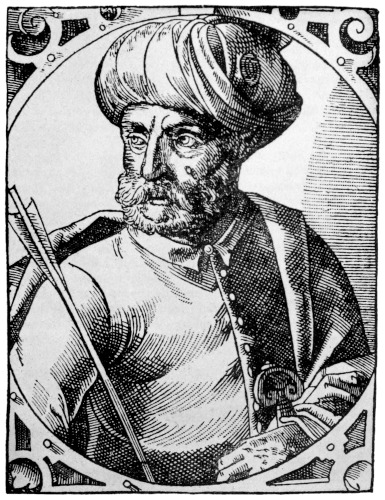
BAJAZET II OF TURKEY 1447-1512
Enlarged, with the courteous permission of the Director of the New York Public Library, from a photographic copy of an engraving in Paolo Giovio’s “Eulogy.”
Note 254 page 142. Besides the mention of this Nicoletto in the text, nothing more seems to be known of him beyond the following anecdote: “Of messer Nicoletto da Orvieto it is narrated that, being in the service of that very courteous pontiff Pope Leo, he once won the lasting favour of his Holiness with only four words; for one day, the talk turning upon a certain vacant benefice which was sought after by a member of the Vitelli family to whom it could be given, he said humourously: ‘Holy Father, fitness requires that it be by all means conferred on Vitello (calf), the more because it has no nearer or closer kinsman than he is,’—playing on the word ‘vacant,’ which he seemed to derive from vacca (cow), the mother of the calf.” Garzoni’s L’Hospidale de’ Pazzi Incurabili, (Piacenza: 1586), page 142.
Note 255 page 142. Antonio Cammelli, (born 1440; died 1502), called Pistoia from the name of his birthplace, was a prolific writer of verse, chiefly sonnets of a humourous and satirical character, which have no small historical value. He spent the larger part of his life in the service of the d’Este at Ferrara, and in that of Duke Ludovico Sforza, of Milan, to whom he remained faithful in adversity. An edition of his verse was published at Turin by Renier in 1888.
The Serafino here mentioned is identified by Cian as a now almost forgotten lyric poet, Serafino Ciminelli, (born 1466; died 1500), who was a native of Aquila (fifty-five miles north-east of Rome), and a welcome guest at the courts of Naples, Rome, Urbino, Mantua and Milan. His verse was by some preferred to that of Petrarch, and the unbounded popularity which he enjoyed was doubtless due to the skill with which he improvised to his own accompaniment on the lute. He was a short ugly man of elfish appearance.
Note 256 page 142. Giovanni Gonzaga, (born 1474; died 1523), was the third son of the Marquess Federico of Mantua and Margarita of Bavaria. He married Laura Bentivoglio, fought in his youth against Charles VIII, and in 1512 was in the service of the Sforza family. He was employed also by his brother Gianfrancesco, Marquess of Mantua, in political negotiations. In 1519, on the death of Lucrezia Borgia, he wrote to his nephew, the new Marquess Federico of Mantua: “Lucrezia’s death occasioned much grief throughout the city, and his Ducal Highness in particular displayed extreme distress. Men here tell wonderful things of her life: for the last ten years she wore a hair shirt; and for two years she has been in the habit of confessing every day, and of attending Communion three or four times a month.”
Note 257 page 142. Giovanni’s son Alessandro Gonzaga was born in 1497, and died in 1527.
Note 258 page 142. Giacomo d’Atri (or d’Adria Picena) was made Count 374of Pianella by Ferdinand II of Naples in 1496, as a reward for faithful service. He acted as confidential secretary to the Marquess Gianfrancesco of Mantua in various wars, and especially in the campaigns against Charles VIII.
Note 259 page 143. Philip II of Macedon, the conqueror of Greece, was born 382 and died 336 B.C.
Note 260 page 143. This retort has by others been ascribed to a Florentine ambassador at Siena, and his name given as Guido del Pelagio.
Note 261 page 144. Mario de’ Maffei da Volterra, (born 1464; died 1537), occupied successively the offices of Archpriest at Volterra, Sacristan of the Vatican, Bishop of Aquino, and Bishop of Cavaillon in France.
Note 262 page 144. Agostino Bevazzano or Beazzano, (flor. 1500-1550), was born at Treviso, near Venice, of which republic his ancestor Francesco had been chancellor in the 15th century. His own portrait hung in the Grand Council Chamber at Venice. He lived some time in Venice, but in 1514 he was employed as secretary by Bembo and sent to Leo X at Rome, where he resided chiefly until 1526. Besides being a noted writer of Italian and Latin verse, he acquired great skill in public affairs and came to be regarded as an oracle at the papal court. Late in life he was painfully afflicted with gout, and passed the last years of his life at Verona and at Treviso, where he died and was buried in the cathedral.
Note 263 page 145. The Marquess Federico Gonzaga of Mantua, (born 1440; died 1484), was the son of the Marquess Ludovico and Barbara of Brandenburg, and married Margarita, daughter of Duke Albert III of Bavaria. His family attained sovereign power at Mantua in 1354 and continued to exercise it for nearly four centuries. Having succeeded to the marquisate on the death of his father in 1478, he expelled from Italy the Swiss who were besieging Lugano, joined the Milanese in a league against the pope in 1479, and in 1482 joined another league against Venice. He is said to have committed suicide.
Note 264 page 145. Niccolò Leonico Tomeo, (born 1456; died 1531), was a native of Venice, and belonged to an Albanian family. He studied Greek under Chalcondylas at Florence, and for many years taught philosophy at Padua, being the first Italian to expound Aristotle from the original text. He wrote philosophical and moral dialogues and also some Italian verse. His friend Bembo wrote of him: “An illustrious philosopher both in life and learning, equally versed in Latin and Greek, wherein he lived and dwelt, leaving ambition and thirst for riches to others.” He was also a wit.
Note 265 page 145. Agostino Foglietta, (died 1527), was a Genoese nobleman, who exercised great authority at Rome under Leo X and Clement VII. 375He was a warm friend of Castiglione, who received cordial aid from him in the efforts that were made on behalf of Francesco Maria della Rovere. He was slain in the sack of Rome by a shot from an arquebuse. In other MS. versions of The Courtier the names of Fedra (Tommaso Inghirami) and Antonio di Tommaso appear in place of Foglietta’s.
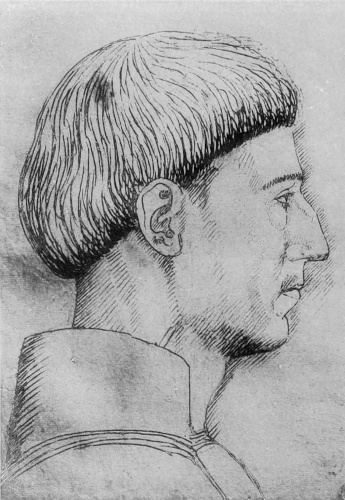
ALFONSO I OF NAPLES 1385-1458
Reduced from Giraudon’s photograph (no. 137) of a drawing, in the Louvre, by Vittore Pisano, better known as Pisanello, (1380?-1451?). The drawing is believed to have been used in designing medals.
Note 266 page 146. Giovanni di Cardona was a Spanish soldier in the service of the “Great Captain” and of Cesare Borgia. He had a brother Ugo (mentioned at page 147, see note 271) and another brother Pedro, who was Count of Gosilano. Giovanni seems to have fallen at the battle of Ravenna in 1512.
Note 267 page 146. Of Alfonso Santacroce nothing more is known than is contained in this mention of him in the text.
Note 268 page 146. Francesco Alidosi, Cardinal of Pavia, (died 1511), was descended from the Lords of Imola, being the second son of the Lord of Castel del Rio. Having been educated for the Church, he attached himself to Cardinal Giuliano della Rovere, whose lasting gratitude he won by steadfastly refusing to poison the cardinal at the desire of Alexander VI. On the accession of Julius II, he was rapidly promoted in spite of the objections raised in the consistory on the score of his questionable character. He was made Bishop of Miletus, Bishop of Pavia, a cardinal (1505), Legate of the Patrimony, Legate of Romagna, and Archbishop of Bologna. In these offices he proved violently tyrannical and a ruthless and bloody persecutor, especially of the Bolognese partisans of the Bentivogli; so that the city rose against him in 1511 and drove him out. His assassination by young Francesco Maria della Rovere has been already mentioned (see note 3). The odium connected with his name finds an echo also in another passage in the text, page 151.
Note 269 page 146. Alfonso I of Naples, (born 1385; died 1458), succeeded his father Ferdinand the Just as King of Aragon and Sicily in 1416, and in 1435 managed to enforce against René of Provence his double claim to Naples, based upon his descent from the former Hohenstauffen rulers of that kingdom, and also upon his adoption as heir by the last Angevin queen of Naples. Scholarly, enlightened, generous and benevolent, he was the ideal type of royal Mæcenas and the hero of his century. He often went afoot and alone about his capital, saying that “a father, walking amid his children, has naught to fear.” On one occasion when a galley full of soldiers and sailors was about to sink, and the men he had ordered to their rescue were hesitating, he leaped into a skiff, crying, “I prefer to be the companion rather than a spectator of their death.” When Constantinople fell into the hands of the Turks in 1453, he welcomed learned refugees to his capital; his court was a meeting-place for the savants of his time; and even when engaged in war, his captains might be seen gathered near their king, listening to his exposition of Livy instead of wasting their leisure at games of chance. He was noted also for his gentle 376disposition and merry humour and seems to have deserved his title of “the Magnanimous.”
Note 270 page 147. The battle of Cerignola (a town in Apulia near Cannæ, the scene of one of Hannibal’s victories) was fought 28 April 1503, between the Spanish army under the “Great Captain” and the French forces of Louis XII, and resulted in the defeat of the latter with the loss of more than half their men.
Note 271 page 147. Ugo di Cardona, a brother of the Giovanni already mentioned, was a Spanish soldier who fought under Cesare Borgia and the “Great Captain,” and was killed by the hand of Francis I at the battle of Pavia in 1525.
Note 272 page 147. This is a corruption of the name of St. Erasmus, a Syrian bishop who suffered martyrdom about 304, and became a favourite saint among the sailors on the Mediterranean. His name is given to certain electrical phenomena often seen at sea and on land also.
Note 273 page 147. Ottaviano Ubaldini, (died 1498), was the son of a famous condottiere, Bernardino Ubaldini, and Aura di Montefeltro, a sister of Duke Federico. His father having died in 1437, he was bred at the court of Urbino and became the trusted counsellor of his uncle Federico, who left to him the guardianship of the young duke, Guidobaldo. To personal valour and address in statecraft he united (if we may trust the rhymed chronicle of Raphael’s father) a knowledge of classic literature, and a taste for music and the other fine arts. He is known to have been a zealous cultivator of astrology. By some writers Duke Federico (the circumstances of whose birth were not free from mystery) was believed to have been an Ubaldini, and this Ottaviano was openly regarded as his brother.
Note 274 page 147. Antonello da Forli was a soldier of fortune who died before May 1488, and of whom little seems to be known apart from this anecdote. It is found also in two other books, where the witty Florentine is named as Cosimo de’ Medici.
Note 275 page 147. San Leo was a fortress perched on an almost inaccessible crag eighteen miles north-west of Urbino. It is mentioned by Dante (Purgatorio, iv, 25) and also by Machiavelli (Art of War, iv) as a place of great natural strength. When in the spring of 1502 Cesare Borgia disclosed his hostile designs against Duke Guidobaldo, the latter, knowing that he could not hold out at Urbino, retired to San Leo, but soon afterwards fled in the garb of a peasant, and the castle was surrendered. In the same year, however, it was recaptured by stratagem. In the spring of 1503 it was besieged by the adherents of Borgia, and bravely defended for six months by Ottaviano Fregoso and the castellan Lattanzio da Bergamo (referred to in the text), in the hope 377of succour from Guidobaldo, who had taken refuge at Venice. Cian says that the place at last fell and was not again recovered by Guidobaldo until after the death of Alexander VI. On the other hand Dennistoun (ii, 13) asserts that by a reinforcement of twenty-five men the castle was enabled to hold out until Guidobaldo’s restoration; he assigns the incident in the text to the first capture (1502), gives the name of the castellan as Scarmiglione da Foglino, and affirms that the surrender was treacherous.
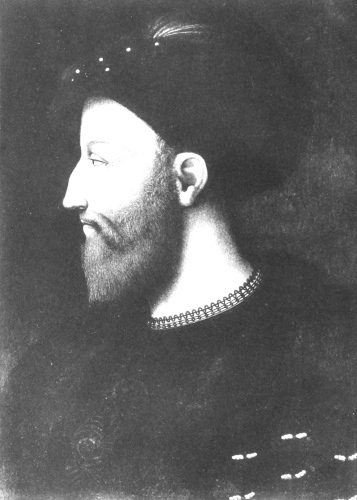
CESARE BORGIA 1478-1507
Reduced from Alinari’s photograph (no. 13438) of the portrait, in the Correr Museum at Venice, formerly ascribed to Leonardo da Vinci, but recently attributed by Berenson to Francesco Beccaruzzi.