NOTES (continued 3)
Leonard Eckstein Opdycke translation
Note 276 page 147. Duke Valentino, i.e. Cesare Borgia, Duke of Valentinois, (born 1478; died 1507), was an openly acknowledged son of Cardinal Roderigo Borgia (afterwards Alexander VI) by Rosa Vanozza, who was the mother also of Cesare’s sister Lucrezia. Created a cardinal on his father’s accession, he procured the murder of his brother Giovanni in 1497, resigned his cardinalate the same year, was given the French duchy of Valentinois in 1498, and married Charlotte d’Albret, daughter of the King of Navarre, in 1499. Having been created Duke of Romagna by his father in 1501, he proceeded to reduce the various fiefs comprised within his intended domain, including the duchy of Urbino. After the death of Alexander VI, Cesare was held in captivity by Julius II and by Ferdinand the Catholic, escaped to his father-in-law’s court in 1506, and fell in battle the following year, the very day after the close of the Courtier dialogues. Handsome, accomplished and subtle, he was a patron of learning and an adept in the cruel and perfidious politics of his day. Upon his public career is founded the famous Principe of Machiavelli, who says: “If all the duke’s achievements are considered, it will be found that he built up a great superstructure for his future power; nor do I know what precepts I could furnish to a prince better than such as are to be derived from his example.”
Note 277 page 148. Literally: “It must be believed to have been in despair.”
Note 278 page 148. Publius Cornelius Scipio Nasica (Scipio with the pointed nose), was an eminent Roman jurist who was Consul in 191 B.C., and own cousin of Scipio Africanus the Elder.
Note 279 page 148. Alonso Carillo is said by Cian to have been one of the many Spaniards who lived at Rome in the service of popes and cardinals belonging to that nation. The Spanish annotator Fabié identifies him as a son of Don Luis and Donna Costanza de Rivera.
Note 280 page 148. My Lady Boadilla. Cian’s identification of this lady as Beatriz Fernandez de Bobadilla, Marchioness of Moya, is confirmed by the fact that Boscan’s translation (1534) gives her name as the Marchioness of Moya instead of ‘my lady Boadilla.’ She and her husband are warmly mentioned in a codicil to Isabella the Catholic’s will, as being among that queen’s most dear and faithful friends.
Note 281 page 149. In this passage, Antonio Ciccarelli’s expurgated edition 378(1584) substitutes “a painter of antiquity” for Raphael, “certain Roman senators” for the two cardinals, and Romulus and Remus for St. Peter and St. Paul. The picture in question has been identified as one painted by Raphael in 1513-14 for the church of San Silvestro.
Note 282 page 149. ‘Aught else ... upon thy shoulders,’ i.e., a head. The Cato referred to was probably Marcus Porcius Cato Uticensis, (born 95 B.C., died 46 B.C.), the Roman philosopher and patriot who espoused the cause of Pompey, and committed suicide on hearing of Cæsar’s victory at Thapsus.
Note 283 page 150. This queen must have been Isabella the Catholic; see note 391.
Note 284 page 150. Rafaello de’ Pazzi, (born 1471, died 1512), was a native of Florence, but was bred away from his home, doubtless owing to the proscription of his family for participation in the Pazzi conspiracy against Lorenzo and Giuliano de’ Medici. Having fought for Cesare Borgia and later for Julius II, he was captured by the French in 1511, and was slain the following year in the battle of Ravenna.
Note 285 page 150. The Prior of Messina is now identified by Cian as a Spanish soldier, Don Pedro de Cuña, who was killed at the battle of Ravenna in 1512.
Note 286 page 151. Of Paolo Tolosa nothing more is known than is contained in the text.
Note 287 page 151. Like purple in Roman times, rose was the aristocratic colour at this period. Cosimo is reported by Machiavelli (Storia Fiorentina, vii, 6) to have said that “two ells of rose-coloured cloth make a man of quality.”
Note 288 page 151. Gianotto de’ Pazzi is regarded by Cian as possibly identical with a certain Florentine, Giovanni de’ Pazzi, who was born in 1476 and died in 1528.
Note 289 page 151. Of Antonio Rizzo nothing more is known than is contained in the text.
Note 290 page 151. ‘The renunciation of a benefice,’ i.e. the notarial deed or testament by which a priest resigned his benefice or prebend in favour of someone else.
Note 291 page 151. Antonio Torello, (died 1536), was private chamberlain to Julius II and Leo X, who conferred a canonry and several prebends 379upon him in 1514. In the briefs he is designated as a priest of the diocese of Foglino, and is given certain benefices there, which had fallen vacant on the death of another priest. We thus infer that Torello must have been familiar with the subject referred to in the text. He was made a Roman citizen in 1530.
Note 292 page 151. These two hunchbacks have not been identified. “The Wheel” (la Ruota or Rota della Giustizia, or simply la Rota) was the highest civil and criminal court of Rome prior to 1870. Its name may have originated in the circular arrangement of the judges’ (auditors’) seats (compare the hemicyclium of Cicero’s time), or possibly in a wheel-shaped porphyry figure set in the pavement of the hall where they sat. The play is of course on the double meaning of the word torto, crooked, wrong.
Note 293 page 151. Latino Giovenale de’ Manetti, (born 1486; died 1553), was a native of Rome, and a canon of St. Peter’s, but being of minor rank he had a wife and children. He held various offices, including that of Commissary General of Roman Antiquities, and was employed in several papal embassies. A writer of Latin and Italian verse, he was a friend of Castiglione, Bembo and Bibbiena, and is mentioned in the autobiography of Cellini, who says that he “had a pretty big dash of the fool in him,”—apparently because he presumed to improve one of the sculptor’s designs for a crucifix.
Note 294 page 152. Peralta is regarded by Cian as probably identical with a certain Captain Luijse Galliego de Peralta, who bore a letter (1521) from Castiglione at Rome to the Marquess Federico of Mantua, then fighting against the French. In this letter Castiglione speaks of having known Peralta for years as “a man of character and a valiant.” Cian regards him as identical also with a certain Colonel Peralta, whose death at the battle of Frosinone is mentioned (in a letter of 1526) among those of other Spaniards.
Molart is identified by Cian as the French soldier of fortune, “Molard,” who commanded a battalion of Gascons at the battle of Ravenna (11 April 1512), and who fell there bravely fighting by the side of Gaston de Foix.
Aldana afterwards served under the Marquess of Mantua at Pavia in 1522, having been summoned (as was Castiglione also) from Rome at the head of his company.
Note 295 page 152. The duel in question is thus described by Branthôme in his Discourse on Duels: “The Grand Master de Chaumont, the King’s Lieutenant in the State of Milan, also allowed a duel to two Spaniards who had asked it of him. The name of one was Signor Peralta, who had formerly been in the King of France’s service, ... and the other Spaniard was called Captain Aldana. Their combat was on horse, à la genette (jennet), with rapier and dagger and three darts to each man. Peralta’s second was another Spaniard, and Aldana’s was the gentle Captain Molart. It had snowed so much that their encounter took place in the Piazza at Parma, from which the snow had been cleared, and there being no other barriers than the 380snow, each of the two combatants did his duty right well. And at last my lord de Chaumont, who had appointed the ground and was umpire, caused them to retire with equal honour.”
Note 296 page 152. Cian inclines to regard this Master Marcantonio as identical with a certain eccentric physician of the same name, who lived at Urbino and was the author of a fantastic law book and a long comedy. Of Bottone da Cesena nothing more is known than is contained in the text.
Note 297 page 152. ‘Three sticks,’ i.e., the gallows.
Note 298 page 152. Of the three persons bearing the name Andrea Coscia and known to have lived at this time, it is uncertain which one is here referred to.
Note 299 page 152. A MS. copy of The Courtier contains the following passage: “Again a Venetian (forgive me, messer Pietro), coming to visit my lady Maddalena, sister to my lady Duchess,—as soon as he was near he offered her his hand, but without removing his cap. My lady Maddalena drew back a step, and drew back her hand too, saying: ‘Gentle Sir, put on your cap; cover your head.’ He still advanced and offered his hand; whereupon she replied: ‘I will never do it, unless you cover.’ Thus the poor man was so put to shame that he at last removed his cap.” Under similar circumstances Madame Bernhardt is said to have reproved Edward VII (then Prince of Wales) by feigning not to recognize him with his hat on.
Note 300 page 152. My Lord Cardinal, i.e., Giovanni de’ Medici, afterwards Leo X, (born 1475; died 1521). He was the second son of Lorenzo de’ Medici and Clarice Orsini, and an elder brother of the Magnifico of The Courtier. Made a cardinal at the age of thirteen, and exiled from Florence with the rest of his family in 1494, he was present at the election of Alexander VI, of whose character he is said to have shown true appreciation at the time by remarking: “We are in the wolf’s jaws; he will gulp us down, unless we make good our flight.” During the reign of Julius II, he seems to have been subservient to that pontiff, and in 1511 was a member of the court of six cardinals which acquitted the young Duke of Urbino of the charge of murdering Cardinal Alidosi. The pontificates of Alexander and Julius had exhausted Italy with wars, and the Christian world, weary of their scandalous violence, hailed with relief the accession of the cultivated and seemingly gentle young prelate, Giovanni de’ Medici. Of his reign,—so brilliant in art and letters, so disastrous to the Church,—it is enough to say that the key is found in the famous phrase with which, on his elevation to the Chair of St. Peter, he greeted his brother Giuliano: “Let us enjoy the Papacy, since God hath given it us.” To him the immortality of the soul was an open topic for debate, while he regarded sound Latinity and a ready tongue as more important than true doctrine and pure living. Sincerely zealous for the diffusion of liberal knowledge, he was extravagantly munificent to artists, scholars and authors. Like all his 381family, after the first Cosimo, he was a poor financier, and on his sudden death he was found to have pawned the very jewels of his tiara. His reckless expenditure led to the sale of indulgences, and thus in no small degree to the progress of the Reformation.
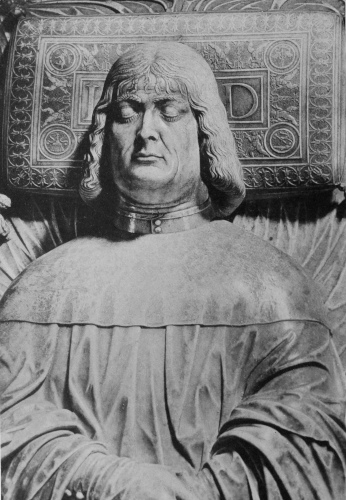
LUDOVICO SFORZA DUKE OF MILAN 1451-1508
Enlarged from a part of Alinari’s photograph (no. 14351) of the marble tomb sculptures, now in the Certosa di Pavia near Milan, by Cristoforo Solari, known as il Gobbo, (died 1540).
Note 301 page 153. Biagino Crivello was one of Duke Ludovico Sforza’s captains, and is mentioned (July 1500) in a list of Sforza adherents who had rebelled against Louis XII, and whose possessions were declared forfeit. The list speaks of him as keeping himself at Mantua and in Venetian territory, and as owning no attachable property in the Milanese. In April of the same year an ineffectual demand had been made upon the Marquess of Mantua for the surrender of Crivello and other chiefs of the Sforza party.
Note 302 page 153. The Duke, i.e., Ludovico Sforza, “Il Moro,” (born 1451; died 1508), was the fourth son of the Francesco Sforza whom Duke Federico of Urbino had helped to become Duke of Milan (and whose father, a peasant condottiere, Muzio Attendolo, became known as Sforza by reason of great personal strength),—and of Bianca Maria, a daughter of the last Visconti duke of Milan. Early noted for his physical and mental qualities, Ludovico read and wrote Latin fluently, had a tenacious memory, and was a ready speaker. He was tall and of strongly marked features. Unlike his horrible brother Galeazzo Maria, he shunned bloodshed. Banished from Milan after his brother’s assassination in 1476, he returned in triumph in 1479, and assumed the guardianship of his nephew Giangaleazzo, for whom he chose as bride his sister’s child, Isabella (see note 396), daughter of Alfonso II of Naples. Having first sought the hand of Isabella d’Este (see note 397),—who was already betrothed to the Marquess of Mantua,—in 1491 he married her younger sister Beatrice (see note 398), whose influence is by some said to have led him to aggravate the humiliation of his young nephew and niece, the rightful duke and duchess. Being threatened by the latter’s father, the King of Naples, Ludovico invited Charles VIII to enter Italy (1494) and assert the Angevine claim to Naples. His unhappy nephew died the same year, not without suspicion of having been poisoned by the uncle’s order, who thereupon assumed the title as well as the despotic power of duke. Becoming alarmed at the rapid success of the French in Italy, he joined the league formed against them, and was afterwards punished for his treachery by being expelled from Milan by Louis XII and carried to France. It is said that at the time of his capture, the only favour he asked was to be allowed the use of a volume of Dante. He died a prisoner in the Castle of Loches, where, after a vain effort to escape, he was confined in an underground dungeon. At the height of his prosperity his revenues exceeded those of any Italian state except Venice. Policy and also his natural taste for intellectual pleasures led him to copy the Medici in their patronage of art and letters. He aspired to make his capital a modern Athens, and sought to attract men of fame and talent from far and wide. Both Leonardo da Vinci and the architect Bramante were in his pay.
382
Note 303 page 153. Cervia is a little town on the Adriatic (between Ravenna and Rimini). A Dominican, Tommaso Cattanei, was bishop of the diocese from 1486 to 1509. The pope referred to in the text was Julius II.
Note 304 page 155. ‘Montefiore Inn’ was a proverbial expression for a bad hostelry. The rustic inns of Italy at this period were usually wretched and for the most part kept by Germans.
Note 305 page 156. One Andrea Castillo was secretary to Leo X, and died in 1545.
Note 306 page 156. Cian identifies this Cardinal Borgia as the Francesco (born 1441; died 1511) who was raised to the purple by Alexander VI, and s’s’ known as a schismatic.
Note 307 page 156. The modern form of ballatore is ballerino. Although the distinction is not free from doubt, there seems to be reason for believing that danzare was the term applied to the more stately forms of dance, while ballare was reserved for more animated movements. See note 147.
Note 308 page 157. The Bergamasque was and still is regarded as the rudest and most rustic of the Italian dialects.
Note 309 page 157. Except as applied to a small Tuscan stream or torrent (flowing near Acquapendente and Orvieto, and finally tributary to the Tiber), the name Paglia does not occur in modern Italian geography. In his autobiography, Cellini mentions crossing the little stream on his first journey from Siena to Rome. Later in the 16th century, Montaigne records (in his diary of a trip into Italy) having spent the night at “La Paille” (Italian, Paglia), and describes it as “a small village of five or six houses at the foot of several barren and ill-favoured mountains.”
Note 310 page 157. They seem to have been playing primero (the modern primiera), a game much in vogue at this time.
Note 311 page 158. Loreto is a small hill town near Ancona, and is celebrated for its pilgrimage shrine of the Sacred House (Santa Casa), which was reputed to have been the veritable dwelling of the Virgin, miraculously transported by angels from Nazareth, and set down in Italy in 1294. In 1511 and again in 1524 Castiglione wrote to his mother that he was preparing to go to Our Lady of Loreto in fulfilment of a vow. The name was said to be derived from that of the widow upon whose land the house was deposited by the angels.
Note 312 page 158. Acquapendente is the name of a small town sixty-seven miles north-west of Rome.
383
Note 313 page 159. Monsignor of San Pietro ad Vincula was the title of Cardinal Galeatto della Rovere; see note 189.
Note 314 page 159. Monsignor of Aragon was the title of Cardinal Ludovico of Aragon, (born 1474), a natural son of Ferdinand I of Naples, and a half-brother of Alfonso II (see note 31) and Federico III of Naples (see note 401). He was not elevated to the purple until 1519; Castiglione’s mention of him as a cardinal in dialogues supposed to take place twelve years earlier, doubtless arose from a natural confusion between the time when and the time of which they were written.
Note 315 page 159. ‘The Banchi’ (Banks) was the name of a street in Rome well known in the 15th and 16th centuries. Containing the offices of the papal Curia and magistrates, it became a preferred neighbourhood, and was enriched with fine buildings, among which was the counting-house of Julius II’s finance minister, Agostino Chigi, the greatest banker of his day.
Note 316 page 159. ‘The Chancery’ (Cancelleria) was a palace designed about 1500 by Bramante for Cardinal Riario, but at this time used for public offices and as the residence of Cardinal Galeotto della Rovere, who had enlarged and embellished the building. It was not far from the Banks.
Note 317 page 159. San Celso was the name of a street and church near the Banks. The saint (Celsus) whose memory is thus perpetuated was born at what is now Cimiez, near Nice, suffered martyrdom at Rome under Nero, and was finally put to death (together with his master, St. Nazarius) at Milan in the year 69.
Note 318 page 160. Cesare Beccadello is regarded by Cian as possibly identical with a certain Bolognese, who was the son of Domenico Maria Beccadello, married Landomia Fasanini, and was living at the papal court as late as 1559. The Spanish annotator Fabié suggests that he was the father (1502) of the author Ludovico Beccadello, who was a follower of Bembo and wrote biographies of Petrarch and others.
Note 319 page 161. These are characters occurring in the third, sixth and ninth tales of the Eighth Day, and in the fifth tale of the Ninth Day.
Note 320 page 161. This knavish student seems to be identical with a certain Caio Caloria Ponzio, who was born at Messina. Of his life little more is known than that he studied law at Padua between 1479 and 1488, and, after residing two years at Venice, returned to Sicily. For an account of a short poem by him in praise of Venice, and of his dialect comedy dedicated to the Marquess of Mantua, see Vittorio Rossi’s Caio Caloria Ponzio, e la poesia volgare letteraria di Sicilia nel Secolo XV, reprinted (Palermo, 1893) from the Archivio Storico Siciliano, N. S., A., xviii.
384
Note 321 page 161. The only belfry at Padua answering to this description is said to be that of San Giacomo.
Note 322 page 162. Gonnella. This name was borne by two famous jesters employed by the d’Este family. The one here referred to was probably the later of the two, who lived at the courts of Dukes Niccolò III and Borso, was the son of a Florentine glover Bernardo Gonnella, and married one Checca Lapi. The next buffoon referred to was probably Ludovico Meliolo, who acted as steward to the court of Mantua about 1500, and was a brother of the goldsmith and sculptor Bartolommeo Meliolo (1448-1514). He was called “the father of jests.”
Note 323 page 163. This is an instance of the use of the word calunnia (rendered ‘imputation’) in its primitive sense of malicious accusation without reference to truth or falsity.
Note 324 page 164. These characters occur in the sixth tale of the Third Day, and in the seventh and eighth tales of the Seventh Day of Boccaccio’s “Decameron.”
Note 325 page 164. The queen here mentioned is of course Isabella the Catholic; see note 391.
Note 326 page 164. Fabié says that this Countess of Castagneta was Brazaida de Almada, daughter of a Portuguese cavalier Juan Baez de Almada and Violante de Castro (of the same nation). She was a lady-in-waiting to Queen Isabella, and her husband Don Garci Fernandez Manrique (third Count of Castagneta and first Marquess of Aguilar) took part in the conquest of Granada.
Note 327 page 167. If unconvinced by the “Decameron,” readers of the Corbaccio will surely be persuaded of the justice of this opinion.
Note 328 page 167. According to one form of the legend of Orpheus, his grief at the final loss of his wife Eurydice, when his lyre had all but enabled him to recover her from Hades, led him to treat contemptuously the Thracian women, who avenged the insult by tearing him in pieces under the excitement of their Bacchanalian orgies.
Note 329 page 167. ‘Braccesque leave’ (una licentia bracciesca in the Aldine folio of 1528, and una licentia Bracciesca in the more correctly printed Aldine folio of 1545) is a phrase derived from the name of Braccio Fortebracci, a captain who was famous for his violence to friend and foe, and whose followers were called Bracceschi. To give a man Braccesque leave meant to dismiss him with blows.
Note 330 page 169. Although in this and a few other passages, Castiglione 385uses virtù in the sense of our “virtue,” he more often gives it its etymological meaning of “manliness,” which the present translator has generally rendered by “worth.” In considering a word like this, we must take into account the character of him who uses it. To Machiavelli, as no doubt to most of his contemporaries in Italy, virtù meant simply that combination of strength, courage, tenacity and cunning that enables a man to achieve his ends,—whether good or bad.
387
NOTES TO THE THIRD BOOK OF THE COURTIER
Note 331 page 171. Achaia, here used as synonymous with Greece, was the name given to that country when conquered by the Romans and made a province. Olympia was not in Achaia proper, but in the adjoining district of Elis, some forty miles south of the modern Patras. The site has been thoroughly excavated by German archæologists, the most noted discovery being that of the “Hermes” of Praxiteles and the “Victory” of Pæonius.
Note 332 page 172. That is to say, nude. According to the familiar Greek myth, Eris (goddess of discord), to avenge her exclusion from the nuptials of Peleus and Thetis, threw among the wedding guests a golden apple inscribed “To the Fairest.” A dispute arising between Aphrodite, Hera and Athena concerning the apple, Zeus appointed the shepherd Paris to decide their claims. The prize having been awarded to Aphrodite, she aided Paris to carry off the beautiful Helen of Sparta, and thus gave rise to the Trojan War.
Note 333 page 173. The Order of St. Michael was instituted in August 1469, by Louis XI of France, and was highly esteemed down to Castiglione’s time, but later suffered in estimation, owing to the freedom with which membership was bestowed. Francis I wore the insignia of the order at the battle of Pavia, 1525.
Note 334 page 173. The Order of the Garter was instituted by Edward III of England in 1344. He assigned to its use the chapel (at Windsor) of St. George, who was its patron saint. Duke Guidobaldo of Urbino having, like his father, been made a knight of the order, Castiglione went to England in 1506 to receive the insignia on the duke’s behalf.
Note 335 page 173. The Order of the Golden Fleece was instituted by Duke Philip the Good of Burgundy (paternal grandfather of Charles V’s paternal grandmother) in 1429 in honour of his third marriage, to Elizabeth of Portugal. Its badge, a golden ram, is shown in our portraits of Charles V and his grandfather Maximilian I.
Note 336 page 173. The king of Persia at this time was Ismail Sufi I, (born 1480; died 1524). He was descended from a family of noted piety, whose peculiar beliefs became the origin of the national Persian faith. Having been proclaimed shah in 1499, after nearly a century of disorderly government by the successors of Timur the Tartar, he spent most of his reign in enlarging and assuring his dominions, and founded the dynasty that was to rule Persia 388until 1736. He waged an unsuccessful war with Selim I of Turkey, the son and successor of Bajazet II, and died while on a pilgrimage to his own father’s tomb. His subjects revered him as a saint.
Note 337 page 174. The ‘Lady whom I know’ is of course the Duchess.
Note 338 page 175. Pygmalion will be remembered as the legendary sculptor-king of Cyprus, who fell in love with an ivory statue that he had made of a beautiful girl, and prayed to Aphrodite to breathe life into it. His prayer being granted, he married the girl, who was called Galatea.
Note 339 page 181. The opinions here ascribed to Plato, are found in the Fifth Book of his “Republic,” but seem to have undergone serious change when he wrote his “Laws.”
Note 340 page 182. The comparative merits of man and woman were much discussed in Greek antiquity and during the Renaissance, and form the subject of a copious literature in which Castiglione’s contribution occupies no unimportant place.
Note 341 page 184. The reference here is to a fragment of the so-called Orphic Hymns, beginning: “Jove the End, Jove the Beginning, Jove the Middle, all things are of Jove: Jove Male, Immortal Virgin Jove.” In this and other respects the theogony to which the name of Orpheus is attached, is closely related to the most ancient religious systems of India.
Note 342 page 185. The author probably refers to Aristotle’s Tenth Problem.
Note 343 page 188. The reference here is doubtless to Jerome’s 54th Epistle (on Widowhood), and to his first tract against Jovinianus, both written about 394 A.D. He was born in what is now the Hungarian town of Stridon about 340, and died in a monastery at Bethlehem 420 A.D. Perhaps his best remembered work is the Vulgate or Latin translation of the Bible.
Note 344 page 189. “If not chastely, then discreetly.”
Note 345 page 190. Octavia, (born 70; died 11 B.C.), was a great-niece of Julius Cæsar, and became the second wife of the triumvir Mark Antony for the purpose (ultimately vain) of cementing the alliance between him and her brother Augustus. Her beauty, accomplishments and virtues proved unavailing against the wiles of Cleopatra, who induced Antony to divorce her. After Antony’s death, she remained true to the interests of his children, including those by his first wife and by Cleopatra. Through the two daughters that she bore to Antony, she became the grandmother of the Emperor Claudius, and great-grandmother of his predecessor Caligula and of his successor Nero.
389
Note 346 page 190. Porcia’s first husband was Marcus Bibulus, who was Consul with Cæsar in 59 B.C. She inherited her father’s republican principles, courage and firm will, and was her second husband Brutus’s confidante in the conspiracy against Cæsar. On his death at Philippi in 42 B.C., she put an end to her life.
Note 347 page 190. Caia Cæcilia Tanaquil appears in Roman legend as the second wife of King Tarquinius Priscus, endowed with prophetic powers, closely connected with the worship of the hearth-deity, expert in healing, and a model of domestic virtues. The traditional date of her husband’s reign is 616-578 B.C.
Note 348 page 190. Cornelia, the mother of the Gracchi (born about 189 B.C.; died about 110 B.C.), wrote letters that had survived in Cicero’s day and were prized for their style. Even in her own lifetime the Romans erected a statue in honour of her virtues. Left a widow with twelve young children, she devoted herself wholly to their training, and rejected all offers of marriage, including that of Ptolemy.
Note 349 page 191. Plutarch (from whose history the narrative in the text is a paraphrase) describes Alexandra as being actuated in her regency solely by ambitious motives. Her husband, Alexander Jannæus, was the son of Johannes Hyrcanus and brother of Aristobulus I, whom he succeeded as second King of the Jews after the Babylonish Captivity. His reign (104-78 B.C.) was marked by atrocities.
Note 350 page 191. The reference here is to Mithridates VI, Eupator, King (120-63 B.C.) of Pontus on the southern shore of the Black Sea. In the Life of Lucullus, Plutarch relates that having been utterly defeated by the Romans in 72 B.C., Mithridates gave order to have his wives Bernice and Monima put to death together with his sisters Statira and Roxana, in order to prevent them from falling into the hands of the enemy,—while he himself took refuge with his son-in-law. Statira is described by Plutarch as grateful to her brother for not forgetting her amid his own anxieties, and for providing her the means of an honourable death.
Note 351 page 191. This Hasdrubal was the general of the Carthaginians in their last struggle with Rome. When Scipio captured Carthage in 146 B.C., Hasdrubal surrendered, while it is said that his wife, after upbraiding him for his weakness, flung herself and her children into the flames of the burning temple in which they had sought shelter.
Note 352 page 191. In fact, Harmonia was Hiero’s granddaughter, and the wife of a Syracusan named Themistus, who (after the death of Hiero in 215 B.C.) was chosen one of the leaders of the commonwealth and afterwards perished in a fresh revolution. Death was then decreed against all surviving 390members of Hiero’s family, and Harmonia was slain together with her aunts, Demarata and Heraclea.
Note 353 page 192. The reference is of course to the familiar story of the obstinate dame who persisted in declaring that a certain rent had been made with scissors, and whose husband vainly tried to change her mind by plunging her in a pond. Each time she came to the surface, she cried “Scissors,” until, unable to speak from strangulation, she stretched forth her hand and made the sign of the instrument with two fingers. In a coarser form, the story was current in Italy even before Castiglione’s time.
Note 354 page 192. The conspiracy in question was discovered in 65 A.D. Tacitus relates that Epicharis strangled herself with her girdle while on the way to be tortured a second time.
Note 355 page 192. Leæna was an Athenian hetaira beloved by Aristogeiton. When he and Harmodius had slain the tyrant Hipparchus in 514 B.C., she was supposed to be privy to their plan, and died under torture. The statue in question is mentioned by Pausanias and said by Plutarch (in his essay on Garrulity) to have been placed “upon the gates of the Acropolis.” Recent archæologists identify its site as being on the level of the Acropolis, near the southern inner corner of the Propylæa.
Note 356 page 192. Massilia became the modern Marseilles.
Note 357 page 192. This story is taken from the “Memorable Doings and Sayings” of Valerius Maximus (flor. 25 A.D.), in which Castiglione mistranslates the Latin word publicè (at the public charge) as publicamente (publicly).
Note 358 page 192. Of several persons of this name, the one here referred to was probably the Roman Consul (14 A.D.),—a patron of literature and a friend of Ovid. Had the Magnifico been allowed to finish his sentence, he would (following the narrative of Valerius Maximus) have doubtless added the name of a town in Asia Minor, Julida.
Note 359 page 195. This story (which was used by Tennyson for his play of “The Cup”) is found in Plutarch’s tract “Concerning Women’s Virtue,” where the scene is placed in Galatia, in Asia Minor.
Note 360 page 197. The number of the Sibyls is usually reckoned as ten: Persian (or Babylonian), Libyan, Phrygian, Delphian, Cimmerian, Erythræan, Samian, Trojan, Tiburtine, and Cumæan,—of which the last was the most famous.
Note 361 page 197. Aspasia, (flor. 440 B.C.), was born at Miletus in Asia Minor, but in her youth removed to Athens, where she was celebrated for her 391talents and beauty, and became the mistress of Pericles, one of whose orations she is said by Plato to have composed. Her house was the centre of intellectual society, and was even frequented by Athenian matrons and their husbands.
Note 362 page 197. Diotima was a probably fictitious priestess of Mantinea in the Peloponnesus, reputed to have been the instructress of Socrates. Her supposed opinions as to the origin, nature and objects of life, form the subject of Plato’s “Symposium.”
Note 363 page 197. Nicostrate or Carmenta was a prophetic and healing divinity, supposed to be of Greek origin. Having tried to persuade her son Evander to kill his father Hermes, she fled with the boy to Italy, where she was said to have given the Roman form to the fifteen characters of the Greek alphabet that Evander introduced into Latium.
Note 364 page 197. This ‘preceptress ... to Pindar’ was Myrtis, a lyric poetess of the 6th century B.C. She is mentioned in a fragment by Corinna as having competed with Pindar. Statues were erected to her in various parts of Greece, and she was counted among the nine lyric muses.
Note 365 page 197. Of Pindar’s life little more is known than that he resided chiefly at Thebes, and that the dates of his birth and death were about 522 and 443 B.C. respectively. Practically all his extant poems are odes in commemoration of victories in the public games.
Note 366 page 197. The Greek poetess Corinna (5th century B.C.) was a native of Tanagra in Bœotia. She is said to have won prizes five times in competition with Pindar. Only a few fragments of her verse remain.
Note 367 page 197. Sappho flourished about 600 B.C., and seems to have been born and to have lived chiefly at Mitylene. She enjoyed unique renown among the ancients: on hearing one of her poems, Solon prayed that he might not see death before he had learned it; Plato called her the Tenth Muse; and Aristotle placed her on a par with Homer. For a recently discovered and interesting fragment of her verse, see the Egypt Exploration Fund’s “Oxyrhynchus Papyri,” Part I, p. 11.
Note 368 page 198. Castiglione here follows Plutarch. Pliny, on the other hand, affirms that Roman women were obliged to kiss their male relatives, in order that it might be known whether they had transgressed the law forbidding them to drink wine.
Note 369 page 199. This paragraph is taken almost literally from Livy, excepting the incident of the babies borne in arms, which Castiglione seems to have invented.
392
Note 370 page 199. Titus Tatius was the legendary king of the Sabines. His forces were so strong that Romulus was driven back to the Saturnian Hill, which had previously been fortified and which became the site of the Capitol. The familiar story is to the effect that Tarpeia (daughter to the captain of the fortress), being dazzled by the Sabines’ golden bracelets, promised to betray the hill to them if they would give her the ornaments on their left arms. Accordingly she admitted the enemy at night, but when she claimed her reward, they threw down upon her the shields that they wore on the left arm, and thus crushed her to death. Her infamy is preserved in the name of the neighbouring Tarpeian Rock, from which traitors were flung down.
Note 371 page 199. There is said to be no historical mention of any Roman temple to Venus Armata. Castiglione may have had in mind a passage in the “Christian Cicero” (Lactantius Firmianus, who wrote about 300 A.D.), recording the dedication by the Spartans of a temple and statue to the Armed Venus in memory of their women’s brave repulse of a sudden attack by the Messenians during the absence of the Spartan army.
Note 372 page 199. Calva (bald) was one of the Roman Venus’s most ancient epithets, under which she had two temples near the Capitol. Of the several explanations of this appellation, Castiglione seems to refer to the one which interprets it as the memorial of the Roman women’s heroism in cutting off their hair to make bow-strings for the men during a siege by the Gauls.
Note 373 page 200. In his life of Camillus (died 365 B.C.), Plutarch gives a legendary account of the origin of the Handmaidens’ Festival. At a time when the Romans were ill prepared for war, the Latins sent to demand of them a number of free-born maidens in marriage. This was suspected as a trick to obtain hostages, but no method of foiling it was devised until Tutula, a slave girl, advised the magistrates to send her to the Latin camp along with some of the most beautiful handmaidens in rich attire. This was done, and at night, when her companions had stolen away the enemies’ weapons, Tutula displayed a signal torch agreed on with the Romans, who at once sallied forth, easily captured the Latin camp, and put most of the enemy to the sword.
Note 374 page 200. The Romans are said to have wearied of Cicero’s self-praise for his suppression of the Cataline conspiracy (63 B.C.). The woman in question was a Roman patrician, Fulvia by name, who was the mistress of one of the conspirators and divulged the plot to Cicero.
Note 375 page 200. This Demetrius (II) was grandson to the Demetrius I already mentioned (see note 136), and ruled over Macedonia from about 239 to about 229 B.C. His son, Philip V (237-179 B.C.), joined Hannibal in a war against Rome, which finally ended in the downfall of the Macedonian monarchy and the captivity of his son and successor Perseus (167 B.C.). The incident mentioned in the text is narrated by Plutarch in his work on “Women’s 393Virtue,” as also is the instance next cited by Castiglione, who however reverses the order of events.
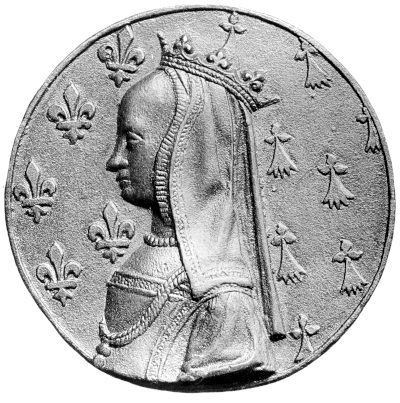
ANNE OF BRITTANY QUEEN OF FRANCE 1476-1514
Enlarged from a negative, specially made by Alinari through the courtesy of Professor I. B. Supino, of a medal, in the National Museum at Florence, by Jean Perreal (1460?-1528?). See note 387.
Note 376 page 200. Erythræ was an important city on the west coast of Asia Minor opposite Chios. The nearest approach to ‘Leuconia’ in ancient geography is the distant town Leuconum in what is now Slavonia, between the Danube and the Save.
Note 377 page 201. Plutarch’s version of this story adds that in honour of the Persian women’s bravery on this occasion, Cyrus (559-529 B.C.) decreed that whenever the king returned from a long journey, each woman should receive a ring of gold.
Note 378 page 201. One of Plutarch’s minor works is entitled “Apothegms and Famous Sayings of Spartan Women,” and Castiglione’s contemporary Marcantonio Casanova wrote two Latin distiches on “The Spartan Mother Slaying Her Son.”
Note 379 page 201. Saguntum, the modern Murviedro, was a city of Greek origin on the eastern coast of Spain. After a desperate siege of nearly eight months, it was captured by Hannibal in 219 B.C.
Note 380 page 201. The reference here is to the victory, at Vercelli near Milan, by which the Roman general Caius Marius repelled the advance of the Cimbri into Italy, 101 B.C. The sacred fire (supposed to have been brought from Troy by Æneas as the symbol of Vesta, the hearth deity) was kept alive at Rome by six virgins.
Note 381 page 202. Amalasontha, (498-535 A.D.), was the daughter of Theodoric the Great, and regent of the East Gothic kingdom from his death in 526 until her own. After a prosperous reign she is said to have been strangled by her cousin and second husband Theodatus, at the instigation of the Empress Theodora, the wife of Justinian.
Note 382 page 202. Theodolinda, daughter of Duke Garibald of Bavaria, married (589 A.D.) Autharis, King of the Lombards, and on his death in the following year, she married Duke Agilulph of Turin, who was proclaimed king in 591. She died in 625, after exercising the regency in the name of her son. Her virtue, wisdom and beauty were extolled; she was active in her labours on behalf of Christianity; and she carried on a correspondence with St. Gregory, who was pope from 590 to 604.
Note 383 page 202. The Theodora here referred to is doubtless the wife, not of Justinian, but of Theophilus, Emperor of Constantinople 829-842. She died in 867, and was canonized by the Greek Church.
Note 384 page 202. Countess Matilda, (1046-1115), one of the most famous 394heroines of the Middle Ages, was the daughter of Duke Boniface of Tuscany and Beatrice of Lorraine. She ruled over Tuscany and a large part of northern Italy, espoused the papal cause against the Emperor, and exercised an important influence upon the politics of her time. She was noted also for her religious zeal, energy, and austere yet gentle and cultivated life. Count Ludovico’s supposed descent from her paternal uncle Conrad is now regarded as doubtful.
Note 385 page 202. Among the eminent women here referred to, we may note: Duke Guidobaldo’s grandfather’s wife, Caterina Colonna, (died 1438), who was a great-aunt of Vittoria Colonna, and was praised as “noble, beautiful, discreet, charming, gentle and generous”; his great-aunt Battista di Montefeltro, (died 1450), who, having been deserted by her worthless Malatesta husband, wrote moral essays and poetry, and was celebrated for her piety and mental gifts, as well as for her learning and literary accomplishments; his aunt, Brigida Sueva di Montefeltro, (born 1428), who, after enduring for twelve years the brutalities of her Sforza husband, became an abbess and ultimately received the honour of beatification,—her remains being revered as a sacred relic; another aunt of his, Violante di Montefeltro, (born 1430), who was famous for her talents and beauty; his maternal grandmother, Costanza da Varano, (born 1428), was a granddaughter of the Battista above mentioned, inherited much of that lady’s taste for learning, became the associate of scholars and philosophers, wrote Latin orations, epistles and poems, and (by her marriage to a brother of the first Sforza duke of Milan) became the mother of Duke Guidobaldo’s own mother, Battista Sforza, (born 1446), who rivalled her ancestresses’ attainments, administered her husband’s government judiciously during his frequent absences, and was regarded as beautiful, although tiny in person.
Note 386 page 202. Perhaps the most famous woman of the Gonzaga family was “my lady Duchess’s” great-aunt, Cecilia Gonzaga, (born 1425), who shared with her four brothers the tuition of the celebrated Vittorino da Feltre, wrote Greek with remarkable purity at the age of ten, became a nun at nineteen, devoted her life to religious and literary exercises, and was regarded as one of the most learned women of her time. Her niece (?), Barbara Gonzaga, (born about 1455), was educated with especial care, became Duchess of Würtemberg, induced her husband to found the University of Tübingen, and ruled the duchy as regent after his death.
Of the Este family, two aunts (Ginevra, born 1419, and Bianca Maria, born 1440) of Isabella and Beatrice d’Este (see notes 397 and 398), were famous for their knowledge of Latin and Greek, in which languages the younger wrote both prose and verse, besides being an accomplished musician, dancer and needlewoman.
Of the Pio family, Castiglione doubtless had in mind the celebrated Alda Pia da Carpi, who was a sister of Aldus’s pupil and patron Alberto Pio, 395aunt of Count Ludovico Pio of The Courtier (see note 46), and mother of the still more celebrated poetess Veronica Gambara, (born 1485).
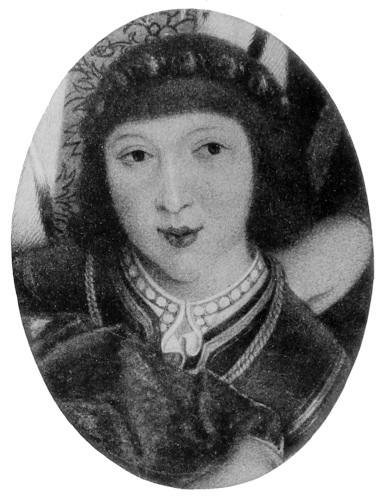
MARGARITA OF AUSTRIA 1480-1530
Head enlarged from Braun’s photograph (no. 13.796) of an anonymous portrait group, in the Palace at Versailles, representing the Emperor Maximilian I and his family.
Note 387 page 202. Anne de Bretagne, (born 1476; died 1514), was the daughter and heiress of Duke Francis II of Brittany, which became permanently united to the crown of France through her marriages to Charles VIII (1492) and Louis XII (1499). Castiglione’s praise of her seems to have been in the main justified. Although sometimes vindictive, she was generous, virtuous beyond the standard of her time, and carried cultivation to the verge of pedantry. She surrounded herself with artists, historians, minstrels and poets, and formed a collection of MSS. and other precious objects, largely the spoils of her husbands’ Italian campaigns. Branthôme called her “the worthiest and most honourable queen that has been since Queen Blanche, mother of the king St. Louis, and so wise and virtuous.”
Note 388 page 202. Charles VIII, (born 1470; died 1498), was the son of Louis XI and Charlotte of Savoy. Having succeeded his father in 1483, and assumed royal power in 1491, he married Anne of Brittany and soon set about enforcing his pretensions to the crown of Naples, transmitted to him through his father and cousin from René of Provence, to whom the last Angevine ruler had devised the kingdom in 1435. As we have seen, the immediate cause of the invasion of Italy (1494) was a request from Duke Ludovico Sforza of Milan and Pope Alexander VI. Although the expedition was undertaken without adequate preparation and conducted with incredible foolhardiness,—continuous good fortune together with the mutual jealousies of Italian princes and the decadence of Italian military power enabled Charles to enter Milan, Florence and Rome without hindrance, to seize Naples almost unopposed, and (when threatened by a powerful league formed against him) to retire northwards, to defeat the Italians at Fornovo, and finally to reach France in safety, October 1495. His garrisons were driven from Naples in the following year, but his foray had the immediate result of expelling the Medici from Florence, and the far more important consequence of revealing to the rest of Europe the wealth and helplessness of Italy,—thus paving the way for the subsequent invasions with which the peninsula was scourged during the 16th Century. The remainder of Charles’s life was given up to inglorious ease and pleasure. A son of the painter Mantegna thus describes him: “A very ill-favoured face, with great goggle eyes, an aquiline nose offensively large, and a head disfigured by a few sparse hairs;” while Duke Ludovico Sforza said of him: “The man is young, and his conduct meagre, nor has he any form or method of council.” His own ambassador, Commines, wrote: “He was little in stature and of small sense, very timid in speech, owing to the way in which he had been treated as a child, and as feeble in mind as he was in body, but the kindest and gentlest creature alive.”
Note 389 page 202. Margarita of Austria, (born 1480; died 1530), was the daughter of the Emperor Maximilian I and Mary of Burgundy, and a native 396of Brussels. Having been betrothed to the Dauphin Charles (VIII) and then rejected by that prince in favour of Anne of Brittany, she married (1497) the Infant Juan of Castile, but soon lost both husband and child. In 1501 she married Duke Filiberto of Savoy, and after four years of happiness again became a widow. In 1507 she was entrusted by her father with the government of the Low Countries and the care of her nephew Charles (see note 462). She did much to further the progress of agriculture and commerce in her dominions, and besides showing a lofty spirit and no little political sagacity, she was a patroness of art and letters, and composed a great number of poems in French, most of which are said to be lost. Her correspondence with her father has been published.
Note 390 page 202. Maximilian I, Emperor of Germany, (born 1459; died 1519), was the son of the Emperor Frederick III of Hapsburg and Eleanora of Portugal. In 1477 he married Charles the Bold’s daughter and heiress, Mary of Burgundy, who bore him five children and died in 1482. On the death of his father in 1493, he was elected Emperor, and soon afterwards married Bianca Maria, niece of Duke Ludovico Sforza of Milan. He was a member of the league that forced Charles VIII to retire from Italy (1495), of the League of Cambray against Venice (1508), and of the Holy League (1511) for the expulsion of Louis XII from Italy. Although deriving little profit or honour from these and other foreign enterprises, he contrived by prudent marriages to add Bohemia and Hungary to his empire and to make Spain a possession of his family. He also effected many reforms in his government, and even founded several important institutions, such as a postal service and a permanent militia. From his youth he showed a taste for study, became a patron of scholars, poets and artists, and enriched the Universities of Vienna and Ingolstadt. Besides being an accomplished if not very successful soldier, he was the author of works on gardening, hunting and agriculture, as well as on military science.
Note 391 page 202. Isabella the Catholic, (born 1451; died 1504), was the daughter and heiress of Juan II of Castile. Having been trained in retirement to habits of religious devotion, she married (1469) Ferdinand of Aragon, with whom she succeeded jointly to her father’s crown in 1474, but was able to gain complete possession of her dominions only in 1479, the same year in which her husband succeeded his father as King of Aragon. Under her rule the Inquisition was established in Castile (1480), but she recoiled before its horrors and was reconciled to its continuance only by the direct assurance of Pope Sixtus IV. In 1481 began the long war, which (largely owing to her energy and perseverance) resulted in the expulsion of the Moors from Spain, and in which she is said to have organized the earliest military hospitals. The story of her noble patronage of Columbus is familiar. Her later years were clouded by the loss of two of her three children, including her only son, and by the unhappy conjugal life and mental disorder of her daughter, Juana, the mother of Charles V. Castiglione’s praise of Isabella’s lofty qualities is not a little justified by the facts of her life. In personal appearance, she is said 397to have been agreeable rather than handsome; her features were regular, her green eyes vivacious, her complexion olive, her hair reddish blond, and her stature above the medium.
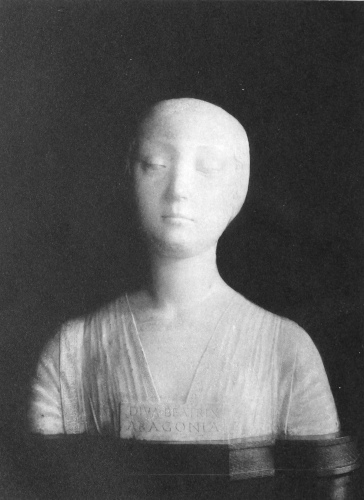
BEATRICE OF ARAGON QUEEN OF HUNGARY 1457-1508
From a negative, specially made by the brothers Moreau with the kind permission of M. Gustave Dreyfus, of an anonymous bust in his collection at Paris.
Note 392 page 202. Ferdinand the Catholic, (born 1452; died 1516), was the son of Juan II of Navarre and Aragon, and is justly regarded as the founder of the Spanish monarchy. The means employed by him in building up his power were perfidy towards other rulers and ruthless oppression of his own people. Besides the other events of his reign, noted above, mention should be made of his cruel expulsion of the Jews from Spain in 1492. These and his other persecutions, supposed at the time to be actuated by zeal for pure religion, were in fact chiefly a source of revenue, and the policy thus inaugurated,—of stifling the commerce, the industry, the free thought and the energy of the nation at the beginning of its greatness,—is now seen to have been one of the important causes of its decline.
Note 393 page 204. Of these two remarkable queens, one was doubtless Federico III’s widow, the Isabella del Balzo who is mentioned below (see note 400). The other may possibly have been her predecessor Joanna, the aunt and widow of Ferdinand II; or (more probably) Ippolita Maria, who was a daughter of the first Sforza duke of Milan and wife of Ferdinand II’s father and predecessor Alfonso II, and of whom Dennistoun says (ii, 122): “It was for this princess that Constantine Lascaris composed the earliest Greek Grammar; and in the convent library of Sta. Croce at Rome there is a transcript by her of Cicero’s De Senectute, followed by a juvenile collection of Latin apothegms curiously indicative of her character and studies.”
Note 394 page 204. Beatrice of Aragon, (born 1457; died 1508), was the daughter of Ferdinand I of Naples and Isabelle de Clermont. In 1476 she married Matthias Corvinus, King of Hungary. On his death in 1490, she married Ladislas II of Bohemia, who for a time prevented the succession of Matthias’s natural son John. However the youth attained the Hungarian throne with the aid of the Emperor Maximilian; whereupon Beatrice was repudiated by Ladislas and her marriage was annulled by Alexander VI. In 1501 she returned to Italy, resided at Ischia and died childless. Like her elder sister, the Duchess Eleanora of Ferrara (see note 399), she was a woman of cultivation and taste, and in spite of her political intrigues, she is praised for having done much to strengthen the intellectual bonds between Italy and Hungary, to which country she invited Italian poets, scholars and artists.
Note 395 page 204. Matthias Corvinus, (born 1443; died 1490), was the son of the famous Hungarian general János Hunyadi, and in 1458 was proclaimed King of Hungary by the soldiers whom his father had so often led to victory. His life was a nearly continuous series of great enterprises, among the most noted of which were his campaigns against the Turks and his siege and capture (1485) of Vienna, where he thereafter resided chiefly and died. By 398no means the least part of his fame was won by the ardour with which he advanced the cause of science, art and letters in his country, and bestowed upon his people not only an enlightened code of laws but also the benefits of Renaissance culture. He introduced printing into Hungary, and was the founder of a magnificent public library at Buda Pest, containing fifty thousand volumes, for the most part MSS. which he caused to be copied in Italy and the East.
Note 396 page 204. Isabella of Aragon, (born 1470; died 1524), was the daughter of Alfonso II of Naples and Ippolita Maria, daughter of the first Sforza duke of Milan. In 1489 she made a splendid entry into Milan as the bride of her own cousin Giangaleazzo Sforza, whose rights as duke were gradually usurped by his uncle Ludovico il Moro. This usurpation has been regarded as partly due to the ambition of Ludovico’s young wife, Beatrice d’Este (see note 398), who could not endure the precedence rightfully belonging to Isabella. As has been seen, it was to protect himself against the wrath of Isabella’s father and grandfather, that Ludovico invited Charles VIII into Italy as his ally. When Charles reached Pavia, he had to endure the pathetic spectacle of his forlorn cousin Giangaleazzo (they were sisters’ sons) in prison, and to hear the piteous pleadings of the beautiful Isabella, who fell at his feet and besought him to have mercy on her husband. Her appeal was withstood, and Ludovico of course had no scruple in setting aside the rights of her infant children. Fresh trials awaited her in her native country, to which she returned in 1500, and from which her family had been expelled.
Note 397 page 204. Isabella d’Este, (born 1474; died 1539), was the oldest child of Duke Ercole I of Ferrara and Eleanora of Aragon. Having had Mario Equicola as preceptor, she married the Marquess Gianfrancesco Gonzaga (see note 446) in 1490, her early betrothal to whom prevented her from becoming the wife of Ludovico Sforza, the duke of Milan, who soon afterwards married her sister Beatrice. At Mantua she continued her literary and artistic training, and her court became one of the brightest and most active centres of Italian culture. The chief poets and painters of the time laboured for her or were her friends. Being for years in her husband’s service, Castiglione knew her closely, maintained a frequent exchange of letters with her, and is only one of many who praise her beauty, her intellect, and her moral qualities; she may be regarded as the most splendid incarnation of the Renaissance ideal of woman. Her long friendship with her sister-in-law, “My lady Duchess,” has been already mentioned. Some interesting details have survived as to her manner of ordering a picture. Having chosen a subject, she had it set forth in writing by some humanist of her court. These specifications were then given to the painter chosen for the purpose, and he was furnished with minute directions as to the placing of the figures and the distribution of light, and required to make a preliminary sketch. As the painting was often intended for a specific space, she took great care to secure the exact dimensions desired, by providing two pieces of ribbon to show the precise height and breadth of 399the picture. Isabella’s brilliant career, and especially her close relations with the chief men of her day and her weighty influence upon contemporary politics, are the subject of many scholarly volumes and interesting articles written jointly by Alessandro Luzio of Mantua and Rodolfo Renier of Turin.
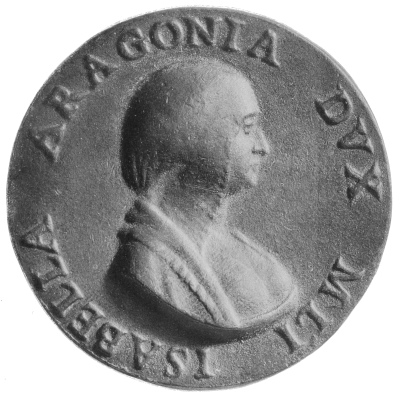
ISABELLA OF ARAGON DUCHESS OF MILAN 1470-1524
Enlarged from a negative, specially made by Alinari through the courtesy of Professor I. B. Supino, of a medal, in the National Museum at Florence, by Giancristoforo Romano (1465?-1512). See Armand’s Les Médailleurs Italiens, ii, 54, no. 1.
Note 398 page 204. Beatrice d’Este, (born 1475; died 1497), married Ludovico Sforza, Duke Regent of Milan, in the same year (1491) in which his niece Anna Sforza married Beatrice’s brother Alfonso, the future husband of Lucrezia Borgia. Younger, apparently less beautiful, and certainly less accomplished than her sister Isabella, Beatrice encouraged her husband’s patronage of art and letters, and took part in his turbid political schemes. It will perhaps never be determined precisely to what extent she was responsible for his treatment of his young nephew and of the latter’s wife (see note 396), and for the disasters to Italy that ensued, but she is known to have exercised a great ascendency over her husband’s mind, and he is said to have spent at her tomb the last night before his final capture and downfall. After the expulsion of the French from Italy in 1512, her sons Maximilian and Francesco Maria successively held the duchy for a time, until it passed into the hands of Spain in 1535. For an account of her life, the reader is referred to Mrs. Henry Ady’s recently published “Beatrice d’Este, Duchess of Milan; a Study of the Renaissance,” which owes much to the labours of Luzio and Renier.
Note 399 page 205. Eleanora of Aragon, (born 1450; died 1493), was the elder sister of the Beatrice who married Matthias Corvinus of Hungary. A projected union with Ludovico Sforza (who afterwards married her daughter) having been abandoned, she became in 1473 the wife of Duke Ercole I of Ferrara, and bore him two daughters and four sons. Other contemporary accounts confirm the praise bestowed upon her by Castiglione, and show her to have been a woman of rare merit, manly courage and enlightened culture. Fond of music, and herself a player upon the harp, she seems to have been a discriminating patroness of art and letters, and at the same time to have taken an active share in the serious cares of government, especially when her husband was absent or disabled. A pleasant glimpse of her character is gained from a letter written by her to the duke’s treasurer on behalf of a certain Neapolitan engineer, who had rendered important services but had fallen ill and was in want. “You will see what this poor man’s needs are. You know with what devotion he has served us, nor are you ignorant who sent him to us,—a circumstance worthy of consideration. It would ill become us so to treat him in his sickness as to give him cause for complaint against us. You must know what his pay is. See, then, what can be done, and arrange for helping him.” She did not live to witness the downfall of her family in Naples.
Note 400 page 205. Isabella del Balzo, (died 1533), was a daughter of the Prince of Altamura, and the wife of Federico III of Naples (see note 401). When her husband lost his crown in 1501, she (together with the faithful 400Sannazaro) accompanied him to France, and shared his exile there until his death in 1504. Being, by the terms of a treaty between Louis XII and Ferdinand the Catholic, compelled to leave France, she and her four children took refuge, first with her sister Antonia at Gazzuolo, and then at Ferrara, where she was kindly treated and maintained by her husband’s nephew Duke Alfonso d’Este. Here she spent the last twenty-five years of her life, but at times in such poverty that when Julius II placed Ferrara under the ban of the Church, she obtained special permission to have religious services performed in her house, on the plea that she had not the means wherewith to leave the city.
Note 401 page 205. Federico III, (born 1452; died 1504), was a son of Ferdinand I of Naples, a younger brother of Alfonso II, and an uncle of his immediate predecessor, Ferdinand II. Having taken part in the weak resistance offered to Charles VIII’s invasion of Naples in 1494, he became king on the early death of his nephew in October 1496, and seems to have tried to keep aloof from the turbulent schemes in which Alexander VI sought to involve him. After another vain attempt to withstand the invasion of Louis XII, and having been shamefully betrayed by the Emperor Maximilian and Ferdinand the Catholic, to both of whom he had appealed for aid, he retired with his wife and children to the island of Ischia (which furnished refuge at the same time to his widowed sister Beatrice, ex-Queen of Hungary, and to his widowed niece Isabella, ex-Duchess of Milan), ceded his crown to Louis XII in exchange for 30,000 ducats and the Countship of Maine, and spent the last three years of his life in France.
Note 402 page 205. Federico’s eldest son Ferdinand, Duke of Calabria, was besieged in Taranto during the Franco-Spanish invasion which resulted in his father’s downfall. On a sworn promise to set him free, he surrendered to the Great Captain (see note 239), but was treacherously detained and sent as a prisoner to Spain, where he was treated by Ferdinand the Catholic with almost royal honours. He continued to reside in Spain, and on the death of his mother in 1533, he was joined at Valencia by his two sisters.
Note 403 page 205. The reference here is probably to the siege of Pisa by the Florentines in 1499, which was finally abandoned owing in part at least to the bravery of the Pisan women. Castiglione himself was the author of some Latin verses celebrating an incident of the siege.
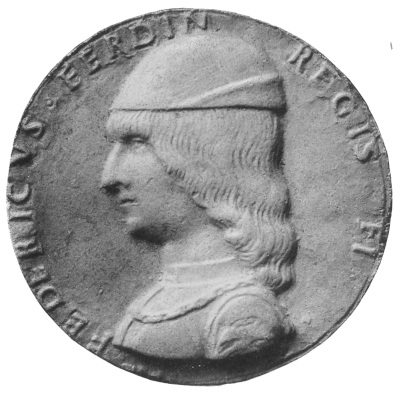
FEDERICO III OF NAPLES 1452-1504
Enlarged from a cast, courteously furnished by Professor I. B. Supino, of an anonymous medal in the National Museum at Florence. See Armand’s Les Médailleurs Italiens, ii, 59.
Note 404 page 205. Tomyris was in fact queen of the Massagetæ, who were a nomadic people allied to the Scythians and dwelt north-east of the Caspian Sea. Herodotus relates that Cyrus the Great sent her an offer of marriage, and on being refused, invaded her kingdom and captured her son, but was finally defeated and slain, 529 B.C. The Artemisia referred to in the text is probably not the Queen of Halicarnassus (who fought on the Persian side at Salamis in 480 B.C.), but rather the sister-consort and successor of 401King Mausolus of Caria, a state on the western coast of Asia Minor. On her husband’s death in 352 B.C., she reigned two years until she pined away for grief. The monument, Mausoleum, erected by her to his memory at Halicarnassus, was regarded as one of the seven wonders of the world—the others being: the Egyptian pyramids, the temple of Artemis at Ephesus, the walls and hanging gardens of Babylon, Phidias’s statue of Zeus at Olympia, the Colossus at Rhodes, and the lighthouse at Alexandria. Zenobia, an Arab by birth, was the second wife of Odenathus, King of Palmyra, which lay to the east of Syria. On the death of her husband, about 266 A.D., she acted as regent for her sons and seems to have shown great talent for war as well as for the arts of wise administration; but in her effort to extend her sway over the entire East, she was defeated by the Emperor Aurelian, and adorned his triumph in golden chains at Rome. She was allowed to spend the remainder of her life in dignified retirement at Tibur (Tivoli). Semiramis was the legendary daughter of the Syrian goddess Derketo, and with her husband Ninus was regarded as the founder of Nineveh. On his death she assumed the government of Assyria, built the city of Babylon and its wonderful gardens, conquered Egypt, etc. To her the Greeks ascribed nearly everything marvellous in the East. Her name appears in inscriptions as that of the consort of an Assyrian ruler who reigned 811-782 B.C. Cleopatra, (69-30 B.C.), was directly descended in the eighth generation from Ptolemy I, the most noted of Alexander the Great’s generals and the founder of the Egyptian dynasty that ended with her life. Her establishment as sole ruler, to the exclusion of her two brothers, was due to the favour of Julius Cæsar, who is said to have acknowledged the paternity of her son Cæsarion, ultimately put to death by order of Augustus. Her love of literature, and the refinement of her luxury, show her to have been no mere voluptuary.
Note 405 page 206. Sardanapalus,—Assurbanipal, the Asnapper of the Old Testament,—ruled over Assyria from 668 to 626 B.C., and was the last monarch of the empire reputed to have been founded by Ninus and Semiramis. His name became a by-word for effeminate luxury, but in recent times the discovery and study of the larger part of the tablets composing his library, prove him to have been a vigorous king and an intelligent patron of art and literature.
Note 406 page 207. In his life of Alexander, Plutarch extols the magnanimity with which the youthful monarch treated the captive mother, wife and two daughters, of Darius, the last King of Persia, whom he had utterly defeated in the battle of Arbela, 331 B.C. In furtherance of his plan of uniting his European and Asiatic subjects into one people, Alexander afterwards married Bersine, the elder of Darius’s two daughters.
Note 407 page 208. This incident is narrated in Valerius Maximus’s “Memorable Sayings and Doings” as having occurred in the first Spanish campaign of Scipio Africanus Maximus, 210 B.C., when that commander was in his twenty-fourth year.
402
Note 408 page 208. This story of the Platonist philosopher Xenocrates (396-314 B.C.) is derived from the same source last cited. His teaching was characterized by the loftiest morality, and included a declaration that it comes to the same thing whether we cast longing eyes, or set our feet, upon the property of others. The ‘very beautiful woman’ of the text is variously mentioned as Phryne and Laïs, rival hetairai said to have served as models to the painter Apelles.
Note 409 page 208. Cicero’s version of this anecdote (De Officiis, i, 40) mentions Sophocles as the ‘someone’ rebuked by Pericles.
Note 410 page 210. The Italians still say:
Donna pregata, nega;
E disprezzata, prega.
Note 411 page 213. The present translator prefers not to offer an English version of the following passage, but to reprint it, line for line, from the Aldine folio of 1528:
si che questo piu tosto un stratogema militare dir si
poria, che pura continentia: auenga anchora che la fama di questo non
sia molto sincera: perche alcuni scrittori d’authorità affermano questa
giouane esser stata da Scipione goduta in amorose delicie: ma di quello
che ui dico io, dubbio alcuno non è. Disse il Phrigio, Douete ha
uerlo trouato ne gli euangelii. Io stesso l’ho ueduto rispose M. Ces. &
però n’ho molto maggior certezza, che non potete hauer, ne uoi, ne altri
che Alcibiade si leuasse dal letto di Socrate non altrimēti, che si facciano
i figlioli dal letto de i padri: che pur strano loco, e tempo era il let
to, & la notte, per contemplar quella pura bellezza: laqual si dice che amaua
Socrate senza alcun desiderio dishonesto, massimamente amādo
piu la bellezza dell’animo, che del corpo: ma ne i fanciulli & nò ne i
uecchi, anchor che siano piu sauii: & certo non si potea gia trouar miglior
exempio, per laudar la continentia de glihomini, che quello di
Xenocrate: che essendo uersato ne gli studii, astretto, & obligato dalla
profession sua, che è la philosophia, laquale consiste ne i boni costumi,
& non nelle parole, uecchio, exhausto del uigor naturale, nō potendo,
ne mostrando segno di potere, s’astenne da una femina publica: laquale
per questo nome solo potea uenirgli à fastidio: piu crederei che fosse sta
to continente, se qualche segno de risentirsi hauesse dimostrato, & in tal
termine usato la continentia: ouero astenutosi da quello, che i uecchi
piu desiderano che —le battaglie di Venere, cioè dal uino: ma per comprobar
ben la continentia senile, scriuesi che di questo era pieno, & gra
ue: & qual cosa dir si po piu aliena della continentia d’un uecchio: che
la ebrietà? & se lo astenerse dalle cose ueneree in quella pigra, & fredda
età merita tanta laude, quanta ne deue meritar in una tenera giouane,
come quelle due di chi dianzi u’ho detto? dellequali l’una imponēdo
durissime leggi à tutti i sensi suoi, non solamente à gliocchi negaua la
403sua luce, ma toglieua al core quei pensieri, che soli lungamēti erano sta
ti dulcissimo cibo per tenerlo in uita. l’altra ardente innamorata ritrouādosi
tante volte sola nelle braccia di quello, che piu assai, che tutto’l
resto del mondo amaua, contra se stessa, & contra colui, che piu, che se
stessa le era caro, combattendo uincea quello ardente desiderio che spes
so ha uinto, & uince tanti sauii homini. Nō ui pare hora S. Gasp. che
douessino i scrittori uergognarsi di far memoria di Xenocrate in questo
caso? & chiamarlo per continente? che chi potesse sapere, io metterei
pegno che esso tutta quella notte sino al giorno sequēte ad hora di desinare
dormi come morto sepulto nel uino: ne mai per stropicciar che
gli facesse quella femina, potè aprir gliocchi, come se fusse stato all’opia
to. Quiui risero tutti glihomini & donne: & la S. Emil. pur ridēdo Ve
ramente disse S. Gasp. se ui pensate un poco meglio credo che trouarete
anchor qualche altro bello exempio di continentia simile à questo.
Rispose M. Ces. Nō ui par Signora, che bello exempio di continentia
sia quell’altro che egli ha allegato di Pericle? Marauigliomi ben chel
non habbia anchor ricordato la continētia, & quel bel detto, che si scri
ue di colui, à chi una donna domādò troppo gran prezzo per una not
te, & esso le rispose, che non compraua cosi caro il pentirsi. Rideasi tut
ta uia & M. Ces. hauendo alquanto tacciuto ... disse:
The only other instance in which the translator has suppressed any part of the text is in line 10 of page 212, where the Italian word ignuda is not rendered.
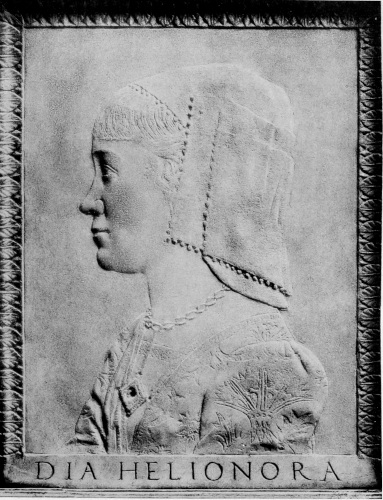
ELEANORA OF ARAGON DUCHESS OF FERRARA 1450-1493
Reduced from a photograph, kindly furnished by M. Gustave Dreyfus, of an anonymous bas-relief in his collection at Paris. The sculptor may possibly have been Sperandio di Bartolommeo de’ Savelli (1425?-1500?). See note 399.
Note 412 page 214. The event occurred in 1501, six years before the date of the Courtier dialogues.
Note 413 page 214. The Volturno flows through Capua.
Note 414 page 214. Gazuolo or Gazzuolo is now the name of an Italian commune, containing less than 5,000 inhabitants, and situated eleven miles west of Mantua.
Note 415 page 214. The Oglio is a river of Lombardy about 135 miles long; it traverses the Lake of Iseo, and joins the Po some ten miles south-west of Mantua.
Note 416 page 214. In two earlier MS. versions of The Courtier, the passage ‘Now from this ... even her name is unknown’ reads: “Then messer Pietro Bembo said: ‘In truth, if I knew this noble peasant girl’s name, I would compose an epitaph for her.’ ‘Do not stop for that,’ said messer Cesare; ‘her name is Maddalena Biga, and if the Bishop’s death had not occurred, that bank of the Oglio’” etc.
With slight variations this story is narrated as fact in a letter of Matteo Bandello (1480-1562), from whose tales Shakspere took plots for his plays. The letter gives the poor girl’s name as Giulia and that of the Bishop of Mantua as Ludovico Gonzaga, and relates that, as it was unlawful to bury 404her remains in consecrated soil, he caused them to be deposited in the piazza, intending to place them in a bronze sarcophagus mounted on a marble column. The letter also affirms that the ravisher was one of the bishop’s valets.
Note 417 page 215. This was Ludovico Gonzaga, (born 1458; died 1511), a son of the Marquess Ludovico of Mantua and Barbara of Brandenburg, and a younger brother of “my lady Duchess’s” father. Made Bishop of Mantua in 1483, he continued to hold that office until his death, and appears from various contemporary documents to have been a liberal and wise prince. The last years of his life were spent at Gazzuolo, which he made a centre of culture, art and learning. His brother Gianfrancesco was husband of the Antonia del Balzo mentioned above, note 400. For particulars regarding him, see an article by Rossi in the Giornale Storico della Letteratura Italiana, xiii, 305.
Note 418 page 215. The basilica of St. Sebastian, on the Appian Way, dates from the 4th century, was built over the most famous of the catacombs, and enjoyed an exceptional veneration during the Middle Ages. The saint was a young military tribune born in Gaul, suffered martyrdom under Diocletian about the year 288, and was buried in the catacombs of Callistus. St. George and he were the favourite saints of chivalry, and may be regarded as the martial Castor and Pollux of Christian myth.
Note 419 page 216. Felice della Rovere, (died about 1536), was a natural daughter of Cardinal Giuliano della Rovere (afterwards Julius II) and a certain Lucrezia, the wife of Bernardo de Cuppis (or Coppi) da Montefolco; thus “my lord Prefect” of The Courtier was her own cousin. In 1506 she became the second wife of the elderly and eccentric Giangiordano Orsini, and the ancestress of the Dukes of Bracciano. Her name often occurs in contemporary documents, not only on account of her lofty position but because of her love of art and letters. Both Castiglione and Giancristoforo Romano were her friends. The incident mentioned in the text seems not to be referred to elsewhere. Savona, a seaport on the western Riviera, is near the birthplace of Felice’s great-uncle, Pope Sixtus IV, who was the founder of the della Rovere family.
Note 420 page 216. Duke Guidobaldo’s impotence is said to have given rise to the project of a divorce for his duchess.
Note 421 page 218. The reference here is to Ovid’s Ars Amandi, which enjoyed an extraordinary reputation during the Renaissance, and from which this passage is largely derived.
Note 422 page 220. The Laura to whom Petrarch consecrated no less than three hundred and eighteen sonnets, is usually regarded as identical 405with Laure, the daughter of a certain knight of Avignon, Audibert de Noves. If this identification be correct, she was born in 1308, married Hughes de Sade in 1325, became the mother of eleven children, and died in 1348. In 1533 Francis I caused her reputed tomb to be opened, and found in it a small box which contained a medal bearing a woman’s profile, and a parchment on which was a sonnet signed by Petrarch.
Note 423 page 220. The so-called “Song of Solomon” is now thought to be the work of a period later than Solomon’s and to contain no mystic meaning.
Note 424 page 222. In the old romance, “Amadis of Gaul,” Isola Ferma is an enchanted island, with a garden at the entrance to which stands an arch surmounted by the statue of a man holding a trumpet to his mouth. Whenever an unfaithful lover attempts to pass, the trumpet emits a dreadful sound with fire and smoke, and drives the culprit back; while it welcomes all true lovers with sweetest music.
Note 425 page 228. Here again the reference is of course to “my lady Duchess.”
Note 426 page 235. The Hypnerotomachia Poliphili, first published by Aldus in 1499, was written by Francesco Colonna, a Dominican friar of Venice, who died an old man in 1527. The book is rare, and is said to be an allegorical romance full of lascivious erudition, and written in a pedantically affected mixture of Italian, Latin, and Venetian patois.
Note 427 page 237. Ars Amandi, i, 597-602.
Note 428 page 237. Ars Amandi, i, 569-72.
407
NOTES TO THE FOURTH BOOK OF THE COURTIER
Note 429 page 243. Gaspar Pallavicino died in 1511, at the age of twenty-five.
Note 430 page 243. Cesare Gonzaga died in 1512, at about the age of thirty-seven. See note 43.
Note 431 page 244. Federico Fregoso was named Archbishop of Salerno in 1507, very soon after the date of the Courtier dialogues; see note 41.
Ludovico da Canossa became Bishop of Bayeux in 1520; see note 44.
Ottaviano Fregoso became Doge of Genoa in 1513; see note 11.
Bibbiena was made cardinal, and Bembo was appointed papal secretary, in 1513; see notes 10 and 42.
Giuliano de’ Medici was created Duke of Nemours in 1515. As he died in 1516, Castiglione’s use of the present tense (‘that greatness where now he is’) is inconsistent with the mention of Canossa as Bishop of Bayeux. See note 9.
Francesco Maria della Rovere succeeded to the dukedom in 1508; see note 3.
Note 432 page 244. Eleanora Gonzaga, (born about 1492; died 1543), was the eldest daughter of the Marquess Gianfrancesco of Mantua and Isabella d’Este. In 1505 Castiglione negotiated her union with Francesco Maria della Rovere, but the marriage did not take place until Christmas Eve 1509, upon which occasion Bembo wrote to Federico Fregoso that he had never seen a comelier, merrier or sweeter girl, and that her amiable disposition and surprisingly precocious judgment won general admiration. She seems to have maintained affectionate relations with her aunt and predecessor (“my lady Duchess” of The Courtier), whose fame quite outshone her own, and to have exhibited in after life no little strength of character. She is said to have excluded, and even to have expelled, great ladies of questionable morality from her court. Titian’s portrait (1537) represents her in middle age, but his pictures, La Bella and Das Mädchen im Pelz, as well as several of his Venus heads, are generally regarded as idealized presentations of her more youthful face.
Note 433 page 249. The Piazza d’Agone occupied the site of the ancient Circus Agonalis, which derived its name from the Agonalia, a festival held twice a year in honour of Janus. Before, during and long after Castiglione’s time, it was a centre of festivals, amusements and spectacles at the carnival season. It is now called the Piazza Navona.
Note 434 page 250. The famous Athenian commander Cimon, (died 449 B.C.), 408was the son of the still more famous Miltiades. His victories repulsed the last Persian aggressions and consolidated the Athenian supremacy. Although an admirer of Spartan institutions, he seems to have been of a somewhat indulgent disposition. The Scipio here referred to, is probably Publius Cornelius Scipio the Elder, who was the victor over Hannibal and died 183 B.C. Lucullus is cited earlier in The Courtier as an instance of a soldier with studious tastes; see note 113.
Note 435 page 250. The Theban general and statesman Epaminondas, (died 362 B.C.), is said by Plutarch to have enjoyed the instruction of the Pythagorean philosopher Lysis of Tarentum, who was driven out of Italy in the persecution of his sect, and found refuge at Thebes.
Note 436 page 250. Agesilaus was King of Sparta 398-361 B.C. Although small and lame, he was the greatest Spartan commander, and became famous for his victories against the Persian and Greek enemies of his country. Xenophon, historian, essayist and disciple of Socrates, was banished from Athens about the time of Socrates’s death (399 B.C.), accompanied Agesilaus into Asia, and wrote a panegyric upon him, regarded by Cicero as more glorious than all the statues erected to kings.
The reverence and love of Scipio the Younger (about 185-129 B.C.) for the Rhodian Stoic philosopher Panaætius (about 180-111 B.C.) is frequently mentioned by Cicero, from whose De Oratore Castiglione seems to have taken this whole passage.
Note 437 page 252. In Greek mythology Epimetheus (Afterthought) and Prometheus (Forethought) were sons of the Titan Iapetus and the ocean nymph Clymene. Angered by a deceit practised upon him by Prometheus, Zeus withheld from men the use of fire; but Prometheus stole fire from heaven and brought it to earth in a hollow reed. For this offence he was chained to a rock where an eagle preyed daily upon his liver (which grew again in the night), until he was finally liberated by Hercules. As compensation for the boon of fire, Zeus sent Pandora (the first woman, endowed with beauty, cunning and other attributes designed to bring woe to man) to be the wife of Epimetheus. Although warned by his brother, Epimetheus accepted her, with the result that she set free the evils which Prometheus had concealed in a box. In a later form of the legend, she received from the gods a box containing the blessings of life, and on her being moved by curiosity to open the box, all of them (save hope) escaped and were lost.
Note 438 page 263. Bias was born at Priene in Asia Minor, and lived in the 6th century B.C. He was celebrated for his apothegms and reckoned among the Seven Sages of Greece,—the other six being: Thales of Miletus, Solon of Athens, Chilon of Sparta, Cleobulus of Rhodes, Periander of Corinth, and Pittacus of Mitylene,—all of whom flourished about 600 B.C. The fame of these seven men rested not upon their philosophy, as we use the word, but upon their practical wisdom—the fruit of experience.
409
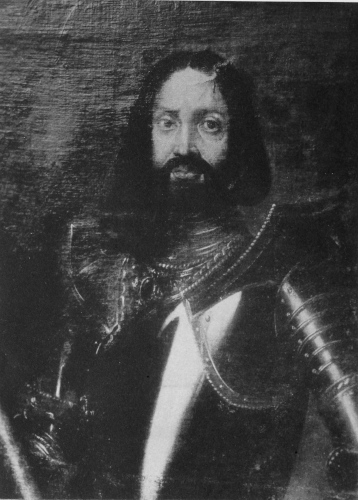
GIANFRANCESCO GONZAGA MARQUESS OF MANTUA BROTHER OF “MY LADY DUCHESS” 1466-1519
Enlarged from a photograph, kindly furnished by Signer Alessandro Luzio and made by his friend Signor Lanzoni, of a portrait attributed to Francesco Bonsignori (1455-1519) and owned by the antiquary Bressanelli of Mantua.
Note 439 page 264. Clearchus, (died 353 B.C.), was for twelve years a cruel tyrant, not of Pontus, but of Heraclea (the modern Eregli), a city on the Black Sea about 140 miles east of Constantinople. He is said to have been a pupil of both Plato and Isocrates, the latter of whom represents him as a gentle youth.
Note 440 page 264. Of the dozen or more ancients known to have borne the name Aristodemus, none seem to fit precisely the description given in the text, which is taken from a passage in Plutarch’s “On the Ignorant Prince.” Plutarch may have had in mind a certain tyrant of Megalopolis in the 3d century B.C.
Note 441 page 269. The reference here is to Book V of “The Republic.”
Note 442 page 270. Fregoso here declares for what has been called “that Utopia of the 16th Century—the Governo Misto—a political invention which fascinated the imagination of Italian statesmen much in the same way as the theory of perpetual motion attracted scientific minds in the last century.” (Symonds’s “Renaissance in Italy,” i, 306.) In this regard the men of Castiglione’s time, men like Machiavelli and Guicciardini, were only following Plato and Aristotle.
Note 443 page 270. The reference here is to the Cyropædia, i, 6.
Note 444 page 270. Castiglione seems to have in mind the game of tavola reale, which is similar to our backgammon.
Note 445 page 273. Circe’s transformation of some of Ulysses’s companions into swine is narrated in the tenth book of the Odyssey. In Castiglione’s day the term “King of France” was used to signify the acme of royal power.
Note 446 page 274. Gianfrancesco—more commonly called Francesco—Gonzaga, (born 1466; died 1519), was the eldest son of the Marquess Federico of Mantua and Margarita of Bavaria, and a brother of “my lady Duchess.” Having succeeded his father in 1484, he married (1490) Isabella d’Este, to whom he had been betrothed at the age of sixteen. Like his ancestors and most other petty Italian rulers of his time, he was at once condottiere and sovereign prince. He commanded the Italian troops against Charles VIII, and although with an overwhelmingly superior force he failed to block the retreat of the French at Fornovo, he treated that disgraceful affair as a glorious victory, and even caused it to be commemorated by Mantegna in a votive picture now in the Louvre. He served successively as captain of the imperial troops in Italy, as commander of Duke Ludovico Sforza’s army, as viceroy of Naples under Louis XII, etc. He joined the League of Cambray and was taken prisoner by the Venetians. In the general disorders that filled the period of his reign, he and his more brilliant wife had the address to protect 410his dominions from the ravages of war. Although, as Castiglione’s natural lord, he was asked and gave his consent to the latter’s entry into the Duke of Urbino’s court (1504), he seems to have continued to resent the affair until Castiglione’s return (1516) to his service,—in which the author remained when this part of the text was written. Castiglione’s eulogy was far from undeserved, for to the Marquess’s munificence, no less than to his consort’s taste and enthusiasm, must be ascribed the lustre of their provincial court. Besides being a patron of art and letters, he was also a successful breeder of horses for use both in war and in racing.
Note 447 page 274. The duke is said to have had no small share in planning the palace; his chief architect was one Luciano, a native of Laurana in Dalmatia on the eastern coast of the Adriatic. The cost of the structure was about £400,000 sterling. See, besides the authorities cited in note 28, Luzio and Renier’s Mantova e Urbino, (Roux: Turin: 1893), p. 10, note 1.
Note 448 page 274. The ancient basilica of St. Peter’s had become ruinous by 1450, but little was done towards rebuilding it until 1506, when the execution of Bramante’s plan was begun with the solemn laying of the first stone by Julius II on Sunday, 18 April. On the death of Bramante, Raphael was put in charge of the work in 1514, as we have seen (note 98), but, apparently owing to lack of funds, progress was slow until 1534 when Michelangelo’s designs were substituted. The dome was completed in 1590, and the church dedicated in 1626.
Note 449 page 274. This ‘street’ was designed by Bramante to be a kind of triumphal way connecting the Vatican with the Belvedere pavilion. It was to be bordered by palaces, courts, gardens, porticoes, terraces, etc., but the death of Julius II led to the abandonment of the plan.
Note 450 page 274. Pozzuoli (the ancient Puteoli), situated seven miles west of Naples, was originally a Greek city, but became one of the chief commercial ports of the Roman Empire, and a resort of the patrician class. It is noted for its ruins, especially those of a large amphitheatre.
Baja (the ancient Baiæ), on the Gulf of Pozzuoli, was the chief Roman watering place, famous for its luxury, and containing the villas of many celebrated Romans. Its principal antiquities are ruins of baths.
Civita Vecchia lies on the coast about thirty-eight miles north-west of Rome, and was anciently known as Centum Cellæ. The Emperor Trajan (reigned 98-117 A.D.) converted it from a poor village into a great seaport, and of his monuments some remains are still extant.
Porto was a Roman city near the mouths of the Tiber. In Castiglione’s time it had become a marshy island. One of the earliest Italian archæologists, Flavio Biondo, visited the site in 1451, and found there many huge marble blocks ready for building and bearing quarry marks of the imperial period. The Apollo Belvedere was discovered here in 1503.
411
Note 451 page 274. Almost the same phrase occurs in the well known letter which Raphael (who had been appointed guardian of antiquities) wrote to Leo X, urging the pontiff to avert the complete destruction of “that little which remains of Italian glory and greatness in proof of the worth and power of those divine minds.” Castiglione was long supposed to be the author of the letter, but is now believed only to have aided Raphael in its composition.
Note 452 page 274. Alexandria was founded by the conqueror in 332 B.C.
Bucephalia (founded 327 B.C.) was situated on the river Hydaspes (the modern Jhelum), a branch of the Indus, about 120 miles north-west of Lahore, and was named in honour of Alexander’s favourite horse, which died there. Bucephalus (ox-headed) is supposed to have been a name given to Thessalian horses, which were branded with a bull’s head.
Note 453 page 274. Mount Athos (6780 feet high) forms the extremity of the easternmost peninsula of Chalcidice in Macedonia. During the Persian invasion of Xerxes (480 B.C.) it was temporarily converted into an island, and since the Middle Ages has been noted for its monasteries. Both Vitruvius and Plutarch give an account of the project mentioned in the text, and ascribe it to a Macedonian architect who appears under the names, Dinocrates, Cheirocrates, and Stasicrates,—and who also planned the city of Alexandria and was chosen to rebuild the great temple of Artemis at Ephesus. The statue was to represent Alexander, who is said to have abandoned the idea when he learned that the city to be placed in the hand of the statue would be without territory and could be provisioned only by sea,—saying that such a city would be like a child that cannot grow for failure of its nurse’s milk.
Note 454 page 275. In Athenian legend Procrustes was a cruel robber, who had a bed upon which he tortured his captives by stretching those who were too short and by cutting off the legs of those who were too long. He was finally slain by the hero Theseus.
Sciron was another legendary Attic robber, who compelled his victims to wash his feet on the Scironian rocks near Athens, and then kicked them into the sea where they served to fatten the turtles upon which he fed. He also was slain by Theseus, and in the same manner in which he had slain others.
In Roman myth Cacus was a gigantic son of Vulcan, living near the site of Rome. He robbed Hercules of some of the cattle stolen from the monster Geryon, and dragged them into his cave backwards, so that they could not be tracked; but Hercules discovered them by their lowing, and slew the thief.
Diomed (not the Argive prince of the Iliad, but Ares’s mythical son, who was king over the Bistones in Thrace) was slain by Hercules because he was accustomed to feed his mares on human flesh.
Antæus was a fabulous and gigantic wrestler of Libya, reputed to be the son of Poseidon and Gæa, the Earth goddess. Being held aloft and thus deprived of the miraculous strength derived from contact with his mother earth, he was crushed to death by Hercules. 412Geryon was the mythical three-headed king of Hesperia, the theft of whose cattle constituted the tenth of the Twelve Labours of Hercules.
Note 455 page 275. “The crimes of the tyrants against their subjects and the members of their own families had produced a correlative order of crime in the people over whom they tyrannized. Cruelty was met by conspiracy. Tyrannicide became honourable; and the proverb, ‘He who gives his own life can take a tyrant’s,’ had worked itself into the popular language.” (Symonds’s “Renaissance in Italy,” i, 154.) “The study of the classics, especially of Plutarch, at this time as also during the French Revolution, fired the imagination of patriots.” (Id., 151, note 2.)
Note 456 page 275. Similar exhortations to a fresh crusade are of frequent occurrence in Italian literature of this period, and were often used by popes and princes as a cover for their selfish designs.
Note 457 page 275. The meaning obviously is that if they had not been exiled, they never would have enjoyed their present prosperity. Plutarch tells the story in four slightly varying forms.
Note 458 page 276. Monseigneur d’Angoulême afterwards became Francis I (see note 111). Even stronger evidence of the author’s admiration than this and another passage (see page 57), is afforded by the Proem with which he originally intended to preface the dialogues, but for which he seems to have been led by political considerations to substitute the introduction finally printed.
Note 459 page 276. Henry, Prince of Wales, afterwards Henry VIII, (born 1491; died 1547), was the younger son of Henry VII and Elizabeth of York, and was educated for the church. Having succeeded his father in 1509, he married (in accordance with his parents’ wish) his elder brother Arthur’s widow, Catherine, the youngest child of Ferdinand and Isabella the Catholic. His accession was hailed with enthusiasm. Left rich through his father’s avarice, he was generous, frank, handsome, exceptionally robust, and an accomplished athlete and scholar. Good men were delighted with the purity of his life, his gaiety pleased the courtiers, and sober statesmen found in him a singular capacity for business. Besides being a musician, he spoke Latin, French and Spanish, and was very devout,—usually attending mass five times daily. Even as late as 1521 he dedicated to the pope an anti-Lutheran tract on the Seven Sacraments, and in return received the title of Defender of the Faith. As an offset to the enormities of his later life, it is only just to remember that he raised England to the rank of a great European power, and that for twenty years he did nothing to mar the harmony of his reign.