THE BOOK OF THE COURTIER BY COUNT BALDESAR CASTIGLIONE
Leonard Eckstein Opdycke translation
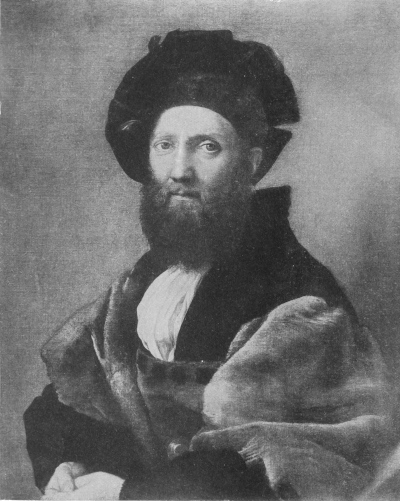
BALDESAR CASTIGLIONE COUNT OF NOVILLARA 1478-1529
Reduced from Braun’s photograph (no. 11.505) of the portrait in the Louvre, painted in 1516 by Raphael (1483-1520). The original belonged to Charles I of England, after whose death it was bought by a Dutch collector and copied by Rubens. Later it became the property of Cardinal Mazarin, from whose heirs it was acquired for Louis XIV of France.
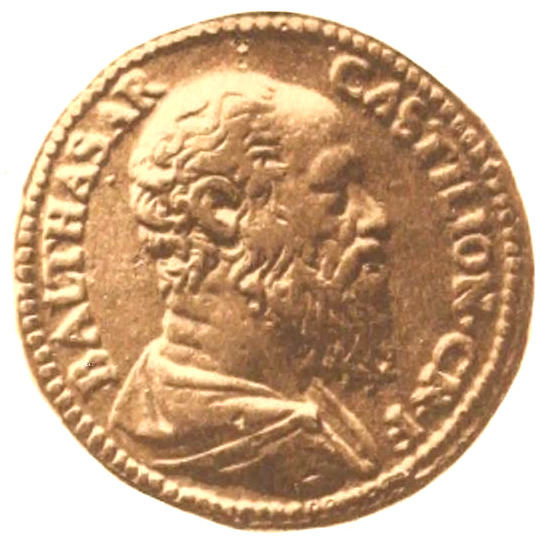
The medallion on the title-page is from a photograph, specially made by Mansell, of a cast, kindly furnished by T. Whitcombe Greene, Esq., of an anonymous medal in his collection at Chandler’s Ford, Hampshire. See the late Alfred Armand’s Les Médailleurs Italiens, ii, 100, no. 10.
THE BOOK OF THE COURTIER
BY COUNT BALDESAR
CASTIGLIONE
(1528)
TRANSLATED FROM THE ITALIAN AND ANNOTATED
BY LEONARD ECKSTEIN OPDYCKE
WITH SEVENTY-ONE PORTRAITS AND FIFTEEN AUTOGRAPHS
REPRODUCED BY EDWARD BIERSTADT
LONDON
DUCKWORTH & CO.
NEW YORK
CHARLES SCRIBNER’S SONS
1902
Copyright 1901, by
Leonard Eckstein Opdycke
The Book of the Courtier was written, partly at Urbino and partly at Rome, between the years 1508 and 1516, and was first printed at the Aldine Press, Venice, in the month of April, 1528.
There have since been published more than one hundred and forty editions, a list of which will be found at page 417 of this volume. The first Spanish version, by Juan Boscan Almogaver, was issued at Barcelona in 1534; the first French version, by Jacques Colin, was issued at Paris in 1537; the first English version, by Thomas Hoby, was issued at London in 1561; the first Latin version, by Hieronymus Turler, was issued at Wittenberg in 1561; the first German version, by Lorenz Kratzer, was issued at Munich in 1566.
The present edition consists of five hundred numbered copies, of which this is No.