Chapter Seven ARCTIC SKIN BOATS Howard I. Chapelle
Reading edition
Among the three primitive watercraft of North America (the others being the dugout and the bark canoe of the American Indians), the Arctic skin boats of the Eskimos are remarkable for effective design and construction obtained under conditions in which building materials are both scarce and limited in selection. The Arctic skin boat is almost entirely to be found in the North American Arctic from Bering Sea to the East Coast of Greenland. In Russian Siberia, only in a small area of the eastern Arctic lands adjacent to the North American continent are any employed.
These craft, an important and necessary factor in the hunting lives of most Eskimo tribal groups, have long attracted the attention of explorers and ethnologists, and many specimens have been deposited in American and European museums. Like bark canoes, they have unfortunately proved difficult to preserve under conditions of museum exhibit. As a result, examples of once numerous types have become so damaged that they no longer give an accurate impression of their original form and appearance, and some have so deteriorated that they have had to be destroyed. Among the latter may have been examples of types long since out of use. One such type was represented by a single kayak, now destroyed; as a result this form has become extinct, and only a poor scale model remains to give a highly unsatisfactory representation of it.
In 1946 the late Vilhjalmur Stefansson, who was then projecting his Encyclopedia Arctica, asked me to prepare for it a technical article on the Arctic skin boat. The decision of the sponsors to discontinue the publication, after the first volume had appeared, prevented appearance of the article, but in 1958, through the kindness of Dr. Stefansson, it was returned to the author for publication by the U.S. National Museum. I have since revised and added to it, after receiving criticisms and suggestions from Henry B. Collins, of the Smithsonian's Bureau of American Ethnology, from John Heath, and from other authorities.[2]
The object of the study, as will be seen, was to measure the skin boats and to make scale drawings that would permit the construction of a replica exact in details of appearance, form, construction, and also in working behavior. Special regard was given to the diversity of types with respect to hull form and construction methods; but questions of ethnic trends, tribal migrations, and such matters, being outside the scope of the study, were not considered. Wherever possible, full-size craft were used as the source, but where only fragments existed, these had to be supplemented by reference to and interpretation of models of the same type.
In spite of the difficulty of locating skin boats of some Arctic areas, examples of most of those mentioned by explorers since 1875 have been found and recorded, so that, as far as possible, every distinctive tribal type of Arctic skin boat which in 1946 was represented by museum exhibits in the eastern United States is represented in plans here.
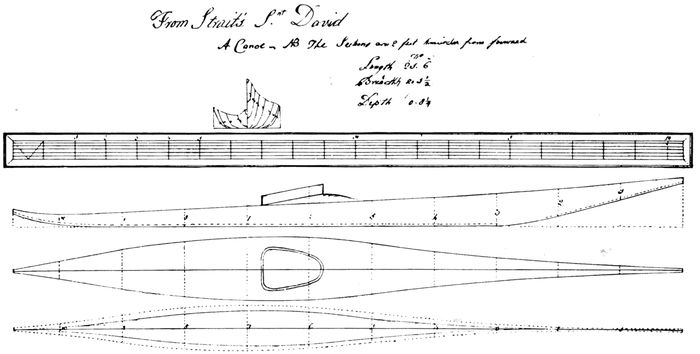
Figure 157
Eighteenth-Century Lines Drawing of a kayak, from Labrador or southern Baffin Island (according to Dr. Kaj Birket-Smith of the Danish National Museum). Note the long stem that is characteristic of present day kayaks from Labrador. The lettering apparently reads:
From Strait's Snt. David
A Canoe—N.B. The sections are 2 feet asunder from forward
Length 21'-6"
Breadth 2'-1½"
Depth 0'-8¼"
(Courtesy National Maritime Museum, Greenwich, England.)
With the material available it was not possible, of course, to explore all the individual types and forms in full; hence, the geographical range of a type can be stated only approximately, owing to the overlapping of tribal groups and the almost constant migratory movement of the Eskimo. Originally the 2-and 3-cockpit kayaks of Russian colonial Alaska had been omitted as being probably the results of Russian influence. John Heath, however, believing attention should be given to this type, has very kindly prepared for me a fine draught of such a kayak, or "baidarka" (other spellings of this name are common); this is shown on page 197.
Although the scale drawings accurately represent the form and details of construction, they necessarily idealize somewhat the primitive boat design. Also, in showing the hull-form, the usual method of projecting the "lines" of the hull was discarded as unsuitable. Instead structural features have been emphasized, with the result that "round"-bottom kayaks appear as multi-chine hulls, as they properly are. In view of the fluid state of design in Eskimo craft it is obvious that the examples shown represent the stage of development at the given date, though the alteration in most designs has been so gradual that the representation could serve to illustrate with reasonable accuracy a tribal or area type for a decade or more.
The Eskimos have produced two types of skin boats that have proved remarkably efficient craft for small-boat navigation in Arctic waters: an open boat ranging from about 15 to approximately 60 feet in length for carrying cargo and passengers for long distances, and a small decked canoe developed exclusively for hunting. With few exceptions these Arctic skin boats are wholly seagoing craft.
The open boat, called the umiak, is propelled by paddles or oars or sail or, in recent years, by an outboard gasoline engine, or it may be towed. While fundamentally a cargo carrier the umiak has been employed by some Eskimo in whaling and in walrus hunting. For these purposes a faster and more developed design is used than that used only to carry families, household goods, and cargo in the constant Eskimo search for new hunting grounds. To a far greater degree than any other boat of similar size, this Eskimo boat is characterized by great strength combined with lightness.
The decked hunting canoe, the kayak, is propelled by paddle alone when used for hunting and fishing, but is occasionally towed by the umiak when the owner travels. The kayak is perhaps the most efficient example of a primitive hunting boat; it can be propelled at high speed by its paddler and maneuvered with ease. These hunting kayaks are commonly built to hold but one person, though one group of Eskimo built the kayaks to carry two or three. The kayak, remarkable for its seaworthiness, lightness and strength, has been perhaps one of the most important tools in the Eskimo fight for existence. Few tribes have been unacquainted with its use. Because of its employment, the kayak often has to be designed to meet very particular requirements and so there is greater variation in its form and dimensions than in the umiak.
Seagoing skin boats have not been common outside the Arctic in historical times. In fact only the European Celts are known with certainty to have used such craft. The Irish, in particular, employed large seagoing skin boats as late as the reign of Queen Elizabeth of England; a drawing of one preserved in the Pepysian Library was reproduced in the Mariner's Mirror (vol. 8, 1922, facing p. 200). Although there can be little doubt that large seagoing skin craft had been more widely used in prehistoric times, the perishable nature of the skin covering and the light framework probably account for the lack of any archeological remains that would indicate its range. The availability of the materials required in its construction, however, suggest that its use could have been very widespread. The long voyages made by the Irish, in the dawning of recorded history, could well have made its design and construction known to others.
There are still many skin boats in use by primitive people and even a few survivals in Europe, but with the exception of the Irish "curragh," these craft are designed for inland waters and are either rather dish-shaped, or oval in plan, like half a walnut shell. In design they are related to the coracle of ancient Britain rather than to a seagoing skin boat of the Irish or Eskimo type. Both the Irish curragh and the British coracle, now, of course, are covered with canvas rather than hide.
Traditions of long voyages by the ancient Irish in the skin-covered curragh make it apparent that such voyages were relatively common, and the design and construction of existing models of the curragh and umiak indicate that these voyages could have been made with reasonable safety. Compared to the dugout canoe, the skin boat was far lighter and roomier in proportion to length and so could carry a far greater load and still retain enough freeboard to be safe. The size of the early skin boats cannot be established with certainty; the modern Irish curragh is probably debased in this respect, but early explorers of Greenland reported umiaks nearly 60 feet in length and there is no structural reason why the curragh could not have been as large or even larger.
Compared with the curragh, the umiak is lighter, stronger, and more resistant to shock. The curragh was built with closely spaced bent frames and longitudinal stringers to support the skin cover, whereas the umiak has very widely spaced frames and few longitudinals, giving the skin cover little support. The difference in construction is undoubtedly a result of the type of covering used, for the curragh was covered with cattle hides, which were less strong than the seal or walrus skins used by the Eskimo. The strong and elastic skin cover of the umiak and the lack of a rigid structural support gives this boat an advantage in withstanding the shocks of beaching or of working in floating ice; and because of its relatively light framework and the method of securing the structural members, its frame is far more flexible than that of the curragh, adding to this ability.
The skin cover of the curragh was made watertight by rubbing the hides with animal fat, and the sewn seams were payed with tallow. The Eskimo soak the skin cover of the umiak with animal oil and pay the seams with blubber or animal fat. Both treatments produced a cover initially watertight but requiring drying and reoiling to remain so. Under most climatic conditions in the North Atlantic or Pacific the oiled skins remain watertight from four days to a week. This period can be lengthened by various methods; skin boats travelling in company can be dried out in turn by unloading one and placing it aboard a companion craft. There is evidence of other methods of treating the skin covering; waterproofing it with melted tallow, for example, or with a vegetable gum or a resin such as pitch, would enable it to remain watertight for a much longer time, though such treatments would make the covering less elastic. Pitch was also used at one time in curragh building, and it would be unwise to assume that the oil treatment used by the Eskimo was their only method of producing watertight skin covers in the period before they were first observed by Europeans.
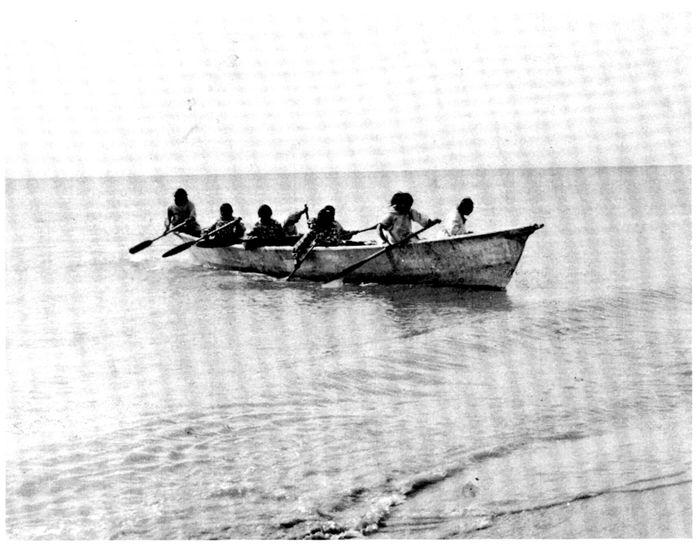
Figure 158
Western Alaskan Umiak with eight women paddling, Cape Prince of Wales, Alaska, 1936. (Photo by Henry B. Collins.)
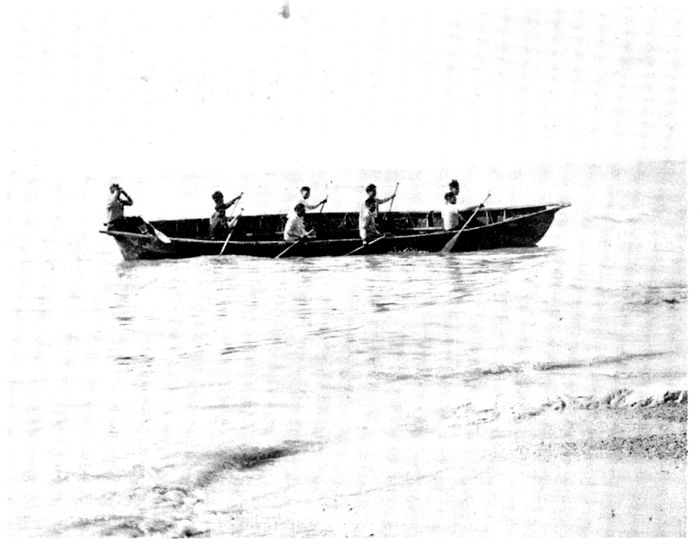
Figure 159
Western Alaskan Umiak being beached, Cape Prince of Wales, Alaska, 1936. (Photo by Henry B. Collins.)
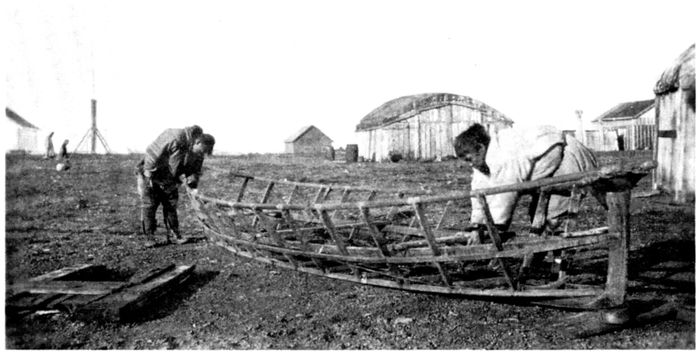
Figure 160
Repairing Umiak Frame at St. Lawrence Island, Alaska, 1930. (Photo by Henry B. Collins.)
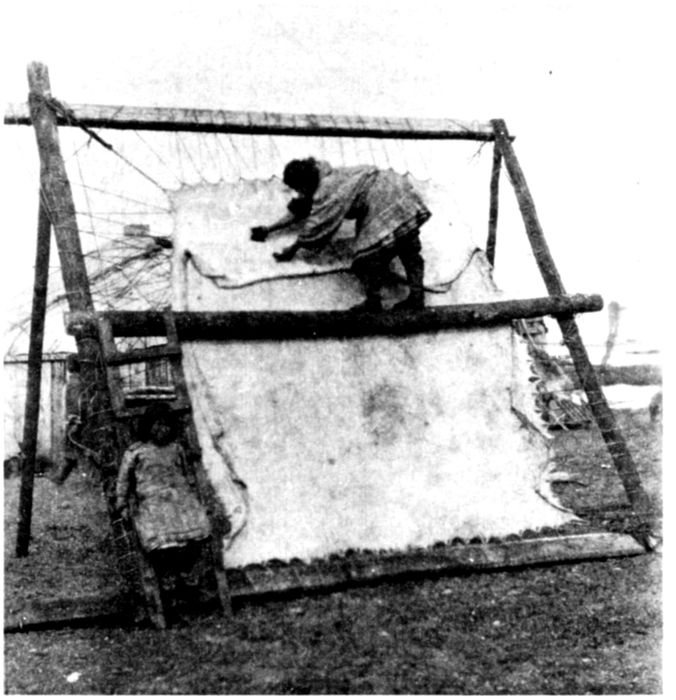
Figure 161
Eskimo Woman Splitting Walrus Hide to make umiak cover, St. Lawrence Island, Alaska, 1930. (Photo by Henry B. Collins.)
The fundamental difference between the construction of the curragh and that of the umiak lies in the type of longitudinal strength members and the transverse framing used. The curragh, like the birch-bark canoe, depended entirely upon its gunwales for longitudinal strength, whereas the umiak has a strong keel, or, properly, a keelson since the keel was inside the skin cover. The curragh used longitudinal battens to support the skin cover. The umiak, on the other hand, has in its chine timbers rather strong longitudinal members that give additional strength to the bottom. Its transverse frames, unlike those of the curragh which were continuous from gunwale to gunwale, are in three sections, two side pieces and a floor, or bottom, member and the frame members are joined to gunwale, chines and keelson by lashings of sinew, whalebone, or hide, a method that, together with three-part frames, gives great flexibility to the framework. The frame of the early curragh may have been lashed, but because of the other fundamental differences in design and construction it was less flexible than that of the umiak.
The basic features of the umiak frame are not found in the kayak, the structure of which in most types approaches that of the curragh. The gunwale is the strength member in the kayak, and some types have a rather extensive longitudinal batten system as well. In only a few types of kayak is the keelson an important strength member, and even here the gunwales are of primary importance. The hypothesis has been offered that this indicates a different parentage for the kayak than for the umiak, and that the umiak represents the earlier type, it being argued that this type of boat was the one more required in migratory periods, and so would be first developed. Such theories should be accepted with caution, however, as the fundamentally different use requirements for the two types of craft might readily explain the variation in their principles of construction. Hunting would also have been necessary during migrations, as existence depended upon food; the earlier appearance of the umiak cannot be assumed on such limited grounds.
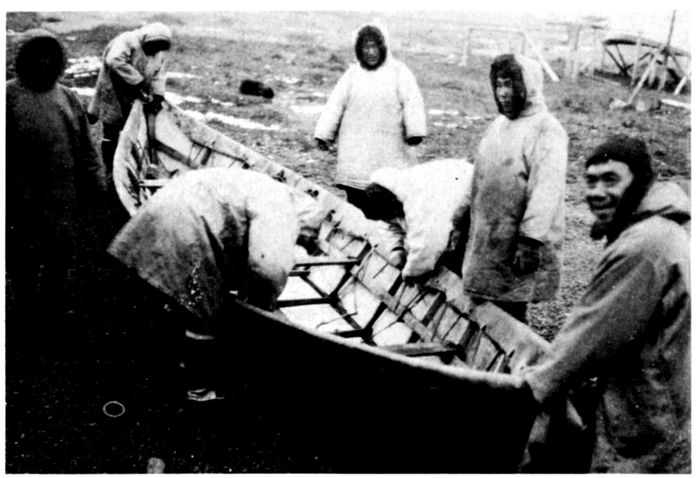
Figure 162
Fitting Split Walrus-Hide Cover to umiak at St. Lawrence Island, Alaska, 1930. (Photo by Henry B. Collins.)
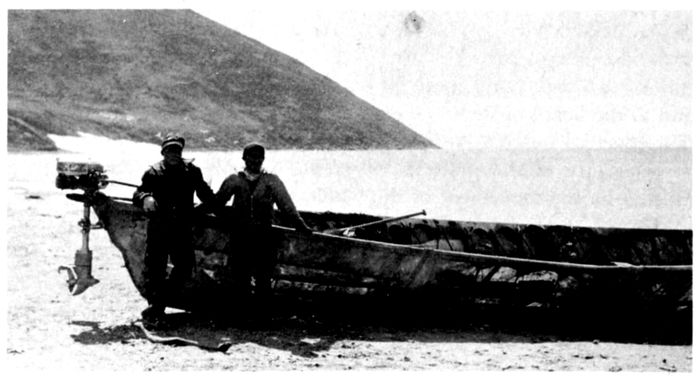
Figure 163
Outboard Motor Installed on Umiak, Cape Prince of Wales, Alaska, 1936. (Photo by Henry B. Collins.)
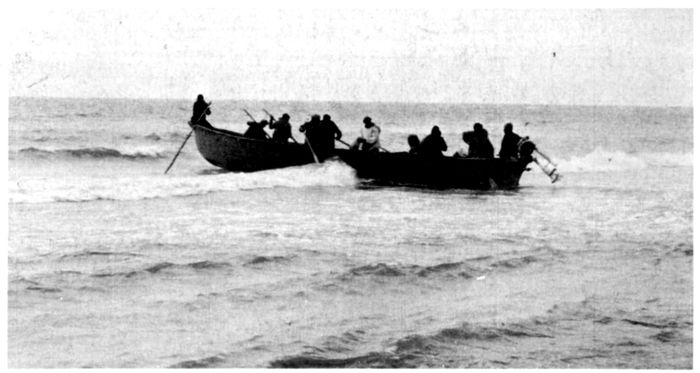
Figure 164
Launching Umiak in Light Surf, with crew of 12 men. (Note outboard motor attached), Cape Prince of Wales, Alaska, 1936. (Photo by Henry B. Collins.)
Eskimo skin boats possess remarkable advantages for their employment and conditions of use. Their hulls are light in weight, simple to build, and relatively easy to repair, yet they are highly shock resistant. They can carry large loads, yet are fast, they are capable of being propelled by more than one means, and they are exceptionally seaworthy.
Floating ice is considered a major hazard to craft of all sizes, but the umiak, for example, can resist the shocks of ramming the ice to a degree beyond the tensile strength of the skin covering, by reason of the method of attaching the skin cover to the framework of the hull, and to some extent the form of the boat itself. The skin cover of the umiak is not rigidly attached to the frame in a number of places, but rather is a complete unit secured only at the gunwales and to the heads of stem and stern. This permits the skin cover to be greatly distorted by a blow, so that the elasticity of the material at point of impact is assisted by the movement of the whole skin cover on the frame. Also, the frame itself is flexible and allows distortion and recovery not only within the limits of the elasticity of the wooden frame but also by the movement of the lashed joints in the transverse frames. Some kayaks have similar characteristics, though their small size and the light weight of both boat and loading make its resistance to shock of far less importance than that of the umiak.
Light weight is a highly desirable characteristic for small craft in the Arctic, since it permits the boat without the aid of skids or other mechanical contrivances to be removed from the water and carried over obstructions, and to be transported either by sledge or by manual portage over long distances. Lightness is obtained in the Eskimo skin boats by the small number and small size of the wooden structural members used in their construction. The resulting light weight hull permits heavy loading in proportion to the size of the boat, and it allows building with a minimum of material, in a country where such materials as wood are scarce and hard to obtain.
For all small craft in Arctic waters, where distances between sources of supply may be great and the time that the water is open to navigation is relatively short, speed is an important and desirable attribute that permits movement with a minimum of effort. The exigencies of Arctic travel make it further desirable that small craft be capable of propulsion under paddle, oars, sail, or low-powered gasoline motors. The umiak, because of its form and weight, can be modified to meet this requirement without loss of other desirable attributes, and to a slightly lesser degree, the same may be said of the kayak.
Simplicity in construction and repair are also basic requirements in the Arctic, where an emergency may make it necessary to repair or rebuild a damaged boat out of materials available nearby with the minimum of tools and under adverse weather conditions. The Eskimo has produced a boat construction that, as will be seen from the descriptions that follow, to a high degree meets this requirement.
Exceptional seaworthiness is required, as most Arctic waters are subject to violent storms; the Arctic skin boats have been developed with forms and proportions to meet this condition. In this matter, the light and flexible hull structure gives a special advantage. The kayak, in its highest state of evolution and in skillful hands is perhaps the most seaworthy of all primitive small craft. The umiak is a close second, but of the two, the kayak is safer under all conditions of Arctic travel.
The load-carrying capacity of skin boats has been mentioned. The Eskimo umiak is notable in this respect, exceeding the curragh and even craft produced by modern civilization. The umiak possesses this advantage because of its very light hull weight in combination with a nearly flat bottom and flaring sides. The resulting hull-form allows heavy loading with relatively little increase in draft, as the flaring sides cause the displacement to increase rapidly with the slightest increase in draft. Though a similar form exists in the lumberman's drive boat, the greater hull weight of this type makes it inferior to the umiak. Light draft when loaded has very definite advantages in the Arctic, for it allows loading and unloading on the beach or afloat, and allows the boat to be beached at points where this would not be possible with a deeper hull. The light draft also makes the umiak easy to propel manually.
The imperative need for very efficient watercraft has made the Eskimo seek improvements, and as his needs altered, so have his skin boats. Consequently the designs of these craft have gone through numerous changes since the first of the types were placed in American museums. It is noticeable that, among other changes, the amount of freeboard of umiaks has been altered as their owners met new conditions imposed by longer voyages, heavier cargo, and the outboard motor. The high-sided umiak, while suited for heavy loads and very seaworthy, was almost impossible to paddle or even row against a strong gale. When this condition had to be met, the freeboard and flare were reduced to minimize the windage. In recent years umiaks have appeared with round bottoms to give greater speed under paddle, the resulting boat being an enlarged kayak in construction. These changes to meet differing use requirements are not necessarily basic improvements, for they result in the sacrifice of some of the other qualities of the type. Nevertheless, they indicate the fluid state of primitive boat design in the Arctic, a condition that has been accentuated in most areas by the increasing influence of white men, their boats and their motors.
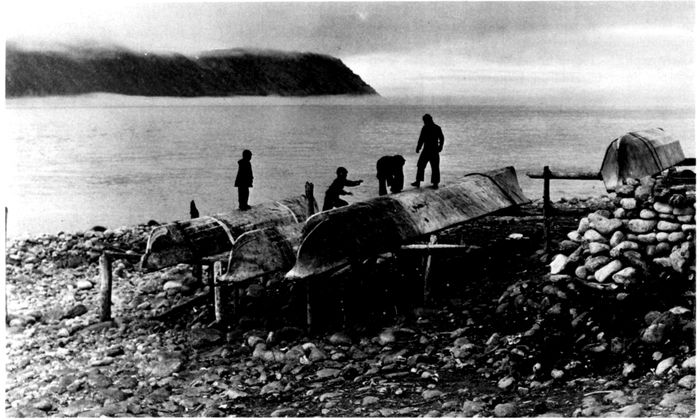
Figure 165
Umiaks on Racks, in front of village on Little Diomede Island, July 30, 1936. (Photo by Henry B. Collins.)
The Umiak
The umiak was undoubtedly more widely employed by the Eskimo before the coming of the white man than existing records indicate. It was a type of boat most necessary for family migration by sea, and with it the early Eskimos could establish themselves on islands far from the mainland and could cross large bodies of water. From some areas where early explorers mention having seen the type, the umiak has disappeared; this suggests the possibility that tribes now unacquainted with the umiak had at some time in the past reached a location where such a boat was no longer necessary.
The umiak was common in open waters and was found from Kodiak Island through the Aleutians and north and eastward along the west and north coast of Alaska to the mouth of the Mackenzie River. On the Siberian coast, opposite Alaska and for a short distance westward, the umiak was also employed. From the Mackenzie eastward to Hudson Bay the umiak has not been employed in recent times, though it is highly probable that it was used in the migrations that populated this part of the Arctic coast with Eskimo. Early explorers found umiaks in use along the northwestern coast of Hudson Bay and Foxe Basin; the umiak disappeared from these areas during the last century, but its use continued in Hudson Strait and in Greenland, where it became highly developed.
Among the various tribes of Eskimo known to have employed the umiak in the last century, the form of the hull varied a good deal, as did its dimensions. In general its form was something like that of the lumberman's "drive boat," except that most umiaks had a slight V-bottom and were quite different from it in the shape of the bow and stern. The size of the umiak does not seem to have been established by a set of measurements as distinct as that used in the building of kayaks, but rather as the result of utilizing material available locally, with due regard to the intended use of the craft for relatively heavy transport. Such matters as the flare of the sides, rake and shape of bow and stern, and width varied from tribe to tribe. The Asiatic and Alaskan umiaks were usually rather sharp-ended, with little spread to the gunwales at bow and stern; one of the Asiatic types has the gunwales brought round in a full curve at the ends of the boat. In the East the umiaks have rather upright bows and sterns and the gunwales are often rather wide apart to form square ends to the hull. Some of the western umiaks were navigated with paddles only; with others, before the appearance of the Russians in the area, both oar and sail may have been used. In the East the umiaks were being paddled, rowed, and sailed when white men reached the Arctic in the 17th century.
The Greenland umiak frame is much heavier and more rigid than the Alaskan. In comparing eastern and western umiaks the frame of the eastern umiak seems to be somewhat better finished, but the models of the western umiak are undoubtedly the better. The eastern umiak is not intended for use in hunting but is primarily a cargo carrier; its use has been confined to women and its chief employment is moving the family and household effects from one hunting ground to another. While it is highly probable that this condition is the result of the disappearance of whaling in this region, the use of the umiak as a hunting boat ceased so long ago that the eastern umiak model may have degenerated to a great degree. It has been otherwise in the western Arctic where the use of the umiak in hunting has continued and the boats have been managed, to a very great extent, by the men. As a result, the boats are held in greater respect by their builders and the better models have survived. The tribal distinctions between the western umiaks are therefore more marked than in the east; including Siberia, at least three basic models and a very large variety of tribal variations, are to be found, as can be proved by existing models. In the east only two basic and distinct umiak models are known to have existed, the Baffin Island type used on both the north side and on the Labrador side of Hudson Strait, and the Greenland type. In the latter, there were slight tribal distinctions it is true, but these were minor.
The Asiatic umiaks may be classed into two types, the Koryak type of Eastern Siberia and the Chukchi model of the Siberian side of Bering Strait. The Koryak umiaks illustrated by Jochelson show a highly developed boat, rather lightly framed compared to boats on the American side. In profile the bow has a long raking curve and the stern much less; as a result the bottom is rather short compared to the length over the gunwales. Viewed in plan, the gunwales are rounded in at bow and stern to form almost a semicircle. At the bow the gunwales are bent around a horizontal headboard tenoned over the stem head but at the stern there is no headboard. The sheer is moderate and very graceful. The flare of the sides is great and there appears to be a little V in the bottom transversely. There is also a slight fore-and-aft rocker in the bottom. The construction is similar to that of the Alaskan umiaks except that the Koryak umiaks have double-chine stringers and also a double riser, or longitudinal stringer, halfway up the sides. The riser is not backed with a continuous stringer, as is the chine; instead three short rods are lashed inside the side frame members. The side stringers do not reach bow and stern. The four thwarts are located well aft, and between the first and second thwarts is a larger space than between the others, for cargo. The boats are rowed, two oarsmen to a thwart. The cover was formerly walrus hides split and scraped thin but more recently the skin of the bearded seal has come into use. A rectangular sail of deer skin is sometimes lashed to a yard and set on a tripod mast about amidships. Two legs of the mast are secured to the gunwale on one side, the remaining leg is lashed to the opposite gunwale. Judging by the drawing made by Jochelson[3] this umiak is perhaps the most graceful of all those known today.
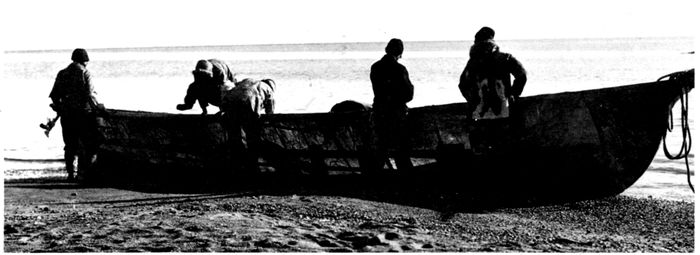
Figure 166
Umiak Covered With Split Walrus Hide, Cape Prince of Wales, Alaska. The framework can be seen through the translucent hide cover. (Photo by Henry B. Collins.)
The Asiatic Chukchi umiak is somewhat similar to that used on the American coast but with less beam in proportion to its length and less flare to the sides. The skin cover is of bearded seal. Bogoras measured an example and found her 35 feet 9 inches long, 4 feet 6 inches wide amidships, 2 feet 6 inches wide on the bottom over the chines. (An Alaskan umiak measured 34 feet 9 inches long, 8 feet 2 inches wide at gunwales and 2 feet 8 inches over the chines.) The Chukchi also use a very small hunting umiak, 15 to 18 feet long and having two or three thwarts, much like the small hunting umiaks once used in the Aleutians. The larger Chukchi umiaks have rectangular sails set on a pole mast; some boats carry a square topsail. The sails are lashed to their yards and the lower sail, or "course," is controlled by sheets and braces. The topsail, when used, has braces only. The sails were formerly of reindeer skins, but now drill is used. These umiaks were formerly paddled, as indicated by their narrow beam, but since the advent of the white man oars have come into use, and it is quite certain that the topsail also is the result of white man's influence, if not the whole rig.
In stormy weather some of these umiaks and also some of those in Alaska employ weather cloths, 18 or 20 inches high above the gunwales, raised on short stanchions lashed to the hull frames. The ends of the stanchions are inserted in slits in the top of the weather cloth, and in fair weather the cloths are folded down inside the gunwale out of the way. Also in some of these Asiatic and Alaskan umiaks, inflated floats, of seal skin, are lashed to the gunwales to prevent capsizing in a heavy sea.
The Alaskan umiaks varied much in size but are rather similar in form. The small hunting umiaks used by the Aleuts are about 18 feet long, while the large cargo carrying umiaks range up to about 40 feet long, so far as available records show. They are marked by heavily flared sides and often have a rather strong sheer; a few, however, are rather straight on the gunwales. Nearly all existing models and boats were built since 1880; and no information is now available on the forms and dimensions of earlier craft.
On page 184 is a drawing of a small umiak, used in walrus hunting, from the Alaskan coast in the neighborhood of the Aleutians. In the U.S. National Museum are the remains of a similar boat obtained in 1888 from Northern Alaska. This type of small umiak is also employed in fishing and is rather widely used as a passage boat for short voyages along shore. These craft, propelled by paddles, are primarily fast, handy hunting canoes rather than boats for migration or cargo-carrying. For this reason they are quite sharp-ended and shallow. The construction of this example will serve to illustrate the methods common to this type.
The umiak shown is 20 feet 8½ inches over the headboards, 4 feet 9½ inches extreme beam and 17⅜ inches depth—apparently an average-sized boat of her class. The width of the bottom over the chine members is 2 feet 7 inches. The keelson is rectangular in section and in two pieces, hooked-scarphed together; each piece is shaped out of the trunk of a small tree with the root knees employed to form the bow and stern posts. The floor timbers are quite heavy and support the chine members by having the floor ends tenoned into the chine pieces. At bow and stern the chines are joined to the keelson in a notched scarph; at these places the keelson is sided rather wide to give good bearing. It is evident that this portion of the boat's structure is the first built and forms a rigid bottom to the hull. The floor timbers are lashed to the keelson by lacings of sinew, whalebone, or hide, passed through holes bored in both, as indicated in the plan. The ends of the floors are pegged where they tenon into the chines and the ends of the chines are pegged to the keelson, but this was evidently not a universal practice, as there are models showing lashings at floor ends and at chine ends. The headboards are carved out of blocks in a T-shape and are stepped on top of the stem and stern posts and lashed. The fit is extremely accurate. The bow headboard is narrower athwartship than the stern headboard. The detail of the hook scarph in the drawing shows a method of lashing that is widely used.
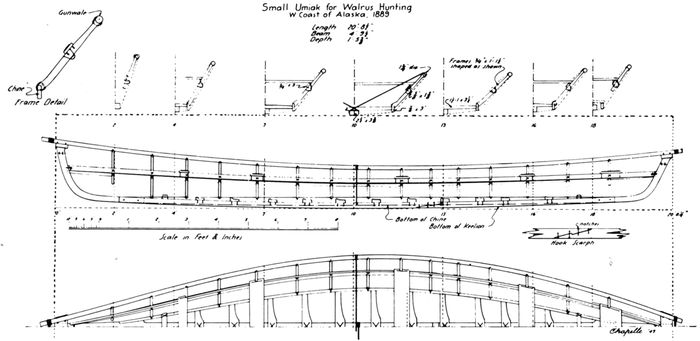
Figure 167
Small Umiak for Walrus Hunting, west coast of Alaska, 1888-89. Reconstructed from damaged umiak formerly in U.S. National Museum, and from models.
Because of the manner in which the keelson is cambered and the floor fitted, the bottom of the covered hull shows in cross section a slight V, reducing toward the bow and stern, that is typical of the Alaskan umiak. The amount of deadrise seems to have been determined by the manner of fitting the floor timbers and it helps the boat to run straight under paddle and oars. In present day umiaks the amount of V in the bottom is slight; too much would make the boat difficult to sledge overland without employing chocks to steady the hull. Perhaps in the past, where sledging was not required, the deadrise was greater, as indicated by some old models.
After the chines and floor are fitted to the keelson, the frames at the thwarts are made and set up at the desired flare and height, being held in place by temporary spreaders lashed or braced. These are sometimes stiffened by thongs from frame head to keelson at each pair, to steady the frame while the gunwale is being bent. As the lengths of the thwarts are controlled by the fairing of the gunwales, the thwarts are not fitted until after the latter are in place. As shown in the figure above, the gunwales are round poles, slightly flattened on the lower side at the headboards, where they are secured by lashings. In building, the gunwales are shaped and secured by lashing them to those side frames selected to shape the hull. The lashings that secure the side frames to both gunwale and chine are passed through holes in each member and are hove taut by means of a short lever with a hole bored in it to take the end of the lashing, which is also wrapped around the lever to give temporary purchase. The side frames have saddle notches to bear on the chine and gunwale. All lashings in the frame, it will be noted, pass through holes bored in the members and in some cases the lashings are let in, so that the sinew is flush with the surfaces of the members, to prevent the lashing from being damaged by chafing.
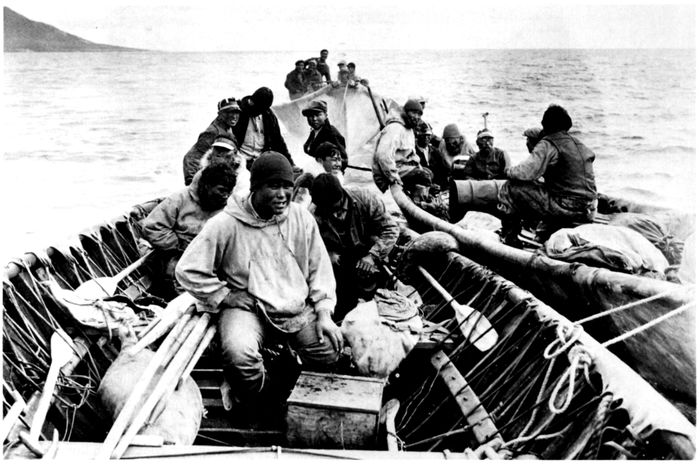
Figure 168
Umiaks Near Cape Prince of Wales, Alaska, showing walrus-hide cover and lacing. Frame lashings are walrus-hide thongs. (Photo by Henry B. Collins.)
With the gunwales faired, the remaining frames are then put in position and lashed to the gunwales and chines. An outside batten is run along each side and lashed by turns of sinew over the batten and around the side frames, with the lashings let into each member to prevent slipping and chafing. The batten is lashed at bow and stern in some umiaks, but in many it is stopped just short of coming home on the posts. Next, the short frames at bow and stern are put in place and the risers secured inside the side frames, then, with the thwarts fitted and lashed to the risers, and the ends of the gunwales are lashed together at bow and stern, the boat is ready to be covered. When ready to cover, the frame is stiffened by diagonal thong ties, each of which has one end secured by turns around the gunwale, with the other end passed through holes in the keelson and secured. These are commonly found in western umiaks; the small umiak has but one pair placed amidships. The timber used in such craft is fir, spruce, and willow, and is usually driftwood obtained at river-mouth.
When this umiak was examined, the skin cover was in such a condition that the number of hides used could not be determined, but it probably is comprised of three sea-lion skins sewn together. New skin covers are made by removing the hair and fat from the skins and then sewing them together by the method illustrated on page 186, to obtain proper dimensions. Green skins are generally preferred, since they stretch into shape better than partly or wholly cured ones. Once stretched to shape and cured, the cover can be readily removed and replaced, without resewing. In fitting a new skin cover the skins are first thoroughly soaked in seawater. The cover is then stretched over the frame and worked taut by lacings. It is wide enough to reach from gunwale to gunwale and a little down inside the boat on each side, and is laced to the rising batten with turns of rope spaced 3 to 5 inches apart amidships and closer together in the ends of the hull. At the headboards the cover is laced around the gunwales and through holes in the headboards, two independent lacings of two turns each being used on each side. At the extreme bow and stern the cover is laced to the gunwale lashings. Where the cover will not stretch smooth in fitting, gores appear to have been cut out and the skin resewn. After being laced, the cover is allowed to shrink until it becomes smooth and tight, then it is heavily oiled and the seams rubbed with tallow or blubber. This treatment is repeated at regular intervals. While the boat is in service care is taken to dry out the skin cover once a day, if possible.
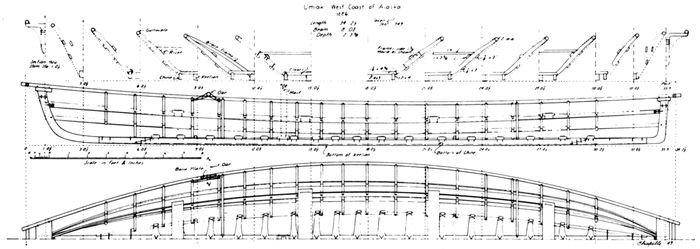
Figure 169
Umiak, West Coast of Alaska, King Island, 1886. Taken off umiak at Mariner's Museum.
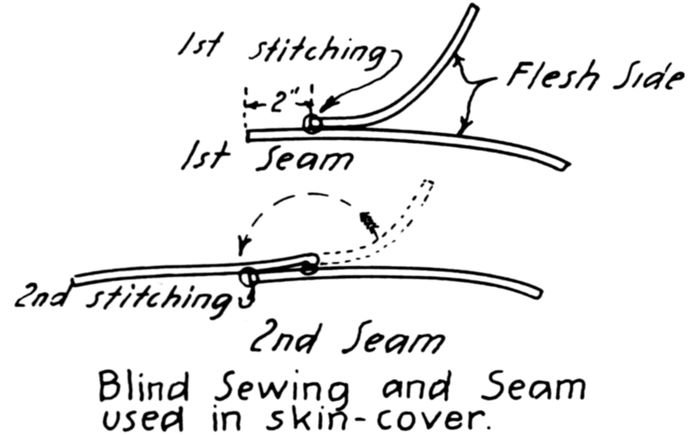
Figure 170
Making the Blind Seam: two stages of method used by the Eskimo to join skins together. The edge of the skins are placed flesh side to flesh side with one overlapping the other about 2 inches. Then, by means of a thin needle and slender sinew, the skins are sewn together, with an over-and-over stitch, care being taken not to penetrate through the lower skin. When this is completed the skins are opened out and the second seam made on the grain side to complete a double seam without penetration of either skin. The width of the seam varies somewhat.
The sequence of construction described is not followed universally; sometimes spreaders are fixed between the gunwales, which are then sheered by thongs to the keelson, after which the side frames are put in and the side and rising battens, and finally the thwarts, are added. Judging by the numerous models seen, the small hunting umiaks varied a good deal in the rake and sweep of the bow and stern, even in the same village. These hunting umiaks worked with kayaks in Aleutian walrus and sea-lion hunting; a practice that seems to have once been common along the Western Alaskan coast and among the islands.
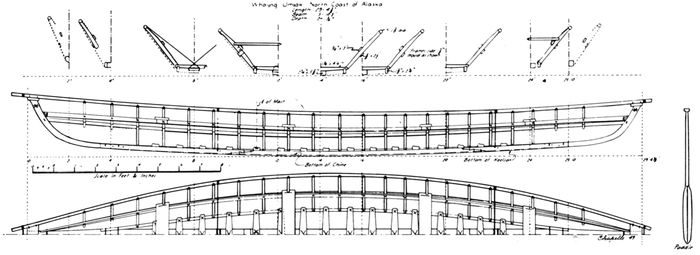
Figure 171
North Alaskan Whaling Umiak of about 1890. Drawn from damaged frame, formerly in a private collection, now destroyed.
The drawing on page 186 represents a large Alaskan umiak from King Island. Two boats of this model, but with modern metal fastenings, are in the Mariners' Museum, Newport News, Virginia, but the drawing shows the methods of fastenings used in 1886. The plan is of a burdensome model, such as is used for travel or other heavy cargo work. The boat is 34 feet 2½ inches over the gunwales, 8 feet ½ inch extreme beam, 2 feet 3⅜ inches deep and 2 feet 10 inches beam on the bottom over the chines. The construction follows the general plan of the small umiak just described, except that another method of fitting the floor timbers to the chines is employed. Due to the size and use of the umiak, two side battens are employed with a single riser. The thwarts are not notched over the frames, but instead fall between them. As diagonal thong braces from gunwale to keelson would be ineffective in this situation, two sets of wooden braces that resist not only tension but also compression are used to take the thrust off the thwart lashings. These brace-frames are staggered slightly to allow room to fit them at the keelson. The drawing, which requires no additional explanation, shows the plan of construction and the important lashings, and the method of fitting oars with thong thole loops.
Boats such as these carried a square sail lashed to a yard, the mast being stepped in a block on the keelson. No mast thwart is used; instead stays and shrouds of hide rope supported the mast, a method that made it easy to step or unstep the mast in a seaway. Early umiaks in this area are said to have had mat sails; later ones used sails of skin and drill. Modern umiaks of this class often have rudders hung on iron pintles and gudgeons and the floors fastened to the keelson with iron bolts or screws. The scarphs are also bolted, but the remaining fastenings are lashings in the old style, to obtain flexibility in the frame.
A North Alaskan whaling umiak, supposed to have been built about 1890, is represented in the drawing of figure 171. The remains of the boat were sufficient to permit reconstruction of the frame. This umiak is about the size of, and in profile greatly resembles, a New Bedford whaleboat. However, the model is that of the umiak, rather sharp-ended and strongly sheered. The boat is 29 feet 4¾ inches over the headboards, 5 feet 10½ inches extreme beam, and 2 feet 1¾ inches deep. Umiaks of this model were used at Point Barrow and vicinity in offshore whaling, and were also used for travel and cargo carrying. Paddles were used in whaling, but in more recent times sail, oars, and outboard engines have been employed. The boats of this class appear to have been marked by a very graceful profile and strongly raking ends. Despite the resemblances of this type of umiak to the whaleboat, it is highly doubtful that its model was influenced by the white man's boat. In fact, it might just as well be claimed that since the whaleboat appears to have been first employed in the early Greenland whale fishery, the latter had been influenced by the umiaks found in that area. However, one might also point to the fact that the model of the early European whaleboat is much like that of a Viking boat, from which will be seen the danger in accepting chance similarities in form or detail as evidence of relationship, particularly when it is not impossible that similarities in use and other requirements have produced similar boat types, the users never having come into contact.
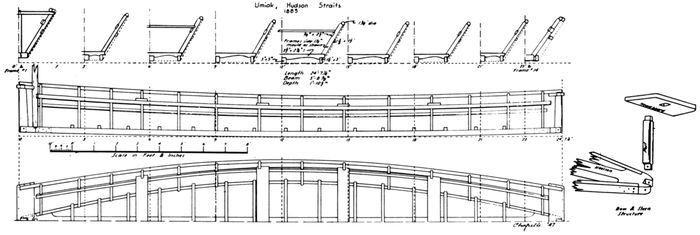
Figure 172
Baffin Island Umiak. Drawn from model and detailed measurements of a single boat.
The whaling umiak has been much used in the western Arctic by explorers and Arctic travellers, who regarded highly its lightness and strength, and its ability to be easily driven. It is much wider than the Chukchi umiak and has far more flare. From a study of models and numerous photographs it can be said that the amount of fore-and-aft camber in the bottom varies greatly between individual umiaks, some of which are almost straight on the bottom. The light framework and elastic construction often cause these umiaks to camber a good deal when heavily loaded; when sledged, they are sometimes fitted amidships with a support for a line from bow to stern, that forms a "hogging-brace," to prevent the boat from losing its camber. It is also apparent that there is no standard practice in fitting floors to the chines; Murdock[4] shows a rough sketch that indicates the floor ends are often tenoned into the chines, as in the small umiak. Tree-nailing of the floors and chines, and the keelson, is common, and sometimes both treenails and lashings are used in scarphs. In some umiaks both the single side batten and the riser are at the same height, but only the riser has its ends secured to the posts, the side battens being cut short and their ends lashed to the riser a few inches inside the posts.
The skin cover of the north Alaskan whaling umiak is made of bearded seal or of walrus hide, which has to be split, because of its weight. Occasionally polar-bear skins are used. Lashings of the frame are of whalebone, sinew, and hide. The skins are treated with seal oil and caribou fat, and when the whaling umiak is taken ashore it is usually stored on a stage to keep dogs from destroying the skin cover. In travelling, however, it is sometimes propped upside down on one edge and used as a shelter. In winter the skin is removed and stored; when it is necessary to be replaced on the frame, the skin cover is soaked in sea water for three to five days, after which it is laced on in the usual manner, dried, and then thoroughly oiled. Low, rather wide sledges are sometimes built to carry the umiak overland, or on the ice, but often the regular sledge is used. The boats cannot be sledged against a strong gale because of their windage.
The north Alaskan umiak is usually propelled by paddles, like the Chukchi umiak. These paddles range in length from about 50 to 76 inches, and as a rule have a rather long narrow blade, though a short and wide blade is occasionally found, particularly at Kotzebue Sound and Point Hope. Oars for the Alaskan umiaks range in length from 6 feet 3 inches to 8 feet 6 inches, and also have rather long narrow blades, 3 to 4 inches wide.
The three examples of Alaskan umiaks serve to show the features that are most common in the area. However, models in the U.S. National Museum suggest that there was a greater variety of form and appearance in the past. One model shows the gunwale ends lengthened by pieces shaped very much like the projecting gunwales of the Malay prah. Some show extreme rake at the bow like that of the Koryak umiak but without the rounded gunwale ends. It is impossible to estimate how far the western Alaska umiak model has been affected by the early Russian traders in this area, but it is quite certain that the use of oars can be traced to this influence. The full-sized umiaks, and models and photographs, from the Bering Strait area give no real clues to the possible parentage or direction of spread of the Alaskan umiak types. Occasional details in fittings or construction, such as the gunwale extensions mentioned, seem to duplicate details in primitive Asiatic craft, but the evidence is too scanty to allow a hypothesis based on design and construction alone.
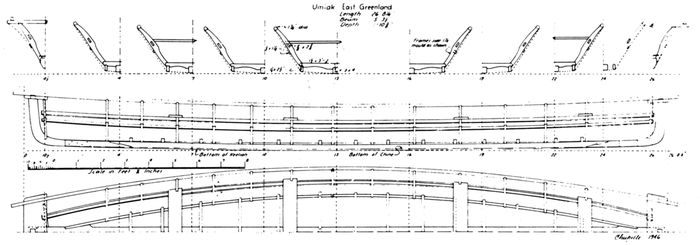
Figure 173
East Greenland Umiak, drawn from measurements taken off by a U.S. Army officer in 1945.
No models or photographs have been found of the extinct types of umiaks once used in the northern part of Hudson Bay and the sketches of early explorers are too crude to allow useful discussion. From such slight evidence it is impossible to say whether the umiaks in this area were of the western or eastern type.
The drawing of a Baffin Island umiak on page 188 is based on measured dimensions of a single boat and upon a small model in the U.S. National Museum. This model conforms in most respects with the drawings and sketches made by Boas.[5] The umiak is a small one, 24 feet 7¼ inches long, 5 feet 8⅜ inches extreme beam, 3 feet 10 inches wide over the chines, and 1 foot 10½ inches deep. These measurements show that the bottom of this type of umiak is wider than that of western types. The bottom is flat, and sheer and camber are both slight. The stem and stern are practically upright and are not formed of knees; rather, they are made by fitting the post into the keelson with an open tenon. Instead of the carved block headboards seen in the Alaskan umiaks, the Baffin Island boat has very wide headboards, and these are tenoned over the posts as in the Asiatic Koryak umiaks. The details of the rest of the framing are not dissimilar from those of the Alaskan umiaks, except that the Baffin Island umiak does not employ any short frames in the end of the hull. The framework is rather heavy and the square-ended appearance of this class of umiak makes it appear more clumsy than is actually the case. The side battens and risers stop short of the posts, and the risers used in this umiak are notched into the side frames, whereas in the Alaskan umiak only the lashings of the riser are let into the frames. The Baffin Island umiaks carry a square sail lashed to a yard, and the mast is placed right up in the eyes of the boat. Boas shows that some of these umiaks have rudders hung on metal pintles and gudgeons, a result of the influence of the white traders, whalers, and sealers who had operated in these waters long before Boas made his investigations. The umiak is rowed in the usual manner, using thong loops as tholes, and is usually steered with an oar or long paddle.
The ends of the gunwales of the Baffin Island umiak are cut off a little inside the forward edges of the headboards, making this the only American type that does not have projecting gunwales at bow and stern. The projection of the gunwales undoubtedly serve a practical purpose in lifting the boat out of water, but obviously this is of minor importance. Probably the real reason for these projections is that they originally made building easier by providing space for a retaining lashing when the gunwales were being bent. As the headboards became wider and the spring of the gunwales, in plain view, became less acute, less strain was put on the lashings of the gunwales at the headboards, but by then the projecting gunwales and their retaining lashings were being utilized in lashing on the skin covering at bow and stern. Thus, beginning as a practical solution of a building problem, the projecting gunwales may have eventually become a traditional tribal feature of the umiak in many localities.
The drawing of an eastern Greenland umiak on page 189 was made from measurements taken off during World War II and checked against dimensions, photos, and descriptions of boats from the same territory. In general design and in construction this umiak differs little from umiaks of the southwest coast of the same island. The eastern Greenland boats are, on the average, much smaller than those on the southwest coast due to the more severe ice conditions met in the east. Some of the Greenland umiaks have flat bottoms like the Baffin Island boats, but the V-bottom appears to be more common. The chief characteristics of the Greenland umiaks are the slight rake in the bow and stern, the moderate sheer and camber, and the conservative flare of the sides. The drawing shows the important structural details seen in most of the Greenland umiaks. The floor timbers are on edge instead of on the flat as in Alaskan boats and this seems to be characteristic of all eastern umiak construction, as is the arching of the underside of the floors. Another common structural detail is the passing of the risers through the side frames; in some, however, the risers lie in deep notches fashioned in the inside of the frames. The eastern Greenland umiaks generally have rather wide headboards and somewhat more projection to the gunwales. Like the Baffin Island umiaks, the side battens and risers of the Greenland boats are cut short of the posts, but the ends of these members are commonly supported by frames placed very far fore and aft, and often these frames form brace-supports to the headboard, as in the drawing. The headboards of these umiaks are always tenoned over the top of the posts. Some of the Greenland umiaks have curved side frames which cause the side battens to form knuckles in the skin cover. The eastern Greenland umiaks rarely if ever carry sail, but this is common on the western and southwestern coasts, where a square-sail on a yard is popular, with the mast usually well forward. Hans Egede in 1729[6] found Greenland umiaks fitted with sails of seal intestines and also saw boats about 10 fathoms (60 feet) long; another early writer, Crantz[6] states that umiaks were commonly 36, 48, and even 54 feet long. In the larger umiaks two side battens were employed. The thongs and brace-frames seen in many Alaskan umiaks do not seem to have been used in eastern waters, the use of bracing-frames from stem or stern post to the gunwales probably serving the purpose, but it is noticeable that pictures of Greenland umiaks preserved in some European museums show that the hulls have a tendency to twist not seen in Alaskan boats. The old Greenland umiaks were built with lashed joints combined with pegging, or treenailing. In recent times the use of pegging has increased and iron fastenings are now quite common. Rigid fastenings of the peg and metal types are used only in scarphs and in securing the chines and keelson to the floors timbers, as in the modern Alaskan umiaks.
The Kayak
The Eskimo hunting boat, the kayak, is more widely employed in the Arctic than the umiak, and its variations in model, construction, and appearance are more distinct and numerous. The kayak is a long, usually narrow, decked canoe and is commonly very well finished. In Alaska a few undecked skin-covered canoes, used in rivers, are built on kayak proportions, but the model of these is quite different from that of the Alaskan sea-kayaks; the river canoes are V or flat bottomed, much like the Greenland kayaks. A similar kayak-type canoe, flat bottomed but birch-bark covered, is used by the Yukon Indians. Undoubtedly a number of such types once existed but most of these became extinct before any attempt was made to preserve models or canoes in museums.
Few Eskimo tribes are without kayaks, only those living inland or where the sea is rarely open are unacquainted with these hunting craft. In very recent times some tribes have ceased to use kayaks, employing purchased canoes instead. The kayaks of the Asiatic Eskimos, and those from the Mackenzie to Hudson Bay, are now crudely built and of inferior design. Both the Greenland and the Alaskan kayaks are highly developed. The Greenland kayaks are undoubtedly given more intricate equipment in the way of weapons and accessories than the Alaskan craft, but it would be difficult to decide which is superior in construction and design.
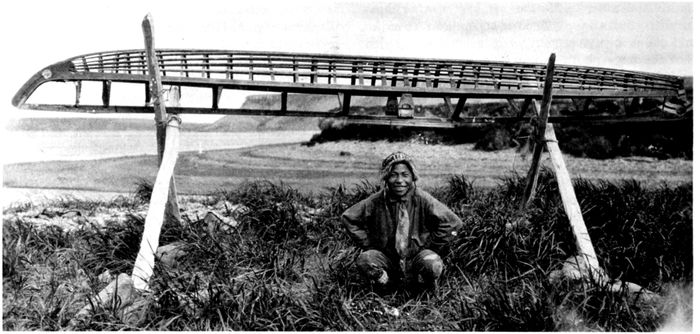
Figure 174
Frame of Kayak, Nunivak Island, Alaska, with young owner beneath. (Photo by Henry B. Collins.)
The basic models used in Eskimo kayaks are the multi-chine, the V-bottom and the flat bottom. The multi-chine models, except for the river kayak-canoe just mentioned, which probably should be classed as a true open canoe rather than a kayak, are employed throughout Alaskan waters. The geographic boundaries of each basic hull form are rather ill-defined. The multi-chine kayak appears as far eastward as the northwest coast of Hudson's Bay. In this area, however, a V-bottom kayak, now extinct, seems to have been in use on Southampton Island. A flat-bottom kayak, with the chines snied off much like a Japanese sampan, is in use in Hudson Strait, along the shores of Baffin Island and Labrador; a flat-bottom kayak shaped like a sharpie is used on the northwest coast of northern Greenland; and a V-bottom hull is employed on the eastern, southwest, and south coasts of Greenland.
According to the Danish classification of the coasts of Greenland, "Polar" is north of Cape York, "Northern" is above Disko Island, "Central" is from Frederikshaab to north of Disko Bay, "Southern" is from Julianhaab to Cape Farvell, and "East" is Angmagsalik and vicinity.
There are variations in each of the basic models, of course, as the tribal designs used vary a good deal. On the whole, the kayak is very carefully built to meet the local conditions of hunting, sea, and land or ice portaging. As a result, some types are far more seaworthy than others and the weight of hull varies a great deal, even within a basic model. The appearance of all the kayaks models, by tribal classifications, show the influence of tradition and, in many cases display, in either shape or decoration, a tribal totem or mark.
The basic requirements in nearly all kayaks are the same; to paddle rapidly and easily, to work against strong wind and tide or heavy head sea, to be maneuverable, and to be light enough to be readily lifted from the water and carried. The low freeboard required makes decking a necessity. In general, the kayak is designed to carry one paddler, but in Alaska are kayaks that can carry two or three paddlers, each in a manhole or cockpit, or a paddler and one or two passengers. It is generally conceded that the kayak built to carry three in this fashion is the result of Russian influence. Nunivak Island kayaks had large manholes that carried two people back-to-back. Where it is desirable to portage the kayak over ice or land for a great distance the boat is very light and is capable of being carried like a large basket, by inserting one arm under the decking at the manhole or cockpit, but where such a requirement is not an important factor, the kayaks are often rather large and heavy. In the majority of types, the degree of seaworthiness obtained is very great. Some types are built very narrow and sharp-ended; these usually require a skillful paddler. Others are wide and more stable, requiring less skill to use. In areas where severe weather is commonly met, the kayaks are usually very strong and well-designed. Where ice or other conditions do not allow a heavy sea to make up, the kayaks are often light, narrow and very low sided—more like racing shells than working canoes. Most Alaskan kayaks come stern to the wind when paddling stops, but most of the eastern craft come head to the wind. Nearly every type has been developed by long periods of trial and error, to produce the greatest efficiency in meeting the conditions of use in a given locality. This has made the kayak a more complicated and more developed instrument of the chase than is to be found in any other form of hunting canoe, due in part, perhaps, to the great craftsmanship of the Eskimo.
The construction of the kayak follows a basic plan. In all kayaks the gunwales are the main strength members, longitudinally. A few designs employ, in addition, a stiff keel member, but most have rather slender and light longitudinal batten systems having little longitudinal strength value, but which in combination with very light frames, give transverse support to the skin cover. Even in the flat-bottom models, the kayaks, unlike the umiaks, depend entirely upon the gunwales for longitudinal strength. The frames are bent and in one piece from gunwale to gunwale in all but a few flat-bottom kayaks, of the sampan cross section; these employ bent frames. The longitudinal batten systems show great variety. The eastern kayaks of the flat-bottom and V-bottom models have three longitudinal battens (including the keel or keelson) in addition to the heavy and often deep gunwale members; these are supported at bow and stern either by stem and stern post of shaped plank on edge as in the Greenland V-bottom kayaks, or by light extensions of the keelson and small end-blocks as in the northern Greenland, Baffin Island, and Labrador types. The multi-chine types of the western Arctic have from seven to eleven longitudinals (including the keelson) in addition to the gunwales. In some of these kayaks there are no stem and stern posts, the battens and keelson coming together at a blunt point in small head blocks; but many types have rather intricate stem-pieces, carved from blocks of wood, and plank-on-edge stern posts. The Asiatic kayaks, curiously enough, exhibit the construction of both eastern and western Arctic kayaks, the crude, small Koryak kayak having a 3-batten V-bottom, while the Chukchi kayak is built like the kayaks on the east side of the Bering Strait. The decking of kayaks is of very light construction; usually there are two heavy thwarts to support the manhole and from one to three light thwarts afore and abaft these. The Alaskan kayaks from Kotzebue Sound southward have ridged decks supported by fore-and-aft ridge-battens from the ends of the hull to the manhole. Elsewhere the deck of the kayak is flat athwartship except at the manhole, where there is some crown or ridging to increase the depth inside the boat, particularly forward of the manhole. In the majority of these kayaks short fore-and-aft battens are laid on the thwarts forward of the manhole to support the skin cover in its sweep upward to the manhole. The transverse frames do not come into contact with the skin cover, to avoid transverse ridges being formed in it; and the longitudinal battens which support the skin cover form longitudinal ridges, or chines, in it.
The timber used in the Eskimo kayak building is usually driftwood. Fir and pine, spruce or willow are available in much of the Arctic for longitudinals. Bent frames are commonly of willow. Scarphing in the framework of kayaks was far less common than in umiaks; the scarphs when found are only in the gunwales. All scarphs are of the hooked type and are usually quite short (the hooked scarph is the best one when the fastenings are lashings). Sinew is generally used in all lashings and for sewing material. The heads of frames are commonly tenoned into the underside of the gunwales and are then either lashed or pegged with treenails of wood or bone to hold them in place. In the joining of frames and longitudinals, the lashings are commonly individual, but in some types of kayak continuous lashings (connections in series using one length of sinew) are occasionally found. Where possible, the lashings are turned in so that the turns cross right and left. In some parts of the framework two pieces of timber are "sewn" together; holes are bored along the edges to be joined and a lacing run in with continuous over-and-over turns. These laced joints are common in the stems of the Alaskan kayaks. Gunwales and battens are most commonly lashed through holes bored in them and in the bow and stern members. Care is taken that all lashings are flush on the outside, so that the skin cover is smooth and chafing will be avoided. Bone knobs at stem and stern heads are used in the Coronation Gulf kayaks in the west and in many Greenland models. Bone stem bands are more widely employed, however, being in use at Kodiak and Nunivak Islands, in the Aleutians, at Norton Sound in Alaska, and in Greenland and Baffin Island in the east. It is probable that these bands were once in wider use than thus indicated. Strips of bone are also used to prevent chafing at gunwale in paddling and for strengthening scarphs in the manhole rim.
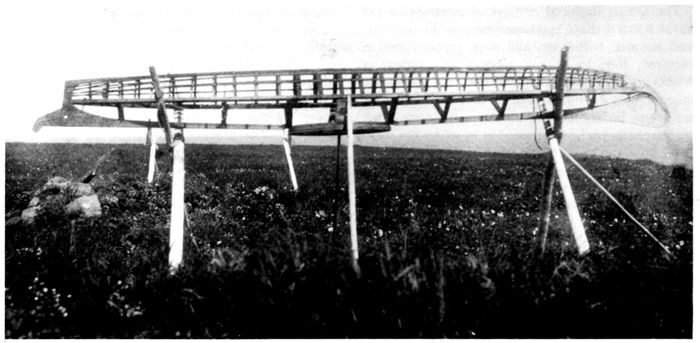
Figure 175
Frame of Kayak at Nunivak Island, Alaska, 1927. Photo by Henry B. Collins.
It will be noted that all Eskimo skin boats have a complete framing system, which is first erected and then fitted with the skin cover. This is a method of construction very different from that of the birch-bark canoes of the Indians living to the southward of the American Eskimo. The birch-bark canoe is built by forcing a framing system into an assembled cover and holding it in place there by a rigid gunwale structure, to which the bark cover is lashed. This basic structure is used even in the Alaskan area, where there are birch-bark canoes that in hull form and proportions strongly resemble the flat-bottom kayak. The basic difference between the two craft is illustrated by the fact that whereas the removal of the skin cover of the kayak leaves the frame intact, the removal of the bark cover of the kayak-like birch-bark canoes would result in the collapse of the framework, except for the gunwale-thwart structure or, in a few, the chine-floor structure. Because of this basic difference the superficial resemblance of some Indian bark canoes to kayaks has no meaningful relationship to the possibility of the influence of the kayak on the bark canoe, or vice-versa. Some Indian tribes have in fact built skin-covered canoes, as will be seen in chapter 8, but the framework and structural system used is always that of the bark canoe, never that of the Eskimo skin boat. Nor is there evidence that the Eskimo ever used the bark canoe frame-structure in their kayaks or umiaks. Hence, in spite of contact between these peoples, the watercraft of each remains basically different in structural design.
The almost universal method of constructing the kayak is first to shape and fasten together the gunwales and thwarts, with stem and stern pieces fitted as required, then to fit and place a few transverse frames to control the shape of the craft. Next the longitudinals are fitted and, finally, the remaining transverse frames are put in place. In some types the manhole rim is now fitted but in others the manhole rim is put on after the skin cover is in place, as some kayaks (the Alaskan) have the skin cover placed over the manhole rim and others have it passed under. The skin cover is stretched and sewn over the frame and is rarely secured to it by lashings except at the manhole. Due to the shape of bow and stern, in some types, difficult and tedious sewing is required to stretch the skins over the ends of the hull. Much of the sewing is completed after the skins are stretched over the hull and held by temporary lacings. The blind seam is used but in many kayaks the lap is very short, about ⅜ inch being common.
The covering most widely used in Alaskan kayaks was the bearded seal skin and with the Aleuts the skin of the sea lion was the most popular. Throughout the eastern Arctic seal skin was the preferred covering though caribou skin was occasionally used by the caribou Eskimos in the central Arctic. The heavy, thick hides were first piled and "sweated," until the hair became loose then the skins were scraped until they were clean. They were thin and light and could be air dried and stored until ready for use. The skins had to be well soaked before being stretched over the frame of a kayak or umiak. When dried out on the boat frame they were oiled in the usual manner. It is claimed by the Eskimos that walrus skin, though strong, is not as good as the bearded seal or the sea-lion skin for boat covers, as the latter two held the oil longer and did not become water soaked as quickly as the walrus hide.
The paddler's seat in most kayaks consists of a portion of heavy skin with fur attached. Sometimes this is supported by a few short, thin battens laced loosely together. These, and the fur seat sometimes are as long as the paddler's legs. No back rest is known to be used. The seat, and any batten supports, are loosely fitted and are not part of the permanent kayak structure.
The kayak is usually entered by floating the boat near a stone or low bank and stepping into it with one foot, which has first been carefully wiped. With the body steadied by placing the paddle upright on the shore, or outside the kayak, the other foot is then wiped and placed in the boat. The paddler then slides downward and works his legs under the deck until he is seated with his hips jammed into the manhole rim. Getting out of a kayak is almost the reverse of this process. Great care is exercised to avoid getting dirt into a kayak, as it might chafe the hide cover. Hence the care in wiping the feet before entering. The practice of entering the boat ashore and throwing man and kayak into the water, undoubtedly very rare, is said to have been practiced not only at King Island but in some parts of Greenland. Both Alaskan and Greenland hunters often lashed two kayaks together, in order to rest in rough weather. Many kayakers using the narrow models laid the paddle athwartships across the deck to help steady the kayak when resting or throwing a weapon; this is basically the same as holding the sculls of a racing shell in the water, to steady the boat. Lashing two kayaks side by side, or parallel with spacing rods, was commonly done to enable the craft to ferry persons or cargo across streams. Some Alaskan Eskimo thus converted kayaks into catamarans and then fitted a mast and sail, but such an arrangement was never used in rough water.
The methods used by a paddler to right a capsized kayak, without aid and while he was still in the cockpit, have aroused the interest of many canoeists. It was used by the King Islanders, some of the Aleuts, and the Greenlanders, who at times, it is said, would deliberately capsize their kayak to avoid the blow of a heavy breaking sea, then right it when the sea had passed. The Eskimo are reported to be gradually losing this skill, but in late years European and American kayakers have learned this method, called the "kayak roll," of righting a decked canoe with paddler in place. It follows in general the Greenland method. In the Appendix (p. 223) is an illustrated description of the kayak roll, supplied by John Heath.
Traditionally, the weapons used by kayakers were darts and harpoons, the bow not being employed, since wetting would damage the weapon. Various forms were used, and many were thrown with the "throwing-stick" to increase the range and force. An inflated bladder or skin was often carried to buoy the harpoon line and tire the game. Bolas and knives were also carried. All eastern kayaks appear to have been propelled with the double-blade paddle, but folklore suggests that the single-blade kayak paddle may have once been used. Greenland kayaks have been reported as carrying a small square sail, but this was actually a hunting screen, or camouflage, to hide the paddler and cause the seal to mistake the canoe for a cake of ice. It was a 19th-century addition, as was a fin attached to the kayak to counteract the effect of the screen in a beam wind. Any effect it had as a sail in a kayak was unintentional, of course: it was dismounted in strong winds or when not required for hunting.
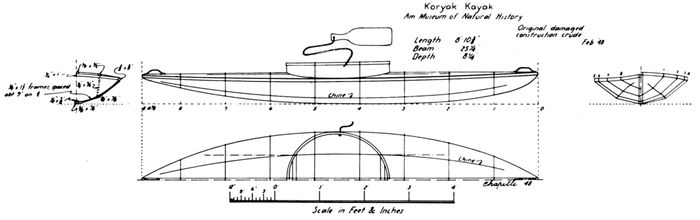
Figure 176
Koryak Kayak, drawn from damaged kayak in the American Museum of Natural History, 1948.
Shown above is the plan of an Asiatic Koryak kayak. This type, used in the Sea of Okhotsk and on the Siberian coast of Bering Sea, is the only distinctive Asiatic type; the Chukchi of the Siberian side of Bering Strait uses a kayak that is on the same model as the one found at Norton Sound, in Alaska. The Chukchi kayak differs only in the ends, which are wholly functional and without the handgrips that distinguish the Alaskan type. There is also a crude Chukchi river kayak, covered with reindeer skin, but its design is not represented in an American museum.
The Koryak kayak is a hunting boat well designed for use in protected waters, but is rather weakly built. In general form it is much like the hunting and fowling skiffs formerly used in America. The plan idealizes the kayak somewhat, for the boat is crude in finish. The only example available for study, in the American Museum of Natural History, is in poor condition. The hull is short, wide and shallow, rather V in cross section, and there is a slight camber in the deck. The length of the Koryak kayak rarely exceeds 10 feet, the beam is from 24 to 26 inches, and the depth between 8 and 9½ inches. The manhole rim is of large diameter, high and without rake. The gunwales, although rather slight, are the strength members. The keelson, a thin, flat batten, forms the stem and stern posts; it is stiffened amidships by a short batten lashed inside the frames. The chine battens are also slight and do not reach the stem and stern. The frames are widely spaced and are wide and thin, in one piece from gunwale to gunwale. There are but two thwarts; these are strong and support the manhole rim, showing inside the cockpit. Two thin longitudinal battens afore and abaft the manhole, support the deck, in addition to a light centerline ridge-batten. On the kayak illustrated the outboard battens appear to have had additional support at one time from two pairs of stanchions standing on frames at the chines, with their heads secured to the deck battens; a pair being placed before and abaft the manhole. A small plank seat appears to have been used and the boat was propelled by two short one-hand paddles, secured to the manhole rim by lanyards made of thongs; these would be only efficient in smooth water. The cover is made from bearded seal skins and passes under the manhole rim being sewn to the rim on the inside at the top, by coarse sewing passed through holes bored in the manhole rim. There are two thong lifting handles or loops, one at bow and stern. This kayak is the most primitive of all types and the smallest as well. The Koryaks are not daring canoemen and do not venture into rough water. Nevertheless, this type of kayak is said to be fast and highly maneuverable.
Compared to the Koryak, the Alaskan kayak is tremendously advanced. The Aleuts are daring and accomplished kayakers, and their craft are among the finest in the Arctic. The Kodiak Island kayak of 1885, shown above, represents one type used in this area and that from Unalaska, shown below, the other. The Kodiak boat is rather short and wide, measuring 15 feet 1 inch in length, 29 inches beam and 14 inches depth to ridge batten of the deck just forward of the manhole. The boat has the humped sheer found in many Alaskan kayaks and is intended for use in stormy waters. Its large manhole, also a feature of the Nunivak Island kayak, permits two persons to be carried, one facing forward to paddle and the passenger facing aft, or the space can be used to carry cargo. The drawing shows the construction and requires no detailed explanation. Kayaks from the Aleutian Islands eastward to Kodiak use rod battens; only the gunwales and keelson are rectangular in section. The frames are thin flat strips bent in one piece from gunwale to gunwale. The ridge-batten of the deck is laminated, in two pieces. The deck beams and thwarts are notched into the ridge-batten and lashed. The bow piece is carved from a block, and the longitudinals are lashed to it, each in a carefully fitted notch. The sternpost is formed of a plank. The skin cover passes over the manhole rim and a line passed outside the rim holds the skin down enough to form a breakwater. The skin cover is sewn to the inside lower edge of the rim, thus covering it almost completely.
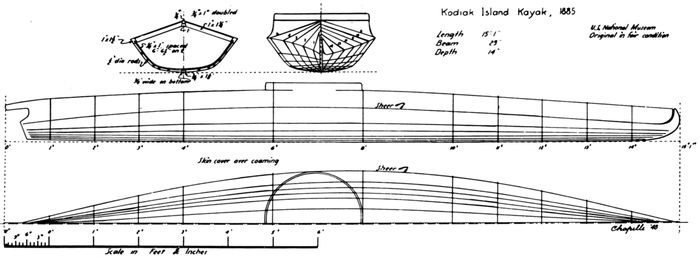
Figure 177
Kodiak Island Kayak, 1885, in U.S. National Museum (USNM 76285). The identification of this kayak has been questioned by Henry B. Collins and John Heath, but it may represent an old form out of use in the twentieth century.
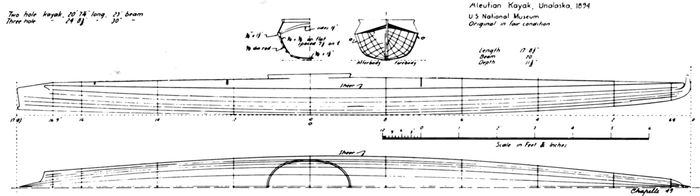
Figure 178
Aleutian Kayak, Unalaska, 1894, in U.S. National Museum (USNM 76282).
The Unalaska kayak of 1894 (below) is a better known type. This design is used throughout the Aleutians and on the adjacent mainland as far east as Prince William Sound. It was also employed in the Pribilof Islands and at St. Matthew, having been used by Aleuts engaged in sealing expeditions there. All kayaks of this type do not have the same bow and stern profiles as the example; some have the bifid bow built with the portion above the slit arched upward higher than the outer stem-piece and so more prominent; there are also minor variations in the stern. The shape of the hull, however, is consistently maintained throughout the area in which this type is used. Though the deck is ridged, it is relatively low compared to that of the Kodiak kayak, and the thwarts supporting the manhole are heavily arched and in one piece from gunwale to gunwale. The construction is like that of the Kodiak kayak, but the gunwales and upper longitudinal battens, instead of meeting the stern post, end on a crosspiece well inside the stern to give the effect of a transom stern. However, some Aleut kayaks have the normal sharp stern after the fashion of the Kodiak kayak, but without the projecting tail or handgrip, and nearly all have two thwarts between the after manhole thwart and the stern and three forward of the fore manhole thwart. The skin cover passes over the manhole rim as in the Kodiak type. The bow block is sometimes built up of two blocks sewn or laced together. Strengthening pieces of light plank are sometimes fitted from the bow block aft; these are laced to the top inside edge of the gunwales and pinned to the stem block to form long breast-hooks. In some kayaks with the square stern, only the gunwale is supported by the crosspiece on the stern, the two battens on each side being supported by the last frame only, about 6 inches inboard of the crosspiece.
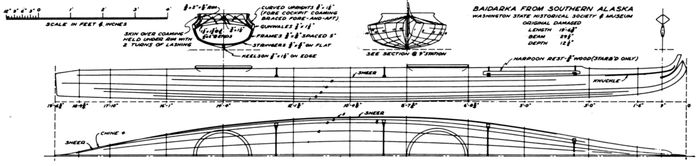
Figure 179
Kayak From Russian Siberia, 2-hole Aleutian type, in Washington State Historical Society and Museum. Taken off by John Heath, 1962.
This type of kayak is the only one known to have been built with more than one manhole. The two-hole kayak is an Aleut development used in whaling and sea-otter hunting, so far as is known; the paddler sits in the after manhole. Measurements of a two-hole kayak in the United States National Museum show it to be 20 feet 7¼ inches long, 23 inches beam, and 9½ inches deep to top of gunwale. The manholes are about 46 inches apart edge to edge and the foremost is about 8 feet from the bow.
The three-holer, commonly believed to have been introduced by the Russians, was used by Russian officers, inspectors, and traders in their explorations and travels on the Alaskan coast. One of these boats measures 24 feet 8⅜ inches long, 30 inches beam, and 10½ inches deep to top of gunwale. The center manhole is commonly larger in diameter than the other two and is used for either a passenger or cargo. The fore edge of the fore manhole is 8 feet to 8½ feet from the bow and the other manholes are from 4 to 4½ feet apart edge to edge. A large example of this class of kayak measures 28 feet 1½ inches long, 38½ inches beam and 12 inches deep to top of gunwale. Probably none exceed 30 feet in length. Both the single-and the double-blade paddle are used by the Aleuts, but the double blade is preferred in hunting. The paddle blades are rather narrow and leaf-shaped, with pointed tips.
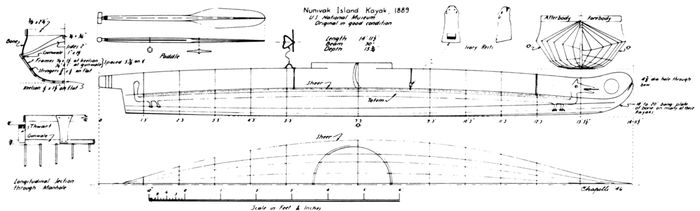
Figure 180
Nunivak Island Kayak, Alaska, 1889, in U.S. National Museum (USNM 160345), showing painted decoration of the mythological water monster Palriayuk.
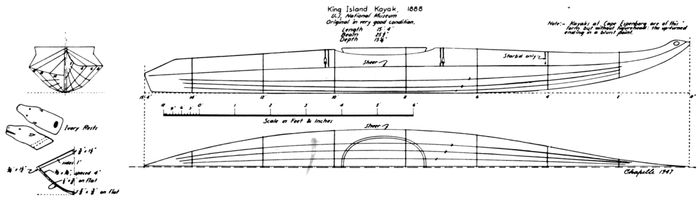
Figure 181
King Island Kayak, Alaska, 1888, in U.S. National Museum (USNM 160326), collected by Capt. M. A. Healy, U.S. Revenue Steamer Bear.
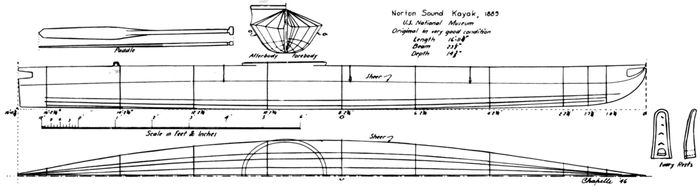
Figure 182
Norton Sound Kayak, Alaska, 1889, U.S. National Museum (USNM 160175).
The plan of a kayak from Nunivak Island (about due north of Unalaska and roughly halfway to St. Lawrence Island) is shown on page 198 (fig. 180). This type of kayak is obviously related to that of Kodiak Island, for it has approximately the same lines and proportions. Only the profiles of bow and stern exhibit marked differences. Perhaps the most striking feature of the Nunivak kayak is its bow, which might represent a seal's head; a hole through the whole bow structure forms the eyes and also serves functionally as a lifting handle. The stern profile is simpler than that used in the Kodiak kayaks. The example shows the mythological water monster Palriayuk, a painted totem that once distinguished the Nunivak kayaks; missionary influence has long since erased such decorations from Alaskan kayaks. Whereas the Kodiak kayak has eleven battens (including the keelson) in its frame, the Nunivak kayak has nine, and all the longitudinals in it are rectangular in section. Differences in dimensions of Nunivak and Kodiak kayaks are remarkably slight, the greatest length reported for either type is about 15 feet 9 inches and the greatest beam is about 32 inches. Both types have a large manhole and carry a passenger back-to-back with the paddler. The single-bladed paddle is used. The kayak is sometimes transported over ice by means of a short sledge, by one man, but it is otherwise rather heavy to portage. Highly regarded by all who have had contact with it, this is generally considered one of the safest and most useful of the Alaskan kayaks.
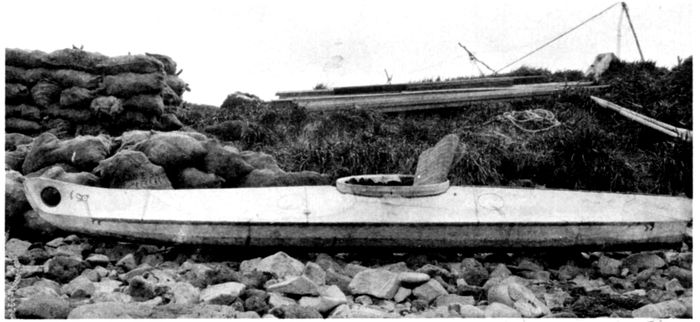
Figure 183
Nunivak Island Kayak with picture of mythological water monster Palriayuk painted along gunwale. (Photo by Henry B. Collins.)
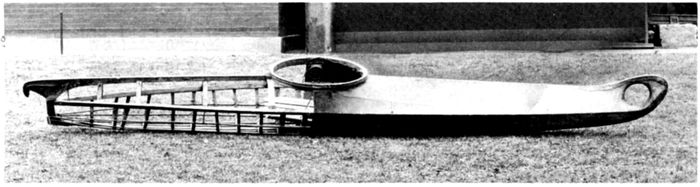
Figure 184
Nunivak Island Kayak in U.S. National Museum (USNM 76283) with cover partly removed to show framework. Collected by Ivan Petroff, March 30, 1894.
King Island, at the entrance to Bering Strait, is the home of the kayak shown on page 198 (fig. 181). The King Islanders are noted as skillful kayakers and their kayak generally follows the Nunivak pattern, but is narrower and more V-shaped in cross section, and the stem and stern are also distinctly different. The King Island craft has a bold upturned stem ending in a small birdlike head, with a small hole through it to represent eyes and to serve for a lifting grip; the stern is low and without the projections seen in the Nunivak type. The fitting of the cockpit rim of the U.S. National Museum kayak is unusual; the rim is not supported by thwarts but rather is made part of the skin cover and therefore can be moved. This seemed to be intentional, for there is no evidence of broken or missing members, but John Heath considers this not typical. A watertight jacket with the skirt laced to the manhole rim is worn by the kayaker to prevent swamping. This practice was common among Eskimo working in stormy waters. A warm-weather alternate was a wide waistband, with its top supported by straps over the shoulders and the bottom laced to the manhole.
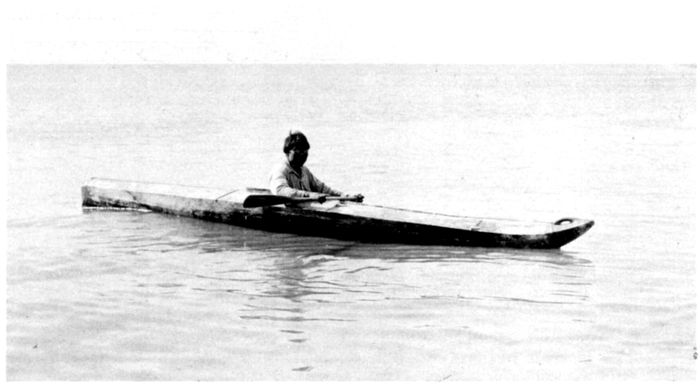
Figure 185
Western Alaskan Kayak, Cape Prince of Wales, 1936. (Photo by Henry B. Collins.)
A somewhat similar but slightly smaller kayak was used at Cape Espenberg; in these the upturned bow ended in a simple point. The sterns were alike in both types. The Cape Espenberg kayak had a fixed cockpit rim however, as in the Nunivak type. Both types employed the single-bladed paddle.
A little to the South, in Norton Sound, the long narrow kayak shown on page 198 (fig. 182) is popular. These are somewhat like the Nunivak kayaks in cross section but with far less beam. They have a slight reverse, or humped, sheer and are very sharp ended. The peculiar handgrips at bow and stern are characteristic, though the shape and size of the grips vary among the villages; the style shown is that of St. Michaels. A single-bladed paddle is used. This type is very fast under paddle, but requires a skillful user in rough water. The Norton Sound kayaks are very well finished and strongly built.
From Kotzebue Sound, at Cape Krusenstern, along the north coast of Alaska to near the Mackenzie Delta, the kayaks are very low in the water, long, narrow, and spindle-shaped at the ends. They are distinguished by a very strong rake in the manhole rim, with an accompanying prominent swell in the deck forward of the manhole. They are built with seven longitudinal battens (including the keelson) in addition to the gunwales. In several examples seen, the latter are sometimes slightly channelled on the inside, but this may have been the result of shrinkage in the pith of the timber used and not intentional. These kayaks are very light and easily carried. Both single-and double-blade paddles are employed; the single blade is usually used in travelling.
On page 201 are shown a kayak from Cape Krusenstern (fig. 186) and one from Point Barrow (fig. 187). It is reported that these types have now gone out of use. In these boats no stem or stern posts exist, these usually being replaced by small end blocks. The only important difference in the two types shown is in the style of crowning the deck, which is ridged in the Cape Krusenstern kayak but more rounded in the Point Barrow kayak. In spite of their narrow beam and obviously unstable form, these kayaks are said to have been used by rather unskillful paddlers. In general, they were not employed in rough weather but were seaworthy in skillful hands.
Though the North Alaska type of kayak, as illustrated by the Point Barrow model (fig. 187), may be said to represent the structural design of kayaks to the eastward as far as Foxe Basin, the Mackenzie Delta kayaks are on an entirely different model. Due to migration of numerous groups of Eskimo to this area in the last seventy years, the design of kayaks here has undergone a great change. In figure 188 appears the plan of a modern Mackenzie Delta kayak.
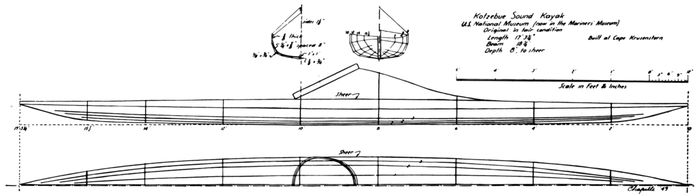
Figure 186
Kotzebue Sound Kayak (Cape Krusenstern), Alaska, formerly in U.S. National Museum, now in Mariner's Museum.
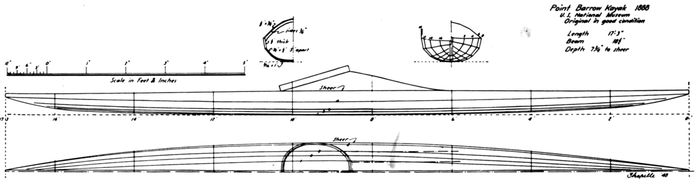
Figure 187
Point Barrow Kayak, Alaska, 1888, in U.S. National Museum (USNM 57773).
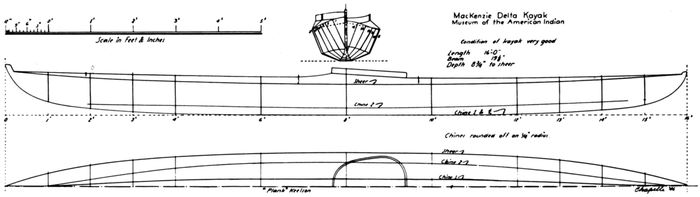
Figure 188
Mackenzie Delta Kayak, in Museum of the American Indian, Heye Foundation.
The design is marked by a very narrow flat bottom or a wide keel combined with the V-bottom. These boats are well-built and are light and graceful. The wide keel is formed by a thick plank keelson which narrows at bow and stern and is bent up to form the stem and stern. The chine pieces run fore and aft and are lashed to the stem and stern thus formed. The gunwales are about ¾ by 1⅛ inches. The frames are about ¼ by ⅝ inch bent in a strongly U-shaped form, with their ends tenoned into the bottom of the gunwales. The keelson is only about ⅜ inch thick and the chines are rather wide thin battens; about 5⁄16 by 1¼ inch. Some kayaks have an additional batten in the sides above the chines. The deck is slightly ridged for nearly the length of the boat. The stem and stern are carried up above the sheer to form prominent posts; some builders carry them higher than shown. The construction is neat and light and the boat is very easily paddled. Its narrow beam makes it somewhat treacherous, however, in unskilled hands. A double-bladed paddle is generally used with this kayak. While the form appears to vary little among individuals of this class, the construction varies, particularly in the number and dimensions of the longitudinals. Frames are spaced rather consistently 5 to 6 inches apart.

Figure 189
Kayak From Point Barrow, Alaska, in U.S. National Museum (USNM 57773). Collected by Capt. M. A. Healy, U.S. Revenue Steamer Bear, 1888. (Smithsonian photo MNH-399-A.)
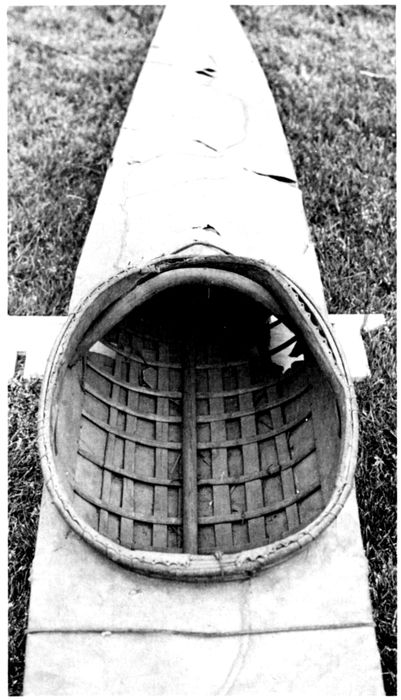
Figure 190
Cockpit of Kayak from Point Barrow (USNM 57773), showing method of lashing skin cover to manhole. (Smithsonian photo MNH-399.)
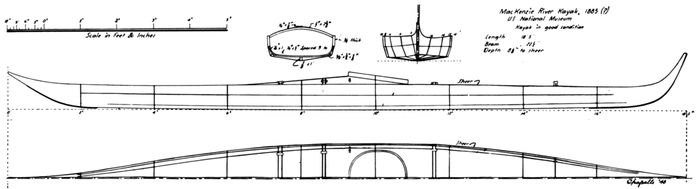
Figure 191
Kayak in U.S. National Museum (USNM 160325) cataloged as from Mackenzie River area, 1885, but apparently an eastern kayak of unidentified origin.
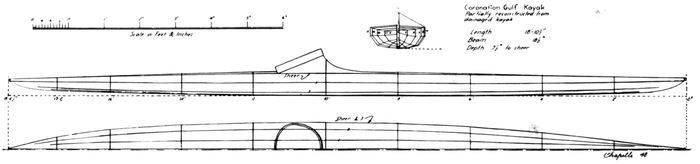
Figure 192
Coronation Gulf Kayak, Canada, partially reconstructed from a damaged privately owned kayak (now destroyed).
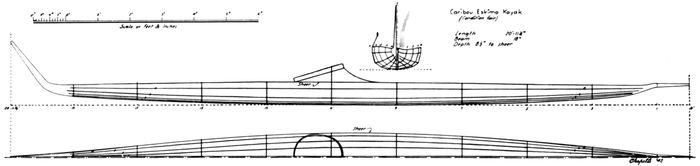
Figure 193
Caribou Eskimo Kayak, Canada, in American Museum of Natural History.
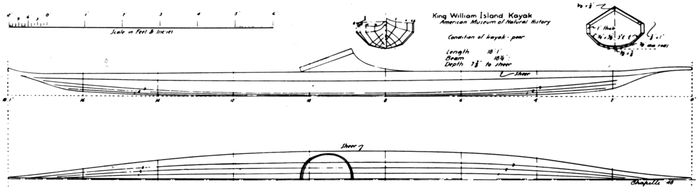
Figure 194
Netsilik Eskimo Kayak, King William Island, Canada, in the American Museum of Natural History.
The foregoing design differs greatly in every respect from the example in figure 191, collected by the U.S. Fish Commission in 1885 and identified as a Mackenzie River kayak. It is a large heavy boat compared to the one just described. The model of this old kayak, and the construction too, is on the eastern pattern, such as is used in Hudson Strait. The strongly upturned stern and less rising bow resembles the old Greenland kayaks. The V-bottom and 3-batten construction combined with heavy deep gunwales is not to be found in any of the known Alaskan kayaks. There is unfortunately no record of the exact location where this kayak was found, nor any information on the builders; if it is from the Mackenzie, the type now appears to be wholly extinct and there has been nothing in recent times in the vicinity faintly resembling it. The kayak is a well-built, safe, strong boat; the high stern would aid it in coming head to sea and wind when paddling stopped; and it resembles, more than most, the early explorers' drawings of Arctic kayaks. The very high ends indicate that it was not used where high winds are common, despite the otherwise seaworthy design and construction, and regardless of the documentation, it now seems certain that this kayak came from somewhere in the eastern Arctic.
To the eastward of the Mackenzie, the kayaks are narrow, spindle-shaped and very low sided, in the manner of the northern Alaskan boats. The drawing of figure 192 was made from the remains of a kayak from Coronation Gulf and to insure accuracy was compared with photographs and measurements of some Copper Eskimo kayaks. This kayak is characterized by a rather marked reverse sheer and a strongly raked manhole rim. The deck forward of the manhole sweeps up very sharply, but with a different profile than is seen on the north coast of Alaska; the deck of these eastern kayaks sweeps up in a very short hollow curve instead of the long convex sweep popular in Alaska. The ends of the hull finish in small bone buttons; the skin cover passes under the manhole rim, as in the Cape Krusenstern and Point Barrow types. A two-bladed paddle is commonly used. The hull design is more stable than that at Point Barrow and the ends are somewhat fuller, giving the boat a rather parallel sided appearance; it has longitudinal battens from the bottom of the hull, one the keelson; the gunwales are channelled on the inside and are very light and neatly made. The frames are split willows, round on the inside.
The Caribou Eskimo kayak preserved in the American Museum of Natural History is the best example of the type found. The drawing of figure 193 shows the features of this particular type; the construction is about the same as that of the Point Barrow kayak but is much lighter and weaker. The peculiar projecting stem is formed of a stem block, scarphed to the gunwales; to it the beak piece is attached with a lashing. The sharply turned-up stern is formed in a similar manner by two pieces joined together at the tip and lashed to the stern block; this stern construction is similar to that of the eastern Arctic kayak shown in figure 192. Both caribou hides and seal skins are used to cover the Caribou Eskimo kayak. The seams are rubbed with fish oil and ochre, a method also used extensively along the north coast of Alaska to paint the framework of both kayaks and umiaks.
The Netsilik Eskimo kayak is related to the Caribou, but is less stable and has different bow and stern profiles. The example shown in the drawing of figure 194 requires little discussion; the cover is of seal skin. These kayaks are used only in hunting caribou at stream crossings and are not employed in sealing. The very narrow bottom and narrow beam make this the most dangerous of all kayaks in the hands of a paddler unaccustomed to such craft. Neither the Caribou nor the Netsilik kayaks are very seaworthy and their construction is inferior. They are characterized by rather heavy gunwales but the other members of their structures are very slight.
No examples remain of the old kayaks once used on the Gulf of Boothia, at Fury and Hecla Strait, and on the west side of Foxe Basin. Early explorers in this area found kayaks, but the types used have been long extinct. One kayak, supposed to have been built at Southampton Island, had been preserved by a private collector, but when measured was in a damaged state. Shown in figure 195, it does not conform with the old description of kayaks from the Melville Peninsula but does agree reasonably well with the Boas model of a kayak from Repulse Bay in the U.S. National Museum (USNM 68126). On this basis it would appear that in Boas' time this form of kayak was also used on the east side of the Melville Peninsula. The design resembles to some extent the kayaks from the southwest coast of Greenland, but the stern is like that used in some Labrador craft. This old kayak was very light and sharp, rather slightly built, but very graceful in model so far as could be determined from the remains of the craft. The foredeck camber is ridged and carried rather far forward. If the identification of this kayak should be correct, it is apparent that the eastern model of the kayak once extended as far west as the west side of Foxe Basin.
The kayak of lower Baffin Island, in figure 196, is flat-bottomed, long, and rather heavy. The gunwale members are very deep and the keelson and chine battens are quite heavy. This type has a slight side-batten between chine and gunwale—in all, five longitudinal members besides the gunwales—hence this example is the sole exception to the 3-batten construction that may be said to mark the eastern kayaks. The Baffin Island kayak is rather roughly built and the two examples found had many frames cracked at the chines. However, this kayak has many excellent features, being easily paddled, very stable, and seaworthy. The double-blade paddle used is like that of the Labrador kayak, very long with narrow blades. When the paddler is seated, these kayaks, like many of their eastern sisters, draw more water forward than the illustration would indicate (it should be remembered that the trim of the kayaks in the water is not indicated by the base lines used in the plans). The deeper draft at the bow, which allows the kayak to hold her course into the wind and to come head to the wind when at rest, gives a long easy run in the bottom toward the stern. The slight rocker in the bottom shown in the drawing is thus misleading. The stem is formed by the extension of the keelson, producing the "clipper-bow" seen in many eastern boats. The stern is shaped by a stern block of simple form into which the gunwales, keelson and chines are notched. The batten between chine and gunwale stops a little short of both bow and stern.
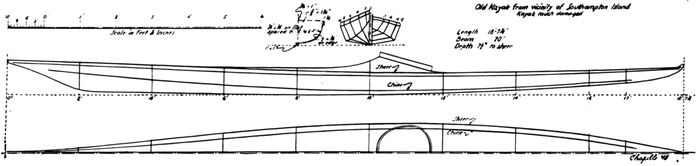
Figure 195
Old Kayak From Vicinity of Southampton Island, Canada. Plan made from a much damaged kayak, now destroyed, once privately owned.
A somewhat similar kayak is used on the Labrador side of Hudson Strait but, as shown in figure 197 on page 207, the appearance of the craft is distinctive. The kayak is flat-bottomed, with the snied-off chines seen in the Baffin Island boat, giving a cross section form like that of many Japanese sampans. The 3-batten system is used in construction, and the gunwales are very heavy and deep, standing vertical in the sides of the boat. The sheer is slightly reversed and there is little rocker in the bottom. One of the most obvious features of the Labrador kayak is the long "grab" bow, which is formed by a batten attached to the end of the keelson. The stern is formed with a very small block inside the gunwales, and to this the keelson is laced or pegged. It will be noticed that the rake of the manhole is very moderate. These kayaks are heavy and strong, paddle well, particularly so against wind and sea. Shown in the drawing is the type of long-and narrow-bladed paddle used.