Chapter Three FORM AND CONSTRUCTION
Reading edition
Classification of the types of bark canoes built by the Indians is not a simple matter. Perhaps the most practical way is to employ the tribal designation, such as Cree canoe, Micmac canoe, accepting as a criterion the distinctive general appearance of the canoes used by each tribe. It must be emphasized, however, that this method of classification does not indicate the model, or "lines," employed. Both the model and the size of bark canoes were extensively affected by the requirements of use: lake, coastal, or river navigation; smooth, rough, or fast-running water; transportation of a hunter, a family, or cargo; the conditions and length of portages; and the permanence of construction desired. Canoes of various models, sizes, methods of construction, or decoration might be found within the limits of a single tribal classification. Also, within a given area, there might be apparent similarity in model among the canoes of two or three tribal groups. However, a classification based on geographical areas has been found to be impractical, because the movements of tribal groups in search of new hunting grounds tend to make tribal boundaries difficult to define.
Form
The canoes of some tribal groups appear to be hybrids, representing an intermingling of types as a result of some past contact between tribes. Those of other groups are of like model, form, and even appearance, possibly owing to like conditions of employment. The effects of a similarity in use requirements upon inventiveness is seen in the applications for modern patent rights, where two or more applications can cover almost exactly the same device without the slightest evidence of contact between the applicants; there is no logical reason to suppose the same condition cannot apply to primitive peoples, even though their processes of invention might be very slow or relatively rare in occurrence.
The effects of migration of tribes upon their canoe forms can only be studied with respect to those comparatively recent times for which records and observations are available. From the limited information at hand it appears that the Indian, when he moved to an area where use requirements and materials available for building differed from those to which he had been accustomed, was often forced to modify the model, form, size, and construction of his canoe. In some instances this seems to have resulted in the adoption of another tribal form.
The distinctive feature that usually identifies the tribal classification of a bark canoe is the profile of the ends, although sometimes the profile of the gunwale, or sheer, and even of the bottom, is also involved. The bow and stern of many bark canoes were as near alike in profile as the method of construction would permit; nevertheless some types had distinct bow and and stern forms. Among tribes the form of the ends of the canoes varied considerably; some were low and unimpressive, others were high and often graceful.
Obviously practical reasons can be found for certain tribal variations. In some areas, the low ends appear to ensue from the use of the canoe in open water, where the wind resistance of a high end would make paddling laborious. In others the low ends appear to result from the canoe being commonly employed in small streams where overhanging branches would obstruct passage. Portage conditions may likewise have been a factor; low ends would pass through brush more easily than high. Types used where rapids were to be run often had ends higher than the gunwales to prevent the canoe from shipping water over the bow. The high, distinctive ends of the canoes most used in the fur trade, on the other hand, were said to have resulted from the necessity of employing the canoe as a shelter. When the canoe was turned upside down on the ground, with one gunwale and the tops of the high ends supporting it, there was enough headroom under the canoe to permit its use as a shelter without the addition of any temporary structure. The desirability of this characteristic in the fur-trade canoe can be explained by the fact that the crew travelled as many hours as possible each day, and rested for only a very short period, so that rapid erection of shelter lengthened both the periods of travel and of rest.
Yet these practical considerations do not always explain the end-forms found in bark canoes. Canoes with relatively high ends were used in open waters, and similar canoes were portaged extensively. Possibly the Indian's consciousness of tribal distinctions led him to retain some feature, such as height of the end-forms, as a means of tribal recognition, even though practical considerations required its suppression to some degree.
The profile of the gunwales also varied a good deal among tribal types. Most bark canoes, because of the raised end-forms, showed a short, sharp upsweep of the sheer close to the bow and stern. Some showed a marked hump, or upward sweep, amidships which made the sheer profile follow somewhat the form of a cupid's bow. Many types had a straight, or nearly straight, sheer; others had an orthodox sheer, with the lowest part nearly amidships.
The bottom profiles of bark canoes showed varying degrees of curvature. In some the bottom was straight for most of its length, with a slight rise toward the ends. In others the bottom showed a marked curvature over its full length, and in a few the bottom was practically straight between the points at which the stems were formed. Some northwestern types had a slightly hogged bottom, but in these the wooden framework was unusually flexible, so that the bottom became straight, or even a little rockered when the canoe was afloat and manned.
The practical reasons for these bottom forms are not clear. For canoes used in rapid streams or in exposed waters where high winds were to be met many Indians preferred bottoms that were straight. Others in these same conditions preferred them rockered to varying degrees. It is possible that rocker may be desirable in canoes that must be run ashore end-on in surf. Of course, a strongly rockered bottom permits quick turning; this may have been appreciated by some tribal groups. Still other Indians appear to have believed that a canoe with a slightly rockered bottom could be paddled more easily than one having a perfectly straight bottom.
The midsections of bark canoes varied somewhat in form within a single tribal type, because the method of construction did not give absolute control of the sectional shape during the building, but, on the whole, the shape followed tribal custom, being modified only to meet use requirements. Perhaps the two most common midsection shapes were the U-form, with the bottom somewhat flattened, and the dish-shape, having rather straight, flaring sides combined with a narrow, flat, or nearly flat bottom. Some eastern canoes showed marked tumble-home in the topside above the bilge; often they had a wide and rather flat rounded bottom, with a short, hard turn in the bilge. A few eastern canoes, used mainly in open waters along the coast, had bottoms with deadrise—that is, a shallow V-form, the apex of the V being much rounded; the V-bottom, of course, would have aided in steering the canoe in strong winds. One type of canoe with this rising bottom had tumble-home topsides, but another, used under severe conditions, had a midsection that was an almost perfect V, the apex being rounded but with so little curvature in the arms that no bilge could be seen.
Generally speaking, the eastern canoes had a rather well rounded bottom with a high turn of the bilge and some tumble-home above, though they might have a flatter form when built for shallow-water use or for increased carrying capacity. A canoe built for speed, however, might be very round on the bottom, and it might or might not have some tumble-home in the topside. In the West, a flat bottom with flaring topsides predominated; fast canoes there had a very narrow, flat bottom with some flare, the width of the bottom and the amount of flare being increased to give greater capacity on a shallow draft. Some canoes in the Northwest had a skiff-form flat bottom and flaring sides, with the chine rounded off sharply.
The form of the sections near the ends of a canoe are controlled to a great extent by the form of midsection. In canoes having flat bottoms combined with flaring sides this form was usually carried to the ends, where it became a rather sharp V, giving fine lines for speed when the canoe was light, and only moderately increased resistance when it was loaded. Among eastern canoes having tumble-home topsides, the midsection form could be carried to the ends, gradually becoming sharper in canoes having "chin" in the profiles of the ends; in canoes having no chin, the sections necessarily took a pointed oval form close to the ends. A few canoes having flaring sides and chin ends showed a similar change in form. In all, however, the bow and stern showed a tendency toward fullness near the waterline.
Canoes with a strongly U-shaped midsection commonly carried this form to the ends, with increasing sharpness in the round of the U. The U-form predominated in the end-sections of eastern canoes, of course, though a few showed a V-form, as must be expected. The fairing of the end sections into the end profiles appears to have controlled this matter. The outline of the gunwales, in plan view, also influenced the form of the end-sections and of the level lines there. Some canoes, when viewed from above, showed a pinched-in form at the ends, this was caused by the construction of the gunwales or by the projection of the end-profile forms beyond the ends of the true structural gunwale members. Such canoes would have a very strong hollow in the level lines projected through their hull-form below the gunwales, and this could have been accentuated by any strong chin in the bow and stern shapes. On the other hand, many canoes showed no hollow, and the level lines were straight for some distance inboard of the ends, or were slightly convex. Full, convex level lines will appear below the waterline in canoes having a strongly rockered bottom.
It should be noted that the Indians were aware that very sharp-ended canoes usually were fast under paddle; hence they employed this characteristic in any canoe where high speed was desired. However, the degree of sharpness in the gunwales and at the level lines is not always the same at both ends, though the variation is sometimes too slight to be detected without careful measurement; it may at times have been accidental, but in many cases it appears to have been intentional.
Some eastern canoes having their greatest width, or beam, on the gunwales at midlength had finer level lines aft than forward, apparently to produce trim by the stern when afloat and manned. This made them steer well in rough water. Some northwestern canoes had their greatest beam abaft the midlength, giving them a long, sharp bow; the run was sometimes formed by sweeping up the bottom aft to a shallow stern, as well as by the double-ended form of the canoe. Despite a general similarity in the form of the ends, in some canoes the bow was marked by its greater height, in others, by the manner in which the bark was lapped at the seams, or by the manner of decoration. In a few with ends exactly alike the bow was indicated by the fitting of the thwarts such as, for example, by placing at the forward end a particular style of thwart, intended to hold the torch used in spearing fish at night, or to support a mast and sail.
In examining the lines, or model, of a bark canoe, the limitations imposed upon the builder by the characteristics of bark must be considered. The degree of flexibility, the run of the grain, and the toughness and elasticity of the bark used all influenced the form of canoes. The marked chin in the ends of some canoes, for example, resulted from an effort to offset the tendency of birch bark to split when a row of stitches lay in the same line of grain. The curved chin profile allowed the stitching to cross a number of lines of grain. Sometimes this tendency was avoided by incorporating battens into the coarse stitching; this style of sewing was particularly useful in piecing out birch bark for width in a canoe, where the sewing had to be in line with the grain. The Indians also employed alternating short and long stitching in some form for the same purpose. Spruce bark, as used in canoes in the extreme North and Northwest, could be sewn in much the same manner as birch bark, but with due regard for the longitudinal grain of the spruce bark.
The joining of two pieces of bark by root sewing or lacing, combined with the use of spruce gum to obtain watertightness, formed a seam that could be readily damaged by abrasion from launching the canoe, from pulling it ashore, or from grounding it accidentally. For this reason, seams below the waterline were kept at a minimum and were never placed along the longitudinal centerline of the bottom, where they would have formed a sharp apex to both the V-shaped midsection and to the deadrise bottom form. Likewise, a seam was not used in forming the rocker of the bottom. Though seams had to be used to join the bark at bow and stern, the form of the canoe allowed the seams to be greatly strengthened and protected there.
The restrictions on form imposed by barks such as elm, chestnut, and hickory were very great. These barks, which are not as elastic as birch bark, were sometimes employed in a single large sheet. The sheets were not joined for length; canoes of this material were often formed by crimping, or lap folding, rather than by cutting out gores and then sewing the edges together. The characteristics of these barks can readily be demonstrated with a sheet of paper: such a sheet can be made into a crude canoe-form by bending it lengthwise and joining the ends, but it will be obvious that the midsection takes a very unstable U-form. By forcing the ends inward to give a ram, or chin, effect to bow and stern, a somewhat flatter bottom can be obtained in the midsection. By crimping or folding the paper gore-fashion near each end of the canoe-form at the gunwale edge, some rocker is created in the bottom and the width of the gunwales is increased near the ends, giving more capacity. But without the crimping along the gunwale, when the midsection form is flattened on the bottom, the latter tends to hog. Many of these bark canoes utilized both the rams ends and crimping to obtain a more useful form. However, while a sheet of birch bark could be crimped or gored into a scow-form canoe such as the Asiatic birch-bark canoe, no example of this form from North America is known. On this continent all bark canoes were sharp at both ends, i.e., double-ended, although a number of North American dugouts were scow-(or punt-) shaped.
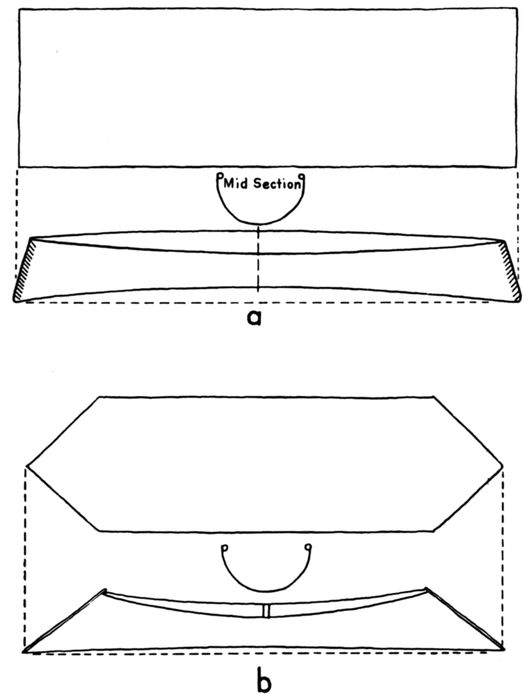
Figure 22
Canoe formed (a) without crimping or goring sides, showing hogged bottom; and (b) with ram ends to reduce hogging of bottom.
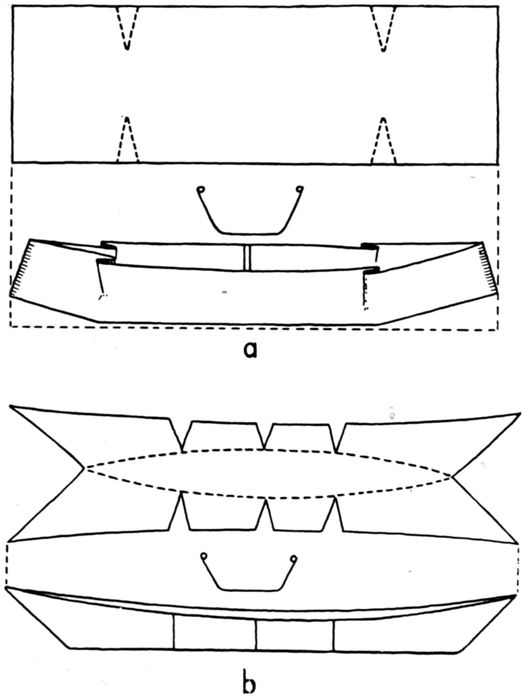
Figure 23
Canoe formed (a) by crimping sides, showing rockered bottom line, and (b) by simple gores in sides. The same effects are obtained by making bark cover of three pieces: sides and bottom.
Birch bark gave much more freedom in the selection of form simply because it could be joined together in small odd-sized sheets to shape a hull, and because it was elastic enough to allow some "moulding" by pressure of the framework employed. Birch bark could be gored, or slashed, and rejoined without resort to folding or crimping; thus it permitted a smooth exterior surface to be achieved. The toughness of the bark was sufficient to allow some sewing in line with the grain, to add to the width of a sheet, if the proper technique were employed (this was also true to a lesser extent of spruce bark).
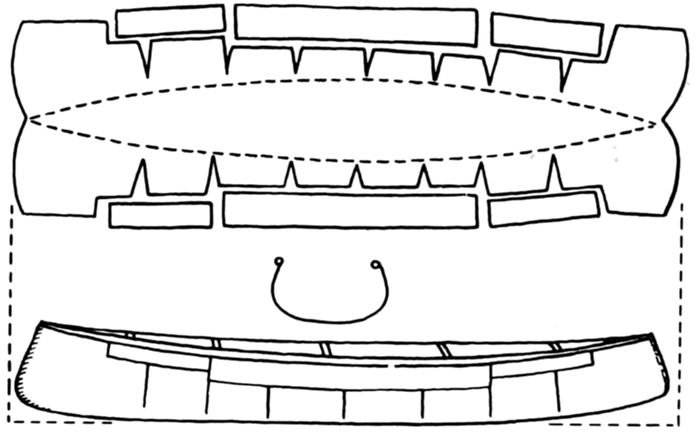
Figure 24
Canoe Formed by use of gores and panels.
The framework of most bark canoes depended upon the gunwale structure to give longitudinal strength to the hull; for this reason the structure was made sufficiently large in cross-section to be rather stiff, or was formed of more than one member. An inner and outer gunwale construction was employed in many bark canoes. The inner member was the strength member and was sometimes square, or nearly so, in cross-section. In some canoes bark was brought up on the outside of this gunwale member, lapped over the top, and lashed over it; in others the bark was lashed to both inner and outer gunwales. The outer gunwale, a rectangular-sectioned batten bent narrow-edge up, was applied like a guard, outside the bark, and was secured by pegs, by the lashings of the bark cover, or by widely spaced lashings. On top of the large inner gunwale and usually extending outward over the outer gunwale, a thin cap, pegged or lashed in the same manner as the outer gunwale, was sometimes added; this was intended to protect the lashing of the bark to the gunwale rather than to add longitudinal strength.
The corners of the inner gunwale, or of the single gunwale, were all rounded off to prevent them from cutting the sewing and lashings. The bottom outboard corner was sometimes rounded off more than the other, or beveled, in order to form between the outboard face of the gunwale and the bark a slot into which the heads of the ribs could be forced. An alternate method of accomplishing this was to notch or drill holes in the gunwales for the heads of the ribs.
The ends of the gunwales were fashioned in various ways. In some canoes the gunwales were sheered upward at the ends only slightly, the gunwale ends being secured to wide end boards in the stems or extended past them and secured to the stem-pieces. The apparent sheer in the latter might be formed by bending the outer gunwale, or outwale, and the cap (if one existed) to the required curve and then securing the ends to the stem-piece, or to the end boards, as the form of end profile dictated. If either the single gunwale or the outwale or both were sharply sheered, they were split, to a point near the end thwart, into two or four or even more laminations; even the rail cap, which was perhaps half an inch thick, might be split in the same manner to allow a sharp upward sweep at the stems. After being bent, the split members were temporarily wrapped to hold the laminations together. In no bark canoes did the ends of the gunwales curve back on themselves to form a hook just inboard of the bow and stern, despite the numerous pictures that show this feature. The gunwale ends sometimes projected almost perpendicularly upward, slightly above the top of the bow and stern, so that when the canoe was upside down its weight came on these rather than on the sewing of the ends of the craft.
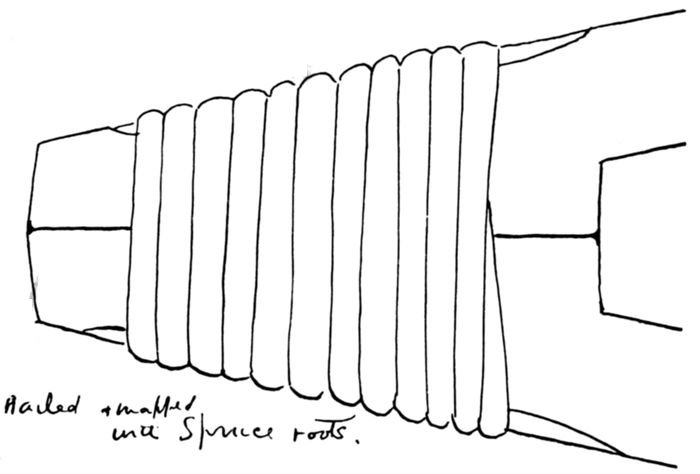
Figure 25
Gunwale Ends nailed and wrapped with spruce roots. (Sketch by Adney.)
The gunwale ends in some canoes were fastened together by means of one or more lashings, often widely spaced. After being lashed together, a narrow wedge was sometimes driven between the two gunwales from inboard to tighten the lashings. The ends were sometimes beveled on their bearing surfaces so as to make a neat appearance when joined. The various ways in which the gunwale ends at stem and stern were finished can best be described when individual types are under examination. Some canoes had a small piece of bark over the ends of the gunwales but under the outwales that held it in place. Whether these pieces were employed to protect the lashing of the gunwales and adjoining work from the weather, or whether they were the vestigial remains of a decking once used, cannot be determined. In the Canadian Northwest the ends of bark canoes were sometimes decked with bark for a short distance inboard.
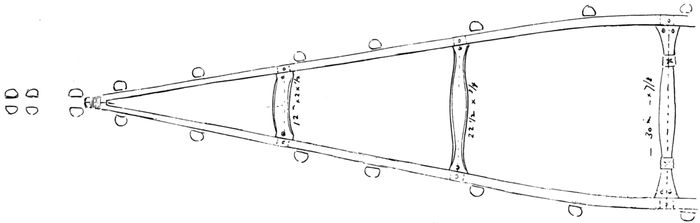
Figure 26
Gunwales and Stakes on Building Bed, plan view. (Sketch by Adney.)
The bark was secured to the gunwales by a continuous spiral lashing all along the main gunwale or by separated lashing in series. In the first, the continuous lashing, where it passed through the bark, might show regularly spaced separations to avoid the tops of the ribs. In the second, the lashings were placed clear of the ribs. There were some slight variations in the lashings, but these were of minor importance so far as structural strength is concerned. In all cases, the bark was brought up to or over the top of the gunwale before being secured, so that the holes for the lashing were pierced at some distance from the edge of the bark to prevent it from splitting.
The ends of the thwarts were mortised into the gunwales and also secured by lashings. The number of thwarts varied with the tribal type, the size, and the purpose of the canoe. Usually an odd number, from three to nine, were used, though occasional canoes had two or four thwarts. Very small canoes for hunting might have only two or three thwarts, but most canoes 14 to 20 feet long had five. Canoes intended for portaging usually had one thwart at midlength to aid in lifting the canoe for the carry position. The distance between the thwarts might be determined by structural design, or might be fixed so as to divide the cargo space to allow proper trim. The thwarts might serve as backrests for passengers, but were never used as seats. There was no standard form for the shape of the thwarts, which varied not only to some degree by tribal classification, but even among builders in single tribe. They were usually thickest and widest over the centerline of the canoe, tapering outboard and then spreading again at the gunwales to form a marked shoulder at the mortise. The lashings to the gunwales often passed through two or more holes in this shoulder.
The ribs, or frames, of most canoes were very closely spaced and were wide, flat, and thin. They ran in a single length from gunwale to gunwale. In canoes having V-sections near the ends, the ribs were often so sharply bent as to be fractured slightly. Across the bottom they were wide but above the bilge they tapered in width toward the end, which was either a rounded point or a beveled or rounded chisel-edge. The ribs were forced under the gunwales so that the heads fitted into the bevel, or into notches or holes at the underside and outboard edge of the gunwale, between it and the bark cover. By canting the rib to bring its ends into the proper position and then forcing it nearly perpendicular, the builder brought enough pressure on the bark cover to mold it to the required form. Bulging of the bark at each frame was prevented by a thin plank sheathing. The ribs in many Eastern canoes were spaced so that on the bottom they were separated only by a space equal to the width of a rib.
Each piece of sheathing, better described as a "splint" than as "planking," was commonly of irregular form. The edges were often beveled to a marked thinness. While some builders laid the sheathing edge-to-edge in the bark cover, others overlapped the edges. Nearly all builders feathered the butts and overlapped them slightly. The sheathing was held in position by a number of light temporary ribs while the permanent frames, or ribs, were being installed. It is to be noted that the sheathing was neither lashed nor pegged; it remained fixed in place only through the pressure of the bent ribs and the restraint of the bark skin.
The exact method of fitting the sheathing varied somewhat from area to area, but not in every instance from tribe to tribe. The bottom sheathing used by some eastern Indians was in two lengths. The individual pieces were tapered toward the stems and the edges butted closely together. The sides were in three lengths, but otherwise similarly fitted. The butts lapped very slightly. In a second method, used to the westward, the sheathing was laid edge-to-edge in two lengths, with the butts slightly lapped. The center members of the bottom, usually five, were parallel-sided, but the outboard ends of those at the turn of the bilges were beveled, or snied, off. The members further outboard were in one length, with both ends snied off. The bottom thus appeared as an elongated diamond-form. The topside sheathing was fitted as in the first instance.
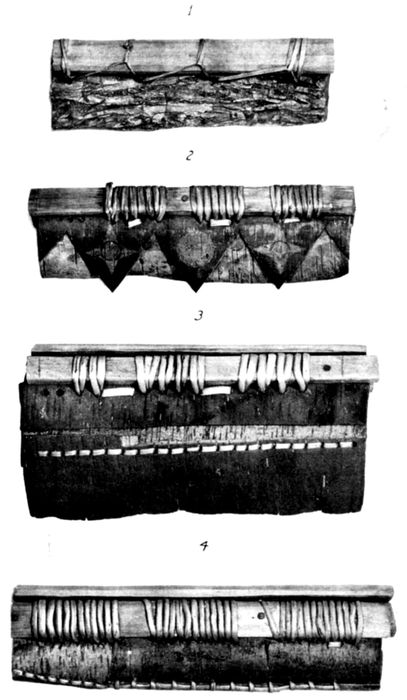
Figure 27
Gunwale Lashings, examples made by Adney: 1, Elm-bark, Malecite; 2, St. Francis; 3, Algonkin; 4, Malecite.
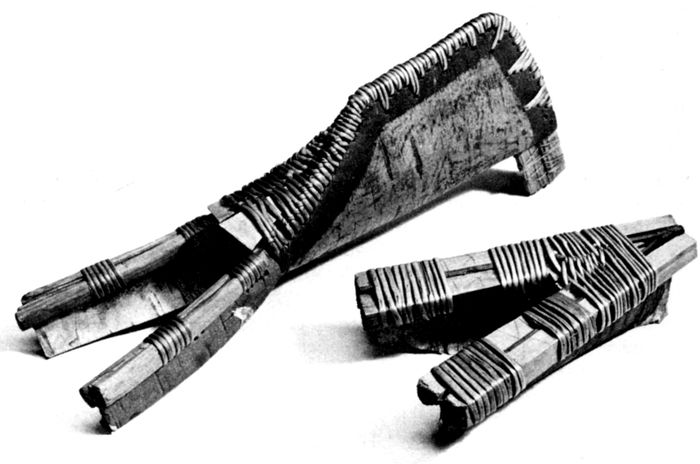
Figure 28
Gunwale-End Lashings, examples made by Adney: Athabascan (large), Ojibway (small).
A variation in the second style used three lengths in the centerline sheathing. In still another variation a centerline piece was laid in two lengths without taper, the next outboard piece was then cut in the shape of a broad-based triangle, and the rest were laid in two lengths, with the sides parallel to the sides of the triangular strake and with their ends snied off against the centerline pieces. In a fourth style short pieces, roughly elongate-oval in shape, were overlapped on all sides and laid irregularly so that when in place they appeared "thrown in." With this style, the midship section was laid first and secured by a temporary rib, then the next toward the ends, with the butts shoved under the ends of the middle section. The next series was similarly laid so that the top member of each butt-lap faced toward the ends of the hull and was under a rib. The ends were not cut square across, but were either blunt-pointed or rounded. Five lengths of sheathing were often used, and the widths of the individual pieces of sheathing were rarely the same, so the seams were not lined up and presented an irregular appearance in the finished canoe. The sheathing was thin enough to allow it to take the curve of the bilge easily.
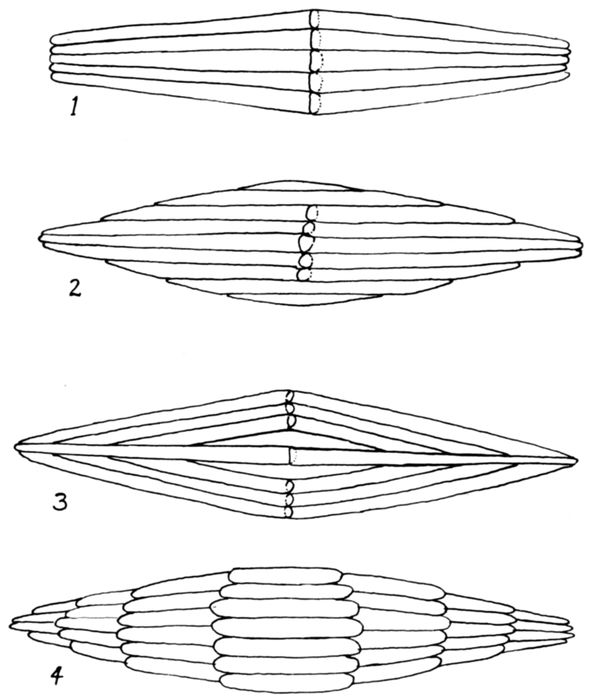
Figure 29
Splints Arranged in various ways to sheath the bottom of a canoe: 1, Micmac, Malecite; 2, Central Cree, Têtes de Boule, etc.; 3, Montagnais; 4, Algonkin, Ojibway, etc.
If the sheathing was lapped, the overlap was always slight. In some old canoes a small space was left between the edges of the sheathing, particularly in the topsides. In some northwestern bark canoes there was no sheathing; these used a batten system somewhat like that in the Eskimo kayak, except that in the bark canoes the battens were not lashed to the ribs, being held in place only by pressure. These kayak-like bark canoes had a bottom framework formed with chine members; some had a rigid bottom frame of this type, while others had bottom frames secured only by rib pressure. The purpose of the sheathing, it should be noted, was to protect the bark cover from abrasion from the inside, to prevent the ribs from bulging the bark, and to back up the bark so as to resist impacts; but in no case, even when battens were employed, as in the Northwest, did the sheathing add to the longitudinal strength of the bark canoe. The principle of the stressed rib and clamped sheathing, which is the most marked characteristic in the construction of the North American Indian bark canoe, is fundamentally different from that used in the construction of the Eskimos' skin craft.
A wide variety of framing methods are exhibited in the construction of the ends, or stems, of bark canoes. In the temporary types of the East, the bark was trimmed to a straight, slightly "ram" form and secured by sewing over two battens, one outboard on each side. Birch-bark canoes of the East usually had an inside stem-piece bent by the lamination method to the desired profile, the heel being left unsplit; as usual, the laminations were spirally wrapped, often with basswood-bark thongs. The stem-piece was then placed between the bark of the sides, and the bark and wood were lashed together with an over-and-over stitch. Sometimes variations of the short-and-long form of stitch were used here, and some builders also placed a halved-root batten over the ends of the bark before lashing to form a stem-band as protection to the seam. In some canoes the end lashing passed through holes drilled in the stem-pieces, often with the turns alternating in some regular manner through and around the stem-piece.
The stem-pieces were generally very light, and in some canoes the head was notched and sharply bent down and inboard, so that it could be secured to the ends of the gunwales. Some tribal types had no inner stem-piece, and the stem profiles were strengthened merely by the use of two split-root or halved-sapling battens, one on each side, outside the bark and under the sewing.
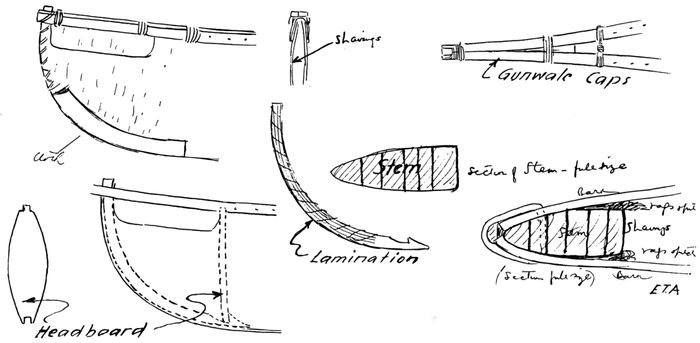
Figure 30
End Details, Including Construction of Stem-Pieces and fitting of bark over them, ending of gunwale caps at stem heads, and the headboard, with its location. Lamination of the stem pieces shows fewer laminae than is common. (Sketches by Adney.)
Birch-bark canoes to the westward used battens under the end lashing as well as rather complicated inside stem-pieces. In some parts of the West and Northwest, the ends were formed of boards set up on edge fore-and-aft, the bark being lashed through all, with the boards projecting slightly outboard of the ends of the bark cover to form a cutwater.
To support the inside stem-piece, some form of headboard was usually fitted near each end after the sheathing was in place. These were shaped to the cross-section of the canoe so as to form bulkheads. In some canoes, these miniature bulkheads stood vertical, but in others they were curved somewhat to follow the general curve of the end-profile, and this caused them to be shaped more like a batten than a bulkhead. Bent headboards were sometimes stepped so as to rake outboard. Sometimes the form of the headboard permitted the gunwale members to be lashed to it, and often there was a notch for the main gunwale on each side.
The headboards were sometimes stepped on the unsplit heel of the stem-piece; a notch was made in the bottom of the headboard to allow this. In two types of canoe in which there was no inner stem-piece, the headboards were stepped on short keel pieces, or "frogs," fore-and-aft on the bottom and extending slightly forward of the end of the sheathing to reinforce the forefoot. The purpose of the headboard was to strengthen the stem-piece, and in many cases it was an integral member of the end structure itself and helped to maintain its form. The headboard usually served to support the gunwale ends in some manner, it stretched the bark smooth near the stems, and it secured the ends of the sheathing where support from a rib would have been most difficult to obtain. Many canoes had the space between the headboard and the stem-piece stuffed with shavings, moss, or other dry material to help mold the bark to form beyond the sheathing in the ends. Some tribal groups decorated the headboards.
In a few canoes, the stem-piece was additionally supported by a short, horizontal member stepped in the forward face of the headboard and projecting forward to bear on the after side of the stem-piece. The latter was sometimes bent back onto itself above this member to form a loop around the top of the end-profile, and the gunwale ends or a part of the gunwale structure were secured to it. This complicated bending of the stem-piece, in conjunction with use of a headboard and a brace member, served to stiffen the end structure sufficiently to meet the requirements of service.
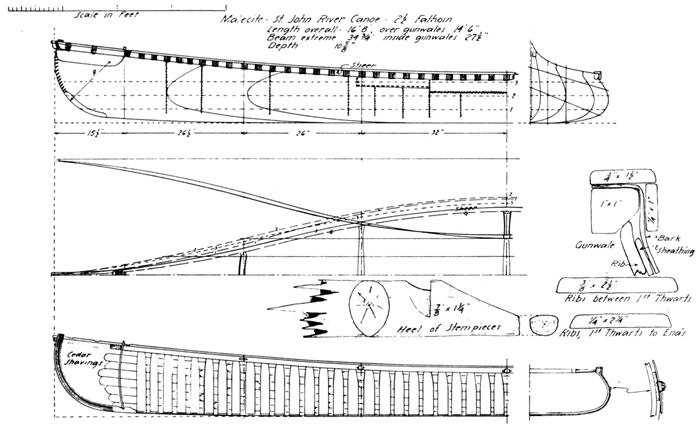
Figure 31
Malecite Canoe of the Type Described in This Chapter. This 2½ fathom St. John River canoe represents the last Malecite birch-bark model, and usually was fastened with tacks and nails, rather than with root lashings and pegs as described here.
The use of a bark cover over the gunwale ends has already been mentioned. In some eastern canoes, this was placed under the cap and outwale pieces and extended below the latter in a shallow flap on which the owner's mark or other decoration might appear; the flap was in fact a kind of name board. Such flaps do not appear on the partly decked bark canoes of the Northwest.
This general description of the structure of the bark canoes is sufficient to permit the explanation of the actual construction of a bark canoe to be more readily understood, and it also serves to illustrate the close connection between the method of construction and the formation of the lines, or model, of bark canoes. From the description, too, it can be seen that while the shape of a bark canoe was partially planned during the construction the control of every part of the model could not be maintained with the same degree of precision as in the building of an Eskimo skin boat or an Indian dugout.
Construction
One aspect of canoe construction, the Indian method of making measurements, was briefly mentioned (p. 8) under a discussion of the origin of the measurement known in French Canada as the brasse. This was the distance from finger-tip to finger-tip of the arms outstretched; in the fur trade in English times it was known as the fathom and it appears to have been about 64 inches, or less than the nautical fathom of 6 feet. Other measurements used were the greatest width of the ball of the thumb, which is very close to an English inch, and the width of the four fingers, each finger-breadth being close to three-fourths of an English inch. The length of the forearm, usually from the knuckles of the clenched hand to the elbow, was also employed by some Indians, as a convenient measurement.
Measurements in these units might be memorized and used in building, but many Indians used measuring sticks, and these served as "foot-rules." They were sometimes squared and were painted as well as notched.
A Malecite Indian, interviewed in 1925, had three such sticks for canoe building. One, for the length of the gunwale frame, was half the total length required; it was notched to show the distance at which the ends of the gunwales were lashed and also the position of the thwarts. Such a stick would be about 7 feet long for a 16-foot canoe, 8 feet for an 18-foot canoe. The second stick was notched to show half the length of each of the thwarts. The third stick had notches showing the height of the gunwale at each thwart and at the end, four notches in all for the half-length of the canoe. This stick measured from the surface of the building bed, not from a regular base line.
The method of measuring canoes appears to have been fairly well standardized, at least in historical times. As stated earlier, length was commonly taken over the gunwales only, and did not include the end profiles, which might extend up to a foot or slightly more beyond the gunwale ends, bow and stern. However, in certain old records the overall length is given, and in various areas other methods of measurement existed. Where a building frame was used, the given length of the canoe was the length of this frame; usually this approximated the length of the gunwales. The width of a canoe was measured by the Indian from inside to inside of the main gunwale members. The extreme beam might be only 2 or 3 inches greater than the inside measurement of the gunwales, but if the sides bulged out, the beam might actually be 6 or more inches greater. The depth was usually measured from the inside of the ribs to the top of the gunwale but in building it was measured from the surface of the building bed to the bottom of the main gunwales, as noted above in the description of the measuring sticks.
Thus it will be seen that the Indian measurements constituted a statement of dimensions primarily useful to the builder, for their main purpose was to fix the proportions rather than establish the actual length, width, and depth. Today we state the length of a canoe in terms of extreme overall measurement; the Indian was inclined to state the length in building terms, giving dimensions applicable to the woodwork only, just as the old-time shipbuilder gave the keel length of a vessel instead of the overall length on deck.
The building site was carefully selected. The space in which the canoe was to be set up had to be smooth, free of stones and roots or anything that might damage the bark, and the soil had to be such that stakes driven into it would stand firmly. A shady place was preferred, as the bark would not dry there as fast as in sunlight. Since the construction of a canoe required both time and the aid of the whole Indian family, the site had to be close to a suitable place for camping, where food and water could be obtained. It is not surprising, therefore, to find canoe building sites that apparently had been used by generations of Indians.
The preparation of the building bed was controlled by the intended form of the canoe to be built. If the bottom of the canoe was to be rockered, the cleared ground was brought to a flat surface for the length required for setting up the canoe. If the rocker was to be great, the middle of the bed would be slightly depressed. If the bottom was to be straight fore-and-aft, or very nearly so, the bed was crowned from 1½ to 2 inches higher in the middle than at the ends, so that the canoe was first set up with a hogged bottom. Very large canoes such as were used in the fur trade required as much as 4 inches crown in the building bed. Other dimensions being equal, the amount of crown was usually somewhat greater in canoes having bulging sides than in ones having more upright or flaring sides. Canoe factories such as were operated in certain fur-trading posts sometimes had a plank building bed suitably crowned and drilled for setting the stakes.
Two methods of setting up the canoe were used. In most of the eastern area, the gunwales were put together and used to establish the plan outline of the canoe on the building bed. But a building frame was used for constructing the various narrow-bottom canoes having flaring sides, and for some other tribal forms. The frame, made in the same general form as the gunwales when assembled, but less wide and sometimes much shorter, could be taken apart easily, allowing it to be removed after the canoe was built; hence it could be used to build as many canoes as desired to the same dimensions as the first, and was retained by the builder as a tool, or pattern, for future use.
The method of construction in which gunwales only were used in setting up the canoe will be explained first in order to show the general technique of construction. Use of the building frame will then be described. Important deviations from these methods will be described in later chapters under the individual tribal types in which they occur.
The Malecite canoe, a straight-bottomed craft about 19 feet long and 36 inches beam, is used as the example, hence the method of building to be described is that generally employed in the East, where variations in construction mainly involve the use or omission of structural elements.
The gunwales are the first members to be formed. In the Malecite canoe these are the inner gunwales, as the canoe will have outwales and caps. The gunwales are split from white cedar to produce battens that will square 1½ inches when shaped. The gunwales are tapered each way from midlength, where they are 1½ inches square, to a point 3 inches short of the ends, where they are ¾ by 1 to 1¼ inches. The edges of the gunwales are all rounded, and the outboard bottom edge is beveled almost ½ inch, at 45° to the bottom of the member. The last 3 inches at each end is formed like half a blunt arrowhead, as shown in the sketch of the member on page 31. The gunwales will be bent, side to side, on the flat as far as the ends are concerned, so the blunt arrowhead is formed on one of the wide faces of the ends as shown. The arrowhead form allows a neat joint when the gunwale ends are brought together, pegged athwartships, and then wrapped with a root lashing. In forming and finishing the gunwales, a good deal of care is required to get them to bend alike, so that the centerline of the finished frame will be straight and true.
To take the ends of the middle thwart, a mortise ¼ by 2 inches is cut in each gunwale member athwartships at exactly midlength, the length of the mortise being with the run of the gunwale. In it, the middle thwart, 33 inches long, is fitted. Made of a ⅞-inch by 3-inch piece of hard maple, the thwart tapers slightly in thickness each way from its center to within 5 inches of the shoulders, which are 30 inches apart. The thickness at a point 5 inches from the shoulder is ¾ inch; from there the taper is quick to the shoulder, which is 5⁄16 inch thick, with a drop to ¼ inch in the tenon. The width, 3 inches at the center, decreases in a graceful curve to within 5 inches of the shoulder, where it is 2 inches, then increases to about 3 inches at the shoulder. The width of the tenon is, of course, 2 inches, to fit the mortise hole in the gunwale. The edges of the outer 5 inches of the thwart are rounded off or beveled a good deal; inboard they are only slightly rounded.
The thwart is carefully fitted to the gunwale members and the ends are pegged. Some builders wedged the ends of this thwart from outside the gunwales, the wedge standing vertical in the thwart so that the gunwale would not split; however, it is not certain that wedging was used in prehistoric times, although it is seen in some existing old canoes. The pegs used in this canoe are driven from above, into holes bored through the gunwale and the tenon of the thwart to lock all firmly together. Three holes are then bored in the broad shoulders of the thwart about 1½ inches inboard of gunwale for the root lashing that is also used.
The ends of the gunwale members are now brought together, and to avoid an unfair curve appearing at the thwart in place, short pieces of split plank or of sapling, notched to hold them in place, are inserted between the gunwale members as temporary thwarts at points about 5 feet on each side of the middle thwart. After the ends are brought together and the final fitting is carried out, a peg is driven athwartships the ends and a single-part root lashing is carefully wrapped around the assembly.
Some canoe builders omitted the blunted half-arrowhead form at the gunwale end. Instead, the inside faces were tapered to allow the two parts to bear on one another for some distance. The gunwales were then pinched together and lashed with one or more wrappings. Finally, a thin wedge was sometimes driven from inboard between the two gunwale ends to tighten the wrappings. The wedges were usually so carefully fitted as to be difficult to identify. It is probable that this wedged gunwale ending represents the prehistoric form, and the blunted half-arrowhead ending is a result of the use of steel tools.
After the ends of the gunwales have been securely fastened together, the first pair of permanent thwarts is fitted. These are located 36 inches, center to center, on each side of the middle thwart, a distance that determines the centers of the mortises in each gunwale member. Each thwart, made from a ¾-inch by 3-inch piece, tapers smoothly in thickness from the ¾-inch center to the 5⁄16-inch shoulder. The tenon is of the same dimensions as that of the middle thwart, the width takes the same form as that of the middle thwart, and the edges are similarly beveled and rounded. The distance between the shoulders, taken along the centerline, is 22½ inches, and the centerline length of the thwart 25½ inches. However, the shoulders and ends of the tenons must be bevelled to follow the curve of the gunwales hence the extreme length of the thwart is actually very close to 26 inches. The worker determines the bevel of the shoulders by fitting the thwart to the run of the gunwales, the temporary thwarts being shifted so that the distance between the gunwales equals that set by the measuring stick. These two thwarts having been fitted, the tenons are pegged as before, but in the shoulders only one lashing hole is bored instead of the three employed in the middle thwart.
Figure 32
Malecite Canoe Building, 1910. (Canadian Geological Survey photos.)
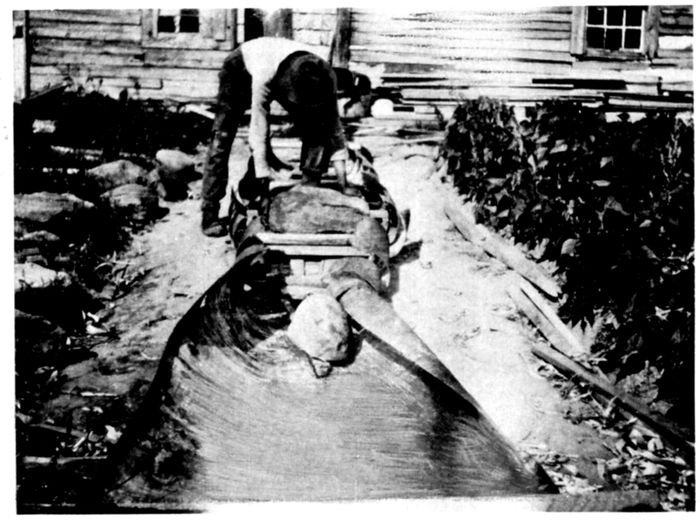
Weighting gunwales on bark cover on building bed.
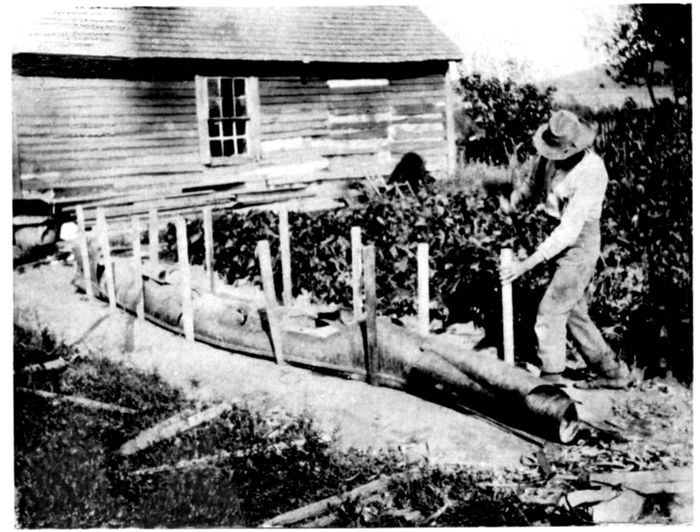
Resetting stakes.
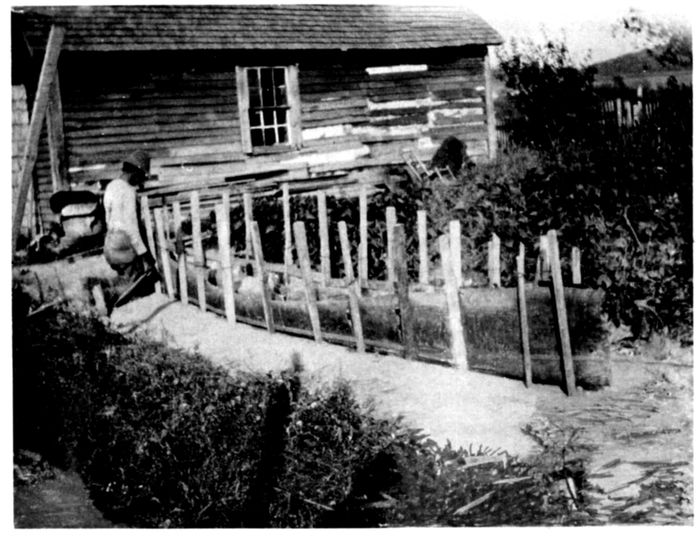
Shaping bark cover and securing it to stakes.
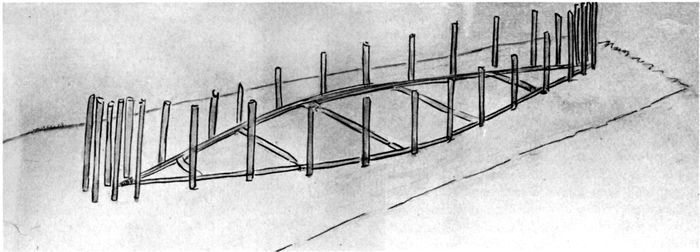
Figure 33
First Stage of Canoe Construction: assembled gunwale frame is used to locate stakes temporarily on building bed. Instead of the gunwales, a building frame was used in some areas. (Sketch by Adney.)
The second pair of thwarts is placed 30 inches, center to center, from the first pair, one at each end, and on the basis of this measurement the tenons are cut as for the others. These two thwarts are made of ⅝-by 4-inch pieces tapering in thickness each way from the center to the shoulder, where they are a scant 5⁄16 inch thick, the tenons having the same dimensions as in the other thwarts. In width the thwarts are worked to an even 3 inches from shoulder to shoulder, but in the form of a curve so that when each thwart is in place its center will be bowed toward the ends of the canoe, viewed from above. As in the first pair, the shoulders and ends are cut to a bevel to fit the gunwale; at the centerline they each measure 12 inches shoulder-to-shoulder in a straight line athwartships and 15 inches end-to-end. Allowing for bevel, the maximum length is just over 155⁄16 inches. These thwarts are drilled for single gunwale lashings and the corner edges are well rounded from shoulder to shoulder. The distance from the centerlines of these last thwarts at the bow and stern to the extreme ends of the joined gunwales is 33 inches, so the finished gunwale length is 16 feet.
After the endmost thwarts are pegged into place, the temporary stays are removed. At each step of construction the alignment of the gunwales is checked by measuring with the measuring sticks and by sighting, since the shape of the assembled gunwales, in this case of the inner gunwales, is very important in determining the sharpness of the completed canoe and the fairness of its general form.
The assembled gunwales are now ready to be laid on the building bed which, for the Malecite canoe, is 20 feet long, about 3½ feet wide and is raised about 1½ inches at midlength so that the canoe bottom will be straight when the craft is in the water. The gunwale frame having been carefully centered on this bed, with the middle thwart exactly over the highest point in the surface of the bed, some scrap split-planking is laid across the gunwales and the whole weighted down with a few flat stones. Next, 34 stakes from 30 to 50 inches long are prepared, each made of a halved length of sapling. Around the outside of the gunwale frame 26 of these are driven in pairs opposite one another across the frame, about 24 inches apart and placed so that none is opposite a thwart, except for the stakes at the extreme ends of the gunwale frame, which are spaced about a foot from their nearest neighbors and are face-to-face, about 1½ inches apart. All the stakes are driven with the flat face about an inch from the gunwale frame and parallel to its outside edge. Finally two more pairs of stakes are driven at each end, the first pair about a foot beyond the end of the gunwale frame and 1½ inches apart, the second about 6 inches beyond these and similarly spaced. The length between the outermost stakes, measured over the gunwale frame, is about 18½ feet. Great care is taken to line up the last pairs of stakes with the centerline of the gunwale frame.
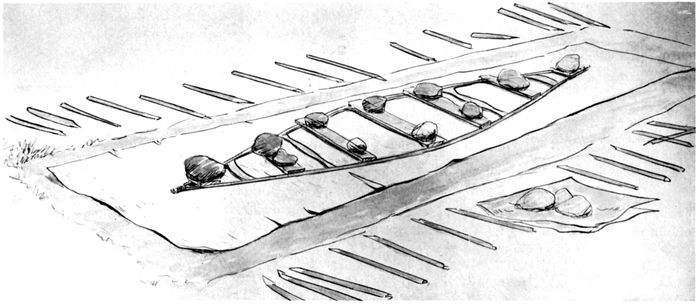
Figure 34
Second Stage of Canoe Construction: stakes have been removed and laid aside, and the gunwales shown in first stage have been removed from the building bed. The bark cover is laid out on the building bed, and the gunwales are in place upon it, weighted down with stones. (Sketch by Adney.)
If the canoe is to have a slight rocker near the ends and is to be straight over the rest of the bottom, the ends of the gunwale frame will be blocked above the building bed so that the frame is not hogged on the bed.
After the builder is satisfied with the staking, each stake is carefully pulled up and laid to one side, off the bed but near its hole. The weights are then removed from the gunwale frame, which is lifted from the bed and laid aside, and the bed, if disturbed is repaired and re-leveled.
The roll of birch bark is now removed from storage, perhaps in a nearby pool where it has been placed to keep it flexible, and unrolled white side up on the building bed. As the bark dries, it will become more and more stiff, so it will be necessary to moisten it frequently during construction to maintain its flexibility.
The bark is usually long enough, but often it is not wide enough. If the bark is too short, it may be pieced out at this time, or later. If it is not wide enough it is centered on the bed; the piecing out will be done later. The gunwale frame is now laid on the bark, care being taken to place it as nearly as possible in its former position on the bed.
The bark outside the frame is then slashed from the edge to a point close to the end of each thwart, and also to points along the frame halfway between the thwarts, so that the edges can be turned up. While it is being slashed, the bark cover is bent slightly, so that it is cut under tension. Later, when the required shape can be determined, these slashes will be made into gores, the Malecite canoes having flush seams, not overlaps, in the topsides and bottom. If a fault is noted along the outer edge of the bark, a slash may be placed so as to allow the fault to be cut out in the later goring; irregularity in the position of the cuts does no great harm to the progress of building these canoes. The slashes are usually carried to within an inch of the gunwales on the bed. It is not customary to slash the bark close to the end, there the bark can usually be brought up unbroken, depending upon the form of the end.
When the bark has been cut as described, it can be turned up smoothly all around the frame so that the stake holes can be seen and a few of the stakes can be replaced. The frame and the bark are then realigned so that all stakes may be replaced in their holes without difficulty. When the frame and bark are aligned, the frame is weighted as before and the bark is turned up all around it, the stakes being firmly driven, as this is done, in their original holes. The longest stakes are at the ends of the frame, as the depth of the hull is to be greatest there. The tops of each pair of opposite stakes are now tied together with a thong of basswood or cedar bark, to hold them rigid and upright.
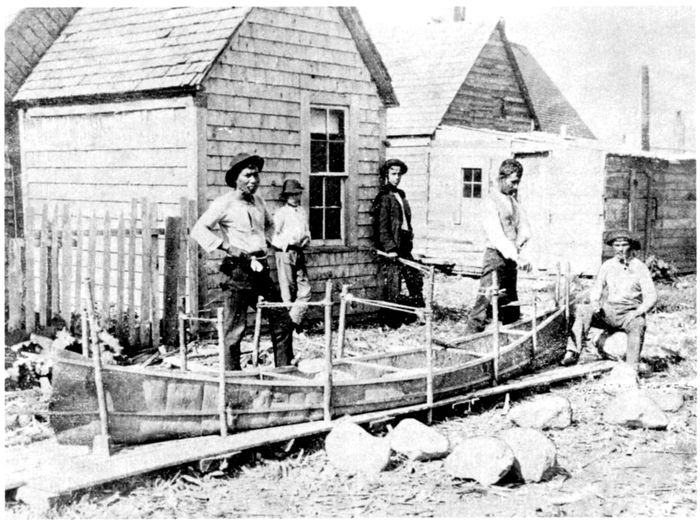
Figure 35
Malecite Canoe Builders Near Fredericton, N.B., using wooden plank building bed with stakes set in holes in the platform. This was a late method of construction, which probably originated in the early French canoe factory at Trois Rivières, Que.
After the bark is turned up around the frame, its lack of width becomes fully apparent. At this stage, some builders fitted the additional pieces to gain the necessary width; others did it later. The method of piecing the bark cover and the sewing technique, however, is explained here.
The bark is pieced out with regard to the danger of abrasion that would occur when the canoe is moving through obstructions in the water, or when it is rolled or hauled ashore and unloaded. If the bark is to be lapped below the waterline, the thickness of the bark of both pieces in the lap is scraped thin so a ridge will not be formed athwart the bottom; here, however, most tribes used edge-to-edge joining. If there are laps in the topsides, the exposed edge is toward the stern; if in the midlength, upward toward the gunwale; and if it is in the end the lap may be toward the bottom, because this makes it easier to sew, and because in the ends of the canoe there is less danger of serious abrasion. Many tribes used edge-to-edge joining everywhere in the topsides so that the direction of lapping was not a matter of consideration. The type of goring, whether by slash and lap or by cutting out a V-shaped gore, will, of course, have much to do with the selection of the method of sewing to be used.
It is to be recalled that in canoe building no needle was used in sewing the bark; the ends of the root strands were sharpened and used to thread the strand through the awl holes. Much of the topside sewing in a bark canoe was done with small strands made by splitting small roots in half and then flattening the halves by scraping. Large root strands quartered and prepared in the same manner, or the cores of these, were sometimes used in heavy sewing or lashing at the gunwale or in the ends of a canoe.
As noted previously, root thongs were used well water-soaked or quite green, for they became very stiff and rather brittle as they dried out. Once in place, however, the drying did not seem to destroy their strength. Rawhide was also used for such sewing by some tribes.
The sewing was done by Indian women, if their help was available, and the forms of stitching used in canoe building varied greatly. The root sewing at the ends of the canoes ranged from a simple over-and-over spiral form to elaborate and decorative styles. Long-and-short stitching in a sequence that usually followed some formal pattern was widely used. Among the patterns were such arrangements as one long, four short, and one long; or two longs, two or three shorts, and two longs; or one short, five of progressively increasing length, and then one short; or six progressively longer followed by six progressively shorter. Cross-stitching, employing the two ends of the sewing root as in the lacing of a shoe was also common. Sometimes this was combined with a straight-across double-strand pass to join the ends of the X. The harness stitch, in which both ends of the sewing root were passed in opposite directions through the same holes, was often used, as was the 2-thong in-and-out lacing from each side used in northwestern canoes having plank stem-pieces.
If the root strand was too short to complete a seam, instead of being spliced or knotted the end was tucked back under the last turns or stitches, on the inside of the bark cover. In starting, the tail was placed under the first turn of the stitch, so that it could not be pulled through. To finish sewing with double-ended strands, as in the harness stitch, both ends were tucked under the last turn or two.
Commonly two or more turns were taken through a single hole in the bark; this might be done to clear some obstruction such as a frame head at the gunwale, or to provide a stronger stitch, or turn, as in the harness stitch and others, or to allow for greater spacing between awl holes in the bark. (Since the awl blade was tapered, the size of the hole it made in the bark could be regulated by the depth of penetration of the blade as it was turned in the hole.)
The length of stitches varied with the need for strength and watertightness. Long stitches were about I inch, short stitches from about ⅜ to ½ inch in length. The run of the grain, of course, was a consideration in the length of stitch used.
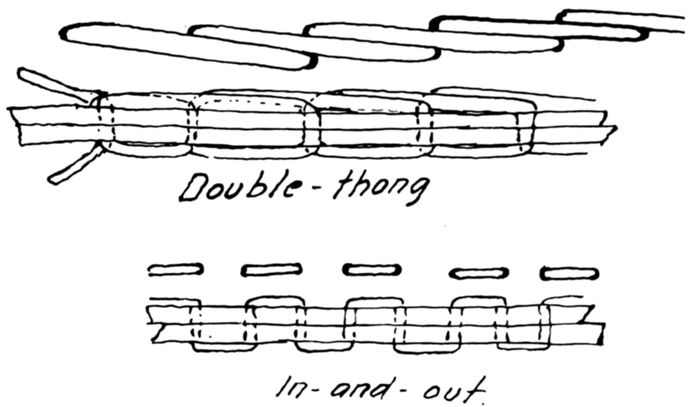
Figure 36
Sewing: two common styles of root stitching used in bark canoes.
The piecing of the side panels was done with a great variety of sewing styles, according to strength requirements. The strain put upon the bark in molding it by rib pressure was greater in the midlength than in the ends; and the sewing differed accordingly. The over-and-over spiral, with a batten under the sewing, was used for sewing in the midlength, as was back-stitching, a variety of basting stitch in which a new pass is started about half way between stitches, thus forming overlapped passes or turns. Back-stitching was usually done in a direction slightly diagonal to the line of sewing, so as to cross the grain of the bark at an angle with each pass. The double-thong in-and-out stitch, in which each thong goes through the same hole from opposite sides, was frequently used. The simple, spiral over-and-over stitch was used in sewing panels in the ends of canoes, as was the simple, in-and-out basting stitch using either a single or double strand.
When the sides were pieced out edge-to-edge, the sewing was usually done spirally, over and over a narrow, thin batten placed outside the bark cover. This batten might be either a thin split sapling or, more commonly, a split and thinned piece of root. If the pieced-out sides were lapped, then the harness stitch was commonly used. The lap might be some inches wide to decrease the danger of splitting while the bark was being punched with the awl, afterward the surplus was cut away leaving about a half inch of overlap. On rare occasions the strength of a lapped-edge seam was increased by the use of a parallel row of stitching.
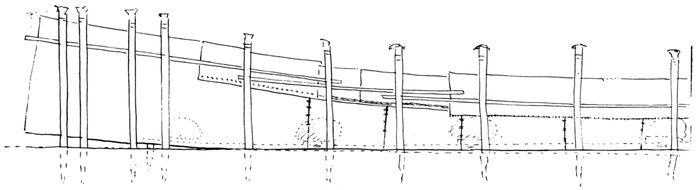
Figure 37
Comparison of Canoe on the Building Bed (above), with gunwales or building frame weighted down by stones inside bark cover, and (below) canoe when first removed from building bed during fifth stage of construction. (Sketches by Adney.)

In making the canoe watertight, it is to be remembered that some forms of stitch make the bark lie up tight all along its edges while others bind only where the stitch crosses the seam. The in-and-out stitch, which was used only above the waterline, cannot be pulled up hard without causing the bark to pucker and split and cannot be made very watertight with gum. The over-and-over stitch, in either a spiral form or square across the seam on the outside and diagonally on the inside, is very strong; when a batten is used under the stitches it can be pulled up hard and allows a very watertight gumming. When this style of sewing is used without a batten across the run of the grain, as in the gore seams, it cannot be pulled up as hard, but will serve. Back-stitching, which was much used in the topsides, can be pulled up quite hard and makes a tight seam when gummed, as do the harness stitch and cross-stitch. The ends, regardless of the style of sewing used, were more readily made tight by gumming than the other seams in a bark canoe.
Two basic methods, with some slight and unimportant variations, were used to fasten the bark to the gunwales. One employed a continuous over-and-over stitch, the other employed groups of lashings. On a canoe with the lashing continuous along the gunwales, the turns were made two or more times through the same hole on each side of each rib head to allow space for them. This might also be done where the lashing was in groups, as described above. Usually, a measuring stick was used to space the groups between thwart ends so that each group came between the rib heads. The groupings could be independent lashings, or the strand could be carried from one group to another. If the latter, it was passed along under the gunwale in a number of in-and-out stitches or in a single lone stitch either inside or out, or else it was brought around over the gunwale from the last full turn. Some tribes use both ends of the lashing, passing them through the same hole in the bark from opposite directions below the gunwales; the ends might be carried in the same manner in a long stitch to the next group. In some elm and other bark canoes employing basswood or cedar-bark lashings the bark was tied with a single turn at wide intervals; when roots were used in these, however, small groupings of stitches were customary. When group lashings were used with birch bark, the intervals between groups was usually relatively short, though in a few canoes the groups and intervals were of nearly equal length.
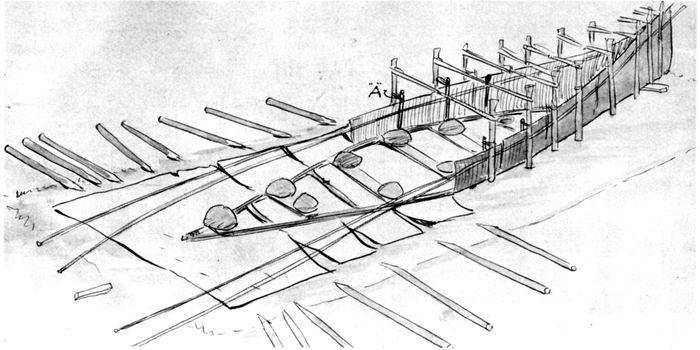
Figure 38
Third Stage of Canoe Construction: the bark cover is shaped on the building bed. The gores have been cut; part of the cover is shaped and secured by stakes and battens. "A" shows battens secured by sticks lashed to stakes. (Sketch by Adney.)
In an independent group, the ends of the strand were treated as in whipping, the tail being under the first turns made and the end tucked back under the last—usually on the inside of the gunwales. Where there were inner and outer gunwales the lashing was always around both, and the tail might be jammed between them. If a cap was used on the gunwales, the lashings were always under it. The use of a knotted turn to start a lashing occurred only in the old Têtes de Boule canoes.
On the Malecite canoe, the sides are pieced out in one to three panels rather than in one long, narrow panel on each side. The panel for the midlength requires the greatest strength and is usually lapped inside the bottom bark. The latter is first trimmed straight along its edge, and the panel inserted behind it with a couple of inches of lap. Then the two pieces of bark are sewn together over a halved-root batten with an over-and-over stitch. (Other tribes used some form of the harness stitch, or a similar style, allowing great strength.) The middle panel does not extend much beyond the ends of the first pair of thwarts on each side of the middle. The next panels toward the ends are lapped outside the bottom bark and are sewn with the back-stitch. Then, if still another panel is required at each end, this too is lapped outside and is sewn in the lap with an in-and-out stitch. The ends of the panels are usually sewn with an over-and-over stitch that runs square with the seam outside and diagonally to it inside the bark. (The harness stitch was used here by some tribes, as were many forms of the cross-stitch.) The ends of the canoe and the gores have already been sewn during an earlier stage of the building process.
Once the sides are pieced out, the bark is ready to be turned up and around the gunwale frame and clamped perpendicularly. To effect this, small stakes are made by halving saplings, so that each half is about a half inch thick. The butt of each half is cut chisel-shaped, with the bevel on the flat side; the rounded face is smoothed off, and it may be tapered toward the head of the stake. Between two of the slashes a length of bark is now brought up against the outer stakes; against the bark the small, inside stake is placed with the round face of the chisel-pointed butt wedged against the outer face of the gunwale. The top is then levered against the outside stake, so that the flat face of each clamps the bark in place. The top of the inner stake is then bound to the outer.
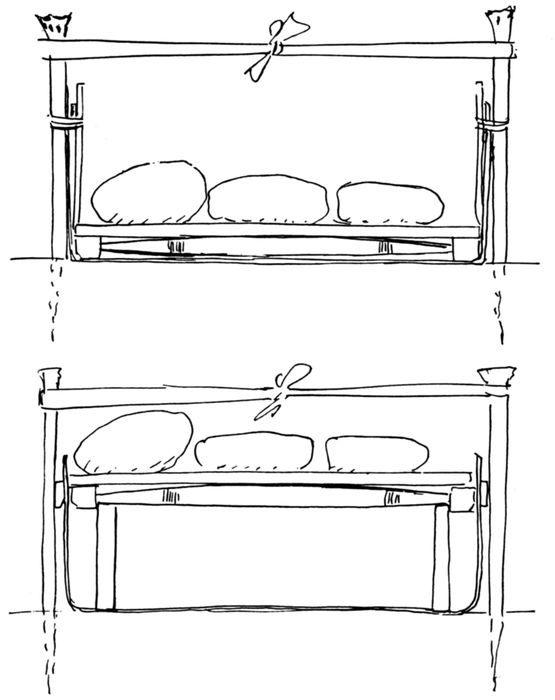
Figure 39
Cross Section of canoe on building bed during third stage of construction (above) and fourth stage. (Sketch by Adney.)
In setting the inside stakes, care is taken that their points do not pierce the bark. No inside stakes are required at the ends, as here the outside stakes are so close together in opposing pairs as to hold the bark in a sharp fold along the centerline of the cover. This of course is also true of the stakes beyond the ends of the gunwales.
After a few lengths of bark have been thus secured, they are faired between the stakes by inserting thin strips of split sapling, or battens of wood or root, along each side of the bark, under the inside and outside stakes. These battens are placed about halfway up the upturned bark. Some builders used long wooden battens, as this gave a very fair side when enough lengths were secured upright; others got the same results with short battens, the ends of which were overlapped between a pair of stakes on each side.
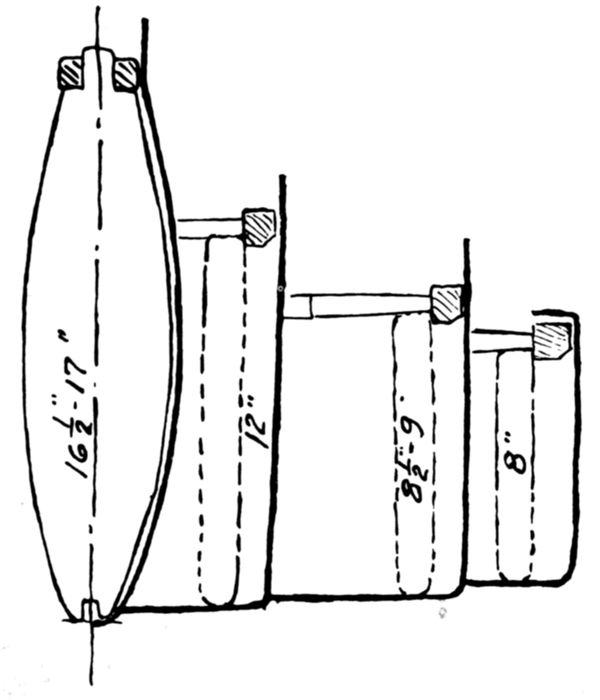
Figure 40
Multiple Cross Section through one side of a canoe on the building bed: at the headboard, middle, first, and second thwarts. Gunwale is raised and supported on sheering posts set under thwarts. Crown of the building bed is shown by varying heights of bottoms of the four sections.
When the bark has been turned up and clamped, the gores may be trimmed to allow it to be sewn with edge-to-edge seams at each slash. This is usually done after the sides are faired, by moving the battens up and down as the cuts are made, then replacing them in their original position. The gores or slashes, if overlapped, are not usually sewn at this stage of construction.
With the inside stakes in place, the longitudinal battens secured, and the gores cut or the overlaps properly arranged, all is ready for sheering the gunwales. First the weights are removed from the gunwale frame so that it can be lifted. If the inside stakes have been properly made and fitted this can be done without disturbing the sides, though the ties across each pair of outside stakes may have to be slacked off somewhat. Before lifting the frame, some short posts, usually of sapling or of waste from splitting out the gunwales and thwarts, are cut in lengths determined by the measuring stick or from memory, one for each end of each thwart, and one for each end of the gunwale frame. Those under the middle thwart ends in this canoe are 7½ inches long, those under the next thwarts out from the middle will be 9 inches, those under the end thwarts will be 12 inches, and those at the gunwale ends will be 17 inches long. These posts, cut with squared butts, are laid alongside the bed. The gunwale frame is now lifted and the pair of posts to go under the middle thwart are stepped on the bark cover, the gunwale is lowered onto them, and while the frame and posts are held steady, stones are laid on a plank over the middle thwart. Next, the ends of the gunwales are held and lifted so that a pair of posts can be placed at the thwarts next out from the middle. More weights are placed over these, the operation is repeated for the end thwarts and, finally at the gunwale ends, so that the gunwales now stand on posts on the bark cover, sprung to the correct fore-and-aft sheer and steadied by the bearing of the outside of the gunwale frame on the rounded faces of the inside stakes. Now the sheer has been established and the depth of the canoe is approximated.
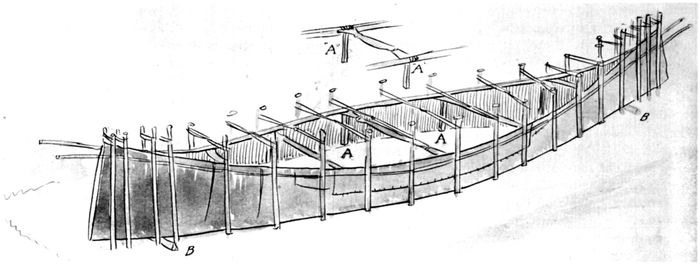
Figure 41
Fourth Stage of Canoe Construction: bark cover has been shaped and all stakes placed. The gunwales have been raised to sheer height; "A" indicates the sticks which fix the sheer of the gunwales; "B" indicates blocks placed under ends to form rocker. Side panels are shown in place, and cover is being sewn to gunwales. (Sketch by Adney.)
To protect the bark cover from the thrust of the weights used to ballast the frame, some builders inserted small bark or wood shields for padding under the heels of the posts. By some tribes the posts were notched on one face, to fit inside the gunwales near the thwarts, and there were also other ways of assembling the gunwales themselves.
It should be apparent that the operations just described would serve only for canoes in which the sheer had a gentle, fair sweep. For canoes in which the sheer turned up sharply at the ends, the gunwale members might have to be split into laminations and prebent to the required sheer before being assembled into the gunwale frame. To accomplish this, the laminations were scalded with boiling water until saturated and then the gunwale members were staked out on the ground or tied with cords to set the wood in the desired curves as it dried out. The laminations were then wrapped with cord and the gunwale was ready to assemble. To produce a hogged sheer, the gunwales were made of green spruce and then staked out to season in the form desired; a hogged sheer was also formed by steaming or boiling the gunwale members at midlength.
The canoe, as now erected on the building bed, has a double-ended, flat-bottomed, wall-sided form. The gunwales are sprung to the proper breadth and sheer, and the bark is standing irregularly above them. At this point, on canoes not having outwales, the bark cover was laced or lashed to the gunwales. Since the Malecite canoe has outwales, these are now made and fitted. They consist of two white cedar battens about 19½ feet long, perhaps 1 inch wide, and ½ inch thick. The face that will be the outboard side is usually somewhat rounded, as are all the corners, and the corner that will be on the inside and bottom of each batten when it is in place is somewhat beveled. The outwales are placed between the bark and the outside stakes, the inside stakes being removed one by one as this is done. The removal of the inside stakes allows room for the outwale to be inserted in their place, between the outside stakes and the inner gunwale face, and it allows the bark to be brought against the outside face of the inner gunwales. In the process of fitting the outwales, the battens along the sides may have to be removed and replaced, or shifted, and the cross-ties of each pair of outside stakes may require adjustment. Beginning at midlength, the outwale is pegged through the bark cover to the inner gunwales at intervals of 6 to 9 inches. The pegging is not carried much beyond the end thwarts in any canoe and could not be in canoes having laminated gunwales near the ends.
The Malecite canoe has bark covers over the ends of the inner gunwales, and these are now fitted so that they can be passed under the outwales and clamped in place. The ends of the outwales are forced inside the stakes at and beyond the ends of the gunwales, assuming a pinched-in appearance there, and they may reach a few inches beyond the ends of the bark cover; they will be cut and shaped to the length of the finished canoe later.
The outwale pegs are made by splitting from a balk of birch, larch, or fir roughly squared dowels about ¼ inch square and 6 to 9 inches long. Each dowel is then tapered and rounded each way from the middle to form two shanks that are between ⅛ and 3⁄16 inch in diameter over 2 to 3 inches of length. The ends may be sharpened by fire. The dowels are then cut in two, providing a pair of pegs with large heads. These are driven in holes drilled through the outwales, bark cover, and gunwales, and when well home, the protruding ends are cut off flush. Toward the ends of the gunwales, the spaces between the pegs increase, and at the extreme ends, the outwale will be lashed to the gunwale by widely spaced groupings of root strand. These are usually temporary, as the final lashing of the bark to the gunwales will secure the outwales.
After the outwales are secured in place, the bark is fastened to the assembled gunwales with group lashings. In the Malecite canoe being built, these are independent, each grouping consisting of eight to ten complete turns of the root strand. The intervals between, roughly 2 inches, are usually spaced by means of a special measuring-stick to insure evenness. Before the lashing is actually begun, however, the excess bark standing above the gunwales is cut away. The bark either is trimmed flush with the top of the gunwale, or enough is left for a flap that will fully cover the top of the inner gunwale, to be turned down under the lashing. The latter method, the stronger, was used by many builders. In making the turns in the group lashings, two or three turns may be taken through a single hole in the bark; the Malecites did this to avoid having the holes too close together. The result is that the group when seen from outboard appears as a W-form, with only two or three holes in the bark for an entire group. Care is taken to lay up the turns over the gunwales neatly, turn against turn without open spacing or overlaps and crossings.
When this is completed, the ends of the thwarts can be lashed, the strand passing through the holes in the shoulders, around the two gunwale members, and through one or two holes in the bark cover. The groupings for the bark cover are spaced so that these lashings do not overlap them, and thus the lashings serve a dual purpose.
Next, the gores are usually sewn and the ends of the side panels closed. To do this, the temporary side battens outside the bark are removed. Since this is a Malecite canoe, the gores are sewn edge-to-edge with an over-and-over stitch, the strand crossing the seam square outside and diagonally inside. When these seams and those remaining in the upper panels are sewn, the rather stiff bark holds the shape formed on the building bed to a remarkable degree.
The canoe can now be raised from the building bed. To set it up at a most convenient working height, the weights are first removed from the gunwales and the remaining stakes are pulled up. The canoe is then lifted from its bed and turned upside down over a couple of logs, or crude horses. Traditionally, logs or sapling were rested across two pairs of boulders or the logs were tied between two pairs of trees at convenient distances apart. More recently, horses, formed by sticking four legs into auger holes drilled in the bottom of a 4-foot length of timber, were used. After the canoe is on its supports the ends are ready to be closed in.
The stem-pieces customarily used by the Malecite builder are formed from two clear white cedar billets a full 36 inches long and in the rough nearly 1½ inches square. The billets are first shaped so that the outboard face of each stem-piece is about ¾ inch wide, making it a truncated triangle in cross-section. Then, along lines parallel to the base of the truncated triangle, it is split into six laminations which are carried to within 6 or 7 inches of the end selected to be the heel of the stem-piece. Just clear of the laminations a notch is cut into the top side of the heel, to hold the headboard, as will be seen. The piece is then treated with boiling water until the laminations are flexible, and the curve of the stem-piece can be formed and either pegged out or tied with cords until it dries in the desired shape. When dry the laminations are tightly wrapped with basswood bark cord, leaving the form of the stem-piece a quarter arc of a circle, with short tangents at each end, as shown in the illustration (p. 35).
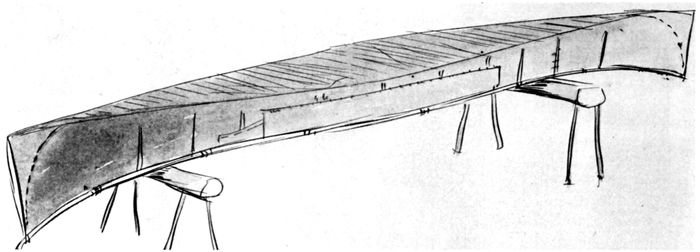
Figure 42
Fifth Stage of Canoe Construction: canoe is removed from building bed and set on horse in order to shape ends and complete sewing. Bark cover has dried out in a flat-bottomed and wall-sided form. (Sketch by Adney.)
Next, the ends of the outwales are cut to a length determined by the quality of the bark already in place; if the bark in one end is not very good, it may be cut away somewhat and the canoe made shorter by this amount at both ends in finishing. After the ends of the outwales have been cut, both are notched on the inside at the extreme ends to take the head of the stem-piece. The outwales may or may not project ¼ or ½ inch beyond the stem and the stem head may project ½ or 1 inch above the top of the outwales of the canoe; these matters, at the builder's option, decide the length of the notch and the fitting of the stem-pieces.
The stem-piece is now placed between the folded bark end of the canoe with the heel resting for a small distance along its length on the bark bottom; the head must come to the right height above the outwales, as noted. While one worker holds the stem-piece in place, another trims away the excess bark at the end to the profile of the outboard face of the stem-piece. Thus the profile of each end is cut and the rake of the ends is established. The bark is next lashed to the stem-piece. In this canoe it is done with a spiral over-and-over stitch, a batten made of a large split root being placed over the edges of the bark, as the lashing proceeds, to form a stem band. The turns pass alternately from outboard around the inboard face of the stem-piece and through it; the awl inserted in the laminations from one side opens them enough to allow the strand to be forced through. Care is taken to pull up the strand very hard each time. As the outwale is approached, the bark is cut away at the notching in each so that the outwales can be brought snugly against the sides of the stem-piece. Here the strand is brought up one or two times over the outwales, abaft the stem head, before the bitter end is tucked, thus locking the outwales to the stem-piece and the bark. Then a lashing is placed around the outwales just inboard of the stem-piece, passing through a hole in the flap of the end deck-piece of bark and through the side bark. This lashing holds the outboard end of the deck piece flap. At the inboard end of the flap, another lashing is required, but the pinched-in outwales require additional securing outboard of this point; hence a lashing is passed just inboard of the middle of the flap, a little outboard of the ends of the inwales, and about six inches inboard from this lashing another is passed through the side bark and around the gunwale and outwale on each side. These three lashings hold the outwales snug to the ends of the gunwales and against the projecting bark ends in the pinched-in form of projecting outwales.
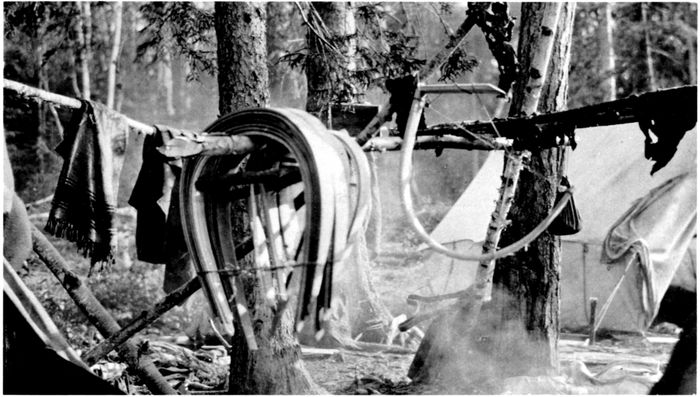
Figure 43
Ribs Being Dried and Shaped for Ojibway Canoe. (Canadian Geological Survey photo.)
The heels of the stem-pieces rest on the bottom bark and the sewing is carried down to where the cutting of the profile makes an end to the seam, the solid part of the heels extending about 6 to 8 inches inboard of this. Next, any sewing required on the bottom is done. When the bark cover has been given a final inspection on the outside and all sewing has been completed, the canoe is lifted from its supports, righted, and set on the bed or on a smooth grassy place.
All seams are now payed with gum on the inside of the bark while this can still be done without interference from the sheathing or those parts of the structure remaining to be installed. The Malecites used only spruce gum tempered with animal fat. The gum, heated until it is sufficiently soft to pour like heavy syrup, is spread with a small wooden paddle or spoon, and is then worked into the seam and smoothed by rubbing with the thumb dipped in water to prevent the gum from sticking and burning. It is first worked into the ends, between the bark and each side of the stem-pieces, particularly near the heel below the waterline. When the crevices are filled, a piece of bark (in later times a piece of cloth was used) wide enough to cover the gum alongside is well smeared with warm gum and pressed down along the inside of the stem-pieces. On each seam, at gores, and on side panels a thin narrow strip of bark is smeared with gum and pressed over the seam after the latter had been well payed. The bark is now carefully scrutinized for small splits, holes, or thin spots since these can be easily patched from the inside at this stage of construction. In fitting bark strips and in gumming, great care is taken to obtain a flat surface; the edges of the strips inside are faired to the inside face of the bark by smearing gum along the edges. The canoe is now ready to be sheathed and ribbed out.
The sheathing for this canoe has been split in advance out of clear white cedar in splints about 5 to 9 feet long, 3 to 4¼ inches wide, and ⅛ inch thick. The butts of each piece have been whittled to a feather edge, the bevel extending back about 2 inches. Also, some pieces of basket ash have been split out of saplings for temporary ribs to hold the sheathing in place.
A total of 50 or more ribs in five lengths, the longest about 5 feet, have been made up from white cedar heartwood and bent to the desired shape.
In deciding the rough lengths of the ribs, the builder can resort to various methods. He can prebend ribs in pairs to a number of arbitrarily chosen shapes: the first set of six pairs to the desired midsection form; a second set of five pairs to the form of the section between the middle and first pair of thwarts; a third, of five pairs, to the section at the first thwarts each way from the middle; a fourth, of four pairs, to the section between the end and the first pair of thwarts each way from the middle; a fifth, of three pairs, to the section at the end thwarts; and a sixth, of two or three pairs, for the section at or near the headboards. This makes from 50 to 52 frames in a canoe measuring 18 or 19 feet overall.
Each frame piece is treated with boiling water and then bent, over the knee or around a tree, to a slightly greater degree than is needed. While thus bent, each pair is wrapped lengthwise over the end with a strip of basswood or cedar bark to hold the ribs in shape. Sometimes a strut is placed under the bark strips to maintain the desired form, or a cross-tie of bark may be employed. The ribs are then allowed to season in this position.
Another method, which will be illustrated later (p. 53), involves placing ribs of green spruce in their approximate position and forcing them against the bark. In this method, a number of long battens are placed over the roughly bent ribs laid loosely inside the bark cover, and are spread by forcing a series of short crosspieces, or stays, between them athwartships. The bark is given a good wetting with boiling water to make it flexible and elastic, so that the pressure applied to the battens by the temporary crosspieces brings the bark to the shape desired for the canoe. The rough lengths of the ribs are determined by use of a measuring stick or by measurements made around the bark with a piece of flexible root or a batten of basket ash. The ribs, in any case, are made somewhat longer than required to allow a final fitting when being placed over the sheathing.
It can be seen that the exact form the canoe takes is largely a matter of judgment and of the flexibility and elasticity of the bark, rather than of precise molding on a predetermined model, or lines.
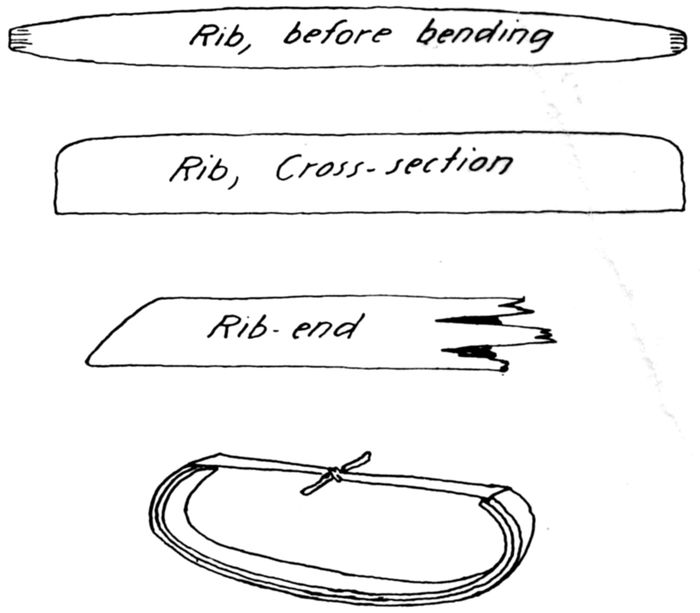
Figure 44
Details of Ribs and method of shaping them in pairs in a bark strap or thong so that they take a "set" while drying out.
In the Malecite canoe the ribs are wide amidships, 3 or 4 inches, and narrow to 2½ or 2 inches toward the ends. The thickness is an even ⅜ inch. Most birch-bark canoes have ribs of even thickness their full length, but in a few the thickness is tapered slightly above the turn of the bilge, usually when the tumble-home is high on the sides and rather great. The width, as previously explained, is usually carried all across the bottom; above the bilges there is a moderate taper.
The sheathing of the canoe is now first to be put in place. In the Malecite canoe the center pieces are the longest; they are tapered each way from their butts, which overlap about 2 inches amidships. The ends are made narrow enough to fit readily into the sharp transverse curve of the bottom and are long enough to pass under the heels of the stem pieces for an inch or two. The pieces of sheathing on each side of the center pieces are fitted in the same manner, and by the time two or three courses are in place they must be held in some manner at the ends. This is accomplished by means of the rough temporary ribs mentioned earlier. The sheathing is laid edge-to-edge, with the butts overlapping, and, if there are not enough long pieces to complete the bottom amidships, three or four lengths, with overlapped butts, will be used. As the sheathing progresses, more temporary ribs will have to be added. At the turn of the bilge, the sheathing will bend transversely as pressure is applied by the temporary ribs; the bark must be again wetted so that the angular bilge can be forced into a roughly rounded form. Particular care is required in finishing the sheathing below the gunwale to be certain that the top strake will be close up against the sewing of the bark at gunwales, but no particular attempt is made to make the edges of the sheathing in the topsides maintain edge-to-edge contact.
The pressure of the temporary ribs, the heads of which are forced under the gunwales, and the elasticity of the bark due to treating it with boiling water are enough to rough-shape the canoe.
Before the permanent ribs are placed the sheer is checked. If it appears to have straightened, the ends of the gunwales are supported by means of short posts placed under them, with the heels standing on the heels of the stem pieces or on the sheathing. Then some stakes, each having a projecting limb or root, are cut and are driven into the ground with the limb hooked over the gunwale to force it down.
After measurements have been made for the first rib with a strand of root or an ash batten, it is now cut to a length slightly more than would permit the rib to be forced upright when in place. The ends of the rib are set in place in the bevel, or notch, on the underside of the gunwales, against the bark cover, and with the bottom part of the rib standing inboard of the head. Then, with one end of a short batten placed against its inboard side, the rib is driven toward the end of the canoe with blows from a club on the head of the batten. If the rib drives too easily it is removed and laid aside; if too hard, it is shortened. It must go home tightly enough to stretch slightly the bark cover by bringing pressure to bear on the whole width of the sheathing. Care is taken, in this operation, to keep moist not only the bark but also the sewing, particularly along the gunwales, so that all possible elasticity is obtained. The ribs are set, one by one, working to within two or three frames of the midship thwart; then the other end of the canoe is begun. The last three or four ribs to be placed are thus amidships. In every rib driven, the tension is great, but no rib is driven so that it stands perpendicular to the base. Those first driven stand with their bottoms nearer the midship thwart than the ends, and this angle, or slant, continues to amidships; the ribs in the other end of the canoe slant in the opposite direction.
It will be evident that skill is required to estimate how much pressure the bark will stand before bursting under the strain of the driven ribs. It is also apparent that the shape of the canoe is controlled by the shaping given the ribs in the prebending, for this fixes the amount of tumble-home and the amount of round, or rounded-V, given to the bottom athwartships. No fixed rules appear to exist; the eye and judgment of the builder are his only guides. To show how much strain is placed on the bark, however, it may be noted that inspection of two old canoes showed that the gunwale pegs had been noticeably bent between the inner and outer gunwales.
It appears to have been a rather common practice, after all the ribs had been driven into place, to allow the canoe to stand a few days and then again to set the frames (where unevenness appears in the topsides) with driving batten and maul, the bark cover and the root sewing or lashings having been again thoroughly wetted.
The headboards are now to be made. These are shaped in the form of an elongate-oval from a wide splint of white cedar about 4 inches wide at midlength and ¼ inch thick. The narrow end is first cut off square or nearly so; the bottom end is notched to fit in the notch in the heel of the stem-piece and the top has a small tenon at the centerline that will be fitted into a hole drilled or gouged in the underside of the inner gunwales where they join at the ends. The length of the headboards in the canoe being built is 15¾ inches over all, and when they have been made for each end, they are checked as to width and height to see that they can be fitted. Next, the extreme ends of the canoe between the stem and the headboards are stuffed with dry cedar shavings or dry moss so that the sides stand firm on each side of the bow outboard of the ends of the sheathing, which ends rather unevenly, just outboard of where the headboards will stand. This completed, the headboards are forced into position by first stepping the heel notch in the stem-piece notch and then bending the board by placing one hand against its middle and pulling the top toward the worker. This shortens the height of the board enough so the tenon projecting on its head can be sprung into the small hole under the inner gunwales, where it becomes rigidly fixed. Its sprung shape pushes up the gunwales and makes the side bark of the ends very taut and smooth, while supporting the gunwale ends.
Two thin strips about 19 feet long are next split out of white cedar to form the gunwale caps; these are ¼ to ⅜ inch thick, and taper each way from about 2 inches wide in the middle to 1 inch wide at the ends. These are laid along the top of the inner gunwales and fastened down with pegs placed clear of the gunwale lashings. The ends of the strips are usually secured by two or three small lashings; the caps thus formed often stop short of the ends of the inner gunwale members. If the caps are carried right out to the stems, as was the practice of some Malecite builders, the lashings of the outwale are not turned in until after the caps are in place, in which case the bark deck pieces, or flaps, are put in just before the final lashing is made.
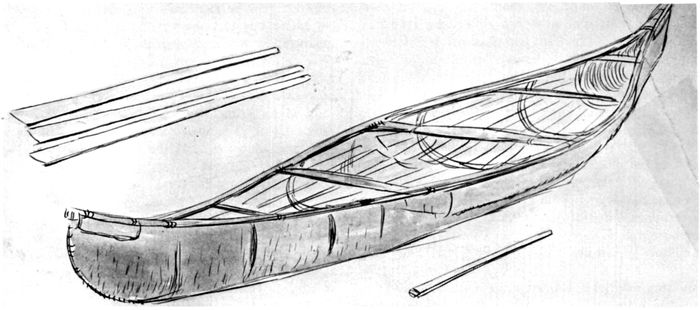
Figure 45
Sixth Stage of Canoe Construction: canoe has been righted and placed on a grassy or sandy spot. In this stage splints for sheathing (upper left) are fixed in place and held by temporary ribs (lower right) under the gunwales. The bark cover has been completely sewn and the shape of the canoe is set by the temporary ribs. (Sketch by Adney.)
Next, the canoe is turned upside-down and all seams are gummed smoothly on the outside. The ends, from the beginning of the seam to above the waterline, may be heavily gummed and then covered with a narrow strip of thin bark, heavily enough smeared with gum to cause it to adhere over the seam. In more recent times a piece of gummed cloth was used here. Above this protective strip, the end seams are filled with gum so that the outside can be smoothed off flush on the face of the cutwater between the stitches. All seams in the side and bottom are gummed smooth and any holes or patches remaining to be gummed are taken care of in this final inspection.
If the canoe is to be decorated (not many types were) the outside of the bark is moistened and the rough, reddish winter bark, or inner rind, is scraped away, leaving only enough to form the desired decorations. When paints of various colors could be obtained, these were also employed, but the use of the inner rind was apparently the older and more common method of decorating.