Chapter Five CENTRAL CANADA
Reading edition
The Indians inhabiting central Canada were expert builders of birch-bark canoes and produced many distinctive types. The area includes not only what are now the Provinces of Quebec (including Labrador), Ontario, Manitoba, and the eastern part of Saskatchewan, but also the neighboring northern portions of Michigan, Wisconsin and Minnesota in the United States. The migrations of tribal groups within this large area in historical times, as well as the influence of a long-established fur trade, have produced many hybrid forms of bark canoes and, in at least a few instances, the transfer of a canoe model from one tribal group to another. It is this that makes it necessary to examine this area as a single geographic unit, although a wide variation of tribal forms of bark canoes existed within its confines.
The larger portion of the Indians inhabiting this area were of the great Algonkian family. In the east during the 18th and 19th centuries, however, some members of the Iroquois Confederacy were also found, and in the west, from at least as early as the beginning of the French fur trade, groups of Sioux, Dakota, Teton, and Assiniboin. From the fur trade as well as from normal migratory movements there was much intermingling of the various tribes, and it was long the practice in the fur trade, particularly in the days of the Hudson's Bay Company, to employ eastern Indians as canoemen and as canoe builders in the western areas. These apparently introduced canoe models into sections where they were formerly unknown; as a result, the tribal classification of bark canoes within the area under examination cannot be very precise and the range of each form cannot be stated accurately. It was in this area, too, that the historical canot du maître (also written maître canot), or great canoe, of the fur trade was developed.
Most of central Canada, except toward the extreme north in Quebec and toward the south below the Great Lakes, is in the area where the canoe birch was plentiful and of large size. There the numerous inland waterways, the Great Lakes, and the coastal waters of James and Hudson Bays make water travel convenient, and natural conditions require a variety of canoe models. Hence, when Europeans first appeared in this area they found already in existence a highly developed method of canoe transportation. This they immediately adopted as their own, and in the long period lasting until very recent times, during which the development of the northern portion of this area was slow, the canoe remained the most important means of forest travel.
In the northeastern portion of the area, including the Province of Quebec (with Labrador) from a line drawn from the head of James Bay eastwardly through Lake St. John and the Saguenay River Valley to the St. Lawrence and thence northward to the treeline in the sub-Arctic, dwelt the eastern branch of the far-ranging Cree tribe. Those living on the shores of Hudson and James Bays, along the west side of the Labrador Peninsula, were known as the Eastern, Swamp, or Muskeg Cree. To the north, at the Head of Ungava Bay, around Fort Chimo, and to the immediate southward, were the Nascapee, or Nascopie, supposedly related to the Eastern Cree. In southern Labrador and in Quebec along the north shore of the Gulf of St. Lawrence and for some distance inland, dwelt another related tribal group now known as the Montagnais.
Although the most recent canoe forms employed by these three Indian groups were very much the same, this may not have been the case earlier. A common canoe model in this area was the so-called "crooked canoe," in which there was a very marked fore-and-aft rocker to the bottom without a corresponding amount of sheer; as a result the canoe was much deeper amidships than near the ends. Another common model had a rather straight bottom fore and aft, with some lift near the ends and a corresponding amount of sheer. Between these was a hybrid which had some fore-and-aft rocker in the bottom and a very moderate sheer. Not until the 1870's was any detailed examination made of the canoes in this area; then it appeared that the crooked canoe might be the tribal model of the eastern Cree only, while the Nascapee employed a straight-bottom model, but it is possible that the examination was limited and that Nascapee use of the crooked canoe was simply not observed. By 1900, however, the crooked model was in use not only by the eastern Cree and the Nascapee but also by the Montagnais.
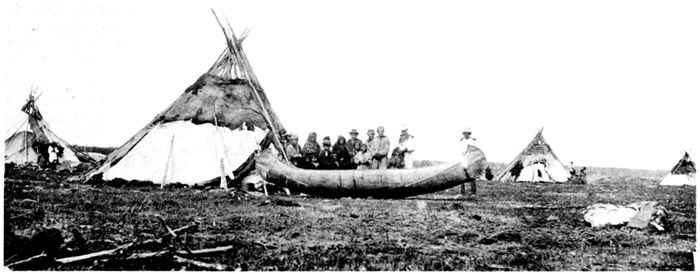
Figure 88
Montagnais Crooked Canoe. (Canadian Geological Survey photo.)
In the area around Fort Chimo and at the northern ranges of the eastern Cree and of the Montagnais the lack of good birch bark made it necessary to make up the bark cover out of many small pieces. This not only was laborious but made a rough and rather unsightly cover. Hence, some of the northern builders, particularly the Nascapee, substituted spruce bark, which was available in quite large sheets. The use of the spruce bark, however, did not cause any of these people to depart markedly from the model or the method of constructing birch-bark canoes, as it did for the Indians in the maritime area.
At the time (1908) when Adney was carefully observing the canoes in this area he found that both crooked and straight-bottom canoes were being used by all three tribal groups, but with a variation in midsection form among individual builders. Both types were built with a midsection that had a wide bottom and vertical sides, or, as an alternative, a narrow bottom and flaring sides. The end profile of all these canoes showed chin. In some crooked canoes the profile was apparently an arc of a circle, but in most canoes the form was an irregular curve. The stem met the gunwale in a marked peak rounded very slightly at the head, as the result of the method by which the stem was constructed, but in the hybrid model used by the Nascapee the ends were low and not much peaked and the quick upward rise of the sheer near the ends was lacking. In cross section all these canoes became V-shaped close to the ends, regardless of the midsection form. For the straight-bottom canoe and in the hybrid form this resulted in very sharp level lines, but the very great rocker of the crooked canoe brought the ends well above the normal line of flotation, so that this type was quite full-ended at the level line in spite of the V-section.
It is apparent upon examining the crooked canoe that there was actually less variation in its form, in spite of differences in midsection shape, than in that of the straight-bottom canoe, owing to its very great depth amidships in proportion to its width. This proportion made necessary a very moderate flare in the narrow-bottom midsection and resulted in a rather wall-sided appearance, even in this model. The hybrid form, which fell between the extremes of the crooked canoe and the straight-bottom canoe, had a narrow-bottomed flaring-sided midsection, and its relatively moderate depth made obvious the flare in the topsides and thus created a distinctive model.
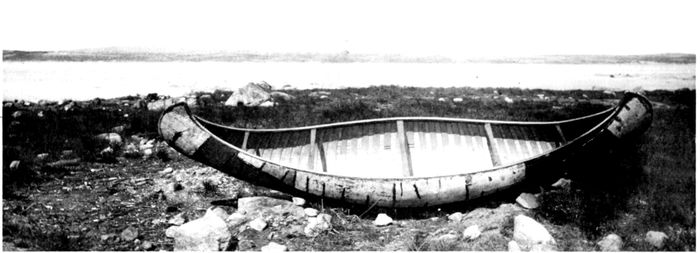
Figure 89
Birch-Bark Crooked Canoe, Ungava Cree. (Smithsonian Institution photo.)
Eastern Cree
The construction of canoes of the eastern Cree and related tribes seems generally like that of the Micmac craft. Instead of the gunwale method employed in the Maritime area, a building frame was used, and as a result the gunwales were longer than the bottom. In constructing the crooked canoe, the building frame must be heavily sheered, and there is evidence that the building bed was depressed amidships, rather than raised as was usual in the east. The great amount of rocker in the bottom in this form of Cree canoe made it necessary to block up the ends of the building frame to a very great height, and there was no need to raise the building bed at midlength, since the rocker extended the full length of the bottom. The bark cover had to be gored at closely spaced intervals to allow the rocker to be formed, and even in the straight-bottom model, the quick rise of the bottom near the ends required closely spaced gores there. In the straight-bottom model, however, the building bed was raised at midlength, as in eastern canoe-building, and the building frame was ballasted to a cupid's-bow profile, when on the bed, so as to achieve the combination of straight bottom amidships with sharply rising ends.
The gunwales were formed of the main gunwale member and a light gunwale cap, no outwale being employed. They were joined at the ends and, after hot water had been applied, were staked out with posts under the ends to obtain the required sheer. The thwarts were then tenoned into the main gunwales, though occasionally a canoe was built with "broken" gunwales, that is, the thwart-ends were let flush into the top and covered by the caps. Some builders did not spread the gunwales and place the thwarts until after the bark cover was lashed at the sheer; others used the eastern methods of assembling the gunwale structure prior to securing the bark cover at sheer. The bark cover was attached to the main gunwales with a continuous lashing, as in the Micmac canoes, but the bark was not always brought over the top of the gunwales. As a result, some canoes had a batten placed under the lashing, near the edge of the cover, to prevent the lashing from tearing away. Due to the lack of good root material, the lashing was often of rawhide. For all horizontal seams in the side panels of the bark cover, rawhide sewing over a root batten was used. The ends of the gunwales were supported by sprung headboards; in some canoes these were bellied toward the ends to such a degree that they almost paralleled the end profiles.
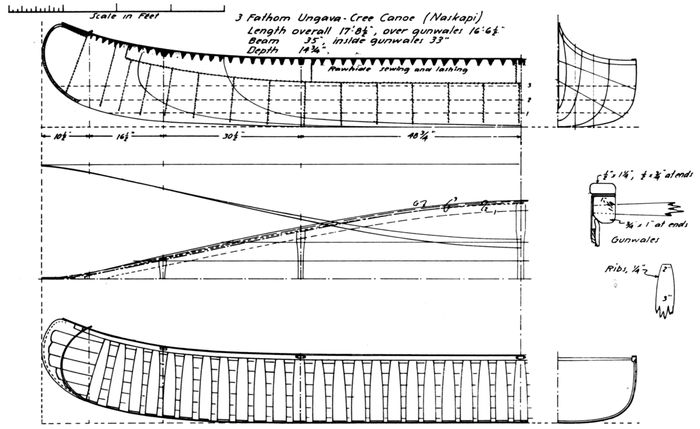
Figure 90
Nascapee 3-Fathom Canoe, Eastern Labrador. Similar canoes, with slight variations in model and dimensions, were used by all Ungava Indians: the Montagnais and the Eastern, or Swamp, Crees.
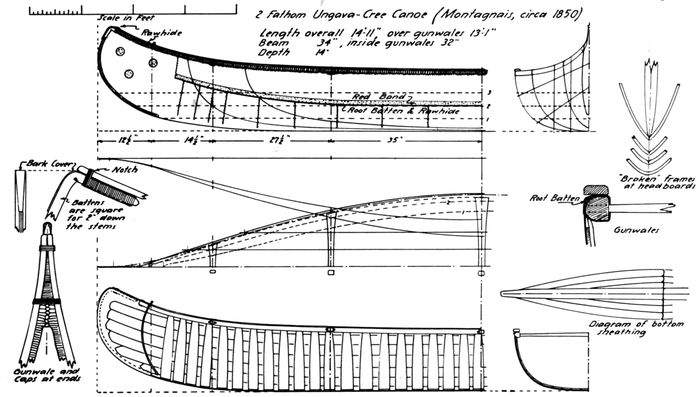
Figure 91
Montagnais 2-Fathom Canoe of Southern Labrador and Quebec, showing old decoration forms. Drawing based on small model of a narrow-bottom canoe built for fast paddling.
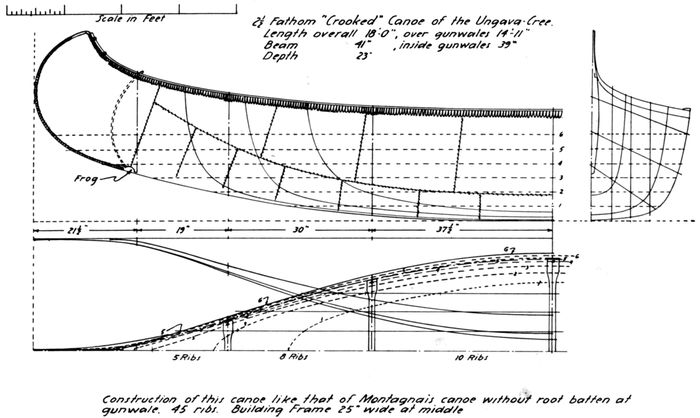
Figure 92
Crooked Canoe, 2½-Fathom, of the Ungava Peninsula, used by the Ungava-Cree, Montagnais, and Nascapee. Also built with a wide bottom and a slight tumble-home in the topsides.
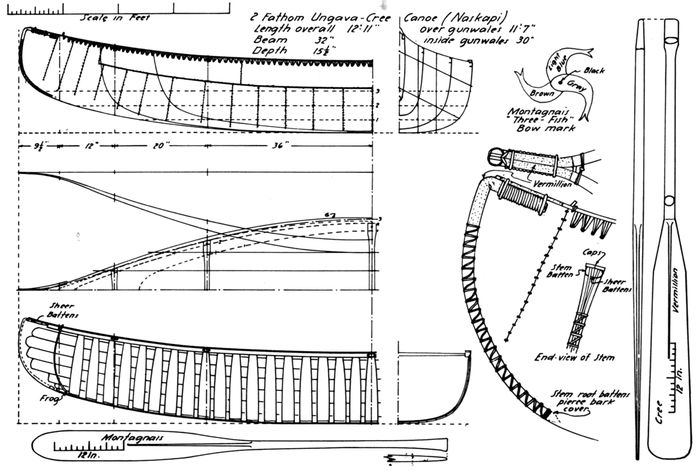
Figure 93
Hybrid Model of the Nascapee-Cree Canoe, 2-Fathom, built of spruce or birch bark, with details of canoes and paddles.
The ends were formed by means of the same technique used for Micmac canoes; no inside stem-piece was employed and the bark cover was stiffened by outside battens covered by the lashing. In the Cree canoes, however, the stem battens were "broken" sharply at the sheer to form a slightly rounded peak where the end met the gunwale caps. The "break" in the battens was made by bending them very sharply, so that they were almost fractured. The Cree practice also differed from that of the Micmac, although not universally, by passing the lower end of the stem batten through the bark cover at the point where the stem met the bottom. The slit thus made was sealed with gum or, more recently, covered with cloth impregnated with gum. The stems were lashed in various ways; the most common was a spiral form up to the sheer. Near the gunwale caps crossed stitches or small, closely spaced wrappings were also employed. The tops of the battens, forming the peak of the stem, were brought along under the rail caps, in line with the gunwale lashings inboard, and secured with a continuous lashing for about 6 inches. In the northern parts of the area under discussion the stem lashing was often of rawhide.
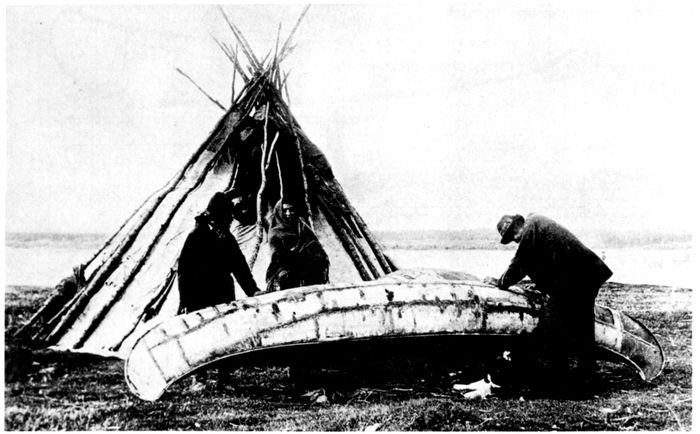
Figure 94
Eastern Cree Crooked Canoe of rather moderate sheer and rocker. (Canadian Pacific Railway Company photo.)
Gunwale caps were wider than the gunwales and thus gave some protection to the lashing there. The ends of the gunwale caps were heavily tapered to allow the sharp bends necessary to carry them out on the stems. They were pegged or nailed to the gunwales, but at the ends were lashed; usually with two or three small group lashings over and under the stem battens, below the caps.
The most recent canoes had canvas covers instead of bark. Nails, tacks, and twine for sewing were used; otherwise they were built as the Indians built birch- and spruce-bark craft, and not as white men built canvas canoes and boats.
The framework of the canoes was usually spruce or larch. Toward the south and along the St. Lawrence some white cedar was used, and in the south maple was sometimes used for thwarts. The ribs of the canoes inspected by Adney were usually about 3 inches wide, and a short taper brought them to about 2 inches at the ends, where they were cut square across. They were spaced about 1 inch apart edge-to-edge amidships and somewhat further apart toward the ends of the canoe. The canoes usually had an odd number of ribs, as the first was placed under the thwart amidships. The last three ribs at the ends were "broken" at the centerline to allow them to take the necessary V-section there; but the fourth rib from each end was only sharply bent. In some canoes the heel of the very narrow headboard was stepped on the sheathing against the endmost rib, in others it was stepped, as in the Micmac canoes, on a frog which rested against the endmost rib.
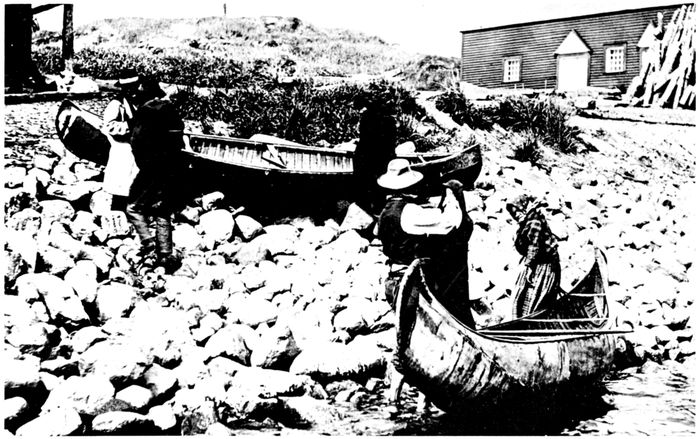
Figure 95
Straight and Crooked Canoes, Eastern Cree.
In more recent times the sheathing was laid in one of two ways, according to the preference of the builder, but the existence of the two styles suggests that each was once a tribal-group method. One method of shaping the bottom sheathing was to employ a center, or keelson, piece in two lengths, the butts being overlapped amidships, parallel-sided except toward the stems, where it was tapered to fit the V-sections rather closely. The next strake outboard was short and was in the form of a shallow triangle with its base along the middle portion of the first strakes and about one-third the length of the bottom. Its apex was under the middle thwart. The next strake outboard was in two lengths lapped amidships, parallel sided along the arms of the triangular strake, and snied off at the ends to fit along the sides of the first strake. Another strake outboard of this was similar in form and position, but longer. Thus seven strake widths would complete the bottom sheathing. The side sheathing was narrow and slightly tapered; each strake in two lengths overlapped slightly amidships. The ends of the topside sheathing ran well into the ends, in most canoes, where they apparently served as stiffening. The second method of sheathing employed parallel-sided strakes throughout, laid side by side on the bottom, with the ends snied off to fit the form of the bark bottom. The existence of a model canoe made about 1850 (see p. 91) supports the theory that the first method was originally the Montagnais tribal construction and that the more primitive second method was probably Cree or Nascapee.
The ribs were preformed and fitted to the canoe after drying out. They were bent to the desired shape in pairs and tied with a thong across the ends to hold their shape while drying. Some builders inserted a strut inside the bent ribs, parallel to the thong, protecting the surface of the inner rib by a pad of bark placed under each end of the strut. The pair of ribs might also be wrapped with a bark cord to help hold them together. To aid in handling, one pair of ribs might be nested inside another. As in eastern canoes the ribs under the gunwales were driven into place. At the ends they were canted toward the center, so that in the straight-bottom models they stood nearly perpendicular to the rocker of the bottom there; in the crooked canoe the ribs were all somewhat canted in this manner.
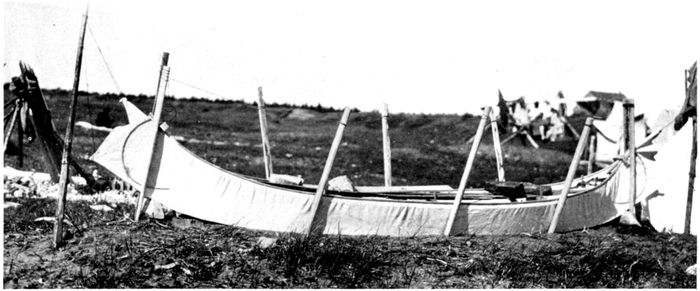
Figure 96
Montagnais Canvas-Covered Crooked Canoe under construction. (Canadian Geological Survey photo.)
The paddles used in this area were made with parallel-sided blades, the end of the blade being almost circular. The handle might be fitted with a wide grip at the head or it might be pole-ended. It is impossible to say how early sails were used to propel canoes, but it is probable they were introduced by the fur traders. Square sails were being used on the coastal canoes at the time the earliest reference was made to these canoes, in the 1870's.
Little is known about the decorations employed by the eastern Cree. The Montagnais birch-bark model canoe of about 1850 (see p. 91) has three small circles placed in a triangular position on the bow and a band along the bottom of the side panels. The circles and the bands are in red paint, but may have been intended to represent the dark inner rind left after scraping the winter bark cover. The use of decoration in this area after 1850 has not been noted in any available reference.
As a rule, the straight-bottom canoes were small, commonly between 12 and 18 feet overall, and the most popular size was 14 to 16 feet overall. A canoe of this size was usually employed as a hunters' canoe for forest travel, though it might be used occasionally along the coasts. These canoes were light and, in this respect, resembled the Micmac models shown in Chapter 4.
The original purpose of the crooked canoe is in question. Those travelers who saw this canoe in use on the Hudson Bay side of the Labrador Peninsula believed that it was designed for use in rough, exposed water. While it would be a desirable form for beach work in surf, the high ends would make paddling against strong winds very difficult. On the other hand the Montagnais used the crooked canoe for river navigation, particularly where rapids were to be run, and for this work it appears to have been well adapted. The crooked canoe was commonly built larger than the straight-bottom model, between 16 and 20 feet in length overall, and was a vessel of burden rather than a hunting canoe. Canoes up to 28 feet in length have been mentioned by travelers in this area but investigation indicates strongly that these were not the tribal form but the canot du nord, or north canoe of the Hudson's Bay Company traders.
Along the southern borders of their territory and to the westward the eastern Cree often built and used canoes modeled on those of their neighbors, the Têtes de Boule and the Ojibway. Hence the tribal classification does not hold good in these localities. Also, the eastern Cree were employed by the Hudson's Bay Company as builders of forms of the maître canot and canot du nord that are unlike their typical tribal model.
Têtes de Boule
The Têtes de Boule, particularly the western bands, were skilled canoe builders and had long been employed by the Hudson's Bay Company in the construction of large fur-trade canoes. Apparently made up of bands of Indians inhabiting lower Quebec, in the basin of the St. Maurice River and on the Height of Land, these bands had come down to the lower Ottawa River to trade with the local Algonkin tribe there in early times. They were known to the Algonkins, who had had some contact with civilization, as "wild Indians." They also came into close trading relations with the French colonists, as the Ottawa River was the early French canoe route between Montreal and Lake Superior. Because they cut their hair short, unlike the other Indians, these northern bands were nicknamed "Bull Heads," or "Round Heads," by the French traders, and the tribesmen soon came to accept this rather than their own designation of "White Fish People" as the tribal name. In more recent times, the name has been applied to groups of Indians living in western Quebec Province, near Lake Barrière and Grand Lake Victoria, but these do not consider themselves related to the St. Maurice bands.
It seems apparent that the canoe models of all these groups had been altered as a result of long contact with other tribal groups. Although the St. Maurice and the western bands were apparently not of the same tribal stock, their relations with the Algonkin may have brought about the use of a standard model by all.
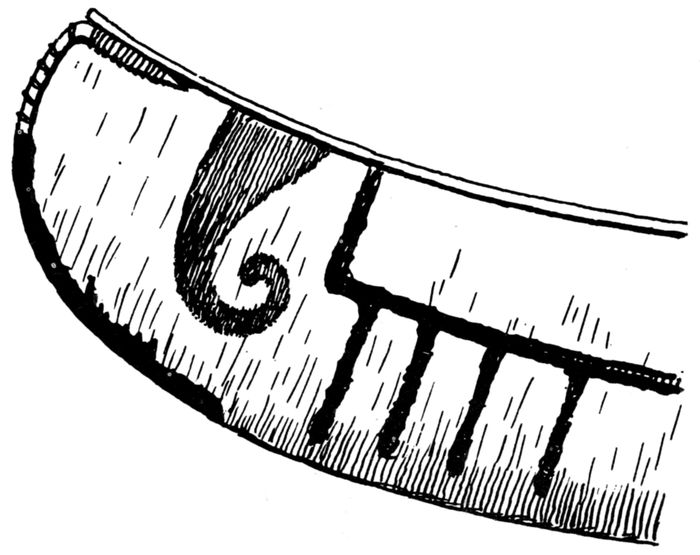
Figure 97
Fiddlehead of Scraped Bark on bow and stern of a Montagnais birch-bark canoe at Seven Islands, Que., 1915.
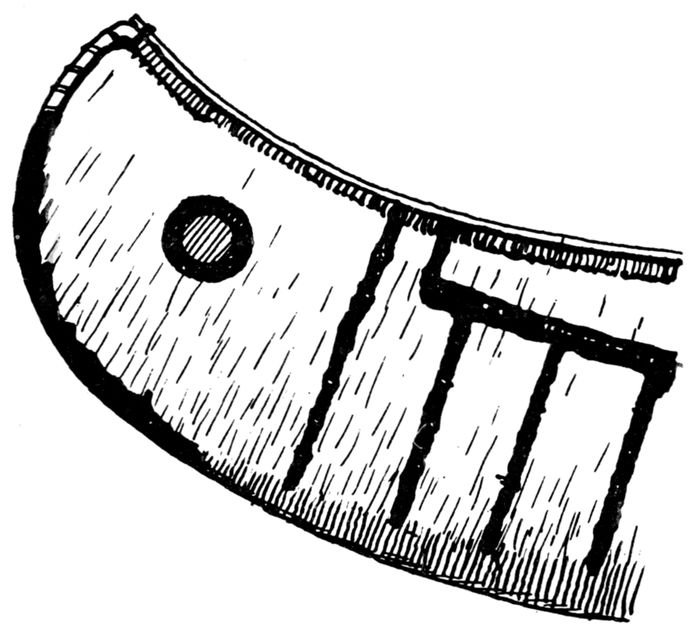
Figure 98
Disk of Colored Porcupine Quills decorating canoe found at Namaquagon, Que., 1898. Within the 4-inch disk may have been an 8-pointed star.
The Têtes de Boule lived in an area where very superior materials for birch-bark canoe construction were plentiful. This, with the need for canoes imposed by the numerous waterways and the demand for canoes from white traders, made many of the tribesmen expert builders. Their small canoes, ranging from the 8-to 12-foot hunter's canoes to the 14-to 16-foot family canoes, were very similar in profile to the canoes of the St. Francis Abnaki. The Têtes de Boule canoes, however, were commonly narrower on the bottom, and in their construction a building frame was always used. The Têtes de Boule model was straight along the bottom for better than half the length and then rose rather quickly toward the ends. Similarly, the sheer was moderate amidships and increased toward the ends. The stems showed a chin and were much peaked at the gunwale ends. Most commonly the midsection had a flat bottom athwartships and a well-rounded bilge, giving the topsides, near the gunwale, a very slight outward flare. Some Têtes de Boule canoes had rather V-section ends in which the endmost rib was "broken" at the centerline. As a result the lines were sharp and the canoes paddled very easily.
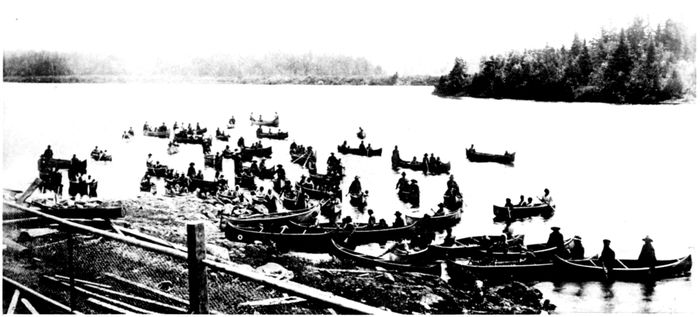
Figure 99
A Fleet of 51 Birch-Bark Canoes of the Têtes de Boule Indians, assembled at the Hudson's Bay Company post, Grand Lake Victoria, Procession Sunday, August 1895. (Photo, Post-Factor L. A. Christopherson.)
For construction of the Têtes de Boule canoe, which was marked by good structural design and neat workmanship, the building bed was slightly raised at midlength, as was the general practice of the St. Francis builders. The building frame was usually about 6 inches less in width amidships, inside to inside, than were the gunwales, and from 15 to 18 inches shorter. The building frame was made quite sharp toward the ends so that, viewed from above, it rather approached a diamond form; this produced the very sharp lines that are to be seen in many examples of the Têtes de Boule canoes. The building frame was of course removed from the canoe as soon as the gunwales were in place and the bark cover lashed to them.
The gunwale structure, comprised of main gunwale members, caps, and outwales, was the same as in the Malecite canoes. The main gunwales were rectangular in cross-section, some being almost square, with the lower outboard corner bevelled off. Compared to those of eastern canoes of equal length, the main gunwales were unusually light; their depth and width rarely exceeded 1 inch, and in very small hunter's canoes these were often only about ¾ inch. Toward the ends, they tapered to ½ inch, or even slightly less. The ends of the main gunwales, usually of the common half-arrowhead form, were held together by rawhide or root thongs passed back and forth through horizontal holes in the members. After being thus lashed together, they were securely wrapped with thongs which usually went over gunwales and outwales and through the bark cover.
The gunwale caps, also light, were usually between ¼ and ½ inch thick and from 1 to 1½ inches wide. At the ends they were tapered in width and thickness, often to 3⁄16 by ½ inch, so as to follow the quickly rising sheer there. The ends of the gunwales, caps, and outwales required hot-water treatment to obtain the required curve of the sheer. The caps were pegged to the gunwales and were secured at each end with two or three groups of lashings which passed around the outwales as well, and through the bark cover.
The outwales were likewise light battens between ¼ and ½ inch thick and from ¾ to 1¼ inches deep, the depth near the ends being tapered to ⅜ to ¾ inch so as to sheer correctly.
The bark cover had four or five vertical gores on each side of the middle thwart, the gore nearest each stem being commonly well inboard of the end thwarts. The side panels were usually deep amidships and narrowed toward the ends. A root batten was used under the stitching of the longitudinal seams of the side panels, which were sewn with a harness-maker's stitch. The top edge of the bark cover was brought over the top of the main gunwales, as in the Malecite canoes, and was secured by group wrappings passing over the gunwales and outwales, under the caps. These groups were not independent, the root thong being carried from group to group outside the bark in a long pass under the outwales. The groups of seven to nine turns were roughly an inch apart in many small canoes, and perhaps 1½ inches in the large craft. In the last birch-bark canoes in which no nails or tacks were used, wrappings of root thongs began with a stop knot, but this does not appear to have been the earlier practice.
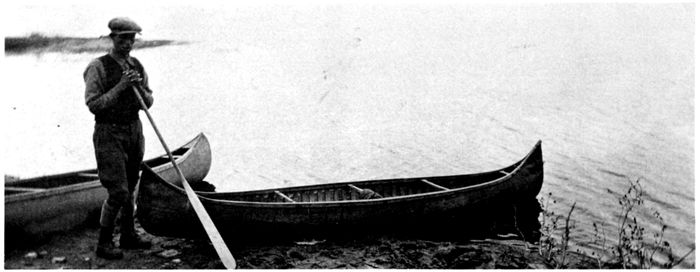
Figure 100
Têtes de Boule Canoe.
The Têtes de Boule canoes had inside stem-pieces split, according to the size of the canoe, in four to six laminations and lashed with a bark or root thong in an open spiral in some canoes but close-wrapped in others. The stem-piece was as in the Malecite canoes, except that it ended under the rail cap, and did not pass through it as in the Eastern canoes; the heel was notched to receive the heel of the headboard. The bark was usually lashed through the stem, as in the Malecite construction. However, in some Têtes de Boule canoes, the stem close to the heel was not laminated and the bark was lashed to the solid part by an in-and-out stitch passing through closely spaced holes drilled in the stem piece. Above this, the lashing was the usual spiral which, in at least a few instances, was passed through the bark just inboard of the stem piece. Near the top of the stem the lashings sometimes were rather widely spaced and passed inboard of the stem-pieces; at other times, however, these lashings were more closely spaced and passed through the stem.
Ordinarily, at the ends of the canoe no wulegessis, or covers of bark, were used under the gunwale caps, although in one example examined a small cover had been inserted over the gunwale ends and under the caps, it did not extend below the outwales to form a wulegessis. In some canoes the bark cover was pieced up at the peak of the stems by a panel whose bottom faired into the bottom of the side panels.
A variety of methods was used to fit the gunwale caps at the ends of the canoe. Some builders carried the cap out beyond the gunwale ends, flat, over the edges of the bark cover and the top face of the outwale, but others tilted the cap outboard and downward. The ends of the caps came flush with the face of the stems. In an apparently late variation, the gunwales, instead of ending in the half-arrowhead, were snied off the inside and a triangular block was inserted between the ends. The gunwales were then pegged or nailed to the block and the whole secured with a root wrapping around them, before the outwales were in place. The first turn began by passing the root through a hole in the block near its inboard end, with a stop knot in the root.
The ends of the gunwales were supported by a narrow headboard sharply bellied toward the end of the canoe. The top of the headboard was notched to stand under the main gunwales; the center portion often was carried high and ended with a cylindrical top that was slightly swelled like the handle of a gouge or chisel. The heel was sometimes held in the stem-piece notch with a root lashing.
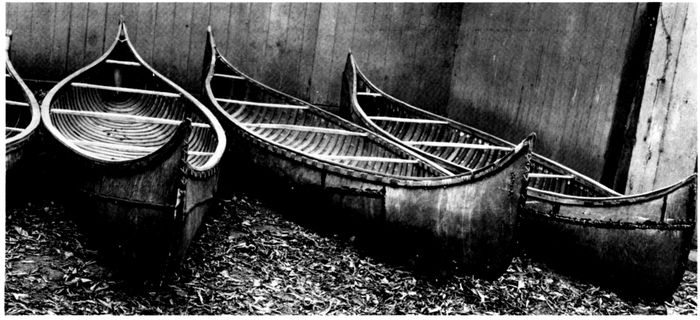
Figure 101
Têtes de Boule Canoes.
The thwarts, spaced equal distances apart, were tenoned into the gunwales as in the old Malecite canoes, and were secured with a peg and lashing through the two holes in the thwart ends. The middle thwart was usually formed with a shoulder, viewed in plan, that started 6 or 7 inches inboard of the inside face of the main gunwale. In form, this thwart usually swelled outward in a straight line from the tenon shoulder, then reduced in a curved line to about the width of the tenon tongue and, finally, increased again in a right-angle cut to the greatest width. From here it was reduced again in a long curve to the canoe's center line. The other thwarts usually had simple ends, wide at the tenon shoulder and reduced in a long curve to a narrow center. In elevation, all the thwarts were thin outboard and thick at the centerline of the canoe. The cross section of the center thwart at the centerline was square or nearly so, the first thwart on each side was rectangular in cross section at the center, and the end thwarts were similar, but very thin.
The sheathing of the Têtes de Boule canoes was thin, particularly at the ends of the strakes. The bottom was laid with a parallel-sided center strake going in first. This strake was in two lengths in a small canoe and three lengths in a large, the butts overlapping slightly. The rest of the strakes in the bottom were tapered toward the ends of the canoe. At the extremities of the canoe, the narrow ends of the strakes were very thin and overlapped along their edges, the bottom sheathing, when in place, thus following the diamond form of the building frame. The topside sheathing was laid up in short lengths with overlapping butts and edges in an irregular plan, those strakes along the bilges being longer than above. Toward the ends of the canoe these strakes were slightly tapered and the edges were very thin. The sheathing ended irregularly, outboard of the headboards, in narrow butts as in most eastern canoes.
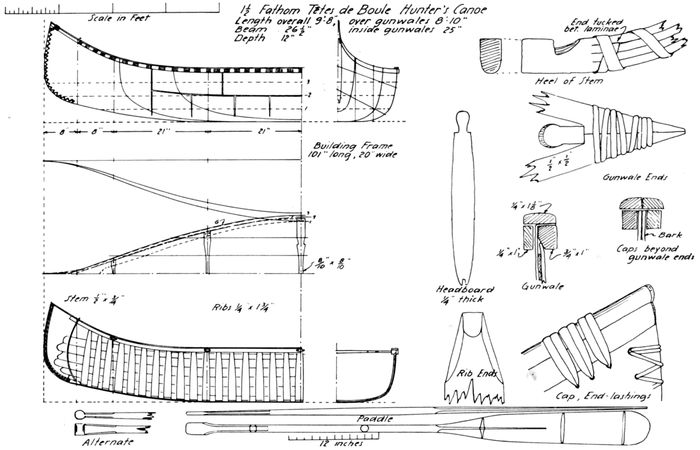
Figure 102
Têtes de Boule Hunting Canoe, 1½-Fathom, with typical construction details and a paddle.
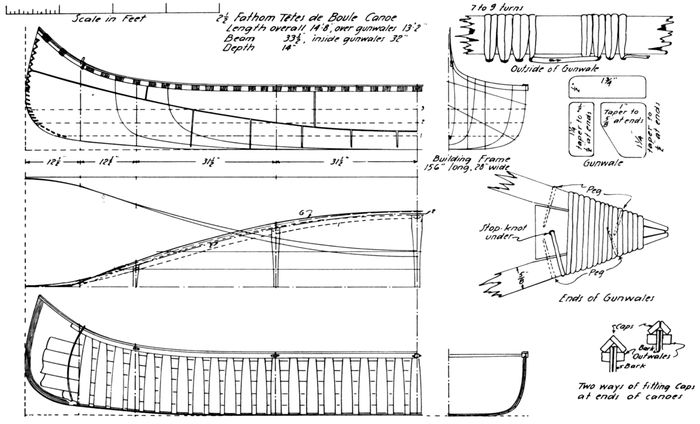
Figure 103
Têtes de Boule Canoe, 2½-Fathom, with some construction details.
The ribs, like the rest of the structure, were very light, usually ¼ to ⅜ inch thick and from about 1¼ to 1¾ inches wide, depending upon the size of the canoe. A few examples had ribs 2 inches wide, and still fewer had ribs up to 2½ inches wide. The spacing was usually close, somewhat more than an inch edge to edge amidships and a little more between the end thwarts and the headboards. The spacing amidships would average perhaps 3¼ inches, center to center. The ends of the ribs, in the last 2 or 3 inches, were reduced in width very sharply in a hollow, curved taper to ½ to ¾ inch wide, and were usually beveled on the inside edge. The thickness was also reduced by a cut on the inside, so that the ends were chisel-pointed with a short bevel on the inboard side. The rib ends were forced between the main gunwales and the bark cover, coming home in the bevel of the lower outboard edge of the main gunwales between the group lashings of the bark cover as in the Malecite canoes. The ribs were not prebent but were placed in the canoe when green, treated with hot water, and then allowed to dry into place. In preparing the rib, it was first bent over the knee. It was the custom of some builders to place under the building frame the ribs that were to go near the ends of the canoe, and to mark the point where they would be bent. Sometimes the endmost ribs that were to be "broken" at the centerline to form the V-section were split edgewise. A piece of the inner lamina was then cut out to one side of the center so that the inner laminae would lie flat against each other, and to prevent the inner half from buckling the rib was wrapped with a thong to one side of the "break."
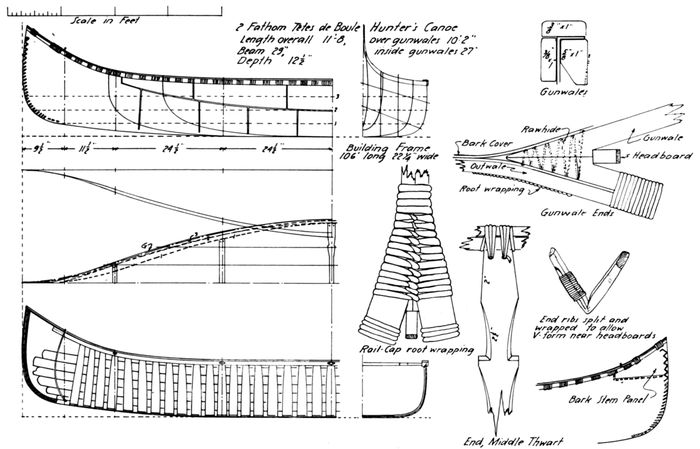
Figure 104
Têtes de Boule Hunting Canoe, 2-Fathom, with wide bottom, showing structural details.
It does not appear to have been the common practice of the Têtes de Boule to decorate their small canoes, though when building for white men they would decorate if the buyer requested it.
The paddles used by the Têtes de Boule were somewhat like those of the eastern Cree but the blade was slightly wider near the tip than near the handle. The top grip was formed wide and thin, the taper from the lower grip to the upper one often being very long. The paddles were usually of white birch, but maple was used in a few of the examples examined.
The gunwales, outwales, and caps of the Têtes de Boule canoes were usually of spruce; the ribs and stem pieces, white cedar; the thwarts, white birch; the headboards, white cedar in all but one of the canoes inspected (in this, birch had been used). Jack pine was used also for thwarts, and cedar was sometimes used for the gunwale members; as would be expected, the builders used the materials that were at hand near the building sites.
Têtes de Boule fur-trade canoes, like those of the eastern Cree, appear to have had no relationship to the smaller tribal types, since they were constructed under supervision of white men. They will be discussed as a group on page 135.
Algonkin
The Algonkins were a tribe residing on the Ottawa River and its tributaries, in what are now the provinces of Quebec and Ontario, when the French first met them. They appear to have been a large and powerful tribe and were apparently competent builders and users of birch-bark canoes. They were not the same tribe as the Ottawa, who controlled the Lake Huron end of the canoe route between Montreal and Lake Superior, by way of the Ottawa River. These Ottawa were related to the Ojibway tribe and received their name from the French, who gave the name Outaouais, or "Ottaway," to all Indians, except the Hurons, who came from the west by way of the Ottawa. The Algonkins, because of their location, were much influenced by the French fur trade. Early in the 18th century they intermingled with certain Iroquois whom they allowed to settle with them, near Montreal, at the Lake of Two Mountains, later Oka. Thence they gradually spread out and lost tribal unity, until only small groups were left. These lived on the Golden Lake Algonkin Reserve, Bonshere River, Ontario; at Oka, Quebec; and elsewhere in western Quebec and eastern Ontario. It is possible that they were the first to build fur-trade canoes for the French, but evidence to support such a claim with any certainty is lacking.
Due to intermixing with other tribal groups and to the influence of the fur trade, in which they were long employed as canoe men and builders, the Algonkins no longer used a single tribal model of canoe. However, one of their models, which had high ends resembling those of the large fur-trade canoe, may have been the tribal type from which the fur-trade canoe was developed, as will be seen.
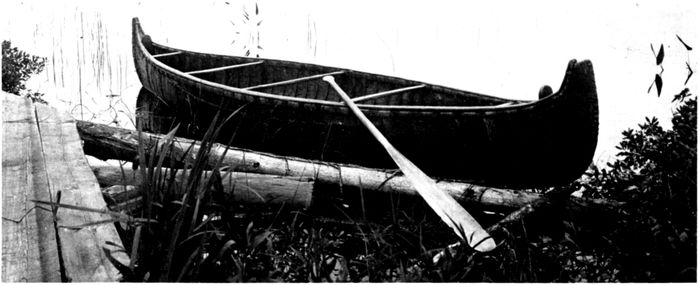
Figure 105
Old Algonkin Canoe.
The high-ended model, the oldest form known to have been used by this tribe, was narrow-bottomed, with flaring sides. The canoes seen were built with careful workmanship and in the old manner, without iron fastenings. They were light and easily paddled, yet would carry a heavy load. The ends were sharp at the line of flotation. The bottom was straight to a point near the ends, where it lifted somewhat. The sheer was rather straight over the middle portion of the canoe, then lifted slightly until close to the stem, where it rose sharply, becoming almost perpendicular at the ends of the rail caps. The midsection was slightly rounded across the bottom, with a well-rounded bilge and a gently flaring topside. The cross-section became V-shaped close to the headboards. The most marked feature in the appearance of this canoe was the profile of the ends. The stem line, beginning with a slight angle where it joined the bottom, bent outward in a gentle curve, reaching the perpendicular at a point a little more than half the height of the end, and from there it tumbled home slightly. In most of the canoes examined the top of the stem then rounded inboard in a quick, hard curve, usually almost half a circle, so that the stem was turned downward as it joined the outwale and gunwale cap. In a variation of this stem form, the top of the stem was cut off almost square, forming a straight line that ran parallel to the rise of the bottom below the stems to the point where it would meet the upturned outwale and cap. The ends of the outwales and caps were thus 3 or 4 inches inboard of the extremities. This form of stem, particularly when to top was rounded in a half-circle, approached the basic form of the ends of the fur-trade canoe.
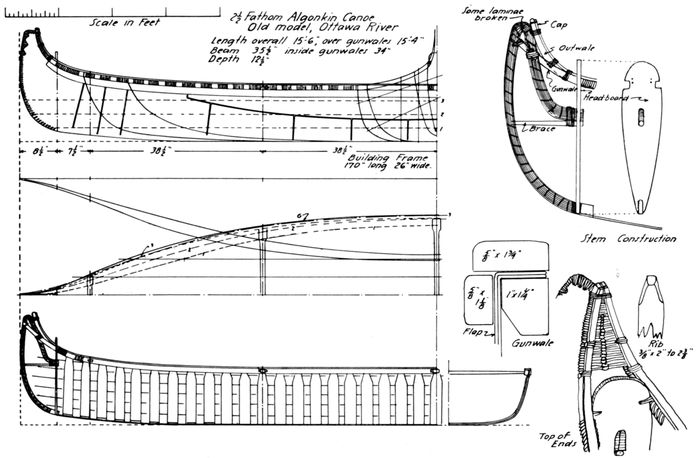
Figure 106
Old Model, Ottawa River, Algonkin Canoe, combining capacity with easy paddling qualities.
All the examples of this form of canoe that were examined were small, from 14 to a little over 16 feet in length overall, but this is not proof that larger canoes of this type had not existed earlier.
The later and more common form of Algonkin canoe was the wabinaki chiman. A corruption of Abnaki, wabinaki to the later Algonkin meant the Malecite as well as the St. Francis Indians. The wabinaki chiman was built in lengths from 12 to 18 feet.
Iroquois living in the Algonkin territory during the period built this form of canoe as well as the older, high-ended form. The wabinaki chiman was very much like the St. Francis and Malecite canoes in appearance, but it was not an exact copy. The Algonkin version was commonly a narrow-bottom canoe with flaring topsides. There was some variation in the end profiles; most had the rather high, peaked ends of the St. Francis canoe. The sheer was rather straight until near the end, where it rose rapidly to the stem. The stem was rounded and was faired into the bottom. The top of the stem was often rather straight and tumbled home slightly, but on some it raked outward, much as did the stem of some Malecite canoes.
Another form of Algonkin canoe had a low sheer with only a slight lift toward the ends. In this canoe the stem might have a short, hard curve at the heel and an upper portion that was quite straight and slightly tumbled home; or the full height might be well rounded, with a slight tumble-home near the stem head.
In appearance these canoes were very like the straight-stem Malecite models. The wabinaki chiman was unquestionably copied from the eastern canoes that came into popularity among the Algonkin late in the 19th century, when white sportsmen were demanding canoes of the St. Francis and Malecite models. However, the Algonkin canoes differed somewhat from the eastern canoes not only in model but also in methods of construction.
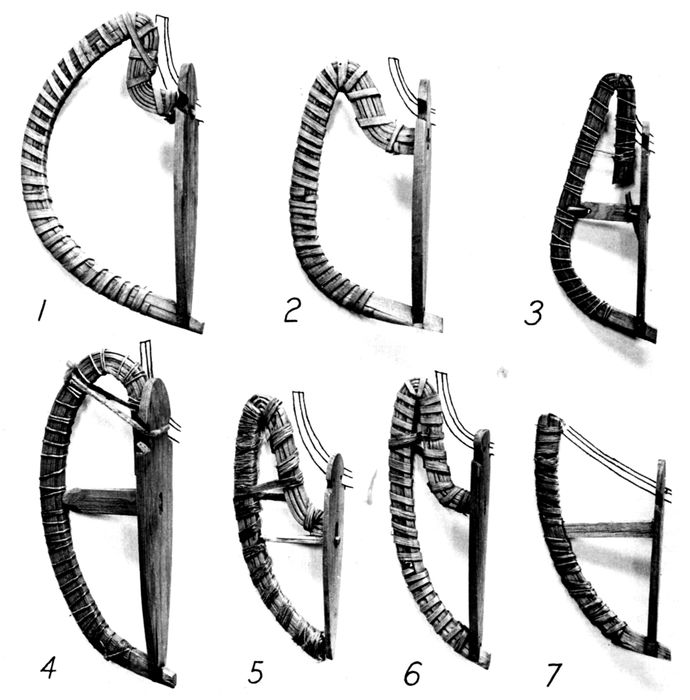
Figure 107
Algonkin and Ojibway Stem-Pieces, models of old forms made by Adney: 1, 2, 3, Ojibway; 4, 5, 6, 7, Algonkin.
Algonkins used the same construction methods in both their canoe models, though the framework was not alike in all respects. The building frame was always used. For a 2-or 2½-fathom canoe this was made of two strips of cedar, 1½ inches wide and ¾ inch deep, that were bent edgewise, notched, and tied together at the ends with thongs of the inner bark of the basswood. These strips were held apart in the required shape by cedar crosspieces 1 inch wide and 1¾ inches deep, with the ends notched ¾ inch deep (the depth of the longitudinals) and the tops well rounded. The crosspieces, five in all, were fastened to the longitudinals with thongs passing through holes in the ends. The middle one was about 19½ inches between the inside faces of the longitudinals, those on each side of it were about 15½ inches long by similar measure, and the end ones were nearly 6 inches long and were located a foot or so from the extremities of the longitudinals. The outside width of the building frame amidships would thus be about 22½ or 23 inches.
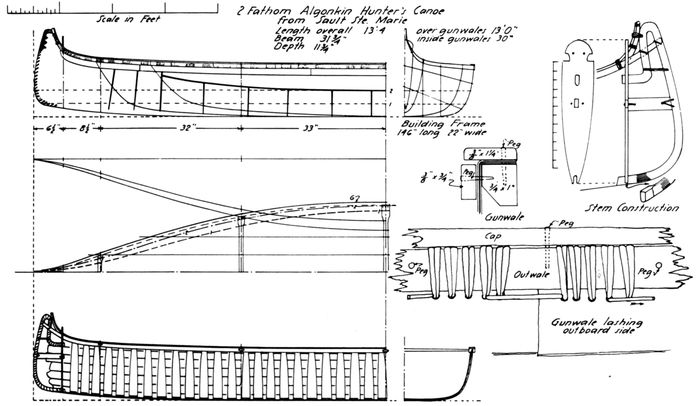
Figure 108
Light, Fast 2-Fathom Hunting Canoe of the old Algonkin model.
The building bed was level, with a 6-inch-wide board, some 6 to 8 feet in length, sunk into the earth flush with the surface to insure a true line for the bottom. The outside stakes were of the usual sort described in building the Malecite canoe (pp. 40-41). The wedge-shaped inside stakes, or clamp pieces, were 1½ inches wide, 1 inch thick, and 20 to 25 inches long. The posts for setting the height of the gunwales at the ends and at the crosspieces were not cut off square at the top as for the Malecite canoe, but were notched on the outside to take the gunwales. The heights of the posts were graduated, of course, to form the required sheer in the gunwales. Like the canoes of the Têtes de Boule, these of the Algonkin were generally less deep amidships than the general run of eastern canoes.
Building procedure was as follows: The gunwales were made, bent, and the ends fastened, but instead of being mortised and fitted with thwarts, they were spread by temporary crosspieces, or "spalls," made of a splint, or plank-on-edge, with the lower edge notched in two places to take the gunwale members. Sometimes the spalls were lashed, pegged or nailed to the gunwales as well. The stakes were set along the building frame and these were generally driven sloping, so that their heads stood outboard of the points. They were then pulled and laid aside, the building frame was removed, and the bark cover placed on the building bed. After the building frame has been reset in its original position and the bark cover turned up along the sides, the stakes were again driven in their holes. The cover was then pieced out with side panels as necessary and gored, and longitudinal strips of wood were set in place by means of the clamp pieces, about as in Malecite construction. The gunwales were then placed on the posts, which had been set to the required sheer, and the bark trimmed and fitted to them. The old method was to lash the bark to the main gunwale members and to peg on the outwales at intervals of about a foot. In earlier times most builders inserted along the gunwales an extra reinforcing strip of bark extending a little below the outwales, as in the St. Francis canoes, but in the nailed-and-tacked bark canoes built during the decadent period this was sometimes omitted.
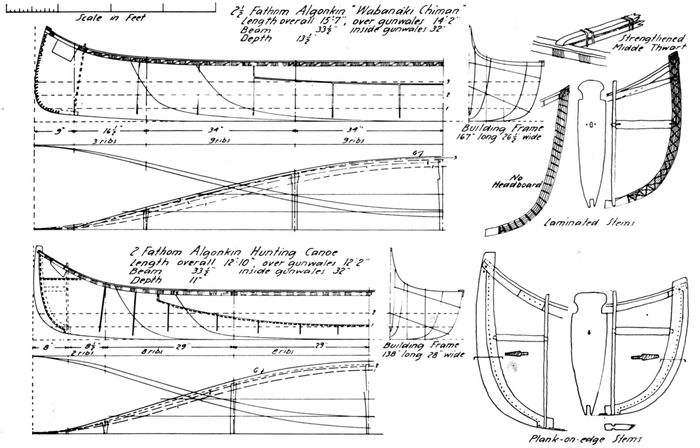
Figure 109
Hybrid Algonkin Canoes: Eastern 2½ fathom (above) and northeastern 2-fathom adaptation, with sketches of stems used in each.
Mortises for the thwarts were next cut and the middle thwart was forced into place, after the spall there had been removed. This required that the gunwales be spread slightly, thus increasing the amount of sheer somewhat. Much judgment was needed to do this correctly. The increase in the sheer lifted the ends slightly and put some rocker in the bottom toward the ends. The building frame was lifted out before the rest of the thwarts were placed; usually it was taken apart in the process. In forming the ends of the bark cover, the two sides were held together by a clothespin-like device made of two short, flat sticks lashed together.
Increasing the beam at the gunwales by fitting the thwarts after the bark cover had been secured to the gunwales not only increased the sheer but decreased the depth of the canoe amidships as established by the posts placed under the gunwales in setting up. In order to retain the required sheer and the desired depth of side, the gunwales had been sheered up at the ends while being shaped, and had also been treated with hot water and hogged upward amidships by being staked out to dry into shape. The spreading of the gunwales tended to lift the ends of the bottom line, a condition that was controlled in two ways: the usual one apparently was to employ, in combination with a level bed, a building frame slightly wider than was desired for the finished bottom; the second way was to follow Malecite procedure and elevate slightly the middle of the building bed while employing a building frame the width of the finished bottom. The Algonkin procedure of spreading the gunwales during construction was that employed in the northwest and in the building of the fur-trade canoes, as will be seen. The amount of spread to be given the gunwales also affected the angle, or slope, at which the side stakes were driven on the building bed. Even so, some builders who spread the gunwales a good deal would set the stakes almost vertically, instead of at a slant, as this made sewing the side panels easier, particularly in large canoes and in canoes whose covers were made up of a large number of small pieces of bark.
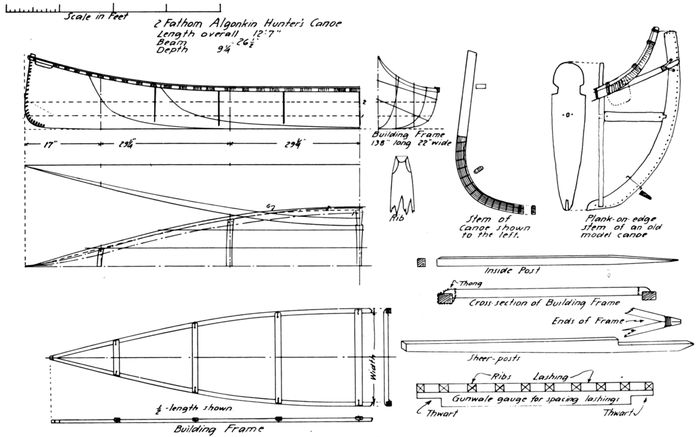
Figure 110
Algonkin, 2-Fathom Hunter's Canoe, without headboards. Details of building frame, stakes or posts, gauge, and stem.
The gunwales of the Algonkin canoes were made up of three members—main gunwales, outwales, and caps. The main gunwales, usually of cedar, were rectangular in cross section and bent on the flat. The lower outboard corner was bevelled off to take the rib ends, as in the Malecite canoes. The gunwales were rather light ranging in the examples found from about 1 inch square to 1 by 1⅝ inches, the ends being tapered to a lesser size. The outwales were light battens, rectangular in cross-section, about as deep as the main gunwales and about two-thirds their thickness or less; they tapered in depth toward the ends to ⅜ or ½ inch in order to follow the sheer, while the thickness might be constant or only slightly reduced. The caps, which were pegged to the gunwales, were also light and were about equal to the combined width of the main gunwales and outwales and had a depth of about ⅜ to ½ inch amidships. At the ends they were tapered in both width and depth, becoming ½ inch wide and ⅜ inch deep. The amount of taper in the ends of the gunwale members depended upon the form of sheer; the Algonkin practice in the old form of canoe was to sheer the outwales and caps to the top of the stem, while the gunwales sheered less and met the sides of the stem piece at a lower point, as in the drawing (p. 116). In the wabinaki chiman, however, the gunwales and other members, as a rule, all followed the sheer of the ends of the canoe.
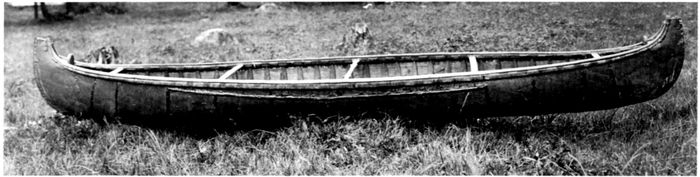
Figure 111
Algonkin Canoe, Old Type.
The Algonkins used inside stem-pieces in both models, but the stem-piece of the old high-ended canoe was quite different from that of the wabinaki chiman, for it was built to give a profile in which the top of the high stem ended in a line straight across to the sheer. The piece consisted of a crooked stick, without lamination, worked out of a thin board, ⅜ to ½ inch thick. It was shaped to the desired profile inside and out, and was slightly sharpened, or sometimes rabbeted and sharpened, toward the outboard face. The headboard was mounted on this stem-piece by means of the usual notch but was not bellied; instead it stood approximately vertical and a short strut was tenoned into both the headboard and the inside face of the stem at a point about half the height of the stem. Sometimes two struts were used, side by side, with the outboard ends lashed at the sides of the stem. Thus the stem-pieces and headboards were placed as a single unit, not independently as in eastern canoes. The gunwale ends were lashed to the sides of the stem-piece, between the strut and the stem-head, at a height determined by the sheering of the main gunwale members. The outwales and caps did not touch the stem-piece, ending with a nearly vertical upward sweep, a few inches inboard. The ends of the outwales and caps were always higher than the top of the stem-piece so that, when the canoe was turned upside down, the bark cover over the stem-head was kept off the ground and thus preserved from damage. The top of the stem-piece was held rigid not only by the strut to the headboard but also by the ends of the main gunwale members lashed to it a little higher up. The headboard was in the form of a rounded V that was widest at midheight, at the gunwales, which were let into its sides.
When the stem-head was rounded in the style of the fur-trade canoe, the stem-piece except near the heel was split into very thin laminations about 1⁄16 inch, or a little more, thick. The carefully selected cedar of which these were made was treated with boiling water, then bent to profile; the head was sharply bent over and down, inside the stem, then sharply up again so the end stood at about right angles to the face of the stem at midheight. The headboard was mounted as previously described, except that the end of the stem-piece was inserted into a hole in the headboard just above the strut. The laminations of the stem-piece were wrapped in the normal manner and the lashing was often brought around the strut as well, up against the outboard face of the headboard. The whole structure was thus made rigid and very strong. As in the other form, the main gunwale members did not follow the sheer near the ends of canoe but were secured at a point lower down on the sides of the stem-piece. In the round-head form, however, the outwale and cap ends were fastened on the after face of the stem-head where the laminations were curved downward as illustrated in the drawing (p. 116).
The headboards for both models were thicker than those in the eastern canoes; this aided in holding the stem line in form. Tension on the bark cover was obtained by making the cover V-formed toward the ends and then spreading the sides of the V with the headboard, thus bringing pressure on the strakes of the sheathing and forcing the sides outward in a slight curve.
The stem-pieces of the wabinaki chiman were either cut out of a thin board or laminated. In the straight-stem form, only the forefoot part was laminated, and no headboard was used. Ordinarily, however, the rigid headboard with a single strut was used. The head of the stem-piece was carried through the rail caps and showed above them; the ends of the caps and main gunwales were notched to permit this, but neither these nor the cap extended outboard of the face of the stem.
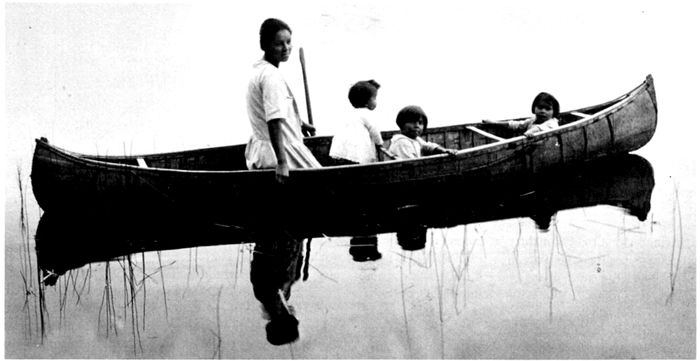
Figure 112
Algonkin "Wabinaki Chiman."
The bark cover was lashed to the gunwales with group lashings in which the thong was carried from group to group by a long stitch outside the cover, under the outwale. The turns in each group were passed through five or six holes in the cover and reinforcing piece, two turns of the thong going through each hole. The connecting stitch between groups, which were usually about 1½ inches apart, usually passed from the last hole in a group to the second hole in the next. Some builders laid a wooden measuring stick along the gunwales to space the lashings; this was perhaps the practice of many tribal groups.
The lashing of the ends of the cover was passed through the stem pieces; when the latter were not laminated, holes through the soft, thin cedar were made by a sharp awl and an in-and-out or harness stitch was quite commonly used. On laminated stem pieces the form of lashing varied; in the wabinaki chiman it was commonly some combination of spiral and crossed turns; in the old form of high-ended canoe multiple turns through a single hole (usually at the top of the stem-head) were also used in combination with closely spaced long-and-short turns in triangular groups near the top of the stem profile. Below, in the forefoot, spiral or crossed stitches were used. The ends of the outwales were lashed together with a close wrapping of turns in contact where they turned upward sharply, and the caps were secured there by two or more group lashings. The head of the headboard was lashed to each gunwale by passing the thong through holes each side of the headboard; these lashings were in a long group and were passed around gunwale and outwale before the caps were in place. With plank stem-pieces the ends of the bark cover were slightly inboard of the cutwater line, sometimes protected by a rabbet.
The side panels were sewn on with in-and-out stitches, back stitches, or a double line of either. The gores were sewn spirally in the usual manner or were stitched with a closely spaced lacing.
Some of the old Algonkin canoes examined had what appeared to be a wulegessis just outboard of the headboards. No marking was found on these and they were too far aft to protect the ends of the gunwales. The bark was carried across the gunwales, under the caps, and hung down a little below the outwales. On top, it reached from the headboard out to the lashings of the outwales, forming between the headboards and the lashings a short deck that may have been intended to keep dirt and water out of the ends of the canoe. Sometimes a modern wabinaki chiman has a wulegessis, copying the Eastern practice but without markings.
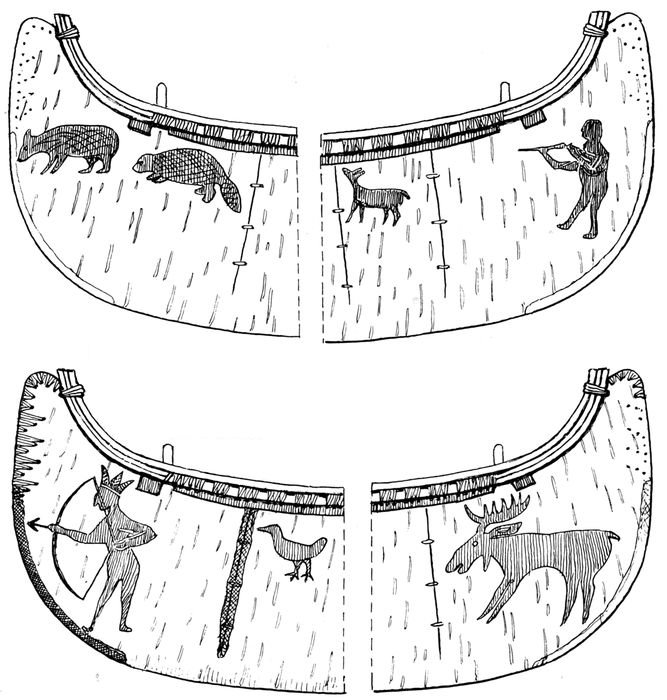
Figure 113
Algonkin Canoe Decorations by Tommy Sersin (or Serzia), Golden Lake, Ont., showing four sides of stems of one canoe. Indian shown has the eastern headdress rather than that of the Plains Indian. Moose, bear, beaver, and goose are shown. (Sketches by Adney.)
The thwarts were of various designs; a common one had parallel sides in plan. The old canoes had thwarts much like those of the Têtes de Boule. The end lashings of these were usually passed through three holes in the thwart ends, but some had only two holes.
Sheathing was laid somewhat as in the Têtes-de-Boule canoe, with overlapping edges and butts. The end sheathing was short and was laid first; the centerline strake was parallel-sided to a point near the sharp end of the canoe. The strakes on each side of it were tapered and were laid with their wide ends toward the middle of the canoe and with the sides and narrow end lapped. In the middle of the canoe the strakes were parallel-sided and their butts were on top of those of the strakes in the end of the canoe. The sheathing was carried up to within about three inches of the gunwales. The edges were not thinned or feathered as much as were those in the Têtes de Boule canoe.
Ribs were of cedar from 2 to 3 inches wide, closely spaced and, as usual, without taper until near the ends, which were formed with a narrow chisel edge as in the Têtes-de-Boule canoe. The ribs were first roughly bent, using the building frame as a general guide for length, in order to obtain a somewhat dish-shaped cross section; by this means the width of the bottom could be established to the builder's satisfaction.
The foregoing description of building methods and construction is based largely upon what is known of the old canoes. In later times the Algonkin copied the eastern canoes and their procedure altered. Not only did they copy extensively the appearance of the St. Francis and Malecite canoes, but they built some canoes much like those of the Têtes de Boule and Ojibway. As a result, it has become difficult to determine what their tribal practices were.
Their paddles were of the same design as those of the Têtes de Boule, round-pointed and with the blade parallel-sided for most of its length. In portaging, the Algonkin, like many forest Indians, placed a pair of paddles a foot or so apart fore-and-aft over the middle thwart and those on each side of it. These were lashed in place with the ends of a band of hide or the inner bark of a tree like the basswood or elm. This band had been first passed around the ends of the middle thwart, outside the shoulders, and hitched with ends long enough to secure the paddles in place. The shoulder on the middle, thwart, a few inches inside the gunwales, was placed there for just this purpose, not as a mere decoration, so that the line could not slide in along the thwart. The canoe was then lifted and turned over by raising one end, or by lifting the whole canoe, and was placed on the carrier's shoulders, so that the paddle handles were on his shoulders. This brought the middle thwart to just behind the carrier's head. The loop of the bark or hide cord was then placed around the forehead of the carrier in order to keep the canoe from slipping backward. In this fashion one man could carry a canoe for miles if the canoe were small—and all woods, or portage, canoes were small and light. The headband was known to white men as a "tump line." The Indians used it to carry not only canoes but other heavy or awkward loads (see p. 25).
There is no certainty about the decorations of Algonkin canoes. Some of the older Indians claimed that the old form of canoe was often decorated with figures formed by scraping the winter bark; usually these depicted the game the owner hunted. Five-pointed stars, fish, and circular forms are known to have been used on the wabinaki chiman, but it is not known whether these were really Algonkin decorations or merely something that had been copied "because it looked good."
The Algonkin called the large fur canoes nabiska, a name which the Têtes de Boule rendered as rabeska. The word may be a corruption of the Cree word for "strong." At any rate, the name rabeska (sometimes pronounced ra-bas-ha), rather than the French maître canot, was long applied by white men in the fur trade to the large canoes built in the Ottawa River Valley for their business. In late years the rabeska was a "large" 2½-fathom high-ended birch-bark canoe, but originally it meant a fur-trade canoe, with the characteristic ends, of from 3 fathoms upward in length.
Ojibway
The Indian bands that were called "Outaouais" by the early French do not appear to have been an independent tribe, as has been mentioned, but were largely made up of Ojibway from the Great Lakes region. Perhaps some Têtes de Boule were among these bands before these people were given their nickname. The Ojibway were a powerful tribal group, made up of far-ranging bands, located all around Lake Superior and to the northwest as far as Lake Winnipeg. They had been in the process of taking over the western end of Lake Superior when the earliest French explorers reached that area; they pushed the Sioux from these forest lands into the plains area, joining with the western Cree in this movement. In the process they seem to have absorbed both some Sioux and some Cree bands. Within the Ojibway tribal group, later called Chippewa or Chippeway by the English and Americans, the bands had local names, or were given nicknames, such as the Menominee, Saltreaux, Pillagers, etc. All the important bands within the tribal group were expert canoemen and builders. As far as can be discovered now, the Ojibway added to their own tribal types the models of canoes they encountered in their expansion westward. It has long been true that the Ojibway canoe can be one of at least three forms, depending upon which area of their territory is being discussed.
What is believed to be their old tribal form was a high-ended canoe in all respects very much like the high-ended Algonkin type. This was the model used by the Lake Nipigon Ojibway, north of Lake Superior in Ontario, and by those of the same tribe that once lived near Saginaw, Michigan, as well as by the Menominee of Wisconsin. At the late period, from the middle of the 19th century onward, for which information was available or in which investigation was possible, it appears that the Ojibway canoes of this high-ended model were built in larger sizes than contemporary Algonkin canoes of like design. The Ojibway canoes had the same end structure as these; the early examples found had "chin" in the end profiles and the tumble-home of the stem was straight, or nearly so, between the large curve of the forefoot and the very short hard curve at the stem head. The Ojibway used the same inner stem-piece, laminated and brought downward abaft the stem-head and then inboard so that the end fitted into a slot in the headboard a little above its midheight, at which point was fitted a strut from the headboard to the back of the stem-piece. The midsection of the Ojibway canoe was very much like that of the Algonkin; it had a narrow bottom somewhat rounded athwartships, a well-rounded bilge, and flaring topsides.
A small Ojibway portage canoe built in the middle of the 19th century had an end profile somewhat different from that described above; the ends were well rounded and had a heavy chin, the stem was carried into the tumble-home with a full rounded curve all the way to the stem-head, where the stem piece was bent in and downward very sharply and then inboard sharply again, so that the end pierced the vertical headboard at sheer height. The S-curve was so located that the main gunwales could be lashed to the stem piece at the point where they paralleled it well below the stem head. In these canoes the Ojibway followed Algonkin practice in ending the gunwales; there was, therefore, no strut. Where this canoe was built is uncertain.
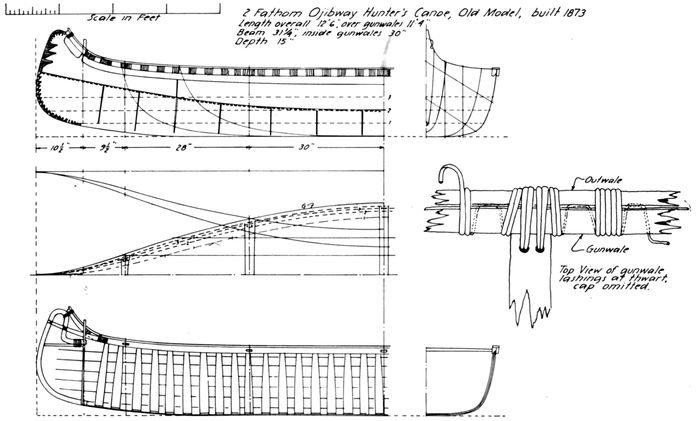
Figure 114
Ojibway 2-Fathom Hunter's Canoe, used by the eastern tribal groups. Probably the ancient model.
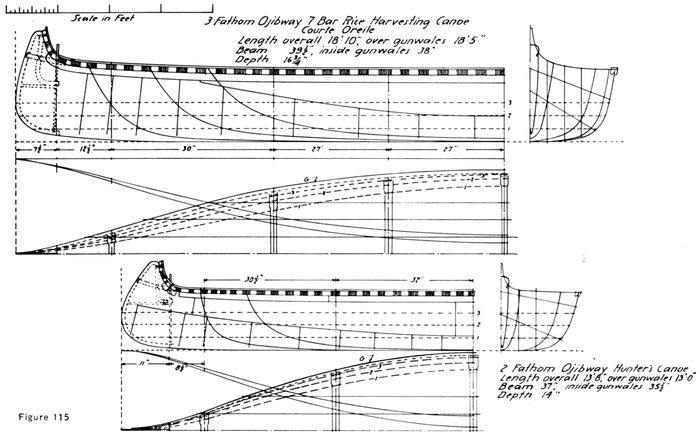
Figure 115
Examples of the Old Model Ojibway 3-Fathom rice-harvesting canoe (above), and 2-fathom hunter's canoe, showing the easy paddling form used.
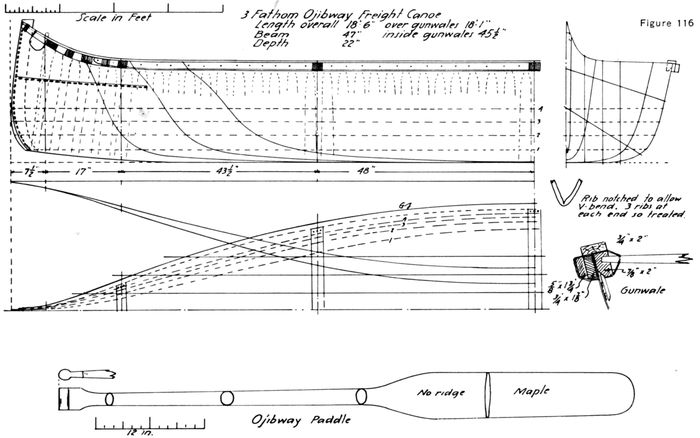
Figure 116
Ojibway 3-Fathom Freight Canoe From Lake Timagami, apparently a hybrid based on canvas canoes.
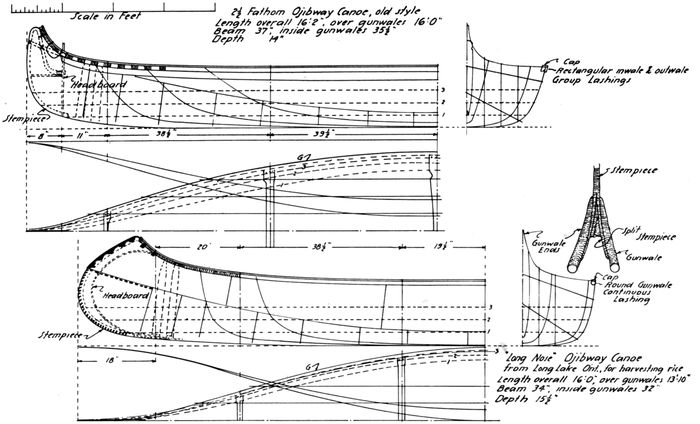
Figure 117
The Old Form of Ojibway 2½-Fathom Canoe of the eastern groups (above), and the long-nose Cree-Ojibway canoe of the western groups.
At Lake Timagami, north of Georgian Bay in Ontario, the Ojibway used a low-ended canoe with a remarkably straight tumble-home stem profile; the forefoot had a very short radius ending at the bottom line with a knuckle, and the stem-head stood slightly above the gunwale caps. The stem-piece was made from a thin plank cut to profile; thus no lamination was necessary. The headboard stood straight, falling inboard slightly at the head. The midsection was dish-shaped, with a flat bottom athwartships and strongly flaring sides, the turn of the bilge being rather abrupt. The ends were strongly V-shaped in cross-section; a number of the frames there being "broken" at the centerline of the bottom. A canoe of this design was seen by Adney at North Bay, Ontario, in 1925, indicating that the design may have been used in some degree outside the Lake area in later years.
The most common Ojibway model used to the northwest and west of Lake Superior was the so-called "long-nose" form, a rather straight-sheered canoe. The bottom, near the ends, had a slight rocker, and the sheer turned up very sharply there, becoming almost perpendicular at the extremities, yet the ends were not proportionally very high. The end-profile came up from the bottom very full and round, then fell sharply inboard in a slightly rounded sweep to join the upturned sheer well inboard. The midsection was somewhat dish-shaped, but with well-rounded bilges, so that the flare of the topsides was rounded and not very apparent to the casual observer. The end section developed into a tumble-home form, so that a section through the top of the headboard was rather oval. As a result, these canoes appeared rather clumsy and unfair in their lines, but this apparently did not harm their paddling qualities or seaworthiness.
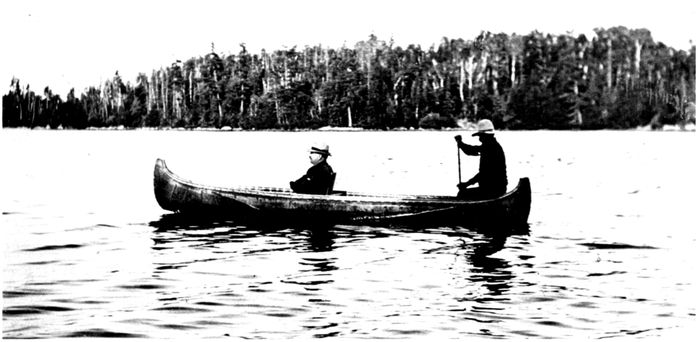
Figure 118
Eastern Ojibway Canoe, Old Form. (Canadian Pacific Railway photo.)
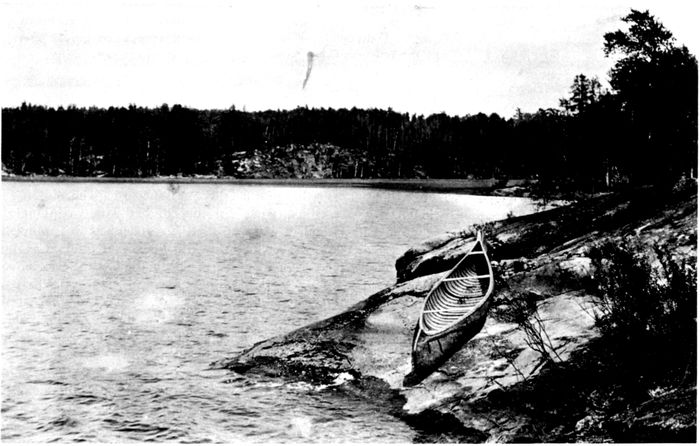
Figure 119
Ojibway Long-Nose Canoe, Rainy Lake District.
These canoes had narrow headboards that were sharply bellied, somewhat like those in the crooked canoes, and the belly was sufficient to allow the heel of the end-board to pass under the bottom sheathing and inside the bark cover so that two end ribs served to hold the heel in place. The inside stem-piece was often no more than a light stick or rod bent to profile, with the head split and brought over the gunwale ends and down inside, between them. Each half of the split was then lashed to its neighboring gunwale member. A strip of bark was often placed over the end of the bark cover and carried down the face of the stem, under the sewing. The rail caps were then brought up over the tops of the gunwales and overlapped the top portion of the stem piece. The heel of the stem-piece was bevelled off on the inboard side so that it could be wedged under the headboard, inside the bark cover. These headboards, it should be noted, were no more than a thin, narrow batten, and in some canoes the head of this batten was lashed under the gunwale ends instead of coming up between them inboard, as usual. A variation in the fitting of the stem head was found in a canoe at Long Lake, Ontario; the stem head, instead of being split, was lashed between the gunwale ends and thus was brought inboard level with the top of the gunwales.
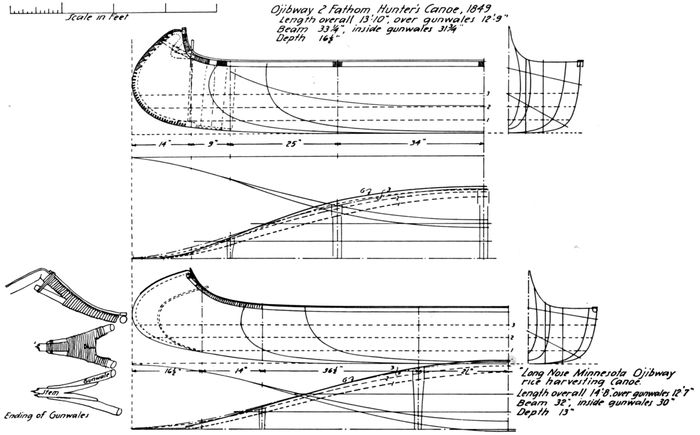
Figure 120
Small Ojibway Canoes of the Two Tribal Forms showing (above) early trend toward the long nose form, and the final Ojibway-Cree hybrid form combining flaring sides amidships with tumble-home sections at ends.
The cross section of the main gunwales was round or nearly so in nearly all long-nose canoes, and often a gunwale cap was fitted. The bark cover was secured to the gunwales by a continuous lashing, but in at least one example, from Minnesota, the gunwale wrappings were in groups over an outwale after the regular fashion to the eastward. The ends of the thwarts were wedge-or chisel-shaped and instead of being tenoned were forced into splits in the round gunwales. Many canoes had bark covers at the gunwale ends and vestiges of the wulegessis were to be seen.
All Ojibway canoes were built with a building frame, the bed being slightly higher at midlength than at the ends. The stakes were driven nearly perpendicular, instead of with heads slanted outward. It is apparent from observed examples that some canoes were built by the same procedure as the Algonkin, but that not all the long-nose canoes were built by spreading the gunwales; some were built using the methods of the St. Francis.
Figure 121
Ojibway Canoe Building, Lac Seul, 1918.
(See pp. 170-171 for more photos of Ojibway canoe building.)
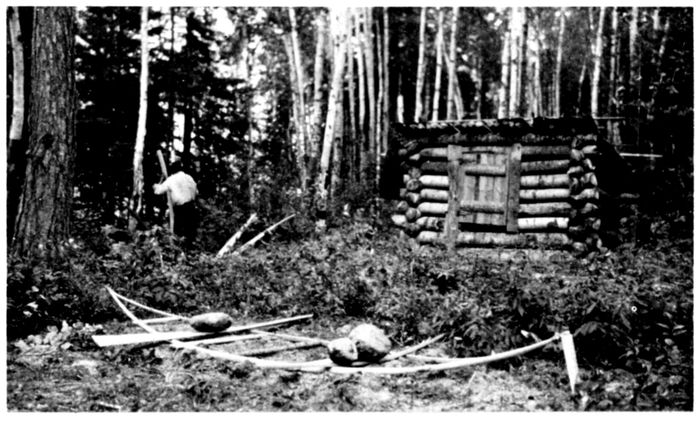
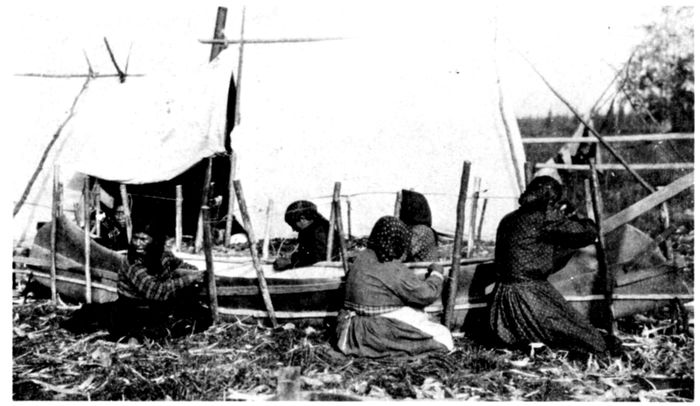
Preparing a building site or bed; building frame in place.
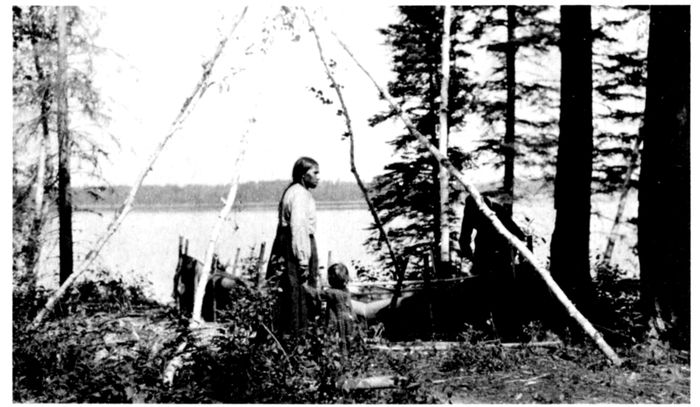
Bark set up; bark staked out on building bed.
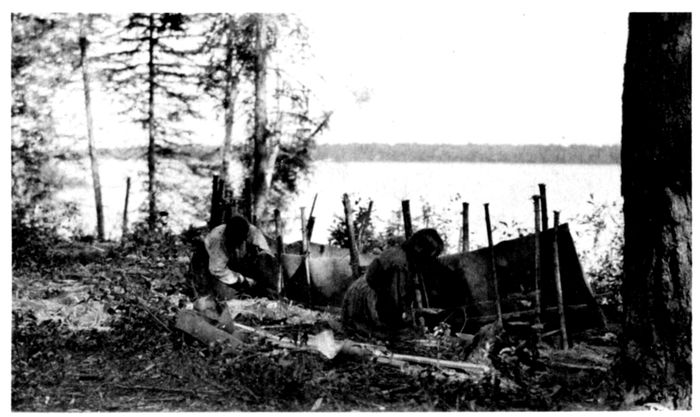
Bark cover being sewn on building bed.
Gunwales being lashed.
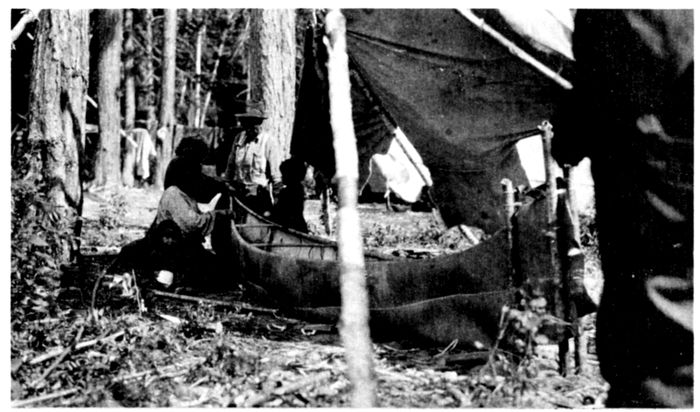
Securing gunwales.
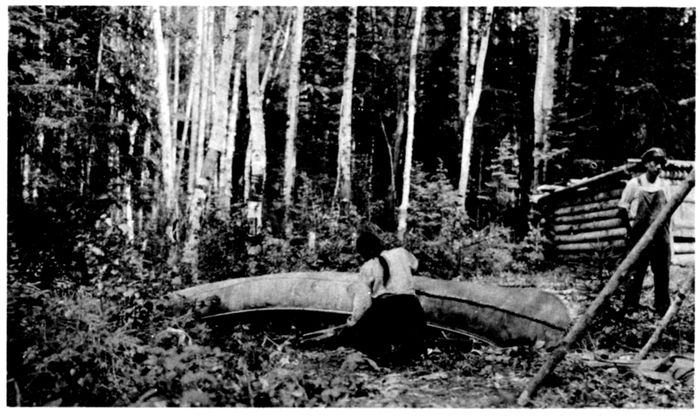
Pitch being applied to seams.
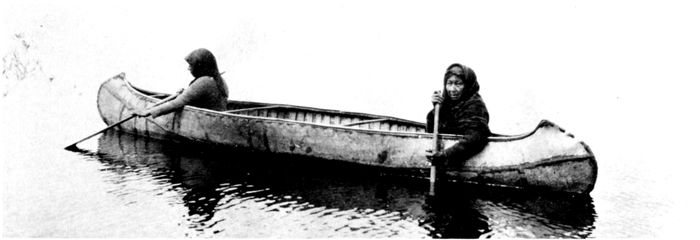
Figure 122
Long Lake Ojibway Long-Nose Canoe. (Canadian Geological Survey photo.)
The lashing in the high-ended Ojibway canoes was about the same as that in the Algonkin canoes, but in the long-nose type the workmanship was often coarse. On many of the latter the stems were lashed by use of small groups in which two turns were taken through each of two closely spaced holes in the bark and the connection between the groups was made by a long spiral around the outside of the stem. This pattern was carried down from the stem-head to about the level of the midship sheer height; from there down around the forefoot the lashing consisted of a simple spiral. Another style was to use widely spaced groups made up of two or three turns through a pair of facing holes in the bark, one on each side and inboard of the stem. The turn went around the stem, and the last connected with the next pair of holes below. A few canoes of this style used closely spaced wrapping, as in the high-ended canoes.
The long-nose Ojibway canoe is surprisingly primitive by comparison with the graceful and well-finished high-ended model built after the Algonkin style. Adney believed that the long-nose type originated with the Sioux Dakotas, before the combined Ojibway and Cree movement forced them out of the forest lands to the west of Lake Superior. He considered it possible that both the Ojibway and Cree adapted the Dakota model, modifying it somewhat to their methods of construction. It is true that the western Cree built a long-nose canoe, but it had less chin than the Ojibway model. On the other hand, the Ojibway prebent ribs in pairs like the eastern Cree, and used spreaders in the end ribs while drying them, in exactly the same manner. A picture taken in 1916 shows the gunwales of a Cree long-nose canoe being set; it was laid on the ground and weighted along the midlength by stones laid on boards placed across the longitudinals. The ends had been sheered up and were supported at each end by a thong made fast to the gunwale end and then brought over a post, or strut, a few feet inboard and made fast to the middle thwart.
It is unnecessary to detail the construction of the Ojibway canoes, as they employed a building-frame, as the drawings on pages 123 to 127 show plainly enough the pertinent details of fitting and construction. It is important to observe that the wide variation in model and in construction details of the Ojibway canoes produced a variety of building procedures that in the main were like those of the Algonkin and Cree. Hence the older tribal method of construction cannot now be stated with any accuracy.
The paddle forms used by the Ojibway groups varied somewhat. Most were made with parallel-sided blades and oval tips. The hand grip at the top of the handle was rectangular and was large in comparison to the grip of the eastern Cree paddles. A few variations have been noticed; the blade of one was widest at the top, the tip was almost squared off, and the upper hand grip was much as in the factory paddle of today. This paddle, from an unknown locality, was used in 1849.
As in the case of the Algonkin, the eastern Ojibway built fur-trade canoes under supervision. Though these canoes differed somewhat from those built by the Algonkins, it is now impossible to say whether or not there was any real relationship between them and the small, high-ended "old-form" canoe. Likewise, the Ojibway built a version of the wabinaki chiman which seems to have influenced some types of their own, such as, for instance, the straight-stem Lake Temagami canoe.
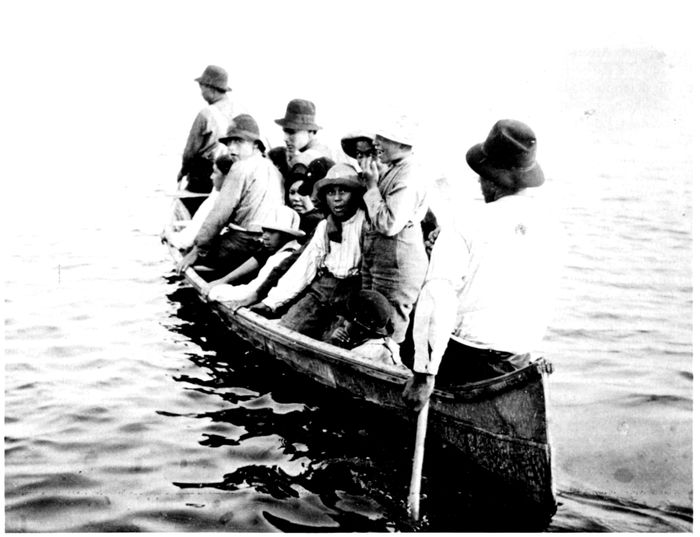
Figure 123
Nineteen-Foot Ojibway Canoe with thirteen Indians aboard (1913).
Western Cree
The western portion of the great Cree tribe appear to have occupied the western shore of James Bay and to have moved gradually northwestward in historical times. Their territory included the northern portion of Ontario and northern Manitoba north of Lake Winnipeg, and as early as 1800 they had entered northwestern Alberta. The line of division between the canoes of the eastern and western Cree cannot be strictly determined, but it is roughly the Missinaibi River, which, with the Abitibi River, empties into the head of James Bay at the old post of Moose Factory. The southern range of the Cree model was only a little way south of the head of James Bay, irregularly westward in line with Lake St. Joseph to Lake Winnipeg. To the west, the Cree type of canoe gradually spread until it met the canoe forms of the Athabascan in the Northwest Territories, in the vicinity of Lake Athabaska in northwestern Saskatchewan.
The canoes of the western Cree, as has been noted, strongly resembled the long-nose Ojibway model except that they had less pronounced chin. But unlike those of the eastern Cree, their canoes employed an inside stem-piece that was sometimes a laminated piece and sometimes a piece of spruce root. The stem head was commonly bent sharply and secured between the gunwale ends at the point where the two longitudinals were fastened together, much as in some Ojibway long-nose canoes. The Cree canoe had basically the same dish-shaped midsection, but it had very full, round bilges and the flare was so curved in the topside that it was even less apparent than in the Ojibway model. The shorter chin of the Cree canoe also made tumble-home in the end sections unnecessary, and cross section near the headboards was given the form of a slightly rounded U.
The bottom had very little rocker at the ends, being straight for practically the whole length. The stem-piece if laminated (often in only two or three laminations) came up from the bottom in a fair round forefoot and then tumbled in by a gentle curve to the stem-head, where it was bent sharply to pass down between the gunwale ends as previously noted. But if the stem-piece was of spruce root, the profile was often somewhat irregular and the chin was more pronounced. In a common style the stem came fair out of the bottom in a quick hard curve, then curved outward slightly until the height of the least freeboard amidships was reached, at which height another hard turn began the tumble-home in a gentle sweep to the stem-head, where there was a very hard turn downward. The stem-head was often split, as in some Ojibway canoes, so that it came over the joined ends of the main gunwales and the two halves were then lashed to the inside faces of the gunwales.
Birch bark was often poor or scarce in the territory of the western Cree, as in that of their eastern brothers. As a substitute, they employed spruce bark and in general seem to have achieved better results, for their spruce-bark canoes had a neater appearance. If the canoe was built when or where root material was difficult to obtain, the western Cree used rawhide for sewing the bark cover. When the stems were lashed with rawhide, a stem-band of bark under the lashing was common.
The gunwales were round in cross section and were often spliced amidships. The bark cover was lashed to these with a continuous lashing, no caps or outwales being employed. As in the Ojibway long-nose canoe, the headboards were very narrow and much bellied. These canoes were built with four or five thwarts; the 4-thwart type was used for gathering wild rice, as was the Ojibway type, while the 5-thwart canoe was the portage model. The thwarts were sometimes mortised into the gunwales, but some builders made the thwart ends chisel-pointed and drove them into short splits in the gunwales before lashing them, one or two holes being drilled in the thwart ends to take the lashing thongs. When the thwarts were tenoned into the gunwales, the builders of course made the inside of the gunwales flat.
When spruce bark was employed, its greater stiffness made it possible to space the ribs as much as 10 inches on centers, but with birch the spacing was about 1 inch, edge to edge. The sheathing was in short splints and the inside of the canoe was "shingled" or covered irregularly without regard to lining off the strakes, a practice sometimes observed in Ojibway long-nose canoes. The much-bellied and narrow headboards were fitted as in the long-nose canoe, and the heel was secured under a piece of sheathing and held by it and the first two ribs.
Western Cree canoes were built with a building frame, and the bed was raised in the middle. The sewing varied. The ends were lashed with combinations of close-wrapped turns, crossed turns, grouped, and spiral turns; the lashing commonly went around the inside stem piece rather than through it. Side panels were sewn with in-and-out stitches or back stitches, and the gores with the usual spiral. Gumming as a rule was done with clear spruce gum tempered by repeated meltings.
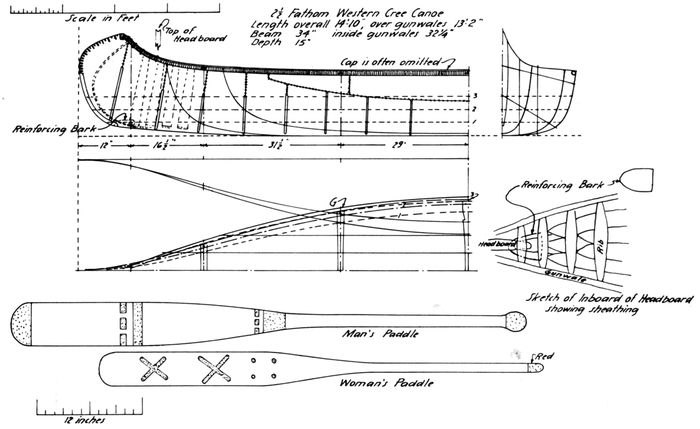
Figure 124
Western Cree 2½-Fathom Canoe, Winisk River District, northwest of James Bay. Built of either birch or spruce bark. Inside root stem piece, round gunwales, and much-bellied headboard are typical.
The woodwork varied with the building site; some builders could use much cedar, but spruce was most common and the thwarts were usually of birch. When spruce bark was used it was never employed in a single large sheet, since it would have been impossible to mold it to the required shape. Hence the bark cover was pieced up, whether birch or spruce, as an aid in molding the form. Before the spruce bark was sewed and gummed, the edges of the pieces had to be thinned to make a neat joint. Furthermore, in the continuous lashing it was desirable to take two or three turns through one hole in the bark cover to avoid weakening the material with closely spaced holes.
The western Cree paddles had parallel-sided blades with rounded tips; the handle sometimes had a ball-shaped top grip and sometimes it was pole-ended. The blade did not have a ridge on its face near the handle. Old Cree paddles were often decorated with red pigment bands, markings in the shape of crosses, squares in series, and dots on the blades; the top grip might also be painted.
Many tribal groups in the western portion of the area have been mentioned—Teton, Sioux, Assiniboine, Illinois, Huron, and many others—but no record of their canoe forms has survived and the assigning of any model to them is pure speculation. The fur trade alone brought about a period of tribal movement among the Indians long enough to erase many tribal distinctions in canoes and to cause types to move great distances.
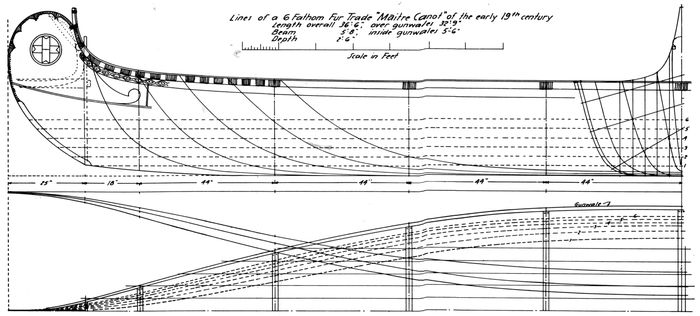
Figure 125
An Old 6-Fathom Fur-Trade Canoe, or "rabeska," used on the Montreal-Great Lakes run. Also called the Iroquois canoe, it approximates the canoes built for the French, at the Trois Rivières, Que., factory and is of the style used by the North West and Hudson's Bay Companies.
Fur-Trade Canoes
Of all birch-bark canoe forms, the most famous were the canots du maître, or maître canots (also called north canoes, great canoes, or rabeskas), of the great fur companies of Canada. These large canoes were developed early, as we have seen in the French colonial records, and remained a vital part of the fur trade until well toward the very end of the 19th century—two hundred years of use and development at the very least. A comprehensive history of the Canadian and American fur trade is yet to be written; when one appears it will show that the fur trade could not have existed on a large scale without the great maître canot of birch bark. It will also have to show that the early exploration of the north country was largely made possible by this carrier. In fact, the great canoes of the Canadian fur trade must be looked upon as the national watercraft type, historically, of Canada and far more representative of the great years of national expansion than the wagon, truck, locomotive, or steamship.
Little has survived concerning the form and construction of the early French-colonial fur-trade canoes. Circumstantial evidence leads to the conclusion that the model was a development, an enlargement perhaps, of the Algonkin form of high-ended canoe as described on pages 113 to 116. The early French came into contact with these tribesmen before they met the Great Lakes Ojibway, the other builders of the high-ended model. It is known that the Indians first supplied large canoes to the French governmental and church authorities and that when this source of canoes proved insufficient, the canoe factory at Trois Rivières was set up and a standard size (probably a standard model as well) came into existence. As the fur trade expanded, large canoes may well have been built elsewhere by the early French; we know at least that building spread westward and northward after Canada became a British possession.
In the rise of the great canoe of the fur trade, the basic model was no doubt maintained through the method of training its builders. The first French engaged in bark-canoe building learned the techniques, let us say, from the original Indian builders, the Algonkin. As building moved westward, the first men sent to the new posts to build canoes apparently came from the French-operated canoe factory. It would be reasonable to expect that as building increased in the west, local modifications would be patterned on canoes from around the building post, but that the basic model would remain. This may account for the departures from the true Ojibway-Algonkin canoes seen in the maître canots.
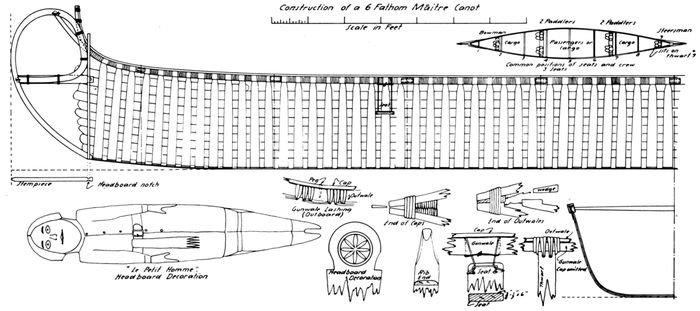
Figure 126
Inboard Profile of a 6-Fathom Fur-Trade Canoe, and details of construction, fitting, and decoration.
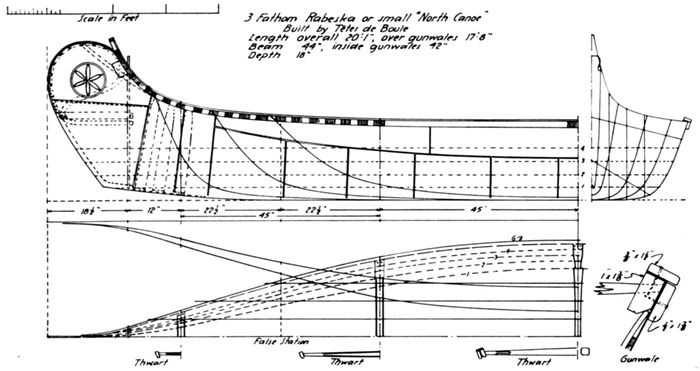
Figure 127
Small 3-Fathom North Canoe of the Têtes de Boule model. Built in the 19th century for fast travel, this Hudson's Bay Company canoe was also called nadowé chiman, or Iroquois canoe.
In model, all the fur-trade canoes had narrow bottoms, flaring topsides, and sharp ends. The flaring sides were rather straight in section and the bottom nearly flat athwartships. The bottom had a moderate rocker very close to the ends. In nearly all of these canoes, the main gunwales were sheered up only slightly at the ends and were secured to the sides of the inner stem-piece; the outwales and caps, however, were strongly sheered up to the top of the stem. The curvature and form of the ends, in later years at least, varied with the place of building.
After the English took control of Canada and the fur trade, a large number of Iroquois removed into Quebec and were employed by the English fur traders as canoemen and as canoe builders. Though the aboriginal Iroquois were not birch-bark canoe builders, they apparently became so after they reached Canada, for the fur-trade canoes built on the Ottawa River and tributaries by the Algonkins and their neighbors became known after 1820 as nadowé chiman or adowe chiman, names which mean Iroquois canoe. These "Iroquois canoes," however, were not a standard form. Those built by the Algonkin had relatively upright stem profiles, giving them a rather long bottom, and the outwales and caps stood almost vertical at the stem-heads; in contrast, the "Iroquois canoes" built by the Têtes de Boule had a proportionally shorter bottom than those of the Algonkin, because the end profiles were cut under more at the forefoot. Also, the outwales and caps of the Têtes de Boule canoes were not sheered quite as much as were those of the Algonkin.
It is supposed that the Têtes de Boule were taught to build this model by Iroquois, who had replaced the French builders subsequent to the closing of the canoe factory at Trois Rivières, sometime about 1820. After the English took possession of Canada in 1763, the old canoe factory had been maintained by the Montreal traders (the "North West Company"), and it was not until these traders were absorbed by the Hudson's Bay Company that canoe manufacture at Trois Rivières finally came to a halt, although it is probable that the production of canoes there had become limited by shortages of bark and other suitable materials. However, the North West Company had built the large trading canoes elsewhere, for many of its posts had found it necessary to construct canoes locally, and when the Hudson's Bay Company finally took over the fur trade it continued the policy of building the canoes at various posts where material and builders could be found. This policy appears to have produced in the fur-trade canoe model a third variant in which the high ends were much rounded at the stem head; this was the form built by the Ojibway and Cree (see p. 139). It must be noted, however, that the variation in the three forms of fur-trade canoe was expressed almost entirely in the form and framing of the ends; the lines were all about the same, though small variations in sheer, rocker, and midsection must have existed.
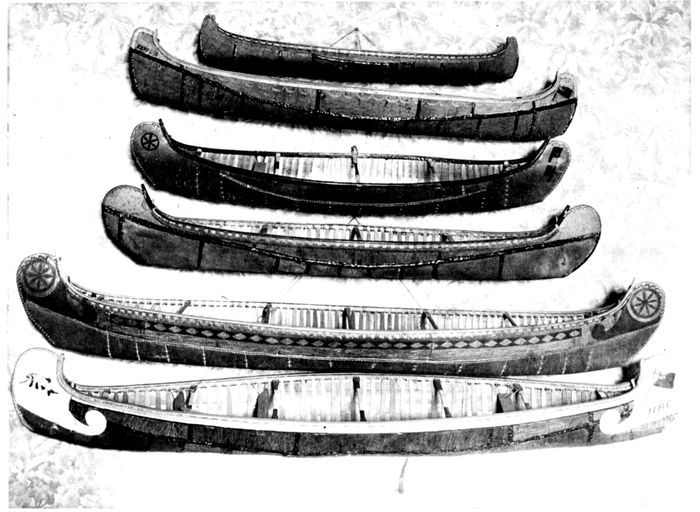
Figure 128
Models of Fur-Trade Canoes, top to bottom: 2½-fathom Ottawa River Algonkin canoe, Hudson's Bay Company express canoe, 3½-fathom Têtes de Boule "Iroquois" canoe, 3¾-fathom Lake Timagami canoe, 5-fathom fur-trade canoe of early type, and 5-fathom Hudson's Bay Company canoe built in northwestern Quebec Province.
Although no regulations appear to have been set up by the fur companies to govern the size, model, construction or finish of these canoes, custom and the requirements of usage appear to have been satisfactory guides, having been established by practical experience. As a result, the length of canoes varied and the classification by "fathoms" or feet must be accepted as no more than approximate.
The form of the canoe was determined by the use to which it was to be put, in trade or in travel. Fur-trade accounts often mention the "light canoe," or canot léger, often misspelled in various ways in early English accounts, and this class of canoe was always mentioned where speed was necessary. Commonly, the light canoe was merely a trade canoe lightly burdened. Due to the narrow bottom of these canoes, they became long and narrow on the waterline when not heavily loaded and so could be paddled very rapidly. It is true, however, that some "express canoes" were built for fast paddling. These were merely the common trade models with less beam than usual at gunwale and across the bottom. Some posts made a specialty of building such canoes, often handsomely painted, for the use of officials of the company, or of the church or government, during "inspection" trips. Not all of the highly finished canoes were of the narrow form, however, as some were built wide for capacity rather than for high speed.
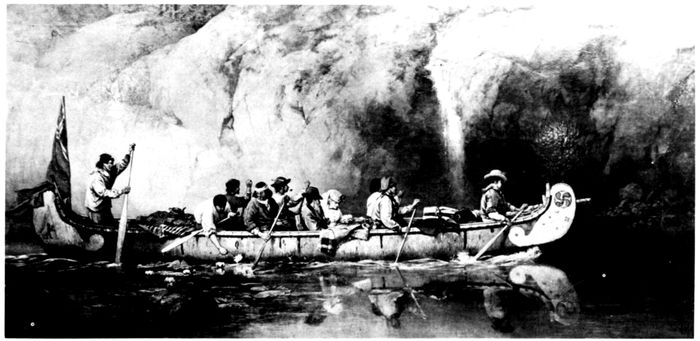
Figure 129
"Fur-Trade Maître Canot With Passengers." From an oil painting by Hopkins (Public Archives of Canada photo).
The fur traders used not only the so-called fur-trade canoes, of course, but they employed various Indian types when small canoes were required. And in the construction of the high-ended fur-trade models, they did not limit themselves to canoes of relatively great length. Each "canoe road" forming the main lines of travel in the old fur-trade had requirements that affected the size of the canoes employed on it. The largest size of fur-trade canoe, the standard 5½-fathom (bottom length), was employed only on the Montreal-Great Lakes route, in the days before this run was taken over by bateaux, schooners, sloops, and later, by steamers. At the western end of this route, a smaller 4-or 4½-fathom canoe came into use. The latter was used on the long run into the northwest. Even smaller canoes were often employed by the northern posts; the 3-or 3½-fathom sizes were popular where the canoe routes were very difficult to operate. For use on some of the large northern lakes, the large canoes of the Montreal-Great Lakes run were introduced. Fur coming east from the Athabasca might thus be transported in canoes of varying size along the way.
In judging the size of the canoe mentioned in a fur-trader's journal, it is often very difficult to be certain whether the measurement he is employing is bottom or gunwale length. In the largest canoes, however, the 5½-fathom bottom-length was the 6-fathom gunwale length, and the use of either usually, but not always, indicates the method of measurement. This is not the case in the small canoe however, where the matter must too often be left to guesswork. To give the reader a more precise idea of the sizes of the canoes last employed in the fur trade, the following will serve. The maître canot of the Montreal-Great Lakes run was commonly about 36 feet overall, or about 32 feet 9 inches over the gunwales, and a little over 32 feet on the bottom. The beam at gunwale was roughly 66 inches (inside the gunwales) or about 68-70 inches extreme beam. The width of the building frame that formed the bottom would be somewhere around 42 inches. The depth amidships, from bottom to top of gunwale might be approximately 30-32 inches and the height of the stems roughly 54 inches. These dimensions might be best described as average, since canoes with gunwale length given as 6 fathoms were built a number of inches wider or narrower, and deeper or shallower. The earlier fur-trade canoes of the French and of the North West Company, for example, were apparently narrower than the above.
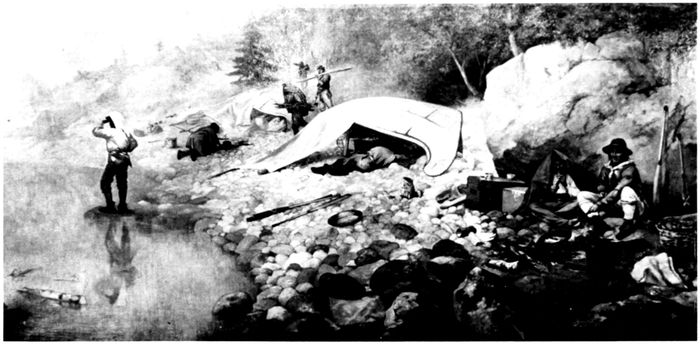
Figure 130
"Bivouac in Expedition in Hudson's Bay Canoe." From an oil painting by Hopkins (Public Archives of Canada photo).
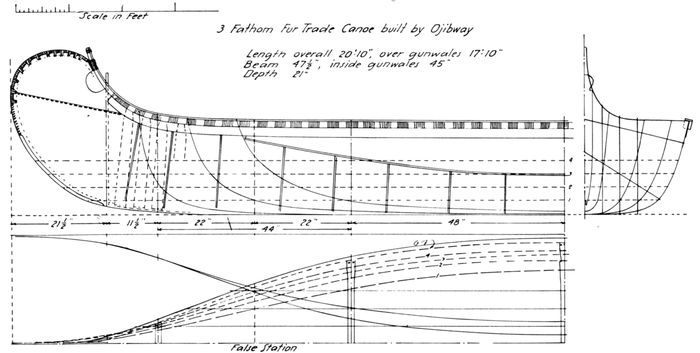
Figure 131
Ojibway 3-Fathom Fur-Trade Canoe, a cargo-carrying type, marked by cut-under end profiles, that was built as late as 1894.
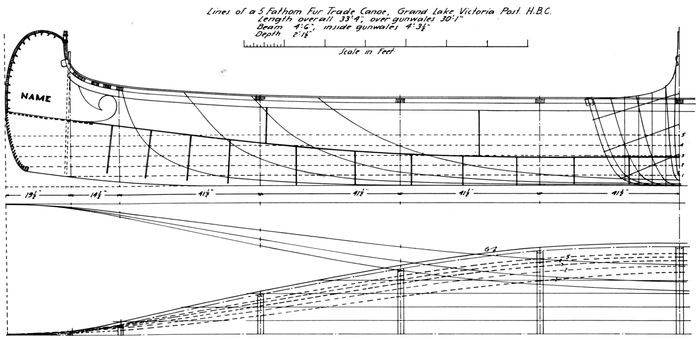
Figure 132
This Type of 5-Fathom Fur-Trade Canoe was built at L. A. Christopherson's Hudson's Bay Company posts at Grand Lake Victoria, Lake Barrière, and Lake Abitibi. Called the Ottawa River canoe by fur-traders, it was used for fast travel and shows the upright stems of the northwest Quebec Algonkin.
The 5-fathom size that replaced the larger canoe at the close of the bark-canoe period was about 31 feet long over the gunwales or 30 feet 8 inches in a straight line from tip of upturned rail cap at one stem to the other. The beam inside the gunwales was 60 inches. The width of the building frame would be between 40 and 45 inches, and the frame when formed would be about 26 feet 8 inches long. The depth of the canoe amidships, from bottom to top of gunwale, was approximate 30 inches and the height of the stems about 50 inches. The overall length of such a canoe was about 34 feet 4 inches. An express canoe of this size would be about 56 inches beam inside the gunwales or even somewhat less, and the depth amidships about 28 inches or a little less.
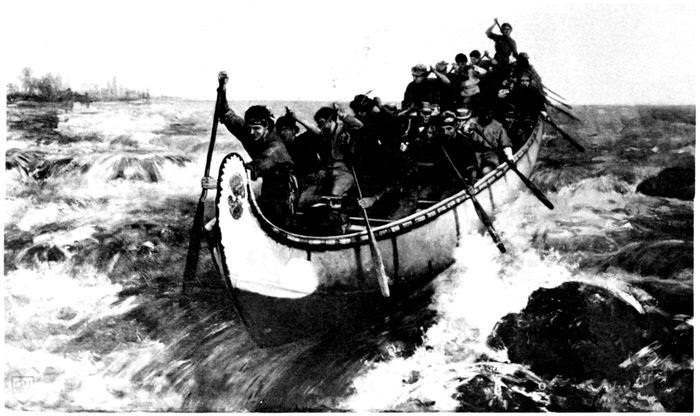
Figure 133
"Hudson's Bay Canoe Running the Rapids." From an oil painting by Hopkins (Public Archives of Canada photo).
A 4-fathom canoe measured 26 feet 8 inches over the tips of the upturned rail caps, and 29 feet 11 inches overall. The beam amidships was 57 inches inside the gunwales and the depth amidships to top of gunwales was 26 inches; the height of the stem was 53 inches.
A 3-fathom canoe was 19 feet 2 inches overall, 16 feet 8 inches over the ends of the gunwale caps, 42 inches beam amidships inside of gunwales, the depth of the canoe from bottom to top of gunwale amidships was 19 inches, and the height of the ends was 38 inches. The building frame for this canoe was 15 feet 8 inches long and 27 inches wide.
The canoes falling between the even-fathom measurements were often of about the same dimensions as the even-fathom size next below; a 3½-fathom canoe would have nearly the same breadth and depth as a 3-fathom; only the length was increased. The half-fathom rarely measured that—a canoe rated as 3½ fathom was actually only 20 feet 5 inches overall. One express canoe rated 3½ fathoms measured 20 feet 1 inch overall, 18 feet 3 inches over the gunwale caps, 44 inches beam inside gunwales amidships, and 21 inches deep, bottom to top of gunwale cap. The height of the ends was 39 inches. This example will serve to indicate how inexact the fathom classification really was. It should also be noted that the height of the ends varied a good deal in any given range of length, as this dimension was determined not by the length of the canoe but by the judgment and taste of the builder and his tribal form of end. Generally, however, small canoes had relatively higher ends than large canoes, in proportion to length, because, as will be remembered, one function of the end was to hold the upended canoe far enough off the ground to permit the user to seek shelter under it.
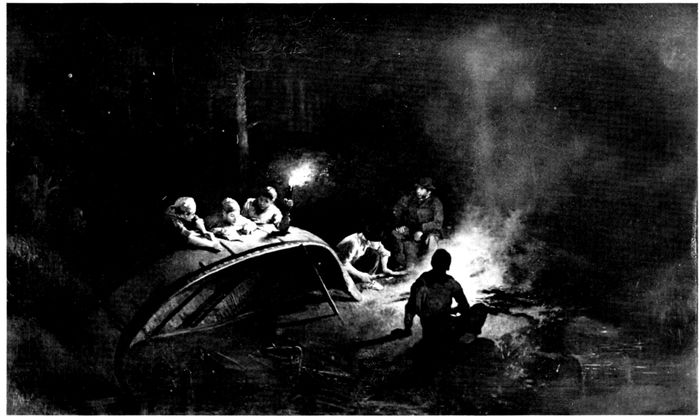
Figure 134
"Repairing the Canoe." From an oil painting by Hopkins (Public Archives of Canada photo).
Extremes of dimension appear to have been rare in fur-trade canoes; none whose length overall exceeded 37 feet have been found in the records, and the maximum beam reported in a maître canot was 80 inches. When canvas replaced birch bark in the fur-trade canoes, the high-ended models disappeared; the canvas freight canoes were commonly of the white man's type having low-peaked ends, or a modified Peterborough type.
Before discussing the methods of construction, the loading and equipment of the fur-trade canoes should be described from contemporary fur trade accounts. The goods carried in these canoes were packed into easily handled bundles, or packages, of from 90 to 100 pounds weight. Wines and liquor were carried in 9-gallon kegs, the most awkward of all cargo to portage. In some cases the furs were packed into 80-or 90-pound bundles in the Northwest, and were repacked into 100-pound bundles before being placed on the large canoes of the Montreal-Great Lakes route, but bundles lighter than 90 pounds were made up for the shipment of small quantities of individual goods to isolated posts. The bundles, or packs, of furs were formed under screw presses so that 500 mink skins, for example, were made into a package 24 inches long, 21 inches wide and 15 inches deep, weighing very close to 90 pounds. Buffalo hides formed a larger pack, of course. In the canoe, packs were covered by a parala, a heavy, oiled red-canvas tarpaulin.
Boxes called cassettes were carried; these were 28 inches long and 16 inches in width and depth, made of ¾-inch seasoned pine dovetailed and iron-strapped, with the lid tightly fitted. The top, and sometimes the bottom too, was bevelled along the edges. The lids were fitted with hasps and padlocks and the boxes were as watertight as possible. Each box was painted and marked; in these were placed cash and other valuables. Also carried was a travelling case—a lined box for medicine, refreshments for the officers, and what would be needed quickly on the road.