Chapter Seven ARCTIC SKIN BOATS Howard I. Chapelle (continued 2)
Reading edition
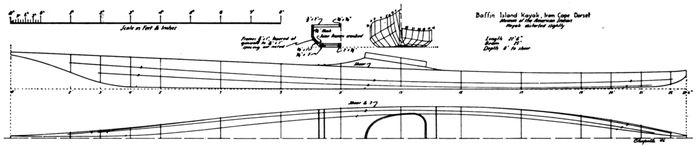
Figure 196
Baffin Island Kayak, from Cape Dorset, Canada, in the Museum of the American Indian, Heye Foundation.
This example illustrates better than the Baffin Island kayak the combination of deep forefoot and the greatest beam well abaft the midlength that marks many eastern models. When paddled, the craft always trims so that the kayak draws most water at the fore end of the keelson and the bottom of the stern is usually just awash. This makes the bottom sweep up from the forefoot in a very slight gradual curve to the stern, when the boat is afloat. As a result, the kayak may be said to be of the "double-wedge" form that has been popular in fast low-powered motor boats, since having the beam far aft gives to the bow a wedge shape in plan, while the deep forefoot and shallow stern produce an opposite wedge in profile. It would appear that this form had been found by trial and error to produce a fast, easily paddled rough-water kayak in an otherwise heavy hull. The North Labrador kayaks are the largest in the Arctic for a single person; some are reported as long as 26 feet. The long-and narrow-bladed paddle may be explained by the fact that the Eskimo never produced a "feathered" double paddle, with blades set at right angles to one another. To paddle against strong winds, he developed a blade that was very long and very narrow for a double-paddle, and therefore offered less resistance to the wind, yet could be dipped deep so that little propulsion effect was lost.
The kayak used on the northeast coast of Labrador, shown in figure 198, differs slightly from that of Hudson Strait. The northeast-coast kayak has a very slight V-bottom and a strong concave sheer with relatively great rocker in the bottom. While the craft trims by the bow afloat, the rocker probably makes it more maneuverable than the Hudson Strait kayak, though less easily paddled against strong winds. The V-bottom is formed by using a keelson that is heavier and deeper than the chines. The latter are thin, wide battens, on the flat. The V-bottom appears to help the boat run straight under paddle and may be said to counteract, to some extent at least, the effect of the strongly rockered bottom.
The Polar coast of Greenland is the home of sharpie-model kayaks having flat bottoms and flaring sides; the kayaks in figures 199 and 200 are representative of those used in the extreme north. These have "clipper" bows, with sterns of varying depth and shape, concave sheer and varying degrees of rocker in the bottom. Most have their greatest beam well aft and draw more water forward, as do the Labrador and Baffin Island types. The chief characteristic of the construction of this type is that the transverse frames are in three parts, somewhat as in the umiak. However, these kayaks depart from umiak construction in having the frame heads rigidly tenoned into the gunwales. This is done to give the structure a measure of transverse rigidity which would otherwise be lacking, since light battens are used for the keelson, stem, and chines. Figure 199 shows the details of the construction used.
These kayaks are highly developed craft—stable, fast, and seaworthy—and the construction is light yet strong enough to withstand the severe abuse sometimes given them. The cap on the fore part of the manhole is a paddle holder, for resting the paddle across the deck. Some Eskimos used this as a thole, and when tired, "rowed" the kayak with the paddle, to maintain control. It will be noted that oval or circular manholes are seldom found in the eastern types of kayaks already described; U-shaped manholes, or bent-rim manholes approaching this form, appear in those very stable types which do not require to be righted at sea by the paddler and in which the watertight paddling jacket or waistband is not used.
Farther south, on the northern coast of Greenland, and apparently also on the opposite coast of Baffin Island, a modified design of kayak is used. This type, illustrated in figure 205, shows relationship to both the flat-bottom kayak of northern Greenland and to the northeastern Labrador type. In this model the "clipper" bow is retained but the stern and cross section resemble those of the Labrador kayaks. The construction, however, is fundamentally that employed in northern Greenland. As in the Labrador type, the deadrise in the bottom is formed by using in the keelson members that are deeper than those in the chine. The gunwales do not flare as in the Greenland model, but stand vertical in the side flaring slightly at bow and extreme stern. The frame heads are rather loosely tenoned and are commonly secured to the gunwales with lashings. Transverse stiffness is obtained in this model by employing a rather heavy, rigid keelson fixed to the stern block, and by a tripod arrangement forward consisting of the stem batten and a pair of transverse frames placed at the junction of stem and keelson with their heads firmly lashed and tenoned into the gunwales. The construction, though strong, is rather rough compared to that of other Greenland types. The manhole rim in this type is not bent, but is made up of short straight pieces, as shown in the drawing; and the double-bladed paddle shown resembles that used in Labrador. This is a rather heavy kayak of very good qualities but not as maneuverable as some of the flat-bottom kayaks found farther north.
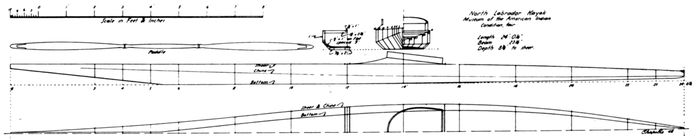
Figure 197
Kayak From North Labrador, Canada, in the Museum of the American Indian, Heye Foundation.
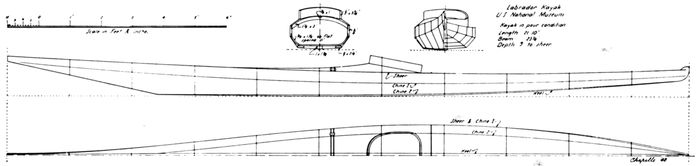
Figure 198
Labrador Kayak, Canada, in the U.S. National Museum (USNM 251693).
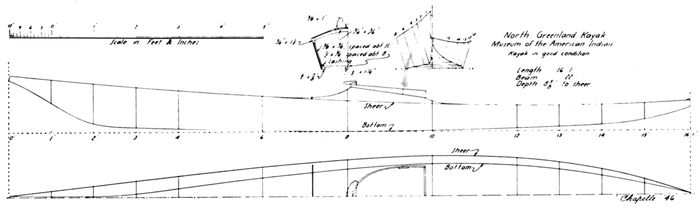
Figure 199
North Greenland Kayak, in the Museum of the American Indian, Heye Foundation.
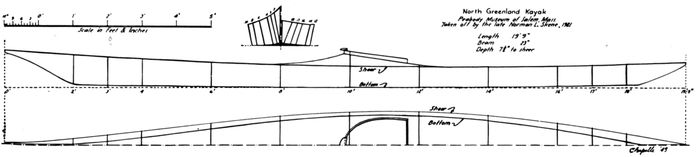
Figure 200
North Greenland Kayak, in the Peabody Museum, Salem, Mass. Taken off by the late Norman L. Skene, 1921.
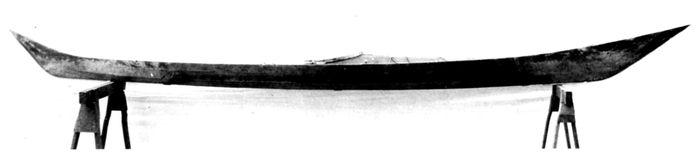
Figure 201
Profile of Greenland Kayak from Disko Bay, in the National Museum (USNM 72564). Collected by Maj. Wm. M. Beebe, Jr., 1882. (Smithsonian photo 15726-D.)
Ross found that the Greenland Eskimos north of Cape York had ceased to use kayaks in 1818. Not until about 1860 was the kayak reintroduced here, by Eskimos from Pond Inlet, north Baffin Island, who walked over the sea ice. This fact probably accounts for the various sharpie and modified sharpie forms used along the northern and Polar coasts of Greenland.
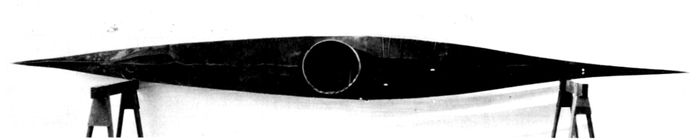
Figure 202
Deck of Greenland Kayak from Disko Bay (USNM 72564). (Smithsonian photo 15726-C.)
The model of the kayak used on much of the central and southern coasts of Greenland has changed rather extensively since 1883, and this change has apparently affected the kayaks used on the east coast as well. In this part of the Arctic, the Eskimo are notable kayakers and the boat is not only well designed but also carries highly developed equipment and weapons for its work. The basic model used is a graceful V-bottom one, with raking ends and rather strong sheer. In the old boats represented by the drawings of figures 206 and 207, the sheer is strong at bow and stern, but this form has been gradually going out of favor. The kayaks are narrow but their shape gives them much stability. Pegged to the bow and stern are plates of bone to protect them from ice; in rare cases these bone stem bands, or bang plates, are lashed in place. The first drawing shows the construction used: light strong gunwales and a 3-batten longitudinal system with bent transverse frames. The keelson and chines—light, rectangular in section and placed on edge—are shaped slightly to fair the sealskin covering. The cover passes under the manhole rim. Bow and stern are made of plank on edge, shaped to the required profile. The gunwales are strongly tapered in depth fore and aft. Eight to twelve thwarts, or deck beams, are used in addition to the two heavy thwarts supporting the manhole; usually there is one more forward of the manhole than there is aft, and all are very light scantlings. The thwart forward of the manhole stands slightly inside the cockpit and is strongly arched; the after one is clear of the cockpit opening and has very little arch. Two light, short battens, or carlins, 24 to 36 inches long support the deck, where it sweeps up to the raked manhole, and usually there are two abaft the manhole as well. Lashings are used as fastenings except at the ends of the hull, where pegs secure the keelson to the stem and stern; at this point, on some kayaks examined, sinew lashings are also found. The whole framework is strong, light, and neatly made. In a few instances the gunwales do not flare with the sides the whole length and, thus, near the stern, a knuckle is formed in the skin cover, as in figure 207, opposite. The exact amount of flare and deadrise varies village to village. The old kayaks used in eastern Greenland had more rake in the bow than the examples illustrated, and also were marked by a sheer almost straight from the bow to within a foot or so of the stern, where it turned up sharply to a high stern, as in the drawing (fig. 191, p. 203.) These kayaks also had less flare and deadrise than most of the southwestern Greenland models. The amount of rocker in the keelson varies a good deal, that shown in figure 206, opposite, appears to have been about the maximum; a straight keelson does not seem ever to have been used. The manholes are fitted to allow use of the watertight paddling jacket; the projecting rim shown at the after-side of the manhole in the drawing is primarily to strengthen the manhole rim, but may also serve to prevent the drawstring holding the skirt of the jacket to the rim from slipping over the top. This old form of Greenland kayak, which has been widely described and much admired, was a fast and handy hunting boat; but it has become obsolete in most areas, and seems to have gone out of use more rapidly on the east coast than the west, where the type represented in the drawing was built as late as 1959 at Umanak Fjord.
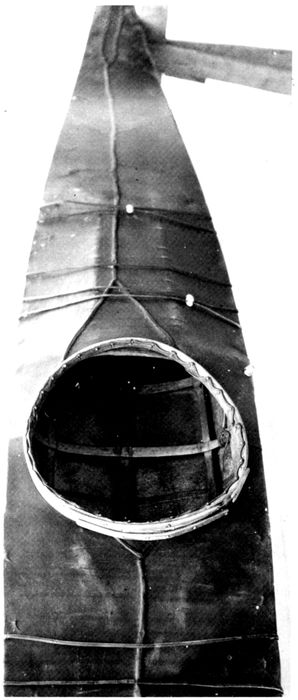
Figure 203
Cockpit of Greenland kayak from Disko Bay. (USNM 72564). (Smithsonian photo 15726.)
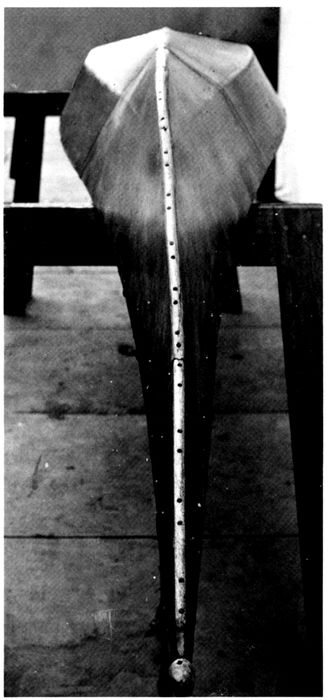
Figure 204
Bow View of Greenland kayak from Disko Bay (USNM 72564). (Smithsonian photo 15726-A.)
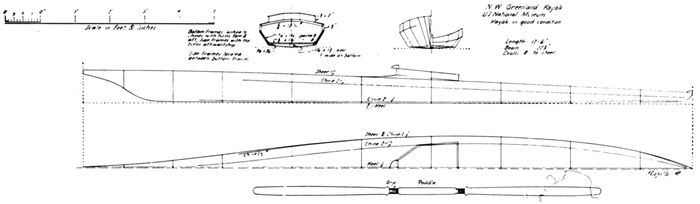
Figure 205
Northwestern Greenland Kayak, in the U.S. National Museum (USNM 160388).
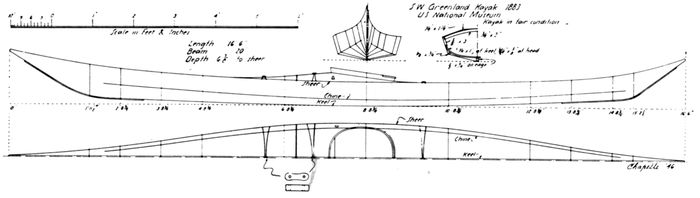
Figure 206
Southwestern Greenland Kayak, 1883, in the U.S. National Museum (USNM 160328).
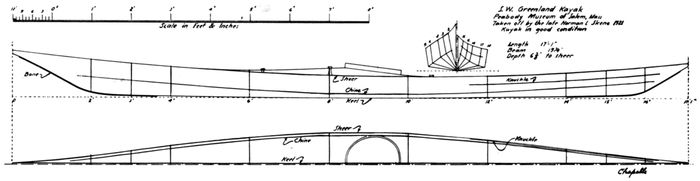
Figure 207
Southwestern Greenland Kayak, in the Peabody Museum, Salem, Mass. Taken off by the late Norman L. Skene, 1921.
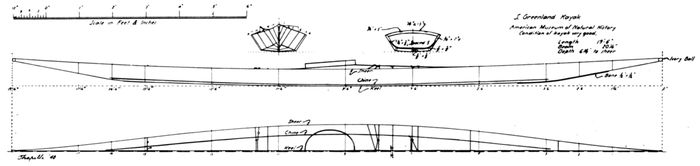
Figure 208
South Greenland Kayak, in the American Museum of Natural History.
Since the 1880's it has been gradually replaced by the type shown above. The modern version has the same construction as the old but, as can be seen, the model has undergone much alteration. The rake of the bow and stern have become much greater; the sheer is now almost straight. The flare of the sides has been increased and the deadrise in the bottom has been reduced. The new model is undoubtedly an improvement over the old type, being faster (particularly against a headwind) and quicker turning. However, it would probably be found to be somewhat harder than the old model to right when capsized. And although the new model is more stable than the old, it is not suited for unskilled users; a few American soldiers drowned during World War II through rashly venturing into rough water before becoming practiced in the use of these kayaks.
The intricate arrangement of deck lashings shown are required to hold weapons and accessories. Just ahead of the paddler a stand or tray on low legs holds the coiled harpoon line; and under the deck lashings are held such weapons as the lance, darts, and harpoons. Toggles of bone or ivory, often carved, are used to tighten and adjust these lines. The Greenland kayaks carry deck fittings and gear that are far better developed than those seen in any of the western types.