Chapter Four EASTERN MARITIME REGION
Reading edition
Study of the tribal forms of bark canoes might well be started with the canoes of the eastern coastal Indians, whose craft were the first seen by white men. These were the canoes of the Indians inhabiting what are now the Maritime Provinces and part of Quebec, on the shores of the St. Lawrence River and in Newfoundland, in Canada, and of the Indians of Maine and New Hampshire, in New England. Within this area were the Micmac, the Malecite, and the mixture of tribal groups known as the Abnaki in modern times, as well as the Beothuk of Newfoundland. All these groups were expert canoe builders and it was their work that first impressed the white men with the virtues of the birch-bark canoe in forest travel.
Micmac
The Micmac Indians appear to have occupied the Gaspé Peninsula, most of the north shore of New Brunswick and nearly all the shores of the Bay of Fundy as well as all of Nova Scotia, Prince Edward Island, and Cape Breton. They may have also occupied much of southern and central New Brunswick as well, but if so they had been driven from these sections by the Malecites before the white men came. The Micmacs were known to the early French invaders under a variety of names; "Gaspesians," "Canadiens," "Sourikois," or "Souriquois," while the English colonists of New England called them merely "Eastern Indians." The name Micmac is said to mean "allies" and not known, but this name was in use early in the 18th century, if not before 1700.
The Micmac were a hunting people with warlike characteristics; they aided the Malecite and other New England Indians in warfare against the early New England colonists and in later times aided the French against the English in Nova Scotia and New Brunswick. These Indians lived in an area where water transport represented the easiest method of travel and so they became expert builders and users of birch-bark canoes, which they employed in hunting, fishing, general travel, and warfare.
The area in which they lived produced fine birch bark and suitable wood for the framework. Through experience, they had become able to design canoes for specific purposes and had produced a variety of models and sizes. The hunting canoe was the smallest, being usually somewhere between 9 and 14 feet long, with an occasional canoe as long as 15 feet. This light craft, known as a "woods canoe" and sometimes as a "portage canoe," was intended for navigating very small streams and for portaging. Another model, the "big-river canoe," somewhat longer than the woods canoe, was usually between 15 and 20 feet long. A third model, the "open water canoe," was for hunting seal and porpoise in salt water and ranged from about 18 feet to a little over 24 feet in length. The fourth model, the "war canoe," about which little is known, appears to have been built in either the "big-river" or "open-water" form, and to the same length, but sharper and with less beam so as to be faster.
The tribal characteristics of the Micmac birch-bark canoes were to be seen in the form of the midsection, in certain structural details, and in their generally sharp, torpedo-shaped lines. The construction was very light and marked by good workmanship. The distinctive profiles of bow and stern, which do not appear in the canoes of other tribes in so radical a form, were almost circular, fairing from the bottom around into the sheer in a series of curves. The break in the profile of the ends at the sheer, a break that marks in more or less degree, the end profile of other tribal forms, never occurs in the Micmac canoe. At most, a slight break in the "streamlined" curve might occur at the point where the profile was started in the bottom, at which point there might be a short, hard curve.
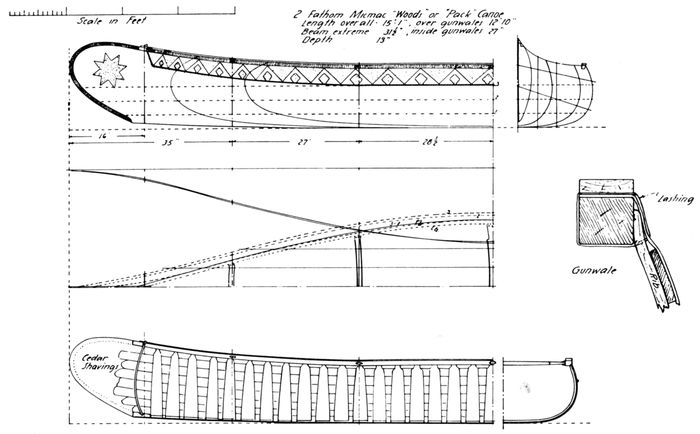
Figure 49
Micmac 2-Fathom Pack, or Woods, Canoe for woods travel with light loads, used by the Nova Scotia Micmacs.
The form of the sheer line of the Micmac canoes apparently varied with the model: the woods canoe had the usual curved sheer with the point of lowest freeboard about amidships, the big river canoe had either a nearly straight sheer or one very slightly hogged, while the open-water canoe had a strongly hogged sheer in which the midship portion was often as much as 3 or 4 inches above that just inboard of the ends. However, there is a possibility that, at one time, the sheer of all Micmac canoes was more or less hogged. The little that is known of the war canoes of colonial times indicate that they had the strongly hogged sheer that now marks the open-water model, through it is also known that some of these were really of the big-river model, which in later times had usually no more than a vestige of the hogged sheer.
The hull-forms of the Micmac canoes were marked in the topsides by a strong tumble-home, carried the full length of the hull, that gave these canoes more beam below than at the gunwale. The form of the midsection varied with the model; the woods canoe usually had a rather flat bottom athwartships, the big river canoe a slightly rounded bottom, and the open water canoe either a well-rounded bottom or one in the form of a slightly rounded V. The fore-and-aft rocker in the bottom was always moderate, usually occurring in the last few feet near the ends; however, many of the canoes were straight along the bottom. This condition will be again referred to in discussing the building beds used in this type. The ends were usually fine-lined; in plan view the gunwales came into the ends in straight or slightly hollow lines. The level lines below the gunwales might also be straight as they came into the ends, but were commonly somewhat hollow; a few examples show marked hollowness there. Predominantly, the Micmac canoes were very sharp in the ends and paddled swiftly. Early Micmac canoes seem to have been narrower than more recent examples, which are usually rather broad as compared to the types used by some other tribes.
Structurally, the Micmac canoes were distinguished by the construction of the ends and by their light build throughout. The canoes had no inner framework to shape the ends; stiffness there was obtained by placing battens outside the bark, one on each side of the hull, that ran from the bottom of the cut in the bark required to shape the ends to somewhat inboard of the ends of the gunwales at the sheer. These two battens, as well as a split-root stem-band covering the raw ends of the cut bark, were held in place by passing a spiral over-and-over lashing around all three. Sometimes thicker battens reaching from the high point of the ends inboard to the end thwarts were added, in which case the side battens were stopped at the high point of the ends and there faired into the thick battens.
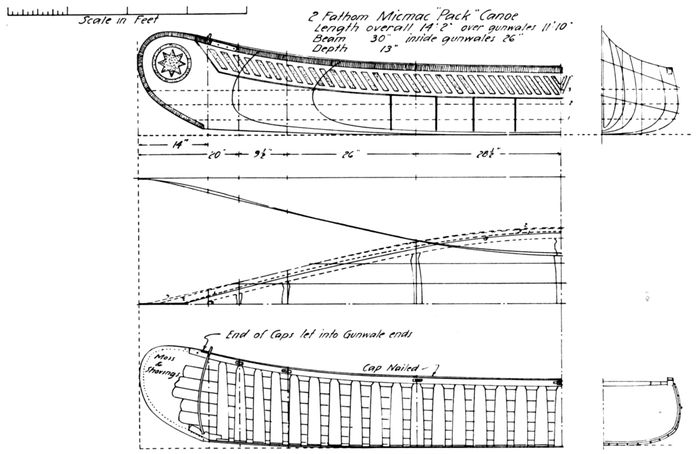
Figure 50
Micmac 2-Fathom Pack, or Woods, Canoe with Northern Lights decoration on bow, and seven thwarts.
The gunwale structure was rather light, the maximum cross section of the main gunwale in large canoes being rarely in excess of 1¼ inches square. These members usually tapered slightly toward the ends of the canoe and had a half-arrowhead form where they were joined. Old canoes had no guard or outwale, but some more recent Micmac canoes have had a short guard along the middle third of the length. Often there was no bevel to take the rib ends on the lower outboard corner of the main gunwales, and the gunwales were not fitted so that their outboard faces stood vertically. Instead, the tenons in the gunwales were cut to slant upward from the inside, so that installation of the thwarts would cause the outboard face to flare outward at the top. Between this face and the inside of the bark cover were forced the beveled ends of the ribs, which were cut chisel-shape. However, some builders beveled or rounded the lower outboard corner of the main gunwale, as described under Malecite canoe building (p. 38). The bark cover in the Micmac canoe was always brought up over the gunwales, gored to prevent unevenness, and folded down on top of them before being lashed. The gunwale lashing was a continuous one in which the turns practically touched one another outboard, though they were sometimes separated under the gunwale to clear the ribs, which widened near their ends, so the intervals between them were very small.
The other member of the gunwale structure was the cap; its thickness was usually ¼ to ⅜ inch, reduced slightly toward the ends. Its inboard face and the bottom were flat, but the top was somewhat rounded, with the thickness reduced toward the outboard edge. The cap was fastened to the main gunwales with pegs and with short lashing groups near the ends, but in late examples nails were used. The ends of the caps were bevelled off on the inboard side, so that they came together in pointed form. The cap usually ended near the end of the gunwale but in some canoes, particularly those that were nail-fastened, the cap was let into the gunwale (see p. 50) so that the top was flush with end of the gunwale.
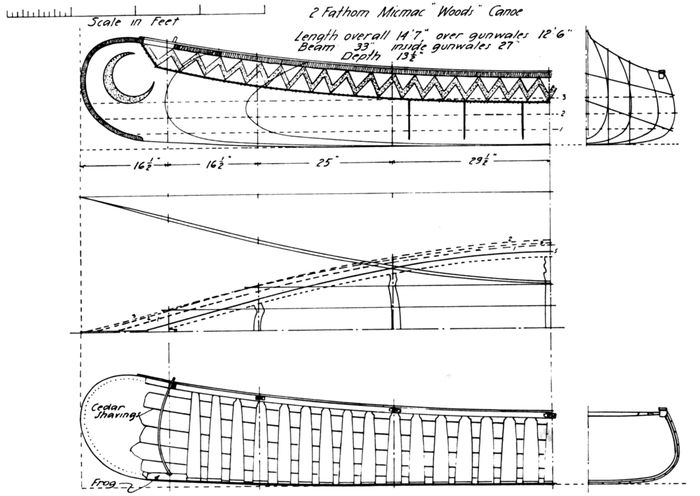
Figure 51
Micmac 2-Fathom Pack, or Woods, Canoe with normal sheer and flat bottom.
The ends of the gunwales were supported by headboards that were bellied outboard to bring tension vertically on the bark cover. The heel of the board stood on a short frog, laid on the bottom with the inboard end touching or slightly lapping over the endmost rib. The frog supported the heels of the headboard and also the forefoot of the stem-piece, which otherwise would have but partial support from the sewing battens outside the ends at these points. The headboard was rather oval-shaped and the top was notched on each side to fit under the gunwale; the narrow central tenon stood slightly above the top of the main gunwales when the headboard was sprung into place and was held in position by a lashing across the gunwales inboard of the top of the headboard. The heel was held by the notch in the frog. Cedar shavings were stuffed into the ends of the canoe between the stem-piece and the headboard to mold the ends properly, as no ribs could be inserted there. All woodwork in these canoes was white cedar, except the headboards and thwarts, which were maple, and the stem battens, which were usually basket ash but sometimes were split spruce roots.
The more recent Micmac canoes usually had no more than five thwarts; this number was found even on small woods canoes. However, old records indicate that canoes 20 to 28 feet long on the gunwales were once built with seven thwarts. The shape of the thwarts varied, apparently in accordance with the builder's fancy. The most common form was nearly rectangular in cross-section; in elevation, it was thick at the hull centerline and tapered smoothly to the outboard ends; and in plan it was narrowest at the hull centerline and increased in width toward the ends, the increase being rather sharp at the shoulders of the tenon. In some, the tenon went through the main gunwales and touched the inside of the bark cover; in others the ends of the thwarts were pointed in elevation, square in plan, and were inserted in shallow, blind tenons on the inboard side of the main gunwales. A single 3-turn lashing through a hole in the shoulder and around the main gunwale was used in every case.
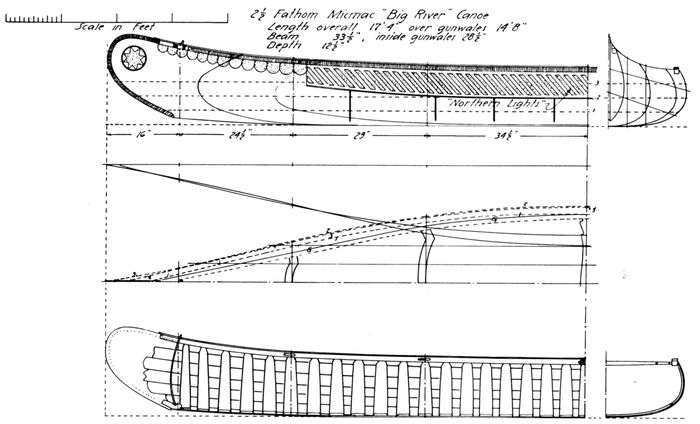
Figure 51
Micmac 2-Fathom Pack, or Woods, Canoe with normal sheer and flat bottom.
Sometimes the thwarts just described were straight (in plan view) on the side toward the middle of the canoe, and only the middle thwart was alike on both sides. In others the straight side of the end thwart and of that next inboard were toward the bow and stern of the canoe. In still others, the middle thwart had a rounded barb form in plan, with the barb located within 6 or 7 inches of the shoulder and pointed toward the tenon; the next thwarts out on each side of the middle thwart were shaped like a cupid's bow but slightly angular and aimed toward the ends of the canoe, and the end thwarts were of similar plan. In one known example having such thwarts, there were two very short thwarts at the ends of the canoe, of the usual plain form described earlier, each a few inches inboard of the headboard. Thus this canoe had seven thwarts in the old fashion.
The ribs, or frames, were thin, about ¼ or 5⁄16 inch thick, and across the bottom of the canoe they were often 3 inches wide. In the topsides the ribs were tapered to about 2 inches in width; when the bottom and outboard corner of the main gunwales were not beveled, the rib ends were cut square across on the wide face and chisel-shaped. When the gunwale corner was beveled, the ribs were formed with a sharply tapered dull point at the ends. From the middle of the canoe to the first thwarts each way from the middle, the ribs were spaced 1 inch edge-to-edge. From the first thwarts to the ends, the spacing was about 1½ inches. Most builders made the ribs narrower toward the ends; if those in the middle of the canoe were 3 inches wide, those near the ends might be 2½. They were shaped and placed as described for the Malecite canoe in Chapter 3.
In the construction of a Micmac canoe, the gunwales were first formed, assembled, and used as a building frame. If the sheer was to be hogged, this was done by treating the main gunwales with boiling water before assembly and then staking them out to dry in the required sheer curves. The building bed was well crowned, usually 2 to 2½ inches because of the very wide bottom and the tumble-home of these canoes. Most Micmac canoes appear to have had only slight fore-and-aft rocker in the bottom; the bottoms of the seagoing type were often quite straight, and the other two types had a slight rocker of perhaps 1½ inches, most of it near the ends. When the sheer was hogged, the amount of hog was probably close to the amount of crown in the building bed. The ends of the gunwales, when laid on the bed, were blocked up to about the desired amount of rocker to be given the bottom.
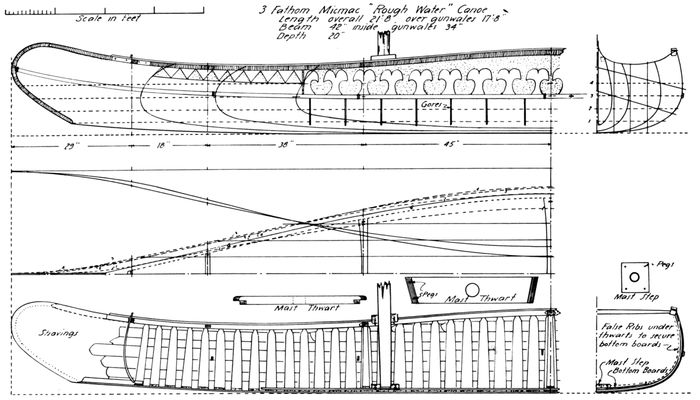
Figure 53
Micmac 3-Fathom Ocean Canoe Fitted for Sailing. Short outwales or battens project gunwales to strengthen the ends of the canoe. Some specimens of this type of canoe had almost no rocker in the bottom.
The bark cover was selected with great care from the fine stand of paper birch available to the Micmac. Except in emergencies, only winter bark was used. The cover was gored six to eight times on each side, and most of these cuts were grouped amidships, owing to the sharpness of the ends. The gores were trimmed edge-to-edge, without overlap, as the Micmac preferred a smooth surfaced canoe, and the sewing was the common spiral, over and over. The width of the bark cover was usually pieced out amidships on each side (at least in existing models) by the addition of narrow panels. These may not have been necessary in the very old canoes, which appear to have been much narrower than more recent examples. The horizontal seams of the panels were straight, or nearly so, and did not follow the sheer. The closely spaced spiral over-and-over stitch was sewn over a batten, the lap being toward the gunwale. As has been said, a continuous over-and-over gunwale lashing was used. The thwart lashings were through single holes in the thwart shoulders, three turns being usual, and two turns around the gunwale on each side were added, all passing through the bark cover, of course. The sewing was neat and the stitches were even.
The wood lining, or sheathing, of the Micmac canoe was like that described for the Malecite canoe in the last chapter. The sheathing was a full ⅛ to about 3⁄16 inch thick. The strakes were laid edge-to-edge longitudinally, with slightly overlapping butts amidships, and were tapered toward the ends of the canoe. The maximum width of any strake at the butts was about 4 inches.
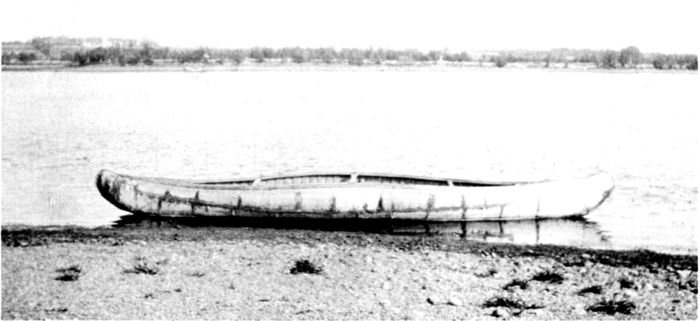
Figure 54
Micmac Rough-Water Canoe, Bathurst, N.B. (Canadian Geological Survey photo.)
In some of the rough-water canoes fitted to sail, a guard strip running the full length of the canoe and located some 6 or 7 inches below the gunwale was placed along both sides to protect the strongly tumble-home sides from abrasion from the paddles, particularly when the craft was steered under sail. These strips, about 5⁄16 inch thick and ¾ inch wide, were butted on each side, a little abaft amidships, and were held together by a single stitch. The guards were secured in place by rather widely spaced stitches around them that passed through the bark cover and ceiling, between the ribs in the topsides. At bow and stern, the ends of the guards butted against the battens outside the bark at the end profiles and were secured there by a through-all lashing.
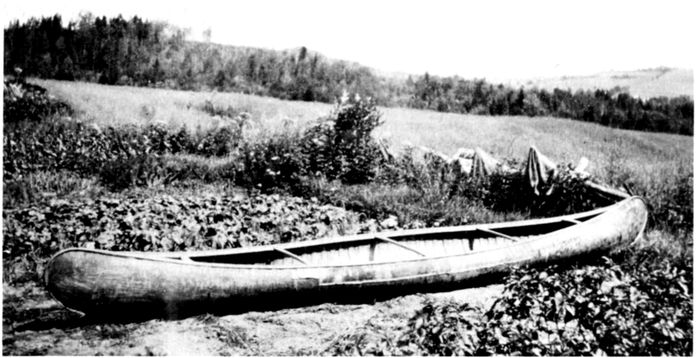
Figure 55
Micmac Woods Canoe, built by Malecite Jim Paul at St. Mary's Reserve in 1911, under the direction of Joe Pictou, old canoe builder of Bear River, N.S. Modern nailed type. (Canadian Geological Survey photo.)
The proportions and measurements of the Micmac canoes appear to have changed between the colonial period and the late 19th century. From early references, it is apparent that the early canoes were much narrower than later ones, in proportion to length, as mentioned earlier. An 18-foot rough-water canoe of the 18th century appears to have had an extreme beam of between 30 and 34 inches and a gunwale beam, measured inside the members, of 24 to 28 inches, the depth amidships being about 18 to 20 inches. A similar canoe late in the 19th century would have had an extreme beam of nearly 40 inches, a beam inside the gunwales of 33 or 34 inches, and a depth of about 18 inches or less. An early woods canoe, about 14 feet long overall, appears to have had an extreme beam of only 29 inches and a beam inside the gunwales of about 25 or 26 inches. A woods canoe of 1890 was 15 feet long, 36½ inches extreme beam, and 30 inches inside the gunwales, with the depth amidships about 11 inches. A big-river canoe of this same date was a little over 20 feet in extreme length, 18 feet over the gunwales, 41 inches extreme beam, and 34 inches gunwale width inside, with a depth amidships of about 12½ inches. An 18-foot big-river canoe of an earlier time was reported as being 37 inches extreme beam, 30½ inches inside the gunwales, and 13 inches depth amidships. The maximum size of the rough-water seagoing canoe, in early times, may have been as great as 28 feet but with a narrow beam of roughly 29 or 30 inches over the gunwales, and say 24 inches inside, with a depth amidships as much as 20 or 22 inches due to the strongly hogged sheer there. In modern times, such canoes were rarely over 21 feet in overall length and had a maximum beam of about 42 inches, a beam inside the gunwales of 36 or 37 inches, and a depth amidships of 16 or 17 inches.
In early colonial times, and well into the 18th century, apparently, the Micmac type of canoe was used as far south as New England, probably having been brought there by the Micmac war parties aiding the Malecite and the Kennebec in their wars against the English. The canoe in the illustration on page 12 is obviously a Micmac canoe and apparently one used by a war party. As it was brought to England in 1749 in the ship America, which was built in Portsmouth, New Hampshire, and probably sailed from there, it seems highly probable that the canoe had been obtained nearby, perhaps in eastern Maine.
The small woods canoe, most commonly about 12 feet long, appears first to have been used by all the Micmac. By the middle of the 19th century, however, this type was to be found only in Nova Scotia, owing to the movement of most of the tribe toward the north shore in New Brunswick, where their inland navigation was confined to large rivers and the coast. Hence the Micmac in New Brunswick used the big-river model and the seagoing type. The latter was last used in the vicinity of the head of Bay Chaleur and was often called the Restigouche canoe, after the Micmac village of that name. It was replaced by a 3-board skiff-canoe and finally by a large wooden canoe of the "Peterborough" type with peaked ends and lapstrake planking; some of the latter may still be seen on the Gaspé Peninsula.
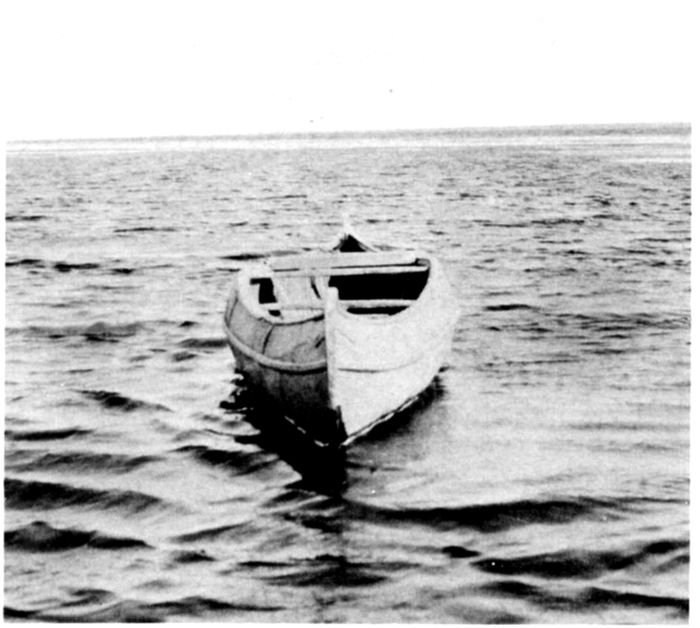
Figure 56
Micmac Rough-Water Canoe fitted for sailing. (Photo W. H. Mechling, 1913.)
The use of sail in the Micmac canoes cannot be traced prior to the arrival of the white men. The use probably resulted from the influence of Europeans, but it is possible that the prehistoric Indians may have set up a leafy bush in the bow of their canoes to act as a sail with favorable winds. The old Nova Scotia expression "carrying too much bush," meaning over-canvassing a boat, is thought by some to have originated from an Indian practice observed there by the first settlers. In early colonial times, the Micmac used a simple square sail in their canoes and this, by the last decade of the 19th century, was replaced by a spritsail probably inspired by the dory-sail of the fishermen. The Indian rig was unusual in several respects. The sheet, for example, was double-ended; one end was made fast to the clew of the sail and the other to the head of the sprit, so that it served also as a vang. The bight was secured within reach of the steersman by a half hitch to a crossbar fixed well aft across the gunwales. The sail, nearly rectangular and with little or no peak, was laced to the mast, and the sprit was supported by a "snotter" lanyard tied low on the mast. A sprit boom was also carried by some canoes; this was secured to the clew of the sail and to the mast, a snotter lanyard being used at the latter position.
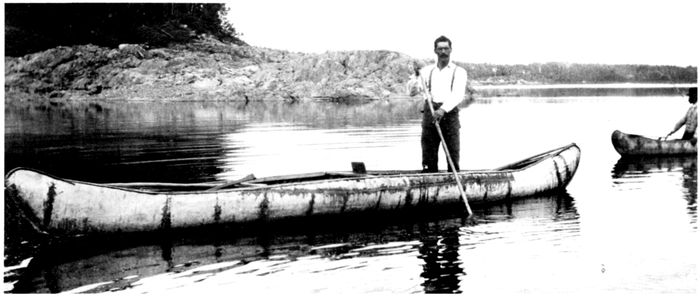
Figure 57
Micmac Rough-Water Canoe, Bay Chaleur. (Photo H. V. Henderson, West Bathurst, N.B.)
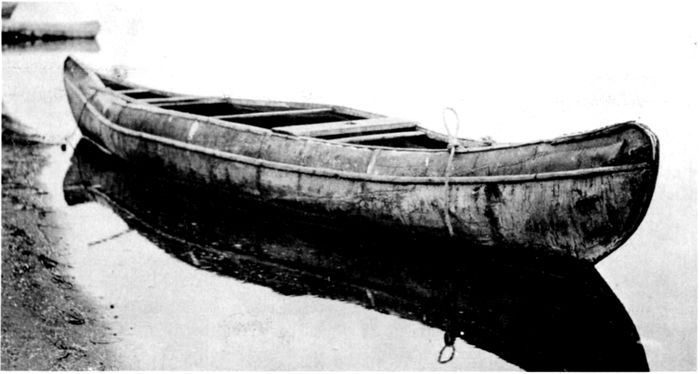
Figure 58
Micmac Rough-Water Sailing Canoe, Bay Chaleur. (Canadian Geological Survey photo.)
The mast was secured by a thwart pegged, or nailed, across the gunwale caps. Sometimes, the thwart was also notched over the caps, so that the side-thrust caused by the leverage of the mast would not shear the fastenings. The crossbar for the sheet was sometimes similarly fastened and fitted, with its ends projecting outboard of the gunwales. The heel of the mast was sometimes stepped into a block, which was usually about 5 inches square and 1½ inches thick, nailed or pegged to the center bottom board, or sometimes it was merely stepped into a hole in the center bottom board. The bottom boards, usually three in number were of wide, thin stock and were clamped in place over the ribs by three or four false frames driven under the thwarts, just as were the canoe ribs under the gunwales.
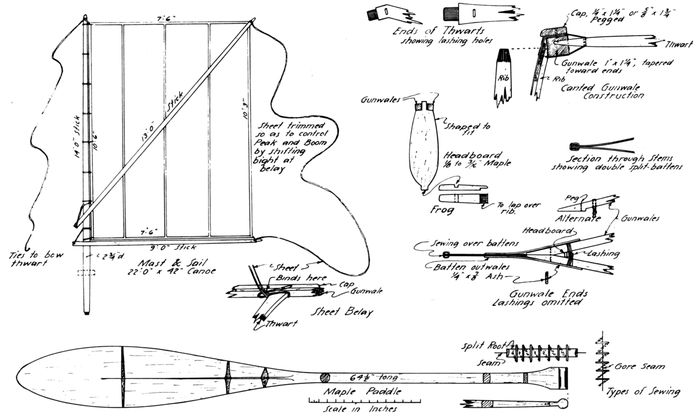
Figure 59
Details of Micmac Canoes, Including Mast and Sail.
The canoes could not sail close-hauled, as a rule, though some Indians learned to use a leeboard in the form of a short plank hung vertically over the lee side and secured by a lanyard to a thwart, the board being shifted in tacking. An alternate was to have a passenger hold a paddle vertically on the lee side. There seems to have been no fixed proportions to the area of sail used; the actual areas appear to have been somewhere between 50 and 100 square feet, depending upon the size of the canoe. Joseph Dadaham, a Micmac, stated in 1925 that he used "24 yards" in the sail of a "rough-water canoe" 20 feet long and about 44 inches beam, while one 18 feet long and about 36 inches extreme beam carried "16 to 18 yards"; it is obvious that the "yards" are of narrow sail cloth and not square yards of finished sail. In the last days of sailing bark canoes, mast hoops and a halyard block were fitted so that the sail could be lowered instead of having to be furled around the mast (to accomplish this the "crew" had to stand). Dadaham also stated that for his sheet belay he used a jamb-hitch which could be released quickly when the canoe was found to be overpowered by the wind. It appears that during the last era of these bark canoes the rig had been improved to fit it for open-water sailing.
The paddles used by the Micmac appear to have varied in shape. If the canoe shown in Chapter 1 (p. 12) was indeed a Micmac canoe as supposed, the paddle shown there is quite different from the later tribal forms illustrated above, and it is possible that the top grips shown in the more modern forms were never used in prehistoric times, when the pole handle shown with the old canoe may have been standard.
The Micmac canoes were decorated by scraping away part of the inner rind of the birch bark, leaving portions of it in a formal design. It seems very probable that the Micmac seldom used this form of decoration in early times, but later they used it a great deal in their rough-water canoes, perhaps as a result of contact with the Malecite. The formal designs used as decoration by the Micmac did not have any particular significance as a totem or religious symbol; they were used purely as decoration or to identify the owner. Such forms as the half-moon, a star in various shapes, or some other figure might be used by the builder, but these were apparently only his canoe mark, not a family insignia or his usual signature, and could be altered at will.
The usual method of decoration was to place the canoe mark on both sides of the canoe at the ends and to have along the gunwales amidships a long narrow panel of decoration, usually of some simple form. The panel decorations are said by Micmacs to have been selected by the builder merely as pleasing designs. One design used was much like the fleur-de-lis, another was a series of triangles supposed to represent camps, still another was the northern lights design, a series of closely spaced, sloping, parallel lines (or very narrow panels) that seem to represent a design much used in the quill decoration for which the Micmac were noted. Canoes are recorded as having stylized representations of a salmon, a moose, a cross, or a very simple star form; these may have been canoe marks or may once have been a tribal mark in a certain locality. A series of half-circles were sometimes used in the gunwale panels, which were rarely alike on both sides of the canoe, and it is probable that use was made of other forms that have not been recorded. Colored quills in northern lights pattern were used in some model or toy canoes but not in any surviving example of a full-size canoe. It is quite possible, however, that such quill-work was once used in Micmac canoe decoration. Painting of the bark cover for decorative purposes in Micmac canoes has not been recorded.
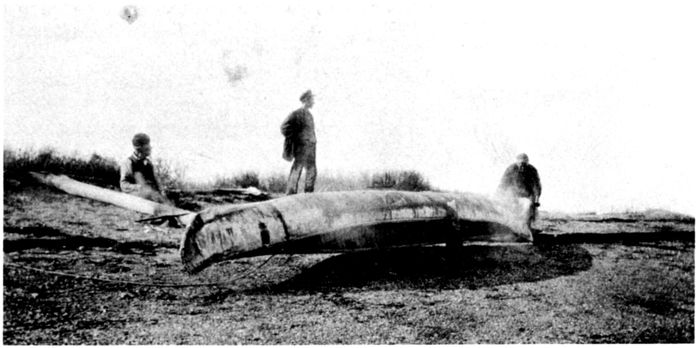
Figure 60
Micmac Canoe, Bathurst, N.B. (Canadian Geological Survey photo.)
Historical references to the canoes of the Micmac are frequent in the French records of Canada; it must have been Micmac canoes that Cartier saw in 1534 at Prince Edward Island and in Bay Chaleur. The most complete description of such canoes is in the account of Nicolas Denys, who came to the Micmac country in 1633 and remained there almost continuously until his death at 90, in 1688. His travels during this period took him into Maine as far as the Penobscot and throughout what are now New Brunswick and Nova Scotia. While his descriptions are primarily concerned with the Malecite dress, houses, and hunting and fishing techniques, his notes on birch-bark canoes seem to indicate very clearly that he is describing a hogged-sheer Micmac rough-water canoe. He says, for example, that the length of these canoes was between 3 and 4½ fathoms, the fathom being the French brasse, so that they ranged in length from 16 to 24 feet over the gunwales. This gunwale length seems reasonable, since Denys gives the beam as only about 2 English feet, obviously a gunwale measurement in view of the great tumble-home in these canoes. That the Micmac rough-water canoe is the subject of Denys' observations is further indicated by his statement that the depth was such that the gunwales came to the armpits of a man seated on the bottom. This could only be true in a canoe having a hogged sheer in the lengths given, and is, in fact, a slight exaggeration unless the man referred to was of less than average height. The depth would be about 22 English inches, great even for a 24-foot canoe. Denys states that the inside sheathing of these canoes was split from cedar. He also states that the splints were about 4 inches wide, were tapered toward the ends, and ran the full length of the canoe. It is probable that they were butted amidships, as in known examples; this, however, would have been covered by a rib and might not have been noticed.
Denys says that the Indians "bent the cedar ribs in half-circles to form ribs and shaped them in the fire." Adney believed this meant by use of hot water. However, this bending could have been done by what was known in 17th-century shipbuilding practice as stoving, in which green lumber was roasted over an open fire until the sap and wood became hot enough to allow a strong bend to be made without breakage. Wood thus treated, when cooled and seasoned somewhat, would hold the set. While it is certain that later Indians knew how to employ hot water, it does not follow that all tribes used this method, particularly in early times.
Denys also states that the roots of "fir," split into three or four parts, were used in sewing. He apparently used "fir" as a general name for an evergreen. It is probable that the roots used were of the black spruce. The technique of building he describes is about the same as that outlined in the last chapter. He says that the gunwales were round and that seven beech thwarts were employed, practices that differ from those in more recent Micmac canoe building, and he notes the goring of the bark cover. Denys states the paddles were made of beech (instead of maple as was perhaps the case) with blades about 6 inches wide and their length that of an arm (about 27 inches), with the handle a little longer than the blade. He also says that four, five, or six paddlers might be aboard a canoe and that a sail was often used. "Formerly of bark," the sail was made of a well-dressed hide of a young moose. Since it could carry eight or ten persons, the canoe Denys is referring to is obviously a large one. In his building description he does not mention headboards, rail caps, or the end forms. It may be assumed that he was then describing a canoe he had seen during construction but whose building he did not follow step by step.
De la Poterie, in his book published in 1722, gives a profile and top view of what must have been a Micmac canoe. The probable length indicated must have been about 22 English feet overall and about 32 inches extreme beam; seven thwarts are shown.
Late in the 19th century there appears to have been some fusion of Micmac and Malecite methods of construction, as Malecite built to Micmac forms and vice versa. This apparently did not produce a hybrid form so far as appearance was concerned but it did affect construction, in that inner end-frames were used and other details of the Micmac design were altered. The Micmac, having early come into close contact with the Europeans, were among the first Indians to employ nails in the construction of bark canoes, and this resulted in an early decadence in their building methods. Hence, some examples of their canoes show what the Indians termed broken gunwales, in which the ends of the thwarts were not tenoned into the gunwales, but rather were let flush into the top by use of a dovetail cut or, less securely, by a rectangular recess across the gunwale, and were held in place with a nail through the thwart end and the gunwale member.
From scanty references by early writers, it appears that a spiral over-and-over lashing was originally used by the Micmac on the ends and gunwales. The lower edges of the side panels were sewn over-and-over a split-root batten. In some extant examples the gores are sewn with a harness stitch; in others a simple spiral stitch is used. The cross-stitch does not appear to have been used by the Micmac. The gunwale caps were certainly pegged and the ends lashed; the bark cover was folded over the gunwale tops and clamped by the caps as well as secured by the gunwale lashings. Tacking the bark cover to the top of the gunwales, with the cap nailed over all, marks the later Micmac canoes. The use of nails and tacks seems to have begun earlier than 1850.
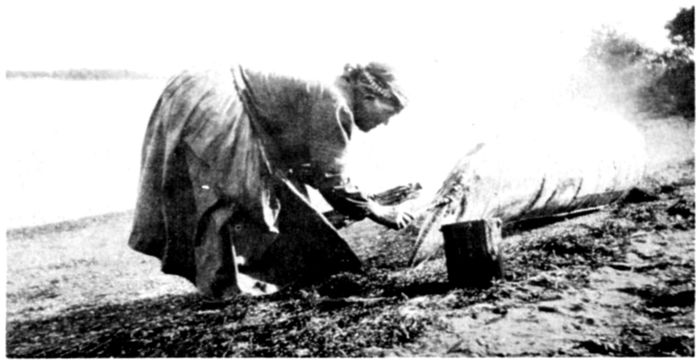
Figure 61
Micmac Woman gumming seams of canoe, Bathurst, N.B., 1913. (Canadian Geological Survey photo.)
In spite of decadent construction methods used in the last Micmac birch-bark canoes, the model remained a very good one in each type. The half-circular ends, sharp lines, and standard mid-sectional forms were unaltered; the hogged sheer was retained in some degree in at least two of the canoe types, the rough water and the big river, right down to the end of bark-canoe building by this tribe. The very fine design and attractive appearance of the Micmac canoe may have contributed to the early acceptance by the early explorers and traders of the birch-bark canoe as the best mode of water transport for forest travel.
Malecite
Another tribe expert in canoe building and use was the Malecite. These Indians were known to the early French explorers as the "Etchimins" or "Tarratines" (or Tarytines). Many explanations have been given for the name Malecite. One is that it was applied to these people by the Micmac and is from their word meaning "broken talkers," since the Micmac had difficulty in understanding them. When the Europeans came, these people inhabited central and southern New Brunswick and the shore of Passamaquoddy Bay, with small groups or tribal subdivisions in the area of the Penobscot to the Kennebec. These were early affected by the retreat of the New England Indians before the whites into eastern and northern Maine and southeastern Quebec. As a result, the Penobscot and Kennebec Indians became part of the group later known as Abnaki, while the Passamaquoddy Indians remained wholly Malecite and closely attached to those living along the St. John River in New Brunswick. Like their neighbors the Micmac, the Malecite were hunters and warlike; during the colonial period they were usually friendly to the French and enemies of the English settlers in their vicinity. It is not certain that the tribe now called by that name were actually of a single tribal stock; it is possible that this designation really covers a loose federation of small tribal groups who eventually achieved a common language. In addition, the tribal designation cannot be wholly accurate because of the fact that much of the original group living in New England were absorbed in the Abnaki in the 17th and 18th centuries. Therefore, the Malecite are considered here to be those Indians formerly inhabiting valleys of the St. John and the St. Croix Rivers, and the Passamaquoddy Bay area. The remaining portions, the Kennebec and Penobscot Indians, must now be classed as Abnaki, of whom more later (see p. 88).
In considering the birch-bark canoes of the Malecite, it is important to understand that this tribal form includes not only the types used in more recent times in New Brunswick and on Passamaquoddy Bay, but also an overlapping type related to the later Abnaki models. The old form of Malecite canoe used on the large rivers and along the coast appears to have had rather high-peaked ends, with a marked overhang fore and aft. The end profiles had a sloping outline, strongly curved into the bottom, and a rather sharply lifting sheer toward each end. This form was also to be seen in old canoes from the St. John River (the lower valley), the Passamaquoddy, the Penobscot, and the upper St. Lawrence. By late in the 19th century, however, this style of canoe had been replaced by canoes having rounded ends, the profiles being practically quarter-circles and sometimes with such small radii that a slight tumble-home appeared near the sheer. The small radius of the end curves is particularly marked in some of the seagoing porpoise-hunting canoes of the Passamaquoddy. In modern forms, the amount of sheer is moderate and the quick lift in the sheer to the ends is practically nonexistent. On the St. Lawrence, the radii of the end curves are very short and the upper part of the stems stands vertical and straight; the sheer, too, is usually rather straight. The older type, with high-peaked ends, was also marked by very sharp lines forward and aft, and had a midsection with tumble-home less extreme than in the Micmac canoes. The bottom, athwartships, was usually somewhat rounded (in coastal canoes the form might be a rounded V) and the bilges were rather slack, with a reverse curve above, to form the tumble-home rather close to the gunwales. The river model probably had lower ends and less rake than the coastal type, but surviving examples of both give confusing evidence. The river canoes usually had a flatter bottom than the coastal type, the latter having somewhat more rocker fore-and-aft. The sections near the ends were rather V-shaped in the coastal canoes, U-shaped in the river canoes.
The old form of small hunting canoe is represented by but one poor model (see p. 72) in which the ends are lower and with much less rake than those of the river type. From this very scant evidence, it seems probable that the small woods canoes were patterned on the river canoe in all respects but the profile of the ends.
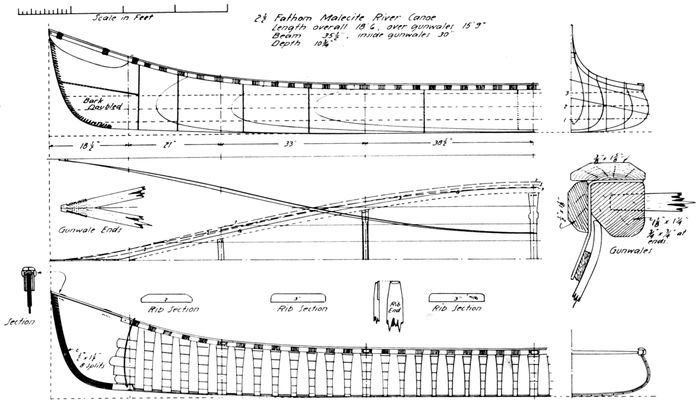
Figure 62
Malecite 2½-Fathom River Canoe, 19th Century. Old form with raking ends and much sheer.
From the early English and French accounts, it is evident that none of the maritime Indians used very large or long war canoes, capable of holding many men. The old war canoes of the Malecite appear to have been either of the coastal or river types as the circumstances of their place of building and use dictated. The slight information available in these accounts suggests that the war canoe did not differ in appearance from the other types of Malecite canoes, and that they were not of greater size. The Malecite appear to have followed the same practices as the Micmac, using for war purposes canoes of standard size and appearance but narrower and built for speed, since a war party sought to travel rapidly to and from its objective in order to surprise the enemy and escape before organized pursuit could be formed. The Malecite placed four warriors in each canoe, two to paddle and two to watch and use weapons while afloat. However, only on rare occasions were bows and arrows used from canoes afloat; most fighting was done on land. Each canoe carried the personal mark of each of the four warriors, apparently one mark on each flap, or wulegessis, under the gunwales near the ends. When a war leader was carried however, only his mark was on his canoe. After a successful raid, the Malecite used to race for the last mile or so of the return journey, and the winning canoe was given, as a distinction, some mark or picture, often something humorous such as a caricature of an animal. This practice, however, was not confined to war canoes; in rather recent times it has been noted that such pictures were placed on any canoe that had shown outstanding qualities in racing competition or in exhibitions of skill.
When making long canoe trips, the Malecite followed the widespread Indian practice of using the canoe as a shelter at night. When a camping place was reached, the canoe was unloaded, carried ashore, and turned upside down so that the tops of the ends and one gunwale rested on the ground. If the ends were high enough, as in the old Malecite type, one gunwale was raised off the ground far enough to permit a man to crawl under. If, as in the Micmac canoes, the ends were too low to allow this, they were raised off the ground by short forked sticks, with the forks resting against the end thwarts and the upper gunwale and the heels stuck into the earth. The dunnage (provisions or other cargo) was then stowed on the ground under the ends of the canoe and the two men would sleep under a single blanket with their feet pointed in opposite directions, each with his head on a pile of dunnage. If there were too many men aboard to do this, in bad weather a crude shelter was made by resting some poles on the upturned bilge and covering them with sheets of bark; under such a shelter meals could be cooked.
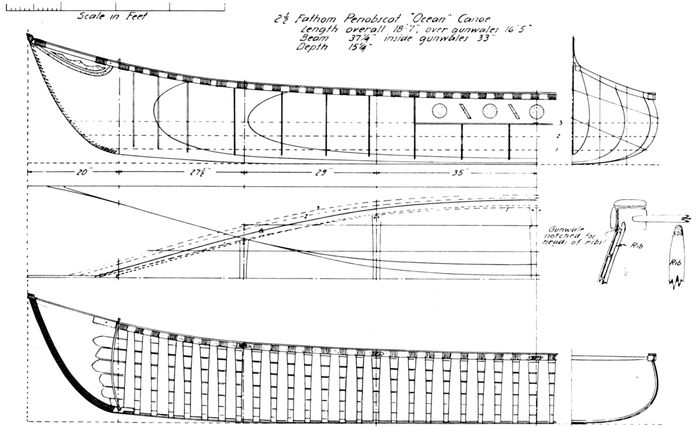
Figure 63
Old Form of Malecite-Abnaki 2½—Fathom Ocean Canoe of the Penobscots. In the Peabody Museum, Salem, Mass.
As did many of the eastern Indians, the old Malecite tribesmen built canoes of materials other than birch bark. When a canoe was required for a temporary use such as in hunting, it could be made of spruce bark. (As the designs of such canoes were rather standardized, they will be dealt with in Chapter 8.) When bark was unobtainable, the Malecite built canoes covered with moosehide, or, in rare instances, they built wooden dugouts.
The old Malecite river canoe shown on page 71 will serve to illustrate a description of the details of construction that were used. These canoes were obviously built with their gunwales (which were the length of the bottom only) serving as a building frame. The ends of the gunwales were supported by headboards stepped on the heels of the inner stem-pieces, and the stems raked outward from their heels. The gunwale ends were joined to the head of the stem-piece by the outwales and the gunwale caps. Bark was used to the ends of the canoe. One side of the bark cover was cut so that it stood well above the sheer line from the gunwale end outboard, and the opposite side was cut to the level of the sheer. The first piece was then folded over the opposite side and down, so that it covered both the extreme ends of the gunwales and the top of the inner stem-piece. Another piece of bark was then fitted over this fold, and this new piece formed the flaps below the outwales on each side, the wulegessis. The outwales ran past the gunwale ends and were cut off flush with the outboard face of the stem; the caps ran likewise and covered the bark over the head of the inner stem piece. The characteristic sheer of these canoes, where the rise toward the ends began, showed a quick curve that faired into a rising straight line at the gunwale and then continued straight and rising to the stem head. The wulegessis was therefore quite long. The ends of the gunwales were not of the half-arrowhead shape, but were snied off on their inboard sides so that they met on a rather long bevel; the lashing was slightly let in to the outboard faces to keep it from slipping over the gunwale ends. The caps of the gunwales were similarly reduced in width, where they came together over the ends of the canoe.
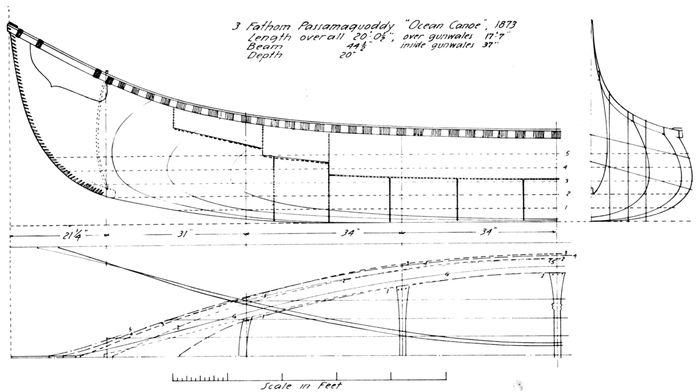
Figure 64
Large 3-Fathom Ocean Canoe of the Passamaquoddy porpoise hunters. These canoes were sometimes fitted to sail or outrigged for rowing. The last of this type had much lower ends.
The main gunwale members were about 1¼ inches square amidships, tapering to ¾ inch at the ends. The lower outboard corner was beveled to take the ends of the ribs, as shown on page 71, and the lower inboard corner was also beveled or rounded, but to a lesser degree. The upper inboard corner, shown beveled in the drawing of figure 62, was sometimes slightly rounded, as were the outwales. Amidships the outwale was about 1 inch deep, and it tapered toward the ends, where its depth was about ⅝ inch, the thickness being ½ inch amidships and a scant ⅜ inch at the ends. On the canoe shown, the cap was ⅜ inch thick, tapering to about 5⁄16 inch at the ends, and 1¾ inches wide amidships, tapering to about ⅝ or ½ inch where the caps came together at the ends. The top corners of the cap were beveled in the example.
The sheathing appears to have been about 3⁄16 inch thick on the average. On the bottom and sides it was in two lengths, overlapping slightly amidships. Toward the ends of the canoe the sheathing was tapered, maximum width of the splints being about 4 inches amidships.
The canoe, which was 18 feet 6 inches long overall, had 46 ribs. These were about 3 inches wide and ⅜ inch thick from the center to the first thwart outboard on each side, and 2 inches wide from these thwarts to the ends, except for the endmost five ribs, which were roughly 1¾ inches wide. The drawing on page 71 shows the shape of the thwarts. The ends were tenoned through the gunwales, and there were three lacing holes in the ends of the middle and first thwarts and two in the end thwarts. The beam of the canoe inside the gunwales was 30 inches and outside, 31¼ inches; the tumble-home made the extreme beam 35½ inches. The canoe was rather flat bottomed athwartships and quite shallow, the depth amidships being 10¾ inches.
The building bed must have had about a 1½ inch crown at midlength. It is probable that the stem pieces were not fixed in place until after the gunwales had been raised to sheer height. The gunwales were lashed with the Malecite group lashings, each of four turns through the bark and spaced at 3 to 3½ inches apart in the midlength and at 2 inches from the end thwarts to the headboards. Two auxiliary lashings were placed over the outwales and caps outboard of the gunwale ends, one about 6 inches beyond the ends of the gunwales and the other against the inboard side of the stem-piece. The end closure was accomplished by the usual spiral lashing passed through the laminated stem pieces. The latter were split (to within about 4 inches of the heel), into six or more laminae that were closely wrapped with bark cord. The headboards were bellied toward the ends to keep the bark cover under tension, and the ends outboard of the headboards were stuffed with shavings or moss.
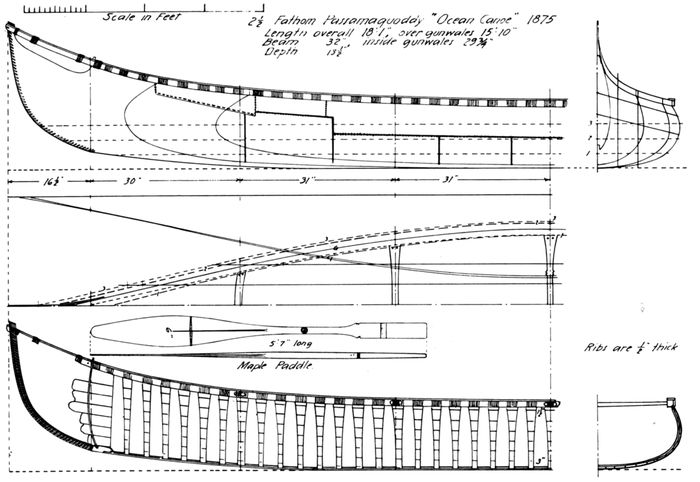
Figure 65
Old Form of Passamaquoddy 2½-Fathom Ocean Canoe with characteristic bottom rocker and sheer. This rather small, fast canoe for coastal hunting and fishing was common in the 19th century.
A canoe from the Penobscot River, obtained in 1826 by the Peabody Museum, Salem, Massachusetts, and described in The American Neptune for October 1948, shows that the Penobscot built their canoes on the old Malecite model. The canoe is apparently a coastal type. It has some round in the bottom amidships and V-sections toward the ends; it is 18 feet 7 inches long overall, 37¼ inches maximum beam, 15¼ inches deep amidships, and the ends stand 26 to 28 inches above the base line, the bow being slightly higher and with more rake than the stern. The rocker takes place within 4 feet of the ends, with the bottom straight for about 8 feet along the midlength. The bilges amidship are slack, and the reverse curve to form the tumble-home starts within 6 inches of the gunwales (see drawing, p. 72.)
A much later coastal canoe of the Passamaquoddy, a porpoise-and seal-hunting canoe built in 1873, will also serve to show the old type (see p. 73). This style of canoe was usually built in lengths ranging from 18 to 20 feet overall, the maximum beam was between 25 and 44 inches, and the beam inside the gunwales was between 29½ and 36 inches. The depth amidships ranged from about 18 to 21 inches, and the height of the ends above the base was from 28 or 30 inches to as much as 45 inches. The ribs numbered from 42 to 48 and were 3 inches wide and ½ inch thick. The sheathing was from ¼ to ⅜ inch thick and the rocker of the bottom, from 4 to 6 inches, took place within the last 4 or 5 feet of the ends. The midsection showed a well-rounded bottom, a slack bilge, and the high reverse to form the tumble-home seen in the old Penobscot canoe at Salem. These canoes were still being built well into the 1880's, if not later, and are to be seen in some old U.S. Fish Commission photographs of porpoise and seal hunting at Eastport, Maine. Seal-and porpoise-hunting canoes carried a sail, usually the spritsail of the dory. While this model probably was little changed in construction from early times, the surviving examples and models are of the period when nails were employed. The drawing on page 74 is of a small coastal hunting canoe of the same class, built in 1875.
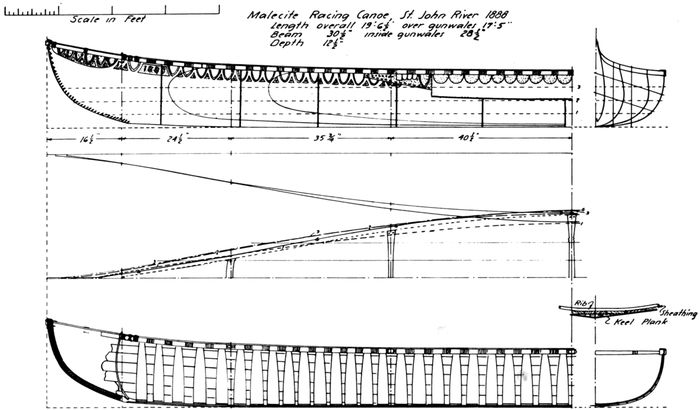
Figure 66
Malecite Racing Canoe of 1888, showing V-shaped keel piece placed between sheathing and bark to form deadrise.
The reasons for the gradual decline in the building of canoes of the old style are not known, and the transition from the high-peaked ends to the more modern low and rounded ends was not sudden. It apparently began in some inland areas, particularly on the St. Lawrence and the St. John Rivers, at least as early as 1849, and the new trend in appearance finally reached the coast about 25 years later. In the period of transition, the high-peaked model developed toward the St. Francis type, or that of the modern "Indian" canvas canoe, as well as toward the low-ended type.
One of the later developments took place on the St. John River, in New Brunswick, where two Indians, Jim Paul and Peter Polchies, both of St. Marys, in 1888 built for a Lt. Col. Herbert Dibble of Woodstock the racing canoe illustrated above (fig. 66). This canoe, 19 feet 6½ inches long overall and only 30½ inches extreme beam, was of a design perhaps not characteristic of any particular type of Malecite canoe, but it nevertheless shows two elements that may have appeared during the period of change in model. The sides amidships not only are without tumble-home, they flare outward slightly, but tumble-home is developed at the first thwart each side of the middle and continues to the headboards. The bottom shows a marked V-deadrise achieved by an unusual construction in a birch-bark canoe: the center strake of the sheathing is shaped in a shallow V in cross section, its width being about 2½ inches amidships and tapering each way toward the ends, and its thickness along the longitudinal centerline being about ⅝ inch and tapering to about ¼ inch at the edges; the two lengths of the strake are butted, not lapped, amidships, though the rest of the sheathing is lapped at the butts in the usual way and is uniformly ¼ inch thick. In this manner a ridge that gives a V-deadrise is formed down the centerline of the bottom, though the frames are bent in a flattened curve from bilge to bilge. The bottom has very little rocker, the rise being only 1 inch, and this takes place in the last 2 feet inboard of the heel of the stem piece.
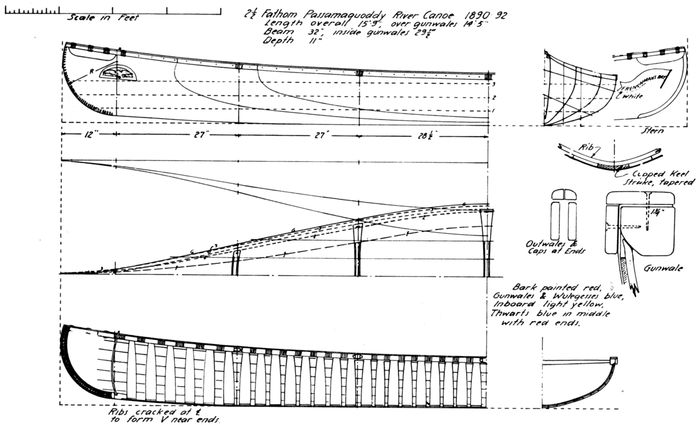
Figure 67
Sharp-Ended 2½-Fathom Hunting Canoe for use on tidal river. Built by the Passamaquoddy Indian Peter Denis, it shows what may be the primitive construction method of obtaining a V-form in hull.
Another feature in this canoe is the end profile; the curved ends are strongly raked, the curve used being the same as that in the old Malecite type, but with the stem-pieces reversed, so that the quick turn is at the head, near the sheer, rather than at the heel. As a result, the gunwales come to the ends in a straight, rising line for the last 16½ inches rather than as a sudden lift near the ends. The stem-heads stand a little above the rail caps. The headboards belly toward the ends and are raked in the same direction.
The use of a V-shaped keel piece in the sheathing has been found in a St. Francis canoe from the St. Lawrence country; this may be a rather old practice. This racing canoe is very lightly built and much decorated, the date 1888 being worked into the hull near one end.
Another canoe having a marked V-deadrise was built sometime between 1890 and 1892 by Nicola (sometimes called Peter) Denis (sometimes spelled Dana), a Passamaquoddy, for his son Francis, who used it at Frenchman's Bay, Maine. The drawing above (fig. 67) shows a coastal-type hunting canoe, nailed along the gunwales but sewn elsewhere, and painted. The craft is 15 feet 9 inches overall and 14 feet 5 inches over the gunwales. The beam amidships is 32 inches over the gunwales, 29½ inches inside. The depth amidships is 11 inches, and at the headboards, 14½ inches. The ends are of the low rounded form; the profile shows a moderate tumble-home just below the sheer, which is a long fair curve without any quick lift toward the ends. The construction is of the usual Malecite type described in Chapter 3. The midsection shows a remarkable amount of V in the bottom without any tumble-home anywhere in the topsides. The V-bottom is rounded at the apex, where the keel would be; this is done by bending the ribs very sharply where they cross the centerline of the hull. A narrow strake of thin sheathing runs along the centerline of the canoe, and this is bent athwart-wise to follow the bends in the ribs there. The canoe had 46 ribs, each 2½ inches wide and 5⁄16 inch thick, tapered slightly from the middle up to the gunwales. The gunwales, as previously noted, are nailed and the main gunwale members are of sawed spruce. The rest of the framework is cedar.
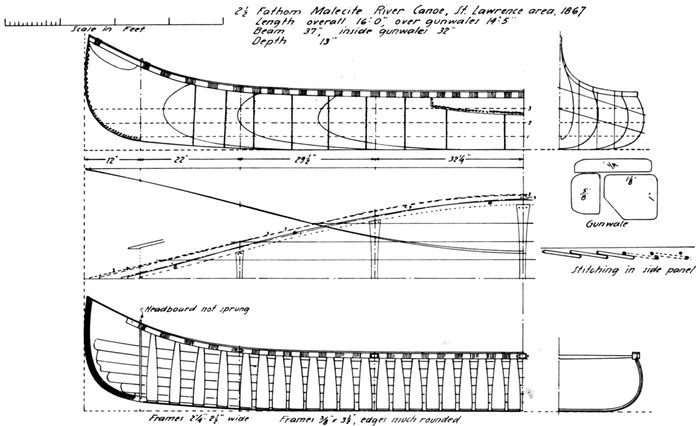
Figure 68
Malecite 2½-Fathom St. Lawrence River Canoe, probably a hybrid model. The high ends show a western influence.
The outside of the canoe was painted red, the inside was a pale yellow, the gunwales and middle portions of the thwarts were cobalt blue, the ends of the thwarts were red. The wulegessis was blue, and the "canoe mark" was a painted representation of the spread eagle of the United States Seal, the border being in black and white and the eagle in black, yellow, and white, holding a brown branch with green leaves. The whole panel was outlined in red. On the side of the canoe, near the stern, was a white swallowtail pennant on which is lettered "Frenchmans Bay" in black capital letters. This canoe was used for fishing and also for porpoise and seal hunting.
The construction employed to form the V-bottom in a birch-bark canoe can be seen to have been done in two ways; that described on page 76 is undoubtedly the method used in prehistoric times, since laborious forming of a V keel-piece in the sheathing, using stone scrapers, would be avoided. The V-bottom, it should be noted, usually appears in canoes used in open waters, as this form tends to run straight under paddle, in spite of a side wind, and thus requires the minimum of steering to hold it on its course. It was this characteristic, too, that made the V-bottom suitable for the racing canoe on the St. John River, since stopping the stroke momentarily to steer diminishes the driving power of the stern paddler.
The various river canoes of the Malecite, built to the modern low, rounded-end profiles, or to the short-radii and straight-line forms, held rather closely to the same lines, that is, sharp ends with a rather flat bottom amidships and an easy bilge. Some of the canoes retained the characteristic tumble-home, but others had nearly vertical sides or the curve of the bilge was carried so high that it ended at the gunwales.
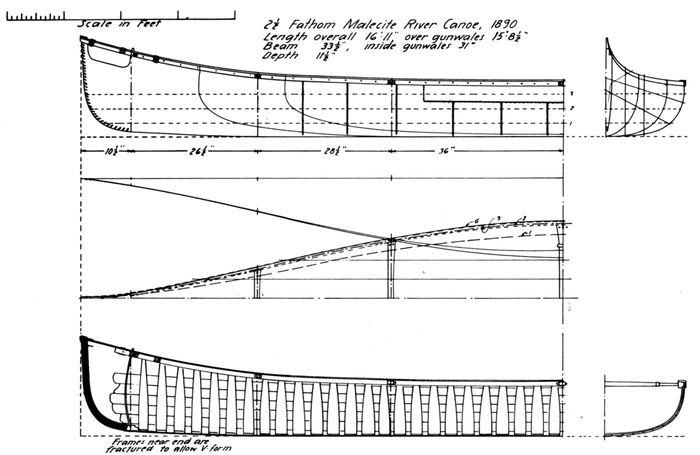
Figure 69
Malecite 2½-Fathom River Canoe of 1890 from the Rivière du Loup region. Canoes in this area had straight stems and sharp lines from at least as early as 1857.
On the St. Lawrence there was apparently a canoe having rather peaked ends as well as the rather straight-stemmed, low-ended type. A St. Lawrence River canoe found in the Chateau de Ramezay and built sometime before 1867 provides an example of the rather high-peaked ends. The canoe, as illustrated on page 77, has a well-rounded bilge working into a very round tumble-home above and into a rather flat bottom below, the tumble-home being carried into the extreme ends, so that the headboards are rather wide. The ends round up rather quickly and then continue up to the sheer in a very slight curve, having a very moderate tumble-home near the sheer. The latter follows somewhat the characteristic sheer of the old Malecite canoes, but the straight portion just inboard of the ends is much shorter, so that the quick upsweep of the sheer begins nearer the ends and thus appears somewhat more pronounced.
The construction is in the usual manner. The rocker of the bottom is 2 inches. The ribs are wider amidships than near the ends. The outwale is rounded on the outboard face so that the cap is slightly narrower than the thickness of inner gunwale and outwale combined. The headboard is rather unusual, however, as it is not bellied but stands straight and vertical. The lashing at the upper portion of the stems is the crossed stitch, below it is spiral. The gunwale groups are made up of six passes through the bark, and the spaces between groups are about 2½ inches. The side panels are sewn with the harness stitch. The canoe is 16 feet long overall and 14 feet 5 inches inside the gunwales; the extreme beam amidships is 37 inches and inside the gunwales 32 inches. The depth amidships is about 13 inches and the height of the ends 25 inches, with 2 inches of rocker at the headboards. This canoe, retaining the high ends, marks the transition from the old form to the new.
A later canoe built on the St. Lawrence about 1890, probably near Rivière de Loup, is shown above. It is 16 feet 11 inches long overall, the beam over the gunwales is 33½ inches and inside it is 31 inches, the curve of the bilge being carried up to the gunwales. The bottom is flat for only a short width. The depth amidships is 11½ inches and the height of the ends is 20 inches, with 1 inch of rocker in the last two feet of length. The sheer is a long fair sweep without any quick upward lift near the ends. The headboards are very narrow and belly only very slightly toward the ends. The end profile illustrates the short radii and straight line form that marked many of the last Malecite birch-bark canoes of the St. Lawrence Valley. It is possible that the end-form was copied from the white man's St. Lawrence skiff, which usually had ends that were straight and nearly vertical, with a sharp turn into the keel.
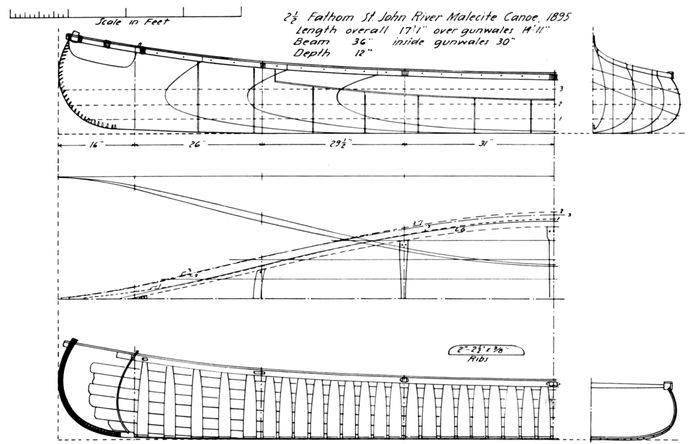
Figure 70
Modern (1895) Malecite 2½-Fathom St. John River Canoe, with low ends and moderate sheer, developed late in the 19th century.
Since a Malecite canoe of the form having rounded low ends was the subject used to describe the construction of a birch-bark canoe in Chapter 3 (see p. 36), there is no need to discuss all the details here. There was some variety in the sewing and lashing used in Malecite canoes; the combination of cross and spiral stitches in the ends and the use of a batten and the over-and-over stitch in the side panels are, of course, very common in these canoes. The occasional use of other stitches in the side panels and even in the gores would probably be normal, since individual preferences in such details were not controlled by a narrow tribal practice.
The Malecite are known to have hauled their canoes overland in the early spring, before the snow was entirely gone, by mounting the canoe on two sleds or toboggans in tandem, binding the canoe to each. This was done as late as the 1890's for early spring muskrat hunts. The Malecite also fitted their river canoes with outside protection when much running of rapids or "quick water" work was done. This protection consisted of two sets of battens (see p. 80), each set being made up of five or six thin splints of cedar about ⅜ inch thick and 3 inches wide, tapering to 2 or 1½ inches at one end. These were held together by four strips of basket ash, bark cord, or rawhide. Each cord was passed through holes or slits made edgewise through each splint. The cords were located so that when the splints were placed on the bottom of the canoe, the cords could be tied at the thwarts. The tapered ends of the splints were at the ends of the canoe; the butts of the two sets being lapped amidships with the lap toward the stern. This formed a wooden sheathing, outside the bottom, to protect the bark from rocks and snags or floating ice that might be met in rapids and small streams. The fitting was used also by the Micmac and Ojibway; it is not known whether this was an Indian or European invention. The French canoemen called it barre d'abordage and the Malecite, P's-ta' k'n; the English woodsmen called the fitting "canoe shoes."
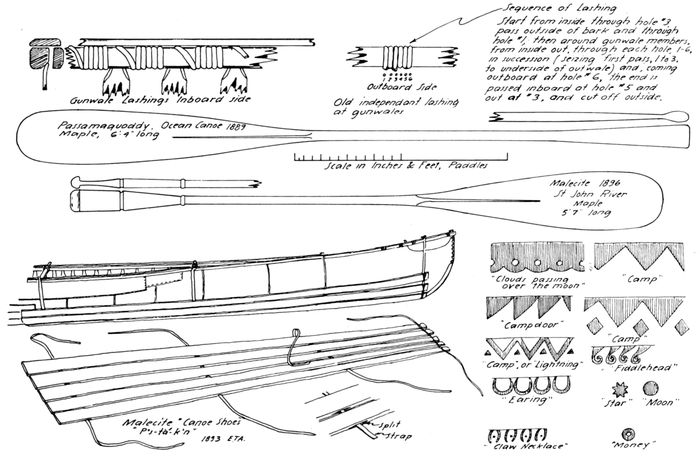
Figure 71
Malecite Canoe Details, Gear, and Gunwale Decorations.
The Malecite paddle was of various forms, as illustrated in figures 71 and 72, the predominant form being very similar to the paddle now used with canvas "Indian" canoes. The total length of the blade was usually about 28 to 30 inches; at 10 or 11 inches from the tip it was about 2½ inches wide. The handle was about 36 inches long. At just above the blade it was 1¼ inches wide and 1 inch thick. The handle was not parallel-sided. Near the top it widened gradually to about 2¼ inches at 2½ inches from the top; here the cross-grip was formed. The thickness of the handle reduced gradually from that given for just above the top of the blade to about ½ inch at about 5 inches below the cross-grip, and widened again to ⅝ inch at the point where the cross-grip was formed. The blade was ridged down its center. The lower end was rounded and the lower half of the blade was approximately half an ellipse in shape. The Passamaquoddy blade had its wide point within 7 inches of the lower tip, where it was about 6 inches wide. The handle was about 1⅛ inches in diameter just above the blade, and then tapered in thickness until it first became oval and then flat in cross section. The width remained nearly constant to a point within 12 to 16 inches of the cross-grip, then gradually widened to nearly 3 inches at the top. The blade was 33 to 36 inches long and the whole paddle somewhere between 73 and 76 inches long. The cross-grips were sometimes round, at other times they were merely worked off in an oval shape to fit the upper hand. The usual width of the cross-grip was just under 3 inches.
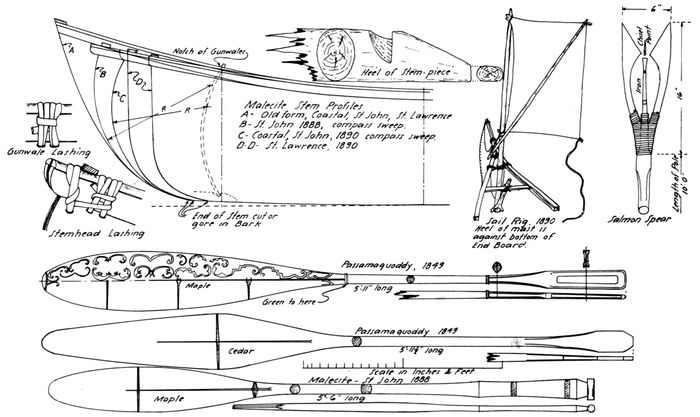
Figure 72
Malecite Canoe Details, Stem Profiles, Paddles, Sail Rig, and Salmon Spear.
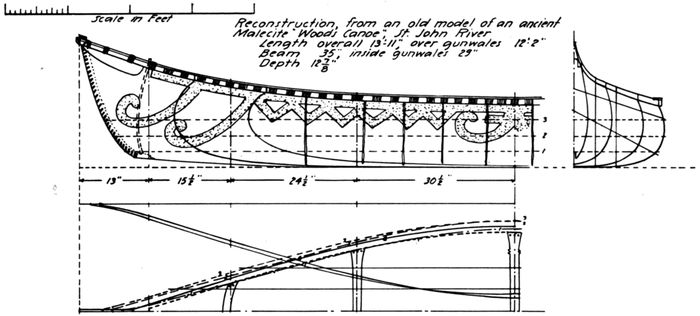
Figure 73
Lines and Decoration Reconstructed From a Very Old Model of an ancient woods, or pack, canoe, showing short ends and use of fiddlehead and fire-steel form of decoration.
Formerly, the Malecite placed his personal mark, or dupskodegun, on the flat of the top of his paddle near the cross-grip. The mark was incised into the wood and the incised line was filled with red or black pigment when available. Sometimes the whole paddle, including the blade, was covered with incised line ornamentation. This was usually a vine-and-leaf pattern, or a combination of small triangles and curved lines. The Passamaquoddy used designs suggesting the needlework once seen on fine linens. Sometimes other designs showing animals, camps, or canoes were used.
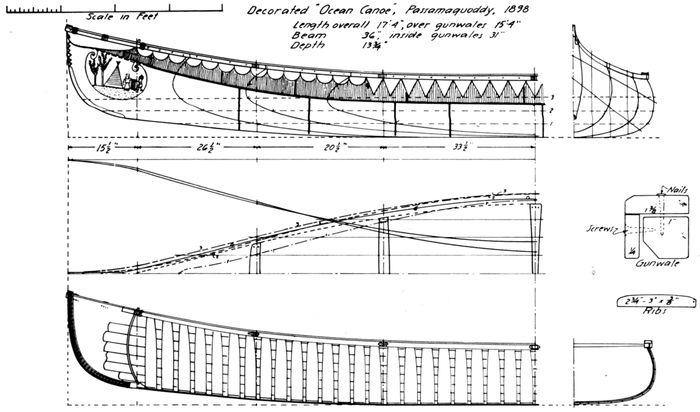
Figure 74
Last Known Passamaquoddy Decorated Ocean Canoe to be built. Constructed in 1898 by Tomah Joseph, Princeton, Maine, on the same model as a canvas porpoise-hunting canoe.
The Malecite, particularly the Passamaquoddy, were especially skillful in decorating bark canoes, as can be seen from the illustrations (pp. 81-87). Sometimes they used scraped winter bark decoration just along the gunwales; occasionally the whole canoe was decorated in this manner above the normal load waterline as described on page 87. Usually, however, the bark decoration was confined to a long panel just below the gunwales and to the ends of the canoe. The personal "mark" of the owner-builder would usually be on the flaps near the ends, the wulegessis, meaning the outside bark of a tree or a child's diaper, but in canoe nomenclature used to indicate the protective cover which it formed for the gunwale-end lashings. Sometimes the Malecite placed his mark in the gunwale decoration. Sometimes he placed a picture or a sign on each side of the ends below the wulegessis, in about the position used for insignia on the canvas "Indian" canoe.
The swastika was used by the Passamaquoddy in a war canoe in colonial times and has been used later. The Passamaquoddy mark for an exceptional canoe (such as a war canoe that won the race home) was often on the wulegessis, and on a relatively modern canoe this mark, or gogetch, was a picture of "a funny-looking kind of doll." A common form of decoration in Passamaquoddy canoes was the fiddlehead curve which resembles the top of young fern shoots. This appears in numerous combinations; often double and back to back, joined with a long bar, or "cross." This particular combination is known as the "fiddlehead and cross" or as the "fire steel"; the latter because of a fancied resemblance of the form to the shape of the old fire-making steels of colonial times. A zigzag line appears to represent lightning to most Indians. A series of half-circles along the gunwales, with the rounded side down and just touching one another at the top, having a small circle in the center of each, represents "clouds passing over the moon." A similar series of half-circles without the center circles might mean the canoe was launched during a new moon; the number of half-circles shown would indicate the month.
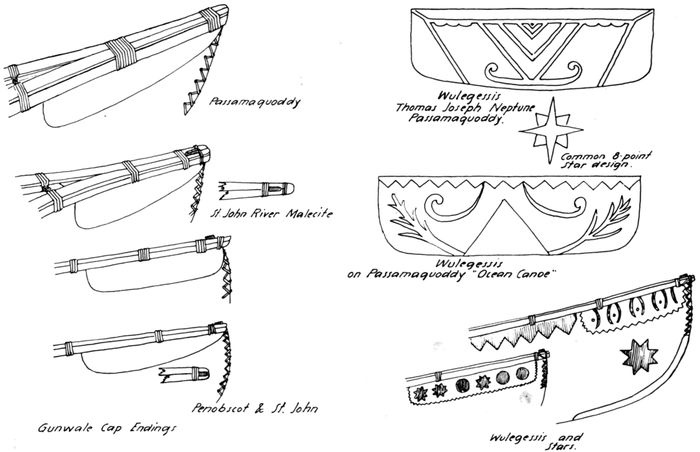
Figure 75
Malecite Canoe Details and Decorations.
Yet there is not full agreement among Indians about the meaning of decorative forms; the crooked or zigzag line might also mean camps or the crooked score stick used in a Malecite game. The circle could mean sun or moon or month. A half-moon form might also be "a woman's earring," or a new moon. A circle with a very small one inside might be a "brooch," as well as "money." Right triangles, in a closely spaced series along the gunwales, apparently meant "door cloth," or tent door ("what you lift with your hand"). Shown on pages 84 and 85 are some Indian marks on the wulegessis, based upon the statements of old Malecites or upon their sketches.
After the Malecite had become Roman Catholic, a fish on the middle panel of a canoe meant that it had been launched on Friday. Pictures on a canoe sometimes indicated a mythological story; a picture of a rabbit sitting and smoking a pipe on one side of the canoe and a lynx on the other would be such a case. In Malecite mythology the rabbit was the ancestor of the tribe. He was also a great magician. The lynx was the mortal enemy of the rabbit, but in the mythological tales he was always overcome and defeated by the rabbit's magic. Hence, the idea conveyed is that "though the-lynx is near, the rabbit sits calmly smoking his pipe and as he knows he can overcome his enemy," or, in short, "self-confidence."
The Indian's mark on his canoe or weapons is not a signature to be read by anyone. The mark may, of course, be identified as to what it represents, but unless it is known as the mark used by a certain man it cannot be "read." Any mark could be used by an Indian, either because it had some connection with his activities or habits, or because he "likes it." The stone tobacco pipe used by Peter Polchies (see p. 85) as his mark had no known connection with this Indian's habits or activities. However, his son, of the same name and well known also as "Doctor Polchies," took the same mark, but in his case it had a personal meaning since he was noted locally for his skill in making stone pipes. Another case was a Passamaquoddy who at every opportunity used to pole his canoe in preference to paddling. As a result he had become known as "Peter of the Pole" or "Peter Pole" and he then used as a canoe mark a representation of a setting pole. In submitting sketches of the marking on the wulegessis of canoes to old Indians it was seldom possible to learn the identity of the owner or builder, since the marks were usually not known to those questioned. In more recent times, the educated Malecite signed his name in English on his canoe and thus gave it more permanent identification.
Figure 76
Wulegessis Decorations
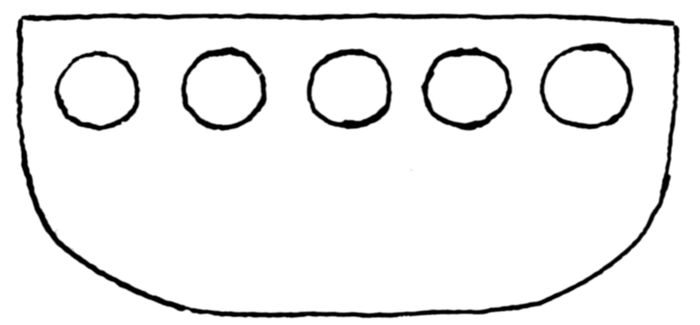
"mark of Mitchell Laporte"
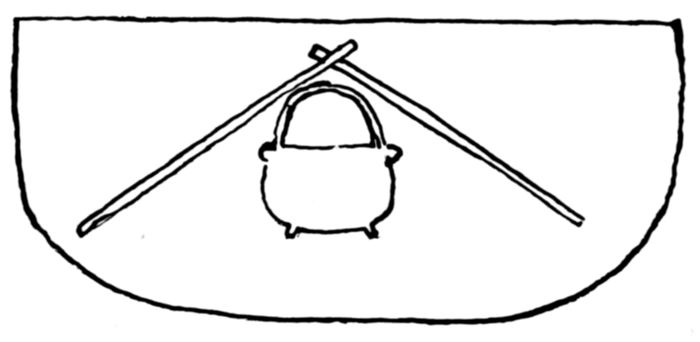
"that pot hanging was used by three or four generations—it was mark on John Lolar's canoe in 1872"
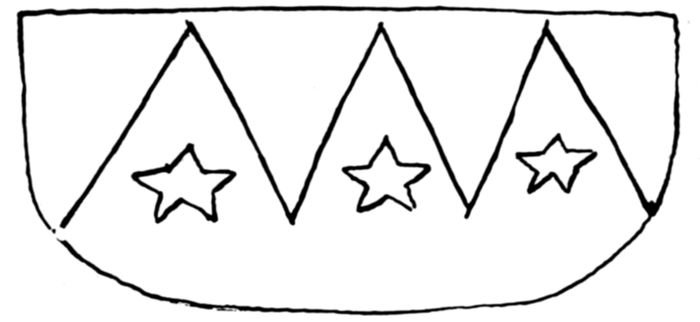
"I made marks like this on wulegessis and sometimes on middle" (Charlie Bear)
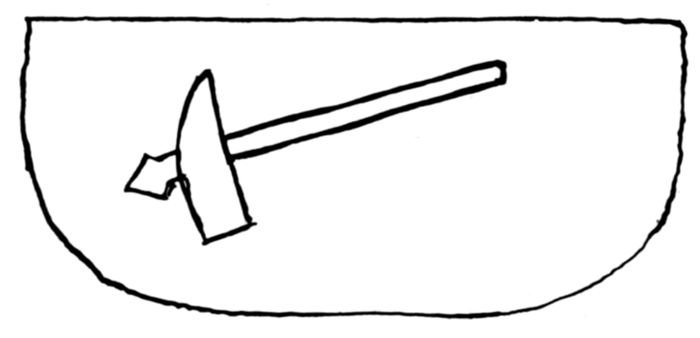
"mark of Noel John Sapier" (tomahawk)
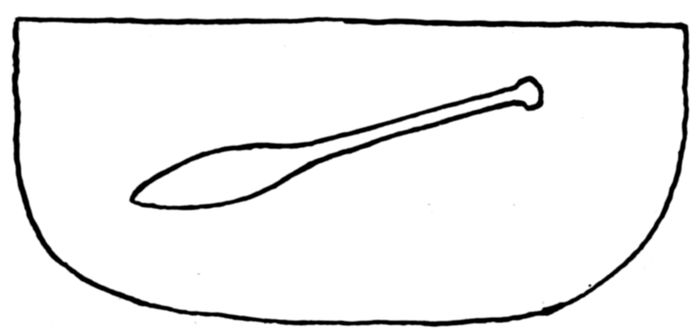
"mark of Noel Polchies" (paddle)
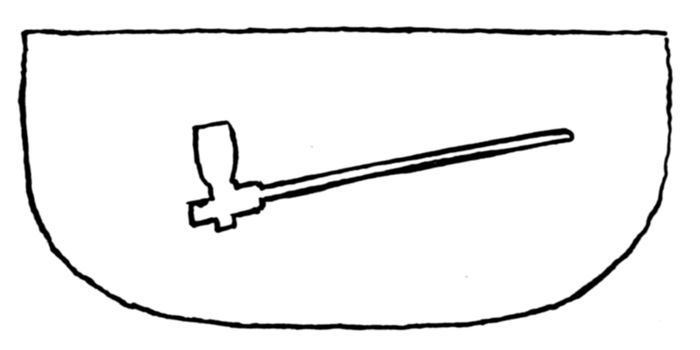
"mark of old Peter Polchies" (stone pipe)
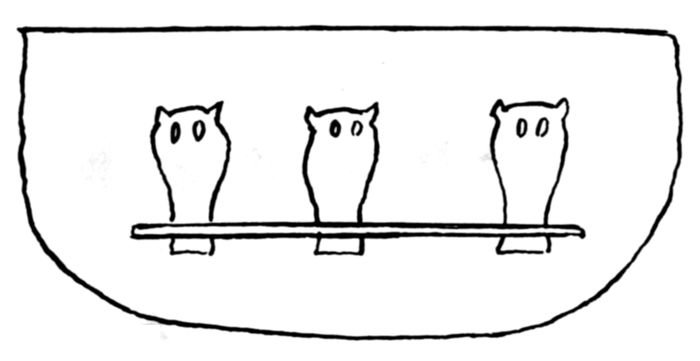
"mark of Chief Neptune" (Passamaquoddy)
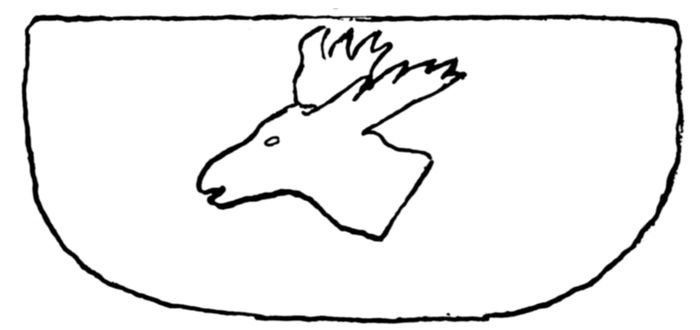
"mark of Louis Paul"
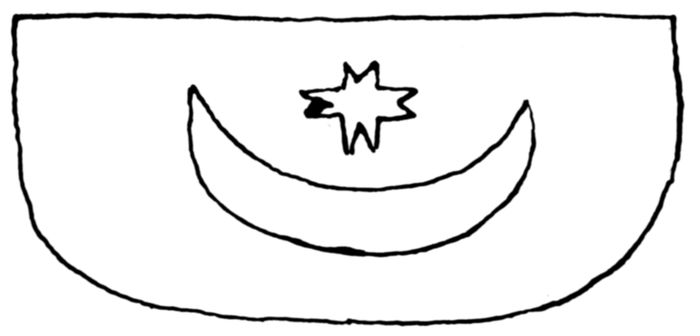
"canoe was finished on new moon" (Joe Ellis)
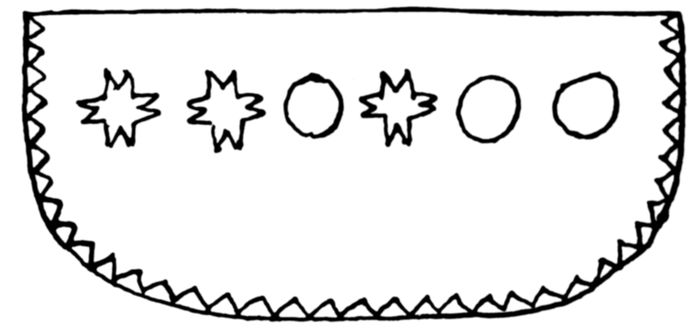
"mark of old Solomon Paul"
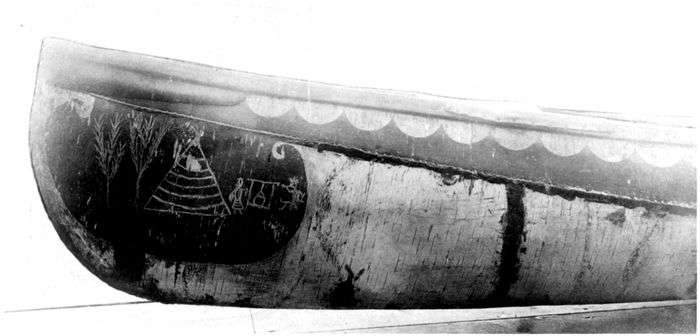
Figure 77
End Decorations, Passamaquoddy Canoe built by Tomah Joseph.
In duplicating a design, the Malecite apparently used a pattern, or stencil, which was preserved to allow duplication over a long period of time. The stencil was usually cut from birch bark, apparently an old practice, although whether it was done in prehistoric times cannot be determined. The long contact of the Malecites with Europeans is a factor to be considered in such matters. This is sometimes shown in picture-writing on a canoe; one, for instance, showed a white man fishing with rod and line from a canoe with an Indian guide. On the opposite side was the representation of an Indian camp beside two trees, a kettle over the fire and the brave sitting cross-legged smoking his pipe, indicating, of course, "comfort and contentment."
Asking old Indians to identify or give the names of decorations, Adney recorded statements which indicate their thought in regard to such matters. There were used, for example, two forms of the half-moon or crescent; one was quite open at the points which plainly indicated a half-moon, but the other was more nearly closed: Mrs. Billy Ellis, widow of Frank Francis, a Malecite, said of them, "Old Indian earrings, that is only what I can call them. Also in nose. Wild Indian made them of silver or moose-bone, I guess he thought he looked nice; it looked like the devil." Joe Ellis, an old canoe builder, also called this form "earrings" and when asked why an Indian would put these on a canoe, replied "He will think what he will put on here. He might have seen his wife at bow of canoe, and put it on [there]." Shown the right-triangle-in-series design, Mrs. Ellis said "I fergit it but I will remember; what you lift with your hand, we call it that—camp door" (referring to the cloth or hide hung over a camp door, and raised at one corner to enter, so that the opening is then divided diagonally).

In a later period, the Malecite usually confined decoration to the wulegessis and to the pieced-out bark amidships, the panel formed on each side. The wulegessis was of various forms; its bottom was sometimes shaped like a cupid's bow, sometimes it was rectangular. A common form was one representing the profile of a canoe. Being of winter bark, it was red or brown, with the part where the design was scraped showing white or yellow. The center panel was also of winter bark, and the design on it showed a similar contrast in color. Even when the bark cover was not pieced out, the panel was formed by scraping all the cover except a panel amidships on each side. Old models indicate that the early Malecite canoes may have used decoration all over above the waterline (see p. 81) far more frequently than has been the recent custom. The decorations were a fiddlehead design in a complicated sequence so that it bore a faint resemblance to the hyanthus in a formal scroll, but the design apparently had no ceremonial significance; it was used for the same reason given Adney for so many forms of bark decoration, "it looked nice."
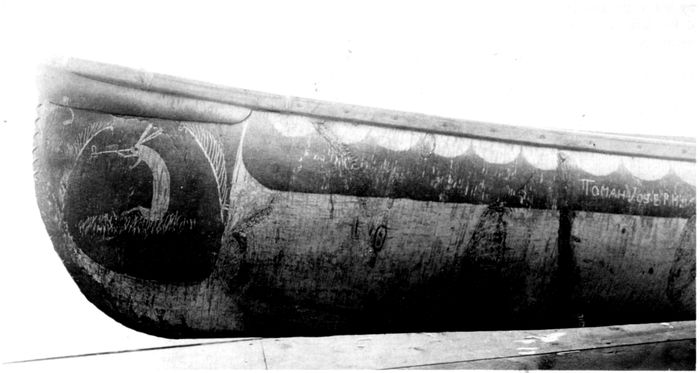
Figure 78
End Decorations, Passamaquoddy Canoe built by Tomah Joseph.
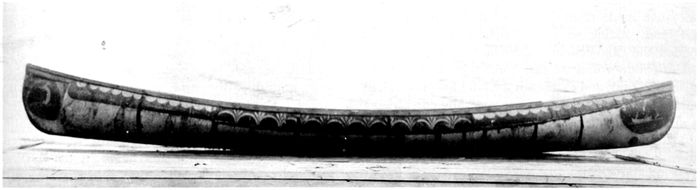
Figure 79
Passamaquoddy Decorated Canoe built by Tomah Joseph.
The drawings and plans on pages 71 to 87 will serve better than words to show these characteristic designs and decorations. It is doubtful that color, paint or pigment, was used in decorating the Malecite bark canoes before the coming of Europeans, but it was employed occasionally in the last half of the 19th century. The beauty of the Malecite canoe designs lay not in the barbaric display of color characteristic of the large fur-traders' canoes, but in the tasteful distribution of the scraped winter bark decoration along the sides of the hull. The workmanship exhibited by the Malecite in the construction of their canoes was generally very fine; indeed, they were perhaps the most finished craftsmen among Indian canoe-builders.
St. Francis
The tribal composition of the Abnaki Indians is somewhat uncertain. The group was certainly made up of a portion of the old Malecite group, the Kennebec and Penobscot, but later also included the whole or parts of the refugee Indians of other New England tribes who were forced to flee before the advancing white settlers. It is probable that among the refugees were the Cowassek (Coosuc), Pennacook, and the Ossipee. There were also some Maine tribes among these—the Sokoki, Androscoggin, (Arosaguntacook), Wewenoc, Taconnet, and Pequawket. It is probable that the tribal groups from southern and central New England were mere fragments and that the largest number to make up the Abnaki were Malecite. The latter in turn were driven out of their old homes on the lower Maine coast and drifted northwestward into the old hunting grounds of the Kennebec and Penobscot, northwestern Maine and eastern Quebec as far as the St. Lawrence. The chief settlement was finally on the St. Francis River in Quebec, hence the Abnaki were also known as the "St. Francis Indians." These tribesmen held a deep-seated grudge against the New Englanders and, by the middle of the 18th century, they had made themselves thoroughly hated in New England. Siding with the French, the St. Francis raided the Connecticut Valley and eastward, taking white children and women home with them after a successful raid, and as a result the later St. Francis had much white blood. They were generally enterprising and progressive.
Little is known about the canoes of these Abnaki during the period of their retreat northwestward. It is obvious that the Penobscot, at least, used the old form of the Malecite canoe. What the canoes of the other tribal groups were like cannot be stated. However, by the middle of the 19th century the St. Francis Indians had produced a very fine birch-bark canoe of distinctive design and excellent workmanship. These they began to sell to sportsmen, with the result that the type of canoe became a standard one for hunting and fishing in Quebec. When other tribal groups discovered the market for canoes, they were forced to copy the St. Francis model and appearance to a very marked degree in order to be assured of ready sales. It is obvious, from what is now known, that the St. Francis had adapted some ideas in canoe building from Indians west of the St. Lawrence, with whom they had come into close contact. However, they had also retained much of the building technique of their Malecite relatives. Hence, the St. Francis canoes usually represent a blend of building techniques as well as of models.
The St. Francis canoe of the last half of the 19th century had high-peaked ends, with a quick upsweep of the sheer at bow and stern. The end profile was almost vertical, with a short radius where it faired into the bottom. The rocker of the bottom took place in the last 18 or 24 inches of the ends, the remaining portion of the bottom being usually straight. The amount of rocker varied a good deal; apparently some canoes had only an inch or so while others had as much as four or five. A few canoes had a projecting "chin" end-profile; the top portion where it met the sheer was usually a straight line.
The midsection was slightly wall-sided, with a rather quick turn of the bilge. The bottom was nearly flat across, with very slight rounding until close to the bilges. The end sections were a U-shape that approached the V owing to the very quick turn at the centerline. The ends of the canoe were very sharp, coming in practically straight at the gunwale and at level lines below it. The gunwales were longer than the bottom and so the St. Francis canoes were commonly built with a building-frame which was nearly as wide amidships as the gunwales but shorter in length.
At least one St. Francis canoe, built on Lake Memphremagog, was constructed with a tumble-home amidships the same as that of some Malecite canoes. The rocker of the bottom at each end started at the first thwart on each side of the middle and gradually increased toward the ends, which faired into the bottom without any break in the curves. The end profiles projected with a chin that was full and round up to the peaked stem heads. The sheer swept up sharply near the ends to the stem heads. This particular canoe represented a hybrid design not developed for sale to sportsmen, and the sole example, a full-size canoe formerly in The American Museum of Natural History at New York and measured by Adney in 1890, is now missing and probably has been broken up.
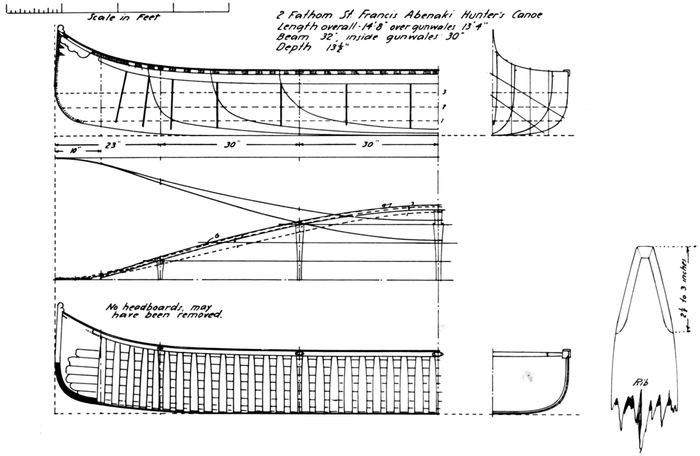
Figure 80
St. Francis 2-Fathom Canoe of About 1865, with upright stems. Built for forest travel, this form ranged in size from 12 feet 6 inches overall and 26½-inch beam, to 16 feet overall and 34-inch beam.
The St. Francis canoes were usually small, being commonly between 12 and 16 feet overall; the 15-foot length usually was preferred by sportsmen. The width amidships was from 32 to 35 inches and the depth 12 to 14 inches. The 14-foot canoe usually had a beam of about 32 inches and was nearly 14 inches deep; if built for portaging the ends were somewhat lower than if the canoe was to be used in open waters. Canoes built for hunting might be as short as 10 or 11 feet and of only 26 to 28 inches beam; these were the true woods canoes of the St. Francis.
The gunwale structure of the St. Francis canoes followed Malecite design; it was often of slightly smaller cross section than that of a Malecite canoe of equal length, but both outwale and cap were of somewhat larger cross section. The stem-pieces were split and laminated in the same manner, but occasionally the lamination was at the bottom, due to the hard curve required where the stem faired into the bottom. Many such canoes had no headboards, the heavy outwales being carried to the sides of the stem pieces and secured there to support the main gunwales. If the headboard was used, it was quite narrow and was bellied toward the ends of the canoe. In some St. Francis canoes the bark cover in the rockered bottom near the ends showed a marked V. In the canoe examined by Adney at the American Museum of Natural History, the ribs inside toward the end showed no signs of being "broken," so it is evident that the V was formed either by use of a shaped keel-piece in the sheathing or by an additional batten shaped to give this V-form under the center strake. Since the V began where the rocker in the canoe started, in an almost angular break in the bottom, it is likely that a shaped batten had been used to form it. He could not verify this, however, as the area was covered by the frames and sheathing.
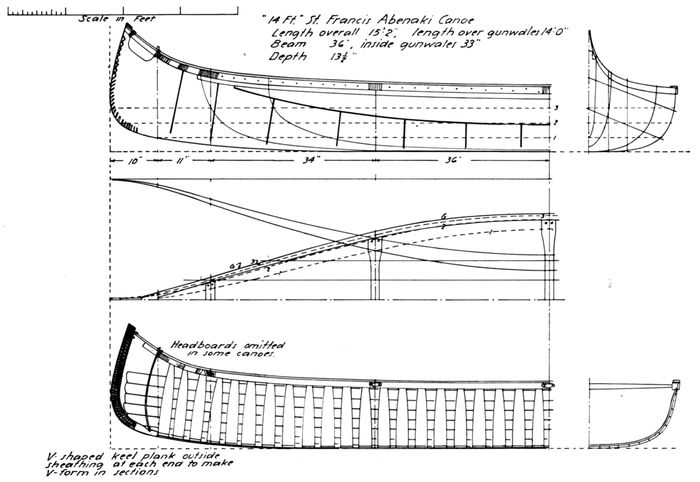
Figure 81
St. Francis Canoe of About 1910, with narrow, rockered bottom, a model popular with guides and sportsmen for forest travel.
The sheathing was in short lengths with rounded ends which overlapped, and it was laid irregularly in the "thrown in" style found in many western birch-bark canoes. The ribs were commonly about 2 inches wide and nearly ⅜ inch thick, the width tapering to roughly 1¾ inches under the gunwales. The ends of the ribs were then sharply reduced in width to a chisel point about 1 inch wide; the sides of the sharply reduced taper being beveled, as well as the end. A 15-foot canoe usually had 46 to 50 ribs.
The thwarts, unlike those of the Micmac and some Malecite canoes, in which the thwarts were unequally spaced, were equally spaced according to a builder's formula. The ends of the thwarts, or crossbars, were tenoned into the main gunwales and lashed in place through the three lashing holes in the ends of each thwart, except the end ones, which usually had but two. In some small canoes, however, two lashing holes were placed in all thwart ends. The design of the St. Francis thwart was as a rule very plain, gradually increasing in width from the center outwards to the tenon at the gunwale in plan and decreasing in thickness in elevation in the same direction. The ends of the main gunwales were of the half-arrowhead form, and were covered with a bark wulegessis, but the flaps below the outwales were sometimes cut off, or they might be formed in some graceful outline.
The bark cover was sometimes in one piece; when it was pieced out for width, the harness-stitch was used. In most canoes, the bark along the gunwale was doubled by adding a long narrow strip, often left hanging free below the gunwales and stopping just short of the wulegessis, which it resembled. It was sometimes decorated. A few St. Francis canoes with nailed gunwales omitted this doubling piece. When used, the doubling piece, as well as the end cover, were folded down on top of the gunwale before being sewn into place. The decoration of the St. Francis canoes seems to have been scant and wholly confined to a narrow band along the gunwale, or to the doubling pieces. The marking of the wulegessis had ceased long before Adney investigated this type of canoe and no living Indian knew of any old marks, if any ever had been used.
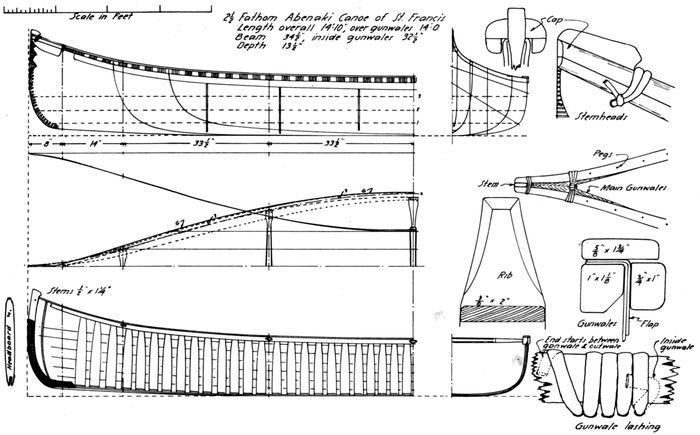
Figure 82
Low-Ended St. Francis Canoe with V-form end sections made with short, V-shaped keel battens outside the sheathing at each end. Note the unusual form of headboard, seen in some St. Francis canoes.
The ends were commonly lashed with a spiral or crossed stitch, but some builders used a series of short-to-long stitches that made groups generally triangular in appearance. The gunwale lashing was in groups about 2½ inches long, each having 5 to 7 turns through the bark. The groups were about 1½ to 1¼ inches apart near the ends and about 2 inches apart elsewhere. The groups were not independent but were made by bringing the last turn of each group over the top and inside the main gunwale in a long diagonal pass so as to come through the bark from the inside for the first pass of the new group. The caps were originally pegged, with a few lashings at the ends.
The ribs were bent green. After the bark cover had been sewn to the gunwales, the green ribs were fitted roughly inside the bark, with their ends standing above the gunwales, and were then forced into the desired shape and held there, usually by two wide battens pressed against them by 7 to 10 temporary cross struts. After being allowed to dry in place, the ribs were then removed, the sheathing was put into place, and the ribs, after a final fitting, were driven into their proper positions. Some builders put in the ribs by pairs in the shaping stage, one on top of the other, as this made easier the job of fitting the temporary battens. The forcing of the ribs to shape also served to shape the bark cover, and the canoe was placed on horses during the operation, so that the shape of the bottom could be observed while the bark was being moulded. Some builders used very thin longitudinal battens between the bark and the green ribs to avoid danger of bursting the bark.
The canoe was built on a level building bed, in most instances apparently, with the ends of the building frame blocked up about an inch. It seems possible, however, that narrow bottom canoes may have been built with the bed raised 2 or 3 inches in the middle, rather than employing a narrow building frame. The construction of the building frame was the same as among the western Indians and as described in Chapter 3.
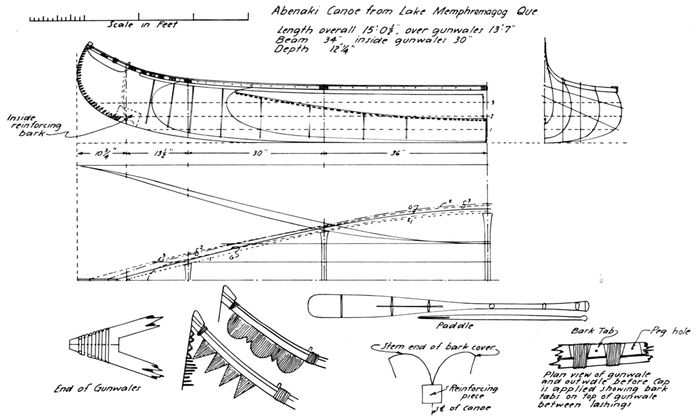
Figure 83
St. Francis-Abnaki Canoe for Open Water, a type that became extinct before 1890. From Adney's drawings of a canoe formerly in the Museum of Natural History, New York. Details of Abnaki canoes are also shown.
In preparing the ribs, a common practice was the following: Assume, for example, that there are 10 ribs from the center to the first thwart forward; these are laid out on the ground edge-to-edge with the rib under the center thwart to the left and the rib under the first thwart to the right. On the rib to the left the middle thwart is laid so that its center coincides with that of the rib, and the ends of the thwart are marked on the rib. The same is done to the rib on the far right, over which the first thwart is laid as the measure. On each side of the centerline the points marking the ends of the thwarts are then joined by a line across the ribs, as they lie together, to mark the approximate taper of the canoe toward the ends, at the turn of the bilge. Each rib is taken in turn from the panel and with it is placed another from the stock on hand to be set in a matching position on the other side of the middle thwart, toward the stern; the pair, placed flat sides together, are then bent over the knee at, or outside of, the marks or lines. The ribs in the next portion of the canoe's length are shaped in the same manner, using the lengths of the first and second thwarts as guides. Thus, the ribs are given a rough, preliminary bend before being fitted inside the bark cover and stayed into place to season. This method allowed the bilge of the canoe to be rather precisely determined and formed during the first stages of construction. At the ends, of course, the ribs are sharply bent only in the middle. Since the full thwart length makes a wide bottom, by setting the length of the rib perhaps a hand's width less than that of the whole thwart, the narrow bottom is formed.
The rough length of the ribs was twice the length of the thwarts nearest them. Hackmatack was used for thwarts by the St. Francis Indians, rock maple being considered next best. Cedar was first choice for ribs, then spruce, and then balsam fir. Longitudinals were cedar or spruce. All canoe measurements were made by hand, finger, and arm measurements. Basket ash strips were often used in transferring measurements.
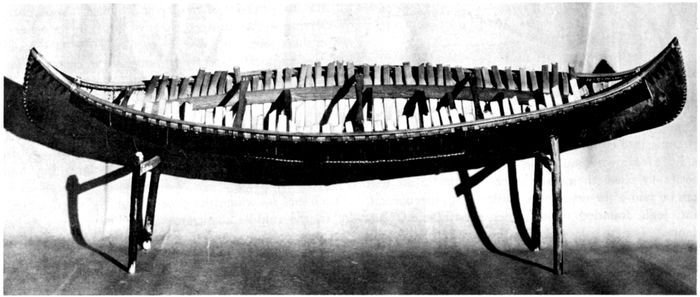
Figure 84
Model of a St. Francis-Abnaki Canoe Under Construction, showing method of moulding ribs inside the assembled bark cover.
From what has been said, it will be seen that the construction practice of the St. Francis did not follow in all details that of their Malecite relatives. The intrusion of western practices into this group probably took place some time after the group's final settlement at St. Francis. As they gradually came into more intimate relations with their western neighbors and drifted into western Quebec, beyond the St. Lawrence, their canoe building technique became influenced by what they saw to the westward. As would be expected, the St. Francis Abnaki began early to use nails in canoe building, but, being expert workmen, they retained the good features of the old sewn construction to a marked degree up to the very end of birch-bark canoe construction in southern Quebec, probably about 1915. It should perhaps be noted that what has been discovered about the St. Francis Abnaki canoes refers necessarily to only the last half of the 19th century, since no earlier canoe of this group has been discovered. The changes that took place between the decline of the Penobscot style of canoe and that of the later Abnaki remain a matter of speculation.
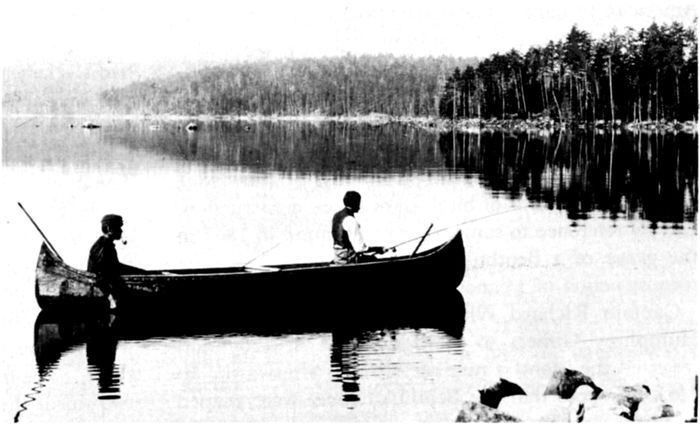
s: Figure 85
St. Francis-Abnaki Canoe.
Beothuk
The fourth group of Indians, classed here as belonging to the eastern maritime area, are the Beothuk of Newfoundland. Historically, perhaps, these Indians should have been discussed first, as they were probably the first of all North American Indians to come into contact with the white man. However, so little is known about their canoes that it has seemed better to place them last, since practically all that can be said is the result of reconstruction, speculation, and logic founded upon rather unsatisfactory evidence. The tribal origin of the Beothuk has long been a matter of argument; they are known to have used red pigment on their weapons, equipment, clothes, and persons. A prehistoric group that once inhabited Maine and the Maritime Provinces appears to have had a similar custom; these are known as the "Red Paint People," and it may be that the Beothuk were a survival of this earlier culture. But all that can be said with certainty is that the Beothuk inhabited Newfoundland and perhaps some of the Labrador coast when the white man began to frequent those parts. The Beothuk made a nuisance of themselves by stealing gear from the European fishermen, and by occasionally murdering individuals or small groups of white men. Late in the 17th century, the French imported some Micmac warriors and began a war of extermination against the Beothuk. By the middle of the 18th century the Newfoundland tribe was reduced to a few very small groups, and the Beothuk became extinct early in the 19th century, before careful investigation of their culture could be made.
Their canoes were made to a distinctive model quite different from that of the canoes of other North American Indians. The descriptions available are far from complete and, as a result, many important details are left to speculation. Some parts of the more complete descriptions are obscure and do not appear to agree with one another. In spite of these difficulties, however, some information on the canoes is rather specific; by using this, together with a knowledge of the requirements of birch-bark canoe construction, and by reference to some toy canoes found in 1869 in the grave of a Beothuk boy, a reasonably accurate reconstruction of a canoe is possible.
Captain Richard Whitbourne had come with Sir Humphrey Gilbert to Newfoundland in 1580 and revisited the island a number of times afterward. In 1612 he wrote that the Beothuk canoes were shaped "like the wherries of the River Thames," apparently referring to the humped sheer of both; in the wherry the sheer swept up sharply to the height of the oar tholes, in profile, and flared outward, in cross section.
John Gay, a member of the Company of Newfoundland Plantation, wrote in 1612 that Beothuk canoes were about 20 feet long and 4½ feet wide "in the middle and aloft," that the ribs were like laths, and that the birch-bark cover was sewn with roots. The canoes carried four persons and weighed less than a hundredweight. They had a short, light staff set in each end by which the canoes could be lifted ashore. "In the middle the canoa is higher a great deale, than at the bowe and quarter." He also says of their cross section: "They be all bearing from the keel to portlesse, not with any circular, but with a straight, line."
Joann de Laet, writing about 1633, speaks of the crescent shape of the canoes, of their "sharp keel" and need of ballast to keep them upright; he also states that the canoes were not over 20 feet long and could carry up to five persons.
The most complete description of the Beothuk canoe was in the manuscript of Lt. John Cartwright, R.N., who was on the coast of Newfoundland in 1767-1768 as Lieutenant of H.B.M. Ship Guernsey. However, some portions are either in error or the description was over-simplified. For example, Cartwright says that the gunwales were formed with a distinct angle made by joining two lengths of the main gunwale members at the elevated middle of the sheer. This hardly seems correct since such a connection would not produce the rigidity that such structural parts require, given the methods used by Indians to build bark canoes. The three grave models show that the sheer was actually curved along its elevated middle. It is possible that Cartwright saw a damaged canoe in which the lashings of the scarf of the gunwales had slackened so that the line of sheer "broke" there. Cartwright is perhaps misleading in his description of the rocker of the keel as being "nearly, if not exactly, the half of an ellipse, longitudinally divided." The models show the keel to have been straight along the length of the canoe and turned up sharply at the ends to form bow and stern. Cartwright also states the keel piece was "about the size of the handle of a common hatchet" amidships, or perhaps 1 inch thick and 1½ inches wide, and tapered toward the ends, which were about ¾ inch wide and about equally thick. The height of the sheer amidships was perhaps two-thirds the height of the ends.