Johan Wolfgang von Goethe (continued 15)
A. J. W. (Alexander James William) Morrison translation
The Moravians.
My gradual alienation from her creed arose from the fact that I had laid hold of it at first with too great zeal, with passionate love. Ever since I became more intimately acquainted with the Moravians, my inclination to this Society, which had united under the victorious banners of Christ, had constantly increased. It is exactly in the moment of its earliest formation that a positive religion possesses its greatest attraction. On that account it is delightful to go back to the time of the Apostles, where all stands forth as fresh and immediately spiritual. And thus it was that the Moravian doctrine acquired something of a magical charm by appearing to continue or rather to perpetuate the condition of those first times. It connected its origin with them; when it seemed to perish, it still wound its way through the world, although by unnoticed tendrils; at last one little germ took root beneath the protection of a pious and eminent man, and so from an unnoticed and apparently accidental beginning expanded once more over the wide world. In this Society, the most important point, was the inseparable combination of the religious and civil constitution by which the teacher was at the same time the ruler, and the father the judge. What was still more distinctive of their fraternity was that the religious head, to whom unlimited faith was yielded in spiritual things, was also intrusted with the guidance of temporal affairs, and his counsels, whether for the government of the whole body, or for the guidance of individuals, if confirmed by the issue of the lot, were implicitly followed. Its peace and harmony, to which at least outward appearances testified, was most alluring, while, on the other hand, the missionary vocation seemed to call forth and to give employment to all man's active powers. The excellent persons whose acquaintance I made at Marienborn, which I had visited in the company of Councillor Moritz, the agent of Count von Isenburg, had gained my unqualified esteem, and it only depended on themselves to make me their own. I studied their history, and their doctrine, and the origin and growth of their society, so as to be able to give an account of it and to talk about it to all who might feel interested in it. Nevertheless, the conviction was soon forced upon me that with the brethren I did not pass for a Christian any more than I did with Fraülein von Klettenberg. At first this disturbed me, but afterwards my inclination to them became somewhat cooler. However, I could not for a long time discover the precise ground of difference, although it was obvious enough, until at last, it was forced upon me more by accident than by reflection. What separated me from this brotherhood, as well as from other good Christian souls, was the very point on which the Church has more than once fallen into dissension. On the one hand, it was maintained that by the Fall human nature had been so corrupted to its innermost core, that not the least good could be found in it, and that therefore man must renounce all trust in his own powers, and look to grace and its operations for everything. The other party, while it admitted the hereditary imperfections of man, nevertheless ascribed to nature a certain germ of good within, which, animated by divine grace, was capable of growing up to a joyous tree of spiritual happiness. By this latter conviction I was unconsciously penetrated to my inmost soul, even while with tongue and pen I maintained the opposite side. But I had hitherto gone on with such ill-defined ideas, that I had never once clearly stated the dilemma to myself. From this dream I was unexpectedly roused one day, when, in a religious conversation, having distinctly advanced opinions, to my mind, most innocent, I had in return to undergo a severe lecture. The very thought of such a thing, it was maintained, was genuine Pelagianism, a pernicious doctrine which was again appearing, to the great injury of modern times. I was astonished and even terrified. I went back to Church history, studied the doctrine and fate of Pelagius more closely, and now saw clearly how these two irreconcilable opinions had fluctuated in favour through whole centuries, and had been embraced and acknowledged by different men, according as they were of a more active or of a more passive nature.
The course of past years had constantly led me more and more to the exercise of my own powers. A restless activity was at work within me, with the best desire for moral development. The world without demanded that this activity should be regulated and employed for the advantage of others, and this great demand I felt called upon in my own case to meet. On all sides I had been directed to nature, and she had appeared to me in her whole magnificence; I had been acquainted with many good and true men who were toiling to do their duty, and for the sake of duty; to renounce them, nay to renounce myself, seemed impossible. The gulf which separated me from the doctrine of man's total depravity now became plain to me. Nothing, therefore, remained to me but to part from this society; and as my love of the holy Scriptures, as well as of the founder of Christianity and its early professors, could not be taken from me, I formed a Christianity for my private use, and sought to establish and build it up by an attentive study of history and a careful observation of those who were favourable to my opinion.
The Wandering Jew.
As everything which I once warmly embraced immediately put on a poetic form, I now took up the strange idea of treating epically the history of the Wandering Jew, which popular books had long since impressed upon my mind. My design was to bring out in the course of the narrative such prominent points of the history of religion and the Church as I should find convenient. I will now explain the way in which I treated this fable, and what meaning I gave to it.
In Jerusalem, according to the legend, there was a shoemaker, of the name of Ahasuerus. For this character my Dresden shoemaker was to supply the main features. I had furnished him with the spirit and humor of a craftsman of the school of Hans Sachs, and ennobled him by an inclination to Christ. Accordingly as, in his open workshop, he liked to talk with the passers-by, jested with them, and, after the Socratic fashion, touched up every one in his own way, the neighbors and others of the people took pleasure in lingering at his booth; even Pharisees and Sadducees spoke to him, and the Saviour himself and his disciples would often stop at his door. The shoemaker, whose thoughts were directed solely towards the world, I painted as feeling, nevertheless, a special affection for our Lord, which, for the most part, evinced itself by a desire to bring this lofty being, whose mind he did not comprehend, over to his own way of thinking and acting. Accordingly, in a modest manner, he recommends Christ to abandon his contemplative life, and to leave off going about the country with such idlers, and drawing the people away from their labor into the wilderness. A multitude, he said, was always ready for excitement, and nothing good could come of it.
On the other hand, the Lord endeavoured, by parables, to instruct him in his higher views and aims, but these were all thrown away on his mere matter-of-fact intellect. Thus, as Christ becomes more and more an important character, and finally a public person, the friendly workman pronounces his opinion still more sharply and vehemently, maintaining that nothing but disorder and tumult could follow from such proceedings, and that Christ would be at last compelled to put himself at the head of a party, though that could not possibly be his design. Finally, when things had taken the course which history narrates, and Christ had been seized and condemned, Ahasuerus gives full vent to his indignation when Judas who undesignedly had betrayed his Lord, in his despair enters the workshop, and with lamentations relates how his plans had been crossed. He had been, he said, as well as the shrewdest of the other disciples, firmly convinced that Christ would declare himself regent and head of the nation. His purpose was only, by this violence, to compel the Lord, whose hesitation had hitherto been invincible, to hasten the declaration. Accordingly, he had incited the priesthood to an act which previously they had not courage to do. The disciples, on their side, were not without arms, and probably all would have turned out well, if the Lord had not given himself up, and left them in the most forlorn state. Ahasuerus, whom this narrative in no ways tends to propitiate, only exasperates the agony of the poor ex-apostle, who rushes out and goes and hangs himself.
The Wandering Jew.
As Jesus is led past the workshop of the shoemaker, on his way to execution, the well-known scene of the legend occurs. The sufferer faints under the burden of the cross, and Simon of Cyrene is compelled to carry it. Upon this, Ahasuerus comes forward, and sustains the part of those harsh common-sense people, who, when they see a man involved in misfortune through his own fault, feel no pity, but, struck by an untimely sense of justice, make the matter worse by their reproaches. As he comes out, he repeats all his former warnings, changing them into vehement accusations, which his attachment to the sufferer seems to justify. The Saviour does not answer, but at the instant the loving Veronica covers his face with the napkin, on which, as she removes it and raises it aloft, Ahasuerus sees depicted the features of the Lord, not indeed as those of the sufferer of the moment, but as of one transfigured and radiant with celestial life. Amazed by this phenomenon, he turns away his eyes and hears the words: "Over the earth shalt thou wander till thou shalt once more see me in this form." Overwhelmed at the sentence, it is not till after some time that the artisan comes to himself; he then finds that every one has gone to the place of execution and that the streets of Jerusalem are empty. Disquiet and curiosity drive him forth, and he begins his wandering.
I shall, perhaps, speak elsewhere of all this, and of the incident by which the poem was ended indeed, but not finished. The beginning, some detached passages, and the conclusion, were written. But I never completed the work. I lacked time for the studies necessary to give it the finish and bearing that I wished. The few sheets which I did write were the more willingly left to repose in obscurity, as a new and necessary epoch was now formed in my mental character by the publication of Werther.
The common fate of man, which all of us have to bear, must fall most heavily on those whose intellectual powers expand very early. For a time we may grow up under the protection of parents and relatives; we may lean for a while upon our brothers and sisters and friends, be supported by acquaintances, and made happy by those we love, but in the end man is always driven back upon himself, and it seems as if the Divinity had taken a position towards men so as not always to respond to their reverence, trust, and love, at least not in the precise moment of need. Early enough, and by many a hard lesson, had I learned that at the most urgent crises the call to us is, "Physician, heal thyself;" and how frequently had I been compelled to sigh out in pain, "I tread the wine-press alone!" So now, while I was looking about for the means of establishing my independence, I felt that the surest basis on which to build was my own creative talents. For many years I had never known it to fail me for a moment. What, waking, I had seen by day, often shaped itself into regular dreams at night, and when I opened my eyes there appeared to me either a wonderful new whole, or a part of one already commenced. Usually, my time for wilting was early in the morning, but still in the evening, or even late at night, when wine and social intercourse had raised my spirits, I was ready for any topic that might be suggested; only let a subject of some character be offered, and I was at once prepared and ready. While, then, I reflected upon this natural gift, and found that it belonged to me as my own, and could neither be favoured nor hindered by any external matters, I easily in thought built my whole existence upon it. This conception soon assumed a distinct form; the old mythological image of Prometheus occurred to me, who, separated from the gods, peopled a world from his own workshop. I clearly felt that a creation of importance could be produced only when its author isolated himself. My productions which had met with so much applause were children of solitude, and since I had stood in a wider relation to the world, I had not been wanting in the power or the pleasure of invention, but the execution halted, because I had, neither in prose nor in verse, a style properly my own, and, consequently, with every new work, had always to begin at the beginning and try experiments. As in this I had to decline and even to exclude the aid of men, so, after the fashion of Prometheus, I separated myself from the gods also, and the more naturally as with my character and mode of thinking one tendency always swallowed up and repelled all others.
Prometheus.
The fable of Prometheus became living in me. The old Titan web I cut up according to my own measurements, and without further reflection began to write a piece in which was painted the difficulty Prometheus was placed in with respect to Jupiter and the later gods, in consequence of his making men with his own hand, giving them life by the aid of Minerva, and founding a third dynasty. And, in fact, the reigning gods had good cause to feel aggrieved, since they might now appear in the light of wrongful intruders between the Titans and men. To this singular composition belongs as a monologue that poem, which has become remarkable in German literature, by having called forth a declaration from Lessing against Jacobi on certain weighty matters of thought and feeling. It thus served as the match to an explosion which revealed and brought into discussion the most secret relations of men of worth;—relations of which they perhaps were not themselves conscious, and which were slumbering in a society otherwise most enlightened. The schism was so violent, that, with the concurrence of further incidents, it caused us the loss of one of our most valuable men, namely, Mendelssohn.
Although philosophical and even religions considerations may be, and before now have been attached to this subject, still it belongs peculiarly to poetry. The Titans are the foil of polytheism, as the devil may be considered the foil of monotheism, though, like the only God to whom he stands in contrast, he is not a poetic figure. The Satan of Milton, though boldly enough drawn, still remains in the disadvantageous light of a subordinate existence attempting to destroy the splendid creation of a higher being; Prometheus, on the contrary, has this advantage, that, even in spite of superior beings, he is able to act and to create. It is also a beautiful thought, and well suited to poetry, to represent men as created not by the Supreme Ruler of the world, but by an intermediate agent, who, however, as a descendant of the most ancient dynasty, is of worth and importance enough for such an office. Thus, and indeed under every aspect, the Grecian mythology is an inexhaustible mine of divine and human symbols.
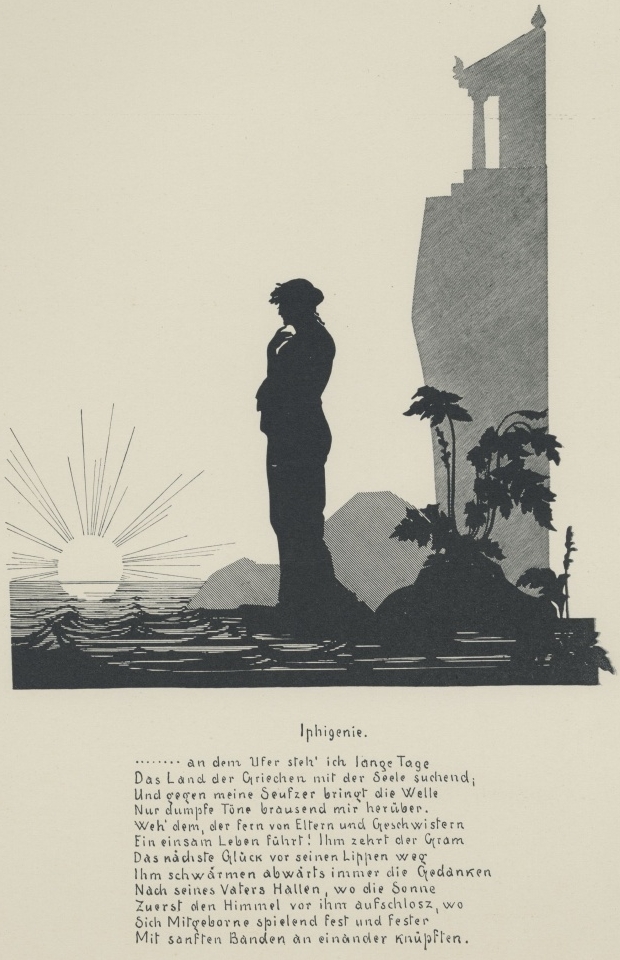
Iphigenie am Wasser stehend, in nachdenklicher Pose vor dem Sonnenuntergang. Im Hintergrund der Tempel Dianas auf einem Felsen. Von Marie Rehsener (1913 - Frankfurter Goethehaus, Freies Deutsches Hochstift)
Nevertheless, the Titanic, gigantic, heaven-storming character afforded no suitable material for my poetic art. It better suited me to represent that peaceful, plastic, and always patient opposition which recognising the superior power, still presumes to claim equality. And yet the bolder members of the race, Tantalus, Ixion, Sisyphus, were also my saints. Admitted to the society of the gods, they would not deport themselves submissively enough, but, by their haughty bearing as guests, provoked the anger of their host and patron, and drew upon themselves a sorrowful banishment. I pitied them; their condition had already been set forth by the ancients as truly tragic, and when I introduced them in the background of my Iphigenie, I was indebted to them for a part of the effect which that piece had the good fortune to produce.
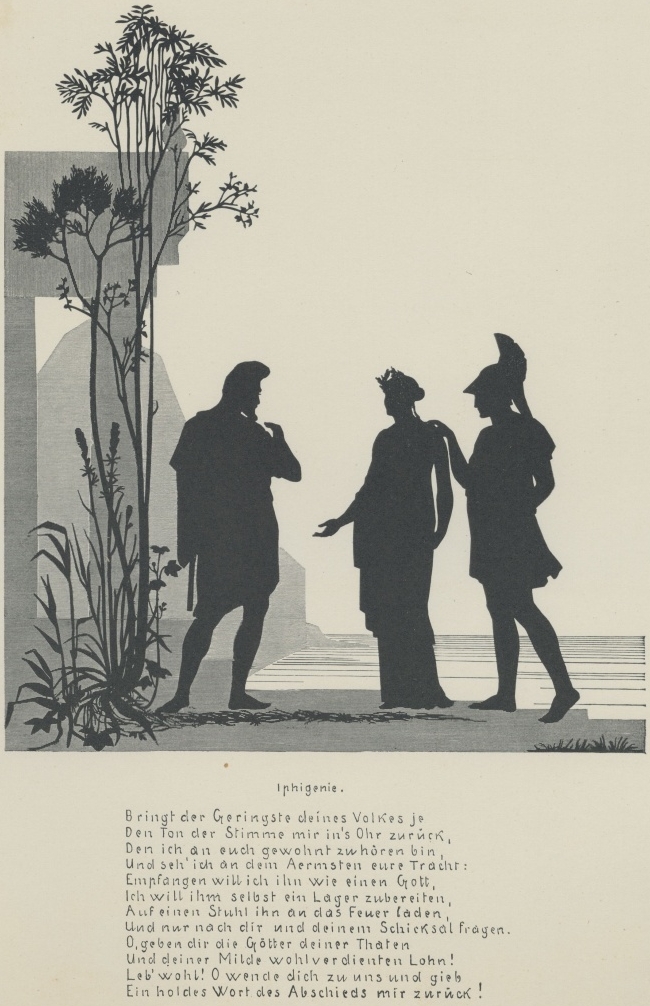
Vor dem Tempel der Diana links Thoas, ihm gegenüber Iphigenie und Orest im Begriff sich zu verabschieden. Von Marie Rehsener (1913 - Frankfurter Goethehaus, Freies Deutsches Hochstift)
At this period I usually combined the art of design with poetical composition. I drew the portraits of my friends in profile on grey paper, in white and black chalk. Whenever I dictated or listened to reading, I sketched the positions of the writer and reader, with the surrounding objects; the resemblance could not be denied, and the drawings were well received. Dilettanti always have this advantage because they give their labor for nothing. But feeling the insufficiency of this copying, I betook myself once more to language and rhythm which were much more at my command. How briskly, how joyously and eagerly I went to work with them will appear from the many poems which, enthusiastically proclaiming the art of nature, and the nature of art, infused, at the moment of their production, new spirit into me as well as into my friends.
At this epoch, and in the midst of these occupations, I was sitting one evening with a struggling light in my chamber, to which at least the air of an artist's studio was thus imparted, while the walls, stuck over and covered with half-finished works, gave the impression of great industry, when there entered a well-formed, slender man, whom, at first, in the twilight, I took for Fritz Jacobi, but soon, discovering my mistake, greeted as a stranger. In his free and agreeable bearing a certain military air was perceptible. He announced himself by the name of Von Knebel, and from a brief introduction I gathered that he was in the Prussian service, and that during a long residence at Berlin and Potsdam he had actively cultivated an acquaintance with the literary men of those places, and with German literature in general. He had attached himself particularly to Ramler, and had adopted his mode of reciting poems. He was also familiar with all that Götz had written, who, at that time, had not as yet made a name among the Germans. Through his exertions the Mädcheninsel (Isle of Maidens) of this poet had been printed at Potsdam, and had fallen into the hands of the king, who was said to have expressed a favorable opinion of it.
State of Weimar.
We had scarcely talked over these subjects of general interest in German literature, before I learned, much to my satisfaction, that he was at present stationed in Weimar, and was appointed the companion of Prince Constantin. Of matters there I had already heard much that was favorable; for several strangers, who had come from Weimar, assured us that the Duchess Amalia had gathered round her the best men to assist in the education of the princes her sons; that the Academy of Jena, through its admirable teachers, had also contributed its part to this excellent purpose; and that the arts were not only protected by this princess, but were practised by her with great diligence and zeal. We also heard that Wieland was in especial favor. The Deutsche Merkur, too, which united the labors of so many scholars in other places, contributed not a little to the fame of the city in which it was published. There also was one of the best theatres in Germany, which was made famous by its actors, as well as by the authors who wrote for it. These noble institutions and plans seemed, however, to have received a sudden check, and to be threatened with a long interruption, in consequence of the terrible conflagration of the castle, which took place in the May of that year. But the confidence in the hereditary prince was so great that every one was convinced not only that the damage would be repaired, but that in spite of it every other hope would be fully accomplished. As I inquired after these persons and things, as if I were an old acquaintance, and expressed a wish to become more intimately acquainted with them, my visitor replied, in the most friendly manner possible, that nothing was easier, since the hereditary prince, with his brother, the Prince Constantin, had just arrived in Frankfort, and desired to see and know me. I at once expressed the greatest willingness to wait upon them, and my new friend told me that I must not delay, as their stay would not be long. In order to equip myself for the visit, I took Von Knebel to my father and mother, who were surprised at his arrival, and the message he bore, and conversed with him with great satisfaction. I then proceeded with him to the young princes, who received me in a very easy and friendly manner; Count Görtz, also, the tutor of the hereditary prince, appeared not displeased to see me. Though there was no lack of literary subjects for our conversation, accident furnished the best possible introduction to it, and rendered it at once important and profitable.
Möser's Patriotische Fantasien (patriotic Fantasies), that is to say, the first part of them, were lying on the table, fresh from the binder, with the leaves uncut. As I was familiar with them, while the rest were scarcely acquainted with them, I had the advantage of being able to give a complete account of the work, and had here a favorable opportunity for speaking with a young prince who was sincerely desirous, and also firmly determined to make use of his station to do all the good in his power. Möser's book, both in its contents and its tone, could not but be highly interesting to every German. While by other writers division, anarchy, and impotence, had been brought as a reproach against the German empire, according to Möser this very number of small states was highly desirable, as affording room for the special cultivation of each, according to its necessities, which must vary with the site and peculiarities of such widely different provinces. In the same way, I remarked, that Möser, starting with the city and bishopric (Stift) of Osnaburg, and thence going over the circle of Westphalia, set forth its relation to the whole empire, and just as he, in the further examination of the subject, uniting the past with the present, deduced the latter from the former, and thus clearly shewed what alterations were desirable or not; so might every ruler, by proceeding in the same way, obtain a thorough knowledge of the constitution of the state he governs, its connexion with its neighbors and with the whole empire, and thus enable himself to judge both the present and the future.
In the course of our conversation, many remarks were made with regard to the difference between the States of Upper and Lower Saxony; not only their natural productions, it was observed, but also their manners, laws, and customs had differed from the earliest times, and, according to the form of religion and government, had variously modified themselves. We endeavoured to obtain a clear view of the differences between the two regions, and in this attempt it soon appeared how useful it would be to have a good model, which, if regarded, not in its individual peculiarities, but in the general method on which it had been based, might be applied to the most widely differing cases, and thereby might be highly serviceable in helping us to form a correct judgment.
This conversation, which was kept up when we were set down at table, made a better impression in my favor than I perhaps deserved. For instead of making such works as belonged to my own sphere of literature the subjects of discussion; instead of demanding an undivided attention for the drama and for romance, I appeared while discussing Möser's book, to prefer those writers whose talents, proceeding from active life, returned to it with immediate benefit, whereas works properly poetical, as soaring above mere social and material interests, could only be indirectly and accidentally profitable. These discussions went on like the stories of the Arabian Nights; one important matter came up after another; many themes were only touched upon without our being able to follow them out, and accordingly, as the stay of the young princes in Frankfort was necessarily short, they made me promise to follow them to Mayence and spend a few days with them there. I gave this promise gladly enough, and hastened home to impart the agreeable intelligence to my parents.
Prospects of a Court-Life.
My father, however, could not by any means be brought to approve of it. In accordance with his sentiments as a citizen of the empire, he had always kept aloof from the great, and although constantly coming in contact with the chargés d'affaires of the neighboring princes, he had nevertheless avoided all personal relations with them. In fact, courts were among the things about which he was accustomed to joke. He was not indeed displeased if any one opposed his opinions on this head; only he was not satisfied unless his opponent maintained his side with wit and spirit. If we allowed his "Procul a Jove procul a fulmine" to pass, but added that with lightning the question was not so much whence it came as whither it went; he would bring up the old proverb, "With great lords it is not good to eat cherries." When to this we replied that it was yet worse to eat with dainty people out of one basket, he would not deny the truth of this; only he was sure to have another proverb ready at hand which was to put us to confusion. For since proverbs and rhyming apophthegms proceed from the people, who, while they are forced to obey, like at least to speak their vengeance, just as their superiors, on the other hand, indemnify themselves by deeds; and since the poetry of the sixteenth century is almost wholly of a nervous didactic character, there is in our language no lack of jests and serious adages, directed from below upwards. We juniors, however, now began to aim from above downwards, fancying ourselves something great as we took up the cause of the great. Of these sayings and counter-sayings I will here insert a few.
A. Long at court is long in hell, B. There many good folks warm them well. A. Such as I am, I'm still mine own, To me shall favors ne'er be shown. B. Blush not a favor to receive, For you must take, if you would give. A. This trouble at the court you catch, That where you itch, you must not scratch. B. The sage, that would the people teach, Must scratch a place that does not itch. A. Those who a slavish office choose, One half of life are sure to lose, And come what will they may be sure, Old Nick the other will secure. B. Whoe'er with princes is at home, Will some day find good fortune come; Who courts the rabble,—to his cost Will find that all his year is lost. A. Though wheat at court seems flourishing, Doubt that great harvest it will bring, When to your barn you deem it brought. You'll find that after all 'tis nought. B. The wheat that blooms will ripen too, For so of old it used to do; And if a crop is spoil'd by hail, The next year's harvest will not fail. A. He who would serve himself alone, Should have a cottage of his own. Dwell with his children and his wife, Regale himself with light new wine, And on the cheapest viands dine; Then nothing can disturb his life. B. So, from a master you'ld be free?— Whither think'st thou then to flee? Dream not your freedom you will get, You have a wife to rule you yet. She by her stupid boy is ruled, Thus in your cot you still are schooled.
Prospects of a Court-Life.
As I was lately looking up these rhymes in some old memorandum books, I fell in with many such jeux d'esprit, in which we had amplified pithy old German saws, in order to set them off against other proverbs which are equally verified by experience. A selection from them may perhaps hereafter, as an epilogue to the "Puppenspiele" (puppet shows), suggest some pleasant reflections.
But all these rejoinders could not move my father from his opinions. He was in the habit of saving his most stringent argument for the close of the discussion. This consisted of a minute description of Voltaire's adventure with Frederick the Second. He told us how the unbounded favor, familiarity, mutual obligations, were at once revoked and forgotten; how he had lived to see the comedy out in the arrest of that extraordinary poet and writer by the Frankfort civic guard, on the complaint of the Resident Freytag, and the warrant of the Burgomaster Fichard, and his confinement for some time in the tavern of the Rose, on the Zeil. To this we might have answered in many ways,—among others, that Voltaire was not free from blame himself,—but from filial respect we always yielded the point. On the present occasion, when these things and others like them were alluded to, I hardly knew how to demean myself, for he warned me explicitly, maintaining that the invitation was given only to entice me into a trap, in order to take vengeance on me for my mischievous treatment of the favored Wieland. Fully as I was convinced of the contrary, yet as I saw but too plainly that a preconceived opinion, excited by hypochondriac fancies, afflicted my worthy father, I was unwilling to act in direct opposition to his convictions. Still I could not find any excuse for failing to keep my promise without appearing ungrateful and uncourteous. Unfortunately our friend Fraülein Von Klettenberg, to whose advice we usually resorted in such cases, was confined to her bed. In her and my mother I had two incomparable companions. I called them Word and Deed; for when the former cast her serene or rather blissful glance over earthly things, what was confusion to us children of earth, at once grew plain before her, and she could almost always point out the right way, because she looked upon the labyrinth from above, and was not herself entangled in it. When a decision was once made, the readiness and energy of my mother could be relied on. While the former had Sight for her aid the latter had Faith, and as she maintained her serenity in all cases, she was never without the means of accomplishing what was proposed or desired. Accordingly she was now despatched to our sick friend to obtain her opinion, and when this turned out in my favour, she was entreated to gain the consent of my father, who yielded, against his belief and will.
Gods, Heroes, and Wieland
It was in a very cold season of the year that I arrived at the appointed hour in Mayence. My reception by the young princes and by their attendants, was no less friendly than the invitation. The conversation in Frankfort was recalled and resumed at the point where it had been broken off. When it touched upon the recent German literature and its audacities, it was perfectly natural that my famous piece, "Götter, Helden, und Wieland" (Gods, Heroes, and Wieland) should come up, at which I remarked with satisfaction that the thing was regarded with good humor. Being called on to give the real history of this jeu d'esprit, which had excited so great attention, I could not avoid confessing, first of all, that as true fellows of the Upper Rhine, we had no bounds either to our liking or disliking. With us, reverence for Shakspeare was carried to adoration. But Wieland, with his decided peculiarity of destroying the interest, both of himself and of his readers, had, in the notes to his translation, found much fault with the great author, and that in such a way as to vex us exceedingly, and to diminish in our eyes, the value of the work. We saw that Wieland, whom we had so highly revered as a poet, and who, as a translator, had rendered such great service, was, as a critic, capricious, one-sided, and unjust. Besides this, he had deliberately spoken against our idols, the Greeks, and this sharpened our hostility yet more. It is well known that the Greek gods and heroes are eminent not for moral but for glorified physical qualities, for which reason they afford such splendid subjects to artists. Now Wieland, in his Alceste, had presented heroes and demi-gods after the modern fashion. Against this we had nothing to say, as every one is at liberty to mould poetic traditions to his own ends and way of thinking. But in the letters on this opera, which he inserted in the Merkur, he appeared to us unduly to exalt this mode of treating them; in short, to show too much of the partisan, and to commit an unpardonable sin against the good ancients and their higher style, by his absolute unwillingness to recognise the strong, healthy nature which is the basis of their productions. I told them we had hardly discussed these grievances with some vehemence in our little society, when my ordinary rage for dramatizing everything came upon me one Sunday afternoon, and so at one sitting, over a bottle of good Burgundy, I wrote off the whole piece, just as it stands. It was no sooner read to those of my colleagues as were present, and received by them with exclamations of delight, than I sent the manuscript to Lenz at Strasburg, who appeared enraptured with it, and maintained that it must be printed without delay. After some correspondence, I at last consented, and he put it hastily to press at Strasburg. Some time afterwards, I learned that this was one of the first steps which Lenz took in his design to injure me, and to bring me into disgrace with the public; but at that time I neither knew nor surmised anything of the kind.
In this way I narrated to my new patrons, with perfect candour, the innocent origin of the piece, as well as I knew it myself, in order to convince them that it contained no personality, nor any ulterior motive. I also took care to let them understand with what gaiety and recklessness we were accustomed to banter and ridicule each other among ourselves. With this, I saw that they were quite content. They almost admired the great fear we had lest any one of ourselves should go to sleep upon his laurels. They compared such a society to those Buccaneers who, in every moment of repose, are afraid of becoming effeminate, and whose leaders, when there are no enemies in sight, and there is no one to plunder, will let off a pistol under the mess-table, in order that even in peace there may be no want of wounds and horrors. After considerable discussion pro and con upon this subject, I was at last induced to write Wieland a friendly letter. I gladly availed myself of the opportunity, as, in the Merkur, he had spoken most liberally of this piece of youthful folly, and as, in literary feuds, was almost always his custom, had ended the affair in the most skilful manner.
Prometheus, Deucalion and his Reviewers.
The few days of my stay at Mayence passed off very pleasantly; for when my new patrons were abroad on visits and banquets, I remained with their attendants, drew the portraits of several, or went skating, for which the frozen ditches of the fortification afforded excellent opportunity. I returned home full of the kindness I had met with, and, as I entered the house, was on the point of emptying my heart by a minute account of it; but I saw only troubled faces, and the conviction was soon forced upon me that our friend Fraülein von Klettenberg was no more. At this I was greatly concerned, because, in my present situation I needed her more than ever. They told me for my consolation, that a pious death had crowned her happy life, and that the cheerfulness of her faith had remained undisturbed to the end. But there was also another obstacle in the way of a free communication on the subject of my visit. My father, instead of rejoicing at the fortunate issue of this little adventure, persisted in his opinion, and maintained, on the other hand, that it was nothing but dissimulation, and that perhaps there was a danger of their carrying out in the end something still worse against me. I was thus driven to my younger friends with my narrative, and to them I could not tell it circumstantially enough. But, their attachment and good will, led to a result which to me was most unpleasant. Shortly afterwards, appeared a pamphlet, called "Prometheus, Deucalion and his Reviewers," also in a dramatic form. In this the comical notion was carried out, of putting little wood-cut figures before the dialogue, instead of proper names, and representing by all sorts of satirical images those critics who had expressed an opinion upon my works, or on works akin to them. In one place the Altona courier, without his head, was blowing his horn, here a bear was growling, and there a goose was cackling. The Merkur, too, was not forgotten, and many wild and tame animals were represented in the atelier of the sculptor endeavoring to put him out, while he, without taking particular notice of them, kept zealously at his work, and did not refrain from expressing his opinion about the matter in general. The appearance of this jeu d'esprit surprised me much, and was as unexpected as it was disagreeable. Its style and tone evidently showed that it was by one of our society, and indeed I feared it might be attributed to me. But what was most annoying, was the circumstance that "Prometheus" brought out some allusions to my stay at Mayence and to what was said there, which nobody but myself could have known. To me this was a proof that the author was one of those who formed my most intimate circle of friends, where he must have heard me relate these events in detail. Accordingly we all looked at each other, and each suspected the rest, but the unknown writer managed very well to keep his own secret. I uttered vehement reproaches against him, because it was exceedingly vexatious to me, after so gracious a reception and so important a conversation, and after the confiding letter I had written to Wieland, to see here an occasion for fresh distrust and disagreement. However my uncertainty on this point was not of long duration. As I walked up and down my room reading the book aloud, I heard clearly in the fancies and the turns of expression the voice of Wagner—and it was he. When I had rushed down stairs to impart my discovery to my mother, she confessed to me that she already knew it. Annoyed at the ill results of what had seemed to him a good and praiseworthy plan, the author had discovered himself to her, and besought her intercession with me, not to fulfil in his person my threat of holding no further intercourse with the writer who had so abused my confidence. The fact that I had found him out myself was very much in his favour, and the satisfaction always attending a discovery of one's own, inclined me to be merciful. The fault which had given occasion for such a proof of my sagacity, was forgiven. Nevertheless, it was not easy to convince the public that Wagner was the author, and that I had had no hand in the game. No one believed that he possessed such versatility of talent; and no one reflected, that it was very easy for him, though possessing no remarkable talents of his own, to notice, seize upon, and bring out in his own way all that for some time had passed either in jest and earnest in an intellectual society. And thus on this occasion as on many others afterwards, I had to suffer not only for my own follies, but also for the indiscretion and precipitancy of my friends.
As the remembrance of them is here suggested by many circumstances, I will speak of some distinguished men who, at different times, on their passage through Frankfort, either lodged at our house or partook of our friendly hospitality. Once more Klopstock stands justly at the head. I had already exchanged several letters with him, when he announced to me that he was invited to go to Carlsruhe and to reside there; that he would be in Friedberg by a specified day, and wished that I would come there and fetch him. I did not fail to be there at the hour. He, however, had been accidently detained upon the road; and after I had waited in vain for some days, I went home, where he did not arrive till after some time, and then excused his delay, and received very kindly my readiness to come to meet him. His person was small but well-built; his manners without being stiff, were serious and precise; his conversation was measured and agreeable. On the whole there was something of the diplomatist in his bearing. Such a man undertakes the difficult task of supporting, at the same time, his own dignity, and that of a superior to whom he is responsible; of advancing his own interest, together with the much more important interest of a prince, or even of a whole State; and of making himself, beyond all things, pleasing to other men while in this critical position. In this way Klopstock appeared to bear himself as a man of worth and as the representative of other things—of religion, of morality and freedom. He had also assumed another peculiarity of men of the world—namely, not readily to speak on subjects upon which he was particularly expected and desired to discourse. He was seldom heard to mention poetic and literary subjects. But as he found in me and my friends a set of passionate skaters, he discoursed to us at length on this noble art, on which he had thought much, having considered what in it was to be sought, and what avoided. Still, before we could receive the instruction he proffered, we had to submit to be put right as to the word itself, in which we blundered.[1] We spoke in good Upper-Saxon of Schlittschuhen, which he would not allow to pass at all; for the word, he said, does not come from Schlitten (sledge), as if one went on little runners, but from Schreiten (to stride), because like the Homeric gods the skater strides away on these winged shoes over the sea frozen into a plain. Next we came to the instrument itself. He would have nothing to do with the high grooved skates, but recommended the low, broad, smooth-bottomed Friseland steel skates as the most serviceable for speed. He was no friend to the tricks of art which are usually performed in this exercise. I procured, according to his advice, a pair of smooth skates, with long toes, and used them for several years, though with some discomfort. He understood, too, the science of horsemanship and horse-breaking, and liked to talk about it; thus, as if by design, he avoided all conversation upon his own profession, that he might speak with greater freedom about arts quite foreign to it, which he pursued only as a pastime. I might say much more of these and other peculiarities of this extraordinary man, if those who lived longer with him had not already informed us fully about them. One observation, however, I will not suppress, which is, that men whom Nature, after endowing them with uncommon advantages, has placed in a narrow circle of action, or at least in one disproportioned to their powers, generally fall into eccentricities; and as they have no opportunity of making direct use of their gifts, seek to employ them in an extraordinary or whimsical manner.
Zimmermann.
Zimmermann was also for a time our guest. He was tall and powerfully built; of a vehement nature open to every impulse; yet he had his outward bearing and manners perfectly under control, so that in society he appeared as a skilful physician and polished man of the world. It was only in his writings and amongst his most confidential friends, that he gave free course to his untamed inward character. His conversation was varied and highly instructive, and for one who could pardon his keen sensitiveness to whatever grated on his own personal feelings and merits, no more desirable companion could be found. For myself, as what is called vanity never disturbed me, and I in return often presumed to be vain also—that is, did not hesitate to enlarge upon whatever in myself pleased me, I got on with him capitally. We mutually tolerated and scolded each other, and, as he showed himself thoroughly open and communicative, I learned from him a great deal in a short time.
To judge such a man with the indulgence of gratitude, nay on principle, I cannot say that he was vain. We Germans misuse the word "vain" (citel), but too often. In a strict sense, it carries with it the idea of emptiness, and we properly designate by it only the man who cannot conceal his joy at his Nothing, his contentment with a hollow phantom. With Zimmermann it was exactly the reverse; he had great deserts, and no inward satisfaction. The man who cannot enjoy his own natural gifts in silence, and find his reward in the exercise of them, but must wait and hope for their recognition and appreciation by others, will generally find himself but badly off, because it is but too well known a fact that men are very niggard of their applause; that they rather love to mingle alloy with praise, and where it can in any degree be done, to turn it into blame. Whoever comes before the public without being prepared for this, will meet with nothing but vexation; since, even if he does not overestimate his own production, it still has for him an unlimited value, while the reception it meets with in the world, is in every case qualified. Besides, a certain susceptibility is necessary for praise and applause, as for every other pleasure. Let this be applied to Zimmermann, and it will be acknowledged in his case too; that no one can obtain what he does not bring with him.
Zimmermann.
If this apology cannot be allowed, still less shall we be able to justify another fault of this remarkable man, because it disturbed and even destroyed the happiness of others. I mean his conduct towards his children. A daughter, who travelled with him, stayed with us while he visited the neighbouring scenes. She might be about sixteen years old, slender and well formed, but without attractiveness; her regular features would have been agreeable, if there had appeared in them a trace of animation, but she was always as quiet as a statue; she spoke seldom, and in the presence of her father never. But she had scarcely spent a few days alone with my mother, receiving the cheerful and affectionate attentions of this sympathizing woman, than she threw herself at her feet with an opened heart, and with a thousand tears, begged to be allowed to remain with her. With the most passionate language she declared that she would remain in the house as a servant, as a slave all her life, rather than go back with her father, of whose severity and tyranny no one could form an idea. Her brother had gone mad under his treatment; she had hitherto borne it though with difficulty, because she had believed that it was the same, or not much better, in every family, but now that she had experienced such a loving, mild and considerate treatment, her situation at home had become to her a perfect hell. My mother was greatly moved as she related to me this passionate effusion, and indeed, she went so far in her sympathy, as to give me pretty clearly to understand, that she would be content to keep the girl in the house, if I would make up my mind to marry her. If she were an orphan, I replied, I might think and talk it over; but God keep me from a father-in-law who is such a father! My mother took great pains with the poor girl, but this made her only the more unhappy. At last an expedient was found, by putting her to a boarding-school. Her life, I should observe in passing, was not a very long one.
I should hardly mention this culpable peculiarity of a man of such great deserts, if it had not already become a matter of public notoriety, and especially had not the unfortunate hypochondria, with which, in his last hours, he tortured himself and others, been commonly talked of. For that severity towards his children was nothing less than hypochondria, a partial insanity, a continuous moral murder, which, after making his children its victims, was at last directed against himself. We must also remember that though apparently in such good health, he was a great sufferer even in his best years;—that an incurable disease troubled the skilful physician who had relieved, and still gave ease to so many of the afflicted. Yes, this distinguished man, with all his outward reputation, fame, honour, rank, and wealth, led the saddest life, and whoever will take the pains to learn more about it from existing publications, will not condemn but pity him.
If it is now expected that I shall give a more precise account of the effect which this distinguished man had upon me, I must once more recall the general features of that period. The epoch in which we were living might be called an epoch of high requisitions, for every one demanded of himself and of others what no mortal had hitherto accomplished. On chosen spirits who could think and feel, a light had arisen, which enabled them to see that an immediate, original understanding of nature, and a course of action based upon it, was both the best thing a man could desire, and also not difficult to attain. Experience thus once more became the universal watchword, and every one opened his eyes as wide as he could. Physicians, especially, had a most pressing call to labour to this end, and the best opportunity for finding it. Upon them a star shone out of antiquity, which could serve as an example of all that was to be desired. The writings which had come down to us under the name of Hippocrates, furnished a model of the way in which a man should both observe the world and relate what he had seen, without mixing up himself with it. But no one considered that we cannot see like the Greeks, and that we shall never become such poets, sculptors, and physicians as they were. Even granted that we could learn from them, still the results of experience already gone through, were almost beyond number, and besides were not always of the clearest kind; moreover had too often been made to accord with preconceived opinions. All these were to be mastered, discriminated, and sifted. This also, was an immense demand. Then again it was required that each observer, in his personal sphere and labours, should acquaint himself with the true, healthy nature, as if she were now for the first time noticed, and attended, and thus only what was genuine and real was to be learned. But as, in general, learning can never exist without the accompaniment of a universal smattering and a universal pedantry, nor the practice of any profession without empiricism and charlatanry, so there sprung up a violent conflict, the purpose of which was to guard use from abuse, and place the kernel high above the shell in men's estimation. In the execution of this design, it was perceived that the shortest way of getting out of the affair, was to call in the aid of genius, whose magic gifts could settle the strife, and accomplish what was required. Meanwhile, however, the understanding meddled with the matter; all it alleged must be reduced to clear notions, and exhibited in a logical form, that every prejudice might be put aside, and all superstition destroyed. And since the achievements of some extraordinary men, such as Boerhaave and Haller, were actually incredible, people thought themselves justified in demanding even still more from their pupils and successors. It was maintained that the path was opened, forgetting that in earthly things a path can very rarely be spoken of; for, as the water that is dislodged by a ship, instantly flows in again behind it, so by the law of its nature, when eminent spirits have once driven error aside, and made a place for themselves, it very quickly closes upon them again.
Zimmermann.
But of this the ardent Zimmermann could form no idea whatever; he would not admit that absurdity did in fact fill up the world. Impatient, even to madness, he rushed to attack everything that he saw and believed to be wrong. It was all the same to him whether he was fighting with a nurse or with Paracelsus, with a quack, or a chemist. His blows fell alike heavily in either case, and when he had worked himself out of breath, he was greatly astonished to see the heads of this hydra, which he thought he had trodden under foot, springing up all fresh again, and showing him their teeth from innumerable jaws.
Every one who reads his writings, especially his clever work "On Experience," will perceive more distinctly than I can express them, the subjects of discussion between this excellent man and myself. His influence over me, was the more powerful, as he was twenty years my senior. Having a high reputation as a physician, he was chiefly employed among the upper classes, and the corruption of the times, caused by effeminacy and excess, was a constant theme of conversation with him. Thus his medical discourses, like those of the philosophers and my poetical friends, drove me again back to nature. In his vehement passion for improvement I could not fully participate; on the contrary, after we separated, I instantly drew back into my own proper calling, and endeavoured to employ the gifts nature had bestowed upon me, with moderate exertion, and by good-natured opposition to what I disapproved of, to gain a standing for myself, in perfect indifference how far my influence might reach or whither it might lead me.
Von Salis, who was setting up the large boarding school at Marsehlins, visited us also at that time. He was an earnest and intelligent man, and must have quietly made many humorous observations on the irregular though genial mode of life in our little society. The same was probably the case with Sulzer, who came in contact with us on his journey to the south of France; at least a passage in his travels where he speaks of me, seems to favor this opinion.
These visits, which were as agreeable as they were profitable, were however diversified by others which we would rather have been spared. Needy and shameless adventurers fixed themselves on the confiding youth, supporting their urgent demands by real as well as fictitious relationships and misfortunes. They borrowed my money, and made it necessary for me to borrow in turn, so that I in consequence fell into the most unpleasant position with opulent and kind-hearted friends. If I wished that all these unfortunate folks were food for the crows, my father found himself in the situation of the Tyro in Witchcraft[2] who was willing enough to see his house washed clean, but is frightened when the flood rushes in without ceasing, over threshold and stairs. By an excessive kindness, the quiet and moderate plan of life which my father had designed for me was step by step interrupted and put off, and from day to day changed contrary to all expectation. All idea of a long visit to Ratisborn and Vienna was as good as given up; but still I was to pass through those cities on my way to Italy, so as at least to gain a general notion of them. On the other hand, some of my friends, who did not approve of taking so long a circuit, in order to get into active life, recommended that I should take advantage of a moment which seemed in every way favorable, and think on a permanent establishment in my native city. Although the Council were closed against me, first by my grandfather and then by my uncle, there were yet many civil offices to which I could lay claim, where I could remain for a time and await the future. There were agencies of several kinds which offered employment enough, and the place of a chargé d'affaires was highly respectable. I suffered myself to be persuaded, and believed also, that I might adapt myself to this plan, without having tried whether I was suited for such a mode of life and business as requires that amid dissipation, we should most of all act for a certain end. To these plans and designs there was now added a tender sentiment which seemed to draw me towards a domestic life and to accelerate my determination.
Plans for Settling in Life.
The society of young men and women already mentioned, which was kept together by, if it did not owe its origin to, my sister, still survived after her marriage and departure, because the members had grown accustomed to each other, and could not spend one evening in the week better than in this friendly circle. The eccentric orator also whose acquaintance we made in the sixth book, had, after many adventures, returned to us, more clever and more perverse than ever, and once again played the legislator of the little state. As a sequel to our former diversions he had devised something of the same kind; he enacted that every week lots should be drawn, not as before to decide what pairs should be lovers, but married couples. How lovers should conduct themselves towards each other, he said, we knew well enough; but of the proper deportment of husbands and wives in society we were totally ignorant, and this, with our increasing years, we ought to learn before all things. He laid down general rules, which, of course, set forth that we must act as if we did not belong to each other; that we must not sit or speak often together, much less indulge in anything like caresses. And at the same time we were not only to avoid everything which would occasion mutual suspicion and discord, but, on the contrary, he was to win the greatest praises, who, with his free and open manners should yet most endear to himself his wife.
The lots were at once drawn; some odd matches that they decided were laughed at and joked about, and the universal marriage-comedy was begun in good humour and renewed every week.
Now it fell out strangely enough, that from the first the same lady fell twice to me. She was a very good creature, just such a woman as one would like to think of as a wife. Her figure was beautiful and well-proportioned, her face pleasing, while in her manners there prevailed a repose which testified to the health of her mind and body. Every day and hour she was perfectly the same. Her domestic industry was in high repute. Though she was not talkative, a just understanding and natural talents could be recognised in her language. To meet the advances of such a person with friendliness and esteem was natural; on a general principle I was already accustomed to do it, and now I acted from a sort of traditional kindness as a social duty. But when the lot brought us together for the third time, our jocose law-giver declared in the most solemn manner that Heaven had spoken, and we could not again be separated. We submitted to his sentence, and both of us adapted ourselves so well to our public conjugal duties, that we might really have served as a model. Since all the pairs who were severally united for the evening, were obliged by the general rules to address each other for the few hours with Du (thou), we had, after a series of weeks, grown so accustomed to this confidential pronoun, that even in the intervals whenever we accidentally came together, the Du would kindly come out.[3] Habit is a strange thing; by degrees both of us found that nothing was more natural than this relation. I liked her more and more, while her manner of treating me gave evidence of a beautiful calm confidence, so that on many an occasion if a priest had been present we might have been united on the spot without much hesitation.
The Clavigo.
As at each of our social gatherings something new was required to be read aloud, I brought with me one evening a perfect novelty, The Memoir of Beaumarchais against Clavigo, in the original. It gained great applause. The thoughts to which it gave occasion were freely expressed, and after much had been spoken on both sides, my partner said: "If I were thy liege lady and not thy wife, I would entreat thee to change this memoir into a play: it seems to me perfectly suited for it." "That thou mayst see, my love," I replied, "that liege lady and wife can be united in one person, I promise that, at the end of a week, the subject-matter of this work, in the form of a piece for the theatre, shall be read aloud, as has just been done with these pages." They wondered at so bold a promise, but I did not delay to set about accomplishing it. What, in such cases, is called invention, was with me instantaneous. As I was escorting home my titulary wife I was silent. She asked me what was the matter? "I am thinking out the play," I answered, "and have got already into the middle of it. I wished to show thee that I would gladly do anything to please thee." She pressed my hand, and as I in return snatched a kiss, she said: "Thou must forget thy character! To be loving, people think, is not proper for married folks." "Let them think," I rejoined, "we will have it our own way."
Before I got home, and indeed I look a very circuitous route, the piece was pretty far advanced. Lest this should seem boastful, I will confess that previously, on the first and second reading, the subject had appeared to me dramatic and even theatrical, but, without such a stimulus, this piece, like so many others, would have remained among the number of the merely possible creations. My mode of treating it is well enough known. Weary of villains, who, from revenge, hate, or mean purposes, attack a noble nature and ruin it, I wished, in Carlos, to show the working of clear good sense, associated with true friendship, against passion, inclination and outward necessity; in order, for once, to compose a tragedy in this way. Availing myself of the example of our patriarch Shakspeare, I did not hesitate for a moment to translate, word for word, the chief scene, and all that was properly dramatic in the original. Finally, for the conclusion, I borrowed the end of an English ballad, and so I was ready before the Friday came. The good effect which I attained in the reading will easily be believed. My liege spouse took not a little pleasure in it, and it seemed as if, by this production, as an intellectual offspring, our union was drawn closer and dearer.
Mephistopheles Merck here did me, for the first time, a great injury. When I communicated, the piece to him he answered: "You must write hereafter no more such trifles; others can do such things." In this he was wrong. We should not, in all things, transcend the notions which men have already formed; it is good that much should be in accordance with the common way of thinking. Had I at that time written a dozen such pieces, which with a little stimulus would have been easy enough, three or four of them would perhaps have retained a place on the stage. Every theatrical manager who knows the value of a repertoire, can say what an advantage that would have been.
By these, and other intellectual diversions, our whimsical game of marriage became a family story, if not the talk of the town, which did not sound disagreeably in the ears of the mothers of our fair ones. My mother, also, was not at all opposed to such an event; she had before looked with favor on the lady with whom I had fallen into so strange a relation, and did not doubt that she would make as good a daughter-in-law as a wife. The aimless bustle in which I had for some time lived was not to her mind, and, in fact, she had to bear the worst of it. It was her part to provide abundant entertainment for the stream of guests, without any compensation for furnishing quarters to this literary army, other than the honor they did her son by feasting upon him. Besides, it was clear to her that so many young persons—all of them without property—united not only for scientific and poetic purposes, but also for that of passing the time in the gayest manner, would soon become a burthen and injury to themselves, and most certainly to me, whose thoughtless generosity and passion for becoming security for others she too well knew.
Accordingly, she looked on the long-planned Italian journey, which my father once more brought forward, as the best means of cutting short all these connexions at once. But, in order that no new danger might spring up in the wide world, she intended first of all to bind fast the union which had already been suggested, so as to make a return into my native country more desirable, and my final determination more decided. "Whether I only attribute this scheme to her, or whether she had actually formed it with her departed friend, I am not quite sure; enough, that her actions seemed to be based on a well-digested plan. I had very often to hear from her a regret that since Cornelia's marriage our family circle was altogether too small; it was felt that I had lost a sister, my mother an assistant, and my father a pupil; nor was this all that was said. It happened, as if by accident, that my parents met the lady on a walk, invited her into the garden, and conversed with her for a long time. Thereupon there was some pleasantry at tea-table, and the remark was made with a certain satisfaction that she had pleased my father, as she possessed all the chief qualities which he as a connoisseur of women required.
Preparations for my Wedding.
One thing after another was now arranged in our first story, as if guests were expected; the linen was reviewed, and some hitherto neglected furniture was thought of. One day I surprised my mother in a garret examining the old cradles, among which an immense one of walnut inlaid with ivory and ebony, in which I had formerly been rocked, was especially prominent. She did not seem altogether pleased when I said to her, that such swing-boxes were quite out of fashion, and that now people put babies, with free limbs, into a neat little basket, and carried them about for show, by a strap over the shoulder, like other small wares.
Enough;—such prognostics of a renewal of domestic activity became frequent, and, as I was in every way submissive, the thought of a state which would last through life spread a peace over our house and its inhabitants such as had not been enjoyed for a long time.[4]
PART THE FOURTH.
NEMO CONTRA DEUM NISI DEUS IPSE.
SIXTEENTH BOOK.
Spinoza—Jung (Stilling)
What people commonly say of misfortunes: that they never come alone: may with almost as much truth be said also of good fortune, and, indeed, of other circumstances which often cluster around us in a harmonious way; whether it he by a kind of fatality, or whether it be that man has the power of attracting to himself all mutually related things.
At any rate, my present experience shewed me everything conspiring to produce an outward and an inward peace. The former came to me while I resolved patiently to await the result of what others were meditating and designing for me; the latter, however, I had to attain for myself by renewing former studies.
I had not thought of Spinoza for a long time, and now I was driven to him by an attack upon him. In our library I found a little book, the author of which railed violently against that original thinker; and to go the more effectually to work, had inserted for a frontispiece a picture of Spinoza himself, with the inscription: "Signum reprobationis in vultu gerens" bearing on his face the stamp of reprobation. This there was no gainsaying, indeed, so long as one looked at the picture; for the engraving was wretchedly bad, a perfect caricature; so that I could not help thinking of those adversaries who, when they conceive a dislike to any one, first of all misrepresent him, and then assail the monster of their own creation.
This little book, however, made no impression upon me, since generally I did not like controversial works, but preferred always to learn from the author himself how he did think, than to hear from another how he ought to have thought. Still, curiosity led me to the article "Spinoza," in Bayle's Dictionary, a work as valuable for its learning and acuteness as it is ridiculous and pernicious by its gossiping and scandal.
Spinoza—His Principles.
The article "Spinoza" excited in me displeasure and mistrust. In the first place, the philosopher is represented as an atheist, and his opinions as most abominable; but immediately afterwards it is confessed that he was a calmly reflecting man, devoted to his studies, a good citizen, a sympathizing neighbour, and a peaceable individual. The writer seemed to me to have quite forgotten the words of the gospel: "By their fruits ye shall know them," for how could a life pleasing in the sight of God and man spring from corrupt principles?
I well remembered what peace of mind and clearness of ideas came over me when I first turned over the posthumous works of that remarkable man. The effect itself was still quite distinct to my mind, though I could not recall the particulars; I therefore speedily had recourse again to the work? to which I had owed so much, and again the same calm air breathed over me. I gave myself up to this reading, and believed, while I looked into myself, that I had never before so clearly seen through the world.
As, on this subject, there always has been, and still is even in these later times, so much controversy, I would not wish to be misunderstood, and therefore I make here a few remarks upon these so much feared, yea, abhorred views.
Our physical as well as our social life, manners, customs, worldly wisdom, philosophy, religion, and many an accidental event, all call upon us, to deny ourselves. Much that is most inwardly peculiar to us we are not allowed to develope; much that we need from without for the completion of our character is withheld; while, on the other hand, so much is forced upon us which is as alien to us as it is burdensome. We are robbed of all that we have laboriously acquired for ourselves, or friendly circumstances have bestowed upon us; and before we can see clearly what we are, we find ourselves compelled to part with our personality, piece by piece, till at last it is gone altogether. Indeed, the case is so universal that it seems a law of society to despise a man who shows himself surly on that account. On the contrary, the bitterer the cup we have to drink, the more pleasant face must one make, in order that composed lookers on may not be offended by the least grimace.
To solve this painful problem, however, nature has endowed man with ample power, activity, and endurance. But especially is he aided therein by his volatility (Leichtsinn), a boon to man, which nothing can take away. By its means he is able to renounce the cherished object of the moment, if only the next presents him something new to reach at; and thus he goes on unconsciously, remodelling his whole life. We are continually putting one passion in the place of another; employments, inclinations, tastes, hobbies—we try them all, only to exclaim at last, All is vanity. No one is shocked by this false and murmuring speech; nay, every one thinks, while he says it, that he is uttering a wise and indisputable maxim. A few men there are, and only a few, who anticipate this insupportable feeling, and avoid all calls to such partial resignation by one grand act of total self-renunciation.
Such men convince themselves of the Eternal, the Necessary, and of Immutable Law, and seek to form to themselves ideas which are incorruptible, nay which observation of the Perishable does not shake, but rather confirms. But since in this there is something superhuman, such persons are commonly esteemed in-human, without a God and without a World. People hardly know what sort of horns and claws to give them.
My confidence in Spinoza rested on the serene effect he wrought in me, and it only increased when I found my worthy mystics were accused of Spinozism, and learned that even Leibnitz himself could not escape the charge; nay, that Boerhaave, being suspected of similar sentiments, had to abandon Theology for Medicine.
But let no one think that I would have subscribed to his writings, and assented to them verbatim et literatim. For, that no one really understands another; that no one attaches the same idea to the same word which another does; that a dialogue, a book, excites in different persons different trains of thought:—this I had long seen all too plainly; and the reader will trust the assertion of the author of Faust and Werther, that deeply experienced in such misunderstandings, he was never so presumptuous as to think that he understood perfectly a man, who, as the scholar of Descartes, raised himself, through mathematical and rabbinical studies, to the highest reach of thought; and whose name even at this day seems to mark the limit of all speculative efforts.
How much I appropriated from Spinoza, would be seen distinctly enough, if the visit of the "Wandering Jew," to Spinoza, which I had devised as a worthy ingredient for that poem, existed in writing. But it pleased me so much in the conception, and I found so much delight in meditating on it in silence, that I never could bring myself to the point of writing it out. Thus the notion, which would have been well enough as a passing joke, expanded itself until it lost its charm, and I banished it from my mind as something troublesome. The chief points, however, of what I owed to my study of Spinoza, so far as they have remained indelibly impressed on my mind, and have exercised a great influence on the subsequent course of my life, I will now unfold as briefly and succinctly as possible.
Influence of Spinoza.
Nature works after such eternal, necessary, dime laws, that the Deity himself could alter nothing in them. In this belief, all men are unconsciously agreed. Think only how a natural phenomenon, which should intimate any degree of understanding, reason, or even of caprice, would instantly astonish and terrify us.
If anything like reason shows itself in brutes, it is long before we can recover from our amazement; for, although they stand so near to us, they nevertheless seem to be divided from us by an infinite gulf, and to belong altogether to the kingdom of necessity. It is therefore impossible to take it ill if some thinkers have pronounced the infinitely ingenious, but strictly limited, organisation of those creatures, to be thoroughly mechanical.
If we turn to plants, our position is still more strikingly confirmed. How unaccountable is the feeling which seizes an observer upon seeing the Mimosa, as soon as it is touched, fold together in pairs its downy leaves, and finally clap down its little stalk as if upon a joint (Gewerbe). Still higher rises that feeling, to which I will give no name, at the sight of the Hedysarum Gyrans, which without any apparent outward occasion moves up and down its little leaves, and seems to play with itself as with our thoughts. Let us imagine a Banana, suddenly endowed with a similar capacity, so that of itself it could by turns let down and lift up again its huge leafy canopy; who would not, upon seeing it the first time, start back in terror? So rooted within us is the idea of our own superiority, that we absolutely refuse to concede to the outward world any part or portion in it; nay, if we could, we would too often withhold such advantages from our fellows.
On the other hand, a similar horror seizes upon us, when we see a man unreasonably opposing universally recognised moral laws, or unwisely acting against the interest of himself and others. To get rid of the repugnance which we feel on such occasions, we convert it at once into censure or detestation, and we seek either in reality or in thought to get free from such a man.
This contrariety between Reason and Necessity, which Spinoza threw out in so strong a light, I, strangely enough, applied to my own being; and what has been said is, properly speaking, only for the purpose of rendering intelligible what follows.
I had come to look upon my indwelling poetic talent altogether as Nature; the more so, as I had always been impelled to regard outward Nature as its proper object. The exercise of this poetic gift could indeed be excited and determined by circumstances; but its most joyful, its richest action was spontaneous-nay, even involuntary.
Through field and forest roaming, My little songs still humming, So went it all day long.
In my nightly vigils the same thing happened; I therefore often wished, like one of my predecessors, to get me a leathern jerkin made, and to accustom myself to write in the dark so as to be able to fix down at once all such unpremeditated effusions. So frequently had it happened that after composing a little piece in my head I could not recall it, that I would now hurry to the desk and, at one standing, write off the poem from beginning to end, and as I could not spare time to adjust my paper, however obliquely it might lie, the lines often crossed it diagonally. In such a mood I liked best to get hold of a lead pencil, because I could write most readily with it; whereas the scratching and spluttering of the pen would sometimes wake me from my somnambular poetizing, confuse me, and stifle a little conception in its birth. For the poems thus created I had a particular reverence; for I felt towards them somewhat as the hen does towards her chickens, which she sees hatched and chirping about her. My old whim of making known these things only by means of private readings, now returned to me: to exchange them for money seemed to me detestable.
Himburg - The Piratical Bookseller.
And this suggests to me to mention in the present place a little incident, which however did not take place till some time after. When the demand for my works had increased and a collected edition of them was much called for, these feelings held me back from preparing it myself; Himburg, however, took advantage of my hesitation, and I unexpectedly received one day several copies of my collected works in print. With cool audacity this unauthorized publisher even boasted of having done me a public service, and offered to send me, if I wished, some Berlin porcelain by way of compensation. His offer served to remind me of the law which compelled the Jews of Berlin, when they married, to purchase a certain quantity of porcelain, in order to keep up the sale of the Royal manufacture. The contempt which was shewn for the shameless pirate, led me to suppress the indignation which I could not but feel at such a robbery. I gave him no reply; and while he was making himself very comfortable with my property, I revenged myself in silence with the following verses:—
Records of the years once dream'd away, Long fallen hairs, and flow'rs that shew decay, Faded ribbons, veils so lightly wove, The mournful pledges of a vanished love; Things that to the flames should long have gone, —Saucy Sosias snatches every one. Just as though he were the heir to claim, Lawfully the poets' works and fame. And to make the owner full amends Paltry tea and coffee-cups he sends! Take your china back, your gingerbread! For all Himburgs living I am dead.
This very Nature, however, which thus spontaneously brought forth so many longer and smaller works, was subject to long pauses, and for considerable periods I was unable, even when I most wished it, to produce anything, and consequently often suffered from ennui. The perception of such contrasts within me gave rise to the thought whether, on the other hand, it would not be my wisest course to employ for my own and others' profit and advantage, the human, rational, and intellectual part of my being, and as I already had done, and as I now felt myself more and more called upon to do, devote the intervals when Nature ceased to influence me, to worldly occupations, and thus to leave no one of my faculties unused. This course, which seemed to be dictated by those general ideas before described, was so much in harmony with my character and my position in life, that I resolved to adopt it and by this means to check the wavering and hesitation to which I had hitherto been subject. Very pleasant was it to me to reflect, that thus for actual service to my fellow men, I might demand a substantial reward, while on the other hand I might go on disinterestedly spending that lovely gift of nature as a sacred thing. By this consideration I guarded against the bitterness of feeling which might have arisen when circumstances should force upon the remark that precisely this talent, so courted and admired in Germany, was treated as altogether beyond the pale of the law and of justice. For not only were piracies considered perfectly allowable, and even comical in Berlin, but the estimable Margrave of Baden, so praised for his administrative virtues, and the Emperor Joseph who had justified so many hopes, lent their sanction, one to his Macklot, and the other to his honorable noble von Trattner; and it was declared, that the rights, as well as the property of genius, should be left at the absolute mercy of the trade.
One day, when we were complaining of this to a visitor from Baden, he told us the following story: Her ladyship the Margravine, being a very active lady, had established a paper-manufactory; but the paper was so bad, that it was impossible to dispose of it. Thereupon Mr. bookseller Macklot proposed, if he were permitted to print the German poets and prose writers, he would use this paper, and thus enhance its value. The proposition was adopted with avidity.
Of course, we pronounced this malicious piece of scandal to be a mere fabrication; but found our pleasure in it notwithstanding. The name of Macklot became a by-word at the time, and was applied by us to all mean transactions. And, a versatile youth, often reduced to borrowing himself, while others' meanness was making itself rich upon his talents, felt himself sufficiently compensated by a couple of good jokes.
Children and youths wander on in a sort of happy intoxication, which betrays itself especially in the fact, that the good, innocent creatures are scarcely able to notice, and still less to understand, the ever changing state of things around them. They regard the world as raw material which they must shape, as a treasure which they must take possession of. Everything they seem to think belongs to them, everything must be subservient to their will; indeed, on this account, the greater part lose themselves in a wild uncontrollable temper. With the better part, however, this tendency unfolds itself into a moral enthusiasm, which, occasionally moves of its own accord after some actual or seeming good, but still oftener suffers itself to be prompted, led, and even misled.
Such was the case with the youth of whom we are at present speaking, and if he appeared rather strange to mankind, still he seemed welcome to many. At the very first meeting you found in him a freedom from reserve, a cheerful open-heartedness in conversation, and in action the unpremeditated suggestions of the moment. Of the latter trait a story or two.
A Scene at a Fire.
In the close-built Jews' street (Judengasse), a violent conflagration had broken out. My universal benevolence, which prompted me to lend my active aid to all, led me to the spot, full dressed as I was. A passage had been broken through from All Saints' street (Allerheiligengasse), and thither I repaired. I found a great number of men busied with carrying water, rushing forward with full buckets, and back again with empty ones. I soon saw that, by forming a lane for passing up and down the buckets, the help we rendered might be doubled. I seized two full buckets and remained standing and called others to me; those who came on were relieved of their load, while those returning arranged themselves in a row on the other side. The arrangement was applauded, my address and personal sympathy found favor, and the lane, unbroken from its commencement to its burning goal, was soon completed. Scarcely, however, had the cheerfulness which this inspired, called forth a joyous, I might even say, a merry humor in this living machine, all of whose party worked well together, when wantonness began to appear, and was soon succeeded by a love of mischief. The wretched fugitives, dragging off their miserable substance upon their backs, if they once got within the lane, must pass on without stopping, and if they ventured to halt for a moment's rest, were immediately assailed. Saucy boys would sprinkle them with the water, and even add insult to misery. However, by means of gentle words and eloquent reproofs, prompted perhaps by a regard to my best clothes, which were in danger, I managed to put a stop to their rudeness.
Some of my friends had from curiosity approached, to gaze on the calamity, and seemed astonished to see their companion, in thin shoes and silk stockings—for that was then the fashion-engaged in this wet business. But few of them could I persuade to join us; the others laughed and shook their heads. We stood our ground, however, a long while, for, if any were tired and went away, there were plenty ready to take their places. Many sight-seers, too, came merely for the sake of the spectacle, and so my innocent daring became universally known, and the strange disregard of etiquette became the town-talk of the day.
This readiness to do any action that a good-natured whim might prompt, which proceeded from a happy self-consciousness which men are apt to blame as vanity, made our friend to be talked of for other oddities.
A very inclement winter had completely covered the Main with ice, and converted it into a solid floor. The liveliest intercourse, both for business and pleasure, was kept up on the ice. Boundless skating-paths, and wide, smooth frozen plains, swarmed with a moving multitude. I never failed to be there early in the morning, and once, being lightly clad, felt myself nearly frozen through by the time that my mother arrived, who usually came at a later hour to visit the scene. She sat in the carriage, in her purple-velvet and fur-trimmed cloak, which, held together on her breast by a strong golden cord and tassel, looked quite fine. "Give me your furs, dear mother!" I cried out on the instant, without a moment's thought, "I am terribly frozen." She, too, did not stop to think, and so in a moment I was wrapped in her cloak. Beaching half-way below my knees with its purple-colour, sable-border, and gold trimmings, it contrasted not badly with the brown fur cap I wore. Thus clad, I carelessly went on skating up and down; the crowd was so great that no especial notice was taken of my strange appearance; still it was not unobserved, for often afterwards it was brought up, in jest or in earnest, among my other eccentricities.
Leaving these recollections of happy and spontaneous action, we will now resume the sober thread of our narrative.
A witty Frenchman has said: If a clever man has once attracted the attention of the public by any meritorious work, every one does his best to prevent his ever doing a similar thing again.
It is even so: something good and spirited is produced in the quiet seclusion of youth; applause is won, but independence is lost; the concentrated talent is pulled about and distracted, because people think that they may pluck off and appropriate to themselves a portion of the personality.
It was owing to this that I received a great many invitations, or, rather, not exactly invitations: a Mend, an acquaintance would propose, with even more than urgency, to introduce me here or there.
The quasi stranger, now described as a bear on account of his frequent surly refusals, and then again like Voltaire's Huron, or Cumberland's West Indian, as a child of nature in spite of many talents, excited curiosity, and in various families negotiations were set on foot to see him.
Introduction to Lili.
Among others, a friend one evening entreated me to go with him to a little concert to be given in the house of an eminent merchant of the reformed persuasion. It was already late; but as I loved to do everything on the spur of the moment, I went with him, decently dressed, as usual. We entered a chamber on the ground floor,—the ordinary but spacious sitting-room of the family. The company was numerous, a piano stood in the middle, at which the only daughter of the house sat down immediately, and played with considerable facility and grace. I stood at the lower end of the piano, that I might be near enough to observe her form and bearing; there was something childlike in her manner; the movements she was obliged to make in playing were unconstrained and easy.
After the sonata was finished, she stepped towards the end of the piano to meet me; we merely saluted, however, without further conversation, for a quartet had already commenced. At the close of it, I moved somewhat nearer and uttered some civil compliment; telling her what pleasure it gave me that my first acquaintance with her should have also made me acquainted with her talent. She managed to make a very clever reply, and kept her position as I did mine. I saw that she observed me closely, and that I was really standing for a show; but I took it all in good part, since I had something graceful to look at in my turn. Meanwhile, we gazed on one another, and I will not deny that I was sensible of feeling an attractive power of the gentlest kind. The moving about of the company, and her performances, prevented any further approach that evening. But I must confess that I was anything but displeased, when, on taking leave, the mother gave me to understand that they hoped soon to see me again, while the daughter seemed to join in the request with some friendliness of manner. I did not fail, at suitable intervals, to repeat my visit, since, on such occasions, I was sure of a cheerful and intellectual conversation, which seemed to prophesy no tie of passion.
In the meantime, the hospitality of our house once laid open caused many an inconvenience to my good parents and myself. At any rate it had not proved in any way beneficial to my steadfast desire to notice the Higher, to study it, to further it, and if possible to imitate it. Men, I saw, so far as they were good, were pious; and, so far as they were active, were unwise and oftentimes unapt. The former could not help me, and the latter only confused me. One remarkable case I have carefully written down.
Jung or Stilling.
In the beginning of the year 1775, Jung, afterwards called Stilling, from the Lower Rhine, announced to us that he was coming to Frankfort, being invited as an oculist, to treat an important case; the news was welcome to my parents and myself, and we offered him quarters.
Herr von Lersner, a worthy man advanced in years, universally esteemed for his success in the education and training of princely children, and for his intelligent manners at court and on his travels, had been long afflicted with total blindness; his strong hope of obtaining some relief of his affliction was not entirely extinct. Now, for several years past, Jung, with much courage and modest boldness, had, in the Lower Rhine, successfully couched for the cataract, and thus had gained a wide-spread reputation. The candor of his soul, his truth fulness of character, and genuine piety, gained him universal confidence; this extended up the river through the medium of various parties connected by business. Herr von Lersner and his friends, upon the advice of an intelligent physician, resolved to send for the successful oculist, although a Frankfort merchant, in whose case the cure had failed, earnestly endeavored to dissuade them. But what was a single failure against so many successful cases! So Jung came, enticed by the hope of a handsome remuneration, which heretofore he had been accustomed to renounce; he came, to increase his imputation, full of confidence and in high spirits, and we congratulated ourselves on the prospect of such an excellent and lively table-companion.