Johan Wolfgang von Goethe (continued 12)
A. J. W. (Alexander James William) Morrison translation
One more event, which happened in an interval, took, from me the last days. I found myself in a respectable society at a country-house, whence there was a noble view of the front of the minster, and the tower which rises over it. "It is a pity," said some one, "that the whole was not finished, and that we have only one tower." "It is just as unpleasant to me," answered I, "to see this one tower not quite completed, for the four volutes leave off much too bluntly; there should have been upon them four light spires, with a higher one in the middle where the clumsy cross is standing."
When I had expressed this strong opinion with my accustomed animation, a little lively man addressed me, and asked, "Who told you so?" "The tower itself," I replied; "I have observed it so long and so attentively, and have shown it so much affection, that it at last resolved to make me this open confession." "It has not misinformed you," answered he; "I am the best judge of that; for I am the person officially placed over the public edifices. We still have among our archives the original sketches, which say the same thing, and which I can show to you." On account of my speedy departure I pressed him to show me this kindness as speedily as possible. He let me see the precious rolls; I soon, with the help of oiled paper, drew the spires, which were wanting in the building as executed, and regretted that I had not been sooner informed of this treasure. But this was always to be the case with me, that by looking at things and considering them, I should first attain a conception, which perhaps would not have been so striking and so fruitful, if it had been given ready made.
Strasburg Minster.
Amid all this pressure and confusion I could not fail to see Frederica once more. Those were painful days, the memory of which has not remained with me. When I reached her my hand from my horse, the tears stood in her eyes, and I felt very uneasy. I now rode along the footpath towards Drusenheim, and here one of the most singular forebodings took possession of me. I saw, not with the eyes of the body, but with those of the mind, my own figure coming towards me, on horseback, and on the same road, attired in a dress which I had never worn;—it was pike-grey (hecht-grau) with somewhat of gold. As soon as I shook myself out of this dream, the figure had entirely disappeared. It is strange, however, that eight years afterwards, I found myself on the very road, to pay one more visit to Frederica, in the dress of which I had dreamed, and which I wore, not from choice, but by accident. However it may be with matters of this kind generally, this strange illusion in some measure calmed me at the moment of parting. The pain of quitting for ever the noble Alsace, with all that I had gained in it, was softened, and having at last escaped the excitement of a farewell, I found myself on a peaceful and quiet journey, pretty well recovered.
Arrived at Mannheim, I hastened with great eagerness to see the hall of antiquities, of which a great boast was made. Even at Leipzig, on the occasion of Winckelmann's and Lessing's writings, I had heard much said of those important works of art, but so much the less had I seen them, for except Laocoön, the father, and the Faun with the crotola, there were no casts in the academy, and whatever Oeser chose to say to us on the subject of those works, was enigmatical enough. How can a conception of the end of art be given to beginners?
Director Verschaffel's reception was kind. I was conducted to the saloon by one of his associates, who, after he had opened it for me, left me to my own inclinations and reflections. Here I now stood, open to the most wonderful impressions, in a spacious, four-cornered, and, with its extraordinary height, almost cubical saloon, in a space well lighted from above by the windows under the cornice; with the noblest statues of antiquity, not only ranged along the walls, but also set up one with another over the whole area;—a forest of statues, through which one was forced to wind; a great ideal popular assembly, through which one was forced to press. All these noble figures could, by opening and closing the curtains, be placed in the most advantageous light, and besides this, they were moveable on their pedestals, and could be turned about at pleasure.
After I had for a time sustained the first impression of this irresistible mass, I turned to those figures which attracted me the most, and who can deny that the Apollo Belvidere, with his well-proportioned colossal stature, his slender build, his free movement, his conquering glance, carried off the victory over our feelings in preference to all the others? I then turned to Laocoön, whom I here saw for the first time in connexion with his sons. I brought to mind as well as possible the discussions and contests which had been held concerning him, and tried to get a point of view of my own; but I was now drawn this way, now that. The dying gladiator long held me fast, but the group of Castor and Pollux, that precious though problematical relic, I had especially to thank for my happiest moments. I did not know how impossible it was at once to account to oneself for a sight affording enjoyment. I forced myself to reflect, and little as I succeeded in attaining any sort of clearness, I felt that every individual figure from this great assembled mass was comprehensible, that every object was natural and significant in itself.
Antiquities at Mannheim.
Nevertheless my chief attention was directed to Laocoön, and I decided for myself the famous question, why he did not shriek, by declaring to myself that he could not shriek. All the actions and movements of the three figures proceeded, according to my view, from the first conception of the group. The whole position—as forcible as artistical—-of the chief body was composed with reference to two impulses—the struggle against the snakes, and the flight from the momentary bite. To soften this pain, the abdomen must be drawn in, and shrieking rendered impossible. Thus I also decided that the younger son was not bitten, and in other respects sought to elicit the artistical merits of this group. I wrote a letter on the subject to Oeser, who, however, did not show any special esteem for my interpretation, but only replied to my good will with general terms of encouragement. I was, however, fortunate enough to retain that thought, and to allow it to repose in me for several years, until it was at last annexed to the whole body of my experiences and convictions, in which sense I afterwards gave it in editing my Propylæa.
After a zealous contemplation of so many sublime plastic works, I was not to want a foretaste of antique architecture. I found the cast of a capital of the Rotunda, and do not deny that at the sight of those acanthus-leaves, as huge as they were elegant, my faith in the northern architecture began somewhat to waver.
This early sight, although so great and so effective throughout my whole life, was nevertheless attended with but small results in the time immediately following. How willingly would I have begun a book, instead of ending one, with describing it; for no sooner was the door of the noble saloon closed behind me, than I wished to recover myself again, nay, I rather sought to remove those forms as cumbersome from my memory; and it was only by a long circuitous route that I was brought back into this sphere. However, the quiet fruitfulness is quite inestimable of those impressions, which are received with enjoyment, and without dissecting judgment. Youth is capable of this highest happiness, if it will not be critical, but allows the excellent and the good to act upon it without investigation and division.
TWELFTH BOOK
Merck—Wetzlar; the Imperial Chamber—Charlotte
The wanderer had now at last reached home,—more healthy and cheerful than on the first occasion,—but still in his whole being there appeared something over-strained, which did not fully indicate mental health. At the very first I put my mother into the position, that, between my father's sincere spirit of order and my own various eccentricities, she was forced to occupy herself with bringing passing events into a certain medium. At Mayence, a harp-playing boy had so well pleased me, that, as the fair was close at hand, I invited him to Frankfort, and promised to give him lodging and to encourage him. In this occurrence appeared once more that peculiarity which has cost me so much in my lifetime,—namely, that I liked to see younger people gather round me and attach themselves to me, by which, indeed, I am at last encumbered with their fate. One unpleasant experience after another could not reclaim me from this innate impulse, which even at present, and in spite of the clearest conviction, threatens from time to time to lead me astray. My mother, clearer than myself, plainly foresaw how strange it would appear to my father, if a musical fair-vagabond went from such a respectable house to taverns and drinking-houses to earn his bread. Hence she provided him with board and lodging in the neighbourhood. I recommended him to my friends; and thus the lad did not fare badly. After several years I saw him again, when he had grown taller and more clumsy, without having advanced much in his art. The good lady, well contented with this first attempt at squaring and hushing up, did not think that this art would immediately become completely necessary to her. My father, leading a contented life amid his old tastes and occupations, was comfortable, like one who, in spite of all hindrances and delays, carries out his plans. I had now gained my degree, and the first step to the further graduating course of citizen-life was taken. My Disputation had obtained his applause; a further examination of it, and many a preparation for a future edition gave him occupation. During my residence in Alsace, I had written many little poems, essays, notes on travel, and several loose sheets. He found amusement in bringing these under heads, in arranging them, and in devising their completion; and was delighted with the expectation that my hitherto insuperable dislike to see any of these things printed would soon cease. My sister had collected around her a circle of intelligent and amiable women. Without being domineering, she domineered over all, as her good understanding could overlook much, and her good-will could often accommodate matters; moreover, she was in the position of playing the confidant, rather than the rival. Of my older friends and companions, I found in Horn the unalterably true friend and cheerful associate. I also became intimate with Riese, who did not fail to practise and try my acuteness by opposing, with a persevering contradiction, doubt and negation to a dogmatic enthusiasm into which I too readily fell. Others, by degrees, entered into this circle, whom I shall afterwards mention; but among the persons who rendered my new residence in my native city pleasant and profitable, the brothers Schlosser certainly stood at the head. The elder, Heronymus, a profound and elegant jurist, enjoyed universal confidence as counsellor. His favourite abode was amongst his books and papers, in rooms where the greatest order prevailed; there I have never found him otherwise than cheerful and sympathising. In a larger society also he showed himself agreeable and entertaining, for his mind, by extensive reading, was adorned with all the beauty of antiquity. He did not, on occasion, disdain to increase the social pleasures by agreeable Latin poems; and I still possess several sportive distiches which he wrote under some portraits drawn by me of strange and generally known Frankfort caricatures. Often I consulted with him as to the course of life and business I was now commencing; and if an hundredfold inclinations and passions had not torn me from this path, he would have been my surest guide.
Nearer to me, in point of age, was his brother George, who had again returned from Treptow, from the service of the Duke Eugene of Würtemberg. While he had advanced in knowledge of the world and in practical talent, he had not remained behindhand in a survey of German and foreign literature. He liked, as before, to write in all languages; but did not further excite me in this respect, as I devoted myself exclusively to German, and only cultivated other languages so far as to enable me, in some measure, to read the best authors in the original. His honesty showed itself the same as ever; nay, his acquaintance with the world may have occasioned him to adhere with more severity and even obstinacy to his well-meaning views.
Merk.
Through these two friends, I very soon became acquainted with Merck, to whom I had not been unfavourably announced by Herder, from Strasburg. This strange man, who had the greatest influence on my life, was a native of Darmstadt. Of his early education I can say but little. After finishing his studies, he conducted a young man to Switzerland, where he remained for some time, and came back married. When I made his acquaintance, he was military paymaster at Darmstadt. Born with mind and understanding, he had acquired much elegant knowledge, especially in modern literature, and had paid attention to all times and places in the history of the world and of man. He had the talent of judging with certainty and acuteness. He was prized as a thorough, decisive man of business, and a ready accountant. With ease he gained an entrance everywhere, as a very pleasant companion for those to whom he had not rendered himself formidable by sarcasms. His figure was long and lean; a sharp prominent nose was remarkable; light blue, perhaps grey eyes, gave something tiger-like to his glance, which wandered attentively here and there. Lavater's Physiognomy has preserved his profile for us. In his character there was a wonderful contradiction. By nature a good, noble, upright man, he had embittered himself against the world, and allowed this morbid whim to sway him to such a degree, that he felt an irresistible inclination to be wilfully a rogue, or even a villain. Sensible, quiet, kind at one moment, it might strike him in the next—-just as a snail puts out his horns—to do something which might hurt, wound, or even injure another. Yet as one readily associates with something dangerous when one believes oneself safe from it, I felt so much the greater inclination to live with him, and to enjoy his good qualities, since a confident feeling allowed me to suspect that he would not turn his bad side towards me. While now, by this morally restless mind,—by this necessity of treating men in a malignant and spiteful way, he on one side destroyed social life, another disquiet, which also he very carefully fostered within himself, opposed his internal comfort; namely he felt a certain dilettantish impulse to production, in which he indulged the more readily, as he expressed himself easily and happily in prose and verse, and might well venture to play a part among the beaux esprits of the time. I myself still possess poetical epistles, full of uncommon boldness, force, and Swift-like gall, which are highly remarkable from their original views of persons and things, but are at the same time written with such wounding power, that I could not publish them, even at present, but must either destroy them or preserve them for posterity as striking documents of the secret discord in our literature. However, the fact that in all his labours he went to work negatively and destructively, was unpleasant to himself, and he often declared that he envied me that innocent love of setting forth a subject which arose from the pleasure I took both in the original and the imitation.
For the rest, his literary dilettantism would have been rather useful than injurious to him, if he had not felt an irresistible impulse to enter also into the technical and mercantile department. For when he once began to curse his faculties, and was beside himself that he could not, with sufficient genius, satisfy his claims to a practical talent, he gave up now plastic art, now poetry, and thought of mercantile and manufacturing undertakings, which were to bring in money while they afforded him amusement.
In Darmstadt there was besides a society of very cultivated men. Privy Councillor von Hess, Minister of the Landgrave, Professor Petersen, Rector Wenk, and others, were the naturalized persons whose worth attracted by turns many neighbours from other parts, and many travellers through the city. The wife of the privy councillor and her sister, Demoiselle Flachsland, were ladies of uncommon merit and talents; the latter, who was betrothed to Herder, being doubly interesting from her own qualities and her attachment to so excellent a man.
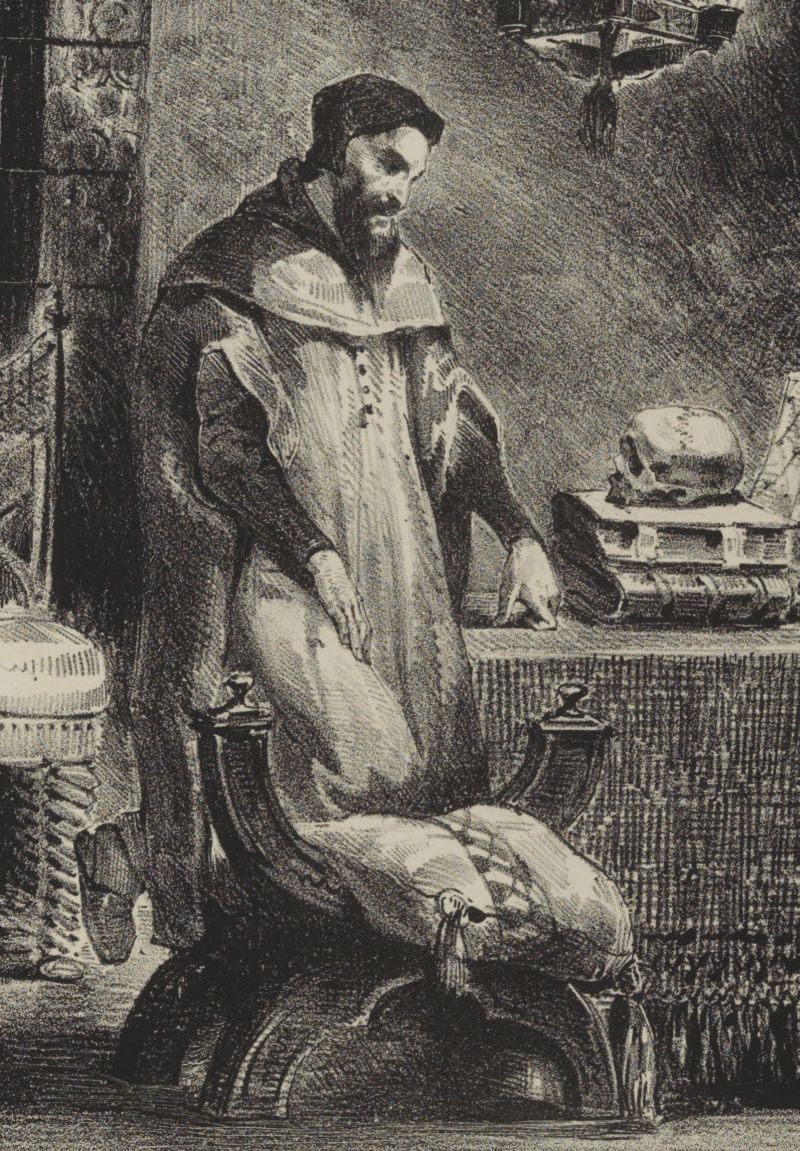
Pauvre crane vide, que me veux tu dire avec ton grincement hideux? par Eugène Delacroix (Détail. Source: Faust, tragédie de M. de Goethe, traduite en français par M. Albert Stapfer. C. Motte (Paris) 1828 - Gallica Bnf)
How much I was animated and advanced by this circle is not to be expressed. They readily heard me read aloud my completed or begun works; they encouraged me, when I openly and circumstantially told what I was then planning, and blamed me when on every new occasion I laid aside what I had already commenced. Faust had already advanced; Götz von Berlichingen was gradually building itself up in my mind: the study of the fifteenth and sixteenth centuries occupied me; and the minster had left in me a very serious impression, which could well stand as a background to such poetical inventions.
Paper on German Architecture.
What I had thought and imagined with respect to that style of architecture, I wrote in a connected form. The first point on which I insisted was, that it should be called German, and not Gothic; that it should be considered not foreign, but native. The second point was, that it could not be compared with the architecture of the Greeks and Romans, because it sprang from quite another principle. If these, living under a more favourable sky, allowed their roof to rest upon columns, a wall, broken through, arose of its own accord. We, however, who must always protect ourselves against the weather, and everywhere surround ourselves with walls, have to revere the genius who discovered the means of endowing massive walls with variety, of apparently breaking them through, and of thus occupying the eye in a worthy and pleasing manner on the broad surface. The same principle applied to the steeples, which are not, like cupolas, to form a heaven within, but to strive towards heaven without, and to announce to the countries far around the existence of the sanctuary which lies at their base. The interior of these venerable piles I only ventured to touch by poetical contemplation and a pious tone.
If I had been pleased to write down these views, the value of which I will not deny, clearly and distinctly, in an intelligible style, the paper "On German Architecture, I: M: Ervini a Steinback," would then, when I published it, have produced more effect, and would sooner have drawn the attention of the native friends of art. But, misled by the example of Herder and Hamann, I obscured these very simple thoughts and observations by a dusty cloud of words and phrases, and both for myself and others, darkened the light which had arisen within me. However, the paper was well received, and reprinted in Herder's work on German manner and art.
If now, partly from inclination, partly with poetical and other views, I very readily occupied myself with the antiquities of my country, and sought to render them present to my mind, I was from time to time distracted from this subject by biblical studies and religious sympathies, since Luther's life and deeds, which shine forth so magnificently in the sixteenth century, always necessarily brought me back to the Holy Scriptures, and to the observation of religious feelings and opinions. To look upon the Bible as a work of compilation, which had gradually arisen, and had been elaborated at different times, was flattering to my little self-conceit, since this view was then by no means predominant,—much less was it received in the circle in which I lived. With respect to the chief sense, I adhered to Luther's expression; in matters of detail, I went to Schmidt's literal translation, and sought to use my little Hebrew as well as possible. That there are contradictions in the Bible, no one will now deny. These they sought to reconcile by laying down the plainest passage as a foundation, and endeavouring to assimilate to that those that were contradictory and less clear. I, on the contrary, wished to find out, by examination, what passage best expressed the sense of the matter. To this I adhered, and rejected the rest as interpolated.
For a fundamental opinion had already confirmed itself in me, without my being able to say whether it had been imparted to me, or had been excited in me, or had arisen from my own reflection. It was this,—that in anything which is handed down to us, especially in writing, the real point is the ground, the interior, the sense, the tendency of the work; that here lies the original, the divine, the effective, the intact, the indestructible; and that no time, no external operation or condition, can in any degree affect this internal primeval nature, at least no more than the sickness of the body affects a well-cultivated soul. Thus, according to my view, the language, the dialect, the peculiarity, the style, and finally the writing, were to be regarded as the body of every work of mind; this body, although nearly enough akin to the internal, was yet exposed to deterioration and corruption; as, indeed, altogether no tradition can be given quite pure, according to its nature; nor, indeed, if one were given pure, could it be perfectly intelligible at every following period,—the former on account of the insufficiency of the organs through which the tradition is made,—the latter on account of the difference of time and place,—but specially the diversify of human capacities and modes of thought; for which reason the interpreters themselves never agree.
Hence it is everybody's duty to seek out for what is internal and peculiar in a book which particularly interests us, and at the same time, above all things, to weigh in what relation it stands to our own inner nature, and how far, by that vitality, our own is excited and rendered fruitful. On the other hand, everything external that is ineffective with respect to ourselves, or is subject to a doubt, is to be consigned over to criticism, which, even if it should be able to dislocate and dismember the whole, would never succeed in depriving us of the only ground to which we hold fast, nor even in perplexing us for a moment with respect to our once formed confidence.
Study of the Bible.
This conviction, sprung from faith and sight, which in all cases that we recognise as the most important, is applicable and strengthening, lies at the foundation of the moral as well as the literary edifice of my life, and is to be regarded as a well-invested and richly productive capital, although in particular cases we may be seduced into making an erroneous application. By this notion, the Bible first became really accessible to me. I had, as is the case in the religious instruction of Protestants, run through it several times, nay, had made myself acquainted with it, by way of leaps from beginning to end and back again. The blunt naturalness of the Old Testament, and the tender naïveté of the New, had attracted me in particular instances; as a whole, indeed, it never properly appealed to me; but now the diverse characters of the different books no more perplexed me; I knew how to represent to myself their significance faithfully and in proper order, and had too much feeling for the book to be ever able to do without it. By this very side of feeling I was protected against all scoffing, because I saw its dishonesty at once. I not only detested it, but could even fall in a rage about it; and I still perfectly remember that in my childishly fanatical zeal I should have completely throttled Voltaire, on account of his Saul, if I could only have got at him. On the other hand, every kind of honest investigation pleased me greatly; the revelations as to the locality and costume of the East, which diffused more and more light, I received with joy, and continued to exercise all my acuteness on such valuable traditions.
It is known that at an earlier period I sought to initiate myself into the situation of the world, as described to us by the first book of Moses. As I now thought to proceed stepwise, and in proper order, I seized, after a long interruption, on the second book. But what a difference! Just as the fulness of childhood had vanished from my life, so did I find the second book separated from the first by a monstrous chasm. The utter forgetfulness of a bygone time is already expressed in the few important words, "Now there arose a new king over Egypt, which knew not Joseph." But the people also, innumerable as the stars of heaven, had almost forgotten the ancestor to whom, under the starry heaven, Jehovah had made the very promise which was now fulfilled. I worked through the five books with unspeakable trouble and insufficient means and powers, and in doing this fell upon the strangest notions. I thought I had discovered that it was not our ten commandments which stood upon the tables that the Israelites did not wander through the desert for forty years, but only for a short time; and thus I fancied that I could give entirely new revelations as to the character of Moses.
Even the New Testament was not safe from my inquiries; with my passion for dissection, I did not spare it, but with love and affection I chimed in with that wholesome word, "The evangelists may contradict each other, provided only the gospel does not contradict itself." In this region also I thought I should make all sorts of discoveries. That gift of tongues imparted at Pentecost with lustre and clearness, I interpreted for myself in a somewhat abstruse manner, not adapted to procure many adherents.
Into one of the chief Lutheran doctrines, which has been still more sharpened by the Hernhuters,—namely, that of regarding the sinful principle as predominant in man,—I endeavoured to accommodate myself, but without remarkable success. Nevertheless I had made the terminology of this doctrine tolerably my own, and made use of it in a letter, which, in the character of country pastor, I was pleased to send to a new brother in office. However, the chief theme in the paper was that watchword of the time, called "Toleration," which prevailed among the better order of brains and minds.
Such things, which were produced by degrees, I had printed at my own cost in the following year, to try myself with the public,—made presents of them, or sent them to Eichenberg's shop, in order to get rid of them as fast as possible, without deriving any profit myself. Here and there a review mentions them, now favourably, now unfavourably,—but they soon passed away. My father kept them carefully in his archives, otherwise I should not have possessed a copy of them. I shall add these, as well as some things of the kind which I have found, to the new edition of my works.
Hamann.
Since I had really been seduced into the sybilline style of such papers, as well as into the publication of them, by Hamann, this seems to me a proper place to make mention of this worthy and influential man, who was then as great a mystery to us as he has always remained to his native country. His Socratio Memorabilia was more especially liked by those persons who could not adapt themselves to the dazzling spirit of the time. It was suspected that he was a profound, well-grounded man, who, accurately acquainted with the public world and with literature, allowed of something mysterious and unfathomable, and expressed himself on this subject in a manner quite his own. By those who then ruled the literature of the day, he was indeed considered an abstruse mystic, but an aspiring youth suffered themselves to be attracted by him. Even the "Quiet-in-the-lands," as they were called—half in jest, half in earnest—those pious souls, who, without professing themselves members of any society, formed an invisible church, turned their attention to him; while to my friend Fräulein von Klettenberg, and no less to her friend Moser, the "Magus from the North" was a welcome apparition. People put themselves the more in connexion with him, when they had learned that he was tormented by narrow domestic circumstances, but nevertheless understood how to maintain this beautiful and lofty mode of thought. With the great influence of President von Moser, it would have been easy to provide a tolerable and convenient existence for such a frugal man. The matter was set on foot, nay, so good an understanding and mutual approval was attained, that Hamann undertook the long journey from Königsberg to Darmstadt. But as the president happened to be absent, that odd man, no one knows on what account, returned at once, though a friendly correspondence was kept up. I still possess two letters from the Königsberger to his patron, which bear testimony to the wondrous greatness and sincerity of their author.
But so good an understanding was not to last long. These pious men had thought the other one pious in their own fashion; they had treated him with reverence as the "Magus of the North," and thought that he would continue to exhibit himself with a reverend demeanour. But already in the Clouds, an after-piece of Socratic Memorabilia, he had given some offence; and when he now published the Crusades of a Philologist, on the title-page of which was to be seen not only the goat-profile of a horned Pan, but also on one of the first pages, a large cock, cut in wood, and setting time to some young cockerels, who stood before him with notes in their claws, made an exceedingly ridiculous appearance, by which certain church-music, of which the author did not approve, was to be made a laughing-stock,—there arose among well-minded and sensitive people a dissatisfaction, which was exhibited to the author, who, not being edified by it, shunned a closer connexion. Our attention to this man was, however, always kept alive by Herder, who, remaining in correspondence with us and his betrothed, communicated to us at once all that proceeded from that extraordinary man. To these belonged his critiques and notices, inserted in the Königsberg Zeitung, all of which bore a very singular character. I possess an almost complete collection of his works, and a very important essay on Herder's prize paper concerning the origin of language, in which, in the most peculiar manner, he throws flashes of light upon this specimen of Herder.
I do not give up the hope of superintending myself, or at least furthering, an edition of Hamann's works; and then, when these documents are again before the public, it will be time to speak more closely of the author, his nature and character. In the meanwhile, however, I will here adduce something concerning him, especially as eminent men are still living who felt a great regard for him, and whose assent or correction will be very welcome to me. The principle to which all Hamann's expressions may be referred is this: "All that man undertakes to perform, whether by deed, by word, or otherwise, must proceed from all his powers united; everything isolated is worthless." A noble maxim, but hard to follow. To life and art it may indeed be applied, but in every communication by words, that is not exactly poetic, there is, on the contrary, a grand difficulty; for a word must sever itself, isolate itself, to say or signify anything. Man, while he speaks, must, for the moment, become one-sided; there is no communication, no instruction, without severing. Now since Hamann, once for all, opposed this separation, and because he felt, imagined, and thought in unity, chose to speak in unity likewise, and to require the same of others, he came into opposition with his own style, and with all that others produced. To produce the impossible, he therefore grasps at every element; the deepest and most mystical contemplations in which nature and mind meet each other-illuminating flashes of the understanding, which beam forth from such a contact—significant images, which float in these regions—forcible aphorisms from sacred and profane writers—with whatever else of a humorous kind could be added—all this forms the wondrous aggregate of his style and his communications. If, now, one cannot associate oneself with him in his depths—cannot wander with him on his heights—cannot master the forms which float before him—cannot, from an infinitely extended literature, exactly find out the sense of a passage which is only hinted at—we find that the more we study him, the more dim and dark it becomes; and this darkness always increases with years, because his allusions were directed to certain definite peculiarities which prevailed, for the moment, in life and in literature. In my collection there are some of his printed sheets, where he has cited with his own hand, in the margin, the passages to which his hints refer. If one opens them, there is again a sort of equivocal double light, which appears to us highly agreeable; only one must completely renounce what is ordinarily called understanding. Such leaves merit to be called sybilline, for this reason, that one cannot consider them in and for themselves, but must wait for an opportunity to seek refuge with their oracles. Every time that one opens them one fancies one has found something new, because the sense which abides in every passage touches and excites us in a curious manner.
Personally I never saw him; nor did I hold any immediate communication with him by means of letters. It seems to me that he was extremely clear in the relations of life and friendship, and that he had a correct feeling for the positions of persons among each other, and with reference to himself. All the letters which I saw by him were excellent, and much plainer than his works, because here the reference to time, circumstances, and personal affairs, was more clearly prominent. I thought, however, that I could discern this much generally, that he, feeling the superiority of his mental gifts, in the most naïve manner, always considered himself somewhat wiser and more shrewd than his correspondents, whom he treated rather ironically than heartily. If this held good only of single cases, it applied to the majority, as far as my own observation went, and was the cause that I never felt a desire to approach him.
On the other hand, a kindly literary communication between Herder and us was maintained with great vivacity, though it was a pity that he could not keep himself quiet. But Herder never left off his teazing and scolding; and much was not required to irritate Merck, who also contrived to excite me to impatience. Because now Herder, among all authors and men, seems to respect Swift the most, he was among us called the "Dean," and this gave further occasion to all sorts of perplexities and annoyances.
Nevertheless we were highly pleased when we learned that he was to have an appointment at Bückeburg, which would bring him double honour, for his new patron had the highest fame as a clear-headed and brave, though eccentric man. Thomas Abt had been known and celebrated in this service; his country still mourned his death, and was pleased with the monument which his patron had erected for him. Now Herder, in the place of the untimely deceased, was to fulfil all those hopes which his predecessor had so worthily excited.
The epoch in which this happened gave a double brilliancy and value to such an appointment; for several German princes already followed the example of the Count of Lippe, inasmuch as they took into their service not merely learned men, and men of business, properly so called, but also persons of mind and promise. Thus, it was said, Klopstock had been invited by the Margrave Charles of Baden, not for real business, but that by his presence he might impart a grace and be useful to the higher society. As now the regard felt for this excellent prince, who paid attention to all that was useful and beautiful, increased in consequence, so also was the veneration for Klopstock not a little heightened. Everything that emanated from him was held dear and valuable; and we carefully wrote down his odes and elegies as we could get them. We were therefore highly delighted when the great Land-gravine Caroline of Hesse-Darmstadt made a collection of them, and we obtained possession of one of the few copies, which enabled us to complete our own manuscript collection. Hence those first readings have long been most in favour with us; nay, we have often refreshed and delighted ourselves with poems which the author afterwards rejected. So true it is, that the life which presses forth out of a "fine soul" works with the greater freedom the less it appears to be drawn by criticism into the department of art.
Klopstock, by his character and conduct, had managed to attain regard and dignity, both for himself and for other men of talent; now they were also, if possible, to be indebted to him for the security and improvement of their domestic condition. For the book-trade, in the previous period, had more to do with important scientific books, belonging to the different faculties—with stock-works, for which a moderate remuneration was paid. But the production of poetical works was looked upon as something sacred; and in this case the acceptance or increase of any remuneration would have been regarded almost as simony. Authors and publishers stood in the strangest reciprocal position. Both appeared, accordingly as it was taken, as patrons and clients. The authors, who, irrespectively of their talent, were generally respected and levered by the public as highly moral men, had a mental rank, and felt themselves rewarded by the success of their labours; the publishers were well satisfied with the second place, and enjoyed a considerable profit. But now opulence again set the rich bookseller above the poor poet, and thus everything stood in the most beautiful equilibrium. Magnanimity and gratitude were not unfrequent on either side. Breitkopf and Gottsched lived, all their lives, as inmates of the same house. Stinginess and meanness, especially that of piracy, were not yet in vogue.
Commotion in the Book-Trade.
Nevertheless a general commotion had arisen among the German authors. They compared their own very moderate, if not poor condition, with the wealth of the eminent booksellers; they considered how great was the fame of a Gellert, of a Rabener, and in what narrow domestic circumstances an universally esteemed German poet must struggle on, if he did not render life easy by some other calling. Even the mediocre and lesser minds felt a strong desire to see their situation improved,—to make themselves free of the publishers.
Now Klopstock came forward and offered his "Republic of Letters" (Gelehrte-Republik) for subscription. Although the latter cantos of the Messiah, partly on account of their subject, partly on account of the treatment, could not produce the same effect as the earlier ones, which, themselves pure and innocent, came into a pure and innocent time, the same respect was always maintained for the poet, who, by the publication of his odes, had drawn to himself the hearts, minds, and feelings of many persons. Many well-thinking men, among whom were several of great influence, offered to secure payment beforehand. This was fixed at a Louis d'or, the object being, it was said, not so much to pay for the book, as on this occasion to reward the author for his services to his country. Now every one pressed forward; even youths and young girls, who had not much to expend, opened their saving-boxes; men and women, the higher and the middle classes, contributed to this holy offering; and perhaps a thousand subscribers, all paying in advance, were collected. Expectation was raised to the highest pitch, and confidence was as great as possible.
After this, the work, on its appearance, was compelled to experience the strangest result in the world; it was, indeed, of important value, but by no means universally interesting. Klopstock's thoughts on poetry and literature were set forth in the form of an old German Druidical republic; his maxims on the true and false were expressed in pithy laconic aphorisms, in which, however, much that was instructive was sacrificed to the singularity of form. For authors and littérateurs, the book was and is invaluable; but it was only in this circle that it could be useful and effective. He who had thought himself followed the thinker; he who knew how to seek and prize what was genuine, found himself instructed by the profound, honest man; but the amateur, the general reader, was not enlightened,—to him the book remained sealed; and yet it had been placed in all hands; and while every one expected a perfectly serviceable work, most of them obtained one from which they could not get the smallest taste. The astonishment was general, but the esteem for the man was so great, that no grumbling, scarcely a murmur, arose. The young and beautiful part of the world got over their loss, and now freely gave away the copies they had so dearly purchased. I received several from kind female friends, but none of them have remained with me.
This undertaking, which was successful to the author, but a failure to the public, had the ill consequence, that there was now no further thought about subscriptions and prepayments; nevertheless the wish had been too generally diffused for the attempt not to be renewed. The Dessau publishing-house now offered to do this on a large scale. Learned men and publishers were here, by a close compact, to enjoy, both in a certain proportion, the hoped-for advantage. The necessity, so long painfully felt, again awakened a great confidence; but this could not last long; and after a brief endeavour the parties separated, with a loss on both sides.
Combination of young poets.
However, a speedy communication among the friends of literature was already introduced. The Musenalmanache[1] united all the young poets with each other; the journals united the poet with other authors. My own pleasure in production was boundless; to what I had produced I remained indifferent; only when, in social circles, I made it present to myself and others, my affection for it was renewed. Moreover, many persons took an interest in both my larger and smaller works, because I urgently pressed every one who felt in any degree inclined and adapted to production, to produce something independently, after his own fashion, and was, in turn, challenged by all to new poetising and writing. These mutual impulses, which were carried even to an extreme, gave every one a happy influence in his own fashion; and from this whirling and working, this living and letting-live, this taking and giving, which was carried on by so many youths, from their own free hearts, without any theoretical guiding-star, according to the innate character of each, and without any special design, arose that famed, extolled, and decried epoch in literature, when a mass of young genial men, with all that audacity and assumption which is peculiar to their own period of youth, produced, by the application of their powers, much that was good, and by the abuse of these, much ill-feeling and mischief; and it is, indeed, the action and reaction which proceeded from this source, that form the chief theme of this volume.
In what can young people take the highest interest, how are they to excite interest among those of their own age, if they are not animated by love, and if affairs of the heart, of whatever kind they may be, are not living within them? I had in secret to complain of a love I had lost; this made me mild and tolerant, and more agreeable to society than in those brilliant times when nothing reminded me of a want or a fault, and I went storming along completely without restraint.
Frederica's answer to a written adieu rent my heart. It was the same hand, the same tone of thought, the same feeling, which had formed itself for me and by me. I now, for the first time, felt the loss which she suffered, and saw no means to supply it, or even to alleviate it. She was completely present to me; I always felt that she was wanting to me and, what was worst of all, I could not forgive myself for my own misfortune. Gretchen had been taken away from me; Annette had left me; now, for the first time, I was guilty I had wounded the most beautiful heart to its very depths; and the period of a gloomy repentance, with the absence of a refreshing love, to which I had grown accustomed, was most agonising, nay, insupportable. But man will live; and hence I took an honest interest in others; I sought to disentangle their embarrassments, and to unite what was about to part, that they might not have the same lot as myself. They were hence accustomed to call me the "confidant," and on account of wandering about the district, the "wanderer." In producing that calm for my mind, which I felt under the open sky, in the valleys, on the heights, in the fields and in the woods, the situation of Frankfort was serviceable, as it lay in the middle between Darmstadt and Hamburg, two pleasant places, which are on good terms with each other, through the relationship of both courts. I accustomed myself to live on the road, and, like a messenger, to wander about between the mountains and the flat country. Often I went alone, or in company, through my native city, as if it did not at all concern me, dined at one of the great inns in the High-street, and after dinner went further on my way. More than ever was I directed to the open world and to free nature. On my way I sang to myself strange hymns and dithyrambics, of which one entitled "The Wanderer's Storm-song" (Wanderer's Sturmlied) still remains. This half-nonsense I sang aloud, in an impassioned manner, when I found myself in a terrific storm, which I was obliged to meet.
My heart was untouched and unoccupied; I conscientiously avoided all closer connexion with ladies, and thus it remained concealed from me, that, inattentive and unconscious as I was, an amiable spirit was secretly hovering round me. It was not until many years afterwards, nay, until after her death, that I learned of her secret heavenly love, in a manner that necessarily overwhelmed me. But I was innocent, and could purely and honestly pity an innocent being; nay, I could do this the more, as the discovery occurred at an epoch when, completely without passion, I had the happiness of living for myself and my own intellectual inclinations.
At the time when I was pained by my grief at Frederica's situation, I again, after my old fashion, sought aid from poetry. I again continued the poetical confession which I had commenced, that by this self-tormenting penance I might be worthy of an internal absolution. The two Marias in Götz von Berlichingen and Clavigo, and the two bad characters who play the part of their lovers, may have been the results of such penitent reflections.
Skating.
But as in youth one soon overcomes mental wounds and diseases, because a healthy system of organic life can rise up for a sick one, and allow it time to grow healthy again, corporeal exercises, on many a favourable opportunity, came forward with very advantageous effect; and I was excited in many ways to man myself afresh, and to seek new pleasures of life and enjoyments. Riding gradually took the place of those sauntering, melancholy, toilsome, and at the same time tedious and aimless rambles on foot; one reached one's end more quickly, merrily, and commodiously. The young people again introduced fencing, but in particular, on the setting-in of winter, a new world was revealed to us, since I at once determined to skate,—an exercise which I had never attempted,—and, in a short time, by practice, reflection, and perseverance, brought it as far as was necessary to enjoy with others a gay, animated course on the ice, without wishing to distinguish myself.
For this new joyous activity we were also indebted to Klopstock,—to his enthusiasm for this happy species of motion, which private accounts confirmed, while his odes gave an undeniable evidence of it. I still exactly remember that on a cheerful frosty morning I sprang out of bed, and uttered aloud these passages:—
"Already, glad with feeling of health, Far down along the shore, I have whiten'd The covering crystal. "How does the winter's advancing day Softly illumine the lake! The night has cast The glittering frost, like stars, upon it."
My hesitating and wavering resolution was fixed at once, and I flew straight to the place where so old a beginner might with some degree of propriety make his first trial. And, indeed, this manifestation of our strength well deserved to be commended by Klopstock, for it is an exercise which brings us into contact with the freshest childhood, summons the youth to the full enjoyment of his suppleness, and is fitted to keep off a stagnant old age. We were immoderately addicted to this pleasure. To pass thus a splendid Sunday on the ice did not satisfy us, we continued our movement late into the night. For as other exertions fatigue the body, so does this give it a constantly new power. The full moon rising from the clouds, over the wide nocturnal meadows, which were frozen into fields of ice; the night-breeze, which rustled towards us on our course; the solemn thunder of the ice, which sank as the water decreased; the strange echo of our own movements, rendered the scenes of Ossian just present to our minds. Now this friend, now that, uttered an ode of Klopstock's, in a declamatory recitative; and if we found ourselves together at dawn, the unfeigned praise of the author of our joys broke forth:—
"And should he not be immortal, Who found for us health and joys Which the horse, though bold in his course, never gave, And which even the ball is without?"
Such gratitude is earned by a man who knows how to honour and worthily to extend an earthly act by spiritual incitement.
And thus, as children of talent, whose mental gifts have, at an early period, been cultivated to an extraordinary degree, return, if they can, to the simplest sports of youth, did we, too, often forget our calling to more serious things. Nevertheless this very motion, so often carried on in solitude—this agreeable soaring in undetermined space—again excited many of my internal wants, which had, for a time, lain dormant; and I have been indebted to such hours for a more speedy elaboration of older plans.
The darker ages of German history had always occupied my desire for knowledge and my imagination. The thought of dramatizing Götz von Berlichingen, with all the circumstances of his time, was one which I much liked and valued. I industriously read the chief authors; to Datt's work, De Pace Publica, I devoted all my attention; I had sedulously studied it through, and rendered those singular details as visible to me as possible. These endeavours, which were directed to moral and poetical ends, I could also use in another direction, and I was now to visit Wetzlar. I had sufficient historical preparation; for the Imperial Chamber had arisen in consequence of the public tranquillity, and its history could serve as an important clue through the confused events of Germany. Indeed, the constitution of the courts and armies gives the most accurate insight into the constitution of every empire. Even the finances, the influence of which are considered so important, come much less under consideration; for if the whole is deficient, it is only necessary to take from the individual what he has laboriously scraped together, and thus the state is always sufficiently rich.
What occurred to me at Wetzlar is of no great importance, but it may inspire a greater interest, if the reader will not disdain a cursory history of the Imperial Chamber, in order to render present to his mind the unfavourable moment at which I arrived there.
History of the Imperial Chamber.
The lords of the earth are such, principally because they can assemble around them, in war, the bravest and most resolute, and in peace, the wisest and most just. Even to the state of a German emperor belonged a court of this kind, which always accompanied him in his expeditions through the empire. But neither this precaution, nor the Suabian law, which prevailed in the south of Germany, nor the Saxon law, which prevailed in the north,—neither the judges appointed to maintain them, nor the decisions of the peers of the contending parties,—neither the umpires recognised by agreement, nor friendly compacts instituted by the clergy,—nothing, in short, could quiet that excited chivalric spirit of feuds which had been roused, fostered, and made a custom among the Germans, by internal discord, by foreign campaigns, by the crusades especially, and even by judicial usages. To the emperor, as well as to the powerful estates, these squabbles were extremely annoying, while, through them, the less powerful became troublesome to each other, and if they combined, to the great also. All outward strength was paralysed, while internal order was destroyed; and besides this, a great part of the country was still encumbered with the Vehmgericht, of the horrors of which a notion may be formed, if we think that it degenerated into a secret police, which, at last, even fell into the hands of private persons.
Many attempts to steer against these evils had been made in vain, until, at last, the estates urgently proposed a court formed from among themselves. This proposal, well-meant as it might have been, nevertheless indicated an extension of the privileges of the estates, and a limitation of the imperial power. Under Frederic III. the matter is delayed; his son Maximilian, being pressed from without, complies. He appoints the chief judge, the estates send the assistants. There were to be four-and-twenty of them; but, at first, twelve are thought sufficient.
An universal fault, of which men are guilty in their under-takings, was the first and perpetual fundamental defect of the Imperial Chamber: insufficient means were applied to a great end. The number of the assessors was too small. How was the difficult and extensive problem to be solved by them? But who could urge an efficient arrangement? The emperor could not favour an institution which seemed to work more against him than for him; far more reason had he to complete the formation of his own court—his own council. If, on the other hand, we regard the interest of the estates, all that they could properly have to do with was the stoppage of bloodshed. Whether the wound was healed, did not so much concern them: and now there was to be, besides, a new expense. It may not have been quite plainly seen that by this institution every prince increased his retinue, for a decided end indeed,—but who readily gives money for what is necessary? Every one would be satisfied, if he could have what is useful "for God's sake."
At first the assistants were to live on fees; then followed a moderate grant from the estates; both were scanty. But to meet the great and striking exigency, willing, clever, and industrious men were found, and the court was established. Whether it was perceived that the question here was concerning only the alleviation and not the cure of the evil, or whether, as in similar cases, the flattering hope was entertained that much was to be done with little, is not to be decided. It is enough that the court served rather as a pretext to punish the originators of mischief, than completely to prevent wrong. But it has scarcely met, than a power grows out of itself; it feels the eminence on which it is placed; it recognises its own great political importance. It now endeavours, by a striking activity, to acquire for itself a more decided respect; they briskly got through what can and must be rapidly dispatched, what can be decided at the moment, or what can otherwise be easily judged; and thus, throughout the empire, they appear effective and dignified. On the other hand, matters of weightier import, the law-suits, properly so called, remained behindhand, and this was no misfortune. The only concern of the state is, that possession shall be certain and secure; whether it is also legal, is of less consequence. Hence, from the monstrous and ever-swelling number of delayed suits, no mischief arose to the empire. Against people who employed force, provision was already made, and with such matters could be settled; but those, on the other hand, who legally disputed about possession, lived, enjoyed, or starved, as they could; they died, were ruined, or made it up; but all this was the good or evil of individual families,—the empire was gradually tranquillised. For the Imperial Chamber was endowed with a legal club-law against the disobedient; had it been able to hurl the bolt of excommunication, this would have been more effective.
But now, what with the sometimes increased, sometimes diminished number of assessors, what with the many interruptions, what with the removal of the court from one place to another, these arrears, these records necessarily increased to an infinite extent. Now, in the distress of war, a part of the archives was sent for safety from Spire to Aschaffenburg, a part to Worms, the third fell into the hands of the French, who thought they had gained the state-archives, but would afterwards have been glad to get rid of such a chaos of paper, if any one would but have furnished the carriages.
During the negotiations for the peace of Westphalia, the chosen men, who were assembled, plainly saw what sort of a lever was required to move from its place a load like that of Sisyphus. Fifty assessors were now to be appointed, but the number was never made up: the half of it was again made to suffice, because the expense appeared too great; but if the parties interested had all seen their advantage in the matter, the whole might well have been afforded. To pay five-and-twenty assessors about one hundred thousand florins (gulden) were required, and how easily could double that amount have been raised in Germany? The proposition to endow the Imperial Chamber with confiscated church property could not pass, for how could the two religious parties agree to such a sacrifice? The Catholics were not willing to lose any more, and the Protestants wished to employ what they had gained, each for his own private ends. The division of the empire into two religious parties had here, in several respects, the worst influence. The interest which the estates took in this their court diminished more and more; the more powerful wished to free themselves from the confederation; licenses exempting their possessor from being prosecuted before any higher tribunal were sought with more and more eagerness; the greater kept back with their payments, while the lesser, who, moreover, believed themselves wronged in the estimates, delayed as long as they could.
How difficult was it, therefore, to raise the supplies necessary for payment. Hence arose a new occupation, a new loss of time for the chamber; previously the so-called annual "visitations" had taken care of this matter. Princes in person, or their councillors, went only for months or weeks to the place of the court, examined the state of the treasury, investigated the arrears, and undertook to get them in. At the same time, if anything was about to create an impediment in the course of law or the court, or any abuse to creep in, they were authorised to provide a remedy. The faults of the institution they were to discover and remove, but it was not till afterwards that the investigation and punishment of the personal crimes of its members became a part of their duty. But because parties engaged in litigation always like to extend their hopes a moment longer, and on this account always seek and appeal to higher authorities, so did these "visitators" become a court of revision, from which, at first in determined manifest cases, persons hoped to find restitution, but at last in all cases, delay and perpetuation of the controversy, to which the appeal to the Imperial diet, and the endeavour of the two religious parties, if not to outweigh each other, at any rate to preserve an equilibrium, contributed their part.
But if one considers what this court might have been without such obstacles, without such disturbing and destructive conditions, one cannot imagine it remarkable and important enough. Had it been supplied at the beginning with a sufficient number of persons, had a sufficient support been secured to them, the monstrous influence which this body might have attained, considering the aptness of the Germans, would have been immeasurable. The honourable title of "Amphictyons," which was only bestowed on them oratorically, they would actually have deserved, nay, they might have elevated themselves into an intermediate power, while revered by the head and the members.
But far removed from such great effects, the court, excepting for a short time under Charles V., and before the Thirty Years' war, dragged itself miserably along. One often cannot understand how men could be found for such a thankless and melancholy employment. But what a man does every day he puts up with, if he has any talent for it, even if he does not exactly see that anything will come of it. The German especially is of this persevering turn of mind, and thus for three hundred years the worthiest men have employed themselves on these labours and objects. A characteristic gallery of such figures would even now excite interest and inspire courage.
For it is just in such anarchical times that the able man takes the strongest position, and he who desires what is good finds himself right in his place. Thus, for instance, the Directorium of Fürstenberg was still held in blessed memory, and with the death of this excellent man begins the epoch of many pernicious abuses.
But all these defects, whether later or earlier, arose from one only original source, the small number of persons. It was decreed that the assistants were to act in a fixed order, and according to a determined arrangement. Every one could know when the turn would come to him, and which of the cases belonging to him it would affect; he could work up to this point,—he could prepare himself. But now the innumerable arrears had heaped themselves up, and they were forced to resolve to select the more important cases, and to deal with them out of order. But with a pressure of important affairs, the decision as to which matter has the more weight, is difficult, and selection leaves room for favour. Now, another critical case occurred. The Referent tormented both himself and the court with a difficult involved affair, and at last no one was found willing to take up the judgment. The parties had come to an agreement, had separated, had died, had changed their minds. Hence they resolved to take in hand only the cases of which they were reminded. They wished to be convinced of the continued obstinacy of the parties, and hence was given an introduction to the greatest defects, for he who commends his affairs, must commend them to somebody, and to whom can one commend them better, than to him who has them already in his hands? To keep this one regularly secret was impossible; for how could he remain concealed with so many subordinates, all acquainted with the matter? If acceleration is requested, favour may well be requested likewise, for the very fact that people urge their cause, shows that they consider it just. This will perhaps not be done in a direct manner, certainly it will be first done through subordinates; these must be gained over, and thus an introduction is given to all sorts of intrigues and briberies.
The Emperor Joseph, following his own impulse, and in imitation of Frederic, first directed his attention to arms and the administration of justice. He cast his eyes upon the Imperial Chamber; traditional wrongs, introduced abuses had not remained unknown to him. Even here something was to be stirred up, shaken, and done. Without inquiring whether it was his imperial right, without foreseeing the possibility of a happy result, he proposed a revival of the "visitation," and hastened its opening. For one hundred and sixty years no regular "visitation" had taken place; a monstrous chaos of papers lay swelled up and increased every year, since the seventeen assessors were not even able to despatch the current business. Twenty thousand processes were heaped up; sixty could be settled every year, and double that number was brought forward. Besides, it was not a small number of revisions that awaited the "visitators,"—they were estimated at fifty thousand. Many other abuses, in addition to this, hindered the course of justice; but the most critical matter of all was the personal delinquency of some assessors, which appeared in the background.
The "visitation" at Wetzlar.
When I was about to go to Wetzlar, the "visitation" had been already for some years in operation, the parties accused had been suspended from office, the investigation had been carried a long way; and because the masters and commissioners of German political law could not let pass this opportunity of exhibiting their sagacity and devoting it to the common weal, several profound, well-designed works appeared, from which every one, who possessed only some preparatory knowledge, could derive solid instruction. When on this occasion they went back into the constitution of the empire and the books written upon it, it was striking to me how the monstrous condition of this thoroughly diseased body, which was kept alive by a miracle alone, was the very thing that most suited the learned. For the venerable German industry, which was more directed to the collection and development of details than to results, found here an inexhaustible impulse to new employment, and whether the empire was opposed to the Emperor, the lesser to the greater estates, or the Catholics to the Protestants, there was necessarily always, according to the diversity of interest, a diversity of opinion, and always an occasion for new contests and controversies.
Since I had rendered all these older and newer circumstances as present to my mind as possible, it was impossible for me to promise myself much pleasure from my abode at Wetzlar. The prospect of finding in a city, which was indeed well situated, but small and ill-built, a double world; first the domestic, old traditional world, then a foreign new one, authorized to scrutinize the other with severity,—a judging and a judged tribunal; many an inhabitant in fear and anxiety, lest he might also be drawn into the impending investigation; persons of consideration, long held in respect, convicted of the most scandalous misdeeds, and marked out for disgraceful punishment;—all this together made the most dismal picture, and could not lure me to go deeper into a business, which, involved in itself, seemed so much perplexed by wrong.
That, excepting the German civil and public law, I should find nothing remarkable in the scientific way, that I should be without all poetical communication, I thought I could foresee, when, after some delay, the desire of altering my situation more than impulse to knowledge led me to this spot. But how surprised I was, when, instead of a crabbed society, a third academical life sprang towards me. At a large table d'hôte I found a number of young lively people, nearly all subordinates to the commission; they gave me a friendly reception, and the very first day it remained no secret to me that they had cheered their noon-meetings by a romantic fiction. With much wit and cheerfulness they represented a table of knights. At the top sat the grand-master, by his side the chancellor, then the most important officers of the state; now followed the knights, according to their seniority. Strangers, on the other hand, who visited, were forced to be content with the lowest places, and to these the conversation was almost unintelligible, because the language of the society, in addition to the chivalric expressions, was enriched with many allusions. To every one a name with an epithet was assigned. Me they called "Götz von Berlichingen the honest." The former I earned by the attention to the gallant German patriarch, the latter by my upright affection and devotion for the eminent men with whom I became acquainted. To the Count von Kielmannsegg I was much indebted during this residence. He was the most serious of all, highly clever, and to be relied on. There was Von Goué, a man hard to be deciphered and described, a blunt, kind, quietly reserved Hanoverian figure. He was not wanting in talent of various kinds. It was conjectured concerning him that he was a natural son; he loved, besides, a certain mysterious deportment, and concealed his most peculiar wishes and plans under various eccentricities, as indeed he was, properly speaking, the very soul of the odd confederation of knights, without having striven to attain the post of grand-master. On the contrary, when, just at this time, the head of the knighthood departed, he caused another to be elected, and through him exercised his influence. Thus he managed so to direct several little trifles, that they appeared of importance, and could be carried out in mythical forms. But with all this no serious purpose could be remarked in him,—he was only concerned to get rid of the tedium which he and his colleagues, during their protracted occupation, necessarily felt, and to fill up the empty space, if only with cobwebs. For the rest, this mythical caricature was carried on with great external seriousness, and no one found it ridiculous if a certain mill was treated as a castle, and the miller as lord of the fortress, if the "Four Sons of Haimon" was declared a canonical book, and on the occasion of ceremonies, extracts from it were read with veneration. The dubbing of knights took place with traditional symbols, borrowed from several orders of knighthood. A chief motive for jest was the fact, that what was manifest was treated as a secret; the affair was carried on publicly, and yet nothing was to be said about it. The list of the whole body of knights was printed with as much importance as a calendar of the Imperial diet, and if families ventured to scoff at this, and to declare the whole matter absurd and ridiculous, they were punished by an intrigue being carried on until a solemn husband or near relation was induced to join the company and to be dubbed a knight; for then there was a splendid burst of malicious joy at the annoyance of the connexions.
Whimsical Societies at Wetzlar.
Into this chivalric state of existence another strange order had insinuated itself, which was to be philosophical and mystical, and had no name of its own. The first degree was called the "Transition," the second the "Transition's transition," the third the "Transition's transition to the transition," and the fourth the "Transition's transition to the transition's transition." To interpret the high sense of this series of degrees was now the duty of the initiated, and this was done according to the standard of a little printed book, in which these strange words were explained, or rather amplified, in a manner still more strange. Occupation with these things was the most desirable pastime. The folly of Behrisch and the perversity of Lenz seemed here to have united themselves; I only repeat that not a trace of purpose was to be found behind these veils.
Although I very readily took part in such fooleries, had first brought into order the extracts from "The Four Sons of Haimon," made proposals how they should be read on feasts and solemn occasions, and even understood how to deliver them myself with great emphasis, I had, nevertheless, grown weary of such things before, and therefore as I missed my Frankfort and Darmstadt circles, I was highly pleased to have found Gotter, who attached himself to me with honest affection, and to whom I showed in return a hearty good-will. His turn of mind was delicate, clear, and cheerful, his talents were practised and well regulated, he aimed at French elegance, and was pleased with that part of English literature which is occupied with moral and agreeable subjects. We passed together many pleasant hours, in which we communicated to each other our knowledge, plans, and inclinations. He excited me to many little works, especially as, being in connexion with the people of Göttingen, he desired some of my poems for Boie's Almanach.
I thus came into contact with those, who, young and hill of talent, held themselves together, and afterwards effected so much and in such various ways. The two Counts Stolberg, Bürger, Voss, Hölty, and others were assembled in faith and spirit around Klopstock, whose influence extended in every direction. In such a poetical circle, which more and more extended itself, was developed at the same time with such manifold poetical merits, another turn of mind, to which I can give no exactly proper name. It might be called the need of independence, which always arises in time of peace, and exactly when, properly speaking, one is not dependent. In war we bear the rude force as well as we can, we feel ourselves physically and economically, but not morally, wounded; the constraint shames no one, and it is no disgraceful service to serve the time; we accustom ourselves to suffer from foes and friends; we have wishes, but no particular views. In peace, on the contrary, man's love of freedom becomes more and more prominent, and the more free one is, the more free one wishes to be. We will not tolerate anything over us; we will not be restrained, no one shall be restrained; and this tender, nay, morbid feeling, appears in noble souls under the form of justice. This spirit and feeling then showed itself everywhere, and just because few were oppressed, it was wished to free even these from temporary oppression, and thus arose a certain moral feud, a mixture of individuals with the government, which, with laudable beginnings, led to inevitably unfortunate results.
Difficulty of German patriotism.
Voltaire, by the protection which he had bestowed on the family of Calas, had excited great attention and made himself respected. In Germany the attempt of Lavater against the Landvogt (sheriff of the province) had been almost more striking and important. The æsthetical feeling, united with youthful courage, strove forward, and as, shortly before, persons had studied to obtain offices, they now began to act as overlookers of those in office; and the time was near when the dramatist and novelist loved best to seek their villains among ministers and official persons. Hence arose a world, half real, half imaginary, of action and reaction, in which we afterwards lived to see the most violent imputations and instigations, which the writers of periodical publications and journals with a sort of passion allowed themselves under the garb of justice, and went to work the more irresistibly, as they made the public believe that it was itself the true tribunal—a foolish notion, as no public has an executive power, and in dismembered Germany public opinion neither benefited nor injured any one.
Among us young people there was indeed nothing to be traced, which could have been culpable, but a certain similar notion, composed of poetry, morality, and a noble striving, and which was harmless but yet fruitless, had taken possession of us.
By his Hermann's-Schlacht,[2] and the dedication of it to Joseph the Second, Klopstock had produced a wonderful excitement. The Germans who freed themselves from Roman oppression were nobly and powerfully represented, and this picture was well suited to awaken the self-feeling of a nation. But because in peace patriotism really consists only in this, that every one sweeps his own door, minds his own business, and learns his own lesson, that it may go well with his house,—so did the feeling for fatherland, excited by Klopstock, find no object on which it could exercise itself. Frederic had saved the honour of one part of the Germans against an united world, and every member of the nation, by applause and reverence of this great prince, was allowed to share in his victory; but what was to come of this excited, warlike spirit of defiance? what direction should it take, and what effect produce? At first it was merely a poetical form, and the songs ridiculous, were accumulated through this impulse,—this incitement. There were no external enemies to fight; so people made tyrants for themselves, and for this purpose princes and their servants were obliged to bestow their figures, first only in general outline, but gradually with particulars. Here it was that poetry attached itself with vehemence to that interference with the administration of justice, which is blamed above; and it is remarkable to see poems of that time written in a spirit by which everything of a higher order, whether monarchical or aristocratic, is abolished.
For my own part, I continued to make poetry the expression of my own whims and feelings. Little poems like the "Wanderer" belong to this time; they were inserted in the Göttingen Musenalmanach. But from whatever of the above-mentioned mania had worked itself into me, I shortly endeavoured to free myself in Götz von Berlichingen, since I described how in disordered times this brave, well-thinking man resolves to take the place of the law and the executive power, but is in despair when, to the supreme authority, which he recognises and reveres, he appears in an equivocal light, and even rebellious.
By Klopstock's odes, it was not so much the Northern mythology as the nomenclature of the divinities, that had been introduced into German poetry; and although I gladly made use of everything else that was offered me, I could not bring myself to use this, for the following causes: I had long become acquainted with the fables of the Edda, from the preface to Mallet's Danish History, and had at once made myself master of them. They belonged to those tales which, when asked by a company, I most willingly related. Herder put Resenius into my hands, and made me better acquainted with the heroic sagas. But all these things, worthy as I held them, I could not bring within the circle of my own poetic faculty. Nobly as they excited my imagination, they nevertheless entirely withdrew themselves from the sensuous perception, while the mythology of the Greeks, changed by the greatest artists in the world into visible, easily imagined forms, still existed before our own eyes in abundance. Gods in general I did not allow' often to appear, because, at all events, they had their abode out of the Nature, which I understood how to imitate. What now could have induced to substitute Woden for Jupiter, and Thor for Mars, and instead of the Southern, accurately described figures, to introduce forms of mist, nay, mere verbal sounds, into my poems? On the one side, they were related to the equally formless heroes of Ossian, only they were ruder and more gigantic; on the other, I brought them into contact with the cheerful tale; for the humoristic vein which runs through the whole Northern mythus, was to me highly pleasing and remarkable. It appeared to me the only one which jests with itself throughout,—wondrous giants, magicians, and monsters opposed to an odd dynasty of gods, and only occupied in leading astray and deriding the highest persons during their government, while they threaten them, besides, with disgraceful and inevitable destruction.
I felt a similar if not an equal interest for the Indian fables, which I at first learned to know from Dapper's Travels, and likewise added with great pleasure to my store of tales. In subsequent repetitions I succeeded especially with the Altar of Ram; and notwithstanding the great number of persons in this tale, the ape Hannemann remained the favorite of my public. But even these unformed and over-formed monsters could not satisfy me in a true poetic sense; they lay too far from the truth, towards which my mind unceasingly strove.
Taste for Homer.
But against all these goblins, so repulsive to art, my sense for the beautiful was to be protected by the noblest power. Always fortunate is that epoch in a literature when the great works of the past again rise up as if thawed, and come into notice, because they then produce a perfectly fresh effect. Even the Homeric light rose again quite new to us, and indeed quite in the spirit of the time, which highly favoured such an appearance; for the constant reference to nature had at last the effect, that we learned to regard even the works of the ancients from this side. What several travellers had done for explanation of the Holy Scriptures, others had done for Homer. By Guys the matter was introduced; Wood gave it an impulse. A Göttingen review of the original work, which was at first very rare, made us acquainted with the design, and taught us how far it had been carried out. We now no longer saw in those poems a strained and inflated heroism, but the reflected truth of a primeval present, and sought to bring this as closely to us as possible. At the same time we could not give our assent, when it was maintained that in order rightly to understand the Homeric natures, one must make oneself acquainted with the wild races and their manners, as described by the travellers in new worlds; for it cannot be denied that both Europeans and Asiatics are represented in the Homeric poems as at a higher grade of culture,—perhaps higher than the time of the Trojan war could have enjoyed. But that maxim was nevertheless in harmony with the prevailing confession of nature, and so far we let it pass.
With all these occupations, which were related to the knowledge of mankind in the higher sense, as well as most nearly and dearly to poetry, I was nevertheless forced every day to experience that I was residing in Wetzlar. The conversation on the situation of the business of the "Visitation," and its ever-increasing obstacles, the discovery of new offences, was heard every hour. Here was the holy Roman Empire once more assembled, not for mere outward forms, but for an occupation which penetrated to the very depths. But even here that half-empty banqueting-hall on the coronation-day occurred to me, where the bidden guests remained without, because they were too proud. Here, indeed, they had come, but even worse symptoms were to be seen. The want of coherence in the whole, the mutual opposition of the parts, were continually apparent; and it remained no secret that princes had confidentially communicated to each other this notion, that they must see whether, on this occasion, something could not be gained from the supreme authority.
What a bad impression the petty detail of all the anecdotes of neglects and delays, of injustices and corruptions, must make upon a young man who desired what was good, and with this view cultivated his mind, every honest person will feel. Under such circumstances, where was a reverence for the law and the judge to arise? Even if the greatest confidence had been placed in the effects of the "Visitation,"—if it could have been believed that it would fully accomplish its high purpose,—there was still no remedy to be found here for a joyous, inwardly-striving youth. The formalities of the proceeding all tended towards delay; if any one desired to do anything, and to be of any importance, he was obliged to serve the party in the wrong—always the accused—and to be skilled in the fencing-art of twisting and evading.
Æsthetic Speculations.
Since, amid this distraction, I could not succeed in any æsthetic labours, I again and again lost myself in æsthetic speculations, as indeed all theorising indicates a defect or stagnation of productive power. Before with Merk, now with Gotter, I endeavoured to find out the maxims according to which one might go to work in production. But neither with me nor with them would it succeed. Merk was a sceptic and eclectic; Gotter adhered to such examples as pleased him the most. The Sulzer theory was published more for the amateur than the artist. In this sphere moral effects are required above all things; and here at once arises a dissension between the class that produces and that which uses; for a good work of art can, and will indeed, have moral consequences; but to require moral ends of the artist, is to destroy his profession.
What the ancients had said on these important subjects I had read industriously for some years, by skips, at least, if not in regular order. Aristotle, Cicero, Quintilian, Longinus—none were unconsidered; but this did not help me in the least, for all these men presupposed an experience which I lacked. They led me into a world infinitely rich in works of art; they unfolded the merits of excellent poets and orators, of most of whom the names alone are left us, and convinced me but too well that a great abundance of objects must lie before us ere we can think upon them; that one must first accomplish something oneself, nay, fail in something, to learn to know one's own capacities, and those of others. My acquaintance with so much that was good in those old times, was only according to school and book, and by no means vital, since, even with the most celebrated, orators, it was striking that they had altogether formed themselves in life, and that one could never speak of the peculiarities of their character as artists, without at the same time mentioning the personal peculiarities of their disposition. With the poets this seemed less to be the case; and thus the result of all my thoughts and endeavours was the old resolution to investigate inner and outer nature, and to allow her to rule herself in loving imitation.
For these operations, which rested in me neither day nor night, lay before me two great, nay, monstrous materials, the wealth of which I had only to prize, in order to produce something of importance. There was the older epoch, into which falls the life of Götz von Berlichingen, and the modern one, the unhappy bloom of which is depicted in Werther. Of the historical preparation to that first work I have already spoken; the ethical occasions of the second shall now be introduced.
The resolution to preserve my internal nature according to its peculiarities, and to let external nature influence me according to its qualities, impelled me to the strange element in which Werther is designed and written. I sought to free myself internally from all that was foreign to me, to regard the external with love, and to allow all beings, from man downwards, as low as they were comprehensible, to act upon me, each after its own kind. Thus arose a wonderful affinity with the single objects of nature, and a hearty concord, a harmony with the whole, so that every change, whether of place and region, or of the times of the day and year, or whatever else could happen, affected me in the deepest manner. The glance of the painter associated itself to that of the poet, the beautiful rural landscape, animated by the pleasant river, increased my love of solitude, and favoured my silent observations as they extended on all sides.
But since I had left the family circle in Sesenheim, and again my family circle at Frankfort and Darmstadt, a vacuum had remained in my bosom which I was not able to fill up; I therefore found myself in a situation where the inclinations, if they appear in any degree veiled, gradually steal upon us, and can render abortive all our good resolutions.
And now, when the author has attained this step of his undertaking, he for the first time feels light-hearted in his labour, since from henceforward this book first becomes what it properly ought to be. It has not been announced as an independent work; it is much more designed to fill up the gaps of an author's life, to complete much that is fragmentary, and to preserve the memory of lost and forgotten ventures. But what is already done neither should nor can be repeated, and the poet would now vainly call upon those darkened powers of the soul, vainly ask of them to render present again those charming circumstances, which rendered the period in Lahnthal so agreeable to him. Fortunately the genius had already provided for that, and had impelled him, in the vigorous period of youth, to hold fast, describe, and with sufficient boldness and at the favourable hour publicly to exhibit that which had immediately gone by. That the little book Werther is here meant, requires no further indication, but something is to be gradually revealed, both of the persons introduced in it and the views which it exhibits.
Origin of "Werther".
Among the young men, who, attached to the embassy, had to prepare themselves for their future career of office, was one whom we were accustomed to call only the "Bridegroom." He distinguished himself by a calm, agreeable deportment, clearness of views, definiteness both in speaking and in acting. His cheerful activity, his persevering industry so much recommended him to his superiors, that an appointment at an early period was promised him. Being justified by this, he ventured to betroth himself to a lady, who fully corresponded to his tone of mind and his wishes. After the death of her mother, she had shown herself extremely active as the head of a numerous young family, and had alone sustained her father in his widowhood, so that a future husband might hope the same for himself and his posterity, and expect a decided domestic felicity. Every one confessed, without having these selfish ends immediately in view, that she was a desirable lady. She belonged to those who, if they do not inspire ardent passion, are nevertheless formed to create a general feeling of pleasure. A figure lightly built and neatly formed, a pure healthy temperament, with a glad activity of life resulting from it, an unembarrassed management of the necessities of the day—all these were given her together. I always felt happy in the contemplation of such qualities, and I readily associated myself to those who possessed them; and if I did not always find opportunity to render them real service, I rather shared with them than with others the enjoyment of those innocent pleasures which youth can always find at hand, and seize without any great cost or effort. Moreover, since it is now settled that ladies decorate themselves only for each other, and are unwearied among each other to heighten the effect of their adornments, those were always the most agreeable to me, who, with simple purity, give their friend, their bridegroom, the silent assurance that all is really done for him alone, and that a whole life could be so carried on without much circumstance and outlay.
Such persons are not too much occupied with themselves; they have time to consider the external world, and patience enough to direct themselves according to it, and to adapt themselves to it; they become shrewd and sensible without exertion, and require but few books for their cultivation. Such was the bride.[3] The bridegroom, with his thoroughly upright and confiding turn of mind, soon made many whom he esteemed acquainted with her; and as he had to pass the greatest part of his day in a zealous attention to business, was pleased when his betrothed, after the domestic toils were ended, amused herself otherwise, and took social recreation in walks and rural parties with friends of both sexes. Lottie—for so we shall call her—was unpretending in two senses; first, by her nature, which was rather directed to a general kindly feeling than to particular inclinations; and then she had set her mind upon a man who, being worthy of her, declared himself ready to attach his fate to hers for life. The most cheerful atmosphere seemed to surround her; nay, if it be a pleasing sight to see parents bestow an uninterrupted care upon their children, there is something still more beautiful when brothers and sisters do the same for each other. In the former case we think we can perceive more of natural impulse and social tradition; in the latter, more of choice and of a free exercise of feeling.
The new comer, perfectly free from all ties, and careless in the presence of a girl who, already engaged to another, could not interpret the most obliging services as acts of courtship, and could take the more pleasure in them accordingly, quietly went his way, but was soon so drawn in and rivetted, that he no longer knew himself. Indolent and dreamy, because nothing present satisfied him, he found what he had lacked in a female friend, who, while she lived for the whole year, seemed only to live for the moment. She liked him much as her companion; he soon could not bear her absence, as she formed for him the connecting link with the every-day world; and during extensive household occupations, they were inseparable companions in the fields and in the meadows, in the vegetable-ground and in the garden. If business permitted, the bridegroom was also of the party; they had all three accustomed themselves to each other without intention, and did not know how they had become so mutually indispensable. During the splendid summer they lived through a real German idyl, to which the fertile land gave the form and a pure affection the poetry. Wandering through ripe corn-fields, they took delight in the dewy morning; the song of the lark, the cry of the quail, were pleasant tones; sultry hours followed, monstrous storms came on,—they grew more and more attached to each other, and by this continuous love many a little domestic annoyance was easily extinguished. And thus one ordinary day followed another, and all seemed to be holidays,—the whole calendar should have been printed red. He will understand me who recollects what was predicted by the happily unhappy friend of the "New Heloise:" "And sitting at the feet of his beloved, he will break hemp, and he will wish to break hemp to-day, to-morrow, and the day after, nay, for his whole life."