Johan Wolfgang von Goethe (continued 10)
A. J. W. (Alexander James William) Morrison translation
One should never speak, publicly at least, of one's own faults, or those of others, if one does not hope to effect some useful purpose by it; on this account I will here insert certain remarks which force themselves upon me.
Gratitude and ingratitude belong to those events which appear every moment in the moral world, and about which men can never agree among themselves. I usually distinguish between non-thankfulness, ingratitude, and aversion from gratitude. The first is innate with men, nay, created with them; for it arises from a happy volatile forgetfulness of the repulsive as well as of the delightful, by which alone the continuation of life is possible. Man needs such an infinite quantity of previous and concurrent assistances for a tolerable existence, that if he would always pay to the sun and the earth, to God and nature, to ancestors and parents, to friends and companions, the thanks due to them, he would have neither time nor feeling left to receive and enjoy new benefits. But if the natural man suffers this volatility to get the control in and over him, a cold indifference gains more and more the ascendancy, and one at last regards one's benefactor as a stranger, to whose injury, perhaps, anything may be undertaken, provided it be advantageous to ourselves. This alone can properly be called ingratitude, which results from the rudeness into which the uncultivated nature must necessarily lose itself at last. Aversion from gratitude, however, the rewarding of a benefit by ill-natured and sullen conduct, is very rare, and occurs only in eminent men, such as, with great natural gifts, and a presentiment of them, being born in a lower rank of society or in a helpless condition, must, from their youth upwards, force themselves along, step by step, and receive, at every point, aids and supports, which are often embittered and repulsive to them through the coarseness of their benefactors, since that which they receive is earthly, while that which, on the other hand, they give, is of a higher kind, so that what is, strictly speaking, a compensation, is out of the question. Lessing, with the fine knowledge of earthly things which fell to his share in the best years of his life, has in one place bluntly, but cheerfully expressed himself. Herder, on the contrary, constantly embittered his finest days, both for himself and others, because he knew not how to moderate, by strength of mind in later years, that ill-humour which had necessarily seized him in youth.
Artificial Gratitude.
One may well make this demand of oneself: for, to a man's capability of cultivation, comes, with friendly aid, the light of nature, which is always active in enlightening him about his condition; and generally, in many moral points of culture, one should not construe the failings too severely, nor look about after the most serious and remote means of correcting them; for certain faults may be easily and even playfully removed. Thus, for instance, by mere habit, we can excite gratitude in ourselves, keep it alive, and even make it necessary to us.
In a biographical attempt, it is proper to speak of oneself. I am, by nature, as little grateful as any man, and on forgetting the benefit received, the violent feeling of a momentary disagreement could very easily beguile me into ingratitude.
To obviate this, I accustomed myself, in the first place, with everything that I possessed, to call to mind with pleasure how I came by it, from whom I received it, whether it was by way of present, exchange, or purchase, or in any other manner. I have accustomed myself, in showing my collections, to mention the persons by whose means I obtained each article, nay, even to do justice to the occasion, to the accident, to the remotest cause and coincidence, by which things which are dear and of value to me have become mine. That which surrounds us thus receives a life; we see in it a spiritual combination, full of love, reminding us of its origin; and, by thus making past circumstances present to us, our momentary existence is elevated and enriched, the originators of the gifts rise repeatedly before the imagination, we connect with their image a pleasing remembrance, ingratitude becomes impossible, and a return, on occasion, becomes easy and desirable. At the same time, we are led to the consideration of that which is not a possession palpable to the senses, and we love to recapitulate to whom our higher endowments are to be ascribed, and whence they take their date.
Before I turn my attention from that connexion with Herder, which was so important and so rich in consequences for me, I find yet something more to adduce. Nothing was more natural than that I should by degrees become more and more reserved towards Herder, in communicating those things which had hitherto contributed to my culture, but especially such as still seriously occupied my attention at the moment. He had destroyed my enjoyment of so much that I had loved before, and had especially blamed me in the strongest manner for the pleasure I took in Ovid's Metamorphoses. I might defend my favourite as I would, I might say that, for a youthful fancy, nothing could be more delightful than to linger in those cheerful and glorious regions with gods and demi-gods, and to be a witness of their deeds and passions; I might circumstantially quote that previously mentioned opinion of a sober-minded man, and corroborate it by my own experience; all this, according to Herder, went for nothing; there was no immediate truth, properly so called, to be found in these poems; here was neither Greece nor Italy, neither a primitive world nor a cultivated one, everything was rather an imitation of what had already existed, and a mannerised representation, such as could be expected only from an over-cultivated man. And if at last I would maintain, that whatever an eminent individual produces is also nature, and that always, in all nations, ancient and modern, the poet alone has been the maker; this was not allowed to pass, and I had to endure much on this account, nay, I was almost disgusted with my Ovid by it; for there is no affection, no habit so strong, that it can hold out in the long run against the animadversions of eminent men in whom one places confidence. Something always cleaves to us, and if one cannot love unconditionally, love is already in a critical condition.
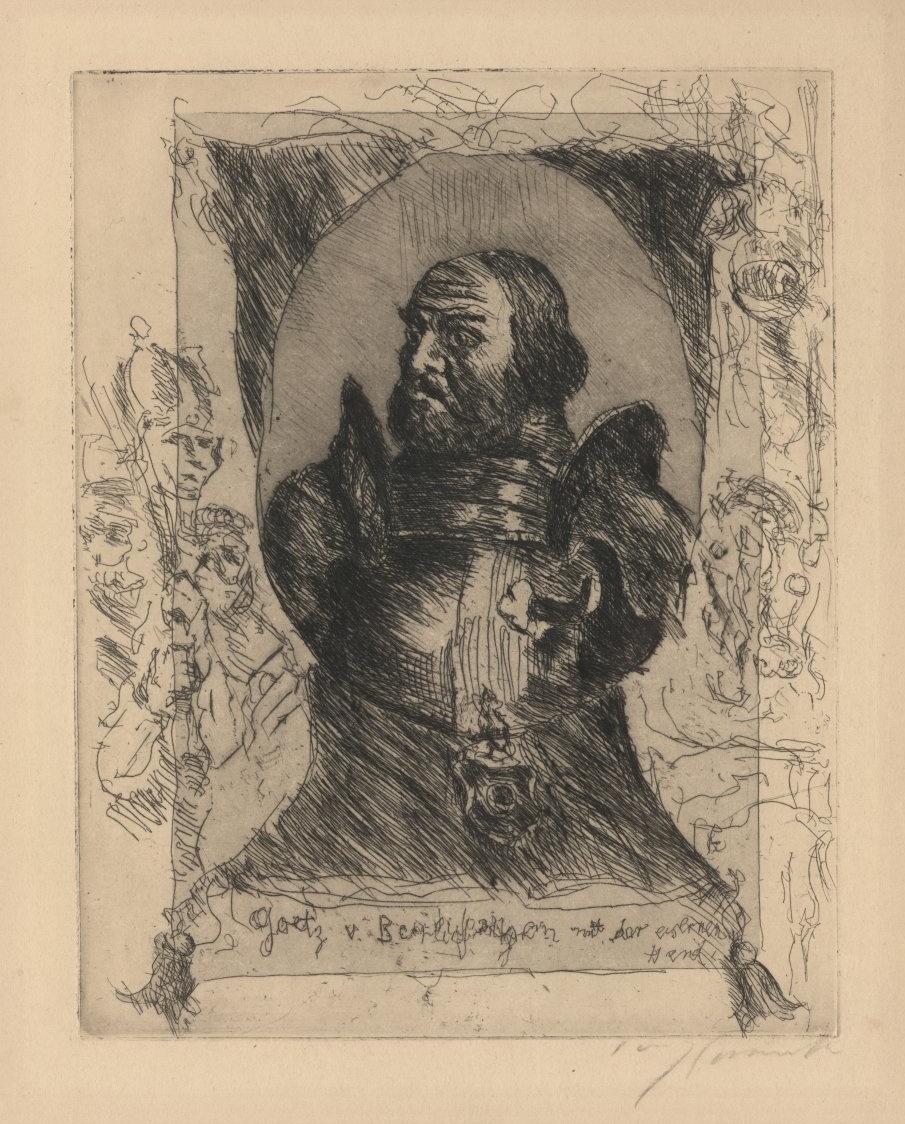
"Goetz von Berlichingen mit der eisernen Hand." Brustbild des Götz von Lovis Corinth (1921-1922, Frankfurter Goethehaus, Freies Deutsches Hochstift.)
I most carefully concealed from him my interest in certain subjects which had rooted themselves within me, and were, by little and little, moulding themselves into poetic form. These were Götz von Berlichingen and Faust. The biography of the former had seized my inmost heart. The figure of a rude, well-meaning self-helper, in a wild anarchical time, awakened my deepest sympathy. The significant puppet-show fable of the latter resounded and vibrated many-toned within me. I had also wandered about in all sorts of science, and had early enough been led to see its vanity. I had, moreover, tried all sorts of ways in real life, and had always returned more unsatisfied and troubled. Now these things, as well as many others, I carried about with me, and delighted myself with them during my solitary hours, but without writing anything down. But most of all, I concealed from Herder my mystico-cabalistical chemistry, and everything relating to it, although, at the same time, I was still very fond of secretly busying myself in working it out more consistently than it had been communicated to me. Of my poetical labours, I believe I laid before him Die Mitschuldigen, but I do not recollect that on this account I received either correction or encouragement on his part. Yet, with all this, he remained what he was; whatever proceeded from him had an important, if not a cheering effect, and even his handwriting exercised a magic power over me. I do not remember having ever torn up or thrown away one of his letters, or even a mere envelope from his hand; yet, with my various changes of place and time, not one document of those strange, foreboding, and happy days is left.
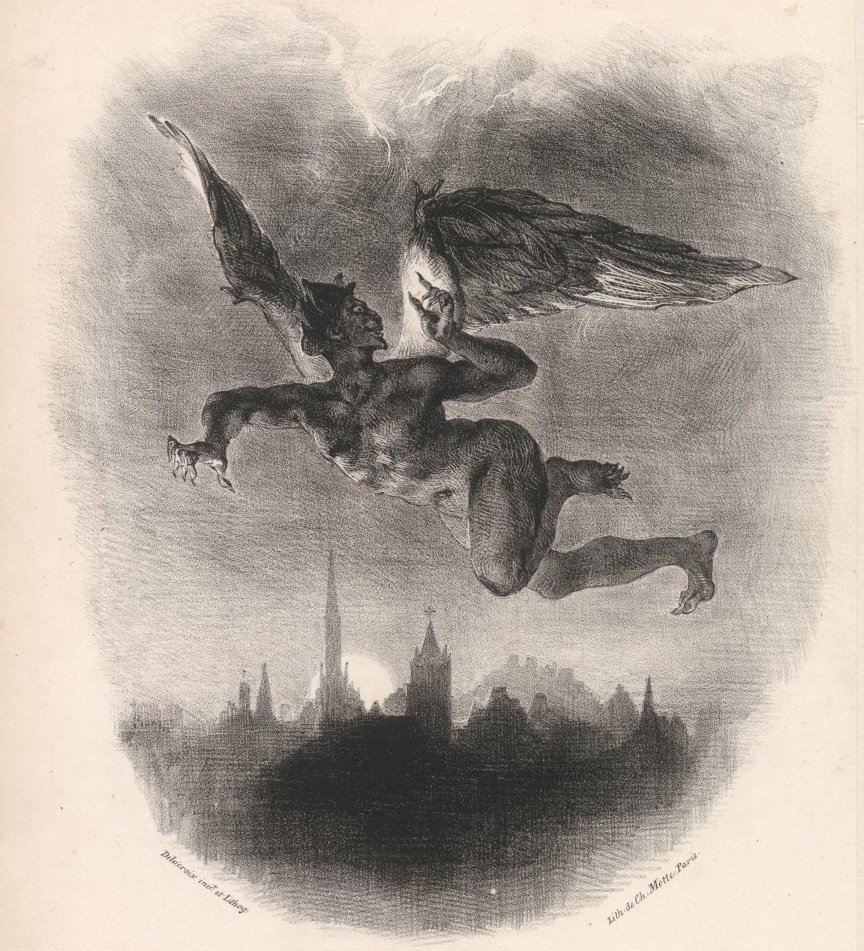
.... De temps en temps j'aime à voir le vieux Père, Et je me garde bien de lui rompre en Misiere... par Eugène Delacroix (Source: Faust, tragédie de M. de Goethe, traduite en français par M. Albert Stapfer. C. Motte (Paris) 1828 - Gallica Bnf)
Herder's Influence on Jung.
That Herder's power of attraction operated upon others as well as upon me, I should scarcely mention, had I not to remark that it extended itself particularly to Jung, commonly called Stilling. The true, honest striving of this man could not but deeply interest everybody who had any feeling, and his susceptibility must have charmed into candour every one who was in a condition to impart anything. Even Herder behaved towards him with more forbearance than towards the rest of us: for his counter-action always seemed to stand in relation with the action exerted upon him. Jung's narrowness was accompanied by so much good-will, his urgency with so much softness and earnestness, that a man of intelligence could certainly not be severe against him, and a benevolent man could not scoff at him, or turn him into ridicule. Jung was also exhilarated to such a degree by Herder, that he felt himself strengthened and advanced in all he did; even his affection for me seemed to lose ground in the same ratio; yet we always remained good companions, made allowances for each other from first to last, and mutually rendered the most friendly services.
Let us now, however, withdraw ourselves from the sick chamber of friendship, and from the general considerations which refer rather to disorder than to health of mind; let us betake ourselves into the open air, to the lofty and broad gallery of the minster, as if the time were still present, when we young fellows often appointed an evening meeting to greet the departing sun with brimming goblets. Here all conversation was lost in the contemplation of the country: here sharpness of eye-sight was put to the proof, and every one strove to perceive, nay, plainly to distinguish, the most distant objects. Good telescopes were employed to assist us, and one friend after another exactly pointed out the spot which had become the most dear and precious to him; and I also did not lack such a little spot, which, although it did not come out with importance in the landscape, nevertheless more than all the rest attracted me with an amiable magic. On these occasions the imagination was excited by relating our adventures, and several little jaunts were concerted, nay, often undertaken on the spur of the moment, of which I will circumstantially relate only one instead of a number, since in many respects it was of consequence to me.
With two worthy friends and fellow-boarders, Engelbach and Weyland, both natives of Lower Alsace, I repaired on horseback to Zabern, where, in the fine weather, the friendly little place smiled pleasantly upon us. The sight of the bishop's castle awakened our admiration; the extent, height, and splendour of a new set of stables bore witness to the other comforts of the owner. The gorgeousness of the staircase surprised us, the chambers and saloons we trode with reverence, only the person of the cardinal, a little wreck of a man, whom we saw at table, made a contrast. The view of the garden is splendid, and a canal, three quarters of a league long, which leads straight up to the middle of the castle, gives a high idea of the taste and resources of the former possessors. We rambled up and down there, and enjoyed many parts of this beautifully situated whole, which lies on the outskirts of the magnificent plain of Alsace, at the foot of the Vosges.
After we had enjoyed ourselves at this clerical outpost of a royal power, and had made ourselves comfortable in its region, we arrived early next morning at a public work, which most nobly opens the entrance into a mighty kingdom. Illumined by the beams of the rising sun, the famous Zabern-stairs, a work of incredible labour, rose before us. A road, built serpentine-wise over the most fearful crags, and wide enough for three wagons abreast, leads up hill so gently, that the ascent is scarcely perceptible. The hardness and smoothness of the way, the flat-topped elevations on both sides for the foot-passengers, the stone channels to lead off the mountain-water, all are executed as neatly as artistically and durably, so that they afford a satisfactory view. Thus one gradually arrives at Pfalzburg, a modern fortification. It lies upon a moderate hill; the works are elegantly built on blackish rocks, and of the same kind of stone, and the joinings being pointed out with white mortar, show exactly the size of the square stones, and give a striking proof of neat workmanship. We found the place itself, as is proper for a fortress, regular, built of stone, and the church in good taste. When we wandered through the streets—it was nine o'clock on Sunday morning—we heard music; they were already waltzing in the tavern to their hearts' content, and as the inhabitants did not suffer themselves to be disturbed in their pleasures by the great scarcity, nay, by the threatened famine, so also our youthful cheerfulness was not at all troubled when the baker on the road refused us some bread, and directed us to the tavern, where perhaps we might procure provisions at the usual place.
Zabern-Buchsweiler.
We now very willingly rode down the Zabern-stairs again to gaze at this architectural wonder a second time, and to enjoy once more the refreshing prospect over Alsace. We soon reached Buchsweiler, where friend Weyland had prepared for us a good reception. To a fresh youthful mind the condition of a small town is well suited; family connexions are closer and more perceptible; domestic life, which, with moderate activity, moves hither and thither between light official duties, town business, agriculture and gardening, invites us to a friendly participation; sociableness is necessary, and the stranger finds himself very pleasantly situated in the limited circles, if the disputes of the inhabitants, which in such places are more palpable, do not everywhere come in contact with him. This little town was the chief place of the county of Hanau-Lichtenberg, belonging to the Landgrave of Darmstadt, under French sovereignty. A regency and board of officers established here made the place an important centre-point of a very beautiful and desirable principality. We easily forgot the unequal streets and the irregular architecture of the place when we went out to look at the old castle and the gardens, which are excellently laid out on a hill. Numerous little pleasure-woods, a preserve for tame and wild pheasants, and the relics of many similar arrangements, showed how pleasant this little residence must formerly have been.
Yet all these views were surpassed by the prospect which met the eye, when, from the neighbouring Baschberg, one looked over the perfectly paradisiacal region. This height, wholly heaped together out of different kinds of shells, attracted my attention for the first time to such documents of antiquity; I had never before seen them together in so great a mass. Yet the curious eye soon turned itself exclusively to the landscape. You stand on the last landward[2] mountain-point; towards the north lies a fruitful plain, interspersed with little forests, and bounded by a stem low of mountains that stretches itself westward towards Zaber, where the episcopal palace and the abbey of St. John, lying a league beyond it, may be plainly recognised. Thence the eye follows the more and more vanishing chain of the Vosges towards the south. If you turn to the north-east you see the castle of Lichtenberg upon a rock, and towards the south-east the eye has the boundless plain of Alsace to scrutinize, which, afar off, withdraws itself from the sight in the more and more misty landscape, until at last the Suabian mountains melt away like shadows into the horizon.
Already in my limited wanderings through the world, I had remarked how important it is in travelling to inquire after the course of the waters, and even to ask with respect to the smallest brook, whither in reality it runs. One thus acquires a general survey of every stream-region, in which one happens to be, a conception of the heights and depths which bear relation to each other, and by these leading things, which assist the contemplation as well as the memory, extricates oneself in the surest manner from the geological and political labyrinth. With these observations, I took a solemn farewell of my beloved Alsace, as the next morning we meant to turn our steps towards Lorraine.
The evening passed away in familiar conversation, in which we tried to cheer ourselves up under a joyless present, by remembrances of a better past. Here, as in the whole of this small country, the name of the last Count Reinhard von Hanau was blessed above all others; his great understanding and aptitude had appeared in all his actions, and many a beautiful memorial of his existence yet remained. Such men have the advantage of being double benefactors: once to the present, which they make happy, and then to the future, the feeling of which and courage they nourish and sustain.
Saarbrück.
Now as we turned ourselves north-westward into the mountains, passed by Lützelstein, an old mountain tower, in a very hilly country, and descended into the region of the Saar and the Moselle, the heavens began to lower, as if they would render yet more sensible to us the condition of the more rugged western country. The valley of the Saar, where we first found Bockenheim, a small place, and saw opposite to it Neusaarwerden, which is well-built, with a pleasure-castle, is bordered on both sides by mountains which might be called melancholy, if at their foot an endless succession of meadows and fields, called the Huhnau, did not extend as far as Saaralbe, and beyond it, further than the eye can reach. Great buildings, belonging to the former stables of the Duke of Lorraine, here attract the eye; they are at present used as a dairy, for which purpose, indeed, they are very well situated. We passed through Saargemünd to Saarbrück, and this little residence was a bright point in a land so rocky and woody. The town, small and hilly, but well adorned by the last prince, makes at once a pleasing impression, as the houses are all painted a greyish white, and the different elevation of them affords a variegated view. In the middle of a beautiful square, surrounded with handsome buildings, stands the Lutheran church, on a small scale, but in proportion with the whole. The front of the castle lies on the same level with the town; the back, on the contrary, on the declivity of a steep rock. This has not only been worked out terrace-fashion, to afford easy access to the valley, but an oblong garden-plot has also been obtained below, by turning off the stream on one side, and cutting away the rock on the other, after which this whole space was lastly filled up with earth and planted. The time of this undertaking fell in the epoch when they used to consult the architects about laying out gardens, just as at present they call in the aid of the landscape-painter's eye. The whole arrangement of the castle, the costly and the agreeable, the rich and the ornamental, betokened a life-enjoying owner, such as the deceased prince had been; the present sovereign was not at home. President von Günderode received us in the most obliging manner, and entertained us for three days better than we had a right to expect. I made use of the various acquaintance which we formed to instruct myself in many respects. The life of the former prince, rich in pleasure, gave material enough for conversation, as well as the various expedients which he hit upon to make use of the advantages supplied by the nature of his land. Here I was now properly initiated into the interest for mountain countries, and the love for those economical and technical investigations which have busied me a great part of my life, was first awakened within me. We heard of the rich coal-pits at Dutweil, of the iron and alum works, and even of a burning mountain, and we prepared ourselves to see these wonders close.
We now rode through woody mountains, which must seem wild and dreary to him who comes out of a magnificent fertile land, and which can attract us only by the internal contents of its bosom. We were made acquainted with one simple, and one complicated piece of machinery, within a short distance of each other; namely, a scythe-smithy and a wire-drawing factory. If one is pleased at the first because it supplies the place of common hands, one cannot sufficiently admire the other, for it works in a higher organic sense, from which understanding and consciousness are scarcely to be separated. In the alum-works we made accurate inquiries after the production and purifying of this so necessary material, and when we saw great heaps of a white greasy, loose, earthy matter, and asked the use of it, the labourers answered, smiling, that it was the scum thrown up in boiling the alum, and that Herr Stauf had it collected, as he hoped perchance to turn it to some profit. "Is Herr Stauf alive yet?" exclaimed my companion in surprise. They answered in the affirmative, and assured us that according to the plan of our journey we should not pass far from his lonely dwelling.
Coal and Alum-Works.
Our road now led up along the channels by which the alum-water is conducted down, and the principal horizontal works (stollen), which they call the "landgrube," and from which the famous Dutweil coals are procured. These, when they are dry, have the blue colour of darkly tarnished steel, and the most beautiful succession of rainbow tints plays over the surface with every movement. The deep abysses of the coal-levels, however, attracted us so much the less as their contents lay richly poured out around us. We now reached the open mine, in which the roasted alum-scales are steeped in lye, and soon after, a strange occurrence surprised us, although we had been prepared. We entered into a chasm and found ourselves in the region of the Burning Mountain. A strong smell of sulphur surrounded us; one side of the cavity was almost red-hot, covered with reddish stone burnt white; thick fumes arose from the crevices, and we felt the heat of the ground through our strong boot-soles. An event so accidental, for it is not known how this place became ignited, affords a great advantage for the manufacture of alum, since the alum-scales of which the surface of the mountain consists, lie there perfectly roasted, and may be steeped in a short time and very well. The whole chasm had arisen by the calcined scales being gradually removed and used up. We clambered up out of this depth, and were on the top of the mountain. A pleasant beech-grove encircled the spot, which followed up to the chasm and extended itself on both sides of it. Many trees stood already dried up, some were withering near others, which, as yet quite fresh, felt no forebodings of that fierce heat which was approaching and threatening their roots also.
Upon this space different openings were steaming, others had already done smoking, and this fire had thus smouldered for ten years already through old broken-up pits and horizontal shafts, with which the mountain is undermined. It may, too, have penetrated to the clefts through new coal-beds: for, some hundred paces further into the wood, they had contemplated following up manifest indications of an abundance of coal; but they had not excavated far before a strong smoke burst out against the labourers and dispersed them. The opening was filled up again, yet we found the place still smoking as we went on our way past it to the residence of our hermit-like chemist. This lies amid mountains and woods; the vallies there take very various and pleasing windings, the soil round about is black and of the coal kind, and strata of it frequently come in sight. A coal philosopher—philosophus per ignem, as they said formerly—could scarcely have settled himself more suitably.
We came before a small house, not inconvenient for a dwelling, and found Herr Stauf, who immediately recognised my friend, and received him with lamentations about the new government. Indeed we could see from what he said, that the alum-works, as well as many other well-meant establishments, on account of external and perhaps internal circumstances also, did not pay their expenses; with much else of the sort. He belonged to the chemists of that time, who, with a hearty feeling for all that could be done with the products of nature, took delight in abstruse investigations of trifles and secondary matters, and with their insufficient knowledge were not dexterous enough to do that from which properly economical and mercantile profit is to be derived. Thus the use which he promised himself from that scum lay very far in the distance; thus he had nothing to show but a cake of sal-ammoniac, with which the Burning Mountain had supplied him.
Ready and glad to communicate his complaints to a human ear, the lean, decrepit little man, with a shoe on one foot and a slipper on the other, and with stockings hanging down and repeatedly pulled up in vain, dragged himself up the mountain to where the resin-house stands, which he himself had erected, and now, with great grief, sees falling to ruins. Here was found a connected row of furnaces, where coal was to be cleansed of sulphur, and made fit for use in iron-works; but at the same time they wished also to turn the oil and resin to account; nay, they would not even lose the soot; and thus all failed together, on account of the many ends in view. During the life-time of the former prince, the business had been carried on in the spirit of an amateur, and in hope; now they asked for the immediate use, which was not to be shown.
After we left our adept to his solitude, we hastened—for it was now late—to the glass-house in Friedrichsthal, where we became acquainted, on our way, with one of the most important and most wonderful operations of human ingenuity.
Nevertheless, some pleasant adventures, and a surprising firework at night-fall, net far from Neukirch, interested us young fellows almost more than these important experiences. For as a few nights before, on the banks of the Saar, shining clouds of glow-worms hovered around us, betwixt rock and thicket, so now the spark-spitting forges played their sprightly firework towards us. We passed, in the depth of night, the smelting-houses situated in the bottom of the valley, and were delighted with the strange half-gloom of these dens of plank, which are but dimly lighted by a little opening in the glowing furnace. The noise of the water, and of the bellows driven by it, the fearful whizzing and shrieking of the blast of air which, raging into the smelted ore, stuns the ears and confuses the senses, drove us away, at last, to turn into Neukirch, which is built up against the mountain.
But, notwithstanding all the variety and fatigue of the day, I could find no rest here. I left my friend to a happy sleep, and sought the hunting-seat, which lay still further up. It looks out far over mountain and wood, the outlines of which were only to be recognised against the clear night-sky, but the sides and depths of which were impenetrable to my sight. This well-preserved building stood as empty as it was lonely; no castellan, no huntsman was to be found. I sat before the great glass doors upon the steps which run around the whole terrace. Here, surrounded by mountains, over a forest-grown, dark soil, which seemed yet darker in contrast with the clear horizon of a summer night, with the glowing starry vault above me, I sat for a long time by myself on the deserted spot, and thought I never had felt such a solitude. How sweetly, then, was I surprised by the distant sound of a couple of French horns, which at once, like the fragrance of balsam, enlivened the peaceful atmosphere. Then there awakened within me the image of a lovely being, which had retired into the background before the motley objects of these travelling days, but which now unveiled itself-more and more, and drove me from the spot back to my quarters, where I made preparations to set off with the earliest.
Zwey-Brücken.
The return was not used like the journey out. Thus we hurried through Zwey-brücken (Deux-Ponts), which, as a beautiful and notable residence, might well have deserved our attention. We cast a glance upon the great, simple castle, on the extensive esplanades, regularly planted with linden-trees, and very well adapted for the training of race-horses, and on the large stables, and the citizens' houses which the prince had built to be raffled for. All this, as well as the costume and manners of the inhabitants, especially of the matrons and maids, had reference to a distant connexion, and made plainly visible the relation with Paris, from which, for a long time, nothing transrhenane had been able to withdraw itself. We visited also the ducal wine-cellars, situated before the city, which are extensive, and furnished with large, well-made tuns. We went on further, and at last found the country like that in the neighbourhood of Saarbrück. Between wild and savage mountains are a few villages; one here gets rid of the habit of looking about for corn. We mounted up, by the side of the Hornbach, to Bitsch, which lies on the important spot where the waters divide, and fall, a part into the Saar, a part into the Rhine. These last were soon to attract us towards them. Yet we could not refuse our attention to the little city of Bitsch, which very picturesquely winds around the mountain, nor to the fortress, which lies above. This is partly built on rocks, and partly hewn out of them. The subterraneous chambers are particularly worthy of remark; here is not only space sufficient for the abode of a number of men and cattle, but one even lights upon large vaults for the drilling of troops, a mill, a chapel, and whatever else could be required under-ground, provided the surface were in a state of disturbance.
We now followed the down-rushing brooks through Bärenthal. The thick forests on both the heights remain unused by the hand of man. Here trunks of trees lie rotting on each other by thousands, and young scions sprout up without number from their half-mouldered progenitors. Here, in conversation with some companions on foot, the name Von Dieterich again struck our ears, which we had often heard honourably mentioned already in these woody regions. The activity and cleverness of this man, his wealth, and the use and applications of it, all seemed in proportion. He could with justice take delight in the acquisitions which he increased, and enjoy the profits he secured. The more I saw of the world, the more pleasure I took, not only in the universally famous names, but in those also, especially, which were mentioned in particular regions with reverence and love: and thus I easily learned here, by a few questions, that Von Dieterich, earlier than others, had known how to make successful use of the mountain treasures, iron, coal, and wood, and had worked his way to an ever-growing opulence.
Niederbrunn, where we now arrived, was a new proof of this. He had purchased this little place from the Count of Leiningen and other part-owners, to erect important iron-works in the place.
Here in these baths, already founded by the Romans, floated around me the spirit of antiquity, venerable relics of which, in fragments of bas-reliefs and inscriptions, capitals and shafts, shone out strangely towards me, from farm-houses, amidst household lumber and furniture.
Sesenheim.
As we were ascending the adjacent Wasenburg also, I paid my respects to a well-preserved inscription, which discharged a thankful vow to Mercury, and is situated upon the great mass of rock which forms the base of the hill on one side. The fortress itself lies on the last mountain, looking from Bitsch towards Germany. It is the ruin of a German castle built upon Roman remains. From the tower the whole of Alsace was once more surveyed, and the conspicuous minster-spire pointed out the situation of Strasburg. First of all, however, the great forest of Hagenau extended itself, and the towers of this town peered plainly from behind. I was attracted thither. We rode through Reichshof, where Von Dieterich built an imposing castle, and after we had contemplated from the hills near Niedermoder the pleasing course of the little river Moder, by the forest of Hagenau, I left my friend on a ridiculous coal-mine visitation, which, at Dutweil, might have been a somewhat more serious business, and I then rode through Hagenau, on the direct road—already indicated by my affection—to my beloved Sesenheim.
For all these views into a wild, mountain region, and then, again, into a cheerful, fruitful, joyous land, could not rivet my mind's eye, which was directed to an amiable, attractive object. This time, also, the hither way seemed to me more charming than its opposite, as it brought me again into the neighbourhood of a lady to whom I was heartily devoted, and who deserved as much respect as love. But before I lead my friends to her rural abode, let me be permitted to mention a circumstance which contributed very much to enliven and enhance my affection, and the satisfaction which it afforded me.
The "Vicar of Wakefield."
How far I must have been behindhand in modern literature, may be gathered from the mode of life which I led at Frankfort, and from the studies to which I had devoted myself; nor could my residence in Strasburg have furthered me in this respect. Now Herder came, and together with his great knowledge brought many other aids, and the later publications besides. Among these he announced to us the Vicar of Wakefield as an excellent work, with the German translation of which he would make us acquainted by reading it aloud to us himself.
His method of reading was quite peculiar; whoever has heard him preach will be able to form a notion of it. He delivered everything, this romance included, in a serious and simple style, perfectly removed from all dramatically imitative representation; he even avoided that variety which is not only permitted, but even required, in an epical delivery—a slight change of tone when different persons speak, by which what every one says is brought into relief, and the actor is distinguished from the narrator. Without being monotonous, Herder let everything go on in the same tone, just as if nothing was present before him, but all was merely historical; as if the shadows of this poetic creation did not act livingly before him, but only glided gently by. Yet this manner of delivery from his mouth had an infinite charm; for, as he felt all most deeply, and knew how to estimate the variety of such a work, so the whole merit of a production appeared purely and the more clearly, as one was not disturbed by details sharply spoken out, nor interrupted in the feeling which the whole was meant to produce.
A Protestant country clergyman is, perhaps, the most beautiful subject for a modern idyl; he appears, like Melchizedek, as priest and king in one person. To the most innocent situation which can be imagined on earth, to that of a husbandman, he is, for the most part, united by similarity of occupation, as well as by equality in family relationships; he is a father, a master of a family, an agriculturist, and thus perfectly a member of the community. On this pure, beautiful, earthly foundation, rests his higher calling: to him is it given to guide men through life, to take care of their spiritual education, to bless them at all the leading epochs of their existence, to instruct, to strengthen, to console them, and, if consolation is not sufficient for the present, to call up and guarantee the hope of a happier future. Imagine such a man, with pure human sentiments, strong enough not to deviate from them under any circumstances, and by this already elevated above the multitude, of whom one cannot expect purity and firmness; give him the learning necessary for his office, as well as a cheerful, equable activity, which is even passionate, as it neglects no moment to do good,—and you will have him well endowed. But at the same time add the necessary limitation, so that he must not only pause in a small circle, but may also perchance pass over to a smaller; grant him good-nature, placability, resolution, and everything else praiseworthy that springs from a decided character, and over all this a cheerful spirit of compliance, and a smiling toleration of his own failings and those of others,—then you will have put together pretty well the image of our excellent Wakefield.
The delineation of this character on his course of life through joys and sorrows, the ever-increasing interest of the story, by the combination of the entirely natural with the strange and the singular, make this novel one of the best which has ever been written; besides this, it has the great advantage that it is quite moral, nay, in a pure sense, Christian—represents the reward of a good will and perseverance in the right, strengthens an unconditional confidence in God, and attests the final triumph of good over evil; and all this without a trace of cant or pedantry. The author was preserved from both of these by an elevation of mind that shows itself throughout in the form of irony, by which this little work must appear to us as wise as it is amiable. The author, Dr. Goldsmith, has without question great insight into the moral world, into its strength and its infirmities; but at the same time he can thankfully acknowledge that he is an Englishman, and reckon highly the advantages which his country and his nation afford him. The family, with the delineation of which he occupies himself, stands upon one of the last steps of citizen comfort, and yet comes in contact with the highest; its narrow circle, which becomes still more contracted, touches upon the great world through the natural and civil course of things; this little skiff floats on the agitated waves of English life, and in weal or woe it has to expect injury or help from the vast fleet which sails around it.
I may suppose that my readers know this work, and have it in memory; whoever hears it named for the first time here, as well as he who is induced to read it again, will thank me. For the former, I would merely make the cursory remark, that the vicar's wife is of that good, busy sort, who allows herself and her own to want for nothing, but who is also somewhat vain of herself and her own. There are two daughters,—Olivia, handsome and more devoted to the external, and Sophia, charming and more given to the internal; nor will I omit to mention an industrious son, Moses, who is somewhat blunt and emulous of his father.
If Herder could be accused of any fault in his reading aloud, it was impatience; he did not wait until the hearer had heard and comprehended a certain part of the progress, so as to be able to feel and think correctly about it; hurrying on, he would see their effect at once, and yet he was displeased even with this when it manifested itself. He blamed the excess of feeling which overflowed from me more and more at every step. I felt like a man, like a young man; everything was living, true, and present before me. He, considering only the intrinsic contents and form, saw clearly, indeed, that I was overpowered by the subject-matter, and this he would not allow. Then Peglow's reflections, which were not of the most refined, were still worse received; but he was especially angry at our want of keenness in not seeing beforehand the contrasts of which the author often makes use, and in suffering ourselves to be moved and carried away by them without remarking the oft-returning artifice. He would not pardon us for not seeing at once, or at least suspecting at the very beginning, where Burchell is on the point of discovering himself by passing over in his narration from the third to the first person, that he himself is the lord of whom he is speaking; and when, finally, we rejoiced like children at the discovery and the transformation of the poor, needy wanderer, into a rich, powerful lord, he immediately recalled the passage, which, according to the author's plan, we had overlooked, and read us a powerful lecture on our stupidity. It wall be seen from this that he regarded the work merely as a production of art, and required the same of us, who were yet wandering in that state where it is very allowable to let works of art affect us like productions of nature.
I did not suffer myself to be at all perplexed by Herder's invectives; for young people have the happiness or unhappiness, that, when once anything has produced an effect on them, this effect must be wrought out within themselves; from which much good, as well as much mischief, arises. The above work had left with me a great impression, for which I could not account, but properly speaking, I felt myself in harmony with that ironical tone of mind which elevates itself above every object, above fortune and misfortune, good and evil, death and life, and thus attains to the possession of a truly poetical world. I could not, indeed, become conscious of this until later; it was enough that it gave me much to do at the moment; but I could by no means have expected to be so soon transposed from this fictitious world into a similar real one.
Pleasures of Travelling Incognito.
My fellow-boarder, Weyland, who enlivened his quiet, laborious life by visiting from time to time his friends and relations in the country (for he was a native of Alsace), did me many services on my little excursions, by introducing me to different localities and families, sometimes in person, sometimes by recommendations. He had often spoken to me about a country clergyman who lived near Drusenheim, six leagues from Strasburg, in possession of a good benefice, with an intelligent wife and a pair of amiable daughters. The hospitality and agreeableness of this family were always highly extolled. It scarcely needed so much to draw thither a young knight who had already accustomed himself to spend all his leisure days and hours on horseback and in the open air. We decided therefore upon this trip, and my friend had to promise that on introducing me he would say neither good nor ill of me, but would treat me with general indifference, and would allow me to make my appearance clad, if not meanly, yet somewhat poorly and negligently. He consented to this, and promised himself some sport from it.
It is a pardonable whim in men of consequence, to place their exterior advantages in concealment now and then, so as to allow their own internal human nature to operate with the greater purity. For this reason the incognito of princes, and the adventures resulting therefrom, are always highly pleasing; these appear disguised divinities, who can reckon at double its value all the good offices shown to them as individuals, and are in such a position that they can either make light of the disagreeable or avoid it. That Jupiter should be well pleased in his incognito with Philemon and Baucis, and Henry the Fourth with his peasants after a hunting party, is quite conformable to nature, and we like it well; but that a young man without importance or name, should take it into his head to derive some pleasure from an incognito, might be construed by many as an unpardonable piece of arrogance. Yet since the question here is not of such views and actions, so far as they are praiseworthy or blameable, but so far as they can manifest themselves and actually occur, we will on this occasion, for the sake of our own amusement, pardon the youngster his self-conceit; and the more so, as I must here allege, that from youth upwards, a love for disguising myself had been excited in me even by my stem father.
This time, too, partly by some cast-off clothes of my own, partly by some borrowed garments and by the manner of combing my hair, I had, if not disfigured myself, yet at least decked myself out so oddly, that my friend could not help laughing on the way, especially as I knew how to imitate perfectly the bearing and gestures of such figures when they sit on horseback, and which are called "Latin riders." The fine road, the most splendid weather, and the neighbourhood of the Rhine, put us in the best humour. At Drusenheim we stopped a moment, he to make himself spruce, and I to rehearse my part, out of which I was afraid I should now and then fall. The country here has the characteristics of all the open, level Alsace. We rode on a pleasant foot-path over the meadows, soon reached Sesenheim, left our horses at the tavern, and walked leisurely towards the parsonage. "Do not be put out," said Weyland, showing me the house from a distance, "because it looks like an old miserable farm-house, it is so much the younger inside." We stepped into the court-yard; the whole pleased me well: for it had exactly that which is called picturesque, and which had so magically interested me in Dutch art. The effect which time produces on all human work was strongly perceptible. House, barn, and stable were just at that point of dilapidation where, indecisive and doubtful between preserving and rebuilding, one often neglects the one without being able to accomplish the other.
The Pastor's Family.
As in the village, so in the court-yard, all was quiet and deserted. We found the father, a little man, wrapped up within himself, but friendly notwithstanding, quite alone, for the family were in the fields. He bade us welcome, and offered us some refreshment, which we declined. My friend hurried away to look after the ladies, and I remained alone with our host. "You are perhaps surprised," said he, "to find me so miserably quartered in a wealthy village, and "with a lucrative benefice; but," he continued, "this proceeds from irresolution. Long since it has been promised me by the parish, and even by those in higher places, that the house shall be rebuilt; many plans have been already drawn, examined and altered, none of them altogether rejected, and none carried into execution. This has lasted so many years, that I scarcely know how to command my impatience." I made him an answer such as I thought likely to cherish his hopes, and to encourage him to pursue the affair more vigorously. Upon this he proceeded to describe familiarly the personages on whom such matters depended, and although he was no great delineator of character, I could nevertheless easily comprehend how the whole business must have been delayed. The confidential tone of the man was something peculiar; he talked to me as if he had known me for ten years, while there was nothing in his look from which I could have suspected that he was directing any attention to me. At last my friend came in with the mother. She seemed to look at me with quite different eyes. Her countenance was regular, and the expression of it intelligent; she must have been beautiful in her youth. Her figure was tall and spare, but not more so than became her years, and when seen from behind, she had yet quite a youthful and pleasing appearance. The elder daughter then came bouncing in briskly; she inquired after Frederica, just as both the others had also done. The father assured them that he had not seen her since all three had gone out together. The daughter again went out at the door to look for her sister; the mother brought us some refreshment, and Weyland, with the old couple, continued the conversation, which referred to nothing but known persons and circumstances; as, indeed, it is usually the case when acquaintances meet after some length of time, that they make inquiries, and mutually give each other information about the members of a large circle. I listened, and now learned how much I had to promise myself from this circle.
The elder daughter again came hastily back into the room, uneasy at not having found her sister. They were anxious about her, and blamed her for this or that bad habit; only the father said, very composedly, "Let her alone; she has already come back!" At this instant she really entered the door; and then truly a most charming star arose in this rural heaven. Both daughters still wore nothing but German, as they used to call it, and this almost obsolete national costume became Frederica particularly well. A short, white, full skirt, with a furbelow, not so long but that the neatest little feet were visible up to the ankle; a tight white bodice and a black taffeta apron,—thus she stood on the boundary between country girl and city girl. Slender and light, she tripped along as if she had nothing to carry, and her neck seemed almost too delicate for the large fair braids on her elegant little head. From cheerful blue eyes she looked very plainly round, and her pretty turned-up nose peered as freely into the air as if there could be no care in the world; her straw hat hung on her arm, and thus, at the first glance, I had the delight of seeing her, and acknowledging her at once in all her grace and loveliness.
I now began to act my character with moderation, half ashamed to play a joke on such good people, whom I had time enough to observe: for the girls continued the previous conversation, and that with passion and some display of temper. All the neighbours and connexions were again brought forward, and there seemed, to my imagination, such a swarm of uncles and aunts, relations, cousins, comers, goers, gossips and guests, that I thought myself lodged in the liveliest world possible. All the members of the family had spoken some words with me, the mother looked at me every time she came in or went out, but Frederica first entered into conversation with me, and as I took up and glanced through some music that was lying around, she asked me if I played also? When I answered in the affirmative, she requested me to perform something; but the father would not allow this, for he maintained that it was proper to serve the guest first with some piece of music or a song.
She played several things with some readiness, in the style which one usually hears in the country, and on a harpsichord, too, that the schoolmaster should have tuned long since, if he had only had time. She was now to sing a song also, a certain tender-melancholy affair; but she did not succeed in it. She rose up and said, smiling, or rather with that touch of serene joy which ever reposed, on her countenance, "If I sing badly, I cannot lay the blame on the harpsichord or the schoolmaster; but let us go out of doors; then you shall hear my Alsatian and Swiss songs; they sound much better."
Comparison with the "Vicar of Wakefield."
During supper, a notion which had already struck me, occupied me to such a degree, that I became meditative and silent, although the liveliness of the elder sister, and the gracefulness of the younger, shook me often enough out of my contemplations. My astonishment at finding myself so actually in the Wakefield family was beyond all expression. The father, indeed, could not be compared with that excellent man; but where will you find his like? On the other hand, all the dignity which is peculiar to that husband, here appeared in the wife. One could not see her without at the same time reverencing and fearing her. In her were remarked the fruits of a good education; her demeanour was quiet, easy, cheerful, and inviting.
If the elder daughter had not the celebrated beauty of Olivia, yet she was well-made, lively, and rather impetuous; she everywhere showed herself active, and lent a helping hand to her mother in all things. To put Frederica in the place of Primrose's Sophia was not difficult; for little is said of the latter, it is only taken for granted that she is amiable; and this girl was amiable indeed. Now as the same occupation and the same situation, wherever they may occur, produce similar, if not the same effects, so here too many things were talked about, many things happened, which had already taken place in the Wakefield family. But when at last a younger son, long announced and impatiently expected by the father, at last sprang into the room, and boldly sat himself down by us, taking but little notice of the guests, I could scarcely help exclaiming, "Moses, are you here too!"
The conversation at table extended my insight into this country and family circle, since the discourse was about various droll incidents which had happened now here, now there. Frederica, who sat by me, thence took occasion to describe to me different localities which it was worth while to visit. As one little story always calls forth another, I was able to mingle so much the better in the conversation, and to relate similar incidents, and as, besides this, a good country wine was by no means spared, I stood in danger of slipping out of my character, for which reason my more prudent friend took advantage of the beautiful moonlight, and proposed a walk, which was approved at once. He gave his arm to the elder, I to the younger, and thus we went through the wide field, paying more attention to the heavens above us than to the earth, which lost itself in extension around us. There was, however, nothing of moonshine in Frederica's discourse; by the clearness with which she spoke she turned night into day, and there was nothing in it which would have indicated or excited any feeling, except that her expressions related more than hitherto to me, since she represented to me her own situation, as well as the neighbourhood and her acquaintances, just as far as I should be acquainted with them; for she hoped, she added, I would make no exception, and would visit them again, as all strangers had willingly done who had once stopped with them.
It was very pleasant to me to listen silently to the description which she gave of the little world in which she moved, and of the persons whom she particularly valued. She thereby imparted to me a clear, and, at the same time, such an amiable idea of her situation, that it had a very strange effect on me; for I felt at once a deep regret that I had not lived with her sooner, and at the same time a truly painful envious feeling towards all who had hitherto had the good fortune to surround her. I at once watched closely, as if I had a right to do so, all her descriptions of men, whether they appeared under the names of neighbours, cousins, or gossips, and my conjectures inclined now this way, now that; but how could I have discovered anything in my complete ignorance of all the circumstances? She at last became more and more talkative, and I more and more silent. It was so pleasant to listen to her, and as I heard only her voice, while the form of her countenance, as well as the rest of the world, floated dimly in the twilight, it seemed to me as if I could see into her heart, which I could not but find very pure, since it unbosomed itself to me in such unembarrassed loquacity.
Comparison with the "Vicar of Wakefield."
When my companion retired with me into the guest-chamber, which was prepared for us, he at once, with self-complacency, broke out into pleasant jesting, and took great credit to himself for having surprised me so much with the similarity to the Primrose family. I chimed in with him by showing myself thankful. "Truly," cried he, "the story is quite complete. This family may very well be compared to that, and the gentleman in disguise here may assume the honour of passing for Mr. Burchell; moreover, since scoundrels are not so necessary in common life as in novels, I will for this time undertake the rôle of the nephew, and behave myself better than he did." However, I immediately changed this conversation, pleasant as it might be to me, and asked him, before all things, on his conscience, if he had not really betrayed me? He answered me, "No!" and I could believe him. They had rather inquired, said he, after the merry table-companion who boarded at the same house with him in Strasburg, and of whom they had been told all sorts of preposterous stuff. I now went to other questions: Had she ever been in love? Was she now in love? Was she engaged? He replied to all in the negative. "In truth," replied I, "such a cheerfulness by nature is inconceivable to me. Had she loved and lost, and again recovered herself, or had she been betrothed,—in both these cases I could account for it."
Thus we chatted together far into the night, and I was awake again at the dawn. My desire to see her once more seemed unconquerable; but while I dressed myself, I was horrified at the accursed wardrobe I had so wantonly selected. The further I advanced in putting on my clothes, the meaner I seemed in my own eyes; for everything had been calculated for just this effect. My hair I might perchance have set to rights; but when at last I forced myself into the borrowed, worn-out grey coat, and the short sleeves gave me the most absurd appearance, I fell the more decidedly into despair, as I could see myself only piecemeal, in a little looking-glass since one part always looked more ridiculous than the other.
During this toilette my friend awoke, and with the satisfaction of a good conscience, and in the feeling of pleasurable hope for the day, looked out at me from the quilted silk coverlet. I had for a long time already envied him his fine clothes, as they hung over the chair, and had he been of my size, I would have carried them off before his eyes, changed my dress outside, and hurrying into the garden, left my cursed husk for him; he would have had good-humour enough to put himself into my clothes, and the tale would have found a merry ending early in the morning. But that was not now to be thought of, no more was any other feasible accommodation. To appear again before Frederica in the figure in which my friend could give me out as a laborious and accomplished but poor student of theology,—before Frederica, who the evening before had spoken so friendly to my disguised self,—that was altogether impossible. There I stood, vexed and thoughtful, and summoned all my power of invention; but it deserted me! But now when he, comfortably stretched out, after fixing his eyes upon me for a while, all at once burst out into a loud laugh, and exclaimed, "No! it is true, you do look most cursedly!" I replied impetuously, "And I know what I will do. Good bye, and make my excuses!" "Are you mad?" cried he, springing out of bed and trying to detain me. But I was already out of the door, down the stairs, out of the house and yard, off to the tavern; in an instant my horse was saddled, and I hurried away in mad vexation, galloping towards Drusenheim, then through that place, and still further on.
As I now thought myself in safety, I rode more slowly, and now first felt how infinitely against my will I was going away. But I resigned myself to my fate, made present to my mind the promenade of yesterday evening with the greatest calmness, and cherished the secret hope of seeing her soon again. But this quiet feeling soon changed itself again into impatience, and I now determined to ride rapidly into the city, change my dress, take a good, fresh horse, since then, as my passion made me believe, I could at all events return before dinner, or, as was more probable, to the dessert, or towards evening, and beg my forgiveness.
The Exchange of Clothes.
I was just about to put spurs to my horse to execute this plan, when another, and, as seemed to me, a very happy thought, passed through my mind. In the tavern at Drusenheim, the day before, I had noticed a son of the landlord very nicely dressed, who, early this morning, being busied about his rural arrangements, had saluted me from his court-yard. He was of my figure, and had for the moment reminded me of myself. No sooner thought than done! My horse was hardly turned round, when I found myself in Drusenheim; I brought him into the stable, and in a few words made the fellow my proposal, namely, that he should lend me his clothes, as I had something merry on foot at Sesenheim. I had no need to talk long; he agreed to the proposition with joy, and praised me for wishing to make some sport for the Mamsells; they were, he said, such capital people, especially Mamselle Riekchen,[3] and the parents, too, liked to see everything go on merrily and pleasantly. He considered me attentively, and as from my appearance he might have taken me for a poor starveling, he said, "If you wish to insinuate yourself, this is the right way." In the meanwhile we had already proceeded far in our toilette, and properly speaking he should not have trusted me with his holiday clothes on the strength of mine; but he was honest-hearted, and, moreover, had my horse in his stable. I soon stood there smart enough, gave myself a consequential air, and my friend seemed to regard his counterpart with complacency. "Topp,[4] Mr. Brother!" said he, giving me his hand, which I grasped heartily, "don't come too near my girl; she might make a mistake!"
My hair, which had now its full growth again, I could part at top, much like his, and as I looked at him repeatedly, I found it comical moderately to imitate his thicker eyebrows with a burnt cork, and bring mine nearer together in the middle, so that with my enigmatical intentions, I might make myself an external riddle likewise. "Now have you not," said I, as he handed me his be-ribboned hat, "something or other to be done at the parsonage, that I might announce myself there in a natural manner?" "Good!" replied he, "but then you must wait two hours yet. There is a woman confined at our house; I will offer to take the cake to the parson's wife,[5] and you may carry it over. Pride must pay its penalty, and so must a joke." I resolved to wait, but these two hours were infinitely long, and I was dying of impatience when the third hour passed before the cake came out of the oven. At last I got it quite hot, and hastened away with my credentials in the most beautiful sunshine, accompanied for a distance by my counterpart, who promised to come after me in the evening and bring me my clothes. This, however, I briskly declined, and stipulated that I should deliver up to him his own.
Goethe's Disguise.
I had not skipped far with my present, which I carried in a neat tied-up napkin, when, in the distance, I saw my friend coming towards me with the two ladies. My heart was uneasy, which was certainly unsuitable under this jacket. I stood still, took breath, and tried to consider how I should begin; and now I first remarked that the nature of the ground was very much in my favour; for they were walking on the other side of the brook, which, together with the strips of meadow through which it ran, kept the two footpaths pretty far apart. When they were just opposite to me, Frederica, who had already perceived me long before, cried, "George, what are you bringing there?" I was clever enough to cover my face with my hat, which I took off, while I held up the loaded napkin high in the air. "A christening cake!" cried she at that; "how is your sister?" "Well,"[6] said I, for I tried to talk in a strange dialect, if not exactly in the Alsatian. "Carry it to the house!" said the elder, "and if you do not find my mother, give it to the maid; but wait for us, we shall soon be back.—do you hear?" I hastened along my path in the joyous feeling of the best hope that, as the beginning was so lucky, all would go off well, and I had soon reached the parsonage. I found nobody either in the house or in the kitchen; I did not wish to disturb the old gentleman, whom I might suppose busy in the study; I therefore sat down on the bench before the door, with the cake beside me, and pressed my hat upon my face.
I cannot easily recall a pleasanter sensation. To sit again on this threshold, over which, a short time before, I had blundered out in despair; to have seen her already again, to have already heard again her dear voice, so soon after my chagrin had pictured to me a long separation, every moment to be expecting herself and a discovery, at which my heart throbbed, and yet, in this ambiguous case, a discovery without shame; for at the very beginning it was a merrier prank than any of those they had laughed at so much yesterday. Love and necessity are the best masters; they both acted together here, and their pupil was not unworthy of them.
"Frederica's Repose."
But the maid came stepping out of the barn. "Now! did the cakes turn out well?" cried she to me; "how is your sister?" "All right," said I, and pointed to the cake without looking up. She took up the napkin and muttered, "Now, what's the matter with you to-day again? Has Barbchen[7] been looking again at somebody else? Don't let us suffer for that! You will make a happy couple if you carry on so!" As she spoke pretty loud, the pastor came to the window and asked what was the matter. She showed him to me; I stood up and turned myself towards him; but still kept the hat over my face. When he had spoken somewhat friendly to me, and had asked me to remain, I went towards the garden, and was just going in, when the pastor's wife, who was entering the courtyard gate, called to me. As the sun shone right in my face, I one more availed myself of the advantage which my hat afforded me, and greeted her by scraping a leg; but she went into the house after she had bidden me not to go away without eating something. I now walked up and down in the garden; everything had hitherto had the best success, yet I breathed hard when I reflected that the young people now would soon return. But the mother unexpectedly stepped up to me, and was just going to ask me a question, when she looked me in the face, so that I could not conceal myself any longer, and the words stuck in her throat. "I am looking for George," said she, after a pause, "and whom do I find? Is it you, young sir? How many forms have you, then?" "In earnest only one," replied I; "in sport as many as you like." "Which sport I will not spoil," smiled she; "go out behind the garden into the meadow until it strikes twelve, then come back, and I shall already have contrived the joke." I did so; but when I was beyond the hedges of the village gardens, and was going along the meadows, towards me some country people came by the footpath, and put me in some embarrassment. I therefore turned aside into a little wood, which crowned an elevation quite near, in order to conceal myself there till the appointed time. Yet how strangely did I feel when I entered it; for there appeared before me a neat place, with benches, from every one of which was a pretty view of the country. Here was the village and the steeple, here Drusenheim, and behind it the woody islands of the Rhine; in the opposite direction was the Vosgian mountain range, and at last the minster of Strasburg. These different heaven-bright pictures were set in bushy frames, so that one could see nothing more joyous and pleasing. I sat down upon one of the benches, and noticed on the largest tree an oblong little board with the inscription, "Frederica's Repose." It never occurred to me that I might have come to disturb this repose; for a budding passion has this beauty about it, that, as it is unconscious of its origin, neither can it have any thought of an end, nor, while it feels itself glad and cheerful, have any presentiment that it may also create mischief.
I had scarcely had time to look about me and was losing myself in sweet reveries, when I heard somebody coming; it was Frederica herself. "George, what are you doing here?" she cried from a distance. "Not George!" cried I, running towards her, "but one who craves forgiveness of you a thousand rimes." She looked at me with astonishment, but soon collected herself, and said, after fetching her breath more deeply, "You abominable man, how you frighten me!" "The first disguise has led me into the second," exclaimed I; "the former would have been unpardonable if I had only known in any degree to whom I was going; but this one you will certainly forgive, for it is the shape of persons whom you treat so kindly." Her pale cheeks had coloured up with the most beautiful rose-red. "You shall not be worse off than George, at any rate! But let us sit down! I confess the fright has gone into my limbs." I sat down beside her, exceedingly agitated. "We know everything already, up to this morning, from your friend," said she, "now do you tell me the rest." I did not let her say that twice, but described to her my horror at my yesterday's figure, and my rushing out of the house, so comically, that she laughed heartily and graciously; then I went on to what followed, with all modesty, indeed, yet passionately enough, so that it might have passed for a declaration of love in historical form. At last I solemnized my pleasure at finding her again, by a kiss upon her hand, which she suffered to remain in mine. If she had taken upon herself the expense of the conversation during yesterday evening's moonlight walk, I now, on my part, richly repaid the debt. The pleasure of seeing her again, and being able to say to her everything that I had yesterday kept back, was so great that, in my eloquence, I did not remark how meditative and silent she was. Once more she deeply fetched her breath, and over and over again I begged her forgiveness for the fright which I had caused her. How long we may have sat I know not; but at once we heard some one call. It was the voice of her sister. "That will be a pretty story," said the dear girl, restored to her perfect cheerfulness; "she is coming hither on my side," she added, bending so as half to conceal me; "turn yourself away, so that you may not be recognised at once." The sister entered the place, but not alone; Weyland was with her, and both, when they saw us, stood still, as if petrified.
If we should all at once see a flame burst out violently from a quiet roof, or should meet a monster whose deformity was at the same time revolting and fearful, we should not be struck with such a fierce horror as that which seizes us when, unexpectedly, we see with our own eyes what we have believed morally impossible. "What is this?" cried the elder, with the rapidity of one who is frightened; "what is this? you with George, hand-in-hand! How am I to understand this?" "Dear sister," replied Frederica, very doubtfully, "the poor fellow,—he is begging something of me; he has something to beg of you, too, but you must forgive him beforehand." "I do not understand—I do not comprehend—" said her sister, shaking her head and looking at Weyland, who, in his quiet way, stood by in perfect tranquillity, and contemplated the scene without any kind of expression. Frederica arose and drew me after her. "No hesitating!" cried she; "pardon begged and granted!" "Now do!" said I, stepping pretty near the elder; "I have need of pardon!" She drew back, gave a loud shriek, and was covered with blushes; she then threw herself down on the grass, laughed immoderately, and seemed as if she would never have done. Weyland smiled as if pleased, and cried, "You are a rare youth!" Then he shook my hand in his. He was not usually liberal with his caresses, but his shake of the hand had something hearty and enlivening about it; yet he was sparing of this also.
After somewhat recovering and collecting ourselves, we set out on our return to the village. On the way I learned how this singular meeting had been occasioned. Frederica had at last parted from the promenaders to rest herself in her little nook for a moment before dinner, and when the other two came back to the house, the mother had sent them to call Frederica with as great haste as possible, because dinner was ready.
The elder sister manifested the most extravagant delight, and when she learned that the mother had already discovered the secret, she exclaimed, "Now we have still to deceive my father, my brother, the servant-man and the maid." When we were at the garden-hedge, Frederica insisted upon going first into the house with my friend. The maid was busy in the kitchen-garden, and Olivia (so let the elder sister be named here) called out to her, "Stop; I have something to tell you!" She left me standing by the hedge, and went to the maid. I saw that they were speaking very earnestly. Olivia represented to her that George had quarrelled with Barbara, and seemed desirous of marrying her. The lass was not displeased at this; I was now called, and was to confirm what had been said. The pretty, stout girl cast down her eyes, and remained so until I stood quite near before her. But when, all at once, she perceived the strange face, she too gave a loud scream and ran away. Olivia bade me run after her and hold her fast, so that she should not get into the house and make a noise; while she herself wished to go and see how it was with her father. On the way Olivia met the servant-boy, who was in love with the maid; I had in the mean time hurried after the maid, and held her fast. "Only think! what good luck!" cried Olivia; "it's all over with Barbara, and George marries Liese." "That I have thought for a long while," said the good fellow, and remained standing in an ill-humour.
Goethe's Disguise.
I had given the maid to understand that all we had to do was to deceive the father. We went up to the lad, who turned away and tried to withdraw; but Liese brought him back, and he, too, when he was undeceived, made the most extraordinary gestures. We went together to the house. The table was covered, and the father was already in the room. Olivia, who kept me behind her, stepped to the threshold and said, "Father, have you any objection to George dining with us today? but you must let him keep his hat on." "With all my heart!" said the old man, "but why such an unusual thing? Has he hurt himself?" She led me forward as I stood with my hat on. "No!" said she, leading me into the room, "but he has a bird-cage under it, and the birds might fly out and make a terrible fuss; for there are nothing but wild ones." The father was pleased with the joke, without precisely knowing what it meant. At this instant she took off my hat, made a scrape, and required me to do the same. The old man looked at me and recognised me, but was not put out of his priestly self-possession. "Aye, aye, Mr. Candidate!" exclaimed he, raising a threatening finger at me; "you have changed saddles very quickly, and in the night I have lost an assistant, who yesterday promised me so faithfully that he would often mount my pulpit on week-days." He then laughed heartily, bade me welcome, and we sat down to table. Moses came in much later; for, as the youngest spoiled child, he had accustomed himself not to hear the dinner-bell. Besides, he took very little notice of the company, scarcely even when he contradicted them. In order to be more sure of him, they had placed me, not between the sisters, but at the end of the table, where George often used to sit. As he came in at the door behind me, he slapped me smartly on the shoulder, and said, "Good dinner to you, George!" "Many thanks, squire!" replied I. The strange voice and the strange face startled him. "What say you?" cried Olivia; "does he not look very like his brother?" "Yes, from behind," replied Moses, who managed to recover his composure immediately, "like all folks." He did not look at me again, and merely busied himself with zealously devouring the dishes, to make up for lost time. Then, too, he thought proper to rise on occasion and find something to do in the yard and the garden. At the dessert the real George came in, and made the whole scene still more lively. They began to banter him for his jealousy, and would not praise him for getting rid of a rival in me; but he was modest and clever enough, and, in a half-confused manner, mixed up himself, his sweetheart, his counterpart, and the Mamsells with each other, to such a degree, that at last nobody could tell about whom he was talking, and they were but too glad to let him consume in peace a glass of wine and a bit of his own cake.
The "New Melusina."
At table there was some talk about going to walk; which, however, did not suit me very well in my peasant's clothes. But the ladies, early on that day already, when they learned who had run away in such a desperate hurry, had remembered that a fine hunting-coat (Pekesche) of a cousin of theirs, in which, when there, he used to go sporting, was hanging in the clothes-press. I, however, declined it, externally with all sorts of jokes, but internally with a feeling of vanity, not wishing, as the cousin, to disturb the good impression I had made as the peasant. The father had gone to take his afternoon-nap; the mother, as always, was busy about her housewifery. But my friend proposed that I should tell them some story, to which I immediately agreed. We went into a spacious arbour, and I gave them a tale which I have since written out under the title of The New Melusina.[8] It bears about the same relation to The New Paris as the youth bears to the boy, and I would insert it here, were I not afraid of injuring, by odd plays of fancy, the rural reality and simplicity which here agreeably surround us. Enough: I succeeded in gaining the reward of the inventors and narrators of such productions, namely, in awakening curiosity, in fixing the attention, in provoking overhasty solutions of impenetrable riddles, in deceiving expectations, in confusing by the more wonderful which came into the place of the wonderful, in arousing sympathy and fear, in causing anxiety, in moving, and at last, by the change of what was apparently earnest into an ingenious and cheerful jest, in satisfying the mind, and in leaving the imagination materials for new images, and the understanding materials for further reflection.
Should any one hereafter read this tale in print, and doubt whether it could have produced such an effect, let him remember that, properly speaking, man is only called upon to act in the present. Writing is an abuse of language, reading silently to oneself is a pitiful substitute for speech. Man effects all he can upon man by his personality, youth is most powerful upon youth, and hence also arise the purest influences. It is these which enliven the world, and allow it neither morally nor physically to perish. I had inherited from my father a certain didactic loquacity: from my mother the faculty of representing, clearly and forcibly, everything that the imagination can produce or grasp, of giving a freshness to known stories, of inventing and relating others, nay, of inventing in the course of narration. By my paternal endowment I was for the most part annoying to the company; for who likes to listen to the opinions and sentiments of another, especially a youth, whose judgment, from defective experience, always seems insufficient? My mother, on the contrary, had thoroughly qualified me for social conversation. The emptiest tale has in itself a high charm for the imagination, and the smallest quantity of solid matter is thankfully received by the understanding.
By such recitals, which cost me nothing, I made myself beloved by children, excited and delighted youth, and drew upon myself the attention of older persons. But in society, such as it commonly is, I was soon obliged to stop these exercises, and I have thereby lost but too much of the enjoyment of life and of free mental advancement. Nevertheless both these parental gifts accompanied me throughout my whole life, united with a third, namely, the necessity of expressing myself figuratively and by comparisons. In consideration of these peculiarities, which the acute and ingenious Doctor Gall discovered in me according to his theory, he assured me that I was, properly speaking, born for a popular orator. At this disclosure I was not a little alarmed; for if it had been here well founded, everything that I undertook would have proved a failure, from the fact that with my nation there was nothing to harangue about.
PART THE THIRD.
CARE IS TAKEN THAT TREES DO NOT GROW INTO THE SKY.
ELEVENTH BOOK.
Frederica (continued)—Return from Strasbourg
After I had, in that bower of Sesenheim, finished my tale, in which the ordinary and the impossible were so agreeably alternated, I perceived that my hearers, who had already shown peculiar sympathy, were now enchanted in the highest degree by my singular narrative. They pressed me urgently to write down the tale, that they might often repeat it by reading it among themselves, and to others. I promised this the more willingly, as I thus hoped to gain a pretext for repeating my visit, and for an opportunity of forming a closer connexion. The party separated for a moment, and all were inclined to feel that after a day spent in so lively a manner, the evening might fall rather flat. From this anxiety I was freed by my friend, who asked permission to take leave at once, in the name of us both, because, as an industrious academical citizen, regular in his studies, he wished to pass the night at Drusenheim, and to be early in the morning at Strasburg.
We both reached our night-quarters in silence; I, because I felt a grapple on my heart, which drew me back; he, because he had something else on his mind, which he told me as soon as we had arrived. "It is strange," he began, "that you should just hit upon this tale. Did not you remark that it made quite a peculiar impression?" "Nay," answered I, "how could I help observing that the elder one laughed more than was consistent at certain passages, that the younger one shook her head, that all of you looked significantly at each other, and that you yourself were nearly put out of countenance. I do not deny that I almost felt embarrassed myself, for it struck me that it was perhaps improper to tell the dear girls a parcel of stuff, of which they had better been ignorant, and to give them such a bad opinion of the male sex as they must naturally have formed from the character of the hero." "You have not hit it at all," said he, "and, indeed, how should you? These dear girls are not so unacquainted with such matters as you imagine, for the great society around them gives occasion for many reflections; and there happens to be, on the other side of the Rhine, exactly such a married pair as you describe, allowing a little for fancy and exaggeration; the husband just as tall, sturdy, and heavy,—the wife so pretty and dainty, that he could easily hold her in his hand. Their mutual position in other respects, their history altogether, so exactly accords with your tale, that the girls seriously asked me whether you knew the persons, and described them in jest. I assured them that you did not, and you will do well to let the tale remain unwritten. With the assistance of delays and pretexts, we may soon find an excuse."
I was much astonished, for I had thought of no couple on this or the other side of the Rhine; nay, I could not have stated how I came by the notion. In thought I liked to sport with such pleasantries, without any particular reference, and I believed that if I narrated them, it would be the same with others.
When I returned to my occupations in the city, I felt them more than usually wearisome, for a man born to activity forms plans too extensive for his capacity, and overburdens himself with labour. This goes on very well till some physical or moral impediment comes in the way, and clearly shows the disproportion of the powers to the undertaking.
Return to Strasburg.
I pursued jurisprudence with as much diligence as was required to take my degree with some credit. Medicine charmed me, because it showed nature, if it did not unfold it on every side; and to this I was attached by intercourse and habit. To society I was obliged to devote some time and attention; for in many families I had fallen in for much both of love and honour. All this might have been carried on, had not that which Herder had inculcated pressed upon me with an infinite weight. He had torn down the curtain which concealed from me the poverty of German literature; he had ruthlessly destroyed so many of my prejudices; in the sky of my fatherland there were few stars of importance left, when he had treated all the rest as so many transient candle-snuffs; nay, my own hopes and fancies respecting myself he had so spoiled, that I began to doubt my own capabilities. At the same time, however, he dragged me on to the noble broad way which he himself was inclined to tread, drew my attention to his favourite authors, at the head of whom stood Swift and Hamann, and shook me up with more force than he had bound me down. To this manifold confusion was now added an incipient passion, which, while it threatened to absorb me, might indeed draw me from other relations, but could scarcely elevate me above them. Then came besides, a corporeal malady, which made me feel after dinner as if my throat was closed up, and of which I did not easily get rid, till afterwards, when I abstained from a certain red wine, which I generally and very willingly drank in the boarding-house. This intolerable inconvenience had quitted me at Sesenheim, so that I felt double pleasure in being there, but when I came back to my town-diet it returned, to my great annoyance. All this made me thoughful and morose; and my outward appearance probably corresponded with my inward feelings.
Being in a worse humour than ever, because the malady was violent after dinner, I attended the clinical lecture. The great care and cheerfulness with which our respected instructor led us from bed to bed, the minute observation of important symptoms, the judgment of the cause of complaint in general, the fine Hippocratic mode of proceeding, by which, without theory, and out of an individual experience, the forms of knowledge revealed themselves, the addresses with which he usually crowned his lectures—all this attracted me towards him, and made a strange department, into which I only looked as through a crevice, so much the more agreeable and fascinating. My disgust at the invalids gradually decreased, as I learned to change their various states into distinct conceptions, by which recovery and the restoration of the human form and nature appeared possible. He probably had his eye particularly upon me, as a singular young man, and pardoned the strange anomaly which took me to his lectures. On this occasion he did not conclude his lecture, as usual, with a doctrine which might have reference to an illness that had been observed, but said cheerfully, "Gentlemen, there are some holidays before us; make use of them to enliven your spirits. Studies must not only be pursued with seriousness and diligence, but also with cheerfulness and freedom of mind. Give movement to your bodies, and traverse the beautiful country on horse and foot. He who is at home will take delight in that to which he has been accustomed, while for the stranger there will be new impressions, and pleasant reminiscences in future."
There were only two of us to whom this admonition could be directed. May the recipe have been as obvious to the other as it was to me! I thought I heard a voice from heaven, and made all the haste I could to order a horse and dress myself out neatly. I sent for Weyland, but he was not to be found. This did not delay my resolution, but the preparations unfortunately went on slowly, and I could not depart so soon as I had hoped. Fast as I rode, I was overtaken by the night. The way was not to be mistaken, and the moon shed her light on my impassioned project. The night was windy and awful, and I dashed on, that I might not have to wait till morning before I could see her.
Return to Sesenheim.
It was already late when I put up my horse at Sesenheim. The landlord, in answer to my question, whether there was still light in the parsonage, assured me that the ladies had only just gone home; he thought he had heard they were still expecting a stranger. This did not please me, as I wished to have been the only one. I hastened, that, late as I was, I might at least appear the first. I found the two sisters sitting at the door. They did not seem much astonished, but I was, when Frederica whispered into Olivia's ear, loud enough for me to hear, "Did I not say so? Here he is!" They conducted me into a room, where I found a little collation set out. The mother greeted me as an old acquaintance; and the elder sister, when she saw me in the light, broke out into loud laughter, for she had little command over herself.
After this first and somewhat odd reception, the conversation became at once free and cheerful, and a circumstance, which had remained concealed from me this evening, I learned on the following day. Frederica had predicted that I should come; and who does not feel some satisfaction at the fulfilment of a foreboding, even if it be a mournful one? All presentiments, when confirmed by the event, give man a higher opinion of himself, whether it be that he thinks himself in possession of so fine a susceptibility as to feel a relation in the distance, or acute enough to perceive necessary but still uncertain associations. Even Olivia's laugh remained no secret; she confessed that it seemed very comical to see me dressed and decked out on this occasion. Frederica, on the other hand, found it advantageous not to explain such a phenomenon as vanity, but rather to discover in it a wish to please her.
Early in the morning Frederica asked me to take a walk. Her mother and sister were occupied in preparing everything for the reception of several guests. By the side of this beloved girl I enjoyed the noble Sunday morning in the country, as the inestimable Hebel has depicted it. She described to me the party which was expected, and asked me to remain by her, that all the pleasure might, if possible, be common to us both, and be enjoyed in a certain order. "Generally," she said, "people amuse themselves alone. Sport and play is very lightly tasted, so that at last nothing is left but cards for one part, and the excitement of dancing for the other."
We therefore sketched our plan as to what should be done after dinner, taught each other some new social games, and were united and happy, when the bell summoned us to church, where, by her side, I found a somewhat dry sermon of her father's not too long.
The presence of the beloved one always shortens time; but this hour passed amid peculiar reflections. I repeated to myself the good qualities which she had just unfolded so freely before me—her circumspect cheerfulness, her naïveté combined with self-consciousness, her hilarity with foresight—qualities which seem incompatible, but which nevertheless were found together in her, and gave a pleasing character to her outward appearance. But now I had to make more serious reflections upon myself, which were somewhat prejudicial to a free state of cheerfulness.