Johan Wolfgang von Goethe (continued 18)
A. J. W. (Alexander James William) Morrison translation
In the course of this biography, we have circumstantially exhibited the child, the boy, the youth, seeking by different ways to approach to the Suprasensible first, looking with strong inclination to a religion of nature; then, clinging with love to a positive one; and, finally, concentrating himself in the trial of his own powers, and joyfully giving himself up to the general faith. Whilst he wandered to and fro, space which lay intermediate between the sensible and suprasensible regions, seeking and looking about him, much came in his way which did not appear to belong to either, and he seemed to see, more and more distinctly, that it is better to avoid all thought of the immense and incomprehensible.
He thought he could detect in nature—both animate and inanimate, with soul or without soul—something which manifests itself only in contradictions, and which, therefore, could not be comprehended under any idea, still less under one word. It was not godlike, for it seemed unreasonable; not human, for it had no understanding; nor devilish, for it was beneficent; nor angelic, for it often betrayed a malicious pleasure. It resembled chance, for it evolved no consequences; it was like Providence, for it hinted at connexion. All that limits us it seemed to penetrate; it seemed to sport at will with the necessary elements of our existence; it contracted time and expanded space. In the impossible alone did it appear to find pleasure, while it rejected the possible with contempt.
The Daemonic—Egmont.
To this principle, which seemed to come in between all other principles to separate them, and yet to link them together, I gave the name of Daemonic, after the example of the ancients and of those who, at any rate, had perceptions of the same kind. I sought to screen myself from this fearful principle, by taking refuge, according to my usual habits, in an imaginary creation.
Among the parts of history which I had particularly studied with some care, were the events which have made the United Netherlands so famous. I had diligently examined the original sources, and had endeavoured, as far as possible, to get my facts at first hand, and to bring the whole period vividly before my mind's eye. The situations it presented appeared to me to be in the highest degree dramatic, while, for a principal figure, around whom the others might be grouped with the happiest effect, there was Count Egmont, whose greatness as a man and a hero was most captivating.
But for my purpose it was necessary to convert him into a character marked by such peculiarities as would grace a youth better than a man in years, and an unmarried man better than the father of a family; and one independent, rather than one, who, however freely disposed, nevertheless restrained by the various relations of life.
Having thus, in my conception of Egmont's character, made him youthful, and set him free from all domestic restraints, I ascribed to him unlimited enjoyment of life and its pleasures, boundless self-reliance, a gift of drawing all men to himself, and consequently also of winning the favor of the people, and which, while it inspired a princess with a silent, and a young child of nature with an avowed passion, won for him the sympathy of a shrewd statesman, and even the loving admiration of the son of his great adversary.
The Daemonic Influence in Life.
The personal courage which distinguishes the hero is the foundation upon which his whole character rests, the ground and soil from which it sprung. He knows no danger, and willingly is blind to the greatest when it is close at hand. Surrounded by enemies, we may, at any rate, cut our way through them; the meshes of state policy are harder to break through. The Daemonic element, which is in play on both sides, and in conflict with which the lovely falls while the hated triumphs; and, above all, the prospect that out of this conflict will spring a third element, which will answer to the wishes of all men this perhaps is what has gained for the piece (not, indeed, immediately on its first appearance, but later and at the right time), the favor which it now enjoys. Here, therefore, for the sake of many beloved readers, I will anticipate myself, and as I know not whether I shall soon have another opportunity, will express a conviction which, however, I did not form till a considerable period subsequent to that of which I am now writing.
Although this Daemonic element can manifest itself in all corporeal and incorporeal things, and even expresses itself most distinctly in animals, yet, with man, especially does it stand in a most wonderful connexion, forming in him a power which, if it be not opposed to the moral order of the world, nevertheless does often so cross it that one may be regarded as the warp, and the other as the woof.
For the phenomena which it gives rise to there are innumerable names: for all philosophies and religions have sought in prose and poetry to solve this enigma and to read once for all the riddle which, nevertheless, remains still unriddled by them.
But the most fearful manifestation of the Daemonical, is when it is seen predominating in some individual character. During my life I have observed several instances of this, either more closely or remotely. Such persons are not always the most eminent men, either morally or intellectually, and it is seldom that they recommend themselves to our affections by goodness of heart; a tremendous energy seems to be seated in them, and they exercise a wonderful power over all creatures, and even over the elements; and, indeed, who shall say how much farther such influence may extend? All the moral powers combined are of no avail against them; in vain does the more enlightened portion of mankind attempt to throw suspicion upon them as deceived if not deceivers—the mass is still drawn on by them. Seldom if ever do the great men of an age find their equals among their contemporaries, and they are to be overcome by nothing but by the universe itself; and it is from observation of this fact that the strange, but most striking, proverb must have risen: Nemo contra Deum nisi Deus ipse.
From these lofty reflections I return to the littleness of my own life, for which strange events, clothed at least with a daemonical appearance, were in store. From the summit of Mont Gotthard, I had turned my back upon Italy, and returned home, because I could not make up my mind to go to a distance from Lili. An affection, which is grounded on the hope of possessing for life one dearly beloved, in an intimate and cordial union, does not die away all at once; on the contrary, it is nourished by a consideration of the reasonable desires and honest hopes we are conscious of cherishing.
It lies in the nature of the thing, that in such cases the maiden should be consoled before the youth. To these beautiful children, as descendants of Pandora, is granted the enviable gift to charm, attract, and (more through nature and of half purpose, than through design or of malice) to gather admirers around them; and thus, like the Magician's Apprentice, they are often in danger of being frightened by the crowd of their adorers. And then at last a choice must be made from among them all; one must be exclusively preferred; one must lead home the bride.
And how often does accident determine the choice and sway the mind of her who has to make the selection! I had renounced Lili from conviction, but love made me suspect my own reason. Lili had taken leave of me with the same feelings, and I had set out on a beautiful tour in order to distract my mind, but it had produced the opposite effect.
As long as I was absent I believed in the separation, but did not believe in the renunciation. Recollections, hopes and wishes, all had free play. Now I came back, and as the re-union of those whose happy love is unopposed, is a heaven so the meeting again of two lovers who are kept apart by cold calculations of reason, is an intolerable purgatory, a forecourt of hell. When I again entered the circle in which Lili still moved, all the dissonances which tended to oppose our union, seemed to have gained double force; when I stood once more before her, the conviction that she was lost to me, fell heavy upon my heart.
Accordingly I resolved at once on flight, and under this impression there was nothing which I desired more, than that the young ducal pair of Weimar should come from Carlsruhe to Frankfort, in order that, complying with old and new imitations, I might follow them to Weimar. Their Highnesses had always maintained towards me a gracious and confidential manner, for which I on my part returned the warmest thanks. My attachment to the Duke from the first moment I saw him; my respect for the princess whom by reputation I had so long known; a desire to render personally some friendly service to Wieland, whose conduct had been so liberal, and to atone upon the spot for my half-wilful, half-unintentional improprieties, were motives enough to induce and even to force the assent of a youth, who now had no attachment to detain him. Moreover, from Lili I must fly, whether to the South, where my Father's enthusiasm was daily depicting to me a most glorious heaven of Art and Nature, or to the North, whither so distinguished a circle of eminent men invited me.
The young princely pair now reached Frankfort on their way home. The Duke of Meiningen's suite was there at the same time, and by him, as well as by the Privy Counsellor von Dürkheim, who accompanied the young prince, I was received in the most friendly manner possible. But now, to keep up the fashion of my youth, a strange incident was not wanting: a little misunderstanding arose to throw me into an incredible but rather laughable perplexity.
A Little Perplexity.
Their Highnesses of Weimar and Meiningen were living in the same hotel. I received one day an invitation to dinner. My mind was so preoccupied with the Court of Weimar, that I did not think it necessary more particularly to inform myself, especially as I had not the presumption to imagine that any notice would be taken of me by the Duke of Meiningen. Accordingly I go full dressed to the "Roman Emperors," and making my way to the apartments of the Weimar family find them empty; being informed that the Duke and his suite are with his Highness of Meiningen, I betake myself thither, and am kindly received. Supposing that this is only a morning visit, or that perhaps the two Dukes are to dine together, I await the issue. Suddenly, however, the Weimar suite sets itself in motion, and I of course follow; but instead of returning to their own apartments they go straight down stairs and into their chariots, and I am left alone in the street.
Now, instead of inquiring into the matter, and adroitly and prudently seeking some solution of it, I, with my usual precipitancy, went straight home, where I found my parents at supper. My father shook his head, while my mother made every possible excuse for me. In the evening she told me in confidence, that after I had left the table, my father had said, that he wondered very much how I, generally acute enough, could not see that in that quarter they only wished to make a fool of me and to laugh at me. But this did not move me: for meanwhile I had met with Herr von Dürkheim, who in his mild way brought me to book with sundry graceful and humorous reproaches. I was now awakened from my dream, and had an opportunity to express my most sincere thanks for the favor intended me contrary to my hope and expectation, and to ask forgiveness for my blunder.
After I had on good grounds determined to accept their friendly offers, the following arrangement was made. A gentleman of the Duke's suite who had stayed behind in Carlsruhe, to wait for a landau which was building in Strasburg, was to be by a certain day in Frankfort, and I was to hold myself in readiness to set off directly with him for Weimar. The hearty and gracious farewell with which the young sovereigns took their leave of me, the friendly behaviour of the courtiers, made me look forward most anxiously to this journey, for which the road seemed so pleasantly to smoothe itself.
But here, too, accidents came in to complicate so simple an arrangement, which through my passionate impatience became still more confused, and was almost quite frustrated. Having announced the day of my departure, I had taken leave of everybody, and after packing up in haste my chattels, not forgetting my unprinted manuscripts, I waited anxiously for the hour which was to bring the aforesaid friend in the new landau, and to carry me into a new country, and into new circumstances. The hour passed, and the day also; and I since, to avoid a second leave-taking and the being overrun with visits, I had given out that I was to depart early in the morning, I was obliged to keep close to the house, and to my own room, and had thus placed myself in a peculiar situation.
But since solitude and a narrow space were always favorable to me, and I was now compelled to find some employment for these hours, I set to work on my "Egmont," and brought it almost to a close. I read over what I wrote to my father who had acquired a peculiar interest in this piece, and wished nothing more than to see it finished and in print, since he hoped that it would add to his son's reputation. He needed something of this sort to keep him quiet, and to make him contented; for he was inclined to make very grave comments on the non-arrival of the carriage. He maintained that the whole affair was a mere fiction, would not believe in any new landau, and pronounced the gentleman who stayed behind to be a phantom of the air. It was, however, only indirectly that he gave me to understand all this; but he only tormented himself and my mother the more openly; insisting that the whole thing was a mere piece of court pleasantry, which they had practised upon me in consequence of my former escapades, and in order to sicken and to shame me, had put upon me a disgraceful mockery instead of the expected honor.
As to myself, I held fast to my first faith, and congratulated myself upon these solitary hours, disturbed by neither friends nor strangers, nor by any sort of social distraction. I therefore wrote on vigorously at "Egmont," though not without inward mortification. And this frame of mind perhaps suited well with the piece itself, which, agitated by so many passions, could not very well have been written by one entirely passionless.
A Disappointment.
Thus passed eight days, and I know not how many more, when such perfect imprisonment began to prove irksome. Accustomed for many years to live under the open sky, and to enter into society on the most frank and familiar terms, in the neighbourhood too of one dearly beloved, from whom indeed I had resolved to part, but from whom, so long as I was within the circle of her attraction, I found it difficult to absent myself—all this begun to make me so uneasy, that there was danger lest the interest of my tragedy should suffer, and my inventive powers be suspended through my impatience. Already for several evenings I had found it impossible to remain at home. Disguised in a large mantle, I crept round the city, passing the houses of my friends and acquaintances, and not forbearing to walk up to Lili's window. Her house was a corner one, and the room she usually spent her evenings in was on the ground floor; the green shades were down, but I could easily remark that the lights stood in their usual places. Soon I heard her singing at the piano; it was the song, Ah! why resistless dost thou press me? which I had written for her hardly a year before. She seemed to me to sing with more expression than ever; I could make out every word distinctly; for I had placed my ear as close as the convex lattice would permit. After she had sung it through, I saw by the shadow which fell upon the curtain that she got up and walked backwards and forwards, but I sought in vain to catch the outline of her lovely person through the thick curtains. Nothing but the firm resolve to tear myself away, and not to afflict her with my presence, but actually to renounce her, and the thought of the strange impression which would be made by my re-appearance, could have determined me to leave so dear a neighbourhood.
Several more days passed away, and my father's suggestion seemed daily to become more probable, since not even a letter arrived from Carlsruhe to explain the reasons of the delay. I was unable to go on with my poetic labors, and now, in the uneasiness with which I was internally distracted, my father had the game to himself. He represented to me, that it was now too late to change matters, that my trunk was packed, and he would give me money and credit to go to Italy; but I must decide quickly. In such a weighty affair, I naturally doubted and hesitated. Finally, however, I agreed that if, by a certain hour, neither carriage nor message came, I would set off, directing my steps first of all to Heidelberg and from there over the Alps, not, however, going through Switzerland again, but rather taking the route through the Grisons, or the Tyrol.
Strange things indeed must happen, when a planless youth who of himself is so easily misled, is also driven into a false step by a passionate error of age. But so it is both with youth and the whole of life. It is not till the campaign is over that we learn to see through its tactics. In the ordinary course of things such an accident were easy enough to be explained; but we are always too ready to conspire with error against what is naturally probable, just as we shuffle the cards before we deal them round, in order that chance may not be deprived of its full share in the game. It is precisely thus that the element arises in and upon which the Daemonical so loves to work; and it even sports with us the more fearfully, the clearer are the inklings we have of its approach.
The last day for my waiting had arrived, and the next morning was fixed for my setting out on my travels; and now I felt extremely anxious to see my friend Passavant again, who had just returned from Switzerland, and who would really have had cause to be offended if, by keeping my plans entirely to myself I had violated the intimate confidence which subsisted between us. I therefore sent him an anonymous note, requesting a meeting by night at a certain spot, where I was the first to arrive enveloped in my mantle; but he was not long after me, and if he wondered at the appointment, he must have been still more surprised to meet the person he did. His joy, however, was equal to the astonishment; conversation and counsel were not to be thought of, he could only wish me well through my Italian journey, and so we parted. The next day I saw myself by good time advancing along the mountain road.
Heidelberg—Mademoiselle Delf.
I had several reasons for going to Heidelberg; one was very sensible and prudent, for I had heard that my missing Weimar friend must pass through Heidelberg from Carlsruhe; and so, when we reached the post-house, I left a note which was to be handed to a cavalier who should pass through in the carriage described; the second reason was one of passion, and bad reference to my late attachment to Lili. In short. Mademoiselle Delf, who had been the confidante of our love, and indeed the mediator with our respective parents for their approval of our marriage, lived there; and I prized it as the greatest happiness to be able, before I left Germany, to talk over those happy times with a worthy, patient, and indulgent friend.
I was well received, and introduced into many families; among others, the family of the high warden of the forests, Von W———, particularly pleased me. The parents were dignified and easy in their manners, and one of the daughters resembled Frederica. It was just the time of vintage, the weather beautiful, and all my Alsacian feelings revived in the beautiful valley of the Rhine. At this time, however, my experience, both of myself and others seemed very strange; it was as yet quite vague and undigested in my mind, no deliberate judgment upon life had shaped itself before me, and whatever sense of the infinite had been awakened within me served only to confuse and perplex me the more. In society, nevertheless, I was as agreeable and entertaining as ever, and possibly even still more so. Here, under this free air of heaven, among joyous men, I sought again the old sports which never lose their novelty and charm for youth. With an earlier and not yet extinguished love in my heart, I excited sympathy without seeking it, even though it sought no utterance of itself, and thus I soon became at home in this circle, and indeed necessary to it, and I forgot that I had resolved, after talking away a couple of evenings, to continue my journey.
Mademoiselle Delf was one of those persons who, without exactly intriguing, always like to have some business in hand, and to keep others employed, and to carry through some object or other. She had conceived a sincere friendship for me; and prevailed the more easily on me to prolong my visit as I lived in her house, where she suggested all manner of inducements for my stay, and raised all manner of obstacles to my journey. When, however, I wanted to turn the conversation to Lili, she was not so well pleased or so sympathizing as I had hoped. On the contrary, she said that, under the circumstances, nothing could be wiser than our resolution to part, and maintained that one must submit to what is unavoidable, banish the impossible from the mind, and look around for some new object of interest in life. Full of plans as she always was, she had not intended to leave this matter to accident, but had already formed a project for my future conduct, from which I clearly saw that her recent invitation to Heidelberg had not been so disinterested as it sounded.
She reminded me that the Electoral Prince, Charles Theodore, who had done so much for the arts and sciences, resided still at Mannheim, and that as the court was Roman Catholic while the country was Protestant the latter party was extremely anxious to strengthen itself by enlisting the services of able and hopeful men. I must now go, in God's name, to Italy, and there mature my views of Art; meanwhile they would work for me. It would, on my return, soon be seen whether the budding affection of Fraülein von W——— had expanded or had been nipped, and whether it would be politic, through an alliance with a respectable family, to establish myself and my fortunes in a new home.
All these suggestions I did not, to be sure, reject; but my planless nature could not wholly harmonize with the scheming spirit of my friend; I was gratified, however, with the kind intentions of the moment, while Lili's image floated before me, waking and dreaming, and mingled with everything else which afforded me pleasure or distraction. But now I summoned before my soul the serious import of my great travelling plan, and I resolved to set myself free, gently and with propriety, and in a few days to make known to her my determination of taking leave of her, and to resume my route.
One night Mademoiselle Delf had gone on until late unfolding to me her plans, and all that certain parties were disposed to do for me, and I could not but feel grateful for such sentiments, although the scheme of strengthening a certain circle, through me and my possible influence at court, was manifest enough. It was about one o'clock when we separated. I soon fell into a sound sleep, but before very long I was awakened by the horn of a postilion who was stopping and blowing it before the house. Very soon Mademoiselle Delf appeared with a light, and a letter in her hands, and coming up to my bed-side, she exclaimed, "Here's the letter; read and tell me what it says. Surely it comes from the Weimar people. If it is an invitation do not follow it, but call to mind our conversation." I asked her to give me a light and leave me for a quarter of an hour to myself. She went away very reluctantly. I remained thinking for some time without opening the letter. The express then has come from Frankfort, I know both the seal and hand; the friend then has arrived there; he is still true to his invitation, and our own want of faith and incredulity had made us act prematurely. Why could one not wait, in a quiet civilized place, for a man who had been announced distinctly, but whose arrival might be delayed by so many accidents? The scales fell from my eyes. All the kindness, the graciousness, the confidence of the past came up livingly before me, and I was almost ashamed of the strange wilful step I had taken. I opened the letter, and found all that had happened explained naturally enough. My missing guide had waited for the new landau which was to come from Strasburg, day after day, hour after hour, as we had waited for him; then for the sake of some business he had gone round by way of Mannheim to Frankfort, and to his dismay had not found me there. He sent the hasty letter by express, proposing that now the mistake was explained I should instantly return, and save him the shame of going to Weimar without me.
Departure for Weimar.
Much as my understanding and my feeling inclined me to this side, there was still no lack of weighty arguments in favour of my new route. My father had laid out for me a fine plan of travel, and had given me a little library, which might prepare me for the scenes I was to visit, and also guide me on the spot. In my leisure hours I had had no other entertainment than to reflect on it, and, indeed, during my last short journey I had thought of nothing else in the coach. Those glorious objects which, from my youth up, I had become acquainted with, histories and all sorts of tales, gathered before my soul, and nothing seemed to me so desirable as to visit them, while I was parting from Lili for ever.
As these thoughts passed through my mind I had dressed myself and was walking up and down my chamber. My anxious hostess entered. "What am I to hope?" she cried. "Dearest madam," I answered;" say no more on the subject; I have made up my mind to return: the grounds of that conclusion I have well weighed, and to repeat them to you would be wasting time. A resolution must be taken sooner or later, and who should take it but the person whom it most concerns?"
I was moved, and so was she; and we had an excited scene, which I cut short by ordering my servant to engage a post-coach. In vain I begged my hostess to calm herself, and to turn the mock-departure which I took of the company the evening before into a real one; to consider that it was only a temporary visit, a postponement for a short time; that my Italian journey was not given up, and my return that way was not precluded. She would listen to nothing, and she disquieted her friend, already deeply excited, still more. The coach was at the door; everything was packed, and the postilion gave the usual signs of impatience; I tore myself away; she would not let me go, and with so much art brought up all the arguments of the present, that finally, impassioned and inspired, I shouted out the words of Egmont:
"Child! child! no more! The coursers of time, lashed, as it were, by invisible spirits, hurry on the light car of our destiny, and all that we can do is in cool self-possession to hold the reins with a firm hand, and to guide the wheels, now to the left, now to the right, avoiding a stone here, or a precipice there. Whither it is hurrying who can tell? and who, indeed, can remember the point from which it started?"
END OF THE AUTOBIOGRAPHY.
Götz von Berlichingen
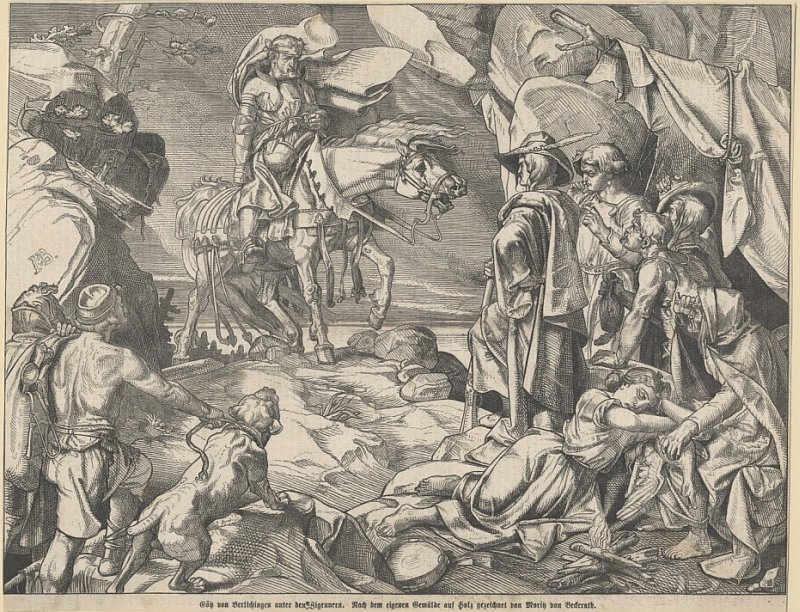
"Götz von Berlichingen bei den Zigeunern" - von Moritz von Beckerath (1868 - Frankfurter Goethehaus, Freies Deutsches Hochstift)
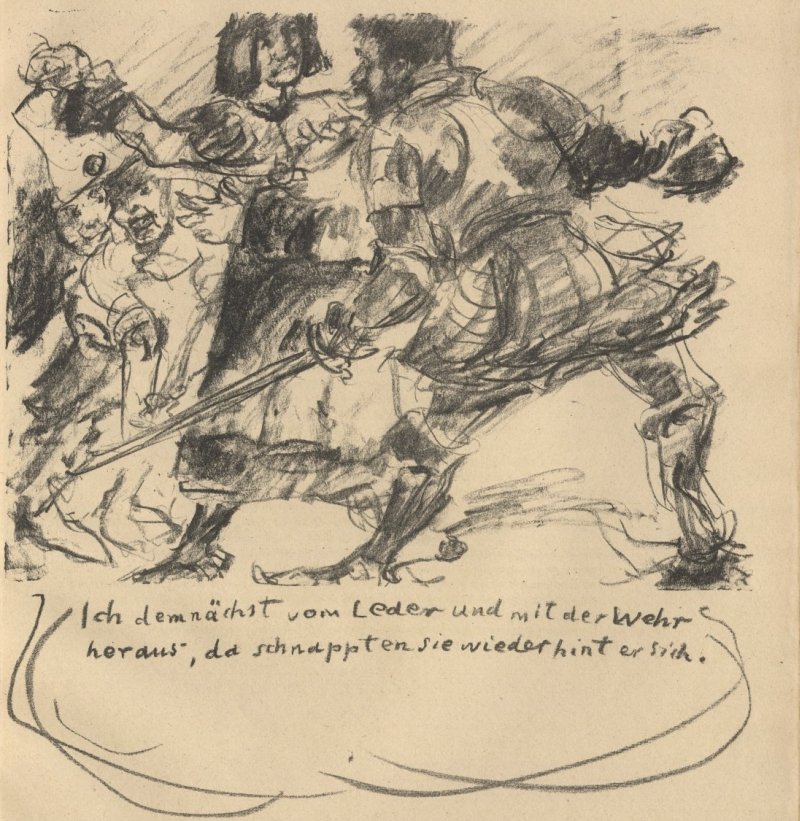
Die Gefangennahme des jungen Götz - Lovis Corinth (1919 - Frankfurter Goethehaus, Freies Deutsches Hochstift)
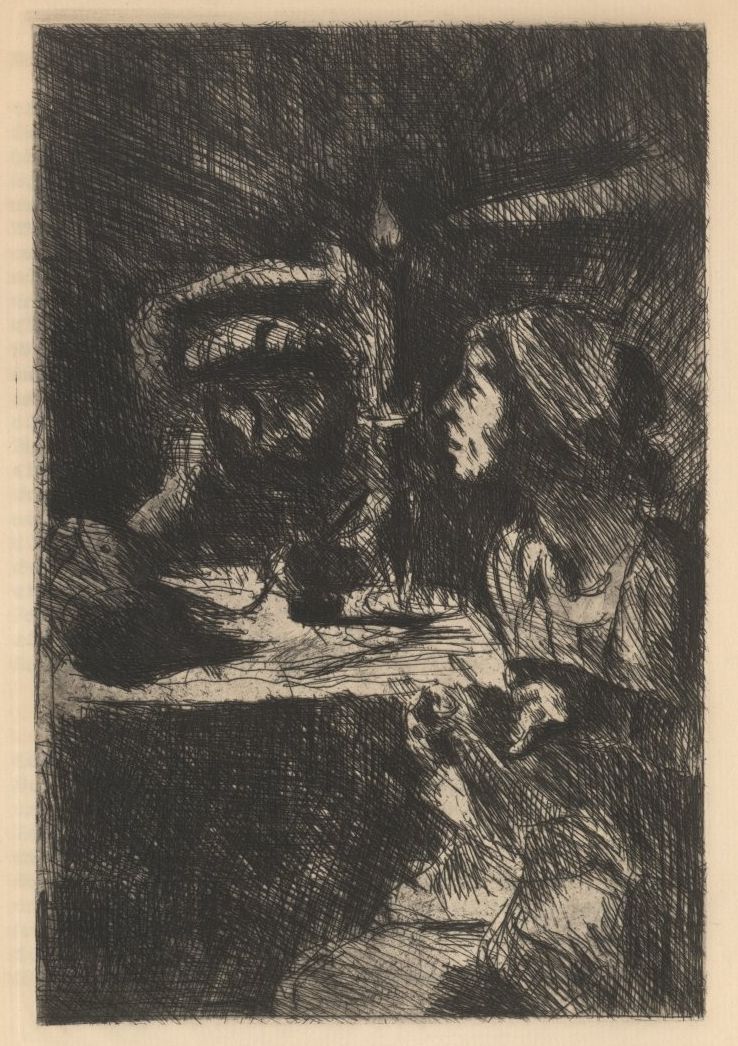
Götz und Elisabeth. Von Lovis Corinth (1921 - Frankfurter Goethehaus, Freies Deutsches Hochstift)
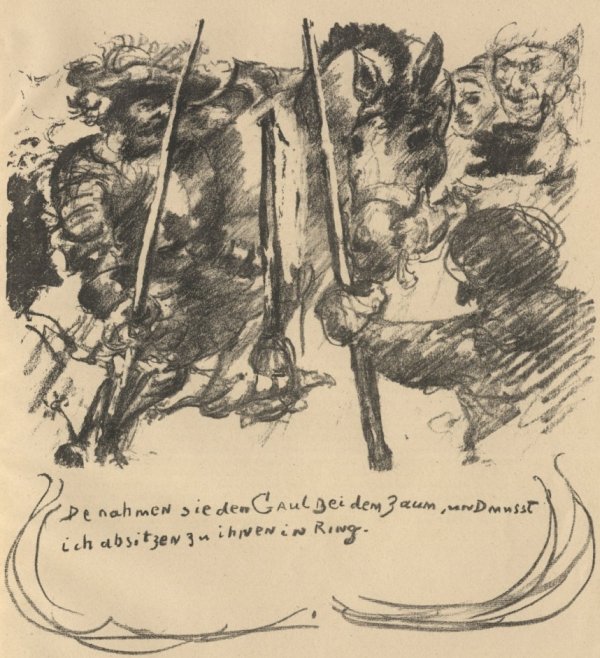
Götz bei den Hauptleuten. Von Lovis Corinth (1919 - Frankfurter Goethehaus, Freies Deutsches Hochstift)
Faust
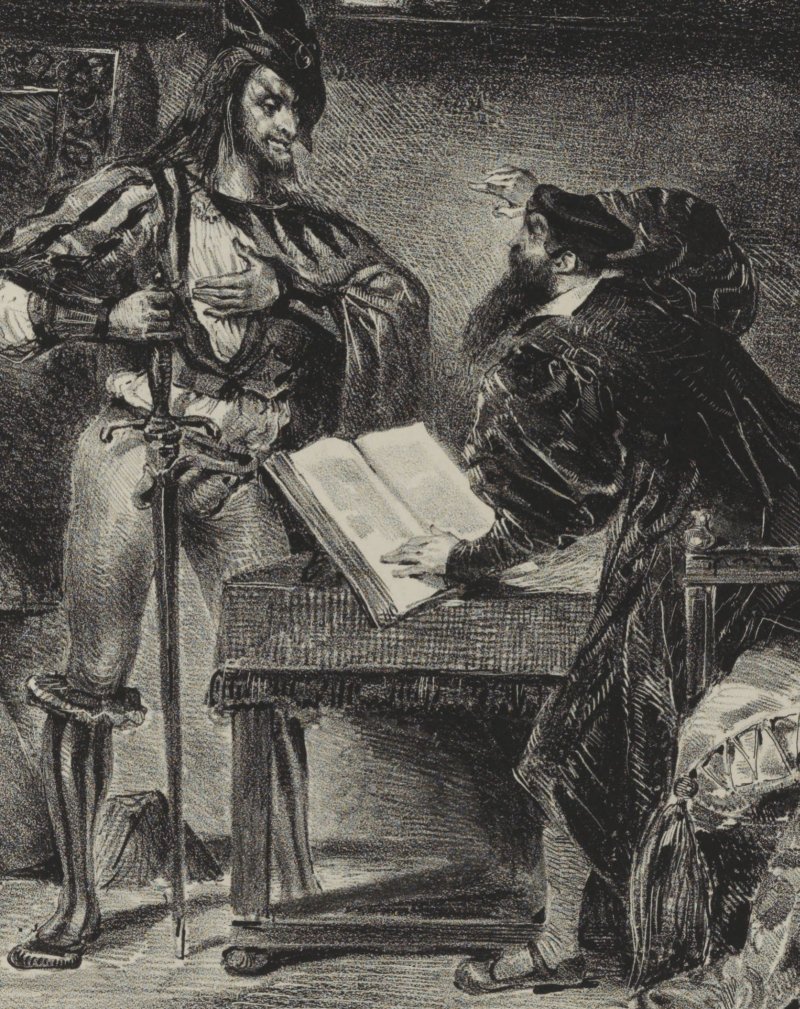
Aleph - Pourquoi tout ce vacarme? que demande Monsieur? qu'y a-t-il pour son service? Par Eugène Delacroix.
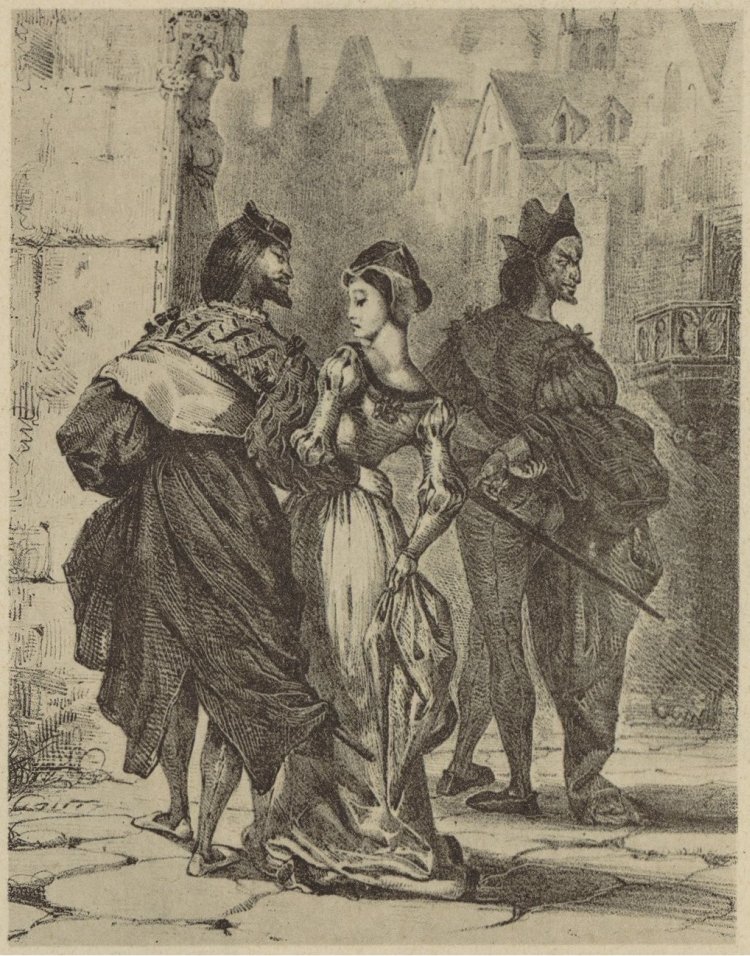
Faust - Ma Belle Demoiselle, oseraisje vous offrir mon bras et vous reconduire chez vous? Par Eugène Delacroix.
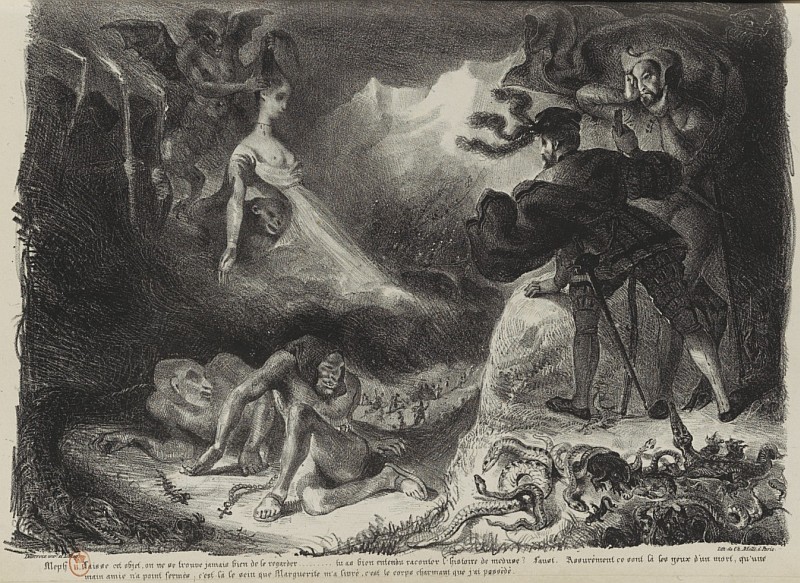
Meph. Laisse cet objet, on ne se trouve jamais bien de le regarder ... tu as bien entendu raconter l'histoire de méduse? Faust. Assurément ce sont là les yeux d'un mort qu'une main amie n'a point fermés. c'est là le sein que Marguerite m'a livré, c'est le corps charmant que j'ai possédé. Par Eugène Delacroix. (Source: Faust, tragédie de M. de Goethe, traduite en français par M. Albert Stapfer. C. Motte (Paris) 1828, Gallica Bnf.)
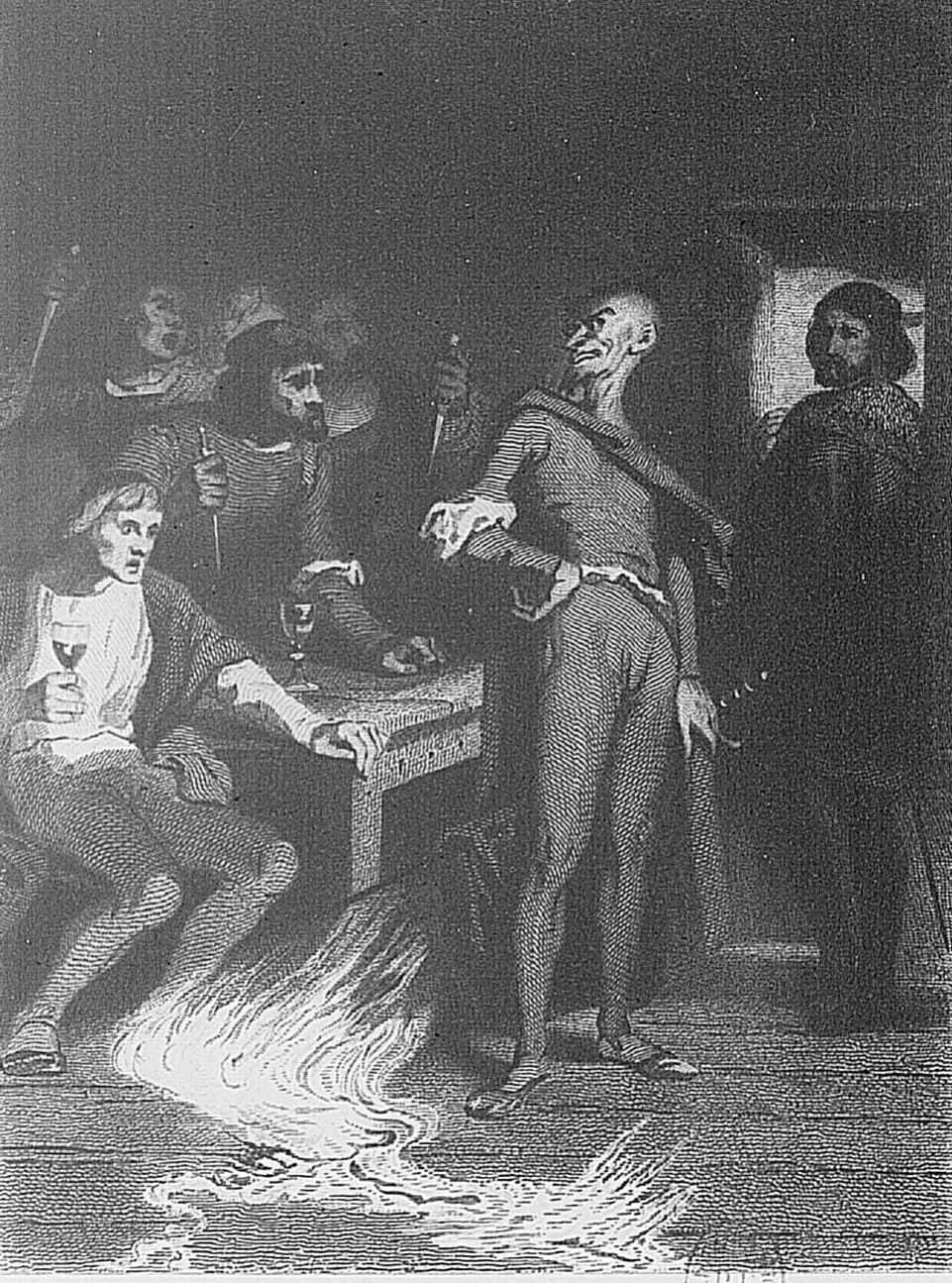
Méphistophélès et Siebel. Sorcellerie! tombez sur lui, le drôle est condamné.
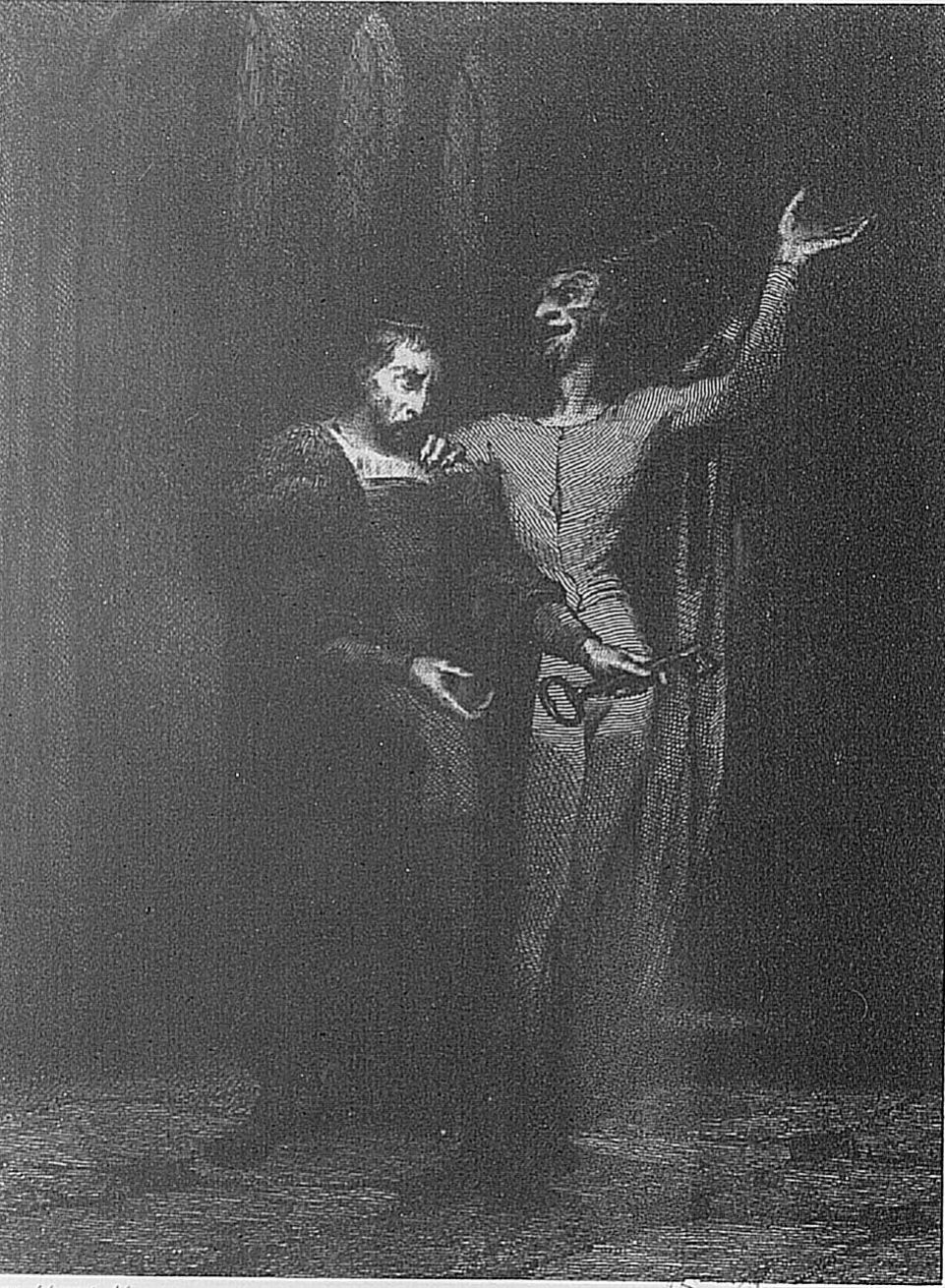
Faust. O prodige! elle grandit entre mes mains, elle s'enflamme,... Le Faust de Goethe. Traduction revue et complète, précédée d'un essai sur Goethe par M. Henri Blaze; édition illustrée par M. Tony Johannot, Dutertre, Paris, 1847.)
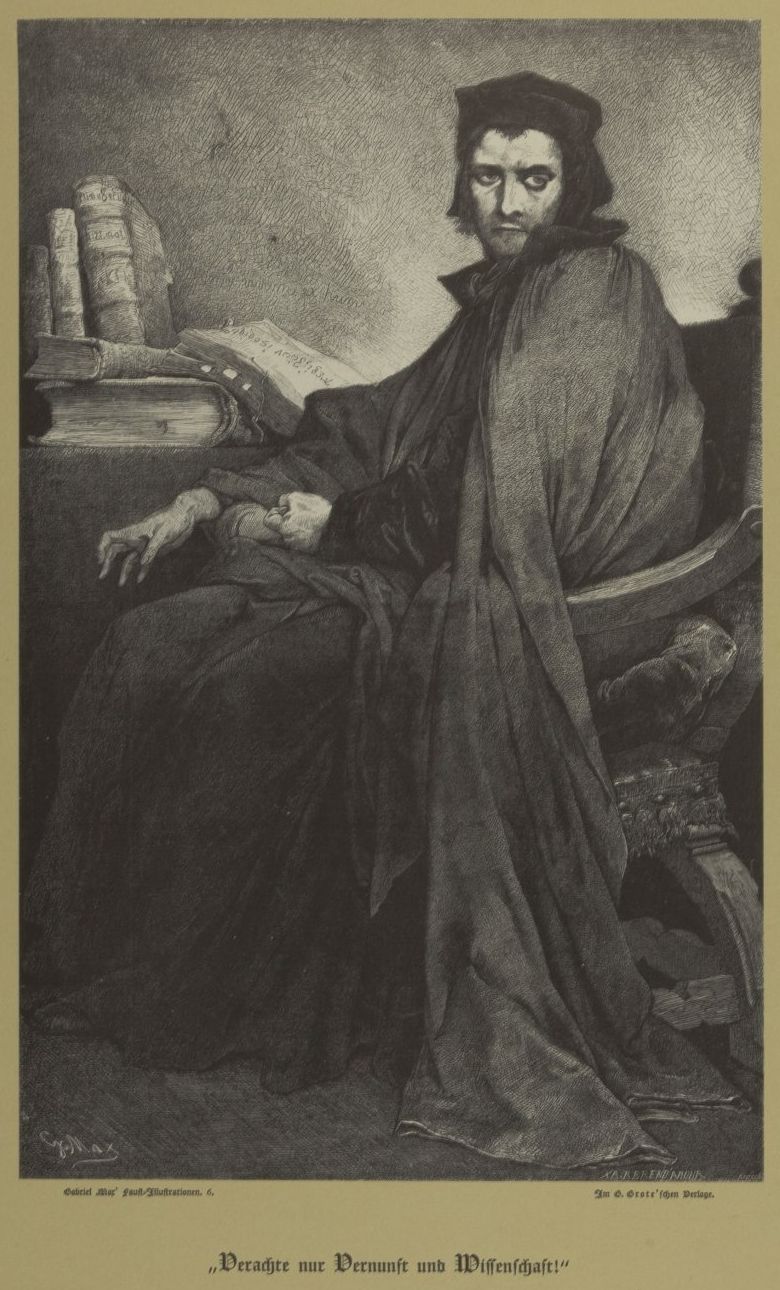
Mephisto nach dem Pakt. Von Gabriel Cornelius von Max (1880, Frankfurter Goethehaus, Freies Deutsches Hochstift.)
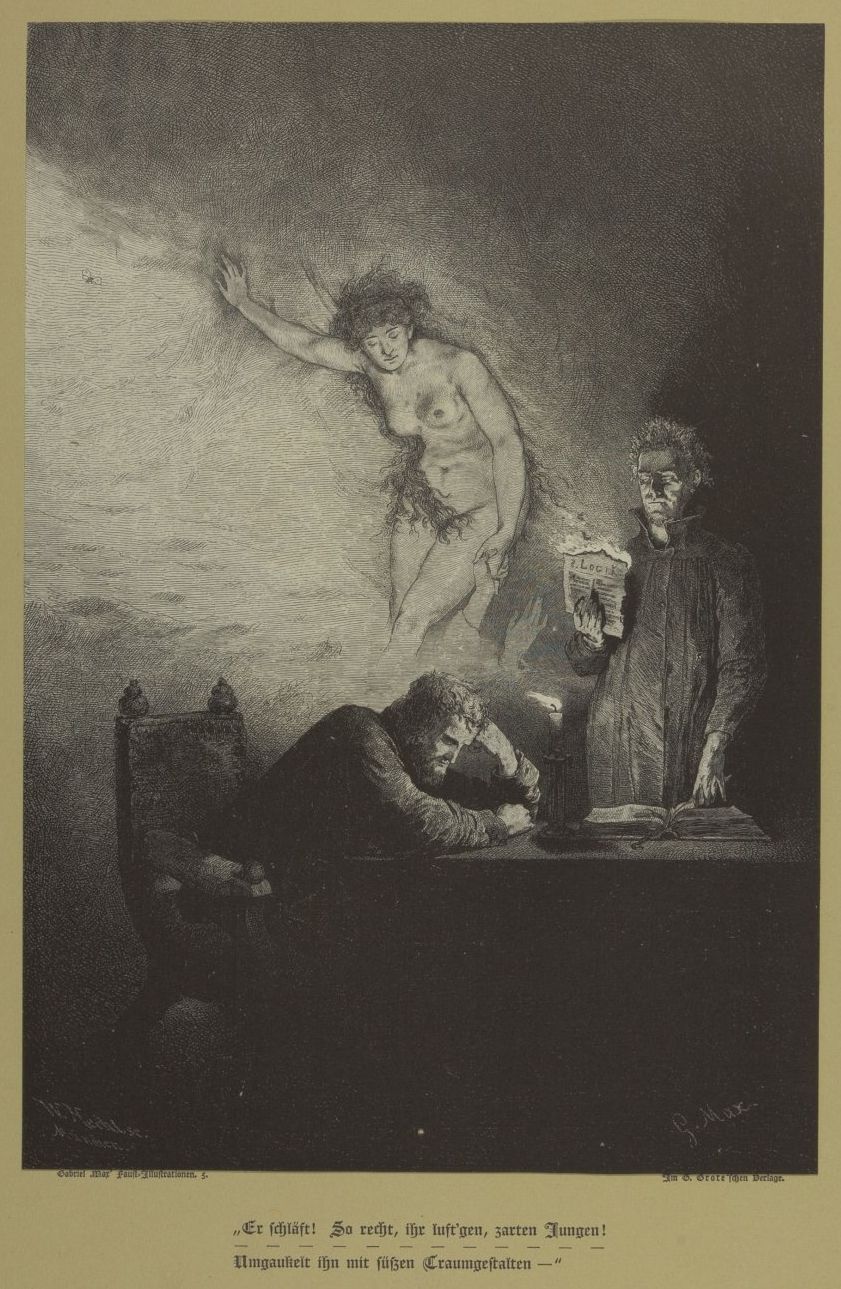
Faust und Mephisto im Studierzimmer. Von Gabriel Cornelius von Max (1880, Frankfurter Goethehaus, Freies Deutsches Hochstift.)
Werther
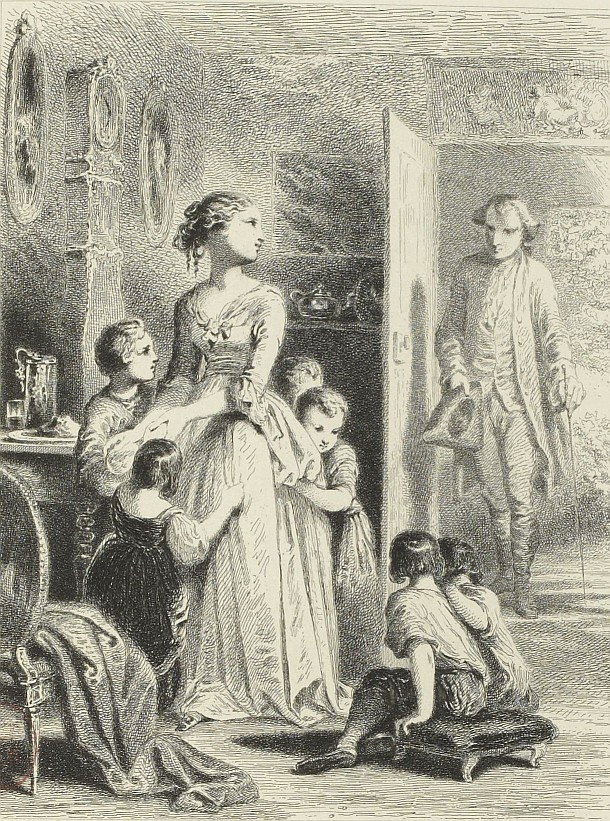
Werther arrive chez Charlotte, et la voit toute entourée d'enfants. Werther par Goethe; traduction nouvelle, précédée de considérations sur Werther et en général sur la poésie de notre époque, par Pierre Leroux; accompagnée d'une préface par George Sand; dix eaux-fortes par Tony Johannot, J. Hetzel, Paris, 1845.)
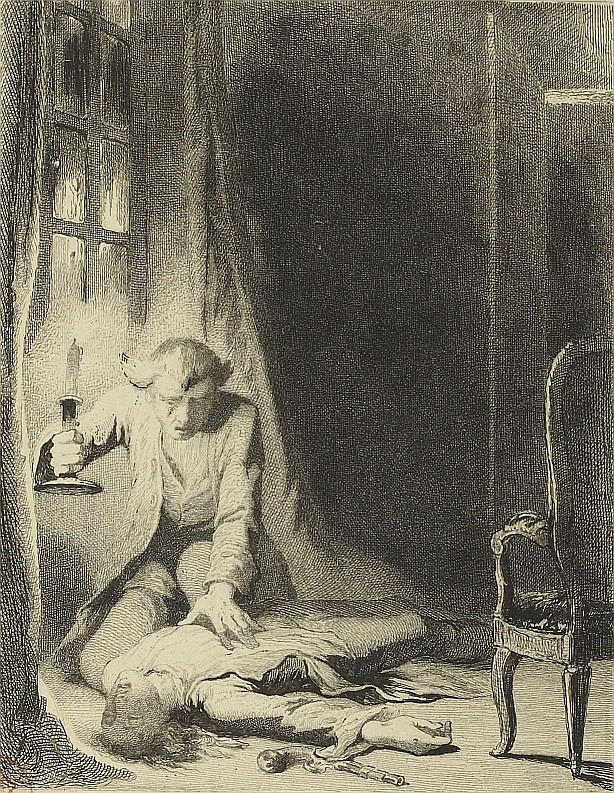
La mort de Werther. Même source.
Reineke Fuchs
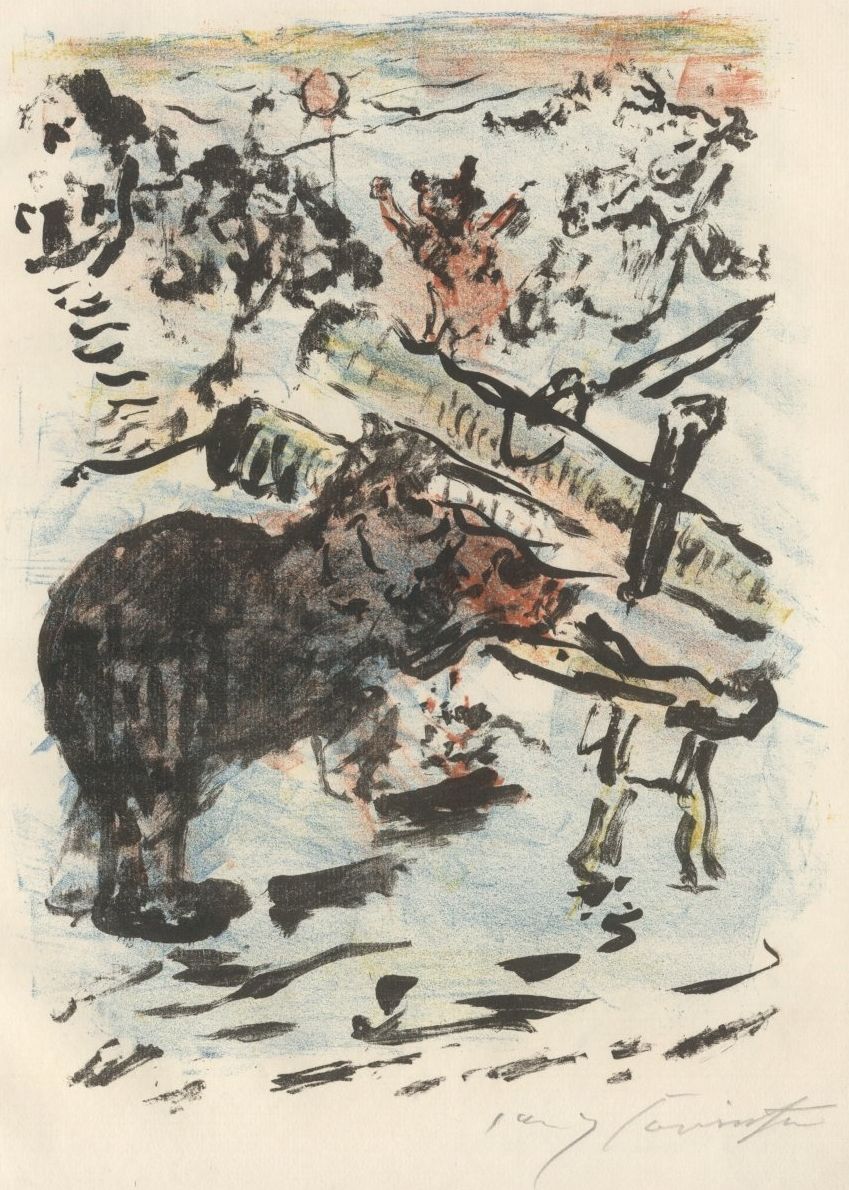
Braun der Bär fängt sich in Reinekes Falle. Von Lovis Corinth (1921, Frankfurter Goethehaus, Freies Deutsches Hochstift.)
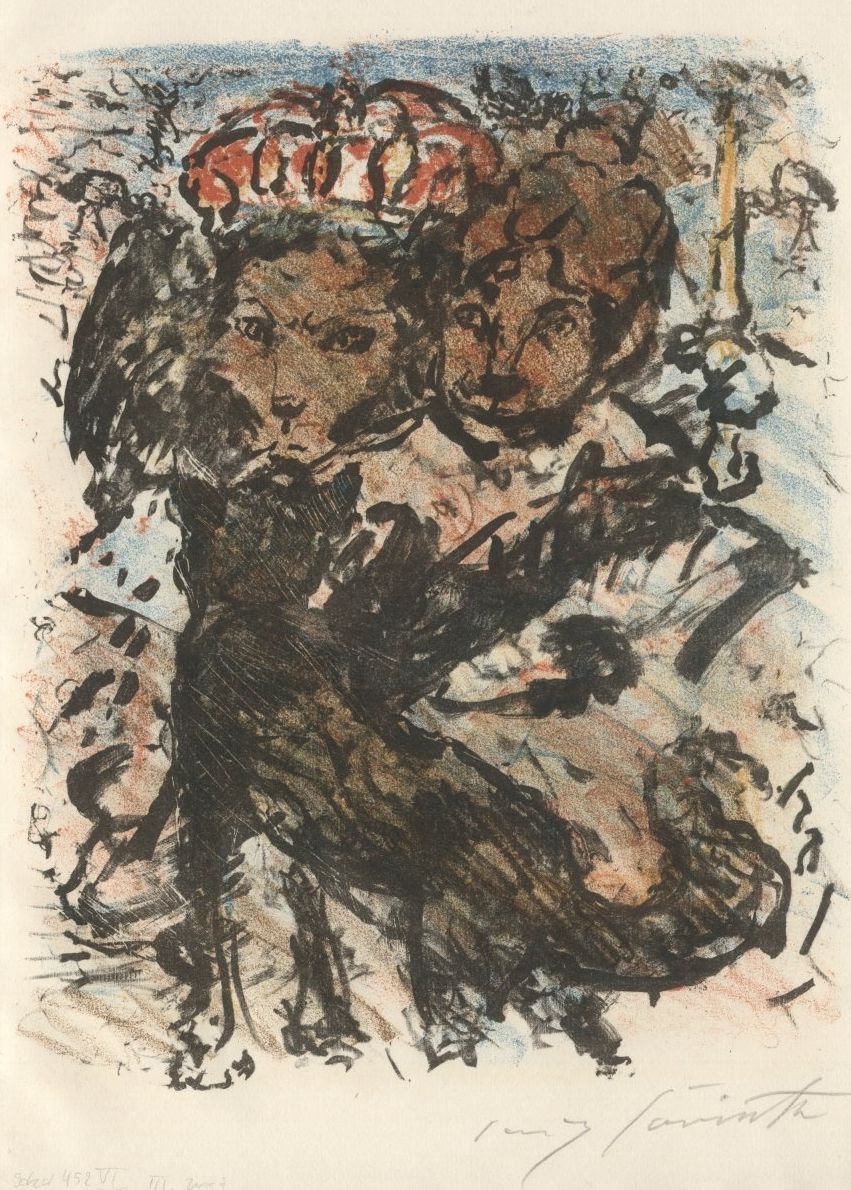
Isegrim der Wolf vor König Nobel und der Königin. Von Lovis Corinth (1921, Frankfurter Goethehaus, Freies Deutsches Hochstift.)
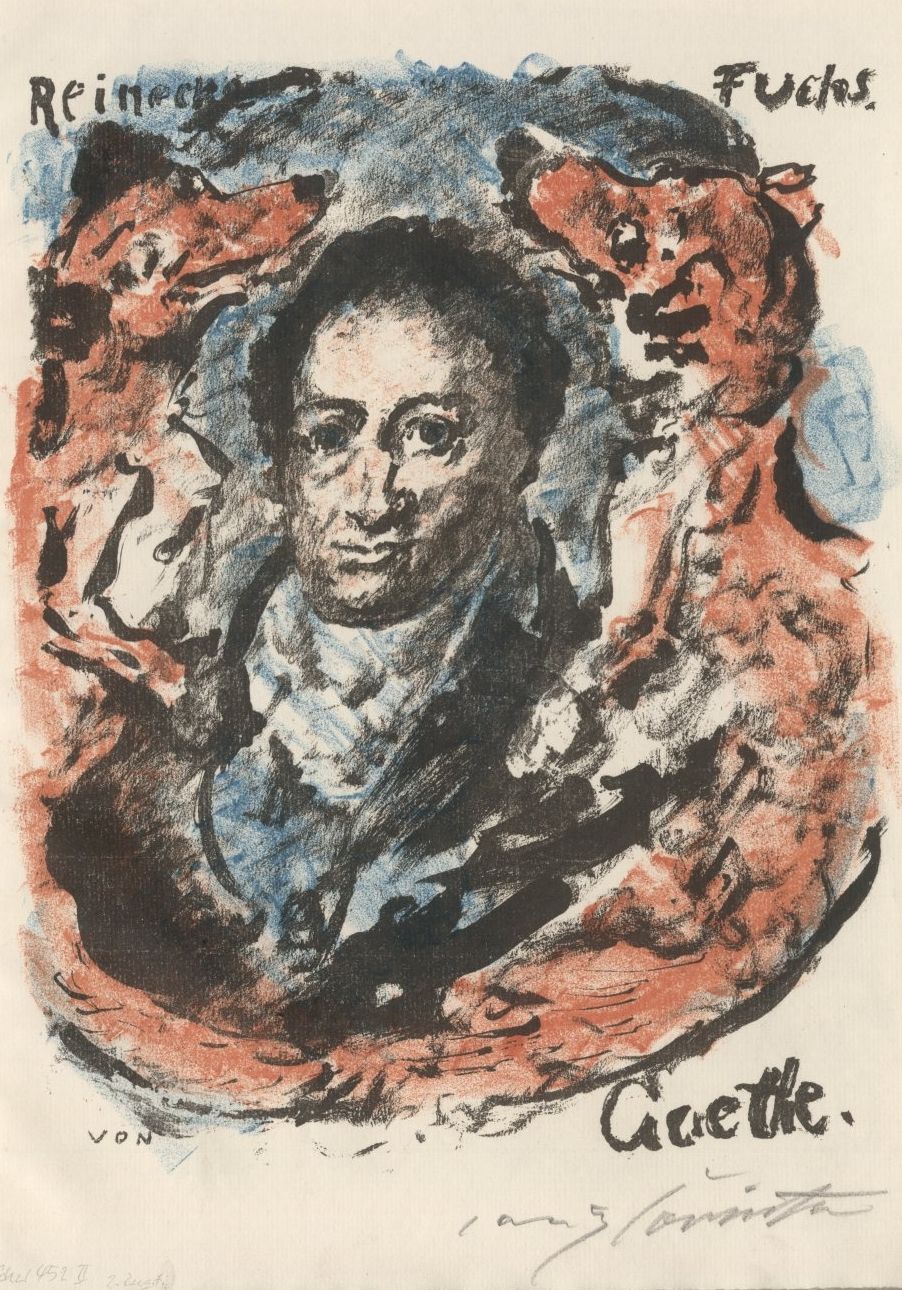
Goethe-Bildnis, von Fuchsen gerahmt. Von Lovis Corinth (1921, Frankfurter Goethehaus, Freies Deutsches Hochstift)
List of illustrations
Frontispiece: Johan Wolfgang von Goethe par Eugène Delacroix (Source: Faust, tragédie de M. de Goethe, traduite en français par M. Albert Stapfer. C. Motte (Paris) 1828, Gallica Bnf.) Pl. 1
Goethe umgeben von Illustrationen seiner Dramen (Franz Heister, nach 1840, Frankfurter Goethehaus, Freies Deutsches Hochstift.) Pl. 2
Goethe und seine Muse. Titelvignette von Lovis Corinth (Frankfurter Goethehaus, Freies Deutsches Hochstift.) Pl. 3
"Götz von Berlichingen mit der eisernen Hand". Brustbild des Götz von Lovis Corinth (1920-1921, Frankfurter Goethehaus, Freies Deutsches Hochstift.) Pl. 4
.... De temps en temps j'aime à voir le vieux Père, Et je me garde bien de lui rompre en Misiere... par Eugène Delacroix (Source: Faust, tragédie de M. de Goethe, traduite en français par M. Albert Stapfer. C. Motte (Paris) 1828, Gallica Bnf.) Pl. 5
Pauvre crane vide, que me veux tu dire avec ton grincement hideux? par Eugène Delacroix (Détail. Source: Faust, tragédie de M. de Goethe, traduite en français par M. Albert Stapfer. C. Motte (Paris) 1828, Gallica Bnf.) Pl. 6
Iphigenie am Wasser stehend, in nachdenklicher Pose vor dem Sonnenuntergang. Im Hintergrund der Tempel Dianas auf einem Felsen. Von Marie Rehsener (1913, Frankfurter Goethehaus, Freies Deutsches Hochstift.) Pl. 7
Vor dem Tempel der Diana links Thoas, ihm gegenüber Iphigenie und Orest im Begriff sich zu verabschieden. Von Marie Rehsener (1913, Frankfurter Goethehaus, Freies Deutsches Hochstift.) Pl. 8
Götz von Berlichingen
"Götz von Berlichingen bei den Zigeunern". Von Moritz von Beckerath (1868, Frankfurter Goethehaus, Freies Deutsches Hochstift.) Pl. 9
Die Gefangennahme des jungen Götz. Von Lovis Corinth (1919, Frankfurter Goethehaus, Freies Deutsches Hochstift.) Pl. 10
Götz und Elisabeth. Von Lovis Corinth (1921, Frankfurter Goethehaus, Freies Deutsches Hochstift.) Pl. 11
Götz bei den Hauptleuten. Von Lovis Corinth (1919, Frankfurter Goethehaus, Freies Deutsches Hochstift.) Pl. 12
Faust
Meph. Pourquoi tout ce vacarme? que demande Monsieur? qu'y a-t-il pour son service? Par Eugène Delacroix. Pl. 13
Faust. Ma Belle Demoiselle, oseraisje vous offrir mon bras et vous reconduire chez vous? Par Eugène Delacroix. Pl. 14
Meph. Laisse cet objet, on ne se trouve jamais bien de le regarder ... tu as bien entendu raconter l'histoire de méduse? Faust. Assurément ce sont là les yeux d'un mort qu'une main amie n'a point fermés. c'est là le sein que Marguerite m'a livré, c'est le corps charmant que j'ai possédé. Par Eugène Delacroix. Pl. 15
(Source: Faust, tragédie de M. de Goethe, traduite en français par M. Albert Stapfer. C. Motte (Paris) 1828, Gallica Bnf.)
Méphistophélès et Siebel. Sorcellerie! tombez sur lui, le drôle est condamné. Pl. 16
Faust. O prodige! elle grandit entre mes mains, elle s'enflamme,... Pl. 17
Source: Le Faust de Goethe, traduction revue et complète, précédée d'un essai sur Goethe par M. Henri Blaze; édition illustrée par M. Tony Johannot, Dutertre, Paris, 1847.)
Faust und Mephisto im Studierzimmer. Von Gabriel Cornelius von Max (1880, Frankfurter Goethehaus, Freies Deutsches Hochstift.) Pl. 18
Mephisto nach dem Pakt. Von Gabriel Cornelius von Max (1880, Frankfurter Goethehaus, Freies Deutsches Hochstift.) Pl. 19
Werther
Werther arrive chez Charlotte, et la voit toute entourée d'enfants. Pl. 20
La mort de Werther. Pl. 21
Source: Werther par Goethe; traduction nouvelle, précédée de considérations sur Werther et en général sur la poésie de notre époque, par Pierre Leroux; accompagnée d'une préface par George Sand; dix eaux-fortes par Tony Johannot, J. Hetzel, Paris, 1845.)
Braun der Bär fängt sich in Reinekes Falle. Von Lovis Corinth (1921, Frankfurter Goethehaus, Freies Deutsches Hochstift.) Pl. 22
Isegrim der Wolf vor König Nobel und der Königin. Von Lovis Corinth (1921, Frankfurter Goethehaus, Freies Deutsches Hochstift.) Pl. 23
Goethe-Bildnis, von Fuchsen gerahmt. Von Lovis Corinth (1921, Frankfurter Goethehaus, Freies Deutsches Hochstift.) Pl. 24
INDEX.
ABEL, musician, 272 Abelard, the old and the new, 155 Abraham, and God, 111; and Lot, 106 Abt, Thomas, 448 Accomplices, the, 242, 299, 357, 498 Accoucheurs, 1 Acerra Philologica, the, 23 Action in life, 185 Æsop's Fables, 222 Æsthetic speculations, 469 Affections, culture of the, 303 Ah! why resistless, etc., song, 683 Albrecht, Dr., the rector, 101 Alchemical studies, 293, 294, 357 Allesina. See Alosino-Schweizer. Almanach, Boie's, 464 Alms-bag, Lavater's, 657 Alosino-Schweizer family, 510 Alsace, 322, 334, 416, 431. See also Strasburg, &c. Altar, Goethe's boyish, 31 Alum works at Dutweil, 362 American Revolution, the, 617 Amos, J., of Comna. See Comenius. Amusements, 124 Anatomy, &c., studies in, 321 André, John, composer, 600, 609, 611 Annette, 236, 240 Anson's Voyage, 23 Antipathies, 481; subjugation of, 321 Antiquities, study of, 8, 206; at Mannheim, 434 Antiquity, 544 Apollo Belvedere, the, 434 Architecture, 435; Gothic and German, 330, 331, 333; studies in, 304 Argenville, D', his Lives of the Painters, 267 Aristotle, 185 Arnold, Gottfried, his History of the Church and of Heretics, 300 Art, in Leipzig, 269; studies in, 484, 491. See also under Drawing, Painting, &c. Art and Nature, 422 Artistic vision, Faculty of, 274 Auerstädt, accident at, 282, 288 Austria, Archduke Joseph. See under Joseph II. Authors, on, 500; and publishers, 449, 498; and readers, 516 Autobiography, Goethe's, 470, 581, 676 BADEN, Charles, Margrave of, 448, 588 ----, Margravine of, 588 Barth, Dr., 518 Baschberg, 360 Basedow, J. P., 536, 540, 541 Bathing, 632, 654 Bayle, 200, 582 Beaumarchais' Mémoire, and Clavigo, 578 Beautiful Magelone, 23 Beauty, want of, in women, 192 Beer-drinking, effects of, 282 Behrisch, E. W., 252, 256, 259, 264, 299 Belvedere, 676 Bengel, commentator, 233 Benner, Dr., 57 Berendis, 676 Bernhard, N., of Offenbach, 602, 609 Bertuch, F. J. J., 675 Betrothal, 613 Biberich, 189 Bible, the, 286; an English commentary on, 104; inspiration of, 232; Luther's, 427; myths of the, 153; and the drama, 658. See also under Religion, &c. ---- history, a summary of, 105 et seq. ---- studies, 101, 104, 105, 117, 232, 442, 443 Boarding-school, Pfeil's, 97, 193, 227 Bodmer, J. J., 115, 119, 121, 223, 230 Boerhaave, 295, 584 Böhme, Prof. and Frau, 206, 207, 213, 244, 296 Boie's Almanach, 464 Boisserée, Sulpiz, 333 Bondeli, Julie, 486 Book-burning, a, in Frankfort, 123 Book-trade, the, 449 Books, popular, in Frankfort, 23 ---- preferable to lectures, 479 Booksellers and authors, 498 Botany, 585 Boucher, 673 Bower's History of the Popes, 118 Boy priest, the, 31 Breitinger, and his work on poetry, 221, 223 Breitkopf, B. C., printer, and his family, 226, 278, 285, 449 ----, J. G. I., printer, 278 Brinkmann, painter, 69 Brion, Frederica Elizabeth. See Frederica. ----, J. J., pastor, 372 et seq., 394 Brockes, 342 Broglie, Marshal de, 77, 150 Brucker, 185 Brunswick, Duke Ferdinand of, 77 Brutes and man, 585 Buchsweiler, 359 Buff, Charlotte. See Charlotte. Buffon, 216 Bürgel, 155 Bürger, 464, 500; his "Leonore," 603 Burials, in Frankfort, 58 CAKE-GIVING custom, 379 Calvinists, of Frankfort, 623; and Lutherans, 132 Canitz, painter, 61 Card-playing, 296, 316 Carlsruhe, 633 Catherine, Empress, 617 Catholics. See Roman Catholics. Caylus, painter, 268 Cellarius (Christof), 21, 22 Ceremonies, state, 168 Changes, moral, and other, 504 Charles VII., Emperor, 29, 32, 150 Charlotte, 481, 482 Chemistry, studies in, 294 Children, cruelty, &c., in, 4; frightening, 4; libraries for, 22; and youths, 69 Chodowiecki, artist, 513 Christ, different views of, by men and women, 534; Lavater's view of, 650 Christ, Prof., 268 Christian maxim, a, 242 "Christian or Atheist?" 529 Christianity and Deism, 280 Church, a State, 408 ----Protestantism, 29 ----attendance, &c., 245 Clavichord, the, 5 Clavigo, 453, 578 Clergyman, a Protestant country, 368 Clodius, Prof., 255, 256 Cluer, secretary, 115 Coal-mine at Dutweil, 362 Coburg Gymnasium, the, 20 Coffee, effects of, 282 Cologne, 22, 24; the cathedral, 333, 544 Comedies, English, 495 Comenius' Orbis Pictus, 23 Comic actors, 494 Common-sense, 231, 273 Conception and perception, 270 Confessions of a Beautiful Soul, the, 290 Corneille, 87, 418 Cornelia, Goethe's sister. See Goethe, Cornelia. Coronation at Frankfort, 165, 178 Coronations, Imperial, 11 Court life, 563, 519 Crespel, J. B., 194, 577 Creuz, painter, 61 Criticism, 218, 221, 229, 235, 436, 478, 499 Criticisms, early, 478 Crockery episode, the, in Goethe's child-life, 2 Cruelty in children, 95 Cruseus, Dr., 233 Curiosity, 70 DAEMONIC principle, the, in life, 677, 679, 684 Dancing, 334, 397 Dancing-master's daughters, the, 335 Danish History, Mallet's, 466 Daries, 184 Darmstadt, 162, 440, 464, 631 Daun, Count, 34 "Dean, the," a nickname for Herder, 448 Decoys and habits in life, 134 De Foe, 23 Deism, 286 Delf, Mdlle., 612, 685,687 Deluge, the, 420 Derones, actor, and his sister, 72, 75, 85 Despotism, 671 Dessau, Prince of, 281 Destiny, 688 Destouches, P. N., 71 Deutsche Merkur, the, 499, 561 Devin du Village, the, 71 Dialects, German, 210 Diderot, 422 Dietetics, 299 Dietrich, von, 366, 367 Dilettantism, 20 Disguise, a, 379 Disputation at Law, the, 407, 437 Dodd's "Beauties of Shakespeare," 426 D'Orville. See Orville. Drama, the, and the Bible, 658 Dramatic theories, 87; unities, &c., 87 Drawing, from nature, 187; studies, 93, 95, 265, 266, 297, 628 Dreams, 27 Dresden, 271; a shoemaker of, 272; state of, 277 Dresden Gallery, the, 275, 351 Dress, 209. See also Tailoring, &c. Drinking beer, effects of, 282 Drollinger, painter, 61 Duel with Derones, 75 Dumeix, D. F., Dean of St Leonards, 510 Dürkheim, Herr von, 680, 681 Düsseldorf Gallery, 548 Dutweil coals, 363 EARTHQUAKE, the, at Lisbon, 19 Eckhof, actor, 494 Edda, fables of the, 466 Education, verse in, 20, 22 Egmont, Count, 677 Egmont, 671, 673, 677, 682 Ehrenreich, M., 491 Ehrmann, Dr. J. F., 321 ----, J. C., 321 Eichenberg, bookseller, 445 Elberfeld, 548 Elective Affinities, the, 431 Electors, the, of Germany, 158, 165, 172 Electricity, 96 Emmendingen, 634 "Emperor Octavian, the," 23 Encyclopedists, the, 421 Engelbach, 358 English, the, 369; their melancholy, 504, 507; their poetry, 505 English studies, 99, 193, 200 Englishman, an, 193 Engravings, bleaching, &c., 99 Enthusiasm, 543 Equality, 124 Ernesti, J. A., 202, 216, 233 Erthal, Baron von, 150 Erwin and Elmire, 670 Erwin, a Steinbach, architect, 331, 441 Eschenburgh, 280; his Shakespeare, 427 Esterhazy, Prince, 150, 173 Etching, studies in, 279, 298 Eternity, Lavater on, 657, 659 Ethics, the foundation of, 286 Etling, M., 491 Ettenburg, 676 Eulenspiegel, 23 Ewald, J. L., pastor, 603, 606 Exercise books, 100 Experience? what is, 261 Experience, Zimmerman's work on, 574 FABLES and poetry, 222 Fahlmer, Mdlle., 542 Fair Melusina, the, 23 Fairs in Frankfort, 12 Faith and knowledge, 535 Faithless Boy, the, 545 Famous people, 591 Fashions, women's, 191 Fault-finding, 354 Faults, growth of, 504 Faust, 356, 441, 525, 633 Fencing, lessons in, 119 Feti, Dominico, 351 Fettmilch rebels, the, 121 Fiction and real life, 314 Fictitious names, 72 Figaro, the, of Beaumarchais, 243 Fire, scene at a, 589 Flachsland, Maria Caroline (afterwards Herder), 440 Flattery, mutual, 316 Fleischer, J. G., bookseller, 203 Forfeits and kissing, 393 Fortunatus, 24 Fortune-telling, 327 Four Sons of Haimon, 23 France before the Revolution, 618. See also under French, &c. Francis I., Emperor, 32, 167, 178; his coronation, 161 Frankfort-on-the-Maine, 6, 25, 121, 201, 288, 616, 618, 623, 630, 683; story of the Bad Wall there, 38; Goethe's birth-place in Stag-Ditch, 3, 7, 16; celebrities of, 55, 129; its constitution, 623; coronation at, 165; Council-House there, 9; election there, 149, 155; occupation of, by the French, 64; painters of, 17, 69; the Seven Years' War and, 32, 55; the theatre, 602; the Schöffen of, 27 Frankfurter gelehrte Anzeigen, the, 478 Franklin, Benjamin, 617 Frederica, 374, 379, 388,390, 431, 433, 452, 453; correspondence, 399 Frederici, of Gera, his pianos, 97 Frederick of Prussia, 32, 33, 55, 57, 156, 236, 237, 251, 417, 465, 617; and the Seven Years' War, 252; and Voltaire, 565 Freemasonry, 616 Freethinking in religion, 133 French, the, 200, 414; in Strasburg, 323; and German painters, 673 ----, the, criticism of, 418; their influence in Germany, 237; their language, 71, 414; their literature, 418; their opinions, 308; their painters, 153; their philosophy, 425; theatre of the, 71, 84, 423; their tragedy, 423 ----studies, 71 Fresenius, J. P., pastor, 117 Freyburg Cathedral, 333 Friendship and love, 108 Funerals, silent, 58 GALL, Dr., 387 Garve, Christian, 235 Gelehrte Anzeigen, the. See Frankfurter gelehrte Anzeigen. Gellert, C. F., the poet, 61, 206, 207, 215, 222, 244, 250, 255, 296 Genius, application of the word, 141 Geognosy, 644 Geology, 124 German, architecture, 331, 333, 441; (see also under Gothic); dialects, 210; history, lessons in, 10; literature, 214, 218, 342, 389 (see also under Literature, &c.); painters, 673, 331; patriotism, 465; poetry, 236, 624; universities, 211 Architecture, essay on, 441 Art, on, 331 Mercury, the, 499; 41 Germans, the, and the French, 417; and the English, 505 Germany, 465, 131; Empire of, 151 (see also under Charles II, Imperial Chamber, Joseph II., &c.) rise of, 218; ruling princes of 618; state of, 618, 676. See also under Seven Years' War, &c. Gerock, Antoinette, 578 ----family, 636 Gerstenberg, 228 Gessner, 228, 230, 624, 654; his Isagoge, 200 Geyser, engraver, 265, 279 Giovinazzi, teacher, 5 Gleim, J. W. L., poet, 228, 238, 344, 542; his war songs, 237 Gnats, the, of the Rhine, 402 God, opinions on, 19, 291, 26 (see also under Religion, &c.); and Abraham, 111; and the gods, 133; and Lucifer, 300; and Nature, 30, 425. See also under Nature. Gods, Heroes, and Wieland, 666 Godfather and gossip, the words, 67 Goethe, the name, 351 ----, Cornelia Friederike, afterwards Schlosser, Goethe's sister, 21, 50, 94, 146, 170, 190, 191, 193, 288, 438, 480, 496, 543, 634, 668 ----, Friedrich Georg, Goethe's paternal grandfather, 52 ----, Johann Kaspar, Goethe's father, 78, 84, 93, 116, 118, 119, 123, 124, 126, 149, 174, 188, 189, 190, 201, 209, 271, 288, 296, 304, 334, 386, 437, 43, 77, 84, 147, 150, 152, 161, 162; his books, 16; his education and dissertation, 20; his pictures, 17; his quarrel with Count Thorane, 79; his travels in Italy, 5 ----, Johann Wolfgang von, the poet, his family, 25, 28, 32, 52 (see also under several names); his birth and child-life, 1; education at home, 7, 19, 25, 50, 71, 93, 100; and the Lisbon earthquake terror, 19; his legal studies and practice, 21, 119, 308, 389, 407, 410, 492; attack of small-pox, 25; religious instruction, 29; the boy priest, 31; early amusements, 35; his story-telling, 36, 386; his personal appearance and dress, 37, 75, 316, 532, 534; his playfellows, 50; juvenile stoicism, 49; his duel with Derones, 75; early writings, 70, 85, 217 (see also under Poems, early; Goethe, his Works, &c.); his busy imagination, 114, 500; his studies in workshops, 123; his memory, 129; his ambition as a poet, 134, 201; his first love, 141 (see also Gretchen); is declared "eccentric" as a youth, 165; his melancholy, 179, 185, 243, 249, 260, 277, 282, 289, 321, 502, et seq.; at Leipzig University, 203, 269, 299; love for Annette, 236 (see also under Annette); his "confessions," 240, 511; his jealousy and passion, 241; affairs of the heart, &c., 243; his "reckless humour," 243, 244; his religion, &c., 249, 582, 251 (see also under God, Religion, &c.); his love for Frederica, 374, 382 (see also under Frederica); his illness, &c., 282, 289, 291, 293, 298, 321, 437; his love for A. S. Münch, or A. Gerock, 578; his study of alchemy, 292, 357; his travels incognito, 372, 379; his conversational powers, &c., 386, 500; and the young 437; his mode of working, 451, 586, 604; as the "confidant," 452; as the "wanderer," 452; his love for Charlotte Buff, 471 (see also Charlotte); contemplates suicide, 508, 510; plans for settling in life, 577; his love for Lili, 591 (see also Lili); his politics, 618; his Court life at Weimar, 519 Goethe, his Works, early work destroyed, 239; collected works, 587. See also under the names of the several works, and under Poems, early; MSS., &c. ----, Katharina Elisabeth (née Textor), Goethe's mother, 4, 28, 31, 62, 66, 174, 290, 386, 437, 566, 580, 629, 670 Goetz von Berlichingen, 320, 356, 441, 453, 455, 470, 496, 500, 513, 466, 524, 620, 629, 671 Golden Bull, Pope Innocent's, 11, 129, 152 Golden heart, To a, &c. See Round my neck, &c. Goldsmith, Oliver, 506; his Edwin and Angelina, 670; his Deserted Village, 474; his Vicar of Wakefield, 368, 375. See also under Vicar of Wakefield. Good People's Court, the, Frankfort, 15 Görtz-Schlitz, J. E., Count von, 561, 633 Gossip, the, and Count Thorane, 80; the word, 67, 80 Gotha, 288 Gothic Architecture and German, 331, 441. See also under Architecture and German. Götter, F. W., 464, 469, 474 Gottfried's Chronicles, 23 Gotthard, Mont, 647, 650, 679 Göttingen, 202; its university, 21 Göttingen Musen Almanach, 466, 628 Gottsched, Q. C., and his influence, 214, 221, 226, 259, 278, 449 Goué, A. S. von, Hanoverian attaché, 462 Grammar, early view of, 200 Gratitude, 354 Grave's woodcuts, 8 Gray, 506 Greek, authors, 285; philosophers, 185 Gretchen, 138, 139, 143, 145, 147, 154, 162, 172, 174, 167, 179, 182, 183, 192, 201, 241 Griesbach, J. J., 134, 202 ----, Frau, 290 Grimm, painter, 673 ----, Herr von, 415 Groening, of Bremen, 284 Groschlag, Baron von, 150 Grütli, 647 Günderode, President von, 362 Günther, Emperor, 10 ----, the Poet, 223, 224, 342 Gustavus III., of Sweden, 617 Gymnasium, the, Frankfort. See Albrecht, Dr. HABITS and Decoys in life, 135 Hackert, Philip, painter, 673 Hagedorn, F., poet, 61, 202, 342 ----, von, of Dresden, 277, 342 Hair-dressing, 316, 634 Hakel, Baron von, 56 Halle, University of, 212 Haller, A. von, poet, 61, 216, 228, 234, 342 Hamann, J. G., 352, 390, 441, 445 Hamlet, 506; reading, 406 Hanau, Count Reinhard von, 361 Hands, expression in, 657 Handwriting, 296 Hanseatic League, the, 519 Hanswurst (Jack-pudding), 494, 626 Hanswurst's Wedding, 626 Happiness, 474 Hares, the three, 59 Harlequin and Hanswurst, 494 Harp-playing boy, the, 437 Harpsichords and pianos, 97 Haugwitz, Count, 629, 630 Health, care of the, 298 Heart, affairs of the, 244 Hebrew, lessons in, 101 Heidelberg, 684 Heinecke, 268 Hendel, cake-baker, poem to him, 257, 259 Herder, J. G. von, 331, 346, 355, 356, 368, 389, 439, 440, 441, 446, 448, 466, 497; his essay on Shakespeare, 428; his letters, 357; his relations with Goethe, 346, 347; his sarcasms, 350; and Jung, 357 Herman, Dr. C. G., 227, 283 Herrnhuters, the, 117, 444. See also under Sects. Hesitation, 498 Hess, A. P. von, 440 Hesse-Darmstadt, Caroline of, 449, 588, 633 Hexameters, Klopstock's, frighten a barber, 63 Heyducks, the, 159 Heyne, C. G., 202 High on the ancient turret stands, 541 Himberg, bookseller, 587 Hirt, painter, 17, 69 History, 108 Hoaxes, 182 Höchst, 145 Holstein-Eutin, Prince of, 346 Hölty, 464 Holy Land, the, 105 Homburg, 189 Homer, 29, 467, 480; in prose, 427 Höpfner, L. J., 475, 478, 479 Hoppe, Prof. J., 119, 199 Horace, 221 Horn, J. A., 198, 258, 284, 438 Horoscope, Goethe's, 1 Hotze, Dr., 643 House-building at Frankfort, 6 Huber, 269 Hubertsberg, the Peace of, 129 Huisgen, Hofrath H. S., 132, 133, 134 Human nature, 298 Humour on the stage, 243 Hutton, Ulrich von, a letter of, 621 ICES, 67 Idle people, 137 Illuminations at the coronation 1764, 173 Ilmenau, mines of, 676 "Image hunt," the, 235 Imaginary conversations, 502 Imperial Chamber, the, history of, 455 et seq. Incognito, travelling, 371 Indian fables, 467 Inns, and Inn life, 271, 275 Inoculation, 24 Iphigenia, 560 Island of Falsenberg, the, 23 Israelitish tradition, 109 Italy, longings for, 21; view of, 651; proposed visit to, 680, 683, 686, 687 JABACH'S Dwelling, 544 Jacob and Esau, 112, 114, 115 Jacobi, the brothers, 542 ----, F. H., 545, 546, 548 Jason and Medea, 311 Jaxthausen, Castle of, 620 Jealousy, 241 Jena, University of, 212, 676 Jerusalem, K. W. von, 234, 478; his suicide, 509, 510, 515 Jesuits, expulsion of the, 323 Jews, the, 114, 115; in Frankfort, 122; savageness of their religion, 111. See also Israelites, &c. Joseph, Archduke of Austria. See Joseph II. Joseph II., Emperor, &c., 125, 147, 151, 157, 420, 465; coronation of, 1764, 165, 169, 178 Jung, J. H., afterwards Stilling, 317, 548, 592; and Herder, 357 Junker, painter, 17, 69, 126 KESTNER, J. C., 147 Kielmansegge, Count C. A. von, 462 King of Thule, the, 545 Kirms, 676 Kissing and Forfeits, 393 Kleist, 235 Klettenberg, Fräulein von, 290, 293, 445, 534, 552, 566, 568 Klinger, F. M., 525 Klingling, Prætor of Strasburg, 324 Klopstock, F. C., 61, 115, 229, 238, 343, 345, 448, 450, 454, 464, 466, 570, 624, 633; his Messiah, 61, 118; his Hermann's-Schlacht, 465; his Republic of Letters, 450 Klotz, 281 Knebel, Capt. K. L., 41 Knighthood, comic order of, at Wetzlar, 463 Knowledge and Faith, 535 Koch, Herr, 412 Koenig, von, poet, 224 "Königsberg Zeitung," the, 446 Köningstein, 189 Köningsthal, 150 Koppen, 61 Kotzebue, A. F. F. von., 676 Kraus, G. M., painter, 673, 675 Krebel, Hofrath, 227, 272 Kreuchauf, Herr F. W., 269 Krüger, his Duke Michael, 240 Küssnacht, 653 LA CHAUSSÉE, Pierre de, 71 Langer, E. T., 285 Language, origin of, 350 Laocoon, the, 434, 435 Laroche family, the, 485 ----, Frau von, 484, 488, 509, 540 ----, Maximiliane (afterwards Brentano), 509 Latin, learning, 20, 200 Laune des Verliebten, Die, 241, 299 Lautensak, jeweller, 124 Lavater, J. C., 153, 465, 528, 536, 540, 637, 639, 641, 655, 674; and Basedow, 549; his view of Christ, 153, 659; his "Physiognomy," 528, 637, 656, 659, et seq.; his description of the Stolbergs, 663; his works, 654 et seq. Law studies and practice, 119, 208, 407, 410, 437, 492, 671 Learning more than can be digested, 209 Le Brun's "Passions," 93 Lectures and books, 479 Leibnitz, 584 Leipzig, 227, 277, 288; art in, 269; the fair, 205; the French in, 213; and the Seven Years' War, 251; student riot there, 287 ----, University, 202, 212, 269, 299 ----, early letters from, 295, 299 Le Kain, actor, 423 Lemière, A. M., 71 Lenz, J. M. R., 428, 525, 567; on Shakespeare, 428 Lerse, F. C., 319, 416 Lersner, Herr von, 72 Lersner's Chronicle, 121, 151 Lessing, 222, 228, 238, 280, 281, 299, 355, 494, 495, 559; his "Laocoon," 270; his "Minna von Barnhelm," 238 Letter of a Pastor, etc., 528 Letters, old, 295 on literature, &c., circulated through the post, 485 Leuchsenring, F M., and his boxes of letters, 485, 490 Library of the Belles Lettres, the, 235 Lichtenstein, Prince of, 150 Lichtwer, 222 Life, and action, 185; and ancestry, 52; the campaign of, 684; the habits and decoys of, 135; settling in, 614; weariness of, 503; and the will, 413 Lili (Anna Elisabeth, Schönemann, afterwards Türckheim), 591, 599, 603, 612, 635, 636, 644, 651, 667, 671, 679, 680, 683, 685, 687 Lili, To, 643 Lili's Menagerie, 669 Limprecht, J. C., 206, 272 Limpurg, the house of, 122 Lindau, von, 653 Lindenau, Count, 285 Lindheim. See Textor. Linnæus, 216 Lippe, Count, 448 Lippert, 268 Lips, J. H., painter, his portraits done for Lavater, 534, 639 Liquor Silicum, 294 Lisbon, the earthquake at, 19, 33 Lishow, C. L., 219 Literary Epistles, the, 235 Literature, 281, 477; by correspondence, 485; transition period of, 227. See also under German literature, &c. Lobstein, J. F., 348 Loen, J. M. von, 57; his collection of travels, 29 Lombardy, 651 Lotte Buff, 471. See also under Charlotte. Louisa, Duchess of Weimar, 633 Love, 155; disinterested, 546; first, and other, 503; juvenile, 141; and hope, 637; and poetry, 243; youthful, 431 Löven, 199 Lover, a jest on a conceited, 139 Lover's Caprice, The, 241, 299 Lucifer, 300 Lucinda, 335; her curse, 341, 393, 398, Ludecus, J. A., 156 Ludwig, Hofrath, 215, 216 Luther, 442 Lutherans, of Frankfort, 623; and Calvinists, 132 Luther's Bible, 427 MACKLOT, bookseller, 588, 628 Magician's Apprentice, the, 576 Mahomet, intended, drama on, 550 Mahomet's Song, 551 Maiden, the, and the youth, 679 Malapert, Herr von, 131 Man, the growth of, 54; his natural course, 105; his volatility, 583; his part in the world, 234, 400 Mankind together is the true man, 332 Mannheim, 632; antiquities at, 435 Manuscripts, Goethe's early, 116. See also Goethe, his works, and others. Maria Theresa, Empress, 34, 161, 167 Marie Antoinette at Strasburg, on her way to Paris (1770), 310 Marivaux, C. de, 71 Marriage, discord in, 109, 112, 113 Marriage-gamme, a, 577, 580 Mayence, 566 Mechanics, 135 Medical Science and Zimmerman, 574 ----studies, 309, 389, 390 Meiningen, Duke of, 680, 681 Melancholy, 502; English, 507; in English poetry, 504 Melbert, or Melber, G. A., druggist, 28 Memory, 325, 543 Men, distinguished, 641 Mendelssohn, Moses, 235 Mentz, 189; Elector of, 153, 154, 156, 157 Merck, J. H., 439, 448, 469, 476, 478, 481, 482, 489, 490, 497, 500, 512, 534, 579, 631, 667 Merian, Matthäus, his Bible and history pictures, 23 Messiah Klopstock's, 343 Metz, Dr. J. F., 292 Meyer, of Lindau, 307, 416 Michaelis, 202 "Michel, cousin," 418 Midwifery in Frankfort, 1 Milton, 506 Minnesingers, the, 625 Molière, 71, 87 Monks, 487 Morals, 299 Moravians, the, 553 Morbid humour, the, 439, 507. See also Melancholy, &c. Morgenstern, painter, 297 Morhov, his "Polyhistor," 200 Moritz, H. F., 92 ----, J. F., 92 Morus, Prof. S. F. N., 202, 215 Moser, C. F. von, 60, 115, 234, 445 Möser, Justus, 518, 562 Müller, 181, 184 Münch, Anna Sibylla, 578 Murki, the, a dance, 334 Musaeus, 676 Musarion, Wieland's, 266 Musenalmanache, the, 451, 466, 628 Music, lessons in, 94 Music-master, the eccentric, 95 Mystifications and the idle, 137 Mythology and poetry, 256 NAMES, cutting, upon trees, 236 Naples, 667 Natural religion, 232 Nature, 186, 470; and Art, 422; contradiction in, 676; and God, 30, 425; the gospel of, 526; human, 298; the laws of, 585 Nature, Système de la, the, 424 Neo-Platonism, 300 Netherlands, revolt of the, 671, 677. See also under Egmont. Neukirch, B., his translation of Télémaque, 23 New draughts, &c., 642 New Melusina, the, 387 New Paris, The; a Boy's Legend, 386, 388 New Year's Day in Frankfort, 64 Newspapers, 616 Nicolai, C. F., 513 at the Grave of Werther, 514 Nothnagel, painter, 69, 491; his oil-cloth factory, 127 Novel-reading, 400 O Hendel, &c., 257, 259 Oberlin, 412 Ochsensteins, the von, 2, 58 Oculist's failure, the, 592 Oeser, A. F., painter, 264, 279 Offenbach on the Main, 602 Oil-cloth factory, an, 127 Olenschlagers, the von, 129, 131 Omens, oracles, &c., 76, 79, 485 Opera, at Frankfort, 602 Oracles, 79, 485 Orations, humorous, 195, 197 Orbis Pictus, Comenius', 23 Orth, Dr., 57, 129 Orville, P. F. D', 602, 608 Osnaburg, 519 Ossian, 507 Otho, Emperor, his suicide, 508 Ottilienberg, the, 431 Ovid, 23, 356 Ox, the, and wooden kitchen, at the coronation, 171 —burials, 58 PAGLIASSO, buffoon, 173 Pain, endurance of, 49 Painter of men, qualifying for being a, 137 Painters, French and German, 673 Painting and poetry, 222. See also Art, &c. Painting, studies in, 674 Paintings upon wood, 126 Pamphlets, early, 444 Paoli and Corsica, 617 Pappenheim, Count von, 166 Paradise, 105 Paris, accident at Louis XVI.'s wedding there, 1770, 313 Paris, The New. See New Paris, The. Parties, injustice of, 34 Partings, 203 Party, among poets, 505 Pasor, George, 21, 22 Passavant, J. L., 641, 684 Passports, 654 Pater Brey, 490 Patriarchs, the, of Israel, traits of savageness in, 110 Peglow, a Russian student, 318, 370 Pepper, &c., ceremonial presentation of, at Frankfort, 15 Perception and conception, 270 Petersen, Prof. G. W., 440 Pfalzburg, 359 Pfeil, J. G. B., and his boarding school, 97, 193, 227 Philosopher, a practical, 274 Philosophy, common-sense, 231 the history of, 184 Pianos and harpsichords, 97 Picture collecting, 88 Pictures, old and new, 17. See also under Art, &c. Pictures, early essay on, 70 Pilgrims in Switzerland, 643 Piper's Court, the, at Frankfort, 13 Piracy of books, the, 449. 499, 587 Piratical Bookseller, poem on a, 587 Plato, 185, 300 Plays, projected, 85, 242 Plitt's sermons, 117 Plotho, Baron von, 150, 156, 173 Poem, a, in French, 312 ----, a lost, 236 Poems, early, 116, 135, 226, 239, 255, 257, 299, 403, 438, 453, 464, 466, 480, 514, 517, 541, 560, 600, 606, 670, 671 ----, early, destroyed, 217 Poet, the, 36 ----, the, is the maker, 356 Poets, a combination of, 451, 479; party among, 505 ----, English, 505. See also Poetry, &c. Poetry, 352; comic, 199; English, 504; German, 215, 223, 624; national, 236; and religion, 184 "Poetry, the Art of," works on, 221 Pope, 199, 226 Post, the Taxisch, 486 Princes and rulers of Germany, the, 618 Prometheus, 558, 569 Prophecy, the gift of, 27; in Scripture, 233 Propylæa, the, 435 Prose, poetical, 228; translations in, 427 Protestants, of Germany, 29, 237; their service, 245 Proverbs on Court life, 564 Prussia and the Seven Years' War, 33 Prussians, the, 237; hatred between them and the Saxons, 238 Public men, the fate of, 549 opinion, 465 Puppet-shows, 5, 35 Putter, 234 Pygmalion, Rousseau's, 424 Pylades (fictitious name for a playfellow), 36, 135, 141, 143, 154, 163, 172, 175, 177, 182 QUIET-IN-THE-LANDS, the (religious sect), 445 RABENER, 219, 342, 495 Racine, 71, 87, 130 Ramler, 228, 237, 624 Raphael, his cartoons, 311, 314 Real life and fiction, 314 Redemption, the, 302 Reichel, Dr., 279, 283 Reineck, F. L. von, 130, 131, 134 Religion, 543; natural and revealed, 109, 113, 232; and poetry, 184; views of, 300, 301, 529, 554, 582, et seq. See also under Bible, &c. Religious apprehensions, 249 instruction, 29 Repetent, a (a tutor), 308 Resenius, 466 Rhetoric, 200 Rhine, the, 485, 489, 490, 541, 547, 637, 685 Rhine-gnats, 402 Rhyme, rejection of, in Germany, 624 Richardson's novels, 191, 494 Richter, Receiver-General, 270 Riding, 453; lessons in, 641 Riedel, Counsellor C. J. R., 275 Riese, J. J., 438 Rigi, the, 646 Rivers, their courses, 360 "Robinson Crusoe," 23 Roman Catholics, 510, 643; of Frankfort, 623; and Protestants, 247 ----Empire, the Holy, 468; election of king of, at Frankfort, 147, 149 ----views, in Goethe's birthplace, 4, 98 Romans, king of. See Joseph II., &c. Round my neck, &c., 652 Rousseau, 155, 282, 421, 422, 424, 486, 526 Royalty and cripples, &c., 312 SAARBRÜCK, 361 Saint Jean, valet, 68 St. Louis, the knight of, 325 St. Mary's Hermitage, 643, 644 Sachs, Hans, 625 Sacraments, the, 245, 247 Sacrifice in the Bible, 111 Salis, von, 576 Salzmann, Dr. J. D., 308, 314, 413, 416 Satire, 218, 506; German, 495 Satyros, or the Deified Wood-devil, 490 Savage worship of the Old Testament, 111 Saxo-Weimar. See Weimar. Saxons and Prussians, hatred between, 238 Saxony, 562 Schaffhausen, 637 Schiebler, Daniel, of Hamburg, 280 Schlegel, 130, 230 ----, Elias 116 Schlosser, the brothers, 134 ----, J. G., 224, 227, 296, 476, 478, 480, 493, 635, 636 Schmidt, P. H., 476 Schneider, Councillor, 53, 61, 174 Schön, Martin, engraver, 645 Schönemann, Anna Elizabeth. See Lili. Schools and education, 96 Schöpflin, J. D., 410, 413, 415 Schröder, F. L., author and actor, 494 Schütz, painter, 17, 69 Schwalbach, 189 Schwyz, 645 Schwyzer-Haken mountains, the, 125 Seals, collecting, 317 Sects of Protestants in Frankfort, 30 Seekatz, painter, 18, 69, 89, 272 Self-complacency, 322 Self-conceit, 54 Self-knowledge, 504 Self-reliance, 557 Self-torture, 1 Senkenberg Hospital, 60 Senkenbergs, the, 59 Sermons, writing from memory, 117 Servières, a lady, 510 Sesenheim, parsonage of, 367, 372 Seven Years' War, the, 32, 55, 236, 238, 252 Shakespeare, 266, 496, 506; his clowns, 429; and the Germans, 230, 426; Herder on, 428; Lenz on, 428; in prose, 427 She Comes Not! 607 Shoemaker, the cheerful, of Dresden, 272 Sickness, moral effect of, 348 Silberschlag, 350 Silk-worms, keeping, 98 Skating, 453, 571, 589 Sketching in words, 653 Sleep, overcome with, at dinner, 204 Small-pox and inoculation, 24 Social games, &c., 297, 489 pleasures, 194-197 Societies, whimsical, at Frankfort, 195, 197, 577; at Wetzlar, 462 Society, labyrinths of, 241 Socrates, 185 Solitude, and melancholy, 502; the productions of, 558 Soubise, Prince, 77. Spalding, theologian, 234 Spangenberg and Count Thorane, 84 Speech and writing, 386 Spinoza, study of, 546, 582 Stadion, Count, 487 Stag-Ditch, the, Frankfort, 3 Stage, the, abuses of, 74; defence of, 84; first acquaintance with, 72; of France, 422; state of, in Germany, 493; scenery on, 422; soldiers on, 74. See also Theatre, &c. Stark, Pastor J. J., 29 State Church, a, 408 Stein, H. F. K., Baron von, of Nassau, and his daughter, 674 ----, Frau von, of Nassau, 540 Stilling. See Jung. Stock, J. M., engraver, 279, 285, 298 Stockhausen, 207 Stoicism, juvenile, 49 Stoics, the, 185 Stolberg, the Counts, 464, 628, 632, 654, 662, 667; described by Lavater, 663 ----, Leopold, Count, 639 Storm of hail, a, 19 Story-telling, early, by Goethe, 36 Strasburg, 304, 323; manners in, 315; Germans in, 416; student life there, 308, 312, et seq. Cathedral, 321, 328, 333, 432 Struve, G. A., 119 Student life, at Leipzig, 213; at Strasburg, 312, 308, et seq. Students, Merck's hatred of, 481 Sublime, the, 186 Suicide, 507, 510 Sulzer, J. G., 576; his Art theory, 469 Superstition, 393; Lucinda's curse, 398 Sweetest roses, &c., 670 Swift, 390, 440, 448 Swiss views of poetry, 221 Switzerland, 654; liberty in, 134, 135; visit to, 110 et seq. TAILORING, 209 Tanentzien, Gen., 238 Tapestries, 311 Taste, change of, 217; and French and German writers, 417 Taxisch post, the, 486 Teaching, must be agreeable, 121; and amusement, 95; bad, 208 "Telemachus," Neukirch's, 23 Tell, William. See William Tell. Terror, the Lisbon earthquake, 19 Textor, Anna Margarete Maria (née Lindheim), Goethe's grandmother, 3, 5, 15, 53, 57 ----, Johann Wolfgang, Goethe's grandfather, chief magistrate of Frankfort, 1, 15, 26, 32, 33, 53, 65, 146, 151, 492 ----, Johann Jost, Goethe's uncle, 492 Theatre, the, at Weimar, 561 Theatricals, amateur, 130 Theodore, Electoral Prince, 686 Theology, state of, 233. See also under Religion, &c. Theophrastus, &c., study of, 293 Thirteen at table,316 Thorane, Count, 65, 70, 79, 84, 87; his pictures, 88 Thümmel, von, 495 Thurn and Taxis, the Princes of, 486 Time, employment of, 297 Tissot, 234 Tolls, in Frankfort, 13 Topp, exclamation, 379 Translations, prose, 427 Trautmann, painter, 17, 69 Triller, a learned, 252 Truth, a criterion of, wanted, 22 Türckheim, Anna Elizabeth. See Lili. Turks, the, 517 Tyrant, the universal, wine, 630 UFFENBACH, von, 576 Unions, the closest, are of opposites, 546 Unities of the Drama, 607 Universal German Library, the, 229, 285, 304 Universities, German, 211 University life, 309. See also Student life, &c. Unsociableness, 489 Unzer, physician, 234 Ursern, 648 Uz, 342 VEHMGERICHT, the, 456 Verse competitions, early, 22 ----in education, 20 "Vicar of Wakefield," the, 368, 375, 395, 400 Vintage-days, 129 Viol di gamba, the, 272 Virgil, 29 Virgin Mary, the, 535 Visitation, the, at Wetzlar, 462, 468 Voigt, Frau von, 518 Volatility of man, 583 Voltaire, 418, 443,465; and the Deluge, 420; and Frederick of Prussia, 57, 565; on the Stage, 74 Voss, J. H., 464 W——, von [(?) Wrede, which see.] Wagner, H. L., 525, 569 Wanderer's Storm-song, the, 453 Wandering Jew, the, 24, 555, 584 War songs, 237 Washington, 97 Water-carrier, the, 243 Watteau, 673 Weakness, 271 Weenix, pictures by, 547 Weimar, 561, 675, 676; departure for, 680, 681, 687 ----, the Duchess Louise of, 620 ----, Duke of, Karl August, 633, 676, 680, 681 ----, Prince of, F. F. Constantin, 41, 46 Weisse, C. F., 280, 342 Welling, G. von, his Opus magocabalisticum, 292, 293 Wenk, Rector H. B., 440, 478 Werther, the Sorrows of, 470, 503, 507, 509, 511, 515, 522, 519, 645, 655; effects of, 512 ----, The Joys of Young, by Nicolai, 513 ----, Count and Countess von, 674 Wetzlar, 455; the Imperial Chamber there, ibid. Weygand, C. F., publisher, 512 Weyland, F. L., 358, 371 Wieland, C. M., 216, 228, 229, 303, 499, 561, 566, 568, 625, 675, 676, 680; his Shakespeare, 426 Wiesbaden, 189 Wilhelm Meister, 290, 386, 388 Will, the, 414 Wille, engraver, 673 William Tell, 647, 653 Will-o'-the-wisps, 204 Winckelmann, J. J., 265, 268, 280; assassination of, 281 Wine, 629; old and new, 17 Winkler, Prof., 208, 269 Wishes, 181; and capabilities, 331 Wolf, musician, 675, 676 Women and dress, 471 Word, an unseasonable, 76 Workshops, boyhood in, 123 W[rede], Fräulein and Herr von, 685, 686 Würtemberg, Duke Ludwig of, 225 YOUNG'S "Night Thoughts," 505 Youth, 453; and age, 331; should not be critical, 436 ----, wishes in, 181, 331 ----, the, and the maiden, 679 Youthful pranks, 243 ZABERN, 358 Zachariä, J. F. W., 199, 212, 240, 280, 495; his brother, 227 Zimmermann, J. G., 234; and his children, 571; his hypochondria, 573; his work "On Experience," 574 Zinzendorf, Count von, 290 Zollinkofer, 234 Zug, 653 Zurich, 637; Lake of, 641 Zweibrücken, 365