Johan Wolfgang von Goethe (continued 9)
A. J. W. (Alexander James William) Morrison translation
This mighty stream of courtly magnificence had now flowed by, and had left in me no other longing than after those tapestries of Raffaelle, which I would willingly have gazed at, revered, nay, adored, every day and every hour. Fortunately, my passionate endeavours succeeded in interesting several persons of consequence in them, so that they were taken down and packed up as late as possible. We now gave ourselves up again to our quiet, easy routine of the university and society, and in the latter the Actuary Salzmann, president of our table, continued to be the general pedagogue. His intelligence, complaisance, and dignity, which he always contrived to maintain amid all the jests, and often even in the little extravagances which he allowed us, made him beloved and respected by the whole company, and I could mention but few instances where he showed his serious displeasure, or interposed with authority in little quarrels and disputes. Yet among them all I was the one who most attached myself to him, and he was not less inclined to converse with me, as he found me more variously accomplished than the others, and not so one-sided in judgment. I also followed his directions in external matters, so that he could, without hesitation, publicly acknowledge me as his companion and comrade: for although he only filled an office which seems to be of little influence, he administered it in a manner which redounded to his highest honour. He was actuary to the Court of Wards (Pupillen-Collegium), and there, indeed, like the perpetual secretary of an university, he had, properly speaking, the management of affairs in his own hands. Now as he had conducted this business with the greatest exactness for many years, there was no family, from the first to the last, which did not owe him its gratitude; as indeed scarcely any one in the whole administration of government can earn more blessings or more curses than one who takes charge of the orphans, or, on the contrary, squanders or suffers to be squandered their property and goods.
Strasburg Manners.
The Strasburgers are passionate walkers, and they have a good right to be so. Let one turn one's steps as one will, one finds pleasure-grounds, partly natural, partly adorned by art in ancient and modern times, all of them visited and enjoyed by a cheerful, merry little people. But what made the sight of a great number of pedestrians still more agreeable here than in other places, was the various costume of the fair sex. The middle class of city girls yet retained the hair twisted up and secured by a large pin; as well as a certain close style of dress, in which anything like a train would have been unbecoming; and the pleasant part of it was, that this costume did not differ violently according to the rank of the wearer; for there were still some families of opulence and distinction, who would not permit their daughters to deviate from this costume. The rest followed the French fashion, and this party made some proselytes every year. Salzmann had many acquaintances and an entrance everywhere; a very pleasant circumstance for his companion, especially in summer, for good company and refreshment were found in all the public gardens far and near, and more than one invitation for this or that pleasant day was received. On one such occasion I found an opportunity to recommend myself very rapidly to a family which I was visiting for only the second time. We were invited, and arrived at the appointed hour. The company was not large; some played and some walked as usual. Afterwards, when they were to go to supper, I saw our hostess and her sister speaking to each other with animation, and as if in a peculiar embarrassment. I accosted them and said: "I have indeed no right, ladies, to force myself into your secrets; but perhaps I may be able to give you good council, or even to serve you." Upon this they disclosed to me their painful dilemma: namely, that they had invited twelve persons to table, and that just at that moment a relation had returned from a journey, who now, as the thirteenth, would be a fatal memento mori, if not for himself, yet certainly for some of the guests. "The case is very easily mended," replied I; "permit me to take my leave, and stipulate for indemnification." As they were persons of consequence and good-breeding, they would by no means allow this, but sent about in the neighbourhood to find a fourteenth. I suffered them to do so, yet when I saw the servant coming in at the garden-gate without having effected his errand, I stole away and spent my evening pleasantly under the old linden-trees of the Wanzenau. That this self-denial was richly repaid me was a very natural consequence.
A certain kind of general society is not to be thought of without card-playing. Salzmann renewed the good instructions of Madame Böhme, and I was the more docile as I had really seen that by this little sacrifice, if it be one, one may procure oneself much pleasure, and even a greater freedom in society than one would otherwise enjoy. The old piquet, which had gone to sleep, was again looked out; I learned whist; I made myself, according to the directions of my Mentor, a card-purse, which was to remain untouched under all circumstances; and I now found opportunity to spend most of my evenings with my friend in the best circles, where, for the most part, they wished me well, and pardoned many a little irregularity, to which, nevertheless, my friend, though kindly enough, used to call my attention.
But that I might experience symbolically how much one, even in externals, has to adapt oneself to society, and direct oneself according to it, I was compelled to something which seemed to me the most disagreeable thing in the world. I had really very fine hair, but my Strasburg hair-dresser at once assured me that it was cut much too short behind, and that it would be impossible to make a frizure of it in which I could show myself, since nothing but a few short curls in front were decreed lawful, and all the rest, from the crown, must be tied up in a queue or a hair-bag. Nothing was left but to put up with false hair till the natural growth was again restored according to the demands of the time. He promised me that nobody should ever remark this innocent cheat (against which I objected at first very earnestly), if I could resolve upon it immediately. He kept his word, and I was always looked upon as the young man who had the best and the best-dressed head of hair. But as I was obliged to remain thus propped up and powdered from early in the morning, and at the same time to take care not to betray my false ornament by heating myself or by violent motions, this restraint in fact contributed much to my behaving for a time more quietly and politely, and accustomed me to going with my hat under my arm, and consequently in shoes and stockings also; however I did not venture to neglect wearing understockings of fine leather, as a defence against the Rhine gnats, which, on the fine summer evenings, generally spread themselves over the meadows and gardens. If now, under these circumstances, a violent bodily motion was denied me, our social conversations certainly became more and more animated and impassioned; indeed they were the most interesting in which I had hitherto ever borne part.
Jung-Stilling
With my way of feeling and thinking, it cost me nothing to let every one pass for what he was, nay, for that which he wished to pass for, and thus the frankness of a fresh youthful heart, which manifested itself almost for the first time in its full bloom, made me many friends and adherents. Our company of boarders increased to about twenty persons, and as Salzmann kept up his accustomed order, everything continued in its old routine; nay, the conversation was almost more decorous, as every one had to be on his guard before several. Among the new comers, was a man who particularly interested me; his name was Jung, the same who afterwards became known under the name of Stilling. In spite of an antiquated dress, his form had something delicate about it, with a certain sturdiness. A bag-wig did not disfigure his significant and pleasing countenance. His voice was mild, without being soft and weak; it became even melodious and powerful as soon as his ardour was roused, which was very easily done. On learning to know him better, one found in him a sound common-sense, which rested on feeling, and therefore took its tone from the affections and passions, and from this very feeling sprang an enthusiasm for the good, the true, and the just, in the greatest possible purity. For the course of this man's life had been very simple, and yet crowded with events and with manifold activity. The element of his energy was an indestructible faith in God, and in an assistance flowing immediately from him, which evidently manifested itself in an uninterrupted providence, and in an unfailing deliverance out of all troubles and from every evil. Jung had made many such experiences in his life, and they had often been repeated of late in Strasburg, so that, with the greatest cheerfulness, he led a life frugal indeed, but free from care; and devoted himself most earnestly to his studies, although he could not reckon upon any certain subsistence from one quarter to another. In his youth, when on a fair way to become a charcoal burner, he took up the trade of a tailor, and after he had instructed himself, at the same time, in higher matters, his knowledge-loving mind drove him to the occupation of schoolmaster. This attempt failed, and he returned to his trade, from which, however, since every one felt for him confidence and affection, he was repeatedly called away, again to take a place as private tutor. But for his most internal and peculiar training he had to thank that wide-spread class of men who sought out their salvation on their own responsibility, and who, while they strove to edify themselves by reading the Scriptures and good books, and by mutual exhortation and confession, thereby attained a degree of cultivation which must excite surprise. For while the interest which always accompanied them and which maintained them in fellowship, rested on the simplest foundation of morality, well-wishing and well-doing, the deviations which could take place with men of such limited circumstances were of little importance, and hence their consciences, for the most part, remained clear, and their minds commonly cheerful; so there arose no artificial, but a truly natural culture, which yet had this advantage over others, that it was suitable to all ages and ranks, and was generally social by its nature. For this reason, too, these persons were, in their own circle, truly eloquent, and capable of expressing themselves appropriately and pleasingly on all the tenderest and best concerns of the heart. Now the good Jung was in this very case. Among a few persons, who, if not exactly like-minded with himself, did not declare themselves averse from his mode of thought, he was found not only talkative but eloquent; in particular, he related the history of his life in the most delightful manner, and knew how to make all the circumstances plainly and vividly present to his listeners. I persuaded him to write them down, and he promised he would do so. But because in his way of expressing himself he was like a somnambulist, whom one dare not call, lest he should fall from his elevation, or like a gentle stream, to which one dare oppose nothing, lest it should foam, so was often constrained to feel uncomfortable in a more numerous company. His faith tolerated no doubt, and his conviction no jest. And if in friendly communication he was inexhaustible, everything came to a standstill with him when he suffered contradiction. I usually helped him through on such occasions, for which he repaid me with honest affection. Since his mode of thought was nothing strange to me, but on the contrary I had already become accurately acquainted with it in my very best friends of both sexes, and since, moreover, it generally interested me with its naturalness and naïveté, he found himself on the very best terms with me. The bent of his intellect was pleasing to me, and his faith in miracles, which was so useful to him, I left unmolested. Salzmann likewise behaved towards him with forbearance,—I say with forbearance, for Salzmann, in conformity with his character, his natural disposition, his age and circumstances, could not but stand and continue on the side of the rational, or rather the common-sense Christians, whose religion properly rested on the rectitude of their characters, and a manly independence, and who therefore did not like to meddle or have anything to do with feelings which might easily have led them into gloom, or with mysticism, which might easily have led them into the dark. This class, too, was respectable and numerous; all men of honour and capacity understood each other, and were of the like persuasion, as well as of the same mode of life.
Lerse.
Lerse, likewise our fellow-boarder, also belonged to this number; a perfectly upright young man, and, with limited gifts of fortune, frugal and exact. His manner of life and housekeeping was the closest I ever knew among students. He dressed himself the neatest of us all, and yet always appeared in the same clothes; but he managed his wardrobe with the greatest care, kept everything about him clean, and required all things in ordinary life to go according to his example. He never happened to lean anywhere, or to prop his elbow on the table; he never forgot to mark his table-napkin, and it always went ill with the maid when the chairs were not found perfectly clean. With all this, he had nothing Stiff in his exterior. He spoke cordially, with precise and dry liveliness, in which a light ironical joke was very becoming. In figure, he was well-built, slender, and of fair height, his face was pock-pitted and homely, his little blue eyes cheerful and penetrating. As he had cause to tutor us in so many respects, we let him be our fencing-master besides; for he drew a very fine rapier, and it seemed to give him sport to play off upon us, on this occasion, all the pedantry of this profession. Moreover, we really profited by him, and had to thank him for many sociable hours, which he induced us to spend in good exercise and practice.
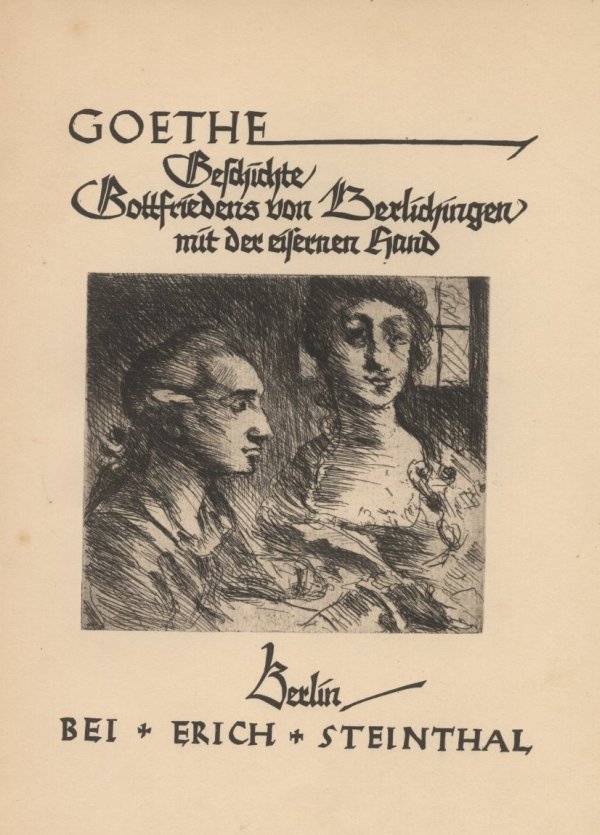
Goethe und seine Muse. Titelvignette von Lovis Corinth (1921-1922, Frankfurter Goethehaus, Freies Deutsches Hochstift)
By all these peculiarities, Lerse completely qualified himself for the office of arbitrator and umpire in all the small and great quarrels which happened, though but rarely, in our circle, and which Salzmann could not hush up in his fatherly way. Without the external forms, which do so much mischief in universities, we represented a society bound together by circumstances and good-feeling, which others might occasionally touch, but into which they could not intrude. Now, in his judgment of internal piques, Lerse always showed the greatest impartiality, and when the affair could no longer be settled by words and explanations, he knew how to conduct the desired satisfaction, in an honourable way, to a harmless issue. In this no man was more clever than he; indeed, he often used to say, that since heaven had destined him for a hero neither in war nor in love, he would be content, both in romances and fighting, with the part of second. Since he remained the same throughout, and might be regarded as a true model of a good and steady disposition, the conception of him stamped itself as deeply as amiably upon me; and when I wrote Götz von Berlichingen, I felt myself induced to set up a memorial of our friendship, and to give the gallant fellow, who knew how to subordinate himself in so dignified a manner, the name of Franz Lerse.
Subjugation of Natural Antipathies.
While now, by his constant humorous dryness, he continued always to remind us of what one owed to oneself and to others, and how one ought to behave in order to live at peace with men as long as possible, and thus gain a certain position towards them, I had to fight, both inwardly and outwardly, with quite different circumstances and adversaries, being at strife with myself, with the objects around me, and even with the elements. I found myself in a state of health which furthered me sufficiently in all that I would and should undertake; only there was a certain irritability left behind, which did not always let me be in equilibrium. A loud sound was disagreeable to me, diseased objects awakened in me loathing and horror. But I was especially troubled by a giddiness which came over me every time that I looked down from a height. All these infirmities I tried to remedy, and, indeed, as I wished to lose no time, in a somewhat violent way. In the evening, when they beat the tattoo, I went near the multitude of drums, the powerful rolling and beating of which might have made one's heart burst in one's bosom. All alone I ascended the highest pinnacle of the minster spire, and sat in what is called the neck, under the nob or crown, for a quarter of an hour, before I would venture to step out again into the open air, where, standing upon a platform scarce an ell square, without any particular holding, one sees the boundless prospect before, while the nearest objects and ornaments conceal the church, and everything upon and above which one stands. It is exactly as if one saw oneself carried up into the air in a balloon. Such troublesome and painful sensations I repeated until the impression became quite indifferent to me, and I have since then derived great advantage from this training, in mountain travels and geological studies, and on great buildings, where I have vied with the carpenters in running over the bare beams and the cornices of the edifice, and even in Rome, where one must run similar risks to obtain a nearer view of important works of art. Anatomy, also, was of double value to me, as it taught me to tolerate the most repulsive sights, while I satisfied my thirst for knowledge. And thus I attended, also, the clinical course of the elder Doctor Ehrmann, as well as the lectures of his son on obstetrics, with the double view of becoming acquainted with all conditions, and of freeing myself from all apprehension as to repulsive things. And I have actually succeeded so far, that nothing of this kind could ever put me out of my self-possession. But I sought to steel myself not only against these impressions on the senses, but also against the infections of the imagination. The awful and shuddering impressions of the darkness in churchyards, solitary places, churches and chapels by night, and whatever may be connected with them, I contrived to render likewise indifferent; and in this, also, I went so far that day and night, and every locality, were quite the same to me; so that even when, in later times, a desire came over me once more to feel in such scenes the pleasing shudder of youth, I could scarcely force this, in any degree, by the strangest and most fearful images which I called up.
In my efforts to free myself from the pressure of the too-gloomy and powerful, which continued to rule within me, and seemed to me sometimes as strength, sometimes as weakness, I was thoroughly assisted by that open, social, stirring manner of life, which attracted me more and more, to which I accustomed myself, and which I at last learned to enjoy with perfect freedom. It is not difficult to remark in the world, that man feels himself most freely and most perfectly rid of his own failings, when he represents to himself the faults of others, and expatiates upon them with complacent censoriousness. It is a tolerably pleasant sensation even to set ourselves above our equals by disapprobation and misrepresentation, for which reason good society, whether it consists of few or many, is most delighted with it. But nothing equals the comfortable self-complacency, when we erect ourselves into judges of our superiors, and of those who are set over us,—of princes and statesmen, when we find public institutions unfit and injudicious, only consider the possible and actual obstacles, and recognise neither the greatness of the invention, nor the co-operation which is to be expected from time and circumstances in every undertaking.
Whoever remembers the condition of the French kingdom, and is accurately and circumstantially acquainted with it from later writings, will easily figure to himself how, at that time, in the Alsatian semi-France, people used to talk about the king and his ministers, about the court and court-favourites. These were new subjects for my love of instructing myself, and very welcome ones to my pertness and youthful conceit. I observed everything accurately, noted it down industriously, and I now see, from the little that is left, that such accounts, although only put together on the moment, out of fables and uncertain general rumours, always have a certain value in after-times, because they serve to confront and compare the secret made known at last with what was then already discovered and public, and the judgments of contemporaries, true or false, with the convictions of posterity.
Striking, and daily before the eyes of us street-loungers, was the project for beautifying the city; the execution of which, according to draughts and plans, began in the strangest fashion to pass from sketches and plans into reality. Intendant Gayot had undertaken to new-model the angular and uneven lanes of Strasburg, and to lay the foundations of a respectable, handsome city, regulated by line and level. Upon this, Blondel, a Parisian architect, drew a plan, by which an hundred and forty householders gained in room, eighty lost, and the rest remained in their former condition. This plan accepted, but not to be put into execution at once, now, should in course of time have been approaching completion, and, meanwhile, the city oddly enough wavered between form and formlessness. If, for instance, a crooked side of a street was to be straightened, the first man who felt disposed to build moved forward to the appointed line perhaps, too, his next neighbour; but perhaps, also, the third or fourth resident from him, by which projections the most awkward recesses were left, like front court-yards, before the houses in the background. They would not use force, yet without compulsion they would never have got on; on which account no man, when his house was once condemned, ventured to improve or replace anything that related to the street. All these strange accidental inconveniences gave to us rambling idlers the most welcome opportunity of practising our ridicule, of making proposals, in the manner of Behrisch, for accelerating the completion, and of constantly doubting the possibility of it, although many a newly-erected handsome, building should have brought us to other thoughts. How far that project was advanced by the length of time, I cannot say.
Expulsion of the Jesuits.
Another subject on which the Protestant Strasburgers liked to converse was the expulsion of the Jesuits. These fathers, as soon as the city had fallen to the share of the French, had made their appearance and sought a domicilium. But they soon extended themselves and built a magnificent college, which bordered so closely on the minster that the back of the church covered a third part of its front. It was to be a complete quadrangle, and have a garden in the middle; three sides of it were finished. It is of stone, and solid, like all the buildings of these fathers. That the Protestants were pushed hard, if not oppressed by them, lay in the plan of the society which made it a duty to restore the old religion in its whole compass. Their fall, therefore, awakened the greatest satisfaction in the opposite party, and people saw, not without pleasure, how they sold their wines, carried away their books, and the building was assigned to another, perhaps less active order. How glad are men when they get rid of an opponent, or only of a guardian; and the herd does not reflect that where there is no dog, it is exposed to wolves.
Now, since every city must have its tragedy, at which children and children's children shudder, so in Strasburg frequent mention was made of the unfortunate Prætor Klingling, who, after he had mounted the highest step of earthly felicity, ruled city and country with almost absolute power, and enjoyed all that wealth, rank, and influence could afford, had at last lost the favour of the court, and was dragged up to answer for all in which he had been indulged hitherto; nay, was even thrown into prison, where, more than seventy years old, he died an ambiguous death.
The Knight of St. Louis.
This and other tales, that knight of St. Louis, our fellow-boarder, knew how to tell with passion and animation, for which reason I was fond of accompanying him in his walks, unlike the others, who avoided such invitations, and left me alone with him. As with new acquaintances I generally suffered myself to go on for a long time without thinking much about them or the effect which they were exercising upon me, so I only remarked gradually that his stories and opinions rather unsettled and confused, than instructed and enlightened me. I never knew what to make of him, although the riddle might easily have been solved. He belonged to the many to whom life offers no results, and who therefore, from first to last, exert themselves on individual objects. Unfortunately he had, with this, a decided desire, nay, even passion for meditating, without having any capacity for thinking; and in such men a particular notion easily fixes itself fast, which may be regarded as a mental disease. To such a fixed view he always came back again, and was thus in the long-run excessively tiresome. He used bitterly to complain of the decline of his memory, especially with regard to the latest events, and maintained by a logic of his own, that all virtue springs from a good memory, and all vice, on the contrary, from forgetfulness. This doctrine he contrived to carry out with much acuteness; as, indeed, everything can be maintained when one permits oneself to use words altogether vaguely, and to employ and apply them in a sense now wider, now narrower, now closer, now more remote.
At first it was amusing to hear him; nay, his persuasiveness even astonished us. We fancied we were standing before a rhetorical sophist, who for jest and practice knew how to give a fair appearance to the strangest things. Unfortunately this first impression blunted itself but too soon; for at the end of every discourse, manage the thing as I would, the man came back again to the same theme. He was not to be held fast to older events, although they interested him,—-although he had them present to his mind with their minutest circumstances. Indeed he was often, by a small circumstance, snatched out of the middle of a wild historical narrative, and thrust into his detestable favourite thought.
One of our afternoon walks was particularly unfortunate in this respect; the account of it may stand here instead of similar cases, which might weary, if not vex the reader.
On the way through the city we were met by an old female mendicant, who by her beggings and importunities disturbed him in his story. "Pack yourself off, old witch!" said he, and walked by. She shouted after him the well-known retort, only somewhat changed, since she saw well that the unfriendly man was old himself,—"If you did not wish to be old, you should have had yourself hanged in your youth!" He turned round violently, and I feared a scene. "Hanged!" cried he, "have myself hanged! No, that could not have been; I was too honest a fellow for that; but hang myself—hang up my own self—that is true—that I should have done; I should have turned a charge of powder against myself, that I might not live to see that I am not even worth that any more." The woman stood as if petrified; but he continued, "You have said a great truth, witch-mother! and as they have neither drowned nor burned you yet, you shall be paid for your proverb." He handed her a büsel, a coin not usually given to a beggar.
We had crossed over the first Rhine-bridge, and were going to the inn where we meant to stop, and I was trying to lead him back to our previous conversation, when, unexpectedly, a very pretty girl met us on the pleasant foot-path, remained standing before us, bowed prettily and cried: "Eh, eh! captain, where are you going?" and whatever else is usually said on such an occasion. "Mademoiselle," replied he, somewhat embarrassed, "I know not——" "How?" said she, with graceful astonishment, "do you forget your friends so soon?" The word "forget" fretted him; he shook his head and replied, peevishly enough, "Truly, mademoiselle, I did not know——!" She now retorted with some humour, yet very temperately: "Take care, captain, I may mistake you another time!" And so she hurried past, taking huge strides, without looking round. At once my fellow-traveller struck his forehead with both his fists: "O what an ass I am!" exclaimed he, "what an old ass I am! Now, you see whether I am right or not." And then, in a very violent manner, he went on with his usual sayings and opinions, in which this case still more confirmed him. I cannot and would not repeat what a philippic discourse he held against himself. At last he turned to me and said: "I call you to witness! You remember that small-ware woman at the corner, who is neither young nor pretty? I salute her every time we pass, and often exchange a couple of friendly words with her; and yet it is thirty years ago since she was gracious to me. But now I swear it is not four weeks since this young lady showed herself more complaisant to me than was reasonable, and yet I will not recognise her, but insult her in return for her favours! Do I not always say that ingratitude is the greatest of vices, and no man would be ungrateful if he were not forgetful!"
"We went into the inn, and nothing but the tippling, swarming crowd in the ante-rooms stopped the invectives which he rattled off against himself and his contemporaries. He was silent, and I hoped pacified, when we stepped into an upper chamber, where we found a young man pacing up and down alone, whom the captain saluted by name. I was pleased to become acquainted with him; for the old fellow had said much good of him to me, and had told me that this young man, being employed in the war-bureau, had often disinterestedly done him very good service when the pensions were stopped. I was glad that the conversation took a general turn, and while we were carrying it on we drank a bottle of wine. But here, unluckily, another infirmity which my knight had in common with obstinate men, developed itself. For as, on the whole, he could not get rid of that fixed notion, so did he stick fast to a disagreeable impression of the moment, and suffer his feelings to run on without moderation. His last vexation about himself had not yet died away, and now was added something new, although of quite a different kind. He had not long cast his eyes here and there before he noticed on the table a double portion of coffee and two cups, and might besides, being a man of gallantry, have traced some other indication that the young man had not been so solitary all the time. And scarcely had the conjecture arisen in his mind, and ripened into a probability, that the pretty girl had been paying a visit here, than the most outrageous jealousy added itself to that first vexation, so as completely to perplex him.
The Knight of St. Louis.
Now before I could suspect anything, for I had hitherto been conversing quite harmlessly with the young man, the captain, in an unpleasant tone, which I well knew, began to be satirical about the pair of cups, and about this and that. The young man, surprised, tried to turn it off pleasantly and sensibly, as is the custom among men of good-breeding; but the old fellow continued to be unmercifully rude, so that there was nothing left for the other to do but to seize his hat and cane, and at his departure to leave behind him a pretty unequivocal challenge. The fury of the captain now burst out the more vehemently, as he had in the interim drunk another bottle of wine almost by himself. He struck the table with his fist, and cried more than once: "I strike him dead!" It was not, however, meant quite so badly as it sounded, for he often used this phrase when any one opposed or otherwise displeased him. Just as unexpectedly the business grew worse on our return: for I had the want of foresight to represent to him his ingratitude towards the young man, and to remind him how strongly he had praised to me the ready obligingness of this official person. No! such rage of a man against himself I never saw again; it was the most passionate conclusion to that beginning to which the pretty girl had given occasion. Here I saw sorrow and repentance carried into caricature, and as all passion supplies the place of genius, to a point really genius-like. He then went over all the incidents of our afternoon ramble again, employed them rhetorically for his own self-reproach, brought up the old witch at last before him once more, and perplexed himself to such a degree, that I could not help fearing he would throw himself into the Rhine. Could I have been sure of fishing him out again quickly, like Mentor his Telemachus, he might have made the leap, and I should have brought him home cooled down for this occasion.
I immediately confided the affair to Lerse, and we went the next morning to the young man, whom my friend in his dry way set laughing. We agreed to bring about an accidental meeting, where a reconciliation should take place of itself. The drollest thing about it was, that this time the captain too had slept off his rudeness, and found himself ready to apologize to the young man, to whom petty quarrels were of some consequence. All was arranged in one morning, and, as the affair had not been kept quite secret, I did not escape the jokes of my friends, who might have foretold me, from their own experience, how troublesome the friendship of the captain could become upon occasion.
But now, while I am thinking what should be imparted next, there comes again into my thoughts, by a strange play of memory, that reverend minster-building, to which in those days I devoted particular attention, and which, in general, constantly presents itself to the eye both in the city and in the country.
The more I considered the façade, the more was that first impression strengthened and developed, that here the sublime has entered into alliance with the pleasing. If the vast, when it appears as a mass before us, is not to terrify; if it is not to confuse, when we seek to investigate its details, it must enter into an unnatural, apparently impossible connexion, it must associate to itself the pleasing. But now, since it will be impossible for us to speak of the impression of the minster except by considering both these incompatible qualities as united, so do we already see, from this, in what high value we must hold this ancient monument, and we begin in earnest to describe how such contradictory elements could peaceably interpenetrate and unite themselves.
Strasburg Minster.
First of all, without thinking of the towers, we devote our considerations to the façade alone, which powerfully strikes the eye as an upright, oblong parallelogram. If we approach it at twilight, in the moonshine, on a starlight night, when the parts appear more or less indistinct and at last disappear, we see only a colossal wall, the height of which bears an advantageous proportion to the breadth. If we gaze on it by day, and by the power of the mind abstract from the details, we recognise the front of a building which not only incloses the space within, but also covers much in its vicinity. The openings of this monstrous surface point to internal necessities, and according to these we can at once divide it into nine compartments. The great middle door, which opens into the nave of the church, first meets the eye. On both sides of it lie two smaller ones, belonging to the cross-ways. Over the chief door our glance falls upon the wheel-shaped window, which is to spread an awe-inspiring light within the church and its vaulted arches. At its sides appear two large, perpendicular, oblong openings, which form a striking contrast with the middle one, and indicate that they belong to the base of the rising towers. In the third story are three openings in a row, which are designed for belfries and other church necessities. Above them one sees the whole horizontally closed by the balustrade of the gallery, instead of a cornice. These nine spaces described, are supported, enclosed, and separated into three great perpendicular divisions by four pillars rising up from the ground.
Now as one cannot deny to the whole mass a fine proportion of height to breadth, so also in the details it maintains a somewhat uniform lightness by means of these pillars and the narrow compartments between them.
But if we keep to our abstraction, and imagine to ourselves this immense wall without ornaments, with firm buttresses, with the necessary openings in it, but only so far as necessity requires them, we even then must allow that these chief divisions are in good proportion: thus the whole will appear solemn and noble indeed, but always heavily unpleasant, and, being without ornament, unartistical. For a work of art, the whole of which is conceived in great, simple, harmonious parts, makes indeed a noble and dignified impression, but the peculiar enjoyment which the pleasing produces can only find place in the consonance of all developed details.
And it is precisely here that the building which we are examining satisfies us in the highest degree: for we see all the ornaments fully suited to every part which they adorn; they are subordinate to it, they seem to have grown out of it. Such a manifoldness always gives great pleasure, since it flows of its own accord from the suitable, and therefore at the same time awakens the feeling of unity. It is only in such cases that the execution is prized as the summit of art.
By such means, now, was a solid piece of masonry, an impenetrable wall, which had moreover to announce itself as the base of two heaven-high towers, made to appear to the eye as if resting on itself, consisting in itself, but at the same time light and adorned, and, though pierced through in a thousand places, to give the idea of indestructible firmness.
This riddle is solved in the happiest manner. The openings in the wall, its solid parts, the pillars, everything has its peculiar character, which proceeds from its particular destination; this communicates itself by degrees to the subdivisions; hence everything is adorned in proportionate taste, the great as well as the small is in the right place, and can be easily comprehended, and thus the pleasing presents itself in the vast. I would refer only to the doors sinking in perspective into the thickness of the wall, and adorned without end in their columns and pointed arches; to the window with its rose springing out of the round form, to the outline of its frame-work, as well as to the slender reedlike pillars of the perpendicular compartments. Let one represent to himself the pillars retreating step by step, accompanied by little, slender, light-pillared, pointed structures, likewise striving upwards, and furnished with canopies to shelter the images of the saints, and how at last every rib, every boss, seems like a flower-head and row of leaves, or some other natural object transformed into stone. One may compare, if not the building itself, yet representations of the whole and of its parts, for the purpose of reviewing and giving life to what I have said. It may seem exaggerated to many, for I myself, though transported into love for this work at first sight, required a long time to make myself intimately acquainted with its value.
Having grown up among those who found fault with Gothic architecture, I cherished my aversion from the abundantly overloaded,complicated ornaments which, by their capriciousness, made a religious, gloomy character highly adverse. I strengthened myself in this repugnance, since I had only met with spiritless works of this kind, in which one could perceive neither good proportions nor a pure consistency. But here I thought I saw a new revelation of it, since what was objectionable by no means appeared, but the contrary opinion rather forced itself upon my mind.
Strasburg Minster.
But the longer I looked and considered, I all the while thought I discovered yet greater merits beyond that which I have already mentioned. The right proportion of the larger divisions, the ornamental, as judicious as rich, even to the minutest, were found out; but now I recognised the connexion of these manifold ornaments amongst each other, the transition from one leading part to another, the enclosing of details, homogeneous indeed, but yet greatly varying in form, from the saint to the monster, from the leaf to the dental. The more I investigated, the more I was astonished; the more I amused and wearied myself with measuring and drawing, so much the more did my attachment increase, so that I spent much time, partly in studying what actually existed, partly in restoring, in my mind and on paper, what was wanting and unfinished, especially in the towers.
Since now I found that this building had been based on old German ground, and grown thus far in genuine German times, and that the name of the master, on his modest gravestone, was likewise of native sound and origin, I ventured, being incited by the worth of this work of art, to change the hitherto decried appellation of "Gothic architecture," and to claim it for our nation as "German architecture;" nor did I fail to bring my patriotic views to light, first orally, and afterwards in a little treatise, dedicated to the memory of Ervinus a Steinbach.
If my biographical narrative should come down to the epoch when the said sheet appeared in print, which Herder afterwards inserted in his pamphlet: Von Deutscher Art und Kunst, (Of German Manner and Art,) much more will be said on this weighty subject. But before I turn myself away from it this time, I will take the opportunity to vindicate the motto prefixed to the present volume, with those who may have entertained some doubt about it. I know indeed very well, that in opposition to this honest, hopeful old German saying: "Whatever one wishes in youth, one has abundance in old age!" many would quote contrary experience, and many trifling comments might be made; but much also is to be said in its favour, and I will explain my own thoughts on the matter.
Our wishes are presentiments of the capabilities which lie within us, and harbingers of that which we shall be in a condition to perform. Whatever we are able and would like to do, presents itself to our imagination, as without us and in the future; we feel a longing after that which we already possess in secret. Thus a passionate anticipating grasp changes the truly possible into a dreamed reality. Now if such a bias lies decidedly in our nature, then, with every step of our development will a part of the first wish be fulfilled—under favourable circumstances in the direct way, under unfavourable in the circuitous way, from which we always come back again to the other. Thus we see men by perseverance attain to earthly wealth; they surround themselves with riches, splendour, and external honour. Others strive yet more certainly after intellectual advantages, acquire for themselves a clear survey of things, a peacefulness of mind, and a certainty for the present and the future.
But now there is a third direction, which is compounded of both, and the issue of which must be the most surely successful. When, namely, the youth of a man falls into a pregnant time, when production overweighs destruction, and a presentiment is early awakened within him as to what such an epoch demands and promises, he will then, being forced by outward inducements into an active interest, take hold now here, now there, and the wish to be active on many sides will be lively within him. But so many accidental hindrances are associated with human limitation, that here a thing, once begun, remains unfinished, there that which is already grasped falls out of the hand, and one wish after another is dissipated. But had these wishes sprung out of a pure heart, and in conformity with the necessities of the times, one might composedly let them lie and fall right and left, and be assured that these must not only be found out and picked up again, but that also many kindred things, which one has never touched and never even thought of, will come to light. If now, during our own lifetime, we see that performed by others, to which we ourselves felt an earlier call, but had been obliged to give it up, with much besides; then the beautiful feeling enters the mind, that only mankind together is the true man, and that the individual can only be joyous and happy when he has the courage to feel himself in the whole.
Study of German Architecture.
This contemplation is here in the right place: for when I reflect on the affection which drew me to these antique edifices, when I reckon up the time which I devoted to the Strasburg minster alone, the attention with which I afterwards examined the cathedral at Cologne, and that at Freyburg, and more and more felt the value of these buildings, I could even blame myself for having afterwards lost sight of them altogether, nay, for having left them completely in the background, being attracted by a more developed art. But when I now, in the latest times, see attention again turned to those objects, when I see affection and even passion for them appearing and flourishing, when I see able young persons seized with this passion, recklessly devoting powers, time, care, and property, to these memorials of a past world, then am I reminded with pleasure that what I formerly would and wished had a value. With satisfaction I see that they not only know how to prize what was done by our forefathers, but that from existing unfinished beginnings they try to represent, in pictures at least, the original design, so as thus to make us acquainted with the thought, which is ever the beginning and end of all undertakings; and that they strive with considerate zeal to clear up and vivify what seems to be a confused past. Here I especially applaud the gallant Sulpiz Boisserée, who is indefatigably employed in a magnificent series of copper-plates to exhibit the cathedral of Cologne as the model of those vast conceptions, the spirit of which, like that of Babel, strove up to heaven, and which were so out of proportion to earthly means, that they were necessarily stopped fast in their execution. If we have been hitherto astonished that such buildings proceeded only so far, we shall learn with the greatest wonder what was really designed to be done.
May the literary-artistical undertakings of this kind be duly patronized by all who have power, wealth, and influence, that the great and gigantic views of our forefathers may be presented to our contemplation, and that we may be able to form a conception of what they dared to desire. The insight resulting from this will not remain fruitless, and the judgment will, for once at least, be in a condition to exercise itself on these works with justice. Nay, this will be done most thoroughly, if our active young friend, besides the monograph devoted to the cathedral of Cologne, follows out in detail the history of our mediæval architecture. When whatever is to be known about the practical exercise of this art is further brought to light, when the art is represented in all its fundamental features by a comparison with the Græco-Roman and the oriental Egyptian, little can remain to be done in this department. And I, when the results of such patriotic labours lie before the world, as they are now known in friendly private communications, shall be able, with true content, to repeat that motto in its best sense: "Whatever one wishes in youth, in old age one has abundance."
But if, in operations like these, which belong to centuries, one can trust oneself to time, and wait for opportunity, there are, on the contrary, other things which in youth must be enjoyed at once, fresh, like ripe fruits. Let me be permitted, with this sudden turn, to mention dancing, of which the ear is reminded, as the eye is of the minster, every day and every hour in Strasburg and all Alsace. From early youth my father himself had given my sister and me instruction in dancing, a task which must have comported strangely enough with so stern a man; but he did not suffer his composure to be put out by it; he drilled us in the positions and steps in a manner the most precise, and when he had brought us far enough to dance a minuet, he played for us something easily intelligible in three-four time, on a flute-douce, and we moved to it as well as we could. On the French theatre, likewise, I had seen from my youth upwards, if not ballets, yet pas seuls and pas de deux, and had noticed in them various strange motions of the feet, and all sorts of springs. When now we had enough of the minuet, I begged my father for other dancing music, of which our music-books, in their jigs and murkies,[2] offered us a rich supply; and I immediately found out, of myself, the steps and other motions for them, the time being quite suitable to my limbs, and, as it were, born with them. This pleased my father to a certain degree; indeed, he often, by way of joke for himself and us, let the "monkies" dance in this way. After my misfortune with Gretchen, and during the whole of my residence in Leipzig, I did not make my appearance again on the floor; on the contrary, I still remember that when, at a ball, they forced me into a minuet, both measure and motion seemed to have abandoned my limbs, and I could no more remember either the steps or the figures, so that I should have been put to disgrace and shame if the greater part of the spectators had not maintained that my awkward behaviour was pure obstinacy, assumed with the view of depriving the ladies of all desire to invite me and draw me into their circle against my will.
The Dancing-Master's Daughters.
During my residence in Frankfort, I was quite cut off from such pleasures; but in Strasburg, with other enjoyments of life, there soon arose in my limbs the faculty of keeping time. On Sundays and week-days, one sauntered by no pleasure-ground without finding there a joyous crowd assembled for the dance, and for the most part revolving in the circle. Moreover, there were private balls in the country-houses, and people were already talking of the brilliant masquerades of the coming winter. Here, indeed, I should have been out of my place, and useless to the company; when a friend, who waltzed very well, advised me to practise myself first in parties of a lower rank, so that afterwards I might be worth something in the highest. He took me to a dancing-master, who was well known for his skill; this man promised me that, when I had in some degree repeated the first elements, and made myself master of them, he would then lead me further. He was one of the dry, ready French characters, and received me in a friendly manner. I paid him a month in advance, and received twelve tickets, for which he agreed to give me certain hours' instruction. The man was strict and precise, but not pedantic; and as I already had some previous practice, I soon gave him satisfaction and received his commendation.
One circumstance, however, greatly facilitated the instruction of this teacher; he had two daughters, both pretty, and both yet under twenty. Having been instructed in this art from their youth upwards, they showed themselves very skilful, and might have been able, as partners, soon to help even the most clumsy scholars into some cultivation. They were both very polite, spoke nothing but French, and I, on my part, did my best, that I might not appear awkward or ridiculous before them. I had the good fortune that they likewise praised me, and were always willing to dance a minuet to their father's little violin, and, what indeed was more difficult for them, to initiate me, by degrees, into waltzing and whirling. Their father did not seem to have many customers, and they led a lonely life. For this reason they often asked me to remain with them after my hour, and to chat away the time a little; which I the more willingly did, as the younger one pleased me well, and generally they both altogether behaved very becomingly. I often read aloud something from a novel, and they did the same. The elder, who was as handsome, perhaps even handsomer, than the second, but who did not correspond with my taste so well as the latter, always conducted herself towards me more obligingly, and more kindly in every respect. She was always at hand during the hour, and often protracted it; hence I sometimes thought myself bound to offer back a couple of tickets to her father, which, however, he did not accept. The younger one, on the contrary, although she did nothing unfriendly towards me, was yet rather reserved, and waited till she was called by her father before she relieved the elder.
The Fortune-Teller.
The cause of this became manifest to me one evening. For when, after the dance was done, I was about to go into the sitting-room with the elder, she held me back and said, "Let us remain here a little longer; for I will confess to you that my sister has with her a woman who tells fortunes from cards, and who is to reveal to her how matters stand with an absent lover, on whom her whole heart hangs, and upon whom she has placed all her hope. Mine is free," she continued, "and I must accustom myself to see it despised." I thereupon said sundry pretty things to her, replying that she could at once convince herself on that point by consulting the wise woman likewise; that I would do so myself, for I had long wished to learn something of the kind, but lacked faith. She blamed me for this, and assured me that nothing in the world was surer than the responses of this oracle, only it must be consulted, not out of sport and mischief, but solely in real affairs. However, I at last compelled her to go with me into that room, as soon as she had ascertained that the consultation was over. We found her sister in a very cheerful humour, and even towards me she was kinder than usual, sportive, and almost witty; for since she seemed to be secure of an absent friend, she may have thought it no treachery to be a little gracious with a present friend of her sister's, which she thought me to be. The old woman was now flattered, and good payment was promised her, if she would tell the truth to the elder sister and to me. With the usual preparations and ceremonies she began her business, in order to tell the fair one's fortune first. She carefully considered the situation of the cards, but seemed to hesitate, and would not speak out what she had to say. "I see now," said the younger, who was already better acquainted with the interpretation of such a magic tablet, "you hesitate, and do not wish to disclose anything disagreeable to my sister; but that is a cursed card!" The elder one turned pale, but composed herself, and said, "Only speak out; it will not cost one's head!" The old woman, after a deep sigh, showed her that she was in love, that she was not beloved, that another person stood in the way, and other things of like import. We saw the good girl's embarrassment. The old woman thought somewhat to improve the affair by giving hopes of letters and money. "Letters," said the lovely child, "I do not expect, and money I do not desire. If it is true, as you say, that I love, I deserve a heart that loves me in return." "Let us see if it will not be better," replied the old woman, as she shuffled the cards and laid them out a second time; but before the eyes of all of us, it had only become still worse. The fair one stood not only more lonely, but surrounded with many sorrows; her lover had moved somewhat farther, and the intervening figures nearer. The old woman wished to try it the third time, in hopes of a better prospect; but the beautiful girl could restrain herself no longer, she broke out into uncontrollable weeping, her lovely bosom heaved violently, she turned round, and rushed out of the room. I knew not what I should do. Inclination kept me with the one present; compassion drove me to the other; my situation was painful enough. "Comfort Lucinda," said the younger; "go after her." I hesitated: how could I comfort her without at least assuring her of some sort of affection, and could I do that at such a moment in a cool, moderate manner? "Let us go together," said I to Emilia. "I know not whether my presence will do her good," replied she. Yet we went, but found the door bolted. Lucinda made no answer; we might knock, shout, entreat, as we would. "We must let her have her own way," said Emilia; "she will not have it otherwise now!" And, indeed, when I called to my mind her manner from our very first acquaintance, she always had something violent and unequal about her, and chiefly showed her affection for me by not behaving to me with rudeness. What should I do? I paid the old woman richly for the mischief she had caused, and was about to go, when Emilia said, "I stipulate that the cards shall now be cut for you too." The old woman was ready. "Do not let me be present," cried I, and hastened down stairs.
Scene with the Two Sisters.
The next day I had not courage to go there. The third day, early in the morning, Emilia sent me word by a boy who had already brought me many a message from the sisters, and had carried back flowers and fruits to them in return, that I should not fail that day. I came at the usual hour, and found the father alone, who, in many respects, improved my paces and steps, my goings and comings, my bearing and behaviour, and, moreover, seemed to be satisfied with me. The younger daughter came in towards the end of the hour, and danced with me a very graceful minuet, in which her movements were extraordinarily pleasing, and her father declared that he had rarely seen a prettier and more nimble pair upon his floor. After the lesson, I went as usual into the sitting-room; the father left us alone; I missed Lucinda. "She is in bed," said Emilia, "and I am glad of it; do not be concerned about it. Her mental illness is first alleviated when she fancies herself bodily sick; she does not like to die, and therefore she then does what we wish. We have certain family medicines which she takes, and reposes; and thus, by degrees, the swelling waves subside. She is, indeed, too good and amiable in such an imaginary sickness, and as she is in reality very well, and is only attacked by passion, she imagines various kinds of romantic deaths, with which she frightens herself in a pleasant manner, like children when we tell them ghost-stories. Thus, yesterday evening, she announced to me with great vehemence, that this time she should certainly die, and that only when she was really near death, they should bring again before her the ungrateful false friend, who had at first acted so handsomely to her, and now treated her so ill; she would reproach him bitterly, and then give up the ghost." "I know not that I am guilty," exclaimed I, "of having expressed any sort of affection for her. I know somebody who can best bear me witness in this respect." Emilia smiled and rejoined, "I understand you; and if we are not discreet and determined, we shall all find ourselves in a bad plight together. What will you say if I entreat you not to continue your lessons? You have, I believe, four tickets yet of the last month, and my father has already declared that he finds it inexcusable to take your money any longer, unless you wish to devote yourself to the art of dancing in a more serious manner; what is required by a young man of the world you possess already." "And do you, Emilia, give me this advice, to avoid your house?" replied I. "Yes, I do," said she, "but not of myself. Only listen. When you hastened away, the day before yesterday, I had the cards cut for you, and the same response was repeated thrice, and each time more emphatically. You were surrounded by everything good and pleasing, by friends and great lords, and there was no lack of money. The ladies kept themselves at some distance. My poor sister in particular stood always the farthest off; one other advanced constantly nearer to you, but never came up to your side, for a third person, of the male sex, always came between. I will confess to you that I thought that I myself was meant by the second lady, and after this confession you will best comprehend my well-meant counsel. To an absent friend I have promised my heart and my hand, and, until now, I loved him above all; yet it might be possible for your presence to become more important to me than hitherto, and what kind of a situation would you have between two sisters, one of whom you had made unhappy by your affection, and the other by your coldness, and all this ado about nothing and only for a short time? For if we had not known already who you are and what are your expectations, the cards would have placed it before my eyes in the clearest manner. Fare you well!" said she, and gave me her hand. I hesitated. "Now," said she, leading me towards the door, "that it may really be the last time that we shall speak to each other, take what I would otherwise have denied you." She fell upon my neck, and kissed me most tenderly. I embraced her, and pressed her to my bosom.
At this moment the side-door flew open, and her sister, in a light but becoming night-dress, sprang out and cried, "You shall not be the only one to take leave of him!" Emilia let me go, and Lucinda seized me, clasped herself fast to my heart, pressed her black locks upon my cheeks, and remained in this position for some time. And thus I found myself in the dilemma between two sisters which Emilia had prophesied to me a moment before. Lucinda let me loose, and looked earnestly into my face. I would have taken her hand and said something friendly to her, but she turned herself away, walked with violent steps up and down the room for some time, and then threw herself into a corner of the sofa. Emilia went to her, but was immediately repulsed, and here began a scene which is yet painful to me in the recollection, and which, although really it had nothing theatrical about it, but was quite suitable to a lively young Frenchwoman, could only be properly repeated in the theatre by a good and feeling actress.
Lucinda's Curse.
Lucinda overwhelmed her sister with a thousand reproaches. "This is not the first heart," she cried, "that was inclining itself to me, and that you have turned away. Was it not just so with him who is absent, and who at last betrothed himself to you under my very eyes? I was compelled to look on; I endured it; but I know how many thousand tears it has cost me. This one, too, you have now taken away from me, without letting the other go; and how many do you not manage to keep at once? I am frank and good-natured, and every one thinks he knows me soon, and may neglect me. You are secret and quiet, and people think wonders of what may be concealed behind you. Yet there is nothing behind but a cold, selfish heart that can sacrifice everything to itself; this nobody learns so easily, because it lies deeply hidden in your breast; and just as little do they know of my warm, true heart, which I carry about with me as open as my face."
Emilia was silent, and had sat down by her sister, who became constantly more and more excited in her discourse, and let certain private matters slip out, which it was not exactly proper for me to know. Emilia, on the other hand, who was trying to pacify her sister, made me a sign from behind that I should withdraw; but as jealousy and suspicion see with a thousand eyes, Lucinda seemed to have noticed this also. She sprang up and advanced to me, but not with vehemence. She stood before me, and seemed to be thinking of something. Then she said, "I know that I have lost you; I make no further pretensions to you. But neither shall you have him, sister!"
With these words she grasped me very singularly by the head, thrusting both her hands into my locks, pressing my face to hers, and kissed me repeatedly on the mouth. "Now," cried she, "fear my curse! Woe upon woe, for ever and ever, to her who kisses these lips for the first time after me! Dare to have anything more to do with him! I know heaven hears me this time. And you, Sir, hasten now, hasten away as fast as you can!"
I flew down the stairs, with the firm determination never to outer the house again.
TENTH BOOK.
Strasbourg (continued)—Herder—Tour in Alsace and Lorraine—Frederika
The German poets, since they, as members of a corporation, no longer stood as one man, did not enjoy the smallest advantages in the citizen-world. They had neither support, standing, nor respectability, except in so far as their other position was favourable to them, and therefore it was a matter of mere chance whether talent was born to honour or to disgrace. A poor son of earth, with a consciousness of mind and faculties, was forced to crawl along painfully through life, and, from the pressure of momentary necessities, to squander the gifts which perchance he had received from the Muses. Occasional poems, the first and most genuine of all kinds of poetry, had become despicable to such a degree, that the nation even now cannot attain a conception of their high value; and a poet, if he did not strike altogether into Günther's path, appeared in the world in the most melancholy state of subserviency, as a jester and parasite, so that both on the theatre and on the stage of life he represented a character which any one and every one could abuse at pleasure.
If, on the contrary, the Muse associated herself with men of respectability, these received thereby a lustre which was reflected back to the donor. Noblemen well versed in life, like Hagedorn, dignified citizens, like Brockes, distinguished men of science, like Haller, appeared among the first in the nation, to be equal with the most eminent and the most prized. Those persons, too, were specially honoured, who, together with this pleasing talent, distinguished themselves as active, faithful men of business. In this way Uz, Rabener, and Weisse enjoyed a respect of quite a peculiar kind; people had here to value, when combined, those most heterogeneous qualities which are seldom found united.
Klopstock.
But now the time was to come when poetic genius should become aware of itself, should create for itself its own relations, and understand how to lay the foundation of an independent dignity. Everything necessary to found such an epoch was combined in Klopstock. Considered both from the sensual and moral side, he was a pure young man. Seriously and thoroughly educated, he places, from his youth upwards, a great value upon himself and upon whatever he does, and while considerately measuring out beforehand the steps of his life, turns, with a presentiment of the whole strength of his internal nature, towards the loftiest and most grateful theme. The Messiah, a name which betokens infinite attributes, was to be glorified afresh by him. The Redeemer was to be the hero whom the poet thought to accompany through earthly lowliness and sorrows to the highest heavenly triumphs. Everything Godlike, angelic, and human that lay in the young soul was here called into requisition. Brought up by the Bible and nourished by its strength, he now lives with patriarchs, prophets, and forerunners, as if they were present; yet all these are only evoked from ages to draw a bright halo round the One whose humiliation they behold with astonishment, and in whose exaltation they are gloriously to bear a part. For at last, after gloomy and horrible hours, the everlasting Judge will uncloud his face, again acknowledge his Son and fellow-God, who, on the other hand, will again lead to Him alienated men, nay, even a fallen spirit. The living heavens shout with a thousand angel voices round the throne, and a radiance of love gushes out over the universe, which shortly before had fastened its looks upon a fearful place of sacrifice. The heavenly peace which Klopstock felt in the conception and execution of this poem, communicates itself even now to every one who reads the first ten cantos, without allowing certain requisitions to be brought forward, which an advancing cultivation does not willingly abandon.
The dignity of the subject elevated in the poet the feeling of his own personality. That he himself would enter hereafter into those choirs, that the God-Man would distinguish him, nay, give him face to face the reward for his labours, which even here every feeling, pious heart had fondly paid in many a pure tear—these were such innocent, childlike thoughts and hopes, as only a well-constituted mind can conceive and cherish. Thus Klopstock gained the perfect right to regard himself as a consecrated person, and thus in his actions he studied the most scrupulous purity. Even in his old age it troubled him exceedingly that he had given his earliest love to a lady who, by marrying another, left him in uncertainty whether she had really loved him or been worthy of him. The sentiments which bound him to Meta, their hearty, tranquil affection, their short sacred married life, the aversion of the surviving husband from a second union, all is of that kind which may well be remembered hereafter in the circle of the blessed.
This honourable conduct towards himself was still further enhanced by his being favourably received for a long time in well-minded Denmark, in the house of a great, and, humanly speaking, excellent statesman. Here, in a higher circle, which was exclusive indeed, but, at the same time, devoted to external manners and attention towards the world, his tendency became still more decided. A composed demeanour, a measured speech, and a laconism even when he spoke openly and decidedly, gave him, through his whole life, a certain diplomatic ministerial consequence, which seemed to be at variance with his tender natural feelings, although both sprang from one source. Of all this, his first works give a clear transcript and type, and they thus could not but gain an incredible influence. That, however, he personally assisted others who were struggling in life and poetry, has scarcely been mentioned, as one of his most decided characteristics.
Klopstock and Gleim.
But just such a furtherance of young people in literary action and pursuit, a hopeful pleasure in bringing forward men not favoured by fortune, and making the way easy to them, has rendered illustrious one German, who, in respect to the dignity which he gave himself, may be named as the second, but, in regard to his living influence, as the first. It will escape no one that Gleim is here meant. In possession of an obscure, indeed, but lucrative office, residing in a pleasantly situated spot, not too large, and enlivened by military, civic, and literary activity, whence proceeded the revenues of a great and wealthy institution, not without a part of them remaining behind for the advantage of the place, he felt within himself also a lively productive impulse, which, however, with all its strength, was not quite enough for him, and therefore he gave himself up to another, perhaps stronger impulse, namely, that of making others produce something. Both these activities were intertwined incessantly during his whole long life. He could as easily have lived without taking breath, as without writing poetry and making presents, and by helping needy talents of all kinds through earlier or later embarrassments, contributing to the honour of literature, he gained so many friends, debtors, and dependents, that they willingly allowed his diffuse verses to pass, since they could give him nothing in return for his rich benefits but endurance of his poetry.
Now, the high idea which these two men might well form of their own worth, and by which others were induced also to think themselves somebody, has produced very great and beautiful results, both in public and private, But this consciousness, honourable as it is, called a peculiar evil down for themselves, for those around them, and for their time. If, judging from their intellectual effects, both these men may without hesitation be called great, with respect to the world they remained but small, and considered in comparison with a more stirring life, their external position was nought. The day is long, and so is the night: one cannot be always writing poetry, or doing, or giving; their time could not be filled up like that of people of the world, and men of rank and wealth; they therefore set too high a value on their particular limited situations, attached an importance to their daily affairs which they should only have allowed themselves amongst each other, and took more than reasonable delight in their own jokes, which, though they made the moment agreeable, could be of no consequence in the end. They received praise and honour from others, as they deserved; they gave it back, with measure indeed, but always too profusely; and because they felt that their friendship was worth much, they were pleased to express it repeatedly, and in this spared neither paper nor ink. Thus arose those correspondences, at the deficiency of which in solid contents the modern world wonders, nor can it be blamed, when it hardly sees the possibility of eminent men delighting themselves in such an interchange of nothing, or when it expresses the wish that such leaves might have remained unprinted. But we may suffer these few volumes always to stand along with so many others upon our bookshelves, if we have learned from them the fact that even the most eminent man lives only by the day, and enjoys but a sorry entertainment, when he throws himself too much back upon himself, and neglects to grasp into the fulness of the external world, where alone he can find nourishment for his growth, and at the same time a standard for its measurement.
The activity of these men was in its finest bloom, when we young folks began also to bestir ourselves in our own circle, and with my younger friends, if not with older persons too. I was pretty much in the way of falling into this sort of mutual flattery, forbearance, raising and supporting. In my immediate sphere, whatever I produced could always be reckoned good. Ladies, friends, and patrons will not consider bad that which is undertaken and written out of affection for them. From such obligations at last arises the expression of an empty satisfaction with each other, in the phrases of which a character is easily lost, if it is not from time to time steeled to higher excellence.
And thus I had the happiness to say that, by means of an unexpected acquaintance, all the self-complacency, love of the looking-glass, vanity, pride, and haughtiness that might have been resting or working within me, were exposed to a very severe trial, which was unique in its kind, by no means in accordance with the time, and therefore so much the more searching and more sorely felt.
Herder.
For the most important event, one that was to have the weightiest consequences for me, was my acquaintance with Herder, and the nearer connexion with him which sprung from it. He accompanied the travels of the Prince of Holstein-Eutin, who was in a melancholy state of mind, and had come with him to Strasburg. Our society, as soon as it knew of his arrival, was seized with a great longing to approach him, and this good fortune happened to me first, quite unexpectedly and by chance. I had gone to the Ghost tavern to inquire after some distinguished stranger or other. Just at the bottom of the staircase I found a man who was on the point of ascending, and whom I might have taken for a clergyman. His powdered hair was put up in a queue, his black clothes likewise distinguished him, but still more a long black silk mantle, the skirts of which he had gathered up and stuck into his pocket. This somewhat striking, but yet, on the whole, polite and pleasing figure, of which I had already been told, left me not the least doubt that he was the celebrated newcomer, and my address was to convince him at once that I knew him. He asked my name, which could be of no consequence to him; but my frankness seemed to please him, since he returned it with great friendliness, and as we mounted the stairs, showed himself ready immediately for animated communication. I have forgotten whom we visited then; it is sufficient to say, that at parting I begged permission to wait on him at his own residence, which he granted me kindly enough. I did not neglect to avail myself repeatedly of this favour, and was more and more attracted by him. He had somewhat of softness in his manner, which was very suitable and becoming, without being exactly easy. A round face, an imposing forehead, a somewhat puggish nose, a mouth somewhat prominent, but highly characteristic, pleasing, and amiable; a pair of coal-black eyes under black eye-brows, which did not fail of their effect, although one of them used to be red and inflamed. By various questions he tried to make himself acquainted with me and my situation, and his power of attraction operated on me with growing strength. I was, generally speaking, of a very confiding disposition, and with him especially I had no secrets. It was not long, however, before the repelling pulse of his nature began to appear, and placed me in no small uneasiness. I related to him many things of my youthful occupations and taste, and among others, of a collection of seals, which I had principally gotten together through the assistance of our family friend, who had an extensive correspondence. I had arranged them according to the State Calendar, and by this means had become well acquainted with the whole of the potentates, the greater and lesser mightinesses and powers, even down to the nobility under them. These heraldic insignia had often, and in particular at the ceremonies of the coronation, been of use to my memory. I spoke of these things with some complacency; but he was of another opinion, and not only stripped the subject of all interest, but also contrived to make it ridiculous and nearly disgusting.
From this his spirit of contradiction I had much to endure; for he had resolved, partly because he wished to separate from the prince, partly on account of a complaint in his eye, to remain in Strasburg. This complaint is one of the most inconvenient and unpleasant, and the more troublesome since it can be cured only by a painful, highly irritating and uncertain operation. The tear-bag is closed below, so that the moisture contained in it cannot flow off to the nose, and so much the less as the adjacent bone is deficient in the aperture by which this secretion should naturally take place. The bottom of the tear-bag must therefore be cut open, and the bone bored through, when a horse-hair is drawn through the lachrymal point, then down through the opened bag, and the new canal thus put into connexion with it, and this hair is moved backwards and forwards every day, in order to restore the communication between the two parts;—all which cannot be done or attained, if an incision is not first made externally in that place.
Herder was now separated from the prince, was moved into lodgings of his own, and resolved to have himself operated upon by Lobstein. Here those exercises by which I had sought to blunt my sensibility did me good service; I was able to be present at the operation, and to be serviceable and helpful in many ways to so worthy a man. I found here every reason to admire his great firmness and endurance: for neither during the numerous surgical operations, nor at the oft-repeated painful dressings, did he show himself in any degree irritable, and of all of us he seemed to be the one who suffered least. But in the intervals, indeed, we had to endure the changes of his temper in many ways. I say we for besides myself, a pleasant Russian, named Peglow, was mostly with him. This man had been an early acquaintance of Herder's in Riga, and though no longer a youth, was trying to perfect himself in surgery under Lobstein's guidance. Herder could be charmingly prepossessing and brilliant, but he could just as easily turn an ill-humoured side foremost. All men, indeed, have this attraction and repulsion, according to their nature, some more, some less, some in longer, some in shorter pulsations; few can really control their peculiarities in this respect, many in appearance. As for Herder, the preponderance of his contradictory, bitter, biting humour was certainly derived from his disease and the sufferings arising from it. This case often occurs in life; one does not sufficiently take into consideration the moral effect of sickly conditions, and one therefore judges many characters very unjustly, because it is assumed that all men are healthy, and required of them that they shall conduct themselves accordingly.
Herder.
During the whole time of this cure I visited Herder morning and evening; I even remained whole days with him, and in a short time accustomed myself so much the more to his chiding and fault-finding, as I daily learned to appreciate his beautiful and great qualities, his extensive knowledge, and his profound views. The influence of this good-natured blusterer was great and important. He was five years older than myself, which in younger days makes a great difference to begin with; and as I acknowledged him for what he was, and tried to value that which he had already produced, he necessarily gained a great superiority over me. But the situation was not comfortable; for older persons, with whom I had associated hitherto, had sought to form me with indulgence, perhaps had even spoiled me by their lenity; but from Herder, behave as one might, one could never expect approval. As now, on the one side, my great affection and reverence for him, and on the other, the discontent which he excited in me, were continually at strife with each other, there arose within me an inward struggle, the first of its kind which I had experienced in my life. Since his conversations were at all times important, whether he asked, answered, or communicated his opinions in any other manner, he could not but advance me daily, nay hourly, to new views. At Leipzig, I had accustomed myself to a narrow and circumscribed existence, and my general knowledge of German literature could not be extended by my situation in Frankfort; nay, those mystico-religio-chemical occupations had led me into obscure regions, and what had been passing for some years back in the wide literary world, had for the most part remained unknown to me. Now I was at once made acquainted by Herder with all the new aspiration, and all the tendencies which it seemed to be taking. He had already made himself sufficiently known, and by his Fragments, his Kritische Wälder (Critical Woods), and other works, had immediately placed himself by the side of the most eminent men who had for a long time drawn towards them the eyes of their country. What an agitation there must have been in such a mind—what a fermentation there must have been in such a nature—can neither be conceived nor described. But great was certainly the concealed effort, as will be easily admitted, when one reflects for how many years afterwards and how much he has done and produced.
We had not lived together long in this manner when he confided to me that he meant to be a competitor for the prize which was offered, at Berlin, for the best treatise on the origin of language. His work was already nearly completed, and, as he wrote a very neat hand, he could soon communicate to me, in parts, a legible manuscript. I had never reflected on such subjects, for I was yet too deeply involved in the midst of things to have thought about their beginning and end. The question, too, seemed to me in some measure an idle one; for if God had created man as man, language was just as innate in him as walking erect; he must have just as well perceived that he could sing with his throat, and modify the tones in various ways with tongue, palate, and lips, as he must have remarked that he could walk and take hold of things. If man was of divine origin, so was also language itself; and if man, considered in the circle of nature, was a natural being, language was likewise natural. These two things, like soul and body, I could never separate. Süssmilch, with a realism crude yet somewhat fantastically devised, had declared himself for the divine origin, that is, that God had played the schoolmaster to the first men. Herder's treatise went to show that man as man could and must have attained to language by his own powers. I read the treatise with much pleasure, and it was of special aid in strengthening my mind; only I did not stand high enough either in knowledge or thought to form a solid judgment upon it. I therefore gave the author my applause, adding only a few remarks which flowed from my way of viewing the subject. But one was received just like the other; there was scolding and blaming, whether one agreed with him conditionally or unconditionally. The fat surgeon had less patience than I; he humorously declined the communication of this prize-essay, and affirmed that he was not prepared to meditate on such abstract topics. He urged us in preference to a game of ombre, which we commonly played together in the evening.
Herder's Sarcasms.
During so troublesome and painful a cure, Herder lost nothing of his vivacity; but it became less and less amiable. He could not write a note to ask for anything, that would not be spiced with some scoff or other. Once, for instance, he wrote to me thus:—
"If those letters of Brutus thou hast in thy Cicero's letters, Thou, whom consolers of schools, deck'd out in magnificent bindings, Soothe from their well plan'd shelves—yet more by the outside than inside, Thou, who from gods art descended, or Goths, or from origin filthy,[1] Goethe, send them to me."
It was not polite, indeed, that he should allow himself this jest on my name; for a man's name is not like a mantle, which merely hangs about him, and which, perchance, may be safely twitched and pulled; but is a perfectly fitting garment, which has grown over and over him like his very skin, at which one cannot scratch and scrape without wounding the man himself.
The first reproach, on the contrary, was better founded. I had brought with me to Strasburg the authors I had obtained, by exchange, from Langer, with various fine editions from my father's collection besides, and had set them up on a neat book-case, with the best intentions of using them. But how should my time, which I split up into an hundred different activities, suffice for that? Herder, who was most attentive to books, since he had need of them every moment, perceived my fine collection at his first visit, but soon saw, too, that I made no use of them. He, therefore, as the greatest enemy to all false appearances and ostentation, was accustomed, on occasion, to rally me upon the subject.
Another sarcastic poem occurs to me, which he sent me one evening, when I had been telling him a great deal about the Dresden gallery. I had, indeed, not penetrated into the higher meaning of the Italian school; but Dominico Feti, an excellent artist, although a humorist, and therefore not of the first rank, had interested me much. Scripture subjects had to be painted. He confined himself to the New Testament parables, and was fond of representing them with much originality, taste, and good-humour. He brought them altogether into every-day life, and the spirited and naïve details of his compositions, recommended by a free pencil, had made a vivid impression upon me. At this, my childish enthusiasm for art, Herder sneered in the following fashion:—
"From sympathy, The master I like best of all Dominico Feti they call. A parable from Scripture he is able Neatly to turn into a crazy fable From sympathy:—thou crazy parable!"
I could mention many jokes of the kind, more or less clear or abstruse, cheerful or bitter. They did not vex me, but made me feel uncomfortable. Yet since I knew how to value highly everything that contributed to my own cultivation, and as I had often given up former opinions and inclinations, I soon accommodated myself, and only sought, as far as it was possible for me from my point of view, to distinguish just blame from unjust invectives. And thus no day passed over that had not been, in the most fruitful manner, instructive to me.
I was made acquainted by him with poetry from quite a different side, in another light than heretofore, and one, too, which suited me well. The poetic art of the Hebrews, which he treated ingeniously after his predecessor Lowth—popular poetry, the traditions of which in Alsace he urged us to search after; and the oldest records existing as poetry—all bore witness that poetry in general was a gift to the world and to nations, and not the private inheritance of a few refined, cultivated men. I swallowed all this, and the more eager I was in receiving, the more liberal was he in giving, so that we spent the most interesting hours together. The other natural studies which I had begun, I endeavoured to continue, and as one always has time enough, if one will apply it well, so amongst them all I succeeded in doing twice or thrice as much as usual. As to the fulness of those few weeks during which we lived together, I can well say that all which Herder has gradually produced since, was then announced in the germ, and that I thereby fell into the fortunate condition that I could completely attach to something higher, and expand all that I had hitherto thought, learned, and made my own. Had Herder been methodical, I should have found the most precious guide for giving a durable tendency to my cultivation; but he was more inclined to examine and stimulate, than to lead and conduct. Thus he at first made me acquainted with Hamann's writings, upon which he set a very great value. But instead of instructing me as to these, and making the bias and drift of his extraordinary mind intelligible to me, it generally only served him for amusement when I behaved strangely enough, in trying to get at the meaning of such sibylline leaves. However, I could well feel that something in Hamann's writings appealed to me; and to this I gave myself up, without knowing whence it came or whither it was leading me.
Herder's Departure.
After the cure had lasted longer than was reasonable, Lobstein had begun to hesitate, and to repeat himself in his treatment, so that the affair would not come to an end; and Peglow, too, had confided to me in private that a favourable issue was hardly to be expected; the whole position became gloomy; Herder became impatient and out of temper, he could not succeed in continuing his activity as heretofore, and was obliged to restrain himself the more, as they began to lay the blame of the surgical failure upon his too great mental exertion, and his uninterrupted, animated, nay, merry intercourse with us. It is sufficient to say, that after so much trouble and suffering, the artificial tear-channel would not form itself, and the communication intended would not take place. It was necessary to let the wound heal over in order that the disease should not become worse. If, now, during the operation, one could but admire Herder's firmness under such pains, his melancholy and even fierce resignation to the idea that he must bear such a blot about him all his life, had about it something truly sublime, by which he gained for ever the reverence of those who saw and loved him. This disease, which disfigured so expressive a countenance, must have been so much the more afflicting to him, as he had become acquainted with an excellent lady in Darmstadt, and had gained her affections. It may have been for this cause principally that he submitted to the cure, in order, on his return, to appear more free, more cheerful, and more handsome in the eyes of his half-betrothed, and to unite himself more certainly and indissolubly with her. However, he hastened away from Strasburg as soon as possible, and since his stay had hitherto been as expensive as it was unpleasant, I borrowed a sum of money for him, which he promised to refund by an appointed day. The time passed without the arrival of the money. My creditor, indeed, did not dun me; but I was for several weeks in embarrassment. At last the letter and the money came, and even here he did not act unlike himself; for, instead of thanks or an apology, his letter contained nothing but satirical things in doggerel verse, which would have puzzled, if not alienated, another; but it did not move me at all, for I had conceived so great and powerful an idea of his worth that it absorbed everything of an opposite nature which could have injured it.