The Squire of Low Degree
Reading edition
The Giant with Flaming Eyes
Britomart, the Warrior Princess, having rescued the fair lady Amoret from the wicked Enchanter, then started forth with her to find her husband, the good Knight Scudamour. Riding through a forest, they alighted to rest, and here Britomart, overcome with weariness, lay down to sleep.
Amoret, meanwhile, fearing nothing, roamed at pleasure through the wood. Suddenly from behind, some one rushed out, who snatched her up and bore her away. This was a huge, hideous savage, who killed and ate all the beautiful maidens he could get hold of. He carried Amoret fainting in his arms, right through the forest, till he came to his dwelling, a horrible cave, far from all people’s hearing. Into this he flung her, and went off to see if he could secure any other victims.
Amoret was roused by her fall, but when she looked 261about and found nothing around her but darkness and horror, she almost fainted again, and did not know whether she were above or under the ground. Then she heard some one close by sighing and sobbing, and found this was another beautiful lady whom the savage had taken prisoner.
Amoret asked her who she was, and the lady told her sad story.
She said her name was Emilia; she was the daughter of a great lord, and everything went joyously with her till she happened to fall in love with a gentle youth, a Squire in her father’s household. He was gallant and worthy enough for any lady to love, but he was not of noble birth like herself, and her father refused to let her marry him, and was angry with her for her folly. Nothing, however, would make her alter her mind, and rather than forsake her faithful Amyas she resolved to leave friends and family, and fly with him. A meeting-place in the wood was arranged, to which she came, but there, instead of her gallant Squire, she found the savage monster, who pounced on her like an eagle, and carried her to his cave.
While Emilia and Amoret were talking of their troubles, the hideous villain who was the cause of them came rushing back, rolling away the stone which he used to stop the entrance, in order that no one might go out. Directly he entered, Amoret slipped past him, and escaped from the cave with a loud scream of horror. Fast she fled, but he followed as swiftly. She did not feel the thorns and thickets prick her tender feet; neither hedge, nor ditch, nor hill, nor 262dale could stop her; she overleaped them all like a deer, and made her way through the thickest brushwood. And whenever she looked back with anxious eyes and saw the grisly monster approaching, she quickened her pace, spurred on by fear.
Long she fled thus, and long he followed, and it seemed as if there were no living aid for her on earth. But it chanced that the glorious Huntress-Queen, Belphœbe, with her companions the wood-nymphs, were that day chasing the leopards and the bears in that wild forest. A gentle squire, who was also one of the party, got separated from the others, and he came in sight of Amoret just as she was overtaken by the savage, who carried her away under his arm, grinning, and yelling with laughter.
The squire immediately attacked the savage, but it was difficult to do him any harm, for the latter held Amoret all the while as a shield, and the squire was afraid of hurting her. But at last he did succeed in wounding the wretch, who then flung Amoret rudely on the ground, and flew at the squire so fiercely that he forced him back.
In the midst of their battle, Belphœbe drew near. The robber, seeing her approach with bow in hand and arrows ready bent, would no longer stay to fight, but fled away in ghastly fear, for he knew she was the only one who could kill him. But fast as he flew, Belphœbe kept pace with him, and before he reached his den she sent forth an arrow with mighty force which caught him in the very doorway and slew him.
Amoret and Emilia were now safe, and they lived 263together in the wood for some time; but both were very ill—Emilia from having been kept so long a prisoner in the cave, where she was nearly starved, and Amoret from the hurts she had received in the rough handling of the savage.
One day it chanced that through this wood rode Prince Arthur, and he came to the place where the two ladies dwelt. He was greatly grieved to see the sad state in which they were, especially Amoret, who looked as if she could not live long. He immediately drew forth some of that precious liquor which he always kept about him, and which had the power of healing all wounds. It was the same wonderful medicine that he had long ago given to the Red Cross Knight, when he rescued him from the dungeon of Giant Pride. Prince Arthur sprinkled a few drops of this on Amoret’s wounds, and she soon recovered her strength.
When the ladies were well, Prince Arthur began to ask what evil guide had brought them there, and how their harms befell. They told him all that had happened, and how they had been released from thraldom by the beautiful Belphœbe. Then the Prince said he would restore them safely to their friends, and placing them both on his war-horse, he went beside them himself on foot, to shield them from fear.
Thus, when they had passed out of the forest they spied far away a little cottage, to which they came before nightfall. But entering, they found no one dwelling there, except one old woman who sat upon the ground in tattered raiment, her dirty locks scattered all about her, while she gnawed her nails with cruelty 264and rage. She was a hideous creature to see, and no less hateful by nature, for she was stuffed full with rancour and spite, which often broke forth in streams of poison, bitterness, and falsehood against all who held to truth or virtue. Men called her name Slander.
It was Slander’s nature to abuse all goodness, and continually to invent crimes of which to accuse guiltless people, so that she might steal away their fair name. No knight was ever so bold, nor any lady so good and loyal, but what Slander strove to defame them falsely; never thing was done so well but she would blot it with blame, and deprive it of due praise. Her words were not, as common words are meant, to express the meaning of the mind, but they were sharp and bitter to pierce the heart and grieve the soul; like the stings of asps that kill with their bite, her spiteful words pricked and wounded inwardly.
Such was the hag, unfit to receive these guests, whom the greatest Prince’s court would have been glad to welcome; but their necessity bade them look for no better entertainment. It was, besides, an age which despised luxury. People were accustomed to hardness and homely fare, which trained them to warlike discipline, and to endure carelessly any hard fortunes or luckless mishaps which might befall them.
All that evening, then, welcomed with cold and cheerless hunger, they spent together, and found no fault, except that the hag scolded and railed at them for lodging there without her consent. But they mildly and patiently endured it all, regardless of the unjust blame and bitter reviling of such a worthless creature.
265
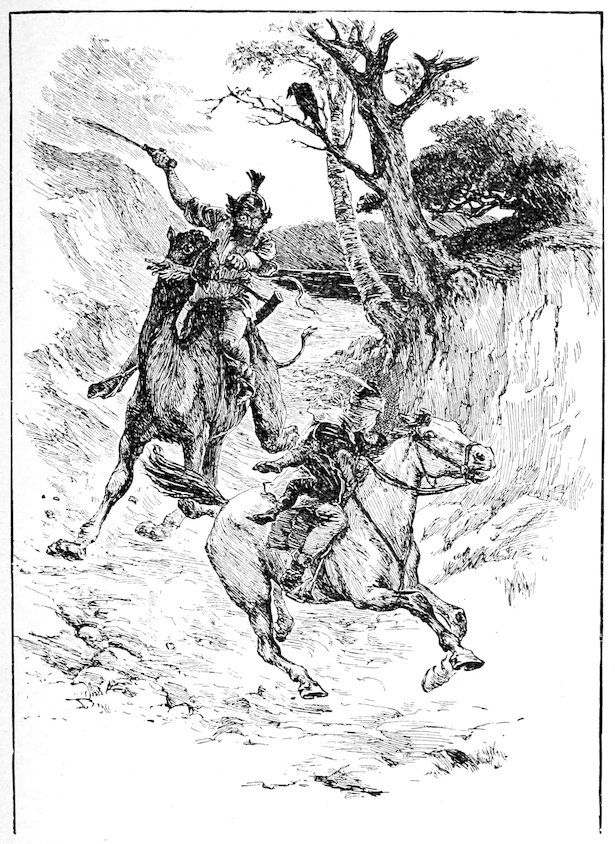
“A Squire came galloping, as he would flie, Bearing a little Dwarfe before his steed, Whom after did a mightie man pursew, Ryding upon a Dromedare on hie, Of stature huge, and horrible of hew.”
267Directly it was daylight they prepared again for their journey, and went forth, Amoret and Emilia as before riding on the horse, and the Prince walking beside them. As soon as they departed, wicked old Slander followed, reviling them, and calling them bad names. The more they were vexed at this, the worse she raged and railed; and even when they had passed out of sight and hearing she did not stop her spiteful speeches, but railed anew against the stones and trees, until she had dulled the sting that grew in the end of her tongue.
As the travellers went slowly on their way, they saw galloping towards them, as if in flight, a Squire who bore before him on his steed a little dwarf, shrieking loudly for help. They were pursued by a mighty man, riding on a dromedary, huge of stature, and horrible to behold. From his terrible eyes came two fiery beams, sharper than needles’ points, which had the power of working deadly poison to all who looked on him without good heed, and of secretly slaying his enemies. All the way he raged at the Squire, and hurled threats at him, but the latter fled so fast he could not overtake him. Seeing the Prince in his bright armour, the Squire called to him to pity him and rescue him from his cruel foe.
Then Prince Arthur at once took down the two ladies from his war-horse, and mounting in their place came to the Squire. In another moment the Giant was upon them. He aimed a furious blow at the Squire, which would certainly have killed him, had not the noble Prince defeated the stroke by thrusting 268forward, and meeting it on his own shield. It fell with such force that it drove the shield aside, and knocked both the Squire and the dwarf to the ground. Then Prince Arthur, enraged, smote at the Pagan with all his might and main, and killed him.
When the Squire saw his foe dead he was indeed glad, but the dwarf howled aloud to see his lord slain, and tore his hair, and scratched his face for grief.
Then the Prince began to inquire about everything that had happened, and who he was whose eyes flamed with fire. And all this the Squire then told him:—
“For his Friend’s Sake”
“This mighty man whom you have slain,” said the Squire, “is the son of a huge giantess. By his strength he gained rule to himself and led many nations into thraldom, conquering them, however, not in battle, by armies of men with waving banners, but by the power of his malignant eyes, with which he killed all who came within his control. Never before was he vanquished, but always vanquished all with whom he fought. Nor was there any man so strong but what he bore him down, nor any woman so fair but he made captive of her; for his chief desire was to make spoil of strength and beauty, and utterly to destroy them. Because of his wicked eyes, which cast flakes of fire into the hearts of those who looked at him, he was rightly called Corflambo.
“He has left one daughter who is named the fair 269Pœana, who seems outwardly as fair as living eye ever yet saw; and if her virtue were as bright as her beauty, she would be as fair as any one on earth. But she is too much given to folly and pleasure, and is also too fickle and too fanciful.
“Well, as it happened, there was a gentle Squire who loved a lady of noble birth; but because his low rank forbade his hoping to marry so high, her friends sagely counselled her against letting herself down to his level. But Emilia would not break the promise she had given Amyas, for she loved him truly, and holding firmly to her first intention, she resolved to marry him, in spite of all her friends. They appointed, therefore, a time and place of meeting, but when accordingly the Squire repaired there, a sad misadventure happened. Instead of finding his fair Emilia, he was caught unawares by Corflambo, who carried his wretched captive, dismayed with despair, to his dungeon, where he remained unaided, and unsought by any one.
“The Giant’s daughter came one day in glee to the prison, to view the captives who lay in bondage there. Among the rest she chanced to see this gallant youth, the Squire of low degree. She took a great liking to him, and she promised that if he would love her in return he should have his liberty.
“Amyas, though plighted to another lady to whom he firmly meant to keep his faith, thought he had better take any means of escape offered by fortune, and therefore pretended to like Pœana a very little, in order to win her favour and get his liberty. But the Giant’s daughter still kept him in captivity, fearing that if she 270set him free he would leave at once and forget her. Yet she showed him so much favour above the other prisoners that he was allowed sometimes to walk about her pleasure gardens, having always a keeper with him. The keeper was this dwarf, her pet menial, to whom as a special favour she commits the keys of all the prison doors. He can, at his will, release those whom he chooses, and those also whom he chooses he can reserve for more severe punishment.
“When tidings of this reached me, I was deeply grieved because of the great love I bear to Amyas, and I went to the Castle of Corflambo. There I concealed myself for a long time, till one day the dwarf discovered me, and told his mistress that her Squire of low degree had secretly stolen out of prison; for he mistook me for Amyas, because no two people were ever more alike.
“I was taken and brought before the Giant’s daughter, who being also beguiled by the likeness, began to blame me for seeking to escape by flight from one who loved me so dearly; and then she ordered me again to prison. Glad of this, I did not contradict her, nor make any resistance, but suffered that same dwarf to drive me to the dungeon.
“There I found my faithful friend in heavy plight and sad perplexity, for which I was sorry, yet bent myself to comfort him again with my company. But this, I found, grieved him the more; for his only joy in his distress, he said, was the thought that Emilia and I were free. He loved Emilia well, as I could guess, and yet he said his love for me was even greater.
271
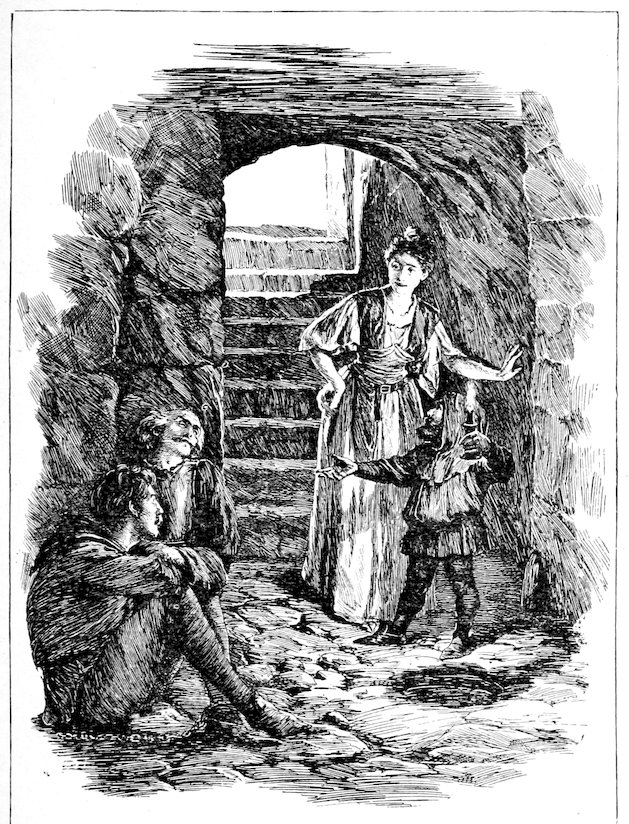
“This Gyant’s daughter came upon a day Unto the prison in her joyous glee, To view the thrals which there in bondage lay.”
“But I reasoned with him and showed him how easy 273it would be to manage a disguise because of our likeness, so that either we could change places or his freedom might be gained. He was most unwilling to agree, and would not for anything consent that I, who was free and out of danger, should wilfully be brought into thraldom. Yet, over-ruled at last, he consented.
“The next day, at about the usual hour, the dwarf called at the door of the dungeon for Amyas to come directly to his lady’s bower. Instead of Amyas, I—Placidas—came forth, and, undiscovered, went with him. The fair Pœana received me with joy, and gave me an affectionate greeting, thinking that I was Amyas. Not having any former love of my own, I was quite willing to accept her kindness and favour, as indeed it was expedient to do. I pretended to make excuses for my former coldness, and promised to be more amiable in future. All this I did, not for my own sake, but to do good to my friend, for whose liberty alone I staked love and life.
“Thenceforward I found more favour at Pœana’s hand. She bade the dwarf who had charge of me lighten my heavy chains and grant me more scope to walk abroad. So, one day, as I played with him on the flowery bank of a stream, finding no means of gaining our freedom unless I could convey away the dwarf, I lightly snatched him up and carried him off.
“He shrieked so loudly that at his cry the tyrant himself came forth and pursued me. Nevertheless I would not give up my prey, and hither by force I have brought him.”
As Placidas spoke thus to Prince Arthur, the two 274ladies, still doubtful through fear, came near, wishing to hear tidings of all that had happened.
Directly Emilia spied her captive lover’s friend, young Placidas, she sprang towards him, and throwing her arms round him, exclaimed, “Does Amyas still live?”
“He lives,” said Placidas, “and loves his Emilia.”
“Not more than I love him,” she cried. “But what misfortune has kept him so long from me?”
Then Placidas told her how Amyas had been taken captive. It filled her tender heart with pity to hear of the misery in which he had lain so long, and she eagerly begged Prince Arthur to set him free. This the Prince readily consented to do, and well he performed his work.
The Giant’s Daughter
Of all human affection the love of one friend for another is surely the noblest and most unselfish; and this true friendship Amyas and Placidas had for each other—not even their affection for kindred or fairest lady could shake their loyalty. For though Pœana were as beautiful as the morning, yet Placidas, for his friend’s sake, scorned her offered favours. His only thought was what he could do to set Amyas free.
275
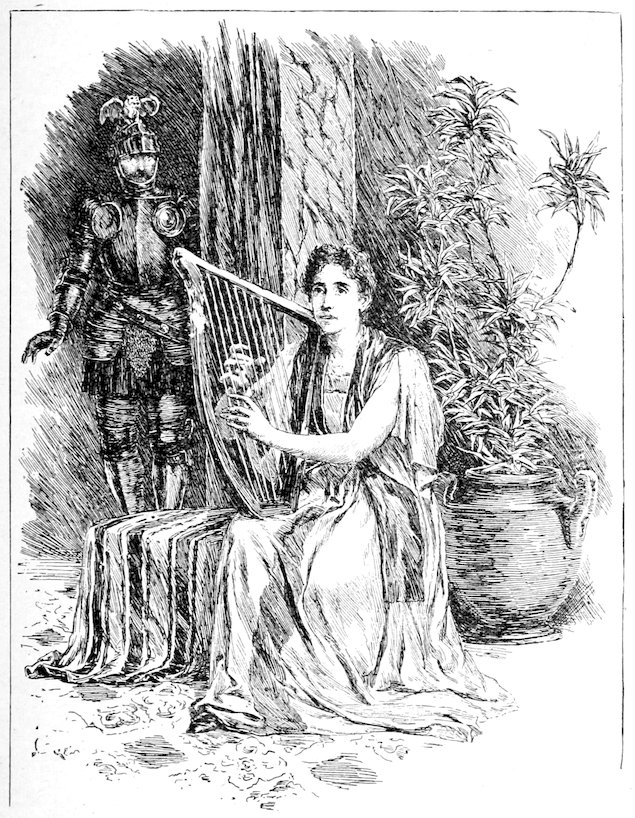
“There did he find in her delicious bower The fair Pœana playing on a rote.”
Now after Prince Arthur had promised to succour the Squire who had lain so long in prison, he next began to consider how best he could effect his purpose. Taking up the dead body of the Giant, he firmly bound 277it on the dromedary, and made it so to ride as if it were alive. Then he took Placidas and placed him in front of Corflambo, as if he were a captive; and he made the dwarf (though very unwillingly) guide the beast till they drew near the castle. When the watchman who kept continual guard saw them thus coming home, he ran down, without doubt or fear, and unbarred the gate, and the Prince following passed in with the others.
There in her delicious bower he found the fair Pœana playing on a rote, complaining of her cruel lover, and singing all her sorrow in music. So sweet and lovely she seemed that the Prince was half-entranced, but wisely bethinking himself of what was right, he caught her unawares and held her captive.
Then he took the dwarf and compelled him to open the prison door, and to bring forth the thralls which he kept there. Over a score of unknown knights and squires were brought to him, all of whom he freed from their bitter bondage, and restored to their former liberty. Among the rest came the Squire of low degree, all weak and wan. As soon as Emilia and Placidas beheld him they both ran and embraced him, holding him fast between them, and striving all they could to comfort him.
The Giant’s daughter, seeing this, envied them both, and bitterly railed at them, weeping with rage and jealousy. But when they had been for some time together, talking over their adventures, although Pœana had often seen Amyas and Placidas separately, she began to doubt which was really the captive Squire 278whom she had loved so dearly; for they appeared so alike in face and person that it was difficult to discover which was which. So also Prince Arthur was amazed at their resemblance, and gazed long in wonder, as did the other knights and squires who saw them.
Then they began to ransack the Giant’s castle, in which they found great store of hoarded treasure, which the tyrant had gathered by wicked means. Prince Arthur took possession of this, and afterwards remained a little while at the castle to rest himself, and refresh the ladies Amoret and Emilia, after their weary toil. To these also he gave part of the treasure.
To add to the rejoicing, he set free the captive lady, the fair Pœana, and placed her in a chair of state with the rest, to feast and frolic. But she would show no gladness nor pleasant glee, for she was grieved for the loss both of her father and of her lands and money. But most of all she deeply grieved for the loss of the gentle Squire Placidas, whom she now really loved.
But Prince Arthur, with his accustomed grace, charmed her to mild behaviour from the sullen rudeness which spoilt her. With gentle words and manner he calmed her raging temper, and softened the bitterness that gnawed at her heart and kept her from the feast; for although she was most fair to see, she spoilt all her beauty by cruelty and pride. And in order to end everything with friendly love—since love was the cause of her grief—Prince Arthur wisely urged the trusty Squire Placidas not to despise without better trial the lady who loved him so dearly, but to accept 279her to be his wedded wife. Placidas was quite willing to marry Pœana; so all their strife came to an end.
From that day forth they lived long together in peace and happiness: no private quarrel nor spite of enemies could shake the calm security of their position. And she whom Nature had created so fair that she could match the fairest of them all, and yet who had spoilt it by her own wayward folly, henceforth reformed her ways, so that all men marvelled at the change, and spoke in praise of her.
Thus having settled these friends, Amyas and Placidas, in peace and rest (for Amyas, of course, married his dear Emilia), Prince Arthur again went on his way; and with him went the Lady Amoret, for she had still to find her husband, the good Knight Scudamour.
280