Sir Calidore, Knight of Courtesy
Reading edition
The Quest of the Blatant Beast
One of the best loved knights at the court of the Faerie Queene was Sir Calidore, for even there, where courteous knights and ladies most did throng, not one was more renowned for courtesy than Calidore. Gentleness of spirit and winning manners were natural to him, and added to these, his gallant bearing and gracious speech stole all men’s hearts. Moreover, he was strong and tall, and well proved in battle, so that he had won much glory, and his fame had spread afar. Not a knight or lady at the Court but loved him dearly; and he was worthy of their affection, for he hated falsehood and base flattery, and loved simple truth and steadfast honesty.
361But like all Queen Gloriana’s other knights, Sir Calidore was not allowed to spend his days in slothful ease at the court. He had his task to perform, and the adventure appointed to him was a hard and perilous one.
As he travelled on his way, it happened by chance that he met Sir Artegall, who was returning half sadly from the conquest he had lately made. They knew each other at once, and Sir Calidore was the first to speak.
“Hail, noblest Knight of all that live and breathe!” he cried. “Now tell me, if it please you, of the good success you have had in your late enterprise.”
Then Sir Artegall told him the whole story of his exploits from beginning to end.
“Happy man to have worthily achieved so hard a quest!” said Calidore, when he had finished. “It will make you renowned for evermore. But where you have ended I now begin to tread an endless track, without guide or direction how to enter in or issue forth—in untried ways, in strange perils, and in long and weary labour. And even although good fortune may befall me, it will be unseen of any one.”
“What is that quest which calls you now into such peril?” asked Sir Artegall.
“I pursue the Blatant Beast,” said Sir Calidore, “and incessantly chase him through the world until I overtake and subdue him. I do not know how or in what place to find him, yet still I fare forward.”
“What is that Blatant Beast?” asked Artegall.
“It is a hideous monster of evil race, born and brought up in dark and noisome places, whence he 362issues forth to be the plague and scourge of wretched men. He has oftentimes annoyed good knight and true lady, and destroyed many, for with his venomous nature and vile tongue he wounds sorely, and bites, and cruelly torments.”
“Then, since I left the savage island, I have seen such a beast,” said Artegall. “He seemed to have a thousand tongues, all agreeing in spite and malice, with which he barked and bayed at me, as if he would have devoured me on the spot. He was set on by two hideous old hags, Envy and Detraction. But I, knowing myself safe from peril, paid no regard to his malice nor his power, whereupon he poured forth his wicked poison the more.”
“That surely is the beast which I pursue,” said Calidore. “I am right glad to have these tidings of him, having had none before in all my weary travels. Now your words give me some hope.”
“God speed you!” said Sir Artegall, “and keep you from the dread danger, for you have much to contend against.”
So they took a kindly leave of each other, and parted on their several ways.
Sir Calidore had not travelled far when he came upon a comely Squire, bound hand and foot to a tree, who seeing him in the distance called to him for aid. The Knight at once set him free, and then asked him what mishap had brought him into such disgrace. The Squire replied it was occasioned not by his fault, but through his misfortune.
363
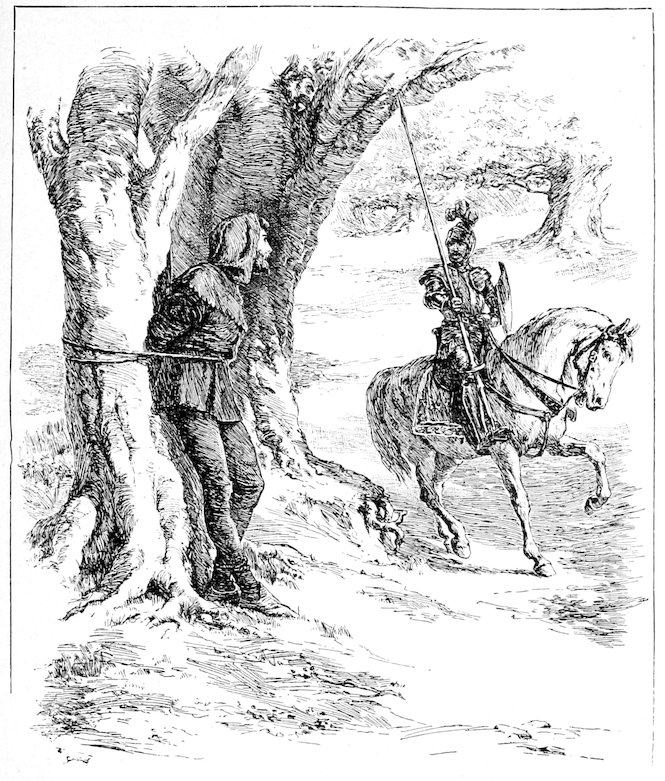
“Sir Calidore thence travelled not long, When as by chaunce a comely Squire be found, That thorough some more mighty enemies wrong Both hand and foote unto a tree was bound.”
“Not far from here, on yonder rocky hill,” he 365said, “stands a strong Castle, where a bad and hateful custom is kept up. For whenever any knight or lady comes along that way (and they must needs go by, for it is the pass through the rocks), they shave away the lady’s locks and the knight’s beard to pay toll for the passage.”
“As shameful a custom as ever I heard of, and it shall be put a stop to!” said Sir Calidore. “But for what cause was it first set on foot?”
“The lady who owns the castle is called Briana, and no prouder one lives,” replied the Squire. “For a long time she has dearly loved a doughty Knight, and sought to win his love by all the means in her power. Crudor, for that is his name, in his scornful and selfish vanity refuses to return her affection until she has made for him a mantle, lined with the beards of knights and the locks of ladies. To provide this, she has prepared this castle, and appointed a Seneschal, called Maleffort, a man of great strength, who executes her wicked will with worse malice.
“As I came along to-day with a fair damsel, my dear love, he set upon us. Unable to withstand him, we both fled, and first capturing me he bound me to this tree till his return, and then went in pursuit of her. Nor do I know whether he has yet found her.”
While they were speaking they heard a piteous shriek, and looking in the direction whence the cry came, they saw the churl dragging the maiden along by her yellow hair. When Calidore beheld the shameful sight he immediately went in pursuit, and commanded the villain to release his prey. Hearing his 366voice, Maleffort turned, and running towards him, more enraged than terrified, said tauntingly—
“Are you the wretch who defies me? And will you give your beard for this maid, whose part you take? Yet it shall not free her locks from ransom.”
With that he flew fiercely at him and laid on the most hideous strokes. But Calidore, who was well skilled in fight, let his adversary exhaust his strength, and then attacked him with such fury that the churl’s heart failed him, and he took flight to the Castle, where his hope of refuge remained. But just as the warders on the Castle wall opened the gates to receive him, Calidore overtook him in the porch, and killed him, so that his dead body fell down inside the door. Then Calidore entered in and slew the porter.
The rest of the Castle inmates flocked round him, but he swept them all aside. Passing into the hall he was met by the Lady Briana herself, who bitterly upbraided him for what she termed his unknightly conduct in slaying her servants.
“Not unto me the shame, but award it to the shameful doer,” replied the Knight. “It is no blame to punish those who deserve it. Those who break the bonds of civility and make wicked customs, those are they who defame both noble arms and gentle courtesy. There is no greater disgrace to man than inhumanity. Then for dread of disgrace forego this evil custom which you here keep up, and show instead kindly courtesy to all who pass. This will gain you more glory than that man’s love which you thus seek to obtain.”
But the Lady Briana only replied to Sir Calidore with 367the most scornful insolence, and despatching a hasty message to Crudor, bade him come to her rescue. While they waited for the return of the messenger, she treated Sir Calidore with every indignity, so that an iron heart could scarcely have borne it; but the Knight wisely controlled his wrath, and bravely and patiently endured her womanish disdain.
In due course the answer came back that Crudor would succour his lady before he tasted bread, and deliver up her foe, dead or alive, into her hand. Then Briana immediately became quite blithe, and spoke more bitterly than ever, yet Calidore was not in the least dismayed, but rather seemed the more cheerful. Putting on his armour, he went out to meet his foe, and soon spied a Knight spurring towards him with all his might.
He guessed at once this was Crudor, and without staying to ask his name couched his spear and ran at him. The Knights met with such fury that both rolled to the ground; but while Calidore at once sprang lightly again to his feet, it was some time before Crudor rose slowly and heavily. Then the battle was renewed on foot, and after a fierce and terrible struggle Calidore at last brought his foe to the ground. He could easily have killed him, but Crudor, seeing the danger in which he was placed, cried out—
“Ah, mercy, Sir! Do not slay me, but spare my life which fate has laid under your foot.”
“And is this the boast of that proud lady’s threat, which menaced to beat me from the field?” said Calidore quietly. “By this you may now learn not to treat strangers so rudely. But put away proud looks and 368stern behaviour, which shall gain for you nothing but dishonour. However strong and fortunate he may be in fight, nothing is more blameful to a Knight, who professes courtesy as well as arms, than the reproach of pride and cruelty. In vain he seeks to suppress others who has not learned first to subdue himself. All flesh is frail and full of fickleness, subject to the chance of ever-changing fortune: what happens to me to-day may happen to you to-morrow. He who will not show mercy to others, how can he ever hope to obtain mercy? To pay each in his own coin is right and just.
“Yet since you now need to crave mercy, I will grant it, and spare your life, on these conditions: First that you shall behave yourself better to all errant knights, wherever they may be; and next, that you aid ladies in every place and in every trouble.”
The wretched man, who had remained all this while in dread of death, gladly promised to perform all Sir Calidore’s behests, and further swore to marry Briana without any dowry, and to release her from his former shameful conditions. Then Calidore called the Lady, and soothing her terror, told her of the promise he had compelled Crudor to make.
Overcome by his exceeding courtesy, which quite pierced her stubborn heart, Briana threw herself at his feet, and acknowledged herself deeply indebted to him for having restored both life and love to her. Then they all returned to the Castle, and she entertained them joyfully with feast and glee, trying by all the means in her power to show her gratitude and goodwill. To Sir Calidore, for his trouble, she freely gave 369the Castle, and professed herself bound to him for ever, so wondrously was she changed from what she had been before.
But Calidore would not keep for himself land or fee as wages for his good deed, but gave them at once as a rightful reward to the Squire whom he had lately freed, and to his damsel, in recompense for all their former wrong. There he remained happily with them till he was well and strong from the wounds he had received, and then he passed forth again on his first quest.
The Proud Discourteous Knight
As Sir Calidore rode on his way he saw not far off a strange sight—a tall young man fighting on foot against an armed Knight on horseback; and beside them he saw a fair lady standing alone on foot, in sad disarray. Before he could get near to ask what was the matter, the armed Knight had been killed by the youth.
Filled with amazement, Sir Calidore steadfastly marked the latter, and found him to be a goodly and graceful youth, still only a slender slip, not more than seventeen years old, but tall and fair of face, so that the Knight surely deemed him of noble birth. He was clad in a woodman’s jacket of Lincoln green, trimmed with silver lace; on his head he wore a hood with spreading points, and his hunter’s horn hung at his side. His buskins were of the costliest leather, adorned with golden points, and regularly intersected with 370stripes, as was then the fashion for those of gentle family. In his right hand he held a quivering dart, and in his left a sharp boar-spear.
Calidore, having well viewed him, at length spoke, and asked him how it came that he, though not yet a Knight, had dared to slay a Knight, which was plainly forbidden by chivalry.
“Truly,” said the youth, “I was loath to break the law of chivalry, but I would break it again rather than let myself be struck by any man. He assailed me first, regardless of what belongs to chivalry.”
“By my troth,” then said Sir Calidore, “great blame is it for an armed Knight to wrong an unarmed man. But tell me why this strife arose between you?”
Then the youth, whose name was Tristram, told him that, as he was hunting that day in the forest, he chanced to meet this man, together with the lady. The Knight, as Sir Calidore had seen, was on horseback, but the lady walked on foot beside the horse, through thick and thin, unfit for any woman. Yet not content with this, to add to the disgrace, whenever she lagged behind, as she must needs do, he would thump her forward with his spear, and force her to go on, while she vainly wept, and made piteous lament.
“When I saw this, as they passed by,” continued Tristram, “I was moved to indignation, and began to blame him for such cruelty. At this he was enraged, and disdainfully reviled me, threatening to chastise me as one would a child. I, no less disdainful, returned his scornful taunts, whereupon he struck me with his spear, and I, seeking to avenge myself, threw a slender 371dart at him, which struck him, as it seems, underneath the heart, so that he quickly died.”
Sir Calidore inquired of the lady if this were indeed true, and as she could deny nothing, but cleared Tristram of all blame, then said the Knight—
“Neither will I charge him with guilt. For what he spoke, he spoke it for you, Lady; and what he did, he did it to save himself, against both of whom that Knight wrought unknightly shame.”
Then turning back to the gallant boy, who had acquitted himself so well and stoutly, and seeing his beautiful face, and hearing his wise words, Sir Calidore was filled with admiration, and felt certain that he came of heroic blood. Then, because of the affection he bore him, he begged the youth to reveal who he was, “for since the day when I first bore arms,” added the Knight, “I never saw greater promise in any one.”
Then Tristram replied that he was the son of a King, although by fate or fortune he had lost his country and the crown that should be his by right. He was the only heir of the good King Meliogras of Cornwall, but his father dying while he was still a child, his uncle had seized the kingdom. The widowed Queen, his mother, afraid lest ill should happen to the boy, sent him away out of the country of Lyonesse, where he was born, into the land of Queen Gloriana, and here he had dwelt since the time he was ten years old.
His days had not been spent in idleness, for he had been well trained with many noble companions in gentle manners and other fitting ways. His chief 372delight was in following the chase, and nothing that ranged in the green forest was unknown to him. But now that he was growing older he felt it was time to employ his strength in a nobler fashion, and he besought Sir Calidore to make him a Squire, so that henceforth he might bear arms, and learn to use them aright.
So Sir Calidore caused him to kneel, and made him swear faith to his Knight, and truth to all ladies, and never to be recreant for fear of peril, nor for anything that might befall. So he dubbed him, and called him his Squire.
Then young Tristram grew full glad and joyous, and when the time came for Sir Calidore to depart, he prayed that he might go with him on his adventure, vowing always to serve him faithfully. Sir Calidore rejoiced at his noble heart, and hoped he would surely prove a doughty Knight, yet for the time he was obliged to make this answer to him:—
“Glad would I surely be, my courteous Squire, to have you with me in my present quest, but I am bound by a vow which I swore to my Sovereign, that in fulfilling her behest I would allow no creature to aid me. For that reason I may not grant what you so earnestly beg. But since this lady is now quite desolate, and needs a safeguard on her way, you would do well to succour her from fear of danger.”
Tristram gladly accepted this new service, so, taking a courteous leave, the two parted.
373
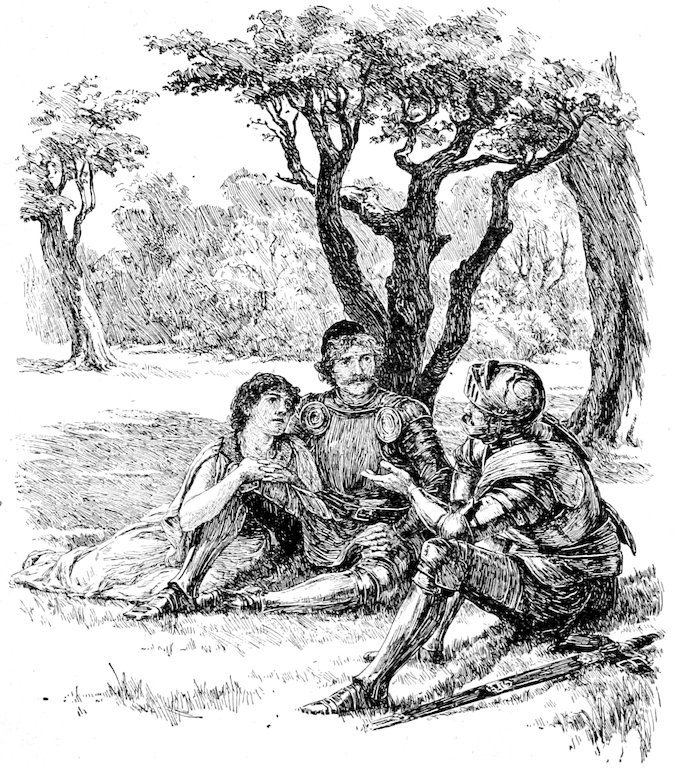
Not long after this, Sir Calidore came upon a Knight and a lady sitting in the shade of some trees. Sir Calidore greeted them courteously, and the Knight invited him to sit down beside them, so that they might talk over all their adventures. While they were chatting together, the Lady Serena wandered away into the fields to pluck some flowers. Then suddenly, from the forest near, the Blatant Beast rushed forth, and catching up the lady, bore her away in his great 374mouth. Starting up, both Knights at once gave chase, and Calidore, who was swiftest of foot, overtook the monster in the midst of his race, and fiercely charging him, made him leave his prey and take to flight.
Knowing that the Knight was close at hand, Sir Calidore did not pause to succour the lady, but quickly followed the brute in his flight. Full many paths and perils he passed; over hill and dale, through forest and plain; so sharply did he pursue the monster that he never suffered him to rest, day or night. From the court he chased him to the city, from the city to the village, from the village into the country, and from the country back to remote farms. Thence the Blatant Beast fled into the open fields, where the herds were keeping the cattle, and the shepherds were singing to their flocks.
Coridon and Pastorella
As Sir Calidore followed the chase of the Blatant Beast he came upon a group of shepherds piping to their flocks. In reply to his questions they answered they had never seen the creature, and if there were any such they prayed heaven to keep him far from them. Then one of them, seeing that Calidore was travel-worn and weary, offered him such simple food and drink as they had with them, and the Knight, who was courteous to all men alike, both the lowly and the high-born, accepted their gentle offer.
375
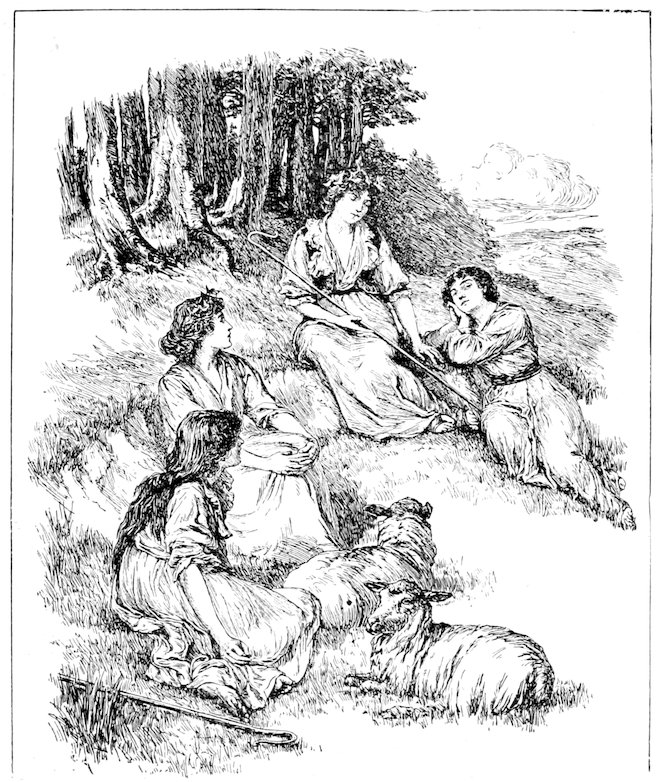
“Upon a little hillocke she was placed Higher than all the rest, and round about Environ’d with a girland, goodly graced Of lovely lasses.”
As he sat amongst these rustics he saw seated on a little hillock, higher than all the rest, a beautiful maiden, 377wearing a crown of flowers tied with silken ribbons. She was surrounded by the other shepherdesses, as with a lovely garland, but her beauty far excelled theirs, and all united in singing the praises and carolling the name of the “fairest Pastorella.” Not one of all the shepherds but honoured her, and many also loved her, but most of all the shepherd Coridon. Yet neither for him nor for any one else did she care a whit; her lot was humble, but her mind was high above it.
As Sir Calidore gazed at her and marked her rare demeanour, which seemed to him far to excel the rank of a shepherd, and to be worthy of a Prince’s paragon, all unawares he was caught in the toils of love, from which no skill of his own could deliver him. So there he sat still, with no desire to move, although his quest had gone far before him. He stayed until the flying day was far spent, and the dews of night warned the shepherds to hasten home with their flocks.
Then came to them an aged sire, with silver beard and locks, and carrying a shepherd’s crook. He was always supposed to be the father of Pastorella, and she indeed thought it herself. But he was not so, having found her by chance in the open field as an infant. He took her home, and cherished her as his own child, for he had none other, and in course of time she came to be accounted so.
Melibee, for so the good old man was called, seeing Calidore left all alone and night at hand, invited him to his simple home, which, although only a mud cottage, with everything very humble, was yet better to lodge in than the open fields. The Knight full gladly agreed, this being his heart’s own wish, and went home with 378Melibee. There he was made heartily welcome by the honest shepherd and his aged wife, and after the frugal supper, which they ate with much contentment, Sir Calidore listened half-entranced while Melibee discoursed on all the joys of a pastoral life. So tempting was the picture he painted that Calidore resolved to lay aside for awhile his toilsome quest and the pursuit of glory, and take a little rest in this peaceful spot. If he were allowed to share the cabin and the scanty fare he promised to reward Melibee well, but the good old man refused the offered gift of gold.
“If you really wish to try this simple sort of life that shepherds lead,” he said, “make it your own, and learn our rustic ways for yourself.”
So Sir Calidore dwelt there that night, and many days after, as long as it pleased him, daily beholding the fair Pastorella, and all the while growing more deeply in love with her. He tried to please her by all the kindly courtesies he could invent, but she, who had never been accustomed to such strange fashions, fit for kings and queens, nor had ever seen such knightly service, paid small heed to them, and cared more for the shepherds’ rustic civility than for anything he did.
Sir Calidore, seeing this, thought it best to change the manner of his appearance. Doffing his bright armour, he dressed himself in shepherd’s attire, taking in his hand a crook instead of a steel-headed spear. Clad thus, he went every day to the fields with Pastorella, and kept her flocks diligently, watching to drive away the ravenous wolf, so that she could sport and play as it pleased her.
379Coridon, who for a long time had loved her, and hoped to gain her love, was greatly troubled, and very jealous of this stranger. He often complained scowlingly of Pastorella to all the other shepherds, and whenever he came near Calidore, would frown and bite his lips, and was ready to devour his own heart with jealousy. The Knight, on the other hand, was utterly free from malice or grudging, never showing any sign of rancour, and often taking an opportunity to praise Coridon to Pastorella. But the maiden, if ever she had cared for her uncouth admirer, certainly did so no longer now that she had seen Calidore.
Once when Calidore was asked to lead the dance with Pastorella, in his courtesy he took Coridon, and set him in his place; and when Pastorella gave him her own flowery garland, he soon took it off and put it on the head of Coridon.
Another time Coridon challenged Calidore to a wrestling match, thinking he would surely avenge his grudge, and easily put his foe to shame, for he was well practised in this game. But he greatly mistook Calidore, for the Knight was strong and mightily tough in sinew, and with one fall he almost broke Coridon’s neck. Then Pastorella gave the oaken crown to Calidore as his due right, but he who excelled in courtesy gave it to Coridon, saying he had won it well.
Thus did that gentle Knight bear himself amidst that rustic throng, so that even they who were his rivals could not malign him, but must needs praise him; for courtesy breeds goodwill and favour even amongst the rudest. So it surely wrought with this fair maiden, 380and in her mind sowed the seeds of perfect love, which at last, after long trial, brought forth the fruit of joy and happiness.
But whatever Sir Calidore did to please Pastorella, Coridon immediately strove to emulate; and if the Knight succeeded in winning favour, he was frozen with jealousy.
One day, as they all three went together to the greenwood to gather strawberries, a dangerous adventure befell them. A tiger rose up out of the wood and rushed with greedy jaws at Pastorella. Hearing her cry for help, Coridon ran in haste to rescue her; but when he saw the fiend he fled away just as fast in cowardly fear, holding his own life dearer than his friend. But Calidore, quickly coming to her aid when he saw the beast ready to rend his dear lady, ran at him enraged, instead of being afraid. He had no weapon but his shepherd’s crook, but with that he struck the monster so sternly that he fell stunned to the ground, and then, before he could recover, Sir Calidore cut off his head, and laid it at the feet of the terrified maiden.
From that day forth Pastorella grew more and more fond of the Knight, but Coridon she despised, because of his cowardice. Then for a long time Sir Calidore dwelt happily among these shepherd folk, forgetting his former quest, so full of toil and pain, and rejoicing in the happy peace of rustic bliss.
But at last malicious fortune, which envies the long prosperity of lovers, blew up a bitter storm of adversity.
381
In the Brigands’ Den
One day, when Sir Calidore was away hunting in the woods, a lawless tribe of brigands invaded the country where the shepherds dwelt, ravaged their houses, murdered the shepherds, and drove away their flocks. Old Melibee and all his household were led away captive, and with them also was taken Coridon. In the dead of night, so that no one might see or rescue them, the robbers carried their prey to their dwelling. This was on a little island, so covered with dense brushwood that there seemed no way for people to pass in or out, or to find footing in the overgrown grass; for the way was made underground, through hollow caves that no man could discover, because of the thick shrubs which hid them from sight. Through all the inner parts of their dwelling the darkness of night daily hovered; they were not lighted by any window or opening in the roof, but with continual candle-light, which made a dim and uncertain gloom.
Hither the brigands brought their prisoners, and kept them under constant watch and ward, meaning, as soon as they conveniently could, to sell them as slaves to merchants, who would either keep them in bondage or sell them again. But the Captain of the brigands was enchanted with the loveliness of Pastorella, and determined to keep her for himself. When, therefore, the other prisoners were brought forward to be sold, so that the money received for them might be divided equally among the band, he held back Pastorella, saying 382that she was his prize alone, with whom no one else had anything to do. Besides, he added, she was now so weak and wan through illness that she was worth nothing as merchandise; and then he showed her to them, to prove how pale and ill she was.
The sight of her wondrous beauty, though now worn and faded, and only to be dimly seen by candle-light, so amazed the eyes of the merchants that they utterly refused to buy any of the other prisoners without her, and offered to pay large sums of gold. Then the Captain bade them be silent. He refused to sell the maiden; they could take the rest if they would—this one he would keep for himself.
Some of the other chief robbers boldly forbade him to do this injury, for the maiden, much as it grieved him, should be sold with the rest of the captives, in order to increase their price. The Captain again refused angrily, and, drawing his sword, declared that if any one dared to lay a hand on her, he should dearly rue it, and his death should pay the price.
From words they rapidly fell to blows, and, the candle being soon quenched in the conflict, the fight raged furiously in the dark. But, first of all, they killed the captives, lest they should join against the weaker side or rise against the remnant. Old Melibee and his aged wife were slain, and many others with them; but Coridon, escaping craftily, crept out of doors, hidden in the darkness, and fled away as fast as he could. Unhappy Pastorella was defended all the time by the Captain of the brigands, who, more careful of her safety than of his own, kept his target always 383stretched over her. At length he was slain, yet, even in his fall, continued with his extended arms to shelter Pastorella, who, wounded with the same stroke, fell to the ground with him.
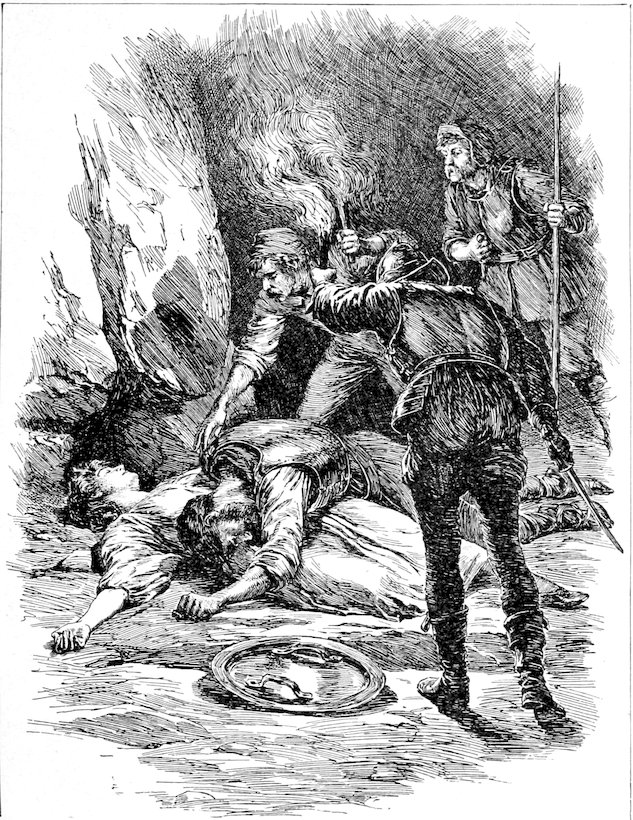
“Their Captaine there they cruelly found kild And in his armes the dreary, dying mayd.”
385With the death of the Captain the fray ceased, and the brigands, lighting fresh candles, made search to see who was slain, friends and foes. There they found their Captain cruelly killed, and, in his arms, the dying maiden; but, seeing that life still lingered, they busily applied all their skill to call her soul back to its home, and so well did they work that at last they restored her to life. This done, they placed her in charge of one of the brigands, who kept her in harsh and wretched thraldom, scarcely allowing her food or rest, or suffering her wounds to be properly tended.
Sir Calidore, meanwhile, having returned from the wood, and found the cottage despoiled and his love reft away, waxed almost mad with grief and rage. To add to his anguish, there was not a soul of whom he could inquire anything. He sought the woods, but could see no man; he sought the plains, but could hear no tidings. The woods only repeated vain echoes; the plains were waste and empty. Where once the shepherds played their pipes and fed a hundred flocks, there now he found not one.
At last, as he roamed up and down, he saw a man coming towards him, who seemed to be some wretched peasant in ragged clothes, with hair standing on end, as if he fled from some recent danger, which still followed close behind. As he came near, the Knight saw it was Coridon. Running up 386to him, Sir Calidore asked where were the rest—where was Pastorella?
Bursting into tears, Coridon told how they had been seized by the brigands, and carried to their den. He described how they were to have been sold as slaves, and the quarrel that had arisen over Pastorella. He told how the Captain had tried to defend her. “But what could he do alone against them all?” he added. “He could not save her; in the end she must surely die. I only escaped in the uproar and confusion, and it were better to be dead with them than to see all this place, where we dwelt together in joy, desolate and waste.”
Calidore was at first almost distracted at hearing this dreadful news; but presently, recovering himself, he began to cast about in his mind how he might rescue Pastorella if she were still alive, or how he should revenge her death; or, if he were too weak to avenge her, then at least he could die with her.
Therefore, he prayed Coridon, since he knew well the readiest way into the thieves’ den, that he would conduct him there. Coridon was still so frightened that at first he refused; but at last he was persuaded by Sir Calidore’s entreaties and promises of reward.
So forth they went together, both clad in shepherd’s dress and carrying their crooks; but Calidore had secretly armed himself underneath. Then, as they approached the place, they saw upon a hill, not far away, some flocks of sheep and some shepherds, to whom they both agreed to take their way, hoping to learn some news.
There they found, which they did not expect, the 387self-same flocks which the brigands had stolen away, with several of the thieves left to look after them. Coridon knew quite well his own sheep, and, seeing them, began to weep for pity; but, when he saw the thieves, his heart failed him, although they were all asleep. He wanted Calidore to kill them as they slept and drive away the sheep, but the Knight had another purpose in view. Waking the brigands, he sat down beside them, and began to chat of different things, hoping to find out from them whether Pastorella were alive or slain. The thieves, in their turn, began to question Sir Calidore and Coridon, asking what sort of men they were and whence they came; to which they replied that they were poor herdsmen who had fled from their masters, and now sought hire elsewhere.
The thieves, delighted to hear this, offered to pay them well if they would tend their flocks, for they themselves were bad herdsmen, they said, not accustomed to watch cattle or pasture sheep, but to foray the land or scour the sea. Sir Calidore and Coridon agreed to keep the flocks; so there they stayed all day, as long as the light lasted.
When it grew towards night the robbers took them to their dens, which they soon got to know quite well, and where they sought out all the secret passages. There they found, to their joy and surprise, that Pastorella still lived. Watching their opportunity, one dead of night, when all the thieves were sound asleep after a recent foray, Sir Calidore made his way to the Captain’s den. When he came to the cave he found it fast, but he assailed the door with irresistible might and burst 388the lock. One of the robbers, awaking at the noise, ran to the entrance, but the bold Knight easily slew him. Pastorella, in the meanwhile, was almost dead with fright, believing it to be another uproar such as she had lately seen. But when Sir Calidore came in, and began to call for her, knowing his voice, she suddenly revived, and her soul was filled with rapture. No less rejoiced Calidore when he found her, and like one distracted he caught her in his arms and kissed her a thousand times.
By this time the hue and cry was raised, and all the brigands came crowding to the cave; but Calidore stood in the entry, and slew each man as he advanced, so that the passage was lined with dead bodies. Then, when no more could get near him, he rested till the morning, when he made his way into the open light. Here all the rest of the brigands were ready waiting for him, and, fiercely assailing him, fell on him with all their might. But Calidore, with his raging brand, divided their thickest troops and scattered them wide. Like a lion among a herd of deer, so did he fly among them, hewing and slaying all that came near, so that none dared face the danger, but fled from his wrath to hide from death in their caves.
Then, returning to his dear lady, he brought her forth into the joyous light, and did everything he could to make her forget the troubles through which she had passed. From the thieves’ den he took all the spoils and treasures of which they had robbed other people, and all the flocks which they had stolen from Melibee he restored to Coridon.
389
The Beast with a Thousand Tongues
Sir Calidore, having rescued Pastorella from the brigands’ den, took her to the Castle of Belgard, where the good Sir Bellamour was lord, and there a strange thing happened.
Years before, Sir Bellamour had secretly married a beautiful maiden, called Claribel, the daughter of a rich and powerful man, known by the name of the “Lord of Many Islands.” Her father had hoped, because of his great wealth, that his daughter would marry the Prince of a neighbouring country, and when he found that she loved Sir Bellamour, he was in such a rage that he threw them in two deep dungeons, forbidding them ever to see each other. When Claribel was in prison, a little daughter was born to her; but, fearing lest her father should get hold of it, she entrusted it to her handmaid, Melissa, to have it brought up as a stranger’s child. The trusty damsel carried it into an empty field, and having kissed and wept over it, placed it on the ground, and hid herself behind some bushes near, to see what mortal would take pity on the poor little infant. At length a shepherd, who kept his fleecy flocks on the plains around, led by the infant’s cry, came to the place, and when he found there the abandoned treasure, he took it up, and wrapping it in his mantle, bore it home to his honest wife, who ever afterwards brought it up as her own child.
Claribel and Bellamour remained a long time in 390captivity, till at last the “Lord of Many Islands” died, and left them all his possessions. Then the tide of fortune turned, they were restored to freedom, and rejoiced in happiness together. They had lived for a long time in peace and love when Sir Calidore brought Pastorella to the castle. Here they both received the heartiest welcome, for Sir Bellamour was an old friend of Calidore’s, and loved him well; and Claribel, seeing how weak and wan Pastorella was after her long captivity, tended her with the greatest love and care.
Now, it happened that before the handmaiden parted with the infant she noticed on its breast a little purple mark, like a rose unfolding its silken leaves. This same maiden, Melissa, was appointed to wait on Pastorella, and one morning, when she was helping her to dress, she noticed on her chest the rosy mark which she remembered well on the little infant, Claribel’s daughter. Full of joy, she ran in haste to her mistress, and told her that the beautiful lady was no other than the little child who had been born in prison. Then Claribel ran quickly to the stranger maiden, and finding it was even as Melissa said, she clasped her in her arms and held her close, weeping softly and saying, “And do you now live again, my daughter, and are you still alive whom long I mourned as dead?”
Then there was great rejoicing in the Castle of Belgard.
391
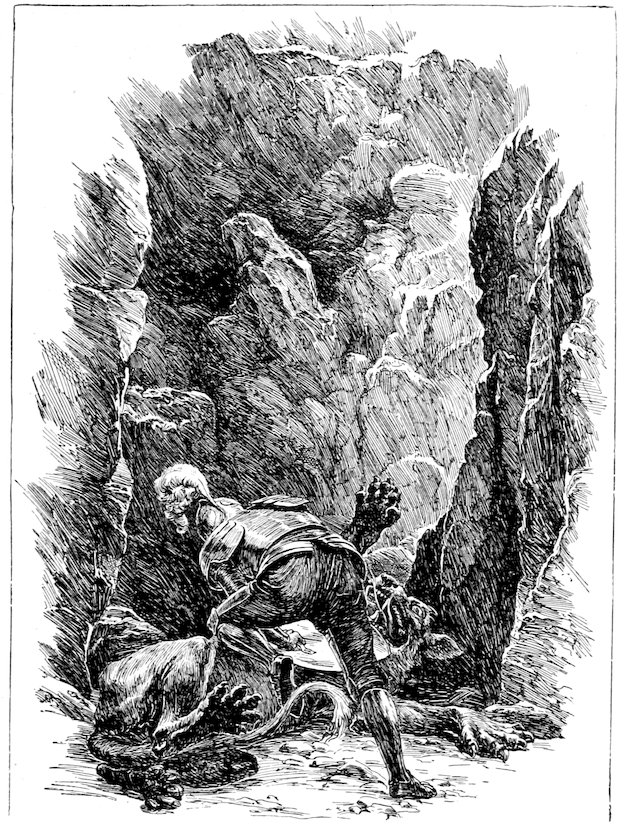
“Putting his puissance forth, pursued so hard That backward he enforced him to fall; And being down, ere he new help could call, His shield he on him threw, and far down held.”
Meanwhile Sir Calidore was pursuing the quest of the Blatant Beast, seeking him in every place with 393unresting pain and toil, and following him by his destroying track, for wherever the monster went he left behind him ruin and devastation.
At last, in a narrow place, Sir Calidore overtook him, and, fiercely assailing, forced him to turn. Then the Blatant Beast ran at him with open mouth, huge and horrible; it was all set with a double row of iron teeth, and in it were a thousand tongues of every kind and quality—some were of dogs, that barked day and night; some of cats that yawled; some of bears that growled continually; some of tigers that seemed to grin and snarl at all who passed by; but most of them were tongues of mortal men, who poured forth abuse, not caring where nor when; and among them were mingled here and there the tongues of serpents, with three-forked stings, that spat out poison at all who came within reach, speaking hateful things of good and bad alike, of high and low, not even sparing kings or kaisers, but either blotting them with infamy or biting them with their baneful teeth.
But Calidore, not in the least afraid of this horrid spectacle, met him with such impetuous might that he checked his violence and beat him back. Then the monster, rearing up, ramped upon him with his ravenous paws, as if his cruel claws would have rent him; but the Knight, being well on guard, cast his shield between, and putting forth all his strength, forced him to fall back; and when he was down, he threw his shield on him and pinned him to the ground. In vain did the Beast rage and roar; for the more he strove, the more firmly the Knight held him, so that he was almost mad 394with spite. He grinned, he bit, he scratched, he spat out venom, and acted like a horrible fiend.
When the monster saw force was of no avail, he began to use his hundred tongues, and reviled and railed at the Knight with bitter terms of infamy, weaving in many a forged lie, whose like Sir Calidore had never heard or thought of; yet for all that he did not let the creature go, but held him so tight that he nearly choked him.
At last, when he found his strength failing and his rage lessening, Sir Calidore took a strong muzzle of the stoutest iron, made with many a link, with which he fastened up his mouth, shutting up therein his blasphemous tongue, so that he should never more defame gentle knight or wrong lovely lady; and to this he tied a great long chain, with which he dragged him forth in spite of himself. The hideous Beast chafed inwardly at these strange bonds, which no one till then had dared to impose on him; yet he dared not draw back nor attempt to resist the power of the noble Calidore, but trembled before him, and followed like a frightened dog.
All through Faerie Land he followed him thus, as if he had learnt obedience, so that all the people wherever he went thronged out of the town to see Sir Calidore lead the Blatant Beast in bondage, and seeing it were amazed at the sight; and all such people as he had formerly wronged rejoiced to see him a captive, and many wondered at the Beast, but more wondered at the Knight.
Thus was this monster suppressed and tamed by the 395mastering might of the doughty Calidore, and so for a long time he remained. But at last, either by wicked fate or the fault of men, he broke his iron chain, and got again at liberty into the world; and here he still ranges, barking and biting, sparing no one in his malice, and doing an infinite deal of mischief wherever he goes; and since the days of the good Sir Calidore no man has ever been able to master him.
THE END
LONDON: WELLS GARDNER, DARTON, AND CO., LIMITED
TRANSCRIBER’S NOTES
Page Changed from Changed to
116 carefully, less a worse evil come upon you carefully, lest a worse evil come upon you
Fixed typos; non-standard spelling and dialect retained.