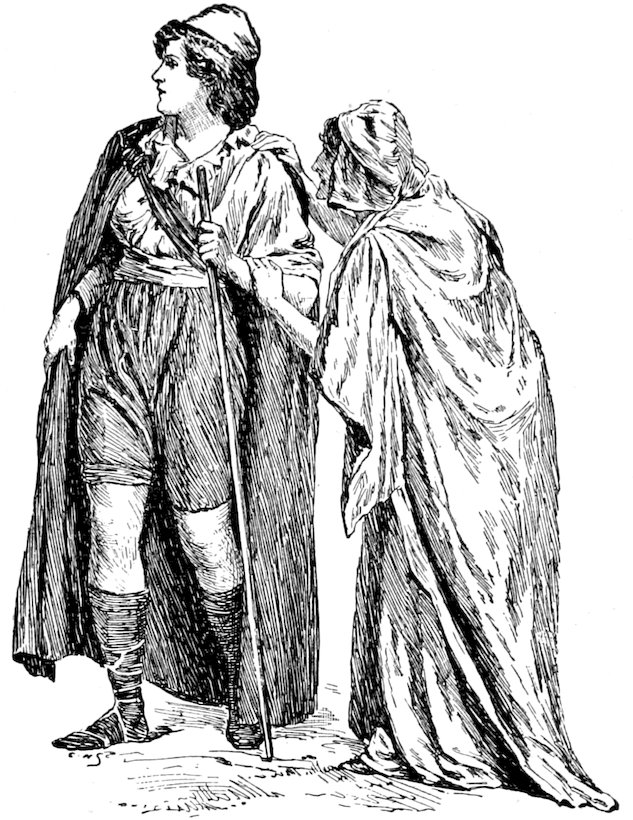
“The Good Sir Guyon”
Reading edition
Sir Guyon meets the Magician
Archimago, the wicked magician, who had worked such mischief to Una and the Red Cross Knight, was very angry when he found that in the end all his evil wiles were defeated, and that the Knight and the lady were happily betrothed. He would willingly have brought more trouble on them, but he was powerless to do any harm to Una, for she was now safely restored to her own kingdom, and 93living in the care of her father and mother. He therefore directed all his spite against the Knight, who had once more to set forth on his adventures, as he had promised Queen Gloriana to serve her faithfully for six years. At the end of that time he hoped to return and marry Una, and the King, her father, had made him heir to the throne.
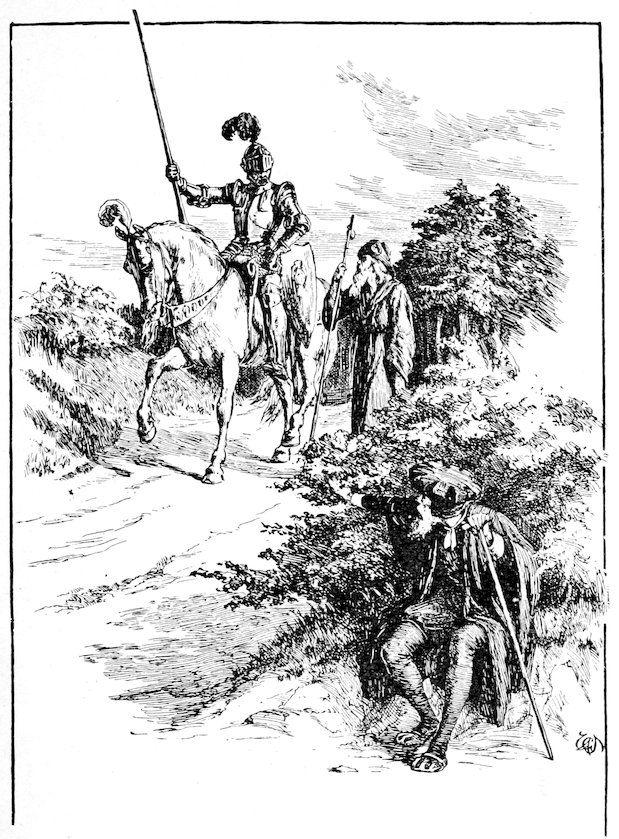
“Upon the way him fortuned to meete, Faire marching underneath a shadie hill, A goodly Knight, all armed in harnesse meete.”
95Archimago, whose other name you may remember was Hypocrisy, set all his wits to work to see what harm he could do the Knight, for he knew that, after all the troubles he had fallen into, he would be more than usually careful. He kept laying snares for him, and placed spies wherever he went, but the Knight had now become so wise and wary that he always found out and shunned the danger. Archimago, however, still kept on hoping he should find some way to hurt him, and at last his opportunity came.
It happened, one day, that the enchanter saw marching to meet him a noble knight. The stranger was clad in shining armour and rode a splendid war-horse; his bearing was very stately, and his face, although calm and beautiful, was so stern and noble that all his friends loved him and his foes feared him. He was one of the chief knights of Queen Gloriana’s court, a man of great honour and power in his native land. His name was Sir Guyon.
As the Red Cross Knight was known as the Champion of Holiness, so Sir Guyon was known as the Knight of Temperance.
With him now there was an aged palmer or pilgrim, clad in black; his hair was grey and he leant on a staff. To judge by his look he was a wise and grave old 96man, and he seemed to be acting as guide to the Knight, who carefully checked his prancing horse to keep pace with his slow footsteps.
The name of the black palmer was Conscience, and he went with Sir Guyon as his companion and adviser, somewhat in the same fashion as Prudence had gone as servant with the Red Cross Knight.
When Archimago saw Sir Guyon, he immediately stopped him, just as on a former occasion he had stopped the Red Cross Knight.
This time he had a fresh story to tell, which, of course, was perfectly false. He implored Sir Guyon to come to the help of a beautiful maiden, cruelly ill-treated by a rough knight, who had cut off her golden locks, and threatened to kill her with his sharp sword.
“What!” cried Sir Guyon, his gentle nature roused to indignation, “is the man still alive who could do such a deed?”
“He is alive, and boasts of it,” said wicked Hypocrisy. “Nor has any other knight yet punished him for it.”
“Take me to him at once,” said Sir Guyon.
“That I can easily do,” said Archimago. “I will show you where he is,” and he hurried off in high glee, because he thought that at last he had found a way of revenging himself on the Red Cross Knight.
Friend or Foe?
Archimago and Sir Guyon came presently to a place where a beautiful lady sat alone, with torn clothes and ruffled hair; she was weeping bitterly and wringing her 97hands, and when Sir Guyon asked her the cause of her grief, she said it was because she had been most cruelly treated by a rough knight.
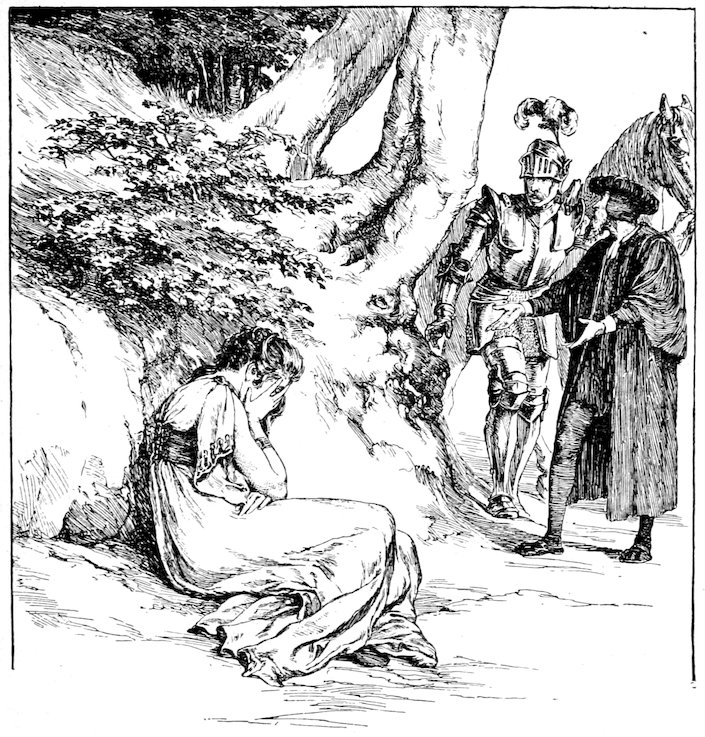
This lady who seemed so good and gentle was, in reality, no other than Duessa (or Falsehood), who had formerly led the Red Cross Knight into such trouble. Her old companion, Archimago, had found her wandering forlorn in the desert whither she had been banished 98by Prince Arthur, and had again decked her out in fine clothes and ornaments, so that she might help him in his wicked schemes.
Her cunning quite deceived Sir Guyon, who believed everything she told him.
“Be comforted, fair lady,” he said, “and tell me who did this, so that I can punish him at once.”
“I do not know his name,” she replied, “but he rode a dappled grey steed, and on his silver shield there was a red cross.”
When Sir Guyon heard this he was amazed.
“I cannot think how that knight could have done such a deed,” he said, “for I can say boldly he is a right good knight. I was present when he first took arms and started out to help the Lady Una, since when he has won great glory, as I have heard tell. Nevertheless, he shall be made to explain this, and if he cannot clear himself of all blame, be sure he shall be well punished.”
Duessa was greatly pleased when she heard this, for now she hoped there would be a quarrel between the two knights.
Archimago then led Sir Guyon by an unknown way through woods and across mountains, till they came at last to a pleasant dale which lay between two hills. A little river ran through this valley, and by it sat a knight with his helmet unlaced, refreshing himself with the cool water after his long journey and hard work.
“Yonder is the man!” cried Archimago. “He has come here thinking to hide himself, but in vain, for you will soon make him repent of his cruelty. 99All success to you! We will stay here, and watch from a distance.”
Archimago and Duessa left Sir Guyon, who immediately rushed forward to the attack. The stranger, seeing a knight hurrying so fiercely towards him, seized his own weapons, prepared for battle, and sprang to meet him. The two had almost met when Sir Guyon suddenly lowered his spear.
“Mercy, Sir Knight! Mercy!” he cried. “Pardon my rashness, that had almost led me to disgrace my honour by raising my weapon against the sacred badge on your shield.”
When the Red Cross Knight, for he indeed it was, heard the other’s voice, he knew him at once.
“Ah! dear Sir Guyon,” he said, bowing courteously, “it is I rather who should be blamed. In my reckless haste I almost did violence to the image of Queen Gloriana which I now see inscribed on your shield. The fault is mine!”
So the two knights made friends, and talked very happily together, and Sir Guyon explained how he had been cheated by Archimago and Duessa, who had both now fled away. Then up came Guyon’s guide, Conscience, and as soon as his eye fell on the Red Cross Knight, he knew him, for he had seen him at the court of Queen Gloriana.
“Joy be with you, and everlasting fame, for the great deeds you have done!” he cried. “Your glorious name is enrolled in the heavenly register, where you have won a seat among the saints. But we luckless mortals are only now beginning to run the race in which you 100have gained such renown.” Then to his master he said, “God grant you, Guyon, to end your work well, and bring your weary bark safely to the wished-for haven.”
“Palmer,” said the Red Cross Knight, “give the praise to God, to whom all honour is due, and who made my hand the organ of His might. Attribute nothing to me except a willing heart; for all that I did, I only did as I ought. But as for you, fair sir, whose turn it is now,” he added to Guyon, “may you prosper as well as you can wish, and may we hear thrice happy tidings of you; for you are indeed worthy, both in courage and gentle manners.”
Then the two Knights took leave of each other with much courtesy and goodwill. Sir Guyon went forward on his journey, still guided by the Black Palmer, who led him over hill and dale, pointing out the way with his staff, and by his wise judgment guarding his master from all dangers into which his own hasty nature might have made him fall.
The Story of the Knight and the Lady
After leaving the Red Cross Knight, Guyon and the Black Palmer (or Conscience) travelled for some distance, fighting and winning many battles as they went, which brought much honour to the Knight.
But the chief adventure in Sir Guyon’s life began in this way:
One day, passing through a forest, they heard sounds of bitter weeping and lamentation.
101“If I cannot be revenged for all my misery,” cried a voice, “at least nothing can prevent my dying. Come then, come soon, come, sweetest death! But, thou, my babe, who hast seen thy father’s fall, long mayest thou live, and thrive better than thy unhappy parents. Live to bear witness that thy mother died for no fault of her own.”
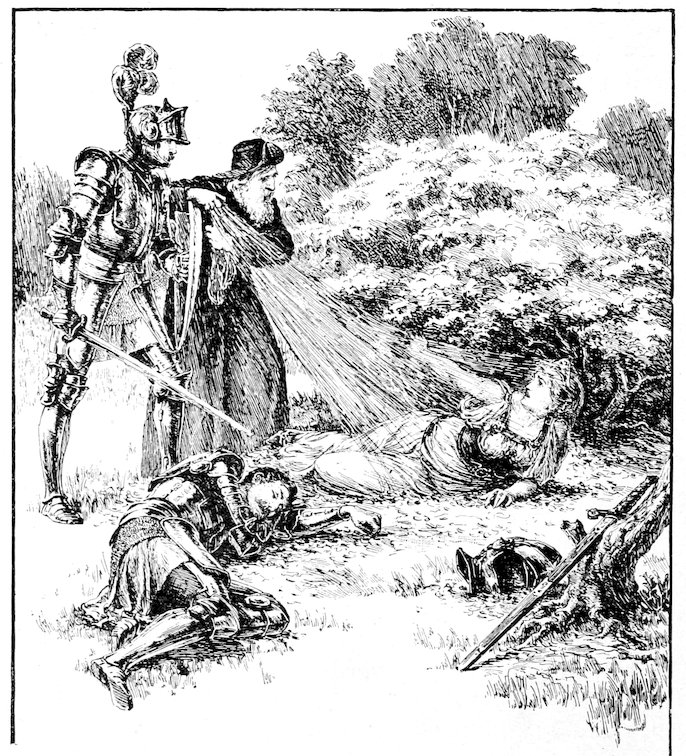
When Sir Guyon heard these piteous words, he dismounted, and rushed into the thicket, where he found a beautiful lady dying on the ground. In her arms there was a lovely baby, and the dead body of an armed knight lay close beside them.
Horrified at the sight, Sir Guyon did all he could to restore the lady to life, but she begged him to leave her alone to die in peace; her sorrows, she said, were more than she could bear, and therefore she had tried to kill herself.
“Dear lady,” said Sir Guyon, “all that I wish is to comfort you, and to bring you some relief, therefore tell me the cause of your misfortune.”
“Listen, then,” she answered. “This dead man, the gentlest, bravest knight that ever lived, was my husband, the good Sir Mordant. One day he rode forth, as is the custom of knights, to seek adventures, and it chanced most unhappily he came to the place where the wicked Acrasia lives—Acrasia, the false enchantress, who has brought ruin on so many knights. Her dwelling is within a wandering island, in Perilous Gulf. Fair sir, if ever you travel there, shun the hateful place! I will tell you the name—it is called the Bower of Bliss. Acrasia’s one aim in life is 102Pleasure. In the Bower of Bliss nothing is thought of but eating and drinking, and every kind of luxury and extravagance. All those who come within it forget everything good and noble, and care for nothing but to amuse themselves. When my dear knight never returned to me, I set forth in search of him, and here I found him, a captive to the spells of Acrasia. At first he did not even know me; but by-and-by, with great care, I brought him back to a better state of mind, and persuaded him to leave the Bower of Bliss. But the wicked enchantress, angry at losing one of her victims, gave him a parting cup of poison, and stooping to drink at this well, he suddenly fell dead. When I saw this——” Here the lady’s own words failed, and, lying down as if to sleep, quiet death put an end to all her sorrow.
Sir Guyon felt such grief at what had happened that he could scarcely keep from weeping. Turning to the Palmer, he said: “Behold here this image of human life, when raging passion like a fierce tyrant robs reason of its proper sway. The strong it weakens, and the weak it fills with fury; the strong (like this Knight) fall soonest through excess of pleasure; the weak (like this Lady) through excess of grief. But Temperance with a golden rule can measure out a medium between the two, neither to be overcome by pleasure, nor to give way to despair. Thrice happy man who can tread evenly between them! But, since this wretched lady did wrong through grief, and not from wickedness, it is not for us to judge her. Let us give her an honourable burial. Death comes to all, 103the good and the bad alike, and, after death, each must answer for his own deeds. But both alike should have a fitting burial.”
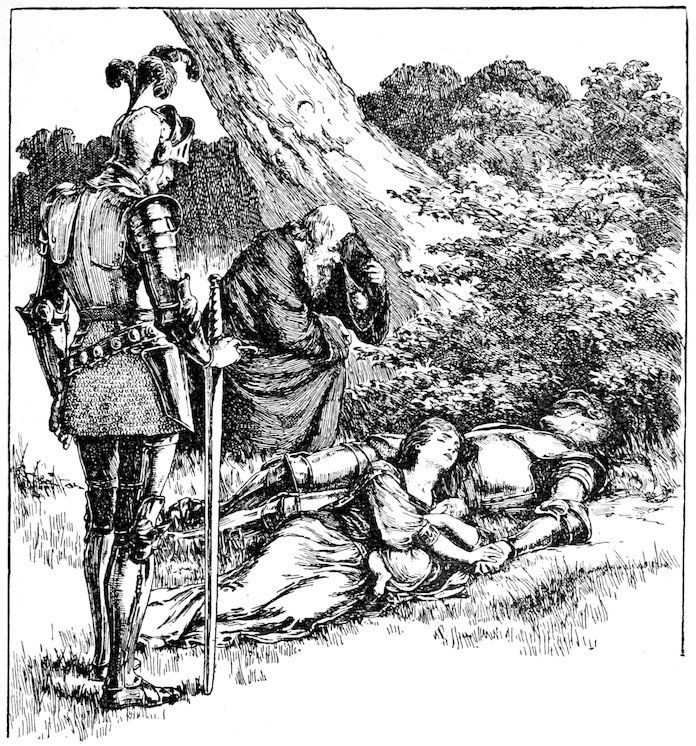
So Sir Guyon and the Black Palmer dug a grave under the cypress-trees, and here they tenderly placed the dead bodies of the Knight and the Lady, and bade them sleep in everlasting peace. And before they left the spot, Sir Guyon swore a solemn vow that he would avenge the hapless little orphan child for the death of his parents.
104
The Three Sisters
After the burial of the Knight and the Lady, Sir Guyon gave the little baby into the care of the Palmer, and, lading himself with the heavy armour of the dead Sir Mordant, the two started again on their journey. But when they came to the place where Sir Guyon had left his steed, with its golden saddle and costly trappings, they found, to their surprise and vexation, that it had quite disappeared. They were obliged, therefore, to go forward on foot.
By-and-by they came to a famous old Castle, built on a rock near the sea. In this castle lived three sisters, who were so different in character that they could never agree. The eldest and the youngest were always quarrelling, and they were both as disagreeable as possible to the middle sister. Elissa, the eldest, was very harsh and stern; she always looked discontented, and she despised every kind of pleasure or merriment. It was useless ever to attempt to make her smile; she was always frowning and scolding in a way not at all becoming to any gentle lady.
Perissa, the youngest sister, was just as bad in the other direction; she cared for nothing but amusement, and was so full of laughter and play that she forgot all rules of right and reason, and became quite thoughtless and silly. She spent all her time in eating, and drinking, and dressing herself up in fine clothes.
105
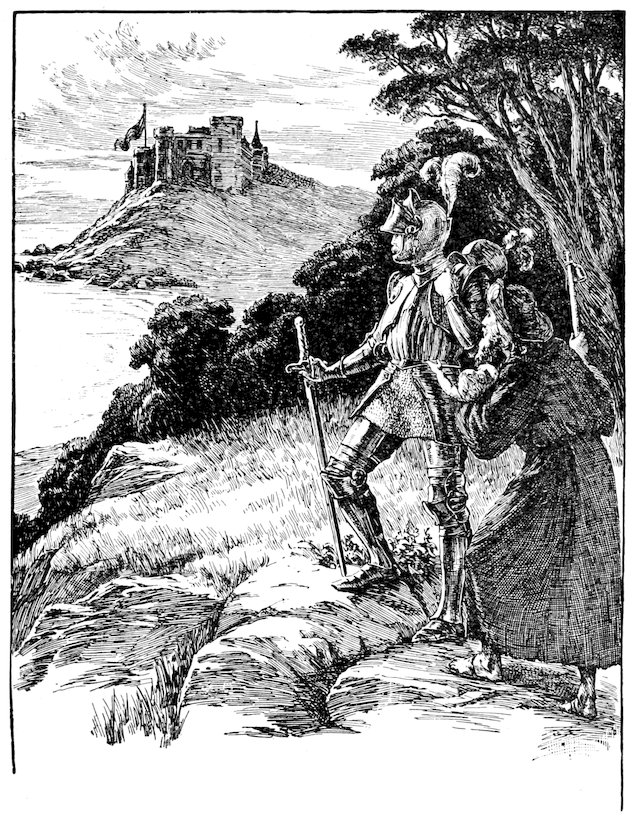
“... At last they to a Castle came, Built on a rocke adjoyning to the seas.”
These two sisters showed the evil of two extremes; but the middle sister, Medina, or “Golden Mean,” as 107she was sometimes called, was the type of moderation, and all that was right and proper. She was sweet, and gracious, and womanly; not harsh and stern, like Elissa, nor yet heedless and silly, like Perissa. She dressed richly, but quietly, and her clothes suited her well: they were different alike from Elissa’s stinginess and Perissa’s extravagance.
When Medina saw Sir Guyon approaching the castle, she met him on the threshold, and led him in like an honoured guest. But her sisters were very angry when they heard of his arrival. There were two other visitors at the castle just then, and they also were very angry. Sir Hudibras was a friend of the eldest sister. He was very savage and sullen, slow-witted, but big and strong. Sans-loy, or Lawless, was the friend of the youngest sister. He was the same Lawless who had been so cruel to poor Una, and he was just as bold and unruly now as he had been then, and he never cared what wrong he did to any one.
These two hated each other, and were always quarrelling, but when they heard of the coming of the stranger knight, they both flew to attack him. On the way, however, they began fighting with each other, and, hearing the noise, Sir Guyon ran to try to stop them, whereupon they both turned upon him. The two sisters stood by, and encouraged them to go on fighting; but Medina ran in amongst them, and entreated them to stop. Her gentle words at last appeased their anger, and they laid down their weapons, and consented to make friends.
Then Medina invited them all to a feast, which 108she had prepared in honour of Sir Guyon. Elissa and Perissa came very unwillingly, though they attempted to hide their grudging and envy under a pretence of cheerfulness. One sister thought the entertainment provided far too much, and the other sister thought it far too little. Elissa would scarcely speak or eat anything, while Perissa chattered and ate far more than was right or proper.
After the feast, Medina begged Sir Guyon to tell them the story of his adventures, and to say on what quest he was now bound.
Then Sir Guyon told them all about the court of the Faerie Queene, Gloriana, and how he had sworn service to her, and promised to go out into the world to fight every kind of evil. The task he had now in hand was to find out the wicked enchantress, Acrasia, and to destroy her dwelling, for she had done more bad deeds than could be told, and, among them, had brought about the deaths of the father and mother of the poor little baby he had taken under his care.
By the time Sir Guyon’s tale was finished the night was far spent, and all the guests in the castle betook themselves to rest.
Braggadochio
As soon as it was dawn, Sir Guyon arose, and, mindful of his appointed work, armed himself again for the journey.
The little baby whom he had rescued he entrusted 109to the tender care of Medina, entreating her to train him up as befitted his noble birth. Then, since his good steed had been stolen from him, he and the Palmer fared forward on foot.
It will be remembered that when Sir Guyon heard the cries for help of the Lady Amavia, he dismounted, and ran into the thicket, leaving his horse outside. While he was absent, there wandered that way an idle, worthless fellow, called Braggadochio. This was a man who never did anything great or good, but who was extremely vain and boastful, and always trying to make out that he was somebody grand. When he saw the beautiful horse with its golden saddle and rich trappings, and Sir Guyon’s spear, he immediately took possession of them, and hurried away. He was so puffed up with self-conceit that he felt now as if he were really some noble knight, and he hoped that every one else would think the same of him. He determined to go first to court, where he thought such a gallant show would at once attract notice and gain him favour.
Braggadochio had never been trained in chivalry; he rode very badly, and could not manage Sir Guyon’s splendid high-spirited horse in the least. He managed, however, to stick on somehow, and presently, seeing a man sitting on a bank by the roadside, and wishing to show off, he rode at him, pretending to aim at him with his spear. The silly fellow fell flat down with fear, crying out for mercy. Braggadochio was very proud and delighted at this, and shouted at him in a loud voice, “Die, or yield thyself my captive!” The man was so terrified that he promised at once to become 110Braggadochio’s servant. So the two went on together. They were excellently well suited, for both were vain, and false, and cowardly, while Braggadochio tried to get his own way by bluster, and his companion by cunning.
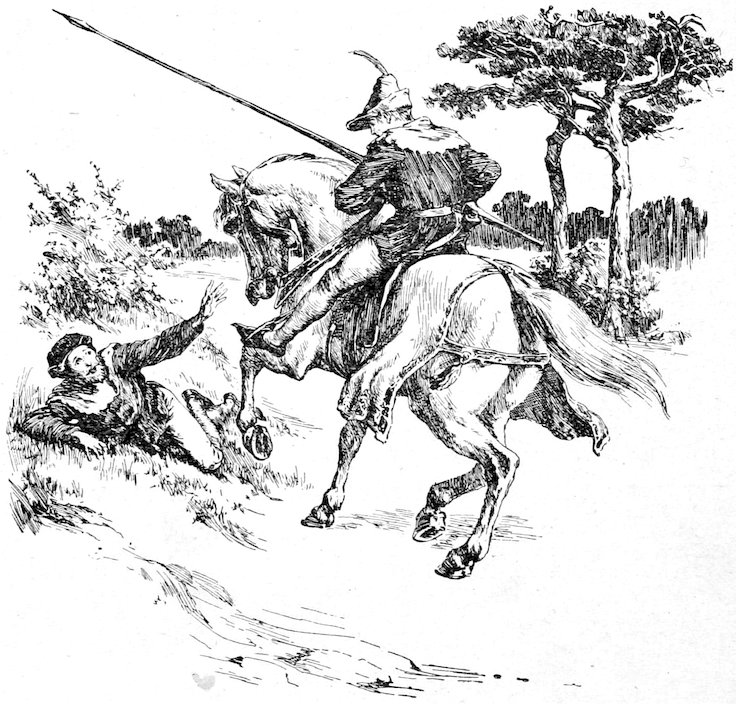
Trompart (or Deceit), for that was the man’s name, speedily discovered the folly of his master. He was very wily-witted and well accustomed to every form of cunning trickery, and, to suit his own purpose, he flattered up Braggadochio, and did all he could to encourage his idle vanity.
111Presently, as the two went along, they met the wicked magician, Archimago (or Hypocrisy), who was now just as angry with Sir Guyon as he had been before with the Red Cross Knight. When he saw Braggadochio, he thought he had found a good opportunity to be revenged on both the knights, and, going up to him, he asked if he would be willing to fight them.
Braggadochio immediately pretended to fall into a great rage against them, and said he would slay them both. Then Archimago, seeing that he had no sword, warned him that he must arm himself with the very best weapons, for they were two of the mightiest warriors living.
“Silly old man!” said Braggadochio boastfully. “Stop giving advice. Isn’t one brave man enough, without sword or shield, to make an army quail? You little know what this right hand can do. Once, when I killed seven knights with one sword, I swore thenceforward never to wear a sword in battle again, unless it could be the one that the noblest knight on earth wears.”
“Good!” said the magician quickly; “that sword you shall have very shortly. For now the best and noblest knight alive is Prince Arthur, who lives in the land of the Faerie Queene. He has a sword that is like a flaming brand. I will undertake that, by my devices, this sword is found to-morrow at your side.”
At these words the boaster began to quake, for he could not think who it was that spoke like this. Then Archimago suddenly vanished, for the north wind, at his command, carried him away, lifting him high into the air.
112Braggadochio and Deceit looked all about, but could find no trace of him. Nearly dead with fright, they both fled, never turning to look round till, at last, they came to a green forest where they hid themselves. Even here fear followed them, and every trembling leaf and rustle of the wind made their hair stand on end.
Fury’s Captive
As Sir Guyon and his guide, the Black Palmer, went on their way, they presently saw at some distance what seemed to be a great uproar and commotion. Hurrying near, they found a big savage man dragging along and beating a handsome youth. An ugly old woman followed them, shouting and railing, and urging the man not to let go the youth, but to treat him worse and worse.
The name of the bad man was Fury; the old woman was his mother, and was called Occasion. The youth was a young squire, named Phaon.
Fury had Phaon completely in his power, but in his blind and senseless rage he scarcely knew what he was about, and spent half his force in vain. He often struck wide of the mark, and frequently hurt himself unawares, like a bull rushing at random, not knowing where he hits and not caring whom he hurts.
113
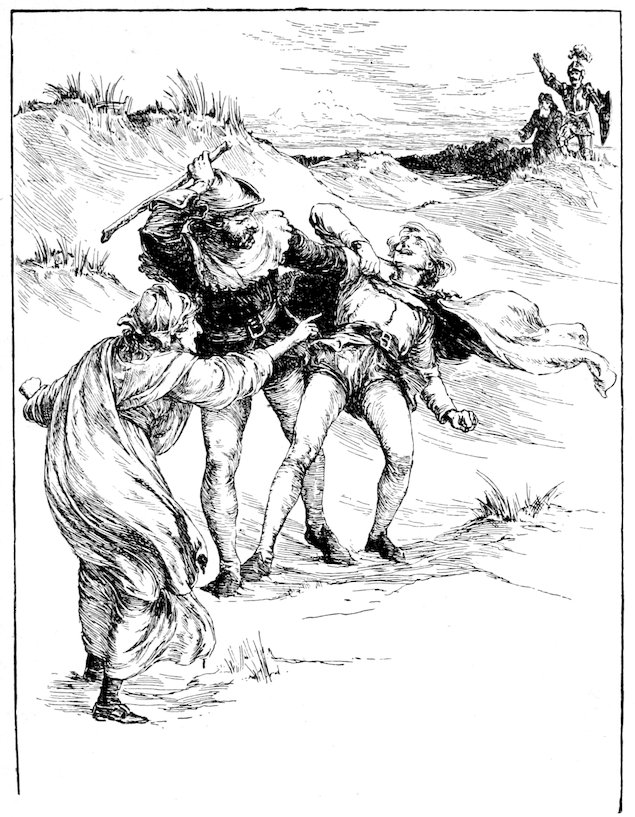
“A mad man, or that feigned mad to bee, Drew by the haire along upon the grownd A handsom stripling with great crueltee, Whom sore he bett.”
When Sir Guyon saw the sad plight of the young squire, he ran to help him; but Fury grappled with the Knight and flung him to the ground. Sir Guyon sprang to his feet, and drew his sword, but, seeing this, 115the Palmer cried, “Not so, O Guyon; never think the monster can be mastered or destroyed in that fashion. He is not a foe to be wounded by steel or overthrown by strength. This cruel wretch is Fury, who works much woe and shame to knighthood. That old hag, his mother, is the cause of all his wrath and spite. Whoever will conquer Fury, must first get hold of Occasion and master her. When she is got rid of, or strongly withstood, Fury himself is easily managed. But she is very difficult to catch, for her hair hangs so thickly over her eyes, it is often impossible to know her, and when she has once slipped past, you can never overtake her.”
When Sir Guyon heard this, he left Fury and went to catch Occasion. All happened as the Palmer said. Directly the wicked old woman was captured, and her angry tongue silenced, her son turned to fly. Sir Guyon followed, and soon made him prisoner; but even when bound in iron chains, Fury kept grinding and gnashing his teeth, shaking his copper-coloured locks, and threatening revenge.
Then Sir Guyon turned to the young squire, and asked him how he had fallen into the power of such a wretch.
Phaon said all his misfortunes arose from his giving way to wrath and jealousy. He had a dear friend, about whom malicious stories were told, and without waiting to find out whether or not they were true, he killed this friend in sudden anger. When he discovered that he had been misled, and that his friend was innocent, he was filled with grief, and swore to be revenged on the two people who had deceived him. To one he gave 116a deadly draught of poison, and the other he was pursuing with a drawn sword, when he himself was overtaken by Fury, who completely mastered him.
“As long as I live,” he ended, “I shall never get over the agony caused me by Grief and Fury.”
“Squire,” said Sir Guyon, “you have suffered much, but all your ills may be softened if you do not give way to such violence.”
Then said the Palmer, “Wretched is the man who never learns to govern his passions. At first they are feeble and can be easily managed, but through lack of control they lead to fearful results. Fight against them while they are young, for when they get strong they do their best to overcome all the good in you. Ungoverned wrath, jealousy, and grief have been the cause of this squire’s downfall.”
“Unlucky Phaon,” said Sir Guyon; “since you have fallen into trouble through your hot, impatient disposition, henceforth take heed, and govern your ways carefully, lest a worse evil come upon you.”
While Sir Guyon spoke, they saw far off a man running towards them, whose flying feet went so fast that he was almost hidden in a cloud of dust.
The Anger of Fire
The man soon reached Sir Guyon and the Palmer, hot, panting, and breathless. He was a bold-looking fellow, not in the least abashed by Sir Guyon, but casting scornful glances at him.
117Behind his back he bore a brazen shield, which looked as if it belonged to some famous knight. On it was drawn the picture of a flaming fire, round which were the words “Burnt, I do burn.” In his hand the man carried two sharp and slender darts, tipped with poison.
When he came near, he said boldly to Guyon, “Sir Knight—if you be a knight—I advise you to leave this place at once, in case of further harm. If you choose to stay, you do so at your own peril!”
Sir Guyon wondered at the fellow’s boldness, though he scorned his idle vanity. He asked him mildly why any harm should come to him if he remained.
“Because,” replied the man, “there is now coming, and close at hand, a knight of wondrous power, who never yet met an enemy without doing him deadly harm, or frightening him dreadfully. You need not hope for any better fate, if you choose to stay.”
“What is his name?” said Sir Guyon, “and where does he come from?”
“His name is Pyrocles, which means the Anger of Fire,” was the answer, “and he is called so from his hot and cruel temper. He is the brother of Cymocles, which means the Anger of the Sea-Waves, for Cymocles is wild and revengeful. They are the sons of Malice and Intemperance. I am Strife, the servant of Pyrocles, and I find work for him to do and stir him up to mischief. Fly, therefore, from this dreadful place, or your foolhardiness may bring you into danger.”
“Never mind about that,” said Sir Guyon, “but tell me whither you are now bound. For it must be some great reason that makes you in such a hurry.”
118“My master has sent me to seek out Occasion,” said Strife. “He is furious to fight, and woe betide the man who first falls in his way.”
“You must be mad,” said the Palmer, “to seek out Occasion and cause for strife. She comes unsought, and follows even when shunned. Happy the man who can keep away from her.”
“Look,” said Sir Guyon, “yonder she sits, bound. Take that message to your master.”
At this Strife grew very angry, and seizing one of his darts, he hurled it at Sir Guyon. The Knight caught it on his shield, whereupon Strife fled away, and was soon lost to sight.
Not long after, Sir Guyon saw a fierce-looking knight riding swiftly towards him. His armour sparkled like fire, and his horse was bright red, and champed and chafed at his bit as his master spurred him roughly forward. This was Pyrocles.
Not waiting to speak, he furiously attacked Sir Guyon, but after a sharp battle he was utterly defeated, and obliged to beg for mercy.
This Sir Guyon courteously granted, and asked the reason why Pyrocles had attacked him so fiercely.
The knight replied it was because he heard that Sir Guyon had taken captive a poor old woman, and chained her up. He demanded that she and her son Fury should be set free.
“And is that all that has so sorely displeased you?” said Sir Guyon, smiling. “There they are; I hand them over to you.”
119
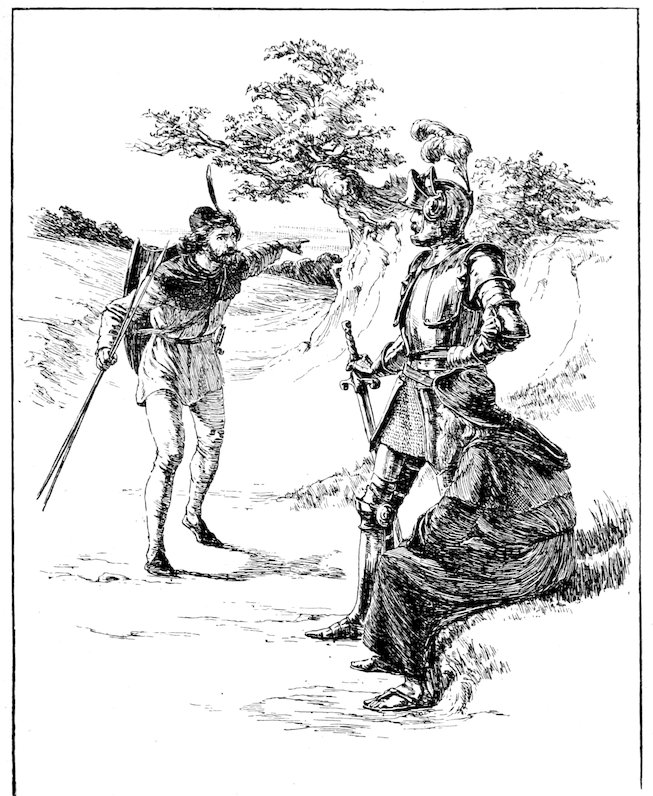
“He boldly spake, ‘Sir Knight, if knight thou bee, Abandon this forestalled place at erst, For fear of further harme, I counsell thee, Or bide the chaunce at thine owne jeopardie.’”
Pyrocles, delighted, rushed to set free the captives, 121but they were scarcely untied before their rage and spite burst forth with double fury. They did everything they could to make Pyrocles and Sir Guyon fight again. They not only railed against Sir Guyon for being the conqueror, but also against Pyrocles for allowing himself to be conquered.
Sir Guyon stood apart and refused to be drawn into the quarrel; but Pyrocles could not help getting enraged, and he and Fury were soon in the midst of a terrible fight.
Seeing that Pyrocles was getting the worst of it, Sir Guyon would have gone to his help, but the Palmer held him back, and refused to let him interfere.
“No,” he said firmly, “it is idle for you to pity him. He has brought this trouble upon himself by his own folly and wilfulness, and he must now bear the punishment.”
So, as there was nothing more to be done, Sir Guyon and the Palmer started again on their journey.
The Idle Lake
In the course of their journey, Sir Guyon and the Palmer came at last to the shores of a great lake. The water of this lake was thick and sluggish, unmoved by any wind or tide. In the midst of it floated an island, a lovely plot of fertile land, set like a little nest among the wide waves. The island was full of dainty herbs and flowers, beautiful trees with spreading branches, and with birds singing sweetly on every branch. But 122everything there—the flowers, the trees, and the singing birds—only served to tempt weak-minded people to be slothful and lazy. Lying on the soft grass in some shady dell, they forgot there was any such thing as work or duty, and cared for nothing but to sleep away the time in idle dreams.
Up to the present, Sir Guyon had only had to face adventures of a stern and painful kind, but now he was to be put to quite a different test. Would he fall a prey to the sloth and luxury of this island, or would he remain faithful to his knightly duty?
When Sir Guyon and his companion, Conscience, came to the shore of the lake, they saw, floating near, a little gondola, all decked with boughs. In the gondola sat a beautiful lady, amusing herself by singing and laughing loudly. She came at once when Guyon called, and offered to ferry him across the lake; but when the Knight was in the boat, she refused to let the Palmer get in, and neither money nor entreaties would induce her to take the old man with them. Sir Guyon was very unwilling to leave his guide behind, but he could not go back, for the boat, obeying the lady’s wish, shot away more swiftly than a swallow flies. It needed no oar nor pilot to guide it, nor any sails to carry it with the wind; it knew how to go exactly where its owner wanted, and could save itself both from rocks and shoals.
The name of the lady in the gondola was Phædria; she was one of the servants of the wicked enchantress, Acrasia, whom Sir Guyon was now on his way to attack. She hoped that the beautiful island would entrap the 123Knight, and make him delay his journey and forget his purpose.
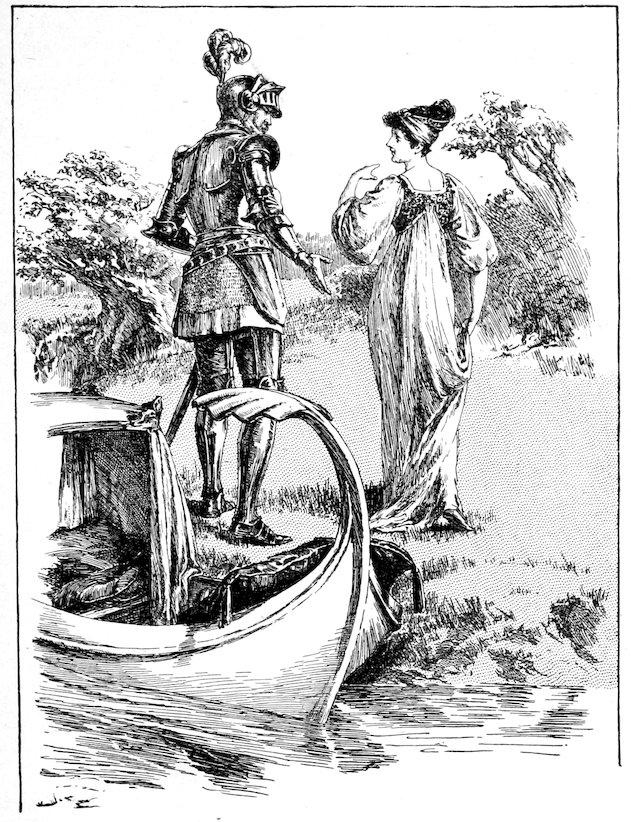
“But whenas Guyon of that land had sight, He wist himselfe amisse, and angry said; ‘Ah, Dame! perdy ye have not doen me right, Thus to mislead mee, whiles I you obaid: Mee litle needed from my right way to have straid.’”
125On the way, as was her custom, she began joking and laughing loudly, thinking this would amuse her guest. Sir Guyon was so kind and courteous that he was quite ready to join in any real merriment; but when he saw his companion grow noisier and sillier every moment, he began to despise her and did not care to share her foolish attempts at fun. But she went on still in the same manner till at last they reached the island.
When Sir Guyon saw this land, he knew he was out of his way, and was very angry.
“Lady,” he said, “you have not done right to me, to mislead me like this, when I trusted you. There was no need for me to have strayed from my right way.”
“Fair sir,” she said, “do not be angry. He who travels on the sea cannot command his way, nor order wind and weather at his pleasure. The sea is wide, and it is easy to stray on it; the wind is uncertain. But here you may rest awhile in safety, till the season serves to attempt a new passage. Better be safe in port than on a rough sea,” she ended laughingly.
Sir Guyon was not at all pleased, but he checked his anger and stepped on shore. Phædria at once began to show off all the delights of the island, which grew in beauty wherever she went. The flowers sprang freshly, the trees burst into bud and early blossom, and a whole chorus of birds broke into song. And the lady, more sweetly than any bird on bough, would often sing with them, surpassing, as she easily could, 126their native music with her skilful art. She strove, by every device in her power, so to charm Sir Guyon that he would forget all deeds of daring and his knightly duty.
But Sir Guyon was wise, and took care not to be carried away by these delights, though he would not seem so rude as to despise anything that a gentle lady did to give him pleasure. He spoke many times of his desire to leave, but she kept on making excuses to delay his journey.
Now it happened that Phædria had already allured to the island another knight. This was Cymocles, whose name means the Anger of the Sea. He was the brother of Pyrocles (the Anger of Fire), whom you may remember Sir Guyon had already fought and conquered. Cymocles had been sunk in a heavy sleep when Sir Guyon arrived, but when he woke up and discovered the new-comer, he flew at once into a furious rage, and rushed to attack him.
Sir Guyon, of course, was quite ready to defend himself, and Cymocles soon found that he had never before met such a powerful foe. The fight between them was so terrible that Phædria, overcome with pity and dismay, rushed forward, and implored them, for her sake, to stop. She blamed herself as the cause of all the mischief, and entreated them not to disgrace the name of knighthood by strife and cruelty, but to make peace and be friends.
So great is the power of gentle words to a brave and generous heart, that at her speech their rage began to relent. When all was over, Sir Guyon again begged 127the lady to let him depart, and to give him passage to the opposite shore. She was now quite as glad as he was for him to go, for she saw that all her folly and vain delights were powerless to tempt him from his duty, and she did not want her selfish ease and pleasure to be troubled with terror and the clash of arms. So she bade him get into the little boat again, and soon conveyed him swiftly to the farther strand.
The Realm of Pluto
Sir Guyon having lost his trusty guide, who was left behind on the shore of the Idle Lake, had now to go on his way alone. At last he came to a gloomy glade, where the thick branches and shrubs shut away the daylight. There, lurking in the shade, he found a rude, savage man, very ugly and unpleasant-looking. His face was tanned with smoke, his eyes dull, his head and beard streaked with soot, his hands were coal-black, as if burnt at a smith’s forge, and his nails were like claws.
His iron coat, all overgrown with rust, was lined with gold, which, though now darkened with dirt, seemed as if it had been formerly a work of rich and curious design. In his lap he counted over a mass of coin, feasting his eyes and his covetous wishes with the sight of his huge treasury. Round about on every side lay great heaps of gold, which could never be spent: some were the rough ore, others were beaten into great ingots and square wedges; some were 128round plates, without mark of any kind, but most were stamped, and bore the ancient and curious inscription of some king or emperor.
As soon as the man saw Sir Guyon, he rose, in great haste and fright, to hide his mounds of treasure, and began with trembling hands to pour them through a wide hole into the earth. But Sir Guyon, though he was himself dismayed at the sight, sprang lightly forward to stop him.
“Who are you that live here in the desert, and hide away from people’s sight, and from their proper use, all these rich heaps of wealth?” he asked.
Looking at him with great disdain, the man replied, “You are very rash and heedless of yourself, Sir Knight, to come here to trouble me, and my heaps of treasure. I call myself ‘King of this world and worldlings’—Great Mammon—the greatest power on earth. Riches, renown, honour, estate, and all the goods of this world, for which men incessantly toil and moil, flow forth from me in abundance. If you will deign to serve and follow me, all these mountains of gold shall be at your command, and, if these will not suffice, you shall have ten times as much.”
“Mammon,” said the Knight, “your boast of kingship is in vain, and your bribe of golden wages is useless. Offer your gifts to those who covet such dazzling gain. It would ill befit me, who spend my days in deeds of daring and pursuit of honour, to pay any attention to the tempting baits with which you bewitch weak men. Any desire for worldly dross mixes badly with, and debases the true heroic spirit 129which joys in fighting for crowns and kingdoms. Fair shields, gay steeds, bright armour are my delight. These are the riches fit for a venturous knight.”
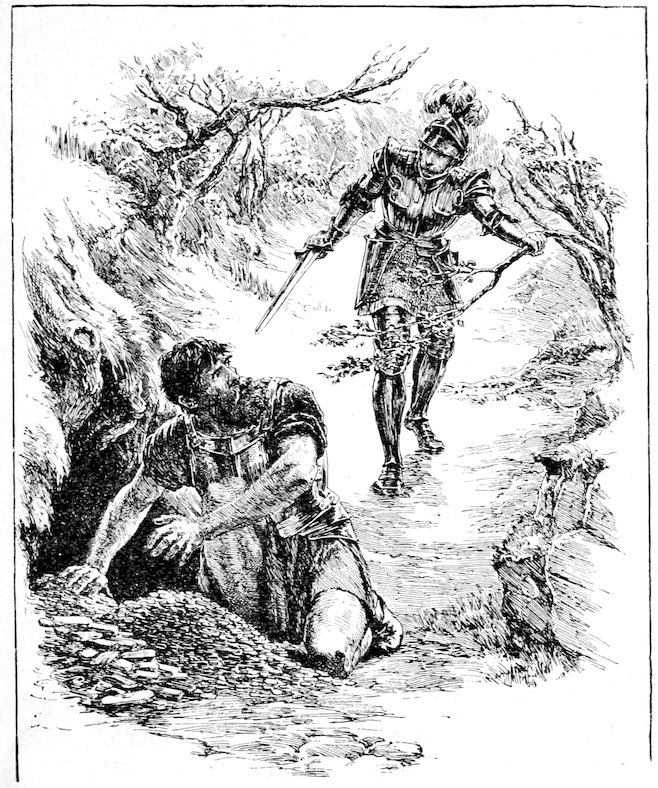
Mammon went on trying to tempt the Knight with all sorts of alluring promises, but Sir Guyon stood firm. He pointed out the evils that had come through 130riches, which he considered the root of all unquietness—first got with guile—then kept with dread, afterwards spent with pride and lavishness, and leaving behind them grief and heaviness. They were the cause of infinite mischief, strife and debate, bloodshed and bitterness, wrong-doing and covetousness, which noble hearts despise as dishonour. Innocent people were murdered, kings slain, great cities sacked and burnt, and other evils, too many to mention, were caused by riches.
“Son,” said Mammon at last, “let be your scorn, and leave the wrongs done in the old days to those who lived in them. You who live in these later times must work for wealth, and risk your life for gold. If you choose to use what I offer you, take what you please of all this abundance; if you don’t choose, you are free to refuse it, but do not afterwards blame the thing you have refused.”
“I do not choose to receive anything,” replied the Knight, “until I am sure that it has been well come by. How do I know but what you have got these goods by force or fraud from their rightful owners?”
“No eye has ever yet seen, nor tongue counted, nor hand handled them,” said Mammon. “I keep them safe hidden in a secret place. Come and see.”
Then Mammon led Sir Guyon through the thick covert, and found a dark way which no man could spy, that went deep down into the ground, and was compassed round with dread and horror. At length they came into a larger space, that stretched into a wide plain; a broad beaten highway ran across this, leading 131straight to the grisly realm of Pluto, ruler of the Lower Regions.
It was indeed a horrible road. By the wayside sat fiendish Vengeance and turbulent Strife, one brandishing an iron whip, the other a knife, and both gnashing their teeth and threatening the lives of those who went by. On the other side, in one group, sat cruel Revenge and rancorous Spite, disloyal Treason and heart-burning Hate; but gnawing Jealousy sat alone out of their sight, biting his lips; and trembling Fear ran to and fro, finding no place where he might safely shroud himself. Lamenting Sorrow lay in the darkness, and Shame hid his ugly face from living eye. Over them always fluttered grim Horror, beating his iron wings, and after him flew owls and night-ravens, messengers of evil tidings, while a Harpy—a hideous bird of ill omen—sitting on a cliff near, sang a song of bitter sorrow that would have broken a heart of flint, and when it was ended flew swiftly after Horror.
All these lay before the gates of Pluto, and passing by, Sir Guyon and Mammon said nothing to them, but all the way wonder fed the eyes and filled the thoughts of Sir Guyon.
At last Mammon brought him to a little door that was next adjoining to the wide-open gate of Hades, and nothing parted them; there was only a little stride between them, dividing the House of Riches from the mouth of the Lower Regions.
Before the door sat self-consuming Care, keeping watch and ward, day and night, for fear lest Force or Fraud should break in, and steal the treasure he was 132guarding. Nor would he allow Sleep once to come near, although his drowsy den was next.
Directly Mammon arrived, the door opened, and gave passage to him. Sir Guyon still kept following, for neither darkness nor danger could dismay him.
The Cave of Mammon
As soon as Mammon and Sir Guyon entered the House of Riches, the door immediately shut of itself, and from behind it leapt forth an ugly fiend, who followed them wherever they went. He kept an eager watch on Guyon, hoping that before long the Knight would lay a covetous hand on some of the treasures, in which case he was ready to tear him to pieces with his claws.
The form of the house inside was rude and strong, like a huge cave hewn out of the cliff; from cracks in the rough vault hung lumps of gold, and every rift was laden with rich metal, so that they seemed ready to fall in pieces, while high above all the spider spun her crafty web, smothered in smoke and clouds blacker than jet. The roof, and floor, and walls were all of gold, but covered with dust and hid in darkness, so that no one could see the colour of it; for the cheerful daylight never came inside that house, only a faint shadow of uncertain light, like a dying lamp. Nothing was to be seen but great iron chests and strong coffers, all barred with double bands of metal, so that no one could force them open by violence; but all the ground 133was strewn with the bones of dead men, who had lost their lives in that place, and were now left there unburied.
They passed on, and Guyon spoke not a word till they came to an iron door, which opened to them of its own accord, and showed them such a store of riches as the eye of man had never seen before.
Then Mammon, turning to the warrior, said, “Behold here the world’s happiness! Behold here the end at which all men aim, to be made rich! Such favour—to be happy—is now laid before you.”
“I will not have your offered favour,” said the Knight, “nor do I intend to be happy in that way. Before my eyes I place another happiness, another end. To those that take pleasure in them, I resign these base things. But I prefer to spend my fleeting hours in fighting and brave deeds, and would rather be lord over those who have riches than have them myself, and be their slave.”
At that the fiend gnashed his teeth, and was angry because he was kept so long from his prey, for he thought that so glorious a bait would surely have tempted his guest. Had it done so, he would have snatched him away lighter than a dove in a falcon’s claws.
But, when Mammon saw he had missed his object, he thought of another way to entrap the Knight unawares. He led him away into another room where there were a hundred furnaces burning fiercely. By every furnace were many evil spirits horrible to see, busily engaged in tending the fires, or working with 134the molten metal. When they saw Guyon they all stood stock still to wonder at him, for they had never seen such a mortal before; he was almost afraid of their staring eyes and hideous figures.
“Behold what living eye has never seen before,” said Mammon. “Here is the fountain of the world’s good. If, therefore, you will be rich, be well advised and change your wilful mood, lest hereafter you may wish and not be able to have.”
“Let it suffice that I refuse all your idle offers,” said Guyon. “All that I need I have. Why should I covet more than I can use? Keep such vain show for your worldlings, but give me leave to follow my quest.”
Mammon was much displeased, but he led him forward, to entice him further. He brought him through a dark and narrow way to a broad gate, built of beaten gold. The gate was open, but there stood in front of it a sturdy fellow, very bold and defiant-looking. In his right hand he held an iron club, but he himself seemed as if he were made of gold. His name was Disdain. When he saw Guyon he brandished his club, but Mammon bade him be still, and led his guest past him.
He took him into a large place, like some solemn temple; great golden pillars upheld the massive roof, and every pillar was decked with crowns and diadems, such as princes wore while reigning on earth. A crowd of people of every sort and nation were there assembled, all pressing with a great uproar to the upper part, where was placed a high throne. On it 135sat a woman, clad in gorgeous robes of royalty. Her face seemed marvellously fair; her beauty threw such brightness round that all men could see it; it was not all her own, however, but was partly made up by art.
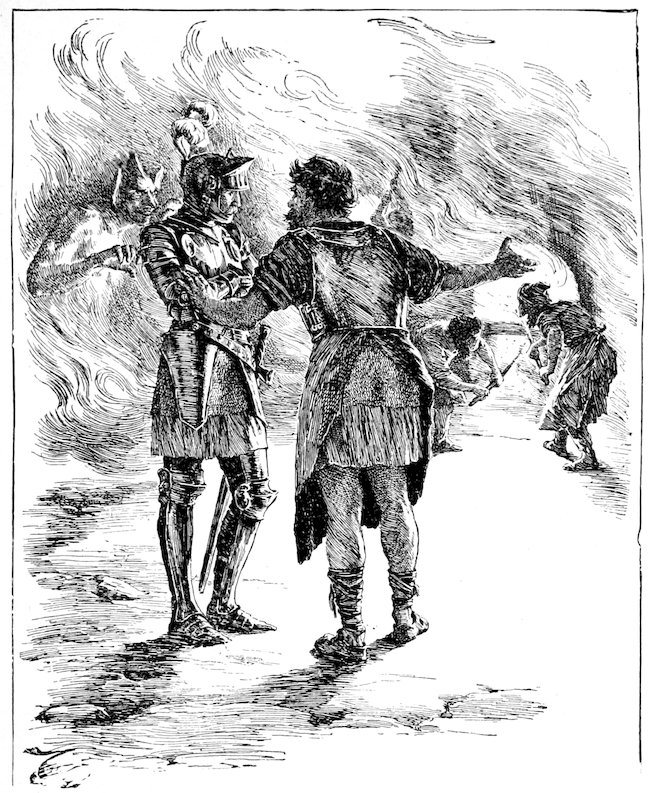
“Behold thou Faeries sonne, with mortall eye, That living eye before did never see: * * * * * Here is the fountaine of the worldes good: How, therefore, if thou wilt enriched bee, Avise thee well, and chaunge thy wilfull mood.”
137As she sat there, glittering, she held a great gold chain, the upper end of which reached high into heaven, and the other end deep down into the lower regions; and all the crowd around her pressed to catch hold of that chain, to climb aloft by it, and excel others.
The name of the chain was Ambition, and every link was a step of dignity. Some thought to raise themselves to a high place by riches, some by pushing, some by flattery, some by friends—and all by wrong ways, for those that were up themselves kept others low, and those that were low held tight hold of others, not letting them rise, while every one strove to throw down his companions.
When Guyon saw this he began to ask what all the crowd meant, and who was the lady that sat on the throne.
“That goodly person, round whom every one flocks, is my dear daughter,” said Mammon. “From her alone come honour and dignity, and this world’s happiness, for which all men struggle, but which few get. She is called Philotime, the Love of Honour, and she is the fairest lady in the world. Since you have found favour with me, I will make her your wife, if you like, that she may advance you, because of your work and just merits.”
“I thank you much, Mammon,” said the gentle Knight, “for offering me such favour, but I am only 138a mortal, and, I know well, an unworthy match for such a wife. And, if I were not, yet is my troth plighted and my love declared to another lady, and to change one’s love without cause is a disgrace to a knight.”
Mammon was inwardly enraged, but, hiding his feelings, he led him away, through the grisly shadows, by a beaten path, into a garden well furnished with herbs and fruits of an unknown kind. They were not such as men gather from the fertile earth, sweet and of good taste, but deadly black, both leaf and flower. Here grew cypress and ebony, poppy and deadly nightshade, hemlock, and many other poisonous plants. The place was called the Garden of Proserpine. In the midst was a silver seat, under a thick arbour, and near by grew a great tree with spreading branches, laden with golden apples.
Mammon showed the Knight many wonders in the Garden of Proserpine, and tried to tempt him to sit in the silver seat, or to eat of the golden apples. If Guyon had done so, the horrible monster who waited behind would have pounced on him and torn him to pieces; but he was wary and took care not to yield to temptation, so the beguiler was cheated of his prey. But now he began to feel weak and ill for want of food and sleep, for three days had passed since he entered the cave. So he begged Mammon to guide him back to the surface of the earth by the way they had come. Mammon, though very unwilling, was forced to obey; but the change was too much for Guyon in his feeble state, and as soon as he came into the light, and began to breathe the fresh air, he fainted away.
139
The Champion of Chivalry
During the time that Guyon stayed in the house of Mammon, the Palmer, whom the maid of the Idle Lake had refused to take in her boat, had found a passage in some other way. On his journey he came near the place where Guyon lay in a trance, and suddenly he heard a voice calling loud and clear, “Come hither, hither! Oh, come quickly!”
He hurried in the direction of the cry, which led him to the shady dell where Mammon had formerly counted his wealth. Here he found Guyon senseless on the ground, but watched over by a beautiful angel.
At first he was dismayed, but the angel bade him not be frightened, for that life and renewed vigour would soon come back to the Knight. He now handed him over to the charge of the Palmer, and bade him watch with care, for fresh evil was at hand.
Thus saying, the angel vanished, and the Palmer, turning to look at Guyon, was rejoiced to find a feeble glimmer of life in him, which he cherished tenderly.
At last there came that way two Pagan knights in shining armour, led by an old man, and with a lightfooted page far in front, scattering mischief and enmity wherever he went. These were the two bad brothers, Pyrocles and Cymocles, the sons of Anger, guided by the false Archimago, while their servant, Atin (or Strife) stirred them up to quarrelling and vengeance.
140
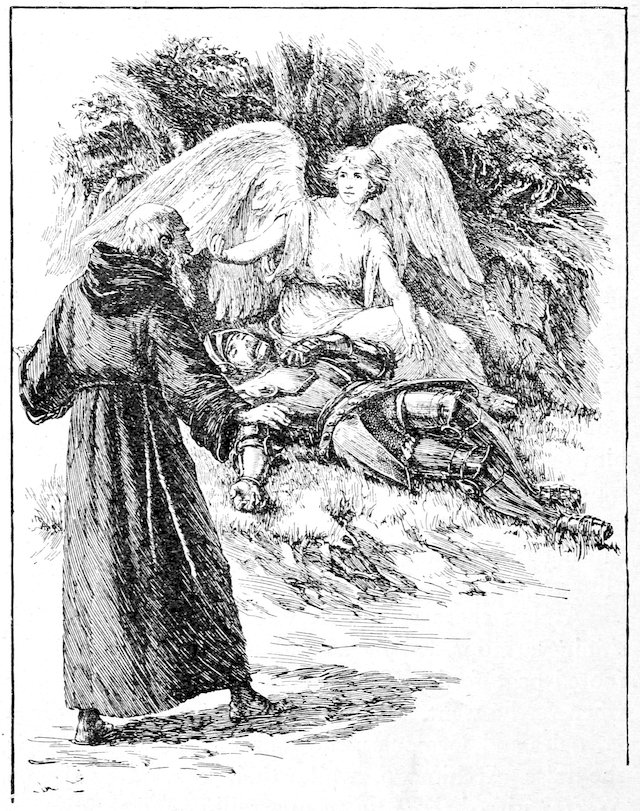
When they came to the place where the Palmer sat watching over the sleeping body of the Knight, they knew the latter at once, for they had both lately fought with him. They reviled the Palmer, and began heaping abuse on Sir Guyon, whom they thought dead, and declared that they would strip him of his armour, 141which was much too good for such a worthless creature. The Palmer implored them not to do such a shameful and dishonourable deed, but his entreaties were in vain; one brother laid his hand on the shield, the other on the helmet, both fiercely eager to possess themselves of the spoil.
At this moment they saw coming towards them an armed knight of bold and lofty grace, whose squire bore after him an ebony spear and a covered shield. Well did the magician know him by his arms and bearing when he saw his prancing Libyan steed, and he cried to the brothers, “Rise quickly, and prepare yourselves for battle, for yonder comes the mightiest knight alive—Prince Arthur, the flower of grace and chivalry.”
The brothers were so impressed that they started up and greedily prepared for battle. Pyrocles, who had lost his own weapons in the fight with Fury, snatched a sword from Archimago, although the latter warned him it was a magic sword, and would do no harm to Prince Arthur, for whom it had been made long ago, and who was its rightful owner. Pyrocles only laughed at the magician’s warning, and having bound Guyon’s shield to his wrist, he was ready for the fray.
By that time the stranger Knight had come near, and greeted them courteously. They returned no answer, but looked very disdainful, and then, turning to the Palmer, Prince Arthur noticed that at his feet lay an armed man, in whose dead face he read great nobility.
“Reverend sir,” he said, “what great misfortune has befallen this Knight? Did he die a natural death, or did he fall by treason or by fight?”
142“Not by one or the other,” said the Palmer; “but his senses are drowned in sleep, and these cruel foes have taken advantage of it to revenge their spite and rob him of his armour; but you, fair sir, whose honourable look promises hope of help, may I beseech you to take pity on his sad plight, and by your power protect him?”
“Palmer,” he said, “there is no knight so rude, I trust, as to do outrage to a sleeping spirit. Maybe, better reason will soften their rash revenge. Well-chosen words have a secret power in appeasing anger. If not, leave to me your Knight’s last defence.”
Then, turning to the brothers, he first tried what persuasion would do. He took for granted that their wrath was provoked by wrongs they had suffered, and did not challenge the right or justice of their actions; but, on behalf of the sleeping man, he entreated pardon for anything he might have done amiss.
To this gentle speech the brothers made rude and insulting answers, and Pyrocles, not waiting to set the Prince on guard, lifted high the magic sword, thinking to kill him. The faithful steel refused to harm its master, and swerved from the mark, but the blow was so furious it made man and horse reel. Prince Arthur was such a splendid rider that he did not fall from the saddle; but, full of anger, he cried fiercely—
“False traitor! you have broken the law of arms by striking a foe unchallenged, but you shall soon right bitterly taste the fruit of your treason, and feel the law which you have disgraced.”
143With that he levelled his spear at Pyrocles, and the two were soon engaged in a fiery battle. Cymocles rushed to his brother’s aid, and they both fell on the Prince with terrific fury, so that he had hard work to defend himself. So mighty was his power that neither of his foes could stand against it; but whenever he smote at Pyrocles, the latter threw in front of him Guyon’s shield, on which was portrayed the face of the Faerie Queene, and when he saw this, the Prince’s hand relented, and he stayed the stroke, because of the love and loyalty he bore the picture. This often saved the Pagan knight from deadly harm, but at last Prince Arthur overcame and killed both him and his brother, while false Archimago and Strife fled fast away.
By this time Sir Guyon had awakened from his trance, and was much grieved when he found that his shield and sword had disappeared; but when he saw beside him his faithful companion, whom he had lost some days before, he was very glad. The Palmer was delighted to see him rise looking so well, and told him not to trouble about the loss of his weapons, for they would soon be restored to him. Then he told Guyon all that had happened, and how the strange Knight had fought for him with the two wicked brothers.
When he heard this, Sir Guyon was deeply touched, and felt all his heart fill with affection. Bowing to Prince Arthur with due reverence, as to the defender of his life, he said, “My lord, my liege, by whose most gracious aid I live this day and see my foes subdued, what reward would be sufficient to repay you for your great goodness, unless to be ever bound——”
144But the Prince interrupted. “Fair sir, what need is there to reckon a good turn as a debt to be paid? Are not all knights bound by oath to withstand the power of the oppressor? It is sufficient that I have done my duty properly.”
So they both found that a good deed is made gracious by kindness and courtesy.
The House of Temperance
After the Pagan brothers were conquered, and Prince Arthur had recovered his stolen sword and Guyon his lost shield, the two went on their way together, talking pleasantly as they journeyed along. When the sun was near setting they saw in the distance a goodly castle, placed near a river, in a pleasant valley. Thinking this place would do to spend the night in, they marched thither, but when they came near, and dismounted from their tired steeds, they found the gates barred and every fastening locked, as though for fear of foes. They thought this was done as an insult to them, to prevent their entrance, till the Squire blew his horn under the castle wall, which shook with the sound as if it would fall. Then a watchman quickly looked forth from the highest tower, and called loudly to the knights to ask what they required so rudely. They gently answered that they wished to enter.
“Fly, fly, good knights!” he said; “fly fast away if you love your lives, as it is right you should. Fly fast, and save yourselves from instant death. You 145may not enter here, though we would most willingly let you in if only we could. But a thousand enemies rage round us, who have held the castle in siege for seven years, and many good knights who have sought to save us have been slain.”
As he spoke, a thousand villains, with horrible outcry, swarmed around them from the adjoining rocks and caves—vile wretches, ragged, rude, and hideous, all threatening death, and all armed in a curious manner, some with unwieldy clubs, some with long spears, some with rusty knives, some with staves heated in the fire. They looked like wild bulls, staring with hollow eyes, and with stiff hair standing on end.
They assailed the Knights fiercely, and made them recoil, but when Prince Arthur and Sir Guyon charged again their strength began to fail, and they were unable to withstand them, for the champions broke on them with such might that they were forced to fly like scattered sheep before the rush of a lion and a tiger. The Knights with their shining blades soon broke their rude ranks, and drove them into confusion, hewing and slashing at them; and now, when faced boldly, they found that they were nothing but idle shadows, for, though they seemed bodies, they had really no substance.
When they had dispersed this troublesome rabble, Prince Arthur and Guyon came again to the castle gate, and begged entrance, where they had been refused before. The report of their danger and conflict having reached the ears of the lady who dwelt there, she came out with a goodly train of squires and ladies to bid them welcome.
146The lady’s name was Alma. She was as beautiful as it was possible to be, in the very flower of her youth, yet full of goodness and modesty. She was clad in a robe of lily-white, reaching from her shoulders to the ground; the long, loose train, embroidered with gold and pearls, was carried by two fair damsels. Her yellow-golden hair was trimly arranged, and she wore no head-dress except a garland of sweet roses.
She entertained the Knights nobly, and, when they had rested a little, they begged her, as a great favour, to show them over her castle. This she consented to do.
First she led them up to the castle wall, which was so high that no foe could climb it, and yet was both beautiful and fit for defence. It was not built of brick, nor yet of stone, sand, nor mortar, but of clay. The pity was that such goodly workmanship could not last longer, for it must soon turn back to earth.
Two gates were placed in this building, the one (mouth) by which all passed in far excelling the other in workmanship. When it was locked, no one could pass through, and when it was opened no man could shut it. Within the barbican sat a porter (the tongue), day and night keeping watch and ward; nobody could go in or out of the gate without strict scrutiny. Utterers of secrets he debarred, babblers of folly, and those who told tales of wrong-doing; when cause required it, his alarm-bell might be heard far and wide, but never without occasion.
Round the porch on each side sat sixteen warders (the teeth), all in bright array; tall yeomen they 147seemed, of great strength, and were ranged ready for fight.
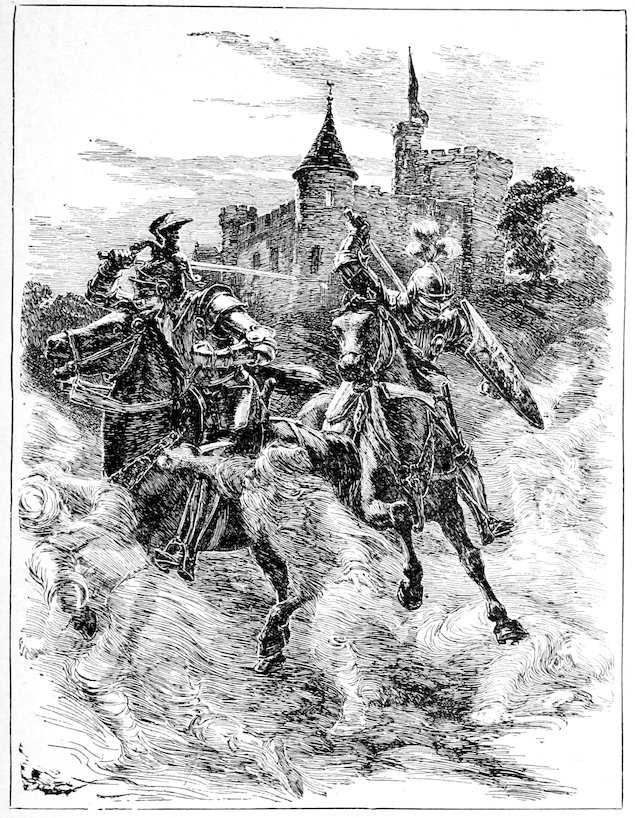
“But soone the knights with their bright-burning blades Broke their rude troupes, and orders did confound, Hewing and slashing at their idle shades; For though they bodies seem, yet substaunce from them fades.”
149Alma then took the Knights over the rest of the castle, and showed them so many curious and beautiful things that their minds were filled with wonder, for they had never before seen so strange a sight. Presently she brought them back into a beautiful parlour (the heart), hung with rich tapestry, where sat a bevy of fair ladies (the feelings, tastes, &c.), amusing themselves in different ways. Some sang, some laughed, some played with straws, some sat idly at ease; but others could not bear to play—all amusement was annoyance to them. This one frowned, that one yawned, a third blushed for shame, another seemed envious or shy, while another gnawed a rush and looked sullen.
After that, Alma took her guests up to a stately turret (the head), in which two beacons (the eyes) gave light, and flamed continually, for they were most marvellously made of living fire, and set in silver sockets, covered with lids that could easily open and shut.
In this turret there were many rooms and places, but three chief ones, in which dwelt three honourable sages, who counselled fair Alma how to govern well. The first of these could foresee things to come; the second could best advise of things present; the third kept things past in memory, so that no time or occasion could arise which one or other of them could not deal with.
The first sat in the front of the house, so that nothing should hinder his coming to a conclusion 150quickly; he made up his mind in advance, without listening to reason; he had a keen foresight, and an active brain that was never idle and never rested. His room held a collection of the oddest and queerest things ever seen or imagined. It was filled, too, with flies, that buzzed all about, confusing men’s eyes and ears, with a sound like a swarm of bees. These were idle thoughts and fancies, dreams, visions, soothsayings, prophecies, &c., and all kinds of false tales and lies.
The second counsellor was a much older man. He spent all his time meditating over things that had really happened, and in studying law, art, science and philosophy, so that he had grown very wise indeed.
The third counsellor was a very, very aged man. His chamber seemed very ruinous and old, and was therefore at the back of the house, but the walls that upheld it were quite firm and strong. He was half blind, and looked feeble in body, but his mind was still vigorous. All things that had happened, however ancient they were, he faithfully recorded, so that nothing might be forgotten.
The names of Alma’s three counsellors were Imagination, Judgment, and Memory.
The Rock of Reproach and the Wandering Islands
The next morning, before it was light, Sir Guyon, clad in his bright armour, and accompanied by the Palmer in his black dress, started once more on his journey to find the wicked enchantress, Acrasia, and the Bower 151of Bliss. At the river ford, they found a ferryman, whom Alma had commanded to be there with his well-rigged boat. They went on board, and he immediately launched his bark, and Lady Alma’s country was soon left far behind.
For two days they sailed without even seeing land; but on the morning of the third day, they heard, far away, a hideous roaring that filled them with terror, and they saw the surges rage so high, they feared to be drowned.
Then said the boatman, “Palmer, steer aright, and keep an even course, for we must needs pass yonder way. That is the Gulf of Greediness, which swallows up all it can devour, and is in a constant turmoil.”
On the other side, stood a hideous rock of mighty magnet stone, whose craggy cliffs were dreadful to behold. Great jagged reefs ran out into the water, and threatened death to all who came near. Yet passers-by were unable to keep away, for trying to escape the devouring jaws of the Gulf of Greediness, they were dashed to pieces on the rock.
As they drew near this dreadful spot, the ferryman had to put forth all his strength and skill to row them past. On the one hand, they saw the horrible gulf, that looked as if it were sucking down all the sea into itself; and on the other hand, they saw the perilous rock, on whose sharp cliffs lay the ribs of many shattered vessels, together with the dead bodies of those who had recklessly flung themselves to destruction.
The name of the rock was the “Rock of Reproach.” It was a dangerous and hateful place, to 152which no fish nor fowl ever came, but only screaming sea-gulls and cormorants, who sat waiting on the cliff to prey on the unhappy wretches whose extravagant and thriftless living had brought them to ruin.
Sir Guyon and his companions passed by this dangerous spot in safety, and the ferryman rowed them briskly over the dancing billows.
At last, far off, they spied many islands floating on every side among the waves. Then said the Knight, “Lo, I see the land, so, Sir Palmer, direct your course to it.”
“Not so,” said the ferryman, “lest we unknowingly run into danger; for those same islands, which now and then appear, are not firm land, nor have they any certain abiding-place; they are straggling plots, which run to and fro in the wide waters, wherefore they are called the ‘Wandering Islands,’ and are to be shunned, for they have drawn many a traveller into danger and distress. Yet from far off, they seem very pleasant, both fair and fruitful, the ground spread with soft, green grass, and the tall trees covered with leaves, and decked with white and red blossoms that might well allure passers-by. But whoever once sets his foot on those islands can never recover it, but evermore wanders, uncertain and unsure.”
Sir Guyon and the Palmer listened to their pilot, as seemed fitting, and they passed on their way.
“Now,” said the cautious boatman, when they had left behind them the Wandering Islands (or, listless idleness), “we must be careful to take good heed of our safety here, for a perilous passage lies before us. 153There is a great quicksand, and a whirlpool of hidden danger; therefore, Sir Palmer, keep a steady hand, for the narrow way lies between them.”
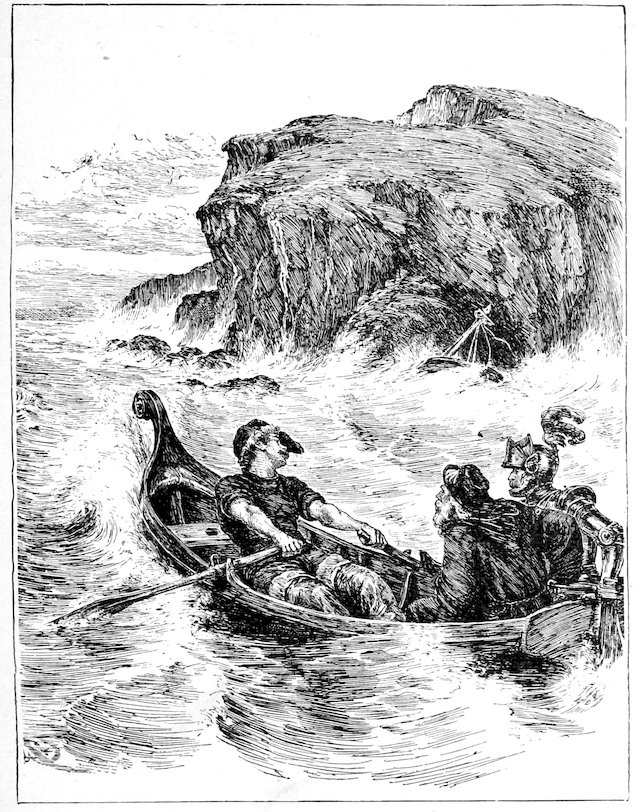
“Said then the Boteman, ‘Palmer, stere aright, And keepe an even course; for yonder way We needes must pas (God doe us well acquight).’”
155Scarcely had he spoken, when near at hand they spied the quicksand; it was almost covered with water, but they knew it at once by the waves round it and the discoloured sea. It was called the Quicksand of Unthriftiness.
Passing by, they saw a goodly ship, laden from far with precious merchandise, and well fitted as a ship could be, which through misadventure or carelessness had run herself into danger. The mariners and merchants, with much toil, laboured in vain to recover their prize and to save the rich wares from destruction, but neither toil nor trouble served to free her from the quicksand.
On the other side, they saw the dangerous pool that was called the Whirlpool of Decay, in which many had haplessly sunk, of whom no memory remained. The circling waters whirled round, like a restless wheel, eager to draw the boat into the outer limit of the labyrinth, and to drown the travellers. But the heedful ferryman rowed with all his might, so that they passed by in safety and left the dreaded danger behind.
Suddenly they saw in the midst of the ocean, the surging waters rise like a mountain, and the great sea puffed up, as though threatening to devour everything. The waves came rolling along, and the billows roared in fury, though there was not a breath of wind. At this, Sir Guyon, the Palmer, and the ferryman were greatly afraid, for they knew not what strange horror was approaching.
156
Sea-Monsters and Land-Monsters
Presently they saw a hideous crowd of huge sea-monsters, such as terrified any one to behold; every shape of ugliness and horror was there—water-snakes, and whales, and sword-fish, and hippopotamuses, and sharks, and every kind of sea-monster, and they came along in thousands, with a dreadful noise and a hollow, rumbling roar. No wonder the Knight was appalled, for, compared with these, all that we hold dreadful on earth were but a trifle.
“Fear nothing,” then said the Palmer, “for these creatures that look like monsters are not so in reality; they are only disguised into these fearful shapes by the wicked enchantress to terrify us, and to prevent our continuing our journey.”
Then, lifting up his magic staff, he smote the sea, which immediately became calm, and all the make-believe monsters fled to the bottom of the ocean.
Free from that danger, the travellers kept on their way, and as they went, they heard a pitiful cry, as of some one wailing and weeping. At last, on an island, they saw a beautiful maiden, who seemed in great sorrow, and who kept calling to them for help. Directly Guyon heard her, he bade the Palmer steer straight to her rescue; but the latter, knowing better, said, “Fair sir, do not be displeased if I disobey you, for it would be a bad thing to listen to her, for really there is nothing the matter; it is only a trick to entrap you.”
157The Knight was guided by his advice, and the ferryman held steadily straight on his course.
The next temptation they had to face was of a different kind. They came to a lovely bay, sheltered on the one side by a steep hill, and on the other by a high rock, so that between them was a still and pleasant haven. In this bay lived five mermaids, who could sing in the sweetest manner possible, but the only use they made of their skill in melody was to allure travellers, whom, when they had got hold of, they killed. So now to Guyon as he passed, they began to sing their sweetest tunes, greeting him as the mightiest knight that had ever fought in battle, and bidding him to turn his rudder into the quiet bay, where his storm-beaten vessel might safely ride.
“This is the port of rest from troublous toil,” they sang; “the world’s sweet inn from pain and wearisome turmoil.”
The rolling sea and the waves breaking on the rock mingled with their singing, and the wind whistled in harmony. The sound so delighted Guyon that he bade the boatman row slowly, to let him listen to their melody. But the Palmer wisely counselled him not to do this, and so they got safely past the danger, and soon after they saw, in the distance, the land to which they were directing their course.
Then suddenly a thick fog came down upon them, hiding the cheerful daylight, and making the whole world seem a confused mass. They were much dismayed at this, not knowing which way to steer in the darkness, and fearing that they would fall into some 158hidden danger. To add to their confusion, they were attacked by a flock of horrible birds, which flew screaming round them, beating at them with their wicked wings—owls, and ravens, and bats, and screech-owls. Yet the travellers would not stay because of these, but went straight forward, the ferryman rowing, while the Palmer kept a firm hand on the rudder, till at last the weather began to clear, and the land showed plainly. Then the Palmer warned Sir Guyon to have his armour in readiness, for peril would soon assail him.
The Knight obeyed, and when the boat reached the shore, he and the Palmer stepped out, fully armed, and carefully prepared against every danger.
They had not gone far, before they heard a hideous bellowing, and a pack of wild beasts rushed forward as if to devour them. But when they came near, the Palmer lifted up his wonderful staff, and immediately they were quelled, and shrank back trembling.
Passing these, Sir Guyon and the Palmer soon came to the place the Knight was seeking—the object of his long and toilsome quest—the home of the wicked enchantress—the “Bower of Bliss.”
The Bower of Bliss
It was a lovely spot, a place adorned in the most perfect way by which art could imitate nature; everything sweet and pleasing, or that the daintiest fancy could devise, was gathered here in lavish profusion. A light fence enclosed it, and a rich ivory gate, 159wonderfully carven, stood open to all those that came thither.
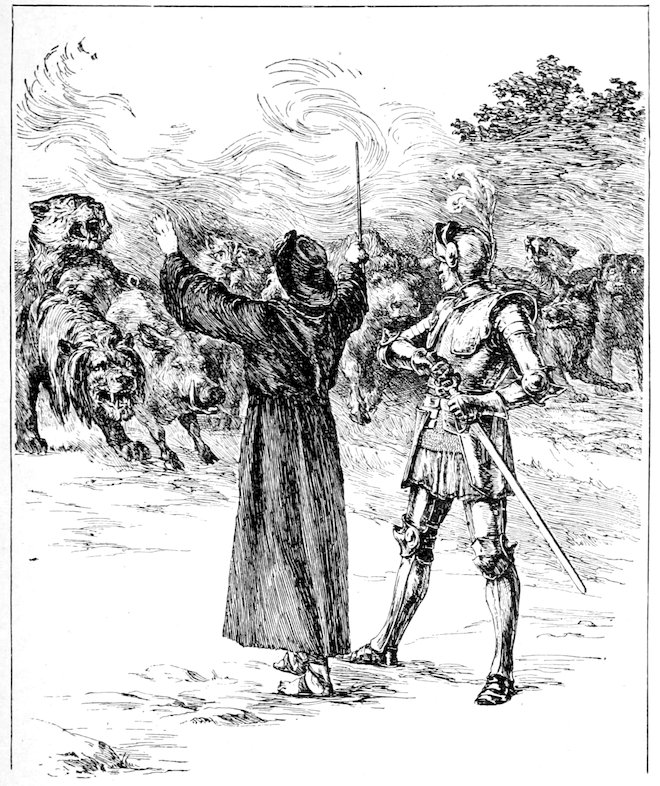
“Ere long they heard an hideous bellowing Of many beasts, that roared outrageously. * * * * * But soone as they approcht with deadly threat, The Palmer over them his staffe upheld.”
161In the porch sat a tall, handsome porter, whose looks were so pleasant that he seemed to entice travellers to him, but it was only to deceive them to their own ruin. He was the keeper of the garden, and his name was Pleasure. He was decked with flowers, and by his side was set a great bowl of wine, with which he pleased all new-comers. He offered it to Sir Guyon, but the latter refused his idle courtesy, and overthrew the bowl.
Passing through the gate, they beheld a large and spacious plain, strewn on every side with delights. The ground was covered with green grass, and made beautiful with all kinds of lovely flowers; the skies were always bright, and the air soft and balmy; no storm or frost ever came to harm the tender blossoms; neither scorching heat nor piercing cold to hurt those who dwelt therein.
Guyon wondered much at the loveliness of that sweet place, yet would not suffer any of its delights to allure him, but passed straight through, and still looked forward. Presently he came to a beautiful arbour, fashioned out of interlacing boughs and branches. This was arched over with a clustering vine, richly laden with bunches of luscious grapes—some were deep purple like the hyacinth—some like rubies, laughing red—some like emeralds, not yet well ripened, and there were others of burnished gold. They almost broke down the branches with their weight, and seemed to offer themselves to be freely gathered by the passers-by.
162In the arbour sat a finely dressed lady; she held in her left hand a golden cup, and with her right hand she gathered the ripe fruit, and squeezed the juice of the grapes into the cup. It was her custom to give a draught of this wine to every stranger that passed, but when she offered it to Guyon to taste, he took the cup out of her hand, and flung it to the ground, so that it was broken and all the wine spilt. Excess, for that was the lady’s name, was very angry at this, but she could not withstand the Knight, and was obliged to let him pass, and he went on, heedless of her displeasure.
Then before his eyes appeared a most lovely paradise, abounding in every sort of pleasure: rainbow-coloured flowers, lofty trees, shady dells, breezy mountains, rustling groves, crystal streams—it was impossible to tell which was art and which nature, they were so cunningly mingled; both combined made greater the beauty of the other, and adorned this garden with an endless variety.
In the midst of all, stood a fountain made of the most precious materials on earth, so pure and bright that one could see the silver flood running through every channel. It was wrought all over with curious carving, and above all was spread a trail of ivy of the purest gold, coloured like nature, so that any one who saw it would surely think it was real ivy. Numberless little streams continually welled out of this fountain, and formed a little lake, through the shallow water of which one could see the bottom, all paved with shining jasper.
163Then at last Sir Guyon and the Palmer drew near to the “Bower of Bliss,” so called by the foolish favourites of the wicked enchantress.
“Now, sir, consider well,” said the Palmer, “for here is the end of all our travel. Here dwells Acrasia, whom we must surprise, or else she will slip away, and laugh at our attempt.”
Soon they heard the most lovely melody, such as might never be heard on mortal ground. It was almost impossible to say what kind of music it was, for all that is pleasing to the ear there joined in harmony—the joyous singing of birds, angelic voices, silver-sounding instruments, murmuring waters, and the whispering wind; and through it all they heard the singing of one voice, sweeter than all the others.
But in spite of the lovely music heard on every side, Sir Guyon and the Palmer never left their path; they kept on through many groves and thickets, till at last they came in sight of the wicked enchantress herself. She lay, half-sleeping, on a bed of roses, clad in a veil of silk and silver; all round were many fair ladies and boys singing sweetly. Not far off was her last victim, a gallant-looking youth, over whom she had cast an evil spell. His brave sword and armour hung idly on a tree, and he lay sunk in a heavy slumber, forgetful of all the noble deeds in which he had once delighted.
Sir Guyon and the Palmer cautiously drew near, then suddenly rushed forward, and flung over Acrasia a net which the skilful Palmer had made for the occasion. All her attendants immediately fled in terror. Acrasia tried all her arts and crafty wiles to set herself 164free, but in vain; the net was so cunningly woven, neither guile nor force could disentangle her.
Then Sir Guyon broke down without pity all the pleasant bowers, and the stately palace, and trampled down the gardens, and burnt the banqueting-hall, so that nothing was left of the beautiful place to tempt other people to ruin.
165As for Acrasia, they led her away captive, bound with adamantine chains, for nothing else would keep her safe; and when they came back to the place where they had met the wild beasts, these again flew fiercely at them, as if they would rescue their mistress. But the Palmer soon pacified them.
Then Guyon asked what was the meaning of these beasts that lived there.
“These seeming beasts are really men whom the enchantress has thus transformed,” replied the Palmer. “Now they are turned into these hideous figures, in accordance with their bad and ugly minds.”
“A sad end of an ignoble life, and a mournful result of excess in pleasure,” said the Knight. “But, Palmer, if it may so please you, let them be returned to their former state.”
So the Palmer struck them with his staff, and immediately they were turned into men. Very queer and ill at ease they looked. Some were inwardly ashamed, and some were angry to see the Lady Acrasia captive. But one in particular, who had lately been a hog, Grill by name, loudly lamented, and abused the Knight for bringing him back from the shape of a hog into that of a man.
Then said Guyon, “See how low a man can sink, to forget so soon the excellence in which he was created, and to choose rather to be a beast without intelligence!”
“Worthless men delight in base things,” said the Palmer. “Let Grill be Grill, and have his hoggish mind. But let us depart hence, while wind and weather serve.”
166So Sir Guyon, having overthrown the power of the wicked enchantress, went back to the house of Alma, where he had left Prince Arthur. The captive Acrasia he sent under a strong guard to the court of the Faerie Queene, to be presented to Queen Gloriana as a proof that he had accomplished his hard task; but he himself travelled forth with Prince Arthur, to make further trial of his strength and to seek fresh adventures.
167