The Legend of Britomart
Reading edition
How Sir Guyon met a Champion mightier than himself
After the capture of the wicked enchantress Acrasia, Prince Arthur and Sir Guyon travelled long and far together in all sorts of dangerous places. They met with many perilous adventures, which won them great glory and honour, for their aim was always to relieve the weak and oppressed, and to recover right for those who had suffered wrong.
168At last one day, as they rode across an open plain, they saw a Knight spurring towards them. An aged squire rode beside him, and on the Knight’s shield was emblazoned a lion on a golden field.
When they saw him, Sir Guyon begged Prince Arthur to let him be the one to face the attack, and the Prince agreeing, Guyon levelled his spear and galloped towards the Knight. They met with such fury that the stranger reeled in his saddle, and Guyon himself, before he was aware, was hurled from his horse.
His fall filled him with shame and sorrow, for never yet since he bore arms had such a disgrace happened to him. He need not, however, have been so grieved, for it was no fault of his own that he was dismounted. The spear that brought him to the ground was enchanted, and no one could resist it.
But Guyon would have felt far more sorry and ashamed had he known that the Knight who overthrew him was in reality a maiden. The stranger was no other than the famous Princess Britomart, daughter of Ryence, King of South Wales. She was roaming the world in search of Artegall, the champion Knight of Justice, whose image she had once beheld in a magic mirror given by the magician Merlin to her father. So grand and noble was the image of this splendid Knight that Britomart felt she could never rest until she had seen him in reality. She dressed herself in the armour of a knight, and her old nurse, Glaucé, disguised herself as her squire, and together the two left the court of King Ryence and wandered through the world in search of Sir Artegall.
169
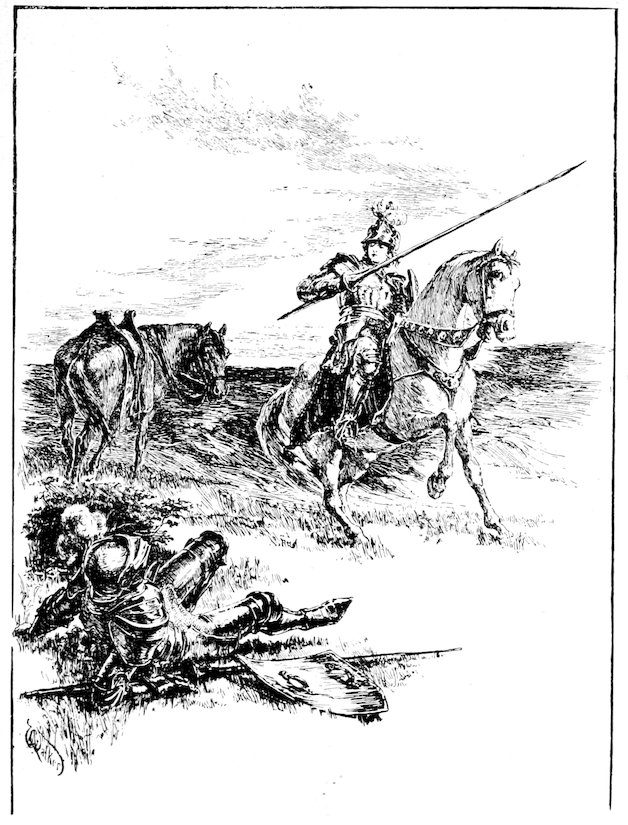
“But Guyon selfe, ere well he was aware, High a speares length behind his crouper fell.”
171Sir Guyon, full of anger at his fall, and eager to revenge himself, rose hastily, drew his sword, and rushed at the foe; but his attendant, the Black Palmer, who had been his faithful companion and guide in all his former adventures, implored his master not to run into fresh danger. By his great wisdom he could tell that Britomart’s spear was enchanted, and that no mortal power could withstand it.
Prince Arthur joined his entreaties to the Palmer’s, and they both spoke so wisely that Guyon’s anger melted away. Britomart and he became reconciled, and swore a firm friendship. In those days, when knights fought together, it was often not at all in malice, but only to test their strength and manliness. The one who conquered won much renown, but the vanquished felt no spite nor envy. It is a great thing to be able to lose with a good grace, without becoming sulky and disagreeable. Later ages might do well in this respect to learn a lesson from the days of chivalry.
So Britomart, Prince Arthur, and Sir Guyon then travelled on together in the most friendly fashion, seeking further adventures. For some time nothing happened, but at length they came to a wide forest, which seemed very horrible and dreary. They rode a long way through this, but found no track of living creature, except bears, and lions, and bulls, which roamed all around. Suddenly, out of the thickest part of the wood, something rushed past them.
172
How Britomart fought with Six Knights
The creature that rushed from the wood, across the path of Britomart, Sir Guyon, and Prince Arthur, was a milk-white pony. On its back was a lovely lady, whose face shone as clear as crystal, though it was now white with fear. Her garments were all worked with beaten gold, and the trappings of her steed were covered with glittering embroidery. The pony fled so fast that nothing could hold it, and they could scarcely see the lady. She kept casting backward glances, as if she feared some evil that closely pursued her, and her bright yellow hair flew out far behind in the wind like the trail of a blazing comet.
The name of the lady was Florimell.
As the Knights stood gazing after her, there rushed from the same thicket a rough, clownish woodman, fiercely urging on his tired horse through thick and thin, over bank and bush, hoping by some means to get hold of Florimell. He was a huge, cruel-looking fellow, and in his hand he carried a sharp boar-spear.
Directly Prince Arthur and Sir Guyon saw this they stayed not a moment to see which would be first, but both spurred after as fast as they could to rescue the lady from the villain.
Britomart waited some time to see if they would return, but finding they did not come back she again set forward on her journey with steadfast courage. She intended no evil, nor did she fear any.
173
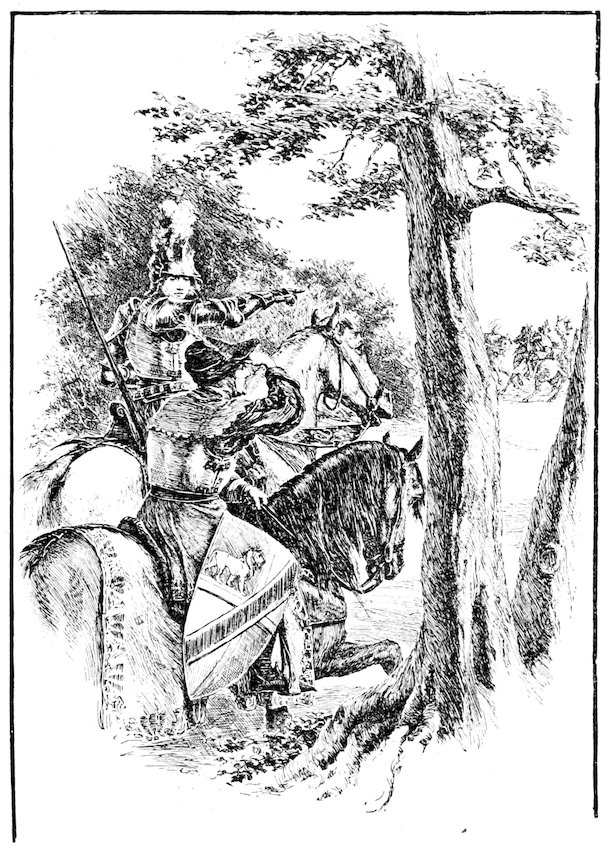
“But faire before the gate a spatious playne Mantled with greene, it selfe did spredden wyde, On which she saw six knights, that did darrayne Fiers battail against one with cruel might and mayne.”
At last, when she had nearly reached the edge of 175the wood, she spied far away a stately Castle, to which she immediately directed her steps. This castle was a fine building, and placed for pleasure near the edge of the forest, but in front of the gate stretched a wide, green plain.
On this plain Britomart saw six knights, who were all engaged in cruel battle against one Knight. They attacked him with great violence all at the same time, and sorely beset him on every side, so that he was nearly breathless; but nothing could dismay him, and he never yielded a foot of ground, although he was sorely wounded. He dealt his blows stoutly, and whichever way he turned he made his enemies recoil, so that not one of all the six dared face him alone. They were like cowardly curs having some savage creature at bay, who run about here and there to snatch a bite at their prey whenever his back is turned.
When Britomart saw this gallant Knight in such distress and danger, she ran quickly to his rescue, and called to the six others to cease their attack on a single enemy. They paid no attention, but rather increased their spiteful fury, till Britomart, rushing through the thickest crowd, broke up their band, and compelled them, by force, to listen to peace. Then she began mildly to inquire the cause of their dispute and outrageous anger.
Thereupon the single Knight answered, “These six tried by force to make me give up my own dear lady, and love another. I would rather die than do such a thing. For I love one lady, the truest one on earth, and I have no desire to change. For her dear 176sake I have endured many a bitter peril and met with many a wound.”
“Then, certainly, you six are to blame,” said Britomart, “for it would be a great shame for a knight to leave his faithful lady—it would be better to die. Neither can you compel love by force.”
Then spoke one of the six. “There dwells within this Castle a fair lady whose beauty has no living rival. She has ordained this law, which we approve—that every knight who comes this way, and has no lady of his own, shall enter her service, never to leave it. But if he has already a lady whom he loves, then he must give her up, or else fight with us to prove that she is fairer than our lady.”
“Truly,” said Britomart, “the choice is hard. But, suppose the knight overcame, what reward would he get?”
“Then he would be advanced to high honour, and win the hand of our lady,” was the answer. “Therefore, sir, if you love any one——”
“I certainly will not give up my love, nor will I do service to your lady,” replied Britomart. “But I will revenge the wrong you have done to this Knight.”
Then she rode at the six with her enchanted spear, and overthrew three of them before they were well aware of it. The fourth was dismayed by the Knight to whose rescue she had come, and the two others gave in before she touched them.
“Too well we see our own weakness and your matchless power,” they said. “Henceforth, fair sir, 177according to her own law, the lady is yours, and we plight our loyalty to you as liegemen.”
So they threw their swords under Britomart’s feet, and afterwards besought her to enter into the castle, and reap the reward of her victory.
Britomart consenting, they all went in together.
How it fared with Britomart in Castle Joyous
The stately mansion into which Britomart and the rescued Knight now entered was called “Castle Joyous,” and the owner of it was known to her retainers by the name of “the Lady of Delight.” It would be impossible to tell all the wonderful richness and beauty of this building, which was adorned fit for the palace of a prince.
Passing through a lofty and spacious chamber, every pillar of which was pure gold, set with pearls and precious stones, the knights came to an inner room, hung with the most costly tapestry. The place was filled with the sweetest music and the singing of birds, but the wasteful luxury they saw on every side did not please Britomart nor the Knight, and they looked with a scornful eye on such lavish profusion.
Then they came into the presence of the Lady of the Castle. They found her seated on a splendid couch, glittering with gold and embroidery. She seemed very generous and of rare beauty, but she was neither gentle nor modest, and she never hesitated to gratify her own desires at any cost.
178When she saw Britomart, who, in her armour, appeared to be a young and handsome knight, she took a great liking to her, and thought how nice it would be if she would enter into her service, and stay altogether at the Castle. All through the splendid supper which was presently served, she tried to make herself as agreeable as ever she could, hoping that Britomart would be tempted to remain. After supper, she begged her to lay aside her armour, and enjoy some sport; but this the maiden refused to do, for she wore it as a disguise. Britomart would not be so discourteous as to repulse the kindly spoken offers of goodwill, but she in her heart thought that such a sudden affection for a wandering guest could not be worth very much.
When the supper-tables were cleared away, all the knights, and squires, and dames began to make merry. There was dancing and gambling, and every kind of revelry; but through it all Malecasta (which was the real name of the Lady of Delight) was plotting in her own mind how she could get hold of Britomart. If the gallant young Knight (as she thought him) would not consent to stay of his own free will, she determined to detain him by guile.
So that night, when Britomart had taken off her armour and was fast asleep, Malecasta went to her room. Britomart sprang up in a great fright, and ran to seize her weapon; but Malecasta shrieked for her six knights, and they all came rushing in, armed and half-armed. When they saw Britomart, with her sword drawn, they were afraid to go near her; but 179one of them drew a deadly bow, and shot a keen arrow at her, which wounded her in the side. But the noise had also wakened the other Knight, who now ran to her help, and, fighting together side by side, they soon defeated their foes.
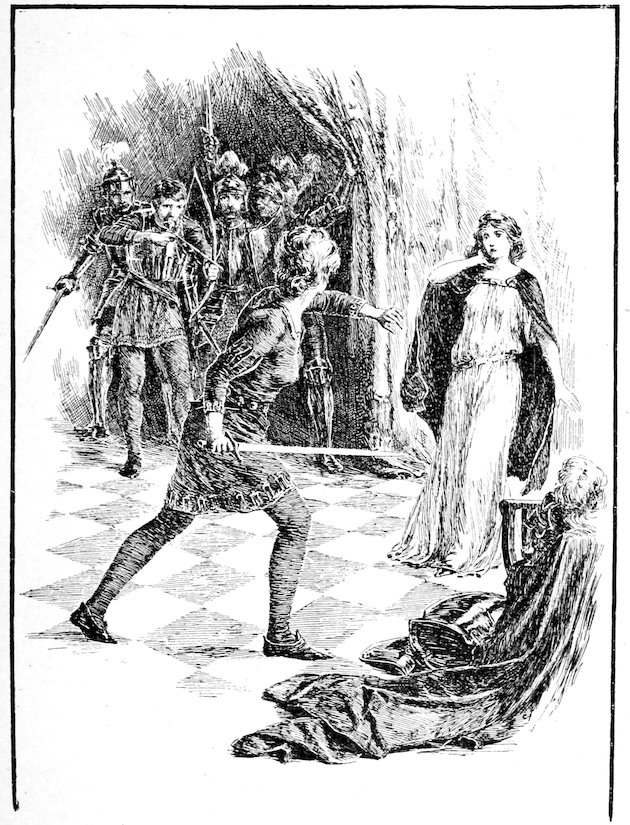
“But one of these sixe knights, Gardanté hight, Drew out a deadly bow and arrow keene, Which forth he sent, with felonous despight And fell intent, against the virgin sheene.”
181When they were all put to shameful flight, Britomart arrayed herself again in her armour, for she would stay no longer in a place where such things were done by those who were apparently noble knights and ladies. Quite early, therefore, while the dawn was still grey, she and her companion-knight took their steeds and went forth upon their journey.
How Britomart looked into the Magic Mirror
As Britomart and the Knight journeyed away from Castle Joyous, it came into the Knight’s mind to ask the Princess what had brought her into that part of the country, and why she disguised herself thus: for she seemed a beautiful lady when she was dressed as one, but the handsomest knight alive when she was clad in armour.
“Fair sir,” replied Britomart, “I would have you know that from the hour when I left my nurse’s arms, I have been trained up in warlike ways, to toss spear and shield, and to meet and overthrow warrior knights. I loathe to lead the lazy life of pleasure that most ladies do, fingering fine needle and fancy thread; I would rather die at the point of the foeman’s spear. All my delight is set on deeds of arms, to hunt out 182perils and adventures wherever they may be met by sea or land, not for riches nor for reward, but only for glory and honour. For this reason, I came into these parts, far from my native country, without map or compass, to seek for praise and fame.
“For report has blazed forth that here, in the land of the Faerie Queene, many famous knights and ladies dwell, and many strange adventures can be found, out of which much glory may be won; and to prove this, I have begun this voyage. But may I ask of you, courteous Knight, tidings of one who has behaved very badly to me, and on whom I am seeking to revenge myself; he is called Artegall.”
Britomart did not mean what she said of Artegall; she only spoke like this to conceal her real feelings. As soon as the words were uttered she repented, and would have recalled them, but her companion answered almost before she had finished speaking. He said she was very wrong to upbraid so scornfully a gentle Knight, for of all who ever rode at tilt or tourney, the noble Artegall was the most renowned. It would be very strange, therefore, if any shameful thought ever entered his mind, or if he did any deed deserving of blame, for noble courage does nothing unworthy of itself.
Britomart grew wonderfully glad to hear her love thus highly praised, and rejoiced that she had given her heart to one so gallant; but in order to lead the Knight to speak further in the same style, she still pretended to find fault with Artegall, and asked where he might be found, because she wanted to fight with him.
183“Ah, if only reason could persuade you to soften your anger!” said the Knight. “It is a bold thing to imagine you can bind a man like this down to hard conditions, or to hope to match in equal fight one whose prowess has no living rival. Besides, it is not at all easy to tell where or how he can be found, for he never dwells in any settled spot, but roams all over the world, always doing noble deeds, defending the rightful cause of women and orphans, whenever he hears they are oppressed by might or tyranny. Thus he wins the highest honour.”
These words sank into Britomart’s heart, and filled her with rapture; but still she would not let her companion see it.
“Since it is so difficult to find Sir Artegall,” she said, “tell me some marks by which he may be known, in case I happen to meet him by chance. What is he like? What is his shield—his arms—his steed—and anything else that may distinguish him?”
The Knight set himself to point out all these, and described Sir Artegall in every particular.
But Britomart knew already exactly what Sir Artegall was like; and this is how she came to know it.
Long ago in Britain she had seen his image plainly revealed in a magic mirror, and ever since then she had loved no one else.
For in the days when her father, King Ryence, reigned over South Wales, Merlin, the great magician, had by his spells devised a wonderful looking-glass, the fame of which soon went through all the world.
184
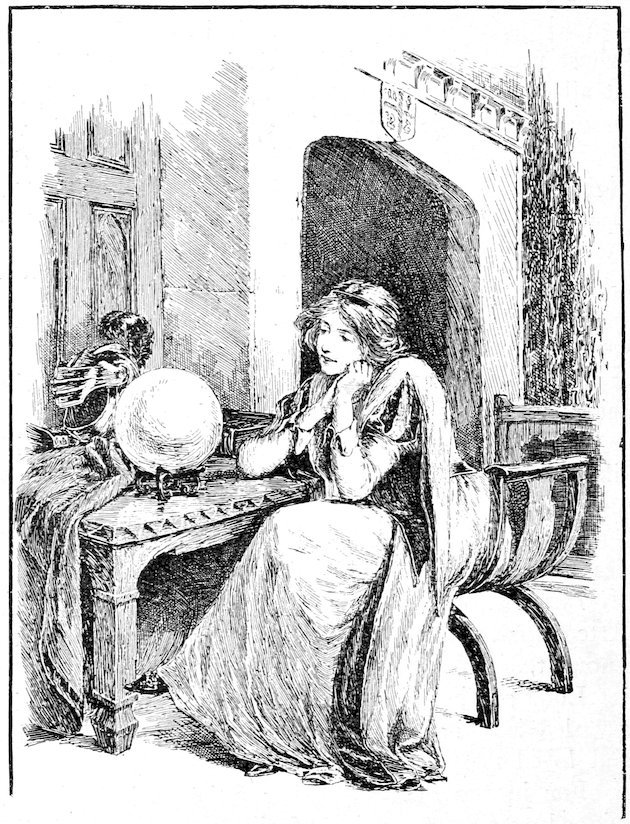
For this mirror had the power of showing perfectly whatever thing the world contained, between heaven and earth, provided it had to do with the person who looked into it. Whatever a foe had done, or a friend 185had feigned, was revealed in this mirror, and it was impossible to keep anything secret from it.
The mirror was round and hollow, and seemed like a great globe of glass. Merlin gave it to King Ryence as a safeguard, so that if foes ever invaded his kingdom he would always know it at home before he heard tidings, and thus be able to prevent them. A present which could thus detect treason and overthrow enemies, was a famous one for a prince.
One day Britomart happened to go into her father’s private room. Nothing was kept hidden from her, for she was his only daughter, and his heir. When she spied the mirror, she first looked in to see herself, but in vain. Then, remembering the strange power it was said to possess, she tried to think of some interesting thing that concerned herself, and thus she wondered what husband fortune would allot to her.
Immediately there was presented to her eyes the picture of a gallant Knight, clad in complete armour. His face, under the uplifted visor of the helmet, showed forth like the sun, to terrify his foes and make glad his friends. His heroic grace and noble bearing added to the grandeur of his figure.
His crest was a crouching hound, and all his armour seemed of an antique fashion, but was wonderfully massive and stout, and fretted all round with gold; written on it in ancient lettering were the words—
“Achilles’ arms, which Artegall did win.”
On his shield he bore the device of a little crowned ermine on an azure field.
186Britomart looked well at the figure of this Knight, and liked it well, and then went on her way, never dreaming that her future fate lay hidden at the bottom of this globe of glass.
How Britomart went to the Cave of the Magician Merlin
After Britomart had seen the figure of Sir Artegall in the magic mirror, a strange thing happened. She grew pale and ill, and lost all her merry spirits, and she no longer cared to do any of the things in which she had formerly delighted. At night, instead of sleeping, she tossed about, and sighed and wept; or if she did close her eyes for a few minutes, it was only to dream of dreadful things, and to start awake again suddenly, with cries of terror.
Her old nurse, Glaucé, was much distressed to see such a sad change in her dear young mistress, and one night when Britomart had been more restless than usual, she begged her to say what was troubling her, and if she were secretly fretting over anything.
Then Britomart told Glaucé of the splendid Knight she had seen in the magic mirror, and how she longed to see him again. If it were some living person, there might have been some hope for her, but now there was none, for it was only the shade or semblance of a knight. So grand and noble was the appearance of Artegall that Britomart’s heart ached with sorrow to think she should never see him in real life.
187Glaucé tried to comfort her, and spoke cheerfully, but at first Britomart would not be consoled, for she did not see how things could ever be better for her. It was very foolish of her, she owned, to love only a shadow, but she knew the remembrance of Sir Artegall would never fade as long as life lasted, and she felt that death only could put an end to her grief.
“Well,” said the faithful old nurse, “if it is a choice between death and seeing him again, I swear to you by right or wrong to discover that Knight.”
Her cheerful words quite soothed Britomart’s sad heart, and she lay down again in bed, and actually got a little sleep; as for Glaucé, she turned the lamp low, and sat by the bedside to watch and weep over her dear young lady.
After that, Glaucé tried every way she could think of to cure Britomart’s grief; but neither medicine, nor charms, nor good advice did her any good, and the nurse began to fear the King would be very angry with her when he heard what had happened to his dear daughter.
At last she thought that he who made the mirror in which Britomart had seen the strange vision of the Knight, would surely be able to tell where the real man could be found. Disguising themselves, therefore, in poor clothes, so that no one would know who they were, she and Britomart took their way to the place where the great magician, Merlin, had his dwelling, low underneath the ground, in a deep dell, far from the light of day. It was a hideous, hollow cave, under a rock that lay near a swift river foaming down the woody hills.
188Arrived here, Glaucé and Britomart at first loitered about outside, afraid to go into the cave, and beginning to doubt whether they had done well to come. The brave maiden, with love to befriend her, was the first to enter, and there she found the magician deep in some work of wonder, busily writing strange characters on the ground.
Merlin was not in the least surprised at their bold visit, for he knew quite well beforehand of their coming; but he bade them unfold their business,—as though anything in the world were hidden from him!
Then Glaucé told him that for the last three months some strange malady had taken hold of the young maiden; what it was, or whence it sprang, she knew not, but this she knew, that if a remedy were not found, she would soon see her dead. Merlin began to smile softly at Glaucé’s smooth speeches, for he knew quite well she was not telling him the whole truth, and he said, “By what you say, your young lady has more need of a doctor than of my skill. He who can get help elsewhere, seeks in vain wonders from magic.”
Glaucé was rather taken aback at hearing these words, and yet she was unwilling to let her purpose appear plainly.
“If any doctor’s skill could have cured my dear daughter,” she said, “I should certainly not have wished to trouble you; but this sad illness which has seized her is far beyond natural causes.”
189
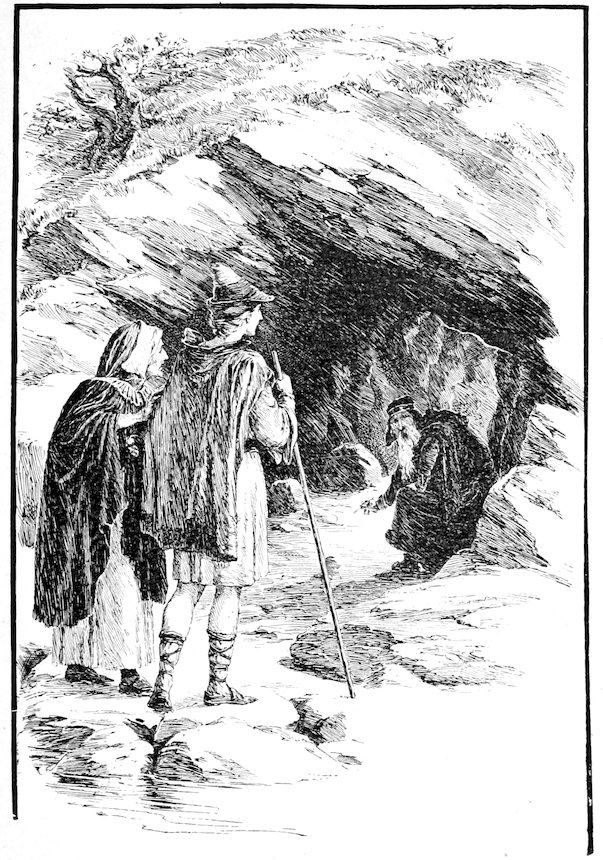
“Deepe busied ’bout worke of wondrous end, And writing straunge characters in the grownd.”
The wizard could stand no more of this, but burst 191out laughing, and said, “Glaucé, what need is there for these excuses to cover the cause which has already betrayed itself? And you, fair Britomart, although dressed in these poor clothes, are no more hidden than the sun in a veil of clouds. You have done well to come to me for help, for I can give it you.”
Britomart was quite abashed at finding herself discovered, and grew very red; but the old nurse was not in the least discomfited.
“Since you know all our grief—for what is there that you do not know?”—she said to Merlin, “I pray you to pity our trouble, and grant us relief.”
Merlin reflected for a few minutes; then he spoke to Britomart, and told her many things that would happen in the future. He bade her not to be in the least troubled, for all would end well, and it was no misfortune for her to love the most powerful knight that had ever lived.
The man whom she had seen in the magic mirror was Sir Artegall, the champion Knight of Justice, and he dwelt in the land of the Faerie Queene. He was a mighty warrior, and would fight many battles for his native country, in which Britomart would aid him. He would win again for himself the crown that was his father’s by right, and he would reign with great happiness. His son would succeed him, and after him would come a long race of kings.
When Britomart and her old nurse, Glaucé, had heard all they wanted to know, they both felt very glad and hopeful, and they returned home with much lighter hearts than they had set out.
192
How Britomart set forth on her Quest
Britomart and her old nurse Glaucé now took counsel together as to the best means of finding Sir Artegall. They thought of one plan after another, and at last the nurse hit upon a bold device. She suggested to Britomart that, as the whole country was now disturbed by war, they should disguise themselves, in armour, and go in search of the Knight. It would be easy for Britomart to do this, for she was tall and strong, and needed nothing but a little practice to render her skilful in the use of spear and sword.
“Truly,” said Glaucé, “it ought to fire your courage to hear the poets sing of all the brave women who have come from the royal house to which you belong.”
She went on to name a long list of noble Princesses who had fought gallantly against their country’s enemies, and bade Britomart follow their example and be equally courageous.
Her stirring words sank deep into the heart of the maiden, and immediately filled her with courage, and made her long to do brave deeds. She resolved to go forth as an adventurous knight, and bade Glaucé put all things at once in readiness.
193
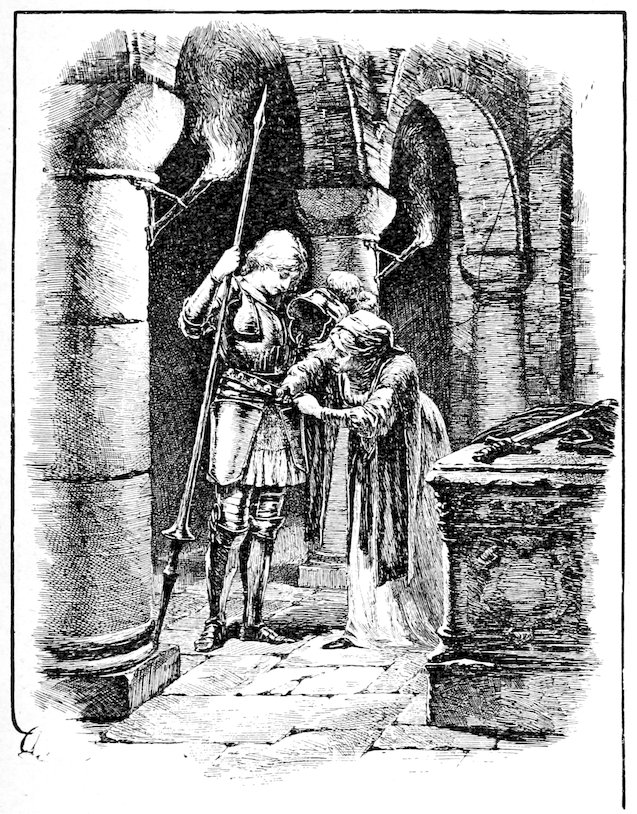
“In th’ evening late old Glaucé hither led Faire Britomart, and, that same Armory Downe taking, her therein appareled Well as she might.” . . .
It happened fortunately for them that only a few days before, a band of Britons riding on a foray had taken some rich spoil from the enemy. Amongst this was a splendid suit of armour which had belonged to the Saxon Queen, Angela. It was all fretted with 195gold, and very beautiful. This, with the other ornaments, King Ryence had caused to be hung in his chief church, as a lasting memorial of his victory. Glaucé, remembering this, led Britomart there late one evening, and, taking down the armour, dressed her in it. Beside the arms stood a mighty spear, which had been made by magic; no living person could sit so fast in the saddle but it could hurl him to the ground. Britomart took this spear, and also a shield which hung near.
When Glaucé had dressed the maiden she took another suit of armour, and put it on herself, so that she could go forth with her young mistress and attend her carefully as her squire. Then they lightly mounted their horses, which were ready for them, and rode away in the darkness of night, so that none should see them.
They never rested till they reached the land of the Faerie Queene, as Merlin had directed them. There they met with the Knight from Queen Gloriana’s court, as we have already seen, with whom they had much pleasant conversation, but especially about the gallant Sir Artegall. When they came at last to the place where they had to part, the Knight and Britomart, who greatly liked each other, promised always to remain true friends, and Britomart then rode on alone with Glaucé in search of Sir Artegall.
What her companion had told her about Artegall made her long all the more to see him, and she fashioned in her mind a thousand thoughts as to what 196he would be like, picturing him in her fancy everything that was noble and lovable—“wise, warlike, handsome, courteous, and kind.” But these thoughts, instead of soothing her sorrow, only made it worse, till it seemed that nothing but death could drive away the pain. So she rode forth, restless and unrefreshed, searching all lands, and every remotest part, with nothing but her love to guide her.
How Britomart came to the Castle of the Churl Malbecco
One night, as Britomart was riding on her way, a fearful storm came on, great blasts of wind and a pelting shower of hail. Seeing a Castle in front of her, she went up to it, and earnestly begged to be let in. But the Castle belonged to a miserly churl, called Malbecco, who, because of his jealous and peevish disposition, refused to allow any strangers to enter his doors. He cared nothing what men said of him, good or bad; all his mind was set upon hoarding up heaps of ill-gotten gain. He was old and ugly, and lacking in all kindness and courtesy. Instead of opening his doors to all wandering knights, as was the custom of the time, he kept them close-barred, and even in the midst of the terrible tempest which was then raging, Britomart was flatly refused entrance. She was greatly displeased at this, and determined when the time came to punish the churl for his discourtesy.
197But, in order to escape the fury of the gale, she was compelled to seek some refuge near. Beside the Castle gate was a little shed, meant for swine, but when she tried to enter she found it already full of guests. Another party of knights had been refused admittance at the Castle, and were forced to fly there for shelter. These would not at first allow Britomart to enter, whereupon she grew very angry, and declared she would either lodge with them in a friendly fashion, or she would turn them all out of the shed, whether they were willing or not, and then she challenged them to come forth and fight.
The knights would now have been willing to let her come in, but her boastful tone irritated them; one of them, Paridell by name, was especially annoyed, and hastily mounting his steed he rode forth to fight with her. Their spears met with such fury that both man and horse were borne to the ground, and Paridell was so sorely bruised that he could scarcely arise to continue the combat on foot, with swords, as was then the custom.
But his companion, Sir Satyrane (who was the good Knight who had formerly befriended Una in the forest), stepped forward to prevent Britomart and Paridell from fighting further, and his wise speeches soon soothed their anger. When peace was restored, they agreed to join together to punish the unmannerly churl, who had acted so ungraciously in refusing them shelter from the tempest, and they went towards the gates to burn them down.
Malbecco, seeing that they were really resolved to 198set fire to the building, ran frantically, and called to them from the castle wall, beseeching them humbly to have patience with him, as being ignorant of his servants’ rudeness and inattention to strangers. The knights were willing to accept his excuses, though they did not believe them, and they did not refuse to enter.
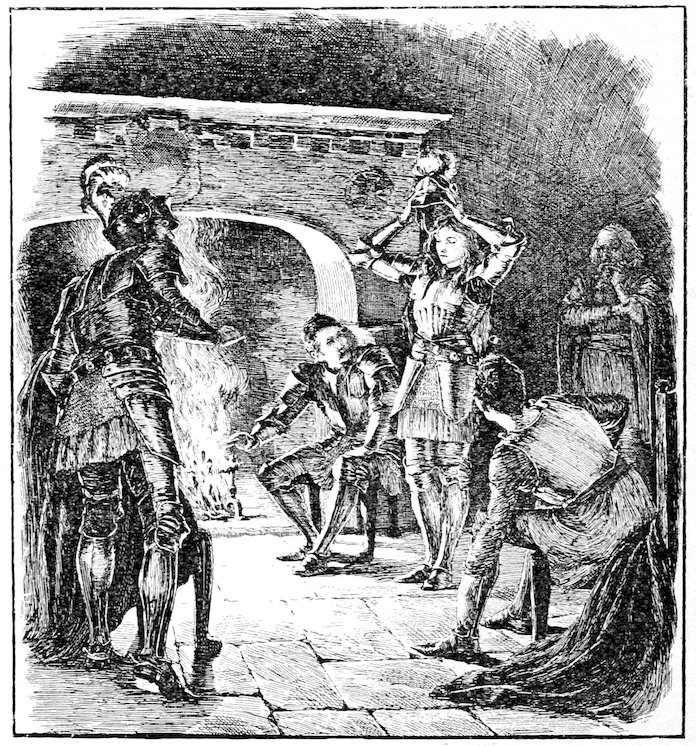
They were brought into a beautiful bower, and served with everything needful, though their host 199secretly scowled at them, and welcomed them more through fear than charity. They took off their wet garments, and undid their heavy armour, to dry themselves at the fire. Britomart, like the rest, was forced to disarray herself. When she lifted her helmet, and her golden locks fell like a cloud of light to the ground, they were all amazed to find the valiant stranger was a beautiful maiden. They stood gazing at her, silent with astonishment, for eye had never seen a fairer woman, but chiefly they marvelled at her chivalry and noble daring. They longed to know who she might be, yet no one questioned her, and every one loved her on the spot.
Supper was then served, and when the meal was over the Lady Hellenore, wife of Malbecco, invited all the knights to tell their name and kindred, and any deeds of arms they had done. They talked so long about their various strange adventures, and the daring feats and many dangers they had passed through, that old Malbecco grew quite impatient. He took no interest in conversation of this kind. At last, when the night was half spent, he persuaded them to go to rest; so they all retired to the rooms prepared for them.
The next day, as soon as the sun shone in the sky, Britomart rose up and set forth on her journey. Sir Satyrane went with her, but Paridell pretended to have been so much hurt by his fight with Britomart that he must stay behind at the Castle till his wounds were cured.
200
How Britomart walked through Fire
Britomart and Sir Satyrane had not long left the Castle of the churl Malbecco when they saw in front of them a huge Giant chasing a young man. Filled with anger, Britomart immediately galloped to the rescue, and Sir Satyrane followed close behind. Seeing them approach, the Giant quickly resigned his prey, and fled to save himself. He ran so fast that neither of them could overtake him, and presently he came to a great forest, where he hid himself. It was not Sir Satyrane he feared so much as Britomart, for some instinct told him that his evil nature would be powerless to fight against any one so good.
Britomart and Sir Satyrane entered the wood, and searched everywhere for the Giant, and, each going a different way, they soon got separated. Britomart went deep into the forest, and at last came to a fountain by which lay a Knight. He had tossed aside his coat and mail, his helmet, his spear, and his shield, and had flung himself face downwards on the grass. At first, Britomart would not disturb him, for she thought him asleep, but, while she stood still looking at him, she presently heard him sob and sigh as if his heart would break.
Filled with pity, Britomart begged him to say what was the matter, as perhaps she might be able to help him. The Knight, whose name was Scudamour, did not think this at all likely, and would scarcely speak, but, after some further gentle words from 201Britomart, he told her that he was in such deep sorrow because the lady he loved had been seized by a wicked enchanter called Busirane, and shut up in a horrible dungeon, from which no living power could release her. The enchanter had done this because he wanted to marry her himself, and when she refused, and declared she would never forsake her own true Knight, he had taken this cruel revenge.
Then Britomart bade him take courage, for she would either deliver the Lady Amoretta from her dungeon, or she would die with her.
“Ah, gentlest Knight alive,” cried Scudamour, “how brave and good you are! But keep your happy days and use them to better purpose. Let me die that ought. One is enough to die.”
“Life is not lost by which is bought endless renown,” said Britomart.
Thus she persuaded Sir Scudamour to rise and go with her to see what success would befall him in this fresh attempt. She gathered up his armour, which he had flung away in despair, and helped him to put it on, and she fetched his steed, which had wandered to some distance.
Then they went forth together, and soon arrived at the place where their venture was to be made. There they dismounted, drew their weapons, and boldly marched up to the Castle. Here they found no gate to bar their passage, nor any warder, but in the porch, which greatly terrified them, was a huge flaming fire, mixed with smoke and sulphur, which choked all the entrance, and forced them to go back.
202Britomart was dismayed at this, and did not know what to do, for it seemed useless danger to attempt to brave the fire, which prevented any one going near. Turning back to Scudamour, she asked what course he thought it would be safest to take, and how they should get at their foe to fight him.
“This is the reason why I said to you at first the quest was hopeless,” replied Scudamour, “for this fire cannot be quenched either by strength or cunning, nor can it be moved away, so mighty are the enchantments that keep it here. What else is to be done but to stop this useless labour, and leave me to my former despair? The Lady Amoretta must stay in her wicked chains, and Scudamour die here with sorrowing.”
“No, indeed,” said Britomart, “for it would be a shameful thing to abandon a noble enterprise at the mere sight of peril, without even venturing. Rather let us try the last chance than give up our purpose out of fear.”
So saying, resolved to try her utmost, she threw her shield in front of her face, and, holding the point of her sword straight in front of her, she advanced to the fire. The flames immediately gave way, and parted on either side, so that she walked through without hindrance.
When Scudamour saw Britomart safe and untouched on the other side of the fire, he also tried to pass, and bade the flames make way for him; but the fire would not obey his threatening command, and only raged the more fiercely, forcing him to retire all scorched and painfully burnt. Furious at his failure, more even than at the pain of his burns, he flung himself 203impatiently down on the grass, but Britomart had now passed the first door and entered the Castle.
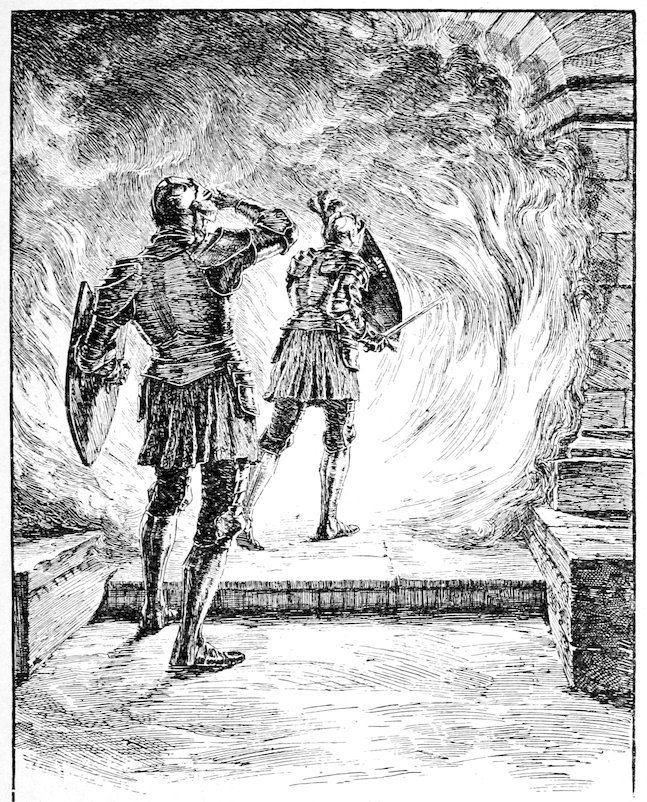
“Her ample shield she threw before her face, And her swords point directing forward right Assayld the flame; the which eftsoones gave place, And did it selfe divide with equall space.”
205The first room she came to was splendid to see, for it was all hung round with rich tapestry, woven with gold and silk. Beautiful pictures, representing well-known fables and stories, were worked in the tapestry, and at the upper end of the room was a great Image which the people of the house were accustomed to worship. This image was made of massive gold, and had wings that shone with all the colours of the rainbow. It was blindfolded, and held in its hand a bow and arrows, which it seemed to shoot at random; some of the arrows were tipped with lead, some with pure gold. A wounded dragon lay under its feet.
Britomart was so amazed at this wonderful figure, that she kept gazing at it again and again, though its brightness quite dazzled her. But, casting her eyes round the room, to discover every secret of the place, she saw written over the door these words:—
“Be bold.”
She read this over and over, but could not think to what it could refer; but, whatever it might mean, it did not in the least discourage her from following out her first intention, so she went forward with bold steps into the next room.
This second room was even fairer and richer than the first one, for it was not hung round with tapestry, but was all overlaid with pure gold carved into the most curious and grotesque figures.
Britomart marvelled much to see all this wealth 206and luxury, but, still more, that there was no trace of living person—nothing but wasteful emptiness and solemn silence over all the place; it seemed strange that there was no one to possess such rich belongings, nor to keep them carefully.
And as she looked about she saw how over that door, too, was written “Be bold, be bold;” and everywhere, “Be bold.” She meditated much over this, but could not understand it. At last, at the upper end of the room, she saw another iron door, on which was written
“Be not too bold,”
but, though she bent all her wise mind to the subject, she could not tell what it might mean.
Thus she waited there until evening, yet saw no living creature appear. And now gloomy shadows began to hide the world from mortal view and wrap it in darkness. Britomart did not dare to take off her tiring armour, nor to go to sleep, for fear of secret danger, but she held herself in readiness, and saw that all her weapons were in good order.
What Britomart saw in the Enchanted Chamber
As darkness fell, Britomart heard the sound of a shrill trumpet, the sign of an approaching battle or a victory gained. This did not in the least daunt her courage, but rather strengthened it, while she expected each moment to see some foe appear.
207Then arose a hideous storm of wind, with thunder and lightning, and an earthquake as if it would shake the foundations of the world. This was followed by a horrible smell of smoke and sulphur, which filled the whole place. Yet still the brave Princess was not afraid, but remained steadfast.
Suddenly a whirlwind swept through the house, banging every door, and bursting open the iron wicket. Then stepped forth a grave-looking person, in costly raiment, and bearing in his hand a branch of laurel. Advancing to the middle of the room, he stood still, as if he had something to say, and beckoned with his hand to call for silence. After making various other signs, as if he were explaining some play that was going on, he softly retired, and then his name could be seen written on his robe in golden letters—“Ease.”
Britomart, still standing, saw all this, and marvelled what his strange intention could be.
Then through the iron wicket came a joyous band, minstrels and poets playing and singing the sweetest music, and after them followed a number of strange figures in curious disguise, marching all in order like a procession.
The first was Fancy, like a lovely boy. His garment was neither silk nor stuff, but painted plumes, such as wild Indians deck themselves with. He seemed as vain and light as these same plumes, for he walked along as if he were dancing, bearing in his hand a great fan, which he waved to and fro. At his side marched Desire. His dress was extravagant, and his embroidered cap was all awry. He carried in his 208two hands some sparks, which he kept so busily blowing that they soon burst into flame.
Next after these came Doubt, in a faded cloak and hood, with wide sleeves. He glanced sideways out of his mistrustful eyes, and trod carefully, as if thorns lay in his path; he supported his feeble steps with a broken reed, which bent whenever he leant hard on it. With Doubt walked Danger, clothed in a ragged bear’s skin, which made him more dreadful, though his own face was grisly enough, and needed nothing to make it more so. In one hand was a net, in the other a rusty blade—Mischief and Mischance. With the one he threatened his foes, with the other he entrapped his friends.
After Danger walked Fear; he was all armed from top to toe, yet even then did not think himself safe. He was afraid of every shadow, and when he spied his own arms glittering, or heard them clashing, he fled fast away. His face was pale as ashes, and he kept his eyes fixed on Danger, against whom he always bent a brazen shield, which he held in his right hand.
Side by side with Fear marched Hope, a handsome maid, with a cheerful expression and lovely to see. She was lightly arrayed in silken samite, and her fair locks were woven up with gold. She always smiled, and in her hand she held a little phial of dew, from which she sprinkled favours on any one she chose. She showed a great liking to many people, but true love to few.
After them, Dissembling and Suspicion marched together, though they were not in the least alike; for Dissembling was gentle and mild, courteous to all, and seemingly gracious, well adorned, and handsome. 209But all her good points were painted or stolen; her deeds were forged, her words false. In her hand she always twined two clues of silk.
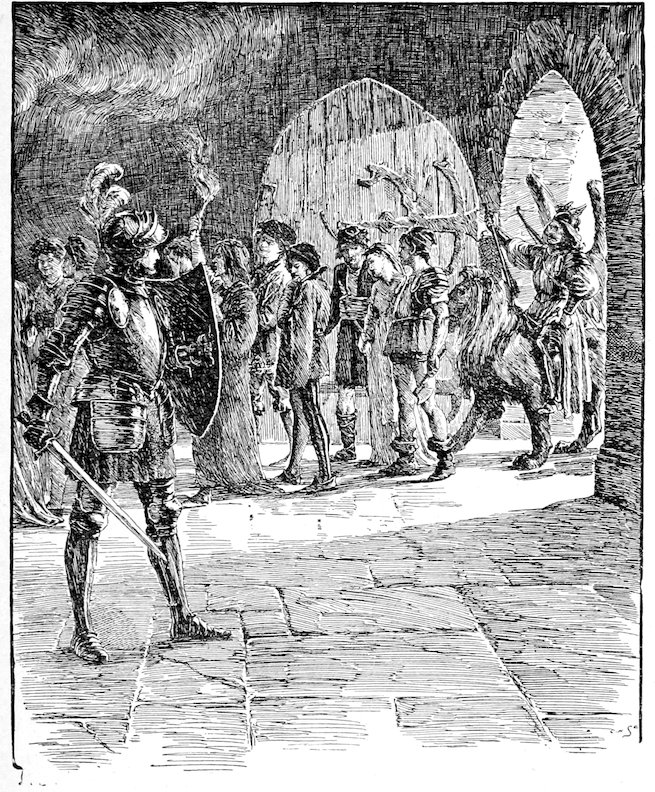
“After all these there marcht a most faire Dame, Led of two grysie Villains, th’ one Despight, The other cleped Cruelty by name.”
211Suspicion was ugly, ill-favoured, and grim, for ever looking askance under his sullen eyebrows. While Dissembling constantly smiled at him, he scowled back at her, showing his nature by his countenance. His rolling eyes never rested in one place, but wandered all round, for fear of hidden mischief; he held a screen of latticework in front of his face, through which he kept peering.
Next him came Grief and Fury, fit companions—Grief clad in sable, hanging his dull head, carrying a pair of pincers, with which he pinched people to the heart; Fury all in rags, tossing in her right hand a firebrand. Then followed Displeasure, looking heavy and sullen, and Pleasure, cheerful, fresh, and full of gladness. Displeasure had an angry wasp in a bottle, and Pleasure a honey-laden bee.
After these six couples came a beautiful lady, led by two villains, Spite and Cruelty. She looked pale as death, and very ill, but in spite of this was most lovely and graceful. Her feeble feet could scarcely carry her, but the two wretches held her up, and kept urging her forward.
Then the Tyrant of the Castle appeared—the winged figure of Love, whom Britomart had already seen in the first room as a golden image. He rode on a ravenous lion, and had unbound his eyes, so that he might gloat over the distress of the lovely lady, which seemed to please him greatly. He looked round him with stern disdain, and, surveying his goodly company, 212marshalled them in order. Then he shook the darts that he carried in his right hand and clashed his rainbow-coloured wings, so that every one was terrified.
Behind him came his three chief attendants, Reproach, Repentance, and Shame, and after them flocked a rude, confused crowd, who owned him as master—Strife and Anger, Care and Unthriftiness, Loss of Time and Sorrow, fickle Change, false Disloyalty, Rioting, Poverty, and, lastly, Death-with-infamy.
All these and many other evil followers passed in disguise before Britomart, and, having thrice marched round the enchanted chamber, returned to the inner room whence they had come.
How Britomart rescued a Fair Lady from a Wicked Enchanter
As soon as the strange procession had passed into the inner room, the door shut tight, driven by the same stormy blast with which it had first opened. Then the brave maiden, who all this while had remained hidden in shadow, came forth, and went to the door to enter in, but found it fast locked. In vain she thought to open it by strength when charms had closed it, and, finding force of no avail, she determined to use art, resolving not to leave that room till the next day, when the same figures would again appear.
At last the morning dawned, calling men to their daily work, and Britomart, fresh as the morning, came out from her hiding-place. All that day she spent in wandering and in gazing at the adornment of the 213chamber, till again the second evening spread her black cloak over everything. Then at midnight the brazen door flew open, and in went bold Britomart, as she had made up her mind to do, afraid neither of idle shows nor of false charms.
As soon as she entered, she cast her eyes round to see what had become of all the persons she had seen in the outside room the night before, but, lo! they had all vanished. She saw no living mortal of that strange company except the same hapless lady, whose two hands were bound fast, and who had an iron chain round her small waist, fastened to a brazen pillar by which she stood.
In front of her sat the vile Enchanter, drawing in blood strange characters of his art, to try to make her love him. But who could love the cause of all her trouble? He had already tried a thousand charms, but a thousand charms could not alter the lady’s steadfast heart.
As soon as the Enchanter saw Britomart, he hastily overthrew his wicked books, not caring to lose his long labour, and, drawing a knife out of his pocket, ran fiercely at the lady, thinking, in his villainy, to kill her. But Britomart, leaping lightly to him, withheld his wicked hand, and overpowered him.
Then, turning the weapon from the one whom he had first meant it, he struck at Britomart and wounded her. The hurt was slight, but it so enraged the maiden that she drew her sword, and smote fiercely at the tyrant. He fell to the ground half dead, and the next stroke would have slain him, had not the lady who 214stood bound called to Britomart not to kill him. If she did so, the prisoner’s pain would be without remedy, for no one but the Enchanter who had put the spell on her could take it off again.
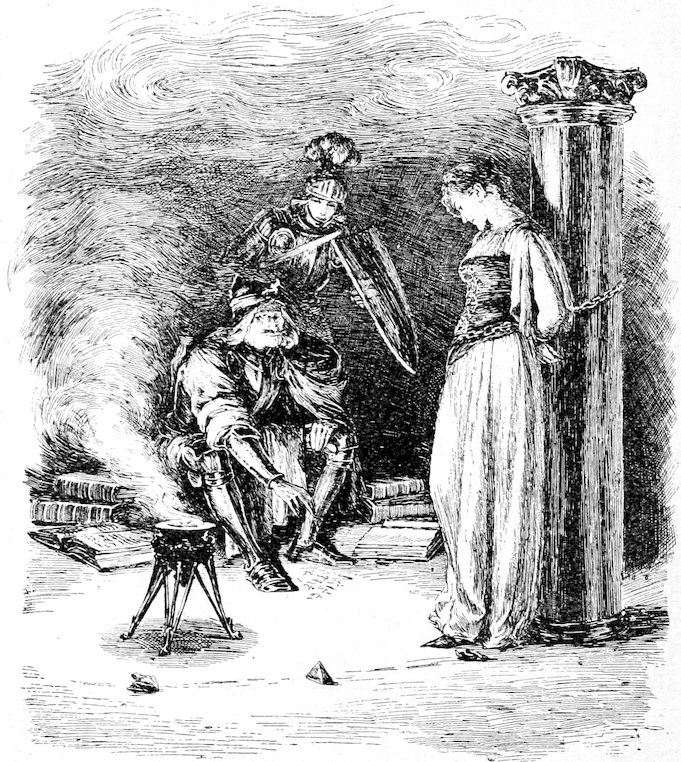
Then Britomart unwillingly stayed her hand, for she grudged him his life, and longed to see him punished.
215“Thou wicked man,” she said to him, “whose huge mischief and villainy merit death or worse than death, be sure that nothing shall save thee, unless thou immediately restore the lady to health and to her former condition. This do and live, or else thou shalt undoubtedly die.”
The Enchanter, glad to live, for he had expected nothing but death, yielded willingly, and, rising, began at once to look over the wicked book, in order to reverse his charms. He read aloud many dreadful things, so that Britomart’s heart was pierced with horror. But all the time he read, she held her sword high over him, in case he tried to do further mischief.
Presently the house began to quake, and all the doors to rattle. Yet this did not dismay her nor make her slacken her threatening hand. But, with steadfast eye and stout courage, she waited to see what would be the end. At last the mighty chain which was wound round the lady’s waist fell down, and the great brazen pillar broke into small pieces. Gradually her look of terrible suffering passed, and she became restored to perfect health, as if she had never been ill.
When she felt herself unbound, and quite well and strong, she threw herself at the feet of Britomart.
“Ah, noble Knight!” she said, “what recompense can a wretched lady, freed from her woeful state, yield you for your gracious deed? Your virtue shall bring its own reward, even immortal praise and glory, which I, your vassal, freed by your prowess, shall proclaim throughout the world.”
216But Britomart, lifting her from the ground, said, “Gentle lady, this I ween is reward enough for many more labours than I have done, that now I see you in safety, and that I have been the means of your deliverance. Henceforth, fair lady, take comfort, and put away remembrance of your late trouble. Know, instead, that your loving husband has endured no less grief for your sake.”
Amoret, for that was the lady’s name, was much cheered to hear this mention of Sir Scudamour, for she loved him best of all living people.
Then the noble champion laid her strong hand on the Enchanter who had treated Amoret so cruelly, and, with the great chain with which he had formerly kept prisoner the hapless lady, she now bound himself, and led him away captive.
Returning the way she came, Britomart was dismayed to find that the goodly rooms which she had lately seen so richly and royally adorned had utterly vanished, and all their glory had decayed. Descending to the perilous porch, she found also that the dreadful flames, which had formerly so cruelly scorched all those who tried to enter, were quenched like a burnt-out torch. It was now much easier to pass out than it had been to come in. The Enchanter, who had framed this fraud to compel the love of the fair lady, was deeply vexed to see his work all wasted.
But when Britomart arrived at the place where she had left Sir Scudamour and her own trusty squire (her old nurse, Glaucé), she found neither of them there. At this she was sorely astonished, and, above all, 217Amoret, who had looked forward to seeing her own dear Knight, being deprived of this hope, was filled with fresh alarm.
Sir Scudamour, poor man, had waited long in dread for Britomart’s return, but not seeing her, nor any sign of her success, his expectation turned to despair, for he felt sure that the flames must have burnt her. Therefore he took counsel with her old squire, who mourned her loss no less deeply, and the two departed in search of further aid.
What Strange Meetings befell on the Way
Leaving the Enchanter’s Castle behind them, Britomart and Amoret started in search of Sir Scudamour and Glaucé.
As they went, Amoret told Britomart the story of how she came into the power of the wicked Busirane. On the very day of her marriage to Sir Scudamour, at the wedding feast, while all the guests were making merry, Busirane found means to introduce the strange procession which had so amazed Britomart in the enchanted chamber. Amoret was persuaded in sport to join it, and was carried away quite unknown to any one. Seven months she had been kept in cruel imprisonment, because she would not consent to give up her own dear husband and become the wife of the wicked Enchanter. Now, at last, she was free, and when she discovered that her deliverer was not after all a knight, but in reality a beautiful maiden like herself, her heart overflowed 218with love and gratitude, and she and Britomart speedily became the best and dearest friends.
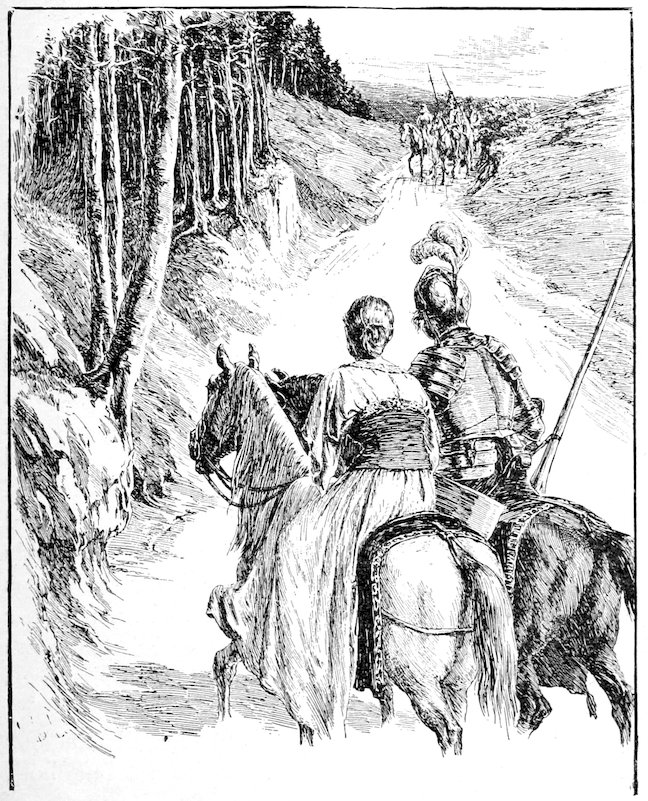
In the course of their journey they presently saw two knights in armour coming to meet them, each with what seemed at that distance a fair lady riding beside him. But ladies they were not, although in face and outward show they seemed so. Under a mask of beauty and graciousness they hid vile treachery and falsehood, which were not apparent to any but the wise and cautious.
One was the false Duessa, who had formerly beguiled the Red Cross Knight and Sir Guyon. She had changed her usual appearance, for she could put on as many different shapes as a chameleon can new colours.
Her companion was, if possible, worse than herself. Her name was Até, Mother of Strife, cause of all dissension both among private men and in public affairs of state. False Duessa, knowing that she was just the most fitting person to aid her in mischief, had summoned her from her dwelling under the earth, where she wasted her wretched days and nights in darkness. Her abode was close to the Kingdom of Evil, where plagues and harms abound to punish those who do wrong. It was a gloomy dell, far under ground, surrounded with thorns and briars, so that no one could easily get out; there were many ways to enter, but none by which to leave when one was once in; for it is harder to end discord than to begin it.
All the broken walls inside were hung with the ragged memorials of past times, which showed the sad effects of strife. There were rent robes and broken sceptres, sacred things ruined, shivered spears, and shields 219torn in twain, great cities ransacked, and strong castles beaten down, nations led into captivity, and huge armies slain—relics of all these ruins remained in the house of Até. All the famous wars in history found a record here, as well as the feuds and quarrels of private persons too many to mention.
220Such was the house inside. Outside, the barren ground was full of poisonous weeds, which Strife herself had sown; they had grown great from small seeds—the seeds of evil words and wrangling deeds, which, when they come to ripeness, bring forth an infinite increase of trouble and contention, often ending in bloodshed and war. These horrible seeds also served Até for bread, and she had been fed upon them from childhood, for she got her life from that which killed other people. She was born of a race of demons, and brought up by the Furies.
Strife was as ugly as she was wicked; she could speak nothing but falsehood, and she never heard aright. She could not even walk straight, but stumbled backwards and forwards; what one hand reached out to take, the other pushed away, or what one hand made, the other destroyed. Great riches, which had taken many a day to collect, she often squandered rapidly, dismaying their possessors; for all her study and thought was how she might overthrow the things done by Concord. So far did her malice surpass her might that she tried to bring all the world’s fair peace and harmony into confusion. Such was the odious creature that rode with Duessa.
The two knights who escorted them, Blandamour and Paridell, were young and handsome, but both equally foolish, fickle, and false. When they saw Britomart and the lovely Lady Amoret approaching, Blandamour jestingly tried to make his companion 221attack Britomart, so that he might win Amoret for himself. But Paridell remembered how he had already fought with a knight bearing those arms and that shield, outside the castle of the churl Malbecco, and he had no desire to provoke a new fight.
“Very well,” said Blandamour; “I will challenge him myself;” and he rode straight at Britomart.
But he had soon cause to repent his rashness, for Britomart received his advance with so rude a welcome that he speedily left his saddle. Then she passed quietly on, leaving him on the ground much hurt, an example of his own folly, and as sad now as he had formerly been merry, well warned to beware in future with whom he dared to interfere.
Paridell ran to his aid and helped him to mount again, and they marched on their way, Blandamour trying as well as he could to hide the evil plight he was in. Before long they saw two other knights coming quickly to meet them, and Blandamour was enraged to see that one was Sir Scudamour, whom he hated mortally, both because of his worth, which made all men love him, and because he had won by right the Lady Amoret. Blandamour was greatly vexed that his bruises prevented his wreaking his old spite, and he immediately spoke thus to Paridell:—
“Fair sir, let me beg of you in the name of friendship, that, as I lately ventured for you and got these wounds, which now keep me from battle, you will now repay me with a like good turn, and justify my cause on yonder Knight.”
Paridell willingly agreed, and sped at the stranger like 222a shaft from a bow, but Sir Scudamour was on his guard, and prepared himself to give him a fitting welcome. So furiously they met that each hurled the other from his horse, like two billows driven by contrary tides, which meet together, and rebound back with roaring rage, dashing on all sides and filling the sea with foam. So fell these two, in spite of all their pride.
But Scudamour soon raised himself, and upbraided his foe for lying there so long.
Blandamour, seeing the fall of Paridell, taunted Sir Scudamour as a traitor, and heaped abuse on him, saying that he only attacked knights who were too weak to defend themselves.
Scudamour gave no answer to this, trying to restrain his indignation; but then Duessa and Até both chimed in, wickedly doing all they could to rouse his passion.
They spoke jeering words, and said they wondered Sir Scudamour should care to fight for any lady, for Amoret was faithless, and had forgotten him and gone off with another Knight.
This Knight, we know, was in reality the Princess Britomart; but Sir Scudamour did not know this. He swore, in a fearful rage, to be revenged; he even threatened to kill the squire, Glaucé, who was still with him, since he could not get hold of his master. In vain the poor old nurse tried to appease him, for she dared not disclose Britomart’s secret. Three times Sir Scudamour lifted his hand to kill Glaucé, and three times he drew back, before at last he became a little pacified.
223
How Sir Satyrane proclaimed a Great Tournament
The fickle and quarrelsome couple, Blandamour and Paridell, having been defeated by Britomart and Sir Scudamour, next fell in with a party of two knights and two masked ladies. They sent their squire to find out who these were, and he brought back word that they were two doughty knights of dreaded name, Cambell and Triamond, and the two ladies were their wives, Cambina and Candace. All four were very famous people, and the dearest friends possible. They had had many wonderful adventures of their own, about which perhaps you will read some day.
Blandamour, in his usual vainglorious spirit, would gladly have tested his strength against the knights, but he was still sore from the late unlucky fight with Britomart. However, he went up to them, and began to abuse and insult them, thinking in this way to win admiration from the ladies. Of course this enraged the two knights, who were both bent on punishing Blandamour for his base behaviour. But Cambina, wife of Cambell, soothed them with her mild words, so, for the present, they were reconciled.
The whole party rode on together, talking of daring deeds and strange adventures, and, among other things, of the great tournament to which they were then all bound.
This tournament had been set on foot by Sir Satyrane, the same woodland knight who had formerly befriended Una, and who had met Britomart at the 224castle of the churl Malbecco. Some time before, ranging abroad in search of adventure, he had come to the sea-coast, where he was horrified to find a vile monster, something like a hyena, feeding on the dead body of a milk-white palfrey. He knew the horse at once as the one on which Florimell was accustomed to ride, and, moreover, he found beside it her golden girdle. This girdle had fallen from her in flight, for Florimell had escaped in a small boat; but Sir Satyrane did not know this—he thought she had been killed by the savage brute. Filled with fury, he fell on the creature. He was unable to slay it, for it was protected by the magic spells of its mistress, a wicked witch; but he led it away captive for the time, though it afterwards escaped.
The golden girdle which Sir Satyrane found he kept as a sacred treasure, and wore for the sake of Florimell. But when she herself was lost and gone, many knights who also loved her dearly were jealous that Sir Satyrane alone should wear the ornament of the lost lady, and began to bear much spite against him. Therefore, to stop their envy, he caused a solemn feast, with public tourneying, to be proclaimed, to which every knight was to bring his lady. She who was found fairest of them all was to have the golden girdle as a reward, and she was to bestow it on the stoutest knight.
225
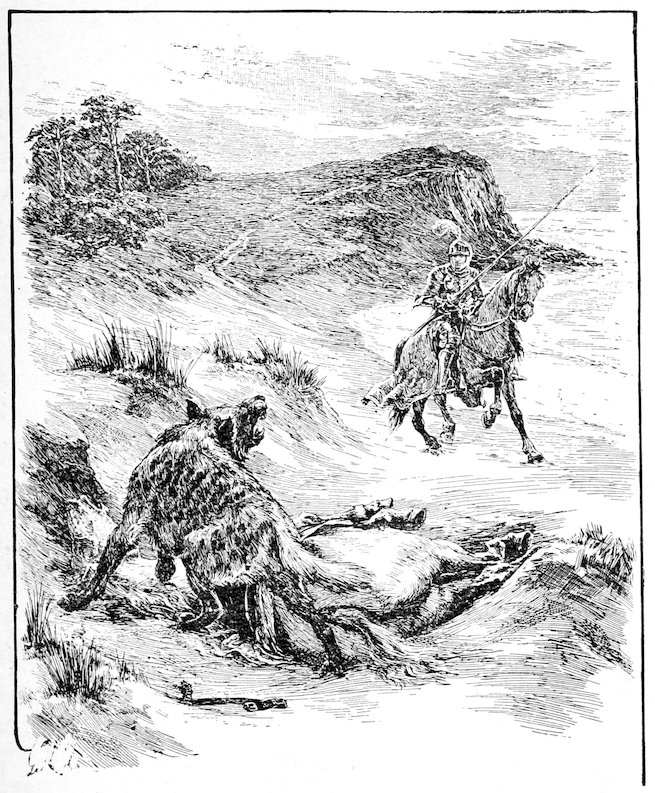
“He sett upon her Palfrey, tired lame, And slew him cruelly ere any reskew came.”
Now it happened after the flight of Florimell, that the wicked witch from whom she had escaped made up another person to represent her, in order to deceive people. This imitation maiden was most beautiful to 227see. The substance of which her body was made was purest snow frozen in a mass, and mixed with virgin wax, tinted with vermilion; her eyes shone like stars, her hair was yellow gold. Any one who saw her would surely say it was Florimell herself, or even fairer than Florimell, if such a thing could be.
But this false Florimell had a wicked and deceitful spirit, full of fawning guile, and she excelled in all manner of wily cunning.
In the course of her wandering, this creature, who was known by the name of the “Snowy Lady,” came across Braggadochio, whom you may remember as the cowardly boaster that stole Sir Guyon’s horse and armour. But as she rode along with Braggadochio the latter was attacked and beaten by another knight, who thought the lady was the real Florimell. He in turn was vanquished by Blandamour, who also imagined that she was the true Florimell, and was very proud of himself for getting possession of such a paragon. Though he was so false himself, and had deceived hundreds of others, he was no match for the “Snowy Lady” in cunning, and was completely taken in by her.
When Blandamour heard of the great tournament held by Sir Satyrane in honour of Florimell’s golden girdle, he immediately determined to go there and claim the prize on behalf of its rightful owner, whom he then believed to be under his protection. Thus it came to pass that the false Florimell journeyed with Blandamour and the others to the tournament.
Not long after Cambell and Triamond, with their wives, Cambina and Candace, had joined the party, 228they saw a man in bright armour, with spear in rest, riding towards them as though he meant to attack them. Paridell immediately prepared his own weapons, whereupon the other slackened his pace, and seemed to alter his intention, as if he meant nothing but peace and pleasure now that he had fallen by chance into their fellowship. Seeing this, they greeted him civilly, and he rode on with them.
This man was Braggadochio. When his eyes fell on the false Florimell, he remembered her as the lady who had been taken from him not long before. He therefore began to challenge her as his own prize, and threatened to seize her again by force.
Blandamour treated his words with much disdain, saying, “Sir Knight, since you claim this lady, you shall win her, as I have done, in fight. She shall be placed here, together with this hideous old hag, Até (Strife), that whoso wins her may have her by right. But Até shall go to the one that is beaten, and he shall always ride with her till he gets another lady.”
That offer pleased all the company, so the false Florimell was brought forward with Até, at which every one began to laugh merrily. But Braggadochio now tried to back out of his challenge. He said he never thought to imperil his person in fight for a hideous old creature like that. If they had sought to match the lady with another one equally fair and radiant, he would then have spent his life to justify his right.
At this vain excuse they all began to smile, scorning his unmanly cowardice. The Snowy Lady reviled him loudly for refusing to venture battle for her sake when 229it was offered in such knightly fashion, and Até secretly taunted him with the shame of such contempt. But nothing did he care for friend or foe, for in the base mind dwells neither friendship nor enmity.
But Cambell jestingly stopped them all, saying, “Brave knights and ladies, certainly you do wrong to stir up strife when most we need rest, so that we may keep ourselves fresh and strong against the coming tournament, when every one who wishes to fight may fight his fill. Postpone your challenge till that day, and then it shall be tried, if you will, which one shall have Até and which one still hold the lady.”
They all agreed, and so, turning everything to sport and pleasantness, they passed merrily on their way, till at length, on the appointed day, they came to the place where the tournament was to be held.
What befell on the First and Second Days of the Tournament
On arriving at the scene of the tournament, the little company divided, Blandamour and those of his party going to one side and the rest to the other side; but boastful Braggadochio, from vain-glory, chose rather to leave his companions, so that men might gaze more on him alone. The rest disposed themselves in groups, as seemed best to each one, every knight with his own lady.
Then, first of all, came forth Sir Satyrane, bearing the precious relic in a golden casket, so that no evil 230eyes should profane it. Then softly drawing it out of the dark, he showed it openly, so that all men might mark it—a gorgeous girdle of marvellous workmanship, curiously embossed with pearls and precious stones of great value. It was the same girdle which Florimell had lately lost. Sir Satyrane hung it aloft in open view, to be the prize of might and beauty. The moment it was uncovered, the glorious sight attracted every one’s gaze and stole the hearts of all who looked on it, so that they uttered vain vows and wishes. Thrice happy, it seemed to them, would be the lady and knight who gained such a splendid reward for their peril and labour.
Then the bold Sir Satyrane took in his hand a great spear, such as he was accustomed to wield, and, advancing forward from all the other knights, set his shield in place, showing that he was ready for the fray. The warriors who fought on his side were called the “Knights of Maidenhood.” They were the challengers, and their aim was to keep the golden girdle in their own possession.
Against him, from the other side, stepped out a Pagan knight, well skilled in arms, and often tried in battle. He was called “Bruncheval the Bold.” These two met together so furiously that neither could sustain the other’s force, and both champions were felled to the ground, where they lay senseless.
Seeing this, other knights rode quickly to their aid, some fighting on one side and some on the other. Only Braggadochio, when his turn came, showed no desire to hasten to the help of his party, but stood 231still as one who seemed doubtful or dismayed. Then Triamond, angry to see him delay, sternly stepped forward and caught away his spear, with which he so sorely assailed one of the knights that he bore both horse and rider to the ground. To avenge his fall one knight after another pressed forward, but Triamond vanquished them all, for no one seemed able to withstand his power.
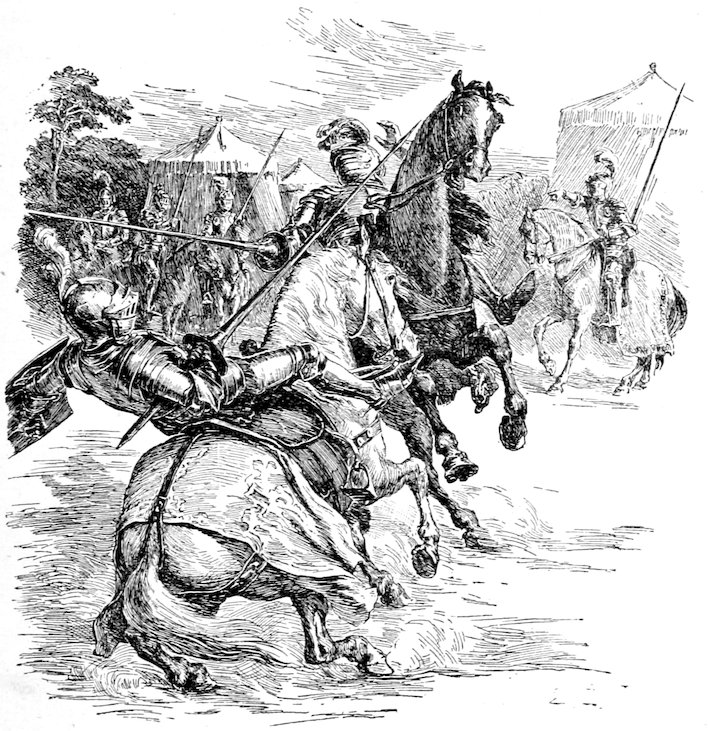
By this time Sir Satyrane had awakened from his 232swoon. When he looked around and saw the merciless havoc that Sir Triamond had wrought to the knights of his party, his heart was almost broken with bitterness, and he wished himself dead rather than in so bad a plight. He began at once to gather up his scattered weapons, and, as it happened, he found his steed ready. Like a flash of fire from the anvil, he rode fiercely to where Triamond was driving his foes before him, and, aiming his spear at him, he pierced his side badly. Triamond could scarcely keep from falling, but he withdrew softly from the field as well as he could, so that no one saw plainly what had happened.
Then the challengers—the Knights of Maidenhood—began to range the field anew, and pride themselves on victory, since no one dared to maintain battle against them. By that time it was evening, which forced them to refrain from fighting, and the trumpets sounded to compel them to cease.
So Sir Satyrane was judged to be the best knight on that first day.
The next morning the tournament began anew. Satyrane, with his gallant band, was the first to appear, but Sir Triamond was unable to prepare for battle, because of his wound. This grieved him much, and Cambell, seeing this, and eager to win honour on his friend’s behalf, took the shield and armour which were well known to belong to Triamond, and without saying a word to any one, put them on and went forth to fight.
There he found Satyrane lord of the field, triumphing in great joy, for no one was able to stand against him. Envious of his glory, and eager to avenge his 233friend’s indignity, Cambell at once bent his spear against him. After a furious battle, he overthrew Sir Satyrane; but, before he could seize his shield and weapons, which were always the reward of the victor, a hundred knights had pressed round him to rescue Satyrane, and in the hope of taking Cambell prisoner. Undismayed, the latter fought valiantly, but what could one do against so many? At last he was taken captive.
When news of this was brought to Triamond, he forgot his wound, and, instantly starting up, looked for his armour. But he sought in vain, for it was not there—Cambell had taken it. Triamond therefore threw on himself Cambell’s armour, and nimbly rushed forward to take his chance. There he found the warrior band leading away his friend—a sorry sight for him to see.
He thrust into the thickest of that knightly crowd, and smote down all between till he came to where he had seen Cambell, like a captive thrall, between two other knights. Triamond attacked them so fiercely that they were obliged to let their prisoner go, and then the two friends, fighting together, scattered their foes in alarm, as two greedy wolves might a flock of sheep. They followed in pursuit till the sound of the trumpet warned every one to rest.
Then all with one consent yielded the prize of this second day to Triamond and Cambell as the two best knights. But Triamond resigned it to Cambell, and Cambell gave it back to Triamond, each trying to advance the other’s deed of arms, and make his praise preferred before his own.
So the judgment was deferred to another day.
234
How Britomart did Battle for the Golden Girdle
The last day of the tournament came, when all the knights again assembled to show their feats of arms. Many brave deeds were done that day, but Satyrane above all the other warriors displayed his wondrous might; from first to last he remained fighting, and though sometimes for a little while fortune failed him, yet he always managed to retrieve his honour, and with unwearied power he kept the prize secure for his own party.
The field was strewn with shivered spears, and broken swords, and scattered shields, showing how severe the fight had been; there might be seen also loose steeds running at random, whose luckless riders had been overthrown, and squires hastening to help their wounded masters. But still the Knights of Maidenhood came off the best, till there entered on the other side a stranger knight.
Whence he came no man could tell. He was in a quaint disguise, hard to be discovered, for all his armour was like a savage dress, decked with woody moss, and his steed had trappings of oak-leaves, that seemed fit for some savage mortal. Charging the enemy, this stranger smote down knight after knight, till every one began to shun the dreadful sight of him. They all wondered greatly who he was and whence he came, and began to ask each other his name; but when they could not learn it anyhow, it seemed most suitable to his wild disguise to term him the Savage Knight.
But, truly, his right name was otherwise. Though 235known to few, he was called Sir Artegall, the champion of Justice, the doughtiest and the mightiest Knight then living.
Sir Satyrane and all his band were so dismayed by his strength and valour that none of them dared remain in the field, but were beaten and chased about all day till the evening. Then, as the sun set, out of the thickest rout rushed forth another strange knight, who put the glory of the “Savage Knight” to shame—so can nothing be accounted happy till the end.
This strange Knight charged his mighty spear at Artegall in the midst of his pride, and smote him so sorely on the visor that he fell back off his horse, and had small desire to rise again. Cambell, seeing this, ran at the stranger with all his might and main, but was soon likewise to be seen lying on the field. Triamond thereupon was inwardly full of wrath, and determined to avenge the shame done to his friend; but by his friend he soon found himself lying, in no less need of help. Blandamour had seen everything from beginning to end, and when he beheld this he was sorely displeased, and thought he would soon mend matters; but he fared no better than the rest before him.
Many others likewise ran at the Knight, but in like manner they were all dismounted; and of a truth it was no wonder. No power of man could stay the force of that enchanted spear, for the stranger was no other than the famous Britomart.
Thus the warrior Princess restored that day to the Knights of Maidenhood the prize which was well-nigh lost, and bore away the prize of prowess from them all.
236Then the shrill trumpets began to bray loudly, and bade them leave their labour and long toil for the joyous feast and other gentle play, for now the precious golden girdle was to be awarded to the most beautiful lady.
Through all ages it has been the custom that the prize of Beauty has been joined with the praise of arms and Chivalry. And there are special reasons for this, for each relies much on the other; that Knight who can best defend a fair Lady from harm, is surely the most fitting to serve her; and that Lady who is fairest and who will never swerve from her faith, is the most fitting to deserve his service.
So after the proof of prowess well ended came next the contest of the sovereign grace of beauty, in which the girdle of Florimell should fall to her who most excelled. Many wished to win it only from vanity, and not for the wondrous virtues which some said it possessed. For the girdle gave the gift of constant and loyal love to all who wore it; but whosoever was false and fickle could never keep it on, for it would loosen itself, or else tear asunder. It was said to be of magic origin, and Florimell, to whom it had been given long ago, held it dear as her life. No wonder, then, that so many ladies sought to win it, for she who wore it was accounted to be peerless.
237
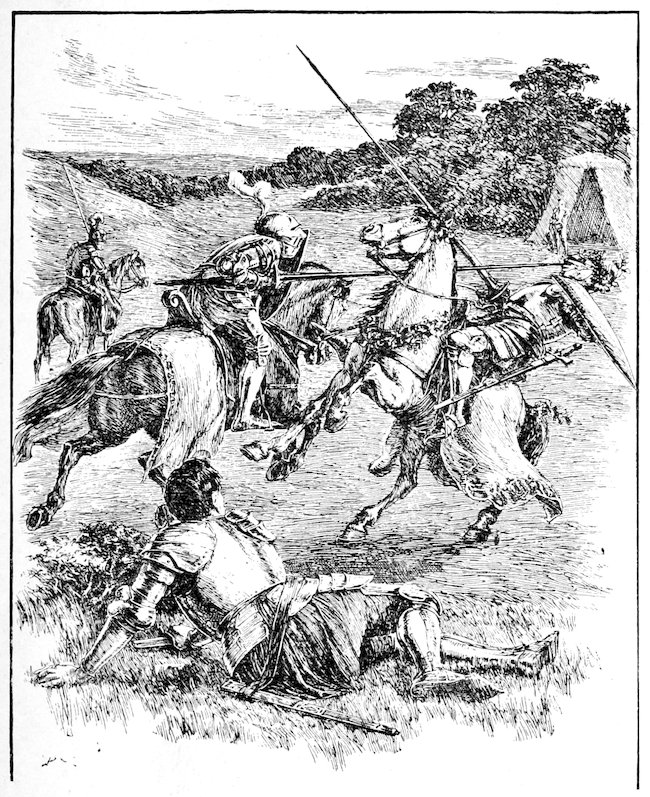
“He at his entrance charg’d his powrefull spear At Artegall, in middest of his pryde, And therewith smote him on his umbriere So sore, that tombling back, he downe did slyde.”
The feast, therefore, being ended, the selected judges went down into the late field of battle to decide this doubtful case, for which all the ladies contended. But, first, inquiry was made as to which of those knights who had lately tourneyed had won the wager. Then it was judged that Satyrane had done best on the first day, for 239he ended last, having begun first; the second day was adjudged to Triamond, because he saved the victor from disaster, for Cambell was in all men’s sight the victor till by mishap he fell into the hands of his foemen; the third day’s prize was adjudged to the stranger knight, whom they all termed the “Knight of the Ebony Spear,” and it was given by good right to Britomart, for she had vanquished the “Savage Knight,” who until then was the victor, and appeared at the last unconquered; for the last is deemed best.
To Britomart, therefore, the fairest lady was adjudged as a companion.
But Artegall greatly grudged this, and was much vexed that this stranger had forestalled him both of honour and of the reward of victory. He could not dispute what was decreed, but he inwardly brooded over the disgrace, and awaited a fit time to be avenged.
This matter being settled and every one agreed, it next followed to decide the Paragon of Beauty, and yield to the fairest lady her due prize.
How the Golden Girdle was awarded to the False Florimell
Then each Knight in turn began to claim the golden girdle on behalf of his own lady. First, Cambell brought to their view his fair wife, Cambina, covered with a veil. The veil being withdrawn at once revealed her surpassing loveliness, which stole all wavering hearts. Next, Sir Triamond uncovered the face of his 240dear Candace, which shone with such beauty that the eyes of all were dazzled as with a great light. After her, Paridell produced his false Duessa. With her forged beauty, Duessa entrapped the hearts of some who considered her the fairest; and, after these, a hundred more ladies appeared in turn, each one of whom seemed to excel the others.
At last Britomart openly showed her lovely Amoret, whose face uncovered seemed like the heavenly picture of some bright angel. Then all who saw her thought that Amoret would surely bear away the prize.
But Blandamour, who imagined that he had the real, true Florimell, now displayed the Snowy Lady, and the sight, once seen, dismayed all the rest.
For all who had seemed bright and fair before, now appeared base and contemptible; compared with her, they were only like stars in comparison with the sun. Every one who saw her was ravished with wonder; they thought she could be no mortal, but must be some celestial being. They were all glad to see Florimell, yet thought Florimell was not so fair as this lady. Like some base metal overlaid with gold, which deceives those who see it, was this false image who passed for the true Florimell. Thus do forged things sometimes show the fairest.
Then, by the decision of all, the golden belt was granted to her as to the fairest lady; and, bringing it to her, they thought to place it round her waist, as became her best. But this they could by no means do, for every time they fastened the girdle, it grew loose and fell away, as if there were some secret fault in her. 241Again and again she put it round her waist, but again and again it fell apart. All the people wondered at the strange sight, and each one thought according to his own fancy. But the Snowy Lady herself thought it was some spiteful trick, and it filled her with wrath and shame as a thing devised to bring disgrace on her.
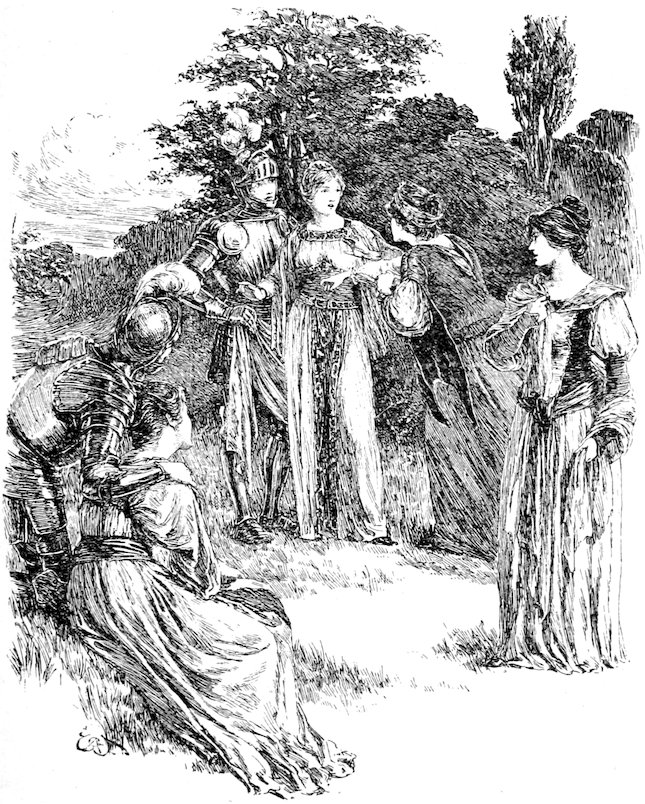
242Then many other ladies likewise tried to put on the girdle, but it would stay on none of them. As soon as they thought it fast, immediately it was untied again.
Seeing this, a scornful knight began to jest and sneer, saying it was a pity that, among so many beautiful ladies, not one was found worthy to wear the girdle. All the knights began to laugh and all the ladies to frown, till at last the gentle Amoret also essayed to prove the girdle’s power. She set it round her waist, and immediately it fitted perfectly, with no difficulty whatever.
The others were very envious, and the Snowy Lady was greatly fretted. Snatching the belt angrily from Amoret, she again tied it round her own body, but none the more would it fit her.
Nevertheless, to her, as her due right, was the girdle yielded, for every one thought she was the true Florimell, to whom it really belonged. And now she had to choose her companion knight. Then she adjudged the prize to the “Knight of the Ebony Spear,” who had won it in fight. But Britomart would not assent to this, nor give up her own companion, Amoret, for the sake of that strange lady, whose wondrous beauty she esteemed less than the wisdom and goodness of Amoret.
When the other knights saw Britomart refuse, they were all very glad, for each hoped Florimell would choose himself. But the judges said that after Britomart she must next choose the second best, and that was the “Savage Knight.” But Sir Artegall had already left in displeasure because he had not won the 243prize. Then she was offered Triamond, but Triamond loved Candace, and no one else. Then Sir Satyrane was adjudged to Florimell, and he was right glad to gain so goodly an award; but Paridell and Blandamour and many other knights were very angry, and wanted to fight Sir Satyrane. The hideous old woman, Até, with her wicked words, stirred them all up to demand and challenge Florimell as their right, the recompense which they deserved for their peril.
Amongst the rest, with boastful, vain pretence, Braggadochio stepped forward and claimed her as his thrall, having won her in battle long ago. He called the Snowy Lady herself to witness this, and being asked, she confessed that it was the case.
Thereupon all the other knights were more angry than ever, and they were quite ready to prepare anew for battle. But Sir Satyrane hit on a plan to appease them. He suggested that the Lady herself should choose which knight she preferred, and all the others should abide by her choice. This they agreed to. So Florimell was placed in the midst of them all, and every knight hoped she would choose him. Then, having looked a long time at each one, as though she wished to please them all, the Snowy Lady walked up to Braggadochio, and the two went off together.
Britomart took no part in the struggle for Florimell, for as soon as she saw that discord had arisen, she left the place. Taking with her the lovely Amoret, who was still looking for Sir Scudamour, Britomart rode off on her first quest, to seek her beloved Knight, Sir Artegall, whose image she had seen in the magic mirror. 244Little did she know that he was the “Savage Knight” with whom she had so lately fought, and who was even now waiting to be revenged on her. Unlucky maid, to seek her enemy! Unlucky maid to seek far and wide for him whom, when he was nearest, she could not discover because of his disguise!
How Sir Scudamour came to the House of Care
Thus Britomart, with much toil and grief, still sought the Knight whom she had seen in the magic mirror, and in all her sad misfortunes she found her fellow-wanderer, Amoret, a great comfort. But the gentle Scudamour, whose heart the malicious Até had filled with jealous discontent, was bent on revenge—on revenge against the blameless Princess. The wicked tale told by Até pricked his jealous heart like a thorn, and pierced his soul like a poisoned arrow. Nothing that Glaucé could do or say would alter his feeling; the more she tried to excuse Britomart, the worse it fretted and grieved him night and day, so that nothing but dire revenge might abate his anger.
Thus as they travelled, night, gloomy with cloud and storm and bitter showers, fell upon them before its usual hour. This forced them to seek some shelter where they might hide their heads in quiet rest. Not far away, unfitting for any guest, they spied a little cottage, like some poor man’s dwelling. It was placed under a steep hillside, where the mouldering earth had hollowed out the bank. A small brook of muddy water, 245bad-smelling as a puddle, passed close to it, bordered by a few crooked willows.
When Sir Scudamour and Glaucé came nearer, they heard the sound of many iron hammers ceaselessly beating in turn, so that it seemed as though some blacksmith dwelt in that desert place. Entering, they found the good man himself bent busily at work. He was a wretched, worn creature, with hollow eyes and wasted cheeks, as if he had been long pent in prison. His face was black and grisly-looking, smeared with smoke that nearly blinded his eyes. He had a ragged beard and shaggy hair, which he never cut nor kept in order. His garment was rough and all torn to rags; he had no better, nor cared for any better. His hands were blistered and burnt from the cinders, all unwashed, with long nails fit to rend the food on which he lived.
This creature was called Care. He was a blacksmith by trade, who never ceased working, day or night, but made iron wedges of small use. (These are unquiet thoughts, that invade anxious minds.)
He kept six servants hard at work, always standing round the anvil with great huge hammers, who never rested from battering stroke on stroke. All six were strong men, but each was stronger than the one before, so they went up, as it were, in steps. So likewise the hammers which they bore succeeded, like bells, in due order of greatness. The last servant far exceeded the first in size; he was like some monstrous giant. So dreadfully did he beat the anvil that it seemed as if he would soon drive it to dust. So huge was his hammer, and so great his energy, that it seemed as though he 246could break and rend asunder a rock of diamond if he cared to try.
Sir Scudamour greatly wondered at the manner of their work and weary labour, and having beheld it for a long time, at last inquired the cause and end of it. But all his questions were in vain, for they would not stop from their work for anything, nor listen to what he said. Even the gusty bellows blew fiercely, like the north wind, so that no one could hear. “Sadness” moved them, and the bellows were “Sighs.”
The warrior, seeing this, said no more, but lay down to rest in his armour. To rest he lay down on the floor—in olden days the best bed for adventurous knights—and thought to have refreshed his weary limbs. And the aged nurse, Glaucé, his faithful squire, also laid her feeble joints down, for her age and weakness much needed rest after so long and tiring a journey.
There lay Sir Scudamour, long expecting the moment when gentle sleep would close his weary eyes, turning often from side to side, and often choosing a new place where it seemed he might repose better. And often in wrath he again rose from there, and often in wrath lay down again. But wherever he disposed himself, he could by no means obtain the desired ease; every place seemed painful, and each alteration useless.
And evermore when he thought to sleep, the sound of the hammers jarred his nerves, and evermore when he began to get drowsy, the noise of the bellows disturbed his quiet rest. All night the dogs barked 247and howled around the house, scenting the stranger-guest; and now the crowing cock, and now the owl shrieking loudly, fretted his very soul.
“Whereto approaching nigh they heard the sound Of many yron hammers beating ranke.”
249If by fortune a little drowsiness chanced to fall on his heavy eyelids, immediately one of the villains rapped him on the head with his iron mallet, so that he awoke at once and started up quickly, as one afraid, or as if one had suddenly called him. Thus he was often roused, and then he lay musing on the unhappy cause that had led him to the House of Care.
At last his weary spirit, too tired to resist further, gave place to rest; yet even now he was troubled with bad dreams. Then the wicked creature, the master-smith, took a pair of red-hot iron tongs and nipped him in the side, so that his heart quite quaked at the pain. Thereupon he started up to be avenged on the person who had broken his quiet slumber, but looking round about him he could see no one, yet the smart remained, though the giver of it fled.
In such disquiet and heart-fretting pain, Sir Scudamour passed all that long night, and now the day began to peep over the earth, sprinkling the morning grass with pearly dew. Then up he rose, like a heavy lump of lead, and one could plainly read in his face, as in a looking-glass, signs of the anguish he had gone through.
He mounted his war-horse and set forth again on his former journey, and with him also went Glaucé, the aged squire, ready to share whatever pain and peril might be in store.
250
How the “Savage Knight” met the “Knight with the Ebony Spear”
The day after Sir Scudamour left the House of Care, as he rode sadly on his way, he unexpectedly saw an armed Knight sitting in the shade on the edge of a forest, while his steed grazed beside him. Directly this Knight saw Scudamour, he mounted and rode eagerly towards him, as if he intended mischief; but, as soon as he saw the arms borne by him, he lowered his spear and turned aside. Sir Scudamour wondered at this, but the other said, “Ah, gentle Scudamour, I submit myself to your grace, and ask pardon of you for having this day almost done you an injury.”
Whereupon Scudamour replied, “Small harm is it for any warrior to prove his spear, without malice, on a venturous knight. But, sir, since you know my name, pray tell me what is your own?”
“Truly, you must excuse me from making known my right name now, for the time has not yet come for it,” was the reply; “but call me the Savage Knight, as others do.”