The Red Cross Knight
Reading edition
“Right faithful true he was in deed and word”
The Court of the Queen
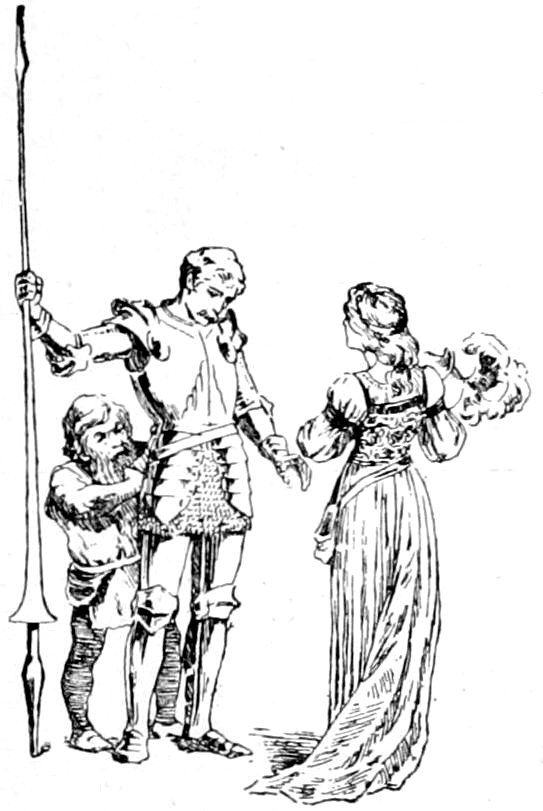
Once upon a time, in the days when there were still such things as giants and dragons, there lived a great Queen. She reigned over a rich and beautiful country, and because she was good and noble every one loved her, and tried also to be good. Her court was the most splendid one in the world, for all her knights were brave and gallant, and each one thought only of what heroic things he could do, and how best he could serve his royal lady.
The name of the Queen was Gloriana, and each of her twelve chief knights was known as the Champion of some virtue. Thus Sir Guyon was the representative of Temperance, Sir Artegall of Justice, Sir Calidore of Courtesy, and others took up the cause of Friendship, Constancy, and so on.
Every year the Queen held a great feast, which 2lasted twelve days. Once, on the first day of the feast, a stranger in poor clothes came to the court, and, falling before the Queen, begged a favour of her. It was always the custom at these feasts that the Queen should refuse nothing that was asked, so she bade the stranger say what it was he wished. Then he besought that, if any cause arose which called for knightly aid, the adventure might be entrusted to him.
When the Queen had given her promise he stood quietly on one side, and did not try to mix with the other guests who were feasting at the splendid tables. Although he was so brave, he was very gentle and modest, and he had never yet proved his valour in fight, therefore he did not think himself worthy of a place among the knights who had already won for themselves honour and renown.
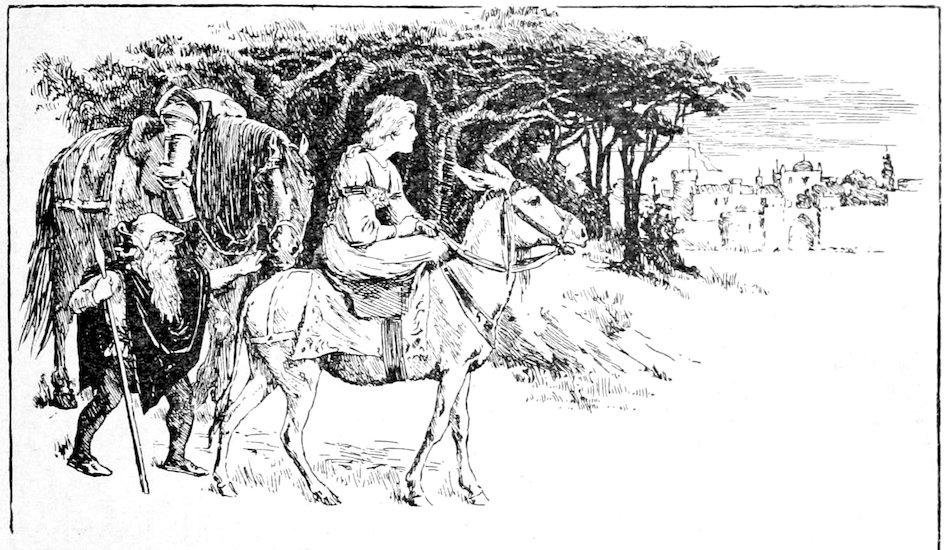
Soon after this there rode into the city a fair lady on a white ass. Behind her came her servant, a dwarf, leading a warlike horse that bore the armour of a knight. The face of the lady was lovely, but it was very sorrowful.
Making her way to the palace, she fell before Queen Gloriana, and implored her help. She said that her name was Una; she was the daughter of a king and queen who formerly ruled over a mighty country; but, many years ago, a huge dragon came and wasted all the land, and shut the king and queen up in a brazen castle, from which they might never come out. The Lady Una therefore besought Queen Gloriana to grant her one of her knights to fight and kill this terrible dragon.
3
Then the stranger sprang forward, and reminded the Queen of the promise she had given. At first she was unwilling to consent, for the Knight was young, and, moreover, he had no armour of his own to fight with.
Then said the Lady Una to him, “Will you wear the armour that I bring you, for unless you do you will never succeed in the enterprise, nor kill the horrible monster of Evil? The armour is not new, it is scratched and dinted with many a hard-fought battle, but if you wear it rightly no armour that ever was made will serve you so well.”
Then the stranger bade them bring the armour and put it on him, and Una said, “Stand, therefore, having your loins girt about with truth, and having on the breastplate of righteousness, and your feet shod with the preparation of the gospel of peace; above all taking the shield of faith, wherewith ye shall be able to quench all the fiery darts of the wicked, and take 4the helmet of salvation and the sword of the Spirit, which is the word of God.”
And when the stranger had put off his own rough clothes and was clad in this armour, straightway he seemed the goodliest man in all that company, and the Lady Una was well pleased with her champion; and, because of the red cross which he wore on his breastplate and on his silver shield, henceforth he was known always as “the Red Cross Knight.” But his real name was Holiness, and the name of the lady for whom he was to do battle was Truth.
So these two rode forth into the world together, while a little way behind followed their faithful attendant, Prudence. And now you shall hear some of the adventures that befell the Red Cross Knight and his two companions.
The Wood of Error
The first adventure happened in this way. Scarcely had the Red Cross Knight and the Lady Una started on their journey when the sky suddenly became overcast, and a great storm of rain beat down upon the earth. Looking about for shelter, they saw, not far away, a shady grove, which seemed just what they wanted. The trees here had great spreading branches, which grew so thickly overhead that no light could pierce the covering of leaves. Through this wood wide paths and alleys, well trodden, led in all directions. It seemed a truly pleasant place, and a safe 5shelter against the tempest, so they entered in at once.
At first, as they roamed along the winding paths they found nothing but pleasure. Deeper and deeper into the heart of the wood they went, hearing with joy the sweet singing of the birds, and filled with wonder to see so many different kinds of beautiful trees clustered in one spot. But by-and-by, when the storm was over and they wished to go forward on their journey, they found, to their sorrow, that they had lost their way. It was impossible to remember by which path they had come; every way now seemed strange and unknown. Here and there they wandered, backwards and forwards; there were so many turnings to be seen, so many paths, they knew not which to take to lead them out of the wood.
In this perplexity, at last they determined to go straight forward until they found some end, either in or out of the wood. Choosing for this purpose one of the broadest and most trodden paths, they came presently, in the thickest part of the wood, to a hollow cave. Then the Red Cross Knight dismounted from his steed, and gave his spear to the dwarf to hold.
“Take heed,” said the Lady Una, “lest you too rashly provoke mischief. This is a wild and unknown place, and peril is often without show. Hold back, therefore, till you know further if there is any danger hidden there.”
“Ah, lady,” said the Knight, “it were shame to go backward for fear of a hidden danger. Virtue herself gives light to lead through any darkness.”
6“Yes,” said Una; “but I know better than you the peril of this place, though now it is too late to bid you go back like a coward. Yet wisdom warns you to stay your steps, before you are forced to retreat. This is the Wandering Wood, and that is the den of Error, a horrible monster, hated of all. Therefore, I advise you to be cautious.”
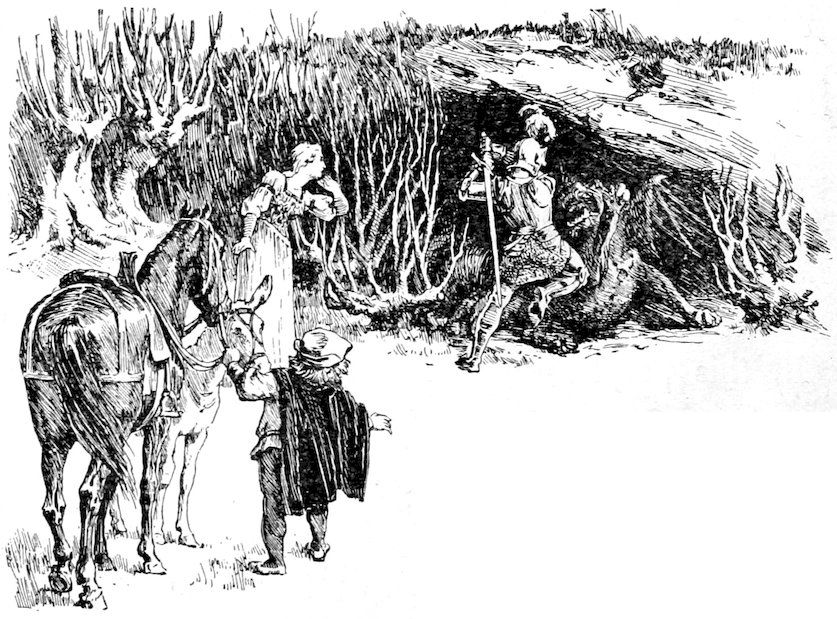
“Fly, fly! this is no place for living men!” cried timid Prudence.
But the young Knight was full of eagerness and fiery courage, and nothing could stop him. Forth to the darksome hole he went, and looked in. His glittering armour made a little light, by which he could plainly see the ugly monster. Such a great, horrible thing it was, something like a snake, with a long tail twisted in knots, with stings all over it. And near this wicked big creature, whose other name was Falsehood, there were a thousand little ones, all 7varying in shape, but every one bad and ugly; for you may be quite sure that wherever one of this horrible race is found, there will always be many others of the same family lurking near.
When the light shone into the cave all the little creatures fled to hide themselves, and the big parent Falsehood rushed out of her den in terror. But when she saw the shining armour of the Knight she tried to turn back, for she hated light as her deadliest foe, and she was always accustomed to live in darkness, where she could neither see plainly nor be seen.
When the Knight saw that she was trying to escape, he sprang after her as fierce as a lion, and then the great fight began. Though he strove valiantly, yet he was in sore peril, for suddenly the cunning creature flung her huge tail round and round him, so that he could stir neither hand nor foot.
Then the Lady Una cried out, to encourage him, “Now, now, Sir Knight, show what you are! Add faith unto your force, and be not faint! Kill her, or else she will surely kill you.”
With that, fresh strength and courage came to the Knight. Gathering all his force, he got one hand free, and gripped the creature by the throat with so much pain that she was soon compelled to loosen her wicked hold. Then, seeing that she could not hope to conquer in this way, she suddenly tried to stifle the Knight by flinging over him a flood of poison. This made the Knight retreat a moment; then she called to her aid all the horrid little creeping and crawling monsters that he had seen before, and 8many others of the same kind, or worse. These came swarming and buzzing round the Knight like a cloud of teasing gnats, and tormented and confused him with their feeble stings. Enraged at this fresh attack, he made up his mind to end the matter one way or another, and, rushing at his foe, he killed her with one stroke of his sword.
Then Lady Una, who, from a distance, had watched all that passed, came near in haste to greet his victory.
“Fair Knight,” she said, “born under happy star! You are well worthy of that armour in which this day you have won great glory, and proved your strength against a strong enemy. This is your first battle. I pray that you will win many others in like manner.”
The Knight deceived by the Magician
After his victory over Falsehood, the Red Cross Knight again mounted his steed, and he and the Lady Una went on their way. Keeping carefully to one path, and turning neither to the right hand nor the left, at last they found themselves safely out of the Wood of Error.
But now they were to fall into the power of a more dangerous and treacherous foe than even the hateful monster, Falsehood.
They had travelled a long way, and met with no fresh adventure, when at last they chanced to meet in 9the road an old man. He looked very wise and good. He was dressed in a long black gown, like a hermit, and had bare feet and a grey beard; he had a book hanging from his belt, as was the custom with scholars in those days. He seemed very quiet and sad, and kept his eyes fixed on the ground, and all the time, as he went along, he seemed to be saying prayers, and lamenting over his own wickedness.
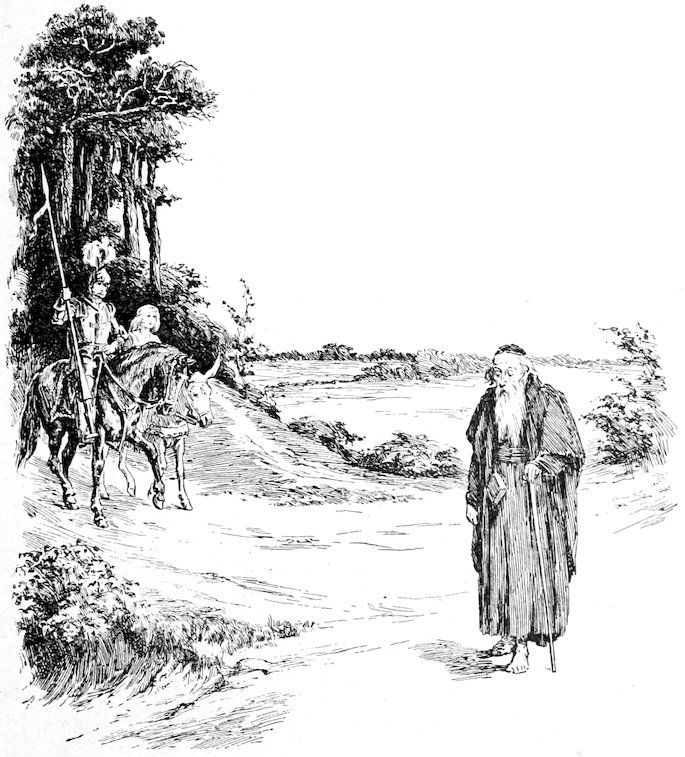
When he saw the travellers he made a very humble salute to them. The Red Cross Knight returned the greeting with all courtesy, and asked him if he knew of any strange adventures that were then taking place.
“Ah, my dear son!” said the hermit, “how should 10a simple old man, who lives in a lonely cell, and does nothing all day but sorrow for his own faults—how should such a man know any tidings of war or worldly trouble? It is not fitting for me to meddle with such matters. But, if indeed you desire to hear about danger and evil near at hand, I can tell you about a strange man who wastes all the surrounding country.”
“That,” said the Knight, “is what I chiefly ask about, and I will reward you well if you will guide me to the place where he dwells. For it is a disgrace to knighthood that such a creature should be allowed to live so long.”
“His dwelling is far away from here, in the midst of a barren wilderness,” answered the old man. “No living person may ever pass it without great danger and difficulty.”
“Now,” said the Lady Una, “night is drawing near, and I know well that you are wearied with your former fight. Therefore, take rest, and with the new day begin new work.”
“You have been well advised, Sir Knight,” said the old man. “Day is now spent; therefore take up your abode with me for this night.”
The travellers were well content to do this, so they went with the apparently good old man to his home.
It was a little lowly hermitage, down in a dale by the side of a forest, far from the beaten track of travellers. A small chapel was built near, and close by a crystal stream gently welled forth from a never-failing fountain.
11Arrived at the house, they neither expected nor found any entertainment; but rest was what they chiefly needed, and they were well satisfied, for the noblest mind is always the best contented. The old man had a good store of pleasing words, and knew well how to fit his talk to suit his visitors. The evening passed pleasantly, and then the hermit conducted his guests to the lodgings where they were to spend the night.
But when they were safely asleep a horrid change came over the old man, for in reality he was not good at all, although he pretended to be so. His heart was full of hatred, malice, and deceit. He called himself Archimago, which means a “Great Magician,” but his real name was Hypocrisy. He knew that as long as Holiness and Truth kept together, no great harm could come to either of them; so he determined to do everything in his power to separate them. For this purpose he got out all his books of magic, and set to work to devise cunning schemes and spells. He was so clever and wily that he could deceive people much better and wiser than himself. He also had at his bidding many bad little spirits, who ran about and did his messages; these he used to help his friends and frighten his enemies, and he had the power of making them take any shape he wished.
Choosing out two of the worst of these, he sent one on a message to King Morpheus, who rules over the Land of Sleep. He bade him bring back with him a bad, false dream, which Archimago then carried to the sleeping Knight. So cunningly did he contrive the matter, that when the Knight awoke the next 12morning he never knew that it had only been a dream, but believed that all the things he had seen in his sleep had really happened.
In the meanwhile, Archimago dressed up the other bad spirit to look like Una, so that at a little distance it was impossible to tell any difference in the two figures. He knew that the only way to part Holiness and Truth was to make Holiness believe by some means that Truth was not as good as she appeared to be. He knew also that the Red Cross Knight would believe nothing against the Lady Una except what he saw with his own eyes. Therefore he laid his plans with the greatest care and guile.
Now we shall see how he succeeded in his wicked endeavour.
The Knight forsakes Una
The next morning at daybreak the Knight awoke, sad and unrested after the unpleasant dreams that had come to him in the night. He did not know he had been asleep; he thought the things that troubled him had really happened.
It was scarcely dawn when Archimago rushed up to him in a state of pretended sorrow and indignation.
“The Lady Una has left you,” said this wicked man. “She is not good as she pretends to be. She cares nothing at all for you, nor for the noble work on which you are bound, and she does not mean to go any farther with you on your toilsome journey.”
The Red Cross Knight started up in anger. This 13was like his dream, and he knew not what was true nor what was false.
“Come,” said Archimago, “see for yourself.”
He pointed to a figure in the distance whom the Knight took to be Una. Then, indeed, he was forced to believe what the wicked magician told him. He now took for granted that Una had been deceiving him all along, and had seized this moment to escape. He forgot all her real sweetness and goodness and beauty; he only thought how false and unkind she was. He was filled with anger, and he never paused a moment to reflect if there could be any possibility of mistake. Calling his servant, he bade him bring his horse at once, and then these two immediately set forth again on their journey.
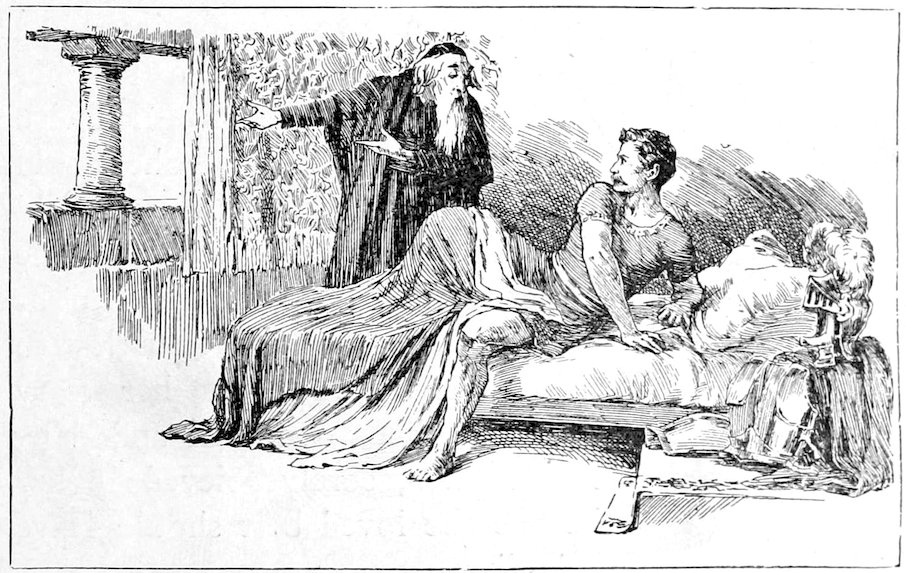
Here the Red Cross Knight was wrong, and we 14shall see presently into what perils and misfortunes he fell because of his hasty want of faith. If he had had a little patience he would soon have discovered that the figure he saw was only a dressed-up imitation. The real Lady Una all this time was sleeping quietly in her own bower.
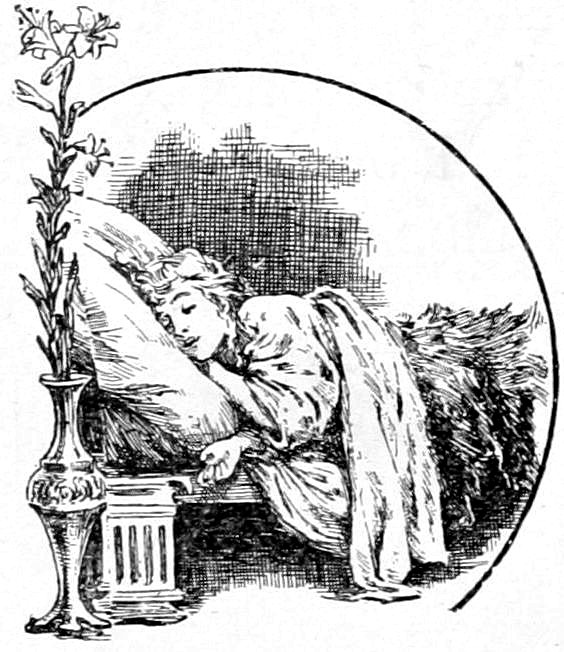
When she awoke and found that her two companions had fled in the night and left her alone behind, she was filled with grief and dismay. She could not understand why they should do such a thing. Mounting her white ass, she rode after them with all the speed she could, but the Knight had urged on his steed so fast it was almost useless to try to follow. Yet she never stayed to rest her weary limbs, but went on seeking them over hill and dale, and through wood and plain, sorely grieved in her tender heart that the one she loved best should leave her with such ungentle discourtesy.
When the wicked Archimago saw that his cunning schemes had succeeded so well he was greatly pleased, and set to work to devise fresh mischief. It was Una whom he chiefly hated, and he took great pleasure in her many troubles, for hypocrisy always hates real goodness. He had the power of turning himself into any shape he chose—sometimes he would be a fowl, sometimes a fish, now like a fox, now like a dragon. On the present occasion, to suit his evil purpose, it 15seemed best to him to put on the appearance of the good knight whom he had so cruelly beguiled.
Therefore, Hypocrisy dressed himself up in imitation armour with a silver shield and everything exactly like the Red Cross Knight. When he sat upon his fiery charger he looked such a splendid warrior you would have thought it was St. George himself.
Holiness fights Faithless, and makes Friends with False Religion
The true St. George, meanwhile, had wandered far away. Now that he had left the Lady Una, he had nothing but his own will to guide him, and he no longer followed any fixed purpose.
Presently he saw coming to meet him another warrior, fully armed. He was a great, rough fellow, who cared nothing for God or man; across his shield, in gay letters, was written “Sans Foy,” which means Faithless.
He had with him a companion, a handsome lady, dressed all in scarlet, trimmed with gold and rich pearls. She rode a beautiful palfrey, with gay trappings, and little gold bells tinkled on her bridle. The two came along laughing and talking, but when the lady saw the Red Cross Knight, she left off her mirth at once, and bade her companion attack him.
Then the two knights levelled their spears, and rushed at each other. But when Faithless saw the red cross graven on the breastplate of the other, he 16knew that he could never prevail against that safeguard. However, he fought with great fury, and the Red Cross Knight had a hard battle before he overcame him. At last he managed to kill him, and he told his servant to carry away the shield of Faithless in token of victory.
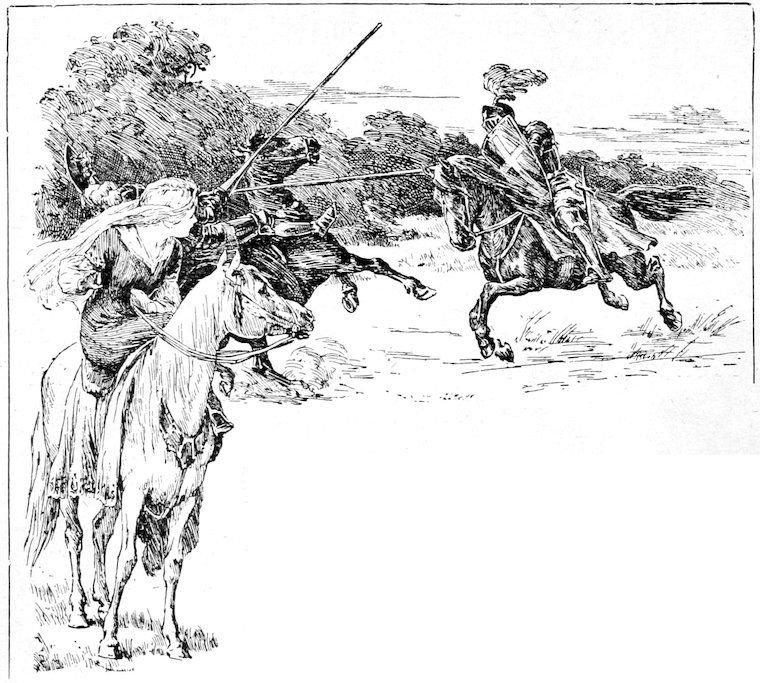
When the lady saw her champion fall, she fled in terror; but the Red Cross Knight hurried after her, and bade her stay, telling her that she had nothing now to fear. His brave and gentle heart was full of pity to see her in so great distress, and he asked her to tell him who she was, and who was the man that had been with her.
Melting into tears, she then told him the following sad story:—She said that she was the daughter of an emperor, and had been engaged to marry a wise and good prince. Before the wedding-day, however, the 17prince fell into the hands of his foes, and was cruelly slain. She went out to look for his dead body, and in the course of her wandering met the Saracen knight, who took her captive. “Sans Foy” was one of three bad brothers. The names of the others were “Sans Loy,” which means Lawless, and “Sans Joy,” which means Joyless. She further said that her own name was “Fidessa,” or True Religion, and she besought the Knight to have compassion on her, because she was so friendless and unhappy.
“Fair lady,” said the Knight, “a heart of flint would grieve to hear of your sorrows. But henceforth rest safely assured that you have found a new friend to help you, and lost an old foe to hurt you. A new friend is better than an old foe.”
Then the seemingly simple maiden pretended to look comforted, and the two rode on happily together.
But what the lady had told about herself was quite untrue. Her name was not “Fidessa” at all, but “Duessa,” which means False Religion. If Una had still been with the Knight, he would never have been led astray; but when he parted from her he had nothing but his own feelings to guide him. He still meant to do right, but he was deceived by his false companion, who brought him into much trouble and danger.
Una and the Lion
All this while the Lady Una, lonely and forsaken, was roaming in search of her lost Knight. How sad was her fate! She, a King’s daughter, so beautiful, so 18faithful, so true, who had done no wrong either in word or deed, was left sorrowful and deserted because of the cunning wiles of a wicked enchanter. Fearing nothing, she sought the Red Cross Knight through woods and lonely wilderness, but no tidings of him ever came to her.
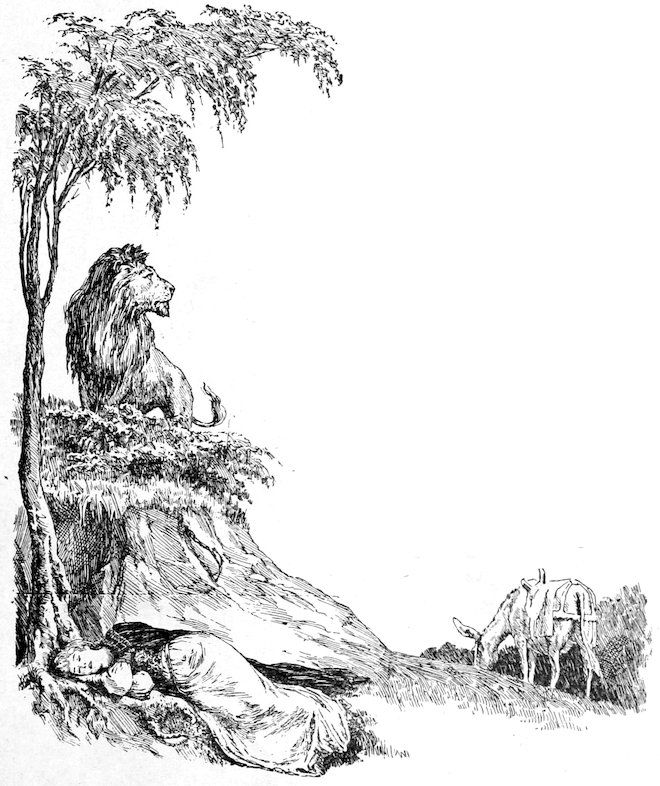
One day, being weary, she alighted from her steed, and lay down on the grass to rest. It was in the midst of a thicket, far from the sight of any traveller. She lifted her veil, and put aside the black cloak which always covered her dress.
“Her angel’s face,
As the great eye of Heaven shinèd bright,
And made a sunshine in the shady place.”
Suddenly, out of the wood there rushed a fierce lion, who, seeing Una, sprang at her to devour her; but, when he came nearer, he was amazed at the sight of her loveliness, and all his rage turned to pity. Instead of tearing her to pieces, he kissed her weary feet and licked her lily hand as if he knew how innocent and wronged she was.[2]
When Una saw the gentleness of this kingly creature, she could not help weeping.
Sad to see her sorrow, he stood gazing at her; all his angry mood changed to compassion, till at last Una mounted her snowy palfrey and once more set out to seek her lost companion.
19The lion would not leave her desolate, but went with her as a strong guard and as a faithful companion. When she slept he kept watch, and when she waked he waited diligently, ready to help her in any way he could. He always knew from her looks what she wanted.
Long she travelled thus through lonely places, where she thought her wandering Knight might pass, yet never found trace of living man. At length she came to the foot of a steep mountain, where the trodden grass showed that there was a path for people to go. This path she followed till at last she saw, slowly walking in the front of her, a damsel carrying a jar of water.
The Lady Una called to her to ask if there were any dwelling-place near, but the rough-looking girl made no answer; she seemed not able to speak, nor 20hear, nor understand. But when she saw the lion standing beside her, she threw down her pitcher with sudden fear and fled away. Never before in that land had she seen the face of a fair lady, and the sight of the lion filled her with terror. Fast away she fled, and never looked behind till she came at last to her home, where her blind mother sat all day in darkness. Too frightened to speak, she caught hold of her mother with trembling hands, while the poor old woman, full of fear, ran to shut the door of their house.
By this time the weary Lady Una had arrived, and asked if she might come in; but, when no answer came to her request, the lion, with his strong claws, tore open the wicket-door and let her into the little hut. There she found the mother and daughter crouched up in a dark corner, nearly dead with fear.
The name of the poor old blind woman was Superstition. She tried to be good in a very mistaken way. She hid herself in her dark corner, and was quite content never to come out of it. When the beautiful Lady Una, who was all light and truth, came to the hut, the mother and daughter, instead of making her welcome, hated her, and would gladly have thrust her out.
Trying to soothe their needless dread, Una spoke gently to them, and begged that she might rest that night in their small cottage. To this they unwillingly agreed, and Una lay down with the faithful lion at her feet to keep watch. All night, instead of sleeping, she wept, still sorrowing for her lost Knight and longing for the morning.
In the middle of the night, when all the inmates 21of the little cottage were asleep, there came a furious knocking at the door. This was a wicked thief, called “Kirkrapine,” or Church-robber, whose custom it was to go about stealing ornaments from churches, and clothes from clergymen, and robbing the alms-boxes of the poor. He used to share his spoils with the daughter of the blind woman, and to-night he had come with a great sackful of stolen goods.
When he received no answer to his knocking, he got very angry indeed, and made a loud clamour at the door; but the women in the hut were too much afraid of the lion to rise and let him in. At last he burst open the door in a great rage and tried to enter, but the lion sprang upon him and tore him to pieces before he could even call for help. His terrified friends scarcely dared to weep or move in case they should share his fate.
When daylight came, Una rose and started again on her journey with the lion to seek the wandering Knight. As soon as they had left, the two frightened women came forth, and, finding Church-robber slain outside the cottage, they began to wail and lament; then they ran after Una, railing at her for being the cause of all their ill; they called after her evil wishes that mischief and misery might fall on her and follow her all the way, and that she might ever wander in endless error.
When they saw that their bad words were of no avail, they turned back, and there in the road they met a knight, clad in armour; but, though he looked such a grand warrior, it was really only the wicked 22enchanter, Hypocrisy, who was seeking Una, in order to work her fresh trouble. When he saw the old woman, Superstition, he asked if she could give him any tidings of the lady. Therewith her passion broke out anew; she told him what had just happened, blaming Una as the cause of all her distress. Archimago pretended to condole with her, and then, finding out the direction in which Una had gone, he followed as quickly as possible.
Before long he came up to where Una was slowly travelling; but seeing the noble lion at her side, he was afraid to go too near, and turned away to a hill at a little distance. When Una saw him, she thought, from his shield and armour, that it was her own true knight, and she rode up to him, and spoke meekly, half-frightened.
“Ah, my lord,” she said, “where have you been so long out of my sight? I feared that you hated me, or that I had done something to displease you, and that made everything seem dark and cheerless. But welcome now, welcome!”
“My dearest lady,” said false Hypocrisy, “you must not think I could so shame knighthood as to desert you. But the truth is, the reason why I left you so long was to seek adventure in a strange place, where Archimago said there was a mighty robber, who worked much mischief to many people. Now he will trouble no one further. This is the good reason why I left you. Pray believe it, and accept my faithful service, for I have vowed to defend you by land and sea. Let your grief be over.”
23
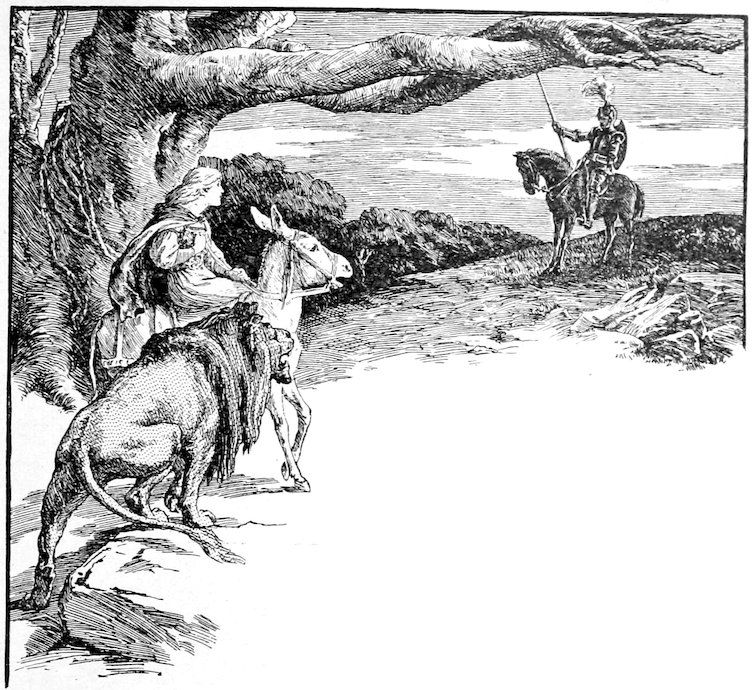
When Una heard these sweet words it seemed to her that she was fully rewarded for all the trials she had gone through. One loving hour can make up for many years of sorrow. She forgot all that she had suffered; she spoke no more of the past. True love never looks back, but always forward. Before her stood her Knight, for whom she had toiled so sorely, and Una’s heart was filled with joy.
In the Hands of the Enemy
Una and the Magician (who was disguised as the Red Cross Knight) had not gone far when they saw some one riding swiftly towards them. The new-comer was on a fleet horse, and was fully armed; his look was stern, cruel, and revengeful. On his shield in bold 24letters was traced the name “Sans Loy,” which means Lawless. He was one of the brothers of “Sans Foy,” or Faithless, whom the real Red Cross Knight had slain, and he had made up his mind to avenge his brother’s death.
When he saw the red cross graven on the shield which Hypocrisy carried, he thought that he had found the foe of whom he was in search, and, levelling his spear, he prepared for battle. Hypocrisy, who was a mean coward, and had never fought in his life, was nearly fainting with fear; but the Lady Una spoke such cheering words that he began to feel more hopeful. Lawless, however, rushed at him with such fury that he drove his lance right through the other’s shield, and bore him to the ground. Leaping from his horse, he ran towards him, meaning to kill him, and exclaiming, “Lo, this is the worthy reward of him that slew Faithless!”
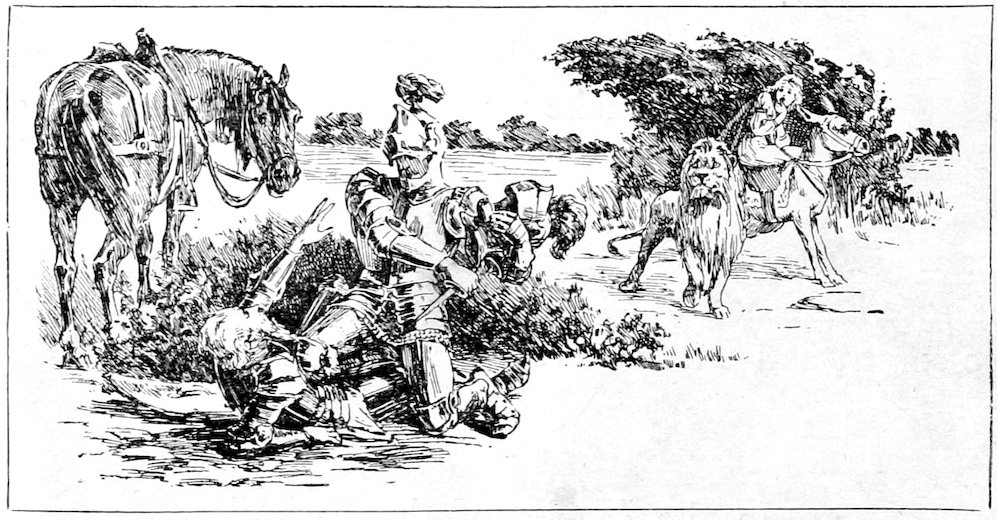
Una begged the cruel knight to have pity on his fallen foe, but her words were of no avail. Tearing off 25his helmet, Lawless would have slain him at once, but he stopped in astonishment when, instead of the Red Cross Knight, he saw the face of Archimago. He knew well that crafty Hypocrisy was skilled in all forms of deceit, but that he took care to shun fighting and brave deeds. Now, indeed, had Hypocrisy’s guile met with a just punishment.
“Why, luckless Archimago, what is this?” cried Lawless. “What evil chance brought you here? Is it your fault, or my mistake, that I have wounded my friend instead of my foe?”
But the old Magician answered nothing; he lay still as if he were dying. So Lawless spent no more time over him, but went over to where Una waited, lost in amazement and sorely perplexed.
Her companion, whom she had imagined was her own true Knight, turned out to be nothing but an impostor, and she herself had fallen into the hands of a cruel enemy.
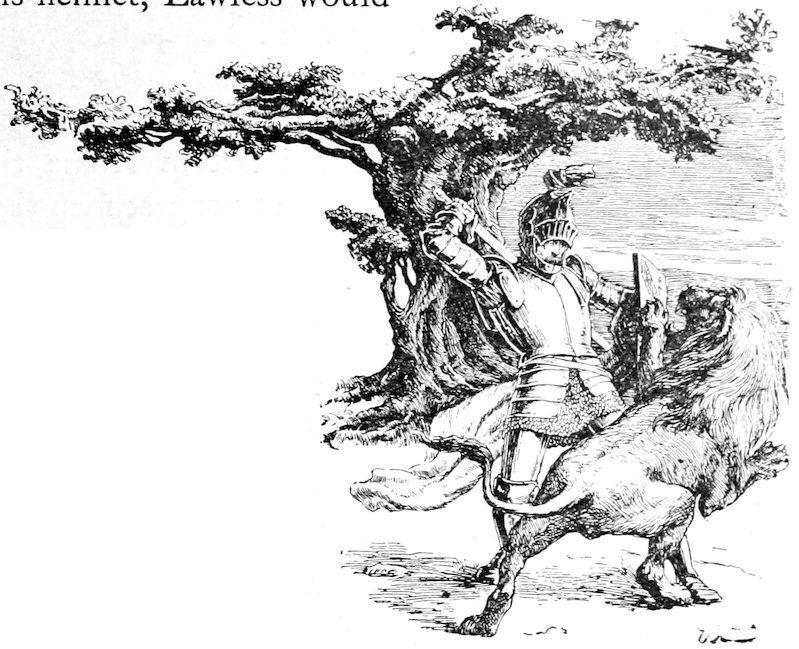
26When the brave lion saw Lawless go up to Una and try to drag her roughly from her palfrey, full of kingly rage he rushed to protect her. He flew at Lawless and almost tore his shield to pieces with his sharp claws. But, alas! he could not overcome the warrior, for Lawless was one of the strongest men that ever wielded spear, and was well skilled in feats of arms. With his sharp sword he struck the lion, and the noble creature fell dead at his feet.
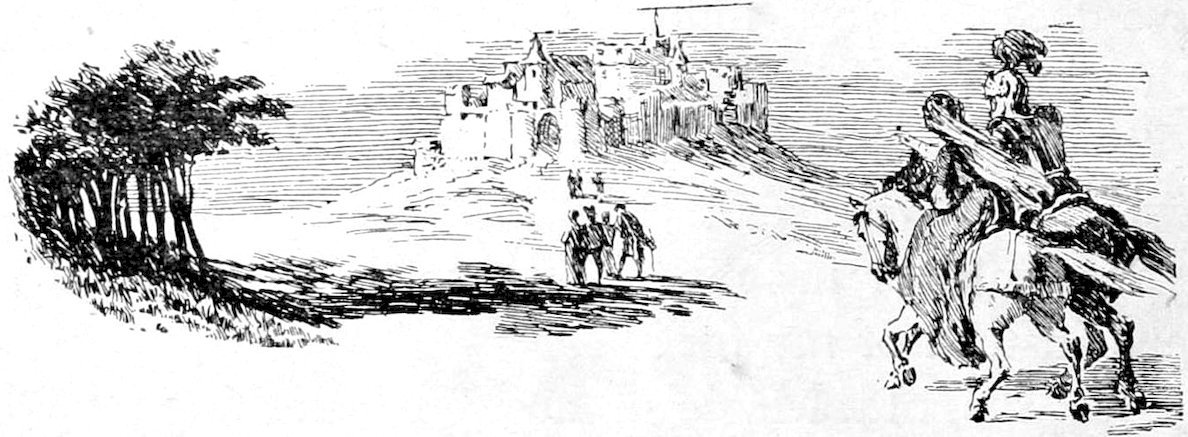
Poor Una, what was to become of her now? Her faithful guardian was gone, and she found herself the captive of a cruel foe. Lawless paid no heed to her tears and entreaties. Placing her on his own horse, he rode off with her; while her snow-white ass, not willing to forsake her, followed meekly at a distance.
The House of Pride
Now the Red Cross Knight, because of his lack of loyalty to Una, fell into much danger and difficulty. His first fault was in believing evil of her so readily, and leaving her forlorn; after that he was too easily beguiled by the pretended goodness and beauty of 27Duessa. All who fight in a good cause must beware of errors such as these. If matters do not go exactly as we wish, we must not lose heart and get impatient; even if we cannot understand what is happening, we must trust that all will be well. We must keep steadily to the one true aim set before us, or else, like the Red Cross Knight, we may be led astray by false things that are only pleasant in appearance, and have no real goodness.
Duessa and the Knight travelled for a long way, till at last they saw in front of them a grand and beautiful building. It seemed as if it were the house of some mighty Prince; a broad highway led up to it, all trodden bare by the feet of those who flocked thither. Great troops of people of all sorts and condition journeyed here, both by day and night. But few returned, unless they managed to escape, beggared and disgraced, when, ever afterwards, they lived a life of misery.
To this place Duessa guided the Red Cross Knight, for she was tired with the toilsome journey, and the day was nearly over.
It was a stately palace, built of smooth bricks, cunningly laid together without mortar. The walls were high, but neither strong nor thick, and they were covered with dazzling gold-foil. There were many lofty towers and picturesque galleries, with bright windows and delightful bowers; and on the top there was a dial to tell the time.
It was lovely to look at, and did much credit to the workman that designed it; but it was a great pity 28that so fair a building rested on so frail a foundation. For it was mounted high up on a sandy hill that kept shifting and falling away. Every breath of heaven made it shake; and all the back parts, that no one could see, were old and ruinous, though cunningly painted over.
Arrived here, Duessa and the Red Cross Knight passed in at once, for the gates stood wide open to all. They were in charge of a porter, called “Ill-come,” who never denied entrance to any one. The hall inside was hung with costly tapestry and rich curtains. Numbers of people, rich and poor, were waiting here, in order to gain sight of the Lady of this wonderful place.
Duessa and the Knight passed through this crowd, who all gazed at them, and entered the Presence Chamber of the Queen.
What a dazzling sight met their eyes! Such a scene of splendour had never been known in the court of any living prince. A noble company of lords and ladies stood on every side, and made the place more beautiful with their presence.
High above all there was a cloth of state, and a rich throne as bright as the sun. On the throne, clad in royal robes, sat the Queen. Her garments were all glittering with gold and precious jewels; but so great was her beauty that it dimmed even the brightness of her throne. She sat there in princely state, shining like the sun. She hated and despised all lowly things of earth. Under her scornful feet lay a dreadful dragon, with a hideous tail. In her hand she held a mirror in which she often looked at her face; she took 29great delight in her own appearance, for she was fairer than any living woman.
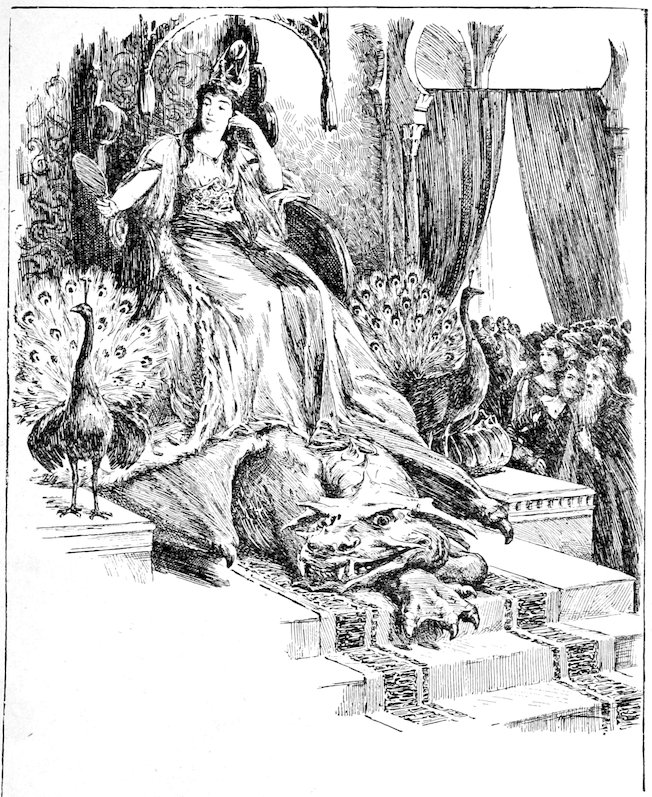
“Lo! underneath her scornful feet was layne A dreadful dragon with an hideous trayne; And in her hand she held a mirrhour bright, Wherein her face she often viewed fayne, And in her self-loved semblance took delight.”
31She was the daughter of grisly Pluto, King of Hades, and men called her proud Lucifera. She had crowned herself a queen, but she had no rightful kingdom at all, nor any possessions. The power which she had obtained she had usurped by wrong and tyranny. She ruled her realm not by laws, but by craft, and according to the advice of six old wizards, who with their bad counsels upheld her kingdom.
As soon as the Knight and Duessa came into the presence-chamber, an usher, by name Vanity, made room and prepared a passage for them, and brought them to the lowest stair of the high throne. Here they made a humble salute, and declared that they had come to see the Queen’s royal state, and to prove if the wide report of her great splendour were true.
With scornful eyes, half unwilling to look so low, she thanked them disdainfully, and did not show them any courtesy worthy of a queen, scarcely even bidding them arise. The lords and ladies of the court, however, were all eager to appear well in the eyes of the strangers. They shook out their ruffles, and fluffed up their curls, and arranged their gay attire more trimly; and each one was jealous and spiteful of the others.
They did their best to entertain the Knight, and would gladly have made him one of their company. To Duessa, also, they were most polite and gracious, for formerly she had been well known in that court. But to the knightly eyes of the warrior all the glitter of the crowd seemed vain and worthless, and he thought 32that it was unbefitting so great a queen to treat a strange knight with such scant courtesy.
Suddenly, Queen Lucifera rose from her throne, and called for her coach. Then all was bustle and confusion, every one rushing violently forth. Blazing with brightness she paced down the hall, like the sun dawning in the east. All the people thronging the hall thrust and pushed each other aside to gaze upon her. Her glorious appearance amazed the eyes of all men.
Her coach was adorned with gold and gay garlands, and was one of the most splendid carriages ever seen, but it was drawn by an ugly and ill-matched team. On every animal rode one of her evil Councillors, who was much like in nature to the creature that carried him.
The first of these, who guided all the rest, was Idleness, the nurse of Sin. He chose to ride a slothful ass; he looked always as if he were half asleep, and as if he did not know whether it were night or day. He shut himself away from all care, and shunned manly exercise, but if there were any mischief to be done he joined in it readily. The Queen was indeed badly served who had Idleness for her leading Councillor.
Next to him came Gluttony, riding on a pig; then Self-indulgence on a goat, Avarice on a camel, Envy on a wolf, and Wrath on a lion. Each in his own way was equally hideous and hateful.
As they went along, crowds of people came round, shouting for joy; always before them a foggy mist sprang up, covering all the land, and under their feet lay the dead bones of men who had wandered from the right path.
33
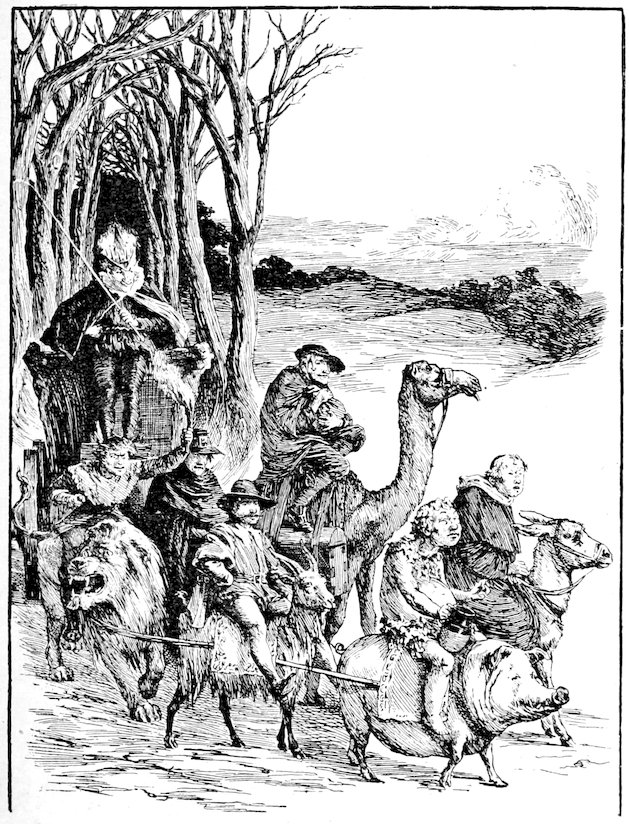
“... This was drawne of six unequall beasts On which her six sage Counsellours did ryde.”
35So forth they went in this goodly array to enjoy the fresh air, and to sport in the flowery meadows. Among the rest, next to the chariot, rode the false Duessa, but the good Knight kept far apart, not joining in the noisy mirth which seemed unbefitting a true warrior.
Having enjoyed themselves awhile in the pleasant fields, they returned to the stately palace. Here they found that a wandering knight had just arrived. On his shield, in red letters, was written the name “Sans Joy,” which means Joyless, and he was the brother of Faithless, whom the Red Cross Knight had slain, and of Lawless, who had taken Una captive. He looked sullen and revengeful, as if he had in his mind bitter and angry thoughts.
When he saw the shield of his slain brother, Faithless, in the hands of the Red Cross Knight’s page, he sprang at him and snatched it away. But the Knight had no mind to lose the trophy which he had won in battle, and, attacking him fiercely, he again got possession of it.
Thereupon they hastily began to prepare for battle, clashing their shields and shaking their swords in the air. But the Queen, on pain of her severe displeasure, commanded them to restrain their fury, saying that if either had a right to the shield, they should fight it out fairly the next day.
That night was passed in joy and gaiety, feasting and making merry in bower and hall. The steward of the court was Gluttony, who poured forth lavishly of his abundance to all; and then the chamberlain, Sloth, summoned them to rest.
36
The Battle for the Shield
That night, when every one slept, Duessa stole secretly to the lodgings of the pagan knight Joyless. She found him wide awake, restless, and troubled, busily devising how he might annoy his foe. To him she spoke many untrue words.
“Dear Joyless,” she said, “I am so glad that you have come. I have passed many sad hours for the sake of Faithless, whom this traitor slew. He has treated me very cruelly, keeping me shut up in a dark cave; but now I will take shelter with you from his disdainful spite. To you belongs the inheritance of your brother, Faithless. Let him not be unavenged.”
“Fair lady, grieve no more for past sorrows,” said Joyless; “neither be afraid of present peril, for needless fear never profited any one, nor is it any good to lament over misfortunes that cannot be helped. Faithless is dead, his troubles are over; but I live, and I will avenge him.”
“Oh, but I fear what may happen,” she answered, “and the advantage is on his side.”
“Why, lady, what advantage can there be when both fight alike?” asked Joyless.
“Yes, but he bears a charmed shield,” said Duessa, “and also enchanted armour that no one can pierce. None can wound the man that wears them.”
“Charmed or enchanted, I care not at all,” said Joyless fiercely, “nor need you tell me anything more about them. But, fair lady, go back whence you came and 37rest awhile. To-morrow I shall subdue the Red Cross Knight, and give you the heritage of dead Faithless.”
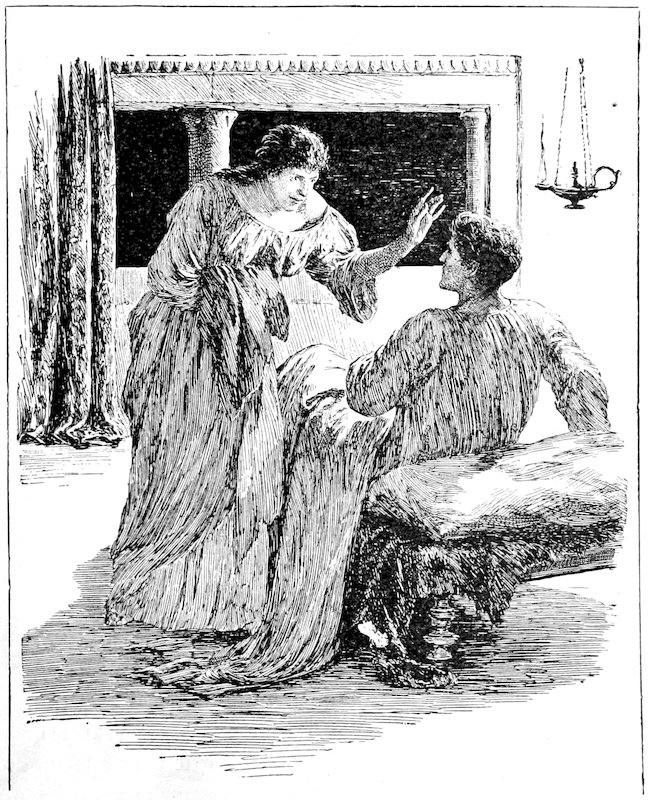
“Wherever I am, my secret aid shall follow you,” she answered, and then she left him.
At the first gleam of dawn the Red Cross Knight 38sprang up and dressed himself for battle in his sun-bright armour. Forth he stepped into the hall, where there were many waiting to gaze at him, curious to know what fate was in store for the stranger knight. Many minstrels were there, making melody to drive away sadness; many singers that could tune their voices skilfully to harp and viol; many chroniclers that could tell old stories of love and war.
Soon after, came the pagan knight, Joyless, warily armed in woven mail. He looked sternly at the Red Cross Knight, who cared not at all how any living creature looked at him. Cups of wine were brought to the warriors, with dainty Eastern spices, and they both swore a solemn oath to observe faithfully the laws of just and fair fighting.
At last, with royal pomp, came the Queen. She was led to a railed-in space of the green field, and placed under a stately canopy. On the other side, full in all men’s view, sat Duessa, and on a tree near was hung the shield of Faithless. Both Duessa and the shield were to be given to the victor.
A shrill trumpet bade them prepare for battle. The pagan knight was stout and strong, and his blows fell like great iron hammers. He fought for cruelty and vengeance. The Red Cross Knight was fierce, and full of youthful courage; he fought for praise and honour. So furious was their onslaught that sparks of fire flew from their shields, and deep marks were hewn in their helmets.
Thus they fought, the one for wrong, the other for right, and each tried to put his foe to shame. At last 39Joyless chanced to look at his brother’s shield which was hanging near. The sight of this doubled his anger, and he struck at his foe with such fury that the Knight reeled twice, and seemed likely to fall. To those who looked on, the end of the battle appeared doubtful, and false Duessa began to call loudly to Joyless,—
“Thine the shield, and I, and all!”
Directly the Red Cross Knight heard her voice he woke out of the faintness that had overcome him; his faith, which had grown weak, suddenly became strong, and he shook off the deadly cold that was creeping over him.
This time he attacked Joyless with such vigour that he brought him down upon his knees. Lifting his sword, he would have slain him, when suddenly a dark cloud fell between them. Joyless was seen no more; he had vanished! The Knight called aloud to him, but received no answer: his foe was completely hidden by the darkness.
Duessa rose hastily from her place, and ran to the Red Cross Knight, saying,—
“O noblest Knight, be angry no longer! Some evil power has covered your enemy with the cloud of night, and borne him away to the regions of darkness. The conquest is yours, I am yours, the shield and the glory are yours.”
Then the trumpets sounded, and running heralds made humble homage, and the shield, the cause of all the enmity, was brought to the Red Cross Knight. He went to the Queen, and, kneeling before her, offered her his service, which she accepted with thanks and much satisfaction, greatly praising his chivalry.
40So they marched home, the Knight next the Queen, while all the people followed with great glee, shouting and clapping their hands. When they got to the palace the Knight was given gentle attendants and skilled doctors, for he had been badly hurt in the fight. His wounds were washed with wine, and oil, and healing herbs, and all the while lovely music was played round his bed to beguile him from grief and pain.
While this was happening, Duessa secretly left the palace, and stole away to the Kingdom of Darkness, which is ruled over by the Queen of Night. This queen was a friend of her own, and was always ready to help in any bad deeds. Duessa told her of what had befallen the pagan knight, Joyless, and persuaded her to carry him away to her own dominions. Here he was placed under the care of a wonderful doctor, who was able to cure people by magic, and Duessa hastened back to the House of Pride.
When she got there she was dismayed to find that the Red Cross Knight had already left, although he was not nearly healed from the wounds which he had received in battle.
The reason why he left was this. One day his servant, whose name you may remember was Prudence, came and told him that he had discovered in the palace a huge, deep dungeon, full of miserable prisoners. Hundreds of men and women were there, wailing and lamenting—grand lords and beautiful ladies, who, from foolish behaviour or love of idle pomp, had wasted their wealth and fallen into the power of the wicked Queen of Pride.
41When the good Red Cross Knight heard this, he determined to stay no longer in such a place of peril.
Rising before dawn, he left by a small side door, for he knew that if he were seen he would be at once put to death. To him the place no more seemed beautiful; it filled him with horror and disgust. Riding under the castle wall, the way was strewn with hundreds of dead bodies of those who had perished miserably. Such was the dreadful sight of the House of Pride.
Una and the Woodland Knight
We left Una in a piteous plight, in the hands of a cruel enemy, the pagan knight Lawless.
Paying no heed to her tears and entreaties, he placed her on his horse, and rode off with her till he came to a great forest.
Una was almost in despair, for there seemed no hope of any rescue. But suddenly there came a wonderful way of deliverance.
In the midst of the thick wood Lawless halted to rest. This forest was inhabited by numbers of strange wild creatures, quite untaught, almost savages. Hearing Una’s cries for help, they came flocking up to see what was the matter. Their fierce, rough appearance so frightened Lawless that he jumped on to his horse and rode away as fast as he could.
When the wild wood-folk came up they found Una sitting desolate and alone. They were amazed at such a strange sight, and pitied her sad condition. 42They all stood astonished at her loveliness, and could not imagine how she had come there.
Una, for her part, was greatly terrified, not knowing whether some fresh danger awaited her. Half in fear, half in hope, she sat still in amazement. Seeing that she looked so sorrowful, the savages tried to show that they meant to be friendly. They smiled, and came forward gently, and kissed her feet. Then she guessed that their hearts were kind, and she arose fearlessly and went with them, no longer afraid of any evil.
Full of gladness, they led her along, shouting and singing and dancing round her, and strewing all the ground with green branches, as if she had been a queen. Thus they brought her to their chief, old Sylvanus.
When Sylvanus saw her, like the rest he was astonished at her beauty, for he had never seen anything so fair. Her fame spread through the forest, and all the other dwellers in it came to look at her. The Hamadryads, who live in the trees, and the Naiades, who live in the flowing fountains, all came flocking to see her lovely face. As for the woodlanders, henceforth they thought no one on earth fair but Una.
Glad at such good fortune, Una was quite contented to please the simple folk. She stayed a long while with them, to gather strength after her many troubles. During this time she did her best to teach them, but the poor things were so ignorant, it was almost impossible to make them understand the difference between right and wrong.
It chanced one day that a noble knight came to 43the forest to seek his kindred who dwelt there. He had won much glory in wars abroad, and distant lands were filled with his fame. He was honest, faithful, and true, though not very polished in manner, nor accustomed to a courtly life. His name was Sir Satyrane. He had been born and brought up in the forest, and his father had taught him nothing but to be utterly fearless. When he grew up, and could master everything in the forest, he went abroad to fight foreign foes, and his fame was soon carried through all lands. It was always his custom, after some time spent in labour and adventure, to return for a while to his native woods, and so it happened on this occasion that he came across Una.
The first time he saw her she was surrounded by the savages, whom she was trying to teach good and holy things. Sir Satyrane wondered at the wisdom which fell from her sweet lips, and when, later on, he saw her gentle and kindly deeds, he began to admire and love her. Although noble at heart, he had never had any one to teach him, but now he began to learn from Una faith and true religion.
The False Pilgrim
Una’s thoughts were still fixed on the Red Cross Knight, and she was sorry to think of his perilous wandering. She was always sad at heart, and spent her time planning how to escape. At last she told her wish to Sir Satyrane, who, glad to please her in 44any way, began to devise how he could help her to get free from the savage folk. One day, when Una was left alone, all the woodlanders having gone to pay court to their chief, old Sylvanus, she and Sir Satyrane rode away together. They went so fast and so carefully that no one could overtake them, and thus at last they came to the end of the forest, and out into the open plain.
Towards evening, after they had journeyed a long distance, they met a traveller. He seemed as if he were a poor, simple pilgrim; his clothes were dusty and travel-worn; his face brown and scorched with the sun; he leant upon a staff, and carried all his necessaries in a scrip, or little bag, hanging behind.
Sir Satyrane asked if there were any tidings of new adventures, but the stranger had heard of none. Then Una began to ask if he knew anything about a knight who wore on his shield a red cross.
“Alas! dear lady,” he replied, “I may well grieve to tell you the sad news! I have seen that knight with my own eyes, both alive and also dead.”
When Una heard these cruel words she was filled with sorrow and dismay, and begged the pilgrim to tell her everything he knew.
Then he related how on that very morning he had seen two knights preparing for battle. One was a pagan, the other was the Red Cross Knight. They fought with great fury, and in the end the Red Cross Knight was slain.
This story was altogether false. The pretended pilgrim was no other than the wicked enchanter 45Archimago, or Hypocrisy, in a fresh disguise. But Sir Satyrane and Una believed everything he told them.
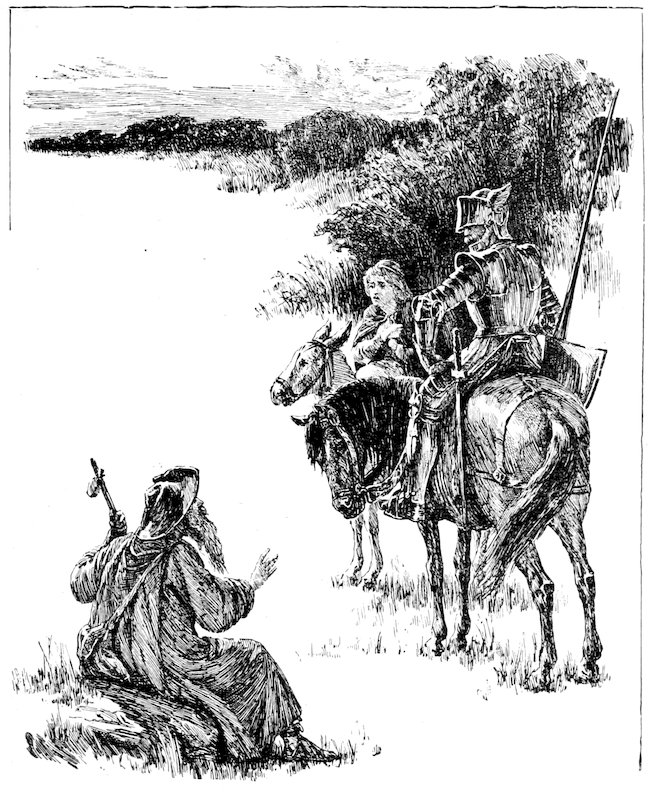
“The Knight, approaching nigh, of him inquired Tidings of warre, and of adventures new.”
47“Where is this pagan now?” asked Satyrane.
“Not far from here,” replied the pilgrim; “I left him resting beside a fountain.”
Thereupon Sir Satyrane hastily marched off, and soon came to the place where he guessed that the other would be found. This pagan knight turned out to be Lawless, from whom, you may remember, Una had escaped in the forest, before she was found by the woodlanders. Sir Satyrane challenged Lawless to fight, and they were soon engaged in a fierce battle. Poor Una was so terrified at this new peril, and in such dread of Lawless, that she did not wait to see what the end would be, but fled far away as fast as she could.
Archimago had been watching everything from a secret hiding-place. Now, when he saw Una escaping, he quickly followed, for he hoped to be able to work her some further mischief.
Giant Pride
When Duessa found that the Red Cross Knight had left the palace of Queen Lucifera, she immediately set out in search of him. It was not long before she found him where he sat wearily by the side of a fountain to rest himself. He had taken off all his armour, and his steed was cropping the grass close by. It was pleasant in the cool shade, and the soft wind blew refreshingly 48upon his forehead, while, in the trees above, numbers of singing birds delighted him with their sweet music.
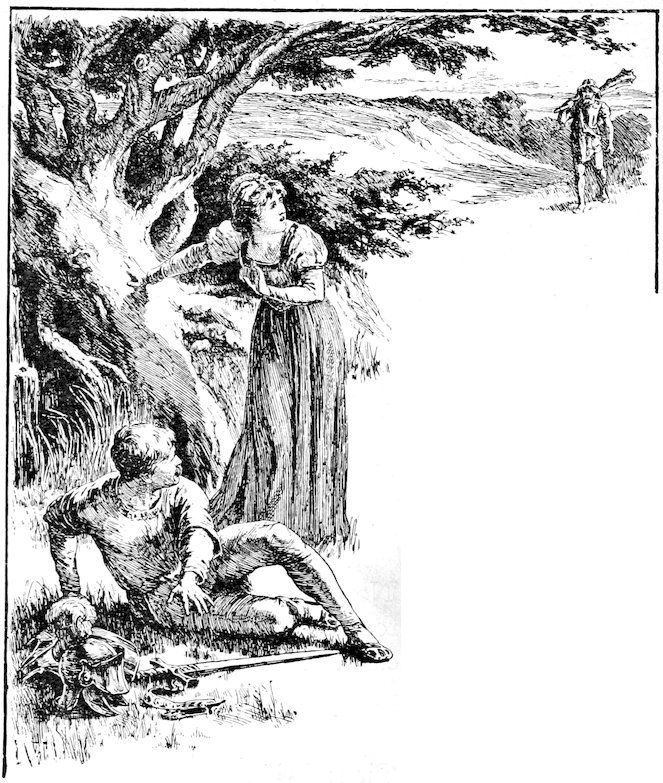
Duessa at first pretended to be angry with the Knight for leaving her so unkindly, but they were soon good friends again. They stayed for some time beside the fountain, where the green boughs sheltered them from the scorching heat.
But although it looked so lovely and tempting, the fountain near which they sat was an enchanted one. Whoever tasted its waters grew faint and feeble.
The Knight, not knowing this, stooped down to drink of the stream, which was as clear as crystal. Then 49all his strength turned to weakness, his courage melted away, and a deadly chill crept over him.
At first he scarcely noticed the change, for he had grown careless both of himself and of his fame. But suddenly he heard a dreadful sound—a loud bellowing which echoed through the wood. The earth seemed to shake with terror, and all the trees trembled. The Knight, astounded, started up, and tried to seize his weapons. But before he could put on his armour, or get his shield, his monstrous enemy came stalking into sight.
It was a hideous Giant, great and horrible. The ground groaned under him. He was taller than three of the tallest men put together. His name was Orgoglio, or Pride, and his father’s name was Ignorance. He was puffed up with arrogance and conceit, and because he was so big and strong he despised every one else. He leant upon a gnarled oak, which he had torn up by its roots from the earth; it also served him as a weapon to dismay his foemen.
When he saw the Knight he advanced to him with dreadful fury. The latter, quite helpless, all in vain tried to prepare for battle. Disarmed, disgraced, inwardly dismayed, and faint in every limb, he could scarcely wield even his useless blade. The Giant aimed such a merciless stroke at him, that if it had touched him it would have crushed him to powder. But the Knight leapt lightly to one side, and thus escaped the blow. So great, however, was the wind that the club made in whirling through the air that the Knight was overthrown, and lay on the ground stunned.
When Giant Pride saw his enemy lying helpless, he 50lifted up his club to kill him, but Duessa called to him to stay his hand.
“O great Orgoglio,” she cried, “spare him for my sake, and do not kill him. Now that he is vanquished make him your bond-slave, and, if you like, I will be your wife!”
Giant Pride was quite pleased with this arrangement, and, taking up the Red Cross Knight before he could awake from his swoon, he carried him hastily to his castle, and flung him, without pity, into a deep dungeon.
As for Duessa, from that day forth she was treated with the greatest honour. She was given gold and purple to wear, and a triple crown was placed upon her head, and every one had to obey her as if she were a queen. To make her more dreaded, Orgoglio gave her a hideous dragon to ride. This dragon had seven heads, with gleaming eyes, and its body seemed made of iron and brass. Everything good that came within its reach it swept away with a great long tail, and then trampled under foot.
All the people’s hearts were filled with terror when they saw Duessa riding on her dragon.
Prince Arthur
When the Red Cross Knight was made captive by Giant Pride and carried away, Prudence, his servant, who had seen his master’s fall, sorrowfully collected his forsaken possessions—his mighty armour, missing when most needed, his silver shield, now idle and masterless, 51his sharp spear that had done good service in many a fray. With these he departed to tell his sad tale.
He had not gone far when he met Una, flying from the scene of battle, while Sir Satyrane hindered Lawless from pursuing her. When she saw Prudence carrying the armour of the Red Cross Knight, she guessed something terrible had happened, and fell to the ground as if she were dying of sorrow.
Unhappy Prudence would gladly have died himself, but he did his best to restore Una to life. When she had recovered she implored him to tell her what had occurred.
Then the dwarf told her everything that had taken place since they parted. How the crafty Archimago had deceived the Red Cross Knight by his wiles, and made him believe that Una had left him; how the Knight had slain Faithless and had taken pity on Duessa because of the false tales she told. Prudence also told Una all about the House of Pride and its perils; he described the fight which the Knight had with Joyless, and lastly, he told about the luckless conflict with the great Giant Pride, when the Knight was made captive, whether living or dead he knew not.
Una listened patiently, and bravely tried to master her sorrow, which almost broke her heart, for she dearly loved the Red Cross Knight, for whose sake she had borne so many troubles. At last she rose, quite resolved to find him, alive or dead. The dwarf pointed out the way by which Giant Pride had carried his prisoner, and Una started on her quest. Long she wandered, through woods and across valleys, high over hills, and low 52among the dales, tossed by storms and beaten by the wind, but still keeping steadfast to her purpose.
At last she chanced by good fortune to meet a knight, marching with his squire. This knight was the most glorious she had ever seen. His glittering armour shone far off, like the glancing light of the brightest ray of sunshine; it covered him from top to toe, and left no place unguarded. Across his breast he wore a splendid belt, covered with jewels that sparkled like stars. Among the jewels was one of great value, which shone with such brilliancy that it amazed all who beheld it. Close to this jewel hung the knight’s sword, in an ivory sheath, carved with curious devices. The hilt was of burnished gold, the handle of mother-of-pearl, and it was buckled on with a golden clasp.
The helmet of this knight was also of gold, and for crest it had a golden dragon with wings. On the top of all was a waving plume, decked with sprinkled pearls, which shook and danced in every little breath of wind.
The shield of the warrior was closely covered, and might never be seen by mortal eye. It was not made of steel nor of brass, but of one perfect and entire diamond. This had been hewn out of the adamant rock with mighty engines; no point of spear could ever pierce it, nor dint of sword break it asunder.
This shield the knight never showed to mortals, unless he wished to dismay some huge monster or to frighten large armies that fought unfairly against him. No magic arts nor enchanter’s spell had any power against it. Everything that was not exactly what it seemed to be faded before it and fell to ruin.
53The maker of the shield was supposed to be Merlin, a mighty magician; he made it with the sword and armour for this young prince when the latter first took to arms.
The name of the knight was Prince Arthur, type of all Virtue and Magnificence, and pattern of all true Knighthood.
His squire bore after him his spear of ebony wood; he was a gallant and noble youth, who managed his fiery steed with much skill and courage.
When Prince Arthur came near Una, he greeted her with much courtesy. By her unwilling answers he guessed that some secret sorrow was troubling her, and he hoped that his gentle and kindly words would persuade her to tell him the cause of her grief.
“What good will it do to speak of it?” said Una. “When I think of my sorrow it seems to me better to keep it hidden than to make it worse by speaking of it. Nothing in the world can lighten my misfortunes. My last comfort is to be left alone to weep for them.”
“Ah, dear lady,” said the gentle Knight, “I know well that your grief is great, for it makes me sad even to hear you speak of it. But let me entreat you to tell me what is troubling you. Misfortunes may be overcome by good advice, and wise counsel will lessen the worst injury. He who never tells of his hurts will never find help.”
His words were so kind and reasonable that Una was soon persuaded to tell him her whole story. She began with the time when she had gone to the Court of Queen Gloriana to seek a champion to release her 54parents from the horrible dragon, and ended with the account of how the Red Cross Knight had fallen a prey to Giant Pride, who now held him captive in a dark dungeon.
“Truly, lady, you have much cause to grieve,” said Prince Arthur when the story was finished. “But be of good cheer, and take comfort. Rest assured I will never forsake you until I have set free your captive Knight.”
His cheerful words revived Una’s drooping heart, and so they set forth on their journey, Prudence guiding them in the right way.
The Wondrous Bugle and the Mighty Shield
Badly indeed would it now have fared with the Red Cross Knight had it not been for the Lady Una. Even good people daily fall into sin and temptation, but as often as their own foolish pride or weakness leads them astray, so often will Divine love and care rescue them, if only they repent of their misdoings. Thus we see how Holiness, in the guise of the Red Cross Knight, was for a while cast down and defeated; yet in the end, because he truly repented, help was given him to fight again and conquer.
Prince Arthur and the Lady Una travelled till they came to a castle which was built very strong and high.
“Lo,” cried the dwarf, “yonder is the place where my unhappy master is held captive by that cruel tyrant!”
The Prince at once dismounted, and bade Una stay 55to see what would happen. He marched with his squire to the castle walls, where he found the gates shut fast. There was no warder to guard them, nor to answer to the call of any who came.
Then the squire took a small bugle which hung at his side with twisted gold and gay tassels. Wonderful stories were told about that bugle; every one trembled with dread at its shrill sound. It could easily be heard three miles off, and whenever it was blown it echoed three times. No false enchantment or deceitful snare could stand before the terror of that blast. No gate was so strong, no lock so firm and fast, but at that piercing noise it flew open or burst.
This was the bugle which Prince Arthur’s squire blew before the gate of Giant Pride. Then the whole castle quaked, and every door flew open. The Giant himself, dismayed at the sound, came rushing forth in haste from an inner bower, to see what was the reason of this sudden uproar, and to discover who had dared to brave his power. After him came Duessa, riding on her dragon with the seven heads; every head had a crown on it, and a fiery tongue of flame.
When Prince Arthur saw Giant Pride, he took his mighty shield and flew at him fiercely; the Giant lifted up his club to smite him, but the Prince leaped to one side, and the weapon, missing him, buried itself with such force in the ground, that the Giant could not quickly pull it out again. Then with his sharp sword Prince Arthur struck at the Giant, and wounded him severely.
Duessa, seeing her companion’s danger, urged forward her dragon to help him, but the brave squire sprang 56in between it and the Prince, and with his drawn sword drove it back. Then the angry Duessa took a golden cup, which she always carried, and which was full of a secret poison. Those who drank of that cup either died, or else felt despair seize them. She lightly sprinkled the squire with the contents of this cup, and immediately his courage faded away, and he was filled with sudden dread. He fell down before the cruel dragon, who seized him with its claws, and nearly crushed the life out of him. He had no power nor will to stir.
When Prince Arthur saw what had happened, he left Giant Pride and turned against the dragon, for he was deeply grieved to see his beloved squire in such peril. He soon drove back the horrible creature, but now once again the Giant rushed at him with his club. This time the blow struck the Prince with such force, that it bore him to the ground. In the fall, his shield, that had been covered, lost by chance its veil, and flew open.
Then through the air flashed such a blazing brightness, that no eye could bear to look upon it. Giant Pride let fall the weapon with which he was just going to slay the Prince, and the dragon was struck blind, and tumbled on the ground.
“Oh, help, Orgoglio, help, or we all perish!” cried Duessa.
Gladly would Giant Pride have helped her, but all was in vain; when that light shone he had no power to hurt others, nor to defend himself; so Prince Arthur soon killed him.
When he was dead, his great body, that had seemed so big and strong, suddenly melted away, and nothing 57was left but what looked like the shrivelled skin of a broken balloon; for, after all, there was no real substance in him, but he was simply puffed out with emptiness and conceit, and his grand appearance was nothing but a sham.
So that was the end of Giant Pride.
When false Duessa saw the fall of Giant Pride she flung down her golden cup, and threw aside her crown, and fled away. But the squire followed, and soon took her prisoner. Telling him to keep safe guard on her, Prince Arthur boldly entered the Giant’s Castle. Not a living creature could he spy; he called loudly, but no one answered; a solemn silence reigned everywhere, not a voice was to be heard, not a person seen, in bower or hall.
At last an old, old man, with beard as white as snow, came creeping along; he guided his feeble steps with a staff, for long ago his sight had failed. On his arm he bore a bunch of keys, all covered with rust. They were the keys of all the doors inside the castle; they were never used, but he still kept possession of them.
It was curious to see the way in which this old man walked, for always, as he went forward, he kept his wrinkled face turned back, as if he were trying to look behind. He was the keeper of the place, and the father of the dead Giant Pride; his name was Ignorance.
Prince Arthur, as was fitting, honoured his grey hair and gravity, and gently asked him where all the people were who used to live in that stately building. The old man softly answered him that he could not 58tell. Again the Prince asked where was the Knight whom the Giant had taken captive?
“I cannot tell,” said the old man.
Then the Prince asked which was the way into the castle, and again he got the same answer, “I cannot tell.”
At first he thought the man was mocking him, and began to be much displeased. But presently, seeing that the poor old thing could not help his foolishness, he wisely calmed his anger. Going up to him he took the keys from his arm, and made an entrance for himself. He opened each door without the least difficulty; there was no one to challenge him, nor any bars to hinder his passage.
Inside the castle he found the whole place fitted up in the most splendid manner, decked with royal tapestry, and shining with gold, fit for the presence of the greatest prince. But all the floors were dirty, and strewn with ashes, for it was here that the wicked Giant Pride used to slay his unhappy victims.
Prince Arthur sought through every room, but nowhere could he find the Red Cross Knight. At last he came to an iron door, which was fast locked, but he found no key among the bunch to open it. In the door, however, there was a little grating, and through this the Prince called as loudly as he could, to know if there were any living person shut up there whom he could set free.
Then there came a hollow voice in answer. “Oh, who is that who brings to me the happy choice of death? Here I lie, dying every hour, yet still compelled 59to live, bound in horrible darkness. Three months have come and gone since I beheld the light of day. Oh, welcome, you who bring true tidings of death.”
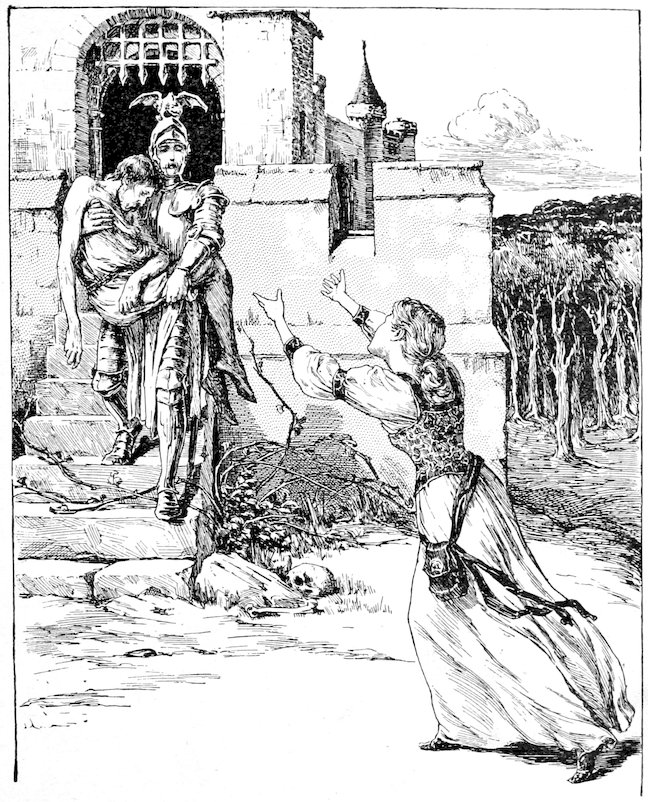
“Whome when his Lady saw, to him she ran With hasty joy: to see him made her glad, And sad to view his visage pale and wan.”
61When Prince Arthur heard these words his heart was so filled with pity and horror at any noble knight being thus shamefully treated, that, in his strength and indignation, he rent open the iron door. But entering, he found no floor; there was a deep descent, as dark as a pit, from which came up a horrible deadly smell.
Neither darkness, however, nor dirt, nor poisonous smell could turn the Prince from his purpose, and he went forward courageously. With great trouble and difficulty he found means to raise the captive, whose own limbs were too feeble to bear him, and then he carried him out of the castle.
What a mournful picture was now the Red Cross Knight! His dull, sunken eyes could not bear the unaccustomed light of the sun; his cheeks were thin and gaunt; his mighty arms, that had fought so often and so bravely, were nothing now but bones; all his strength was gone, and all his flesh shrunk up like a withered flower.
When Una saw Prince Arthur carrying the Red Cross Knight out of the castle she ran to them joyfully; it made her glad even to see the Knight, but she was full of sorrow at the sight of his pale, wan face, which had formerly been radiant with the glory of youth.
“My dearest lord,” she cried, “what evil star has frowned on you and changed you thus? But welcome now, in weal or woe, my dear lord whom I have lost 62too long! Fate, who has been our foe so long, will injure us no further, but shall pay penance with threefold good for all these wrongs.”
The unhappy man, dazed with misery, had no desire to speak of his troubles; his long-endured famine needed more relief.
“Fair lady,” then said the victorious Prince, “things that were grievous to do or to bear it brings no pleasure to recall. The only good that comes from past danger is to make us wiser and more careful for the future. This day’s example has deeply written this lesson on my heart—perfect happiness can never be lasting while we still live on earth.
“Henceforth, Sir Knight,” he continued, “take to yourself your old strength, and master these mishaps by patience. Look where your foe lies vanquished, and the wicked woman, Duessa, the cause of all your misery, stands in your power, to let her live or die.”
“To kill her would be to act unworthily,” said Una, “and it would be a shame to avenge one’s self on such a weak enemy. But take off her scarlet robe and let her fly!”
So they did as Una bade them. They took from Duessa all her finery—her royal robe, and purple cloak, and all the rich ornaments with which she was decked. And when this disguise was taken from her, they saw her as she really was—old, and ugly, and bad. She would no longer be able to deceive people by her pretended goodness, and youth, and beauty, for every one who saw her shrunk away in horror.
“Such,” said Una, “is the face of Falsehood when 63its borrowed light is laid aside, and all its deceitfulness is made known.”
Thus, having taken from Duessa her power to work evil, they set her free to go where she pleased. She fled to a barren wilderness, where she lurked unseen in rocks and caves, for she always hated the light.
But Prince Arthur, and the Red Cross Knight, and fair Una stayed for awhile in the castle of Giant Pride, to rest themselves and to recover their strength. And here they found a goodly store of all that was dainty and rare.
The Knight with the Hempen Rope
When the two Knights and the Lady Una had rested awhile in the castle of Giant Pride, they set out again on their journey. Before they parted, Prince Arthur and the Red Cross Knight gave each other beautiful gifts—tokens of love and friendship. Prince Arthur gave a box of adamant, embossed with gold, and richly ornamented; in it were enclosed a few drops of a precious liquid of wonderful power, which would immediately heal any wound. In return the Red Cross Knight gave the Prince a Bible, all written with golden letters, rich and beautiful.
Thus they parted, Prince Arthur to go about his own work, and the Knight to fight the terrible Dragon that was laying waste the kingdom that belonged to Una’s father and mother. But she, seeing how thin and ill her champion looked, and knowing that he was still weak and weary, would not hasten forward, nor 64let him run the chance of any further fighting, until he had recovered his former strength.
As they travelled, they presently saw an armed knight galloping towards them. It seemed as though he were flying from a dreaded foe, or some other grisly thing. As he fled, his eyes kept looking backwards as if the object of his terror were pursuing him, and his horse flew as if it had wings to its feet.
When he came nearer they saw that his head was bare, his hair almost standing on end with fright, and his face very pale. Round his neck was a hempen rope, suiting ill with his glittering armour.
The Red Cross Knight rode up to him, but could scarcely prevail upon him to stop.
“Sir Knight,” he said, “pray tell us who hath arrayed you like this, and from whom you are flying, for never saw I warrior in so unseemly a plight.”
The stranger seemed dazed with fear, and at first answered nothing; but after the gentle Knight had spoken to him several times, at last he replied with faltering tongue, and trembling in every limb: “I beseech you, Sir Knight, do not stop me, for lo! he comes—he comes fast after me!”
With that he again tried to run away, but the Red Cross Knight prevented him, and tried to persuade him to say what was the matter.
“Am I really safe from him who would have forced me to die?” said the stranger. “May I tell my luckless story?”
“Fear nothing,” said the Knight; “no danger is near now.”
65
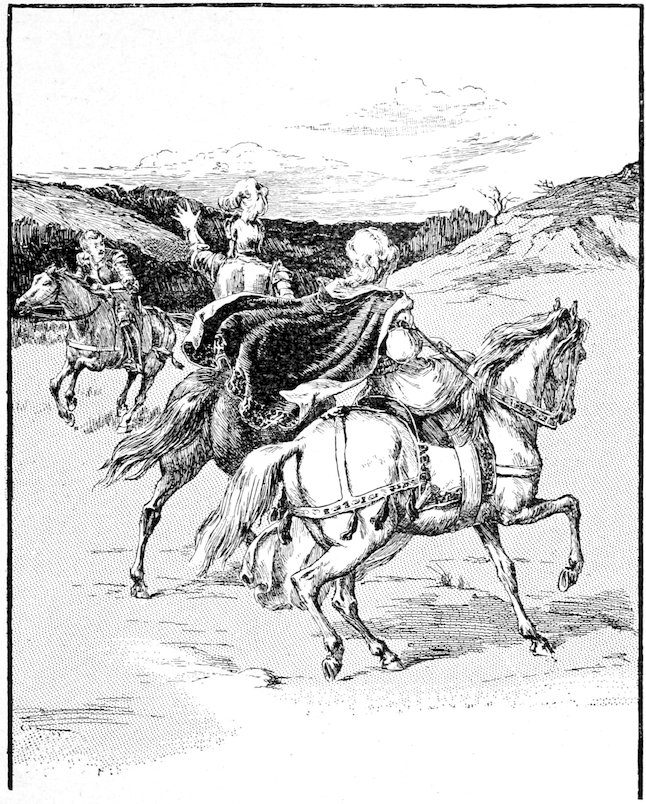
“So as they traveíled, lo! they gan espy An armed knight towards them gallop fast, That seemed from some feared foe to fly, Or other griesly thing that him aghast.”
67Then the stranger told how he and another knight had lately been companions. The name of his friend was Sir Terwin. He was bold and brave, but because everything did not go exactly as he wished, he was not happy. One day when they were feeling very sad and comfortless, they met a man whose name was Despair. Greeting them in a friendly fashion, Despair soon contrived to find out from them what they were feeling, and then he went on to make the worst of everything. He told them there was no hope that things would get any better, and tried to persuade them to put an end to all further trouble by killing themselves. To Sir Terwin he lent a rusty knife, and to the other knight a rope. Sir Terwin, who was really very unhappy, killed himself at once; but Sir Trevisan, dismayed at the sight, fled fast away, with the rope still round his neck, half dead with fear.
“May you never hear the tempting speeches of Despair,” he ended.
“How could idle talking persuade a man to put an end to his life?” said the Red Cross Knight. He was ready to despise the danger, and he trusted in his own strength to withstand it.
“I know,” said the stranger, “for trial has lately taught me; nor would I go through the like again for the world’s wealth. His cunning, like sweetest honey, drops into the heart, and all else is forgotten. Before one knows it, all power is secretly stolen, and only weakness remains. Oh, sir, do not wish ever to meet with Despair.”
“Truly,” said the Red Cross Knight, “I shall 68never rest till I have heard what the traitor has to say for himself. And, Sir Knight, I beg of you, as a favour, to guide me to his cabin.”
“To do you a favour, I will ride back with you against my will,” said Sir Trevisan; “but not for gold, nor for anything else will I remain with you when you arrive at the place. I would rather die than see his deadly face again.”
In the Cave of Despair
Sir Trevisan and the Red Cross Knight soon came to the place where Despair had his dwelling. It was in a hollow cave, far underneath a craggy cliff, dark and dreary. On the top always perched a melancholy owl, shrieking his dismal note, which drove all cheerful birds far away. All around were dead and withered trees, on which no fruit nor leaf ever grew.
When they arrived, Sir Trevisan would have fled in terror, not daring to go near, but the Red Cross Knight forced him to stay, and soothed his fears.
They entered the gloomy cave, where they found a miserable man sitting on the ground, musing sullenly. He had greasy, unkempt locks, and dull and hollow eyes, and his cheeks were thin and shrunken, as if he never got enough to eat. His garment was nothing but rags, all patched, and pinned together with thorns. At his side lay the dead body of Sir Terwin, just as Sir Trevisan had told.
69
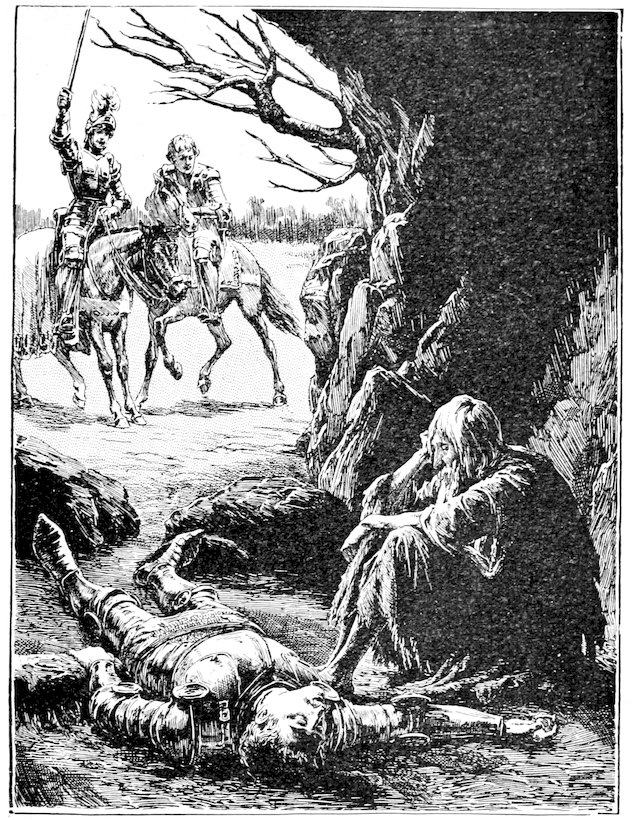
“Ere long they come where that same wicked wight His dwelling has, low in a hollow cave, For underneath a craggy cliff ypight, Dark, doleful, dreary, like a greedy grave, That still for carrion carcases doth crave.”
When the Red Cross Knight saw this sad sight, all 71his courage blazed up in the desire to avenge him, and he said to Despair, “Wretched man! you are the cause of this man’s death. It is only just that you should pay the price of his life with your own.”
“Why do you speak so rashly?” said Despair. “Does not justice teach that he should die who does not deserve to live? This man killed himself by his own wish. Is it unjust to give to each man his due? Or to let him die who hates to live longer? Or to let him die in peace who lives here in trouble? If a man travels by a weary, wandering way, and comes to a great flood between him and his wished-for home, is it not a gracious act to help him to pass over it? Foolish man! would you not help him to gain rest, who has long dwelt here in woe?”
Thus spoke Despair, and he said many beautiful and persuasive words concerning Death. And as the Red Cross Knight listened, all his courage and all his anger melted away, and it seemed to him that there would be no sweeter thing in the whole world than to lie down and be at rest.
“What is the good of living?” said Despair. “The longer you live the more sins you commit. All those great battles that you are so proud of winning, all this strife and bloodshed and revenge, which are praised now, hereafter you will be sorry for. Has not your evil life lasted long enough? He that hath once missed the right way, the farther he goes, the farther he goes wrong. Go no farther, then—stray no farther. Lie down here and take your rest. What has life to make men love it so? Fear, sickness, age, loss, labour, 72sorrow, strife, pain, hunger, cold, and fickle fortune, all these, and a thousand more ills make life to be hated rather than loved. Wretched man! you indeed have the greatest need of death if you will truly judge your own conduct. Never did knight who dared warlike deeds meet with more luckless adventures. Think of the deep dungeon wherein you were lately shut up; how often then did you wish for death! Though by good luck you escaped from there, yet death would prevent any further mischance into which you may happen to fall.”
Then Despair went on to speak to the Red Cross Knight of all his sins. He pointed out the many wrong things he had done, and said that he had been so faithless and wicked that there was no hope for him of any mercy or forgiveness. Rather than live longer and add to his sins, it would be better for him to die at once, and put an end to all.
The Knight was greatly moved by this speech, which pierced his heart like a sword. Too well he knew that it was all true. There came to his conscience such a vivid memory of all his wrongdoings that all his strength melted away, as if a spell had bewitched him. When Despair saw him waver and grow weak, and that his soul was deeply troubled, he tried all the harder to drive him to utter misery.
“Think of all your sins,” he said. “God is very angry with you. You are not worthy to live. It is only just that you should die. Better kill yourself at once.”
Then Despair went and fetched a dagger, sharp and keen, and gave it to the Red Cross Knight. Trembling 73like an aspen-leaf, the Knight took it, and lifted up his hand to slay himself.
When Una saw this, she grew cold with horror, but, starting forward, she snatched the knife from his hand, and threw it to the ground, greatly enraged.
“Fie, fie, faint-hearted Knight!” she cried. “What is the meaning of this shameful strife? Is this the battle which you boasted you would fight with the horrible fiery Dragon? Come, come away, feeble and faithless man! Let no vain words deceive your manly heart, nor wicked thoughts dismay your brave spirit. Have you not a share in heavenly mercy? Why should you then despair who have been chosen to fight the good fight? If there is Justice, there is also Forgiveness, which soothes the anguish of remorse and blots out the record of sin. Arise, Sir Knight, arise and leave this evil place.”
So up he rose, and straightway left the cave. When Despair saw this, and that his guest would safely depart in spite of all his beguiling words, he took a rope and tried to hang himself. But though he had tried to kill himself a thousand times, he could never do so, until the last day comes when all evil things shall perish for ever.
How the Red Cross Knight came to the House of Holiness
The bravest man who boasts of bodily strength may often find his moral courage fail in the hour of temptation. If he gain the victory, let him not 74ascribe it to his own skill, but rather to the grace of God.
From what had happened in the Cave of Despair, Una saw that her Knight had grown faint and feeble; his long imprisonment had wasted away all his strength, and he was still quite unfit to fight. Therefore she determined to bring him to a place where he might refresh himself, and recover from his late sad plight.
There was an ancient house not far away, renowned through all the world for its goodness and holy learning, so well was it guided and governed by a wise matron. Her only joy was to comfort those in trouble and to help the helpless poor. She was called Dame Celia—the “Heavenly Lady”—and she had three beautiful daughters, Fidelia (Faith), Speranza (Hope), and Charissa (Love).
Arrived at the House of Holiness, they found the door fast locked, for it was warily watched, night and day, for fear of many foes. But when they knocked, the porter straightway opened to them. He was an aged man, with grey hair and slow footsteps; his name was Humility. They passed in, stooping low, for the way he showed them was strait and narrow, even as all good things are hardest at the beginning. But when they had entered they saw a spacious court, very pleasant to walk in. Here they were met by a frank, honest-looking man, called Zeal, who gladly acted as their guide till they came to the hall.
The squire of the household received them, and made them welcome; his name was Reverence. He was very gentle, modest, and sincere, always treating 75every one with the greatest kindness and courtesy, not from any pretended politeness, but because of his own good and sweet disposition.
He conducted them to the lady of the house, who was busied as usual in some good works. Directly Dame Celia saw Una, she knew who she was; her heart filled with joy, and she put her arms round her and kissed her.
“Oh, happy earth,” she cried, “whereon your innocent feet still tread! What good fortune has brought you this way, or did you wander here unknowingly? It is strange to see a knight-errant in this place, or any other man, for there are few who choose the narrow path or seek the right.”
Una replied that they had come to rest their weary limbs, and to see the lady herself, whose fame and praise had reached them.
Then Dame Celia entertained them with every courtesy she could think of, and nothing was lacking to show her generosity and wisdom. Whilst they were talking, two beautiful maidens came in; they were Faith and Hope, the daughters of the lady. Faith was arrayed all in lily-white, and her face shone like the light of the sun; in one hand she held a book. Her younger sister, Hope, was clad all in blue, and carried a silver anchor; her face was not as cheerful as Faith’s, but it was very noble and steadfast.
Presently a servant, called Obedience, came and conducted the guests to their rooms, in order that they might rest awhile. Afterwards Una asked Faith if she would allow the Red Cross Knight to enter her schoolhouse, 76in order that he might share in her heavenly learning, and hear the divine wisdom of her words.
So the Knight went to school to learn of Faith, and many were the wondrous things she taught him. Now he saw in its true light all the error of his ways, and he began truly to repent of all his wrongdoings. The thought of them was so bitter, that he felt he was no longer worthy to live.
Then came Hope with sweet comfort, and bade him trust steadily and not lose heart. And Dame Celia, seeing how unhappy he was, sent to him a wonderful doctor, called Patience. Thanks to his skill and wisdom, and to the careful nursing of his attendant, Repentance, the Red Cross Knight presently recovered, and grew well and strong again.
After this Una took him one day to visit the third daughter, whose name was Love. She was so wonderfully beautiful and good that there were few on earth to compare with her. They found her in the midst of a group of happy children; she wore a yellow robe, and sat in an ivory chair, and at her side were two turtle-doves.
Una besought Love to let the Red Cross Knight learn of her whatever she could teach, and to this request Love gladly agreed. Then she began to instruct the Knight in all good things. She spoke to him of love and righteousness, and how to do well, and bade him shun all wrath and hatred, which are displeasing to God. And when she had well taught him this, she went on to show him the path to heaven.