The Adventures of Sir Artegall
Reading edition
“The champion of true Justice, Artegall.”
“Wise, warlike, personable, courteous, and kind.”
The Sword of Justice and the Iron Man
One of the noblest heroes at the Court of the Faerie Queene was Artegall, the champion of Justice. After his marriage with Britomart, it may be remembered, he started on a hard adventure, which led him into much peril. This was to succour a distressed lady whom a strong tyrant unjustly kept captive, withholding from her the heritage which she claimed. The lady was called Irene (Peace), and the Tyrant, Grantorto (Great Wrong).
281When Irene came to the Faerie Queene to beg redress, Queen Gloriana, whose delight it was to aid all poor suppliants, chose Artegall to restore right to her, because he seemed the best skilled in righteous learning.
Even from his cradle Artegall had been brought up to justice; for one day when he was a little child playing with his companions, he had been found by a great and wonderful lady called Astræa, who, while she dwelt here among earthly men, instructed them in the rules of justice. Seeing that the boy was noble and fit for her purpose, she persuaded him to go with her. She took him far away to a lonely cave, in which she brought him up, and taught him all the discipline of justice. She taught him to weigh equally both right and wrong, and where severity was needed to measure it out according to the line of conscience. For want of mankind she caused him to practise this teaching on wild beasts which she found in the woods wrongfully oppressing others of their own kind. Thus she trained him, and thus she taught him to judge skilfully wrong and right till he reached the years of manhood, so that even wild beasts feared him, and men admired his over-ruling might. Nor was there any living person who dared withstand his behest, much less match him in fight. To make him more dreaded, Astræa gave Artegall a wonderful sword, called “Chrysaor,” which excelled all other swords. It was made of most perfect metal, tempered with adamant, all garnished with gold upon the blade, whereby it took its name. It was no less powerful than famous, for there was no substance so firm and hard but it could pierce or cleave, nor any armour that 282could guard off the stroke, for wherever it lighted, it cut completely through.
In course of time Astræa left this world, and went to live among the stars, from which she had first come. But she left behind her on earth her servant, an Iron Man, who always attended on her to execute her judgments, and she bade him go with Artegall and do whatever he was told. The man’s name was Talus; he was made of iron mould, immovable, irresistible, unchanging; he held in his hand an iron flail, with which he threshed out falsehood and unfolded the truth.
Talus, therefore, went with Sir Artegall on this new quest, to aid him, if he chanced to need aid, against the cruel tyrant who oppressed the Lady Irene and kept the crown from her. Nothing is more honourable to a knight, nor better becomes brave chivalry, than to defend the feeble in their right, and redress the wrongs of those who go astray. So the heroes of old won their greatest glory, and herein this noble Knight excelled, who now went forth to dare great perils for the sake of justice.
As Artegall and Talus went on their way they chanced to meet the servant of Florimell, who told the good news that his lady was safe and well, and engaged to be married to her own true knight, Marinell. Sir Artegall was very glad to hear this, and asked when the wedding was to take place, for if he had time he would like to be present to do honour to the occasion.
283
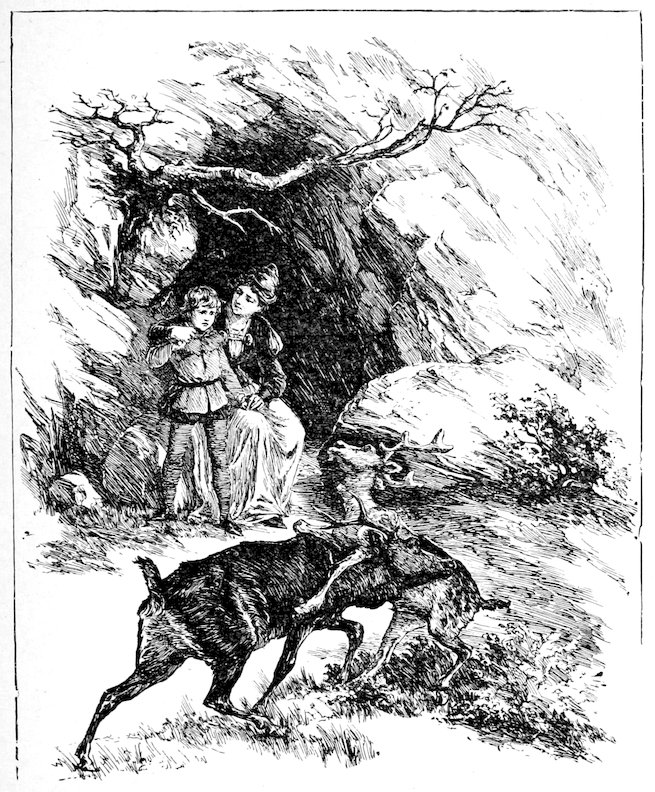
... “For want there of mankind, She caused him to make experience Upon wyld beasts, which she in woods did find With wrongfull powre oppressing others of their kind.”
“The wedding will be within three days,” said the man, “at the Castle of the Strand; at which time, if nothing hinders me, I shall be there to do her service, 285as I am bound. But in my way, a little beyond here, dwells a cruel Saracen who keeps with strong hand the passage of a bridge. He has killed there many a knight-errant, wherefore all men, out of fear, shun the passage.”
“What sort of person, and how far away, is he who does such harm to travellers?” asked Artegall.
“He is a man of great defence, expert in battle and in deeds of arms,” was the answer; “and he is made much bolder by the wicked spells with which his daughter supports him. He has got large estates and goodly farms by oppression and extortion, with which he still holds them. His crimes increase daily, for he never lets any one pass that way over his Bridge, be he rich or poor, without paying him toll-money. His name is called Pollenté, because he is so strong and powerful; he conquers every one,—some by his strength, and some also he circumvents by cunning. For it is his custom to fight on the bridge, which is very narrow, but exceedingly long, and in this bridge are fixed many trap-falls, through which, not noticing, the rider falls down. Underneath the bridge flows a swift and dangerously deep river, into which falls headlong, destitute of help, any one whom the Saracen overthrows. But the tyrant himself, because of his long practice, leaps forth into the flood, and there assails his foe, confused by his sudden fall, so that horse and man are both equally dismayed, and either drowned or treacherously slain. Then Pollenté robs them at will, and brings the spoil to his daughter, who dwells hard by. She takes everything that comes, and 286fills her wicked coffers, which she has heaped so high by wrong-doing that she is richer than many a prince, and has purchased all the country lying near with her ill-gotten revenue. Her name is Munera.
“She is very beautiful and richly attired; her hands are made of gold, and her feet of silver. Many great lords have wished to marry her, but she is so proud that she despises them all.”
“Now by my life, and with Heaven to guide me,” said Sir Artegall, “no other way will I take this day but by that bridge where the Saracen abides; therefore lead me thither.”
The Adventure of the Saracen’s Bridge
Sir Artegall soon came to the place where he saw the Saracen ready armed on the bridge, waiting for spoil. When he and Talus drew near to cross it, an ugly-looking rascal came to them to demand passage-money, according to the custom of the law. “Lo, there are your wages!” said Sir Artegall, and smote him so that he died.
When the Pagan saw this he grew very angry, and at once prepared himself for battle; nor was Sir Artegall behind, so they both ran at each other with levelled spears. Right in the middle, where they would have met breast to breast, a trap was let down to make them fall into the river. The wicked wretch leaped down, knowing well that his foe would fall; but Sir Artegall was on his guard, and also leaped before he fell.
287Then both of them being in the stream they flew at each other violently, the water in no way cooling the heat of their temper but rather adding to it. But there the Saracen, who was well used to fighting in the water, had great advantage, and often almost overthrew Sir Artegall. The charger, also, which he rode could swim like a fish.
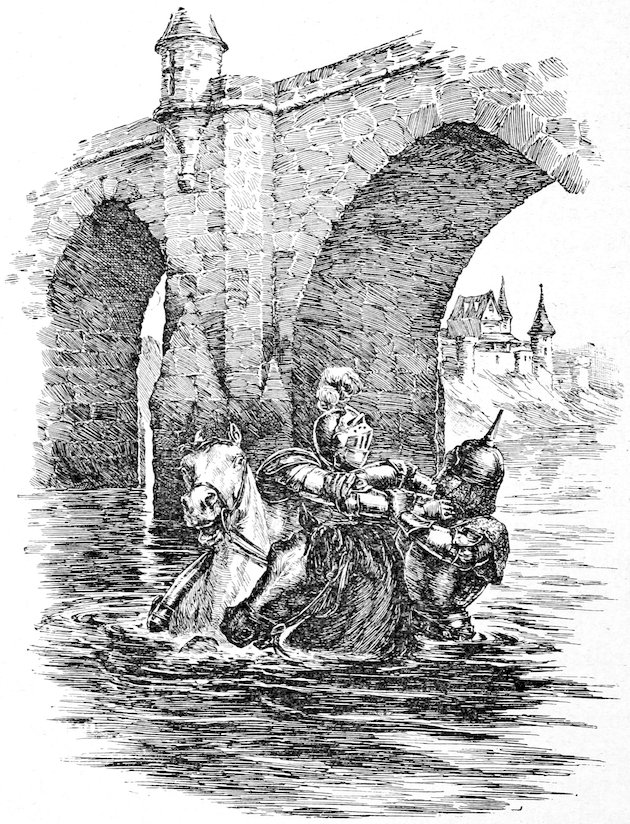
When Sir Artegall saw the odds against him, he knew there was no way but to close hastily with his foe, and driving strongly at Pollenté he gripped him fast by his iron collar, and almost throttled him. There they strove and struggled together, each trying to drag the other from his horse, but nothing could make Artegall slacken his grip. At length he forced Pollenté to forsake his horse’s back, for fear of being drowned, and to betake himself to his swimming. There Pollenté had no advantage, for Artegall was skilful in swimming, and dared venture in any depth of water. So every knight exposed to peril should be expert in swimming and able to make his way through water.
For some time the end of the contest was doubtful, for besides being skilled in that exercise, both were well trained in arms and thoroughly tried. Artegall, however, kept his breath and strength better, so that his foe could no longer withstand him, nor bear himself upright, but fled from the water to the land. Artegall, with his bright sword, Chrysaor, pursued him so closely that Pollenté had scarcely set foot on shore before his head was cut off.
288
This done, Sir Artegall took his way to the castle in which Munera dwelt, guarded by many defenders. Artegall sought entrance, but was refused and defied with a torrent of evil abuse. He was also beaten with stones flung down from the battlements, so that he was 289forced to retire, and he bade his servant Talus invent some way by which he could enter without danger.
Then Talus went to the castle gate, and let fly at it with his iron flail, so that it sorely terrified all the warders, and made those stoop who had borne themselves so proudly. He battered and banged on the door, and thundered strokes so hideously that he shook the very foundations of the building, and filled all the house with fear and uproar.
At this noise the Lady Munera appeared on the castle wall. When she saw the dangerous state in which she stood, she feared she would soon be destroyed, and began with fair words to entreat the Iron Man below to cease his outrage; for neither the force of the stones which they threw, nor the power of charms which she wrought against him could make him stop.
But when she saw him proceed, unmoved by pity or by prayers, she tried to bribe him with a goodly reward. She caused great sacks with countless riches to be brought to the battlements, and poured over the castle wall, so that she might gain some time, though dearly bought, whilst he gathered up the gold.
Talus was not in the least moved or tempted by this, but still continued his assault with the iron flail, so that at length he rent down the door, and made a way for his master. When Artegall entered, it was no use for any one to try to withstand him. They all fled; their hearts failed them, and they hid in corners here and there; and their wicked lady herself, half-dead, hid in terror. For a long time no one could find 290her, but Talus, who, like a bloodhound, could track out secret things, at length found her where she lay hidden under a heap of gold, and dragged her forth. Sir Artegall himself pitied her sad plight, but he could not change the course of justice. Like her father, Munera had to be punished, in order to warn all mighty people who possess great power that they must use it in the right way, and not oppress the feeble. The Tyrant’s daughter was thrown into the water, and the stream washed her away.
Then Talus took all the ill-gotten gold and treasure which her father had scraped together by hook and crook, and burning it into ashes, poured it into the river. Lastly, he pulled down the castle to its very foundation, and broke up all the hewn stones, so that there could be no hope of its being restored, nor memory of it among any nation. All which Talus having thoroughly performed, Sir Artegall reformed the evil fashion and wicked customs of the bridge; and this done, he returned to his former journey.
The Giant with the Scales
After travelling a long, weary way, Sir Artegall and Talus came near the sea, and here one day they saw before them an immense crowd of people, stretching out as far as the eye could reach. They were much astonished at this great assembly, and therefore approached to ask what had brought them together. There they beheld a mighty giant standing on a rock, 291and holding high in his hand a great pair of scales, with which he boasted in his presumption that he would accurately weigh the whole world, if he had anything to match it in the other scale. He said he would take up all the earth, and all the sea, divided from each other; so would he also make one balance of the fire, and one of air, without wind or weather; then he would balance heaven and hell together, and all that was contained within them, and would not miss a feather of their weight—any surplus of each that remained over he would restore to its own part. For, said he, they were all unequal, and had encroached on each other’s share, like the sea which had worn the earth, as the fire had done the air. So all the rest took possession of each other’s parts, and thus countries and nations had gone awry. All of which he undertook to repair in the way they had anciently been formed, and everything should be made equal. He would throw down the mountains and make them level with the plain; the towering rocks he would thrust down into the deepest sea; he would suppress tyrants, so that they should no longer rule; and all the wealth of the rich men he would take away and give to the poor.
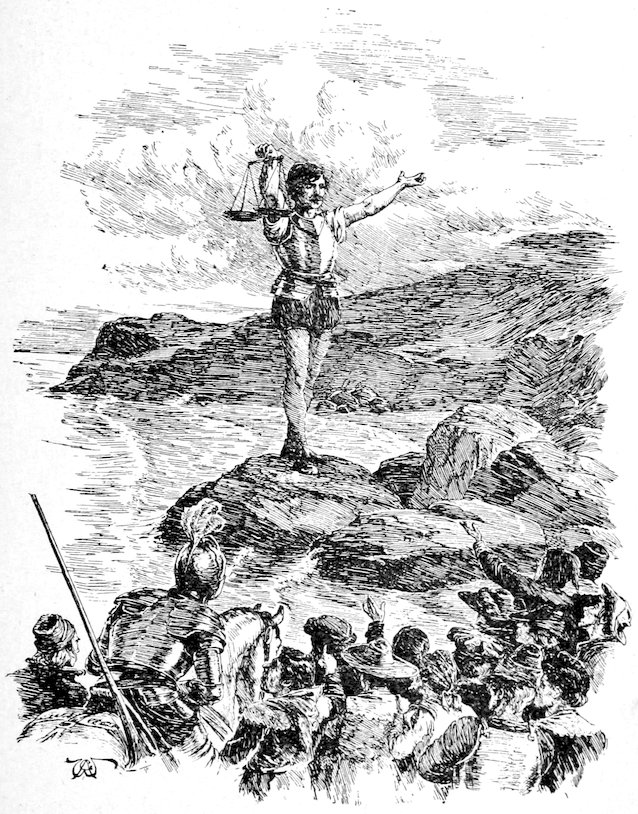
292All the silly ignorant folk flocked about the giant, and clustered thick to hear his vain delusions, like foolish flies round a jar of honey; for they hoped to gain great benefits by him, and uncontrolled freedom. When Artegall saw and heard how he misled the simple people, he disdainfully drew near, and thus spoke to him without fear:—
“You that presume to weigh the world anew, and restore all things to an equality, it seems to me show great wrong instead of right, and boast far more than you are able to perform.” And then he went on to 293rebuke the giant for his folly and presumption, and showed him that if he could not understand nor weigh properly even the things that he saw, how much less could he attempt to balance unseen matters, or call into account the works of the great Ruler of the universe.
But the giant would not listen to reason, for he had no real desire for the right, and he still tried to continue his false and wicked teaching. Talus, therefore, seeing his mischievous ignorance, came up, and toppled him over into the sea, where he fell with a great splash and was drowned.
When the people who had long waited there saw his sudden destruction, they began to gather in a turbulent mob, and tried to stir up strife, because of the loss of all their expectations. For they had hoped to get great good, and wonderful riches, by the giant’s new schemes, and resolving to revenge his death, they rose in arms, and stood in order of battle.
When Artegall saw this lawless multitude advancing in hostile fashion, he was much troubled, and did not know what to do; for he was loath to soil his hands by killing such a rascally crew, and yet he feared to retire, lest they should follow him with shame. Therefore he sent Talus to them to inquire the cause of their array, and to request a truce. But as soon as they saw him coming they began to attack him with their weapons, and rudely struck at him on every side; yet they could not in the least hurt or dismay him. Then Talus lay about him with his flail and overthrew them like a swarm of flies. Not one of them dared 294come in his way, but they flew here and there, and hid themselves out of his sight in holes and bushes. When Talus saw that they all forsook the field and none of the rascal rout were left, he returned to Sir Artegall, and they went on together.
Borrowed Plumes, and the Fate of the Snowy Lady
After long storms and tempests the sun’s face again shines forth joyfully, so when fortune has shown all her spite some blissful hours at last must needs appear. So it was with the Lady Florimell. After escaping from the cruel hyena that killed and devoured her milk-white palfrey, she met with many troubles and misfortunes; but they were all over now, and she was happily betrothed to her own true Knight, Marinell.
The time and place of the bridal were blazed far and wide, and solemn feasts and tournaments were arranged, to which a countless throng of lords and ladies resorted from all directions, nor was there any brave knight absent. It would need the tongue of a herald to tell the glory of the feast that day—the splendid service, the brilliant variety of entertainments, the pomp of the bridegroom, the richness of the bride’s array, the crowd of noble ladies and gallant knights, the royal banquets, and the general rejoicing. When all the people had sufficiently feasted, they began to prepare themselves for deeds of arms and contests of chivalry.
Then first of all rode forth Sir Marinell, and with him six more knights, to challenge all on behalf of 295Florimell, and to maintain that she excelled all other ladies. Against them came every one that cared to joust, from every coast and country under the sun: no one was debarred; all had leave who chose. Many brave deeds were done that day, and many a knight unhorsed, but little was lost or won. All that day the greatest praise redounded to Marinell. So also the second day. At the end of the fighting the trumpets proclaimed that Marinell was the best.
The third day came, which would test all the others, and the warriors met together to finish the tournament. Then Marinell again showed great valour, and flew like a lion through the thickest of the press, so that every one fled from the danger, and was amazed at his might. But the greater the prowess, the greater the peril; Marinell pressed so far into the ranks of the enemy that they closed up behind him, so that he could by no means make a way out. He was taken prisoner, and bound with chains, and would have been led away, forsaken of all, had not some succour overtaken him in time.
It happened that while Marinell was thus sorely beset, Sir Artegall came into the tilt-yard, with Braggadochio, whom he had lately met on the way with the false Florimell, the “Snowy Lady.” When Artegall heard the bad fortune that had betided Marinell, he was much excited at his undeserved disgrace. He immediately begged the braggart with whom he was riding to change shields with him, in order that he might be the better concealed, and thus armed he went forth, and soon overtook the knights who were leading Marinell away. 296There were a hundred of them altogether. Half of them set upon Sir Artegall, and half stayed behind to guard the prey. Artegall was not long in beating the first fifty, and soon snatched the prisoner from the other fifty. Then he quickly armed Marinell again, and together they overcame all the rest of the knights, and were left lords of the field. So Marinell was rescued from his foes.
Having done this, Sir Artegall restored his shield to Braggadochio, who all this while had remained in the background. Then the trumpets sounded, and the judges rose, and all the knights who had borne armour that day came to the open hall to listen to whom the honour of the prize should be adjudged.
There also in open sight came the fair Florimell into the public hall, to give his guerdon to every knight, and the best to him to whom the best should fall. Then they loudly called for the stranger Knight, to whom they should yield the garland, but he came not forth; but instead of Sir Artegall came Braggadochio, and showed his shield, which bore the device of the sun, broadly blazoned on a golden field.
The sight filled them with gladness, so to him they adjudged the prize of all that triumph. Then the shrill trumpets thrice resounded the name of Braggadochio, and thus courage lent a cloak to cowardice. Then the beautiful Florimell came to Braggadochio, and spoke graciously in praise of his gallantry, and gave him a thousand thanks for so well defending her cause.
To this the boaster (which filled all knights with utter contempt for him) made scornful answer that 297what he did that day he did, not for her, but for his own lady’s sake, who excelled both her and every one else; and he added further bragging and unseemly speeches. His words much abashed the gentle lady, and she turned aside, ashamed to hear what he said.
Then he brought forth his snowy Florimell, who was standing near, in charge of Trompart, covered with a veil from people’s gaze; and when they had thoroughly eyed her they were stupefied with great amazement, saying that it was surely Florimell, or if it were not, then she surpassed Florimell herself. Such feeble skill have the vulgar with respect to perfect things!
Marinell, likewise, when he beheld, was exceedingly amazed, not knowing what to think or to do. He stood for a long time lost in astonishment, his eyes fixed fast on the Snowy Maid, whom the more he looked at, the more he thought was the true Florimell.
When Artegall, who stood all this while close covered in the crowd, saw everything that passed, and the boasting and ungrateful cheating of Braggadochio, he could stand it no longer, but came forth, and showed himself openly to every one, and said to the boaster—
“Base wretch, thou hast defaced another’s worth with thy lies and decked thyself with borrowed plumes; when they are all restored, thou shalt be left in disgrace. That shield which thou bearest was indeed the one which saved the day’s honour to Marinell; but that was not the arm, nor thou the man who did that service to Florimell. For proof, show forth thy sword, 298and let it tell what strokes, what dreadful battle it stirred up this day. Or show the wounds which befell you!
“But this is the sword which wrought such havoc; and this the arm which bore that shield; and these the signs” (he pointed to his wounds) “by which it is apparent the glory was got. As for that lady which he shows here,” he continued, turning to the others, “it is not Florimell at all, but some worthless creature, fit for such a mate, who has fallen into his hand by misfortune;” and for proof he bade them call the true Florimell.
So the noble Lady was brought, adorned with honour and all comely grace, blushing with modesty, so that the roses mixed with the lilies in her lovely face, for she still felt deep shame at the rude words which Braggadochio had flung at her. And when the people saw her they shouted aloud, and all showed signs of gladness.
Then Sir Artegall placed her by the Snowy Lady, like a true saint beside some painted image, to make trial of their beauty, and to see which should get the honour. Straightway, as soon as they were both met together, the enchanted damsel vanished into nothing. Her body of snow melted as with heat, and nothing remained of all her goodly appearance except the empty girdle, which had been clasped round her waist.
When the people present beheld this, they were struck with astonishment, and their hearts quailed with horror, to see the thing which seemed so excellent stolen away, so that no one understood what became of it. Braggadochio himself was so daunted with despair that he stood immovable, like a lifeless body.
299
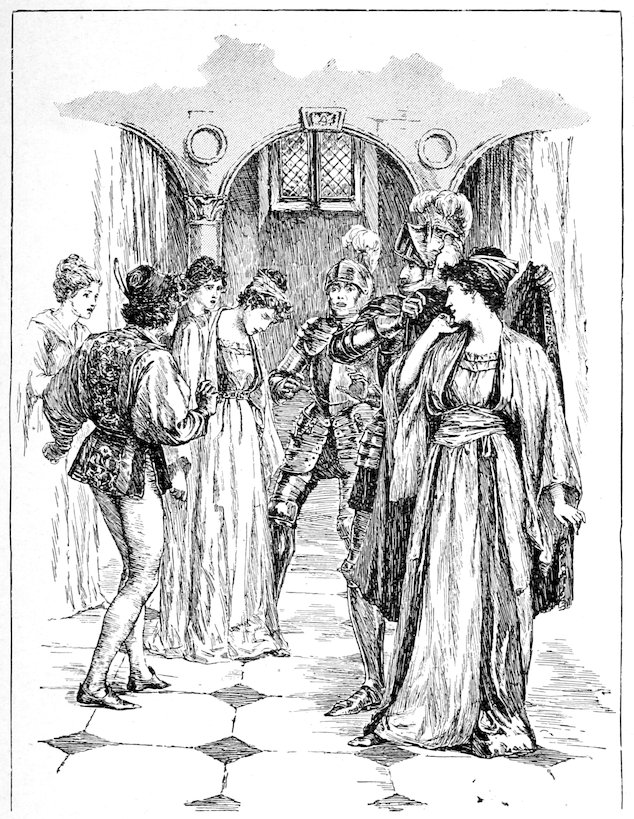
“Streight-way, so soone as both together met, Th’ enchaunted Damzel vanisht into nought, Her snowy substance melted as with heat, Ne of that goodly hew remayned ought.”
301But Artegall took up the golden belt, the only thing left of all the spoil, which was not the Snowy Lady’s, as many mistakenly believed, but Florimell’s own girdle, reft from her when she fled from the vile monster; unbuckling it, he presented it to Florimell, who fitted it perfectly round her slender waist. The girdle possessed the magic power of breaking or becoming unfastened when it was put on by any unworthy person. Many ladies had often tried to wear it, but it fitted no one till it came into the hands of its rightful owner, Florimell.
How the Good Horse Brigadore knew his own Master
While every one was busied about Florimell, and in hearing the truth about Braggadochio, Sir Guyon, as it befell, came forward from the thickest of the crowd to claim his own good steed, which Braggadochio had stolen long ago. Seizing the golden bit with one hand, he drew his sword with the other, for he meant to smite the thief heavily, and had he not been held he would certainly have done so.
Then a great hurly-burly arose in the hall because of that war-horse, for Braggadochio would not let him pass, and Sir Guyon was quite resolved to have him, or to put the matter to the proof over his dead body. The uproar being perceived by Artegall, he drew near to stay the tumult, and began to ask how the steed had been taken away, whether extorted by might or stolen by cunning.
302Then Sir Guyon told him about the Knight and the Lady, whom he and the Palmer had found, and to avenge whom he had gone on his quest against the wicked enchantress, Acrasia. He described how, when he had gone into the thicket to help the dying lady, his horse had been purloined by craft, for which he now challenged the thief to fight. But Braggadochio would by no means consent to this, for he hated such doings, and would rather lose than make trial of his right by an appeal to arms.
Sir Artegall, hearing this, might then have handed over the horse to Sir Guyon, for according to knightly custom there was no need to try one’s cause by the law of arms, if a foe refused to meet one in the field. But wishing to establish Guyon’s claim properly, he asked him to describe any secret token borne by the horse.
“If that will satisfy you,” said Sir Guyon, “there is within his mouth a black spot, shaped like a horse’s shoe, for any one who cares to seek for it.”
In order to test this, some one took hold of the horse, to look into his mouth; but the creature immediately struck at him so savagely with his heels that he broke his ribs to pieces. Another, who seemed to have a little more sense, took him by the bright embroidered headstall, but the horse bit him so sharply on the shoulder that he was quite disabled. Nor would he open his mouth to a single person until Sir Guyon himself spoke to him, and called him by his name, “Brigadore.”
303
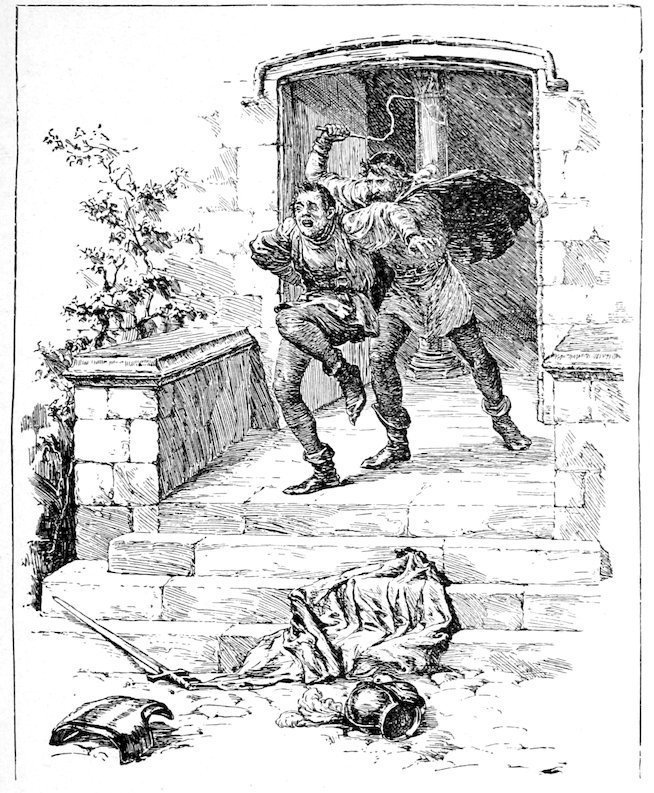
“And out of court him scourged openly; So ought all faytours that true knighthood shame, And armes dishonour with base villanie, From all brave knights be banisht with defame.”
The instant the horse understood his voice he stood stock-still, and allowed every one to see the secret mark; and when his master called him by name he broke all 305his fastenings with joy, and gleefully followed him, frisking, and prancing, and bending his head in submission. Thereupon Sir Artegall plainly saw to whom he belonged, and said—
“Lo, there, Sir Guyon, take to yourself the steed, arrayed as he is in his golden saddle, and let that worthless fellow fare hence on foot, until he has gained a horse.”
But the vain braggart began to rate and revile Sir Artegall for giving such an unjust judgment against him. The Knight was so incensed at his insolence that he was tempted to punish him, and thrice he laid his hand on his sword to slay him. But Sir Guyon pacified Sir Artegall, saying it would only dishonour him to wreak his wrath on a churl like that. It would be punishment enough that every one saw his disgrace.
Then Talus seized the boaster, and dragging him out of the hall inflicted this punishment on him. First he shaved off his beard; then he took his shield, and turned it upside down, and blotted out the device; and then he broke his sword in two, and scattered all his armour. After that he openly scourged him out of the court.
So should all traitors who shame true chivalry be banished with infamy from among brave knights, for their evil doings often bring disgrace on just merit.
The Adventure of the Two Brothers and the Coffer
When the wedding festivities of Marinell and Florimell were over, Sir Artegall left the Castle of the Strand, to follow his first quest; and the only person 306who went with him to help him was his servant Talus, the Iron Man.
As he passed along the sea-shore he chanced to come where two comely squires were having an angry quarrel. They were brothers, but were just now stirred up by some matter of debate. Two good-looking damsels stood beside them, trying by every means to soothe their ire—now by fair words, but words did little good—now by threats, but threats only made them angrier. Before them stood a strong coffer, fast bound on every side with iron bands, but seeming to have received much injury either by being wrecked upon the shore, or by being carried far from foreign lands. It appeared as if it were for this coffer the squires were fighting; and though the ladies kept interfering to prevent their furious encounter, yet they were firmly resolved to try their rights by dint of sword. Thus they both stood ready to meet in cruel combat when Sir Artegall, happily arriving, stopped for awhile their greedy bickering till he had inquired the cause of their dispute. To whom the elder made this answer:—
“You must know, sir, we are two brothers, to whom our father, Milesio by name, equally bequeathed his land, two islands, which you see there before you, not far off in the sea. Of these the one appears but like a little mount, of small size, yet it was as great and wide, not many years ago, as that other island, which is now so much larger.
“But the course of time, which destroys everything, and this devouring sea, which spares nothing, have washed away the greater part of my land, and thrown 307it up to my brother’s share, so his is increased but mine is lessened. Before which time I loved, as it happened, the maid over there, called Philtera the Fair, with whom I should have received a goodly dower, and to whom I was to have been married.
“At that time my younger brother, Amidas, loved the other damsel—Lucy—to whom but little dower was allotted. Her virtue was the dowry that delighted—and what better dowry can a lady possess? But now when Philtera saw my lands decay, and my former livelihood fail, she left me, and went over to my brother, who, taking her from me, completely deserted his own love.
“Lucy, seeing herself forsaken, in despair flung herself into the sea, thinking to take away her grief by death. But see how her purpose was foiled! Whilst beaten to and fro amidst the billows, hovering between life and death, she chanced unawares to light upon this coffer, which offered to her, in her danger, hope of life.
“The wretched maiden, who had formerly desired death, now that she had had a taste of it began to repent that she had been so foolish, and caught hold of the sea-beaten chest, which after long tossing in the rough waves, at last rested on my island. Here I, wandering by chance on the shore, espied her, and with some difficulty helped to save her from the jaws of death, which threatened to swallow her up. In recompense for this she then bestowed on me those goods which fortune had given her, together with herself, a free gift—both goodly portions, but herself the better of the two.
308
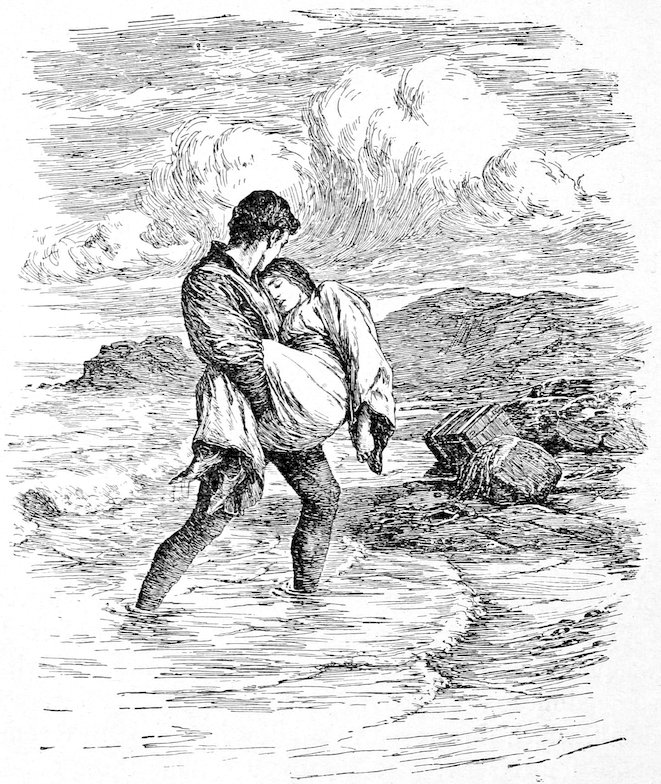
“In this coffer which she brought with her we found great treasure, which we took as our own, and so considered it. But this other damsel, Philtera, my brother’s wife, pretends now that the treasure belongs to herself, that she transported the same by sea, to bring it to her newly made husband, but suffered shipwreck by the way. Whether it be so or not 309I cannot say. But whether it indeed be so or not, this I do say, that whatsoever good or ill Providence or fortune throws to me, not purposely wronging any one else, I hold as my own, and will so hold it still. And though Amidas first won away my land, and then my love (though now that matters little), yet he shall not also make prey of my good luck, but I will defend it as long as ever I can.”
Bracidas, the elder brother, having thus spoken, the younger one followed on.
“It is quite true what my brother here has declared to you about the land; but the dispute between us is not for that, but for this treasure, thrown upon his shore, which I can prove, as shall appear by trial, to belong to this lady, to whom I am married. It is well known by good marks and perfect witnesses, and therefore it ought to be rendered to her without denial.”
When they had thus ended, the Knight spoke:—
“Truly it would be easy to reconcile your strife, if you would submit it to some just man.”
“Unto yourself!” they both cried. “We give you our word to abide the judgment you pronounce to us.”
“Then in token that you will accept my verdict, let each lay down his sword under my foot,” said Sir Artegall, “and then you shall hear my sentence.”
So each of them laid down his sword out of his hand.
Then Artegall spoke thus to the younger brother:—
“Now tell me, Amidas, if you can, by what good right do you withhold to-day that part of your brother’s land which the sea has plucked away from him, and laid on your share?”
310“What other right,” quoth Amidas, “would you deem valid, except that the sea laid it to my share?”
“Your right is good,” said Sir Artegall, “and so I judge it. That which the sea sent unto you should be your own.”
Then, turning to the elder brother, he spoke thus:—
“Now, Bracidas, let this likewise be plain: your brother’s treasure, which has strayed from him, being well known to be the dowry of his wife—by what right do you claim this to be your own?”
“What other right,” quoth Bracidas, “would you deem valid, except that the sea has thrown it unto me?”
“Your right is good,” said Sir Artegall, “and so I judge it. That which the sea sent unto you should be your own; for equal things have equal rights. What the mighty sea has once possessed and quite plucked from its owner’s hands—whether by the rage of the unresting waves, or tempest, or shipwreck—it may dispose of by its imperial might to whomever it chooses, as a thing left at random. So in the first place, Amidas, the land was declared to be yours; and so, in like manner, Bracidas, the treasure is yours by right.”
When Sir Artegall had thus pronounced sentence, both Amidas and Philtera were displeased, but Bracidas and Lucy were very glad, and immediately took possession of the treasure, in accordance with the judgment.
So their discord was appeased by this sentence, and each one had his right; and Sir Artegall, having stopped their contention, went on his way.
311
Radigund, Queen of the Amazons
As Sir Artegall travelled on his way he saw far off a crowd of many people, to whom he hastened, in order to discover the cause of such a large assembly. When he came near he saw a strange sight—a troop of women clad in warlike fashion, with weapons in their hands, as if ready to fight; and in the midst of them he saw a Knight, with both hands pinioned behind him, and round about his neck a halter tight, ready prepared for the gallows. His head was bare and his face covered, so that it was not easy to distinguish him. He went along with a heavy heart, grieved to the soul, and groaning inwardly that he should die so base a death at the hands of women. But they, like merciless tyrants, rejoiced at his misery, and reviled him, and sorely reproached him with bitter taunts and terms of disgrace.
When Artegall, arriving at the place, asked what cause had brought the man to destruction, the women swarmed eagerly around him, meaning to lay their cruel hands on him, and to do him some unexpected mischief. But he was soon aware of their evil mind, and drawing back defeated their intention. He was ashamed to disgrace himself by fighting with women, so he sent Talus to punish them for their rash folly. With a few strokes of his iron flail the latter speedily dispersed their troop, and sent them home to tell a piteous tale of their vain prowess turned to their own injury.
The wretched man doomed to death they left behind them, glad to be quit of them. Talus soon 312set him at liberty, and released him from his horror at such a shameful death, unfitting a knight, which he dreaded more than loss of life; and uncovering his face, he brought him to his master, who then knew him at once.
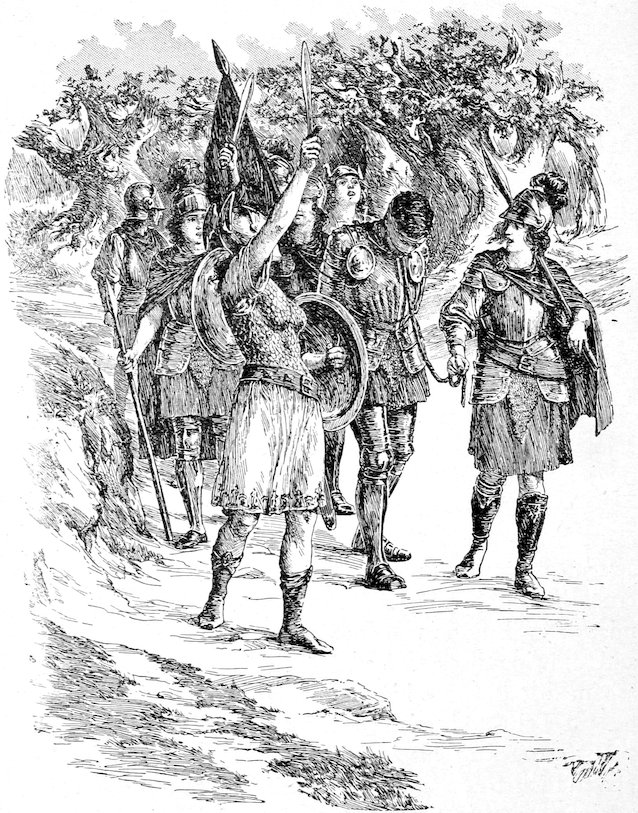
313“Sir Terpin!” cried Artegall. “Hapless man, what are you doing here? Have you lost yourself and your senses? Or have you, who can boast of subduing men, yielded to the oppression of women? Or what other deadly misfortune has fallen on you, that you have run so foolishly far astray as to lead yourself to your own destruction?”
The man was so confused, partly with shame, partly with dismay, that he stood lost in astonishment, and could find little to say in excuse.
“You may justly term me hapless, who am brought to this shame, and am to-day made the scorn of knighthood,” was his only answer. “But who can escape Fate? The work of Heaven’s will surpasses human thought.”
“True,” said Sir Artegall, “but faulty men often attribute their own folly to Fate, and lay on Heaven the guilt of their own crimes. But tell me, Sir Terpin—and do not let your misery daunt you—how you fell into this state.”
“Since you needs will know my shame,” said the Knight, “and all the ill which has lately chanced to me, I will briefly relate it, and do not turn my misfortune to my blame.
“Being desirous, as all knights are, to try deeds of arms through hard adventures, and to hunt after fame and honour, I heard a report which flew far abroad that a proud Amazon lately bade defiance to all brave knights, and wrought them all the villainy her malice 314could devise, putting some to shame, and doing many of them to death.
“The cause of her hate is for the sake of a Knight called Bellodant the Bold, whom a short time ago she liked greatly, and tried in every way to attract; but finding nothing of any avail, her love turned to hatred, and for his sake she vowed to do all the ill she could to other knights,—which vow she now fulfils.
“For all those knights whom by force or guile she subdues she treats shamefully. First she despoils them of their armour, and clothes them in women’s garments; then with threats she compels them to work to earn their food—to spin, to card, to sew, to wash, to wring. She gives them nothing to eat but bread and water, or some such feeble food, to disable them from attempting revenge.
“But if with manly disdain any of them withstand her insolent commands, she causes them to be immediately hanged on that gibbet over there, in which condition I stood just now; for being conquered by her in fight, and put to the base service of her band, I chose rather to die than to live that shameful life, unworthy of a knight.”
“What is the name of that Amazon?” asked Artegall. “And where, and how far hence does she live?”
“Her name is called Radigund,” replied Sir Terpin, “a princess of great power, and greater pride, Queen of the Amazons, well tried in arms and sundry battles, which she has achieved with great success, and which have won her much glory and fame.”
315“Now, by my faith,” said Sir Artegall, “I will not rest till I have tested her power, and avenged the shame that she shows to knights. Therefore, Sir Terpin, throw from you those squalid clothes, the pattern of despair, and go with me, that you may see and know how Fortune will repair your ruined name and knighthood, whose praise she would tarnish.”
Sir Terpin joyfully threw off his iron fetters, and eagerly prepared to guide the way to the dwelling of the Amazon, which was not more than a mile or two distant—a goodly and a mighty city, called after her own name Radigund.
On their arrival they were immediately espied by the watchman, who warned all the city of the appearance of three warlike persons, of whom one seemed like a Knight fully armed, and the other two likely to prove dangerous. The people ran at once to put on their armour, swarming in a cluster like bees, and before long their Queen herself, looking half like a man, came forth into the crowd, and began to set them in array.
And now the Knights, being arrived near, beat upon the gates to enter in; threatening the porter, who scorned them for being so few, to tear him to pieces if they won the city. When Radigund heard them her heart was torn with rage. She bade her people to unbar the gates at once, and to make way for the Knights with well-prepared weapons.
As soon as the gates were set open the Knights pressed forward to make an entrance, but midway they were met by a sharp shower of arrows, which stopped them. Then all the mob attacked them savagely 316heaping strokes so fast on every side, and with such a hail of arrows, that the Knights could not withstand them. But Radigund herself, when she espied Sir Terpin freed from her cruel doom, was suddenly seized with a fit of fury, and flying at him like a lioness, smote him so fiercely that he fell to the ground. Then she leaped to him, and placed her foot on his neck.
When Sir Artegall saw the Knight’s peril, he sprang at once to his rescue, and assailed Radigund with such vigour that he drove her back. For a moment she was stunned, but as soon as she collected her senses she turned on Sir Artegall, half-mad with revengeful anger and pride, for she had never suffered such a rebuff. But before they could meet in fight her maidens flocked round her so fast that they parted them, in spite of their valour, and kept them far asunder. But amongst the others the fight lasted till the evening.
And all the while the great Iron Man sorely vexed the Amazons with his strange weapon, to which they had never been accustomed in war. He chased and outran them, and broke their bows, and spoilt their shooting, so that not one of them all dared to go near him. They scattered like sheep before a wolf, and fled before him through all the fields and valleys.
But when the daylight grew dim with the shadows of night, Radigund, with the sound of a trumpet, caused her people to cease fighting, and gathering them to the gate of the city, made them all enter, and had the weak and wounded conveyed in, before she would retreat herself.
317When the field was thus empty and all things quiet, Sir Artegall, weary with toil and travel, caused his pavilion to be richly prepared in full view of the city gate. He himself, together with Sir Terpin, rested here in safety all that night; but Talus was accustomed, in times of jeopardy, to keep a nightly watch for fear of treachery.
Radigund, full of heart-gnawing grief for the rebuke she had met that day, could take no rest nor relief, but tossed about in her mind in what way she could revenge her disgrace. Then she resolved to try her fortune in single fight herself, rather than see her people destroyed, as she had seen that day.
She called to her a trusty maid, named Clarinda, whom she thought fittest for the business, and said to her—
“Go, damsel, quickly; get ready to do the message which I shall tell you. Go you to the stranger Knight who yesterday drove us to such distress; tell him that to-morrow I will fight with him, and try in a fair field which is the mightier.
“But these conditions you must propound to him—that if I vanquish him he shall obey my law, and ever be bound to do my bidding. And so will I, if he vanquish me, whatever he shall like to do or say. Go straight, and take with you as witness six of your companions of the highest rank; and carry with you wine and rich delicacies, and bid him eat: henceforth he shall often sit hungry.”
The damsel instantly obeyed, and putting all in readiness went forth to the town gate, where, sounding a trumpet loudly from the wall, she sent warning to the warrior Knights. Then Talus, issuing from the tent, 318took his way fearlessly to the wall, to know what that sounding of the trumpet meant, whereupon the damsel called to him, and explained that she wished to parley with his lord.
Then he conducted them at once to his master, who gave them a cordial greeting, and to whom they told their message, word for word. Sir Artegall, gladly accepting it, entertained them with fitting courtesy, and gave them rich and handsome gifts. So they turned their steps homeward again, but Artegall went back to rest, that he might be fresher against the next day’s fight.
How Sir Artegall threw away his Sword
As soon as day dawned, the noble warriors, mindful of the fight before them, duly prepared themselves, the Knight as beseemed a knight, and the Amazon in the way she liked best to dress.
She wore a light loose robe of purple silk, woven with silver, quilted upon white satin, and plentifully trimmed with ribbons; not to hinder her movements it was tucked up to her knee, but could when she liked be lowered to her heel. Over that she wore for defence a small coat of mail. On her legs were painted buskins, laced with bands of gold; her scimitar was lashed at her thigh in an embroidered belt; and on her shoulder hung her shield, decked with glittering stones, so that it shone like the full moon.
Thus she came forth, stately and magnificent, from the city gate, guarded with many damsels who waited 319on her to defend her, playing on shalms and trumpets, the sound of which reached high into heaven; and so she marched into the field, where there was a rich pavilion ready prepared to receive her, until it was time to begin the fight.
Then forth from his tent came Artegall, armed from head to foot, and first entered the lists. Radigund soon followed, cruel of mind, and with a fierce countenance, fully bent on daring the utmost trial of battle. The lists were shut fast, to prevent the mob from rudely pressing to the centre, and they circled round in huge crowds to see how fortune would decide the dangerous problem.
The trumpets sounded, and the fight began—bitterly it began and ended. The Amazon flew at Sir Artegall frantic with fury, but the more she raged the more resolute he stood. She hewed, she thrust, she lashed, she laid on every side. At first the Knight bore her blows, and forbore to return them; but presently in his turn he began to attack, and so mightily did his strokes fall on her steel armour, that flakes of flame were seen flashing all round her as if she had been on fire. But Radigund with her shield so well warded off the danger of his keen weapon that she safely guarded her life, until at last, with one stroke of his blade, Sir Artegall cut away half her shield.
This so enraged Radigund that she flew at Artegall with her sharp scimitar, like a bear on her prey, and wounded him badly in the thigh. Thereupon she began to boast of her triumph, and taunt the Knight with spiteful speeches, as if she had already got the prize.
320Indignant at her idle vaunting, Sir Artegall struck at her again with such power that he shattered the other half of her shield, and then he smote on her helmet so that she sank senseless on the grassy field.
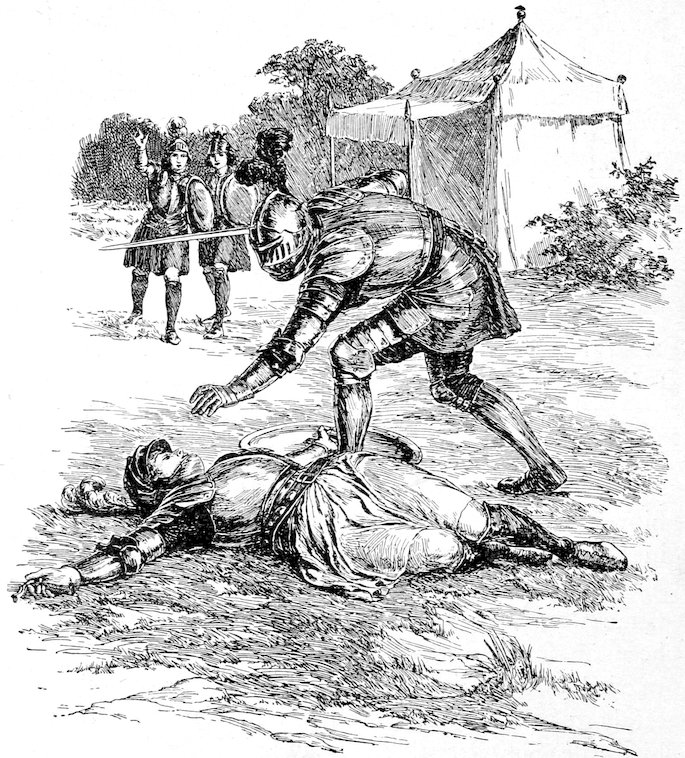
When he saw her lying on the ground, he sprang towards her, and unlaced her helmet, thinking to cut 321off her head; but when he had uncovered her face such a miracle of loveliness shone forth that he was dazzled with astonishment. His heart was so pierced with pity that he threw away his sharp sword, reviling his hand that had done injury to such a vision of beauty.
Radigund meanwhile awakened from her swoon, and stared about her in confusion. As soon as she saw the Knight standing there beside her with no weapon in his empty hands, she flew at him with fresh cruelty, and though he kept retiring she laid on him huge redoubled strokes. The more he meekly entreated her to stay her hand from greedy vengeance, the more she increased her merciless attack.
Sir Artegall could do nothing but shun her angry onslaught, and ward off with his shield alone, as well as he could, the fierceness of her rage. He begged her to stay her strokes, and said that he would yield himself; yet she would not hearken, nor give him time to breathe, till he had delivered to her his shield, and submitted himself to her mercy in the open field.
Thus was Sir Artegall overcome—though indeed he was not overcome, but yielded of his own accord. Yet was he justly doomed by his own judgment when he had said unwarily that he would be her thrall and do her service. For though he first gained the victory, yet afterwards, by abandoning his sword, he wilfully lost that which before he had attained.
Then Radigund struck him with the flat of her sword, in token of true subjection to her power, and as a vassal took him to thraldom. But the more hapless Terpin she caused to be pinioned and led away 322to the cruel fate from which he had but lately been rescued.
But when the Amazons thought to lay hands on Talus, he thundered amongst them with his iron flail, so that they were glad to let him escape, for the heaps of those he slew and wounded, besides the rest which he dismayed, were too many to number. But all this while he did not once attempt to rescue his own lord, for he thought it just to obey.
Then Radigund took this noble Knight, left at her disposal by his own wilful blame, and caused him to be disarmed of all the knightly ornaments with which he had formerly won great fame. In place of these she had him shamefully dressed in woman’s clothes, and put on him a white apron instead of a cuirass.
Thus clad, she brought him from the battlefield into a long, large chamber, decked with memorials of the ruin of many knights whom she had subdued; amongst these she caused his armour to be hung on high, to betray his shame, and she broke his sword for fear of further harm.
Entering, he saw round about him many brave knights whose names he knew well, who were there bound to obey the Amazon’s arrogant law, all spinning and carding in an orderly row, so that Sir Artegall’s brave heart loathed the unseemly sight. But the captive knights were forced through hunger and want of food to do the work appointed them, for nothing was given them to eat or drink, but what their hands could earn by twisting linen twine.
323Radigund placed Sir Artegall the lowest among them all, and gave a distaff into his hand, that he should spin thereon flax and tow—a sordid office for so brave a mind; thus hard is it to be the slave of a woman!
Yet Sir Artegall took it even in his own despite, and obeyed her without murmuring, since he had plighted his faith to become her vassal if she won him in fight.
The House of Guile
Thus for a long while Sir Artegall continued obediently serving proud Radigund, however much it galled his noble heart to obey the dictates of a tyrannous woman. Having chosen his lot, he could not now change.
As the days went by, the Amazon Queen began to have a great liking for her strange captive, but for a long time she kept this carefully concealed, for her pride would not allow her to own to such a feeling for her lowly vassal. At last, when she could bear it no longer, she sent for her trusted maid, Clarinda, and told her to devise some means by which to discover whether there were any chance of Sir Artegall’s loving her, if she gave him his liberty. Clarinda promised to do her best, and tried by all the means in her power to win favour with the Knight, but the more she saw of him the better she liked him herself, so she ended by being false both to her mistress and to Sir Artegall. To the Queen she pretended that Sir 324Artegall was very stern and obstinate, and scorned all her offers of kindness and gentler treatment; and to the Knight she declared that she had earnestly besought Radigund to grant him freedom, but the Queen would by no means be persuaded, and had ordered instead that he should be more harshly treated and laden with iron chains. This command, however, Clarinda said she would not carry out, because of her own regard for the Knight, and she further promised that if she found favour in his sight she would devise some means of setting him free.
Sir Artegall, glad to gain his liberty, answered her civilly, but determined in his heart that nothing should make him forsake his own true love, Britomart; and deceitful Clarinda had not the least intention of freeing him from bondage, but considered rather how she might keep him more securely. Therefore every day she unkindly told her mistress that the Knight spurned her offers of goodwill, and Sir Artegall she told that the Queen refused him his freedom. Yet in order to win his affection, she showed him this much friendship, that his scanty fare was improved, and his work lessened.
Thus for a long while Sir Artegall remained there in thraldom.
Britomart, meanwhile, waited and longed for news of her absent lord, and when the utmost date assigned for his return had passed, a thousand fears assailed her doubting mind. Sometimes she feared lest a terrible misfortune had befallen him; sometimes lest his false foe had entrapped him in a snare; at other times a 325jealous fear troubled her that perhaps Sir Artegall had forgotten her, and found some other lady whom he loved better. Yet she was loath to think so ill of him as this. One moment she blamed herself; another, condemned him as faithless and untrue; then, trying to cheat her grief, she pretended she had reckoned the time wrong, and began to count it all over a different way.
When months went on, and still he never came back, she thought of sending some one to seek him, but could find no one so fitting to do this as her own self.
One day, unable to rest quietly in any place, she came to a window opening to the west, which was the way Sir Artegall had gone. There, looking forth, she felt many vain fancies disquiet her, and sent her winged thoughts swifter than wind to carry her heart’s message to her love. As she looked long, she spied some one coming hastily towards her. Then she knew well before she saw him plainly, that it was some one sent from Sir Artegall; and as he drew near, she found it was his servant, Talus. Filled with hope and dread she ran to meet him, exclaiming—
“And where is he, thy lord, and how far hence? Tell me at once. And has he lost or won?”
Then Talus told the whole story of Sir Artegall’s captivity.
Britomart listened bravely to the end, and then a sudden fit of wrath and grief seized her. Without waiting to make any answer, she got ready at once, donned her armour, and mounting her steed, bade Talus guide her on.
So she rode forth to seek her Knight; sadly she 326rode, speaking no word good or bad, and looking neither to the right or left. Her heart burned with rage to punish the pride of that woman who had pent her lord in a base prison, and had tarnished his great honour with such infamous disgrace.
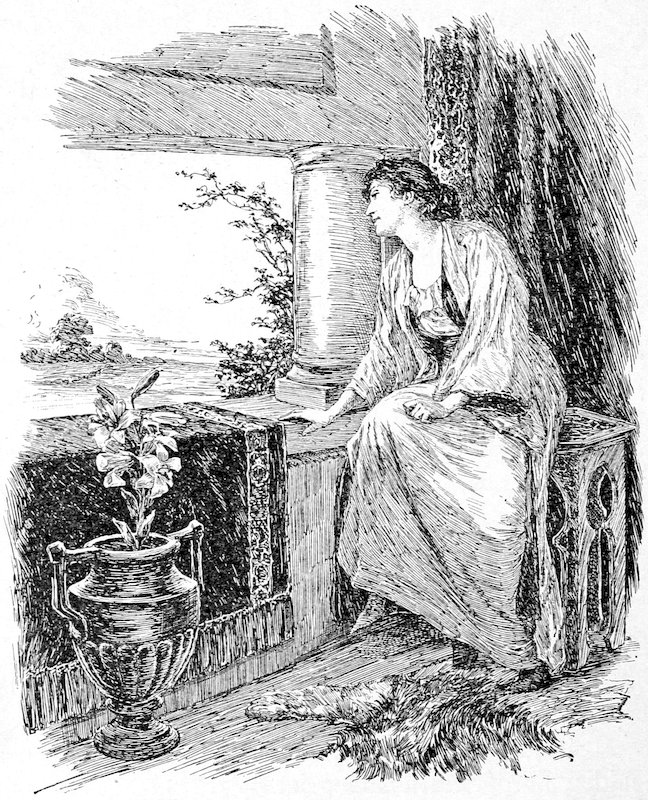
327Thus riding, she chanced to meet towards evening a knight strolling on the plain as if to refresh himself. He seemed well on in years, and inclined rather to peace than to needless trouble, his raiment and his modest bearing both showing that he meant no evil. Coming near, he began to salute Britomart in the most courteous fashion. Though the Princess would rather have remained mute than joined in commonplace conversation, yet sooner than despise such kindness she set her own wishes aside, and so returned his greeting in due form. Then the other began to chat further about things in general, and asked many questions, to which she gave careless answer. For she had little desire to talk about anything, or to hear about anything, however delightful; her mind was wholly possessed by one thought, and there was no place for any other.
When the stranger observed this, he no longer forced her to talk unwillingly, but begged her to favour him, since the skies were growing dark and wet, by lodging with him that night, unless good cause forbade it. Britomart, seeing night was at hand, was glad to yield to his kind request, and went with him without any objection.
His dwelling was not far away, and soon arriving, they were received in the most gracious and befitting manner, for their host gave them excellent good cheer, and talked of pleasant things to entertain them. Thus the evening passed well, till the time came for rest. Then Britomart was brought to her bower, where attendants waited to help her to undress. But she would not for anything take off her armour, although her host warmly besought her; for she had vowed, she said, not 328to lay aside this warrior garb till she had wrought revenge on a mortal foe for a recent wrong; which she would surely perform, let weal or woe betide her.
When their host perceived this, he grew very discontented, for he was afraid lest he should now miss his purpose; but taking leave of her, he departed.
Britomart remained all night restless and comfortless, with deeply grieved heart, not allowing the least twinkle of sleep to refresh her. In sorrowful thoughts she wore away the weary hours, now walking softly about, now sitting still, upright. Neither did Talus let sleep close his eyelids, but kept continual guard, lying in much discomfort outside her door, like a spaniel, watching carefully lest any one should by treachery betray his lady.
Just at cock-crow Britomart heard a strange noise in the hall below, and suddenly the bed, on which she might have been lying, by a false trap was let to fall down into a lower room; then immediately the floor was raised again, so that no one could spy the trap.
At the sight of this, Britomart was sorely dismayed, plainly perceiving the treason which was intended; yet she did not stir, in case of more, but courageously kept her place, waiting what would follow.
It was not long before she heard the sound of armed men coming towards her chamber, at which dreadful peril she quickly caught her sword, and bound her shield about her. As she did so, there came to her door two knights, all armed ready to fight, and after them a rascally mob, rudely equipped with weapons.
As soon as Talus spied them he started up from 329where he lay on the ground, and caught his thresher ready in his hand. They immediately let drive at him, and pressed round in riotous array, but as soon as he began to lay about with his iron flail, they turned and fled, both the armed knights and the unarmed crowd. Talus pursued them wherever he could spy them in the dark, then returning to Britomart, told her the story of the fray, and all the treason that was intended.
Though greatly enraged, and inwardly burning to be avenged for such an infamous deed, Britomart was compelled to wait for daylight. She therefore remained in her chamber, but kept wary heed, in case of any further treachery.
The cause of this evil behaviour was unknown to Britomart, but this is how it was.
The master of the house was called Dolon (Guile), a subtle and wicked man; in his youth he had been a knight, and borne arms, but gained little good and less honour by that warlike kind of life; for he was not in the least valorous, but with sly shifts and wiles got the better of all noble and daring knights, and brought many to shame by treachery.
He had three sons, all three like their father treacherous, and full of fraud and guile. The eldest, named Guizor, had, through his own guilty cunning, been slain by Artegall, and to avenge him, Dolon, with his other two sons, had lately devised many vile plots. He imagined by several tokens that his present guest was Artegall, but chiefly on account of the Iron Man who was always accustomed to remain with Artegall. Dolon, therefore, meant surely to have slain the Knight, but by 330the grace of heaven and her own good heed, Britomart was preserved from the traitor.
The next morning, as soon as it was dawn, she came forth from the hateful chamber, fully intending to punish the villain and all his family. But coming down to seek them where they dwelt, she could not see father, nor sons, nor any one. She sought in each room, but found them all empty; every one had fled in fear, but whither neither she nor Talus knew.
She saw it was in vain to stay there longer, so took her steed, and lightly mounting, started again on her former way. She had not ridden the distance of an arrow’s flight before she saw in front of her the two false brethren on the perilous Bridge, where Sir Artegall had fought with the Saracen. The passage was narrow, like a ploughed ridge, so that if two met, one must needs fall over the edge.
There they thought to wreak their wrath on her, and began to reproach her bitterly, accusing her of murdering Guizor by cunning. Britomart did not know what they meant, but she went forward without pausing till she came to the perilous Bridge. There Talus wanted to prepare the way for her, and scare off the two villains, but her eyes sparkled with anger at the suggestion. Not staying to consider which way to take, she put spurs to her fiery steed, and making her way between them, she drove one brother at the point of her spear to the end of the Bridge, and hurled the other brother over the side of it into the river.
Thus the Warrior Princess slew the two wicked sons of Goodman Guile.
331
The Battle of Queen Radigund and Britomart
That night Britomart spent in the great Temple of Isis, which was dedicated in days of old to the worship of Justice. Here in her sleep she had a wondrous vision, which at first filled her with dread. But when she described it next morning to the priests in the Temple, they told her that her dream had a good meaning, and that everything would end well. Greatly relieved to hear this, she bestowed rich rewards on the priests, and made royal gifts of gold and silver to the Temple. Then taking leave of them, she went forward to seek her love, never resting and never relenting till she came to the land of the Amazons.
When news of her approach was brought to Radigund she was filled with courage and glee instead of being dismayed. Glad to hear of fighting, of which she had now had none for a long time, she bade them open the gates boldly, so that she might see the face of her new foe; but when they told her of the Iron Man who had lately slain her people, she bade them hold them shut.
So there outside the gate, as seemed best, her pavilion was pitched, in which brave Britomart rested herself, while Talus watched at her door all night. All night, likewise, those of the town, in terror, kept good watch and ward upon their wall.
The next morning, as soon as it was dawn, the warlike Amazon peeped out of her bower, and caused a shrill trumpet to sound to warn her foe to hasten to the battle. Britomart, who had long been awake 332and arrayed for contest, immediately stepped haughtily from the pavilion, ready for the fight, and on the other side her foe soon appeared.
But before they lifted hand, Radigund began to propound the strict conditions with which she always fettered her foes—that Britomart should serve her as she had bound the rest to do. At this, Britomart frowned sternly, in disdain of such indignity, and would no longer parley, but bade them sound the advance, for she would be tied by no other terms than those prescribed by the laws of chivalry.
The trumpets sounded, and they rushed together with greedy rage, smiting with their falchions; neither sought to shun the other’s stroke, but both savagely hacked and hewed, furious as a tiger and a lioness fighting over the same prey. So long they fought that all the grassy floor was trampled with blood. At last Radigund, having espied some near advantage, let drive at Britomart with all her might, thus taunting her with savage scorn—
“Bear this token to the man whom you love so dearly, and tell him you gave your life for his sake!”
The cruel stroke glanced on Britomart’s shoulder plate, and bit to the bone, so that she could hardly hold up her shield for the smart of it. Yet she soon avenged it, for the furious pain gave her fresh force, and she smote Radigund so rudely on the helmet that it pierced to the very brain, and felled her to the ground, where with one stroke Britomart killed her.
333
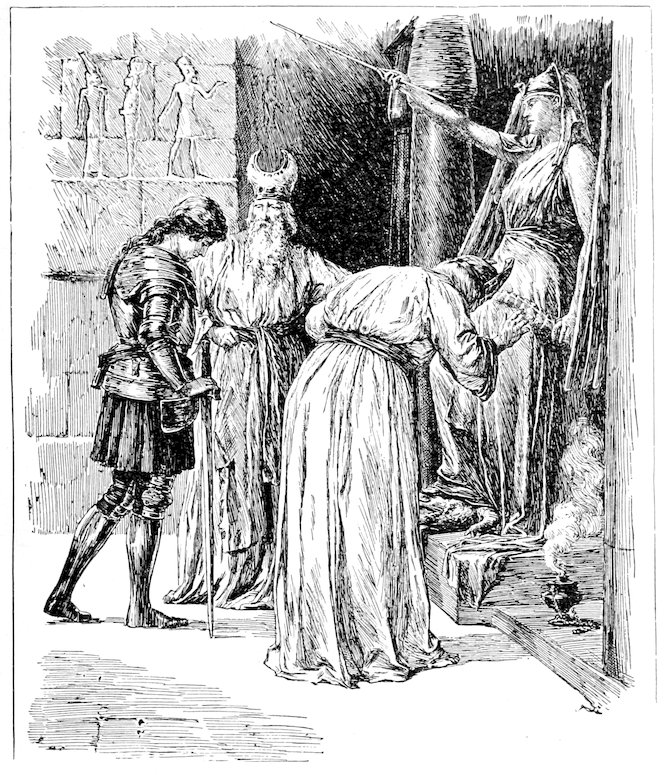
“Thence forth unto the Idole they her brought; * * * * * To which the Idole, as it were inclining, Her wand did move with amiable looke, By outward shew her inward sense designing.”
When Radigund’s warrior band saw this dreadful sight they all fled into the town, and left Britomart 335sole victor. But they could not retreat so fast but that Talus could overtake the foremost. Pressing through the mob to the gate, he entered in with them, and then began a piteous slaughter; for all who came within reach of his iron flail were soon beyond the skill of any doctor.
Then the noble Conqueror herself came in, and though she had sworn a vow of revenge, yet when she saw the heaps of dead bodies slain by Talus, her heart was torn with pity, and she bade him slack his fury. Having thus stayed the massacre, she inquired for the iron prison where her love lay captive. Breaking it open with indignant rage, she entered, and went all over it; when she saw the strange and horrible sight of the men dressed up in womanish garb, her heart groaned with compassion for such unmanly and disgraceful misery.
When at last she came to her own Knight, whom the like disguise had no less disfigured, abashed with shame she turned aside her head, and then with pity and tender words she tried to comfort him. She caused the unsightly garments to be immediately taken off, and in their stead sought for other raiment, of which there was great store, as well as bright armour reft from many a noble knight whom the proud Amazon had subdued. When Sir Artegall was clad anew in this apparel Britomart’s spirits revived, and she rejoiced in his gallant appearance.
They remained for awhile in the city of Queen Radigund, so that Sir Artegall might recover his strength, and Britomart be healed of her wounds. During this time Britomart reigned as a Princess, and 336changed all the order of government. The women were deposed from the rule which they had usurped, and true justice was dealt them, so that, worshipping Britomart as a goddess, they all admired her wisdom and listened to her teaching. All those knights who had long been hidden in captivity, she freed from their thraldom, and made magistrates of the city, giving them great wealth and authority. And in order that they should always remain faithful, she made them swear fealty to Artegall.
As the latter Knight was now fully recovered, he proposed to proceed upon the first adventure which had called him forth, the release of the Lady Irene from the villain Grantorto. Very sad and sorrowful was Britomart at his departure, yet wisely moderated her own grief, seeing that his honour, which she put above all things, was much concerned in carrying out that adventure. For a little while after he had gone she remained there in the city, but finding her misery increase with his absence, and hoping that change of air and place would somewhat ease her sorrow, she too departed, to appease her anguish in travel.
The Adventure of the Damsel, the Two Knights, and the Sultan’s Horses
As Sir Artegall rode forth on his way, accompanied only by Talus, he saw far off a damsel on a palfrey flying fast in terror before two knights, who pursued her. These in turn were themselves pursued by another 337knight, who pricked after them with all his might, his spear ready levelled. At length the latter overtook the hindmost of the two knights, and compelled him to turn and face him; but the other still pursued the maid, who flew as fast in front of him, and never stopped till she saw Sir Artegall. To him she ran at once, in glad haste, hoping to get help against her enemy; and Artegall, seeing her approach, went forward to relieve her fear, and to prevent her foe from hurting her.
But the pursuing knight, greedy as a hound after his prey, still continued his course, thinking to overthrow Sir Artegall with his spear. Thus alike sternly resolved they met fiercely. But Artegall was the stronger, and better skilled in tilt and tournament, and he hurled the other out of his saddle quite two spears’ lengths. The Pagan knight, unluckily for himself, pitched on his head, broke his neck, and was killed on the spot.
Meanwhile the third Knight had defeated and slain the second of the villains, and leaving him there dead, he ran on to overtake his companion. Instead of him he found Sir Artegall, and not knowing he was also on the side of the damsel, he ran at him without thinking; and the latter, seeing him approach so fiercely, made against him again. So they met, and struck strongly, and broke their spears; yet neither was dismounted, though they both shook to and fro, and tottered like two towers quaking in a tempest.
But when they had recovered their senses they drew their swords, meaning to make amends with them where their spears had failed. When the damsel, who had 338seen the end of both her foes, now beheld her friends beginning for her sake a more fearful fray, she ran to them in haste, crying to them to stay their cruel hands until they both heard what she had to say to them.
“Ah, gentle Knights,” she cried, “why do you thus unwisely wreak on yourselves another’s wrong? I am the injured one whom both of you have aided. Witness the two Pagan knights whom ye may see dead on the ground! What more revenge, therefore, do you desire? If more, then I am she who was the root of all. End your revenge on me.”
When they heard her speak thus, and saw that their foes were indeed dead, they immediately stayed their hands, and lifted up their visors to look at each other; and then Sir Artegall saw that his adversary was none other than Prince Arthur himself.
Filled with admiration for his gallant and noble bearing, and touched with the deepest affection, he drew near, and prayed pardon for having unknowingly wronged him, offering to yield himself to the Prince for ever, or to any penance he chose to inflict.
To whom the Prince replied—
“Truly, I need more to crave the same pardon, for having been so misled by error as to mistake you for the dead man. But since it pleases you that both our faults shall be forgotten, amends can soon be made, since neither is much damaged thereby.”
Thus their perfect friendship was easily restored, and they embraced lovingly, each swearing faithfully on his blade never thenceforth to nourish enmity against the other, but always mutually to maintain each other’s cause.
339Then they called the damsel, and asked her who were the two foes from whom she was flying so fast, and who she was herself, and what was the reason why she was pursued by them.
The maiden, whose name was Samient, replied that she was in the service of a great and mighty queen called Mercilla, a Princess of great power and majesty. She was known above all for her bounty and sovereign grace, with which she supported her royal crown, and strongly beat down the malice of her foes, who envied her, and fretted, and frowned at her happiness. In spite of them she grew greater and greater, and even to her foes her mercies increased.
Amongst the many who maligned her was a mighty man dwelling near, who, with cruel spite and hatred, did all in his power to undermine her crown and dignity. Her good knights, of whom she had as brave a band as any Princess on earth, he either destroyed, if they stood against him, or else tried to bribe slyly to take his part. And not content with this, he was always trying by treacherous plots to kill Queen Mercilla.
“He is provoked to all this tyranny, they say, by his bad wife, Adicia,” continued Samient, “who counsels him, because of his strength, to break all bonds of law and rule of right; for she professes herself a mortal foe to justice, and always fights against it, working deadly woe to all who love it, and making her knights and people do so likewise.
“My liege lady, seeing this, thought it best to deal with Adicia in a friendly fashion, in order to put an end to strife, and to establish rest both for herself and 340her people. She therefore sent me on a message to treat with her, by way of negotiation, as to some final peace and fair arrangement, which might be concluded by mutual consent.
“At all times it is customary to afford safe passage to messengers who come on a just cause, but this proud dame, disdaining all such rules, not only burst into bitter words, reviling and railing at me as she chose, but actually thrust me like a dog out of doors, miscalling me by many a bitter name, who never did any ill to her. Then lastly she sent those two knights after me to work me further mischief, but thanks to Heaven and your valour, they have paid the price of their own folly.”
So said the damsel, and showed herself most grateful to Prince Arthur and Sir Artegall for their aid.
The Knights, having heard of all the wrongs done by the proud dame Adicia, were very indignant, and eagerly desired to punish her and her husband, the Sultan. But thinking to carry out their design more easily by a counterfeit disguise, they arranged this plot: first, that Sir Artegall should array himself like one of the two dead knights, then that he should convey the damsel Samient as his prize to the Sultan’s court, to present her to the scornful lady, who had sent for her.
This was accordingly done.
Directly the Sultan’s wife saw them, as she lay looking out of the window, she thought it was the Pagan knight with her prey, and sent a page to direct him where to go. Taking them to the appointed place, the page offered his service to disarm the Knight, but Sir 341Artegall refused to take off his armour, fearing to be discovered.
Soon after, Prince Arthur arrived, and sent a bold defiance to the Sultan, requiring of him the damsel whom he held as a wrongful prisoner. The Sultan, filled with fury, swearing and cursing, commanded his armour to be brought at once, and mounted straight upon a high chariot, dreadfully armed with iron wheels and hooks, and drawn by cruel steeds, whom he fed with the flesh of slaughtered men.
Thus he came forth, clad in a coat of mail, all red with rust. The Prince waited ready for him in glistering armour, right goodly to see, that shone like the sun. By the stirrup Talus attended, playing his page’s part, as his master had directed.
So they went forth to battle, both alike fierce, but with different motives. For the proud and presumptuous Sultan, with insolent bearing, sought only slaughter and revenge; but the brave Prince fought for right and honour against lawless tyranny, on behalf of wronged weakness, trusting more to the truth of his cause than in his own strength.
The Sultan in his folly thought either to hew the Prince in pieces with his sharp wheels, or to bear him down under his fierce horses’ feet, and trample him in the dust. But the bold Knight, well spying that peril if he came too near the chariot, kept out of the way of the flying horses. Yet as he passed by, the Pagan threw a dart with such force that, had he not shunned it heedfully, it would have transfixed either himself or his horse. Often Prince Arthur came near, hoping to 342aim some stroke at him, but the Sultan was mounted so high in his chariot, and his wing-footed coursers bore him so fast away, that before the Prince could advance his spear, he was past and gone; yet still he followed him everywhere, and in turn was followed by him.
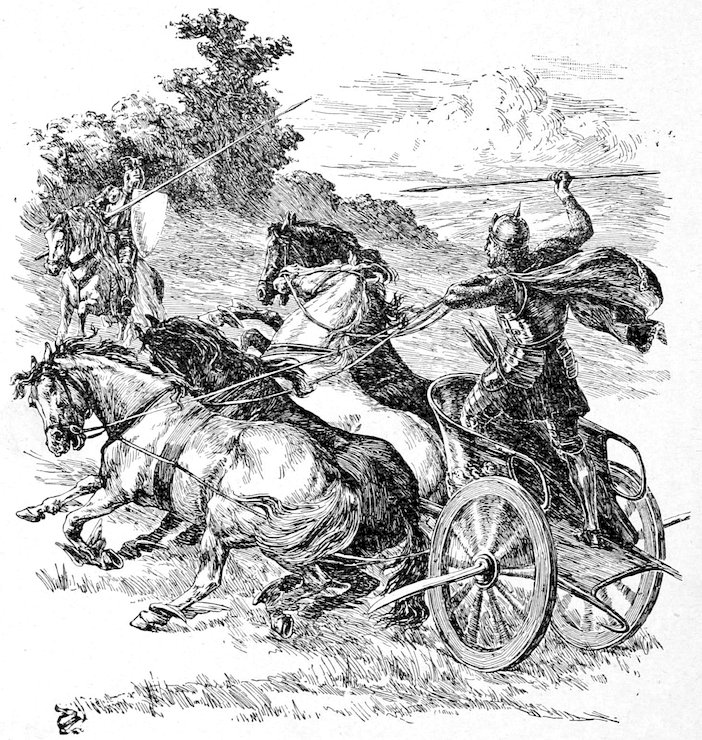
Again the Pagan threw another dart, which, guided by some bad spirit, glided through Prince Arthur’s cuirass, and made a grisly wound in his side. Furious as a raging 343lion, the Prince sought to get at his foe; but whenever he approached, the chariot wheels whirled round him, and made him fly back again as fast; and the Sultan’s horses, like hungry hounds hunting after game, so cruelly chased and pursued him that his own good steed, although renowned for courage and hardy race, dared not endure the sight of them, but fled from place to place.
Thus for a long while they rushed to and fro, seeking in every way to find some opening for attack; but the Prince could never get near enough for one sure stroke. Then at last from his victorious shield he drew the veil which hid its magic light, and coming full before the horses as they pressed upon him, flashed it in their eyes.
Like the lightning which burns the gazer, so did the sight of the shield dismay their senses, so that they turned back upon themselves and ran away with their driver. Nor could the Sultan stay their flight with reins or accustomed rule, as he well knew how; they did not fear him in the least—their only fear was that from which they fled dismayed, like terrified deer. Fast as their feet could bear them they flew over hill and dale. In vain the Pagan cursed and swore and railed, and dragged with both hands at the reins; he called and spoke to them, but nothing availed. They heard him not, they forgot his training, they went which way they chose, heedless of their guide. Through woods and rocks and mountains they drew the iron chariot, and the wheels tore the Sultan, and tossed him here and there from side to side, crying in vain to those who would not hear his crying.
344And all the while Prince Arthur pursued closely behind, but could find no means of smiting his foe.
At last the horses overthrew the chariot, which was turned topsy-turvy, and the iron hooks and sharp knives caught hold of the Sultan and tore him all to rags. Nothing was left of him but some bits of his battered and broken shield and armour. These Prince Arthur gathered up and took with him that they might remain as a token, whenever the tale was told, of how worthily that day, by Heaven’s decree, justice had avenged herself of wrong, so that all men might take warning by the example.
Therefore, on a tree in front of the tyrant’s door, he caused them to be hung in the sight of all men, to be a memorial for ever.
When the Lady Adicia from the castle height beheld them she was appalled, but instead of being overcome with fright, as another woman might have been, she immediately began to devise how to be revenged.
Knife in hand, she ran down, vowing to wreak her vengeance on the maiden messenger whom she had ordered to be kept prisoner by Sir Artegall, mistaking him for her own knight; and coming into her presence she ran at her with all her might. But Artegall, being aware thereof, stayed her cruel hand before it reached Samient, and caught the weapon from her. Thereupon, like one distracted, she rushed forth, wherever her rage bore her, frantic with passion. Breaking out at a postern door, she ran into the wild wood, where, it is said, on account of her malice and cruelty she was transformed into a tiger.
345
The Adventure at the Den of Deceit
After the defeat of the Sultan and the flight of his wicked wife, Prince Arthur and Sir Artegall wished to hand over the place and all its wealth to Samient to hold for her lady, while they departed on their quest; but the maiden begged them so earnestly to go with her to see Queen Mercilla that at last they consented.
On the way she told them of a strange thing near at hand—to wit, a wicked villain who dwelt in a rock not far off, and who robbed all the country round, and took the pillage home. In this his own wily wit, and also the security of his dwelling-place, both of which were unassailable, were of great assistance. For he was so crafty both to invent and execute, so light of hand and nimble of foot, so smooth of tongue and subtle in his tale, that any one looking at him might well be taken in. Therefore he was called Deceit.
He was well known for his achievements, and by his tricks had brought many to ruin. The rock, also, where he dwelt was wondrous strong, and hewn a dreadful depth far under ground; within it was full of winding and hidden passages, so that no one could find his way back who once went amiss.
The Knights, hearing this, longed to see the villain where he lurked, and bade Samient guide them to the place. As they came near, they agreed that the best plan would be for the damsel to go on in front, and sit alone near the den, wailing and raising a pitiful uproar. When the wretch issued forth, hoping to find some 346spoil, they, lying in wait, would closely ensnare him before he could retreat to his den, and thus they hoped to foil him easily.
Samient immediately did as she was directed, and the noise of her weeping speedily brought forth the villain, as they had intended.
He was as dreadful a creature as ever walked on earth, with hollow, deeply set eyes, and long shaggy locks straggling down his shoulders. He wore strange garments all in rags and tatters, and in his hand he held a huge long staff, the top of which was armed with many iron hooks, to catch hold of everything that came within reach of his clutches, and he kept casting looks around in all directions. At his back he bore a great wide net, with which he seldom fished in the water, but which he used to fish for silly folk on the dry shore, and in fair weather he caught many.
When Samient saw close beside her such an ugly creature she was really frightened, and now in earnest cried aloud for help. But when the villain saw her so afraid, he tried guilefully to persuade her to banish fear; smiling sardonically on her, he diverted her mind by talking pleasantly and showing her some amusing tricks, for he was an adept at jugglery and conjuring feats. Whilst her attention was engaged, he suddenly threw his net over her like a puff of wind, and snatching her up before she was well aware, ran with her to his cave. But when he came near and saw the armed Knights stopping his passage, he flung down his burden and fled fast away.
347
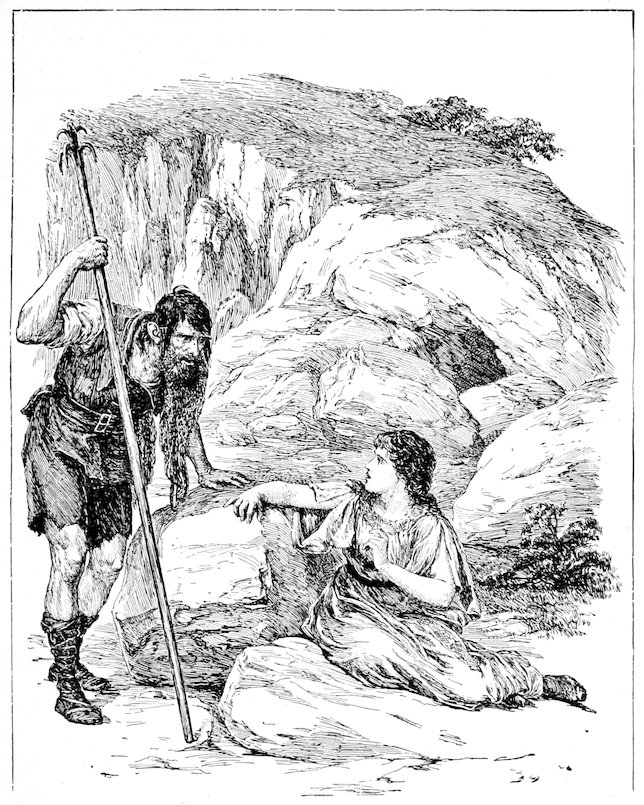
“The Damzell straight went, as she was directed, Unto the rocke; and there upon the soyle Gan weepe and wayle, as if great grief had her affected. The cry whereof entering the hollow cave Eftsoones brought forth the villaine, as they ment.”
Sir Artegall pursued him, while Prince Arthur still kept guard at the entrance of the den. Up to the rock 349ran Deceit, like a wild goat leaping from hill to hill, and dancing on the very edge of the craggy cliffs. It was useless for the armed Knight to think of following him, but he sent his Iron Man after him, for Talus was swift in chase.
Then wherever Deceit went Talus pursued him, so that he soon forced him to forsake the heights and descend to the low ground. Now Deceit tried a new plan: he suddenly changed his form. First he turned himself into a fox, but Talus still hunted him as a fox; then he transformed himself to a bush, but Talus beat the bush till at last it changed into a bird, and passed from him, flying from tree to tree, and from reed to reed; but Talus threw stones at the bird, so that presently it changed itself into a stone, and dropped to the ground; whereupon Talus took the stone up in his hand and brought it to the Knights, and gave it to Sir Artegall, warning him to hold it fast for fear of tricks. While the Knight seized it in a tight grip, the stone went unawares into a hedgehog, and pricked him, so that he threw it away; then it began to run off quickly, returning to Deceit’s own shape; but Talus soon overtook him and brought him back.
But when he would have changed himself into a serpent, Talus drove at him with his iron flail, and thrashed him so that he died. So that was the end of Deceit the self-deceiver.
Leaving his dead body where it fell, the two Knights went on with the maiden to see her Lady, as they had agreed. Presently they beheld a stately palace, mounted high with terraces and towers, and all the tops were glistering 350with gold, which seemed to outshine the sky, and with their brightness dazzled the eyes of strangers. There alighting, they were directed in by Samient, and shown all that was to be seen. The magnificent porch stood open wide to all men, day and night; yet it was well guarded by a man of great strength, like a giant, who sat there to keep out guile and malice and spite, which often under a feigned semblance works much mischief in Princes’ courts. His name was Awe.
Passing by him they went up the hall, which was a wide large room, filled with people, making a great din. In the thickest of the press the marshal of the hall, whose name was Order, came to them, and commanding peace, guided them through the throng. All ceased their clamour to gaze at the Knights, half terrified at their shining armour, which was a strange sight to them; for they never saw such array there, nor was the name of war ever spoken, but all was joyous peace, and quietness, and just government.
So by degrees they were guided into the presence of the Queen. She sat high up, on a throne of bright and shining gold, adorned with priceless gems. All over her was spread a canopy of state, glittering and gleaming like a cloud of gold and silver, upheld by the rainbow-coloured wings of little cherubs. Thus she sat in sovereign majesty, holding a sceptre in her royal hand, the sacred pledge of peace and clemency. At her feet lay her sword, the bright steel brand rusted from long rest, yet when foes forced it, or friends sought aid, she could draw it sternly to dismay the world. Round about her sat a bevy of fair maidens, clad in white, 351whilst underneath her feet lay a great huge lion, like a captive thrall, bound with a strong iron chain and collar.
Now at the instant when the two stranger Knights came into the presence of the Queen, she was holding, as it happened, a great and important trial. Having acknowledged their obeisance with royal courtesy, she gave orders to proceed with the trial; and wishing that the Knights should see and understand all that was going on, she bade them both mount up to her stately throne, and placed one on each side of her.
Then there was brought forward as prisoner a lady of great beauty and high position, but who had blotted all her honour and titles of nobility by her wicked behaviour. This was no other than the false Duessa, who had wrought so much mischief by her malice and cunning. Seeing the piteous plight in which she now stood, Prince Arthur’s tender heart was touched with compassion; but when he heard the long roll of her crimes read forth, he could no longer wish that she should escape punishment. Sir Artegall, for the sake of justice, was against her, and she was judged guilty by all. Then they called loudly to the Queen to pronounce sentence. Mercilla was deeply moved at the sight of Duessa’s wretched plight, and even then would gladly have pardoned her; but in order to save her land from further evil, which would grow if not checked, she was obliged to keep to the stern law of justice. Melting to tears, she suddenly left her throne, unable to speak the words that doomed the prisoner to death; and she never ceased to lament with bitter remorse the fate which the wretched Duessa had brought on herself.
352
The Adventure of the Tyrant Grantorto
While Prince Arthur and Sir Artegall were staying at the court of Queen Mercilla, there came one day two noble youths to implore aid for their mother, for their father was dead. A cruel tyrant, the son of a giant, had ravaged all her land, setting up an idol of his own, and giving her dear children one by one to be devoured by a horrible monster. Prince Arthur, seeing that none of the other knights were eager for this adventure, boldly stepped forward, and begged the Queen to let him undertake it. She gladly granted permission, and the following morning he started on his journey. In due course he reached the land which had been laid waste, fought with the tyrant, and overcame him, slew the vile monster, and restored the lady to her rightful possessions.
Sir Artegall, meanwhile, had started again on his first quest, which was to set free the Lady Irene and punish Grantorto. He fared forward through many perils, with Talus, as usual, his only attendant, till he came at length near the appointed place.
There, as he travelled, he met an old and solitary wayfarer, whom he knew at once as the attendant of Irene, when she came in sorrow to the court of the Faerie Queene to entreat protection. Saluting him by name, Sir Artegall inquired for news of his Lady, whether she were still alive, and if so why he had left her. To whom the aged knight replied that she lived and was well, but had been seized by treachery and imprisoned 353by the tyrant Grantorto, who had often sought her life. And now he had fixed a day by which, if no champion appeared to do battle for her and prove her innocent of those crimes of which she was accused, she should surely suffer death.