WESTMINSTER ABBEY.
Reading edition
BY CHARLES W. SQUIRES.
I have no doubt that most of the readers of ST. NICHOLAS have heard of the grand old Abbey of Westminster, in London, and that they would be glad to visit this famous historical place. I had often been there in my thoughts and dreams, and had often wished that I might really walk through its quiet aisles and chapels, when, at last, I should make a trip to Europe. And my wish was granted.
It was on a November morning—one of those dark, gloomy mornings, peculiar to London, that I started from my lodgings to walk to the Abbey. As I said before, I had often been there in my imagination, and, as I walked slowly along, I could hardly realize that I was actually about to visit it in person. After a while I came in sight of Westminster Bridge and the Houses of Parliament, and then, on my right, I noticed two tall towers, and without the help of my guide-book I knew that they must belong to the Abbey; so I quickened my steps until I had gained the entrance door. What a change I experienced as I stepped from the busy, crowded streets, into this old sepulcher, so celebrated for its relics of the dead! It almost made me shudder, for the interior of the building was dark and gloomy, and I saw many cold, white figures towering high above me. The original Abbey was built many, many years ago, and has been restored from time to time by the succeeding kings and queens of England, until we find it in its present condition, safe and sound, and one of the greatest, if not the greatest object of interest in the city of London.
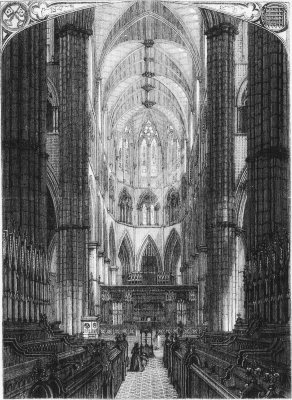
INTERIOR OF WESTMINSTER ABBEY.
Westminster Abbey may certainly be called a tomb, for we could spend a whole day in simply counting its monuments. There were so many of these that I hardly knew which to look at first, but I thought it best to follow my own inclinations, and so, instead of procuring a guide (men with long gowns, who take visitors around and point out the objects of greatest interest), I roamed about at my will. The first monument that attracted my attention was the venerable shrine of Edward the Confessor, in the chapel of St. Edward, once the glory of the Abbey, but which has been much defaced by persons who were desirous of obtaining a bit of stone from this famous tomb. In this chapel I saw also the old coronation chairs, in which all the reigning sovereigns of England, since Edward I. have been crowned. They are queer, old-fashioned chairs, made of wood, and not very comfortable, I imagine. The older of the two chairs was built to inclose the stone (which they call Jacob's pillar) brought from Scotland by Edward, and placed in this chapel. Many other interesting tombs are to be seen here, and the floor of the chapel is six hundred and fourteen years old!
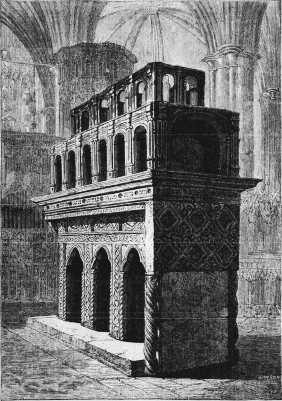
SHRINE OF EDWARD THE CONFESSOR.
I next visited the chapel of Islip, built by the old Abbot of Islip, who dedicated it to St. John the Baptist. One very interesting monument there was to the memory of General Wolfe, who fell, you remember, at the battle of Quebec. His monument is a very beautiful piece of art. It represents him falling into the arms of one of his own soldiers, who is pointing to Glory, which comes in the shape of an angel from the clouds, holding a wreath with which to crown the hero. A Highland sergeant looks sorrowfully on the dying warrior, while two lions sleep at his feet. The inscription reads as follows: "To the memory of James Wolfe, Major-General and Commander-in-Chief of the British land forces on an expedition against Quebec, who, after surmounting, by ability and valor, all obstacles of art and nature, was slain in the moment of victory, on the 13th of September, 1759, the King and Parliament of Great Britain dedicate this monument."
I now walked on to the north transept, and the first monument I noticed was one erected to Sir Robert Peel, the great orator and statesman. I seated myself on an old stone bench to rest, and looking around, saw a magnificent statue of the great William Pitt, who, you may remember, was also a great statesman, and accomplished more for the glory and prosperity of England than any other statesman who ever lived. In this transept there is a beautiful window, which represents our Savior, the twelve apostles, and four evangelists. As I was sitting quietly in this secluded spot, looking up at the window, strains of solemn music reached my ear, which sounded as if they came from one of the gloomy vaults around me. I walked on to discover, if possible, whence this music came, and I saw, in the nave of the Abbey, the Dean of Westminster conducting a service, assisted by his choir boys. I seated myself until the ceremonies were over, and I thought it was a very odd place to hold church—among so many graves.
After the Dean and his choir boys had disappeared I commenced my walk again, and saw many fine old monuments. One of these was in memory of Sir Isaac Newton, and I am sure I need not tell you who he was. Prominent among the monuments in this part of the Abbey is that to Major André, the fine young officer who was executed during our Revolutionary War.
I next visited the south transept, better known as the "Poet's Corner," which I think is the most interesting part of Westminster. A hundred, and more, monuments to the memory of great men can be seen here; but I can only tell you of a few of the most important. The one I thought most of is erected to the memory of William Shakspeare, although his bones repose far away, in the little church at Stratford-on-Avon. Then I saw the tombs of David Garrick, the great actor and delineator of Shakspeare's characters; George Frederick Handel, the eminent composer, the author of that beautiful anthem, "I know that my Redeemer liveth;" the great Milton; rare old Ben Jonson; Edmund Spenser, author of the "Faëry Queene;" and those of Southey, Dryden, Addison, Gray, Campbell, and other well-known English poets.
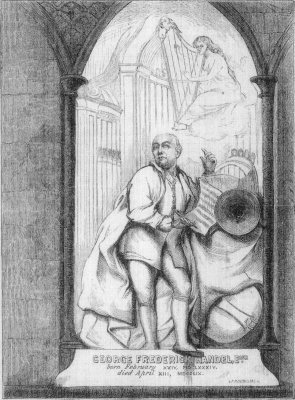
TOMB OF HANDEL.
Then, among the names of the dead of our own day, I saw those of Dickens, Bulwer, Macaulay, and Dr. Livingstone.
Kings, queens, statesmen, soldiers, clergymen, authors and poets here have equal station. Some may lie under richer tombs than others, but all rest beneath the vaulted roof of Westminster Abbey, the place of highest honor that England can offer her departed sons.